Introduction
The first human cases of COVID-19 infection were reported in Wuhan, China, in December 2019. The infection spread globally. The first case of COVID infection reported in the Czech Republic was on March 1, 2020 and COVID-19 was assessed to be a pandemic by the World Health Organization on March 11, 2020.
In order to mitigate the alarming speed with which the COVID-19 infection was spreading, many governments have introduced movement restrictions, such as “stay-at-home” orders also known as “lockdowns”. In the Czech Republic and in Germany, the lockdown was started on March 16, 2020; the lockdown in other European states and in the US started around the same time (South Carolina on March 16, California on March 19, Illinois on March 23, etc.). The durations and levels of lockdown enforcement varied.
As early as March 27, 2020, the United Nations Human Rights Office of the High Commissioner issued a statement insisting that “States must combat domestic violence in the context of COVID-19 lockdowns”.Reference Simonovic 1 Consistently with the General Strain Theory,Reference Agnew 2 it was assumed that keeping potential perpetrators and victims in permanent close contact during the lockdown could increase the risk of domestic violence. On the other hand, opportunity theory and routine activity theory suggest that stay-at-home policies interrupted the daily movements in time and space of suitable targets, capable guardians, and motivated offenders, which may reduce the risk of violence.Reference Bernasco, Ruiter and Block 3
Surgeons, workers in emergency departments (EDs), and scientists all over the world started studying relations between the lockdowns and violence. What follows is a brief review of the pertinent published literature on the COVID-19 lockdown and violence available by March 20, 2022.
Reports of an increase in physical violence during the lockdown period
An article entitled “Alarming trends in US domestic violence during the COVID-19 pandemic”Reference Boserup, McKenney and Elkbuli 4 described data from many US police departments (and some from France and Argentina) indicating a general increase of calls reporting domestic violence during the lockdowns.
A study conducted at a department of radiology of a hospital in the US focused on the incidence, pattern, and severity of injuries as well as radiologic findings, in patients reporting physical intimate partner violence (IPV) between March 11 and May 3, 2020.Reference Gosangi, Park and Thomas 5 These data were compared with those from the same period for the past 3 years. There were 26 physical IPV “lockdown victims”; 25 of these 26 victims were females. Comparable controls were selected from the same time periods during 2017–2019. When compared with 2017–2019, the incidence of physical IPV was 1.9 times greater in 2020 (95% CI: 1.1–3.0; P = 0.01). The severity of injuries was also significantly greater in cases than in controls.
Lockdown effects on violence were studied at a trauma center in the US.Reference Abdallah, Zhao and Kaufman 6 Characteristics of cases presenting during the period of 10 weeks after the March 16, 2020, start of the lockdown orders were compared with controls presenting during the 6 weeks preceding the lockdown order, and with controls presenting with the same time each year from 2015 to 2019 variation. The variable indexing violence was labeled Intentional Violent Trauma (IVT) and defined as assault, firearm-related injury, and stabbing. All other injuries such as falls or traffic accidents were labeled as nonintentional (NIT). The comparison of 2020 IVT in the periods of 6 weeks before with 10 weeks after the lockdown starts showed an increase from 70 IVT before to 148 IVT after. Similarly, the comparison with preceding years showed also an IVT increase in 2020. All analyzes showed an increase in gunshot wounds after the lockdown starts. Notably, the NITs showed a decrease in the analyses.
An investigation of changes in orthopedic trauma patterns during COVID-19 pandemic was conducted at a trauma center in Germany.Reference Maleitzke, Pumberger and Gerlach 7 The trauma patterns were studied in three time frames: Control (March 16–April 19, 2019), Pre (February 10–March 15, 2020), Lockdown (March 16–April 19, 2020), and Post (April 20–May 24, 2020). The total numbers of cases in Control, Pre, and Post periods were 5864, 5200, and 4176, respectively. Thus, the changes in the total number of cases seem to follow a U-shaped curve, with a minimum during the Lockdown period. However, the absolute number of injuries resulting from domestic violence increased from 14 during the Control to 20 during the Lockdown period. This resulted in a statistically significant increase in incidence proportions of domestic violence injuries during the Lockdown in comparison with Control (risk ratio 2.41 [1.22;4.47]).
Furthermore, comparisons between the Control and Lockdown periods revealed significantly increased risks for alcohol intoxication and substance misuse.
A retrospective chart review covering the 2020 lockdown period and one 2019 calendar-matched control period was implemented at a rural US trauma center.Reference Rhodes, Petersen, Lunsford and Biswas 8 Comparison of the 2900 lockdown trauma cases with 7008 control period cases showed a statistically significant elevation of the proportion of assaults during the lockdown.
A report from a hospital in France compared 279 injury cases seen during a lockdown period with 784 cases during a control period.Reference Pichard, Kopel, Lejeune, Masmoudi and Masmejean 9 During the lockdown, there was an increase in “aggressions”. The “aggressions” were undefined and the increase was not statistically significant.
Reports of a decrease in physical violence during the lockdown period
In a national US study covering more than 3500 EDs, Holland et al.Reference Holland, Jones and Vivolo-Kantor 10 examined changes in ED visits for IPV and several other variables from December 30, 2018 to October 10, 2020 (before and during the COVID-19 pandemic). Weekly ED visit counts for IPV decreased between March 8 and 28, 2020 (most of the lockdowns in the US started by March 16, 2020). Mean weekly visit counts for IPV in weeks between March 15, 2020 and October 10, 2020 were lower in comparison with control periods in 2019. The mean number of ED visits for IPV ranged between 430 (during the period of December 30, 2018 to March 16, 2019) and 485 (during the period of March 17 to October 12, 2019). The ED visit counts for IPV were higher among female than male patients. The authors of this study were affiliated with the US Centers for Disease Control and Prevention.
A national study of crimes against women before, during, and after COVID-19 lockdown was conducted in Mexico.Reference Hoehn-Velasco, Silverio-Murillo and de la Miyar 11 A national lockdown went into effect on March 23, 2020 and continued until May 23, 2020. Rates of domestic violence and sexual crimes were followed between 2015 and 2020. The rates presented a U-shaped curve, with a minimum during the lockdown. Domestic violence decreased during the lockdown was greater in municipalities that prohibited sales of alcohol.
South Africa implemented a national COVID-19 lockdown in March 2020 and started to relax it in May 2020. 12 A study in Natal, South Africa was designed to describe the effects of this COVID-19 lockdown on the number, type, and severity of trauma presentations at a local hospital.Reference Morris, Rogers, Kissmer, Du Preez and Dufourq 13 The triage register at the hospital ED was the source of data. These data were collected in cases in April 2020 during the lockdown. Analogous data were collected in controls in the month of April in 2018 and 2019. In April 2020, there was a 47% reduction in the absolute number of trauma presentations in comparison with the average of 2018 and 2019 presentations. Regarding comparisons of specific trauma categories between 2018 plus 2019 with 2020 for specific trauma categories, the reductions in assault, gunshot wounds, and several other categories in 2020 were statistically significant. On the other hand, there were no noticeable changes in trauma severity over the duration of the study.
A US trauma center was the site of a retrospective study of the effects of lockdown on trauma volume.Reference Leichtle, Rodas, Procter, Bennett, Schrader and Aboutanos 14 There was a nonsignificant decrease in injury due to assault during the lockdown in comparison with a control period. However, there was a significantly higher proportion of chronic alcohol use during the lockdown period.
Data on daily counts of crime in 27 cities across 23 countries were collected to assess the impact of COVID-19 lockdowns on crime.Reference Nivette, Zahnow and Aguilar 15 Overall, there was a decrease of violent crime, but there was a considerable variation across cities.
Reports of no or minimal change in physical violence during the lockdown period
A trauma center in the US was the site of a study comparing trauma volumes during the COVID-19 lockdown with preceding and following control periods.Reference Matthay, Kornblith and Matthay 16 Trauma volume was indexed by trauma team activations. Injuries were classified as violent or nonviolent. “Violence-related injury mechanisms included all blunt and penetrating assaults and self-harm” (p. 701). All other injuries were considered nonviolent. To examine relationships between the lockdown and violence, weekly data on the volume of violent and nonviolent injuries were collected for six months before the start of the lockdown, and then for subsequent three months after the start (September 2019 through June 2020). A comparison of violent and nonviolent injuries showed that the lockdown was associated with a decreased incidence of nonviolent injuries, but no change in the violent ones. The difference between violent and nonviolent injuries was statistically significant (P < 0.01).
A report from a trauma center in India compared 263 patients admitted for injury during a COVID-19 lockdown period with 611 trauma patients admitted during a control period.Reference Dhillon, Kumar, Saini, Bhayana, Gopinathan and Aggarwal 17 The numbers of injuries due to assault in the lockdown and control groups were 9 and 8, respectively. Thus, there was essentially no group difference in assaults.
Changes in the number and type of injuries in patients presenting during a COVID-19 lockdown were studied at a trauma center in the US.Reference Sherman, Khadra, Kale, Wu, Gladden and Lee 18 A register of trauma activations from 2017 to 2020 was used as a measure of trauma volume. The number of trauma activations during the lockdown (March 20, 2020 to May 14, 2020) was compared with predicted numbers of trauma activations computed in a model that used data from the years 2017 to 2019. The predicted number for assault with firearm was 86, and the actual observed number during the lockdown in 2020 was 84. The predicted number for assault was 31, and the observed number was 28. Neither of these differences between the predicted and observed values were statistically significant.
Summary
A review concluded that there has been an overall reduction in physical trauma volume during the COVID-19 pandemic, “with a higher proportion occurring secondary to interpersonal violence” (p. 1).Reference Waseem, Nayar and Hull 19 However, it is not clear what effects on violence, if any, are exerted by the lockdowns. There is credible evidence for an increase, decrease, or no change in violent behavior during lockdowns. The two national studies that are availableReference Holland, Jones and Vivolo-Kantor 10 , Reference Hoehn-Velasco, Silverio-Murillo and de la Miyar 11 suggest that physical violence decreases during the lockdowns.
The aims of the study
The primary aim was to test the hypothesis that physical interpersonal violence is decreased during the lockdown period in comparison with comparable control periods.
The secondary aims were to explore the effects of gender and alcohol consumption on the violence during the lockdown. Police-reported violence crime rates were analyzed to obtain results from an independent set of data.
Methods
Population-wise records of hospitalizations secondary to an assault (any hospital admission including an ICD code X93–95, X99, Y00-Y05) between January 1, 2017 and December 31, 2020 were received from the Institute of Health Information and Statistics of the Czech Republic (IHIS), together with history of psychiatric hospitalizations the patients ranging from January 1, 2010 to April 30, 2021. The ICD codes are reported to IHIS by hospitals following discharge of the patient; the exact procedure is reported elsewhere.Reference Mlada, Formanek and Vevera 20 Every assault-related hospitalization was labeled with respect to whether the patient had a history of alcohol use disorder (AUD; defined as any hospital admission including an ICD code F10).
To estimate the effect of COVID-related lockdown assault rates, records about assault-related hospitalizations were split into weeks. The analysis included 201 full weeks between Monday, January 2, 2017 and Sunday, November 29, 2020 after weeks including January 1 of every year were dropped due to an excessive number of assaults related to the new year celebrations and the last weeks of 2020 were dropped from the analysis as the lockdown was shortly lifted and enforced again in that period. Lockdown is defined as the weeks in the period between March 12 and May 17, 2020 and after October 5, 2020 based on the dates of national state of emergency overlapping with closure of bars and restaurants (enforced by laws and regulations 2020/69, 2020/156 and 2020/219, and by 2020/391, 2020/521, 2020/593; in addition to other measures being in effect). To measure gradual changes in the effects of lockdowns, each week was labeled with time since the beginning of the lockdown.
Generalized linear regression based on quasipoisson distribution was chosen as the most appropriate measure combining feasibility for count data with overdispersion with relative simplicity.Reference Walby, Towers and Francis 21 , Reference Osgood 22 To control for the effect of the COVID-pandemic itself and other restrictive measures, each week after the first day of national emergency state on March 12, 2020 was labeled with the presence of COVID. To control for seasonal fluctuations in rates of violence observed in Europe,Reference Morken and Linaker 23 –Reference Uittenbogaard and Ceccato 26 each week was further labeled with a number approximating seasonal effect, calculated as the difference between the respective month and summer solstice (expressed in months; i.e., 0 for June, 1 for July, 6 for Dec, 5 for Jan, and so on). The effects of sex and AUD on the effects of lockdown were examined using the difference-in-differences method. Two models were created, one with and one without interaction between lockdown and the variable of interest, and chi-squared test was used to assess whether the model with interaction fits the data significantly better than the one without. Analysis was conducted in RStudio, version 1.4.1103, 27 using packages tidyverseReference Wickham, Averick and Bryan 28 and sjPlot.Reference Lüdecke 29
To compare our results with independent data, violent crime rates were analyzed in a separate analysis. Monthly rates of violent crime were received from the records of the Police of the Czech Republic. Statistics of the Police of the Czech Republic classify these criminal offenses as violent crime: murder, abduction, robbery, intentional bodily injury, brawling, violence against a group of citizens, assaults a public official, battering a charge, hostage taking, dangerous threats, extortion, unlawful restraint, criminal trespass, counseling and aiding suicide, and torture.
Crime rates during the national emergency state (“lockdown period”: March to May 2020 and October 2020 to April 2021) and during other pandemic months when the national emergency state was not in effect (“COVID period”: June to September 2020 and May to November 2021) were compared with the baseline (January 2017 to February 2020) using one-way ANOVA (lockdown vs pandemic vs baseline period) followed by t-tests.
Results
Records of 10 698 assault-related hospitalizations throughout 4 years were analyzed, including 2332 hospitalizations of female patients and 8366 hospitalizations of male patients, as summarized in Table 1.
Assault-Related Hospitalizations by Age Group, Sex and History of Alcohol Use Disorder (AUD)

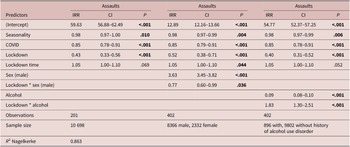
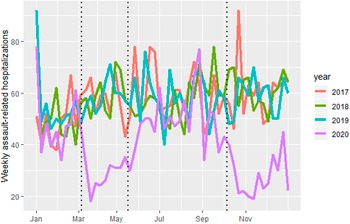
During lockdown, the number of assault-related hospitalizations was reduced (IRR = .43; P < .001), in addition to reduction of assault-related hospitalizations during the whole period of COVID (IRR = .85; P < .001), while duration of lockdown did not have significant effect on assault-related hospitalizations (P = .07), as summarized in the Table 2. During the lockdown, the weekly number of assault-related hospitalizations dropped by 55%, with mean 25.06 hospitalizations, compared to 55.66 weekly hospitalizations in the control period (including the COVID period when lockdown was not in effect with mean of 49.05, as well as prepandemic period with 56.51 weekly hospitalizations), as shown in Figure 1.
Quasipoisson Model of Assault-Related Hospitalizations Between 2017 and 2020

Quasipoisson model of assault-related hospitalizations between 2017 and 2020 depending on seasonality, COVID pandemic, lockdown and the time since the entry into force of the lockdown (first column). The same models for the sample split by sex of the patients (second column) and the history of alcohol use disorder (third column). Incidence rate ratios (IRR) and their 95% confidence intervals (CI) are included; significant predictors are in bold.
Hospitalizations secondary to an assault during the pandemics (year 2020) and in three previous years. The first week of a year starts always on January 1 and lasts for 7 days, irrespective of weekdays; the last days of a year not combining into a full week are dropped. Dotted vertical lines mark the beginning and end of the first lockdown (March 12 to May 17, 2020) and the beginning of the second lockdown (October 5, 2020).

Splitting the sample by sex of the patient, we confirmed that a model including the interaction between lockdown and sex was fitting the data better than the same model excluding the interaction (P < .05) and observed a stronger reduction of assault-related hospitalizations during lockdown in males compared to females (IRR = .77; P < .05), as summarized in Table 2.
Splitting the sample by history of AUD in patients hospitalized with injuries secondary to an assault, we confirmed the interaction between AUD history and lockdown (P < .001) and observed a weaker reduction of the assault-related hospitalizations during lockdown in patients with a history of AUD compared to those without (IRR = 1.83; P < .001), as presented in Table 2.
Between January 2017 and November 2021, 64 317 cases of violent crimes were recorded. ANOVA confirmed a difference in violent crime rates (F(2,56) = 8.76; P < .001) between the lockdown period, pandemic period (excluding lockdown) and prepandemic baseline. Post-hoc t-tests confirmed a difference between lockdown and baseline (t = −4.32; P < .001), COVID and baseline (t = −2.24; P < .05) as well as lockdown and COVID (t = −2.31; P < .05). In absolute numbers, the monthly violent crime incidence decreased from 1145 in the baseline period to 1051 during the COVID period (excl. lockdown) and further to 925 during lockdown (decrease of 19%).
Discussion
Discussion of variable results of lockdown assault studies
We have demonstrated that assault rates were reduced during the lockdown in comparison with control periods. This finding, supporting our principal hypothesis, is consistent with important national studies in the USReference Holland, Jones and Vivolo-Kantor 10 and Mexico,Reference Hoehn-Velasco, Silverio-Murillo and de la Miyar 11 each of which used methods that differed from our project. Our findings are also consistent with other studies in various countries.Reference Morris, Rogers, Kissmer, Du Preez and Dufourq 13 –Reference Nivette, Zahnow and Aguilar 15
However, discrepant results indicating increases of interpersonal violence during lockdowns have also been reported.Reference Boserup, McKenney and Elkbuli 4 –Reference Pichard, Kopel, Lejeune, Masmoudi and Masmejean 9
Some of these reportsReference Maleitzke, Pumberger and Gerlach 7 , Reference Rhodes, Petersen, Lunsford and Biswas 8 used proportions of assaults (percentages of total trauma cases) in their computations instead of rates (which is the metric used by us and most other investigators). Since the total trauma volume decreased during the lockdown periods,Reference Waseem, Nayar and Hull 19 the proportions of assaults may have increased even if the rates remained the same.
The increased numbers of police calls during the lockdownsReference Boserup, McKenney and Elkbuli 4 are difficult to interpret since the calls may have been prompted by various forms of domestic discord, including humiliation, controlling behavior, and threats, but not necessarily physical assaults. Of course, this does not mean that the calls were unjustified.
Violent behavior during the lockdown was not always clearly defined,Reference Pichard, Kopel, Lejeune, Masmoudi and Masmejean 9 and a reported statistically significant increase in domestic violence can be based on a small absolute number of assaults.Reference Maleitzke, Pumberger and Gerlach 7 Finally, the variability of the results can be partially attributable to regional differences. The general level of violence and violent crime is higher in the US than in Europe and in many other countries. The use of firearms contributes to the rates of violent behavior during the lockdowns in the US.Reference Abdallah, Zhao and Kaufman 6
Discussion of the effect of sex and violent crime
In an exploratory analysis, we have demonstrated that while the lockdowns reduced assault-related hospitalizations in both sexes, that reduction was significantly greater in males. We suggest that this sex difference could have been due to the reduction of the number of males in the streets caused by the lockdown.
This suggestion is based on the observations of changes in ED visits caused by the lockdown in Cardiff, UK.Reference Shepherd, Moore, Long and Sumner 30 There was no significant change in the incidence of injuries at home. However, the lockdown caused a dramatic reduction in the number of injuries outside the home. This reduction involved females younger than 18 years and males of all ages, “those injured with weapons, and those in which the perpetrator was a stranger, acquaintance, or security officer.” Overall, it appears that the reduction of the number of injuries outside the home was caused largely by the reduction of males who were outside the home and at risk of committing violent crime.
For our current study, we obtained nationwide data on monthly rate of violent crimes from the Police of the Czech Republic covering the lockdown period and two control periods. There was a significantly lower rate of violent crimes during the lockdown in comparison with the controls.
This result is consistent with our hypothesis that physical interpersonal violence is reduced during the lockdown period.
Discussion of the effects of alcohol
An increased risk of alcohol useReference Leichtle, Rodas, Procter, Bennett, Schrader and Aboutanos 14 and alcohol intoxicationReference Maleitzke, Pumberger and Gerlach 7 during the lockdowns have been observed. The role of alcohol in elevating the risk of violent behavior has been known for a long time. Unsurprisingly, banning the sale of alcohol contributed to a decrease of crimes against women.Reference Hoehn-Velasco, Silverio-Murillo and de la Miyar 11 However, complete long-term prohibition of alcohol sales is not feasible in most countries. Regulation of time when alcohol is served in bars and sold in other outlets provides an acceptable method to reduce the opportunity to drink alcoholic beverages and thus may be used to reduce the amount of alcohol ingested. Reduction of business hours of bars can thus result in a reduction of harms associated with heavy drinking. This was demonstrated for example by abolishing existing 24-hour license to serve and sell alcohol and introducing trading hours of 8 AM–4 AM or 7 AM–11 PM in New Zealand.Reference Connor, Maclennan, Huckle, Romeo, Davie and Kypri 31 Following these restrictions, weekend hospitalized assaults decreased by 11%. There was also a modest reduction in the proportion of assaults occurring at night documented by police. Somewhat similar results were observed in Zacatecas, Mexico, when the closing hour for serving and selling alcohol in bars, restaurants and other outlets was changed from 4 AM to 2 AM.Reference Paschall, Miller and Grube 32
In the current study, a history of alcohol misuse was associated with an increased risk of hospitalization for assault during lockdown, relatively to the population without alcohol abuse. It is possible that some persons with such history have continued or increased their alcohol use during the lockdown. Alcohol ingestion may lead to increased belligerence, and/or to decreased cognitive abilities needed to assess risks and avoid them. These problems may lead to a violent confrontation which results in an injury.Reference Volavka 33
Strengths and limitations of the study
The strengths and limitations of the present study are similar to those that were associated with our previous report using the same register database.Reference Mlada, Formanek and Vevera 20 The principal strength of the present study is its use of data from nationwide registers, encompassing essentially all hospitalizations in the Czech Republic during the periods we examined. This feature greatly reduced the selection biases that may occur in cohort studies. Second, our definition of assault required injury that was sufficiently severe to require hospitalization. This was a clear definition that greatly reduced the possibility of false positives. Third, we obtained an external validation of our assault-related hospitalization results from the police data on changes of violent crime rates.
The main limitation of the study is that it did not include less serious injuries that did not require hospitalization; the results thus may not be generalized to such lesser injuries. Second, we did not have data on the location of the assaults; therefore, we are unable to determine which of the assaults were due to domestic violence. Third, we have no information about the perpetrators of the assaults. Fourth, we could not obtain data on arrest and incarceration of study participants. This was a limitation because violent victimization increases the risk of subsequent violent crime by the victim.Reference Cerny, Hodgins and Kucikova 34 Such violent crime may lead to incarceration. That could bias our results, since the risk of being violently assaulted in prison may not be the same as in the community. Fifth, our retrospective cohort study was not designed to test causal mechanisms.
Conclusion
We have demonstrated a significant reduction of assaults leading to hospitalizations as well as a significant reduction of police-reported violent crimes during the lockdowns. These results support each other, confirm our a priori hypothesis, and are consistent with a large part of published literature. The reduction of assault-related injuries was significantly greater in males.
We observed a weaker reduction of the assault-related hospitalizations during lockdown in patients with the history of AUD compared to those without it. Emerging published evidence suggested an increased risk of alcohol use and intoxication during the lockdowns. It is well known that alcohol can increase the risk of violent behavior. For these reasons, we suggest that if lockdowns are necessary in the future, the medical professionals and the public should be warned about potential dangers of alcohol misuse during the lockdown period. This warning should apply particularly to persons with a history of AUD. The relationship between the lockdowns, alcohol misuse, and violence is incompletely understood, and should be a matter of future research.
Financial Support
This work was supported by the Research Center of Charles University (program number 9) and by the Ministry of the Interior of the Czech Republic (project VJ01010116).
Disclosures
The authors have no competing interests to declare.