




No CrossRef data available.
Article contents
Erdős–Ko–Rado for Random Hypergraphs: Asymptotics and Stability
Part of:
Extremal combinatorics
Published online by Cambridge University Press: 29 March 2017
Abstract
Core share and HTML view are not available for this content. However, as you have access to this content, a full PDF is available via the 'Save PDF' action button.
We investigate the asymptotic version of the Erdős–Ko–Rado theorem for the random k-uniform hypergraph  $\mathcal{H}$ k (n, p). For 2⩽k(n) ⩽ n/2, let
 $N=\binom{n}k$ and
 $D=\binom{n-k}k$ . We show that with probability tending to 1 as n → ∞, the largest intersecting subhypergraph of $\mathcal{H}$ has size for any
 $$(1+o(1))p\ffrac kn N$$ This lower bound on p is asymptotically best possible for k = Θ(n). For this range of k and p, we are able to show stability as well.
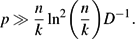 $$p\gg \ffrac nk\ln^2\biggl(\ffrac nk\biggr)D^{-1}.$$
A different behaviour occurs when k = o(n). In this case, the lower bound on p is almost optimal. Further, for the small interval D −1 ≪ p ⩽ (n/k)1−ϵ D −1, the largest intersecting subhypergraph of $\mathcal{H}$ k (n, p) has size Θ(ln(pD)ND −1), provided that  $k \gg \sqrt{n \ln n}$ .
Together with previous work of Balogh, Bohman and Mubayi, these results settle the asymptotic size of the largest intersecting family in $\mathcal{H}$ k , for essentially all values of p and k.
Information
- Type
- Paper
- Information
- Copyright
- Copyright © Cambridge University Press 2017
References
[1]
Ajtai, M., Komlós, J. and Szemerédi, E. (1980) A note on Ramsey numbers, J. Combin. Theory Ser. A
29
354–360.Google Scholar
[2]
Alon, N., Dinur, I., Friedgut, E. and Sudakov, B. (2004) Graph products, Fourier analysis and spectral techniques.
Geom. Funct. Anal.
14
913–940.Google Scholar
[3]
Balogh, J., Bohman, T. and Mubayi, D. (2009) Erdős–Ko–Rado in random hypergraphs.
Combin. Probab. Comput.
18
629–646.CrossRefGoogle Scholar
[4]
Balogh, J., Bollobás, B. and Narayanan, B.
Transference for the Erdős–Ko–Rado theorem. Forum of Math. Sigma, to appear https://doi.org/10.1017/fms.2015.21.Google Scholar
[5]
Balogh, J., Das, S., Delcourt, M., Liu, H. and Sharifzadeh, M. (2015) Intersecting families of discrete structures are typically trivial.
J. Combin. Theory Ser. A
132
224–245.Google Scholar
[6]
Balogh, J., Morris, R. and Samotij, W. (2015) Independent sets in hypergraphs.
J. Amer. Math. Soc.
28
669–709.Google Scholar
[7]
Bollobás, B., Narayanan, B. and Raigorodskii, A.
On the stability of the Erdős–Ko–Rado theorem. J. Combin. Theory Ser. A, to appear http://dx.doi.org/10.1016/j.jcta.2015.08.002.Google Scholar
[8]
Conlon, D. and Gowers, W. Combinatorial theorems in sparse random sets. Submitted DOI 10.4007/annals.2016.184.2.2.Google Scholar
[9]
Das, S. and Tran, T.
Removal and stability for Erdős–Ko–Rado. SIAM J. Discrete Math., to appear DOI:10.1137/15M105149X.Google Scholar
[10]
Devlin, P. and Kahn, J. On stability in the Erdős–Ko–Rado theorem. Submitted DOI:10.1137/15M1012992.Google Scholar
[11]
Erdős, P., Ko, C. and Rado, R. (1961) Intersection theorems for systems of finite sets.
Quart. J. Math.
12
313–320.Google Scholar
[12]
Friedgut, E. (2008) On the measure of intersecting families, uniqueness and stability.
Combinatorica
28
503–528.Google Scholar
[16]
Hoffman, A. (1970) On eigenvalues and colorings of graphs. In Graph Theory and its Applications (Proc. Advanced Sem., Math. Research Center, Univ. of Wisconsin), pp. 79–91.Google Scholar
[17]
Janson, S., Łuczak, T. and Ruciński, A. (2000) Random Graphs, Wiley-Interscience Series in Discrete Mathematics and Optimization, Wiley-Interscience.Google Scholar
[18]
Kleitman, D. and Winston, K. (1982) On the number of graphs without 4-cycles.
Discrete Math.
41
167–172.Google Scholar
[19]
Kohayakawa, Y., Kreuter, B. and Steger, A. (1998) An extremal problem for random graphs and the number of graphs with large even-girth.
Combinatorica
18
101–120.Google Scholar
[20]
Kohayakawa, Y., Lee, S. J., Rödl, V. and Samotij, W. (2015) The number of Sidon sets and the maximum size of Sidon sets contained in a sparse random set of integers.
Random Struct. Alg.
46
1–25.Google Scholar
[21]
Lovász, L. (1979) On the Shannon capacity of a graph.
IEEE Trans. Inform. Theory
25
1–7.Google Scholar
[22]
Samotij, W. (2014) Stability results for random discrete structures.
Random Struct. Alg.
44
269–289.Google Scholar
[23]
Saxton, D. and Thomason, A. (2015) Hypergraph containers.
Invent. Math.
201
925–992.Google Scholar
[24]
Schacht, M. Extremal results for random discrete structures. Submitted DOI 10.4007/annals.2016.184.2.1.Google Scholar
[25]
Shearer, J. (1983) A note on the independence number of triangle-free graphs.
Discrete Math.
46
83–87.Google Scholar
 You have
Access
- 3
- Cited by