

Hostname: page-component-7b7567c8c-2rsb6 Total loading time: 0 Render date: 2026-11-12T08:00:26.313Z Has data issue: false hasContentIssue false

Longest Increasing Subsequences of Randomly Chosen Multi-Row Arrays

Published online by Cambridge University Press:  02 October 2014

MARCOS KIWI
Affiliation:
Departamento de Ingeniería Matemática and Centro de Modelamiento Matemático UMI 2807, Universidad de Chile (e-mail: mk@dim.uchile.cl)
JOSÉ A. SOTO
Affiliation:
Departamento de Ingeniería Matemática and Centro de Modelamiento Matemático UMI 2807, Universidad de Chile (e-mail: jsoto@dim.uchile.cl)
Rights & Permissions [Opens in a new window]

Abstract

Core share and HTML view are not available for this content. However, as you have access to this content, a full PDF is available via the 'Save PDF' action button.

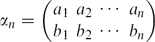
A two-row array of integers

\[\alpha_{n}= \begin{pmatrix}a_1 & a_2 & \cdots & a_n\\ b_1 & b_2 & \cdots & b_n \end{pmatrix}\]
is said to be in lexicographic order if its columns are in lexicographic order (where character significance decreases from top to bottom, i.e., either ak < a k+1, or bk ≤ b k+1 when ak = a k+1). A length ℓ (strictly) increasing subsequence of αn is a set of indices i 1 < i 2 < ⋅⋅⋅ < i ℓ such that a i1 < a i2 < ⋅⋅⋅ < a iℓ and b i1 < b i2 < ⋅⋅⋅ < b iℓ . We are interested in the statistics of the length of a longest increasing subsequence of αn chosen according to ${\cal D}$ n , for different families of distributions ${\cal D} = ({\cal D}_{n})_{n\in\NN}$ , and when n goes to infinity. This general framework encompasses well-studied problems such as the so-called longest increasing subsequence problem, the longest common subsequence problem, and problems concerning directed bond percolation models, among others. We define several natural families of different distributions and characterize the asymptotic behaviour of the length of a longest increasing subsequence chosen according to them. In particular, we consider generalizations to d-row arrays as well as symmetry-restricted two-row arrays.

Keywords

Information

Type
Paper
Copyright
Copyright © Cambridge University Press 2014