




No CrossRef data available.
Article contents
Measurable Events Indexed by Trees
Published online by Cambridge University Press: 12 March 2012
Abstract
Core share and HTML view are not available for this content. However, as you have access to this content, a full PDF is available via the 'Save PDF' action button.
A tree T is said to be homogeneous if it is uniquely rooted and there exists an integer b ≥ 2, called the branching number of T, such that every t ∈ T has exactly b immediate successors. We study the behaviour of measurable events in probability spaces indexed by homogeneous trees.
Precisely, we show that for every integer b ≥ 2 and every integer n ≥ 1 there exists an integer q(b,n) with the following property. If T is a homogeneous tree with branching number b and {At:t ∈ T} is a family of measurable events in a probability space (Ω,Σ,μ) satisfying μ(At)≥ϵ>0 for every t ∈ T, then for every 0<θ<ϵ there exists a strong subtree S of T of infinite height, such that for every finite subset F of S of cardinality n ≥ 1 we have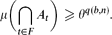 In fact, we can take q(b,n)= ((2b−1)2n−1−1)·(2b−2)−1. A finite version of this result is also obtained.
Keywords
Information
- Type
- Paper
- Information
- Copyright
- Copyright © Cambridge University Press 2012
References
[1]Blass, A. (1981) A partition theorem for perfect sets. Proc. Amer. Math. Soc. 82 271–277.CrossRefGoogle Scholar
[2]Dodos, P., Kanellopoulos, V. and Karagiannis, N. (2010) A density version of the Halpern–Läuchli theorem. Preprint, available at http://arxiv.org/abs/1006.2671.Google Scholar
[3]Carlson, T. J. (1988) Some unifying principles in Ramsey Theory. Discrete Math. 68 117–169.CrossRefGoogle Scholar
[4]Furstenberg, H. and Katznelson, Y. (1991) A density version of the Hales–Jewett theorem. J. Anal. Math. 57 64–119.CrossRefGoogle Scholar
[5]Galvin, F. (1968) Partition theorems for the real line. Notices Amer. Math. Soc. 15 660.Google Scholar
[6]Hales, A. H. and Jewett, R. I. (1963) Regularity and positional games. Trans. Amer. Math. Soc. 106 222–229.CrossRefGoogle Scholar
[7]Halpern, J. D. and Läuchli, H. (1966) A partition theorem. Trans. Amer. Math. Soc. 124 360–367.CrossRefGoogle Scholar
[8]Milliken, K. (1979) A Ramsey theorem for trees. J. Combin. Theory Ser. A 26 215–237.CrossRefGoogle Scholar
[9]Milliken, K. (1981) A partition theorem for the infinite subtrees of a tree. Trans. Amer. Math. Soc. 263 137–148.CrossRefGoogle Scholar
[10]Polymath, D. H. J. (2009) A new proof of the density Hales–Jewett theorem. Preprint, available at http://arxiv.org/abs/0910.3926.Google Scholar
[11]Ramsey, F. P. (1930) On a problem of formal logic. Proc. London Math. Soc. 30 264–286.CrossRefGoogle Scholar
[12]Rose, H. E. (1984) Subrecursion: Functions and Hierarchies, Vol. 9 Oxford Logic Guides, Oxford University Press.Google Scholar
[13]Shelah, S. (1988) Primitive recursive bounds for van der Waerden numbers. J. Amer. Math. Soc. 1 683–697.CrossRefGoogle Scholar
[15]Todorcevic, S. (2010) Introduction to Ramsey Spaces, Vol. 174 of Annals of Mathematics Studies, Princeton University Press.Google Scholar
 You have
Access
- 2
- Cited by