




No CrossRef data available.
Article contents
On Komlós’ tiling theorem in random graphs
Part of:
Graph theory
Published online by Cambridge University Press: 25 July 2019
Abstract
Core share and HTML view are not available for this content. However, as you have access to this content, a full PDF is available via the 'Save PDF' action button.
Given graphs G and H, a family of vertex-disjoint copies of H in G is called an H-tiling. Conlon, Gowers, Samotij and Schacht showed that for a given graph H and a constant γ>0, there exists C>0 such that if 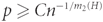 $p \ge C{n^{ - 1/{m_2}(H)}}$, then asymptotically almost surely every spanning subgraph G of the random graph 𝒢(n, p) with minimum degree at least contains an H-tiling that covers all but at most γn vertices. Here, χcr(H) denotes the critical chromatic number, a parameter introduced by Komlós, and m2(H) is the 2-density of H. We show that this theorem can be bootstrapped to obtain an H-tiling covering all but at most
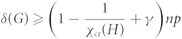 $\delta (G) \ge (1 - \frac{1}{{{\chi _{{\rm{cr}}}}(H)}} + \gamma )np$
 $\gamma {(C/p)^{{m_2}(H)}}$ vertices, which is strictly smaller when $p \ge C{n^{ - 1/{m_2}(H)}}$. In the case where H = K3, this answers the question of Balogh, Lee and Samotij. Furthermore, for an arbitrary graph H we give an upper bound on p for which some leftover is unavoidable and a bound on the size of a largest H -tiling for p below this value.
Information
- Type
- Paper
- Information
- Copyright
- © Cambridge University Press 2019
References
Allen, P., Böttcher, J., Ehrenmüller, J. and Taraz, A. (2015) Local resilience of spanning subgraphs in sparse random graphs. Electron. Notes Discrete Math. 49 513–521.CrossRefGoogle Scholar
Allen, P., Böttcher, J., Hàn, H., Kohayakawa, Y. and Person, Y. (2016) Blow-up lemmas for sparse graphs. arXiv:1612.00622Google Scholar
Alon, N. and Yuster, R. (1992) Almost H-factors in dense graphs. Graphs Combin
. 8 95–102.CrossRefGoogle Scholar
Alon, N. and Yuster, R. (1996) H-factors in dense graphs. J. Combin. Theory Ser. B 66 269–282.CrossRefGoogle Scholar
Balogh, J., Lee, C. and Samotij, W. (2012) Corrádi and Hajnal’s theorem for sparse random graphs. Combin. Probab. Comput. 21 23–55.CrossRefGoogle Scholar
Balogh, J., Morris, R. and Samotij, W. (2015) Independent sets in hypergraphs. J. Amer. Math. Soc. 28 669–709.CrossRefGoogle Scholar
Conlon, D., Gowers, W., Samotij, W. and Schacht, M. (2014) On the KŁR conjecture in random graphs. Israel J. Math
. 203 535–580.CrossRefGoogle Scholar
Corrádi, K. and Hajnal, A. (1963) On the maximal number of independent circuits in a graph. Acta Math. Acad. Sci. Hungar. 14 423–439.CrossRefGoogle Scholar
Erdös, P. and Rényi, A. (1960) On the evolution of random graphs. Magyar Tud. Akad. Mat. Kutató Int. Közl. 5 17–61.Google Scholar
Gerke, S. and McDowell, A. (2015) Nonvertex-balanced factors in random graphs. J. Graph Theory 78 269–286.CrossRefGoogle Scholar
Hajnal, A. and Szemerédi, E. (1970) Proof of a conjecture of P. Erdös. In Combinatorial Theory and its Applications, II (Proc. Colloq., Balatonfüred, 1969), North-Holland, pp. 601–623.Google Scholar
Huang, H., Lee, C. and Sudakov, B. (2012) Bandwidth theorem for random graphs. J. Combin. Theory Ser. B 102 14–37.CrossRefGoogle Scholar
Johansson, A., Kahn, J. and Vu, V. (2008) Factors in random graphs. Random Struct. Alg
. 33 1–28.CrossRefGoogle Scholar
Kim, J. H. and Vu, V. H. (2000) Concentration of multivariate polynomials and its applications. Combinatorica 20 417–434.CrossRefGoogle Scholar
Kohayakawa, Y. (1997) Szemerédi’s regularity lemma for sparse graphs. In Foundations of Computational Mathematics, Springer, pp. 216–230.CrossRefGoogle Scholar
Kohayakawa, Y., Łuczak, T. and Rödl, V. (1997) On K
4-free subgraphs of random graphs. Combinatorica 17 173–213.CrossRefGoogle Scholar
Komlós, J., Sárközy, G. and Szemerédi, E. (2001) Proof of the Alon–Yuster conjecture. Discrete Math
. 235 255–269.CrossRefGoogle Scholar
Kühn, D. and Osthus, D. (2009) Embedding large subgraphs into dense graphs. In Surveys in Combinatorics 2009, Vol. 365 of London Mathematical Society Lecture Note Series, Cambridge University Press, pp. 137–167.CrossRefGoogle Scholar
Kühn, D. and Osthus, D. (2009) The minimum degree threshold for perfect graph packings. Combinatorica 29 65–107.CrossRefGoogle Scholar
Saxton, D. and Thomason, A. (2015) Hypergraph containers. Inventio. Math. 201 925–992.CrossRefGoogle Scholar
Shokoufandeh, A. and Zhao, Y. (2003) Proof of a tiling conjecture of Komlós. Random Struct. Alg
. 23 180–205.CrossRefGoogle Scholar
 You have
Access
- 4
- Cited by