




No CrossRef data available.
Article contents
On the Normalized Shannon Capacity of a Union
Published online by Cambridge University Press: 03 March 2016
Abstract
Core share and HTML view are not available for this content. However, as you have access to this content, a full PDF is available via the 'Save PDF' action button.
Let G 1 × G 2 denote the strong product of graphs G 1 and G 2, that is, the graph on V(G 1) × V(G 2) in which (u 1, u 2) and (v 1, v 2) are adjacent if for each i = 1, 2 we have ui = vi or u i v i ∈ E(G i ). The Shannon capacity of G is c(G) = limn → ∞ α(Gn )1/n , where Gn denotes the n-fold strong power of G, and α(H) denotes the independence number of a graph H. The normalized Shannon capacity of G is Alon [1] asked whether for every ε < 0 there are graphs G and G′ satisfying C(G), C(G′) < ε but with C(G + G′) > 1 − ε. We show that the answer is no.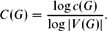 $$C(G) = \ffrac {\log c(G)}{\log |V(G)|}.$$
Information
- Type
- Paper
- Information
- Copyright
- Copyright © Cambridge University Press 2016
References
[2]
Alon, N. (2002) Graph powers, Contemporary Combinatorics, Vol. 10 of Bolyai Society Mathematical Studies, János Bolyai Mathematical Society, pp. 11–28.Google Scholar
[3]
Alon, N. and Lubetzky, E. (2006) The Shannon capacity of a graph and the independence numbers of its powers. IEEE Trans. Inform. Theory
52
2172–2176.CrossRefGoogle Scholar
[4]
Alon, N. and Orlitsky, A. (1995) Repeated communication and Ramsey graphs.
IEEE Trans. Inform. Theory
41
1276–1289.CrossRefGoogle Scholar
[5]
Haemers, W. (1979) On some problems of Lovász concerning the Shannon capacity of a graph.
IEEE Trans. Inform. Theory
25
231–232.CrossRefGoogle Scholar
[6]
Körner, J. and Orlitsky, A. (1998) Zero-error information theory.
IEEE Trans. Inform. Theory
44
2207–2229.CrossRefGoogle Scholar
[7]
Lovász, L. (1979) On the Shannon capacity of a graph.
IEEE Trans. Inform. Theory
25
1–7.CrossRefGoogle Scholar
[8]
Shannon, C. E. (1956) The zero-error capacity of a noisy channel
IRE Trans. Inform. Theory
2
8–19.CrossRefGoogle Scholar
 You have
Access
- 9
- Cited by