




No CrossRef data available.
Article contents
Packing Loose Hamilton Cycles
Published online by Cambridge University Press: 01 August 2017
Abstract
Core share and HTML view are not available for this content. However, as you have access to this content, a full PDF is available via the 'Save PDF' action button.
A subset C of edges in a k-uniform hypergraph H is a loose Hamilton cycle if C covers all the vertices of H and there exists a cyclic ordering of these vertices such that the edges in C are segments of that order and such that every two consecutive edges share exactly one vertex. The binomial random k-uniform hypergraph H k n,p has vertex set [n] and an edge set E obtained by adding each k-tuple e ∈ (  $\binom{[n]}{k}$ ) to E with probability p, independently at random.
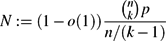
Here we consider the problem of finding edge-disjoint loose Hamilton cycles covering all but o(|E|) edges, referred to as the packing problem. While it is known that the threshold probability of the appearance of a loose Hamilton cycle in H k n,p is the best known bounds for the packing problem are around p = polylog(n)/n. Here we make substantial progress and prove the following asymptotically (up to a polylog(n) factor) best possible result: for p ≥ logC n/n k−1, a random k-uniform hypergraph H k n,p with high probability contains 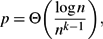 $p=\Theta\biggl(\frac{\log n}{n^{k-1}}\biggr),$ edge-disjoint loose Hamilton cycles.
 $N:=(1-o(1))\frac{\binom{n}{k}p}{n/(k-1)}$
Our proof utilizes and modifies the idea of ‘online sprinkling’ recently introduced by Vu and the first author.
Keywords
Information
- Type
- Paper
- Information
- Copyright
- Copyright © Cambridge University Press 2017
References
[1]
Dudek, A. and Frieze, A. (2011) Loose Hamilton cycles in random uniform hypergraphs. Electron. J. Combin.
18
P48.Google Scholar
[2]
Dudek, A., Frieze, A., Loh, P.-S. and Speiss, S. (2012) Optimal divisibility conditions for loose Hamilton cycles in random hypergraphs. Electron. J. Combin.
19
P44.Google Scholar
[3]
Ferber, A. (2015) Closing gaps in problems related to Hamilton cycles in random graphs and hypergraphs. Electron. J. Combin.
22
P1.61.Google Scholar
[4]
Ferber, A., Kronenberg, G. and Long, E. (2015) Packing, Counting and Covering Hamilton cycles in random directed graphs. Electron. Notes Discrete Math.
49
813–819.Google Scholar
[5]
Ferber, A. and Vu, V. (2016) Packing perfect matchings in random hypergraphs. arXiv preprint arXiv:1606.09492.Google Scholar
[6]
Frieze, A. (2010) Loose Hamilton cycles in random 3-uniform hypergraphs. Electron. J. Combin.
17
N28.Google Scholar
[7]
Frieze, A. and Krivelevich, M. (2005) On packing Hamilton cycles in ϵ-regular graphs. J. Combin. Theory Ser. B
94
159–172.CrossRefGoogle Scholar
[8]
Frieze, A. and Krivelevich, M. (2012) Packing Hamilton cycles in random and pseudo-random hypergraphs. Random Struct. Alg.
41
1–22.Google Scholar
[9]
Knox, F., Kühn, D. and Osthus, D. (2015) Edge-disjoint Hamilton cycles in random graphs. Random Struct. Alg.
46
397–445.CrossRefGoogle Scholar
[10]
Krivelevich, M. and Samotij, W. (2012) Optimal packings of Hamilton cycles in sparse random graphs. SIAM J. Discrete Math.
26
964–982.CrossRefGoogle Scholar
[11]
McDiarmid, C. (1998) Concentration. In Probabilistic Methods for Algorithmic Discrete Mathematics, Springer, pp. 195–248.Google Scholar
 You have
Access