

Hostname: page-component-7b7567c8c-kwt9d Total loading time: 0 Render date: 2026-11-13T05:12:07.615Z Has data issue: false hasContentIssue false

Resolution of T. Ward's Question and the Israel–Finch Conjecture: Precise Analysis of an Integer Sequence Arising in Dynamics

Published online by Cambridge University Press:  02 October 2014

JEFFREY GAITHER
Affiliation:
Department of Mathematics, Purdue University, 150 North University Street, West Lafayette, IN 47907–2067, USA (e-mail: gaither.16@mbi.osu.edu)
GUY LOUCHARD
Affiliation:
Département d'Informatique, Université Libre de Bruxelles, CP 212, Boulevard du Triomphe, B-1050, Bruxelles, Belgium (e-mail: louchard@ulb.ac.be)
STEPHAN WAGNER
Affiliation:
Department of Mathematical Sciences, Stellenbosch University, Private Bag X1, Matieland 7602, South Africa (e-mail: swagner@sun.ac.za)
MARK DANIEL WARD
Affiliation:
Department of Statistics, Purdue University, 150 North University Street, West Lafayette, IN 47907–2067, USA (e-mail: mdw@purdue.edu)
Rights & Permissions [Opens in a new window]

Abstract

Core share and HTML view are not available for this content. However, as you have access to this content, a full PDF is available via the 'Save PDF' action button.

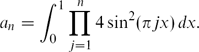
We analyse the first-order asymptotic growth of

\[a_{n}=\int_{0}^{1}\prod_{j=1}^{n}4\sin^{2}(\pi jx)\, dx.\]
The integer an appears as the main term in a weighted average of the number of orbits in a particular quasihyperbolic automorphism of a 2n-torus, which has applications to ergodic and analytic number theory. The combinatorial structure of an is also of interest, as the ‘signed’ number of ways in which 0 can be represented as the sum of ϵjj for −n ≤ j ≤ n (with j ≠ 0), with ϵj ∈ {0, 1}. Our result answers a question of Thomas Ward (no relation to the fourth author) and confirms a conjecture of Robert Israel and Steven Finch.

Information

Type
Paper
Copyright
Copyright © Cambridge University Press 2014