




No CrossRef data available.
Article contents
Saturated Subgraphs of the Hypercube
Published online by Cambridge University Press: 19 September 2016
Abstract
Core share and HTML view are not available for this content. However, as you have access to this content, a full PDF is available via the 'Save PDF' action button.
We say a graph is (Q n ,Q m )-saturated if it is a maximal Q m -free subgraph of the n-dimensional hypercube Q n . A graph is said to be (Q n ,Q m )-semi-saturated if it is a subgraph of Q n and adding any edge forms a new copy of Q m . The minimum number of edges a (Q n ,Q m )-saturated graph (respectively (Q n ,Q m )-semi-saturated graph) can have is denoted by sat(Q n ,Q m ) (respectively s-sat(Q n ,Q m )). We prove that for fixed m, disproving a conjecture of Santolupo that, when m=2, this limit is 1/4. Further, we show by a different method that sat(Q n , Q 2)=O(2n ), and that s-sat(Q n , Q m )=O(2n ), for fixed m. We also prove the lower bound 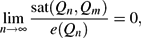 $$\begin{linenomath}\lim_{n\to\infty}\ffrac{\sat(Q_n,Q_m)}{e(Q_n)}=0,\end{linenomath}$$ thus determining sat(Q n ,Q 2) to within a constant factor, and discuss some further questions.
 $$\begin{linenomath}\ssat(Q_n,Q_m)\geq \ffrac{m+1}{2}\cdot 2^n,\end{linenomath}$$
Information
- Type
- Paper
- Information
- Copyright
- Copyright © Cambridge University Press 2016
References
[1]
Alon, N., Krech, A. and Szabó, T. (2007) Turán's theorem in the hypercube.
SIAM J. Discrete Math.
21
66–72.Google Scholar
[2]
Balogh, J., Hu, P., Lidický, B. and Liu, H. (2014) Upper bounds on the size of 4- and 6-cycle-free subgraphs of the hypercube.
European J. Combin.
35
75–85.CrossRefGoogle Scholar
[3]
Brass, P., Harborth, H. and Nienborg, H. (1995) On the maximum number of edges in a C
4-free subgraph of Q
n
.
J. Graph Theory
19
17–23.Google Scholar
[4]
Choi, S. and Guan, P. (2008) Minimum critical squarefree subgraph of a hypercube.
Congressus Numerantium
189
57–64.Google Scholar
[5]
Erdős, P. (1984) Some problems in graph theory, combinatorial analysis and combinatorial number theory. In Graph Theory and Combinatorics (Bollobás, B., ed.), Academic Press, pp. 1–17.Google Scholar
[6]
Erdős, P., Hajnal, A. and Moon, J. W. (1964) A problem in graph theory.
Amer. Math. Monthly
71
1107–1110.Google Scholar
[7]
Faudree, J. R., Faudree, R. J. and Schmitt, R. (2011) A survey of minimum saturated graphs. Electron. J. Combin.
18.Google Scholar
[8]
Katona, G. O. H. and Tarján, T. G. (1983) Extremal problems with excluded subgraphs in the n-cube. In Graph Theory: Łagów, Poland, Vol. 1018 of Lecture Notes in Mathematics, Springer, pp. 84–93.Google Scholar
[10]
Morrison, N., Noel, J. A. and Scott, A. (2014) On saturated k-Sperner systems. Electron. J. Combin.
21, Paper #P3.22.CrossRefGoogle Scholar
[11]
Pikhurko, O. (2004) Results and open problems on minimum saturated hypergraphs.
Ars Combinatorica
72
435–451.Google Scholar
 You have
Access
- 3
- Cited by