




No CrossRef data available.
Article contents
Surprise Probabilities in Markov Chains
Part of:
Markov processes
Published online by Cambridge University Press: 16 March 2017
Abstract
Core share and HTML view are not available for this content. However, as you have access to this content, a full PDF is available via the 'Save PDF' action button.
In a Markov chain started at a state x, the hitting time τ(y) is the first time that the chain reaches another state y. We study the probability  $\mathbb{P}_x(\tau(y) = t)$ that the first visit to y occurs precisely at a given time t. Informally speaking, the event that a new state is visited at a large time t may be considered a ‘surprise’. We prove the following three bounds.
-
• In any Markov chain with n states,
 $\mathbb{P}_x(\tau(y) = t) \le {n}/{t}$ .
-
• In a reversible chain with n states,
 $\mathbb{P}_x(\tau(y) = t) \le {\sqrt{2n}}/{t}$ for $t \ge 4n + 4$ .
-
• For random walk on a simple graph with n ≥ 2 vertices,
 $\mathbb{P}_x(\tau(y) = t) \le 4e \log(n)/t$ .
To prove the bound for random walk on graphs, we establish the following estimate conjectured by Aldous, Ding and Oveis-Gharan (private communication): for random walk on an n-vertex graph, for every initial vertex x, 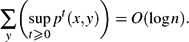 $$\sum_y \biggl( \sup_{t \ge 0} p^t(x, y) \biggr) = O(\log n). $$
MSC classification
Information
- Type
- Paper
- Information
- Copyright
- Copyright © Cambridge University Press 2017
References
[1]
Basu, R., Hermon, J. and Peres, Y. (2015) Characterization of cutoff for reversible Markov chains. Ann. Probab., to appear. An extended abstract appeared in Proc. Twenty-Sixth Annual ACM–SIAM Symposium on Discrete Algorithms, SIAM.CrossRefGoogle Scholar
[2]
Durrett, R. (2010) Probability: Theory and Examples, Cambridge University Press.CrossRefGoogle Scholar
[3]
Feller, W. (1957) An Introduction to Probability Theory and its Applications, Vol. I, Wiley.Google Scholar
[4]
Gurel-Gurevich, O. and Nachmias, A. (2013) Nonconcentration of return times. Ann. Probab.
41
848–870.CrossRefGoogle Scholar
[7]
Levin, D. A., Peres, Y. and Wilmer, E. L. (2009) Markov Chains and Mixing Times, AMS.Google Scholar
[8]
Miclo, L. (2010) On absorption times and Dirichlet eigenvalues. ESAIM: Probab. Statist.
14
117–150.CrossRefGoogle Scholar
[9]
Peres, Y. and Sousi, P. (2015) Total variation cutoff in a tree. Annales de la faculté des sciences de Toulouse
24
763–779.Google Scholar
[10]
Starr, N. (1966) Operator limit theorems. Trans. Amer. Math. Soc.
121
90–115.CrossRefGoogle Scholar
[11]
Wilson, D. B. (1996) Generating random spanning trees more quickly than the cover time. In Proc. Twenty-Eighth Annual ACM Symposium on Theory of Computing, ACM, pp. 296–303.CrossRefGoogle Scholar
 You have
Access
- 2
- Cited by