

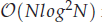
 memory and
 work, where N
 of order α∈(0,1). The algorithm is based on an efficient sum-of-exponentials (SOE) approximation for the kernel t
 for T≫1 or
 for TH1 for fixed accuracy ε. The resulting algorithm requires only
 storage and
 work when numerically solving the time fractional PDEs. Furthermore, we also give the stability and error analysis of the new scheme, and present several numerical examples to demonstrate the performance of our scheme.
 finite difference method for fractional diffusion equations


Crossref Citations

This article has been cited by the following publications. This list is generated based on data provided by Crossref.
Zhang, Wei
Li, Can
Wu, Xiaonan
and
Zhang, Jiwei
2017.
High-Order Local Artificial Boundary Conditions for the Fractional Diffusion Equation on One-Dimensional Unbounded Domain.
Journal of Mathematical Study,
Vol. 50,
Issue. 1,
p.
28.
Yan, Yonggui
Sun, Zhi-Zhong
and
Zhang, Jiwei
2017.
Fast Evaluation of the Caputo Fractional Derivative and Its Applications to Fractional Diffusion Equations: A Second-Order Scheme.
Communications in Computational Physics,
Vol. 22,
Issue. 4,
p.
1028.
Ren, Jincheng
Long, Xiaonian
Mao, Shipeng
and
Zhang, Jiwei
2017.
Superconvergence of Finite Element Approximations for the Fractional Diffusion-Wave Equation.
Journal of Scientific Computing,
Vol. 72,
Issue. 3,
p.
917.
Zhang, Qian
Zhang, Jiwei
Jiang, Shidong
and
Zhang, Zhimin
2017.
Numerical solution to a linearized time fractional KdV equation on unbounded domains.
Mathematics of Computation,
Vol. 87,
Issue. 310,
p.
693.
Wu, Shu-Lin
2017.
Optimized Overlapping Schwarz Waveform Relaxation for a Class of Time-Fractional Diffusion Problems.
Journal of Scientific Computing,
Vol. 72,
Issue. 2,
p.
842.
Li, Hongwei
Wu, Xiaonan
and
Zhang, Jiwei
2018.
Numerical Solution of the Time-Fractional Sub-Diffusion Equation on an Unbounded Domain in Two-Dimensional Space.
East Asian Journal on Applied Mathematics,
Vol. 7,
Issue. 3,
p.
439.
Ren, Jincheng
Mao, Shipeng
and
Zhang, Jiwei
2018.
Fast evaluation and high accuracy finite element approximation for the time fractional subdiffusion equation.
Numerical Methods for Partial Differential Equations,
Vol. 34,
Issue. 2,
p.
705.
McLean, William
2018.
Contemporary Computational Mathematics - A Celebration of the 80th Birthday of Ian Sloan.
p.
911.
Zhao, Meng
He, Shuai
Wang, Hong
and
Qin, Guan
2018.
An integrated fractional partial differential equation and molecular dynamics model of anomalously diffusive transport in heterogeneous nano-pore structures.
Journal of Computational Physics,
Vol. 373,
Issue. ,
p.
1000.
Hou, Dianming
Hasan, Mohammad Tanzil
and
Xu, Chuanju
2018.
Müntz Spectral Methods for the Time-Fractional Diffusion Equation.
Computational Methods in Applied Mathematics,
Vol. 18,
Issue. 1,
p.
43.
Zeng, Fanhai
Turner, Ian
Burrage, Kevin
and
Karniadakis, George Em
2018.
A New Class of Semi-Implicit Methods with Linear Complexity for Nonlinear Fractional Differential Equations.
SIAM Journal on Scientific Computing,
Vol. 40,
Issue. 5,
p.
A2986.
Li, Dan
Zhang, Jiwei
and
Zhang, Zhimin
2018.
The Numerical Computation of the Time Fractional Schrödinger Equation on an Unbounded Domain.
Computational Methods in Applied Mathematics,
Vol. 18,
Issue. 1,
p.
77.
Zeng, Fanhai
Turner, Ian
and
Burrage, Kevin
2018.
A Stable Fast Time-Stepping Method for Fractional Integral and Derivative Operators.
Journal of Scientific Computing,
Vol. 77,
Issue. 1,
p.
283.
Wu, Shu-Lin
and
Zhou, Tao
2018.
Parareal algorithms with local time-integrators for time fractional differential equations.
Journal of Computational Physics,
Vol. 358,
Issue. ,
p.
135.
Li, Lili
Zhou, Boya
Chen, Xiaoli
and
Wang, Zhiyong
2018.
Convergence and stability of compact finite difference method for nonlinear time fractional reaction–diffusion equations with delay.
Applied Mathematics and Computation,
Vol. 337,
Issue. ,
p.
144.
Wu, Shu-Lin
and
Huang, Chengming
2018.
Asymptotic Results of Schwarz Waveform Relaxation Algorithm for Time Fractional Cable Equations.
Communications in Computational Physics,
Vol. 25,
Issue. 2,
p.
390.
Li, Changpin
and
Chen, An
2018.
Numerical methods for fractional partial differential equations.
International Journal of Computer Mathematics,
Vol. 95,
Issue. 6-7,
p.
1048.
Li, Dongfang
Zhang, Jiwei
and
Zhang, Zhimin
2018.
Unconditionally Optimal Error Estimates of a Linearized Galerkin Method for Nonlinear Time Fractional Reaction–Subdiffusion Equations.
Journal of Scientific Computing,
Vol. 76,
Issue. 2,
p.
848.
Zhang, Jingyuan
2018.
A stable explicitly solvable numerical method for the Riesz fractional advection–dispersion equations.
Applied Mathematics and Computation,
Vol. 332,
Issue. ,
p.
209.
Liu, Huan
Cheng, Aijie
Wang, Hong
and
Zhao, Jia
2018.
Time-fractional Allen–Cahn and Cahn–Hilliard phase-field models and their numerical investigation.
Computers & Mathematics with Applications,
Vol. 76,
Issue. 8,
p.
1876.