1. Introduction
Cluster algebras were originally introduced in a series of papers by Fomin and Zelevinsky, starting with [Reference Fomin and ZelevinskyFZ02], and have since been found to appear in many diverse branches of mathematics. They enjoy many remarkable properties, two of the most important of which are the Laurent phenomenon (i.e. that any cluster variable can be expanded as a Laurent polynomial in some distinguished subset of the other cluster variables) and, for cluster algebras of finite type, a classification parallel to the Cartan–Killing classification of Lie groups. In particular, a cluster algebra of finite type is generated by a finite number of cluster variables.
In the language of the wider cluster algebra literature, in this paper we use the term ‘cluster algebra’ to mean a generalised cluster algebra  $\mathcal {A}$ with universal geometric coefficients, and ‘cluster variety’ to mean the affine variety
 $X=\operatorname {Spec}\mathcal {A}$. However, as algebraic geometers we like to take a more geometric approach to defining cluster varieties, in terms of the families of log Calabi–Yau surfaces constructed by Gross, Hacking and Keel [Reference Gross, Hacking and KeelGHK15a]. Taking this approach provides a much clearer way to generalise our methods.
1.1 Motivation
Our primary motivation comes from classification problems in low-dimensional algebraic geometry. In particular, we have chosen to concentrate on the classification of Fano 3-folds (a.k.a.  $\mathbb {Q}$-Fano 3-folds with at worst terminal singularities), but the methods of this paper would be just as applicable to constructing other types of projective algebraic varieties, including Calabi–Yau 3-folds, surfaces and 3-folds of general type. Hyperplane sections of our Fano 3-folds are either K3 surfaces or del Pezzo surfaces, with cyclic quotient singularities.
1.1.1 Gorenstein formats
For a formal definition of Gorenstein formats and key varieties, we refer to § 2.5 or [Reference Brown, Kasprzyk and ZhuBKZ19]. Informally, a Gorenstein format is a succinct representation of the generators, relations and syzygies of a Gorenstein ring  $R$. A key variety
 $V$ is the generic case of a format, that is,
 $V=\operatorname {Spec} R$. We construct
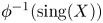
 $\phi ^{-1}(V)\subset \mathbb {A}^{n}_{z_1,\ldots , z_n}$ by substituting the generators
 $x_1,\ldots ,x_m$ of
 $R$ with polynomials
 $x_i=\phi _i(z_1,\ldots ,z_n)$,
 $i=1,\ldots ,m$. If
 $\phi$ preserves the format of
 $\phi ^{-1}(V)$, then this is called a regular pullback of
 $V$. If
 $R$ is graded and we choose
 $\phi$ appropriately, then we can divide
 $\phi ^{-1}(V)$ by the
 $\mathbb {C}^{*}$-action to get (weighted) projective varieties. In the best cases,
 $V$ has a large torus action so that there are several choices of grading available.
For example, the origin  $V:=V(x_1,\ldots ,x_m)$ in
 $\mathbb {A}^{m}$, together with the Koszul resolution of its defining ideal, is a format. Regular pullbacks of
 $V$ give hypersurfaces (
 $m=1$) or complete intersections of codimension
 $m\ge 2$. Another classic example is the affine cone over the Plücker embedding of the Grassmannian
 $\operatorname {Gr}(2,5)$ (cf. [Reference Corti and ReidCR02]). This is an instance of the Buchsbaum–Eisenbud theorem for projectively Gorenstein varieties in codimension 3. Moreover, we note that
 $\operatorname {Gr}(2,5)$ also appears as the simplest non-trivial cluster variety, associated to the
 $\mathsf {A}_2$ root system. Brown, Kasprzyk and Zhu [Reference Brown, Kasprzyk and ZhuBKZ19] make a detailed analysis of
 $\operatorname {Gr}(2,5)$ format (or, in our notation,
 $\mathsf {A}_2$ format) for constructing Calabi–Yau and canonical 3-folds.
Other symmetric spaces, such as the orthogonal Grassmannian  $\operatorname {OGr}(5,10)$, were used by Mukai to construct canonical curves, K3 surfaces and smooth Fano 3-folds of genus
 $6\leq g\leq 10,12$, among other things. In particular, it seems that the weighted
 $\operatorname {OGr}(5,10)$ format does not yield any other constructions of Fano 3-folds [Reference Corti and ReidCR02], but is moderately successful for canonical 3-folds [Reference Brown, Kasprzyk and ZhuBKZ19].
1.1.2 Fano 3-folds
Previous efforts to construct Fano 3-folds in codimension  $4$ or higher include Tom and Jerry [Reference Brown, Kerber and ReidBKR12, Reference Brown and SuzukiBS07a, Reference Brown and SuzukiBS07b, Reference Prokhorov and ReidPR16, Reference Brown, Kasprzyk and QureshiBKQ18]. There are also non-existence results for Fanos of high Fano index due to Prokhorov [Reference ProkhorovPro13, Reference ProkhorovPro16]. The approach taken in most of these works is to construct Fano 3-folds by various types of unprojection, that is, by starting at the midpoint of a Sarkisov link and working backwards, or something similar. In her forthcoming PhD thesis, Taylor has developed new types of unprojection to construct many of the codimension 4 Fano 3-fold candidates.
Despite the geometrically appealing nature of these constructions, unfortunately it is difficult to construct birationally rigid varieties this way since the corresponding Sarkisov link gives a non-trivial birational map which must necessarily return to the variety you started with. Our cluster formats give uniform descriptions for special subfamilies of the Hilbert scheme of Fano 3-folds, with no predisposition to the birational geometry. One advantage of this approach is that we construct some examples which are expectedFootnote 1 to be birationally rigid (see § 5.6).
1.1.3 Similar constructions
The  $\mathsf {C}_2$ and
 $\mathsf {G}_2$ cluster varieties appearing in this paper have been used in the literature before as key varieties to construct several interesting algebraic varieties. Indeed,
 $\mathsf {C}_2$ format appears in the construction of Godeaux surfaces by Reid [Reference ReidRei1] (see also § 5.9.1) and a version of
 $\mathsf {G}_2$ format appears in the explicit construction of 3-fold flips (in the guise of one of Brown and Reid's diptych varieties [Reference Brown and ReidBR17, § 5.2]) and 3-fold divisorial contractions [Reference DucatDuc15, Example 7.2].
1.2 Rank 2 cluster formats
There are four rank 2 cluster varieties of finite type corresponding to the four rank 2 root systems of finite type:  $\mathsf {A}_1\times \mathsf {A}_1$,
 $\mathsf {A}_2$,
 $\mathsf {C}_2$ and
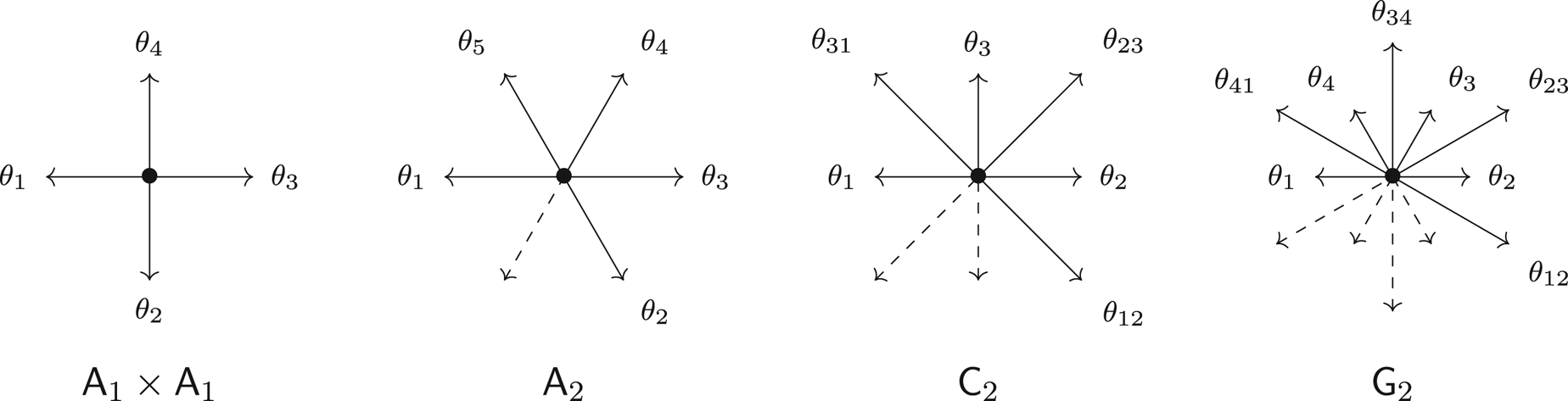
 $\mathsf {G}_2$. In each case the cluster algebra has a distinguished set of generators, called cluster variables, which can be put into correspondence with the almost positive roots of the corresponding root system, as shown in Figure 1.Footnote 2 Given two adjacent cluster variables,
 $\theta _1$ and
 $\theta _{2}$ say, any other cluster variable
 $\theta '$ can be written as a Laurent polynomial
 $\theta ' = {F(\theta _1,\theta _2)}/{\theta _1^{\alpha _1}\theta _2^{\alpha _2}}$ where
 $\alpha _1 r_1 + \alpha _2 r_2$ is a positive root in the corresponding root system and
 $r_1,r_2$ are a basis of simple roots.
The almost positive roots in the root systems of rank 2.

Given three consecutive cluster variables  $\theta _{i-1},\theta _i,\theta _{i+1}$ corresponding to roots
 $r_{i-1},r_i,r_{i+1}$, say, the tag at
 $\theta _i$ is the integer
 $d_i$ such that
 $r_{i-1}+r_{i+1}=d_ir_i$. As seen in (1.1) and (1.2) below, this tag records the degree of the exchange relation,
 $\theta _{i-1}\theta _{i+1}=f_i(\theta _i)$, where
 $f_i$ is a polynomial of degree
 $d_i$ over an appropriate coefficient ring.
The simplest rank 2 cluster variety,  $\mathsf {A}_1\times \mathsf {A}_1$ format, is a generic complete intersection of codimension 2. Moreover, as already mentioned,
 $\mathsf {A}_2$ format coincides with
 $\operatorname {Gr}(2,5)$ format (cf. § 2.4). In this paper we concentrate on the
 $\mathsf {C}_2$ case, which is a Gorenstein format of codimension 4, and the
 $\mathsf {G}_2$ case, which is a Gorenstein format of codimension 6. Very concretely, the corresponding cluster varieties are the affine varieties given by the explicit equations appearing below. We will explain one way to derive these equations in §§ 3.1 and 4.1, but, for the applications we have in mind, we will essentially use them as black boxes with the nice properties described in § 2.3.
1.2.1  $\mathsf {C}_2$ format

The cluster variety  $X_{\mathsf {C}_2}=\operatorname {Spec}{\mathcal {A}_{\mathsf {C}_2}}\subset \mathbb {A}^{13}$ is an affine Gorenstein
 $9$-fold of codimension 4, where
 $\mathcal {A}_{\mathsf {C}_2}$ is a
 $\mathbb {Z}^{6}$-graded ring with 13 generators, 9 relations and 16 syzygies. The 13 generators are given by six cluster variables
 $\theta _1$,
 $\theta _{12}$,
 $\theta _2$,
 $\theta _{23}$,
 $\theta _3$,
 $\theta _{31}$, six coefficients
 $A_1$,
 $A_{12}$,
 $A_2$,
 $A_{23}$,
 $A_3$,
 $A_{31}$ and one parameter
 $\lambda$. The nine relations are:
 \begin{align}\begin{array}{r@{\,}ll} \theta_i\theta_j &= A_{ij}\theta_{ij} + A_{jk}A_kA_{ki}, &\quad (\times 3) \notag\\ \theta_{ki}\theta_{ij} &= A_i\theta_i^{2} + \lambda A_{jk}\theta_i + A_jA_{jk}^{2}A_k, &\quad (\times 3) \\ \theta_i\theta_{jk} &= A_{ij}A_j\theta_j + \lambda A_{ki}A_{ij} + A_kA_{ki}\theta_k, &\quad (\times 3) \notag \end{array} \end{align}
where  $(i,j,k)$ are taken to vary over all
 $\operatorname {Dih}_6$-permutations of
 $(1,2,3)$.
1.2.2 $\mathsf {G}_2$ format

The cluster variety  $X_{\mathsf {G}_2}=\operatorname {Spec}{\mathcal {A}_{\mathsf {G}_2}}\subset \mathbb {A}^{18}$ is an affine Gorenstein
 $12$-fold of codimension 6, where
 $\mathcal {A}_{\mathsf {G}_2}$ is a
 $\mathbb {Z}^{8}$-graded ring with 18 generators, 20 relations and 64 syzygies. The 18 generators are given by eight cluster variables
 $\theta _1$,
 $\theta _{12}$,
 $\theta _2$,
 $\theta _{23}$,
 $\theta _3$,
 $\theta _{34}$,
 $\theta _4$,
 $\theta _{41}$, eight coefficients
 $A_1$,
 $A_{12}$,
 $A_2$,
 $A_{23}$,
 $A_3$,
 $A_{34}$,
 $A_4$,
 $A_{41}$ and two parameters
 $\lambda _{13}$,
 $\lambda _{24}$. The 20 relations are:
 \begin{align} \begin{array}{r@{\,}lll} \theta_i\theta_j &= A_{ij}\theta_{ij} + A_{jk}A_kA_{kl}^{2}A_lA_{li}, & (\times 4) \\ \theta_{ij}\theta_{jk} &= A_j\theta_j^{3} + \lambda_{jl}A_{kl}A_{li}\theta_j^{2} + \lambda_{ik}A_{kl}^{2}A_lA_{li}^{2}\theta_j + A_kA_{kl}^{3}A_l^{2}A_{li}^{3}A_i, & (\times 4) \\ \theta_i\theta_{jk} &= A_{ij}A_j\theta_j^{2} + \lambda_{jl}A_{kl}A_{li}A_{ij}\theta_j + \lambda_{ik}A_{kl}^{2}A_lA_{li}^{2}A_{ij} + A_kA_{kl}^{2}A_lA_{li}\theta_k, & (\times 8) \\ \theta_i\theta_k &= A_{ij}A_jA_{jk}\theta_j + \lambda_{jl}A_{ij}A_{jk}A_{kl}A_{li} + A_{kl}A_lA_{li}\theta_l, & (\times 2) \\ \theta_{ij}\theta_{kl} &= A_jA_{jk}^{2}A_k\theta_j\theta_k + A_{li}A_{jk}(\lambda_{ik}\theta_i \theta_k + \lambda_{jl}\theta_j\theta_l) + A_lA_{li}^{2}A_i\theta_l\theta_i + \cdots\\ &\quad + A_{ij}A_{jk}^{2}A_{kl}A_{li}^{2}(A_iA_jA_kA_l - \lambda_{ik}\lambda_{jl}),& (\times 2) \end{array} \end{align}
where  $(i,j,k,l)$ are taken to vary over all
 $\operatorname {Dih}_8$-permutations of
 $(1,2,3,4)$.
1.2.3 Relation to Gross, Hacking and Keel's construction
Given a positive Looijenga pair  $(Y,D)$ (i.e. a rational surface
 $Y$ and an ample anticanonical cycle
 $D\in |{-K_Y}|$), Gross, Hacking and Keel [Reference Gross, Hacking and KeelGHK15a] define a family of mirror surfaces
 $\mathcal {X}$ fibred over a toric base variety
 $B=\operatorname {Spec}\mathbb {C}[\operatorname {NE}(Y)]$. In this case, the family
 $\mathcal {X}/B$ is a relatively Gorenstein affine scheme with nice properties, including a torus grading
 $\mathbb {T}^{k}\curvearrowright \mathcal {X}$. However, we are interested in working with (absolutely) Gorenstein varieties, so instead we consider a slightly different family. We first restrict
 $\mathcal {X}$ to
 $\mathcal {X}\vert _{\mathbb {T}^{n}}$, over the dense torus orbit
 $\mathbb {T}^{n}\subset B$, and then extend this to an affine Gorenstein variety
 $X/\mathbb {A}^{n}$, corresponding to the closure of
 $\mathbb {T}^{n}\subset \mathbb {A}^{n}$ for some good choice of coordinates on
 $\mathbb {T}^{n}$. We take this
 $X$ as our rank 2 cluster variety. In particular, the theta functions introduced by [Reference Gross, Hacking and KeelGHK15a] play the role of the cluster variables. Our coefficients
 $A_i$ correspond to coefficients (or frozen variables) in the language of cluster algebras. Our parameters,
 $\lambda$ or
 $\lambda _{ij}$, do not appear in the original cluster algebra story; however, we see them to be unified with the other coefficients by taking this approach.
1.2.4 Unprojection structure
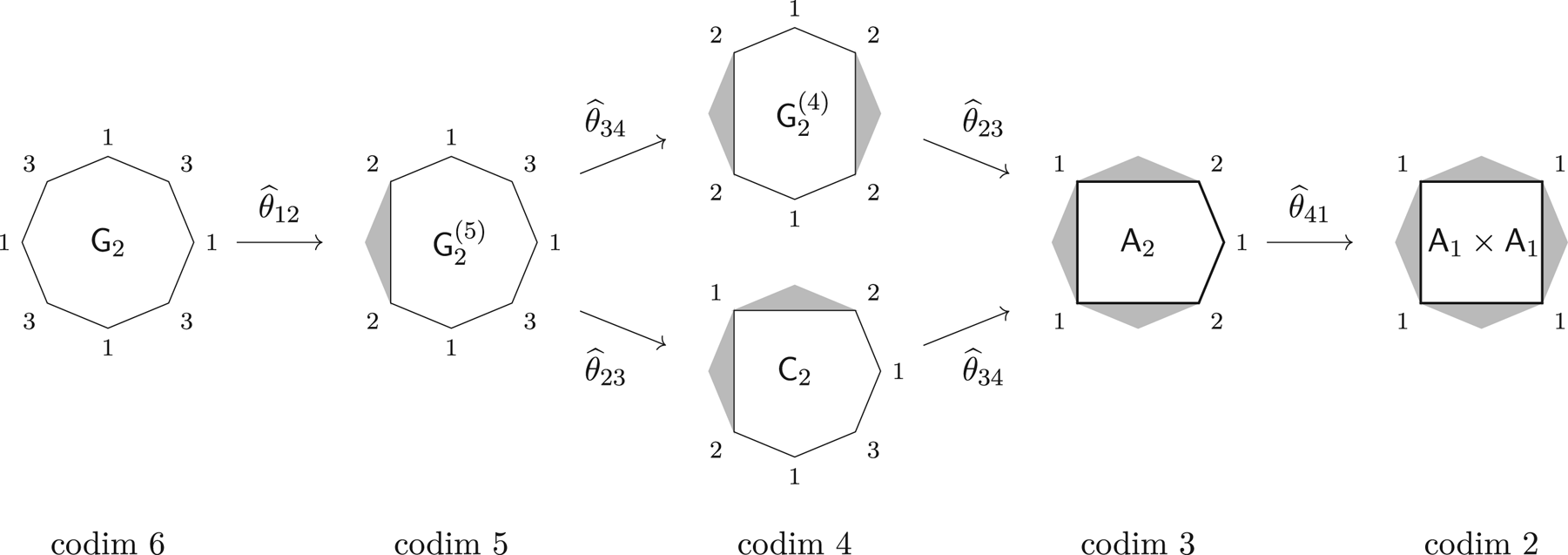
These cluster varieties come with a natural type I Gorenstein projection structure. The champion  $X_{\mathsf {G}_2}$ has a projection to a complete intersection in codimension 2, given by eliminating the four tag 1 cluster variables
 $\theta _{12}$,
 $\theta _{23}$,
 $\theta _{34}$ and
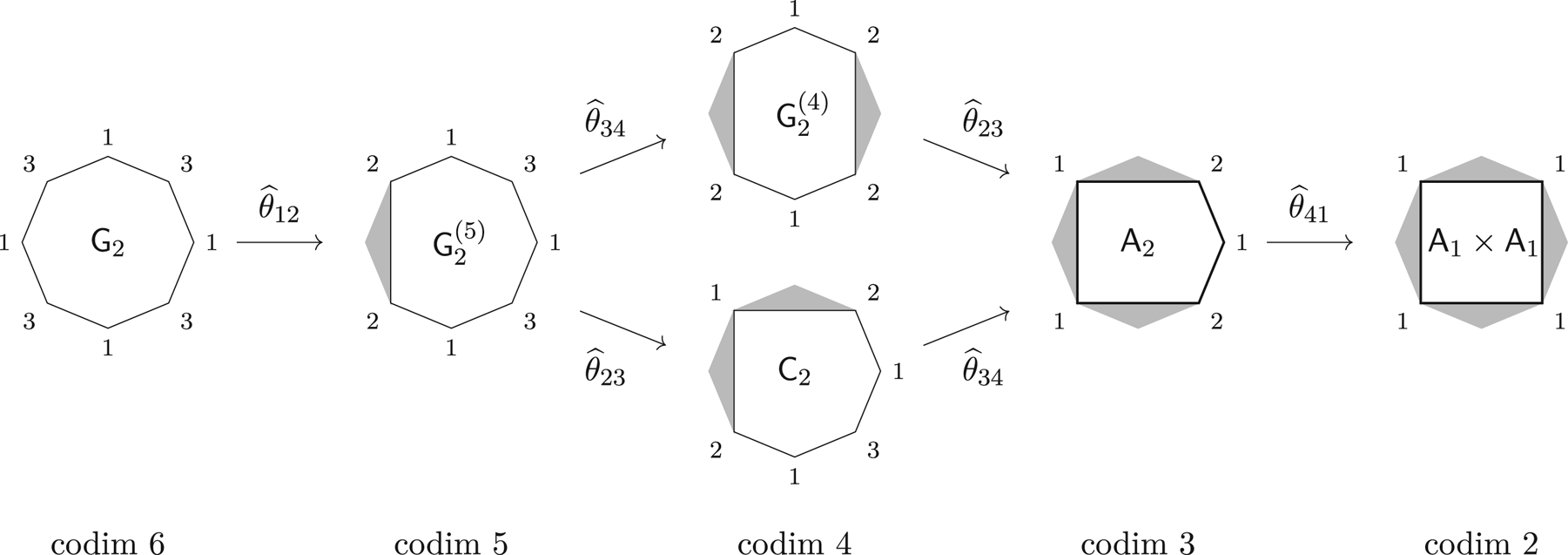
 $\theta _{41}$. We get a projection cascade (part of which is shown in Figure 2) in which we see all of the other rank 2 cluster varieties, albeit not in their most natural presentation.In particular, this projection cascade also allows us to define two intermediate formats,
 $\mathsf {G}_2^{(5)}$ and
 $\mathsf {G}_2^{(4)}$, where the superscript denotes the codimension. The two codimension 4 formats behave like the two codimension 4 formats Tom and Jerry [Reference Brown, Kerber and ReidBKR12]. Indeed,
 $\mathsf {C}_2$ format can be written as a Tom unprojection from
 $\mathsf {A}_2$ format, and
 $\mathsf {G}_2^{(4)}$ format as a Jerry unprojection.
Part of the projection cascade for the  $\mathsf {G}_2$ cluster variety.
This should be an instance of the more general observation that whenever two Looijenga pairs are related by blowing down a  $(-1)$-curve in the boundary divisor
 $\pi \colon (Y',D')\to (Y,D)$ then there is a relationship between the mirror families, described in [Reference Gross, Hacking and KeelGHK15a, § 6.2]. The family
 $\mathcal {X}/B$ for
 $(Y,D)$ can be obtained from the family
 $\mathcal {X}'/B'$ for
 $(Y',D')$ as a pullback along the morphism of affine toric varieties
 $B\to B'$ induced by the inclusion of cones
 $\pi ^{*}\colon \operatorname {NE}(Y) \to \operatorname {NE}(Y')$.
1.3 Main results
For definitions and notation concerning Fano 3-folds, we refer to § 5. The main result of this paper is the classification and construction of all families of quasismooth Fano 3-folds in  $\mathsf {C}_2$ or
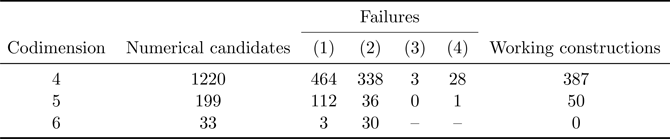
 $\mathsf {G}_2$ format. The full classification is available from [Reference Coughlan and DucatCD]. In total, we construct over 400 families in codimensions 4 and 5. There are none in codimension 6. About two-thirds of these families are prime. The following theorem highlights some more features of the classification.
Theorem 1.1
(i) Of the 29 candidates in codimension 4 of index 1 and with no type I centre, 25 have at least one cluster format construction which is prime.
(ii) Of the 61 candidates in codimension 4 of index at least 2, 45 have at least one cluster format construction which is prime.
(iii) There are 50 families of codimension 5 Fano 3-folds in a cluster format.
In particular, when combined with non-existence results of Prokhorov, part (ii) answers the question of existence of Fano 3-folds in codimension 4 with large Fano index.
Corollary 1.2 For each candidate Fano 3-fold Hilbert series appearing in [Reference Brown and KasprzykGRDB] with codimension 4 and Fano index  $q\ge 4$, then either there exists a prime Fano 3-fold with that Hilbert series or, by the work of Prokhorov, no such Fano 3-fold exists.
Several of the codimension 4 candidates have constructions in both  $\mathsf {C}_2$ and
 $\mathsf {G}_2^{(4)}$ formats, echoing Tom and Jerry [Reference Brown, Kerber and ReidBKR12]. Around 270 of our constructions in codimension 4 have index 1 and a type I centre, and so are special subfamilies of those appearing in [Reference Brown, Kerber and ReidBKR12].
We give a criterion for checking primality in cluster formats. It turns out that the families which are not prime are related to  $\mathbb {P}^{2}\times \mathbb {P}^{2}$,
 $(\mathbb {P}^{1})^{3}$ or rolling factors formats. In particular, this answers the question of primality for those cases which overlap with [Reference Brown, Kerber and ReidBKR12].
1.4 Outline of the paper
In § 2 we give a brief introduction to cluster varieties, including their important properties. We also give a crash course on Gorenstein formats. In §§ 3 and 4 we look at the  $\mathsf {C}_2$ and
 $\mathsf {G}_2$ rank 2 cluster formats in more detail and explain some ways of constructing them. We make a detailed study of their singular loci and the singular loci of some hyperplane sections, since this plays a crucial part in excluding bad cases from consideration. In § 5 we explain how we apply these formats to construct Fano 3-folds and give many examples. In § 6 we explain the computer algorithm that we use to make our classification.
1.5 Conventions and terminology
– Cluster varieties can be defined as schemes over
$\mathbb {Z}$ but, since the applications we have in mind are constructing complex projective varieties, we choose to work over $\mathbb {C}$ throughout.– We write
$\mathbb {T}^{k} = (\mathbb {C}^{\times })^{k}$ for the torus of rank $k$.– We write
$\operatorname {Dih}_{2n}$ for the dihedral group of order $2n$, which acts on the set $\{1,\ldots ,n\}$ labelling the vertices of a regular $n$-gon cyclically. Our cluster formats have variables $\theta _i$, $\theta _{ij}$, etc. indexed by $i,j\in \{1,\ldots ,n\}$ and an action of $\operatorname {Dih}_{2n}$, where $\pi \in \operatorname {Dih}_{2n}$ acts by $\theta _{ij}\mapsto \theta _{\pi (i)\pi (j)}$ etc. Throughout this paper we always consider our labellings to be unordered, for example $\theta _{ij}=\theta _{ji}$.– We write
$\operatorname {CI}^{(c)}$ to denote a complete intersection of codimension $c$.– We write down a skew-symmetric matrix
$M$ by specifying the strict upper triangular part only. We use $\operatorname {Pf}_k M$ to denote the ideal generated by the $k\times k$ maximal Pfaffians of $M$.– We make free reference to the terminology of Tom and Jerry [Reference Brown, Kerber and ReidBKR12].
– A variety
$Y$ in weighted projective space is quasismooth if the affine cone $\widehat {Y}$ has at worst an isolated singularity at the vertex.– A variable
$x$ in a graded ring is redundant if it satisfies a relation of the form $x=\cdots$, where $\cdots$ is an expression in terms of the other ring generators.







2. Cluster varieties of rank 2
We only give a very brief recap of the theory established by Gross, Hacking and Keel [Reference Gross, Hacking and KeelGHK15a] since we are primarily interested in using our two cluster varieties  $X_{\mathsf {C}_2}$ and
 $X_{\mathsf {G}_2}$ to construct examples of Fano
 $3$-folds. In particular, we summarise the results of several calculations without providing many of the details. Hopefully this is enough to provide some motivation for their existence and basic properties, as well as giving some hints as to how other families of log Calabi–Yau surfaces (or higher-dimensional varieties) could be used as key varieties. The reader is perfectly entitled to ignore this section if they are willing to take our key varieties
 $X_{\mathsf {C}_2}$ and
 $X_{\mathsf {G}_2}$ as black boxes with the properties described in §§ 2.3 and 2.5.
2.1 Looijenga pairs
A Looijenga pair  $(Y,D)$ is a projective rational surface
 $Y$ together with a reduced anticanonical cycle
 $D=\sum _{i=1}^{k} D_i \in |{-K_{Y}}|$.
2.1.1 The $\mathsf {A}_2$, $\mathsf {C}_2$ and $\mathsf {G}_2$ Looijenga pairs


We will consider  $(Y,D)$ to be one of the following three cases.Footnote 3
(A2) Let
$k=5$ and $(-D_i^{2} : i=1,\ldots ,5)=(1,1,1,1,1)$.(C2) Let
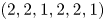
$k=6$ and $(-D_i^{2} : i=1,\ldots ,6)=(2,1,2,1,2,1)$.(G2) Let
$k=8$ and $(-D_i^{2} : i=1,\ldots ,8)=(3,1,3,1,3,1,3,1)$.






For convenience, in the  $\mathsf {C}_2$ case we relabel the boundary divisors
 $D_1,D_{12},D_2,\ldots ,D_{31}$, so that
 $D_i^{2}=-2$ and
 $D_{ij}^{2}=-1$, and similarly in the
 $\mathsf {G}_2$ case.
2.1.2 Toric models
Any Looijenga pair can be obtained, possibly after a sequence of toric blow-ups, as the blow-up of a toric surface  $(\bar {Y},\bar {D})$ at points along the toric boundary divisor
 $\bar {D}$, such that
 $D\subset Y$ is the strict transform of
 $\bar {D}\subset \bar {Y}$ (cf. [Reference Gross, Hacking and KeelGHK15a, Proposition 1.3]). We can realise special casesFootnote 4 of the three examples above by considering blow-ups
 \[ \pi_{\mathsf{A}_2}\colon Y_{\mathsf{A}_2}\to\mathbb{P}^{2}, \quad \pi_{\mathsf{C}_2}\colon Y_{\mathsf{C}_2}\to\mathbb{P}^{2}, \quad \pi_{\mathsf{G}_2}\colon Y_{\mathsf{G}_2}\to\mathbb{P}^{1}\times\mathbb{P}^{1} \]
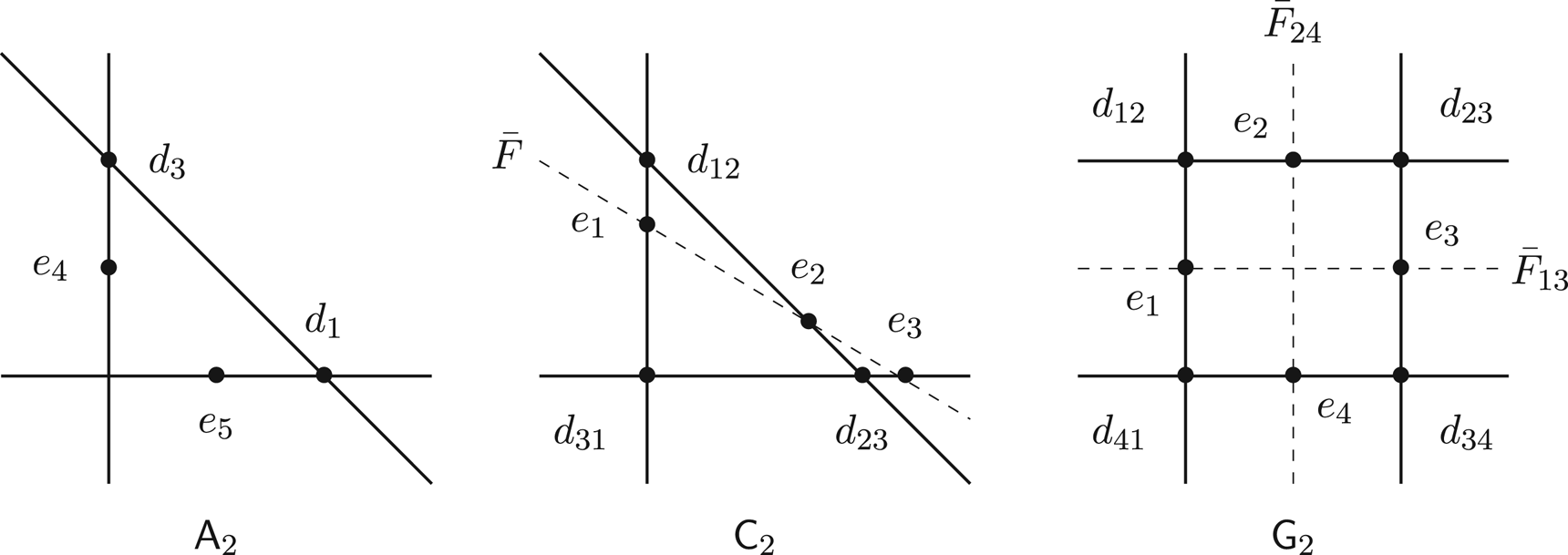
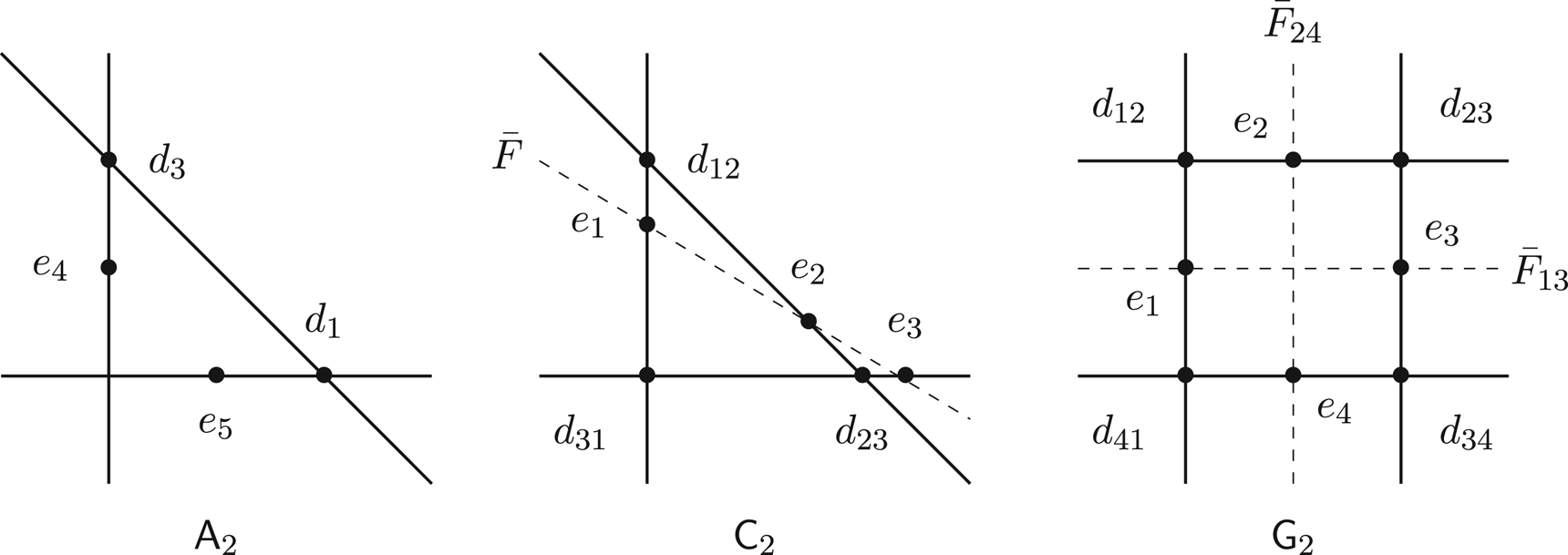
at the configurations of points described below, and shown in Figure 3.
The configurations of points blown up to obtain  $Y_{\mathsf {A}_2}$,
 $Y_{\mathsf {C}_2}$ and
 $Y_{\mathsf {G}_2}$.
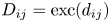
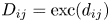
Let  $\operatorname {exc}(p)$ be the exceptional divisor above a point
 $p$, let
 $\pi ^{-1}(\bar {C})$ be the strict transform of a curve
 $\bar C$ under a birational map
 $\pi$, let
 $L_{p,q}$ be the line in
 $\mathbb {P}^{2}$ which passes through two points
 $p,q$, and let
 $M_{p,q,r}$ be the curve of bidegree
 $(1,1)$ in
 $\mathbb {P}^{1}\times \mathbb {P}^{1}$ which passes through three points
 $p,q,r$. Then the blow-ups we consider are given by the following.
(A2) Let
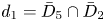
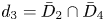
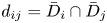
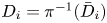
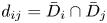
$\bar {D}_2+\bar {D}_4+\bar {D}_5$ be the toric boundary components of $\mathbb {P}^{2}$. We obtain $Y_{\mathsf {A}_2}$ by blowing up the two intersection points $d_1=\bar {D}_5\cap \bar {D}_2$, $d_3=\bar {D}_2\cap \bar {D}_4$ and two general points $e_4\in \bar {D}_4$, $e_5\in \bar {D}_5$.The anticanonical cycle
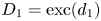
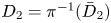
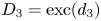
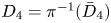
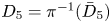
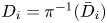
$D\subset Y_{\mathsf {A}_2}$ is given by $D_1 = \operatorname {exc}(d_1)$, $D_2 = \pi ^{-1}(\bar {D}_2)$, $D_3 = \operatorname {exc}(d_3)$, $D_4 = \pi ^{-1}(\bar {D}_4)$ and $D_5 = \pi ^{-1}(\bar {D}_5)$. Moreover, we note that $Y_{\mathsf {A}_2}$ contains five interior $(-1)$-curves $E_1 = \pi ^{-1}(L_{d_1,e_4})$, $E_2 = \pi ^{-1}(L_{e_4,e_5})$, $E_3 = \pi ^{-1}(L_{d_3,e_5})$, $E_4 = \operatorname {exc}(e_4)$ and $E_5 = \operatorname {exc}(e_5)$.(C2) Let
$\bar {D}_1+\bar {D}_2+\bar {D}_3$ be the toric boundary components of $\mathbb {P}^{2}$. We obtain $Y_{\mathsf {C}_2}$ by blowing up the three intersection points $d_{ij}=\bar {D}_i\cap \bar {D}_j$ and three points $e_i\in \bar {D}_i\cap \bar {F}$, where $\bar {F}$ is a line in general position with respect to $\bar {D}$.Let
$(i,j,k)$ vary over all $\operatorname {Dih}_6$-permutations of $(1,2,3)$. Then the anticanonical cycle $D\subset Y_{\mathsf {A}_2}$ is given by $D_i = \pi ^{-1}(\bar {D}_i)$ and $D_{ij} = \operatorname {exc}(d_{ij})$. Moreover, we note that $Y_{\mathsf {C}_2}$ contains six interior $(-1)$-curves $E_i = \operatorname {exc}(e_i)$ and $E_{ij} = \pi ^{-1}(L_{d_{ij},e_k})$, and one interior $(-2)$-curve $F=\pi ^{-1}(\bar {F})$.(G2) Let
$\bar {D}_1+\bar {D}_2+\bar {D}_3+\bar {D}_4$ be the toric boundary components of $\mathbb {P}^{1}\times \mathbb {P}^{1}$. We obtain $Y_{\mathsf {G}_2}$ by blowing up the four intersection points $d_{ij}=\bar {D}_i\cap \bar {D}_j$ and four points $e_i\in \bar {D}_i\cap (\bar {F}_{13}\cup \bar {F}_{24})$, where $\bar {F}_{13}$ and $\bar {F}_{24}$ are two curves of bidegree $(1,0)$ and $(0,1)$ which are in general position with respect to $\bar {D}$.Let
$(i,j,k,l)$ vary over all $\operatorname {Dih}_8$-permutations of $(1,2,3,4)$. Then the anticanonical cycle $D\subset Y_{\mathsf {G}_2}$ is given by $D_i = \pi ^{-1}(\bar {D}_i)$ and $D_{ij}=\operatorname {exc}(d_{ij})$. Moreover, we note that $Y_{\mathsf {G}_2}$ contains eight interior $(-1)$-curves $E_i = \operatorname {exc}(e_i)$ and $E_{ij}=\pi ^{-1}(M_{d_{ij},e_k,e_l})$, and two interior $(-2)$-curves $F_{ik} = \pi ^{-1}(\bar {F}_{ik})$.

































2.1.3 The Mori cone $\operatorname {NE}(Y)$

A Looijenga pair  $(Y,D)$ is said to be positive if the cycle
 $D$ supports an ample divisor. In particular, this implies that the Mori cone
 $\operatorname {NE}(Y)\subset N_1(Y)_{\mathbb{Q}}$ is a closed finite polyhedral cone.
In the  $\mathsf {A}_2$,
 $\mathsf {C}_2$ and
 $\mathsf {G}_2$ cases,
 $(Y,D)$ is positive and the Mori cone
 $\operatorname {NE}(Y)$ is spanned by
 $10$,
 $13$ and
 $18$ extremal rays respectively, corresponding to the classes
 $[D_i],[D_{ij}],[E_i],[E_{ij}],[F],[F_{ik}]$ described above. A
 $(-1)$-curve contained in
 $Y\setminus D$ must intersect the boundary divisor
 $D$ at precisely one point, in the interior of a component
 $D_i$ or
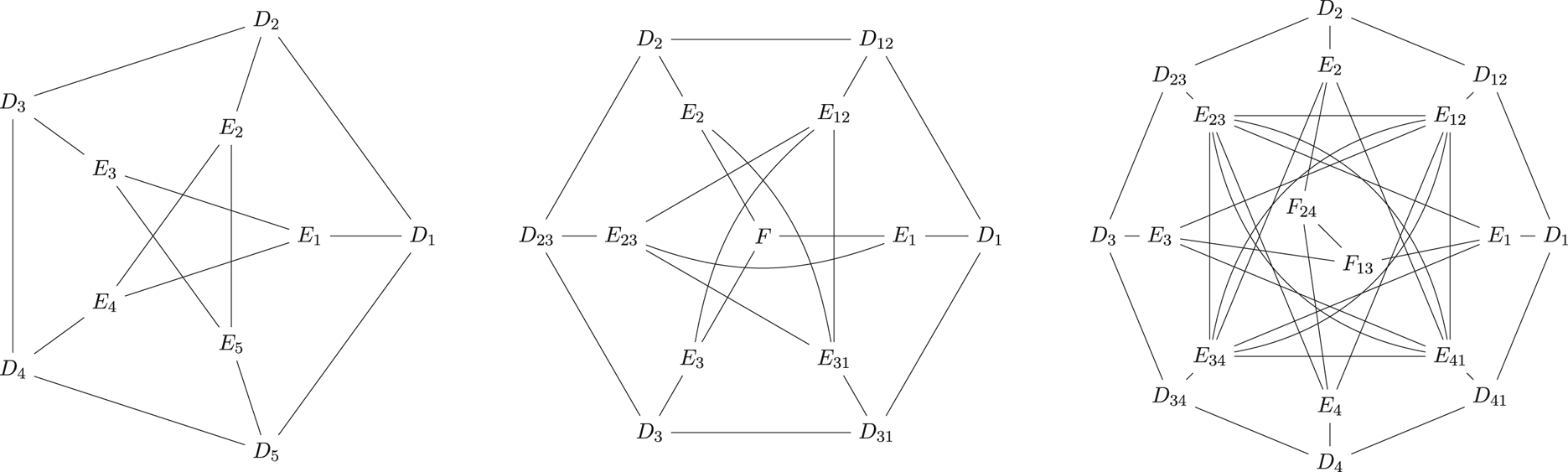
 $D_{ij}$. In each of the three cases there is precisely one
 $(-1)$-curve
 $E_i$ which intersects
 $D_i$ and one
 $(-1)$-curve
 $E_{ij}$ which intersects
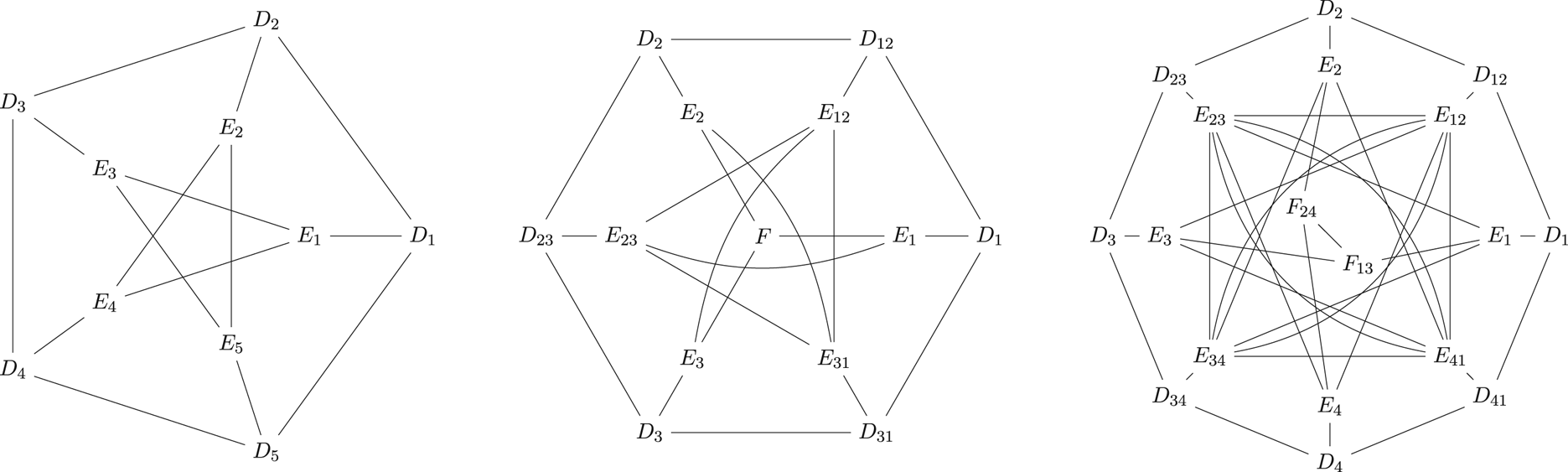
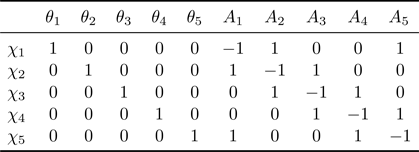
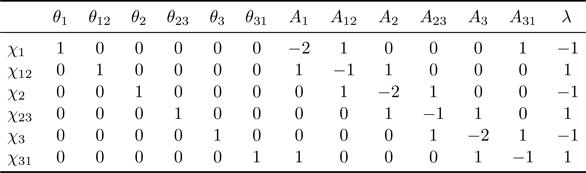
 $D_{ij}$. Figure 4 depicts the dual intersection diagrams for the curves in
 $Y$ belonging to the extremal rays of
 $\operatorname {NE}(Y)$.Footnote 5
Dual intersection diagrams for the extremal curves on  $Y_{\mathsf {A}_2}$,
 $Y_{\mathsf {C}_2}$ and
 $Y_{\mathsf {G}_2}$.
2.1.4 The intersection pairing and the Looijenga roots
We have the usual intersection pairing
 \[ ({\:}\cdot{\:}) \colon N_1(Y)_\mathbb{Q}\times N^{1}(Y)_\mathbb{Q} \to \mathbb{Q} . \]
Let 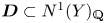 $\boldsymbol {D}\subset N^{1}(Y)_\mathbb {Q}$ be the sublattice
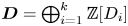 $\boldsymbol {D}=\bigoplus _{i=1}^{k}\mathbb {Z} [D_i]$, spanned by the components of
 $D$. Then elements
 $\alpha$ of the subspace
 \[ \boldsymbol{D}^{\perp}=\{ [C]\in N_1(Y)_\mathbb{Q} : [D]\cdot[C] = 0 \text{ for all }D\in\boldsymbol{D} \}\subset N_1(Y)_\mathbb{Q} \]
satisfying  $\alpha ^{2}=-2$ are called Looijenga roots.Footnote 6 In the
 $\mathsf {A}_2$ case
 $\boldsymbol {D}^{\perp }=\emptyset$, in the
 $\mathsf {C}_2$ case
 $\boldsymbol {D}^{\perp }=\mathbb {Z}[F]$ forms a root system of type
 $\mathsf {A}_1$, and in the
 $\mathsf {G}_2$ case
 $\boldsymbol {D}^{\perp }=\mathbb {Z}\langle [F_{13}],[F_{24}]\rangle$ forms a root system of type
 $\mathsf {A}_2$.
2.2 The mirror family $\mathcal {X}$ and the cluster variety $X$


We now describe the mirror family  $\mathcal {X}$ introduced by Gross, Hacking and Keel and the related cluster variety
 $X$. In both cases these are families of mildly singular (log canonical) surfaces. Thefirst
 $\mathcal {X}$ is defined over a singular base variety
 $B$, whereas
 $X$ is defined over a much nicer base variety
 $\mathbb {A}^{n}$.
2.2.1 The mirror family $\mathcal {X}$

The mirror family  $\mathcal {X}$, for a Looijenga pair
 $(Y,D)$, is a deformation of the vertex
 \[ \mathbb{V}_k = (\mathbb{A}^{2}_{\theta_1,\theta_2} \cup \mathbb{A}^{2}_{\theta_2,\theta_3} \cup \cdots \cup \mathbb{A}^{2}_{\theta_{k-1},\theta_k} \cup \mathbb{A}^{2}_{\theta_k,\theta_1} ) \subseteq \mathbb{A}^{k}_{\theta_1,\ldots,\theta_k}, \]
with  $k$ equal to the number of components of
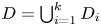 $D=\bigcup _{i=1}^{k}D_i$, defined by introducing theta functions and using the machinery of scattering diagrams. If
 $(Y,D)$ is positive, then the construction yields an algebraic variety
 $\mathcal {X}$ with the following nice properties.
(i)
$\mathcal {X}/B$ is a deformation of $\mathbb {V}_k$ over the affine toric variety:
\[ B := \operatorname{Spec}(\mathbb{C}[\operatorname{NE}(Y)]) = \operatorname{Spec} (\mathbb{C}[ z^{C} : [C] \in \operatorname{NE}(Y) ] ). \](ii)
$\mathcal {X}/B$ is a flat family of affine Gorenstein surfaces with at worst semi-log canonical singularities.(iii) The action of the torus
$\mathbb {T}^{D} = \boldsymbol {D}\otimes \mathbb {C}^{*}$ on $B$, given by
extends uniquely to a\[ \lambda_i\cdot (z^{C}) = \lambda_i^{D_i\cdot C}z^{C} \quad \text{for } i=1,\ldots,k, \]$\mathbb {T}^{D}$-action on $\mathcal {X}$.





Our only problem with trying to use  $\mathcal {X}/B$ as a key variety directly is that the total space
 $\mathcal {X}$ is not Gorenstein, but only relatively Gorenstein.
2.2.2 The cluster variety $X$

For that reason we consider a slightly different family, by first taking the restriction  $\mathcal {X}|_{\mathbb {T}^{n}}$ to the structure torus
 $\mathbb {T}^{n}\subset B$ and then considering the variety
 $X/\mathbb {A}^{n}$, obtained by the compactification
 $\mathbb {T}^{n}\subset \mathbb {A}^{n}$ with respect to some natural choice of coordinates on
 $\mathbb {T}^{n}$:

This choice of coordinates is described in § 3.1 for the  $\mathsf {C}_2$ cluster variety and in § 4.1 for the
 $\mathsf {G}_2$ cluster variety.
2.3 Basic properties
The cluster variety  $X$ inherits all of the good properties of the mirror family
 $\mathcal {X}$. In particular,
 $X$ is an normal affine Gorenstein variety and has a
 $\mathbb {T}^{D}$ action. We summarise some of the basic properties of the cluster variety
 $X$ that will be important later on.
Proposition 2.1 The cluster variety  $X=\operatorname {Spec} \mathcal {A}$ has the following properties:
(i)
$X$ is a normal, prime, Gorenstein, affine variety;(ii)
$X$ has an action by $G\times \mathbb {T}^{D}$ for some finite symmetry group $G$.


Moreover, because of the nice structure of the equations we also have the following lemma.
Lemma 2.2 The cluster variety  $X$ has a partial open covering by complete intersection affine hypersurfaces
 \[ U_i = X \cap( \theta_i \neq 0 ) \quad \text{and} \quad U_{ij} = X \cap( \theta_{ij} \neq 0 ). \]
The complement of these pieces is called the deep locus of  $X$ and breaks up into a union of subvarieties of very high codimension. See § 3.3 for an example.

2.4 The $\mathsf {A}_2$ case

As a warm-up we explain how this works in the  $\mathsf {A}_2$ case.
2.4.1 Equations for the mirror family $\mathcal {X}_{\mathsf {A}_2}$

The equations for  $\mathcal {X}_{\mathsf {A}_2}/B_{\mathsf {A}_2}$ are worked out in [Reference Gross, Hacking and KeelGHK15a, Example 3.7]. To simplify the notation we let
 $A_i=z^{[D_i]}$ and
 $B_i=z^{[E_i]}$. The base variety
 $B_{\mathsf {A}_2}$ is a toric variety defined by 10 equations,
 \[ A_iB_i = A_{i-2}A_{i+2} = B_{i-1}B_{i+1}, \]
and there are five relative equations,
 \[ \theta_{i-1}\theta_{i+1} = A_i\theta_i + A_iB_i, \]
which define  $\mathcal {X}_{\mathsf {A}_2}$ as a scheme over
 $B_{A_2}$. Therefore the total space
 $\mathcal {X}_{\mathsf {A}_2}\subset \mathbb {A}^{5}_{\theta _i}\times \mathbb {A}^{10}_{A_i,B_i}$ is an affine variety of codimension 8 defined by 15 equations. This variety is Cohen–Macaulay, but not Gorenstein.
2.4.2 The cluster variety $X_{\mathsf {A}_2}$

To recover the Grassmannian  $\operatorname {Gr}(2,5)$ we restrict
 $\mathcal {X}$ to the locus
 $\mathcal {X}|_{\mathbb {T}^{5}}\subset \mathcal {X}$ over the structure torus
 $\mathbb {T}^{5}\subset B$. After writing all of the elements of
 $N_1(Y)$ in terms of the basis
 $[D_i]$, the equations become
 \[ \theta_{i-1}\theta_{i+1} = A_i\theta_i + A_{i-2}A_{i+2} \]
which we see to be ideal, given by the  $4\times 4$ maximal Pfaffians of a
 $5\times 5$ skew-symmetric matrix
 \[ \operatorname{Pf}_4\begin{pmatrix} A_5 & \theta_1 & \theta_2 & A_3 \\ & A_2 & \theta_3 & \theta_4 \\ & & A_4 & \theta_5 \\ & & & A_1 \end{pmatrix}. \]
Taking the closure of  $\mathcal {X}|_{\mathbb {T}^{5}}$ over
 $\mathbb {T}^{5}\subset \mathbb {A}^{5}_{A_i}$ gives the cluster variety
 $X_{\mathsf {A}_2}$. Indeed, we see that
 $X_{\mathsf {A}_2}$ is nothing other than the affine cone over the Grassmannian
 $\operatorname {Gr}(2,5)$ in its Plücker embedding.
2.4.3 Symmetries
 $X_{\mathsf {A}_2}$ has the action of the group
 $\operatorname {Dih}_{10}\times \mathbb {T}^{D}$, where
 $\operatorname {Dih}_{10}$ permutes the indices
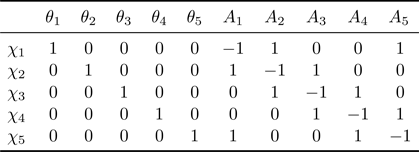
 $\{1,\ldots ,5\}$. The characters for the
 $\mathbb {T}^{D}$-action are given by
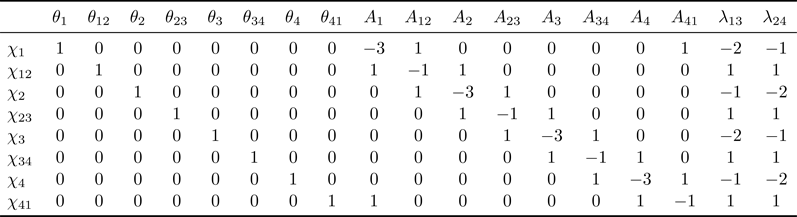
 $\chi _i(z^{C})=D_i\cdot C$, as shown in Table 1.
The character table for  $\mathbb {T}^{D} \curvearrowright X_{\mathsf {A}_2}$.
2.5 Cluster varieties as key varieties
Suppose that  $X=\operatorname {Spec}\mathcal {A}\subset \mathbb {A}^{n}$ is an affine cluster variety with torus action
 $\mathbb {T}^{k}\times X\to X$. Define the character lattice
 $M=\operatorname {Hom}(\mathbb {T}^{k},\mathbb {T})\cong \mathbb {Z}^{k}$ and the dual lattice of one-parameter subgroups
 $M^{\vee }=\operatorname {Hom}(\mathbb {T},\mathbb {T}^{k})$, together with the perfect pairing
 ${\langle {}\cdot {},{}\cdot {}\rangle }\colon M\times M^{\vee }\to \mathbb {Z}$. The following objects are all endowed with an
 $M$-grading induced by the torus action: the coordinate ring
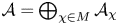 $\mathcal {A}=\bigoplus _{\chi \in M}\mathcal {A}_\chi$, the ambient ring
 $\mathcal {O}_{\mathbb {A}^{n}}$, the minimal free resolution
 $\mathbb {F}$ of
 $\mathcal {A}$ as an
 $\mathcal {O}_{\mathbb {A}^{n}}$-module and the Hilbert series of
 $X$,
 \[ P_X(t_1,\ldots,t_k)=\sum_{\chi\in M}\dim(\mathcal{A}_{\chi})t_1^{\chi_1}\cdots t_k^{\chi_k}. \]
Following the definition of a Gorenstein format by Brown, Kasprzyk and Zhu [Reference Brown, Kasprzyk and ZhuBKZ19], we make the following definition.
Definition 2.4 A cluster format is a triple  $(X,\mu ,\mathbb {F})$ where
 $X\subset \mathbb {A}^{n}$ is a cluster variety,
 $\mu$ is the character of an action
 $\mathbb {T} \curvearrowright X$ and
 $\mathbb {F}$ is a
 $\mathbb {Z}$-graded resolution of
 $\mathcal {A}$ as an
 $\mathcal {O}_{\mathbb {A}^{n}}$-module. If
 $X$ is the cluster variety of finite type
 $\mathsf {T}$ we also call this
 $\mathsf {T}$ format.
In this set-up, a cluster format is determined by the choice of cluster variety  $X$ and a one-parameter subgroup
 $\rho \in M^{\vee }$. For such a
 $\rho$, the action of
 $\lambda \in \mathbb {T}$ on
 $v_\chi \in \mathcal {A}_{\chi }$ is given by
 $\lambda \cdot v_\chi \mapsto \lambda ^{\langle \rho ,\chi \rangle }v_\chi$, and extended to all of
 $\mathcal {A}$ linearly. The degree of
 $v_\chi$ is this exponent, denoted by
 $d(v_\chi ):=\langle \rho ,\chi \rangle$. Thus
 $\rho$ induces a
 $\mathbb {Z}$-grading on
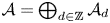 $\mathcal {A}=\bigoplus _{d\in \mathbb {Z}} \mathcal {A}_d$, where
 $\mathcal {A}_d=\bigoplus _{\{\chi \in M : \left <\chi ,\rho \right >=d\}}\mathcal {A}_{\chi }$. The polynomial ring
 $\mathcal {O}_{\mathbb {A}^{n}}$ is
 $\mathbb {Z}$-graded in a similar way, which determines the character
 $\mu =\langle \rho ,\cdot \rangle$ of the
 $\mathbb {T}$-action and a
 $\mathbb {Z}$-grading on
 $\mathbb {F}$.
Fix a cluster format  $(X,\mu ,\mathbb {F})$ of codimension
 $c$ and consider the polynomial ring
 $\mathcal {O}_{\mathbb {A}^{m}}=\mathbb {C}[y_1,\ldots ,y_m]$ with a (positive)
 $\mathbb {Z}$-grading
 $(a_1,\ldots ,a_m)$. Let
 $\phi \colon \mathbb {A}^{m}\to \mathbb {A}^{n}$ be a homogeneous morphism of degree
 $0$ with respect to the given grading on
 $\mathcal {O}_{\mathbb {A}^{m}}$ and the
 $\mu$-grading on
 $\mathcal {O}_{\mathbb {A}^{n}}$ (i.e.
 $\phi$ is
 $\mathbb {T}$-equivariant).
Proposition 2.5 (Cf. [Rei2, Proposition 1.3]) Let  $\widehat Y=\phi ^{-1}(X)\subset \mathbb {A}^{m}$ for a morphism
 $\phi \colon \mathbb {A}^{m}\to \mathbb {A}^{n}$ homogeneous of degree
 $0$, as above. Then
 $\widehat Y$ is called a regular pullback of
 $X$ if one of the following equivalent conditions holds.
(i)
$\widehat Y\subset \mathbb {A}^{m}$ has codimension $c$.(ii) The pullback of
$\mathbb {F}$ by $\phi$ is a free resolution of $\mathcal {O}_{\mathbb {A}^{m}}$-modules.(iii) If
$x_i$ are coordinates on $\mathbb {A}^{n}$, then $x_i-\phi ^{*}(x_i)$ form a regular sequence on $\mathbb {A}^{m}\times \mathbb {A}^{n}$ for $i=1,\ldots ,n$.


The point of the definition is that all of the equations, the syzygies, the Hilbert series, etc. of  $\widehat Y$ come from the cluster format
 $(X,\mu ,\mathbb {F})$ together with the morphism
 $\phi$. Since
 $\phi$ is
 $\mathbb {T}$-equivariant, we may define the weighted projective variety associated to
 $(X,\mu ,\mathbb {F})$ and
 $\phi$ by taking the geometric invariant theory (GIT) quotient
 \[ Y = ( \widehat{Y} \: {/\!\!/}_{\mu} \: \mathbb{T} ) \subset\mathbb{P}(a_1,\ldots,a_m). \]
See Examples 3.4 and 4.4 for details.
Remark 2.6 (i) The character  $\mu$ is allowed to have non-positive weights, since if
 $x_i$ is a coordinate with
 $d(x_i)<0$ then
 $\phi ^{*}(x_i)=0$.
(ii) By considering larger torus actions  $\mathbb {T}^{d}$ for
 $d\leq k$, we could also use
 $X$ as a key variety for the Cox ring of some variation of geometric invariant theory (VGIT) quotient, for example to construct 3-fold flips as with Brown and Reid's diptych varieties [Reference Brown and ReidBR17], divisorial extractions as in [Reference DucatDuc15], or Sarkisov links in the style of Brown and Zucconi [Reference Brown and ZucconiBZ10].
In this paper we consider the first generalisation. Our convention is always to assume that  $\phi$ is a generic morphism, and therefore that
 $\phi ^{*}(v)\neq 0$ is a non-zero constant if
 $d(v)=0$.
We end this section with a useful lemma.
Lemma 2.7 (Singularity avoidance lemma) Let  $\widehat {Y}=\phi ^{-1}(X)$ be a regular pullback where
 $\phi \colon \mathbb {A}^{m} \to \mathbb {A}^{n}$ is a morphism of graded degree
 $0$.
(i)
$\phi ^{-1} (\operatorname {sing}(X) ) \subseteq \operatorname {sing}(\widehat Y)$.(ii) Let
$\Pi =V(f_1,\ldots ,f_c)\subset \mathbb {A}^{n}$ be a homogeneous complete intersection of codimension $c\leq m$. Then either
(a)
$\phi ^{-1}(\Pi ) = \emptyset$, which happens if and only if $d(f_i)=0$ and $\phi ^{*}(f_i)\neq 0$ for some $i$, or(b)
$\dim \phi ^{-1}(\Pi )\geq m-c$.
(iii) If
$\widehat Y$ is the affine cone over a quasismooth weighted projective variety $Y$, then $\phi ^{-1} ( \operatorname {sing}(X) )$ is at worst the cone point $P\in \widehat Y$. Moreover, if $\Pi \subseteq \operatorname {sing}(X)$ is a homogeneous complete intersection in $\mathbb {A}^{n}$ of codimension less than $m$, then $d(f)=0$ and $\phi ^{*}(f)\neq 0$ for some generator $f\in I(\Pi )$.









Proof. Suppose  $X$ is defined by equations
 $g_1,\ldots ,g_d$ in variables
 $x_1,\ldots ,x_n$ and
 $\widehat Y$ is defined by equations
 $h_1,\ldots ,h_d$ in variables
 $y_1,\ldots ,y_m$, where
 $h_i(y_1,\ldots ,y_n) = g_i(\phi ^{*}(x_1), \ldots , \phi ^{*}(x_n))$ for all
 $i$. Now, by the chain rule for differentiation, we have
 \[ \operatorname{Jac}(\widehat Y) = \left(\frac{\partial h_i}{\partial y_j}\right) = \phi^{*}\left(\frac{\partial g_i}{\partial x_k}\right)\cdot\left(\frac{\partial\phi^{*}(x_k)}{\partial y_j}\right) = \phi^{*}(\operatorname{Jac}(X))\cdot \operatorname{Jac}(\phi), \]
and when the rank of  $\operatorname {Jac}(X)$ is less than
 $c$ then the rank of
 $\operatorname {Jac}(\widehat Y)$ must be less than
 $c$. This proves statement (i).
Statement (ii) follows from  $\phi ^{-1}(\Pi ) = V(\phi ^{*}(f_1),\ldots ,\phi ^{*}(f_c)) \subset \mathbb {A}^{n}$, which is an intersection of
 $c$ homogeneous polynomials in
 $\mathbb {A}^{m}$. These define a locus of dimension at least
 $m-c$, unless one
 $\phi ^{*}(f_i)$ is identically non-zero. This can only happen if
 $d(f_i)=0$ and
 $\phi ^{*}(f_i)\neq 0$.
Statement (iii) follows directly from (i) and (ii).
Remark 2.8 In our situation,  $\phi \colon \mathbb {A}^{m}\to \mathbb {A}^{n}$ is usually a generic immersion. One might ask whether
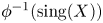 $\phi ^{-1}(\operatorname {sing}(X))$ being empty implies that
 $\operatorname {sing}(\widehat Y)$ is empty. This is not true; the rank of
 $\operatorname {Jac}(\widehat Y)$ may drop if the image of
 $\operatorname {Jac}(\phi )$ intersects too much of the kernel of
 $\phi ^{*}(\operatorname {Jac}(X))$. See § 6.3 for examples.
Remark 2.9 Our codimension 4 cluster formats determine certain loci inside  $\text {SpH}_8$, the Spin-Hom variety introduced by Reid in [Reference ReidRei15]. The main theorem of [Reference ReidRei15] puts codimension 4 Gorenstein ideals
 $I$ into correspondence with regular pullbacks by suitable morphisms
 $\varphi \colon \mathbb {A}^{n}\to \text {SpH}_k$, thus
 $\text {SpH}_k$ acts as a key variety for the
 $(k+1)\times 2k$ first syzygy matrix of
 $I$. We specify a grading on
 $\operatorname {Mor}(\mathbb {A}^{8},\text {SpH}_8)$ and only consider those morphisms landing in the cluster locus. We classify the components of this space which correspond to quasismooth varieties. This is a tractable case of a question raised in [Reference ReidRei15, § 4.8].
3. $\mathsf {C}_2$ cluster format

Recall that the cluster variety  $X_{\mathsf {C}_2}\subset \mathbb {A}^{13}$ is the affine Gorenstein
 $9$-fold in codimension
 $4$ described in § 1.2.1. We now describe how to derive equations (1.1) defining
 $X_{\mathsf {C}_2}$ from the mirror family
 $\mathcal {X}_{\mathsf {C}_2}$. Throughout the whole of this section we consider subscripts
 $(i,j,k)$ in all formulae to vary over all of the
 $\operatorname {Dih}_6$-permutations of
 $(1,2,3)$.
3.1 The equations for $\mathsf {C}_2$ format

Recall that the mirror family  $\mathcal {X}_{\mathsf {C}_2}$ is defined over a toric basic variety
 $B_{\mathsf {C}_2}=\operatorname {Spec}(\mathbb {C}[\operatorname {NE}(Y_{\mathsf {C}_2})])$.
3.1.1 The toric base $B_{\mathsf {C}_2}$

In this case  $B_{\mathsf {C}_2}$ is a singular affine toric variety with 18 equations of the form
 $z^{X}=z^{Y}$, where
 $X=Y$ is a linear relation in
 $N_1(Y_{\mathsf {C}_2})$ for some classes
 $X,Y\in \operatorname {NE}(Y_{\mathsf {C}_2})$. We only write down six of these 18 equations, which will be relevant to the following calculation:
 \begin{equation} \begin{aligned} [D_i]+2[E_i]+[F] &= [D_j]+2[D_{jk}]+[D_k], \\ [D_{ij}]+[E_{ij}] &= [D_{jk}]+[D_k]+[D_{ki}]. \end{aligned} \end{equation}
3.1.2 The mirror family $\mathcal {X}_{\mathsf {C}_2}$

In this case, the mirror family  $\mathcal {X}_{\mathsf {C}_2}/B_{\mathsf {C}_2}$ is defined by nine relative equations. These nine equations are determined by the six tag equations
 \begin{align*} \theta_i\theta_j &= z^{D_{ij}}(\theta_{ij} + z^{E_{ij}}), \\ \theta_{ij}\theta_{jk} &= z^{D_j}(\theta_j + z^{E_j})(\theta_j + z^{E_j+F}), \end{align*}
where the monomials appearing in the right-hand side of these equations come from counting certain classes of rational curves on  $Y_{\mathsf {C}_2}$. In general, the expectation that the coefficients appearing in the mirror algebra can be interpreted in terms of the enumerative geometry of
 $Y$ is described in [Reference Gross and SiebertGS18].
In the case above, the first tag equation is of the form  $\theta _i\theta _j=\sum _{m=1}^{2}z^{[\Sigma _m]}\theta _{ij}^{-D_{ij}\cdot \Sigma _m}$, where
 $[\Sigma _1]=[D_{ij}]$ and
 $[\Sigma _2]=[D_{ij}]+[E_{ij}]$ are the two classes of an effective rational curve
 $\Sigma \subset Y_{\mathsf {C}_2}$ such that
 $\Sigma \cdot D_i=\Sigma \cdot D_j =1$, and
 $\Sigma \cdot D'=0$ for all other irreducible components in the boundary
 $D'\subset D$. Similarly, the second tag equation is
 $\theta _{ij}\theta _{jk}=\sum _{m=1}^{4}z^{[\Sigma _m]}\theta _j^{-D_j\cdot \Sigma _m}$, where
 $[\Sigma _1]=[D_j]$,
 $[\Sigma _2]=[D_j]+[E_j]$,
 $[\Sigma _3]=[D_j]+[E_j]+[F]$ and
 $[\Sigma _4]=[D_j]+2[E_j]+[F]$ are the four classes of an effective rational curve
 $\Sigma \subset Y_{\mathsf {C}_2}$ such that
 $\Sigma \cdot D_{ij}=\Sigma \cdot D_{jk} =1$, and
 $\Sigma \cdot D'=0$ for all other irreducible components in the boundary
 $D'\subset D$. The remaining equations, which are of the form
 $\theta _i\theta _{jk}=\cdots$, can be obtained either by a similar calculation (i.e. finding the relevant classes of rational curves passing between
 $D_i$ and
 $D_{jk}$) or by simply calculating the relation which is implied birationally from the tag equations.Footnote 7
Remark 3.1 Since we are primarily concerned with the existence of  $X_{\mathsf {C}_2}$ we do not take the time to give a rigorous proof of this description. To do that one would either have to calculate the relevant Gromov–Witten invariants for
 $Y$ or (similarly to [Reference Gross, Hacking and KeelGHK15a, Example 3.7]) show that there is a consistent scattering diagram with six rays, corresponding to the six cluster variables, with the attached functions
 $z^{D_{ij}}(1 + z^{E_{ij}}\theta _{ij}^{-1})$ and
 $z^{D_j}(1 + z^{E_j}\theta _j^{-1})(1 + z^{E_j+F}\theta _j^{-1})$.
3.1.3 The cluster variety $X_{\mathsf {C}_2}$

We write  $N_1(Y_{\mathsf {C}_2})=\boldsymbol {D} \oplus \mathbb {Z}[\delta ]$, according to the
 $\mathbb {Q}$-basis
 $[D_1],\ldots ,[D_{31}],\delta$, where
 \[ \delta=\tfrac 12([D_1]+[D_2]+[D_3]-[F]) = \pi_{\mathsf{C}_2}^{*}H - D_{12} - D_{23} - D_{31}, \]
in which  $\pi _{\mathsf {C}_2}$ is as in § 2.1.2 and
 $H$ is the hyperplane class on
 $\mathbb {P}^{2}$. The reason for this choice of basis is that, by the equations for
 $B_{\mathsf {C}_2}$ (3.1), we have:
 \begin{align*} [E_i] &= [D_{jk}] - [D_i] + \delta, \\ [E_{ij}] &= [D_{jk}] + [D_k] + [D_{ki}] - [D_{ij}], \end{align*}
which allows us to eliminate the coefficients  $z^{E_i}$,
 $z^{E_{ij}}$ in a
 $\operatorname {Dih}_6$-invariant way. After doing this, and setting
 $A_i:=z^{D_i}$,
 $A_{ij}:=z^{D_{ij}}$ and
 $\lambda :=z^{\delta }(1+z^{F})$ to simplify the notation, we arrive at our desired equations (1.1), albeit defined over the torus
 $\mathbb {T}^{7}_{A_1,\ldots ,A_{31},\lambda }$. Since all the exponents that appear in the equations are positive and integral, the equations defining
 ${\mathcal {X}_{\mathsf {C}_2}}|_{\mathbb {T}^{7}}$ immediately extend to obtain the cluster variety
 $X_{\mathsf {C}_2}/\mathbb {A}^{7}$.
3.1.4 Symmetries
The cluster variety  $X_{\mathsf {C}_2}$ has the action of
 $\operatorname {Dih}_6\times \mathbb {T}^{6}$, where
 $\operatorname {Dih}_6$ permutes the indices
 $\{1,2,3\}$. The torus action
 $\mathbb {T}^{6}=\mathbb {T}^{D} \curvearrowright X_{\mathsf {C}_2}$ is determined by the six characters
 $\chi _i$,
 $\chi _{ij}$, as defined in § 2.2.1. Since
 $\delta \cdot [D_i]=-1$ for all
 $i$ and
 $\delta \cdot [D_{ij}]=1$ for all
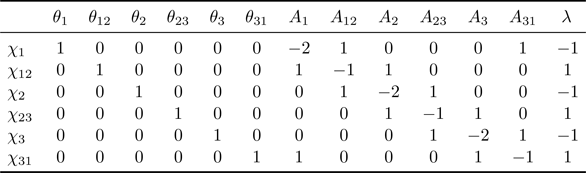
 $i,j$, the character table for
 $\mathbb {T}^{D} \curvearrowright X_{\mathsf {C}_2}$ is given by Table 2.
The character table for  $\mathbb {T}^{D}\curvearrowright X_{\mathsf {C}_2}$.
3.2 Alternative presentations for $\mathsf {C}_2$ format

The nine equations (1.1) can be presented in a number of different ways.
3.2.1 Crazy Pfaffian format
The equations can be written in a  $6\times 6$ crazy Pfaffian format:
 \[\operatorname{Pf}_4\begin{pmatrix} A_3A_{31} & \theta_1 & \theta_{12} & A_2\theta_2 + \lambda A_{31} & A_2A_{23}A_3 + \lambda \theta_1 \\ & A_{12} & \theta_2 & \theta_{23} & A_3\theta_3 + \lambda A_{12} \\ & & A_{23} & \theta_3 & \theta_{31} \\ & & & A_{31}A_1 & A_1\theta_1 \\ & & & & A_1A_{12}A_2 \end{pmatrix} \]
where the variables  $A_1,A_2,A_3$ are floating factors. In other words, after expanding these Pfaffians some of the relations are found to be divisible by
 $A_1$,
 $A_2$ or
 $A_3$. In crazy Pfaffian format we allow ourselves to divide by these floating factors wherever possible. In particular, if we set
 $A_1=A_2=A_3=1$ and
 $\lambda =0$ then we recover the codimension 4 extrasymmetric format which first appeared in Dicks’ thesis [Reference DicksDic88], and now in many other places.
3.2.2 Triple unprojection structure
Eliminating  $\theta _{12},\theta _{23},\theta _{31}$ from
 $\mathcal {A}_{\mathsf {C}_2}$ gives a Gorenstein projection
 $X_{\mathsf {C}_2}\dashrightarrow Z$ where
 $Z$ is the hypersurface:
 \[ \theta_1\theta_2\theta_3 = A_{31}A_1A_{12}\theta_1 + A_{12}A_2A_{23}\theta_2 + A_{23}A_3A_{31}\theta_3 + \lambda A_{12}A_{23}A_{31}. \]
This variety  $Z$ is a family of affine cubic surfaces over
 $\mathbb {A}^{7}_{A_i,A_{ij},\lambda }$ whose general member has three lines at infinity meeting at three
 $\tfrac 12(1,1)$ singularities, obtained by contracting the three
 $(-2)$-curves in the boundary divisor of
 $Y_{\mathsf {C}_2}$. The variable
 $\theta _{ij}$ can be recovered from
 $Z$ as a serial Gorenstein type I unprojection of the divisor
 $\Pi _{ij}=V(A_{ij},\theta _k)$. This gives rise to the following description as an interlaced
 $4\times 4$-Pfaffian format for the three matrices:
 \begin{equation} \operatorname{Pf}_4 \begin{pmatrix} A_kA_{ki} & \theta_i & \theta_{ij} & A_j\theta_j + \lambda A_{ki} \\ & A_{ij} & \theta_j & \theta_{jk} \\ & & A_{jk} & \theta_k \\ & & & A_{ki}A_i \end{pmatrix} \end{equation}
where two Pfaffian equations in each matrix are repeated in one of the other two matrices. From any one of these three matrices,  $X_{\mathsf {C}_2}$ is given by unprojecting the Tom
 $_{3}$ ideal
 $(A_{ki},\theta _{ij},\theta _{j},\theta _{jk})$ with unprojection variable
 $\theta _{ki}$.
3.2.3 Papadakis and Neves’ $\binom {n}{2}$ Pfaffian format

Papadakis and Neves [Reference Papadakis and NevesPN09] define the  $\binom n2$ Pfaffian format as a series of parallel type I unprojections from a certain codimension 1 ring. When
 $n=3$ (and in different notation from [Reference Papadakis and NevesPN09]) it is given by the parallel unprojection of the three ideals
 $(u_1,v_1)$,
 $(u_2,v_2)$,
 $(u_3,v_3)$ contained in the hypersurface:
 \[ Cu_1u_2u_3 - D_1v_1u_2u_3 \!-\! D_2u_1v_2u_3 - D_3u_1u_2v_3 \!+\! E_1u_1v_2v_3 + E_2v_1u_2v_3 \!+\! E_3v_1v_2u_3 - Fv_1v_2v_3 = 0. \]
The result is a Gorenstein ring in codimension 4 with  $9\times 16$ equations and syzygies. For
 $(i,j,k)$ any
 $\operatorname {Dih}_6$-permutation of
 $(1,2,3)$, the nine equations are
 \begin{align*} w_iu_i &= D_iu_ju_k - E_ju_jv_k - E_ku_kv_j + Fv_jv_k, \\ w_iv_i &= Cu_ju_k - D_ju_kv_j - D_ku_jv_k + E_iv_jv_k, \\ w_jw_k &= (D_jD_k - CE_i)u_i^{2} + (CF + D_iE_i - D_jE_j - D_kE_k)u_iv_i + (E_jE_k - D_iF)v_i^{2}, \end{align*}
and (as can be seen from the hypersurface model  $Z$ of § 3.2.2) if we set
 \[ (u_i,\; v_i,\; w_i;\; C,\; D_i,\; E_i,\; F)\mapsto(\theta_i,\; A_{jk},\; \theta_{jk};\; 1,\; 0,\; -A_i,\; \lambda) \]
then we recover  $X_{\mathsf {C}_2}$. The
 $\binom 32$ Pfaffians ring has symmetry groupFootnote 8
 $\operatorname {BDih}_6\times \mathbb {T}^{7}$ which is slightly larger than
 $\operatorname {Dih}_6\times \mathbb {T}^{6}$, the symmetry group of
 $X_{\mathsf {C}_2}$.
Remark 3.2 The reason why we stick to the cluster algebra format and do not consider this more general format is mainly due to computational advantage. Even though this ring is not that much bigger than  $\mathcal {A}_{\mathsf {C}_2}$ (and has greater symmetry) in almost all computations the computer has a much harder time working with it. For example, the decomposition of
 $\binom 32$ Pfaffian format into affine charts is more complicated than for
 $X_{\mathsf {C}_2}$, which is worked out next.
Question: Can we also obtain the  $\binom {3}{2}$ Pfaffians variety from
 $\mathcal {X}_{\mathsf {C}_2}$? It seems a little suspicious that the rank of the torus action is now bigger, and that part of the symmetry switches cluster variables
 $\theta _{ij}$ with coefficients
 $A_{ij}$.
3.3 Affine pieces and the deep locus
We explain in more detail the partial covering of the  $\mathsf {C}_2$ cluster variety from Lemma 2.2. In the locus where the cluster variable
 $\theta _{12}$ does not vanish, the equations defining
 $X_{\mathsf {C}_2}\cap (\theta _{12}\neq 0)$ reduce to
 $\operatorname {CI}^{(4)}$:
 \begin{align*} \theta_{31}\theta_{12} &= A_1\theta_1^{2} + \lambda A_{23}\theta_1 + A_2A_{23}^{2}A_3, \\ \theta_{12}\theta_{23} &= A_2\theta_2^{2} + \lambda A_{31}\theta_2 + A_3A_{31}^{2}A_1, \\ \theta_1\theta_2 &= A_{12}\theta_{12} + A_{23}A_3A_{31}, \\ \theta_3\theta_{12} &= A_{31}A_1\theta_1 + \lambda A_{23}A_{31} + A_2A_{23}\theta_2. \end{align*}
Similarly, if any of the other cluster variables  $\theta _i$,
 $\theta _{ij}$ are non-vanishing, the equations also reduce to
 $\operatorname {CI}^{(4)}$. Therefore
 $X_{\mathsf {C}_2}$ is partly covered by six affine
 $\operatorname {CI}^{(4)}$ charts and the remaining ‘deep locus’
 $X_0=X\cap V(\theta _1,\theta _{12},\theta _2,\theta _{23},\theta _3,\theta _{31})$ decomposes into 11 pieces. Up to the
 $\operatorname {Dih}_6$ symmetry, these are
 \begin{align*} \mathbb{A}^{4}_{A_1,A_2,A_3,\lambda} &= V(\theta_1,\ldots,\theta_{31},A_{12},A_{23},A_{31}), \\ \mathbb{A}^{4}_{A_{23},A_{31},A_1,A_2} &= V(\theta_1,\ldots,\theta_{31},A_3,A_{12},\lambda), \\ \mathbb{A}^{4}_{A_{31},A_2,A_3,\lambda} &= V(\theta_1,\ldots,\theta_{31},A_1,A_{12},A_{23}), \\ \mathbb{A}^{3}_{A_{12},A_{23},A_{31}} &= V(\theta_1,\ldots,\theta_{31},A_1,A_2,A_3,\lambda). \end{align*}
3.4 Regular pullbacks from $\mathsf {C}_2$ format

Let  $(X_{\mathsf {C}_2},\mu ,\mathbb {F})$ be a
 $\mathsf {C}_2$ format determined by the one-parameter subgroup
 \[ \rho=(\rho_1,\ldots,\rho_{31})\colon\mathbb{C}^{*}\to\mathbb{T}^{D}. \]
The action on  $X_{\mathsf {C}_2}$ is readily computed from Table 2; we just multiply the matrix of torus weights on the left by
 $\rho$ to obtain
 $d(\theta _i)=\rho _i$,
 $d(\theta _{ij})=\rho _{ij}$,
 $d(A_i)=\rho _{ki}-2\rho _i+\rho _{ij}$,
 $d(A_{ij})=\rho _i-\rho _{ij}+\rho _j$ and
 $d(\lambda )=\rho _{12} + \rho _{23} + \rho _{31} - \rho _1 - \rho _2 - \rho _3$.
We use the shorthand
 \[\mathsf{C}_2\left(\begin{array}{@{}ccc} \phi^{*}(\theta_{12}) & \phi^{*}(\theta_{23}) & \phi^{*}(\theta_{31})\\ \phi^{*}(A_{12}) & \phi^{*}(A_{23}) & \phi^{*}(A_{31})\end{array}\Bigg| \begin{array}{ccc} \phi^{*}(\theta_1) & \phi^{*}(\theta_2) & \phi^{*}(\theta_3)\\ \phi^{*}(A_1)& \phi^{*}(A_2) & \phi^{*}(A_3) \end{array}\Bigg|\ \phi^{*}(\lambda)\right)\]
to write down a regular pullback from  $\mathsf {C}_2$ format, and the same array with integer entries if we wish to denote a generic pullback with given degrees.
The  $M$-graded Hilbert series of
 $X_{\mathsf {C}_2}$ can be computed using Macaulay2 (or even by hand), and we can easily translate this into the
 $\mathbb {Z}$-graded Hilbert series of
 $(X_{\mathsf {C}_2},\mu ,\mathbb {F})$:
 \[ P_{(X_{\mathsf{C}_2},\mu,\mathbb{F})}(t) = P_{X_{\mathsf{C}_2}}(t^{\rho_1},t^{\rho_{12}},t^{\rho_2},t^{\rho_{23}},t^{\rho_3},t^{\rho_{31}}). \]
The resolution  $\mathbb {F}$ is Gorenstein codimension 4 with nine relations and 16 syzygies, and the Hilbert numerator is of the form
 \[ 1 - \sum(t^{\rho_i+\rho_j}+t^{\rho_{ij}+\rho_{jk}}+t^{\rho_i+\rho_{jk}}) + \cdots + t^{\alpha}, \]
where the adjunction number is  $\alpha =\rho _1+\rho _{12}+\rho _2+\rho _{23}+\rho _3+\rho _{31}$.
3.5 Singular locus
We want to construct quasismooth three-dimensional varieties via regular pullback from a key variety  $X$ that turns out to be rather singular. According to Lemma 2.7, we have to control the dimension of the pullback of
 $\operatorname {sing}(X)$, so we first compute the singular locus of
 $X_{\mathsf {C}_2}$ and of some distinguished subvarieties of
 $X_{\mathsf {C}_2}$.
Lemma 3.3 The reduced singular locus of  $X_{\mathsf {C}_2}$ is contained in the deep locus
 \[ \operatorname{sing}(X_{\mathsf{C}_2}) \subset X_0 = X_{\mathsf{C}_2}\cap V(\theta_1,\theta_{12},\theta_2,\theta_{23},\theta_3,\theta_{31}) \]
and decomposes into four irreducible linear subvarieties, given by
 \[ \mathbb{A}^{4}_{A_1,A_2,A_3,\lambda} = X_0\cap V(A_{12},A_{23},A_{31}) \quad \text{and} \quad \mathbb{A}^{2}_{A_i,A_{jk}} = X_0\cap V(A_{ij},A_j,A_k,A_{ki},\lambda). \]
In particular, all components of the singular locus have codimension at least  $5$ in
 $X_{\mathsf {C}_2}$.
Moreover, the singular locus of the hyperplane section  $X^{z} := X_{\mathsf {C}_2}\cap V(z)$ contains the following bad components of codimension at least
 $3$.
(i)
$\operatorname {sing}(X^{\theta _i})$ is contained in the locus $X^{\theta _i}_0:=X^{\theta _i}\cap V(\theta _{ij},\theta _j,\theta _k,\theta _{ki})$ and contains the following component which has codimension $3$ in $X^{\theta _i}$:
\[ \mathbb{A}^{5}_{\theta_{jk},A_i,A_j,A_k,\lambda} = X^{\theta_i}_0 \cap V(A_{ij},A_{jk},A_{ki}). \](ii)
$\operatorname {sing}(X^{\theta _{ij}})$ contains the following component which has codimension $1$ in $X^{\theta _{ij}}$:
\[ X^{\theta_{ij}}\cap V(\theta_i,\theta_j,A_{jk},A_{ki}). \](iii)
$\operatorname {sing}(X^{A_i})$ is contained in the locus $X^{A_i}_0:=X^{A_i}\cap V(\theta _{ij},\theta _j,\theta _{jk},\theta _k,\theta _{ki})$ and contains the following component which has codimension $3$ in $X^{A_i}$:
\[ \mathbb{A}^{5}_{\theta_i,A_{ij},A_j,A_k,A_{ki}} = X^{A_i}_0 \cap V(A_i,A_{jk},\lambda). \](iv)
$\operatorname {sing}(X^{A_{ij}})$ is contained in the locus $X^{A_{ij}}_0:=X^{A_{ij}}\cap V(\theta _j,\theta _{jk},\theta _k,\theta _{ki},\theta _i)$ and contains the following component which has codimension $3$ in $X^{A_{ij}}$:
\[ \mathbb{A}^{5}_{\theta_{ij},A_i,A_j,A_k,\lambda} = X^{A_{ij}}_0 \cap V(A_{ij},A_{jk},A_{ki}). \]










Proof. The statements about singular loci can easily be checked by using Macaulay2 or Magma (cf. [Reference ReidRei1, Theorem 1.1]). Note that if  $\theta _{ij}=0$ then
 $T = {A_i\theta _i}/{A_{jk}} = {A_j\theta _j}/{A_{ki}}$ are solutions to the equation
 $T^{2} + \lambda T + A_1A_2A_3 = 0$ in the ring
 $\mathcal {O}_{X^{\theta _{ij}}}$, so
 $X^{\theta _{ij}}$ is not normal. Since
 $X^{\theta _{ij}}$ is Gorenstein, and hence
 $S_2$, it must be singular in codimension 1.
3.6 Quasismoothness conditions
Let  $\widehat Y \subset \mathbb {A}^{8}$ be the four-dimensional affine cone over a quasismooth weighted projective 3-fold
 $Y\subset w\mathbb {P}^{7}$ given as a regular pullback of the
 $\mathsf {C}_2$ cluster variety. The following proposition lists the conditions imposed on the format by avoiding large components in the singular locus of
 $X_{\mathsf {C}_2}$.
Proposition 3.4 Suppose that 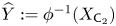 $\widehat Y := \phi ^{-1}(X_{\mathsf {C}_2})$ is a regular pullback and is not a complete intersection. Then, for all
 $i,j$, we must have
 $d(\theta _i)>0$,
 $d(\theta _{ij})>0$ and one of the following conditions must hold.
(i) If
$d(A_{ij})>0$ for all $i,j$ and $d(\lambda )>0$, then we say $\widehat {Y}$ is in $\mathsf {C}_2$ format. In this case, $d(A_i)\geq 0$ for all $i$.(ii) If
$d(A_{ij})>0$ for all $i,j$ and $d(\lambda )=0$, then we say $\widehat Y$ is in $\mathbb {P}^{2}\times \mathbb {P}^{2}$ format. In this case, either
(a)
$d(A_1)=d(A_2)=d(A_3)=0$, or(b)
$d(A_i)<0$ for some $i$.
(iii) If
$d(A_{ij})=0$ then we say $\widehat {Y}$ is in $\mathsf {A}_2+\operatorname {CI}^{(1)}$ format. In this case, all of $A_i$, $A_{jk}$, $A_{ki}$, $A_j$, $\lambda$ have positive degree.





Proof. If  $d(\theta _i)=0$ for some
 $i$, or if
 $d(\theta _{ij})=0$ for some
 $i,j$, then we can eliminate most of the equations to be left with a
 $\operatorname {CI}^{(4)}$. Therefore we may assume that
 $d(\theta _i)\neq 0$ and
 $d(\theta _{ij})\neq 0$ for all
 $i,j$.
We now prove that the stated conditions on the degrees of the variables hold through the following series of claims. We repeatedly use the following argument: if a variable  $z$ has degree
 $d(z)<0$ then
 $\phi ^{*}(z)=0$, and hence
 $\phi$ must factor as a regular pullback from
 $X^{z}$. Then, by Lemma 2.7(iii), some of the other variables must be non-vanishing and constant in order to avoid pulling back the bad components in
 $\operatorname {sing}(X^{z})$ of codimension at least
 $3$, listed in Lemma 3.3.
Claim 1 Any one of  $d(\theta _i)<0$,
 $d(\theta _{ij})<0$ or
 $d(A_{ij})<0$ cannot happen.
If  $d(\theta _i)<0$ then
 $\phi$ factors through
 $X^{\theta _i}$ and, in order to avoid pulling back the bad component of Lemma 3.3(i), we must have
 $d(A_{ij})=0$,
 $d(A_{jk})=0$ or
 $d(A_{ki})=0$. This puts us in case (iii) below, but with a zero entry appearing in the Pfaffian matrix. Hence
 $\widehat {Y}$ will fail to be quasismooth, by [Reference Brown, Kasprzyk and ZhuBKZ19, Proposition 2.7]. Similarly for the cases
 $d(\theta _{ij})<0$ and
 $d(A_{ij})<0$.
Claim 2 If  $d(A_i)<0$ for some
 $i$, then we are either in case (ii)(b) or case (iii).
To avoid pulling back the bad component of  $\operatorname {sing}(X^{A_i})$ we need either
 $d(\lambda )=0$, which puts us in case (ii)(b), or
 $d(A_{jk})=0$, which puts us in case (iii).
Claim 3 If  $d(\lambda )=0$ then we are in case (ii), and
 $d(\lambda )<0$ cannot happen.
From Table 2 we have the relation  $2d(\lambda ) = d(A_1) + d(A_2) + d(A_3)$. Therefore
 $d(\lambda )=0$ implies either that
 $d(A_1)=d(A_2)=d(A_3)=0$ or that
 $d(A_i)<0$ for some
 $i$, which are the two conditions of case (ii). If
 $d(\lambda )<0$ then
 $d(A_i)<0$ for some
 $i$ and by Claim 2 we end up in case (iii), but with a zero entry in the Pfaffian matrix. Hence
 $\widehat {Y}$ will not be quasismooth, as in the conclusion of Claim 1.
This completes the analysis of the allowed degrees in cases (i)–(iii). We now show that case(ii) is equivalent to  $\mathbb {P}^{2}\times \mathbb {P}^{2}$ format and case (iii) is equivalent to
 $\mathsf {A}_2+\operatorname {CI}^{(1)}$ format.
Case (ii) is  $\mathbb {P}^{2}\times \mathbb {P}^{2}$ format. In case (ii)(a),
 $\phi$ factors through the regular pullback of
 $X_{\mathsf {C}_2}$ by the morphism
 $\phi _1\colon \mathbb {A}^{9}\to \mathbb {A}^{13}$, given by
 $\phi _1^{*}(\lambda ) = \phi _1^{*}(A_1) = \phi _1^{*}(A_2) = \phi _1^{*}(A_3) = 1$ and
 $\phi _1^{*}(z)=z$ for all other variables. If we make the change of variables
 $X_i=(1+\omega )(\theta _i-\omega A_{jk})$ and
 $Y_i=(1+\omega ^{2})(\theta _i-\omega ^{2}A_{jk})$ for
 $\omega$ a primitive third root of unity, the equations defining
 $\phi _1^{-1}(X_{\mathsf {C}_2})$ can be written as
 \[ \bigwedge^{2}\begin{pmatrix} -\theta_{12} & X_2 & Y_1 \\ Y_2 & -\theta_{23} & X_3 \\ X_1 & Y_3 & -\theta_{31} \end{pmatrix} = 0, \]
so that  $\phi _1^{-1}(X_{\mathsf {C}_2})$ is a regular pullback from
 $\mathbb {P}^{2}\times \mathbb {P}^{2}$ format.
In case (ii)(b), pulling back  $X_{\mathsf {C}_2}$ by the morphism
 $\phi _2\colon \mathbb {A}^{11}\to \mathbb {A}^{13}$ given by
 $\phi _2^{*}(\lambda ) = 1$,
 $\phi _2^{*}(A_i) = 0$ and
 $\phi _2^{*}(z)=z$ for all other variables, gives
 \[ \bigwedge^{2}\begin{pmatrix} \theta_{ij} & A_j\theta_j + A_{ki} & A_jA_{jk}A_k + \theta_i \\ \theta_j & \theta_{jk} & A_k\theta_k + A_{ij} \\ A_{jk} & \theta_k & \theta_{ki} \end{pmatrix} = 0, \]
so that  $\phi _2^{-1}(X_{\mathsf {C}_2})$ can also be rewritten as a regular pullback from
 $\mathbb {P}^{2}\times \mathbb {P}^{2}$ format.
Case (iii) is  $\mathsf {A}_{2}+\operatorname {CI}^{(1)}$ format. In case (iii), pulling back
 $X_{\mathsf {C}_2}$ by the morphism
 $\phi _3\colon \mathbb {A}^{12}\to \mathbb {A}^{13}$ given by
 $\phi _3^{*}(A_{ij}) = 1$ and
 $\phi _3^{*}(z)=z$ for all other variables, gives
 \[ \operatorname{Pf}_4 \begin{pmatrix} A_i & \theta_j & \theta_{jk} & A_k\theta_k + \lambda \\ & A_{jk} & \theta_k & \theta_{ki} \\ & & A_{ki} & \theta_i \\ & & & A_j \end{pmatrix} = 0 \quad \text{and} \quad \theta_{ij} = \theta_i\theta_j - A_{jk}A_kA_{ki}. \]
Therefore,  $\phi _3^{-1}(X_{\mathsf {C}_2})$ can be rewritten as a regular pullback from a hypersurface inside
 $\operatorname {Gr}(2,5)$ format. Note that all entries in the Pfaffian matrix must have degree at least
 $0$, else
 $\widehat {Y}$ is too singular to be the affine cone over a quasismooth 3-fold
 $Y$, and if any entry has degree
 $0$ then
 $\widehat {Y}$ is a
 $\operatorname {CI}^{(4)}$.
As a consequence of the proposition we may easily discard cases with  $d(\lambda )<0$, and if
 $d(\lambda )=0$ we could search with a simpler algorithm for
 $\mathbb {P}^{2}\times \mathbb {P}^{2}$ format (or just appeal to Brown, Kasprzyk and Qureshi's work on Fano 3-folds in
 $\mathbb {P}^{2}\times \mathbb {P}^{2}$ format [Reference Brown, Kasprzyk and QureshiBKQ18]).
Example 3.5 (Hypersurface inside Pfaffians) The reason why we call case (iii) of the proposition ‘ $\mathsf {A}_2+\operatorname {CI}^{(1)}$ format’ (and not simply ‘
 $\mathsf {A}_2$ format’) is that if
 $\phi _3^{*}(\theta _{ij})$ cannot be used to eliminate a variable then the variety we construct by regular pullback will be a genuine hypersurface inside
 $\operatorname {Gr}(2,5)$ format. This happens for Fano 3-fold #29374, classically constructed as
 $Y=Q_2\cap \operatorname {Gr}(2,5)\cap \mathbb {P}^{7}$, where
 $Q_2$ is a quadric hypersurface. We construct
 $Y$ in format
 $\mathsf {C}_2(\begin {smallmatrix}2 & 1 & 1\\0 & 1 & 1\end {smallmatrix}\bigr \vert \begin {smallmatrix}1 & 1 & 1\\1 & 1 & 0\end {smallmatrix}\bigr \vert \begin {smallmatrix}1\end {smallmatrix})$. Here
 $d(A_{12})=0$ but, since there are no variables of degree
 $d(\theta _{12})=2$ to eliminate, the equation involving
 $\theta _{12}$ defines a quadric hypersurface. A similar phenomenon occurs for
 $\mathsf {G}_2$ format. Indeed, #29374 is also constructed as
 $\mathsf {G}_2(\begin {smallmatrix}2 & 2 & 2 & 1\\0 & 0 & 0 & 1\end {smallmatrix}\bigr \vert \begin {smallmatrix}1 & 1 & 1 & 1\\0 & 1 & 1 & 0\end {smallmatrix}\bigr \vert \begin {smallmatrix}1\\1\end {smallmatrix})$ (see Example4.4 for notation). This format commonly occurs in constructions of general type 3-folds [Reference Brown, Kasprzyk and ZhuBKZ19].
4. $\mathsf {G}_2$ cluster format

The cluster variety  $X_{\mathsf {G}_2}\subset \mathbb {A}^{18}$ is the affine Gorenstein
 $12$-fold in codimension
 $6$ described in § 1.2.2. We now describe how to derive the equations (1.2) defining
 $X_{\mathsf {G}_2}$ from the mirror family
 $\mathcal {X}_{\mathsf {G}_2}$. Throughout this section we consider subscripts
 $(i,j,k,l)$ in all formulae to vary over all
 $\operatorname {Dih}_8$-permutations of
 $(1,2,3,4)$. We give a parallel treatment to the previous section on
 $X_{\mathsf {C}_2}$, but the situation for
 $X_{\mathsf {G}_2}$ is more involved. Indeed, we realise
 $X_{\mathsf {C}_2}$ as a special case of
 $X_{\mathsf {G}_2}$.
4.1 The equations for $\mathsf {G}_2$ format

Recall that the mirror family  $\mathcal {X}_{\mathsf {G}_2}$ is defined over a toric basic variety
 $B_{\mathsf {G}_2}=\operatorname {Spec}(\mathbb {C}[\operatorname {NE}(Y_{\mathsf {G}_2})])$.
4.1.1 The toric base
The base variety  $B_{\mathsf {G}_2}$ is a singular affine toric variety with 40 equations of the form
 $z^{X}=z^{Y}$, where
 $X=Y$ is a linear relation for some classes
 $X,Y\in \operatorname {NE}(Y_{\mathsf {G}_2})$. We only write down eight of the 40 equations, which will be relevant to our calculations:
 \begin{equation} \begin{aligned} [D_i]+3[E_i]+2[F_{ik}]+[F_{jl}] &= [D_j]+3[D_{jk}]+2[D_k]+3[D_{kl}]+[D_l], \\ [D_{ij}]+[E_{ij}] &= [D_{jk}]+[D_k]+2[D_{kl}]+[D_l]+[D_{li}]. \end{aligned} \end{equation}
4.1.2 The mirror family
In this case  $\mathcal {X}_{\mathsf {G}_2}/B_{\mathsf {G}_2}$ is given by 20 relative equations, determined by eight tag equations:
 \begin{align*} \theta_i\theta_j &= z^{D_{ij}}(\theta_{ij} + z^{E_{ij}}), \\ \theta_{ij}\theta_{jk} &= z^{D_j}(\theta_j + z^{E_j}) (\theta_j + z^{E_j+F_{jl}})(\theta_j + z^{E_j+F_{jl}+F_{ik}}), \end{align*}
where the monomials appearing in the equations are counting certain classes of rational curves on  $Y_{\mathsf {G}_2}$. More precisely, the first tag equation is derived from
 $\theta _i\theta _j=\sum _{m=1}^{2}z^{[\Sigma _m]}\theta _{ij}^{-D_{ij}\cdot \Sigma _m}$, where
 $[\Sigma _1]=[D_{ij}]$ and
 $[\Sigma _2]=[D_{ij}]+[E_{ij}]$ are the two classes of an effective rational curve
 $\Sigma \subset Y_{\mathsf {G}_2}$ such that
 $\Sigma \cdot D_i=\Sigma \cdot D_j =1$, and
 $\Sigma \cdot D'=0$ for all other irreducible components in the boundary
 $D'\subset D$. The second tag equation comes from
 $\theta _{ij}\theta _{jk}=\sum _{m}z^{[\Sigma _m]}\theta _{j}^{-D_j\cdot \Sigma _m}$, where
 $[\Sigma _m]$ runs over the classes of an effective rational curve
 $\Sigma \subset Y_{\mathsf {G}_2}$ such that
 $\Sigma \cdot D_{ij}=\Sigma \cdot D_{jk} =1$, and
 $\Sigma \cdot D'=0$ for all other irreducible components in the boundary
 $D'\subset D$. As before, the other 14 equations defining
 $\mathcal {X}_{\mathsf {G}_2}$ can be found from the tag equations by working birationally.
As explained in Remark 3.1, to give a rigorous proof that this description holds we could use the machinery of scattering diagrams. However, we skip this since we are only interested in the existence of  $X_{\mathsf {G}_2}$ in order for us to use it as a key variety.
4.1.3 The cluster variety
We write  $N_1(Y)=\boldsymbol {D}\oplus \mathbb {Z}\langle \delta _{13},\delta _{24}\rangle$, according to the
 $\mathbb {Q}$-basis
 $[D_1],\ldots ,[D_{41}]$,
 $\delta _{13}$,
 $\delta _{24}$, where
 \[ \delta_{ik} = \tfrac 13(2[D_i]+[D_j]+2[D_k]+[D_l]-2[F_{ik}]-[F_{jl}]). \]
The  $\delta _{ik}$ were chosen so that
 \begin{align*} [E_i] &= [D_{jk}]+[D_{kl}]-[D_i]+\delta_{ik}, \\ [E_{ij}] &= [D_{jk}]+[D_k]+2[D_{kl}]+[D_l]+[D_{li}]-[D_{ij}], \end{align*}
and therefore we can eliminate all of the coefficients  $z^{E_i}$,
 $z^{E_{ij}}$ in a
 $\operatorname {Dih}_8$-equivariant way. Writing
 $A_i:=z^{D_i}$,
 $A_{ij}:=z^{D_{ij}}$,
 $\lambda _{ik}:=z^{\delta _{ik}}(1 + z^{F_{ik}} + z^{F_{ik}+F_{jl}})$, and noting that
 \[ 2\delta_{ik} = \delta_{jl}+[D_i]+[D_k]-[F_{ik}], \]
we recover our desired equations (1.2). Since all powers are positive and integral we can easily extend all these equations to get an irreducible affine Gorenstein variety  $X_{\mathsf {G}_2}/\mathbb {A}^{10}$.
4.1.4 Symmetries
The cluster variety  $X_{\mathsf {G}_2}$ has the action of
 $\operatorname {Dih}_8\times \mathbb {T}^{8}$, where
 $\operatorname {Dih}_8$ permutes the indices
 $\{1,2,3,4\}$. By calculating
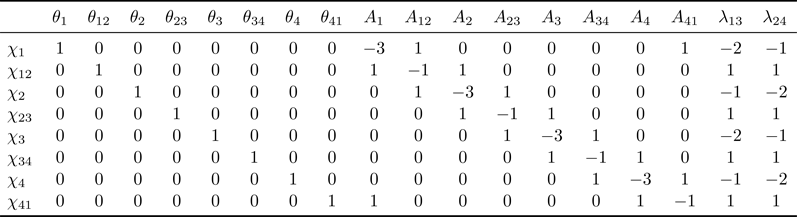
 $D_i\cdot \delta _{ik}=1$ etc., we get the character table for the torus action
 $\mathbb {T}^{8}\curvearrowright X_{\mathsf {G}_2}$, as shown in Table 3.
The character table for  $\mathbb {T}^{D}\curvearrowright X_{\mathsf {G}_2}$.
4.2 Alternative formats for $X_{\mathsf {G}_2}$

We discuss some of the possible formats and useful subformats for  $X_{\mathsf {G}_2}$.
4.2.1 Quadruple unprojection structure
Eliminating  $\theta _{12}$,
 $\theta _{23}$,
 $\theta _{34}$,
 $\theta _{41}$ from
 $\mathcal {A}_{\mathsf {G}_2}$ gives a Gorenstein projection
 $X_{\mathsf {G}_2}\dashrightarrow Z$ where
 $Z$ is the following complete intersection of codimension2:
 \begin{gather*} \theta_1\theta_3 = A_{12}A_2A_{23}\theta_2 + \lambda_{24}A_{12}A_{23}A_{34}A_{41} + A_{34}A_4A_{41}\theta_4, \\ \theta_2\theta_4 = A_{41}A_1A_{12}\theta_1 + \lambda_{13}A_{12}A_{23}A_{34}A_{41} + A_{23}A_3A_{34}\theta_3. \end{gather*}
This variety  $Z$ is a family of affine surfaces over
 $\mathbb {A}^{10}_{A_i,A_{ij},\lambda _{ik}}$ whose general member has a compactification to a singular Del Pezzo surface with four lines at infinity meeting at four
 $\tfrac 13(1,1)$ singularities; see [Reference Corti and HeubergerCH17, § 2.2.1]. These four
 $\tfrac 13(1,1)$ singularities are obtained by contracting the four
 $(-3)$-curves in
 $Y_{\mathsf {G}_2}$. Each variable
 $\theta _{ij}$ can be recovered from
 $Z$ as a serial Gorenstein type I unprojection of the divisor
 $D_{ij}=V(A_{ij},\theta _k,\theta _l)$, giving the following codimension 3 Pfaffian format
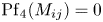 $\operatorname {Pf}_4(M_{ij})=0$, where
 $M_{ij}$ is the matrix
 \begin{equation} M_{ij} = \begin{pmatrix} A_{jk}A_kA_{kl} & \theta_l & \theta_i & A_{ij} \\ & A_{li}(A_i\theta_i+\lambda_{ik}A_{jk}A_{kl}) & \theta_{ij} & \theta_j \\ & & A_{jk}(A_j\theta_j+\lambda_{jl}A_{kl}A_{li}) & \theta_k \\ & & & A_{kl}A_lA_{li} \end{pmatrix}. \end{equation}
We note that  $M_{ij}$ contains three unprojection divisors:
(i) the Tom
$_5$ ideal $(\theta _l,\theta _i,\theta _{ij},A_{jk})$ for the unprojection variable $\theta _{jk}$;(ii) the Jer
$_{24}$ ideal $(\theta _i,\theta _{ij},\theta _j,A_{kl})$ for the unprojection variable $\theta _{kl}$;(iii) the Tom
$_1$ ideal $(\theta _{ij},\theta _j,\theta _k,A_{li})$ for the unprojection variable $\theta _{li}$.









Taken all together, these variables give an unprojection cascade, partly shown in Figure 2.
4.2.2 The $\mathsf {G}_2^{(5)}$ and $\mathsf {G}_2^{(4)}$ subformats


It is clear from equations (1.2) that if  $\phi ^{*}(A_{ij})=1$ for some regular pullback
 $\phi$ from
 $X_{\mathsf {G}_2}$, then the variable
 $\theta _{ij}$ becomes redundant.
Definition 4.1 We define the  $\mathsf {G}_2^{(5)}$ format of codimension 5 by making the specialisation
 ${A_{12}=1}$ and eliminating the redundant variable
 $\theta _{12}$. We define the
 $\mathsf {G}_2^{(4)}$ format of codimension 4 by making the specialisation
 $A_{12}=A_{34}=1$ and eliminating the redundant variables
 $\theta _{12}$ and
 $\theta _{34}$.Footnote 9
4.2.3 $\mathsf {G}_2^{(5)}$ format

This is a triple Jerry format. In terms of the matrices  $M_{ij}$ defined above, the 14 equations are:
 \begin{gather*} \operatorname{Pf}_4(M_{23}|_{A_{12}=1})=0,\quad \operatorname{Pf}_4(M_{34}|_{A_{12}=1})=0,\quad \operatorname{Pf}_4(M_{41}|_{A_{12}=1})=0, \\ \theta_{23}\theta_{34} = (\text{long equation}),\quad \theta_{34}\theta_{41} = (\text{long equation}), \quad \theta_{41}\theta_{12} = (\text{long equation}). \end{gather*}
If we wish to keep the variable  $\theta _{12}$ with the equation
 $\theta _{12}= \theta _1\theta _2 - A_{23}A_3A_{34}^{2}A_4A_{41}$, then we call this
 $\mathsf {G}_2^{(5)}+\operatorname {CI}^{(1)}$ format.
4.2.4 $\mathsf {G}_2^{(4)}$ format

This is a double Jerry format (cf. [Reference Brown, Kerber and ReidBKR12, § 9]). The nine equations are:
 \[ \operatorname{Pf}_4(M_{23}|_{A_{12}=A_{34}=1})=0, \quad \operatorname{Pf}_4(M_{41}|_{A_{12}=A_{34}=1})=0, \quad \theta_{23}\theta_{41}=(\text{long equation}). \]
If we wish to keep the variables  $\theta _{12},\theta _{34}$ and their tag equations, then we call this
 $\mathsf {G}_2^{(4)}+\operatorname {CI}^{(2)}$ format.
4.3 Affine pieces and the deep locus
Similarly to the  $\mathsf {C}_2$ cluster variety
 $X_{\mathsf {C}_2}$, the
 $\mathsf {G}_2$ cluster variety
 $X_{\mathsf {G}_2}$ is partly covered by eight affine
 $\operatorname {CI}^{(6)}$ charts where one of each of the cluster variables
 $\theta _i$ or
 $\theta _{ij}$ does not vanish. The deep locus
 $X_0=X_{\mathsf {G}_2}\cap V(\theta _1,\ldots ,\theta _{41})$ breaks up into the following 28 linear subvarieties.
 $$\begin{align*} \mathbb{A}^{8} &\cong V(\theta_1,\ldots,\theta_{41},A_{ij},A_{kl}), & (\times 2)\\ \mathbb{A}^{7} &\cong V(\theta_1,\ldots,\theta_{41},A_i,A_{ij},A_{jk}) , & (\times 8) \\ \mathbb{A}^{7} &\cong V(\theta_1,\ldots,\theta_{41},A_i,A_{jk},\lambda_{ik}), & (\times 8)\\ \mathbb{A}^{7} &\cong V(\theta_1,\ldots,\theta_{41},A_i,A_{jk},A_{kl}), & (\times 4) \\ \mathbb{A}^{7} &\cong V(\theta_1,\ldots,\theta_{41},A_{ij},A_k,A_l), & (\times 4)\\ \mathbb{A}^{6} &\cong V(\theta_1,\ldots,\theta_{41},A_i,A_k,\lambda_{ik},\lambda_{jl}). & (\times 2)\end{align*}$$
4.4 Regular pullbacks from $\mathsf {G}_2$ format

Let  $(X_{\mathsf {G}_2},\mu ,\mathbb {F})$ be a
 $\mathsf {G}_2$ cluster format determined by the one-parameter subgroup
 \[ \rho=(\rho_1,\rho_{12},\ldots,\rho_4,\rho_{41})\colon\mathbb{C}^{*}\to\mathbb{T}^{D}. \]
From Table 3,
 \begin{gather*} d(\theta_i)=\rho_{i},\quad d(\theta_{ij})=\rho_{ij},\quad d(A_i)=\rho_{li}-3\rho_i+\rho_{ij}, \quad d(A_{ij})=\rho_i-\rho_{ij}+\rho_j,\\ d(\lambda_{ik})= - 2\rho_i + \rho_{ij} - \rho_j + \rho_{jk} - 2\rho_k + \rho_{kl} - \rho_l + \rho_{li}. \end{gather*}
We use the shorthand
 \[ \mathsf{G}_2 \left(\begin{array}{@{}cccc} \phi^{*}(\theta_{12}) & \phi^{*}(\theta_{23}) & \phi^{*}(\theta_{34}) & \phi^{*}(\theta_{41})\\ \phi^{*}(A_{12}) & \phi^{*}(A_{23}) & \phi^{*}(A_{34})& \phi^{*}(A_{41})\end{array}\Bigg| \begin{array}{cccc} \phi^{*}(\theta_1) & \phi^{*}(\theta_2) & \phi^{*}(\theta_3) & \phi^{*}(\theta_4)\\ \phi^{*}(A_1) & \phi^{*}(A_2) & \phi^{*}(A_3) & \phi^{*}(A_4)\end{array}\Bigg| \begin{array}{c@{}}\phi^{*}(\lambda_{13})\\\phi^{*}(\lambda_{24})\end{array}\right) \]
to write down a regular pullback from  $\mathsf {G}_2$ format, or the same array with integer entries if we just wish to denote the degrees.
As with the regular pullbacks from  $X_{\mathsf {C}_2}$, it is easy to use the
 $M$-graded Hilbert series of
 $X_{\mathsf {G}_2}$ to get the
 $\mathbb {Z}$-graded Hilbert series of
 $(X_{\mathsf {G}_2},\mu ,\mathbb {F})$. Again, the Hilbert numerator has adjunction number
 $\alpha =\rho _1+\rho _{12}+\rho _2+\rho _{23}+\rho _3+\rho _{34}+\rho _4+\rho _{41}$.
4.5 Singular locus
As we did with the  $\mathsf {C}_2$ cluster variety
 $X_{\mathsf {C}_2}$ we now describe the singular locus of
 $X_{\mathsf {G}_2}$ and some of the hyperplane sections of
 $X_{\mathsf {G}_2}$.
Lemma 4.2 The reduced singular locus  $\operatorname {sing}(X_{\mathsf {G}_2})$ is contained inside the deep locus
 \[ \operatorname{sing}(X_{\mathsf{G}_2}) \subset X_0 := X_{\mathsf{G}_2}\cap V(\theta_1,\theta_{12},\theta_2,\theta_{23},\theta_3,\theta_{34},\theta_4,\theta_{41}) \]
and decomposes into 14 irreducible linear subvarieties, given by
 \[ \begin{array}{ll} \mathbb{A}^{8} = X_0\cap V(A_{ij},A_{kl}), & \mathbb{A}^{7} = X_0\cap V(A_i,A_{jk},A_{kl}), \\ \mathbb{A}^{5} = X_0\cap V(A_i,A_{ij},A_{jk},A_k,\lambda_{ik}), & \mathbb{A}^{5} = X_0\cap V(A_i,A_j,A_{kl},\lambda_{ik},\lambda_{jl}). \end{array} \]
In particular, all components of the singular locus have codimension at least  $4$ in
 $X_{\mathsf {G}_2}$.
The hyperplane section  $X^{z}=X_{\mathsf {G}_2}\cap V(z)$ is singular in codimension
 $1$ if
 $z=\theta _i$ or
 $z=\theta _{ij}$. In other cases,
(i)
$\operatorname {sing}(X^{A_i})$ is contained in the locus $X^{A_i}_0 := V_{X^{A_i}}(\theta _{ij},\theta _j,\theta _{jk},\theta _k,\theta _{kl},\theta _l,\theta _{li})$ and contains the components
which have codimension\[ \mathbb{A}^{8} = X^{A_i}_0\cap V(A_{jk},A_{kl}), \quad \mathbb{A}^{8} = X^{A_i}_0\cap V(A_{jk},\lambda_{ik}) \quad \text{and} \quad \mathbb{A}^{8} = X^{A_i}_0\cap V(A_{kl},\lambda_{ik}), \]$3$ in $X^{A_i}$;(ii)
$\operatorname {sing}(X^{A_{ij}})$ is contained in the locus $X^{A_{ij}}_0 := V_{X^{A_{ij}}}(\theta _j,\theta _{jk},\theta _k,\theta _{kl},\theta _l,\theta _{li},\theta _i)$ and contains the components
which have codimension\[ \mathbb{A}^{9}=X^{A_{ij}}_0\cap V(A_{kl}) \quad \text{and} \quad \mathbb{A}^{8}=X^{A_{ij}}_0\cap V(A_{jk},A_{li}), \]$\leq 3$ in $X^{A_{ij}}$.







Proof. This is slightly more delicate than the computation of  $\operatorname {sing}(X_{\mathsf {C}_2})$, since asking the computer to compute the
 $6\times 6$ minors of the
 $18\times 20$ Jacobian matrix
 $J$ is fairly hopeless. First of all, if one of the cluster variables
 $\theta _i$ or
 $\theta _{ij}$ is non-zero we are in one of the affine complete intersection charts of Lemma 2.2 and it is easy to check that these are smooth. Therefore
 $\operatorname {sing}(X_{\mathsf {G}_2})$ is contained in the deep locus
 $\operatorname {sing}(X_{\mathsf {G}_2})\subseteq X_0$. Let
 $\Pi$ be one of the 28 irreducible components of
 $X_0$ listed in § 4.3, and take the restriction
 $J|_\Pi$. It turns out that
 $J|_{\Pi }$ is rather sparse, and it is then much easier to compute
 $\operatorname {sing}(X_{\mathsf {G}_2})|_{\Pi }$ for each
 $\Pi$. Finally, we take the union of all of these singular subloci and compute the irreducible components of this union. We see that
 $\operatorname {sing}(X_{\mathsf {G}_2})$ has the 14 irreducible components above.
The singular loci of  $X^{A_i}$ and
 $X^{A_{ij}}$ can be computed in a similar way (with the appropriate adjustments to
 $X_0$), although it is easier just to check the inclusion of the components claimed in the statement of the proposition directly.
If  $\theta _{12}=0$, then
 $T={A_1\theta _1}/{A_{23}A_{34}}$ is a solution to the monic polynomial equation
 \[ T^{3} + \mu T^{2} + \lambda A_1A_3 T + A_1^{2}A_2A_3^{2}A_4 = 0 \]
over the ring  $\mathcal {O}_{X^{\theta _{12}}}$, and hence
 $\mathcal {O}_{X^{\theta _{12}}}$ is not integrally closed. Moreover, since
 $\theta _{12}$ is not a zero divisor in
 $\mathcal {A}_{\mathsf {G}_2}$ we know that
 $X^{\theta _{12}}$ is Gorenstein (hence
 $S_2$) and therefore must be singular in codimension 1. By a similar argument, because
 $U={A_{12}A_2\theta _2}/{A_{34}}$ solves the monic equation
 \[ U^{2} + \lambda_{24}A_{41}A_{12}U + \lambda_{13}A_2A_4A_{12}^{2}A_{41}^{2} + A_2A_3A_4A_{12}A_{41}\theta_3=0 \]
over the ring  $\mathcal {O}_{X^{\theta _{1}}}$,
 $X^{\theta _1}$ is also singular in codimension 1.
4.6 Quasismoothness conditions
Let  $\widehat Y\subset \mathbb {A}^{10}$ be the four-dimensional affine cone over a quasismooth weighted projective 3-fold
 $Y$.
Proposition 4.3 Suppose that 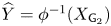 $\widehat Y = \phi ^{-1}(X_{\mathsf {G}_2})$ is a regular pullback and is not a complete intersection. Then, for any
 $i,j$, we must have
 $d(\theta _i)>0$,
 $d(\theta _{ij})>0$, and one of the following conditions must hold, up to
 $\operatorname {Dih}_8$ symmetry.
(i)
$\mathsf {G}_2^{(6)}$ format: $d(A_{ij})>0$ for all $i,j$. Then $d(A_i)\ge 0$ for all $i$ and $d(\lambda _{13}),d(\lambda _{24})\ge 0$.(ii)
$\mathsf {G}_2^{(5)}+\operatorname {CI}^{(1)}$ format: $d(A_{12})=0$ and $d(A_{ij})>0$ for all other $i,j$. Then $d(A_1),d(A_2)\ge 0$ and $d(\lambda _{13}),d(\lambda _{24})\ge 0$. (See Corollary 4.4 for further analysis.)(iii)
$\mathsf {G}_2^{(4)} + \operatorname {CI}^{(2)}$ format: $d(A_{12})=d(A_{34})=0$ and $d(A_{23}),d(A_{41})>0$. (See Corollary 4.6 for further analysis.)(iv)
$\mathsf {C}_2 + \operatorname {CI}^{(2)}$ format: $d(A_{12})=d(A_{23})=0$ and $d(A_{34}),d(A_{41})>0$. (See Proposition 3.4.)(v)
$\mathsf {A}_2 + \operatorname {CI}^{(3)}$ format: $d(A_{12})=d(A_{23})=d(A_{34})=0$ and $d(A_{41})>0$.
















If all four  $d(A_{ij})=0$ then we are in
 $\operatorname {CI}^{(6)}$ format. In other words, we consider cases according to the following cascade of specialisations (cf. Figure 2):

(Note that, after making the specialisation, we do not automatically assume that the redundant variables are eliminated.)
Proof. There are two things to prove: first, that the claimed inequalities on the degrees are necessary in each case; and second, that  $\mathsf {C}_2$ and
 $\mathsf {A}_2$ format appear as claimed in case (iv) and case (v), respectively.
We obtain the degree inequalities in each case by considering what happens if one of the variables is allowed to take a negative degree. Up to the  $\operatorname {Dih}_8$ symmetry we can reduce to one of the following cases.
Claim 1  $d(\theta _1)<0$ and
 $d(\theta _{12})<0$ cannot happen.
Using Lemma 4.2, we see that  $d(\theta _1)\ge 0$ and
 $d(\theta _{12})\ge 0$. A single equality
 $d(\theta _1)=0$ or
 $d(\theta _{12})=0$ would reduce
 $\widehat Y$ to a complete intersection
 $\operatorname {CI}^{(6)}$ by Lemma 2.2. Thus from now on, we assume
 $d(\theta _i)>0$,
 $d(\theta _{ij})>0$.
Claim 2  $d(A_{12})<0$ cannot happen.
If  $d(A_{12})<0$ then we must have
 $d(A_{34})=0$ and either
 $d(A_{23})=0$ or
 $d(A_{41})=0$ to avoid pulling back the two bad components of Lemma 4.2(ii). This puts us in case (iv), which is
 $\mathsf {C}_2^{(4)}+\operatorname {CI}^{(2)}$ format. Proposition 3.4, combined with the coordinate change described below, implies that
 $d(A_{12})$ cannot be negative.
Claim 3  $d(A_1)<0$ puts us in case (ii).
If  $d(A_1)<0$ we need either
 $d(A_{23})=0$ or
 $d(A_{34})=0$, which puts us in case (ii). Assume the former case. Then if one of
 $d(A_2)<0$ or
 $d(A_3)<0$ holds, this forces one of
 $d(A_{34})=0$,
 $d(A_{41})=0$ or
 $d(A_{12})=0$, and so we are either in case (iii) or case (iv).
Claim 4  $d(\lambda _{13})<0$ puts us in case (iv).
Table 3 can be used to obtain the following identities:
 \begin{equation} \begin{aligned} 3d(\lambda_{13}) &= 2d(A_1)+d(A_2)+2d(A_3)+d(A_4),\\ 3d(\lambda_{24}) &= d(A_1)+2d(A_2)+d(A_3)+2d(A_4),\\ d(\lambda_{13})+d(\lambda_{24}) &= d(A_1)+d(A_2)+d(A_3)+d(A_4). \end{aligned} \end{equation}
If  $d(\lambda _{13})<0$ the first of these implies that
 $d(A_i)<0$ for some
 $i$—without loss of generality either
 $A_1$ or
 $A_2$.
If  $d(A_1)<0$ then, to avoid pulling back the big components of
 $\operatorname {sing}(X^{A_1})$, we need
 \begin{equation} (d(A_{23})=0 \text{ or }d(A_{34})=0) \text{ and }(d(A_{23})=0\text{ or }d(\lambda_{13})=0) \text{ and }(d(A_{34})=0\text{ or }d(\lambda_{13})=0). \end{equation}
Since  $d(\lambda _{13})<0$, this implies
 $d(A_{23})=d(A_{34})=0$ and we are in case (iv).
If  $d(A_2)<0$ then, to avoid pulling back the big components of
 $\operatorname {sing}(X^{A_2})$, we need
 \[ (d(A_{34})=0 \text{ or }d(A_{41})=0)\text{ and }(d(A_{41})=0\text{ or }d(\lambda_{24})=0) \text{ and }(d(A_{34})=0\text{ or }d(\lambda_{24})=0). \]
If  $d(A_{34})=d(A_{41})=0$ then we go to case (iv), otherwise
 $d(\lambda _{24})=0$ and the relations (
 $\dagger$) imply
 $d(A_1)+d(A_3)=2d(\lambda _{13})<0$, so either
 $d(A_1)<0$ or
 $d(A_3)<0$. This again forces two consecutive
 $A_{ij}$ to have degree
 $0$, and we go to case (iv).
This completes our rough analysis of the admissible degrees in cases (i)–(v). We now show that  $\mathsf {C}_2$ format and
 $\mathsf {A}_2$ format appear in cases (iv) and (v). By definition, case (ii) is
 $\mathsf {G}_2^{(5)}$ format and case (iii) is
 $\mathsf {G}_2^{(4)}$ format.
Case (iv) is  $\mathsf {C}_2+\operatorname {CI}^{(2)}$ format. Pulling back
 $X_{\mathsf {G}_2}$ by the morphism
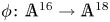 $\phi \colon \mathbb {A}^{16}\to \mathbb {A}^{18}$ given by
 $\phi ^{*}(A_{12}) = \phi ^{*}(A_{23}) = 1$, and
 $\phi ^{*}(z)=z$ for all other variables, gives a complete intersection of codimension 2,
 \[ \theta_{12} = \theta_1\theta_2 - A_3A_{34}^{2}A_4A_{41}, \quad \theta_{23} = \theta_2\theta_3 - A_{34}A_4A_{41}^{2}A_1, \]
inside the following generic pullback from  $\mathsf {C}_2$ format:
 \[\mathsf{C}_2\left(\begin{array}{@{}ccc} \theta_{41} & \theta_2 & \theta_{34}\\ A_{41} & A_2 & A_{34}\end{array}\Bigg| \begin{array}{ccc} \theta_1 & \theta_3 & \theta_4\\ A_1 & A_3 & A_4\theta_4+\lambda_{24}\end{array}\Bigg|\ \lambda_{13}\right),\]
that is, inside 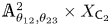 $\mathbb {A}^{2}_{\theta _{12},\theta _{23}}\times X_{\mathsf {C}_2}$. Under this coordinate change, the degrees of all variables must satisfy the conditions of Proposition 3.4.
Case (v) is  $\mathsf {A}_2+\operatorname {CI}^{(3)}$ format. Pulling back
 $X_{\mathsf {G}_2}$ by the morphism
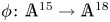 $\phi \colon \mathbb {A}^{15}\to \mathbb {A}^{18}$ given by
 $\phi ^{*}(A_{12}) = \phi ^{*}(A_{23}) = \phi ^{*}(A_{34}) = 1$, and
 $\phi ^{*}(z)=z$ for all other variables, gives
 \[ \operatorname{Pf}_4\begin{pmatrix} A_2 & \theta_3 & \theta_4 & A_{41} \\ & A_4\theta_4+\lambda_{24} & \theta_{41} & \theta_1 \\ & & A_1\theta_1+\lambda_{13} & \theta_2 \\ & & & A_3 \end{pmatrix} \quad \begin{array}{l} \theta_{12} = \theta_1\theta_2 - A_3A_4A_{41},\\ \theta_{23} = \theta_2\theta_3 - A_4A_{41}^{2}A_1,\\ \theta_{34} = \theta_3\theta_4 - A_{41}A_1A_2. \end{array} \]
If  $\widehat Y$ is quasismooth and not a complete intersection, then the entries of this matrix must all have positive degrees [Reference Brown, Kasprzyk and ZhuBKZ19, Proposition 2.7].
4.6.1 Some further subformats
Let  $\widehat Y \subset \mathbb {A}^{10}$ be the four-dimensional affine cone over a quasismooth weighted projective 3-fold
 $Y$. We refine cases (ii) and (iii) of Proposition 4.3.
Corollary 4.4 (Subformats for  $\mathsf {G}_2^{(5)}$)
Suppose that  $\widehat Y$ is in
 $\mathsf {G}_2^{(5)}$ format, that is,
 $d(A_{12})=0$, all other
 $d(A_{ij})>0$,
 $d(A_1),d(A_2)\ge 0$ and
 $d(\lambda _{13}),d(\lambda _{24})\ge 0$. There are three possibilities.
(i)
$d(A_3),d(A_4)\ge 0$.(ii)
$d(A_3)<0$ and $d(\lambda _{13})=0$.(iii)
$d(A_3),d(A_4)<0$ and $d(\lambda _{13})=d(\lambda _{24})=0$.





Proof. From ( $\ddagger$) and its translates under
 $\operatorname {Dih}_8$, if
 $d(A_3)<0$ then
 $d(\lambda _{13})=0$, and if
 $d(A_4)<0$ then
 $d(\lambda _{24})=0$. This completes the proof.
Remark 4.5 We do not have special formats for cases (ii) and (iii), but their divisor class group has rank greater than  $1$.
Corollary 4.6 (Subformats for  $\mathsf {G}_2^{(4)}$)
Suppose that  $\widehat Y$ is in
 $\mathsf {G}_2^{(4)}$ format, that is,
 $d(A_{12})=d(A_{34})=0$ and
 $d(A_{23}),d(A_{41})>0$. There are three possibilities (up to symmetry).
(i) If
$d(\lambda _{13}),d(\lambda _{24})>0$, then $d(A_i)\ge 0$ for all $i$ and $\widehat Y$ is in (strict) $\mathsf {G}_2^{(4)}$ format.(ii) If
$d(\lambda _{24})=0$ and $d(\lambda _{13})>0$, then $\widehat Y$ is in rolling factors format.(iii) If
$d(\lambda _{13})=d(\lambda _{24})=0$, then $\widehat Y$ is in $\mathbb {P}^{1}\times \mathbb {P}^{1}\times \mathbb {P}^{1}$ format.






Proof. We have that  $d(A_{12})=d(A_{34})=0$, so we assume that
 $\phi ^{*}(A_{12})=\phi ^{*}(A_{34})=1$. By equation (
 $\ddagger$), if
 $d(A_1)<0$ or
 $d(A_3)<0$ then we must have
 $d(\lambda _{13})=0$. Similarly, if
 $d(A_2)<0$ or
 $d(A_4)<0$ then we must have
 $d(\lambda _{24})=0$.
Suppose we are in case (ii). Then equations ( $\dagger$), combined with the above, imply that at least one of
 $d(A_2)<0$ or
 $d(A_4)<0$ is negative, and
 $d(A_1),d(A_3)\geq 0$. Say
 $d(A_2)<0$ and let
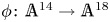 $\phi \colon \mathbb {A}^{14}\to \mathbb {A}^{18}$ be defined by
 $\phi ^{*}(A_2)=0$,
 $\phi ^{*}(\lambda _{24})=\phi ^{*}(A_{12})=\phi ^{*}(A_{34})=1$, and
 $\phi ^{*}(z)=z$ otherwise. Since
 $d(\lambda _{24})=0$, the coordinate changes
 \[ A_{23}' = A_4\theta_4 + A_{23}, \quad \theta_2' = \theta_2 + \lambda_{13}A_4A_{41} + A_3A_4\theta_3 \]
are homogeneous, and the ideal defining  $\phi ^{*}X_{\mathsf {G}_2}$ is in rolling factors format:
 \[ \bigwedge^{2}\begin{pmatrix} \theta_{23} & \theta_3 & \theta_4 & A_{41} \\ \theta_2' & A_{23}' & \theta_{41} & \theta_1 \end{pmatrix} =0, \quad \quad \begin{array}{r@{\,}ll} \theta_{23}\theta_4 &= A_3\theta_3^{2} + \lambda_{13} A_{41}\theta_3 + A_1A_{41}^{2}, \\ \theta_{23}\theta_{41} &= A_3A_{23}'\theta_3 + \lambda_{13} A_{41}A_{23}' + A_1A_{41}\theta_1, \\ \theta_2'\theta_{41} &= A_3A_{23}'^{2} + \lambda_{13} \theta_1A_{23}' + A_1\theta_1^{2}. \\\end{array}\]
If we are in case (iii), then equations ( $\dagger$) reduce to
 $d(\lambda _{13})=d(A_1)+d(A_3)$ and
 $d(\lambda _{24})=d(A_2)+d(A_4)$. Thus
 $d(A_1)=-d(A_3)$ and
 $d(A_2)=-d(A_4)$. So either two consecutive
 $A_i$ have negative degree, or
 $d(A_i)=0$ for all
 $i$.
For the former case, suppose  $\phi ^{*}(A_2)=\phi ^{*}(A_3)=0$,
 $\phi ^{*}(\lambda _{13})=\phi ^{*}(\lambda _{24})=\phi ^{*}(A_{12})=\phi ^{*}(A_{34})=1$ and
 $\phi ^{*}(z)=z$ otherwise. Then
 $\phi ^{*}(X_{\mathsf {G}_2})\subset \mathbb {A}^{12}$ is in
 $\mathbb {P}^{1}\times \mathbb {P}^{1}\times \mathbb {P}^{1}$ format, defined by the
 $2\times 2$ minors of the following cube after the displayed coordinate changes:

In the latter case,  $\phi ^{*}(A_i)=\phi ^{*}(\lambda _{13})=\phi ^{*}(\lambda _{24})=\phi ^{*}(A_{12})=\phi ^{*}(A_{34})=1$ for all
 $A_i$, and
 $\phi ^{*}(z)=z$ otherwise. Then
 $\phi ^{*}(X_{\mathsf {G}_2})\subset \mathbb {A}^{12}$ is in
 $\mathbb {P}^{1}\times \mathbb {P}^{1}\times \mathbb {P}^{1}$ format, defined by the
 $2\times 2$ minors of the cube after the displayed coordinate changes:

where  $\epsilon$ is a primitive eighth root of unity.
5. Applications to constructing Fano 3-folds
5.1 Introduction to Fano 3-folds
A Fano 3-fold is a normal projective 3-fold  $Y$ with at worst
 $\mathbb {Q}$-factorial terminal singularities and whose anticanonical divisor
 $-K_Y$ is
 $\mathbb {Q}$-Cartier and ample. The Fano index of
 $Y$ is the largest positive integer
 $q$ such that
 $-K_Y=qA$ for some ample Weil divisor
 $A$. If the Weil divisor class group
 $\operatorname {Cl}(Y)=\mathbb {Z}$, then
 $Y$ is called prime. The discrete invariants of
 $Y$ are
 $q$,
 $h^{0}(Y,A)$ and the basket of terminal quotient singularities
 $\mathcal {B}$. There are a finite number of numerical possibilities for
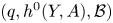 $(q,h^{0}(Y,A),\mathcal {B})$, and approximately 50 000 such are listed in [Reference Brown and KasprzykGRDB], produced using [Reference Altınok, Brown and ReidABR02, Reference Brown and SuzukiBS07a, Reference Brown and SuzukiBS07b]. We refer to any one such numerical possibility as a candidate Fano 3-fold.
The next stage of the classification is to prove whether a given candidate  $Y$ exists, and then to investigate the structure of the Hilbert scheme of
 $Y$. We construct
 $Y$ by taking
 $\operatorname {Proj}$ of the finitely generated Gorenstein graded ring
 $R(Y,A)=\bigoplus _{n\ge 0}H^{0}(Y,nA)$. A choice of generators for
 $R(Y,A)$ gives an embedding of
 $Y$ into weighted projective space
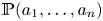 $\mathbb {P}(a_1,\ldots ,a_n)$. From now on, we assume that
 $Y$ is quasismooth with at worst terminal quotient singularities. The expected codimension of
 $Y$ may be computed from the Hilbert series
 $P_{(Y,A)}(t)=\sum _{n\ge 0}h^{0}(Y,nA)t^{n}$, which is in turn computed using the above invariants. Since our cluster formats have codimension 4, 5 or 6, we only consider those candidates whose expected dimension lies in this range. We further assume that
 $R(Y,A)$ is generated as simply as possible; that is, we do not consider specialisations of
 $A$ (e.g. hyperelliptic, trigonal) which may also have cluster format constructions, but in higher than expected codimension.
5.2 Primality of Fano 3-folds
We give a criterion for checking primality of quasismooth varieties in cluster format.
Lemma 5.1 Let  $k$ be an algebraically closed field of characteristic
 $0$. Suppose that
 $Y=\phi ^{-1}(X)$ is a quasismooth variety defined over
 $k$, of dimension at least
 $3$ in cluster format. Choose one of the cluster variables
 $\theta _i$ or
 $\theta _{ij}$ and denote it by
 $\theta$. If
 $\phi ^{*}(\theta )$ is a prime element of
 $k[Y]$, then every Weil divisor on
 $Y$ is of the form
 $\mathcal {O}_Y(n)$ for some
 $n$.
Proof. We show that the coordinate ring  $k[\widehat Y]$ is factorial. If
 $\tau =\phi ^{*}(\theta )$ is a prime element of
 $k[\widehat Y]$, then by Nagata's lemma [Reference MatsumuraMat89, Theorem 20.2], it suffices to show that the localisation
 $k[\widehat Y]_{\tau }$ is factorial. The open set
 $\widehat Y\cap (\tau \ne 0)$ is a complete intersection, because the localisation at
 $\tau$ factors through the open subset
 $\widehat X\cap (\theta \ne 0)$, which is a complete intersection by Lemma 2.2. Since complete intersections of dimension at least
 $4$ are parafactorial and
 $\widehat Y$ is regular outside the vertex (by quasismoothness), it follows that
 $k[\widehat Y]_{\tau }$ is factorial (see [Reference Grothendieck and RaynaudSGA2, XI 3.10, 3.13]).
The following theorem summarises the application of this criterion to our list of Fano 3-folds in cluster formats.
Theorem 5.2
(i) If
$\,Y\!$ is in $\mathsf {C}_2$ format and not $\mathbb {P}^{2}\times \mathbb {P}^{2}$ subformat, then $Y$ is prime.(ii) If
$\,Y\!$ is in $\mathsf {G}_2^{(4)}$ format and not rolling factors or $(\mathbb {P}^{1})^{3}$ subformat, then $Y$ is prime.(iii) If
$\,Y\!$ is in $\mathsf {G}_2^{(5)}$ format, and in case (i) of Corollary 4.4, then $Y$ is prime.


Proof. Primality depends on the format and on  $\phi$, so we apply the above lemma to each construction individually, using the computer. We do not check primality of
 $\tau =\phi ^{*}(\theta )$ in
 $k[\widehat Y]$ directly, as the computer does this over
 $\mathbb {Q}$, and
 $\tau$ could still be non-prime over
 $\mathbb {C}$. Instead, we check that
 $Y\cap V(\tau )$ is non-singular in codimension 1 (this computation is valid over
 $\mathbb {C}$). Since
 $R_1+S_2$ is equivalent to normality, the fact that
 $Y$ is Gorenstein implies that
 $Y\cap V(\tau )$ is normal over
 $\mathbb {C}$ and hence geometrically normal. Thus by [Reference GrothendieckEGA, IV § 4.6],
 $Y\cap V(\tau )$ is geometrically irreducible—in particular, irreducible over
 $\mathbb {C}$.
Moreover, it follows from Lemmas 3.3 and 4.2 that  $Y\cap V(\theta )$ is necessarily singular in codimension 1 for certain choices of
 $\theta$. Thus for
 $\mathsf {C}_2$ format, we need only check
 $\theta _1$,
 $\theta _2$,
 $\theta _3$, for
 $\mathsf {G}_2^{(4)}$ format only
 $\theta _1$,
 $\theta _3$, and for
 $\mathsf {G}_2^{(5)}$ format only
 $\theta _3$.
5.3 Comparison with Tom and Jerry
In this subsection we suppose that  $Y$ is a Fano 3-fold in codimension 4 with a type I centre. The definitive guide to this situation is [Reference Brown, Kerber and ReidBKR12], according to which each
 $Y$ has at least two constructions: one Tom and one Jerry. In total, 274 of the 322 families from [Reference Brown, Kerber and ReidBKR12] contain a subfamily which is in a cluster format.
Based on analysis of our classification [Reference Coughlan and DucatCD], we make the following observation.
 \begin{align*} &\text{Up to symmetry of the cluster format and choice of coordinates,}\\ &\text{the type I centre is positioned at the coordinate point}\ P_{\phi^{*}(\theta_{12})}. \end{align*}
Thus if  $Y$ is in
 $\mathsf {C}_2$ format, then the projection is the
 $\text {Tom}_3$ matrix (3.2), and if
 $Y$ is in
 $\mathsf {G}_2^{(4)}$ format, then the projection is the
 $\text {Jerry}_{24}$ matrix (4.2).
Under assumption (TJ), we can transform the output of [Reference Brown, Kerber and ReidBKR12] into a short list of possible cluster formats for  $Y$, by permuting the row-columns of the skew-symmetric weight matrix appropriately. We work through a representative example.
Example 5.3 According to [Reference Brown, Kerber and ReidBKR12], candidate  $\#5000$
 $Y\subset \mathbb {P}(1,1,3,4,4,5,5,9)$ has
 $\text {Tom}_4$ and
 $\text {Jerry}_{24}$ projections from the type
 $\rm I$ centre
 $\frac 19(1,4,5)$, leading to an unprojection divisor
 $\mathbb {P}(1,4,5)$ inside a Fano 3-fold
 $\overline Y\subset \mathbb {P}(1,1,3,4,4,5,5)$ defined by the Pfaffians of a
 $5\times 5$ skew matrix. We assume that
 $\overline Y$ is a Tom
 $_4$. The weights of this skew matrix
 $(m_{ij})$ are then
 \[ (m_{ij})=\begin{pmatrix} 3 & 4 & 3 & 4\\ & 5 & 4 & 5 \\ & & 5 & 6 \\ & & & 5 \end{pmatrix} \]
after swapping row-columns 3 and 4, to match up with (3.2). According to (3.2), the one-parameter subgroup  $\rho \colon \mathbb {C}^{*}\to \mathbb {T}^{D}$ (see 3.4) corresponding to
 $(m_{ij})$ is
 $\rho =(d(\theta _{12}), m_{14},m_{25},m_{35},m_{13},m_{24})$. Further permutations fixing row–column 3 lead to different possibilities for
 $\rho$. After removing those which are invalid according to Proposition 3.4, we get four possible
 $\mathsf {C}_2$-formats matching
 $\text {Tom}_4$, indexed by the corresponding permutation:
 \[ \rho\!=\!(9,3,5,6,4,4),\quad \rho_{(1,2)}\!=\!(9,4,5,6,5,3),\quad \rho_{(4,5)}\!=\!(9,5,4,5,4,5),\quad \rho_{(1,2)(4,5)}\!=\!(9,5,3,5,5,5). \]
Of these,  $\rho \mapsto \mathsf {C}_2(\begin {smallmatrix}9 & 3 & 5 \\ 1 & 5 & 5 \end {smallmatrix}\big \vert \begin {smallmatrix}6 & 4 & 4 \\ 2 & 4 & 0 \end {smallmatrix}\big \vert \begin {smallmatrix}3\end {smallmatrix})$ gives a working construction for
 $Y$, corresponding to a subfamily of that constructed by [Reference Brown, Kerber and ReidBKR12]. The other three fail because the adjunction number is wrong. We carried out a similar analysis for
 $\text {Jerry}_{24}$. There is no
 $\mathsf {G}_2^{(4)}$ construction for candidate
 $\#5000$.
Thus cluster format constructions do not exist for some of the families constructed by [Reference Brown, Kerber and ReidBKR12]. Heuristically, the cluster format restricts the monomials available to the  $5\times 5$ matrix, and this sometimes imposes worse than allowed singularities on
 $\overline Y$ and therefore
 $Y$.
5.4 Fano 3-folds of large Fano index
Table 4 presents the data of [Reference Brown and KasprzykGRDB] for prime Fano 3-folds with  $q\ge 2$ in codimension 4, and its refinement using results of Prokhorov [Reference ProkhorovPro13, § 1] on the non-existence of certain candidates. The last row lists our cluster format constructions which are prime.
Fano 3-folds with  $q\ge 2$.

Thus the question of existence is now settled in codimension 4 and Fano index at least  $4$. In particular, the constructions of two index 7 candidates provide an answer to a question of Prokhorov [Reference ProkhorovPro16, § 1.4]. For index 3, the missing candidates are
 $\#41058$ and
 $\#41245$. It would be interesting to know whether these exist. Brown and Suzuki [Reference Brown and SuzukiBS07a] constructed 33 of the index 2 candidates, although it is not clear to us whether these constructions are prime. We have prime cluster format constructions corresponding to 27 of these 33 candidates. Thus there remain at least four candidates for which is it not known whether there is a prime construction, hence the ‘?’ in the table.
The finer question of describing the Hilbert scheme for each of the candidates with  $q\ge 2$ remains open. For some candidates, we get two distinct cluster constructions, often both prime. Perhaps the general phenomenon from [Reference Brown, Kerber and ReidBKR12] persists, and there are always at least two components to the Hilbert scheme, if we relax the requirement that
 $Y$ be prime.
5.5 Fano 3-folds with empty $|{-K_Y}|$

We use  $\mathsf {C}_2$ cluster format to construct two codimension 4 candidates with
 $|{-K_Y}|$ empty. These both have extrasymmetric descriptions induced by the
 $\mathsf {C}_2$ format. We explain
 $\#25$ in some detail;
 $\#38$ is rather similar.
Example 5.4 Candidate  $\#25$ is
 $Y\subset \mathbb {P}(2,5,6,7,8,9,10,11)$. Let
 $p,q,r,s,t,u,v,w$ be coordinates on the ambient space. With the notation established in Example 3.4, the cluster format is
 $\mathsf {C}_2(\begin {smallmatrix}8 & 10 & 12 \\ 8 & 7 & 9 \end {smallmatrix}\big \vert \begin {smallmatrix}10 & 6 & 11 \\ 0 & 6 & 0 \end {smallmatrix}\big \vert \begin {smallmatrix}3\end {smallmatrix})$, and after coordinate choices, the general morphism
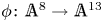 $\phi \colon \mathbb {A}^{8}\to \mathbb {A}^{13}$ of degree 0 is
 \[ \left(\begin{array}{@{}ccc} R_8 & v & P_{12}\\ t& s & u\end{array}\Bigg| \begin{array}{ccc} Q_{10} & S_6 & w\\ 1 & r & 1\end{array}\Bigg|\ 0\right), \]
where  $P_{12},Q_{10},R_8,S_6$ are general weighted homogeneous forms of degree given by the subscript. Since
 $d(\lambda )=3$ forces
 $\phi ^{*}(\lambda )=0$ for degree reasons, and
 $\phi ^{*}(B_{23})=\phi ^{*}(B_{31})=1$, the equations defining
 $Y$ have a nice extrasymmetric format with floating factor
 $r$ (see 3.2.1):
 \[ \operatorname{Pf}_4\begin{pmatrix} t & S_6 & v & w & u \\ & s & w & P_{12} & Q_{10} \\ & & u & Q_{10} & R_8 \\ & & & rt & rS_6 \\ & & & & rs \end{pmatrix}. \]
The third codimension 4 candidate with  $|{-K_Y}|$ empty,
 $\#166$, does not have a cluster format construction. Indeed, a proposed construction for
 $\#166$ is as a
 $\mathbb {Z}/2$-quotient of a complete intersection Fano 3-fold [Reference Altınok and ReidAR]. This proposed construction has expected embedding codimension greater than
 $4$. There are a handful of further candidates with
 $|{-K_Y}|$ empty in codimension 5 and 6, but none of these have cluster format constructions.
5.6 Fano 3-folds with no projections
According to [Reference Ahmadinezhad and OkadaAO18], the candidates that are most likely to give rise to birationally rigid Fano 3-folds are those with no centres of projection. In codimension 4 and Fano index 1, there are five such candidates, of which we construct three:  $\#25$ has
 $|{-K_Y}|$ empty, and is treated above;
 $\#29374$ is a del Pezzo 3-fold, classically known;
 $\#282$ has two constructions, which we describe here.
Example 5.5 Candidate  $\#282$ is
 $Y\subset \mathbb {P}(1,6,6,7,8,9,10,11)$. Let
 $p,q,r,s,t,u,v,w$ be coordinates on the ambient space. We first consider the cluster format
 $\mathsf {G}_2(\begin {smallmatrix}15 & 9 & 21 & 12 \\ 0 & 7 & 0 & 8 \end {smallmatrix}\big \rvert \begin {smallmatrix} 9 & 6 & 10 & 11 \\ 0 & 6 & 0 & 0 \end {smallmatrix}\big \vert \begin {smallmatrix} 2 \\ 4 \end {smallmatrix})$, which is in
 $\mathsf {G}_2^{(4)}$ subformat, because
 $d(A_{12})=d(A_{34})=0$ (see § 4.4 for notation). The general morphism
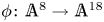 $\phi \colon \mathbb {A}^{8}\to \mathbb {A}^{18}$ is
 \[\left(\begin{array}{@{}cccc} \theta_{12} & Q_9 & \theta_{34} & P_{12}\\ 1 & s & 1 & t\end{array}\Bigg| \begin{array}{cccc} u & q & v & w\\ 1 & r & 1 & 1\end{array}\Bigg| \begin{array}{c@{}}p^{2}\\ p^{4}\end{array}\right),\]
where the redundant variables  $\theta _{12}$ and
 $\theta _{34}$ are eliminated, so we do not consider their images. The equations of
 $Y$ can be expressed as a double Jerry format following § 4.2.2:
 \begin{gather*} \operatorname{Pf}_4\begin{pmatrix}t & u & q & s \\ & qr+p^{4}t & Q_9 & v \\ & & v+p^{2}t & w \\ & & & t \end{pmatrix},\quad \operatorname{Pf}_4\begin{pmatrix}rs & v & w & t \\ & w+p^{4}s & P_{12} & u \\ & & u+p^{2}s & q \\ & & & s \end{pmatrix},\\ P_{12}Q_9=vw+p^{4}qw+p^{2}uv+uqr+str-stp^{6}. \end{gather*}
The other construction of  $\#282$ uses exactly the same
 $\mathsf {C}_2$ cluster format as
 $\#25$ above (Example 5.4), giving an extrasymmetric construction whose explication we leave to the reader.
5.7 Fano 3-folds in codimension 5
There are 50 Fano 3-folds in  $\mathsf {G}_2^{(5)}$ format. Three of these have Fano index 3, one has index 2 and the remainder have index 1. Moreover, all of the index 1 candidates that we construct in codimension 5 have type I centres.
Example 5.6 Consider the index 3 candidate  $\#41117$ given by
 $Y\subset \mathbb {P}(1,2,3,3,4,5,5,6,7)$ with coordinates
 $p,q,r,s,t,u,v,w,x$. From [Reference Coughlan and DucatCD],
 $Y$ has a
 $\mathsf {G}_2(\begin {smallmatrix}11 & 4 & 5 & 7 \\ 0 & 3 & 1 & 3 \end {smallmatrix}\big \vert \begin {smallmatrix}6 & 5 & 2 & 4 \\ 0 & 0 & 3 & 0 \end {smallmatrix}\big \vert \begin {smallmatrix}2 \\ 1\end {smallmatrix})$ cluster format construction. The general morphism
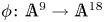 $\phi \colon \mathbb {A}^{9}\to \mathbb {A}^{18}$ is
 \[\left(\begin{array}{@{}cccc}\theta_{12} & P_4 & u & x\\ 1 & r & p & s\end{array} \Bigg| \begin{array}{cccc} w & v & q & t\\ 1 & 1 & Q_3 & 1\end{array}\Bigg| \begin{array}{c@{}}R_2\\ S_1 \end{array}\right), \]
where  $P_4,Q_3,R_2,S_1$ are general polynomials of degree denoted by the subscript, and the redundant variable
 $\theta _{12}$ is eliminated. Following § 4.2.2,
 $Y$ is a triple Jerry format with 14 equations:
 \begin{gather*} \operatorname{Pf}_4\begin{pmatrix} ps & w & v & r \\ & v+Sps & P & q \\ & & p(Qq+Rs) & t \\ & & & s \end{pmatrix},\quad \operatorname{Pf}_4\begin{pmatrix}s & v & q & p \\ & r(Qq+Rs) & u & t \\ & & s(t+Sr) & w \\ & & & r \end{pmatrix},\\ \operatorname{Pf}_4\begin{pmatrix}r & q & t & s \\ & p(t+Sr) & x & w \\ & & w+Rrp & v \\ & & & Qrp \end{pmatrix},\quad \begin{array}{c} Pu= Qq^{3}+Rsq^{2}+Ss^{2}q+s^{3}, \\ ux= Qr^{3}+Rr^{2}t+Srt^{2}+t^{3}, \\ Px=(Qqt+(Q-RS)rs)p^{2}+p(Stv+Rqw)+vw. \end{array} \end{gather*}
5.8 Why no Fano 3-folds in codimension 6 cluster format?
There are no codimension 6 Fano 3-folds in  $\mathsf {G}_2^{(6)}$ format. According to Lemma 4.2 and Proposition 4.3, if
 $Y$ is in strict
 $\mathsf {G}_2^{(6)}$ format, then
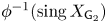 $\phi ^{-1}(\operatorname {sing} X_{\mathsf {G}_2})$ contains two components of expected dimension
 $0$. These must therefore be supported at the vertex of
 $\widehat Y$, and this imposes rather strong numerical conditions on the available
 $\mathsf {G}_2^{(6)}$ formats. Indeed, the first part of our classification algorithm (see § 6) outputs 33 numerical
 $\mathsf {G}_2^{(6)}$ formats for Fano 3-folds in codimension 6. In each case, we have
 $d(A_i)<0$ for all
 $i$ and
 $d(\lambda _{13}),d(\lambda _{24}) <0$ as well. This implies that the
 $\mathsf {G}_2^{(6)}$ format is highly reducible.
5.9 Fano 3-folds with $\operatorname {Dih}_6$ symmetry in $\mathsf {C}_2$ format


The  $\operatorname {Dih}_6$ invariant characters of non-negative degree are generated by
 $\chi ^{\operatorname {Dih}_6}_1=\sum \chi _i + \sum \chi _{ij}$ and
 $\chi ^{\operatorname {Dih}_6}_2=\sum \chi _i + 2\sum \chi _{ij}$:
 \[ \begin{array}{c|ccccc} & \theta_i & \theta_{ij} & A_i & A_{ij} & \lambda \\\hline \chi^{\operatorname{Dih}_6^{\vphantom{1^1}}}_1 & 1 & 1 & 0 & 1 & 0 \\ \chi^{\operatorname{Dih}_6^{\vphantom{1^1}}}_2 & 1 & 2 & 2 & 0 & 3 \\ \end{array} \]
With respect to these two characters  $X_{\mathsf {C}_2}$ has multigraded Hilbert series
 \[ P_X(s,t) = \frac{1 - 3s^{2}t^{2} - 3s^{2}t^{3} - 3s^{2}t^{4} \!+\! 2s^{3}t^{3} \!+\! 6s^{3}t^{4} \!+\! 6s^{3}t^{5} \!+\! 2s^{3}t^{6} \!-\! 3s^{4}t^{5} - 3s^{4}t^{6} - 3s^{4}t^{8} + s^{6}t^{9} }{(1-s)^{3}(1-t^{2})^{3}(1-t^{3})(1-st)^{3}(1-st^{2})^{3}}. \]
Let  $X_{(a,b)}$ be the
 $\mathsf {C}_2$ format
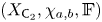 $(X_{\mathsf {C}_2},\chi _{a,b},\mathbb {F})$, where
 $\chi _{a,b}=a\chi ^{\operatorname {Dih}_6}_1+b\chi ^{\operatorname {Dih}_6}_2$. In other words
 $X_{(a,b)}$ is the generic regular pullback with degrees
 $\mathsf {C}_2(\begin {smallmatrix} a+2b & a+2b & a+2b \\ a & a & a \end {smallmatrix}\bigr \vert \begin {smallmatrix} a+b & a+b & a+b \\ 2b & 2b & 2b \end {smallmatrix}\Bigr \vert \begin {smallmatrix}3b\end {smallmatrix})$. Now
 \[ X_{(a,b)} \subset \mathbb{P}^{12}\big((a)^{3},(2b)^{3},3b,(a+b)^{3},(a+2b)^{3} \big) \]
is a Fano 8-fold with  $-K_X=\mathcal {O}_X(3a + 9b)$. We can construct the following projective varieties as
 $\operatorname {Dih}_6$-invariant hyperplane sections of
 $X_{(a,b)}$, which therefore all carry the action of
 $\operatorname {Dih}_6$.
From [Reference Coughlan and DucatCD] the possible symmetric constructions are as follows.
(i)
$X_{(0,1)}$ is a 5-fold complete intersection of codimension 4, $X_{2,2,2,3}\subset \mathbb {P}^{9}(1^{3},2^{6},3)$:
\[ \theta_i\theta_j = \theta_{ij} + A_k \quad (\times 3), \quad \theta_1\theta_2\theta_3 = A_1\theta_{23} + A_2\theta_{31} + A_3\theta_{12} + \lambda. \](ii)
$X_{(1,0)}$ is $\mathsf {C}_2(\begin {smallmatrix} 1 & 1 & 1 \\ 1 & 1 & 1 \end {smallmatrix}\bigr \vert \begin {smallmatrix} 1 & 1 & 1 \\ 0 & 0 & 0 \end {smallmatrix} \bigr \vert \begin {smallmatrix} 0 \end {smallmatrix})$, the Segre embedding $\mathbb {P}^{2}\times \mathbb {P}^{2} \subset \mathbb {P}^{8}$, by Proposition 3.4(ii)(a). This gives a $\operatorname {Dih}_6$-symmetric construction for
(but not for #12960).\[ \begin{array}{ccc} \#41028 & Y\subset \mathbb{P}(1,1,1,1,1,1,1,1) & -K_{Y}=\mathcal{O}_{Y}(2). \end{array} \](iii)
$X_{(1,1)}$ is $\mathsf {C}_2(\begin {smallmatrix} 3 & 3 & 3 \\ 1 & 1 & 1 \end {smallmatrix}\bigr \vert \begin {smallmatrix} 2 & 2 & 2 \\ 2 & 2 & 2 \end {smallmatrix}\bigr \vert \begin {smallmatrix} 3 \end {smallmatrix})$, giving $\operatorname {Dih}_6$-symmetric constructions for
\[ \begin{array}{ccc} \#11222 & Y_1\subset \mathbb{P}(1,1,1,2,2,3,3,3) & -K_{Y_1}=\mathcal{O}_{Y_1}(1), \\ \#40407 & Y_2\subset \mathbb{P}(1,1,2,2,2,3,3,3) & -K_{Y_2}=\mathcal{O}_{Y_2}(2). \end{array} \](iv)
$X_{(2,1)}$ is $\mathsf {C}_2(\begin {smallmatrix} 4 & 4 & 4 \\ 2 & 2 & 2 \end {smallmatrix}\bigr \vert \begin {smallmatrix} 3 & 3 & 3 \\ 2 & 2 & 2 \end {smallmatrix} \bigr \vert \begin {smallmatrix} 3 \end {smallmatrix})$, giving no $\operatorname {Dih}_6$-symmetric constructions. (We do not consider #2511 or #5410, since $X_{(2,1)}$ does not have variables of weight 1.)(v)
$X_{(3,1)}$ is $\mathsf {C}_2(\begin {smallmatrix} 5 & 5 & 5 \\ 3 & 3 & 3 \end {smallmatrix}\bigr \vert \begin {smallmatrix} 4 & 4 & 4 \\ 2 & 2 & 2 \end {smallmatrix}\bigr \vert \begin {smallmatrix} 3 \end {smallmatrix})$, giving possibly symmetric constructions for
(We do not consider #1405, #39678 or #41297, since\[ \begin{array}{ccc} \#5052 & Y_1\subset \mathbb{P}(1,1,3,4,4,5,5,5) & -K_{Y_1}=\mathcal{O}_{Y_1}(1), \\ \#39934 & Y_2\subset \mathbb{P}(1,2,3,4,4,5,5,5) & -K_{Y_2}=\mathcal{O}_{Y_2}(2). \\ \end{array} \]$X_{(3,1)}$ does not have two variables of weight 3.)

















5.9.1 Reid's $\mathbb {Z}/3$-Godeaux surface

For (iii), note that  $X_{(1,1)}\subset \mathbb {P}^{12}(1^{3},2^{6},3^{4})$ is the regular pullback
 $\mathsf {C}_2(\begin {smallmatrix}3 & 3 & 3\\1 & 1 & 1\end {smallmatrix}\bigr \vert \begin {smallmatrix}2 & 2 & 2\\2 & 2 & 2\end {smallmatrix}\bigr \vert \begin {smallmatrix}3\end {smallmatrix})$. We get a Fano 8-fold of index 12 with Hilbert series
 \[ P_{(2,3)}(t) = \frac{ 1 - 3t^{4} - 3t^{5} - t^{6} +6t^{7} + 6t^{8} - t^{9} - 3t^{10} - 3t^{11} + t^{15}}{(1-t)^{3}(1-t^{2})^{6}(1-t^{3})^{4}}. \]
This variety was considered by Reid in [Reference ReidRei1, Theorem 1.1]. If we take  $\operatorname {Dih}_6$-invariant hyperplane sections
 \[ \theta_1+\theta_2+\theta_3=\theta_{12}+\theta_{23}+\theta_{31}=A_1+A_2+A_3=0 \]
then we cut down to a Fano 5-fold  $W\subset \mathbb {P}(1^{3},2^{4},3^{3})$ of index 5. Now we find the Fano 3-folds
 \[ \begin{array}{ccc} \#11222 & Y_1\subset \mathbb{P}(1^{3},2^{2},3^{3}) & -K_{Y_1}=\mathcal{O}_{Y_1}(1), \\ \#40407 & Y_2\subset \mathbb{P}(1^{2},2^{3},3^{3}) & -K_{Y_2}=\mathcal{O}_{Y_2}(2) \end{array} \]
as hyperplane sections of  $W$. (It is tempting to think we may also cut
 $W$ by hyperplanes of degrees
 $1$ and
 $3$ to construct Fano 3-fold #8051 given by
 $Y_3\subset \mathbb {P}(1^{2},2^{4},3^{2})$, with
 $-K_{Y_3}=\mathcal {O}_{Y_3}(1)$. Alas, this construction turns out to be too singular.)
Moreover, following Reid again, we may cut down this second Fano 3-fold  $Y_2$ by a
 $\operatorname {Dih}_6$-invariant section of degree 3 to get a surface of general type
 $S$ with
 $p_g = 2$,
 $K_S^{2} = 3$ and an action of
 $\operatorname {Dih}_6$. Taking the quotient
 $S/C_3$ by the cyclic subgroup
 $C_3\subset \operatorname {Dih}_6$ gives a
 $\mathbb {Z}/3$-Godeaux surface with an involution. See also [Reference Coughlan and UrzúaCU18] for a detailed study of this surface using Reid's construction.
Remark 5.7 We do not consider the case of  $\operatorname {Dih}_8$-invariant constructions from
 $\mathsf {G}_2$ format since, for dimensional reasons (see § 5.8), the full codimension 6
 $\mathsf {G}_2$ format does not give us any quasismooth Fano 3-folds. However it may well still be possible to obtain interesting surfaces, similar to Reid's Godeaux surface, from
 $\mathsf {G}_2$ format.
6. Proof of the classification
Let  $Y\subset \mathbb {P}(a)$ be a candidate Fano 3-fold from [Reference Brown and KasprzykGRDB] with expected codimension 4, 5 or 6, and let
 $(X,\mu ,\mathbb {F})$ be a cluster format as in Definition 2.4. As explained in § 2.5, the character
 $\mu$ is determined by the choice of
 $\rho$ in
 $M^{\vee }\cong \mathbb {Z}^{m}$. We write
 $R$ for the polynomial ring generated by variables with weights
 $a_i$, such that
 $\mathbb {P}(a)=\operatorname {Proj}(R)$.
6.1 The computer search
The algorithm proceeds in two stages. First, we search over all  $\rho$ inside a certain finite polytope in
 $\mathbb {Z}^{m}$ and check the Hilbert series of the corresponding cluster format against the candidate Hilbert series. This gives a list of potential cluster formats whose numerical invariants match those of
 $Y$. Second, for each such numerical cluster format, we consider homogeneous maps
 $\phi ^{*}\colon \mathcal {A}\to R$ of degree 0. Such
 $\phi$ must satisfy certain further conditions in order that
 $Y$ be quasismooth. If these conditions are satisfied, we construct a variety
 $Y'$ as the projectivised regular pullback of
 $X$ under
 $\phi$, and check whether
 $Y'$ is really quasismooth and has the correct basket. The details are as follows.
6.1.1 Part 1 (Finding numerical cluster formats)
We search through all  $\rho$ in
 $\mathbb {Z}^{m}$ for numerical cluster formats
 $(X,\mu ,\mathbb {F})$ matching the Hilbert series data of the candidate
 $Y$.
(i) According to § 2.5, the adjunction number of the cluster format
$X$ is $\alpha _X=\sum _i \rho _i$. Thus we only consider $\rho$ lying on the hyperplane $(\sum \rho _i=\alpha _Y)\subset \mathbb {Z}^{n}$, where $\alpha _Y$ is the adjunction number of the candidate $Y$.(ii) Propositions 3.4 and 4.3 determine several half-spaces in which
$\rho$ must lie, in particular all $\rho _i>0$. The intersection of all these half spaces determines our finite search polytope $P$.(iii) If the cluster format is
$\mathsf {G}_2$ and $Y$ has codimension 4, then we assume that $Y$ is in $\mathsf {G}_2^{(4)}$ subformat. According to Proposition 4.3, this cuts $P$ by two further hyperplanes. For codimension 5, the $\mathsf {G}_2^{(5)}$ subformat cuts $P$ by one hyperplane.(iv) For each
$\rho$ in $P$, we compute the Hilbert series of the corresponding cluster format and compare that with the Hilbert series of $Y$. This is computationally expensive, so we do it in two stages.
(a) Compute equation degrees of
$X$ and check whether the predicted equation degrees of $Y$ are a subset thereof.(b) For each
$\rho$ satisfying (a), we compute the Hilbert numerator and compare it with that of $Y$.
(v) Each
$\rho$ has an orbit under the dihedral group action, and elements of the same orbit give the same cluster format up to a coordinate change. Thus we choose a representative $\rho$ for each orbit. Sometimes there are extra symmetries. For example, when $\rho$ lies on a certain facet of $P$, the cluster format specialises to $\mathbb {P}^{1}\times \mathbb {P}^{1}\times \mathbb {P}^{1}$ format. Such a $\rho$ has an orbit under the octahedral group.







The output from Part 1 is a list of numerical cluster formats  $(X,\mu ,\mathbb {F})$ for the candidate
 $Y$.
6.1.2 Part 2 (Checking quasismoothness)
We work through necessary conditions on  $\rho$ and
 $\phi$ imposed by the assumption that
 $Y$ is quasismooth.
(i) For each potential
$\rho$, we run through the reasons for failure (see § 6.3) to remove those cluster formats which it would be impossible for $\phi ^{-1}(X)$ to be quasismooth.(ii) We construct a general homogeneous map
$\phi ^{*}\colon \mathcal {A}\to R$ of degree 0. Wherever possible, we use coordinate changes to optimise $\phi$ (see, e.g., Example 5.4).(iii) We construct a test variety
$Y'$, the regular pullback of $X$ along $\phi$. Depending on $\rho$, we may know a subformat for $Y'$ (e.g. $\mathbb {P}^{2}\times \mathbb {P}^{2}$), in which case we use this subformat to construct$Y'$.(iv) We check the quasismoothness of
$Y'$. This is by far the most computationally expensive part of the algorithm. We use the strategy outlined in § 6.2.(v) If quasismoothness fails, we try again—accidents happen! There is a chance that
$Y'$ is not quasismooth for a bad random choice of $\phi$. The fact that $Y'$ is eventually quasismooth proves that our reasons for failure are sharp.(vi) We check that the basket of
$Y'$ matches the basket of the candidate $Y$—this is a non-trivial condition in general (see § 6.3.4).


6.2 Strategy for testing quasismoothness
We exploit the structure of the cluster variety to produce an efficient way of testing quasismoothness of a regular pullback 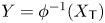 $Y=\phi ^{-1}(X_{\mathsf {T}})$. First we compute
 $\bigwedge ^{c}(\operatorname {Jac}(Y)|_{\phi ^{-1}(\Pi )})$, for each linear subspace
 $\Pi$ in the deep locus. This is fast because the Jacobian matrix is very sparse. Then we compute non-singularity for each affine piece of the partial covering from Lemma 2.2. Let
 $F_1,\ldots ,F_c$ be the homogeneous equations whose restriction to
 $(\phi ^{*}(\theta )\ne 0)$ defines the
 $\operatorname {CI}^{(c)}$ chart
 $Y_\theta =\phi ^{-1}(X\cap (\theta \ne 0))$ corresponding to cluster variable
 $x$. We verify the inclusion of ideals
 $(\phi ^{*}(\theta )^{k})\subset (\bigwedge ^{c}(\operatorname {Jac}(F_i)))$ for large enough
 $k$, which implies that the reduced singular locus of the chart
 $Y_\theta$ is empty.
Remark 6.1 Naïvely checking the rank of  $\operatorname {Jac}(Y)$ directly is not feasible in codimension greater than
 $4$ because of the size of the matrix. We have compared output of both methods in codimension 4, to ensure correct implementation.
6.3 Reasons for failure
We summarise the results on Part 2 of the algorithm in Table 5.
Table of failures.
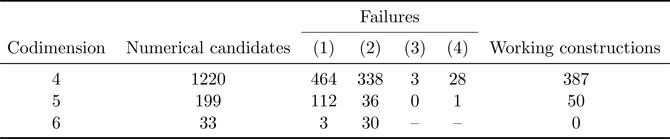
The ‘Numerical candidates’ column refers to the numerical cluster constructions output from Part 1. Part 2 removes those cluster formats which fail to construct a quasismooth Fano 3-fold  $Y$, and outputs those which do give a working construction. The reasons for failure listed in the table are explained in the rest of this subsection:
(1)
$\phi ^{-1}(\operatorname {sing} X)$ is non-empty, § 6.3.1;(2)
$Y$ is not quasismooth at a coordinate point, § 6.3.2;(3)
$Y$ fails for some ad hoc reason, § 6.3.3;(4)
$Y$ is quasismooth but has a false basket, § 6.3.4.


Throughout this subsection,  $\hat Y$ in
 $\mathbb {A}^{n}$ is the affine cone over a quasismooth 3-fold
 $Y\subset \mathbb {P}(a)$ in cluster format
 $(X,\mu ,\mathbb {F})$, and we denote the coordinates on
 $\mathbb {A}^{n}$ by
 $z_{1,\ldots ,n}$. The reasons for failure are conditions on the morphism
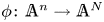 $\phi \colon \mathbb {A}^{n}\to \mathbb {A}^{N}$ which are necessary for
 $Y$ to be quasismooth. These conditions are independent of the choice of
 $\phi$.
6.3.1 Pullback singular locus of the cluster variety
The search polytope  $P$ from Part 1 of the search is defined by certain numerical conditions on
 $\rho$ implied by the requirement that
 $\phi ^{-1}(\operatorname {sing} X)$ is supported at the vertex or empty. By analysing
 $\phi$ more closely, we can sharpen the conditions on
 $\rho$.
Lemma 6.2 Suppose that  $\Pi$ is a component of the singular locus of
 $X$, with defining ideal
 $I_{\Pi }=(w_1,\ldots ,w_k)$. If
 $\hat Y$ is the affine cone over a quasismooth 3-fold, then one of the following two conditions must hold.
(i) (Empty) For some
$i$, $d(w_i)=0$.(ii) (Vertex) For each
$i=1,\ldots ,n$, there exists $j_i$ such that $d(z_i)$ divides $d(w_{j_i})$.


Proof. (i) If  $d(w_i)=0$ for some
 $i$, then we are done, because
 $\phi ^{*}(w_i)=1$ by convention, and
 $\phi ^{-1}(\Pi )$ is empty. (ii) Otherwise,
 $\phi ^{-1}(\Pi )$ is supported at the vertex, which implies that for each
 $i$, some power of
 $z_i$ is in
 $\phi ^{*}(I_{\Pi })$. Thus for each
 $i$, there exists
 $j_i$ such that some power of
 $z_i$ appears in
 $\phi ^{*}(w_{j_i})$.
Lemma 6.3 Suppose we are in case (ii) of Lemma 6.2. Choose coordinates and reorder them  $z_1,\ldots ,z_p,z_{p+1},\ldots ,z_n$ so that for
 $i=p+1,\ldots ,n$, we have
 $\phi ^{*}(w_{j_i})=z_i$ for some
 $w_{j_i}$. Then at least
 $p$ of the
 $\phi ^{*}(w_i)$ must be non-trivial modulo
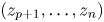 $(z_{p+1},\ldots ,z_n)$.
Proof. We work on the affine subspace  $V(z_{p+1},\ldots ,z_n)=\mathbb {A}^{p}\subset \mathbb {A}^{n}$. It remains to show that the ideal quotient
 $I'=\phi ^{*}(I_{\Pi })/(z_{p+1},\ldots ,z_n)$ is supported on the vertex
 $V(z_1,\ldots ,z_p)$ in
 $\mathbb {A}^{p}$. For this, we need at least
 $\dim \mathbb {A}^{p}$ non-trivial generators for
 $I'$.
Example 6.4 (Pullback of  $\operatorname {sing} X_{\mathsf {C}_2}$ is non-empty)
Consider  $\#25$,
 $Y\subset \mathbb {P}(2,5,6,7,8,9,10,11)$. Part 1 of the algorithm gives five numerical
 $\mathsf {C}_2$ formats for
 $Y$:
 \[ \left(\begin{smallmatrix}7 & 9 & 13 \\ 10 & 9 & 8 \end{smallmatrix}\big\vert \begin{smallmatrix}7 & 11 & 10 \\ 2 & 0 & 0 \end{smallmatrix}\big\vert \begin{smallmatrix}1\end{smallmatrix}\right), \left(\begin{smallmatrix}8 & 9 & 13 \\ 8 & 9 & 7 \end{smallmatrix}\big\vert \begin{smallmatrix}7 & 11 & 9 \\ 3 & 0 & 3 \end{smallmatrix}\big\vert \begin{smallmatrix}3\end{smallmatrix}\right), \left(\begin{smallmatrix}11 & 9 & 11 \\ 5 & 8 & 8 \end{smallmatrix}\big\vert \begin{smallmatrix}7 & 10 & 9 \\ 6 & 0 & 4 \end{smallmatrix}\big\vert \begin{smallmatrix}5\end{smallmatrix}\right), \left(\begin{smallmatrix}8 & 10 & 12 \\ 8 & 7 & 9 \end{smallmatrix}\big\vert \begin{smallmatrix}6 & 11 & 10 \\ 6 & 0 & 0 \end{smallmatrix}\big\vert \begin{smallmatrix}3\end{smallmatrix}\right), \left(\begin{smallmatrix}10 & 9 & 12 \\ 6 & 9 & 6 \end{smallmatrix}\big\vert \begin{smallmatrix}8 & 10 & 8 \\ 3 & 1 & 6 \end{smallmatrix}\big\vert \begin{smallmatrix}5\end{smallmatrix}\right). \]
By Lemma 3.3, the largest component of  $\operatorname {sing} X_{\mathsf {C}_2}$ is
 $V(\theta _1,\theta _2,\theta _3,\theta _{12},\theta _{23},\theta _{31},A_{12},A_{23},A_{31})$. We can read the degrees of the ideal generators directly from the cluster format. For example, in the first displayed case, we have
 $(7,9,13,7,11,10,10,9,8)$. Since none of these is divisible by
 $d(z_3)=6$, this case fails Lemma 6.2. Similarly for the second and third cases, while the fifth case also fails, because there is no space for
 $z_4$ which has degree
 $7$. The fourth case is actually a working construction; see Example 5.4 above.
Example 6.5 Consider  $\#166$,
 $Y\subset \mathbb {P}(2,2,3,3,4,4,5,5)$ with coordinates
 $p,q,r,s,t,u,v,w$ and
 $\mathsf {C}_2$ format
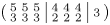 $(\begin {smallmatrix}5 & 5 & 5 \\ 3 & 3 & 3 \end {smallmatrix}\big \vert \begin {smallmatrix}4 & 4 & 4 \\ 2 & 2 & 2 \end {smallmatrix}\big \vert \begin {smallmatrix}3\end {smallmatrix})$. After choosing coordinates,
 $\phi$ takes the form
 \[ \left(\begin{array}{@{}ccc} v & w & P_5\\ r & s & R_3\end{array}\Bigg| \begin{array}{ccc} t & u & Q_4\\ p & q & S_2\end{array}\Bigg|\ T_3 \right),\]
which passes Lemma 6.2(ii), so we test Lemma 6.3. For the component
 \[ \Pi=V(\theta_1,\theta_2,\theta_3,\theta_{12},\theta_{23},\theta_{31},A_{12},A_{23},A_{31}) \subset \operatorname{sing}(X_{\mathsf{C}_2}), \]
the variables  $r,s,t,u,v,w$ appear as pullbacks of
 $A_{12},A_{23},\theta _1,\theta _2,\theta _{12},\theta _{23}$, respectively. Thus we need only consider
 $\phi ^{-1}(\Pi )\cap \mathbb {A}^{2}_{p,q}=V(P_5,Q_4,R_3)|_{\mathbb {A}^{2}_{p,q}}$. For degree reasons,
 $P|_{\mathbb {A}^{2}_{p,q}}\equiv R|_{\mathbb {A}^{2}_{p,q}}\equiv 0$ and so
 $Q|_{\mathbb {A}^{2}_{p,q}}$ cuts out two lines. Thus
 $\phi ^{-1}(\Pi )$ must be non-empty along the
 $pq$-plane.
6.3.2 Quasismoothness at coordinate points
It may still happen that  $Y$ is singular even though
 $\phi ^{-1}(\operatorname {sing} X)=\emptyset$. The following lemma gives a necessary condition for
 $Y$ to be quasismooth at all coordinate points of
 $\mathbb {P}(a)$.
Lemma 6.6 Let  $\phi ^{*}(I_X)=(\phi ^{*}(f_1),\ldots ,\phi ^{*}(f_m))$ be the ideal defining
 $\hat Y$ under regular pullback, and suppose that
 $P_i$ is the coordinate point corresponding to
 $z_i$. Then for each
 $i$, one of the following conditions must hold.
(i) (
$P_i\notin Y$) There exists an integer $j$ such that $\phi ^{*}(f_j)$ contains the monomial $z_i^{k}$ for some $k>0$.(ii) (
$P_i\in Y$) There exists $S\subset \{1,\ldots ,n\}$ of cardinality $c=\operatorname {codim}_{\mathbb {P}(a)} Y$ and a permutation $\sigma$ on $n$ elements, such that for all $j$ in $S$, $\phi ^{*}(f_{j})$ contains the monomial $z_{\sigma (j)}z_i^{m_j}$ for some $m_j>0$.






Proof. Clearly, condition (i) implies that  $P_i$ is not contained in
 $Y$. So we assume that
 $P_i$ is in
 $Y$. Let
 $J$ denote the Jacobian matrix
 $\operatorname {Jac}(Y)$ evaluated at
 $P_i$. If
 $Y$ is quasismooth, then
 $J$ contains a
 $c\times c$ submatrix
 $J_c$ of rank
 $c$. Since
 $P_i$ is a coordinate point, this implies condition (ii) of the lemma. Indeed, the row numbers of
 $J_c$ make up the subset
 $S$, and
 $\sigma$ is some suitable permutation whose restriction to
 $S$ maps rows of
 $J_c$ to linearly independent columns of
 $J_c$.
Example 6.7 Consider #308,  $Y\subset \mathbb {P}(1,5,6,6,7,8,9,10)$, with coordinates
 $p,q,r,s,t,u,v,w$ in
 $\mathsf {C}_2$ format
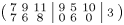 $(\begin {smallmatrix}7 & 9 & 11 \\ 7 & 6 & 8 \end {smallmatrix}\big \vert \begin {smallmatrix}9 & 5 & 10 \\ 0 & 6 & 0 \end {smallmatrix}\big \vert \begin {smallmatrix}3\end {smallmatrix})$. The general form of
 $\phi$ is
 \[\left( \begin{array}{@{}ccc} t & v & P_{11}\\ R_7 & r & u\end{array}\Bigg| \begin{array}{ccc} Q_9 & q & w\\ 1 & s & 1\end{array}\Bigg|\ p^{3} \right). \]
Here  $Y=\phi ^{-1}(X)$ is always singular at the coordinate point
 $P_s$, even though
 $\phi$ is generically an immersion, and
 $\phi ^{-1}(\operatorname {sing} X)$ is empty. Indeed, for degree reasons,
 $s$ only appears as
 $\phi ^{*}(A_2)$ and possibly in
 $P_{11}$,
 $Q_9$,
 $R_7$. A quick examination of the equations shows that the tangent cone to
 $\phi ^{-1}(X)$ at
 $P_s$ must be singular.
6.3.3 Ad hoc reasons for failure
We document the failures appearing in column (3) of Table5.
 $(\#360)$
 $Y\subset \mathbb {P}^{7}(1, 4, 5, 6, 7, 7, 8, 9)$ in
 $\mathsf {C}_2(\begin {smallmatrix}6 & 8 & 10 \\ 7 & 6 & 7 \end {smallmatrix}\big \vert \begin {smallmatrix}5 & 9 & 8 \\ 4 & 0 & 0 \end {smallmatrix}\big \vert \begin {smallmatrix}2\end {smallmatrix})$ format is always singular at one point in
 $\mathbb {P}(4,8)$.
 $(\#393)$
 $Y\subset \mathbb {P}^{7}(1, 4, 5, 5, 6, 7, 8, 9)$ in
 $\mathsf {C}_2(\begin {smallmatrix}6 & 7 & 9 \\ 6 & 8 & 8 \end {smallmatrix}\big \vert \begin {smallmatrix}5 & 10 & 7 \\ 3 & -4 & 1 \end {smallmatrix}\big \vert \begin {smallmatrix}0\end {smallmatrix})$ format (i.e.
 $\mathbb {P}^{2}\times \mathbb {P}^{2}$ subformat) has a singular curve supported on
 $\mathbb {P}(5,5)$ and a singular point in
 $\mathbb {P}(4,8)$.
 $(\#878)$
 $Y\subset \mathbb {P}^{7}(1, 3, 3, 4, 4, 5, 5, 6)$ in
 $\mathsf {G}_2(\begin {smallmatrix}9 & 6 & 9 & 6 \\ 0 & 2 & 0 & 4 \end {smallmatrix}\big \vert \begin {smallmatrix}4 & 4 & 5 & 5 \\ 3 & 3 & 0 & 0 \end {smallmatrix}\big \vert \begin {smallmatrix}3 \\ 3 \end {smallmatrix})$ format is singular along a curve in
 $\mathbb {P}(3,3,6)$.
6.3.4 False baskets and ice cream
Let  $Y\subset \mathbb {P}(a_1,\ldots ,a_n)$ be a candidate Fano 3-fold from [Reference Brown and KasprzykGRDB] with basket of terminal quotient singularities
 $\mathcal {B}$. Suppose
 $Y'$ is a quasismooth 3-fold in weighted projective space with Hilbert series matching
 $Y$. We say that
 $Y'$ has a false basket if the quotient singularities of
 $Y'$ are not terminal. Such
 $Y'$ are discarded.
Example 6.8  $\#569$,
 $Y\subset \mathbb {P}(1,3,4,5,5,6,7,9)$ of Fano index
 $q=1$ in
 $\mathsf {G}_2(\begin {smallmatrix}15 & 5 & 10 & 9 \\ 0 & 5 & 0 & 6 \end {smallmatrix}\big \vert \begin {smallmatrix}7 & 3 & 7 & 8 \\- 1 & 6 & -2 & 0 \end {smallmatrix}\big \vert \begin {smallmatrix}0 \\ 3 \end {smallmatrix})$ format has
 $\frac 15(1,1,4)$ and
 $\frac 15(3,4,4)$ singularities instead of a single
 $\frac 15(1,2,3)$ singularity.
Example 6.9  $\#2410$,
 $Y\subset \mathbb {P}(1,2,2,3,4,5,5,6)$ in
 $\mathsf {G}_2(\begin {smallmatrix}6 & 5 & 9 & 6 \\ 0 & 0 & 0 & 4 \end {smallmatrix}\big \vert \begin {smallmatrix}2 & 3 & 6 & 4 \\ 5 & 5 & -3 & 0 \end {smallmatrix}\big \vert \begin {smallmatrix}3 \\ 4 \end {smallmatrix})$ format (i.e.
 $\mathsf {A}_2+\operatorname {CI}^{(1)}$ subformat) has a curve of index 2 singularities. This is the only quasismooth Fano 3-fold with non-isolated singularities that we find.
Remark 6.10 There is a misprint in [Reference Brown, Kasprzyk and QureshiBKQ18, Table 1]: #577 has a working construction in  $\mathbb {P}^{2}\times \mathbb {P}^{2}$ format, while #645 is quasismooth but not terminal.
Let  $\mathcal {B}$ denote either the basket of a candidate Fano 3-fold
 $Y$, or the set of isolated singularities on a quasismooth Fano 3-fold
 $Y'$. Define the basket vector of
 $\mathcal {B}$ to be
 $v(\mathcal {B})=(v_2,\ldots ,v_{a_n})$ where
 $v_r$ is the number of quotient singularities in
 $\mathcal {B}$ with index divisible by
 $r$, for
 $2\le r\le a_n$.
Example 6.11 According to [Reference Brown and KasprzykGRDB],  $\#569$ has basket vector
 $v(\mathcal {B})=(0,3,0,1,0,0,0,1)$, while the construction of Example 6.8 has basket vector
 $v(\mathcal {B}')=(0,3,0,2,0,0,0,1)$.
Lemma 6.12 Suppose  $Y$ is a candidate Fano 3-fold from [Reference Brown and KasprzykGRDB] in codimension 4, 5 or 6 and
 $Y'$ is a quasismooth 3-fold with isolated singularities such that
 $P_Y(t)=P_{Y'}(t)$. Then
 $\mathcal {B}(Y)=\mathcal {B}(Y')$ if and only if
 $v(\mathcal {B}(Y))=v(\mathcal {B}(Y'))$.
Proof. The ‘only if’ part is obvious. For the ‘if’ part, we use ice cream. Define  $k_Y=-q(Y)<0$ so that
 $\omega _Y=\mathcal {O}_Y(k_Y)$. By [Reference Buckley, Reid and ZhouBRZ13], the Hilbert series of
 $Y$ can be expressed as
 \[ P_Y(t)=P_I(t)+\sum_{Q\in\mathcal{B}} P_{\text{orb}}(Q,k_Y)(t) \]
where  $P_I(t)$ is uniquely determined by
 $k_Y$ and the first
 $\lfloor ({k_Y+2})/2\rfloor$ terms of
 $P_Y(t)$. In particular, the orbifold contributions to
 $P_Y(t)$ and
 $P_{Y'}(t)$ are equal.
Using a computer, we calculate the orbifold contribution to the Hilbert series for all baskets  $\mathcal {B}'$ with basket vector
 $v(\mathcal {B}')=v(\mathcal {B}(Y))$. Since
 $Y'$ is quasismooth with isolated singularities, one of these baskets must be the set of singularities of
 $Y'$. We find that the only possibilities for
 $\mathcal {B}'$ whose orbifold contribution matches that of
 $Y$ are permutations of
 $\mathcal {B}$, so the lemma is proven.
We discard any constructions  $Y'$ whose basket vector does not match that of the candidate
 $Y$, or which has non-isolated singularities. The basket vector is quite easy for the computer to determine. According to the above lemma, the remainder are terminal quasismooth Fano 3-folds.
Acknowledgements
It is our pleasure to dedicate this paper to our former advisor, Miles Reid, on the occasion of his 70th birthday. Clearly, this work is steeped in his influence, right down to the dilatory write-up process. We also thank Gavin Brown, Fabrizio Catanese, Alessio Corti, Paul Hacking and Balázs Szendroi for helpful conversations and encouragement at various stages of this project. SC was supported by ERC Advanced grant no. 340258, TADMICAMT.