










Introduction
0.1
Let  $F$ be a locally compact non-Archimedean field,
 $G$ a connected reductive
 $F$-group, and
 $\text{}\underline{G}^{\prime }$ an endoscopic datum of
 $G$ with underlying group
 $G^{\prime }$. If
 $\operatorname{char}(F)=0$, we know [Reference NgôNgô10, Reference WaldspurgerWal97, Reference WaldspurgerWal06] that for any function
 $f\in C_{\text{c}}^{\infty }(G(F))$, there exists a function
 $f^{\prime }\in C_{\text{c}}^{\infty }(G^{\prime }(F))$ such that
 $f$ and
 $f^{\prime }$ have matching (semi-simple) strongly
 $G$-regular orbital integrals. Such a function
 $f^{\prime }$ is called an endoscopic transfer, or simply a transfer, of
 $f$. If
 $\operatorname{char}(F)>0$, the existence of transfer is not known in general.
Even if the transfer is not unique, it is expected that for each  $f$, there is a transfer
 $f^{\prime }$ which is (in some sense) better than the others. For example, if
 $G$ and
 $\text{}\underline{G}^{\prime }$ are unramified, the fundamental lemma states that for any
 $K$-spherical function
 $f\in C_{\text{c}}^{\infty }(G(F))$, there exists a unique
 $K^{\prime }$-spherical function
 $f^{\prime }\in C_{\text{c}}^{\infty }(G^{\prime }(F))$ which is a transfer of
 $f$, where
 $K$ and
 $K^{\prime }$ are hyperspecial maximal compact subgroups of
 $G(F)$ and
 $G^{\prime }(F)$. Moreover, in that case, the correspondence
 $f\mapsto f^{\prime }$ is given by a morphism of algebras. If
 $\operatorname{char}(F)=0$, other examples of ‘distinguished transfers’ are given in [Reference HainesHai09, Reference HainesHai13, Reference Kazhdan and VarshavskyKV12].
Our aim here is to produce ‘distinguished transfers’ in the following case (studied by Roche [Reference RocheRoc98]):  $\operatorname{char}(F)\geqslant 0$,
 $G$ is
 $F$-split,
 $G^{\prime }$ is an (
 $F$-split) endoscopic group of
 $G$ associated to a depth-zero character of the maximal compact subgroup of a maximal split torus in
 $G(F)$, and
 $f$ is in the center of the Hecke algebra associated to this character.
0.2
Let  $p$ be the residual characteristic of
 $F$. From now on, we suppose
 $G$ is
 $F$-split. Let
 $T$ be a maximal
 $F$-split torus in
 $G$, and
 $\unicode[STIX]{x1D712}_{0}$ a depth-zero character of the maximal compact subgroup
 $T$ of
 $T(F)$. This character can be extended to a
 $W_{\unicode[STIX]{x1D712}_{0}}$-invariant character
 $\unicode[STIX]{x1D712}$ of
 $T(F)$, where
 $W_{\unicode[STIX]{x1D712}_{0}}$ is the subgroup of the Weyl group
 $W=N_{G}(T)/T$ formed of those elements which fix
 $\unicode[STIX]{x1D712}_{0}$. We fix a hyperspecial maximal compact subgroup
 $K$ of
 $G(F)$ corresponding to a vertex in the apartment of the Bruhat–Tits building of
 $G(F)$ associated to
 $T$. Let
 $B$ be a Borel subgroup of
 $G$ containing
 $T$. The Borel pair
 $(B,T)$ of
 $G$ determines an Iwahori subgroup
 $\unicode[STIX]{x2110}\subset K$ of
 $G(F)$. The character
 $\unicode[STIX]{x1D712}_{0}$ of
 $T$ defines by inflation a character
 $\unicode[STIX]{x1D70C}=\unicode[STIX]{x1D70C}_{\unicode[STIX]{x1D712}_{0}}$ of
 $\unicode[STIX]{x2110}$. It also defines a connected reductive
 $F$-split group
 $G^{\prime }$ with maximal
 $F$-split torus
 $T^{\prime }=T$, which turns out to be an endoscopic group of
 $G$. We fix a hyperspecial maximal compact subgroup
 $K^{\prime }$ of
 $G^{\prime }(F)$ as above. Then an Iwahori subgroup
 $\unicode[STIX]{x2110}^{\prime }\subset K^{\prime }$ of
 $G^{\prime }(F)$ is associated to
 $\unicode[STIX]{x2110}$. Let
 $Z(G(F),\unicode[STIX]{x1D70C})$ be the center of the Hecke algebra
 $\unicode[STIX]{x210B}(G(F),\unicode[STIX]{x1D70C})$ of compactly supported
 $\unicode[STIX]{x1D70C}^{-1}$-spherical functions on
 $G(F)$, and
 $Z(G^{\prime }(F),1_{\unicode[STIX]{x2110}^{\prime }})$ be the center of the Hecke algebra
 $\unicode[STIX]{x210B}(G^{\prime }(F),1_{\unicode[STIX]{x2110}^{\prime }})$ of compactly supported
 $\unicode[STIX]{x2110}^{\prime }$-biinvariant functions on
 $G^{\prime }(F)$. We have a natural injective morphism of
 $\mathbb{C}$-algebras (cf. § 1.3)
 $$\begin{eqnarray}\unicode[STIX]{x1D701}_{\unicode[STIX]{x1D712}}:Z(G(F),\unicode[STIX]{x1D70C})\rightarrow Z(G^{\prime }(F),1_{\unicode[STIX]{x2110}^{\prime }}).\end{eqnarray}$$
On the other hand, the image of the Langlands parameter  $\unicode[STIX]{x1D711}_{\unicode[STIX]{x1D712}}:W_{F}\rightarrow {\check{T}}$ of
 $\unicode[STIX]{x1D712}$ is contained in the center
 $Z({\check{G}}^{\prime })$ of the dual group (in the sense of Langlands)
 ${\check{G}}^{\prime }$ of
 $G^{\prime }$. Thus it defines a character
 $\unicode[STIX]{x1D714}_{\unicode[STIX]{x1D712}}^{\prime }$ of
 $G^{\prime }(F)$. The question is: does the map
 $$\begin{eqnarray}Z(G(F),\unicode[STIX]{x1D70C})\rightarrow C_{\text{c}}^{\infty }(G^{\prime }(F)),\quad f\mapsto (\unicode[STIX]{x1D714}_{\unicode[STIX]{x1D712}}^{\prime })^{-1}\unicode[STIX]{x1D701}_{\unicode[STIX]{x1D712}}(f)\end{eqnarray}$$
realize the transfer?
0.3
In [Reference HainesHai13], Haines answered a different but similar question, relative to unramified base change (in characteristic zero). In the case of unramified base change, the study is made simpler by the following property: for an unramified extension  $F_{r}/F$ of degree
 $r$, all the elements of the Weyl group
 $W_{r}$ of
 $G(F_{r})$ that give a non-trivial contribution to the geometric transfer from
 $G(F_{r})$ to
 $G(F)$ belong to the Weyl group
 $W$ of
 $G(F)$. This is no longer true for our problem. So we have to consider, for each element
 $w\in W$, a variant of the morphism
 $\unicode[STIX]{x1D701}_{\unicode[STIX]{x1D712}}$: let
 $\unicode[STIX]{x1D712}_{w,0}$ be the character
 $(\text{}^{w}\!\unicode[STIX]{x1D712}_{0})\unicode[STIX]{x1D712}_{0}^{-1}$ of
 $T$, and
 $\unicode[STIX]{x1D70C}_{w}^{\prime }$ be the character of
 $\unicode[STIX]{x2110}^{\prime }$ extending
 $\unicode[STIX]{x1D712}_{w,0}$ by inflation. Also let
 $\text{}^{w}\!\unicode[STIX]{x1D70C}$ be the character
 $\unicode[STIX]{x1D70C}\circ \operatorname{Int}_{n_{w}^{-1}}$ of the Iwahori subgroup
 $\text{}^{w}\unicode[STIX]{x2110}=\operatorname{Int}_{n_{w}}(\unicode[STIX]{x2110})$, where
 $n_{w}$ is a representative element of
 $w$ in
 $K\,\cap \,N_{G}(T)$. We have a (similar) natural injective morphism of
 $\mathbb{C}$-algebras
 $$\begin{eqnarray}\unicode[STIX]{x1D701}_{w,\unicode[STIX]{x1D712}}:Z(G(F),\text{}^{w}\!\unicode[STIX]{x1D70C})\rightarrow Z(G^{\prime }(F),\unicode[STIX]{x1D70C}_{w}^{\prime }).\end{eqnarray}$$
We also have an isomorphism of  $\mathbb{C}$-algebras
 $$\begin{eqnarray}Z(G(F),\unicode[STIX]{x1D70C})\rightarrow Z(G(F),\text{}^{w}\!\unicode[STIX]{x1D70C}),\quad f\mapsto \text{}^{w}\!f=f\circ \operatorname{Int}_{n_{w}^{-1}}.\end{eqnarray}$$
For  $f\in Z(G(F),\unicode[STIX]{x1D70C})$, let
 $\boldsymbol{\unicode[STIX]{x1D701}}_{\unicode[STIX]{x1D712}}(f)\in C_{\text{c}}^{\infty }(G^{\prime }(F))$ be the function defined by
 $$\begin{eqnarray}\boldsymbol{\unicode[STIX]{x1D701}}_{\unicode[STIX]{x1D712}}(f)=|W^{\prime }|^{-1}\mathop{\sum }_{w\in W}\unicode[STIX]{x1D701}_{w,\unicode[STIX]{x1D712}}(\text{}^{w}\!f).\end{eqnarray}$$
Note that the function  $(\unicode[STIX]{x1D714}_{\unicode[STIX]{x1D712}}^{\prime })^{-1}\boldsymbol{\unicode[STIX]{x1D701}}_{\unicode[STIX]{x1D712}}(f)\in C_{\text{c}}^{\infty }(G^{\prime }(F))$ depends only on
 $\unicode[STIX]{x1D712}_{0}$ (lemma of § 1.6), and not on the choice of the
 $W_{\unicode[STIX]{x1D712}_{0}}$-invariant character
 $\unicode[STIX]{x1D712}$ of
 $T(F)$ extending
 $\unicode[STIX]{x1D712}_{0}$. We denote it by
 $$\begin{eqnarray}\boldsymbol{\unicode[STIX]{x1D709}}_{\unicode[STIX]{x1D712}_{0}}(f)=(\unicode[STIX]{x1D714}_{\unicode[STIX]{x1D712}}^{\prime })^{-1}\boldsymbol{\unicode[STIX]{x1D701}}_{\unicode[STIX]{x1D712}}(f).\end{eqnarray}$$
Our main result is the following theorem.
Theorem. Let  $f\in Z(G(F),\unicode[STIX]{x1D70C})$. The function
 $\boldsymbol{\unicode[STIX]{x1D709}}_{\unicode[STIX]{x1D712}_{0}}(f)$ is a transfer of
 $f$.
The proof of the theorem uses a local–global argument based on a simple trace formula, whose geometric side sees only the elliptic regular elements. Thus we have to reduce the theorem to the following ‘elliptic version’.
Theorem*. Assume that the endoscopic group  $G^{\prime }$ of
 $G$ is elliptic, and let
 $f$ be a function in
 $Z(G(F),\unicode[STIX]{x1D70C})$. Then
 $f$ and
 $\boldsymbol{\unicode[STIX]{x1D709}}_{\unicode[STIX]{x1D712}_{0}}(f)$ have matching elliptic strongly
 $G$-regular orbital integrals.
For technical reasons, we will have to prove a slight generalization of the elliptic version above. Let us fix another depth-zero character  $\unicode[STIX]{x1D713}_{0}$ of
 $T$. For each element
 $w\in W$, the depth-zero character
 $\unicode[STIX]{x1D709}_{w,0}=\text{}^{w}(\unicode[STIX]{x1D713}_{0}\unicode[STIX]{x1D712}_{0})\unicode[STIX]{x1D712}_{0}^{-1}$ of
 $T$ inflates to a character
 $\unicode[STIX]{x1D70C}_{\unicode[STIX]{x1D709}_{w,0}}^{\prime }$ of
 $\unicode[STIX]{x2110}^{\prime }$, and we have a natural injective morphism of
 $\mathbb{C}$-algebras
 $$\begin{eqnarray}\unicode[STIX]{x1D701}_{w,\unicode[STIX]{x1D712}}:Z(G(F),\text{}^{w}\!(\unicode[STIX]{x1D70C}_{\unicode[STIX]{x1D713}_{0}\unicode[STIX]{x1D712}_{0}}))\rightarrow Z(G^{\prime }(F),\unicode[STIX]{x1D70C}_{\unicode[STIX]{x1D709}_{w,0}}^{\prime }).\end{eqnarray}$$
For  $f\in Z(G(F),\unicode[STIX]{x1D70C}_{\unicode[STIX]{x1D713}_{0}\unicode[STIX]{x1D712}_{0}})$, we define
 $\boldsymbol{\unicode[STIX]{x1D709}}_{\unicode[STIX]{x1D712}_{0}}=(\unicode[STIX]{x1D714}_{\unicode[STIX]{x1D712}}^{\prime })^{-1}\boldsymbol{\unicode[STIX]{x1D701}}_{\unicode[STIX]{x1D712}}(f)\in C_{\text{c}}^{\infty }(G^{\prime }(F))$ as above. Then we have the ‘variant with two characters’ of Theorem*:
Theorem**. Assume that the endoscopic group  $G^{\prime }$ of
 $G$ is elliptic, and let
 $f$ be a function in
 $Z(G(F),\unicode[STIX]{x1D70C}_{\unicode[STIX]{x1D713}_{0}\unicode[STIX]{x1D712}_{0}})$. Then
 $f$ and
 $\boldsymbol{\unicode[STIX]{x1D709}}_{\unicode[STIX]{x1D712}_{0}}(f)$ have matching elliptic strongly
 $G$-regular orbital integrals.
We prove that the theorem is implied by Theorem**. The local–global argument is used in the proof of Theorem**. In fact, it allows us to prove a slightly stronger result: assuming the endoscopic group  $G^{\prime }$ is elliptic, for all functions
 $f\in Z(G(F),\unicode[STIX]{x1D70C}_{\unicode[STIX]{x1D713}_{0}\unicode[STIX]{x1D712}_{0}})$, the function
 $\boldsymbol{\unicode[STIX]{x1D709}}_{\unicode[STIX]{x1D712}_{0}}(f)$ is a transfer of
 $f$. We also prove that this result remains true without assuming
 $G^{\prime }$ elliptic (i.e. the ‘variant with two characters’ of the theorem).
0.4
The local–global argument in question is the existence of Hales local data for our local problem, obtained as in [Reference HalesHal95] by comparing two simple trace formulas,Footnote 1 one for  $G$ and the other for
 $G^{\prime }$. In characteristic zero, Waldspurger pointed out to us that the spectral transfer, proved by Arthur in [Reference ArthurArt96], provides these local data by a purely local argument. Waldspurger’s proof (see § 2.6) is much shorter but (as he explained to us) essentially the same because Arthur obtained the spectral transfer using a local–global argument very close to that of Hales. Note that (in characteristic zero) Waldspurger’s proof makes unnecessary the reductionFootnote 2 to an elliptic endoscopic group
 $G^{\prime }$.
The rest of the proof is a simple adaptation of that of Haines [Reference HainesHai13]. As in [Reference HainesHai13], we introduce some Labesse elementary functions (for  $G$ and
 $G^{\prime }$) whose orbital integrals on strongly regular elements and traces on irreducible smooth representations are very easy to calculate. In particular, for each
 $B$-dominant regular co-character
 $\unicode[STIX]{x1D708}$ of
 $T$, we have a function
 $\mathfrak{f}_{\unicode[STIX]{x1D708}}\in \unicode[STIX]{x210B}(G(F),\unicode[STIX]{x1D70C}_{\unicode[STIX]{x1D713}_{0}\unicode[STIX]{x1D712}_{0}})$ and a function
 $\boldsymbol{\mathfrak{f}}_{\unicode[STIX]{x1D708}}^{\prime }\in \sum _{w\in W}\unicode[STIX]{x210B}(G^{\prime }(F),\unicode[STIX]{x1D70C}_{\unicode[STIX]{x1D709}_{w,0}}^{\prime })$ such that
 $(\unicode[STIX]{x1D714}_{\unicode[STIX]{x1D712}}^{\prime })^{-1}\boldsymbol{\mathfrak{f}}_{\unicode[STIX]{x1D708}}^{\prime }$ is a transfer of
 $\mathfrak{f}_{\unicode[STIX]{x1D708}}$. Thanks to the existence of local data, these functions allow the geometric identities of transfer to be rewritten in terms of characters identities. By linear independence of characters, viewed as linear combinations of characters on the set of
 $B$-dominant regular co-characters
 $\unicode[STIX]{x1D708}$, we obtain the same identity for
 $\unicode[STIX]{x1D708}=0$. In others words, denoting by
 $e_{\unicode[STIX]{x1D70C}_{\unicode[STIX]{x1D713}_{0}\unicode[STIX]{x1D712}_{0}}}$ the unit element of the Hecke algebra
 $\unicode[STIX]{x210B}(G(F),\unicode[STIX]{x1D70C}_{\unicode[STIX]{x1D713}_{0}\unicode[STIX]{x1D712}_{0}})$, and by
 $e_{\unicode[STIX]{x1D70C}_{\unicode[STIX]{x1D709}_{w,0}}^{\prime }}$ the unit element of the Hecke algebra
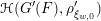 $\unicode[STIX]{x210B}(G^{\prime }(F),\unicode[STIX]{x1D70C}_{\unicode[STIX]{x1D709}_{w,0}}^{\prime })$, the function
 $(\unicode[STIX]{x1D714}_{\unicode[STIX]{x1D712}}^{\prime })^{-1}|W^{\prime }|^{-1}\sum _{w\in W}e_{\unicode[STIX]{x1D70C}_{\unicode[STIX]{x1D709}_{w,0}}^{\prime }}$ is a transfer of
 $e_{\unicode[STIX]{x1D70C}_{\unicode[STIX]{x1D713}_{0}\unicode[STIX]{x1D712}_{0}}}$. Now for
 $f\in Z(G(F),\unicode[STIX]{x1D70C}_{\unicode[STIX]{x1D713}_{0}\unicode[STIX]{x1D712}_{0}})$, thanks again to the existence of local data, the characterization of
 $\boldsymbol{\unicode[STIX]{x1D701}}_{w,\unicode[STIX]{x1D712}}(f)$ for
 $w\in W$ by actions on principal series gives the desired result:
 $\boldsymbol{\unicode[STIX]{x1D709}}_{\unicode[STIX]{x1D712}_{0}}(f)=(\unicode[STIX]{x1D714}_{\unicode[STIX]{x1D712}}^{\prime })^{-1}\boldsymbol{\unicode[STIX]{x1D701}}_{\unicode[STIX]{x1D712}}(f)$ is a transfer of
 $f$. This proves the ‘variant with two characters’ of the theorem in the case of an elliptic endoscopic group
 $G^{\prime }$, and hence in general.
0.5
Let us briefly describe the content of the various sections.
In § 1 we introduce the objects and state the various versions of the theorem. We prove the reduction of the theorem to Theorem**. We also prove that we can suppose (in Theorem**) that the derived group  $G_{\text{der}}$ of
 $G$ is simply connected and the scheme-theoretic center of
 $G$ is a torus; alternatively, we can suppose
 $G=G_{\text{AD}}$.
In § 2, we introduce the elementary functions adapted to our problem, for  $G$ and for
 $G^{\prime }$ (we do not suppose
 $G^{\prime }$ elliptic). Then we calculate their orbital integrals on strongly regular elements and their traces on smooth irreducible representations. Together with the existence of local data, these calculations allow us to prove the variant with two characters of the theorem. When
 $\operatorname{char}(F)=0$, we also give Waldspurger’s proof of the existence of local data.
In § 3, we prove the existence of local data when  $\operatorname{char}(F)\geqslant 0$ as in [Reference HalesHal95], assuming
 $G$ semi-simple and
 $G^{\prime }$ elliptic (this reduction is possible, as we see in § 1). For the last part of this introduction, let us change notation: we denote by
 $F_{0}$,
 $G_{0}$,
 $G_{0}^{\prime }$ the objects previously denoted by
 $F$,
 $G$ and
 $G^{\prime }$. We can realize our local situation
 $(G_{0},G_{0}^{\prime })$ as the localization at a finite place
 $v_{0}$ of a global field
 $F$ of a global situation
 $(G,G^{\prime })$, where
 $G$ is an
 $F$-split connected reductive group and
 $G^{\prime }$ is an
 $F$-split elliptic endoscopic group of
 $G$. Thus we have
 $F_{v_{0}}\simeq F_{0}$,
 $G_{v_{0}}\;(=G\times _{F}F_{v_{0}})\simeq G_{0}$ and
 $G_{\!v_{0}}^{\prime }\simeq G_{0}^{\prime }$. Suppose for a moment that
 $\operatorname{char}(F_{0})=0$. Hence
 $F$ is a number field. Since the global endoscopic group
 $G^{\prime }$ is elliptic and unramified at almost all Footnote 3 (in fact at all) finite places of
 $F$, it is possible to isolate it in the stabilized elliptic part of the trace formula for
 $G$. Here we used the following result [Reference Lemaire and WaldspurgerLW19]: two (global) endoscopic data of
 $G$ which are equivalent almost everywhere, are globally equivalent. Once we have isolated
 $G^{\prime }$, we prove the existence of local data following [Reference ClozelClo90, Reference LabesseLab90, Reference HalesHal95]. If
 $\operatorname{char}(F_{0})=p>0$, the proof works in the same way provided that the following local results are available: the fundamental lemma for the unit (at almost all places
 $v$ of
 $F$); at a given place
 $v\neq v_{0}$, the existence of a non-zero linear combination
 $f_{v}$ of matrix coefficients of irreducible supercuspidal representations of
 $G(F_{v})$ that transfers to
 $G^{\prime }(F_{v})$; at a given place
 $w\neq v_{0}$, the existence of a function on
 $G(F_{w})$ that transfers to a non-zero linear combination
 $f_{w}^{\prime }$ of matrix coefficients of irreducible supercuspidal representations of
 $G^{\prime }(F_{w})$. These local results are proved if
 $p$ is large enough.
0.6
Let us emphasize that our proof is modeled on that of Haines [Reference HainesHai13], even if the technical complications are relevant. We wrote this proof carefully because we hope to be able to apply it to much more general situations, for example for a character  $\unicode[STIX]{x1D712}_{0}$ of positive depth, or for a general depth-zero Bernstein block.
In characteristic  $p>0$, the result is weaker because of the restriction on
 $p$. It is also more interesting because we do not know the existence of transfer in general,Footnote 4 but only for particular functions (cf. § 0.5). As a consequence, for
 $G$ split, our result shows the existence of transfer relative to certain split endoscopic groups
 $G^{\prime }$ (see Remark 3 of § 1.1), in characteristic
 $p>0$ large enough (see remark of § 3.10), for certain more functions than the one guaranteed by the fundamental lemma.
Note also that our result should make possible an explicit description of the spectral endoscopic transfer from  $G^{\prime }(F)$ to
 $G(F)$ for the representations in the depth-zero Bernstein blocks involved here.
1 Main result and various reductions
In this section  $F$ is a non-Archimedean local field, and
 $G$ is a connected reductive
 $F$-split (i.e. defined and split over
 $F$) group. We identify
 $G$ with
 $G(\overline{F})$ for a fixed algebraic closure
 $\overline{F}$ of
 $F$. Then
 $G(F)$ identifies with the subgroup
 $G(F^{\text{sep}})^{\unicode[STIX]{x1D6E4}_{F}}\subset G$ of elements of
 $G(F^{\text{sep}})$ fixed by
 $\unicode[STIX]{x1D6E4}_{F}=\operatorname{Gal}(F^{\text{sep}}/F)$, where
 $F^{\text{sep}}$ is the separable closure of
 $F$ in
 $\overline{F}$.
1.1 Some results of Roche [Reference RocheRoc98]
Let  $\mathfrak{o}$ be the ring of integers of
 $F$,
 $\mathfrak{p}$ the maximal ideal of
 $\mathfrak{o}$, and
 $\mathfrak{K}=\mathfrak{o}/\mathfrak{p}$ the residue field. We denote by
 $|\,\cdot \,|_{F}$ the absolute value on
 $F$ normalized by
 $|\unicode[STIX]{x1D71B}|_{F}=q^{-1}$ for a uniformizer element
 $\unicode[STIX]{x1D71B}$ of
 $F$, where
 $q$ is the number of elements of
 $\mathfrak{K}$. Let
 $(B,T)$ be a Borel pair of
 $G$, defined and split over
 $F$, and
 $U$ the radical unipotent of
 $B$. Let
 $X$ (respectively,
 $\check{X}$) be the group of algebraic characters (respectively, co-characters) of
 $T$. Let
 $T=T(\mathfrak{o})$ be the maximal compact subgroup of
 $T$, and
 $T_{+}\subset T$ the kernel of the natural morphism (reduction modulo
 $\mathfrak{p}$)
 $T(\mathfrak{o})\rightarrow T(\mathfrak{K})$. We fix a character
 $\unicode[STIX]{x1D712}_{0}$ of
 $T$. We assume that
 $\unicode[STIX]{x1D712}_{0}$ is depth zero, that is, trivial on
 $T_{+}$.
We fix a hyperspecial maximal compact subgroup  $K$ of
 $G(F)$ corresponding to a hyperspecial vertex
 $x_{0}$ in the apartment of the Bruhat–Tits building of
 $G(F)$ associated to
 $T$. The base-point
 $x_{0}$ allows us to identify this apartment with the vector space
 $V=\check{X}\otimes _{\mathbb{Z}}\mathbb{R}$. Thus we have
 $$\begin{eqnarray}K\,\cap \,B=(K\,\cap \,T)(K\,\cap \,U),\quad K\,\cap \,T=T.\end{eqnarray}$$
Let  $\unicode[STIX]{x1D6F7}=\unicode[STIX]{x1D6F7}(G,T)$ be the set of roots of
 $T$ in
 $G$, and
 $\check{\unicode[STIX]{x1D6F7}}$ the set of co-roots. Let
 $\unicode[STIX]{x1D6F7}_{+}=\unicode[STIX]{x1D6F7}(B,T)$ be the set of roots of
 $T$ in
 $B$, and
 $\unicode[STIX]{x1D6E5}\subset \unicode[STIX]{x1D6F7}_{+}$ the corresponding basis of
 $\unicode[STIX]{x1D6F7}$. Let
 $\unicode[STIX]{x2110}\subset K$ be the Iwahori subgroup of
 $G(F)$ corresponding to the alcove
 $$\begin{eqnarray}A=\{v\in V:0<\unicode[STIX]{x1D6FC}(v)<1,\,\forall \unicode[STIX]{x1D6FC}\in \unicode[STIX]{x1D6F7}_{+}\},\quad V=\check{X}\otimes _{\mathbb{Z}}\mathbb{R}.\end{eqnarray}$$
Hence  $\unicode[STIX]{x2110}$ is in good position with respect to the Borel pair
 $(B,T)$: we have the triangular decomposition
 $$\begin{eqnarray}\unicode[STIX]{x2110}=(\unicode[STIX]{x2110}\,\cap \,\overline{U})(\unicode[STIX]{x2110}\,\cap \,T)(\unicode[STIX]{x2110}\,\cap \,U)\end{eqnarray}$$
where  $\overline{U}$ is the unipotent radical of the Borel subgroup
 $\overline{B}$ opposite to
 $B$ with respect to
 $T$. Moreover, we have
 $T=\unicode[STIX]{x2110}\,\cap \,T$ and
 $T_{+}=\unicode[STIX]{x2110}_{+}\,\cap \,T$, where
 $\unicode[STIX]{x2110}_{+}$ is the pro-unipotent radical of
 $\unicode[STIX]{x2110}$, and the inclusion
 $T\subset \unicode[STIX]{x2110}$ induces an isomorphism
 $T/T_{+}\stackrel{\simeq }{\longrightarrow }\unicode[STIX]{x2110}/\unicode[STIX]{x2110}_{+}$. So the character
 $\unicode[STIX]{x1D712}_{0}$ of
 $T$ can be viewed as a one-dimensional representation of
 $\unicode[STIX]{x2110}$, denoted by
 $\unicode[STIX]{x1D70C}=\unicode[STIX]{x1D70C}_{\unicode[STIX]{x1D712}_{0}}$. It is given by
 $$\begin{eqnarray}\unicode[STIX]{x1D70C}(\bar{u}tu)=\unicode[STIX]{x1D712}_{0}(t),\quad \bar{u}\in \unicode[STIX]{x2110}\,\cap \,\overline{U},~t\in T,~u\in \unicode[STIX]{x2110}\,\cap \,U.\end{eqnarray}$$
Let  $\unicode[STIX]{x1D712}$ be a characterFootnote 5 of
 $T(F)$ extending
 $\unicode[STIX]{x1D712}_{0}$. Let
 $\mathfrak{s}=\mathfrak{s}_{\unicode[STIX]{x1D712}_{0}}$ be the
 $G(F)$-inertial class
 $[T,\unicode[STIX]{x1D712}]_{G}$ of the cuspidal pair
 $(T,\unicode[STIX]{x1D712})$ of
 $G(F)$. It does not depend on the choice of
 $\unicode[STIX]{x1D712}$, and we know by Roche [Reference RocheRoc98] that the pair
 $(\unicode[STIX]{x2110},\unicode[STIX]{x1D70C})$ is an
 $\mathfrak{s}$-type in the Bushnell–Kutzko sense: for an irreducible (smooth, complex) representation
 $\unicode[STIX]{x1D70B}$ of
 $G(F)$, we have
 $\operatorname{Hom}_{\unicode[STIX]{x2110}}(\unicode[STIX]{x1D70C},\unicode[STIX]{x1D70B}|_{\unicode[STIX]{x2110}})\neq 0$ if and only if
 $\unicode[STIX]{x1D70B}$ is isomorphic to a subquotient of a principal series representation
 $i_{B}^{G}(\unicode[STIX]{x1D712}\unicode[STIX]{x1D709})$ of
 $G(F)$ for some character
 $\unicode[STIX]{x1D709}$ of
 $T(F)$ trivial on
 $T$, where
 $i_{B}^{G}$ denotes the normalized parabolic induction functor.
Remark 1. In Roche’s proof, there is a restriction on the residue characteristic on  $F$. However, in the depth-zero situation, no such restriction is needed (see [Reference HainesHai13]).
Let  $N=N_{G}(T)$ be the normalizer of
 $T$ in
 $G$, and
 $W=N/T\;(=N(F)/T(F))$ the Weyl group of
 $G$. We denote by
 $N(F)_{\unicode[STIX]{x1D712}_{0}}$ (respectively,
 $W_{\unicode[STIX]{x1D712}_{0}}$) the subgroup of
 $N(F)$ (respectively,
 $W$) formed by the elements which fix
 $\unicode[STIX]{x1D712}_{0}$. The group
 $N(F)_{\unicode[STIX]{x1D712}_{0}}$ contains
 $T(F)$, and we have
 $W_{\unicode[STIX]{x1D712}_{0}}=N(F)_{\unicode[STIX]{x1D712}_{0}}/T(F)$.
The character  $\unicode[STIX]{x1D712}_{0}$ of
 $T$ extends to a (
 $W_{\unicode[STIX]{x1D712}_{0}}$-invariant) character
 $\tilde{\unicode[STIX]{x1D712}}$ of
 $N(F)_{\unicode[STIX]{x1D712}_{0}}$. In fact,
 $\unicode[STIX]{x1D712}_{0}$ extends to a character
 $\tilde{\unicode[STIX]{x1D712}}_{0}$ of the subgroup
 $N_{\unicode[STIX]{x1D712}_{0}}$ of
 $N=N(\mathfrak{o})$ formed by the elements which fix
 $\unicode[STIX]{x1D712}_{0}$ [Reference Howlett and LehrerHL80, 6.11]. The choice a uniformizer element
 $\unicode[STIX]{x1D71B}$ of
 $F$ gives an identification
 $N(F)=\check{X}\,\rtimes \,N$, which induces an identification
 $N(F)_{\unicode[STIX]{x1D712}_{0}}=\check{X}\,\rtimes \,N_{\unicode[STIX]{x1D712}_{0}}$. Let
 $\tilde{\unicode[STIX]{x1D712}}=\tilde{\unicode[STIX]{x1D712}}_{0}^{\unicode[STIX]{x1D71B}}$ be the character of
 $N(F)_{\unicode[STIX]{x1D712}_{0}}$ extending
 $\tilde{\unicode[STIX]{x1D712}}_{0}$ trivially on
 $\check{X}$. It is
 $W_{\unicode[STIX]{x1D712}_{0}}$-invariant by construction, and the restriction
 $\tilde{\unicode[STIX]{x1D712}}|_{T(F)}$ is the character
 $\unicode[STIX]{x1D712}_{0}^{\unicode[STIX]{x1D71B}}$ of
 $T(F)$ extending
 $\unicode[STIX]{x1D712}_{0}$ trivially on
 $\check{X}$ for the identification
 $T(F)=\check{X}\times T$ given by
 $\unicode[STIX]{x1D71B}$. From now on, we suppose
 $\unicode[STIX]{x1D712}=\unicode[STIX]{x1D712}_{0}^{\unicode[STIX]{x1D71B}}$ and
 $\tilde{\unicode[STIX]{x1D712}}=\tilde{\unicode[STIX]{x1D712}}_{0}^{\unicode[STIX]{x1D71B}}$ for a character
 $\tilde{\unicode[STIX]{x1D712}}_{0}$ of
 $N_{\unicode[STIX]{x1D712}_{0}}$ extending
 $\unicode[STIX]{x1D712}_{0}$ and a uniformizer element
 $\unicode[STIX]{x1D71B}$ of
 $F$.
Let
 $$\begin{eqnarray}\displaystyle & \displaystyle \unicode[STIX]{x1D6F7}^{\prime }=\{\unicode[STIX]{x1D6FC}\in \unicode[STIX]{x1D6F7}:\unicode[STIX]{x1D712}_{0}\circ \check{\unicode[STIX]{x1D6FC}}|_{\mathfrak{o}^{\times }}=1\}, & \displaystyle \nonumber\\ \displaystyle & \displaystyle \check{\unicode[STIX]{x1D6F7}}^{\prime }=\{\check{\unicode[STIX]{x1D6FC}}\in \check{\unicode[STIX]{x1D6F7}}:\unicode[STIX]{x1D712}_{0}\circ \check{\unicode[STIX]{x1D6FC}}|_{\mathfrak{o}^{\times }}=1\}. & \displaystyle \nonumber\end{eqnarray}$$
Hence we have  $\check{\unicode[STIX]{x1D6F7}}^{\prime }=\{\check{\unicode[STIX]{x1D6FC}}\in \unicode[STIX]{x1D6F7}:\unicode[STIX]{x1D6FC}\in \unicode[STIX]{x1D6F7}^{\prime }\}$. We also denote by
 $W^{\prime }$ the subgroup of
 $W_{\unicode[STIX]{x1D712}_{0}}$ generated by the reflections
 $s_{\unicode[STIX]{x1D6FC}}$ for
 $\unicode[STIX]{x1D6FC}\in \unicode[STIX]{x1D6F7}^{\prime }$. By definition,
 $\check{\unicode[STIX]{x1D6F7}}^{\prime }$ is a closed sub-root system of
 $\check{\unicode[STIX]{x1D6F7}}$. Hence
 $\unicode[STIX]{x1D6F7}^{\prime }$ is a sub-root system of
 $\unicode[STIX]{x1D6F7}$, with Weyl group
 $W^{\prime }$. Let
 $G^{\prime }$ be a connected reductive group with root datum
 $(X,\unicode[STIX]{x1D6F7}^{\prime },\check{X},\check{\unicode[STIX]{x1D6F7}}^{\prime })$, defined and split over
 $F$. We identify
 $T$ with a maximal split torus
 $T^{\prime }$ in
 $G^{\prime }$. Then
 $\unicode[STIX]{x1D6F7}_{+}^{\prime }=\unicode[STIX]{x1D6F7}^{\prime }\,\cap \,\unicode[STIX]{x1D6F7}_{+}$ is a subset of positive roots of
 $\unicode[STIX]{x1D6F7}^{\prime }$. It defines a basis
 $\unicode[STIX]{x1D6E5}^{\prime }$ of
 $\unicode[STIX]{x1D6F7}^{\prime }$, and a Borel subgroup
 $B^{\prime }$ of
 $G^{\prime }$ containing
 $T^{\prime }$. We fix a hyperspecial maximal compact subgroup
 $K^{\prime }=K_{G^{\prime }}$ of
 $G^{\prime }(F)$ corresponding to a hyperspecial vertex
 $x_{0}^{\prime }$ in the apartment of the Bruhat–Tits building of
 $G^{\prime }(F)$ associated to
 $T^{\prime }$. The base-point
 $x_{0}^{\prime }$ allows us to identify this apartment with
 $V\;(=\check{X}\otimes _{\mathbb{Z}}\mathbb{R})$. Let
 $\unicode[STIX]{x2110}^{\prime }=\unicode[STIX]{x2110}_{G^{\prime }}\subset K^{\prime }$ be the Iwahori subgroup of
 $G^{\prime }(F)$ corresponding to the alcove
 $$\begin{eqnarray}A^{\prime }=\{v\in V:0<\unicode[STIX]{x1D6FC}(v)<1,\,\forall \unicode[STIX]{x1D6FC}\in \unicode[STIX]{x1D6F7}_{+}^{\prime }\}.\end{eqnarray}$$
Put  $C_{\unicode[STIX]{x1D712}_{0}}=\{w\in W_{\unicode[STIX]{x1D712}_{0}}:w(\unicode[STIX]{x1D6F7}_{+}^{\prime })=\unicode[STIX]{x1D6F7}_{+}^{\prime }\}$. Then we have [Reference RocheRoc98, Lemma 8.1]
 $$\begin{eqnarray}W_{\unicode[STIX]{x1D712}_{0}}=W^{\prime }\,\rtimes \,C_{\unicode[STIX]{x1D712}_{0}},\end{eqnarray}$$
and the choice of an  $F$-épinglage of the based root datum
 $(X,\unicode[STIX]{x1D6F7}^{\prime },\unicode[STIX]{x1D6E5}^{\prime },\check{X},\check{\unicode[STIX]{x1D6F7}}^{\prime },\check{\unicode[STIX]{x1D6E5}}^{\prime })$ gives an embedding of
 $C_{\unicode[STIX]{x1D712}_{0}}$ in
 $\operatorname{Aut}_{F}(G^{\prime })$. We put
 $$\begin{eqnarray}\widetilde{G}^{\prime }=G^{\prime }\,\rtimes \,C_{\unicode[STIX]{x1D712}_{0}}.\end{eqnarray}$$
Then we have [Reference RocheRoc98]:
(1)
 $G^{\prime }$ is an endoscopic group of $G$;
(2)
$\unicode[STIX]{x210B}(\widetilde{G}^{\prime }(F),1_{\unicode[STIX]{x2110}^{\prime }})\simeq \unicode[STIX]{x210B}(G^{\prime }(F),1_{\unicode[STIX]{x2110}^{\prime }})\,\widetilde{\otimes }\,\mathbb{C}[C_{\unicode[STIX]{x1D712}_{0}}]$;(3) there is a support-preserving isomorphism of
$\mathbb{C}$-algebras $$\begin{eqnarray}\unicode[STIX]{x1D6F9}_{\tilde{\unicode[STIX]{x1D712}}}:\unicode[STIX]{x210B}(G(F),\unicode[STIX]{x1D70C})\stackrel{\simeq }{\longrightarrow }\unicode[STIX]{x210B}(\widetilde{G}^{\prime }(F),1_{\unicode[STIX]{x2110}^{\prime }});\end{eqnarray}$$(4) if the scheme-theoretic center of
$G$ is a torus, then we have $C_{\unicode[STIX]{x1D712}_{0}}=\{1\}$.


In (1),  $G^{\prime }$ is the underlying group of an endoscopic datum
 $\text{}\underline{G}^{\prime }=(G^{\prime },G^{\prime },s)$ of
 $G$, where
 $s$ is an element of
 ${\check{T}}=\operatorname{Hom}(\check{X},\mathbb{C}^{\times })$ whose connected centralizer
 ${\check{G}}_{s}$ in
 ${\check{G}}$ (the complex dual group of
 $G$) is a connected reductive group over
 $\mathbb{C}$ with root system
 $(\check{X},\check{\unicode[STIX]{x1D6F7}}^{\prime },X,\unicode[STIX]{x1D6F7}^{\prime })$, and
 $G^{\prime }={\check{G}}_{s}\times W_{F}(\subset \text{}^{L}G={\check{G}}\times W_{F})$. In (2), the twisted tensor product
 $\widetilde{\otimes }$ is given by the conjugation action of
 $C_{\unicode[STIX]{x1D712}_{0}}$ on
 $\check{X}\,\rtimes \,W^{\prime }$ (cf. [Reference RocheRoc98, § 8]). In (3),
 $\unicode[STIX]{x210B}(G(F),\unicode[STIX]{x1D70C})$ is the convolution
 $\mathbb{C}$-algebra of compactly supported functions on
 $G(F)$ which are
 $\unicode[STIX]{x1D70C}^{-1}$-spherical, and
 $\unicode[STIX]{x210B}(\widetilde{G}^{\prime }(F),1_{\unicode[STIX]{x2110}^{\prime }})$ is the convolution
 $\mathbb{C}$-algebra of compactly supported
 $\unicode[STIX]{x2110}^{\prime }$-biinvariant functions on
 $\widetilde{G}^{\prime }(F)$. The isomorphism
 $\unicode[STIX]{x1D6F9}_{\tilde{\unicode[STIX]{x1D712}}}$ of (3) is described explicitly in § 1.2 (Proposition 2). In (4), the scheme-theoretic center of
 $G$ is the diagonalizable
 $F$-group scheme whose group of characters is
 $X/\mathbb{Z}\unicode[STIX]{x1D6F7}$. We denote it by
 $\mathfrak{Z}_{G}$. Hence
 $\mathfrak{Z}_{G}$ is a torus if and only if
 $X/\mathbb{Z}\unicode[STIX]{x1D6F7}$ is torsion-free, which is equivalent to
 ${\check{G}}$ having a simply connected derived group. Note that the reduced subscheme
 $(\mathfrak{Z}_{G})_{\text{red}}$ is a smooth group scheme that coincides with the ‘center’
 $Z(G)$ of
 $G$ in the sense of Borel (whose group of characters is the quotient of
 $X/\mathbb{Z}\unicode[STIX]{x1D6F7}$ by its
 $p$-torsion). Hence
 $\mathfrak{Z}_{G}$ is a torus if and only if it is reduced and connected.
Remark 2. Let us make (1) precise. The group  ${\check{T}}$ is the complex torus dual (in the sense of Langlands) to
 $T$: we have
 $X({\check{T}})=\check{X}$ and
 $\check{X}({\check{T}})=X$. Let
 $W_{F}\subset \unicode[STIX]{x1D6E4}_{F}$ be the absolute Weil group of
 $F$, and
 $\unicode[STIX]{x1D70F}_{F}:W_{F}\rightarrow W_{F}^{\text{ab}}\stackrel{\simeq }{\longrightarrow }F^{\times }$ be the morphism of local class field theory. The Langlands parameter of
 $\unicode[STIX]{x1D712}:T(F)\rightarrow \mathbb{C}^{\times }$ is the morphism
 $\unicode[STIX]{x1D711}_{\unicode[STIX]{x1D712}}:W_{F}\rightarrow {\check{T}}$ defined by
 $$\begin{eqnarray}\unicode[STIX]{x1D708}(\unicode[STIX]{x1D711}_{\unicode[STIX]{x1D712}}(\unicode[STIX]{x1D70E}))=\unicode[STIX]{x1D712}(\unicode[STIX]{x1D708}(\unicode[STIX]{x1D70F}_{F}(\unicode[STIX]{x1D70E}))),\quad \unicode[STIX]{x1D708}\in \check{X},~\unicode[STIX]{x1D70E}\in W_{F}.\end{eqnarray}$$
The restriction  $\unicode[STIX]{x1D711}_{\unicode[STIX]{x1D712}}|_{I_{F}}$ to the inertia group
 $I_{F}=\unicode[STIX]{x1D70F}_{F}^{-1}(\mathfrak{o}^{\times })$ of
 $F$ depends only on
 $\unicode[STIX]{x1D712}_{0}$. We denote it by
 $\unicode[STIX]{x1D711}_{\unicode[STIX]{x1D712}_{0}}$. Since the group
 $\mathfrak{K}^{\times }$ is cyclic, the image
 $\operatorname{Im}(\unicode[STIX]{x1D711}_{\unicode[STIX]{x1D712}_{0}})$ is a cyclic subgroup of
 ${\check{T}}$. Let us choose a generator
 $s$ of
 $\operatorname{Im}(\unicode[STIX]{x1D711}_{\unicode[STIX]{x1D712}_{0}})$. Then we have
 $$\begin{eqnarray}{\check{G}}^{\prime }=Z_{{\check{G}}}(\operatorname{Im}(\unicode[STIX]{x1D711}_{\unicode[STIX]{x1D712}_{0}}))^{\circ }={\check{G}}_{s}.\end{eqnarray}$$
Let  $\unicode[STIX]{x1D719}\in W_{F}$ be a Frobenius element such that
 $\unicode[STIX]{x1D70F}(\unicode[STIX]{x1D719})=\unicode[STIX]{x1D71B}$. Then
 $W_{F}=I_{F}\,\rtimes \,\langle \unicode[STIX]{x1D719}\rangle$ and
 $\unicode[STIX]{x1D711}_{\unicode[STIX]{x1D712}}:W_{F}\rightarrow {\check{T}}$ is the morphism extending
 $\unicode[STIX]{x1D711}_{\unicode[STIX]{x1D712}_{0}}$ trivially on
 $\langle \unicode[STIX]{x1D719}\rangle$.
Remark 3. From Remark 2, we see that any split endoscopic group  $G^{\prime }$ of
 $G$ such that
 ${\check{G}}^{\prime }={\check{G}}_{s}$ for a semi-simple element
 $s$ whose order is finite and divides
 $|\unicode[STIX]{x1D705}_{F}^{\times }|$, can be realized as the endoscopic group associated to a depth-zero character
 $\unicode[STIX]{x1D712}_{0}$ of
 $T$ as above.
1.2 Hecke algebra isomorphism
Let  $W=N(F)/T$ be the Iwahori–Weyl group of
 $G$. Recall that we have a (non-canonical) identification
 $N(F)=\check{X}\,\rtimes \,N$ given by the choice of the uniformizer element
 $\unicode[STIX]{x1D71B}$ of
 $F$. Since
 $N/T=N/T=W$, this identification also gives an identification
 $W=\check{X}\,\rtimes \,W$. Let
 $W_{\unicode[STIX]{x1D712}_{0}}=\check{X}\,\rtimes \,W_{\unicode[STIX]{x1D712}_{0}}$ be the subgroup of
 $W$ formed by the elements which fix
 $\unicode[STIX]{x1D712}_{0}$. As we have defined the subgroup
 $W^{\prime }\subset W_{\unicode[STIX]{x1D712}_{0}}$, we define a subgroup
 $W^{\prime }\subset W_{\unicode[STIX]{x1D712}_{0}}$ as follows. Let
 $\unicode[STIX]{x1D6F7}_{\text{aff}}^{\prime }$ be the set of affine roots
 $a=\unicode[STIX]{x1D6FC}+n$ where
 $\unicode[STIX]{x1D6FC}\in \unicode[STIX]{x1D6F7}^{\prime }$ and
 $n\in \mathbb{Z}$. Then
 $W^{\prime }$ is the subgroup of
 $W_{\unicode[STIX]{x1D712}_{0}}$ generated by the affine reflections
 $s_{a}$ for
 $a\in \unicode[STIX]{x1D6F7}_{\text{aff}}^{\prime }$. Hence we have
 $$\begin{eqnarray}W^{\prime }=\check{X}\,\rtimes \,W^{\prime }.\end{eqnarray}$$
Recall that we have defined in § 1.1 an alcove  $A^{\prime }$ in
 $V$. This alcove is a chamber for the decomposition of
 $V$ induced by
 $\unicode[STIX]{x1D6F7}_{\text{aff}}^{\prime }$:
 $A^{\prime }$ is a connected component of
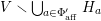 $V\smallsetminus \bigcup _{a\in \unicode[STIX]{x1D6F7}_{\text{aff}}^{\prime }}H_{a}$ where
 $H_{a}=\{v\in V:a(v)=0\}$. It also defines a partial order on
 $\unicode[STIX]{x1D6F7}_{\text{aff}}^{\prime }$: for
 $a\in \unicode[STIX]{x1D6F7}_{\text{aff}}^{\prime }$, write
 $a>0$ if
 $a(v)>0$ for all
 $v\in A^{\prime }$. Let
 $\unicode[STIX]{x1D6E5}_{\text{aff}}^{\prime }$ be the subset of
 $\unicode[STIX]{x1D6F7}_{\text{aff}}^{\prime }$ formed of those affine roots
 $a$ which are minimal positive for this partial order. Put
 $$\begin{eqnarray}\displaystyle & \displaystyle S^{\prime }=\{s_{a}:a\in \unicode[STIX]{x1D6E5}_{\text{aff}}^{\prime }\}, & \displaystyle \nonumber\\ \displaystyle & \displaystyle C_{\unicode[STIX]{x1D712}_{0}}=\{w\in W_{\unicode[STIX]{x1D712}_{0}}:w(A^{\prime })=A^{\prime }\}. & \displaystyle \nonumber\end{eqnarray}$$
From [Reference RocheRoc98, Lemma 6.2], we have the following result.
Lemma. The pair  $(W^{\prime }\!,S^{\prime })$ is a Coxeter system (i.e.
 $W^{\prime }$ is a Coxeter group with
 $S^{\prime }$ as fundamental set of generators), and there is a canonical decomposition
 $W_{\unicode[STIX]{x1D712}_{0}}=W^{\prime }\,\rtimes \,C_{\unicode[STIX]{x1D712}_{0}}$. The length function
 $l^{\prime }$ on
 $W^{\prime }$ can be naturally extended to
 $W_{\unicode[STIX]{x1D712}_{0}}$ in such a way that
 $C_{\unicode[STIX]{x1D712}_{0}}$ consists of the length-zero elements.
Let  $\unicode[STIX]{x210B}(W^{\prime }\!,S^{\prime })$ be the Hecke algebra of the Coxeter system
 $(W^{\prime }\!,S^{\prime })$, that is, the associative
 $\mathbb{C}$-algebra with
 $\mathbb{C}$-basis
 $\{T_{w}:w\in W^{\prime }\}$ and multiplication given by
 $$\begin{eqnarray}\displaystyle & \displaystyle T_{w_{1}w_{2}}=T_{w_{1}}T_{w_{2}}\quad \text{if }l^{\prime }(w_{1}w_{1})=l^{\prime }(w_{1})+l^{\prime }(w_{2}), & \displaystyle \nonumber\\ \displaystyle & \displaystyle T_{s}T_{s}=(q-1)T_{s}+qT_{1}\quad ifs\in S^{\prime }. & \displaystyle \nonumber\end{eqnarray}$$
The group  $C_{\unicode[STIX]{x1D712}_{0}}$ acts by
 $\mathbb{C}$-algebra automorphisms on
 $\unicode[STIX]{x210B}(W^{\prime }\!,S^{\prime })$ via
 $$\begin{eqnarray}\unicode[STIX]{x1D702}\cdot T_{w}=T_{\unicode[STIX]{x1D702}w\unicode[STIX]{x1D702}^{-1}},\quad \unicode[STIX]{x1D702}\in C_{\unicode[STIX]{x1D712}_{0}},w\in W^{\prime }.\end{eqnarray}$$
This action naturally extends to an injective morphism of  $\mathbb{C}$-algebras
 $$\begin{eqnarray}\mathbb{C}[C_{\unicode[STIX]{x1D712}_{0}}]\rightarrow \operatorname{End}_{\mathbb{C}\text{-}\text{alg}}(\unicode[STIX]{x210B}(W^{\prime }\!,S^{\prime })).\end{eqnarray}$$
Via this morphism, we get a  $\mathbb{C}$-algebra
 $$\begin{eqnarray}\unicode[STIX]{x210B}(W_{\unicode[STIX]{x1D712}_{0}},S^{\prime })=\unicode[STIX]{x210B}(W^{\prime }\!,S^{\prime })\,\widetilde{\otimes }\,\mathbb{C}[C_{\unicode[STIX]{x1D712}_{0}}]\end{eqnarray}$$
where the multiplication in the twisted tensor product is given by
 $$\begin{eqnarray}(T_{w_{1}}\otimes e_{\unicode[STIX]{x1D702}_{1}})(T_{w_{2}}\otimes e_{\unicode[STIX]{x1D702}_{2}})=T_{w_{1}}T_{\unicode[STIX]{x1D702}_{1}w_{2}\unicode[STIX]{x1D702}_{1}^{-1}}\otimes e_{\unicode[STIX]{x1D702}_{1}\unicode[STIX]{x1D702}_{2}}\end{eqnarray}$$
for  $w_{1},w_{2}\in W^{\prime }$ and
 $\unicode[STIX]{x1D702}_{1},\unicode[STIX]{x1D702}_{2}\in C_{\unicode[STIX]{x1D712}_{0}}$, where we have denoted by
 $e_{\unicode[STIX]{x1D702}_{1}}$ the element of
 $\mathbb{C}[C_{\unicode[STIX]{x1D712}_{0}}]$ given by
 $\unicode[STIX]{x1D702}_{\unicode[STIX]{x1D702}_{1}}(\unicode[STIX]{x1D702})=\unicode[STIX]{x1D6FF}_{\unicode[STIX]{x1D702}_{1},\unicode[STIX]{x1D702}}$ (Kronecker symbol). For
 $w\in W^{\prime }$ and
 $\unicode[STIX]{x1D702}\in C_{\unicode[STIX]{x1D712}_{0}}$, we write the basis element
 $T_{w}\otimes e_{\unicode[STIX]{x1D702}}\in \unicode[STIX]{x210B}(W_{\unicode[STIX]{x1D712}_{0}},S^{\prime })$ as
 $T_{w\unicode[STIX]{x1D702}}$. Thus we have
 $T_{w}T_{\unicode[STIX]{x1D702}}=T_{w\unicode[STIX]{x1D702}}$ and
 $T_{\unicode[STIX]{x1D702}}T_{w}T_{\unicode[STIX]{x1D702}^{-1}}=T_{\unicode[STIX]{x1D702}w\unicode[STIX]{x1D702}^{-1}}$.
For an element  $w\in W_{\unicode[STIX]{x1D712}_{0}}=N(F)_{\unicode[STIX]{x1D712}_{0}}/T$, let
 $f_{\tilde{\unicode[STIX]{x1D712}},w}$ be the unique element of the Hecke algebra
 $\unicode[STIX]{x210B}(G(F),\unicode[STIX]{x1D70C})$ supported on
 $\unicode[STIX]{x2110}w\unicode[STIX]{x2110}=\unicode[STIX]{x2110}n\unicode[STIX]{x2110}$ and having value
 $q^{-l(w)/2}\tilde{\unicode[STIX]{x1D712}}(n)^{-1}$ at
 $n$ for any representative element
 $n$ of
 $w$ in
 $N(F)_{\unicode[STIX]{x1D712}_{0}}$, where
 $l$ is the length function on the affine Weyl group
 $W=N(F)/T$ of
 $G$. The functions
 $f_{\tilde{\unicode[STIX]{x1D712}},w}$ for
 $n\in W_{\unicode[STIX]{x1D712}_{0}}$ generate the
 $\mathbb{C}$-vector space
 $\unicode[STIX]{x210B}(G(F),\unicode[STIX]{x1D70C})$. On the other hand, let
 $\unicode[STIX]{x1D719}_{w}^{\prime }$ be the element
 $q^{-l^{\prime }(w)/2}T_{w}\in \unicode[STIX]{x210B}(W_{\unicode[STIX]{x1D712}_{0}},S^{\prime })$, where
 $l^{\prime }$ is the length function on
 $W_{\unicode[STIX]{x1D712}_{0}}$ defined by the lemma. From [Reference RocheRoc98, Theorem 6.3],Footnote 6 we have the following proposition.
Proposition 1. There is an isomorphism of  $\mathbb{C}$-algebras
 $$\begin{eqnarray}\unicode[STIX]{x1D717}_{\tilde{\unicode[STIX]{x1D712}}}:\unicode[STIX]{x210B}(W_{\unicode[STIX]{x1D712}_{0}},S^{\prime })\stackrel{\simeq }{\longrightarrow }\unicode[STIX]{x210B}(G(F),\unicode[STIX]{x1D70C})\end{eqnarray}$$
which sends  $\unicode[STIX]{x1D719}_{w}^{\prime }$ to
 $f_{\tilde{\unicode[STIX]{x1D712}},w}$ for all
 $w\in W_{\unicode[STIX]{x1D712}_{0}}$. Moreover, the restriction
 $\unicode[STIX]{x1D717}_{\tilde{\unicode[STIX]{x1D712}}}|_{\unicode[STIX]{x210B}(W^{\prime }\!,S^{\prime })}$ is the unique injective morphism of
 $\mathbb{C}$-algebras
 $\unicode[STIX]{x210B}(W^{\prime }\!,S^{\prime })\rightarrow \unicode[STIX]{x210B}(G(F),\unicode[STIX]{x1D70C})$ which is support-preserving in the sense that the image of
 $T_{w}$ has support
 $\unicode[STIX]{x2110}w\unicode[STIX]{x2110}$ for all
 $w\in W^{\prime }$.
Now let us recall the dual interpretation of Proposition 1 [Reference RocheRoc98]. The group  $W^{\prime }=\check{X}\,\rtimes \,W^{\prime }$ is the Iwahori–Weyl group of
 $G^{\prime }$. Put
 $$\begin{eqnarray}C^{\prime }=\{w\in W^{\prime }:w(A^{\prime })=A^{\prime }\}.\end{eqnarray}$$
Recall that we have the decomposition [Reference RocheRoc98, Lemma 8.1]  $W_{\unicode[STIX]{x1D712}_{0}}=W^{\prime }\,\rtimes \,C_{\unicode[STIX]{x1D712}_{0}}$. From [Reference RocheRoc98, Lemma 8.1], we also have the decomposition
 $$\begin{eqnarray}C_{\unicode[STIX]{x1D712}_{0}}=C^{\prime }\,\rtimes \,C_{\unicode[STIX]{x1D712}_{0}}.\end{eqnarray}$$
This gives a decomposition
 $$\begin{eqnarray}\mathbb{C}[C_{\unicode[STIX]{x1D712}_{0}}]=\mathbb{C}[C^{\prime }]\,\widetilde{\otimes }\,\mathbb{C}[C_{\unicode[STIX]{x1D712}_{0}}]\end{eqnarray}$$
where the tensor product is defined by the conjugation action of  $C_{\unicode[STIX]{x1D712}_{0}}$ on
 $C^{\prime }$. Hence we have
 $$\begin{eqnarray}\unicode[STIX]{x210B}(W^{\prime }\!,S^{\prime })\,\widetilde{\otimes }\,\mathbb{C}[C_{\unicode[STIX]{x1D712}_{0}}]\,\simeq \,(\unicode[STIX]{x210B}(W^{\prime }\!,S^{\prime })\,\widetilde{\otimes }\,\mathbb{C}[C^{\prime }])\,\widetilde{\otimes }\,\mathbb{C}[C_{\unicode[STIX]{x1D712}_{0}}].\end{eqnarray}$$
By Iwahori and Matsumoto, we know there is a support-preserving isomorphism of  $\mathbb{C}$-algebras
 $$\begin{eqnarray}\unicode[STIX]{x210B}(W^{\prime }\!,S^{\prime })\,\widetilde{\otimes }\,\mathbb{C}[C^{\prime }]\stackrel{\simeq }{\longrightarrow }\unicode[STIX]{x210B}(G^{\prime }(F),1_{\unicode[STIX]{x2110}^{\prime }}).\end{eqnarray}$$
For an element  $w\in W_{\unicode[STIX]{x1D712}_{0}}=N(F)_{\unicode[STIX]{x1D712}_{0}}/T$, let
 $f_{w}^{\prime }$ be the unique element of the Hecke algebra
 $\unicode[STIX]{x210B}(\widetilde{G}^{\prime }(F),1_{\unicode[STIX]{x2110}^{\prime }})$ supported on
 $\unicode[STIX]{x2110}^{\prime }w\unicode[STIX]{x2110}^{\prime }=\unicode[STIX]{x2110}^{\prime }n\unicode[STIX]{x2110}^{\prime }$ and having value
 $q^{-l^{\prime }(w)/2}$ at
 $n$, for any representative element
 $n$ of
 $w$ in
 $N(F)_{\unicode[STIX]{x1D712}_{0}}$. From (1) and (2), there is an isomorphism of
 $\mathbb{C}$-algebras
 $$\begin{eqnarray}\unicode[STIX]{x210B}(W_{\unicode[STIX]{x1D712}_{0}},S^{\prime })=\unicode[STIX]{x210B}(W^{\prime }\!,S^{\prime })\,\widetilde{\otimes }\,\mathbb{C}[C_{\unicode[STIX]{x1D712}_{0}}]\stackrel{\simeq }{\longrightarrow }\unicode[STIX]{x210B}(\widetilde{G}^{\prime }(F),1_{\unicode[STIX]{x2110}^{\prime }}).\end{eqnarray}$$
which sends  $\unicode[STIX]{x1D719}_{w}^{\prime }$ to
 $f_{w}^{\prime }$ for all
 $w\in W_{\unicode[STIX]{x1D712}_{0}}$. Composing (3) with the isomorphism
 $\unicode[STIX]{x1D717}_{\tilde{\unicode[STIX]{x1D712}}}^{-1}$ of the Proposition 1, we obtain the following result.
Proposition 2. There is an isomorphism of  $\mathbb{C}$-algebras
 $$\begin{eqnarray}\unicode[STIX]{x1D6F9}_{\tilde{\unicode[STIX]{x1D712}}}:\unicode[STIX]{x210B}(G(F),\unicode[STIX]{x1D70C})\stackrel{\simeq }{\longrightarrow }\unicode[STIX]{x210B}(\widetilde{G}^{\prime }(F),1_{\unicode[STIX]{x2110}^{\prime }})\end{eqnarray}$$
which sends  $f_{\tilde{\unicode[STIX]{x1D712}},w}$ to
 $f_{w}^{\prime }$ for all
 $w\in W_{\unicode[STIX]{x1D712}_{0}}$.
Remark.
As in [Reference RocheRoc98], we chose a character  $\tilde{\unicode[STIX]{x1D712}}$ of
 $N(F)_{\unicode[STIX]{x1D712}_{0}}$ extending
 $\unicode[STIX]{x1D712}_{0}$ of the form
 $\tilde{\unicode[STIX]{x1D712}}=\tilde{\unicode[STIX]{x1D712}}_{0}^{\unicode[STIX]{x1D71B}}$ for a character
 $\tilde{\unicode[STIX]{x1D712}}_{0}$ of
 $N_{\unicode[STIX]{x1D712}_{0}}$ extending
 $\unicode[STIX]{x1D712}_{0}$ and a uniformizer element
 $\unicode[STIX]{x1D71B}$ of
 $F$. Now let
 $\unicode[STIX]{x1D712}^{\natural }$ be another character of
 $T(F)$ such that
 $\unicode[STIX]{x1D712}^{\natural }|_{T}=\unicode[STIX]{x1D712}_{0}$. Then there exists a character
 $\tilde{\unicode[STIX]{x1D712}}^{\natural }$ of
 $N(F)_{\unicode[STIX]{x1D712}_{0}}$ which extends
 $\unicode[STIX]{x1D712}^{\natural }$ if and only if
 $\unicode[STIX]{x1D712}^{\natural }$ is
 $W_{\unicode[STIX]{x1D712}_{0}}$-invariant [Reference Haines and RapoportHR12, Lemma 9.2.3], that is, if and only if
 $\unicode[STIX]{x1D712}^{\natural }=\unicode[STIX]{x1D709}\unicode[STIX]{x1D712}$ for a
 $W_{\unicode[STIX]{x1D712}_{0}}$-invariant unramified character
 $\unicode[STIX]{x1D709}$ of
 $T(F)$. For such a
 $\tilde{\unicode[STIX]{x1D712}}^{\natural }$, we can define in the same manner an isomorphism of
 $\mathbb{C}$-algebras
 $\unicode[STIX]{x1D6F9}_{\tilde{\unicode[STIX]{x1D712}}^{\natural }}:\unicode[STIX]{x210B}(G(F),\unicode[STIX]{x1D70C})\stackrel{\simeq }{\longrightarrow }\unicode[STIX]{x210B}(\widetilde{G}^{\prime }(F),1_{\unicode[STIX]{x2110}^{\prime }})$.
1.3 Bernstein center
Most of the material in this subsection comes from [Reference HainesHai13, 4].
We denote by  $\mathfrak{X}(\mathfrak{s})$ the complex algebraic variety (in fact a complex torus) associated to
 $\mathfrak{s}$, and by
 $\mathfrak{R}^{\mathfrak{s}}(G(F))$ the corresponding category of (complex, smooth) representations of
 $G(F)$. The elements of
 $\mathfrak{s}$ are the
 $G(F)$-conjugacy classes
 $(T,\unicode[STIX]{x1D713})_{G}$ of cuspidal pairs
 $(T,\unicode[STIX]{x1D713})$ of
 $G(F)$ such that
 $\unicode[STIX]{x1D713}$ is a character of
 $T(F)$ which extends a
 $W$-conjugate of
 $\unicode[STIX]{x1D712}_{0}$. Recall that we chose a base-point
 $(T,\unicode[STIX]{x1D712})_{G}\in \mathfrak{s}$ such that
 $\unicode[STIX]{x1D712}$ is
 $W_{\unicode[STIX]{x1D712}_{0}}$-invariant. Then, writing
 $\unicode[STIX]{x1D6F9}(T)=\operatorname{Hom}(T(F)/T,\mathbb{C}^{\times })$, the group of unramified characters of
 $G(F)$, we have an isomorphism of algebraic varieties
 $$\begin{eqnarray}\unicode[STIX]{x1D6F9}(T)/W_{\unicode[STIX]{x1D712}_{0}}\stackrel{\simeq }{\longrightarrow }\mathfrak{X}(\mathfrak{s}),\quad \unicode[STIX]{x1D709}\mapsto (T,\unicode[STIX]{x1D709}\unicode[STIX]{x1D712})_{G}.\end{eqnarray}$$
We also have an isomorphism of algebraic varieties
 $$\begin{eqnarray}\unicode[STIX]{x1D6F9}(T)/W^{\prime }\stackrel{\simeq }{\longrightarrow }\mathfrak{X}(\mathfrak{s}^{\prime }),\quad \unicode[STIX]{x1D709}\mapsto (T,\unicode[STIX]{x1D709})_{G^{\prime }},\end{eqnarray}$$
where  $\mathfrak{s}^{\prime }=[T,1]_{G^{\prime }}$ is the
 $G^{\prime }(F)$-inertial class of the cuspidal pair
 $(T,1)$ of
 $G^{\prime }(F)$. We deduce from these two isomorphisms a surjective morphism of algebraic varieties
 $$\begin{eqnarray}\mathfrak{X}(\mathfrak{s}^{\prime })\rightarrow \mathfrak{X}(\mathfrak{s}),\quad (T,\unicode[STIX]{x1D709})_{G^{\prime }}\mapsto (T,\unicode[STIX]{x1D709}\unicode[STIX]{x1D712})_{G},\end{eqnarray}$$
which gives dually an injective morphism of  $\mathbb{C}$-algebras
 $$\begin{eqnarray}\unicode[STIX]{x1D702}_{\unicode[STIX]{x1D712}}:\mathbb{C}[\mathfrak{X}(\mathfrak{s})]\rightarrow \mathbb{C}[\mathfrak{X}(\mathfrak{s}^{\prime })].\end{eqnarray}$$
On the other hand, there is a natural equivalence between  $\mathfrak{R}^{\mathfrak{s}}(G(F))$ and the category of left
 $\unicode[STIX]{x210B}(G(F),\unicode[STIX]{x1D70C})$-modules (given by
 $\unicode[STIX]{x1D70B}\mapsto \unicode[STIX]{x1D70B}^{\unicode[STIX]{x1D70C}}$, where
 $\unicode[STIX]{x1D70B}^{\unicode[STIX]{x1D70C}}$ denotes the
 $\unicode[STIX]{x1D70C}$-isotypic component of
 $\unicode[STIX]{x1D70B}$) which gives an isomorphism between the centers of these categories (cf. [Reference HainesHai13, 3.1]), say
 $$\begin{eqnarray}\unicode[STIX]{x1D6FD}:\mathbb{C}[\mathfrak{X}(\mathfrak{s})]\stackrel{\simeq }{\longrightarrow }Z(G(F),\unicode[STIX]{x1D70C}).\end{eqnarray}$$
Here  $Z(G(F),\unicode[STIX]{x1D70C})$ denotes the center of the (unital) algebra
 $\unicode[STIX]{x210B}(G(F),\unicode[STIX]{x1D70C})$. We also have an isomorphism
 $$\begin{eqnarray}\unicode[STIX]{x1D6FD}^{\prime }:\mathbb{C}[\mathfrak{X}(\mathfrak{s}^{\prime })]\stackrel{\simeq }{\longrightarrow }Z(G^{\prime }(F),1_{\unicode[STIX]{x2110}^{\prime }}).\end{eqnarray}$$
The isomorphism  $\unicode[STIX]{x1D6F9}_{\tilde{\unicode[STIX]{x1D712}}}$ of § 1.1.(3) gives by restriction an isomorphism of
 $\mathbb{C}$-algebras
 $$\begin{eqnarray}Z(G(F),\unicode[STIX]{x1D70C})\stackrel{\simeq }{\longrightarrow }Z(\widetilde{G}^{\prime }(F),1_{\unicode[STIX]{x2110}^{\prime }}).\end{eqnarray}$$
On the other hand, let
 $$\begin{eqnarray}\unicode[STIX]{x1D701}_{\unicode[STIX]{x1D712}}=\unicode[STIX]{x1D701}_{\unicode[STIX]{x1D712}}^{\unicode[STIX]{x2110}}:Z(G(F),\unicode[STIX]{x1D70C})\rightarrow Z(G^{\prime }(F),1_{\unicode[STIX]{x2110}^{\prime }})\end{eqnarray}$$
be the unique morphism of  $\mathbb{C}$-algebras which makes the diagram

commutative. It is injective by construction.
Remark 1. If  $W_{\unicode[STIX]{x1D712}_{0}}=W^{\prime }$, that is, if
 $\widetilde{G}^{\prime }=G^{\prime }$, it is proved in [Reference Haines and RapoportHR12, § 9] that
 $\unicode[STIX]{x1D701}_{\unicode[STIX]{x1D712}}$ coincides with
 $\unicode[STIX]{x1D6F9}_{\tilde{\unicode[STIX]{x1D712}}}|_{Z(G(F),\unicode[STIX]{x1D70C})}$. In particular in that case,
 $\unicode[STIX]{x1D6F9}_{\tilde{\unicode[STIX]{x1D712}}}|_{Z(G(F),\unicode[STIX]{x1D70C})}$ depends only on
 $\unicode[STIX]{x1D712}$ and not on the choice of
 $\tilde{\unicode[STIX]{x1D712}}$. We shall see later (lemma below) that this remains true if we remove the hypothesis
 $W_{\unicode[STIX]{x1D712}_{0}}=W^{\prime }$.
Now let  $\unicode[STIX]{x1D713}$ be a character of
 $T(F)$ which extends a
 $W$-conjugate of
 $\unicode[STIX]{x1D712}_{0}$. Put
 $\unicode[STIX]{x1D713}^{\ast }=\unicode[STIX]{x1D6FF}_{B}^{1/2}\unicode[STIX]{x1D713}$. Let
 $i_{B}^{G}(\unicode[STIX]{x1D713})^{\unicode[STIX]{x1D70C}}$ be the space of functions
 $\unicode[STIX]{x1D719}:G(F)\rightarrow \mathbb{C}$ such that
 $$\begin{eqnarray}\unicode[STIX]{x1D719}(tugk)=\unicode[STIX]{x1D713}^{\ast }(t)\unicode[STIX]{x1D719}(g)\unicode[STIX]{x1D70C}(k),\quad t\in T(F),~u\in U(F),~g\in G(F),~k\in \unicode[STIX]{x2110}.\end{eqnarray}$$
Then every function  $f\in Z(G(F),\unicode[STIX]{x1D70C})$ acts on the left on
 $i_{B}^{G}(\unicode[STIX]{x1D713})^{\unicode[STIX]{x1D70C}}$ by multiplication by the scalar
 $$\begin{eqnarray}\unicode[STIX]{x1D706}_{\unicode[STIX]{x1D713}}(f)=\unicode[STIX]{x1D6FD}^{-1}(f)((T,\unicode[STIX]{x1D713})_{G}),\end{eqnarray}$$
where  $\unicode[STIX]{x1D6FD}^{-1}(f)$ is viewed as a regular function on the complex algebraic variety
 $\mathfrak{X}(\mathfrak{s})$. In particular, we have the equality
 $\unicode[STIX]{x1D706}_{\text{}^{w}\unicode[STIX]{x1D713}}=\unicode[STIX]{x1D706}_{\unicode[STIX]{x1D713}}$ as functions on
 $Z(G(F),\unicode[STIX]{x1D70C})$. In the same manner, for an unramified character
 $\unicode[STIX]{x1D709}$ of
 $T^{\prime }(F)=T(F)$, every function
 $f^{\prime }\in Z(G^{\prime }(F),1_{\unicode[STIX]{x2110}^{\prime }})$ acts on the left on the space
 $i_{B^{\prime }}^{G^{\prime }}(\unicode[STIX]{x1D709})^{\unicode[STIX]{x2110}^{\prime }}=i_{B^{\prime }}^{G^{\prime }}(\unicode[STIX]{x1D709})^{1_{\unicode[STIX]{x2110}^{\prime }}}$ by multiplication by the scalar
 $$\begin{eqnarray}\unicode[STIX]{x1D706}_{\unicode[STIX]{x1D709}}^{\prime }(f^{\prime })=\unicode[STIX]{x1D6FD}^{\prime -1}(f^{\prime })((T^{\prime }\!,\unicode[STIX]{x1D709})_{G^{\prime }}).\end{eqnarray}$$
Now take  $\unicode[STIX]{x1D713}=\unicode[STIX]{x1D709}\unicode[STIX]{x1D712}$ for an unramified character
 $\unicode[STIX]{x1D709}$ of
 $T(F)$. From (3) we have
 $$\begin{eqnarray}\unicode[STIX]{x1D706}_{\unicode[STIX]{x1D709}\unicode[STIX]{x1D712}}(f)=\unicode[STIX]{x1D706}_{\unicode[STIX]{x1D709}}^{\prime }(\unicode[STIX]{x1D701}_{\unicode[STIX]{x1D712}}(f)),\quad f\in Z(G(F),\unicode[STIX]{x1D70C}).\end{eqnarray}$$
In other words, the morphism of  $\mathbb{C}$-algebras
 $\unicode[STIX]{x1D701}_{\unicode[STIX]{x1D712}}:Z(G(F),\unicode[STIX]{x1D70C})\rightarrow Z(G^{\prime }(F),1_{\unicode[STIX]{x2110}^{\prime }})$ is characterized by actions on principal series: for
 $f\in Z(G(F),\unicode[STIX]{x1D70C})$,
 $\unicode[STIX]{x1D701}_{\unicode[STIX]{x1D712}}(f)$ is the unique element of
 $Z(G^{\prime }(F),1_{\unicode[STIX]{x2110}^{\prime }})$ which acts on the left on the space
 $i_{B^{\prime }}^{G^{\prime }}(\unicode[STIX]{x1D709})^{\unicode[STIX]{x2110}^{\prime }}$ by multiplication by the scalar
 $\unicode[STIX]{x1D706}_{\unicode[STIX]{x1D712}\unicode[STIX]{x1D709}}(f)$, for all unramified characters
 $\unicode[STIX]{x1D709}$ of
 $T(F)$.
Lemma. The center  $Z(\widetilde{G}^{\prime }(F),1_{\unicode[STIX]{x2110}^{\prime }})$ is contained in the center
 $Z(G^{\prime }(F),1_{\unicode[STIX]{x2110}^{\prime }})$, and
 $\unicode[STIX]{x1D701}_{\unicode[STIX]{x1D712}}$ coincides with
 $(Z(\widetilde{G}^{\prime }(F),1_{\unicode[STIX]{x2110}^{\prime }}){\hookrightarrow}Z(G^{\prime }(F),1_{\unicode[STIX]{x2110}^{\prime }}))\circ \unicode[STIX]{x1D6F9}_{\tilde{\unicode[STIX]{x1D712}}}|_{Z(G(F),\unicode[STIX]{x1D70C})}$. In particular, the restriction
 $\unicode[STIX]{x1D6F9}_{\tilde{\unicode[STIX]{x1D712}}}|_{Z(G(F),\unicode[STIX]{x1D70C})}$ depends only on
 $\unicode[STIX]{x1D712}$ and not on the choice of
 $\tilde{\unicode[STIX]{x1D712}}$.
Proof. Let
 $$\begin{eqnarray}\unicode[STIX]{x1D6F9}_{\unicode[STIX]{x1D712}}^{T}:\unicode[STIX]{x210B}(T(F),\unicode[STIX]{x1D712})\stackrel{\simeq }{\longrightarrow }\unicode[STIX]{x210B}(T^{\prime }(F),1_{T^{\prime }})\end{eqnarray}$$
be the isomorphism of  $\mathbb{C}$-algebras obtained by replacing
 $G$ by
 $T$ in the definition of
 $\unicode[STIX]{x1D6F9}_{\tilde{\unicode[STIX]{x1D712}}}$. From [Reference RocheRoc98, Lemma 9.3] (see also [Reference Haines and RapoportHR12, equation 9.3.4]), there are morphisms of
 $\mathbb{C}$-algebras
 $$\begin{eqnarray}\unicode[STIX]{x1D703}_{B,\unicode[STIX]{x1D712}}:\unicode[STIX]{x210B}(T(F),\unicode[STIX]{x1D712})\rightarrow \unicode[STIX]{x210B}(G(F),\unicode[STIX]{x1D70C})\end{eqnarray}$$
and
 $$\begin{eqnarray}\tilde{\unicode[STIX]{x1D703}}_{B^{\prime }\!,1}:\unicode[STIX]{x210B}(T^{\prime }(F),1_{T^{\prime }})\rightarrow \unicode[STIX]{x210B}(\widetilde{G}^{\prime }(F),1_{\unicode[STIX]{x2110}^{\prime }})\end{eqnarray}$$
which make the diagram

commutative. It induces a commutative diagram of functors

where ?-Mod denotes the category of left  $?$-modules. From [Reference RocheRoc98, Theorem 9.4],
 $(\unicode[STIX]{x1D703}_{B,\unicode[STIX]{x1D712}})_{\ast }$ coincides with the induction functor
 $i_{B}^{G}$ (via the natural equivalences of categories), and
 $(\tilde{\unicode[STIX]{x1D703}}_{B^{\prime }\!,1})_{\ast }$ coincides with
 $i_{B^{\prime }}^{\tilde{G}}=i_{G^{\prime }}^{\widetilde{G}^{\prime }}\circ i_{B^{\prime }}^{G^{\prime }}$ where
 $$\begin{eqnarray}i_{G^{\prime }}^{\widetilde{G}^{\prime }}:\unicode[STIX]{x210B}(G^{\prime }(F),1_{\unicode[STIX]{x2110}^{\prime }})\text{-Mod}\rightarrow \unicode[STIX]{x210B}(\widetilde{G}^{\prime }(F),1_{\unicode[STIX]{x2110}^{\prime }})\text{-Mod}\end{eqnarray}$$
is the ordinary induction functor. Here we used the equivalence of categories (cf. [Reference RocheRoc98, § 9, p. 400])
 $$\begin{eqnarray}\mathfrak{R}^{1_{\unicode[STIX]{x2110}^{\prime }}}(\widetilde{G}^{\prime }(F))\rightarrow \unicode[STIX]{x210B}(\widetilde{G}^{\prime }(F),1_{\unicode[STIX]{x2110}^{\prime }})\text{-Mod},\quad W\mapsto W^{\unicode[STIX]{x2110}^{\prime }}\end{eqnarray}$$
where  $\mathfrak{R}^{1_{\unicode[STIX]{x2110}^{\prime }}}(\widetilde{G}^{\prime }(F))$ denotes the category of representations of
 $\widetilde{G}^{\prime }(F)$ generated by their
 $\unicode[STIX]{x2110}^{\prime }$-fixed vectors. In other words, for all unramified characters
 $\unicode[STIX]{x1D709}$ of
 $T(F)$, we have
 $$\begin{eqnarray}(\unicode[STIX]{x1D6F9}_{\tilde{\unicode[STIX]{x1D712}}})_{\ast }(i_{B}^{G}(\unicode[STIX]{x1D709}\unicode[STIX]{x1D712})^{\unicode[STIX]{x2110}})=i_{B^{\prime }}^{\widetilde{G}^{\prime }}(\unicode[STIX]{x1D709})^{\unicode[STIX]{x2110}^{\prime }}.\end{eqnarray}$$
Hence for  $f\in Z(G(F),\unicode[STIX]{x1D70C})$,
 $\unicode[STIX]{x1D6F9}_{\tilde{\unicode[STIX]{x1D712}}}(f)$ acts on the space
 $$\begin{eqnarray}i_{B^{\prime }}^{\widetilde{G}^{\prime }}(\unicode[STIX]{x1D709})^{\unicode[STIX]{x2110}^{\prime }}=\unicode[STIX]{x210B}(\widetilde{G}^{\prime }(F),1_{\unicode[STIX]{x2110}^{\prime }})\otimes _{\unicode[STIX]{x210B}(G(F),1_{\unicode[STIX]{x2110}^{\prime }})}i_{B^{\prime }}^{G^{\prime }}(\unicode[STIX]{x1D709})^{\unicode[STIX]{x2110}^{\prime }}\end{eqnarray}$$
by multiplication by the scalar  $\unicode[STIX]{x1D706}_{\unicode[STIX]{x1D712}\unicode[STIX]{x1D709}}(f)$, for all unramified characters
 $\unicode[STIX]{x1D709}$ of
 $T(F)$. But
 $\unicode[STIX]{x1D701}_{\unicode[STIX]{x1D712}}(f)=\unicode[STIX]{x1D701}_{\unicode[STIX]{x1D712}}(f)\,\widetilde{\otimes }\,1\in \unicode[STIX]{x210B}(\widetilde{G}^{\prime }(F),1_{\unicode[STIX]{x2110}^{\prime }})$ acts on the space
 $i_{B^{\prime }}^{\widetilde{G}^{\prime }}(\unicode[STIX]{x1D709})$ by multiplication by the scalar
 $\unicode[STIX]{x1D706}_{\unicode[STIX]{x1D712}\unicode[STIX]{x1D709}}(f)$, for all unramified characters
 $\unicode[STIX]{x1D709}$ of
 $T(F)$. Hence
 $$\begin{eqnarray}\unicode[STIX]{x1D6F9}_{\tilde{\unicode[STIX]{x1D712}}}(f)-\unicode[STIX]{x1D701}_{\unicode[STIX]{x1D712}}(f)\end{eqnarray}$$
acts by  $0$ on each irreducible subquotient of the
 $\unicode[STIX]{x210B}(\widetilde{G}^{\prime }(F),1_{\unicode[STIX]{x2110}^{\prime }})$-module
 $i_{B^{\prime }}^{\widetilde{G}^{\prime }}(\unicode[STIX]{x1D709})^{\unicode[STIX]{x2110}^{\prime }}$, for all unramified characters
 $\unicode[STIX]{x1D709}$ of
 $T^{\prime }(F)$. This implies
 $\unicode[STIX]{x1D6F9}_{\tilde{\unicode[STIX]{x1D712}}}(f)=\unicode[STIX]{x1D701}_{\unicode[STIX]{x1D712}}(f)$ as elements of
 $\unicode[STIX]{x210B}(\widetilde{G}^{\prime }(F),1_{\unicode[STIX]{x2110}^{\prime }})$. The lemma is proved.◻
Remark 2. Let  $\unicode[STIX]{x1D712}^{\natural }$ be another
 $W_{\unicode[STIX]{x1D712}_{0}}$-invariant character of
 $T(F)$ extending
 $\unicode[STIX]{x1D712}_{0}$. It defines as above an injective morphism of
 $\mathbb{C}$-algebras
 $\unicode[STIX]{x1D702}_{\unicode[STIX]{x1D712}^{\natural }}:\mathbb{C}[\mathfrak{X}(\mathfrak{s})]\rightarrow \mathbb{C}[\mathfrak{X}(\mathfrak{s}^{\prime })]$ which gives, via the isomorphisms
 $\unicode[STIX]{x1D6FD}$ and
 $\unicode[STIX]{x1D6FD}^{\prime }$, an injective morphism of
 $\mathbb{C}$-algebras
 $\unicode[STIX]{x1D701}_{\unicode[STIX]{x1D712}^{\natural }}:Z(G(F),\unicode[STIX]{x1D70C})\rightarrow Z(G^{\prime }(F),1_{\unicode[STIX]{x2110}^{\prime }})$. Moreover, if
 $\tilde{\unicode[STIX]{x1D712}}^{\natural }$ is a character of
 $N(F)_{\unicode[STIX]{x1D712}_{0}}$ that extends
 $\unicode[STIX]{x1D712}^{\natural }$, then we have
 $\unicode[STIX]{x1D701}_{\unicode[STIX]{x1D712}^{\natural }}=\unicode[STIX]{x1D6F9}_{\tilde{\unicode[STIX]{x1D712}}^{\natural }}|_{Z(G(F),\unicode[STIX]{x1D70C})}$ (cf. the remark of § 1.2).
1.4 Conjugation by $w\in W$

This subsection is a simple variant of [Reference HainesHai13, 4.3]. Let  $w$ be an element of
 $W$. It can be lifted to an element
 $n\in N\,\cap \,K$. The character
 $\text{}^{w}\!\unicode[STIX]{x1D712}_{0}=\unicode[STIX]{x1D712}_{0}\circ \operatorname{Int}_{w^{-1}}$ of
 $T$ can be identified as in § 1.1 with a character of the Iwahori subgroup
 $\text{}^{w}\unicode[STIX]{x2110}=\operatorname{Int}_{n}(\unicode[STIX]{x2110})$ of
 $G(F)$, the inflation of
 $\text{}^{w}\!\unicode[STIX]{x1D712}_{0}$ to
 $\text{}^{w}\unicode[STIX]{x2110}$. This character is
 $\text{}^{w}\!\unicode[STIX]{x1D70C}=\unicode[STIX]{x1D70C}\circ \operatorname{Int}_{n^{-1}}$. The group
 $\text{}^{w}\unicode[STIX]{x2110}$ and the character
 $\text{}^{w}\!\unicode[STIX]{x1D70C}$ of
 $\text{}^{w}\unicode[STIX]{x2110}$, and more generally the function
 $\text{}^{w}\!f=f\circ \operatorname{Int}_{n^{-1}}\in \unicode[STIX]{x210B}(G(F),\text{}^{w}\!\unicode[STIX]{x1D70C})$ for any
 $f\in \unicode[STIX]{x210B}(G(F),\unicode[STIX]{x1D70C})$, do not depend on the choice of the representative element
 $n\in K\,\cap \,N$ of
 $w$: since
 $K\,\cap \,T=T$, another lift of
 $w$ in
 $N\,\cap \,K$ belongs to
 $nT=Tn$. The map
 $$\begin{eqnarray}\unicode[STIX]{x210B}(G(F),\unicode[STIX]{x1D70C})\rightarrow \unicode[STIX]{x210B}(G(F),\text{}^{w}\!\unicode[STIX]{x1D70C}),\quad f\mapsto \text{}^{w}\!f\end{eqnarray}$$
is an isomorphism of  $\mathbb{C}$-algebras which restricts to an isomorphism
 $$\begin{eqnarray}[w]:Z(G(F),\unicode[STIX]{x1D70C})\stackrel{\simeq }{\longrightarrow }Z(G(F),\text{}^{w}\!\unicode[STIX]{x1D70C}).\end{eqnarray}$$
From [Reference HainesHai13, 4.3.1], the diagram

is commutative. Here, the lower  $\unicode[STIX]{x1D6FD}$ is the isomorphism of
 $\mathbb{C}$-algebras given by the natural equivalence between
 $\mathfrak{R}^{\mathfrak{s}}(G(F))$ and the category of left
 $\unicode[STIX]{x210B}(G(F),\text{}^{w}\!\unicode[STIX]{x1D70C})$-modules. As for the morphism
 $\unicode[STIX]{x1D701}_{\unicode[STIX]{x1D712}}$ in § 1.3.(
), the isomorphism of  $\mathbb{C}$-algebras
 $[w]:Z(G(F),\unicode[STIX]{x1D70C})\rightarrow Z(G(F),\text{}^{w}\!\unicode[STIX]{x1D70C})$ can be characterized by actions on principal series (cf. § 1.3): for
 $f\in Z(G(F),\unicode[STIX]{x1D70C})$,
 $[w](f)=\text{}^{w}\!f$ is the unique element of
 $Z(G(F),\text{}^{w}\!\unicode[STIX]{x1D70C})$ which acts on the left on
 $i_{\text{}^{w}\!B}^{G}(\text{}^{w}\unicode[STIX]{x1D713})^{\text{}^{w}\!\unicode[STIX]{x1D70C}}\simeq i_{B}^{G}(\unicode[STIX]{x1D713})^{\unicode[STIX]{x1D70C}}$ by multiplication by the scalar
 $$\begin{eqnarray}\unicode[STIX]{x1D706}_{\text{}^{w}\unicode[STIX]{x1D713}}(\text{}^{w}\!f)(=\unicode[STIX]{x1D706}_{\unicode[STIX]{x1D713}}(\text{}^{w}\!f)=\unicode[STIX]{x1D706}_{\unicode[STIX]{x1D713}}(f)),\end{eqnarray}$$
for all characters  $\unicode[STIX]{x1D713}$ of
 $T(F)$ extending a
 $W$-conjugate of
 $\unicode[STIX]{x1D712}_{0}$.
If  $\unicode[STIX]{x1D713}=\unicode[STIX]{x1D709}\unicode[STIX]{x1D712}$ for an unramified character
 $\unicode[STIX]{x1D709}$ of
 $T(F)$, then we have
 $\text{}^{w}\unicode[STIX]{x1D713}=(\text{}^{w}\unicode[STIX]{x1D709})\unicode[STIX]{x1D712}_{w}\unicode[STIX]{x1D712}$ with
 $$\begin{eqnarray}\unicode[STIX]{x1D712}_{w}=(\text{}^{w}\unicode[STIX]{x1D712})\unicode[STIX]{x1D712}^{-1}.\end{eqnarray}$$
Note that  $\unicode[STIX]{x1D712}_{w}$ is a character of
 $T(F)$ extending
 $\unicode[STIX]{x1D712}_{w,0}=(\text{}^{w}\unicode[STIX]{x1D712}_{0})\unicode[STIX]{x1D712}_{0}^{-1}$. If
 $w\in W_{\unicode[STIX]{x1D712}_{0}}$, then we have
 $\unicode[STIX]{x1D712}_{w,0}=1$ and
 $\unicode[STIX]{x1D712}_{w}=1$. Moreover, if
 $w_{0}\in W_{\unicode[STIX]{x1D712}_{0}}$, since
 $\text{}^{w_{0}}\unicode[STIX]{x1D712}=\unicode[STIX]{x1D712}$, we have
 $$\begin{eqnarray}\unicode[STIX]{x1D712}_{ww_{0}}=\unicode[STIX]{x1D712}_{w},\quad \unicode[STIX]{x1D712}_{w_{0}w}=\unicode[STIX]{x1D712}_{w_{0}ww_{0}^{-1}}.\end{eqnarray}$$
Let  $\mathfrak{s}_{w}^{\prime }=\mathfrak{s}_{\unicode[STIX]{x1D712}_{w,0}}^{\prime }$ be the
 $G^{\prime }(F)$-inertial class
 $[T(F),\unicode[STIX]{x1D712}_{w}]_{G^{\prime }}$ of the cuspidal pair
 $(T(F),\unicode[STIX]{x1D712}_{w})$ of
 $G^{\prime }(F)$. Recall that we have an isomorphism of algebraic varieties
 $$\begin{eqnarray}\unicode[STIX]{x1D6F9}(T)/W^{\prime }\stackrel{\simeq }{\longrightarrow }\mathfrak{X}(\mathfrak{s}^{\prime }),\quad \unicode[STIX]{x1D709}\mapsto (T,\unicode[STIX]{x1D709})_{G^{\prime }}.\end{eqnarray}$$
We also have an isomorphism of algebraic varieties
 $$\begin{eqnarray}\unicode[STIX]{x1D6F9}(T)/W_{\text{}^{w}\!\unicode[STIX]{x1D712}_{0}}^{\prime }\stackrel{\simeq }{\longrightarrow }\mathfrak{X}(\mathfrak{s}_{w}^{\prime }),\quad \unicode[STIX]{x1D709}\mapsto (T,(\text{}^{w}\unicode[STIX]{x1D709})\unicode[STIX]{x1D712}_{w})_{G^{\prime }},\end{eqnarray}$$
where  $W_{\text{}^{w\!\unicode[STIX]{x1D712}_{0}}}^{\prime }=W^{\prime }\,\cap \,wW_{\unicode[STIX]{x1D712}_{0}}w^{-1}$ is the subgroup of
 $W^{\prime }$ formed by the elements which fix
 $\text{}^{w}\!\unicode[STIX]{x1D712}_{0}$. The surjective morphism of algebraic varieties
 $$\begin{eqnarray}\mathfrak{X}(\mathfrak{s}_{w}^{\prime })\rightarrow \mathfrak{X}(\mathfrak{s}^{\prime }),\quad (T,(\text{}^{w}\unicode[STIX]{x1D709})\unicode[STIX]{x1D712}_{w})_{G^{\prime }}\mapsto (T,\unicode[STIX]{x1D709})_{G^{\prime }}\end{eqnarray}$$
gives by duality an injective morphism of  $\mathbb{C}$-algebras
 $$\begin{eqnarray}\unicode[STIX]{x1D707}_{w}^{\prime }=\unicode[STIX]{x1D707}_{w,\unicode[STIX]{x1D712}}^{\prime }:\mathbb{C}[\mathfrak{X}(\mathfrak{s}^{\prime })]\rightarrow \mathbb{C}[\mathfrak{X}(\mathfrak{s}_{w}^{\prime })],\end{eqnarray}$$
which is the identity if  $w\in W^{\prime }$. The natural isomorphism
 $T/T_{+}\stackrel{\simeq }{\longrightarrow }\unicode[STIX]{x2110}^{\prime }/\unicode[STIX]{x2110}_{+}^{\prime }$ allows us to view
 $\unicode[STIX]{x1D712}_{w,0}$ as a character
 $\unicode[STIX]{x1D70C}_{w}^{\prime }=\unicode[STIX]{x1D70C}_{\unicode[STIX]{x1D712}_{w,0}}^{\prime }$ of
 $\unicode[STIX]{x2110}^{\prime }$ trivial on
 $\unicode[STIX]{x2110}_{+}^{\prime }$ (cf. § 1.1), the inflation of
 $\unicode[STIX]{x1D712}_{w,0}$ to
 $\unicode[STIX]{x2110}^{\prime }$. Let
 $$\begin{eqnarray}\{w\}^{\prime }=\{w\}_{\unicode[STIX]{x1D712}}^{\prime }:Z(G^{\prime }(F),1_{\unicode[STIX]{x2110}^{\prime }})\rightarrow Z(G^{\prime }(F),\unicode[STIX]{x1D70C}_{w}^{\prime })\end{eqnarray}$$
be the injective morphism of  $\mathbb{C}$-algebras which makes the diagram

commutative. Here the lower  $\unicode[STIX]{x1D6FD}^{\prime }$ is the isomorphism of
 $\mathbb{C}$-algebras given by the natural equivalence between
 $\mathfrak{R}^{\mathfrak{s}_{w}^{\prime }}(G^{\prime }(F))$ and the category of left
 $\unicode[STIX]{x210B}(G^{\prime }(F),\unicode[STIX]{x1D70C}_{w}^{\prime })$-modules. Note that if
 $w\in W_{\unicode[STIX]{x1D712}_{0}}$, then
 $\{w\}^{\prime }$ is an automorphism of
 $Z(G^{\prime }(F),1_{\unicode[STIX]{x2110}^{\prime }})$, which is the identity if
 $w\in W^{\prime }$.
Notation.
For all unramified characters  $\unicode[STIX]{x1D709}$ of
 $T(F)$, we put
 $\{w\}^{\prime }(\unicode[STIX]{x1D709})=(\text{}^{w}\unicode[STIX]{x1D709})\unicode[STIX]{x1D712}_{w}$.
The morphism  $\{w\}^{\prime }$ can be characterized by actions on principal series: for
 $f^{\prime }\in Z(G^{\prime }(F),1_{\unicode[STIX]{x2110}^{\prime }})$,
 $\{w\}^{\prime }(f^{\prime })$ is the unique element of
 $Z(G^{\prime }(F),\unicode[STIX]{x1D70C}_{w}^{\prime })$ which acts on the left on
 $i_{B^{\prime }}^{G^{\prime }}(\{w\}^{\prime }(\unicode[STIX]{x1D709}))^{\unicode[STIX]{x1D70C}_{w}^{\prime }}$ by multiplication by the scalar
 $$\begin{eqnarray}\unicode[STIX]{x1D706}_{\{w\}^{\prime }(\unicode[STIX]{x1D709})}^{\prime }(\{w\}^{\prime }(f^{\prime }))=\unicode[STIX]{x1D706}_{\unicode[STIX]{x1D709}}^{\prime }(f^{\prime }),\end{eqnarray}$$
for all unramified characters  $\unicode[STIX]{x1D709}$ of
 $T^{\prime }(F)$.
For  $w_{0}\in W_{\unicode[STIX]{x1D712}_{0}}$, since
 $\text{}^{w_{0}}\!\unicode[STIX]{x1D712}=\unicode[STIX]{x1D712}$, we have
 $\unicode[STIX]{x1D712}_{w_{0}w}=\text{}^{w_{0}}(\unicode[STIX]{x1D712}_{w})$ and
 $$\begin{eqnarray}\{w_{0}w\}^{\prime }(\unicode[STIX]{x1D709})=(\text{}^{w_{0}w}\unicode[STIX]{x1D709})\unicode[STIX]{x1D712}_{w_{0}w}=\text{}^{w_{0}}(\{w\}^{\prime }(\unicode[STIX]{x1D709})).\end{eqnarray}$$
In particular, for  $w^{\prime }\in W^{\prime }$, we have
 $\mathfrak{s}_{w^{\prime }w}^{\prime }=\mathfrak{s}_{w}^{\prime }$ and
 $\unicode[STIX]{x1D707}_{w^{\prime }w}^{\prime }=\unicode[STIX]{x1D707}_{w}^{\prime }$, and the morphism
 $\{w^{\prime }w\}^{\prime }:Z(G^{\prime }(F),1_{\unicode[STIX]{x2110}^{\prime }})\rightarrow Z(G^{\prime }(F),\unicode[STIX]{x1D70C}_{w^{\prime }w}^{\prime })$ is given by
 $$\begin{eqnarray}\{w^{\prime }w\}^{\prime }=[w^{\prime }]_{w}^{\prime }\circ \{w\}^{\prime },\end{eqnarray}$$
where  $[w^{\prime }]_{w}^{\prime }:Z(G^{\prime }(F),\unicode[STIX]{x1D70C}_{w}^{\prime })\rightarrow Z(G^{\prime }(F),\unicode[STIX]{x1D70C}_{w^{\prime }w}^{\prime })$ is the isomorphism of
 $\mathbb{C}$-algebras which makes the diagram

commutative. As for the morphism  $\{w\}^{\prime }$ introduced above, the isomorphism
 $[w^{\prime }]_{w}^{\prime }$ can be characterized by actions on principal series: for
 $f^{\prime }\in Z(G^{\prime }(F),\unicode[STIX]{x1D70C}_{w}^{\prime })$,
 $[w^{\prime }]_{w}(f^{\prime })$ is the unique element of
 $Z(G^{\prime }(F),\unicode[STIX]{x1D70C}_{w^{\prime }w}^{\prime })$ which acts on the left on
 $i_{B^{\prime }}^{G^{\prime }}(\{w^{\prime }w\}^{\prime }(\unicode[STIX]{x1D709}))^{\unicode[STIX]{x1D70C}_{w^{\prime }w}^{\prime }}$ by multiplication by the scalar
 $$\begin{eqnarray}\unicode[STIX]{x1D706}_{\{w^{\prime }w\}^{\prime }(\unicode[STIX]{x1D709})}^{\prime }([w^{\prime }]_{w}^{\prime }(f^{\prime }))=\unicode[STIX]{x1D706}_{\{w\}(\unicode[STIX]{x1D709})}^{\prime }(f^{\prime })\end{eqnarray}$$
for all unramified characters  $\unicode[STIX]{x1D709}$ of
 $T^{\prime }(F)$.
On the other hand, for  $w_{0}\in W_{\unicode[STIX]{x1D712}_{0}}$, since
 $\unicode[STIX]{x1D712}_{ww_{0},0}=\unicode[STIX]{x1D712}_{w,0}$, we have
 $\mathfrak{s}_{ww_{0}}^{\prime }=\mathfrak{s}_{w}^{\prime }$ and
 $\unicode[STIX]{x1D707}_{ww_{0}}^{\prime }=\unicode[STIX]{x1D707}_{w}^{\prime }$. We also have
 $\unicode[STIX]{x1D70C}_{ww_{0}}^{\prime }=\unicode[STIX]{x1D70C}_{w}^{\prime }$ and
 $\unicode[STIX]{x1D712}_{ww_{0}}=\unicode[STIX]{x1D712}_{w}$, and
 $$\begin{eqnarray}\{ww_{0}\}^{\prime }(\unicode[STIX]{x1D709})=(\text{}^{ww_{0}}\unicode[STIX]{x1D709})\unicode[STIX]{x1D712}_{w}=\text{}^{w}(\unicode[STIX]{x1D709}_{w_{0}})\cdot \{w\}^{\prime }(\unicode[STIX]{x1D709}),\quad \unicode[STIX]{x1D709}_{w_{0}}=(\text{}^{w_{0}}\unicode[STIX]{x1D709})\unicode[STIX]{x1D709}^{-1},\end{eqnarray}$$
for all unramified characters  $\unicode[STIX]{x1D709}$ of
 $T(F)$. The automorphism of algebraic varieties
 $$\begin{eqnarray}\mathbb{C}[\mathfrak{X}(\mathfrak{s}_{w}^{\prime })]\rightarrow \mathbb{C}[\mathfrak{X}(\mathfrak{s}_{w}^{\prime })],\quad (T^{\prime }\!,(\text{}^{ww_{0}}\unicode[STIX]{x1D709})\unicode[STIX]{x1D712}_{w})_{G^{\prime }}\mapsto (T^{\prime }\!,(\text{}^{w}\unicode[STIX]{x1D709})\unicode[STIX]{x1D712}_{w})_{G^{\prime }}\end{eqnarray}$$
gives by duality, and via the isomorphism  $\unicode[STIX]{x1D6FD}^{\prime }:\mathbb{C}[\mathfrak{X}(\mathfrak{s}_{w}^{\prime })]\rightarrow Z(G^{\prime }(F),\unicode[STIX]{x1D70C}_{w}^{\prime })$, an automorphism of
 $\mathbb{C}$-algebras
 $$\begin{eqnarray}\{w_{0}\}_{w}^{\prime }:Z(G^{\prime }(F),\unicode[STIX]{x1D70C}_{w}^{\prime })\rightarrow Z(G^{\prime }(F),\unicode[STIX]{x1D70C}_{w}^{\prime }).\end{eqnarray}$$
By construction we have
 $$\begin{eqnarray}\{ww_{0}\}^{\prime }=\{w_{0}\}_{w}^{\prime }\circ \{w\}^{\prime }.\end{eqnarray}$$
As before, it can be characterized via actions on principal series: for a function  $f^{\prime }\in Z(G^{\prime }(F),\unicode[STIX]{x1D70C}_{w}^{\prime })$,
 $\{w_{0}\}_{w}^{\prime }(f^{\prime })$ is the unique element of
 $Z(G^{\prime }(F),\unicode[STIX]{x1D70C}_{w}^{\prime })$ which acts on the left on
 $i_{B^{\prime }}^{G^{\prime }}(\text{}^{w}(\unicode[STIX]{x1D709}_{w_{0}})\unicode[STIX]{x1D713})^{\unicode[STIX]{x1D70C}_{w}^{\prime }}$ with
 $\unicode[STIX]{x1D713}=\{w\}^{\prime }(\unicode[STIX]{x1D709})$ by multiplication by the scalar
 $$\begin{eqnarray}\unicode[STIX]{x1D706}_{\text{}^{w}\!(\unicode[STIX]{x1D709}_{w_{0}})\unicode[STIX]{x1D713}}^{\prime }(\{w_{0}\}_{w}^{\prime }(f^{\prime }))=\unicode[STIX]{x1D706}_{\unicode[STIX]{x1D713}}^{\prime }(f^{\prime })\end{eqnarray}$$
for all unramified characters  $\unicode[STIX]{x1D709}$ of
 $T(F)$. Note that in general
 $\{w_{0}\}_{w}^{\prime }\neq \operatorname{id}$, even if
 $w_{0}\in W^{\prime }$.
The surjective morphism of algebraic varieties
 $$\begin{eqnarray}\mathfrak{X}(\mathfrak{s}_{w}^{\prime })\rightarrow \mathfrak{X}(\mathfrak{s}),\quad (T,(\text{}^{w}\unicode[STIX]{x1D709})\unicode[STIX]{x1D712}_{w})_{G^{\prime }}\mapsto (T,\unicode[STIX]{x1D709}\unicode[STIX]{x1D712})_{G}\end{eqnarray}$$
gives by duality an injective morphism of  $\mathbb{C}$-algebras
 $$\begin{eqnarray}\unicode[STIX]{x1D702}_{w,\unicode[STIX]{x1D712}}:\mathbb{C}[\mathfrak{X}(\mathfrak{s})]\rightarrow \mathbb{C}[\mathfrak{X}(\mathfrak{s}_{w}^{\prime })].\end{eqnarray}$$
Let
 $$\begin{eqnarray}\unicode[STIX]{x1D701}_{w,\unicode[STIX]{x1D712}}:Z(G(F),\text{}^{w}\!\unicode[STIX]{x1D70C})\rightarrow Z(G^{\prime }(F),\unicode[STIX]{x1D70C}_{w}^{\prime })\end{eqnarray}$$
be the injective morphism of  $\mathbb{C}$-algebras which makes the diagram

commutative. By construction, the diagram

is commutative. As for the morphism  $\unicode[STIX]{x1D701}_{\unicode[STIX]{x1D712}}$ of § 1.3.(
), the morphism  $\unicode[STIX]{x1D701}_{w,\unicode[STIX]{x1D712}}$ above can be characterized by actions on principal series: for
 $f\in Z(G(F),\unicode[STIX]{x1D70C})$,
 $\unicode[STIX]{x1D701}_{w,\unicode[STIX]{x1D712}}(\text{}^{w}f)$ is the unique element of
 $Z(G^{\prime }(F),\unicode[STIX]{x1D70C}_{w}^{\prime })$ which acts on the left on
 $\unicode[STIX]{x1D704}_{B^{\prime }}^{G^{\prime }}(\unicode[STIX]{x1D709})^{\unicode[STIX]{x1D70C}_{w}^{\prime }}$ by multiplication by the scalar
 $$\begin{eqnarray}\unicode[STIX]{x1D706}_{\unicode[STIX]{x1D709}}^{\prime }(\unicode[STIX]{x1D701}_{w,\unicode[STIX]{x1D712}}(\text{}^{w}\!f))=\unicode[STIX]{x1D706}_{\unicode[STIX]{x1D709}\unicode[STIX]{x1D712}}(f)\end{eqnarray}$$
for all characters  $\unicode[STIX]{x1D709}$ of
 $T^{\prime }(F)=T(F)$ extending a
 $W^{\prime }$-conjugate of
 $\unicode[STIX]{x1D712}_{w,0}$ (note that since
 $W^{\prime }\subset W_{\unicode[STIX]{x1D712}_{0}}$,
 $\unicode[STIX]{x1D709}\unicode[STIX]{x1D712}$ extends a
 $W^{\prime }$-conjugate of
 $\text{}^{w}\!(\unicode[STIX]{x1D712}_{0})$, and in particular it extends a
 $W$-conjugate of
 $\unicode[STIX]{x1D712}_{0}$). From the characterization of the morphisms
 $\{w\}$ and
 $[w]^{\prime }$ by actions on principal series, we have also: for
 $f\in Z(G(F),\unicode[STIX]{x1D70C})$,
 $\unicode[STIX]{x1D701}_{w,\unicode[STIX]{x1D712}}(\text{}^{w}\!f)\in Z(G(F),\unicode[STIX]{x1D70C}_{w}^{\prime })$ acts on the left on
 $i_{B^{\prime }}^{G^{\prime }}(\{w\}^{\prime }(\unicode[STIX]{x1D709}))^{\unicode[STIX]{x1D70C}_{w}^{\prime }}$ by multiplication by the scalar
 $$\begin{eqnarray}\unicode[STIX]{x1D706}_{\{w\}^{\prime }(\unicode[STIX]{x1D709})}^{\prime }(\unicode[STIX]{x1D701}_{w,\unicode[STIX]{x1D712}}(\text{}^{w}\!f))=\unicode[STIX]{x1D706}_{\{w\}^{\prime }(\unicode[STIX]{x1D709})}^{\prime }(\{w\}^{\prime }(\unicode[STIX]{x1D701}_{\unicode[STIX]{x1D712}}(f)))=\unicode[STIX]{x1D706}_{\unicode[STIX]{x1D709}}^{\prime }(\unicode[STIX]{x1D701}_{\unicode[STIX]{x1D712}}(f))=\unicode[STIX]{x1D706}_{\unicode[STIX]{x1D709}\unicode[STIX]{x1D712}}(f)\end{eqnarray}$$
for all unramified characters  $\unicode[STIX]{x1D709}$ of
 $T^{\prime }(F)$. Note that since
 $\{w\}^{\prime }(\unicode[STIX]{x1D709})\unicode[STIX]{x1D712}=\text{}^{w}\!(\unicode[STIX]{x1D709}\unicode[STIX]{x1D712})$, we have
 $$\begin{eqnarray}\unicode[STIX]{x1D706}_{\unicode[STIX]{x1D709}\unicode[STIX]{x1D712}}(f)=\unicode[STIX]{x1D706}_{\text{}^{w}\!(\unicode[STIX]{x1D709}\unicode[STIX]{x1D712})}(f)=\unicode[STIX]{x1D706}_{\{w\}^{\prime }(\unicode[STIX]{x1D709})\unicode[STIX]{x1D712}}(f).\end{eqnarray}$$
Remark 1. For  $w^{\prime }\in W^{\prime }$, since
 $\{w^{\prime }\}^{\prime }$ is the identity of
 $Z(G^{\prime }(F),1_{\unicode[STIX]{x2110}^{\prime }})$, we have
 $\unicode[STIX]{x1D701}_{w^{\prime }\!,\unicode[STIX]{x1D712}}\circ [w^{\prime }]=\unicode[STIX]{x1D701}_{\unicode[STIX]{x1D712}}$. More generally, we have
 $$\begin{eqnarray}\unicode[STIX]{x1D701}_{w^{\prime }w,\unicode[STIX]{x1D712}}\circ [w^{\prime }w]=\{w^{\prime }w\}^{\prime }\circ \unicode[STIX]{x1D701}_{\unicode[STIX]{x1D712}}=[w^{\prime }]_{w}^{\prime }\circ \{w\}^{\prime }\circ \unicode[STIX]{x1D701}_{\unicode[STIX]{x1D712}}=[w^{\prime }]_{w}^{\prime }\circ \unicode[STIX]{x1D701}_{w,\unicode[STIX]{x1D712}}\circ [w].\end{eqnarray}$$
On the other hand, for  $w_{0}\in W_{\unicode[STIX]{x1D712}_{0}}$, we have
 $$\begin{eqnarray}\unicode[STIX]{x1D701}_{ww_{0},\unicode[STIX]{x1D712}}\circ [ww_{0}]=\{ww_{0}\}^{\prime }\circ \unicode[STIX]{x1D701}_{\unicode[STIX]{x1D712}}=\{w_{0}\}_{w}^{\prime }\circ \{w\}^{\prime }\circ \unicode[STIX]{x1D701}_{\unicode[STIX]{x1D712}}=\{w_{0}\}_{w}^{\prime }\circ \unicode[STIX]{x1D701}_{w,\unicode[STIX]{x1D712}}\circ [w].\end{eqnarray}$$
Remark 2. As in § 1.1, the character  $\text{}^{w}\unicode[STIX]{x1D712}_{0}$ of
 $T$ defines an
 $F$-split connected reductive group
 $G_{w}^{\prime }$ with maximal
 $F$-split torus
 $T_{w}^{\prime }=T$, an Iwahori subgroup
 $\unicode[STIX]{x2110}_{w}^{\prime }$ of
 $G_{w}^{\prime }(F)$, and an
 $F$-group
 $\widetilde{G}_{w}^{\prime }=G_{w}^{\prime }\,\rtimes \,C_{\text{}^{w}\!\unicode[STIX]{x1D712}_{0}}$. More precisely,
 $G_{w}^{\prime }$ is given by the root datum
 $(X,w(\unicode[STIX]{x1D6F7}^{\prime }),\check{X},w(\check{\unicode[STIX]{x1D6F7}}^{\prime }))$,
 $\unicode[STIX]{x2110}_{w}^{\prime }$ corresponds to the alcove
 $w(A^{\prime })\subset V$, and
 $C_{\text{}^{w}\!\unicode[STIX]{x1D712}_{0}}=wC_{\unicode[STIX]{x1D712}_{0}}w^{-1}$. In other words,
 $w$ induces by transport of structure an
 $F$-isomorphism
 $\widetilde{G}^{\prime }\stackrel{\simeq }{\longrightarrow }\widetilde{G}_{w}^{\prime }$ which allows us to identify
 $G_{w}^{\prime }(F)$ with
 $G(F)$ and
 $\unicode[STIX]{x2110}_{w}^{\prime }$ with
 $\unicode[STIX]{x2110}^{\prime }$. With these identifications, we have an injective morphism of
 $\mathbb{C}$-algebras
 $$\begin{eqnarray}\unicode[STIX]{x1D701}_{\text{}^{w}\unicode[STIX]{x1D712}}^{\text{}^{w}\unicode[STIX]{x2110}}:Z(G(F),\text{}^{w}\!\unicode[STIX]{x1D70C})\rightarrow Z(G_{w}^{\prime }(F),1_{\unicode[STIX]{x2110}_{w}^{\prime }})=Z(G^{\prime }(F),1_{\unicode[STIX]{x2110}^{\prime }})\end{eqnarray}$$
which is given by  $\unicode[STIX]{x1D701}_{\text{}^{w}\unicode[STIX]{x1D712}}^{\text{}^{w}\unicode[STIX]{x2110}}=\unicode[STIX]{x1D701}_{\unicode[STIX]{x1D712}}\circ [w]^{-1}$. Hence we have
 $$\begin{eqnarray}\{w\}^{\prime }\circ \unicode[STIX]{x1D701}_{\text{}^{w}\unicode[STIX]{x1D712}}^{\text{}^{w}\unicode[STIX]{x2110}}=\unicode[STIX]{x1D701}_{w,\unicode[STIX]{x1D712}}.\end{eqnarray}$$
In particular, if  $w\in W_{\unicode[STIX]{x1D712}_{0}}$, we have
 $\unicode[STIX]{x1D701}_{w,\unicode[STIX]{x1D712}}=\{w\}^{\prime }\circ \unicode[STIX]{x1D701}_{\unicode[STIX]{x1D712}}^{\text{}^{w}\unicode[STIX]{x2110}}$, and if
 $w\in W^{\prime }$, we have
 $\unicode[STIX]{x1D701}_{w,\unicode[STIX]{x1D712}}=\unicode[STIX]{x1D701}_{\unicode[STIX]{x1D712}}^{\text{}^{w}\unicode[STIX]{x2110}}$.
1.5 Conjugation by $w\in W^{\prime }$

Let  $w$ be an element of
 $W^{\prime }$. We choose a representative element
 $n_{w}^{\prime }$ of
 $w$ in
 $N^{\prime }\,\cap \,K^{\prime }$, and we put
 $\text{}^{w}\unicode[STIX]{x2110}^{\prime }=\text{}^{w}\!(\unicode[STIX]{x2110}^{\prime })=\operatorname{Int}_{n_{w}^{\prime }}(\unicode[STIX]{x2110}^{\prime })$. For a function
 $f^{\prime }\in Z(G^{\prime }(F),1_{\unicode[STIX]{x2110}^{\prime }})$, we put
 $[w]^{\prime }(f^{\prime })=\text{}^{w}\!f^{\prime }=f^{\prime }\circ \operatorname{Int}_{n_{w}^{\prime -1}}$. Since
 $\text{}^{w}\unicode[STIX]{x1D712}=\unicode[STIX]{x1D712}$, by replacing
 $\unicode[STIX]{x2110}$ by
 $\text{}^{w}\unicode[STIX]{x2110}$ and
 $\unicode[STIX]{x2110}^{\prime }$ by
 $\text{}^{w}\unicode[STIX]{x2110}^{\prime }$ in the definition of
 $\unicode[STIX]{x1D701}_{\unicode[STIX]{x1D712}}$, we obtain an injective morphism of
 $\mathbb{C}$-algebras
 $$\begin{eqnarray}\text{}^{w}\!\unicode[STIX]{x1D701}_{\unicode[STIX]{x1D712}}:Z(G(F),\text{}^{w}\!\unicode[STIX]{x1D70C})\rightarrow Z(G^{\prime }(F),1_{\text{}^{w}\unicode[STIX]{x2110}^{\prime }})\end{eqnarray}$$
which makes the diagram

commutative. Here  $\unicode[STIX]{x1D6FD}^{\prime }$ is the isomorphism of
 $\mathbb{C}$-algebras given by the natural equivalence between
 $\mathfrak{R}^{\mathfrak{s}^{\prime }}(G^{\prime }(F))$ and the category of left
 $\unicode[STIX]{x210B}(G^{\prime }(F),1_{\text{}^{w}\unicode[STIX]{x2110}^{\prime }})$-modules. By construction, the diagram

is commutative.
Remark.
From Remark 1 of § 1.4, we have  $\unicode[STIX]{x1D701}_{\unicode[STIX]{x1D712}}^{\text{}^{w}\unicode[STIX]{x2110}}=\unicode[STIX]{x1D701}_{w,\unicode[STIX]{x1D712}}=\unicode[STIX]{x1D701}_{\unicode[STIX]{x1D712}}\circ [w]^{-1}$. Hence we have
 $\text{}^{w}\unicode[STIX]{x1D701}_{\unicode[STIX]{x1D712}}=[w]^{\prime }\circ \unicode[STIX]{x1D701}_{w,\unicode[STIX]{x1D712}}$.
1.6 The theorem
The theory of orbital integrals and their  $\unicode[STIX]{x1D705}$-variants has been developed in characteristic zero mainly by Harish-Chandra, Langlands, Kottwitz and Shelstad. More recently, Labesse simplified the study of stable conjugation of semi-simple elements thanks to a systematic use of non-abelian cohomological constructions. Ultimately, all these constructions are done in the derived category of bounded complexes of diagonalizable groups. Most of these constructions (in particular, all those used here) can be realized using complexes of tori, making them valid in characteristic
 $p>0$ (see [Reference Labesse and LemaireLL15]).
For a semi-simple element  $\unicode[STIX]{x1D6FE}\in G(F)$, let
 $G_{\unicode[STIX]{x1D6FE}}=G^{\unicode[STIX]{x1D6FE},\circ }$ be its connected (i.e. stable) centralizer. For a function
 $f\in C_{\text{c}}^{\infty }(G(F))$, we define the orbital integral
 $$\begin{eqnarray}\mathbf{O}_{\unicode[STIX]{x1D6FE}}(f)=\int _{G_{\unicode[STIX]{x1D6FE}}(F)\backslash G(F)}f(g^{-1}\unicode[STIX]{x1D6FE}g)\,\frac{dg}{dg_{\unicode[STIX]{x1D6FE}}}.\end{eqnarray}$$
This depends on the choice of Haar measures  $dg$ on
 $G(F)$ and
 $dg_{\unicode[STIX]{x1D6FE}}$ on
 $G_{\unicode[STIX]{x1D6FE}}(F)$. Since the orbit
 $\{g^{-1}\unicode[STIX]{x1D6FE}g:g\in G(F)\}\subset G(F)$ is closed for the
 $\mathfrak{p}$-adic topology, the integral is absolutely convergent. Two semi-simple elements
 $\unicode[STIX]{x1D6FE},\unicode[STIX]{x1D6FE}^{\prime }\in G(F^{\text{sep}})$ are stably conjugate (in
 $G$) if there exists an element
 $g\in G(F^{\text{sep}})$ such that
 $g^{-1}\unicode[STIX]{x1D6FE}g=\unicode[STIX]{x1D6FE}^{\prime }$ and
 $g\unicode[STIX]{x1D70E}(g)^{-1}\in G_{\unicode[STIX]{x1D6FE}}$ for all
 $\unicode[STIX]{x1D70E}\in \unicode[STIX]{x1D6E4}_{F}$. In that case, the connected centralizers
 $G_{\unicode[STIX]{x1D6FE}}$ and
 $G_{\unicode[STIX]{x1D6FE}^{\prime }}$ are inner forms of each other and we require the Haar measures
 $dg_{\unicode[STIX]{x1D6FE}}$ and
 $dg_{\unicode[STIX]{x1D6FE}^{\prime }}$ on
 $G_{\unicode[STIX]{x1D6FE}}(F)$ and on
 $G_{\unicode[STIX]{x1D6FE}^{\prime }}(F)$ to be compatible with each other, the Haar measure
 $dg$ on
 $G(F)$ being fixed. If, moreover,
 $\unicode[STIX]{x1D6FE}$ is regular (i.e. if the connected centralizer
 $G_{\unicode[STIX]{x1D6FE}}$ is a torus) then we also define the stable orbital integral
 $$\begin{eqnarray}\mathbf{S}\mathbf{O}_{\unicode[STIX]{x1D6FE}}(f)=\mathop{\sum }_{\unicode[STIX]{x1D6FE}^{\prime }}\mathbf{O}_{\unicode[STIX]{x1D6FE}^{\prime }}(f)\end{eqnarray}$$
where  $\unicode[STIX]{x1D6FE}^{\prime }$ runs over the elements of
 $G(F)$ which are stably conjugate to
 $\unicode[STIX]{x1D6FE}$ modulo conjugation by
 $G(F)$.
Two semi-simple elements  $\unicode[STIX]{x1D6FF}\in G^{\prime }(F^{\text{sep}})$ and
 $\unicode[STIX]{x1D6FE}\in G(F^{\text{sep}})$correspond if their conjugacy classes (over
 $F^{\text{sep}}$) correspond via the natural surjective morphism
 $T^{\prime }/W^{\prime }\rightarrow T/W$. If
 $(\unicode[STIX]{x1D6FF},\unicode[STIX]{x1D6FE})\in G^{\prime }(F)\times G(F)$ is a pair of corresponding elements, the connected centralizer
 $G_{\unicode[STIX]{x1D6FF}}^{\prime }$ of
 $\unicode[STIX]{x1D6FF}$ in
 $G^{\prime }$ is an inner form of
 $G_{\unicode[STIX]{x1D6FE}}$. If, moreover,
 $\unicode[STIX]{x1D6FE}$ is strongly regular (i.e. if the centralizer
 $G^{\unicode[STIX]{x1D6FE}}$ is a torus) then
 $\unicode[STIX]{x1D6FF}$ is said to be strongly
 $G$-regular.
A function  $f^{\prime }\in C_{\text{c}}^{\infty }(G^{\prime }(F))$ is said to be an endoscopic transfer, or simply a transfer, of a function
 $f\in C_{\text{c}}^{\infty }(G(F))$ if
 $f$ and
 $f^{\prime }$ have matching strongly regular orbital integrals: for all (semi-simple) strongly
 $G$-regular elements
 $\unicode[STIX]{x1D6FF}\in G^{\prime }(F)$, we have
 $$\begin{eqnarray}\mathbf{S}\mathbf{O}_{\unicode[STIX]{x1D6FF}}(f^{\prime })=\mathop{\sum }_{\unicode[STIX]{x1D6FE}}\unicode[STIX]{x1D6E5}(\unicode[STIX]{x1D6FF},\unicode[STIX]{x1D6FE})\mathbf{O}_{\unicode[STIX]{x1D6FE}}(f)\end{eqnarray}$$
where  $\unicode[STIX]{x1D6FE}$ runs over the elements of
 $G(F)$ which correspond (in
 $G$) to
 $\unicode[STIX]{x1D6FF}$ modulo conjugation by
 $G(F)$. In particular, this means that
 $\mathbf{S}\mathbf{O}_{\unicode[STIX]{x1D6FF}}(f^{\prime })=0$ if
 $\unicode[STIX]{x1D6FF}$ does not correspond to any element of
 $G(F)$. In (1),
 $G_{\unicode[STIX]{x1D6FF}}^{\prime }$ is an inner form of
 $G_{\unicode[STIX]{x1D6FE}}$, and we choose compatible Haar measures on
 $G_{\unicode[STIX]{x1D6FF}}^{\prime }(F)$ and on
 $G_{\unicode[STIX]{x1D6FE}}(F)$. We use them, and the Haar measures
 $dg$ on
 $G(F)$ and
 $dg^{\prime }$ on
 $G^{\prime }(F)$ normalized by
 $$\begin{eqnarray}\operatorname{vol}(\unicode[STIX]{x2110},dg)=1=\operatorname{vol}(\unicode[STIX]{x2110}^{\prime },dg^{\prime }),\end{eqnarray}$$
to define the stable orbital integral  $\mathbf{S}\mathbf{O}_{\unicode[STIX]{x1D6FF}}$ on
 $G^{\prime }(F)$ and the orbital integral
 $\mathbf{O}_{\unicode[STIX]{x1D6FE}}$ on
 $G(F)$. The transfer factor
 $\unicode[STIX]{x1D6E5}(\unicode[STIX]{x1D6FF},\unicode[STIX]{x1D6FE})$ is the canonical transfer factor defined by the choice of
 $K$ as in [Reference Mœglin and WaldspurgerMW16, 6.3].Footnote 7 In other words,
 $\unicode[STIX]{x1D6E5}(\unicode[STIX]{x1D6FF},\unicode[STIX]{x1D6FE})$ is the transfer factor which makes
 $\operatorname{vol}(K^{\prime },dg^{\prime })^{-1}1_{K^{\prime }}$ a transfer of
 $\operatorname{vol}(K,dg)^{-1}1_{K}$ (fundamental lemma).
Notation.
We denote by  $\widetilde{\mathbf{O}}_{\unicode[STIX]{x1D6FF}}(f)$ the right-hand side of (1).
Recall that for all elements  $w\in W$, we have defined an injective morphism of
 $\mathbb{C}$-algebras
 $\{w\}^{\prime }:Z(G^{\prime }(F),1_{\unicode[STIX]{x2110}^{\prime }})\rightarrow Z(G^{\prime }(F),\unicode[STIX]{x1D70C}_{w}^{\prime })$ (cf. § 1.4). We are interested in the composition morphism
 $$\begin{eqnarray}\unicode[STIX]{x1D701}_{w,\unicode[STIX]{x1D712}}\circ [w]=\{w\}^{\prime }\circ \unicode[STIX]{x1D701}_{\unicode[STIX]{x1D712}}:Z(G(F),\unicode[STIX]{x1D70C})\rightarrow Z(G^{\prime }(F),\unicode[STIX]{x1D70C}_{w}^{\prime }).\end{eqnarray}$$
For  $w_{0}\in W_{\unicode[STIX]{x1D712}_{0}}$, we have
 $\unicode[STIX]{x1D70C}_{ww_{0}}^{\prime }=\unicode[STIX]{x1D70C}_{w}^{\prime }$, but the composition morphism depends really on
 $w$, and not only on the projection of
 $w$ on
 $W/W^{\prime }$ (Remark 1 of § 1.4): we have
 $\{ww_{0}\}^{\prime }\circ \unicode[STIX]{x1D701}_{\unicode[STIX]{x1D712}}=\{w_{0}\}_{w}^{\prime }\circ \{w\}^{\prime }\circ \unicode[STIX]{x1D701}_{\unicode[STIX]{x1D712}}$ where
 $\{w_{0}\}_{w}^{\prime }$ is an automorphism of the
 $\mathbb{C}$-algebra
 $Z(G^{\prime }(F),\unicode[STIX]{x1D70C}_{w}^{\prime })$ which is not trivial in general, even if
 $w_{0}\in W^{\prime }$.
For  $f\in Z(G(F),\unicode[STIX]{x1D70C})$, we put
 $$\begin{eqnarray}\boldsymbol{\unicode[STIX]{x1D701}}_{\unicode[STIX]{x1D712}}(f)=|W^{\prime }|^{-1}\mathop{\sum }_{w\in W}\unicode[STIX]{x1D701}_{w,\unicode[STIX]{x1D712}}(\text{}^{w}\!f).\end{eqnarray}$$
By definition, the function  $\boldsymbol{\unicode[STIX]{x1D701}}_{\unicode[STIX]{x1D712}}(f)$ belongs to the subspace
 $$\begin{eqnarray}\mathbf{Z}(G^{\prime }(F))_{\unicode[STIX]{x1D712}_{0}}=\mathop{\sum }_{w\in W/W_{\unicode[STIX]{x1D712}_{0}}}Z(G^{\prime }(F),\unicode[STIX]{x1D70C}_{w}^{\prime })\end{eqnarray}$$
of  $\unicode[STIX]{x210B}(G^{\prime }(F),1_{\unicode[STIX]{x2110}_{+}^{\prime }})$. For
 $w_{1},w_{2}\in W$, we have
 $\mathfrak{s}_{w_{1}}^{\prime }=\mathfrak{s}_{w_{2}}^{\prime }$ if and only if there exists an element
 $w^{\prime }\in W^{\prime }$ such that
 $\text{}^{w^{\prime }}\!(\unicode[STIX]{x1D712}_{w_{1},0})=\unicode[STIX]{x1D712}_{w_{2},0}$, that is,
 $\unicode[STIX]{x1D712}_{w^{\prime }w_{1},0}=\unicode[STIX]{x1D712}_{w_{2},0}$. But the last equality is equivalent to
 $w_{2}^{-1}w^{\prime }w_{1}\in W_{\unicode[STIX]{x1D712}_{0}}$. Hence we have
 $$\begin{eqnarray}\mathbf{Z}(G^{\prime }(F))_{\unicode[STIX]{x1D712}_{0}}=\bigoplus _{w}Z(G^{\prime }(F),\unicode[STIX]{x1D70C}_{w}^{\prime })\end{eqnarray}$$
where  $w$ runs over a set of representative elements of
 $W^{\prime }\backslash W/W_{\unicode[STIX]{x1D712}_{0}}$ in
 $W$.
By definition, the image of the Langlands parameter  $\unicode[STIX]{x1D711}_{\unicode[STIX]{x1D712}}:W_{F}\rightarrow {\check{T}}$ of
 $\unicode[STIX]{x1D712}$ is contained in the center
 $Z({\check{G}}^{\prime })$ of the dual group
 ${\check{G}}^{\prime }$ (cf. Remark 2 of § 1.1), and from Langlands, it defines a character
 $\unicode[STIX]{x1D714}_{\unicode[STIX]{x1D712}}^{\prime }$ of
 $G^{\prime }(F)$. Of course
 $\unicode[STIX]{x1D714}_{\unicode[STIX]{x1D712}}^{\prime }$ extends the character
 $\unicode[STIX]{x1D712}_{0}$ of the maximal compact subgroup
 $T$ of
 $T^{\prime }(F)=T(F)$.
Lemma. For  $f\in Z(G(F),\unicode[STIX]{x1D70C})$, the function
 $(\unicode[STIX]{x1D714}_{\unicode[STIX]{x1D712}}^{\prime })^{-1}\boldsymbol{\unicode[STIX]{x1D701}}_{\unicode[STIX]{x1D712}}(f)$ depends only on the depth-zero character
 $\unicode[STIX]{x1D712}_{0}$ of
 $T$ (not on the choice of the
 $W_{\unicode[STIX]{x1D712}_{0}}$-invariant character
 $\unicode[STIX]{x1D712}$ of
 $T(F)$ extending
 $\unicode[STIX]{x1D712}_{0}$).
Proof. Let  $\unicode[STIX]{x1D712}^{\natural }$ be another
 $W_{\unicode[STIX]{x1D712}_{0}}$-invariant character of
 $T(F)$ extending
 $\unicode[STIX]{x1D712}_{0}$. Put
 $\unicode[STIX]{x1D703}=(\unicode[STIX]{x1D712}^{\natural })\unicode[STIX]{x1D712}^{-1}$. It is an unramified character of
 $T(F)$ which coincides with the restriction of the character
 $w_{\unicode[STIX]{x1D712}^{\natural }}^{\prime }(\unicode[STIX]{x1D714}_{\unicode[STIX]{x1D712}}^{\prime })^{-1}$ of
 $G^{\prime }(F)$ to
 $T(F)$. For
 $f\in Z(G(F),\unicode[STIX]{x1D70C})$ and
 $w\in W$, from § 1.4.(4),
 $\unicode[STIX]{x1D701}_{w,\unicode[STIX]{x1D712}^{\natural }}(\text{}^{w}\!f)$ is the unique element of
 $Z(G^{\prime }(F),\unicode[STIX]{x1D70C}_{w}^{\prime })$ which acts on the left on
 $\unicode[STIX]{x1D704}_{B^{\prime }}^{G^{\prime }}(\unicode[STIX]{x1D709})^{\unicode[STIX]{x1D70C}_{w}^{\prime }}$ by multiplication by the scalar
 $$\begin{eqnarray}\unicode[STIX]{x1D706}_{\unicode[STIX]{x1D709}}^{\prime }(\unicode[STIX]{x1D701}_{w,\unicode[STIX]{x1D712}^{\natural }}(\text{}^{w}\!f))=\unicode[STIX]{x1D706}_{\unicode[STIX]{x1D709}\unicode[STIX]{x1D712}^{\natural }}(f)=\unicode[STIX]{x1D706}_{(\unicode[STIX]{x1D709}\unicode[STIX]{x1D703})\unicode[STIX]{x1D712}}(f)=\unicode[STIX]{x1D706}_{\unicode[STIX]{x1D709}\unicode[STIX]{x1D703}}^{\prime }(\unicode[STIX]{x1D701}_{w,\unicode[STIX]{x1D712}}(\text{}^{w}\!f)),\end{eqnarray}$$
for all characters  $\unicode[STIX]{x1D709}$ of
 $T^{\prime }(F)=T(F)$ extending a
 $W^{\prime }$-conjugate of
 $\unicode[STIX]{x1D712}_{w,0}$. Since
 $\unicode[STIX]{x1D703}=\unicode[STIX]{x1D714}_{\unicode[STIX]{x1D712}^{\natural }}^{\prime }(\unicode[STIX]{x1D714}_{\unicode[STIX]{x1D712}}^{\prime })^{-1}|_{T(F)}$, we obtain
 $$\begin{eqnarray}\unicode[STIX]{x1D701}_{w,\unicode[STIX]{x1D712}^{\natural }}(\text{}^{w}\!f)=\unicode[STIX]{x1D714}_{\unicode[STIX]{x1D712}^{\natural }}^{\prime }(\unicode[STIX]{x1D714}_{\unicode[STIX]{x1D712}}^{\prime })^{-1}\unicode[STIX]{x1D701}_{w,\unicode[STIX]{x1D712}}(\text{}^{w}\!f).\end{eqnarray}$$
Thus we have
 $$\begin{eqnarray}(\unicode[STIX]{x1D714}_{\unicode[STIX]{x1D712}^{\natural }}^{\prime })^{-1}\boldsymbol{\unicode[STIX]{x1D701}}_{\unicode[STIX]{x1D712}^{\natural }}(f)=(\unicode[STIX]{x1D714}_{\unicode[STIX]{x1D712}}^{\prime })^{-1}\boldsymbol{\unicode[STIX]{x1D701}}_{\unicode[STIX]{x1D712}}(f).\end{eqnarray}$$
This proves the lemma. ◻
For  $f\in Z(G(F),\unicode[STIX]{x1D70C})$, we put
 $$\begin{eqnarray}\boldsymbol{\unicode[STIX]{x1D709}}_{\unicode[STIX]{x1D712}_{0}}(f)=(\unicode[STIX]{x1D714}_{\unicode[STIX]{x1D712}}^{\prime })^{-1}\boldsymbol{\unicode[STIX]{x1D701}}_{\unicode[STIX]{x1D712}}(f).\end{eqnarray}$$
The function  $\boldsymbol{\unicode[STIX]{x1D709}}_{\unicode[STIX]{x1D712}_{0}}(f)$ belongs to the subspace
 $\bigoplus _{w\in W^{\prime }\backslash W/W_{\unicode[STIX]{x1D712}_{0}}}Z(G^{\prime }(F),\unicode[STIX]{x1D70C}_{\text{}^{w}\!(\unicode[STIX]{x1D712}_{0})}^{\prime })$ of
 $\unicode[STIX]{x210B}(G^{\prime }(F),1_{\unicode[STIX]{x2110}_{+}^{\prime }})$.
Theorem. Let  $f\in Z(G(F),\unicode[STIX]{x1D70C})$. The function
 $\boldsymbol{\unicode[STIX]{x1D709}}_{\unicode[STIX]{x1D712}_{0}}(f)$ is a transfer of
 $f$.
Remark 1. The character  $\unicode[STIX]{x1D714}_{\unicode[STIX]{x1D712}}^{\prime }$ of
 $G^{\prime }(F)$ is constant on each stable conjugacy class of
 $G^{\prime }(F)$ [Reference HalesHal95, Lemma 3.1]. Hence the theorem says we have
 $$\begin{eqnarray}\mathbf{S}\mathbf{O}_{\unicode[STIX]{x1D6FF}}(\boldsymbol{\unicode[STIX]{x1D701}}_{\unicode[STIX]{x1D712}}(f))=\unicode[STIX]{x1D714}_{\unicode[STIX]{x1D712}}^{\prime }(\unicode[STIX]{x1D6FF})\widetilde{\mathbf{O}}_{\unicode[STIX]{x1D6FF}}(f)\end{eqnarray}$$
for all strongly  $G$-regular elements
 $\unicode[STIX]{x1D6FF}\in G^{\prime }(F)$.
Remark 2. Suppose  $G=T$. In that case the theorem is true. Indeed, for
 $f\in \unicode[STIX]{x210B}(T(F),\unicode[STIX]{x1D712}_{0})=Z(T(F),\unicode[STIX]{x1D712}_{0})$, the compactly supported function
 $\unicode[STIX]{x1D701}_{\unicode[STIX]{x1D712}}(f)$ on
 $T(F)/T$ is given by
 $\unicode[STIX]{x1D701}_{\unicode[STIX]{x1D712}}(f)=\unicode[STIX]{x1D712}f$, and the character
 $\unicode[STIX]{x1D714}_{\unicode[STIX]{x1D712}}^{\prime }$ of
 $T(F)$ is given by
 $\unicode[STIX]{x1D714}_{\unicode[STIX]{x1D712}}^{\prime }=\unicode[STIX]{x1D712}$. On the other hand, the transfer factor
 $\unicode[STIX]{x1D6E5}$ on
 $T(F)\,\times \,T(F)$ is equal to
 $1$. Thus equality (1) is true:
 $\unicode[STIX]{x1D714}_{\unicode[STIX]{x1D712}}^{\prime }(t)^{-1}\unicode[STIX]{x1D701}_{\unicode[STIX]{x1D712}}(f)(t)=\unicode[STIX]{x1D6E5}(t,t)f(t)$ for all
 $t\in T(F)$.
The proof is modeled on the method of Haines [Reference HainesHai13]. The final part of the proof uses local data, which are obtained via a local–global argument based on a simple trace formula, whose geometric side is the elliptic (strongly regular) part of the trace formula. Beforehand it is necessary to reduce the proof of the theorem to the proof of the following ‘elliptic version’.Footnote 8
Theorem*. Assume that the endoscopic group  $G^{\prime }$ of
 $G$ is elliptic, and let
 $f$ be a function in
 $Z(G(F),\unicode[STIX]{x1D70C})$. The functions
 $f$ and
 $\boldsymbol{\unicode[STIX]{x1D709}}_{\unicode[STIX]{x1D712}_{0}}(f)$ have matching elliptic strongly
 $G$-regular orbital integrals.
For technical reasons, other reductions are needed. In fact, we will prove that we can suppose (in the theorem and also in Theorem*) that the derived group  $G_{\text{der}}$ of
 $G$ is simply connected, and the scheme-theoretic center of
 $G$ is a (split) torus.
1.7 Variant with two depth-zero characters of $T$

As we will see in § 1.11, the reduction of the theorem to the Theorem* of § 1.6 is based on a descent formula (proposition of § 1.11) which leads us to consider a generalization of the Theorem* of § 1.6.
So let us fix another depth-zero character  $\unicode[STIX]{x1D713}_{0}$ of
 $T$. Let
 $\unicode[STIX]{x1D70C}_{\unicode[STIX]{x1D713}_{0}}^{\prime }$ be the inflation of
 $\unicode[STIX]{x1D713}_{0}$ to the Iwahori subgroup
 $\unicode[STIX]{x2110}^{\prime }$ of
 $G^{\prime }$. Here,
 $G^{\prime }$ is always the endoscopic group of
 $G$ defined by
 $\unicode[STIX]{x1D712}_{0}$ (cf. § 1.1). We define an injective morphism of
 $\mathbb{C}$-algebras (again denoted by
 $\unicode[STIX]{x1D701}_{\unicode[STIX]{x1D712}}$)
 $$\begin{eqnarray}\unicode[STIX]{x1D701}_{\unicode[STIX]{x1D712}}=\unicode[STIX]{x1D701}_{\unicode[STIX]{x1D712}}^{\unicode[STIX]{x2110}}:Z(G(F),\unicode[STIX]{x1D70C}_{\unicode[STIX]{x1D713}_{0}\unicode[STIX]{x1D712}_{0}})\rightarrow Z(G^{\prime }(F),\unicode[STIX]{x1D70C}_{\unicode[STIX]{x1D713}_{0}}^{\prime }).\end{eqnarray}$$
Let us choose a character  $\unicode[STIX]{x1D713}$ of
 $T(F)$ extending
 $\unicode[STIX]{x1D713}_{0}$ (it is not necessary to take it
 $W_{\unicode[STIX]{x1D713}_{0}}$-invariant). Let
 $\mathfrak{s}_{\unicode[STIX]{x1D713}_{0}\unicode[STIX]{x1D712}_{0}}=[T,\unicode[STIX]{x1D713}\unicode[STIX]{x1D712}]_{G}$ be the
 $G(F)$-inertial class of the cuspidal pair
 $(T,\unicode[STIX]{x1D713}\unicode[STIX]{x1D712})$ of
 $G(F)$, and
 $\mathfrak{s}_{\unicode[STIX]{x1D713}_{0}}^{\prime }=[T,\unicode[STIX]{x1D713}]_{G^{\prime }}$ be the
 $G^{\prime }(F)$-inertial class of the cuspidal pair
 $(T,\unicode[STIX]{x1D713})$ of
 $G^{\prime }(F)$. Since
 $$\begin{eqnarray}W_{\unicode[STIX]{x1D713}_{0}}^{\prime }\subset W_{\unicode[STIX]{x1D713}_{0}}\,\cap \,W_{\unicode[STIX]{x1D712}_{0}}\subset W_{\unicode[STIX]{x1D713}_{0}\unicode[STIX]{x1D712}_{0}},\end{eqnarray}$$
the surjective morphism of algebraic varieties
 $$\begin{eqnarray}\mathfrak{X}(\mathfrak{s}_{\unicode[STIX]{x1D713}_{0}}^{\prime })\rightarrow \mathfrak{X}(\mathfrak{s}_{\unicode[STIX]{x1D713}_{0}\unicode[STIX]{x1D712}_{0}}),\quad (T,\unicode[STIX]{x1D709})\mapsto (T,\unicode[STIX]{x1D709}\unicode[STIX]{x1D712})\end{eqnarray}$$
defines by duality an injective morphism of  $\mathbb{C}$-algebras (again denoted by
 $\unicode[STIX]{x1D702}_{\unicode[STIX]{x1D712}}$)
 $$\begin{eqnarray}\unicode[STIX]{x1D702}_{\unicode[STIX]{x1D712}}:\mathbb{C}[\mathfrak{X}(\mathfrak{s}_{\unicode[STIX]{x1D713}_{0}\unicode[STIX]{x1D712}_{0}})]\rightarrow \mathbb{C}[\mathfrak{X}(\mathfrak{s}_{\unicode[STIX]{x1D713}_{0}}^{\prime })],\end{eqnarray}$$
and  $\unicode[STIX]{x1D701}_{\unicode[STIX]{x1D712}}$ is the morphism of
 $\mathbb{C}$-algebras which makes the diagram

commutative. As for the morphism  $\unicode[STIX]{x1D701}_{\unicode[STIX]{x1D712}}$ of § 1.3.(3), the morphism
 $\unicode[STIX]{x1D701}_{\unicode[STIX]{x1D712}}$ above can be characterized by actions on principal series: for
 $f\in Z(G(F),\unicode[STIX]{x1D70C}_{\unicode[STIX]{x1D713}_{0}\unicode[STIX]{x1D712}_{0}})$,
 $\unicode[STIX]{x1D701}_{\unicode[STIX]{x1D712}}(f)$ is the unique element of
 $Z(G^{\prime }(F),\unicode[STIX]{x1D70C}_{\unicode[STIX]{x1D713}_{0}}^{\prime })$ which acts on the space
 $\unicode[STIX]{x1D704}_{B^{\prime }}^{G^{\prime }}(\unicode[STIX]{x1D709})^{\unicode[STIX]{x1D70C}_{\unicode[STIX]{x1D713}_{0}}^{\prime }}$ by multiplication by the scalar
 $$\begin{eqnarray}\unicode[STIX]{x1D706}_{\unicode[STIX]{x1D709}}^{\prime }(\unicode[STIX]{x1D701}_{\unicode[STIX]{x1D712}}(f))=\unicode[STIX]{x1D706}_{\unicode[STIX]{x1D709}\unicode[STIX]{x1D712}}(f)\end{eqnarray}$$
for all characters  $\unicode[STIX]{x1D709}$ of
 $T^{\prime }(F)=T(F)$ extending a
 $W^{\prime }$-conjugate of
 $\unicode[STIX]{x1D713}_{0}$ (note that since
 $W^{\prime }\subset W_{\unicode[STIX]{x1D712}_{0}}$,
 $\unicode[STIX]{x1D709}\unicode[STIX]{x1D712}$ extends a
 $W^{\prime }$-conjugate of
 $\unicode[STIX]{x1D713}_{0}\unicode[STIX]{x1D712}_{0}$).
Remark 1. If  $\unicode[STIX]{x1D713}_{0}=1$, then
 $\unicode[STIX]{x1D70C}_{\unicode[STIX]{x1D713}_{0}}^{\prime }=1_{\unicode[STIX]{x2110}^{\prime }}$ and
 $\unicode[STIX]{x1D701}_{\unicode[STIX]{x1D712}}$ coincides with the injective morphism of
 $\mathbb{C}$-algebras
 $Z(G(F),\unicode[STIX]{x1D70C}_{\unicode[STIX]{x1D712}_{0}})\rightarrow Z(G^{\prime }(F),1_{\unicode[STIX]{x2110}^{\prime }})$ defined in § 1.3. On the other hand, if
 $\unicode[STIX]{x1D712}_{0}=1$, then
 $G^{\prime }=G$ and
 $\unicode[STIX]{x1D701}_{\unicode[STIX]{x1D712}}$ is the identity of
 $Z(G(F),\unicode[STIX]{x1D70C}_{\unicode[STIX]{x1D713}_{0}})$.
Let  $w$ be an element of
 $W$. As in § 1.4, we choose a lift
 $n$ of
 $w$ in
 $N\,\cap \,K$ (recall that
 $K$ is a hyperspecial maximal compact subgroup of
 $G(F)$ containing
 $\unicode[STIX]{x2110}$). We consider the character
 $\text{}^{w}\!(\unicode[STIX]{x1D70C}_{\unicode[STIX]{x1D713}_{0}\unicode[STIX]{x1D712}_{0}})=\unicode[STIX]{x1D70C}_{\unicode[STIX]{x1D713}_{0}\unicode[STIX]{x1D712}_{0}}\circ \operatorname{Int}_{n^{-1}}$ of
 $\text{}^{w}\unicode[STIX]{x2110}$, and the character
 $\unicode[STIX]{x1D70C}_{\text{}^{w}\!\unicode[STIX]{x1D713}_{0}}^{\prime }\unicode[STIX]{x1D70C}_{\unicode[STIX]{x1D712}_{w,0}}^{\prime }=\unicode[STIX]{x1D70C}_{(\text{}^{w}\!\unicode[STIX]{x1D713}_{0})\unicode[STIX]{x1D712}_{w,0}}^{\prime }$ of
 $\unicode[STIX]{x2110}^{\prime }$. Recall that (by definition)
 $\unicode[STIX]{x1D712}_{w,0}=(\text{}^{w}\!\unicode[STIX]{x1D712}_{0})\unicode[STIX]{x1D712}_{0}^{-1}$, thus
 $\unicode[STIX]{x1D70C}_{(\text{}^{w}\!\unicode[STIX]{x1D713}_{0})\unicode[STIX]{x1D712}_{w,0}}^{\prime }$ is the inflation of the character
 $(\text{}^{w}\!\unicode[STIX]{x1D713}_{0})\unicode[STIX]{x1D712}_{w,0}=\text{}^{w}\!(\unicode[STIX]{x1D713}_{0}\unicode[STIX]{x1D712}_{0})\unicode[STIX]{x1D712}_{0}^{-1}$ of
 $T$ to
 $\unicode[STIX]{x2110}^{\prime }$. We define an injective morphism of
 $\mathbb{C}$-algebras
 $$\begin{eqnarray}\unicode[STIX]{x1D701}_{w,\unicode[STIX]{x1D712}}:Z(G(F),\text{}^{w}\!(\unicode[STIX]{x1D70C}_{\unicode[STIX]{x1D713}_{0}\unicode[STIX]{x1D712}_{0}}))\rightarrow Z(G^{\prime }(F),\unicode[STIX]{x1D70C}_{(\text{}^{w}\!\unicode[STIX]{x1D713}_{0})\unicode[STIX]{x1D712}_{w,0}}^{\prime }).\end{eqnarray}$$
Let  $\mathfrak{s}_{(\text{}^{w}\!\unicode[STIX]{x1D713}_{0})\unicode[STIX]{x1D712}_{w,0}}^{\prime }=[T,(\text{}^{w}\!\unicode[STIX]{x1D713})\unicode[STIX]{x1D712}_{w}]_{G^{\prime }}$ be the
 $G^{\prime }(F)$-inertial class of the cuspidal pair
 $(T,(\text{}^{w}\!\unicode[STIX]{x1D713})\unicode[STIX]{x1D712}_{w})$ of
 $G^{\prime }(F)$. Since
 $$\begin{eqnarray}W_{(\text{}^{w}\!\unicode[STIX]{x1D713}_{0})\unicode[STIX]{x1D712}_{w,0}}^{\prime }=W_{\text{}^{w}\!(\unicode[STIX]{x1D713}_{0}\unicode[STIX]{x1D712}_{0})}^{\prime }\subset W_{\unicode[STIX]{x1D712}_{0}},\end{eqnarray}$$
for a character  $\unicode[STIX]{x1D709}$ of
 $T(F)$ extending
 $\unicode[STIX]{x1D713}_{0}$ and for
 $\unicode[STIX]{x1D702}\in W_{(\text{}^{w}\!\unicode[STIX]{x1D713}_{0})\unicode[STIX]{x1D712}_{w,0}}^{\prime }$, we have
 $$\begin{eqnarray}\text{}^{\unicode[STIX]{x1D702}}((\text{}^{w}\!\unicode[STIX]{x1D709})\unicode[STIX]{x1D712}_{w})=\text{}^{\unicode[STIX]{x1D702}w}(\unicode[STIX]{x1D709}\unicode[STIX]{x1D712})\unicode[STIX]{x1D712}^{-1}=\text{}^{w}(\text{}^{w^{-1}\unicode[STIX]{x1D702}w}(\unicode[STIX]{x1D709}\unicode[STIX]{x1D712}))\unicode[STIX]{x1D712}^{-1}=\text{}^{w}(\text{}^{w^{-1}\unicode[STIX]{x1D702}w}(\unicode[STIX]{x1D709}\unicode[STIX]{x1D712})\unicode[STIX]{x1D712}^{-1})\unicode[STIX]{x1D712}_{w}\end{eqnarray}$$
(in this calculation we used  $\text{}^{\unicode[STIX]{x1D702}}\unicode[STIX]{x1D712}=\unicode[STIX]{x1D712}$). Hence the surjective morphism of algebraic varieties
 $$\begin{eqnarray}\mathfrak{X}(\mathfrak{s}_{(\text{}^{w}\!\unicode[STIX]{x1D713}_{0})\unicode[STIX]{x1D712}_{w,0}}^{\prime })\rightarrow \mathfrak{X}(\mathfrak{s}_{\unicode[STIX]{x1D713}_{0}\unicode[STIX]{x1D712}_{0}}),\quad (T,(\text{}^{w}\unicode[STIX]{x1D709})\unicode[STIX]{x1D712}_{w})_{G^{\prime }}\mapsto (T,\unicode[STIX]{x1D709}\unicode[STIX]{x1D712})_{G}\end{eqnarray}$$
is well defined. It defines by duality an injective morphism of  $\mathbb{C}$-algebras
 $$\begin{eqnarray}\unicode[STIX]{x1D702}_{w,\unicode[STIX]{x1D712}}:\mathbb{C}[\mathfrak{X}(\mathfrak{s}_{\unicode[STIX]{x1D713}_{0}\unicode[STIX]{x1D712}_{0}})]\rightarrow \mathbb{C}[\mathfrak{X}(\mathfrak{s}_{(\text{}^{w}\!\unicode[STIX]{x1D713}_{0})\unicode[STIX]{x1D712}_{w,0}}^{\prime })],\end{eqnarray}$$
and  $\unicode[STIX]{x1D701}_{w,\unicode[STIX]{x1D712}}$ is the morphism of
 $\mathbb{C}$-algebras which makes the diagram

commutative. As for the morphism  $\unicode[STIX]{x1D701}_{w,\unicode[STIX]{x1D712}}$ of § 1.4.(
), the morphism  $\unicode[STIX]{x1D701}_{w,\unicode[STIX]{x1D712}}$ above can be characterized by actions on principal series: for
 $f\in Z(G(F),\unicode[STIX]{x1D70C}_{\unicode[STIX]{x1D713}_{0}\unicode[STIX]{x1D712}_{0}})$,
 $\unicode[STIX]{x1D701}_{w,\unicode[STIX]{x1D712}}(f)$ is the unique element of
 $Z(G^{\prime }(F),\unicode[STIX]{x1D70C}_{(\text{}^{w}\unicode[STIX]{x1D713}_{0})\unicode[STIX]{x1D712}_{w,0}}^{\prime })$ which acts on the left on
 $\unicode[STIX]{x1D704}_{B^{\prime }}^{G^{\prime }}(\unicode[STIX]{x1D709})^{\unicode[STIX]{x1D70C}_{(\text{}^{w}\unicode[STIX]{x1D713}_{0})\unicode[STIX]{x1D712}_{w,0}}^{\prime }}$ by multiplication by the scalar
 $$\begin{eqnarray}\unicode[STIX]{x1D706}_{\unicode[STIX]{x1D709}}^{\prime }(\unicode[STIX]{x1D701}_{w,\unicode[STIX]{x1D712}}(\text{}^{w}\!f))=\unicode[STIX]{x1D706}_{\unicode[STIX]{x1D709}\unicode[STIX]{x1D712}}(f)\end{eqnarray}$$
for all characters  $\unicode[STIX]{x1D709}$ of
 $T^{\prime }(F)=T(F)$ extending a
 $W^{\prime }$-conjugate of
 $(\text{}^{w}\unicode[STIX]{x1D713}_{0})\unicode[STIX]{x1D712}_{w,0}$ (note that since
 $W^{\prime }\subset W_{\unicode[STIX]{x1D712}_{0}}$,
 $\unicode[STIX]{x1D709}\unicode[STIX]{x1D712}$ extends a
 $W^{\prime }$-conjugate of
 $\text{}^{w}\!(\unicode[STIX]{x1D713}_{0}\unicode[STIX]{x1D712}_{0})$, and, in particular, it extends a
 $W$-conjugate of
 $\unicode[STIX]{x1D713}_{0}\unicode[STIX]{x1D712}_{0}$).
Remark 2. If  $\unicode[STIX]{x1D713}_{0}=1$, then (in the notation of §§ 1.1 and 1.4)
 $\mathfrak{s}_{\unicode[STIX]{x1D713}_{0}\unicode[STIX]{x1D712}_{0}}=\mathfrak{s}$ and
 $\mathfrak{s}_{(\text{}^{w}\!\unicode[STIX]{x1D713}_{0})\unicode[STIX]{x1D712}_{w,0}}^{\prime }=\mathfrak{s}_{w}^{\prime }$, and
 $\unicode[STIX]{x1D701}_{w,\unicode[STIX]{x1D712}}$ coincides with the injective morphism of
 $\mathbb{C}$-algebras
 $\unicode[STIX]{x1D701}_{w,\unicode[STIX]{x1D712}}:Z(G(F),\text{}^{w}\!\unicode[STIX]{x1D70C})\rightarrow Z(G^{\prime }(F),\unicode[STIX]{x1D70C}_{w}^{\prime })$ defined in § 1.4.(3). On the other hand, If
 $\unicode[STIX]{x1D713}_{0}\neq 1$, in general the composition morphism
 $$\begin{eqnarray}\unicode[STIX]{x1D701}_{w,\unicode[STIX]{x1D712}}\circ [w]:Z(G(F),\unicode[STIX]{x1D70C}_{\unicode[STIX]{x1D713}_{0}\unicode[STIX]{x1D712}_{0}})\rightarrow Z(G^{\prime }(F),\unicode[STIX]{x1D70C}_{(\text{}^{w}\unicode[STIX]{x1D713}_{0})\unicode[STIX]{x1D712}_{w,0}}^{\prime })\end{eqnarray}$$
does not factorize through the morphism  $\unicode[STIX]{x1D701}_{\unicode[STIX]{x1D712}}:Z(G(F),\unicode[STIX]{x1D70C}_{\unicode[STIX]{x1D713}_{0}\unicode[STIX]{x1D712}_{0}})\rightarrow Z(G^{\prime }(F),\unicode[STIX]{x1D70C}_{\unicode[STIX]{x1D713}_{0}}^{\prime })$ defined above; it does so if and only if the inclusion
 $$\begin{eqnarray}W_{(\text{}^{w}\!\unicode[STIX]{x1D713}_{0})\unicode[STIX]{x1D712}_{w,0}}^{\prime }=W_{\text{}^{w}\!(\unicode[STIX]{x1D713}_{0}\unicode[STIX]{x1D712}_{0})}^{\prime }\subset W_{\unicode[STIX]{x1D713}_{0}}^{\prime }\end{eqnarray}$$
is satisfied. Nevertheless, equality (4) is true even if  $\unicode[STIX]{x1D713}_{0}\neq 1$.
For  $f\in Z(G(F),\unicode[STIX]{x1D70C}_{\unicode[STIX]{x1D713}_{0}\unicode[STIX]{x1D712}_{0}})$, we put
 $$\begin{eqnarray}\boldsymbol{\unicode[STIX]{x1D701}}_{\unicode[STIX]{x1D712}}(f)=|W^{\prime }|^{-1}\mathop{\sum }_{w\in W}\unicode[STIX]{x1D701}_{w,\unicode[STIX]{x1D712}}(\text{}^{w}\!f).\end{eqnarray}$$
The notation is coherent: if  $\unicode[STIX]{x1D713}_{0}=1$, from Remark 2, the function
 $\boldsymbol{\unicode[STIX]{x1D701}}_{\unicode[STIX]{x1D712}}(f)$ defined by (5) coincides with the one defined by § 1.4.(2).
Lemma. For  $f\in Z(G(F),\unicode[STIX]{x1D70C}_{\unicode[STIX]{x1D713}_{0}\unicode[STIX]{x1D712}_{0}})$, the function
 $(\unicode[STIX]{x1D714}_{\unicode[STIX]{x1D712}}^{\prime })^{-1}\boldsymbol{\unicode[STIX]{x1D701}}_{\unicode[STIX]{x1D712}}(f)$ depends only on the depth-zero character
 $\unicode[STIX]{x1D712}_{0}$ of
 $T$.
Proof. The proof is identical to that of the lemma of § 1.6. ◻
For  $f\in Z(G(F),\unicode[STIX]{x1D70C}_{\unicode[STIX]{x1D713}_{0}\unicode[STIX]{x1D712}_{0}})$, we put
 $$\begin{eqnarray}\boldsymbol{\unicode[STIX]{x1D709}}_{\unicode[STIX]{x1D712}_{0}}(f)=(\unicode[STIX]{x1D714}_{\unicode[STIX]{x1D712}}^{\prime })^{-1}\boldsymbol{\unicode[STIX]{x1D701}}_{\unicode[STIX]{x1D712}}(f).\end{eqnarray}$$
Note that the function  $\boldsymbol{\unicode[STIX]{x1D709}}_{\unicode[STIX]{x1D712}_{0}}(f)$ belongs to the subspace
 $\sum _{w\in W}Z(G^{\prime }(F),\unicode[STIX]{x1D70C}_{\text{}^{w}\!(\unicode[STIX]{x1D713}_{0}\unicode[STIX]{x1D712}_{0})}^{\prime })$ of
 $\unicode[STIX]{x210B}(G^{\prime }(F),1_{\unicode[STIX]{x2110}^{\prime }})$. The following theorem (respectively, Theorem*) is a generalization of the theorem (respectively, Theorem*) of § 1.6: we recover the theorems of § 1.6 by taking
 $\unicode[STIX]{x1D713}_{0}=1$.
Theorem. Let  $f\in Z(G(F),\unicode[STIX]{x1D70C}_{\unicode[STIX]{x1D713}_{0}\unicode[STIX]{x1D712}_{0}})$. The function
 $\boldsymbol{\unicode[STIX]{x1D709}}_{\unicode[STIX]{x1D712}_{0}}(f)$ is a transfer of
 $f$.
Theorem*. Assume that the endoscopic group  $G^{\prime }$ of
 $G$ is elliptic, and let
 $f$ be a function in
 $Z(G(F),\unicode[STIX]{x1D70C}_{\unicode[STIX]{x1D713}_{0}\unicode[STIX]{x1D712}_{0}})$. The functions
 $f$ and
 $\boldsymbol{\unicode[STIX]{x1D709}}_{\unicode[STIX]{x1D712}_{0}}(f)$ have matching elliptic strongly
 $G$-regular orbital integrals.
Remark 3. This generalization with two depth-zero characters of  $T$ is not really of interest in itself except as a tool to reduce the theorem of § 1.6 to its elliptic version (Theorem* of § 1.6.). In fact, we will prove in § 1.14 that the ‘variant with two characters’ of the Theorem* of § 1.6 (i.e. the Theorem* above) implies the theorem of § 1.6. But the local–global argument used to prove the Theorem* above also makes it possible to obtain a stronger result: assuming the endoscopic group
 $G^{\prime }$ is elliptic, for all
 $f\in Z(G(F),\unicode[STIX]{x1D70C}_{\unicode[STIX]{x1D713}_{0}\unicode[STIX]{x1D712}_{0}})$, the function
 $\boldsymbol{\unicode[STIX]{x1D709}}_{\unicode[STIX]{x1D712}_{0}}(f)$ is a transfer of
 $f$. Using a descent formula (Lemma 1 of § 1.11), we will prove in § 1.15 that the result remains true without assuming
 $G$ elliptic (i.e. the theorem above).
1.8 Parabolic descent
Let  $P$ be a semi-standard parabolic subgroup of
 $G$ defined over
 $F$, where semi-standard means containing
 $T$. Let
 $U$ be the unipotent radical of
 $P$, and
 $M$ the semi-standard Levi component of
 $P$. The decomposition
 $P=M\,\rtimes \,U$ is defined over
 $F$. We denote by
 $W_{M}$ the Weyl group
 $N_{M}(T)/T$ of
 $M$. We put
 $B_{M}=B\,\cap \,M$ and
 $\unicode[STIX]{x2110}_{M}=\unicode[STIX]{x2110}\,\cap \,M$. The group
 $\unicode[STIX]{x2110}_{M}$ is an Iwahori subgroup of
 $M(F)$ in good position with respect to the Borel pair
 $(B_{M},T)$ of
 $M$.
Let  $\mathfrak{s}_{M}=[T,\unicode[STIX]{x1D712}]_{M}$ be the
 $M(F)$-inertial class of the cuspidal pair
 $(T,\unicode[STIX]{x1D712})$ of
 $M(F)$. Let
 $\mathfrak{X}(\mathfrak{s}_{M})$ be the complex algebraic variety associated to
 $\mathfrak{s}_{M}$. There is a canonical surjective morphism of varieties
 $$\begin{eqnarray}\mathfrak{X}(\mathfrak{s}_{M})\rightarrow \mathfrak{X}(\mathfrak{s}),\quad (T,\unicode[STIX]{x1D709})_{M}\mapsto (T,\unicode[STIX]{x1D709})_{G},\end{eqnarray}$$
which gives an injective morphism of  $\mathbb{C}$-algebras
 $$\begin{eqnarray}\unicode[STIX]{x1D702}_{M}^{G}:\mathbb{C}[\mathfrak{X}(\mathfrak{s})]\rightarrow \mathbb{C}[\mathfrak{X}(\mathfrak{s}_{M})].\end{eqnarray}$$
For  $f\in C_{\text{c}}^{\infty }(G)$, we define a function
 $f^{(P,\unicode[STIX]{x2110})}\in C_{\text{c}}^{\infty }(M)$ by
 $$\begin{eqnarray}f^{(P,\unicode[STIX]{x2110})}(m)=\unicode[STIX]{x1D6FF}_{P(F)}^{1/2}(m)\int _{U(F)}f(mu)\,du\end{eqnarray}$$
where  $du$ is the Haar measure on
 $U$ which gives the volume
 $1$ to
 $U\,\cap \,\unicode[STIX]{x2110}$. The inclusion
 $T\subset \unicode[STIX]{x2110}_{M}$ induces an isomorphism
 $T/T_{+}\stackrel{\simeq }{\longrightarrow }\unicode[STIX]{x2110}_{M}/\unicode[STIX]{x2110}_{M,+}$ which allows us to view
 $\unicode[STIX]{x1D712}_{0}$ as a character
 $\unicode[STIX]{x1D70C}_{M}$ of
 $\unicode[STIX]{x2110}_{M}$. For
 $f\in \unicode[STIX]{x210B}(G(F),\unicode[STIX]{x1D70C})$, the function
 $f^{(P,\unicode[STIX]{x2110})}$ is contained in
 $\unicode[STIX]{x210B}(M(F),\unicode[STIX]{x1D70C}_{M})$. From [Reference HainesHai13, Proposition 5.4.1], the map
 $$\begin{eqnarray}C_{\text{c}}^{\infty }(G(F))\rightarrow C_{\text{c}}^{\infty }(M(F)),\quad f\mapsto f^{(P,\unicode[STIX]{x2110})}\end{eqnarray}$$
induces by restriction a morphism of  $\mathbb{C}$-algebras
 $\unicode[STIX]{x1D701}_{M}^{G}:Z(G(F),\unicode[STIX]{x1D70C})\rightarrow Z(M(F),\unicode[STIX]{x1D70C}_{M})$ and the diagram

is commutative. In particular,  $\unicode[STIX]{x1D701}_{M}^{G}$ is injective. Moreover [Reference HainesHai13], if we replace
 $P$ by another semi-standard parabolic subgroup of
 $G$, defined over
 $F$ and having
 $M$ as Levi component, we obtain the same morphism
 $\unicode[STIX]{x1D701}_{M}^{G}$. Note that
 $\unicode[STIX]{x1D701}_{M}^{G}$ depends on
 $\unicode[STIX]{x2110}$ (even if
 $\unicode[STIX]{x2110}$ does not appear in the notation):
 $\unicode[STIX]{x1D70C}$ is a character of
 $\unicode[STIX]{x2110}$, and the Haar measure
 $du$ on
 $U(F)$ is normalized by
 $\unicode[STIX]{x2110}$.
Remark.
The commutativity of (1) is obtained by comparing the actions on principal series (cf. § 1.3): for  $f\in Z(G(F),\unicode[STIX]{x1D70C})$,
 $\unicode[STIX]{x1D701}_{M}^{G}(f)$ is the unique element of
 $Z(M(F),\unicode[STIX]{x1D70C}_{M})$ which acts on the left on
 $i_{B_{M}}^{M}(\unicode[STIX]{x1D713})^{\unicode[STIX]{x1D70C}_{M}}$ by multiplication by the scalar
 $$\begin{eqnarray}\unicode[STIX]{x1D706}_{M,\unicode[STIX]{x1D713}}(\unicode[STIX]{x1D701}_{M}^{G}(f))=\unicode[STIX]{x1D706}_{\unicode[STIX]{x1D713}}(f),\end{eqnarray}$$
for all characters  $\unicode[STIX]{x1D713}$ of
 $T(F)$ extending a
 $W_{M}$-conjugate of
 $\unicode[STIX]{x1D712}_{0}$.
Now we can replace  $G$ by
 $M$ in the construction of §§ 1.1 and 1.3. In particular, we obtain a connected reductive
 $F$-split group
 $M^{\prime }$ which is an endoscopic group of
 $M$, a group
 $\widetilde{M}^{\prime }=M^{\prime }\,\rtimes \,C_{M^{\prime }}$, and a support-preserving isomorphism of
 $\mathbb{C}$-algebras
 $$\begin{eqnarray}\unicode[STIX]{x1D6F9}_{\tilde{\unicode[STIX]{x1D712}}_{M}}^{M}:\unicode[STIX]{x210B}(M(F),\unicode[STIX]{x1D70C}_{M})\stackrel{\simeq }{\longrightarrow }\unicode[STIX]{x210B}(\widetilde{M}^{\prime }(F),1_{\unicode[STIX]{x2110}_{M^{\prime }}})\end{eqnarray}$$
where  $\tilde{\unicode[STIX]{x1D712}}_{M}$ is the restriction of
 $\tilde{\unicode[STIX]{x1D712}}$ to the group
 $N_{M}(T)(F)_{\unicode[STIX]{x1D712}_{0}}=M\,\cap \,N(F)_{\unicode[STIX]{x1D712}_{0}}$. Hence we have
 $\tilde{\unicode[STIX]{x1D712}}_{M}|_{T(F)}=\unicode[STIX]{x1D712}$. The isomorphism (2) gives by restriction an isomorphism of
 $\mathbb{C}$-algebras
 $$\begin{eqnarray}\unicode[STIX]{x1D701}_{\unicode[STIX]{x1D712}}^{M}:Z(M(F),\unicode[STIX]{x1D70C}_{M})\stackrel{\simeq }{\longrightarrow }Z(\widetilde{M}^{\prime }(F),1_{\unicode[STIX]{x2110}_{M^{\prime }}})\;(\subset Z(M^{\prime }(F),1_{\unicode[STIX]{x2110}_{M^{\prime }}})).\end{eqnarray}$$
Put  $\mathfrak{s}_{M^{\prime }}^{\prime }=[T,1]_{M^{\prime }}$. As in § 1.3, the character
 $\unicode[STIX]{x1D712}$ of
 $T(F)$ gives an injective morphism of
 $\mathbb{C}$-algebras
 $$\begin{eqnarray}\unicode[STIX]{x1D702}_{\unicode[STIX]{x1D712}}^{M}:\mathbb{C}[\mathfrak{X}(\mathfrak{s}_{M})]\rightarrow \mathbb{C}[\mathfrak{X}(\mathfrak{s}_{M^{\prime }}^{\prime })],\end{eqnarray}$$
and the diagram

is commutative. By construction, the group  $M^{\prime }$ can be identified with a semi-standard
 $F$-Levi factor in
 $G^{\prime }$, that is, the Levi component of a semi-standard parabolic subgroup of
 $G^{\prime }$ defined over
 $F$, where semi-standard means containing
 $T^{\prime }=T$. Hence the diagram

is commutative, where the maps  $\unicode[STIX]{x1D702}_{M^{\prime }}^{G^{\prime }}$ and
 $\unicode[STIX]{x1D701}_{M^{\prime }}^{G^{\prime }}$ are defined as for (1), mutatis mutandis. From (1), (
) and (
6), we deduce that the diagram

is commutative. We just have to verify the commutativity of the left and right trapezoids. But the commutativity of the left trapezoid is clear (by definition of the maps), and since all the horizontal arrows are bijective maps, it implies the commutativity of the right trapezoid.
Suppose, moreover, that the Weyl group  $W^{\prime }$ of
 $G^{\prime }$ is contained in the Weyl group
 $W_{M}=N_{M}(T)/T$ of
 $M$. In that case, we have
 $M^{\prime }=G^{\prime }$ and
 $\unicode[STIX]{x1D6FD}_{M^{\prime }}=\unicode[STIX]{x1D6FD}^{\prime }$, and from (7) the diagram

is commutative.
1.9 Compatibility with conjugation by $w\in W$

Let  $w$ be an element of
 $W$. Let
 $M$ be a semi-standard
 $F$-Levi factor in
 $G$ (i.e. the semi-standard Levi component of a semi-standard parabolic subgroup
 $P$ of
 $G$ defined over
 $F$). Let
 $\text{}^{w}\mathfrak{s}_{M}=[T,\text{}^{w}\unicode[STIX]{x1D712}]_{M}$ be the
 $M(F)$-inertial class of the cuspidal pair
 $(T,\text{}^{w}\unicode[STIX]{x1D712})$ of
 $M(F)$. There is an isomorphism of algebraic varieties
 $$\begin{eqnarray}\mathfrak{X}(\text{}^{w}\mathfrak{s}_{M})\stackrel{\simeq }{\longrightarrow }\mathfrak{X}(\mathfrak{s}_{M}),\quad (T,\unicode[STIX]{x1D713})_{M}\mapsto (T,\text{}^{w^{-1}}\!\unicode[STIX]{x1D713})_{M},\end{eqnarray}$$
which gives by duality an isomorphism of  $\mathbb{C}$-algebras
 $$\begin{eqnarray}\text{}^{w}\!\unicode[STIX]{x1D707}_{M}:\mathbb{C}[\mathfrak{X}(\mathfrak{s}_{M})]\stackrel{\simeq }{\longrightarrow }\mathbb{C}[\mathfrak{X}(\text{}^{w}\mathfrak{s}_{M})].\end{eqnarray}$$
By construction, the diagram

is commutative. The character  $\text{}^{w}\unicode[STIX]{x1D712}$ of
 $T(F)$ can be identified as in § 1.1 with a character
 $[\text{}^{w}\!\unicode[STIX]{x1D70C}]_{M}$ of the Iwahori subgroup
 $[\text{}^{w}\unicode[STIX]{x2110}]_{M}=\text{}^{w}\unicode[STIX]{x2110}\,\cap \,M$ of
 $M(F)$. It is given by
 $[\text{}^{w}\!\unicode[STIX]{x1D70C}]_{M}=\text{}^{w}\!\unicode[STIX]{x1D70C}|_{[\text{}^{w}\unicode[STIX]{x2110}]_{M}}$. Let
 $$\begin{eqnarray}[w]_{M}:Z(M(F),\unicode[STIX]{x1D70C}_{M})\stackrel{\simeq }{\longrightarrow }Z(M(F),[\text{}^{w}\!\unicode[STIX]{x1D70C}]_{M})\end{eqnarray}$$
be the isomorphism of  $\mathbb{C}$-algebras which makes the diagram

commutative. Let
 $$\begin{eqnarray}\unicode[STIX]{x1D701}_{M}^{G}:Z(G(F),\text{}^{w}\!\unicode[STIX]{x1D70C})\rightarrow Z(M(F),[\text{}^{w}\!\unicode[STIX]{x1D70C}]_{M})\end{eqnarray}$$
be the morphism of  $\mathbb{C}$-algebras given by
 $\unicode[STIX]{x1D701}_{M}^{G}(f)=f^{(P,\text{}^{w}\unicode[STIX]{x2110})}$. From (
), (
2) and § 1.4.(
1), we obtain that the diagram

is commutative.
Let us continue with the semi-standard  $F$-Levi factor
 $M$ in
 $G$. This defines a semi-standard
 $F$-Levi factor
 $M^{\prime }$ in
 $G^{\prime }$ (cf. § 1.8), and by replacing
 $(G,G^{\prime })$ by
 $(M,M^{\prime })$ in the construction of diagram § 1.4.(3), we obtain a similar commutative diagram

Here,  $[\unicode[STIX]{x1D70C}_{w}^{\prime }]_{M^{\prime }}$ is the restriction of the character
 $\unicode[STIX]{x1D70C}_{w}^{\prime }$ of
 $\unicode[STIX]{x2110}^{\prime }$ to the Iwahori subgroup
 $\unicode[STIX]{x2110}_{M^{\prime }}=\unicode[STIX]{x2110}^{\prime }\,\cap \,M^{\prime }$ of
 $M^{\prime }(F)$, and
 $\{w\}_{M^{\prime }}=\{w\}_{M^{\prime }\!,\unicode[STIX]{x1D712}}$ is defined as follows. Let
 $\mathfrak{s}_{M^{\prime }\!,w}^{\prime }=[T,\unicode[STIX]{x1D712}_{w}^{\prime }]_{M^{\prime }}$ be the
 $M^{\prime }(F)$-inertial class of the cuspidal pair
 $(T,\unicode[STIX]{x1D712}_{w})$ of
 $M^{\prime }(F)$, and let
 $\unicode[STIX]{x1D707}_{M^{\prime }\!,w}=\unicode[STIX]{x1D707}_{M^{\prime }\!,w,\unicode[STIX]{x1D712}}:\mathbb{C}[\mathfrak{X}(\mathfrak{s}_{M^{\prime }}^{\prime })]\rightarrow \mathbb{C}[\mathfrak{X}(\mathfrak{s}_{M^{\prime }\!,w}^{\prime })]$ be the injective morphism of
 $\mathbb{C}$-algebras defined as we have defined
 $\unicode[STIX]{x1D707}_{w}^{\prime }=\unicode[STIX]{x1D707}_{w,\unicode[STIX]{x1D712}}^{\prime }$ (cf. § 1.4), replacing
 $(G,G^{\prime })$ by
 $(M,M^{\prime })$. Then
 $$\begin{eqnarray}\{w\}_{M^{\prime }}:Z(M^{\prime }(F),1_{\unicode[STIX]{x2110}^{\prime }})\rightarrow Z(M^{\prime }(F),[\unicode[STIX]{x1D70C}_{w}^{\prime }]_{M^{\prime }})\end{eqnarray}$$
is the injective morphism of  $\mathbb{C}$-algebras which makes the diagram

commutative. By construction, the diagram

is commutative. We have to verify the commutativity of the middle rectangle and of the right trapezoid. The commutativity of the middle rectangle is clear by definition of the maps  $\{w\}^{\prime }$ and
 $\{w\}_{M^{\prime }}$, and the commutativity of the right trapezoid is a consequence of the commutativity of the other three trapezoids and of the two rectangles.
Remark.
As in § 1.1 (replacing  $G$ by
 $M$), the character
 $\text{}^{w}\!\unicode[STIX]{x1D712}_{0}$ of
 $T$ defines an
 $F$-split connected reductive group
 $M_{w}^{\prime }$ with maximal
 $F$-split torus
 $T_{w}^{\prime }=T$, an
 $F$-group
 $\widetilde{M}_{w}^{\prime }=M_{w}^{\prime }\,\rtimes \,C_{\text{}^{w}\!\unicode[STIX]{x1D712}_{0}}^{M}$, and an Iwahori subgroup
 $\unicode[STIX]{x2110}_{M_{w}^{\prime }}$ of
 $M_{w}^{\prime }(F)$. The root datum
 $(X,\unicode[STIX]{x1D6F7}_{M_{w}^{\prime }},\check{X},\check{\unicode[STIX]{x1D6F7}}_{M_{w}^{\prime }})$ of
 $M_{w}^{\prime }$ is given by
 $$\begin{eqnarray}\unicode[STIX]{x1D6F7}_{M_{w}^{\prime }}=\unicode[STIX]{x1D6F7}_{M}\,\cap \,w(\unicode[STIX]{x1D6F7}^{\prime }),\quad \check{\unicode[STIX]{x1D6F7}}_{M_{w}^{\prime }}=\check{\unicode[STIX]{x1D6F7}}_{M}\,\cap \,w(\check{\unicode[STIX]{x1D6F7}}^{\prime }),\end{eqnarray}$$
where  $(X,\unicode[STIX]{x1D6F7}_{M},\check{X},\check{\unicode[STIX]{x1D6F7}}_{M})$ is the root datum of
 $M$. Note that in general, the group
 $M_{w}^{\prime }$is not isomorphic to
 $M^{\prime }$ (even if
 $\text{}^{w}\unicode[STIX]{x2110}\,\cap \,M=\unicode[STIX]{x2110}\,\cap \,M$, in which case
 $[\text{}^{w}\!\unicode[STIX]{x1D70C}]_{M}$ is a character of
 $\unicode[STIX]{x2110}_{M}=\unicode[STIX]{x2110}\,\cap \,M$ which coincides with the inflation of the character
 $\text{}^{w}\!\unicode[STIX]{x1D712}_{0}$ of
 $T$ to
 $\unicode[STIX]{x2110}_{M}$ via the natural isomorphism
 $T/T_{+}\stackrel{\simeq }{\longrightarrow }\unicode[STIX]{x2110}_{M}/\unicode[STIX]{x2110}_{M,+}$).
Suppose, moreover, that the Weyl group  $W^{\prime }$ of
 $G^{\prime }$ is contained in
 $M$. Then the diagram

is commutative.
1.10 Compatibility with conjugation by $w\in W^{\prime }$

Let  $w$ be an element of
 $W^{\prime }$, and
 $M$ a semi-standard
 $F$-Levi factor in
 $G$. Put
 $[\text{}^{w}\unicode[STIX]{x2110}^{\prime }]_{M^{\prime }}=\text{}^{w}\unicode[STIX]{x2110}^{\prime }\,\cap \,M^{\prime }$. By replacing
 $(G,G^{\prime })$ by
 $(M,M^{\prime })$ in the previous constructions, we obtain the commutative diagram

The morphism  $\text{}^{w}\unicode[STIX]{x1D701}_{\unicode[STIX]{x1D712}}^{M}$ is defined as in § 1.5 and makes the lower trapezoid commutative (cf. § 1.5.(2)). The morphism
 $[w]_{M^{\prime }}$ is defined as in § 1.9 and makes the middle rectangle commutative (cf. § 1.9.(3)). We just have to verify the commutativity of the right trapezoid, but this is a consequence of the commutativity of the other three trapezoids and of the two rectangles.
Suppose, moreover, that the Weyl group  $W^{\prime }$ of
 $G^{\prime }$ is contained in
 $M$ (we always assume that
 $w\in W^{\prime }$). Then the diagram

is commutative.
1.11 A result of descent
Let  $M$ be a semi-standard
 $F$-Levi factor in
 $G$, and let
 $P$ be the standard parabolic subgroup of
 $G$ having
 $M$ as Levi component, where standard means containing
 $B$. The group
 $P$ is defined over
 $F$. Let
 $\{{\dot{w}}:w\in W_{M}\backslash W\}$ be the set of Kostant representatives for
 $W_{M}\backslash W$ in
 $W$, that is, the set of minimal coset representatives for the elements of
 $W_{M}\backslash W$ with respect to the Bruhat order on
 $W$ (and the notion of length) defined by
 $B$. For each
 $w\in W_{M}\backslash W$, we fix a representative element
 $n_{{\dot{w}}}$ of
 ${\dot{w}}$ in
 $N\,\cap \,K$. Then we have the refined Iwasawa decomposition (cf. [Reference HainesHai13, 5.2.1])
 $$\begin{eqnarray}G(F)=\coprod _{w\in W_{M}\backslash W}P(F)n_{{\dot{w}}}\unicode[STIX]{x2110}.\end{eqnarray}$$
Remark 1. For  $w\in W_{M}\backslash W$, the Kostant representative
 ${\dot{w}}$ has a nice property [Reference HainesHai09, 4.5.2.(a)]:
 $$\begin{eqnarray}\text{}^{{\dot{w}}}\unicode[STIX]{x2110}\,\cap \,M=\unicode[STIX]{x2110}\,\cap \,M\;(=\unicode[STIX]{x2110}_{M}).\end{eqnarray}$$
We also have (by the same proof of [Reference HainesHai09, 4.5.2.(a)])
 $$\begin{eqnarray}\text{}^{{\dot{w}}}\!B\,\cap \,M=B\,\cap \,M\;(=B_{M}).\end{eqnarray}$$
In particular, we have  $\unicode[STIX]{x1D701}_{\text{}^{{\dot{w}}}\unicode[STIX]{x1D712}}^{M,[\text{}^{{\dot{w}}}\unicode[STIX]{x2110}]_{M}}=\unicode[STIX]{x1D701}_{\text{}^{{\dot{w}}}\unicode[STIX]{x1D712}}^{M,\unicode[STIX]{x2110}_{M}}=\unicode[STIX]{x1D701}_{\text{}^{{\dot{w}}}\unicode[STIX]{x1D712}}^{M}$.
In the same way, the group  $M^{\prime }$ is the semi-standard Levi component of a standard parabolic subgroup
 $P^{\prime }$ of
 $G^{\prime }$ defined over
 $F$, where standard means containing
 $B^{\prime }$. Let
 $\{\ddot{w}:w\in W_{M^{\prime }}\backslash W^{\prime }\}$ be the set of Kostant representatives for
 $W_{M^{\prime }}\backslash W^{\prime }$ in
 $W^{\prime }$, that is, the set of minimal coset representatives for the elements of
 $W_{M^{\prime }}\backslash W^{\prime }$ with respect to the Bruhat order on
 $W^{\prime }$ defined by
 $B^{\prime }$. For each
 $w\in W_{M^{\prime }}\backslash W^{\prime }$, we fix a representative element
 $n_{\ddot{w}}^{\prime }$ of
 $\ddot{w}$ in
 $N^{\prime }\,\cap \,K^{\prime }$. Then we have the refined Iwasawa decomposition
 $$\begin{eqnarray}G^{\prime }(F)=\coprod _{w\in W_{M^{\prime }}\backslash W^{\prime }}P^{\prime }(F)n_{\ddot{w}}^{\prime }\unicode[STIX]{x2110}^{\prime }.\end{eqnarray}$$
Since  $W_{M^{\prime }}=W^{\prime }\,\cap \,W_{M}$, the inclusion
 $W^{\prime }\subset W$ induces an injective map
 $W_{M^{\prime }}\backslash W^{\prime }\rightarrow W_{M}\backslash W$ which allows us to identify
 $W_{M^{\prime }}\backslash W^{\prime }$ with a subset of
 $W_{M}\backslash W$. For
 $w\in W_{M^{\prime }}\backslash W^{\prime }$,
 $\ddot{w}$ is the element of
 $W_{M^{\prime }}w$ of minimal length, and
 ${\dot{w}}$ is the element of
 $W_{M}w$ of minimal length.
For a strongly  $M$-regular element
 $\unicode[STIX]{x1D6FF}\in M^{\prime }(F)$, let
 $\mathbf{S}\mathbf{O}_{\unicode[STIX]{x1D6FF}}^{M^{\prime }}$ (respectively,
 $\widetilde{\mathbf{O}}_{\unicode[STIX]{x1D6FF}}^{M}$) be the distribution on
 $M^{\prime }(F)$ (respectively, on
 $M(F)$), defined as in § 1.6, replacing
 $(G,G^{\prime })$ by
 $(M,M^{\prime })$: for a function
 $\unicode[STIX]{x1D719}^{\prime }\in C_{\text{c}}^{\infty }(M^{\prime }(F))$, we have
 $$\begin{eqnarray}\mathbf{S}\mathbf{O}_{\unicode[STIX]{x1D6FF}}^{M^{\prime }}(\unicode[STIX]{x1D719}^{\prime })=\mathop{\sum }_{\unicode[STIX]{x1D6FF}^{\prime }}\mathbf{O}_{\unicode[STIX]{x1D6FF}^{\prime }}^{M^{\prime }}(\unicode[STIX]{x1D719}^{\prime })\end{eqnarray}$$
where  $\unicode[STIX]{x1D6FF}^{\prime }$ runs over the elements of
 $M^{\prime }(F)$ which are stably conjugate to
 $\unicode[STIX]{x1D6FF}$ modulo conjugation by
 $M^{\prime }(F)$ (since the connected centralizer
 $M_{\unicode[STIX]{x1D6FF}^{\prime }}^{\prime }$ is a torus, we have
 $e(M_{\unicode[STIX]{x1D6FF}^{\prime }}^{\prime })=1$), and for a function
 $\unicode[STIX]{x1D719}\in C_{\text{c}}^{\infty }(M(F))$, we have
 $$\begin{eqnarray}\widetilde{\mathbf{O}}_{\unicode[STIX]{x1D6FF}}^{M}(\unicode[STIX]{x1D719})=\mathop{\sum }_{\unicode[STIX]{x1D6FE}}\unicode[STIX]{x1D6E5}_{M}(\unicode[STIX]{x1D6FF},\unicode[STIX]{x1D6FE})\mathbf{O}_{\unicode[STIX]{x1D6FE}}^{M}(\unicode[STIX]{x1D719})\end{eqnarray}$$
where  $\unicode[STIX]{x1D6FE}$ runs over the strongly regular elements in
 $M(F)$ which correspond to
 $\unicode[STIX]{x1D6FF}$ modulo conjugation by
 $M(F)$. In (3),
 $\mathbf{O}_{\unicode[STIX]{x1D6FF}^{\prime }}^{M^{\prime }}$ is the orbital integral defined by
 $\unicode[STIX]{x1D6FF}^{\prime }$ on
 $M^{\prime }(F)$. In (4),
 $\unicode[STIX]{x1D6E5}_{M}(\unicode[STIX]{x1D6FF},\unicode[STIX]{x1D6FE})$ is the canonical transfer factor on
 $M^{\prime }(F)\times M(F)$ defined by the hyperspecial maximal compact subgroups
 $K_{M}=K\,\cap \,M$ of
 $M(F)$, and
 $\mathbf{O}_{\unicode[STIX]{x1D6FE}}^{M}$ is the orbital integral defined by
 $\unicode[STIX]{x1D6FE}$ on
 $M(F)$. The invariant measures defining the distributions
 $\mathbf{S}\mathbf{O}_{\unicode[STIX]{x1D6FF}}^{M^{\prime }}$ on
 $M^{\prime }(F)$ and
 $\mathbf{O}_{\unicode[STIX]{x1D6FE}}^{M}$ on
 $M(F)$ are chosen as in § 1.6 (replacing
 $(G,G^{\prime })$ by
 $(M,M^{\prime })$).
Lemma 1. Let  $f\in Z(G,\unicode[STIX]{x1D70C})$, and let
 $\unicode[STIX]{x1D6FF}\in M^{\prime }(F)$ be a strongly
 $G$-regular element. We have the descent formula
 $$\begin{eqnarray}\widetilde{\mathbf{O}}_{\unicode[STIX]{x1D6FF}}(f)=|D_{M^{\prime }\backslash G^{\prime }}(\unicode[STIX]{x1D6FF})|_{F}^{-1/2}\mathop{\sum }_{w}\widetilde{\mathbf{O}}_{\unicode[STIX]{x1D6FF}}^{M}(\unicode[STIX]{x1D701}_{M}^{G}(\text{}^{{\dot{w}}}\!f))\end{eqnarray}$$
where  $w$ runs over the elements of
 $W_{M}\backslash W$.
Proof. Note that since  $\unicode[STIX]{x1D6FF}$ is strongly
 $G$-regular, it is a fortiori strongly
 $M$-regular. Recall also that we have (by definition)
 $\unicode[STIX]{x1D701}_{M}^{G}(\text{}^{{\dot{w}}}\!f)=[\text{}^{{\dot{w}}\!}f]^{(P,\text{}^{{\dot{w}}}\unicode[STIX]{x2110})}$.
If  $\unicode[STIX]{x1D6FE}\in G(F)$ corresponds to
 $\unicode[STIX]{x1D6FF}$, then the
 $G(F)$-orbit of
 $\unicode[STIX]{x1D6FE}$ meets
 $M(F)$, so we can suppose that
 $\unicode[STIX]{x1D6FE}$ belongs to
 $M(F)$. In that case, since
 $M_{\unicode[STIX]{x1D6FE}}=G_{\unicode[STIX]{x1D6FE}}$ and since the map
 $$\begin{eqnarray}\mathbf{H}^{1}(F,M)\rightarrow \mathbf{H}^{1}(F,G)\end{eqnarray}$$
is injective (cf. [Reference HainesHai09, 4.1]), we obtain that the natural map
 $$\begin{eqnarray}\ker [\mathbf{H}^{1}(F,M_{\unicode[STIX]{x1D6FE}})\rightarrow \mathbf{H}^{1}(F,M)]\rightarrow \ker [\mathbf{H}^{1}(F,G_{\unicode[STIX]{x1D6FE}})\rightarrow \mathbf{H}^{1}(F,G)]\end{eqnarray}$$
is bijective. Here we put  $\mathbf{H}^{1}(F,?)=\mathbf{H}^{1}(\unicode[STIX]{x1D6E4}_{F},?(F^{\text{sep}}))$. In other words, there is a natural bijection from the set of
 $M(F)$-conjugacy classes in the stable conjugacy class of
 $\unicode[STIX]{x1D6FE}$ in
 $M(F)$ to the set of
 $G(F)$-conjugacy classes in the stable conjugacy class of
 $\unicode[STIX]{x1D6FE}$ in
 $G(F)$. So we have
 $$\begin{eqnarray}\widetilde{\mathbf{O}}_{\unicode[STIX]{x1D6FF}}(f)=\mathop{\sum }_{\unicode[STIX]{x1D6FE}}\unicode[STIX]{x1D6E5}(\unicode[STIX]{x1D6FF},\unicode[STIX]{x1D6FE})\mathbf{O}_{\unicode[STIX]{x1D6FE}}(f)\end{eqnarray}$$
where  $\unicode[STIX]{x1D6FE}$ runs over the strongly regular elements in
 $M(F)$ which correspond to
 $\unicode[STIX]{x1D6FF}$ modulo conjugation by
 $M(F)$.
On the other hand, for  $\unicode[STIX]{x1D6FE}\in M(F)$ corresponding to
 $\unicode[STIX]{x1D6FF}$, we have the descent formula [Reference HainesHai13, 6.2.3]
 $$\begin{eqnarray}|D_{M\backslash G}(\unicode[STIX]{x1D6FE})|_{F}^{1/2}\mathbf{O}_{\unicode[STIX]{x1D6FE}}(f)=\mathop{\sum }_{w}\mathbf{O}_{\unicode[STIX]{x1D6FE}}^{M}(\unicode[STIX]{x1D701}_{M}^{G}(\text{}^{{\dot{w}}\!}f))\end{eqnarray}$$
where  $w$ runs over the elements of
 $W_{M}\backslash W$. Thus we have
 $$\begin{eqnarray}\widetilde{\mathbf{O}}_{\unicode[STIX]{x1D6FF}}(f)=\mathop{\sum }_{w}\mathop{\sum }_{\unicode[STIX]{x1D6FE}}|D_{M\backslash G}(\unicode[STIX]{x1D6FE})|_{F}^{-1/2}\unicode[STIX]{x1D6E5}(\unicode[STIX]{x1D6FF},\unicode[STIX]{x1D6FE})\mathbf{O}_{\unicode[STIX]{x1D6FE}}^{M}(\unicode[STIX]{x1D701}_{M}^{G}(\text{}^{{\dot{w}}\!}f))\end{eqnarray}$$
where  $w$ runs over the elements of
 $W_{M}\backslash W$ and
 $\unicode[STIX]{x1D6FE}$ runs over the elements of
 $M(F)$ corresponding to
 $\unicode[STIX]{x1D6FF}$ modulo conjugation by
 $M(F)$. For such a
 $\unicode[STIX]{x1D6FE}$, we have (by definition of the canonical transfer factors)
 $$\begin{eqnarray}\unicode[STIX]{x1D6E5}_{\text{IV}}(\unicode[STIX]{x1D6FF},\unicode[STIX]{x1D6FE})^{-1}\unicode[STIX]{x1D6E5}(\unicode[STIX]{x1D6FF},\unicode[STIX]{x1D6FE})=\unicode[STIX]{x1D6E5}_{M,\text{IV}}(\unicode[STIX]{x1D6FF},\unicode[STIX]{x1D6FE})^{-1}\unicode[STIX]{x1D6E5}_{M}(\unicode[STIX]{x1D6FF},\unicode[STIX]{x1D6FE}),\end{eqnarray}$$
that is,
 $$\begin{eqnarray}|D_{M\backslash G}(\unicode[STIX]{x1D6FE})|_{F}^{-1/2}\unicode[STIX]{x1D6E5}(\unicode[STIX]{x1D6FF},\unicode[STIX]{x1D6FE})=|D_{M^{\prime }\backslash G^{\prime }}(\unicode[STIX]{x1D6FF})|_{F}^{-1/2}\unicode[STIX]{x1D6E5}_{M}(\unicode[STIX]{x1D6FF},\unicode[STIX]{x1D6FE}).\end{eqnarray}$$
Lemma 2. Let  $f^{\prime }\in Z(G^{\prime }(F),\unicode[STIX]{x1D70C}_{w_{1}}^{\prime })$ for an element
 $w_{1}\in W$, and let
 $\unicode[STIX]{x1D6FF}\in M^{\prime }(F)$ be a strongly
 $M$-regular element. We have the descent formula
 $$\begin{eqnarray}\mathbf{S}\mathbf{O}_{\unicode[STIX]{x1D6FF}}(f^{\prime })=|D_{M^{\prime }\backslash G^{\prime }}(\unicode[STIX]{x1D6FF})|_{F}^{-1/2}\mathop{\sum }_{w}\mathbf{S}\mathbf{O}_{\unicode[STIX]{x1D6FF}}^{M^{\prime }}(\unicode[STIX]{x1D701}_{M^{\prime }}^{G^{\prime }}(\text{}^{\ddot{w}\!}f^{\prime }))\end{eqnarray}$$
where  $w$ runs over the element of
 $W_{M^{\prime }}\backslash W^{\prime }$.
Proof. From the proof of Lemma 1, there is a natural bijection from the set of  $M^{\prime }(F)$-conjugacy classes in the stable conjugacy class of
 $\unicode[STIX]{x1D6FF}$ in
 $M^{\prime }(F)$ to the set of
 $G^{\prime }(F)$-conjugacy classes in the stable conjugacy class of
 $\unicode[STIX]{x1D6FF}$ in
 $G^{\prime }(F)$. So we have
 $$\begin{eqnarray}\mathbf{S}\mathbf{O}_{\unicode[STIX]{x1D6FF}}(f^{\prime })=\mathop{\sum }_{\unicode[STIX]{x1D6FF}^{\prime }}\mathbf{O}_{\unicode[STIX]{x1D6FF}^{\prime }}(f^{\prime })\end{eqnarray}$$
where  $\unicode[STIX]{x1D6FF}^{\prime }$ runs over the elements in
 $M^{\prime }(F)$ which are stably conjugate to
 $\unicode[STIX]{x1D6FF}$ modulo conjugation by
 $M^{\prime }(F)$. For such a
 $\unicode[STIX]{x1D6FF}^{\prime }$, we have the descent formula [Reference HainesHai13, 6.2.3]
 $$\begin{eqnarray}|D_{M^{\prime }\backslash G^{\prime }}(\unicode[STIX]{x1D6FF}^{\prime })|_{F}^{1/2}\mathbf{O}_{\unicode[STIX]{x1D6FF}^{\prime }}(f^{\prime })=\mathop{\sum }_{w}\mathbf{O}_{\unicode[STIX]{x1D6FF}^{\prime }}^{M^{\prime }}(\unicode[STIX]{x1D701}_{M^{\prime }}^{G^{\prime }}(\text{}^{\ddot{w}\!}f^{\prime }))\end{eqnarray}$$
where  $w$ runs over the element of
 $W_{M^{\prime }}\backslash W^{\prime }$. Since
 $$\begin{eqnarray}|D_{M^{\prime }\backslash G^{\prime }}(\unicode[STIX]{x1D6FF}^{\prime })|_{F}=|D_{M^{\prime }\backslash G^{\prime }}(\unicode[STIX]{x1D6FF})|_{F}\end{eqnarray}$$
for all  $\unicode[STIX]{x1D6FF}^{\prime }\in M^{\prime }(F)$ stably conjugate to
 $\unicode[STIX]{x1D6FF}$, we obtain Lemma 2.◻
Using these two lemmas, we can deduce, for the strongly  $M$-regular elements of
 $M^{\prime }(F)$, the matching relation we are interested in (for the pair
 $(G,G^{\prime })$) from similar matching relations for the pair
 $(M,M^{\prime })$.
Recall that for each  $w_{1}\in W$, we have defined in § 1.9 an injective morphism of
 $\mathbb{C}$-algebras
 $$\begin{eqnarray}\{{w_{1}\}}_{M^{\prime }}=\{{w_{1}\}}_{M^{\prime }\!,\unicode[STIX]{x1D712}}:Z(M^{\prime }(F),1_{\unicode[STIX]{x2110}_{M^{\prime }}})\rightarrow Z(M^{\prime }(F),[\unicode[STIX]{x1D70C}_{w_{1}}^{\prime }]_{M^{\prime }})\end{eqnarray}$$
where  $[\unicode[STIX]{x1D70C}_{w_{1}}^{\prime }]_{M^{\prime }}$ is the inflation of the character
 $\unicode[STIX]{x1D712}_{w_{1},0}=(\text{}^{w_{1}}\!\unicode[STIX]{x1D712}_{0})\unicode[STIX]{x1D712}_{0}^{-1}$ of
 $T$ to the Iwahori subgroup
 $\unicode[STIX]{x2110}_{M^{\prime }}$ of
 $M^{\prime }(F)$.
We defined in § 1.3 a character  $\unicode[STIX]{x1D714}_{\unicode[STIX]{x1D712}}^{\prime }$ of
 $G^{\prime }(F)$, associated to the
 $W_{\unicode[STIX]{x1D712}_{0}}$-invariant character
 $\unicode[STIX]{x1D712}$ of
 $T(F)$ extending
 $\unicode[STIX]{x1D712}_{0}$. Since
 $\unicode[STIX]{x1D712}$ is a fortiori
 $(W_{M})_{\unicode[STIX]{x1D712}_{0}}$-invariant, it also defines a character
 $\unicode[STIX]{x1D714}_{\unicode[STIX]{x1D712}}^{M^{\prime }}$ of
 $M^{\prime }(F)$, which is the restriction of
 $\unicode[STIX]{x1D714}_{\unicode[STIX]{x1D712}}^{\prime }$ to
 $M^{\prime }(F)$.
Proposition. Let  $f\in Z(G,\unicode[STIX]{x1D70C})$ and
 $f^{\prime }=\unicode[STIX]{x1D701}_{\unicode[STIX]{x1D712}}(f)\in Z(G^{\prime }\!,1_{\unicode[STIX]{x2110}^{\prime }})$, and let
 $\unicode[STIX]{x1D6FF}\in M^{\prime }(F)$ be a strongly
 $G$-regular element. Suppose we have
 $$\begin{eqnarray}|W_{M^{\prime }}|^{-1}\mathop{\sum }_{w}\mathop{\sum }_{w_{M}\in W_{M}}\mathbf{S}\mathbf{O}_{\unicode[STIX]{x1D6FF}}^{M^{\prime }}(\{w_{M}{\dot{w}}\}_{M^{\prime }}\circ \unicode[STIX]{x1D701}_{M^{\prime }}^{G^{\prime }}(f^{\prime }))=\unicode[STIX]{x1D714}_{\unicode[STIX]{x1D712}}^{\prime }(\unicode[STIX]{x1D6FF})\mathop{\sum }_{w}\widetilde{\mathbf{O}}_{\unicode[STIX]{x1D6FF}}^{M}(\unicode[STIX]{x1D701}_{M}^{G}(\text{}^{{\dot{w}}}\!f))\end{eqnarray}$$
where  $w$ runs over the elements of
 $W_{M}\backslash W$. Then we have
 $$\begin{eqnarray}|W^{\prime }|^{-1}\mathop{\sum }_{w_{1}\in W}\mathbf{S}\mathbf{O}_{\unicode[STIX]{x1D6FF}}(\{w_{1}\}^{\prime }(f^{\prime }))=\unicode[STIX]{x1D714}_{\unicode[STIX]{x1D712}}^{\prime }(\unicode[STIX]{x1D6FF})\widetilde{\mathbf{O}}_{\unicode[STIX]{x1D6FF}}(f).\end{eqnarray}$$
Proof. For  $w_{1}\in W$, we put
 $f_{w_{1}}^{\prime }=\{w_{1}\}^{\prime }(f^{\prime })\in Z(G^{\prime }(F),\unicode[STIX]{x1D70C}_{w_{1}}^{\prime })$. From Lemmas 1 and 2, we have to prove the equality
 $$\begin{eqnarray}|W^{\prime }|^{-1}\mathop{\sum }_{w_{1}\in W}\mathop{\sum }_{w^{\prime }}\mathbf{S}\mathbf{O}_{\unicode[STIX]{x1D6FF}}^{M^{\prime }}(\unicode[STIX]{x1D701}_{M^{\prime }}^{G^{\prime }}(\text{}^{\ddot{w}^{\prime }}\!(f_{w_{1}}^{\prime })))=\unicode[STIX]{x1D714}_{\unicode[STIX]{x1D712}}^{\prime }(\unicode[STIX]{x1D6FF})\mathop{\sum }_{w}\widetilde{\mathbf{O}}_{\unicode[STIX]{x1D6FF}}^{M}(\unicode[STIX]{x1D701}_{M}^{G}(\text{}^{{\dot{w}}}\!f))\end{eqnarray}$$
where  $w^{\prime }$ runs over the elements of
 $W_{M^{\prime }}\backslash W^{\prime }$ and
 $w$ runs over the elements of
 $W_{M}\backslash W$. For
 $w^{\prime }\in W_{M^{\prime }}\backslash W^{\prime }$, the function
 $\text{}^{\ddot{w}^{\prime }}\!(f_{w_{1}}^{\prime })$ belongs to
 $Z(G^{\prime }(F),\text{}^{\ddot{w}^{\prime }}\!(\unicode[STIX]{x1D70C}_{w_{1}}^{\prime }))$ where
 $\text{}^{\ddot{w}^{\prime }}\!(\unicode[STIX]{x1D70C}_{w_{1}}^{\prime })$ is the character
 $\unicode[STIX]{x1D70C}_{w_{1}}^{\prime }\circ \operatorname{Int}_{\ddot{w}^{\prime -1}}$ of
 $\text{}^{\ddot{w}^{\prime }}\!\unicode[STIX]{x2110}^{\prime }$, and we have (by definition)
 $$\begin{eqnarray}\unicode[STIX]{x1D701}_{M^{\prime }}^{G^{\prime }}(\text{}^{\ddot{w}^{\prime }\!}(f_{w_{1}}^{\prime }))=[\text{}^{\ddot{w}^{\prime }\!}(f_{w_{1}}^{\prime })]^{(P^{\prime },\text{}^{\ddot{w}}\unicode[STIX]{x2110}^{\prime })}.\end{eqnarray}$$
Since  $\text{}^{\ddot{w}^{\prime }}\!\unicode[STIX]{x1D712}_{0}=\unicode[STIX]{x1D712}_{0}$,
 $\text{}^{\ddot{w}^{\prime }}\!(\unicode[STIX]{x1D70C}_{w_{1}}^{\prime })$ is the inflation of the character
 $\text{}^{\ddot{w}^{\prime }}\!(\unicode[STIX]{x1D712}_{w_{1},0})=\unicode[STIX]{x1D712}_{\ddot{w}w_{1},0}$ of
 $T$ to the Iwahori subgroup
 $\text{}^{\ddot{w}}\unicode[STIX]{x2110}^{\prime }$ of
 $G^{\prime }(F)$, and since
 $\text{}^{\ddot{w}}\unicode[STIX]{x2110}^{\prime }\,\cap \,M^{\prime }=\unicode[STIX]{x2110}^{\prime }\,\cap \,M^{\prime }=\unicode[STIX]{x2110}_{M^{\prime }}$,
 $[\text{}^{\ddot{w}^{\prime }}\!(\unicode[STIX]{x1D70C}_{w_{1}}^{\prime })]_{M^{\prime }}$ is the inflation of the character
 $\unicode[STIX]{x1D712}_{\ddot{w}w_{1},0}$ of
 $T$ to
 $\unicode[STIX]{x2110}_{M^{\prime }}$. In other words, we have
 $$\begin{eqnarray}[\text{}^{\ddot{w}^{\prime }}\!(\unicode[STIX]{x1D70C}_{w_{1}}^{\prime })]_{M^{\prime }}=[\unicode[STIX]{x1D70C}_{\ddot{w}^{\prime }w_{1}}^{\prime }]_{M^{\prime }},\end{eqnarray}$$
and the function  $\unicode[STIX]{x1D701}_{M^{\prime }}^{G^{\prime }}(\text{}^{\ddot{w}^{\prime }\!}(f_{w_{1}}^{\prime }))$ belongs to
 $Z(M^{\prime }(F),[\unicode[STIX]{x1D70C}_{\ddot{w}^{\prime }w_{1}}^{\prime }]_{M^{\prime }})$. We also have the injective morphism of
 $\mathbb{C}$-algebras
 $$\begin{eqnarray}\{\ddot{w}^{\prime }w_{1}\}_{M^{\prime }}=\{\ddot{w}^{\prime }w_{1}\}_{M^{\prime }\!,\unicode[STIX]{x1D712}}:Z(M^{\prime }(F),1_{\unicode[STIX]{x2110}_{M^{\prime }}})\rightarrow Z(M^{\prime }(F),[\unicode[STIX]{x1D70C}_{\ddot{w}^{\prime }w_{1}}^{\prime }]_{M^{\prime }}),\end{eqnarray}$$
and the function  $\{\ddot{w}^{\prime }w_{1}\}_{M^{\prime }}\circ \unicode[STIX]{x1D701}_{M^{\prime }}^{G^{\prime }}(f^{\prime })$ belongs to
 $Z(M^{\prime }(F),[\unicode[STIX]{x1D70C}_{\ddot{w}^{\prime }w_{1}}^{\prime }]_{M^{\prime }})$. Recall that we have defined in § 1.4 an isomorphism of
 $\mathbb{C}$-algebras
 $$\begin{eqnarray}[\ddot{w}]_{w_{1}}^{\prime }:Z(G^{\prime }(F),\unicode[STIX]{x1D70C}_{w_{1}}^{\prime })\rightarrow Z(G^{\prime }(F),\unicode[STIX]{x1D70C}_{\ddot{w}w_{1}}^{\prime })\end{eqnarray}$$
such that
 $$\begin{eqnarray}\{\ddot{w}w_{1}\}^{\prime }=[\ddot{w}]_{w_{1}}^{\prime }\circ \{w_{1}\}^{\prime }.\end{eqnarray}$$
From (10), we have
 $$\begin{eqnarray}\unicode[STIX]{x1D701}_{M^{\prime }}^{G^{\prime }}\circ \{\ddot{w}w_{1}\}^{\prime }=\unicode[STIX]{x1D701}_{M^{\prime }}^{G^{\prime }}\circ [\ddot{w}]_{w_{1}}^{\prime }\circ \{w_{1}\}^{\prime }=\unicode[STIX]{x1D701}_{M^{\prime }}^{G^{\prime }}\circ [\ddot{w}]^{\prime }\circ \{w_{1}\}^{\prime }.\end{eqnarray}$$
Since
 $$\begin{eqnarray}\unicode[STIX]{x1D701}_{M^{\prime }}^{G^{\prime }}\circ \{\ddot{w}w_{1}\}^{\prime }=\{\ddot{w}^{\prime }w_{1}\}_{M^{\prime }}\circ \unicode[STIX]{x1D701}_{M^{\prime }}^{G^{\prime }},\end{eqnarray}$$
we obtain the equality
 $$\begin{eqnarray}\unicode[STIX]{x1D701}_{M^{\prime }}^{G^{\prime }}(\text{}^{\ddot{w}^{\prime }\!}(f_{w_{1}}^{\prime }))=\{\ddot{w}^{\prime }w_{1}\}_{M^{\prime }}\circ \unicode[STIX]{x1D701}_{M^{\prime }}^{G^{\prime }}(f^{\prime }).\end{eqnarray}$$
On the other hand,  $\ddot{w}^{\prime }w_{1}$ can be written as
 $\ddot{w}^{\prime }w_{1}=w_{M}{\dot{w}}$ for a unique
 $w\in W_{M}\backslash W$ and a unique
 $w_{M}\in W_{M}$. The map
 $$\begin{eqnarray}W\times (W_{M^{\prime }}\backslash W^{\prime })\rightarrow (W_{M}\backslash W)\times W_{M},\,(w_{1},w^{\prime })\mapsto (w,w_{M})\end{eqnarray}$$
defined by  $\ddot{w}^{\prime }w_{1}=w_{M}{\dot{w}}$ is surjective, with fibers of cardinality
 $|W_{M^{\prime }}\backslash W^{\prime }|$. Thus from (11), the left-hand side of (9) is equal to
 $$\begin{eqnarray}|W^{\prime }|^{-1}|W_{M^{\prime }}\backslash W^{\prime }|\mathop{\sum }_{w}\mathop{\sum }_{w_{M}}\mathbf{S}\mathbf{O}_{\unicode[STIX]{x1D6FF}}^{M^{\prime }}(\{w_{M}{\dot{w}}\}_{M^{\prime }}\circ \unicode[STIX]{x1D701}_{M^{\prime }}^{G^{\prime }}(f^{\prime }))\end{eqnarray}$$
where  $w$ runs over the elements of
 $W_{M}\backslash W$ and
 $w_{M}$ runs over the elements of
 $W_{M}$. The hypothesis of the proposition implies that (12) is equal to the right-hand side of (9).◻
1.12 About the hypothesis in the proposition of §1.11
Let us continue with the hypothesis and notation of § 1.11. Let  $f\in Z(G(F),\unicode[STIX]{x1D70C})$ and
 $f^{\prime }=\unicode[STIX]{x1D701}_{\unicode[STIX]{x1D712}}(f)\in Z(G^{\prime }(F),1_{\unicode[STIX]{x2110}^{\prime }})$, and let
 $w$ be an element of
 $W_{M}\backslash W$. The function
 $\unicode[STIX]{x1D719}_{{\dot{w}}}=\unicode[STIX]{x1D701}_{M}^{G}(\text{}^{{\dot{w}}}\!f)$ belongs to
 $Z(M(F),[\text{}^{{\dot{w}}}\!\unicode[STIX]{x1D70C}]_{M})$ where
 $[\text{}^{{\dot{w}}}\!\unicode[STIX]{x1D70C}]_{M}$ is the inflation of the character
 $\text{}^{{\dot{w}}}\!\unicode[STIX]{x1D712}_{0}$ of
 $T$ to the Iwahori subgroup
 $\unicode[STIX]{x2110}_{M}$ of
 $M(F)$. Replacing
 $(G,\unicode[STIX]{x1D712}_{0})$ by
 $(M,\text{}^{{\dot{w}}}\!\unicode[STIX]{x1D712}_{0})$ in the definition of
 $G^{\prime }$, as in § 1.1 (cf. also the remark of § 1.9), the character
 $\text{}^{{\dot{w}}}\!\unicode[STIX]{x1D712}_{0}$ of
 $T$ defines an
 $F$-split connected reductive group
 $M_{{\dot{w}}}^{\prime }$ with maximal
 $F$-split torus
 $T_{{\dot{w}}}^{\prime }=T$, an Iwahori subgroup
 $\unicode[STIX]{x2110}_{M_{{\dot{w}}}^{\prime }}$ of
 $M_{{\dot{w}}}^{\prime }(F)$, and an
 $F$-group
 $\widetilde{M}_{{\dot{w}}}^{\prime }=M_{{\dot{w}}}^{\prime }\,\rtimes \,C_{\text{}^{{\dot{w}}}\!\unicode[STIX]{x1D712}_{0}}^{M}$. The group
 $M_{{\dot{w}}}^{\prime }$ is an endoscopic group of
 $M$. We have an injective morphism of
 $\mathbb{C}$-algebras
 $$\begin{eqnarray}\unicode[STIX]{x1D701}_{\text{}^{{\dot{w}}}\!\unicode[STIX]{x1D712}}^{M}=\unicode[STIX]{x1D701}_{\text{}^{{\dot{w}}}\!\unicode[STIX]{x1D712}}^{M,\unicode[STIX]{x2110}_{M}}:Z(M(F),[\text{}^{{\dot{w}}}\!\unicode[STIX]{x1D70C}]_{M})\rightarrow Z(M_{{\dot{w}}}^{\prime }(F),1_{\unicode[STIX]{x2110}_{M_{{\dot{w}}}^{\prime }}}),\end{eqnarray}$$
and for each  $w_{M}\in W_{M}$ we have an injective morphism of
 $\mathbb{C}$-algebras
 $$\begin{eqnarray}\{w_{M}\}_{M_{w}^{\prime },\text{}^{{\dot{w}}}\!\unicode[STIX]{x1D712}}:Z(M_{{\dot{w}}}^{\prime }(F),1_{\unicode[STIX]{x2110}_{M_{{\dot{w}}}^{\prime }}})\rightarrow Z(M_{{\dot{w}}}^{\prime }(F),(\text{}^{{\dot{w}}}\!\unicode[STIX]{x1D70C})_{w_{M}}^{\prime })\end{eqnarray}$$
where  $(\text{}^{{\dot{w}}}\!\unicode[STIX]{x1D70C})_{w_{M}}^{\prime }$ is the inflation of the character
 $\text{}^{w_{M}}\!(\text{}^{{\dot{w}}}\!\unicode[STIX]{x1D712}_{0})(\text{}^{{\dot{w}}}\!\unicode[STIX]{x1D712}_{0})^{-1}$ of
 $T$ to
 $\unicode[STIX]{x2110}_{M_{{\dot{w}}}^{\prime }}$. The theorem of § 1.6 for
 $M$ and the character
 $\text{}^{{\dot{w}}}\!\unicode[STIX]{x1D712}_{0}$ of
 $T$ says that the function
 $$\begin{eqnarray}\unicode[STIX]{x1D719}_{{\dot{w}}}^{\prime }=|W_{M_{{\dot{w}}}^{\prime }}|^{-1}\mathop{\sum }_{w_{M}\in W_{M}}\{w_{M}\}_{M_{{\dot{w}}}^{\prime },\text{}^{{\dot{w}}}\!\unicode[STIX]{x1D712}}\circ \unicode[STIX]{x1D701}_{\text{}^{{\dot{w}}}\!\unicode[STIX]{x1D712}}^{M}(\unicode[STIX]{x1D719}_{{\dot{w}}})\end{eqnarray}$$
is a transfer of  $\unicode[STIX]{x1D719}_{{\dot{w}}}$. In other words, for all
 $M(F)$-regular elements
 $\unicode[STIX]{x1D6FF}\in M_{{\dot{w}}}^{\prime }(F)$ we have
 $$\begin{eqnarray}\unicode[STIX]{x1D714}_{\text{}^{{\dot{w}}}\!\unicode[STIX]{x1D712}}^{M_{{\dot{w}}}^{\prime }}(\unicode[STIX]{x1D6FF})^{-1}\mathbf{S}\mathbf{O}_{\unicode[STIX]{x1D6FF}}^{M_{{\dot{w}}}^{\prime }}(\unicode[STIX]{x1D719}_{{\dot{w}}}^{\prime })=\mathop{\sum }_{\unicode[STIX]{x1D6FE}}\unicode[STIX]{x1D6E5}_{M,\text{}^{{\dot{w}}}\!\unicode[STIX]{x1D712}_{0}}(\unicode[STIX]{x1D6FF},\unicode[STIX]{x1D6FE})\mathbf{O}_{\unicode[STIX]{x1D6FE}}^{M}(\unicode[STIX]{x1D719}_{{\dot{w}}})\end{eqnarray}$$
where  $\unicode[STIX]{x1D6FE}$ runs over the semi-simple (regular) elements in
 $M(F)$ corresponding to
 $\unicode[STIX]{x1D6FF}$, modulo conjugation by
 $M(F)$. Here
 $\unicode[STIX]{x1D6E5}_{M,\text{}^{{\dot{w}}}\!\unicode[STIX]{x1D712}_{0}}(\unicode[STIX]{x1D6FF},\unicode[STIX]{x1D6FE})$ is the canonical transfer factor defined by the hyperspecial compact subgroup
 $K_{M}=K\,\cap \,M$ of
 $M(F)$, and
 $\unicode[STIX]{x1D714}_{\text{}^{{\dot{w}}}\!\unicode[STIX]{x1D712}}^{M_{{\dot{w}}}^{\prime }}$ is the character of
 $M_{{\dot{w}}}^{\prime }(F)$ associated to
 $\text{}^{{\dot{w}}}\!\unicode[STIX]{x1D712}$ as in § 1.6.
Instead of working with the endoscopic group  $M_{{\dot{w}}}^{\prime }$ of
 $M$, we can replace
 $M$ by
 $M_{{\dot{w}}}=\operatorname{Int}_{{\dot{w}}^{-1}}(M)$ and consider the endoscopic group
 $(M_{{\dot{w}}})^{\prime }$ of
 $M_{{\dot{w}}}$ defined by
 $\unicode[STIX]{x1D712}_{0}$, replacing
 $M$ by
 $M_{{\dot{w}}}$. Note that
 $M_{{\dot{w}}}$ is the semi-standard
 $F$-Levi subgroup of
 $G$ associated to the root datum
 $(X,{\dot{w}}^{-1}(\unicode[STIX]{x1D6F7}_{M}),\check{X},{\dot{w}}^{-1}(\check{\unicode[STIX]{x1D6F7}}_{M}))$. Since
 $$\begin{eqnarray}\text{}^{{\dot{w}}^{-1}}\!(\unicode[STIX]{x2110}_{M})=\text{}^{{\dot{w}}^{-1}}(\text{}^{{\dot{w}}}\unicode[STIX]{x2110}\,\cap \,M)=\unicode[STIX]{x2110}\,\cap \,M_{{\dot{w}}}=\unicode[STIX]{x2110}_{M_{{\dot{w}}}},\end{eqnarray}$$
the character  $[\text{}^{{\dot{w}}}\!\unicode[STIX]{x1D70C}]_{M}\circ \operatorname{Int}_{{\dot{w}}}$ of
 $\unicode[STIX]{x2110}_{M_{{\dot{w}}}}$ coincides with
 $\unicode[STIX]{x1D70C}_{M_{{\dot{w}}}}$, the inflation of the character
 $\unicode[STIX]{x1D712}_{0}$ of
 $T$ to the Iwahori subgroup
 $\unicode[STIX]{x2110}_{M_{{\dot{w}}}}$ of
 $M_{{\dot{w}}}(F)$. The map
 $$\begin{eqnarray}C_{\text{c}}^{\infty }(M(F))\rightarrow C_{\text{c}}^{\infty }(M_{{\dot{w}}}(F)),\quad \unicode[STIX]{x1D719}\mapsto \text{}^{{\dot{w}}^{-1}}\!\unicode[STIX]{x1D719}=\unicode[STIX]{x1D719}\circ \operatorname{Int}_{n_{{\dot{w}}}}\end{eqnarray}$$
induces by restriction an isomorphism of  $\mathbb{C}$-algebras
 $$\begin{eqnarray}[{\dot{w}}^{-1}]_{M_{{\dot{w}}}}^{M}:Z(M(F),[\text{}^{{\dot{w}}}\!\unicode[STIX]{x1D70C}]_{M})\rightarrow Z(M_{{\dot{w}}}(F),\unicode[STIX]{x1D70C}_{M_{{\dot{w}}}}).\end{eqnarray}$$
Replacing  $M$ by
 $M_{{\dot{w}}}$ in the definition of
 $M^{\prime }$, the character
 $\unicode[STIX]{x1D712}_{0}$ of
 $T$ defines an
 $F$-split connected reductive group
 $(M_{{\dot{w}}})^{\prime }$ with maximal
 $F$-split torus
 $(T_{{\dot{w}}})^{\prime }=T$, an Iwahori subgroup
 $\unicode[STIX]{x2110}_{(M_{{\dot{w}}})^{\prime }}$ of
 $(M_{{\dot{w}}})^{\prime }(F)$, and an
 $F$-group
 $(M_{{\dot{w}}})^{\prime }\,\rtimes \,C_{\unicode[STIX]{x1D712}_{0}}^{M_{{\dot{w}}}}$. The root datum
 $(X,\unicode[STIX]{x1D6F7}_{(M_{{\dot{w}}})^{\prime }},\check{X},\check{\unicode[STIX]{x1D6F7}}_{(M_{{\dot{w}}})^{\prime }})$ of
 $(M_{{\dot{w}}})^{\prime }$ is given by
 $$\begin{eqnarray}\unicode[STIX]{x1D6F7}_{(M_{{\dot{w}}})^{\prime }}={\dot{w}}^{-1}(\unicode[STIX]{x1D6F7}_{M})\,\cap \,\unicode[STIX]{x1D6F7}^{\prime },\quad \check{\unicode[STIX]{x1D6F7}}_{(M_{{\dot{w}}})^{\prime }}={\dot{w}}^{-1}(\check{\unicode[STIX]{x1D6F7}}_{M})\,\cap \,\check{\unicode[STIX]{x1D6F7}}^{\prime }.\end{eqnarray}$$
As in Remark 2 of § 1.4,  ${\dot{w}}$ induces by transport of structure an
 $F$-isomorphism
 $(M_{{\dot{w}}})^{\prime }\,\rtimes \,C_{\unicode[STIX]{x1D712}_{0}}^{M_{{\dot{w}}}}\stackrel{\simeq }{\longrightarrow }\widetilde{M}_{{\dot{w}}}^{\prime }$ which allows us to identify
 $(M_{{\dot{w}}})^{\prime }(F)$ with
 $M_{{\dot{w}}}^{\prime }(F)$ and
 $\unicode[STIX]{x2110}_{(M_{{\dot{w}}})^{\prime }}$ with
 $\unicode[STIX]{x2110}_{M_{{\dot{w}}}^{\prime }}$. For a semi-simple regular element
 $\unicode[STIX]{x1D6FE}\in M(F)$, writing
 $\unicode[STIX]{x1D6FE}_{{\dot{w}}}=n_{{\dot{w}}}^{-1}\unicode[STIX]{x1D6FE}n_{{\dot{w}}}$, we have (by transport of structure)
 $$\begin{eqnarray}\mathbf{O}_{\unicode[STIX]{x1D6FE}}^{M}(\unicode[STIX]{x1D719}_{{\dot{w}}})=\mathbf{O}_{\unicode[STIX]{x1D6FE}_{{\dot{w}}}}^{M_{{\dot{w}}}}([{\dot{w}}^{-1}]_{M_{{\dot{w}}}}^{M}(\unicode[STIX]{x1D719}_{{\dot{w}}})).\end{eqnarray}$$
Hence for all  $M$-regular elements
 $\unicode[STIX]{x1D6FF}\in M_{{\dot{w}}}^{\prime }(F)=(M_{{\dot{w}}})^{\prime }(F)$ and for all semi-simple (regular) elements
 $\unicode[STIX]{x1D6FE}\in M(F)$ corresponding to
 $\unicode[STIX]{x1D6FF}$, the canonical transfer factor
 $\unicode[STIX]{x1D6E5}_{M,\text{}^{{\dot{w}}}\!\unicode[STIX]{x1D712}_{0}}(\unicode[STIX]{x1D6FF},\unicode[STIX]{x1D6FE})$ is given by
 $$\begin{eqnarray}\unicode[STIX]{x1D6E5}_{M,\text{}^{{\dot{w}}}\!\unicode[STIX]{x1D712}_{0}}(\unicode[STIX]{x1D6FF},\unicode[STIX]{x1D6FE})=\unicode[STIX]{x1D6E5}_{M_{{\dot{w}}}}(\unicode[STIX]{x1D6FF},\unicode[STIX]{x1D6FE}_{{\dot{w}}}).\end{eqnarray}$$
Here  $\unicode[STIX]{x1D6E5}_{M_{{\dot{w}}}}(\unicode[STIX]{x1D6FF},\unicode[STIX]{x1D6FE}_{{\dot{w}}})=\unicode[STIX]{x1D6E5}_{M_{{\dot{w}}},\unicode[STIX]{x1D712}_{0}}(\unicode[STIX]{x1D6FF},\unicode[STIX]{x1D6FE}_{{\dot{w}}})$ is the canonical transfer factor defined by the hyperspecial compact subgroup
 $K_{M_{{\dot{w}}}}=K\,\cap \,M_{{\dot{w}}}$ of
 $M_{{\dot{w}}}(F)$; since the representative element
 $n_{{\dot{w}}}$ of
 ${\dot{w}}$ belongs to
 $K\,\cap \,N_{G}(T)$, we have
 $$\begin{eqnarray}K_{M_{{\dot{w}}}}=n_{{\dot{w}}}^{-1}K_{M}n_{{\dot{w}}}.\end{eqnarray}$$
On the other hand, the character  $\unicode[STIX]{x1D714}_{\unicode[STIX]{x1D712}}^{(M_{{\dot{w}}})^{\prime }}$ of
 $(M_{{\dot{w}}})^{\prime }(F)$ defined by
 $\unicode[STIX]{x1D712}$ coincides with the character
 $\unicode[STIX]{x1D714}_{\text{}^{{\dot{w}}}\!\unicode[STIX]{x1D712}}^{M_{{\dot{w}}}^{\prime }}$ of
 $M_{{\dot{w}}}^{\prime }(F)$ defined by
 $\text{}^{{\dot{w}}}\!\unicode[STIX]{x1D712}$.
Unfortunately, formula (1) and the calculation of the transfer factor (2) are not sufficient to prove the hypothesis of the proposition of § 1.11: we need a formula analogous to (1), but in terms of  $M^{\prime }$ instead of
 $M_{{\dot{w}}}^{\prime }$ (recall that the groups
 $M^{\prime }$ and
 $M_{{\dot{w}}}^{\prime }$ are in general not isomorphic). This is why we have introduced in § 1.7 the ‘variant with two characters’ of the theorems of § 1.6.
Proposition. If the theorem of § 1.7 is true for  $M$ (and for all pairs
 $(\unicode[STIX]{x1D713}_{0},\unicode[STIX]{x1D712}_{0})$ of depth-zero characters of
 $T$), then the hypothesis of the proposition of § 1.11 is satisfied.
Proof. Let  $f\in Z(G(F),\unicode[STIX]{x1D70C})$ and
 $f^{\prime }=\unicode[STIX]{x1D701}_{\unicode[STIX]{x1D712}}(f)\in Z(G^{\prime }(F),1_{\unicode[STIX]{x2110}^{\prime }})$. Let us prove that for all
 $w\in W_{M}\backslash W$ and
 $w_{M}\in W_{M}$, we have
 $$\begin{eqnarray}\{w_{M}{\dot{w}}\}_{M^{\prime }\!,\unicode[STIX]{x1D712}}\circ \unicode[STIX]{x1D701}_{M^{\prime }}^{G^{\prime }}(f^{\prime })=\unicode[STIX]{x1D701}_{w_{M},\unicode[STIX]{x1D712}}^{M}\circ \text{}^{w_{M}}\!(\unicode[STIX]{x1D701}_{M}^{G}(\text{}^{{\dot{w}}}\!f))\end{eqnarray}$$
where
 $$\begin{eqnarray}\unicode[STIX]{x1D701}_{w_{M},\unicode[STIX]{x1D712}}^{M}:Z(M(F),\text{}^{w_{M}}\!([\text{}^{{\dot{w}}}\!\unicode[STIX]{x1D70C}]_{M}))\rightarrow Z(M^{\prime }(F),[\unicode[STIX]{x1D70C}_{w_{M}{\dot{w}},\unicode[STIX]{x1D712}_{0}}^{\prime }]_{M^{\prime }})\end{eqnarray}$$
is the morphism of  $\mathbb{C}$-algebras defined in § 1.7 taking
 $\unicode[STIX]{x1D713}_{0}=\unicode[STIX]{x1D712}_{{\dot{w}},0}\;(=(\text{}^{{\dot{w}}}\!\unicode[STIX]{x1D712}_{0})\unicode[STIX]{x1D712}_{0}^{-1})$,
 $[\text{}^{{\dot{w}}}\!\unicode[STIX]{x1D70C}]_{M}$ is the inflation of the character
 $\text{}^{{\dot{w}}}\!\unicode[STIX]{x1D712}_{0}=\unicode[STIX]{x1D713}_{0}\unicode[STIX]{x1D712}_{0}$ of
 $T$ to
 $\unicode[STIX]{x2110}_{M}$, and
 $[\unicode[STIX]{x1D70C}_{w_{M}{\dot{w}},\unicode[STIX]{x1D712}_{0}}]_{M^{\prime }}$ is the inflation of the character
 $(\text{}^{w_{M}}\!\unicode[STIX]{x1D713}_{0})\unicode[STIX]{x1D712}_{w_{M},0}=\unicode[STIX]{x1D712}_{w_{M}{\dot{w}},0}\;(=(\text{}^{w_{M}{\dot{w}}}\!\unicode[STIX]{x1D712}_{0})\unicode[STIX]{x1D712}_{0}^{-1})$ of
 $T$ to
 $\unicode[STIX]{x2110}_{M^{\prime }}$. Since
 $$\begin{eqnarray}\{w_{M}{\dot{w}}\}_{M^{\prime }\!,\unicode[STIX]{x1D712}}\circ \unicode[STIX]{x1D701}_{M^{\prime }}^{G^{\prime }}(f^{\prime })=\{w_{M}{\dot{w}}\}_{M^{\prime }}\circ \unicode[STIX]{x1D701}_{\unicode[STIX]{x1D712}}^{M}\circ \unicode[STIX]{x1D701}_{M}^{G}(f)\end{eqnarray}$$
and
 $$\begin{eqnarray}\unicode[STIX]{x1D701}_{w_{M},\unicode[STIX]{x1D712}}^{M}\circ \text{}^{w_{M}}\!(\unicode[STIX]{x1D701}_{M}^{G}(\text{}^{{\dot{w}}}\!f))=\unicode[STIX]{x1D701}_{w_{M},\unicode[STIX]{x1D712}}^{M}\circ [w_{M}{\dot{w}}]_{M}\circ \unicode[STIX]{x1D701}_{M}^{G}(f),\end{eqnarray}$$
we are reduced to proving the equality
 $$\begin{eqnarray}\{w_{M}{\dot{w}}\}_{M^{\prime }}\circ \unicode[STIX]{x1D701}_{\unicode[STIX]{x1D712}}^{M}=\unicode[STIX]{x1D701}_{w_{M},\unicode[STIX]{x1D712}}^{M}\circ [w_{M}{\dot{w}}]_{M}\end{eqnarray}$$
as morphisms of  $\mathbb{C}$-algebras
 $Z(M(F),\unicode[STIX]{x1D70C}_{M})\rightarrow Z(M^{\prime }(F),[\unicode[STIX]{x1D70C}_{w_{M}{\dot{w}},\unicode[STIX]{x1D712}_{0}}]_{M^{\prime }})$. But (4) follows quite directly from the definitions: the injective composition morphisms of
 $\mathbb{C}$-algebras of the left- and right-hand side of (3) are given by two surjective morphisms of algebraic varieties
 $$\begin{eqnarray}\mathfrak{X}(\mathfrak{s}_{M^{\prime }\!,\unicode[STIX]{x1D712}_{w_{M}{\dot{w}},0}})\rightarrow \mathfrak{X}(\mathfrak{s}_{M,\unicode[STIX]{x1D712}_{0}})\end{eqnarray}$$
which (by definition) coincide; here  $\mathfrak{s}_{M,\unicode[STIX]{x1D712}_{0}}=[T,\unicode[STIX]{x1D712}]_{M}$ is the
 $M(F)$-inertial class of the cuspidal pair
 $(T,\unicode[STIX]{x1D712})$ of
 $M(F)$ and
 $\mathfrak{s}_{M^{\prime }\!,\unicode[STIX]{x1D712}_{w_{M}{\dot{w}},0}}=[T,\unicode[STIX]{x1D712}_{w_{M}{\dot{w}}}]_{M^{\prime }}$ is the
 $M^{\prime }(F)$-inertial class of the cuspidal pair
 $(T,\unicode[STIX]{x1D712}_{w_{M}{\dot{w}}})$ of
 $M^{\prime }(F)$. Now if the theorem of § 1.7 is true for
 $M$ (and for all pairs
 $(\unicode[STIX]{x1D713}_{0},\unicode[STIX]{x1D712}_{0})$ of depth-zero characters of
 $T$), then for all
 $w\in W_{M}\backslash W$, by (3) the function
 $$\begin{eqnarray}(\unicode[STIX]{x1D714}_{\unicode[STIX]{x1D712}}^{M^{\prime }})^{-1}|W_{M^{\prime }}|^{-1}\mathop{\sum }_{w_{M}\in W_{M}}\{w_{M}{\dot{w}}\}_{M^{\prime }}\circ \unicode[STIX]{x1D701}_{M^{\prime }}^{G^{\prime }}(f^{\prime })\end{eqnarray}$$
is a transfer of  $\unicode[STIX]{x1D701}_{M}^{G}(\text{}^{{\dot{w}}}\!f)$. Taking the sum over all the elements
 $w\in W_{M}\backslash W$, we obtain that the hypothesis of the proposition of § 1.11 is true.◻
Corollary. Suppose  $M^{\prime }$ is an elliptic endoscopic group of
 $M$. If Theorem* of § 1.7 is true for
 $M$ (and for all pairs of depth-zero characters
 $(\unicode[STIX]{x1D713}_{0},\unicode[STIX]{x1D712}_{0})$ of
 $T$), then for all strongly
 $G$-regular elements
 $\unicode[STIX]{x1D6FF}\in M^{\prime }(F)$ which are
 $M$-elliptic, the hypothesis of the proposition of § 1.11 is satisfied.
1.13 An example
Let us give the simplest example illustrating the result of descent: the case of a depth-zero regular character  $\unicode[STIX]{x1D712}_{0}$ of
 $T$. In that case we have
 $G^{\prime }=T^{\prime }=T$. Let
 $f\in Z(G(F),\unicode[STIX]{x1D70C})$. For
 $w\in W$ and
 $t\in T(F)$, we have
 $$\begin{eqnarray}\unicode[STIX]{x1D701}_{T}^{G}(\text{}^{w}\!f)(t)=(\text{}^{w}\!f)^{(B,\text{}^{w}\unicode[STIX]{x2110})}(t)=\unicode[STIX]{x1D6FF}_{B}^{1/2}(t)\int _{U(F)}\text{}^{w}\!f(tu)\,\text{}^{w}\!du\end{eqnarray}$$
where  $\text{}^{w}\!du$ is the Haar measure on
 $U(F)$ which gives the volume
 $1$ to
 $\text{}^{w}\unicode[STIX]{x2110}\,\cap \,U$. Let
 $n_{w}$ be a representative element of
 $w$ in
 $N\,\cap \,K$. Put
 $B_{1}=\text{}^{w^{-1}}\!B$ and
 $U_{1}=\text{}^{w^{-1}}\!U$. The map
 $$\begin{eqnarray}U(F)\rightarrow U_{1}(F),\quad u\mapsto \operatorname{Int}_{n_{w}^{-1}}(u)\end{eqnarray}$$
is an isomorphism of  $\mathfrak{p}$-adic varieties, with Jacobian
 $1$. Using
 $$\begin{eqnarray}\unicode[STIX]{x1D6FF}_{B}^{1/2}(t)\unicode[STIX]{x1D6FF}_{B_{1}}^{-1/2}(\text{}^{w^{-1}}\!t)=1,\end{eqnarray}$$
we obtain
 $$\begin{eqnarray}\unicode[STIX]{x1D701}_{T}^{G}(\text{}^{w}\!f)(t)=\unicode[STIX]{x1D6FF}_{B}^{1/2}(t)\int _{U_{1}(F)}f((\text{}^{w^{-1}}\!t)u_{1})\,du_{1}=f^{(B_{1},\unicode[STIX]{x2110})}(\text{}^{w^{-1}}\!t)=\unicode[STIX]{x1D701}_{T}^{G}(f)(\text{}^{w^{-1}}\!t)\end{eqnarray}$$
where  $du_{1}$ is the Haar measure on
 $U_{1}(F)$ which gives the volume
 $1$ to
 $\unicode[STIX]{x2110}\,\cap \,U_{1}$. Note that the above equality is just
 $\unicode[STIX]{x1D701}_{T}^{G}\circ [w]=[w]_{T}\circ \unicode[STIX]{x1D701}_{T}^{G}$.
On the other hand, for a  $G$-regular element
 $t\in T(F)$, we have (§ 1.11.(7))
 $$\begin{eqnarray}|D_{G}(t)|_{F}^{-1/2}\unicode[STIX]{x1D6E5}(t,t)=\unicode[STIX]{x1D6E5}_{T}(t,t)=1,\end{eqnarray}$$
and  $\unicode[STIX]{x1D714}_{\unicode[STIX]{x1D712}}^{\prime }=\unicode[STIX]{x1D712}$. From (2), Lemma 1 of § 1.11 gives
 $$\begin{eqnarray}\unicode[STIX]{x1D6E5}(t,t)\mathbf{O}_{t}(f)=\mathop{\sum }_{w\in W}\unicode[STIX]{x1D701}_{T}^{G}(\text{}^{w}\!f)(t).\end{eqnarray}$$
Since
 $$\begin{eqnarray}\unicode[STIX]{x1D712}\cdot \unicode[STIX]{x1D701}_{T}^{G}(\text{}^{w}\!f)=\unicode[STIX]{x1D701}_{w,\unicode[STIX]{x1D712}}^{T}\circ \unicode[STIX]{x1D701}_{T}^{G}(\text{}^{w}\!f)=\unicode[STIX]{x1D701}_{w,\unicode[STIX]{x1D712}}(\text{}^{w}\!f),\quad w\in W,\end{eqnarray}$$
we obtain
 $$\begin{eqnarray}\unicode[STIX]{x1D712}(t)\widetilde{\mathbf{O}}_{t}(f)=\mathop{\sum }_{w\in W}\unicode[STIX]{x1D701}_{w,\unicode[STIX]{x1D712}}(\text{}^{w}\!f)(t)=\boldsymbol{\unicode[STIX]{x1D701}}_{\unicode[STIX]{x1D712}}(f)(t),\quad t\in T(F).\end{eqnarray}$$
This proves the theorem of § 1.6 in this case. Note that in this case, we do not need the ‘variant with two characters’ for  $T$. Note also that for
 $w\in W$, we have
 $$\begin{eqnarray}\unicode[STIX]{x1D701}_{w,\unicode[STIX]{x1D712}}(\text{}^{w}\!f)(t)=\unicode[STIX]{x1D712}(t)\unicode[STIX]{x1D701}_{T}^{G}(f)(\text{}^{w^{-1}}\!t)=\unicode[STIX]{x1D712}_{w}(t)^{-1}\unicode[STIX]{x1D701}_{\unicode[STIX]{x1D712}}(f)(\text{}^{w^{-1}}\!t),\quad t\in T(F).\end{eqnarray}$$
Thus in this case, the transfer  $\boldsymbol{\unicode[STIX]{x1D709}}_{\unicode[STIX]{x1D712}_{0}}(f)=(\unicode[STIX]{x1D714}_{\unicode[STIX]{x1D712}}^{\prime })^{-1}\boldsymbol{\unicode[STIX]{x1D701}}_{\unicode[STIX]{x1D712}}(f)\in C_{\text{c}}^{\infty }(T(F))$ of
 $f$ is given by
 $$\begin{eqnarray}\boldsymbol{\unicode[STIX]{x1D709}}_{\unicode[STIX]{x1D712}_{0}}(f)=\mathop{\sum }_{W}\unicode[STIX]{x1D712}^{-1}\unicode[STIX]{x1D701}_{w,\unicode[STIX]{x1D712}}(\text{}^{w}\!f)=\mathop{\sum }_{w\in W}\text{}^{w}(\unicode[STIX]{x1D712}^{-1}\unicode[STIX]{x1D701}_{\unicode[STIX]{x1D712}}).\end{eqnarray}$$
1.14 Reduction to the Theorem* of §1.7
Let us prove that the theorem of § 1.6 is implied by the Theorem* of § 1.7.
We start with a remark on the condition of ellipticity for  $G^{\prime }$. Suppose the Weyl group
 $W^{\prime }$ of
 $G^{\prime }$ is contained in the Weyl group
 $W_{M}=N_{M}(T)/T$ of
 $M$ for a semi-standard
 $F$-Levi factor
 $M$ in
 $G$. Then we have
 $G^{\prime }=M^{\prime }$. Suppose, moreover, that
 $M$ is the minimal semi-standard
 $F$-Levi factor in
 $G$ such that
 $W^{\prime }\subset W_{M}$, that is,
 $M$ is the intersection of all the semi-standard
 $F$-Levi factors in
 $G$ containing
 $W^{\prime }$. Let
 $A_{M}$ be the maximal central
 $F$-split torus in
 $M$. Since
 $M$ is
 $F$-split,
 $A_{M}$ coincides with the connected component
 $Z(M)^{\circ }$ of
 $Z(M)$. We put also
 $A_{G^{\prime }}=Z(G^{\prime })^{\circ }$. The inclusion
 $Z(M)\subset Z(G^{\prime })$ induces an inclusion
 $A_{M}\subset A_{G^{\prime }}$. The centralizer
 $L=Z_{G}(A_{G^{\prime }})$ of
 $A_{G^{\prime }}$ in
 $G$ is a semi-standard
 $F$-Levi factor in
 $G$, verifying the inclusions
 $W^{\prime }\subset L\subset M$. Thus
 $L=M$,
 $A_{M}=A_{G^{\prime }}$, and
 $G^{\prime }$ is an elliptic endoscopic group of
 $M$. Conversely, for a semi-standard
 $F$-Levi factor
 $M$ in
 $G$, the equality
 $A_{M}=A_{G^{\prime }}$ implies that
 $G^{\prime }$ is an elliptic endoscopic group of
 $M$.
Now let  $f\in Z(G(F),\unicode[STIX]{x1D70C})$. We wish to prove that
 $f$ and
 $$\begin{eqnarray}\boldsymbol{\unicode[STIX]{x1D709}}_{\unicode[STIX]{x1D712}_{0}}(f)=(\unicode[STIX]{x1D714}_{\unicode[STIX]{x1D712}}^{\prime })^{-1}|W^{\prime }|^{-1}\mathop{\sum }_{w\in W}\unicode[STIX]{x1D701}_{w,\unicode[STIX]{x1D712}}(\text{}^{w}\!f)\end{eqnarray}$$
have matching strongly  $G$-regular orbital integrals, that is, that
 $\boldsymbol{\unicode[STIX]{x1D709}}_{\unicode[STIX]{x1D712}_{0}}(f)$ is a transfer of
 $f$. So let
 $\unicode[STIX]{x1D6FF}\in G^{\prime }(F)$ be a strongly
 $G$-regular element. Suppose
 $\unicode[STIX]{x1D6FF}$ belongs to
 $M^{\prime }(F)$ for a semi-standard
 $F$-Levi factor
 $M$ in
 $G$. If the theorem of § 1.7 is true for
 $M$, then the propositions of §§ 1.11 and 1.12 imply that we have
 $$\begin{eqnarray}\mathbf{S}\mathbf{O}_{\unicode[STIX]{x1D6FF}}(\boldsymbol{\unicode[STIX]{x1D701}}_{\unicode[STIX]{x1D712}}(f))=\unicode[STIX]{x1D714}_{\unicode[STIX]{x1D712}}^{\prime }(\unicode[STIX]{x1D6FF})\widetilde{\mathbf{O}}_{\unicode[STIX]{x1D6FF}}(f).\end{eqnarray}$$
Let  $A_{\unicode[STIX]{x1D6FF}}$ be the maximal central
 $F$-split torus in
 $G_{\unicode[STIX]{x1D6FF}}^{\prime }$ (recall that
 $G_{\unicode[STIX]{x1D6FF}}^{\prime }=G^{\prime \unicode[STIX]{x1D6FF},\circ }$ is the connected centralizer of
 $\unicode[STIX]{x1D6FF}$ in
 $G^{\prime }$). There exists a
 $G^{\prime }(F)$-conjugate of
 $g^{\prime -1}\unicode[STIX]{x1D6FF}g$ of
 $\unicode[STIX]{x1D6FF}$ such that
 $A_{g^{\prime -1}\unicode[STIX]{x1D6FF}g}=\operatorname{Int}_{g^{\prime -1}}(A_{\unicode[STIX]{x1D6FF}})$ is contained in
 $T^{\prime }=T$, so we can suppose (by replacing
 $\unicode[STIX]{x1D6FF}$ by
 $g^{\prime -1}\unicode[STIX]{x1D6FF}g^{\prime }$) that
 $A_{\unicode[STIX]{x1D6FF}}\subset T^{\prime }$. Let
 $M=Z_{G}(A_{\unicode[STIX]{x1D6FF}})$. It is a semi-standard
 $F$-Levi factor in
 $G$, and the endoscopic group
 $M^{\prime }$ of
 $M$ associated to
 $\unicode[STIX]{x1D712}_{0}$ as in § 1.1 is given by
 $M^{\prime }=Z_{G^{\prime }}(A_{\unicode[STIX]{x1D6FF}})$. Since
 $A_{M}=A_{\unicode[STIX]{x1D6FF}}=A_{M^{\prime }}$,
 $M^{\prime }$ is an elliptic endoscopic group of
 $M$, and
 $\unicode[STIX]{x1D6FF}$ is an elliptic strongly regular (in fact strongly
 $G$-regular) element in
 $M^{\prime }(F)$. Hence if the Theorem* of § 1.7 is true for
 $M$, then the proposition of § 1.11 and the corollary of § 1.12 imply that we have
 $$\begin{eqnarray}\mathbf{S}\mathbf{O}_{\unicode[STIX]{x1D6FF}}(\boldsymbol{\unicode[STIX]{x1D701}}_{\unicode[STIX]{x1D712}}(f))=\unicode[STIX]{x1D714}_{\unicode[STIX]{x1D712}}^{\prime }(\unicode[STIX]{x1D6FF})\widetilde{\mathbf{O}}_{\unicode[STIX]{x1D6FF}}(f).\end{eqnarray}$$
So we are reduced to proving the Theorem* of § 1.7.
1.15 Reduction to $G^{\prime }$ elliptic in the theorem of § 1.7

Let us prove that if the theorem of § 1.7 is true when the endoscopic group  $G^{\prime }$ is elliptic, then it is true in general.
Suppose the endoscopic  $G^{\prime }$ is not elliptic, and let
 $M=Z_{G}(A_{G^{\prime }})$. Then
 $M^{\prime }=G^{\prime }$ is an elliptic endoscopic group of
 $M$, and (by hypothesis) the theorem of § 1.7 is true for
 $M$. Let
 $f\in Z(G(F),\unicode[STIX]{x1D70C}_{\unicode[STIX]{x1D713}_{0}\unicode[STIX]{x1D712}_{0}})$ and
 $\unicode[STIX]{x1D6FF}\in G^{\prime }(F)$ a strongly
 $G$-regular element. By Lemma 1 of § 1.11, we have
 $$\begin{eqnarray}\widetilde{\mathbf{O}}_{\unicode[STIX]{x1D6FF}}(f)=\mathop{\sum }_{w\in W_{M}\backslash W}\widetilde{\mathbf{O}}_{\unicode[STIX]{x1D6FF}}^{M}(\unicode[STIX]{x1D701}_{M}^{G}(\text{}^{{\dot{w}}}\!f)).\end{eqnarray}$$
For  $w\in W_{M}\backslash W$, the function
 $\unicode[STIX]{x1D701}_{M}^{G}(\text{}^{{\dot{w}}}\!f)$ belongs to
 $Z(M(F),\unicode[STIX]{x1D70C}_{\text{}^{{\dot{w}}}\!(\unicode[STIX]{x1D713}_{0}\unicode[STIX]{x1D712}_{0})}^{M})$, where
 $\unicode[STIX]{x1D70C}_{\text{}^{{\dot{w}}}\!(\unicode[STIX]{x1D713}_{0}\unicode[STIX]{x1D712}_{0})}^{M}$ is the inflation of the depth-zero character
 $\text{}^{{\dot{w}}}\!(\unicode[STIX]{x1D713}_{0}\unicode[STIX]{x1D712}_{0})$ of
 $T$ to the Iwahori subgroup
 $\unicode[STIX]{x2110}_{M}$ of
 $M(F)$. Put
 $\unicode[STIX]{x1D709}_{{\dot{w}},0}=\text{}^{{\dot{w}}}\!(\unicode[STIX]{x1D713}_{0}\unicode[STIX]{x1D712}_{0})\unicode[STIX]{x1D712}_{0}^{-1}$. For
 $w_{M}\in W_{M}$, we have an injective morphism of
 $\mathbb{C}$-algebras
 $$\begin{eqnarray}\unicode[STIX]{x1D701}_{w_{M},\unicode[STIX]{x1D712}}^{M}:Z(M(F),\unicode[STIX]{x1D709}_{{\dot{w}},0}\unicode[STIX]{x1D712}_{0})\rightarrow Z(G^{\prime }(F),\text{}^{w_{M}}\!(\unicode[STIX]{x1D709}_{{\dot{w}},0}\unicode[STIX]{x1D712}_{0})\unicode[STIX]{x1D712}_{0}^{-1}),\end{eqnarray}$$
and (by hypothesis) the function
 $$\begin{eqnarray}(\unicode[STIX]{x1D714}_{\unicode[STIX]{x1D712}}^{\prime })|_{M^{\prime }(F)}^{-1}|W_{M}|^{-1}\mathop{\sum }_{w_{M}\in W_{M}}\unicode[STIX]{x1D701}_{w_{M},\unicode[STIX]{x1D712}}^{M}\circ \unicode[STIX]{x1D701}_{M}^{G}(\text{}^{{\dot{w}}}\!f)\in C_{\text{c}}^{\infty }(G^{\prime }(F))\end{eqnarray}$$
is a transfer of  $\unicode[STIX]{x1D701}_{M}^{G}(\text{}^{{\dot{w}}}\!f)$. But for
 $w_{M}\in W_{M}$,
 $$\begin{eqnarray}\text{}^{w_{M}}\!(\unicode[STIX]{x1D709}_{{\dot{w}},0}\unicode[STIX]{x1D712}_{0})\unicode[STIX]{x1D712}_{0}^{-1}=\text{}^{w_{M}{\dot{w}}}\!(\unicode[STIX]{x1D713}_{0}\unicode[STIX]{x1D712}_{0})\unicode[STIX]{x1D712}_{0}^{-1}\end{eqnarray}$$
and
 $$\begin{eqnarray}\unicode[STIX]{x1D701}_{w_{M},\unicode[STIX]{x1D712}}^{M}\circ \unicode[STIX]{x1D701}_{M}^{G}\circ [{\dot{w}}]=\unicode[STIX]{x1D701}_{w_{M}{\dot{w}},\unicode[STIX]{x1D712}}\circ [w_{M}{\dot{w}}],\end{eqnarray}$$
thus we have
 $$\begin{eqnarray}|W_{M}|^{-1}\mathop{\sum }_{w_{M}\in W_{M}}\mathbf{S}\mathbf{O}_{\unicode[STIX]{x1D6FF}}(\unicode[STIX]{x1D701}_{w_{M}{\dot{w}},\unicode[STIX]{x1D712}}(\text{}^{w_{M}{\dot{w}}}\!f))=\unicode[STIX]{x1D714}_{\unicode[STIX]{x1D712}}^{\prime }(\unicode[STIX]{x1D6FF})\widetilde{\mathbf{O}}_{\unicode[STIX]{x1D6FF}}^{M}(\unicode[STIX]{x1D701}_{M}^{G}(\text{}^{{\dot{w}}}\!f)).\end{eqnarray}$$
Summing over all the elements  $w\in W_{M}\backslash W$, from (1) we obtain
 $$\begin{eqnarray}|W|^{-1}\mathop{\sum }_{w\in W}\mathbf{S}\mathbf{O}_{\unicode[STIX]{x1D6FF}}(\unicode[STIX]{x1D701}_{w,\unicode[STIX]{x1D712}}(\text{}^{w}\!f))=\unicode[STIX]{x1D714}_{\unicode[STIX]{x1D712}}^{\prime }(\unicode[STIX]{x1D6FF})\widetilde{\mathbf{O}}_{\unicode[STIX]{x1D6FF}}(f).\end{eqnarray}$$
This proves that  $\boldsymbol{\unicode[STIX]{x1D709}}_{\unicode[STIX]{x1D712}_{0}}(f)=(\unicode[STIX]{x1D714}_{\unicode[STIX]{x1D712}}^{\prime })^{-1}|W|^{-1}\sum _{w\in W}\unicode[STIX]{x1D701}_{w,\unicode[STIX]{x1D712}}(\text{}^{w}\!f)$ is a transfer of
 $f$.
1.16 Further reductions (step 1)
As we explained in the introduction, a local–global argument will be necessary to finish the proof of the Theorem* of § 1.7. We will use a simple trace formula, and it is possible to make things even simpler thanks to the following reductions. We proceed in two steps, as in [Reference HainesHai09, Reference HainesHai13]:
(1) we may assume that
$G_{\text{der}}$ is simply connected;(2) we may assume that
$G_{\text{der}}$ is simply connected and $\mathfrak{Z}_{G}$ is a torus.


Let us continue with the previous notation:  $\unicode[STIX]{x1D712}_{0}$ is a depth-zero character of
 $T$,
 $\unicode[STIX]{x1D70C}=\unicode[STIX]{x1D70C}_{\unicode[STIX]{x1D712}_{0}}$ is the inflation of
 $\unicode[STIX]{x1D712}_{0}$ to
 $\unicode[STIX]{x2110}$, and
 $\unicode[STIX]{x1D712}$ is a
 $W_{\unicode[STIX]{x1D712}_{0}}$-invariant character of
 $T(F)$ extending
 $\unicode[STIX]{x1D712}_{0}$. For
 $w\in W$,
 $\unicode[STIX]{x1D70C}_{w}^{\prime }=\unicode[STIX]{x1D70C}_{\unicode[STIX]{x1D712}_{w,0}}^{\prime }$ is the inflation to
 $\unicode[STIX]{x2110}$ of the character
 $\unicode[STIX]{x1D712}_{w,0}=({\text{}^{w}\!\unicode[STIX]{x1D712}}_{0})\unicode[STIX]{x1D712}_{0}^{-1}$ of
 $T$.
We also fix another depth-zero character  $\unicode[STIX]{x1D713}_{0}$ of
 $T$. Let
 $\unicode[STIX]{x1D702}=\unicode[STIX]{x1D70C}_{\unicode[STIX]{x1D713}_{0}}$ be the inflation of
 $\unicode[STIX]{x1D713}_{0}$ to
 $\unicode[STIX]{x2110}$, and for
 $w\in W$, let
 $\unicode[STIX]{x1D709}_{w,0}$ be the character
 $(\text{}^{w}\!\unicode[STIX]{x1D713}_{0})\unicode[STIX]{x1D712}_{w,0}=\text{}^{w}\!(\unicode[STIX]{x1D713}_{0}\unicode[STIX]{x1D712}_{0})\unicode[STIX]{x1D712}_{0}^{-1}$ of
 $T$, and
 $\unicode[STIX]{x1D70F}_{w}^{\prime }=\unicode[STIX]{x1D70C}_{\unicode[STIX]{x1D709}_{w,0}}^{\prime }$ the inflation of
 $\unicode[STIX]{x1D709}_{w,0}$ to
 $\unicode[STIX]{x2110}^{\prime }$. Hence we have
 $\unicode[STIX]{x1D70F}_{w}^{\prime }=\unicode[STIX]{x1D70C}_{\text{}^{w}\!\unicode[STIX]{x1D713}_{0}}^{\prime }\unicode[STIX]{x1D70C}_{w}^{\prime }$.
For  $w\in W$, we defined in § 1.7 an injective morphism of
 $\mathbb{C}$-algebras
 $$\begin{eqnarray}\unicode[STIX]{x1D701}_{w,\unicode[STIX]{x1D712}}:Z(G^{\prime }(F),\text{}^{w}\!(\unicode[STIX]{x1D702}\unicode[STIX]{x1D70C}))\rightarrow Z(G^{\prime }(F),\unicode[STIX]{x1D70F}_{w}^{\prime }),\end{eqnarray}$$
and for  $f\in Z(G(F),\unicode[STIX]{x1D702}\unicode[STIX]{x1D70C})$, we put
 $$\begin{eqnarray}\boldsymbol{\unicode[STIX]{x1D701}}_{\unicode[STIX]{x1D712}}(f)=|W^{\prime }|^{-1}\mathop{\sum }_{w\in W}\unicode[STIX]{x1D701}_{w,\unicode[STIX]{x1D712}}(\text{}^{w}\!f).\end{eqnarray}$$
Let us prove (1). There exists a  $z$-extension of
 $F$-split groups
 $$\begin{eqnarray}1\rightarrow Z_{1}\rightarrow G_{1}\rightarrow G\rightarrow 1.\end{eqnarray}$$
By definition of a  $z$-extension,
 $Z_{1}$ is a torus and
 $G_{1}$ is a connected reductive group such that
 $(G_{1})_{\text{der}}$ is simply connected. Let us give a characteristic-free short proof of the existence of such a
 $z$-extension. Let
 $\unicode[STIX]{x1D70B}:G_{\text{SC}}\rightarrow G$ be the simply connected covering of
 $G_{\text{der}}$, and
 $T_{\text{sc}}$ the inverse image of
 $T$ in
 $G_{\text{SC}}$. It is easy to construct a short exact sequence of
 $F$-split tori
 $1\rightarrow Z_{1}\rightarrow T_{1}\rightarrow T\rightarrow 1$ such that the morphism
 $T_{\text{sc}}\rightarrow T$ lifts to an injective morphism
 $T_{\text{sc}}\rightarrow T_{1}$ (cf. [Reference Milne, Shih, Deligne, Milne, Ogus. and ShihMS82, pp. 298–299]). The group
 $T$ acts on
 $G$ via inner automorphisms: for
 $t\in T$, we choose an element
 $t_{\text{sc}}\in T_{\text{sc}}$ that lifts the projection of
 $t$ on
 $G_{\text{AD}}$, and we make
 $t$ act on
 $G_{\text{sc}}$ via
 $\operatorname{Int}_{t}$ (it does not depend on the choice of
 $t_{\text{sc}}$). This defines a semi-direct product
 $G_{\text{SC}}\,\rtimes \,T$. We denote by
 $G_{\text{SC}}\ast _{T_{\text{sc}}}T$ the quotient of
 $G_{\text{SC}}\,\rtimes \,T$ by the distinguished subgroup
 $\{(t_{\text{sc}},\unicode[STIX]{x1D70B}(t_{\text{sc}})^{-1}):t_{\text{sc}}\in T_{\text{sc}}\}$. The morphism
 $$\begin{eqnarray}G_{\text{SC}}\times T\rightarrow G,\quad (g_{\text{sc}},t)\mapsto \unicode[STIX]{x1D70B}(g_{sc})t\end{eqnarray}$$
induces an identification  $G=G_{\text{SC}}\ast _{T_{\text{sc}}}T$. We define the group
 $G_{1}=G_{\text{SC}}\ast _{T_{\text{sc}}}T_{1}$ in the same way. The morphism
 $T_{1}\rightarrow T$ induces a surjective morphism
 $G_{1}\rightarrow G$ with kernel
 $Z_{1}$, and the morphism
 $G_{\text{SC}}\rightarrow G_{1}$ induces an isomorphism
 $G_{\text{SC}}\rightarrow (G_{1})_{\text{der}}$. Hence we are done.
So let us fix a  $z$-extension of
 $F$-split groups
 $1\rightarrow Z_{1}\rightarrow G_{1}\rightarrow G\rightarrow 1$. The inverse image
 $T_{1}$ of
 $T$ in
 $G_{1}$ is a maximal
 $F$-split torus in
 $G_{1}$, and we have a short exact sequence of
 $F$-tori
 $$\begin{eqnarray}1\rightarrow Z_{1}\rightarrow T_{1}\rightarrow T\rightarrow 1\end{eqnarray}$$
which induces a short exact sequence of commutative groups
 $$\begin{eqnarray}1\rightarrow Z_{1}(F)\rightarrow T_{1}(F)\rightarrow T(F)\rightarrow 1.\end{eqnarray}$$
Put  $T_{1}=T_{1}(\mathfrak{o})$ and
 $Z_{1}=Z_{1}(\mathfrak{o})$. By applying the functor
 $\operatorname{Hom}(-,\mathfrak{o}^{\times })$ to the short exact sequence of free
 $\mathbb{Z}$-modules
 $$\begin{eqnarray}0\rightarrow X=X(T)\rightarrow X(T_{1})\rightarrow X(Z_{1})\rightarrow 0,\end{eqnarray}$$
we obtain a short exact sequence of compact commutative groups
 $$\begin{eqnarray}1\rightarrow Z_{1}\rightarrow T_{1}\rightarrow T\rightarrow 1=\operatorname{Ext}_{\mathbb{Z}}^{1}(X(Z_{1}),\mathfrak{o}^{\times }).\end{eqnarray}$$
This allows us to identify  $\unicode[STIX]{x1D712}_{0}$ with a character of
 $T_{1}$ trivial on
 $Z_{1}$. It is also trivial on
 $T_{1,+}$. Denote by
 $\unicode[STIX]{x2110}_{1}$ the Iwahori subgroup of
 $G_{1}(F)$ corresponding to
 $\unicode[STIX]{x2110}$ (for the identification of the building of
 $G_{1}(F)$ with the building of
 $G(F)$). Let
 $B_{1}$ be the Borel subgroup of
 $G_{1}$ corresponding to
 $B$ (i.e. the pre-image of
 $B$),
 $U_{1}$ be the unipotent radical of
 $B_{1}$, and
 $\overline{U}_{\!1}$ be the unipotent radical of the Borel subgroup
 $\overline{B}_{1}$ of
 $G$ opposite to
 $B_{1}$ with respect to
 $T_{1}$. The
 $F$-morphism
 $G_{1}\rightarrow G$ gives by restriction two isomorphisms
 $$\begin{eqnarray}\unicode[STIX]{x2110}_{1}\,\cap \,U_{1}\stackrel{\simeq }{\longrightarrow }\unicode[STIX]{x2110}\,\cap \,U,\quad \unicode[STIX]{x2110}_{1}\,\cap \,\overline{U}_{\!1}\stackrel{\simeq }{\longrightarrow }\unicode[STIX]{x2110}\,\cap \,\overline{U}.\end{eqnarray}$$
From the triangular decompositions for  $\unicode[STIX]{x2110}_{1}$ and
 $\unicode[STIX]{x2110}$ (cf. § 1.1) and the previous short exact sequence, we obtain a short exact sequence of compact groups
 $$\begin{eqnarray}1\rightarrow Z_{1}\rightarrow \unicode[STIX]{x2110}_{1}\rightarrow \unicode[STIX]{x2110}\rightarrow 1\end{eqnarray}$$
which allows us to identify the character  $\unicode[STIX]{x1D70C}=\unicode[STIX]{x1D70C}_{\unicode[STIX]{x1D712}_{0}}$ of
 $\unicode[STIX]{x2110}$ with a character of
 $\unicode[STIX]{x2110}_{1}$ trivial on
 $\unicode[STIX]{x2110}_{1,+}Z_{1}=Z_{1}\unicode[STIX]{x2110}_{1,+}$. The Weyl group
 $W_{1}=N_{G_{1}}(T_{1})/T_{1}$ of
 $G_{1}$ is canonically identified with
 $W$, and the
 $W_{\unicode[STIX]{x1D712}_{0}}$-invariant character
 $\unicode[STIX]{x1D712}$ of
 $T(F)$ extending
 $\unicode[STIX]{x1D712}_{0}$ is identified with a
 $W_{\unicode[STIX]{x1D712}_{0}}$-invariant character of
 $T_{1}(F)$ trivial on
 $Z_{1}(F)$. Let
 $G_{1}^{\prime }$ be the endoscopic group of
 $G_{1}$ defined by the character
 $\unicode[STIX]{x1D712}_{0}$ of
 $T_{1}$. It is an extension of
 $G^{\prime }$ by
 $Z_{1}$: we have a short exact sequence of
 $F$-split groups
 $$\begin{eqnarray}1\rightarrow Z_{1}\rightarrow G_{1}^{\prime }\rightarrow G^{\prime }\rightarrow 1.\end{eqnarray}$$
Let  $\unicode[STIX]{x2110}_{1}^{\prime }$ be the Iwahori subgroup of
 $G_{1}(F)$ corresponding to
 $\unicode[STIX]{x2110}^{\prime }$. As in § 1.3 we obtain an injective morphism of
 $\mathbb{C}$-algebras
 $\unicode[STIX]{x1D701}_{1,\unicode[STIX]{x1D712}}:Z(G_{1}(F),\unicode[STIX]{x1D70C})\rightarrow Z(G_{1}^{\prime }(F),1_{\unicode[STIX]{x2110}_{1}^{\prime }})$. More generally, for all
 $w\in W$, as in § 1.7 we obtain an injective morphism of
 $\mathbb{C}$-algebras
 $$\begin{eqnarray}\unicode[STIX]{x1D701}_{1,w,\unicode[STIX]{x1D712}}:Z(G_{1}(F),\text{}^{w}\!(\unicode[STIX]{x1D702}\unicode[STIX]{x1D70C}))\rightarrow Z(G_{1}^{\prime }(F),\unicode[STIX]{x1D70F}_{w}^{\prime })\end{eqnarray}$$
where  $\text{}^{w}\!(\unicode[STIX]{x1D702}\unicode[STIX]{x1D70C})$ is viewed as a character of
 $\text{}^{w}\!(\unicode[STIX]{x1D702}\unicode[STIX]{x1D70C})$ of
 $\text{}^{w}(\unicode[STIX]{x2110}_{1})$ trivial on
 $$\begin{eqnarray}\text{}^{w}(\unicode[STIX]{x2110}_{1,+})Z_{1}=\text{}^{w}(\unicode[STIX]{x2110}_{1,+}Z_{1})=\text{}^{w}(Z_{1}\unicode[STIX]{x2110}_{1,+})=Z_{1}\text{}^{w}(\unicode[STIX]{x2110}_{1,+})\end{eqnarray}$$
and  $\unicode[STIX]{x1D70F}_{w}^{\prime }$ is viewed as a character of
 $\unicode[STIX]{x2110}_{1}^{\prime }$ trivial on
 $\unicode[STIX]{x2110}_{1,+}^{\prime }Z_{1}=Z_{1}\unicode[STIX]{x2110}_{1,+}^{\prime }$.
For a function  $\unicode[STIX]{x1D719}\in C_{\text{c}}^{\infty }(G_{1}(F))$ and a character
 $\unicode[STIX]{x1D706}$ of
 $Z_{1}(F)$, we put
 $$\begin{eqnarray}\unicode[STIX]{x1D719}_{\unicode[STIX]{x1D706}}(g_{1})=\int _{Z_{1}(F)}\unicode[STIX]{x1D719}(g_{1}z_{1})\unicode[STIX]{x1D706}(z_{1})\,dz_{1},\quad g_{1}\in G_{1}(F),\end{eqnarray}$$
where  $dz_{1}$ is the Haar measure on
 $Z_{1}(F)$ which gives the volume
 $1$ to
 $Z_{1}$. This defines a function
 $\unicode[STIX]{x1D719}_{\unicode[STIX]{x1D706}}$ on
 $G_{1}(F)$ which belongs to the space
 $C_{\unicode[STIX]{x1D706}}^{\infty }(G_{1}(F))$ of locally constant functions
 $f_{1}$ on
 $G_{1}(F)$ which are compactly supported modulo
 $Z_{1}(F)$ and satisfy
 $f_{1}(z_{1}g_{1})=\unicode[STIX]{x1D706}(z_{1})^{-1}f_{1}(g)$ for all
 $z_{1}\in Z_{1}(F)$ and all
 $g_{1}\in G_{1}(F)$. The function
 $\unicode[STIX]{x1D719}_{\unicode[STIX]{x1D706}=1}$, denoted
 $\bar{\unicode[STIX]{x1D719}}$, is identified with an element of
 $C_{\text{c}}^{\infty }(G(F))$. For a function
 $\unicode[STIX]{x1D719}^{\prime }\in C_{\text{c}}^{\infty }(G_{1}^{\prime }(F))$ and a character
 $\unicode[STIX]{x1D706}$ of
 $Z_{1}(F)$, we define the function
 $\unicode[STIX]{x1D719}_{\unicode[STIX]{x1D706}}^{\prime }\in C_{\unicode[STIX]{x1D706}}^{\infty }(G_{1}^{\prime }(F))$ in the same manner, and we put
 $\bar{\unicode[STIX]{x1D719}}^{\prime }=\unicode[STIX]{x1D719}_{\unicode[STIX]{x1D706}=1}^{\prime }\in C_{\text{c}}^{\infty }(G^{\prime }(F))$. For all
 $w\in W$, the map
 $$\begin{eqnarray}C_{\text{c}}^{\infty }(G_{1}(F))\rightarrow C_{\text{c}}^{\infty }(G(F)),\quad \unicode[STIX]{x1D719}\mapsto \bar{\unicode[STIX]{x1D719}}\end{eqnarray}$$
induces a surjective morphism of  $\mathbb{C}$-algebras
 $$\begin{eqnarray}Z(G_{1}(F),\text{}^{w}\!(\unicode[STIX]{x1D702}\unicode[STIX]{x1D70C}))\rightarrow Z(G(F),\text{}^{w}\!(\unicode[STIX]{x1D702}\unicode[STIX]{x1D70C})),\end{eqnarray}$$
and the map
 $$\begin{eqnarray}C_{\text{c}}^{\infty }(G_{1}(F))\rightarrow C_{\text{c}}^{\infty }(G(F)),\quad \unicode[STIX]{x1D719}\mapsto \bar{\unicode[STIX]{x1D719}}\end{eqnarray}$$
induces a surjective morphism of  $\mathbb{C}$-algebras
 $$\begin{eqnarray}Z(G_{1}(F),\unicode[STIX]{x1D70F}_{w}^{\prime })\rightarrow Z(G(F),\unicode[STIX]{x1D70F}_{w}^{\prime }).\end{eqnarray}$$
By construction we have
 $$\begin{eqnarray}\unicode[STIX]{x1D701}_{1,w,\unicode[STIX]{x1D712}}(\bar{\unicode[STIX]{x1D719}})=\overline{\unicode[STIX]{x1D701}_{1,w,\unicode[STIX]{x1D712}}(\unicode[STIX]{x1D719})},\quad \unicode[STIX]{x1D719}\in Z(G_{1}(F),\text{}^{w}\!(\unicode[STIX]{x1D702}\unicode[STIX]{x1D70C})).\end{eqnarray}$$
For  $\unicode[STIX]{x1D719}\in Z(G_{1}(F),\unicode[STIX]{x1D702}\unicode[STIX]{x1D70C})$, we put
 $$\begin{eqnarray}\boldsymbol{\unicode[STIX]{x1D701}}_{1,\unicode[STIX]{x1D712}}(\unicode[STIX]{x1D719})=|W^{\prime }|^{-1}\mathop{\sum }_{w\in W}\unicode[STIX]{x1D701}_{1,w,\unicode[STIX]{x1D712}}(\text{}^{w}\!\unicode[STIX]{x1D719}).\end{eqnarray}$$
Note that the function  $\boldsymbol{\unicode[STIX]{x1D701}}_{1,\unicode[STIX]{x1D712}}(\unicode[STIX]{x1D719})$ belongs to the subspace
 $$\begin{eqnarray}\mathbf{Z}(G_{1}^{\prime }(F))_{\unicode[STIX]{x1D713}_{0},\unicode[STIX]{x1D712}_{0}}=\mathop{\sum }_{w\in W}Z(G_{1}^{\prime }(F),\unicode[STIX]{x1D70F}_{w}^{\prime })\end{eqnarray}$$
of  $Z(G_{1}^{\prime }(F),1_{Z_{1}\unicode[STIX]{x2110}_{1,+}^{\prime }})$. Since
 $\overline{\text{}^{w}\!\unicode[STIX]{x1D719}}=\text{}^{w}\!\bar{\unicode[STIX]{x1D719}}$ (
 $w\in W$), we obtain
 $$\begin{eqnarray}\overline{\boldsymbol{\unicode[STIX]{x1D701}}_{1,\unicode[STIX]{x1D712}}(\unicode[STIX]{x1D719})}=\boldsymbol{\unicode[STIX]{x1D701}}_{\unicode[STIX]{x1D712}}(\bar{\unicode[STIX]{x1D719}}),\quad \unicode[STIX]{x1D719}\in Z(G_{1}(F),\unicode[STIX]{x1D702}\unicode[STIX]{x1D70C}).\end{eqnarray}$$
The hyperspecial vertex of the building of  $G(F)$, which is also the Bruhat–Tits building of
 $G_{1}(F)$, defining the hyperspecial maximal compact subgroup
 $K$ of
 $G(F)$ defines also a hyperspecial maximal compact subgroup
 $K_{1}$ of
 $G_{1}(F)$. From the decompositions
 $K_{1}=\unicode[STIX]{x2110}_{1}W\unicode[STIX]{x2110}_{1}$ and
 $K=\unicode[STIX]{x2110}W\unicode[STIX]{x2110}$ and the short exact sequence
 $1\rightarrow Z_{1}\rightarrow \unicode[STIX]{x2110}_{1}\rightarrow \unicode[STIX]{x2110}\rightarrow 1$, we deduce a short exact sequence of compact groups
 $$\begin{eqnarray}1\rightarrow Z_{1}\rightarrow K_{1}\rightarrow K\rightarrow 1.\end{eqnarray}$$
For a pair  $(\unicode[STIX]{x1D6FF}_{1},\unicode[STIX]{x1D6FE}_{1})\in G_{1}^{\prime }(F)\times G_{1}(F)$ of corresponding semi-simple elements such that
 $\unicode[STIX]{x1D6FE}_{1}$ is strongly regular in
 $G_{1}$, let
 $\unicode[STIX]{x1D6E5}_{1}(\unicode[STIX]{x1D6FF}_{1},\unicode[STIX]{x1D6FE}_{1})$ be the canonical transfer factor defined by the choice of
 $K_{1}$. The image
 $(\unicode[STIX]{x1D6FF},\unicode[STIX]{x1D6FE})\in G^{\prime }(F)\times G(F)$ of
 $(\unicode[STIX]{x1D6FF}_{1},\unicode[STIX]{x1D6FE}_{1})$ is a pair of corresponding semi-simple elements such that
 $\unicode[STIX]{x1D6FE}$ is strongly regular in
 $G(F)$, and from the definition of canonical transfer factors [Reference Mœglin and WaldspurgerMW16, 6.3], we have the equality
 $$\begin{eqnarray}\unicode[STIX]{x1D6E5}(z_{1}\unicode[STIX]{x1D6FF}_{1},z_{1}\unicode[STIX]{x1D6FE}_{1})=\unicode[STIX]{x1D6E5}_{1}(\unicode[STIX]{x1D6FF}_{1},\unicode[STIX]{x1D6FE}_{1})=\unicode[STIX]{x1D6E5}(\unicode[STIX]{x1D6FF},\unicode[STIX]{x1D6FE}),\quad z_{1}\in Z_{1}(F).\end{eqnarray}$$
The character  $\unicode[STIX]{x1D714}_{\unicode[STIX]{x1D712}}^{\prime }$ of
 $G^{\prime }(F)$, viewed as a character of
 $G_{1}^{\prime }(F)$ trivial on
 $Z_{1}(F)$, coincides with the character
 $\unicode[STIX]{x1D714}_{\unicode[STIX]{x1D712}}^{G_{1}^{\prime }}$ of
 $G_{1}^{\prime }(F)$ associated to
 $\unicode[STIX]{x1D712}$, viewed as a
 $W_{\unicode[STIX]{x1D712}_{0}}$-invariant character of
 $T_{1}(F)$ trivial on
 $Z_{1}(F)$, as in § 1.6. For
 $\unicode[STIX]{x1D719}\in Z(G_{1}(F),\unicode[STIX]{x1D702}\unicode[STIX]{x1D70C})$, we put
 $$\begin{eqnarray}\boldsymbol{\unicode[STIX]{x1D709}}_{1,\unicode[STIX]{x1D712}_{0}}(\unicode[STIX]{x1D719})=(\unicode[STIX]{x1D714}_{\unicode[STIX]{x1D712}}^{G_{1}^{\prime }})^{-1}\boldsymbol{\unicode[STIX]{x1D701}}_{1,\unicode[STIX]{x1D712}}(\unicode[STIX]{x1D719}).\end{eqnarray}$$
We have
 $$\begin{eqnarray}\overline{\boldsymbol{\unicode[STIX]{x1D709}}_{1,\unicode[STIX]{x1D712}_{0}}(\unicode[STIX]{x1D719})}=\boldsymbol{\unicode[STIX]{x1D709}}_{\unicode[STIX]{x1D712}_{0}}(\bar{\unicode[STIX]{x1D719}}),\quad \unicode[STIX]{x1D719}\in Z(G_{1}(F),\unicode[STIX]{x1D702}\unicode[STIX]{x1D70C}).\end{eqnarray}$$
Proposition. Let  $\unicode[STIX]{x1D719}\in C_{\text{c}}^{\infty }(G_{1}(F))$ and
 $\unicode[STIX]{x1D719}^{\prime }\in C_{\text{c}}^{\infty }(G_{1}^{\prime }(F))$.
(i)
$\unicode[STIX]{x1D719}^{\prime }$ is a transfer of $\unicode[STIX]{x1D719}$ if and only if $\unicode[STIX]{x1D719}_{\unicode[STIX]{x1D706}}^{\prime }$ is a transfer of $\unicode[STIX]{x1D719}_{\unicode[STIX]{x1D706}}$ for every character $\unicode[STIX]{x1D706}$ of $Z_{1}(F)$.(ii) If
$\unicode[STIX]{x1D719}\in \unicode[STIX]{x210B}(G_{1}(F),1_{\unicode[STIX]{x2110}_{1,+}})$ and $\unicode[STIX]{x1D719}^{\prime }\in \unicode[STIX]{x210B}(G_{1}^{\prime }(F),1_{\unicode[STIX]{x2110}_{1,+}^{\prime }})$, then in (i) we need only consider characters $\unicode[STIX]{x1D706}$ of $Z_{1}(F)$ that are trivial on $Z_{1,+}$.(iii)
$\unicode[STIX]{x1D719}_{\unicode[STIX]{x1D706}=1}^{\prime }$ is a transfer of $\unicode[STIX]{x1D719}_{\unicode[STIX]{x1D706}=1}$ (for the pair $(G_{1},G_{1}^{\prime })$) if and only if $\bar{\unicode[STIX]{x1D719}}^{\prime }$ is a transfer of $\bar{\unicode[STIX]{x1D719}}$ (for the pair $(G,G^{\prime })$).





Proof. This is a simple adaptation of [Reference HainesHai09, 5.3] and [Reference HainesHai13, 7.2]. Let  $\unicode[STIX]{x1D719}\in C_{\text{c}}^{\infty }(G_{1}(F))$ and
 $\unicode[STIX]{x1D719}^{\prime }\in C_{\text{c}}^{\infty }(G_{1}^{\prime }(F))$. Let
 $\unicode[STIX]{x1D6FF}_{1}\in G_{1}^{\prime }(F)$ be a strongly
 $G_{1}$-regular element. From (5), for a character
 $\unicode[STIX]{x1D706}$ of
 $Z_{1}(F)$, we have
 $$\begin{eqnarray}\widetilde{\mathbf{O}}_{\unicode[STIX]{x1D6FF}_{1}}^{G_{1}}(\unicode[STIX]{x1D719}_{\unicode[STIX]{x1D706}})=\int _{Z_{1}(F)}\unicode[STIX]{x1D706}(z_{1})\widetilde{\mathbf{O}}_{z_{1}\unicode[STIX]{x1D6FF}_{1}}^{G_{1}}(\unicode[STIX]{x1D719})\,dz_{1}\end{eqnarray}$$
and
 $$\begin{eqnarray}\mathbf{S}\mathbf{O}_{\unicode[STIX]{x1D6FF}_{1}}^{G_{1}^{\prime }}(\unicode[STIX]{x1D719}_{\unicode[STIX]{x1D706}}^{\prime })=\int _{Z_{1}(F)}\unicode[STIX]{x1D706}(z_{1})\mathbf{S}\mathbf{O}_{z_{1}\unicode[STIX]{x1D6FF}_{1}}^{G_{1}^{\prime }}(\unicode[STIX]{x1D719}^{\prime })\,dz_{1}.\end{eqnarray}$$
This proves (i) and (ii). For  $\unicode[STIX]{x1D706}=1$, again from (5), we have
 $$\begin{eqnarray}\widetilde{\mathbf{O}}_{\unicode[STIX]{x1D6FF}_{1}}^{G_{1}}(\unicode[STIX]{x1D719}_{\unicode[STIX]{x1D706}=1})=\widetilde{\mathbf{O}}_{\unicode[STIX]{x1D6FF}}(\bar{\unicode[STIX]{x1D719}})\end{eqnarray}$$
and
 $$\begin{eqnarray}\mathbf{S}\mathbf{O}_{\unicode[STIX]{x1D6FF}_{1}}^{G_{1}^{\prime }}(\unicode[STIX]{x1D719}_{\unicode[STIX]{x1D706}=1}^{\prime })=\mathbf{S}\mathbf{O}_{\unicode[STIX]{x1D6FF}}(\bar{\unicode[STIX]{x1D719}}^{\prime }).\end{eqnarray}$$
This proves (iii). ◻
Note that the endoscopic group  $G^{\prime }$ of
 $G$ is elliptic if and only if the endoscopic group
 $G_{1}^{\prime }$ of
 $G_{1}$ is elliptic. If
 $G^{\prime }$ is elliptic and if
 $(\unicode[STIX]{x1D6FF}_{1},\unicode[STIX]{x1D6FE}_{1})\in G_{1}^{\prime }(F)\times G_{1}(F)$ is a pair of (semi-simple) strongly
 $G_{1}$-regular elements which correspond, then the projection
 $(\unicode[STIX]{x1D6FF},\unicode[STIX]{x1D6FE})$ of
 $(\unicode[STIX]{x1D6FF}_{1},\unicode[STIX]{x1D6FE}_{1})$ on
 $(G^{\prime }(F),G(F))$ is a pair of strongly
 $G$-regular elements which correspond, and
 $\unicode[STIX]{x1D6FF}_{1}$ is elliptic in
 $G_{1}^{\prime }(F)$ if and only if
 $\unicode[STIX]{x1D6FF}$ is elliptic in
 $G^{\prime }(F)$. Thus from (6) and the proposition, we may assume in the theorems of § 1.7 that the derived group
 $G_{\text{der}}$ of
 $G$ is simply connected.
1.17 Further reductions (step 2)
Now let us prove step (2) of § 1.16. From step (1) already proved in § 1.16, we may assume that  $G_{\text{der}}$ is simply connected. From [Reference RocheRoc98, 8], there exists an exact sequence of
 $F$-split groups
 $$\begin{eqnarray}1\rightarrow G\rightarrow G_{1}\rightarrow C_{1}\rightarrow 1\end{eqnarray}$$
where  $C_{1}$ is a torus, and
 $G_{1}$ is a connected reductive group such that the scheme-theoretic center
 $\mathfrak{Z}_{G_{1}}$ of
 $G_{1}$ is a torus. We identify
 $G$ with a subgroup of
 $G_{1}$. Thus we have
 $(G_{1})_{\text{der}}=G_{\text{der}}$. Let
 $T_{1}=Z_{G_{1}}(T)$. This is a maximal
 $F$-split torus in
 $G_{1}$. We have a short exact sequence of
 $F$-split tori
 $$\begin{eqnarray}1\rightarrow T\rightarrow T_{1}\rightarrow C_{1}\rightarrow 1,\end{eqnarray}$$
which induces a short exact sequence of commutative groups
 $$\begin{eqnarray}1\rightarrow T(F)\rightarrow T_{1}(F)\rightarrow C_{1}(F)\rightarrow 1.\end{eqnarray}$$
Put  $T_{1}=T(\mathfrak{o})$ and
 $C_{1}=C(\mathfrak{o})$. Let
 $U_{F}^{1}=1+\mathfrak{p}\subset \mathfrak{o}^{\times }$. By applying the functors
 $\operatorname{Hom}(-,\mathfrak{o}^{\times })$,
 $\operatorname{Hom}(-,U_{F}^{1})$ and
 $\operatorname{Hom}(-,\mathfrak{K})$ to the short exact sequence of free
 $\mathbb{Z}$-modules
 $$\begin{eqnarray}0\rightarrow X(C_{1})\rightarrow X(T_{1})\rightarrow X=X(T)\rightarrow 0,\end{eqnarray}$$
we obtain two short exact sequences of compact commutative groups
 $$\begin{eqnarray}\displaystyle & \displaystyle 1\rightarrow T\rightarrow T_{1}\rightarrow C_{1}\rightarrow 1, & \displaystyle \nonumber\\ \displaystyle & \displaystyle 1\rightarrow T_{+}\rightarrow T_{1,+}\rightarrow C_{1,+}\rightarrow 1 & \displaystyle \nonumber\end{eqnarray}$$
and a short exact sequence of finite commutative groups
 $$\begin{eqnarray}1\rightarrow T(\mathfrak{K})=T/T_{+}\rightarrow T_{1}/T_{1,+}\rightarrow C_{1}/C_{1,+}\rightarrow 1.\end{eqnarray}$$
We also have a short exact sequence of locally compact commutative groups
 $$\begin{eqnarray}1\rightarrow T(F)/T_{+}\rightarrow T_{1}(F)/T_{1,+}\rightarrow C_{1}(F)/C_{1,+}\rightarrow 1.\end{eqnarray}$$
Choose  $\unicode[STIX]{x1D712}_{1,0}$ a depth-zero character of
 $T_{1}$ extending
 $\unicode[STIX]{x1D712}_{0}$, and let
 $\unicode[STIX]{x1D712}_{1}=\unicode[STIX]{x1D712}_{1,0}^{\unicode[STIX]{x1D71B}}$ be the character of
 $T_{1}(F)$ extending
 $\unicode[STIX]{x1D712}_{1,0}$ trivially on
 $\check{X}(T_{1})$ for the identification
 $T_{1}(F)=\check{X}(T_{1})\times T_{1}$ given by
 $\unicode[STIX]{x1D71B}$. Then
 $\unicode[STIX]{x1D712}_{1}|_{T(F)}=\unicode[STIX]{x1D712}\;(=\unicode[STIX]{x1D712}_{0}^{\unicode[STIX]{x1D71B}})$. The Weyl group
 $W_{1}=N_{G_{1}}(T_{1})/T_{1}$ of
 $G_{1}$ is canonically identified with
 $W$ and acts trivially on
 $C_{1}$. We have
 $W_{\unicode[STIX]{x1D712}_{1,0}}=W_{\unicode[STIX]{x1D712}_{0}}$ and
 $\unicode[STIX]{x1D712}_{1}$ is
 $W_{\unicode[STIX]{x1D712}_{0}}$-invariant. Let
 $G_{1}^{\prime }$ be the endoscopic group of
 $G_{1}$ defined by the character
 $\unicode[STIX]{x1D712}_{1,0}$ of
 $T_{1}$. We have a short exact sequence of
 $F$-split groups
 $$\begin{eqnarray}1\rightarrow G^{\prime }\rightarrow G_{1}^{\prime }\rightarrow C_{1}\rightarrow 1.\end{eqnarray}$$
Let  $\unicode[STIX]{x2110}_{1}^{\prime }$ be the Iwahori subgroup of
 $G_{1}(F)$ corresponding to
 $\unicode[STIX]{x2110}^{\prime }$. Let
 $\unicode[STIX]{x1D713}_{1,0}$ be a depth-zero character of
 $T_{1}$ extending
 $\unicode[STIX]{x1D713}_{0}$, and let
 $\unicode[STIX]{x1D70C}_{\unicode[STIX]{x1D713}_{1,0}}^{\prime }$ be the inflation of
 $\unicode[STIX]{x1D713}_{1,0}$ to
 $\unicode[STIX]{x2110}_{1}^{\prime }$. As in § 1.7, we define an injective morphism of
 $\mathbb{C}$-algebras
 $$\begin{eqnarray}\unicode[STIX]{x1D701}_{\unicode[STIX]{x1D712}_{1}}:Z(G_{1}(F),\unicode[STIX]{x1D702}_{1}\unicode[STIX]{x1D70C}_{1})\rightarrow Z(G_{1}^{\prime }(F),\unicode[STIX]{x1D70C}_{\unicode[STIX]{x1D713}_{1,0}}^{\prime }).\end{eqnarray}$$
We also have a natural morphism of  $\mathbb{C}$-algebras
 $$\begin{eqnarray}\unicode[STIX]{x1D701}_{G_{1}}^{G}:Z(G(F),\unicode[STIX]{x1D702}\unicode[STIX]{x1D70C})\rightarrow Z(G_{1}(F),\unicode[STIX]{x1D702}_{1}\unicode[STIX]{x1D70C}_{1})\end{eqnarray}$$
defined as follows. Let  $\mathfrak{r}=\mathfrak{s}_{\unicode[STIX]{x1D713}_{0}\unicode[STIX]{x1D712}_{0}}$ be the
 $G(F)$-inertial class
 $[T,\unicode[STIX]{x1D713}\unicode[STIX]{x1D712}]_{G}$ of the cuspidal pair
 $(T,\unicode[STIX]{x1D713}\unicode[STIX]{x1D712})$ of
 $G(F)$, and let
 $\mathfrak{r}_{1}=\mathfrak{s}_{\unicode[STIX]{x1D713}_{1,0}\unicode[STIX]{x1D712}_{1,0}}$ be the
 $G_{1}(F)$-inertial class
 $[T_{1},\unicode[STIX]{x1D713}_{1}\unicode[STIX]{x1D712}_{1}]_{G_{1}}$ of the cuspidal pair
 $(T,\unicode[STIX]{x1D713}_{1}\unicode[STIX]{x1D712}_{1})$ of
 $G_{1}(F)$, where
 $\unicode[STIX]{x1D713}$ is a character of
 $T(F)$ extending
 $\unicode[STIX]{x1D713}_{0}$ and
 $\unicode[STIX]{x1D713}_{1}$ is a character of
 $T_{1}(F)$ extending
 $\unicode[STIX]{x1D713}_{1,0}$. The choices of
 $\unicode[STIX]{x1D713}$ and
 $\unicode[STIX]{x1D713}_{1}$ do not matter (we can suppose
 $\unicode[STIX]{x1D713}_{1}|_{T(F)}=\unicode[STIX]{x1D713}$ but it is not necessary). The surjective morphism of algebraic varieties
 $$\begin{eqnarray}\mathfrak{X}(\mathfrak{r}_{1})\rightarrow \mathfrak{X}(\mathfrak{r}),\quad (T_{1},\unicode[STIX]{x1D709}_{1})_{G_{1}}\mapsto (T,\unicode[STIX]{x1D709}_{1}|_{T(F)})_{G}\end{eqnarray}$$
gives by duality an injective morphism of  $\mathbb{C}$-algebras
 $$\begin{eqnarray}\unicode[STIX]{x1D702}_{G_{1}}^{G}:\mathbb{C}[\mathfrak{X}(\mathfrak{r})]\rightarrow \mathbb{C}[\mathfrak{X}(\mathfrak{r}_{1})],\end{eqnarray}$$
and  $\unicode[STIX]{x1D701}_{G_{1}}^{G}$ is the unique morphism of
 $\mathbb{C}$-algebras which makes the diagram

commutative. Here,  $\unicode[STIX]{x1D6FD}_{1}$ is the isomorphism of
 $\mathbb{C}$-algebras given by the natural equivalence between
 $\mathfrak{R}^{\mathfrak{r}_{1}}(G_{1}(F))$ and the category of left
 $\unicode[STIX]{x210B}(G_{1}(F),\unicode[STIX]{x1D702}_{1}\unicode[STIX]{x1D70C}_{1})$-modules. We define in the same manner an injective morphism of
 $\mathbb{C}$-algebras
 $$\begin{eqnarray}\unicode[STIX]{x1D701}_{G_{1}^{\prime }}^{G^{\prime }}:Z(G^{\prime }(F),\unicode[STIX]{x1D70C}_{\unicode[STIX]{x1D713}_{0}}^{\prime })\rightarrow Z(G_{1}^{\prime }(F),\unicode[STIX]{x1D70C}_{\unicode[STIX]{x1D713}_{1,0}}^{\prime }).\end{eqnarray}$$
By construction, the diagram

is commutative.
For  $w\in W$, we define as in § 1.7 an injective morphism of
 $\mathbb{C}$-algebras
 $$\begin{eqnarray}\unicode[STIX]{x1D701}_{w,\unicode[STIX]{x1D712}_{1}}:Z(G_{1}(F),\text{}^{w}\!(\unicode[STIX]{x1D702}_{1}\unicode[STIX]{x1D70C}_{1}))\rightarrow Z(G_{1}^{\prime }(F),\unicode[STIX]{x1D70F}_{1,w}^{\prime })\end{eqnarray}$$
where  $\unicode[STIX]{x1D70F}_{1,w}^{\prime }$ is the inflation of the character
 $\text{}^{w}\!(\unicode[STIX]{x1D713}_{1,0}\unicode[STIX]{x1D712}_{1,0})\unicode[STIX]{x1D712}_{1,0}^{-1}$ of
 $T_{1}$ to
 $\unicode[STIX]{x2110}_{1}$. We also define, as we have defined
 $\unicode[STIX]{x1D701}_{G_{1}}^{G}$ and
 $\unicode[STIX]{x1D701}_{G_{1}^{\prime }}^{G^{\prime }}$ before, an injective morphism of
 $\mathbb{C}$-algebras (again denoted
 $\unicode[STIX]{x1D701}_{G_{1}}^{G}$)
 $$\begin{eqnarray}\unicode[STIX]{x1D701}_{G_{1}}^{G}:Z(G(F),\text{}^{w}\!(\unicode[STIX]{x1D702}\unicode[STIX]{x1D70C}))\rightarrow Z(G_{1}(F),\text{}^{w}\!(\unicode[STIX]{x1D702}_{1}\unicode[STIX]{x1D70C}_{1}))\end{eqnarray}$$
and an injective morphism of  $\mathbb{C}$-algebras (again denoted
 $\unicode[STIX]{x1D701}_{G_{1}^{\prime }}^{G^{\prime }}$)
 $$\begin{eqnarray}\unicode[STIX]{x1D701}_{G_{1}^{\prime }}^{G^{\prime }}:Z(G^{\prime }(F),\unicode[STIX]{x1D70F}_{w}^{\prime })\rightarrow Z(G_{1}^{\prime }(F),\unicode[STIX]{x1D70F}_{1,w}^{\prime }).\end{eqnarray}$$
By construction, the diagram

is commutative.
Let  $K_{1}$ be the hyperspecial maximal compact subgroup of
 $G_{1}(F)$ defined by the hyperspecial vertex of the building of
 $G(F)$ (which is also the building of
 $G_{1}(F)$) defining
 $K$. From the decompositions
 $K=\unicode[STIX]{x2110}W\unicode[STIX]{x2110}$ and
 $K_{1}=\unicode[STIX]{x2110}_{1}W\unicode[STIX]{x2110}_{1}$ and the short exact sequence of compact groups (cf. § 1.16)
 $1\rightarrow \unicode[STIX]{x2110}\rightarrow \unicode[STIX]{x2110}_{1}\rightarrow C_{1}\rightarrow 1$, we deduce a short exact sequence of compact groups
 $$\begin{eqnarray}1\rightarrow K\rightarrow K_{1}\rightarrow C_{1}\rightarrow 1.\end{eqnarray}$$
For a pair  $(\unicode[STIX]{x1D6FF}_{1},\unicode[STIX]{x1D6FE}_{1})\in G_{1}^{\prime }(F)\times G_{1}(F)$ of corresponding semi-simple elements such that
 $\unicode[STIX]{x1D6FE}_{1}$ is strongly regular in
 $G_{1}$, let
 $\unicode[STIX]{x1D6E5}_{1}(\unicode[STIX]{x1D6FF}_{1},\unicode[STIX]{x1D6FE}_{1})$ be the canonical transfer factor defined by the choice of
 $K_{1}$.
Lemma. Let  $(\unicode[STIX]{x1D6FF},\unicode[STIX]{x1D6FE})\in G^{\prime }(F)\times G(F)$ be a pair of corresponding semi-simple elements such that
 $\unicode[STIX]{x1D6FE}$ is strongly regular in
 $G$. Then
 $\unicode[STIX]{x1D6FE}$ is strongly regular in
 $G_{1}$, and we have the equality
 $$\begin{eqnarray}\unicode[STIX]{x1D6E5}_{1}(\unicode[STIX]{x1D6FF},\unicode[STIX]{x1D6FE})=\unicode[STIX]{x1D6E5}(\unicode[STIX]{x1D6FF},\unicode[STIX]{x1D6FE}).\end{eqnarray}$$
Proof. The centralizer  $(G_{1})^{\unicode[STIX]{x1D6FE}}$ of
 $\unicode[STIX]{x1D6FE}$ in
 $G_{1}$ is an extension of
 $C_{1}$ by
 $G^{\unicode[STIX]{x1D6FE}}$: we have a short exact sequence of
 $F$-groups
 $$\begin{eqnarray}1\rightarrow G^{\unicode[STIX]{x1D6FE}}\rightarrow (G_{1})^{\unicode[STIX]{x1D6FE}}\rightarrow C_{1}\rightarrow 1.\end{eqnarray}$$
Since  $C_{1}$ and
 $G^{\unicode[STIX]{x1D6FE}}$ are tori,
 $(G_{1})^{\unicode[STIX]{x1D6FE}}$ is a torus too. Hence
 $\unicode[STIX]{x1D6FE}$ is strongly regular in
 $G_{1}$. For the equality of transfer factors, we calculate
 $\unicode[STIX]{x1D6E5}(\unicode[STIX]{x1D6FF},\unicode[STIX]{x1D6FE})$ and
 $\unicode[STIX]{x1D6E5}_{1}(\unicode[STIX]{x1D6FF},\unicode[STIX]{x1D6FE})$. Put
 $S=G_{\unicode[STIX]{x1D6FE}}$,
 $S_{1}=(G_{1})_{\unicode[STIX]{x1D6FE}}$,
 $S^{\prime }=G_{\unicode[STIX]{x1D6FF}}^{\prime }$ and
 $S_{1}^{\prime }=(G_{1}^{\prime })_{\unicode[STIX]{x1D6FF}}$. The
 $F$-torus
 $S_{1}$ (respectively,
 $S_{1}^{\prime }$) is an extension of the
 $F$-split torus
 $C_{1}$ by
 $S$ (respectively,
 $S^{\prime }$). We identify the dual torus
 ${\check{S}}$ with
 ${\check{T}}$ endowed with a Galois action defined by a
 $1$-cocycle of
 $\unicode[STIX]{x1D6E4}_{F}$ with values in
 $W=N_{G}(T)/T\;(=N_{{\check{G}}}({\check{T}}))$. Hence
 ${\check{S}}_{1}$ identifies with
 ${\check{T}}_{1}$ with a Galois action defined by the same
 $1$-cocycle. The dual torus
 ${\check{S}}^{\prime }$ (respectively,
 ${\check{S}}_{1}^{\prime }$) identifies with
 ${\check{S}}$ (respectively,
 ${\check{S}}_{1}$) in a
 $\unicode[STIX]{x1D6E4}_{F}$-equivariant way. We have to fix some
 $a$-data and some
 $\unicode[STIX]{x1D712}$-data for the action of
 $\unicode[STIX]{x1D6E4}_{F}$ on
 $S$ (or
 ${\check{S}}$). They identify with
 $a$-data and
 $\unicode[STIX]{x1D712}$-data for the action of
 $\unicode[STIX]{x1D6E4}_{F}$ on
 $S_{1}$ (or
 ${\check{S}}_{1}$). The formula in [Reference Mœglin and WaldspurgerMW16, I, 6.3] givesFootnote 9
 $$\begin{eqnarray}\unicode[STIX]{x1D6E5}(\unicode[STIX]{x1D6FF},\unicode[STIX]{x1D6FE})=\unicode[STIX]{x1D706}_{\unicode[STIX]{x1D701}}(\unicode[STIX]{x1D6FF})^{-1}\unicode[STIX]{x1D706}_{z}(\unicode[STIX]{x1D6FE})\langle (V_{S},\unicode[STIX]{x1D708}_{\text{ad}}),(t_{S,\text{sc}},s_{\text{ad}})\rangle ^{-1}\unicode[STIX]{x1D6E5}_{\text{II}}(\unicode[STIX]{x1D6FF},\unicode[STIX]{x1D6FE})\unicode[STIX]{x1D6E5}_{\text{IV}}(\unicode[STIX]{x1D6FF},\unicode[STIX]{x1D6FE}).\end{eqnarray}$$
Here  $\unicode[STIX]{x1D706}_{\unicode[STIX]{x1D701}}$ is a character of
 $G^{\prime }(F)$ and
 $\unicode[STIX]{x1D706}_{z}$ is a character of
 $G(F)$. Since the Galois actions on the dual groups
 ${\check{G}}$ and
 ${\check{G}}^{\prime }$ are trivial, these two characters are trivial. For each of the other three factors of
 $\unicode[STIX]{x1D6E5}(\unicode[STIX]{x1D6FF},\unicode[STIX]{x1D6FE})$, it is easy to verify that it coincides with the corresponding factor defined by replacing
 $G$ by
 $G_{1}$.◻
Let  $\unicode[STIX]{x1D714}_{\unicode[STIX]{x1D712}_{1}}^{\prime }=\unicode[STIX]{x1D714}_{\unicode[STIX]{x1D712}_{1}}^{G_{1}^{\prime }}$ be the character of
 $G_{1}^{\prime }(F)$ associated to
 $\unicode[STIX]{x1D712}_{1}$ as in § 1.6. Since
 $\unicode[STIX]{x1D712}_{1}|_{T(F)}=\unicode[STIX]{x1D712}$, the Langlands parameter
 $\unicode[STIX]{x1D711}_{\unicode[STIX]{x1D712}}:W_{F}\rightarrow {\check{T}}$ of
 $\unicode[STIX]{x1D712}$ coincides with the composition of the Langlands parameter
 $\unicode[STIX]{x1D711}_{\unicode[STIX]{x1D712}_{1}}:W_{F}\rightarrow {\check{T}}_{1}$ with the natural morphism
 ${\check{T}}_{1}\rightarrow {\check{T}}$ (i.e. the one dual to the inclusion
 $T\subset T_{1}$), and we have
 $$\begin{eqnarray}\unicode[STIX]{x1D714}_{\unicode[STIX]{x1D712}_{1}}^{\prime }|_{G^{\prime }(F)}=\unicode[STIX]{x1D714}_{\unicode[STIX]{x1D712}}^{\prime }.\end{eqnarray}$$
It is convenient to introduce the following normalization of the elliptic regular orbital integrals. Let  $A_{G}=Z(G)^{\circ }$ be the maximal central
 $F$-split torus in
 $G$, and
 $da$ the Haar measure on
 $A_{G}(F)$ which gives the volume
 $1$ to the maximal compact subgroup
 $A_{G}(\mathfrak{o})$ of
 $A_{G}(F)$. For a (semi-simple) elliptic regular element
 $\unicode[STIX]{x1D6FE}$ in
 $G(F)$, we can normalize the orbital integral
 $\mathbf{O}_{\unicode[STIX]{x1D6FE}}$ on
 $G(F)$ by taking the Haar measure
 $dg_{\unicode[STIX]{x1D6FE}}$ on
 $G_{\unicode[STIX]{x1D6FE}}(F)$ such that
 $$\begin{eqnarray}\operatorname{vol}\biggl(A_{G}(F)\backslash G_{\unicode[STIX]{x1D6FE}}(F),\frac{dg_{\unicode[STIX]{x1D6FE}}}{da}\biggr)=1.\end{eqnarray}$$
Recall that  $dg$ is the Haar measure on
 $G(F)$ which gives the volume
 $1$ to
 $\unicode[STIX]{x2110}$. Hence we have
 $$\begin{eqnarray}\mathbf{O}_{\unicode[STIX]{x1D6FE}}(f)=\int _{A_{G}(F)\backslash G(F)}f(g^{-1}\unicode[STIX]{x1D6FE}g)\frac{dg}{da},\quad f\in C_{\text{c}}^{\infty }(G(F)).\end{eqnarray}$$
We define the normalized elliptic regular orbital integrals on  $G_{1}(F)$,
 $G^{\prime }(F)$ and
 $G_{1}^{\prime }(F)$ in the same manner. Note that the endoscopic group
 $G^{\prime }$ of
 $G$ is elliptic if and only if
 $A_{G^{\prime }}=A_{G}$, in which case for a pair
 $(\unicode[STIX]{x1D6FF},\unicode[STIX]{x1D6FE})\in G^{\prime }(F)\times G(F)$ of corresponding semi-simple elements such that
 $\unicode[STIX]{x1D6FF}$ is elliptic
 $G$-regular, the Haar measures
 $dg_{\unicode[STIX]{x1D6FF}}$ on
 $G_{\unicode[STIX]{x1D6FF}}^{\prime }(F)$ and
 $dg_{\unicode[STIX]{x1D6FE}}$ on
 $G_{\unicode[STIX]{x1D6FE}}(F)$, normalized as above, are compatible. On the other hand, the endoscopic group
 $G^{\prime }$ of
 $G$ is elliptic if and only if the endoscopic group
 $G_{1}^{\prime }$ of
 $G_{1}$ is elliptic.
For  $\unicode[STIX]{x1D719}\in Z(G_{1}(F),\unicode[STIX]{x1D702}_{1}\unicode[STIX]{x1D70C}_{1})$, we put
 $$\begin{eqnarray}\boldsymbol{\unicode[STIX]{x1D701}}_{\unicode[STIX]{x1D712}_{1}}(\unicode[STIX]{x1D719})=|W^{\prime }|^{-1}\mathop{\sum }_{w\in W}\unicode[STIX]{x1D701}_{w,\unicode[STIX]{x1D712}_{1}}(\text{}^{w}\!\unicode[STIX]{x1D719})\end{eqnarray}$$
and
 $$\begin{eqnarray}\boldsymbol{\unicode[STIX]{x1D709}}_{\unicode[STIX]{x1D712}_{1,0}}(\unicode[STIX]{x1D719})=(\unicode[STIX]{x1D714}_{\unicode[STIX]{x1D712}_{1}}^{\prime })^{-1}\boldsymbol{\unicode[STIX]{x1D701}}_{\unicode[STIX]{x1D712}_{1}}(\unicode[STIX]{x1D719}).\end{eqnarray}$$
Proposition. Assume that the endoscopic group  $G^{\prime }$ of
 $G$ is elliptic, and that all the elliptic regular orbital integrals are the normalized ones.
(i) For all
$f\in Z(G(F),\unicode[STIX]{x1D702}\unicode[STIX]{x1D70C})$ and all elliptic strongly $G$-regular $\unicode[STIX]{x1D6FF}\in G^{\prime }(F)$, we have $$\begin{eqnarray}\widetilde{\mathbf{O}}_{\unicode[STIX]{x1D6FF}}(f)=\widetilde{\mathbf{O}}_{\unicode[STIX]{x1D6FF}}^{G_{1}}(\unicode[STIX]{x1D701}_{G_{1}}^{G}(f)).\end{eqnarray}$$(ii) For all
$f\in Z(G(F),\unicode[STIX]{x1D702}\unicode[STIX]{x1D70C})$ and all elliptic strongly $G$-regular $\unicode[STIX]{x1D6FF}\in G^{\prime }(F)$, we have $$\begin{eqnarray}\mathbf{S}\mathbf{O}_{\unicode[STIX]{x1D6FF}}(\boldsymbol{\unicode[STIX]{x1D701}}_{\unicode[STIX]{x1D712}}(f))=\mathbf{S}\mathbf{O}_{\unicode[STIX]{x1D6FF}}^{G_{1}^{\prime }}(\boldsymbol{\unicode[STIX]{x1D701}}_{\unicode[STIX]{x1D712}_{1}}\circ \unicode[STIX]{x1D701}_{G_{1}}^{G}(f)).\end{eqnarray}$$


Proof. We need to compare orbital integrals on  $G_{1}$ (respectively,
 $G_{1}^{\prime }$) to orbital integrals on
 $G$ (respectively,
 $G^{\prime }$). For this, let
 $\unicode[STIX]{x1D703}_{0}$ be a depth-zero character of
 $T$, and let
 $\unicode[STIX]{x1D703}_{1,0}$ be a depth-zero character of
 $T_{1}$ extending
 $\unicode[STIX]{x1D703}_{0}$. Since the Weyl group
 $W=W_{1}$ acts trivially on
 $C_{1}$, we have the equality
 $W_{\unicode[STIX]{x1D703}_{1,0}}=W_{\unicode[STIX]{x1D703}_{0}}$. We define as before (diagram (1)) a morphism of
 $\mathbb{C}$-algebras
 $$\begin{eqnarray}\unicode[STIX]{x1D701}_{G_{1}}^{G}:Z(G(F),\unicode[STIX]{x1D70C}_{\unicode[STIX]{x1D703}_{0}})\rightarrow Z(G_{1}(F),\unicode[STIX]{x1D70C}_{\unicode[STIX]{x1D703}_{1,0}}).\end{eqnarray}$$
Put  $N_{1}=N_{G}(T_{1})$ and
 $N_{1}=N_{1}(\mathfrak{o})$. Let us choose a character
 $\tilde{\unicode[STIX]{x1D703}}_{1,0}$ of
 $(N_{1})_{\unicode[STIX]{x1D703}_{1,0}}$ extending
 $\unicode[STIX]{x1D703}_{1,0}$ [Reference Howlett and LehrerHL80, 6.11], and let
 $\tilde{\unicode[STIX]{x1D703}}_{1}$ be the character of
 $N_{1}(F)_{\unicode[STIX]{x1D703}_{1,0}}=\check{X}_{1}\,\rtimes \,(N_{1})_{\unicode[STIX]{x1D703}_{1,0}}$ extending
 $\tilde{\unicode[STIX]{x1D703}}_{1,0}$ trivially on
 $\check{X}_{1}=\check{X}(T_{1})$. Then
 $\unicode[STIX]{x1D703}_{1}=\tilde{\unicode[STIX]{x1D703}}_{1}|_{T_{1}(F)}$ is a
 $W_{\unicode[STIX]{x1D703}_{0}}$-invariant character of
 $T_{1}(F)$ extending
 $\unicode[STIX]{x1D703}_{1,0}$. By restriction, we obtain also a character
 $\tilde{\unicode[STIX]{x1D703}}=\tilde{\unicode[STIX]{x1D703}}_{1}|_{N(F)_{\unicode[STIX]{x1D703}_{0}}}$ of
 $N(F)_{\unicode[STIX]{x1D703}_{0}}=N\,\cap \,N_{1}(F)_{\unicode[STIX]{x1D703}_{1,0}}$ extending
 $\unicode[STIX]{x1D703}_{0}$, and a
 $W_{\unicode[STIX]{x1D703}_{0}}$-invariant character
 $\unicode[STIX]{x1D703}=\tilde{\unicode[STIX]{x1D703}}|_{T(F)}\;(=\tilde{\unicode[STIX]{x1D703}}_{1}|_{T(F)})$ of
 $T(F)$. For
 $w_{1}\in (W_{1})_{\unicode[STIX]{x1D703}_{1,0}}=N_{1}(F)_{\unicode[STIX]{x1D703}_{1,0}}/T_{1}$, we define as in § 1.2 the element
 $f_{1,w_{1},\tilde{\unicode[STIX]{x1D703}}_{1}}$ of the Hecke algebra
 $\unicode[STIX]{x210B}(G_{1}(F),\unicode[STIX]{x1D70C}_{\unicode[STIX]{x1D703}_{1,0}})$: it is the unique element of
 $\unicode[STIX]{x210B}(G_{1}(F),\unicode[STIX]{x1D70C}_{\unicode[STIX]{x1D703}_{1,0}})$ supported on
 $\unicode[STIX]{x2110}_{1}w_{1}\unicode[STIX]{x2110}_{1}=\unicode[STIX]{x2110}_{1}n_{w_{1}}\unicode[STIX]{x2110}_{1}$ and having value
 $q^{-l_{1}(w)/2}\tilde{\unicode[STIX]{x1D703}}_{1}(n_{w_{1}})^{-1}$ at
 $n_{w_{1}}$ for any representative element
 $n_{w_{1}}$ of
 $w_{1}$ in
 $N_{1}(F)_{\unicode[STIX]{x1D703}_{1,0}}$. Here
 $l_{1}$ is the length function on
 $(W_{1})_{\unicode[STIX]{x1D703}_{1,0}}$ defined by the lemma of § 1.2. For
 $w\in W_{\unicode[STIX]{x1D703}_{0}}=N(F)_{\unicode[STIX]{x1D703}_{0}}/T$, we define the element
 $f_{w,\tilde{\unicode[STIX]{x1D703}}}\in \unicode[STIX]{x210B}(G(F),\unicode[STIX]{x1D70C}_{\unicode[STIX]{x1D703}_{0}})$ in the same manner. We have
 $W_{\unicode[STIX]{x1D703}_{0}}\subset (W_{1})_{\unicode[STIX]{x1D703}_{1,0}}$, and the length function
 $l$ on
 $W_{\unicode[STIX]{x1D703}_{0}}$ coincides with the restriction
 $l_{1}|_{W_{\unicode[STIX]{x1D703}_{0}}}$. The map
 $$\begin{eqnarray}f_{w,\tilde{\unicode[STIX]{x1D703}}}\mapsto f_{1,w,\tilde{\unicode[STIX]{x1D703}}_{1}},\quad w\in W_{\unicode[STIX]{x1D703}_{0}},\end{eqnarray}$$
defines by linearity an injective morphism of  $\mathbb{C}$-vector spaces
 $$\begin{eqnarray}\unicode[STIX]{x1D6F9}_{G_{1}}^{G}:\unicode[STIX]{x210B}(G(F),\unicode[STIX]{x1D70C}_{\unicode[STIX]{x1D703}_{0}})\rightarrow \unicode[STIX]{x210B}(G_{1}(F),\unicode[STIX]{x1D70C}_{\unicode[STIX]{x1D703}_{1,0}}).\end{eqnarray}$$
From [Reference HainesHai13, 7.3] (cf. also §§ 1.2 and 1.3),  $\unicode[STIX]{x1D6F9}_{G_{1}}^{G}$ is a morphism of
 $\mathbb{C}$-algebras such that
 $$\begin{eqnarray}\unicode[STIX]{x1D6F9}_{G_{1}}^{G}|_{Z(G(F),\unicode[STIX]{x1D70C}_{\unicode[STIX]{x1D703}_{0}})}=\unicode[STIX]{x1D701}_{G_{1}}^{G}.\end{eqnarray}$$
Note that for  $f\in \unicode[STIX]{x210B}(G(F),\unicode[STIX]{x1D70C}_{\unicode[STIX]{x1D703}_{0}})$, we have
 $$\begin{eqnarray}\operatorname{Supp}(\unicode[STIX]{x1D6F9}_{G_{1}}^{G}(f))=\unicode[STIX]{x2110}_{1}\operatorname{Supp}(f)\unicode[STIX]{x2110}_{1}.\end{eqnarray}$$
Let  $w\in W_{\unicode[STIX]{x1D703}_{0}}$. From [Reference HainesHai13, 7.4.5], for an elliptic regular element
 $\unicode[STIX]{x1D6FE}\in G(F)$, we have the equality
 $$\begin{eqnarray}\mathbf{O}_{\unicode[STIX]{x1D6FE}}^{G_{1}}(f_{1,w,\tilde{\unicode[STIX]{x1D703}}_{1}})=\mathop{\sum }_{\unicode[STIX]{x1D706}_{1}}\mathbf{O}_{\unicode[STIX]{x1D6FE}_{\unicode[STIX]{x1D706}_{1}}}(f_{w,\tilde{\unicode[STIX]{x1D703}}})\end{eqnarray}$$
where  $\unicode[STIX]{x1D706}_{1}$ runs over the elements of a finite group
 $\unicode[STIX]{x1D6EC}_{1}/\unicode[STIX]{x1D6EC}$ and
 $\unicode[STIX]{x1D6FE}_{\unicode[STIX]{x1D706}_{1}}=g_{\unicode[STIX]{x1D706}_{1}}^{-1}\unicode[STIX]{x1D6FE}g_{\unicode[STIX]{x1D706}_{1}}$ for an element
 $g_{\unicode[STIX]{x1D706}_{1}}\in G_{1}(F)$. More precisely,
 $\unicode[STIX]{x1D6EC}$ and
 $\unicode[STIX]{x1D6EC}_{1}$ are the finite groups defined by
 $\unicode[STIX]{x1D6EC}=\check{X}/(\mathbb{Z}\check{\unicode[STIX]{x1D6F7}}+\check{X}(A_{G}))$ and
 $\unicode[STIX]{x1D6EC}_{1}=\check{X}_{1}/(\mathbb{Z}\check{\unicode[STIX]{x1D6F7}}+\check{X}(A_{G_{1}}))$ (note that since
 $G_{\text{der}}=D(G_{1})$ is simply connected, the
 $\mathbb{Z}$-modules
 $\check{X}/\mathbb{Z}\check{\unicode[STIX]{x1D6F7}}$ and
 $\check{X}_{1}/\mathbb{Z}\check{\unicode[STIX]{x1D6F7}}$ are free), and
 $\unicode[STIX]{x1D6EC}$ is identified with a subgroup of
 $\unicode[STIX]{x1D6EC}_{1}$ via the natural injective morphism
 $\unicode[STIX]{x1D6EC}\rightarrow \unicode[STIX]{x1D6EC}_{1}$. There is also a surjective morphism
 $G_{1}(F)\rightarrow \unicode[STIX]{x1D6EC}_{1}$, which is the composition of the Kottwitz morphism
 $G_{1}(F)\rightarrow \check{X}_{1}/\mathbb{Z}\check{\unicode[STIX]{x1D6F7}}$ with the natural projection
 $\check{X}_{1}/\mathbb{Z}\check{\unicode[STIX]{x1D6F7}}\rightarrow \unicode[STIX]{x1D6EC}_{1}$. For
 $\unicode[STIX]{x1D706}_{1}\in \unicode[STIX]{x1D6EC}_{1}$, we choose an element
 $g_{\unicode[STIX]{x1D706}_{1}}\in G_{1}(F)$ that projects on
 $\unicode[STIX]{x1D706}_{1}$. The correspondence
 $\unicode[STIX]{x1D6EC}_{1}\rightarrow G(F),\unicode[STIX]{x1D706}_{1}\mapsto \unicode[STIX]{x1D6FE}_{\unicode[STIX]{x1D706}_{1}}$ is not really defined (as a map), but it satisfies the following properties [Reference HainesHai13, 7.4.3]:
- ($\text{P}_{1}$)
two elements of the form
$\unicode[STIX]{x1D6FE}_{\unicode[STIX]{x1D706}_{1}}$ and $\unicode[STIX]{x1D6FE}_{\unicode[STIX]{x1D706}_{1}^{\prime }}$ are in the same $G(F)$-conjugacy class if and only if $\unicode[STIX]{x1D706}_{1}$ and $\unicode[STIX]{x1D706}_{1}^{\prime }$ belong to the same coset in $\unicode[STIX]{x1D6EC}_{1}/\unicode[STIX]{x1D6EC}$;- ($\text{P}_{2}$)
any element
$\unicode[STIX]{x1D6FE}^{\prime }\in G(F)\,\cap \,\unicode[STIX]{x2110}_{1}w\unicode[STIX]{x2110}_{1}$ belonging to the $G_{1}(F)$-conjugacy class of $\unicode[STIX]{x1D6FE}$ is $G(F)$-conjugate to an element of the form $\unicode[STIX]{x1D6FE}_{\unicode[STIX]{x1D706}_{1}}$.


Moreover, from [Reference HainesHai13, 7.4.2] we have:
- ($\text{P}_{3}$)
if an element
$\unicode[STIX]{x1D6FE}_{1}\in \unicode[STIX]{x2110}_{1}w\unicode[STIX]{x2110}_{1}$ is stably conjugate to $\unicode[STIX]{x1D6FE}$, then it is $G_{1}(F)$-conjugate to an element in $G(F)\,\cap \,\unicode[STIX]{x2110}_{1}w\unicode[STIX]{x2110}_{1}$.


From (5) and (6), for all functions  $f\in Z(G(F),\unicode[STIX]{x1D70C}_{\unicode[STIX]{x1D703}_{0}})$, we have the equality
 $$\begin{eqnarray}\mathbf{O}_{\unicode[STIX]{x1D6FE}}^{G_{1}}(\unicode[STIX]{x1D701}_{G_{1}}^{G}(f))=\mathop{\sum }_{\unicode[STIX]{x1D706}_{1}\in \unicode[STIX]{x1D6EC}_{1}/\unicode[STIX]{x1D6EC}}\mathbf{O}_{\unicode[STIX]{x1D6FE}_{\unicode[STIX]{x1D706}_{1}}}(f).\end{eqnarray}$$
Now we can apply these results to points (i) and (ii) of the proposition. Let  $f\in Z(G(F),\unicode[STIX]{x1D702}\unicode[STIX]{x1D70C})$ and
 $\unicode[STIX]{x1D6FF}\in G^{\prime }(F)$ be an elliptic strongly
 $G$-regular element. For (i), we take
 $\unicode[STIX]{x1D703}_{0}=\unicode[STIX]{x1D713}_{0}\unicode[STIX]{x1D712}_{0}$ and
 $\unicode[STIX]{x1D703}_{1,0}=\unicode[STIX]{x1D713}_{1,0}\unicode[STIX]{x1D712}_{1,0}$. We have
 $$\begin{eqnarray}\widetilde{\mathbf{O}}_{\unicode[STIX]{x1D6FF}}^{G_{1}}(\unicode[STIX]{x1D701}_{G_{1}}^{G}(f))=\mathop{\sum }_{\unicode[STIX]{x1D6FE}_{1}}\unicode[STIX]{x1D6E5}_{1}(\unicode[STIX]{x1D6FF},\unicode[STIX]{x1D6FE}_{1})\mathbf{O}_{\unicode[STIX]{x1D6FE}}^{G_{1}}(\unicode[STIX]{x1D701}_{G_{1}}^{G}(f))\end{eqnarray}$$
where  $\unicode[STIX]{x1D6FE}_{1}$ runs over the elements of
 $G_{1}(F)$ which correspond (in
 $G_{1}$) to
 $\unicode[STIX]{x1D6FF}$ modulo conjugation by
 $G_{1}(F)$. Let
 $\unicode[STIX]{x1D6FE}\in G(F)$ be an elliptic strongly regular element which corresponds to
 $\unicode[STIX]{x1D6FF}$ (in
 $G$). From (
 $\text{P}_{3}$), all the elements
 $\unicode[STIX]{x1D6FE}_{1}\in G_{1}(F)$ giving a non-trivial contribution to the right-hand side of (8) can be chosen in
 $G(F)$, and from (
 $\text{P}_{1}$), (
 $\text{P}_{2}$) and (7), the right-hand side of (8) is equal to
 $$\begin{eqnarray}\mathop{\sum }_{\unicode[STIX]{x1D6FE}^{\prime }}\unicode[STIX]{x1D6E5}_{1}(\unicode[STIX]{x1D6FF},\unicode[STIX]{x1D6FE}^{\prime })\mathbf{O}_{\unicode[STIX]{x1D6FE}^{\prime }}(f)\end{eqnarray}$$
where  $\unicode[STIX]{x1D6FE}^{\prime }$ runs over the elements of
 $G(F)$ which correspond (in
 $G$) to
 $\unicode[STIX]{x1D6FF}$ modulo conjugation by
 $G(F)$. Using the lemma, we obtain that the right-hand side of (8) is equal to
 $\widetilde{\mathbf{O}}_{\unicode[STIX]{x1D6FF}}(f)$. Point (i) is proved. For (ii), we have
 $$\begin{eqnarray}\boldsymbol{\unicode[STIX]{x1D701}}_{\unicode[STIX]{x1D712}_{1}}\circ \unicode[STIX]{x1D701}_{G_{1}}^{G}(f)=|W^{\prime }|^{-1}\mathop{\sum }_{w\in W}\unicode[STIX]{x1D701}_{w,\unicode[STIX]{x1D712}_{1}}(\text{}^{w}[\unicode[STIX]{x1D701}_{G_{1}}^{G}(f)]).\end{eqnarray}$$
Since we have
 $$\begin{eqnarray}\text{}^{w}[\unicode[STIX]{x1D701}_{G_{1}}^{G}(f)]=\unicode[STIX]{x1D701}_{G_{1}}^{G}(\text{}^{w}\!f),\quad w\in W,\end{eqnarray}$$
from (3) we obtain
 $$\begin{eqnarray}\boldsymbol{\unicode[STIX]{x1D701}}_{\unicode[STIX]{x1D712}_{1}}\circ \unicode[STIX]{x1D701}_{G_{1}}^{G}(f)=|W^{\prime }|^{-1}\mathop{\sum }_{w\in W}\unicode[STIX]{x1D701}_{G_{1}^{\prime }}^{G^{\prime }}\circ \unicode[STIX]{x1D701}_{w,\unicode[STIX]{x1D712}}(\text{}^{w}\!f).\end{eqnarray}$$
Let  $w\in W$. Replacing
 $G$ by
 $G^{\prime }$,
 $f$ by
 $f_{w}^{\prime }=\unicode[STIX]{x1D701}_{w,\unicode[STIX]{x1D712}}(\text{}^{w}\!f)$, and
 $(\unicode[STIX]{x1D713}_{0}\unicode[STIX]{x1D712}_{0},\unicode[STIX]{x1D713}_{1,0}\unicode[STIX]{x1D712}_{1,0})$ by the depth-zero characters
 $\unicode[STIX]{x1D703}_{0}=\text{}^{w}\!(\unicode[STIX]{x1D713}_{0}\unicode[STIX]{x1D712}_{0})\unicode[STIX]{x1D712}_{0}^{-1}$ of
 $T$ and
 $\unicode[STIX]{x1D703}_{1,0}=\text{}^{w}\!(\unicode[STIX]{x1D713}_{1,0}\unicode[STIX]{x1D712}_{1,0})\unicode[STIX]{x1D712}_{1,0}^{-1}$ of
 $T_{1}$, as in the proof of (i), we obtain the equality
 $$\begin{eqnarray}\mathbf{S}\mathbf{O}_{\unicode[STIX]{x1D6FF}}^{G_{1}^{\prime }}(\unicode[STIX]{x1D701}_{G_{1}^{\prime }}^{G^{\prime }}(f_{w}^{\prime }))=\mathbf{S}\mathbf{O}_{\unicode[STIX]{x1D6FF}}(f_{w}^{\prime }).\end{eqnarray}$$
Corollary. If the theorem (respectively, Theorem*) of § 1.7 is true for  $G_{1}$, then it is true for
 $G$.
Proof. If the theorem of § 1.7 is true for  $G_{1}$, then for all
 $f\in Z(G(F),\unicode[STIX]{x1D70C}_{\unicode[STIX]{x1D713}_{0}\unicode[STIX]{x1D712}_{0}})$, the function
 $\boldsymbol{\unicode[STIX]{x1D709}}_{\unicode[STIX]{x1D712}_{1,0}}(\unicode[STIX]{x1D701}_{G_{1}}^{G}(f))$ is a transfer of
 $\unicode[STIX]{x1D701}_{G_{1}}^{G}(f)$: for all strongly
 $G_{1}$-regular elements
 $\unicode[STIX]{x1D6FF}_{1}\in G_{1}(F)$, we have
 $$\begin{eqnarray}\mathbf{S}\mathbf{O}_{\unicode[STIX]{x1D6FF}_{1}}(\boldsymbol{\unicode[STIX]{x1D701}}_{\unicode[STIX]{x1D712}_{1}}\circ \unicode[STIX]{x1D701}_{G_{1}}^{G}(f))=\unicode[STIX]{x1D714}_{\unicode[STIX]{x1D712}_{1}}^{\prime }(\unicode[STIX]{x1D6FF}_{1})\widetilde{\mathbf{O}}_{\unicode[STIX]{x1D6FF}_{1}}(\unicode[STIX]{x1D701}_{G_{1}}^{G}(f)).\end{eqnarray}$$
In particular, for  $\unicode[STIX]{x1D6FF}_{1}=\unicode[STIX]{x1D6FF}\in G^{\prime }(F)$, since
 $\unicode[STIX]{x1D714}_{\unicode[STIX]{x1D712}_{1}}^{\prime }(\unicode[STIX]{x1D6FF})=\unicode[STIX]{x1D714}_{\unicode[STIX]{x1D712}}^{\prime }(\unicode[STIX]{x1D6FF})$, we obtain
 $$\begin{eqnarray}\mathbf{S}\mathbf{O}_{\unicode[STIX]{x1D6FF}}(\boldsymbol{\unicode[STIX]{x1D701}}_{\unicode[STIX]{x1D712}}(f))=\unicode[STIX]{x1D714}_{\unicode[STIX]{x1D712}}^{\prime }(\unicode[STIX]{x1D6FF})\widetilde{\mathbf{O}}_{\unicode[STIX]{x1D6FF}}(f),\end{eqnarray}$$
which means that  $\boldsymbol{\unicode[STIX]{x1D709}}_{\unicode[STIX]{x1D712}_{0}}(f)$ is a transfer of
 $f$. This also proves that if the Theorem* of § 1.7 is true for
 $G_{1}$, then it is true for
 $G$.◻
We have proved that in the theorems of § 1.7, we may assume that the derived group  $G_{\text{der}}$ of
 $G$ is simply connected and the scheme-theoretic center
 $\mathfrak{Z}_{G}$ of
 $G$ is a torus (i.e.
 $\mathfrak{Z}_{G}=Z(G)=Z(G)^{\circ }$).
Remark.
Suppose  $\mathfrak{Z}_{G}$ is a torus. Hence it is an
 $F$-split torus, and since
 $\mathfrak{Z}_{G}$ is the scheme-theoretic kernel of the natural morphism
 $G\rightarrow G_{\text{AD}}$, the morphism
 $G(F)\rightarrow G_{\text{AD}}(F)$ is surjective. If, moreover, the derived group
 $G_{\text{der}}$ is simply connected,Footnote 10 then we may apply step 1 to the
 $z$-extension
 $$\begin{eqnarray}1\rightarrow \mathfrak{Z}_{G}\rightarrow G\rightarrow G_{\text{AD}}\rightarrow 1.\end{eqnarray}$$
Thus we may also assume in the Theorem* of § 1.7 that  $G=G_{\text{AD}}$.
2 Proof of the theorem of § 1.7 (assuming the existence of local data)
Let us continue with the notation of §§ 1.1–1.7:  $G$ is a connected reductive
 $F$-split group,
 $T$ is a maximal
 $F$-split torus in
 $G$,
 $(\unicode[STIX]{x1D712}_{0},\unicode[STIX]{x1D713}_{0})$ is a pair of depth-zero characters of the maximal compact subgroup
 $T=T(\mathfrak{o})$ of
 $T(F)$, and
 $G^{\prime }$ is the (
 $F$-split) endoscopic group of
 $G$ defined by
 $\unicode[STIX]{x1D712}_{0}$. We do not assume that the endoscopic group
 $G^{\prime }$ of
 $G$ is elliptic.
2.1 Elementary functions
The elementary functions defined here are simple variants of those introduced by Labesse in [Reference LabesseLab90]. Recall that we have chosen in § 1.1 a uniformizer element  $\unicode[STIX]{x1D71B}$ of
 $F$, and
 $\unicode[STIX]{x1D712}$ is the
 $W_{\unicode[STIX]{x1D712}_{0}}$-invariant character
 $\unicode[STIX]{x1D712}_{0}^{\unicode[STIX]{x1D71B}}$ of
 $T(F)$ extending
 $\unicode[STIX]{x1D712}_{0}$ trivially on
 $\check{X}$, for the identification
 $T(F)=\check{X}\,\rtimes \,T$ given by
 $\unicode[STIX]{x1D71B}$.
Notation.
For  $\unicode[STIX]{x1D708}\in \check{X}=\check{X}(T)$, let
 $t_{\unicode[STIX]{x1D708}}=t_{\unicode[STIX]{x1D708}}^{\unicode[STIX]{x1D71B}}$ be the element
 $\unicode[STIX]{x1D708}(\unicode[STIX]{x1D71B})\in T(F)$. In other words,
 $t_{\unicode[STIX]{x1D708}}=\unicode[STIX]{x1D708}$ for the identification
 $T(F)=\check{X}\times T$ given by
 $\unicode[STIX]{x1D71B}$.
Let  $\unicode[STIX]{x1D708}\in \check{X}$ be a
 $B$-dominant regular co-character of
 $T$. Here
 $B$-dominant (or dominant with respect to
 $B$) means that
 $\langle \unicode[STIX]{x1D6FC},\unicode[STIX]{x1D708}\rangle \geqslant 0$ for all
 $\unicode[STIX]{x1D6FC}\in \unicode[STIX]{x1D6E5}$, and regular means that
 $\langle \unicode[STIX]{x1D6FC},\unicode[STIX]{x1D708}\rangle \neq 0$ for all
 $w\in \unicode[STIX]{x1D6F7}$; thus
 $\unicode[STIX]{x1D708}\in \check{X}$ is
 $B$-dominant regular if and only if
 $\langle \unicode[STIX]{x1D6FC},\unicode[STIX]{x1D708}\rangle >0$ for all
 $\unicode[STIX]{x1D6FC}\in \unicode[STIX]{x1D6E5}$. To any element
 $g\in G(F)$, one can associate an
 $F$-parabolic subgroup
 $P_{g}$ of
 $G$ and an
 $F$-Levi component
 $M_{g}$ of
 $P_{g}$:
 $P_{g}$ (respectively,
 $M_{g}$) is the set of elements
 $x\in G$ such that
 $x^{n}gx^{-n}$ remains bounded as
 $n$ ranges over all positive integers (respectively, all integers). For
 $g=t_{\unicode[STIX]{x1D708}}$, since
 $\unicode[STIX]{x1D708}$ is
 $B$-dominant regular, we have
 $P_{t_{\unicode[STIX]{x1D708}}}=B$ and
 $M_{t_{\unicode[STIX]{x1D708}}}=T$.
The map
 $$\begin{eqnarray}\unicode[STIX]{x1D6FF}_{\unicode[STIX]{x1D708}}:T\backslash \unicode[STIX]{x2110}\times t_{\unicode[STIX]{x1D708}}T\rightarrow G(F),\quad (k,y)\mapsto k^{-1}yk\end{eqnarray}$$
is injective and everywhere submersive. Thus its image is a compact open subset of  $G(F)$ which we denote by
 $\unicode[STIX]{x2112}_{\unicode[STIX]{x1D708}}$. Moreover, the absolute value of the Jacobian of
 $\unicode[STIX]{x1D6FF}_{\unicode[STIX]{x1D708}}$ is constant on
 $T\backslash \unicode[STIX]{x2110}\times t_{\unicode[STIX]{x1D708}}T$ and equal to the non-zero number
 $$\begin{eqnarray}\unicode[STIX]{x1D6FF}_{B}(t_{\unicode[STIX]{x1D708}})^{-1}=q^{\langle 2\unicode[STIX]{x1D707},\unicode[STIX]{x1D708}\rangle }\end{eqnarray}$$
where  $\unicode[STIX]{x1D707}$ denotes the half sum of positive roots of
 $G$. In [Reference LabesseLab95, Proposition IV.1.1], Labesse proved that
 $$\begin{eqnarray}\unicode[STIX]{x2112}_{\unicode[STIX]{x1D708}}=\unicode[STIX]{x2110}t_{\unicode[STIX]{x1D708}}\unicode[STIX]{x2110}.\end{eqnarray}$$
As in [Reference HainesHai13, 8.1], we define the elementary function  $\mathfrak{f}_{\unicode[STIX]{x1D708}}=\mathfrak{F}_{\unicode[STIX]{x1D708},\unicode[STIX]{x1D713}_{0}\unicode[STIX]{x1D712}_{0}}$ to be the function on
 $G(F)$ supported on
 $\unicode[STIX]{x2112}_{\unicode[STIX]{x1D708}}$ and satisfying
 $$\begin{eqnarray}\mathfrak{f}_{\unicode[STIX]{x1D708}}(k^{-1}t_{\unicode[STIX]{x1D708}}t_{0}k)=q^{-l(t_{\unicode[STIX]{x1D708}})/2}(\unicode[STIX]{x1D713}_{0}\unicode[STIX]{x1D712}_{0})(t_{0})^{-1},\quad k\in \unicode[STIX]{x2110},~t_{0}\in T.\end{eqnarray}$$
From [Reference HainesHai13, Lemma 8.1.3],  $\mathfrak{f}_{\unicode[STIX]{x1D708}}$ belongs to
 $\unicode[STIX]{x210B}(G(F),\unicode[STIX]{x1D70C}_{\unicode[STIX]{x1D713}_{0}\unicode[STIX]{x1D712}_{0}})$, where
 $\unicode[STIX]{x1D70C}_{\unicode[STIX]{x1D713}_{0}\unicode[STIX]{x1D712}_{0}}$ is the inflation of the depth-zero character
 $\unicode[STIX]{x1D713}_{0}\unicode[STIX]{x1D712}_{0}$ of
 $T$ to
 $\unicode[STIX]{x2110}$.
Now let  $\unicode[STIX]{x1D708}\in \check{X}$ be a
 $B^{\prime }$-dominant
 $G^{\prime }$-regular co-character of
 $T$, i.e. such that
 $w^{\prime }(\unicode[STIX]{x1D708})\neq \unicode[STIX]{x1D708}$ for all
 $w^{\prime }\in W^{\prime }$ and
 $\langle \unicode[STIX]{x1D6FC},\unicode[STIX]{x1D708}\rangle >0$ for all
 $\unicode[STIX]{x1D6FC}\in \unicode[STIX]{x1D6E5}^{\prime }$. Similarly, we define the elementary function
 $\mathfrak{f}_{\unicode[STIX]{x1D708}}^{\prime }=\mathfrak{f}_{\unicode[STIX]{x1D708},\unicode[STIX]{x1D713}_{0}}^{\prime }$ to be the function on
 $G^{\prime }(F)$ supported on the compact open subset
 $$\begin{eqnarray}\unicode[STIX]{x2112}_{\unicode[STIX]{x1D708}}^{\prime }=\{k^{\prime -1}t_{\unicode[STIX]{x1D708}}t_{0}k^{\prime }:k^{\prime }\in \unicode[STIX]{x2110}^{\prime },t_{0}\in T\}\subset G^{\prime }(F)\end{eqnarray}$$
and satisfying
 $$\begin{eqnarray}\mathfrak{f}_{\unicode[STIX]{x1D708}}^{\prime }(k^{\prime -1}t_{\unicode[STIX]{x1D708}}t_{0}k^{\prime })=q^{-l^{\prime }(t_{\unicode[STIX]{x1D708}})/2}\unicode[STIX]{x1D713}_{0}(t_{0})^{-1},\quad k^{\prime }\in \unicode[STIX]{x2110}^{\prime },t_{0}\in T.\end{eqnarray}$$
From [Reference HainesHai13, Lemma 8.1.3],  $\mathfrak{f}_{\unicode[STIX]{x1D708}}^{\prime }$ belongs to
 $\unicode[STIX]{x210B}(G^{\prime }(F),\unicode[STIX]{x1D70C}_{\unicode[STIX]{x1D713}_{0}}^{\prime })$, where
 $\unicode[STIX]{x1D70C}_{\unicode[STIX]{x1D713}_{0}}^{\prime }$ is the inflation of the depth-zero character
 $\unicode[STIX]{x1D713}_{0}$ of
 $T$ to
 $\unicode[STIX]{x2110}^{\prime }$.
We will also need to consider the following variant of the elementary functions  $\mathfrak{f}_{\unicode[STIX]{x1D708}}^{\prime }$. Let
 $\unicode[STIX]{x1D708}\in \check{X}$ be a
 $B$-dominant regular co-character of
 $T$, and let
 $w\in W$. The co-character
 $w(\unicode[STIX]{x1D708})$ of
 $T$ is still regular, but no longer
 $B$-dominant; in fact it is
 $\text{}^{w}\!B$-dominant, with
 $\text{}^{w}\!B=wBw^{-1}$. As in § 1.1, the Borel subgroup
 $\text{}^{w}\!B$ of
 $G$ defines a Borel subgroup
 $(\text{}^{w}\!B)^{\prime }$ of
 $G^{\prime }$, and the Iwahori subgroup
 $\text{}^{w}\unicode[STIX]{x2110}$ of
 $G(F)$ defines a Iwahori subgroup
 $(\text{}^{w}\unicode[STIX]{x2110})^{\prime }$ of
 $G^{\prime }(F)$. Since
 $w(\unicode[STIX]{x1D708})$ is a
 $(\text{}^{w}\!B)^{\prime }$-dominant (
 $G$-)regular co-character of
 $T$, it is a fortiori
 $(\text{}^{w}\!B)^{\prime }$-dominant and
 $G^{\prime }$-regular. Since the Weyl group
 $W^{\prime }=N_{G^{\prime }}(T)/T$ acts simply transitively on the set of Borel subgroup of
 $G^{\prime }$ containing
 $T$, there exists a unique element
 $w^{\prime }\in W^{\prime }$ such that
 $\text{}^{w^{\prime }}\!({\text{}^{w}\!B}^{\prime })=B^{\prime }$. Let
 $\tilde{w}=w^{\prime }w$. Then
 $\tilde{w}(\unicode[STIX]{x1D708})$ is a
 $B^{\prime }$-dominant
 $G^{\prime }$-regular co-character of
 $T$. We define the elementary function
 $\mathfrak{f}_{w,\unicode[STIX]{x1D708}}^{\prime }=\mathfrak{f}_{\tilde{w}(\unicode[STIX]{x1D708}),\unicode[STIX]{x1D709}_{\tilde{w},0}}^{\prime }$ to be the function on
 $G^{\prime }(F)$ supported on the compact open subset
 $$\begin{eqnarray}\unicode[STIX]{x2112}_{\tilde{w}(\unicode[STIX]{x1D708})}^{\prime }=\{k^{\prime -1}t_{\tilde{w}(\unicode[STIX]{x1D708})}t_{0}k^{\prime }:k^{\prime }\in \unicode[STIX]{x2110}^{\prime },t_{0}\in T\}\subset G^{\prime }(F)\end{eqnarray}$$
and satisfying
 $$\begin{eqnarray}\mathfrak{f}_{w,\unicode[STIX]{x1D708}}^{\prime }(k^{\prime -1}t_{\tilde{w}(\unicode[STIX]{x1D708})}t_{0}k^{\prime })=q^{-l^{\prime }(t_{\tilde{w}(\unicode[STIX]{x1D708})})/2}\unicode[STIX]{x1D709}_{\tilde{w},0}(t_{0})^{-1},\quad k^{\prime }\in \unicode[STIX]{x2110}^{\prime },~t_{0}\in T.\end{eqnarray}$$
From [Reference HainesHai13, Lemma 8.1.3],  $\mathfrak{f}_{w,\unicode[STIX]{x1D708}}^{\prime }$ belongs to
 $\unicode[STIX]{x210B}(G^{\prime }(F),\unicode[STIX]{x1D70C}_{\unicode[STIX]{x1D709}_{\tilde{w},0}}^{\prime })$ where
 $\unicode[STIX]{x1D70C}_{\unicode[STIX]{x1D709}_{\tilde{w},0}}^{\prime }$ is the inflation of the character
 $\unicode[STIX]{x1D709}_{\tilde{w},0}=\text{}^{\tilde{w}}\!(\unicode[STIX]{x1D713}_{0}\unicode[STIX]{x1D712}_{0})\unicode[STIX]{x1D712}_{0}^{-1}$ of
 $T$ to
 $\unicode[STIX]{x2110}^{\prime }$. Note that for all
 $w_{1}\in W^{\prime }w$, we have
 $\tilde{w}_{1}=\tilde{w}$ and (by definition)
 $\mathfrak{f}_{w_{1},\unicode[STIX]{x1D708}}^{\prime }=\mathfrak{f}_{w,\unicode[STIX]{x1D708}}^{\prime }=\mathfrak{f}_{\tilde{w},\unicode[STIX]{x1D708}}^{\prime }$. In particular, if
 $w\in W^{\prime }$ then
 $\tilde{w}=1$ and
 $\unicode[STIX]{x1D709}_{\tilde{w}=1,0}=\unicode[STIX]{x1D713}_{0}$, thus
 $\mathfrak{f}_{w,\unicode[STIX]{x1D708}}^{\prime }=\mathfrak{f}_{\unicode[STIX]{x1D708}}^{\prime }$.
Lemma. For  $\unicode[STIX]{x1D708}\in \check{X}$ and
 $w\in W$, we have
 $l^{\prime }(t_{w(\unicode[STIX]{x1D708})})=l^{\prime }(t_{\unicode[STIX]{x1D708}})$.
Proof. Recall that  $l^{\prime }$ is the length function on
 $W_{\unicode[STIX]{x1D712}_{0}}$ extending the one associated to the Coxeter system
 $(W^{\prime }\!,S^{\prime })$ (cf. § 1.2). The character
 $\text{}^{w}\!\unicode[STIX]{x1D712}_{0}$ of
 $T$ defines an
 $F$-group
 $\widetilde{G}_{w}^{\prime }=G_{w}^{\prime }\,\rtimes \,C_{\text{}^{w}\!\unicode[STIX]{x1D712}_{0}}$ with connected component
 $G_{w}^{\prime }$, and
 $w$ induces by transport of structure an
 $F$-isomorphism
 $\widetilde{G}^{\prime }\stackrel{\simeq }{\longrightarrow }\widetilde{G}_{w}^{\prime }$ (cf. the Remark 2 of § 1.4). The stabilizer
 $W_{\text{}^{w}\!\unicode[STIX]{x1D712}_{0}}$ of
 $\text{}^{w}\!\unicode[STIX]{x1D712}_{0}$ in
 $W=\check{X}\,\rtimes \,W$ is equal to
 $$\begin{eqnarray}\text{}^{w}\!(W_{\unicode[STIX]{x1D712}_{0}})=\check{X}\,\rtimes \,\text{}^{w}(W_{\unicode[STIX]{x1D712}_{0}}),\end{eqnarray}$$
and  $l^{\prime \prime }=l^{\prime }\circ w^{-1}$ is the length function on
 $W_{\text{}^{w}\!\unicode[STIX]{x1D712}_{0}}$ extending the one associated to the Coxeter system
 $(\text{}^{w}W^{\prime },\text{}^{w}S^{\prime })$ deduced from
 $(W^{\prime }\!,S^{\prime })$ by transport of structure. This implies the lemma.◻
For a dominant  $G^{\prime }$-regular co-character
 $\unicode[STIX]{x1D708}\in \check{X}$, the function
 $$\begin{eqnarray}\boldsymbol{\mathfrak{f}}_{\unicode[STIX]{x1D708}}^{\prime }=|W^{\prime }|^{-1}\mathop{\sum }_{w\in W}\mathfrak{f}_{w,\unicode[STIX]{x1D708}}^{\prime }=\mathop{\sum }_{w\in W^{\prime }\backslash W}\mathfrak{f}_{\tilde{w},\unicode[STIX]{x1D708}}^{\prime }\end{eqnarray}$$
belongs to the subspace  $\sum _{w\in W^{\prime }\backslash W}\unicode[STIX]{x210B}(G^{\prime }(F),\unicode[STIX]{x1D70C}_{\unicode[STIX]{x1D709}_{\tilde{w},0}}^{\prime })$ of
 $\unicode[STIX]{x210B}(G^{\prime }(F),1_{\unicode[STIX]{x2110}_{+}^{\prime }})$, and the function
 $$\begin{eqnarray}\boldsymbol{\mathfrak{h}}_{\unicode[STIX]{x1D708}}^{\prime }=(\unicode[STIX]{x1D714}_{\unicode[STIX]{x1D712}}^{\prime })^{-1}\boldsymbol{\mathfrak{f}}_{\unicode[STIX]{x1D708}}^{\prime }\end{eqnarray}$$
belongs to the subspace  $\sum _{w\in W^{\prime }\backslash W}\unicode[STIX]{x210B}(G^{\prime }(F),\unicode[STIX]{x1D70C}_{\text{}^{\tilde{w}}\!(\unicode[STIX]{x1D713}_{0}\unicode[STIX]{x1D712}_{0})}^{\prime })$ of
 $\unicode[STIX]{x210B}(G^{\prime }(F),1_{\unicode[STIX]{x2110}_{+}^{\prime }})$.
2.2 Matching of elementary functions
Let  $\unicode[STIX]{x1D708}\in \check{X}$ be a
 $B$-dominant regular co-character of
 $T$. Put
 $$\begin{eqnarray}\mathfrak{U}_{\unicode[STIX]{x1D708}}=\mathop{\bigcup }_{w\in W}t_{w(\unicode[STIX]{x1D708})}T.\end{eqnarray}$$
Since  $\unicode[STIX]{x1D708}$ is regular, the union is disjoint:
 $t_{w_{1}(\unicode[STIX]{x1D708})}T\,\cap \,t_{w_{2}(\unicode[STIX]{x1D708})}T=\emptyset$ if
 $w_{1}\neq w_{2}$. From [Reference HainesHai13, Proposition 8.3.1], for a strongly regular element
 $\unicode[STIX]{x1D6FE}\in G(F)$, we have
 $\mathbf{O}_{\unicode[STIX]{x1D6FE}}(\mathfrak{f}_{\unicode[STIX]{x1D708}})=0$ if
 $\unicode[STIX]{x1D6FE}$ is not
 $G(F)$-conjugate to an element in
 $t_{\unicode[STIX]{x1D708}}T$, and for all
 $t_{0}\in T$, we have
 $$\begin{eqnarray}\mathbf{O}_{t_{\unicode[STIX]{x1D708}}t_{0}}(\mathfrak{f}_{\unicode[STIX]{x1D708}})=q^{-l(t_{\unicode[STIX]{x1D708}})/2}(\unicode[STIX]{x1D713}_{0}\unicode[STIX]{x1D712}_{0})(t_{0})^{-1}.\end{eqnarray}$$
In particular, the function  $T(F)\rightarrow \mathbb{C},~t\mapsto \mathbf{O}_{t}(\mathfrak{f}_{\unicode[STIX]{x1D708}})$ is supported on the compact open
 $W$-invariant set
 $\mathfrak{U}_{\unicode[STIX]{x1D708}}$.
Similarly, for a strongly regular element  $\unicode[STIX]{x1D6FF}\in G^{\prime }(F)$, we have
 $\mathbf{O}_{\unicode[STIX]{x1D6FF}}(\mathfrak{f}_{\unicode[STIX]{x1D708}}^{\prime })=0$ if
 $\unicode[STIX]{x1D6FF}$ is not
 $G^{\prime }(F)$-conjugate to an element of
 $t_{\unicode[STIX]{x1D708}}T$, and for all
 $t_{0}\in T$, we have
 $$\begin{eqnarray}\mathbf{O}_{t_{\unicode[STIX]{x1D708}}t_{0}}(\mathfrak{f}_{\unicode[STIX]{x1D708}}^{\prime })=q^{-l^{\prime }(t_{\unicode[STIX]{x1D708}})/2}\unicode[STIX]{x1D713}_{0}(t_{0})^{-1}.\end{eqnarray}$$
In particular, the function  $T(F)\rightarrow \mathbb{C},t\mapsto \mathbf{O}_{t}(\mathfrak{f}_{\unicode[STIX]{x1D708}}^{\prime })$ is supported on the compact open
 $W^{\prime }$-invariant subset
 $$\begin{eqnarray}\mathfrak{U}_{\unicode[STIX]{x1D708}}^{\prime }=\coprod _{w^{\prime }\in W^{\prime }}t_{w^{\prime }(\unicode[STIX]{x1D708})}T\subset \mathfrak{U}_{\unicode[STIX]{x1D708}}.\end{eqnarray}$$
Let  $w\in W$. Recall we put
 $\tilde{w}=w^{\prime }w$, where
 $w^{\prime }$ is the unique element of
 $W^{\prime }$ such that
 $\text{}^{w^{\prime }}\!(\text{}^{w}\!B)^{\prime }=B^{\prime }$. For a strongly regular
 $\unicode[STIX]{x1D6FF}\in G^{\prime }(F)$, we have
 $\mathbf{O}_{\unicode[STIX]{x1D6FF}}(\mathfrak{f}_{w,\unicode[STIX]{x1D708}}^{\prime })=0$ if
 $\unicode[STIX]{x1D6FF}$ is not
 $G^{\prime }(F)$-conjugate to an element in
 $t_{\tilde{w}(\unicode[STIX]{x1D708})}T=\text{}^{w^{\prime }}\!(t_{w(\unicode[STIX]{x1D708})}T)$, that is, if
 $\unicode[STIX]{x1D6FF}$ is not
 $G^{\prime }(F)$-conjugate to an element in
 $t_{w(\unicode[STIX]{x1D708})}T=\text{}^{w}\!(t_{\unicode[STIX]{x1D708}}T)$, and for
 $t_{0}\in T$, we have
 $$\begin{eqnarray}\mathbf{O}_{\text{}^{w}\!(t_{\unicode[STIX]{x1D708}}t_{0})}(\mathfrak{f}_{w,\unicode[STIX]{x1D708}}^{\prime })=\mathbf{O}_{\text{}^{\tilde{w}}\!(t_{\unicode[STIX]{x1D708}}t_{0})}(\mathfrak{f}_{w,\unicode[STIX]{x1D708}}^{\prime })=q^{-l^{\prime }(t_{\tilde{w}(\unicode[STIX]{x1D708})})/2}\unicode[STIX]{x1D709}_{\tilde{w},0}(\text{}^{\tilde{w}}t_{0})^{-1}\end{eqnarray}$$
hence
 $$\begin{eqnarray}\mathbf{O}_{\text{}^{w}\!(t_{\unicode[STIX]{x1D708}}t_{0})}(\mathfrak{f}_{w,\unicode[STIX]{x1D708}}^{\prime })=\unicode[STIX]{x1D709}_{\tilde{w},0}(\text{}^{\tilde{w}}t_{0})^{-1}\unicode[STIX]{x1D713}_{0}(\text{}^{\tilde{w}}t_{0})\mathbf{O}_{\text{}^{w}\!(t_{\unicode[STIX]{x1D708}}t_{0})}(\mathfrak{f}_{\tilde{w}(\unicode[STIX]{x1D708})}^{\prime })\end{eqnarray}$$
with
 $$\begin{eqnarray}\unicode[STIX]{x1D709}_{\tilde{w},0}(\text{}^{\tilde{w}}t_{0})^{-1}\unicode[STIX]{x1D713}_{0}(\text{}^{\tilde{w}}t_{0})=(\unicode[STIX]{x1D713}_{0}\unicode[STIX]{x1D712}_{0})((\text{}^{\tilde{w}}t_{0})t_{0}^{-1}).\end{eqnarray}$$
But we also have (using the lemma of § 2.1)
 $$\begin{eqnarray}\mathbf{O}_{\text{}^{w}\!(t_{\unicode[STIX]{x1D708}}t_{0})}(\mathfrak{f}_{\tilde{w}(\unicode[STIX]{x1D708})}^{\prime })=q^{-l^{\prime }(t_{\tilde{w}(\unicode[STIX]{x1D708})})/2}\unicode[STIX]{x1D713}_{0}(\text{}^{\tilde{w}}t_{0})^{-1}=\unicode[STIX]{x1D713}_{0}((\text{}^{\tilde{w}}t_{0})t_{0}^{-1})^{-1}\mathbf{O}_{t_{\unicode[STIX]{x1D708}}t_{0}}(\mathfrak{f}_{\unicode[STIX]{x1D708}}^{\prime }),\end{eqnarray}$$
which gives
 $$\begin{eqnarray}\mathbf{O}_{\text{}^{w}\!(t_{\unicode[STIX]{x1D708}}t_{0})}(\mathfrak{f}_{w,\unicode[STIX]{x1D708}}^{\prime })=\unicode[STIX]{x1D712}_{0}((\text{}^{w}t_{0})t_{0}^{-1})\mathbf{O}_{t_{\unicode[STIX]{x1D708}}t_{0}}(\mathfrak{f}_{\unicode[STIX]{x1D708}}^{\prime })=\unicode[STIX]{x1D712}_{w^{-1}}(t_{\unicode[STIX]{x1D708}}t_{0})\mathbf{O}_{t_{\unicode[STIX]{x1D708}}t_{0}}(\mathfrak{f}_{\unicode[STIX]{x1D708}}^{\prime }),\end{eqnarray}$$
with  $\unicode[STIX]{x1D712}_{w^{-1}}=(\text{}^{w^{-1}}\!\unicode[STIX]{x1D712})\unicode[STIX]{x1D712}^{-1}=(\text{}^{\tilde{w}^{-1}}\!\unicode[STIX]{x1D712})\unicode[STIX]{x1D712}^{-1}$ (since
 $\unicode[STIX]{x1D712}=\unicode[STIX]{x1D712}_{0}^{\unicode[STIX]{x1D71B}}$, we have
 $\unicode[STIX]{x1D712}_{w^{-1}}(t_{\unicode[STIX]{x1D708}})=1$).
For a strongly  $G$-regular element
 $t\in T(F)$, we have (by definition of the canonical transfer factor)
 $$\begin{eqnarray}\unicode[STIX]{x1D6E5}(t,t)=\unicode[STIX]{x1D6E5}_{T}(t,t)|D_{G}(t)|_{F}^{1/2}|D_{G^{\prime }}(t)|_{F}^{1/2}\end{eqnarray}$$
with  $\unicode[STIX]{x1D6E5}_{T}=1$. On the other hand, for
 $t\in \mathfrak{U}_{\unicode[STIX]{x1D708}}$, we have
 $|D_{G}(t)|_{F}=q^{\langle 2\unicode[STIX]{x1D707},\unicode[STIX]{x1D708}\rangle }$ where
 $\unicode[STIX]{x1D707}$ is the half sum of positive roots of
 $G$. From [Reference MacDonaldMac03, 2.4.1], we have
 $$\begin{eqnarray}l(t_{\unicode[STIX]{x1D708}})=\mathop{\sum }_{\unicode[STIX]{x1D6FC}\in \unicode[STIX]{x1D6F7}^{+}}\langle \unicode[STIX]{x1D6FC},\unicode[STIX]{x1D708}\rangle =\langle 2\unicode[STIX]{x1D707},\unicode[STIX]{x1D708}\rangle .\end{eqnarray}$$
Thus  $|D_{G}(t)|_{F}^{1/2}=q^{l(t_{\unicode[STIX]{x1D708}})/2}$. We also have
 $|D_{G^{\prime }}(t)|_{F}^{1/2}=q^{l^{\prime }(t_{\unicode[STIX]{x1D708}})/2}$. From (5) we obtain
 $$\begin{eqnarray}\unicode[STIX]{x1D6E5}(t,t)q^{-l(t_{\unicode[STIX]{x1D708}})/2}=q^{-l^{\prime }(t_{\unicode[STIX]{x1D708}})/2}.\end{eqnarray}$$
For  $w\in W$, since
 $\unicode[STIX]{x1D6E5}(\text{}^{w^{-1}}\!t,\text{}^{w^{-1}}\!t)=\unicode[STIX]{x1D6E5}(t,t)$, we have
 $$\begin{eqnarray}\unicode[STIX]{x1D712}(\text{}^{w^{-1}}\!t)\unicode[STIX]{x1D6E5}(\text{}^{w^{-1}}\!t,\text{}^{w^{-1}}\!t)=\unicode[STIX]{x1D712}_{w}(t)\unicode[STIX]{x1D712}(t)\unicode[STIX]{x1D6E5}(t,t).\end{eqnarray}$$
Now let  $t\in \mathfrak{U}_{\unicode[STIX]{x1D708}}$. There exists a unique element
 $w\in W$ such that
 $t\in t_{w(\unicode[STIX]{x1D708})}T$. Write
 $t_{1}=\text{}^{w^{-1}}\!t\in t_{\unicode[STIX]{x1D708}}T$. From (1), (2) and (6), we have
 $$\begin{eqnarray}\unicode[STIX]{x1D712}(t_{1})\unicode[STIX]{x1D6E5}(t_{1},t_{1})\mathbf{O}_{t_{1}}(\mathfrak{f}_{\unicode[STIX]{x1D708}})=\mathbf{O}_{t_{1}}(\mathfrak{f}_{\unicode[STIX]{x1D708}}^{\prime }),\end{eqnarray}$$
and from (7) we deduce
 $$\begin{eqnarray}\unicode[STIX]{x1D712}(t)\unicode[STIX]{x1D6E5}(t,t)\mathbf{O}_{t}(\mathfrak{f}_{\unicode[STIX]{x1D708}})=\unicode[STIX]{x1D712}_{w}(t)^{-1}\mathbf{O}_{t_{1}}(\mathfrak{f}_{\unicode[STIX]{x1D708}}^{\prime }).\end{eqnarray}$$
Since  $\unicode[STIX]{x1D712}_{w}(t)^{-1}=\unicode[STIX]{x1D712}_{w^{-1}}(t_{1})$, from (4) we obtain
 $$\begin{eqnarray}\unicode[STIX]{x1D712}(t)\unicode[STIX]{x1D6E5}(t,t)\mathbf{O}_{t}(\mathfrak{f}_{\unicode[STIX]{x1D708}})=\mathbf{O}_{t}(\mathfrak{f}_{w,\unicode[STIX]{x1D708}}^{\prime })=\mathbf{O}_{t}(\mathfrak{f}_{\tilde{w},\unicode[STIX]{x1D708}}^{\prime }).\end{eqnarray}$$
Recall that we have
 $$\begin{eqnarray}\unicode[STIX]{x1D714}_{\unicode[STIX]{x1D712}}^{\prime }|_{T(F)}=\unicode[STIX]{x1D712}.\end{eqnarray}$$
Since
 $$\begin{eqnarray}\mathfrak{U}_{\unicode[STIX]{x1D708}}=\coprod _{w\in W^{\prime }\backslash W}\mathfrak{U}_{\tilde{w}(\unicode[STIX]{x1D708})}^{\prime },\end{eqnarray}$$
equality (8) says that  $\boldsymbol{\mathfrak{h}}_{\unicode[STIX]{x1D708}}^{\prime }=(\unicode[STIX]{x1D714}_{\unicode[STIX]{x1D712}}^{\prime })^{-1}\boldsymbol{\mathfrak{f}}_{\unicode[STIX]{x1D708}}^{\prime }$ is a transfer of
 $\mathfrak{f}_{\unicode[STIX]{x1D708}}$.
Remark.
Let us take the example of § 1.13: the depth-zero character  $\unicode[STIX]{x1D712}_{0}$ of
 $T$ is regular (i.e.
 $G^{\prime }=T$; in particular,
 $G^{\prime }$ is not elliptic if
 $G\neq T$), and
 $\unicode[STIX]{x1D713}_{0}=1$. Suppose, moreover, that the center
 $Z(G)$ is connected. In that case, since the Hecke algebra
 $\unicode[STIX]{x210B}(G(F),\unicode[STIX]{x1D70C})\simeq \unicode[STIX]{x210B}(G^{\prime }(F),1_{\unicode[STIX]{x2110}^{\prime }})=\mathbb{C}[T(F)/T]$ is commutative, we have
 $\unicode[STIX]{x210B}(G(F),\unicode[STIX]{x1D70C})=Z(G(F),\unicode[STIX]{x1D70C})$ and we can apply the result of § 1.13 to the elementary functions. Let
 $\unicode[STIX]{x1D708}\in \check{X}$ be a dominant regular co-character of
 $T$. We have
 $\unicode[STIX]{x1D701}_{\unicode[STIX]{x1D712}}(\mathfrak{f}_{\unicode[STIX]{x1D708}})=\mathfrak{f}_{\unicode[STIX]{x1D708}}^{\prime }=q^{-l^{\prime }(t_{\unicode[STIX]{x1D708}})/2}1_{t_{\unicode[STIX]{x1D708}}T}$, and
 $$\begin{eqnarray}\unicode[STIX]{x1D701}_{w,\unicode[STIX]{x1D712}}(\text{}^{w}\!(\mathfrak{f}_{\unicode[STIX]{x1D708}}))=\unicode[STIX]{x1D712}_{w}^{-1}\cdot \text{}^{w}\!(\unicode[STIX]{x1D701}_{\unicode[STIX]{x1D712}}(\mathfrak{f}_{\unicode[STIX]{x1D708}}))=\unicode[STIX]{x1D712}_{w}^{-1}\cdot \text{}^{w}\!(\mathfrak{f}_{\unicode[STIX]{x1D708}}^{\prime })\end{eqnarray}$$
is the unique element of  $\unicode[STIX]{x210B}(T(F),\unicode[STIX]{x1D712}_{w,0})$ supported on
 $t_{w(\unicode[STIX]{x1D708})}T$ which takes the value
 $\unicode[STIX]{x1D712}_{w,0}(t_{0})^{-1}q^{-l^{\prime }(t_{\unicode[STIX]{x1D708}})/2}$ at
 $t_{w(\unicode[STIX]{x1D708})}t_{0}$ for all
 $t_{0}\in T$. Hence we have
 $$\begin{eqnarray}\unicode[STIX]{x1D701}_{w,\unicode[STIX]{x1D712}}(\text{}^{w}\!(\mathfrak{f}_{\unicode[STIX]{x1D708}}))=\mathfrak{f}_{w,\unicode[STIX]{x1D708}}^{\prime },\end{eqnarray}$$
and from § 1.13, the function
 $$\begin{eqnarray}\boldsymbol{\unicode[STIX]{x1D709}}_{\unicode[STIX]{x1D712}_{0}}(\mathfrak{f}_{\unicode[STIX]{x1D708}})=(\unicode[STIX]{x1D714}_{\unicode[STIX]{x1D712}}^{\prime })^{-1}|W^{\prime }|^{-1}\mathop{\sum }_{w\in W}\mathfrak{f}_{w,\unicode[STIX]{x1D708}}^{\prime }=\boldsymbol{\mathfrak{h}}_{\unicode[STIX]{x1D708}}^{\prime }\end{eqnarray}$$
is a transfer of  $\mathfrak{f}_{\unicode[STIX]{x1D708}}$, which is the result proved above.
2.3 Traces of elementary functions
For a depth-zero character  $\unicode[STIX]{x1D703}_{0}$ of
 $T$, let
 $\widetilde{\unicode[STIX]{x1D6EF}}_{\unicode[STIX]{x1D703}_{0}}$ be the set of characters of
 $T(F)$ which extend some
 $W$-conjugate of
 $\unicode[STIX]{x1D703}_{0}$, and let
 $\unicode[STIX]{x1D6EF}_{\unicode[STIX]{x1D703}_{0}}\subset \widetilde{\unicode[STIX]{x1D6EF}}_{\unicode[STIX]{x1D703}_{0}}$ be the subset formed of those characters which extend
 $\unicode[STIX]{x1D703}_{0}$. Let
 $\mathfrak{s}_{\unicode[STIX]{x1D703}_{0}}$ be the
 $G(F)$-inertial class
 $[T,\unicode[STIX]{x1D703}]_{G}$ of the cuspidal pair
 $(T,\unicode[STIX]{x1D703})$ of
 $G(F)$ for some character
 $\unicode[STIX]{x1D703}\in \widetilde{\unicode[STIX]{x1D6EF}}_{\unicode[STIX]{x1D703}_{0}}$. We denote by
 $i_{B}^{G}:\mathfrak{R}(T(F))\rightarrow \mathfrak{R}(G(F))$ and
 $r_{G}^{B}:\mathfrak{R}(G)\rightarrow \mathfrak{R}(T(F))$ the normalized parabolic induction and Jacquet restriction functors (with respect to
 $U(F)$). Let
 $\unicode[STIX]{x1D70B}$ be an irreducible representation in
 $\mathfrak{R}^{\mathfrak{s}_{\unicode[STIX]{x1D703}_{0}}}(G(F))$. Then
 $\unicode[STIX]{x1D70B}$ is a subquotient of
 $i_{B}^{G}(\unicode[STIX]{x1D709})$ for some
 $\unicode[STIX]{x1D709}\in \widetilde{\unicode[STIX]{x1D6EF}}_{\unicode[STIX]{x1D703}_{0}}$, and by the geometric lemma, the Jacquet module
 $\unicode[STIX]{x1D70B}_{U}=\unicode[STIX]{x1D6FF}_{B}^{1/2}r_{B}^{G}(\unicode[STIX]{x1D70B})$ is a subquotient of
 $$\begin{eqnarray}i_{B}^{G}(\unicode[STIX]{x1D709})_{U}=\unicode[STIX]{x1D6FF}_{B}^{1/2}\underset{w\in W}{\bigoplus }\mathbb{C}_{\text{}^{w}\!\unicode[STIX]{x1D709}}.\end{eqnarray}$$
Here  $\mathbb{C}_{\text{}^{w}\!\unicode[STIX]{x1D709}}$ denotes the one-dimensional representation of
 $T(F)$ corresponding to the character
 $\text{}^{w}\!\unicode[STIX]{x1D709}$. Thus there is a well-defined subset
 $\widetilde{\unicode[STIX]{x1D6EF}}_{\unicode[STIX]{x1D703}_{0}}(\unicode[STIX]{x1D70B})\subset \widetilde{\unicode[STIX]{x1D6EF}}_{\unicode[STIX]{x1D703}_{0}}$ such that
 $$\begin{eqnarray}\unicode[STIX]{x1D70B}_{U}=\unicode[STIX]{x1D6FF}_{B}^{1/2}\underset{\unicode[STIX]{x1D707}\in \widetilde{\unicode[STIX]{x1D6EF}}_{\unicode[STIX]{x1D703}_{0}}(\unicode[STIX]{x1D70B})}{\bigoplus }\mathbb{C}_{\unicode[STIX]{x1D707}}^{a_{\unicode[STIX]{x1D707}}(\unicode[STIX]{x1D70B})},\quad a_{\unicode[STIX]{x1D707}}(\unicode[STIX]{x1D70B})>0.\end{eqnarray}$$
Let
 $$\begin{eqnarray}\unicode[STIX]{x1D6EF}_{\unicode[STIX]{x1D703}_{0}}(\unicode[STIX]{x1D70B})=\unicode[STIX]{x1D6EF}_{\unicode[STIX]{x1D703}_{0}}\,\cap \,\widetilde{\unicode[STIX]{x1D6EF}}_{\unicode[STIX]{x1D703}_{0}}(\unicode[STIX]{x1D70B}).\end{eqnarray}$$
If  $\unicode[STIX]{x1D70B}$ is an irreducible representation of
 $G(F)$ which is not in
 $\mathfrak{R}^{\mathfrak{s}_{\unicode[STIX]{x1D703}_{0}}}(G(F))$, it will be convenient to put
 $$\begin{eqnarray}\unicode[STIX]{x1D6EF}_{\unicode[STIX]{x1D703}_{0}}(\unicode[STIX]{x1D70B})=\emptyset .\end{eqnarray}$$
Recall that we have an identification  $T(F)=\check{X}\times T$ given by the choice of the uniformizer element
 $\unicode[STIX]{x1D71B}$ of
 $F$. For a character
 $\unicode[STIX]{x1D707}$ of
 $T(F)$, we denote by
 $\unicode[STIX]{x1D707}^{\text{nr}}:T(F)/T\rightarrow \mathbb{C}^{\times }$ the unramified character of
 $T(F)$ defined by
 $\unicode[STIX]{x1D707}^{\text{un}}=\unicode[STIX]{x1D707}|_{\check{X}}$. Thus, writing
 $\unicode[STIX]{x1D707}_{0}=\unicode[STIX]{x1D707}|_{T}$, we have the decomposition
 $$\begin{eqnarray}\unicode[STIX]{x1D707}=\unicode[STIX]{x1D707}^{\text{nr}}\unicode[STIX]{x1D707}_{0}.\end{eqnarray}$$
For a co-character  $\unicode[STIX]{x1D708}\in \check{X}$, we thus have
 $\unicode[STIX]{x1D707}(t_{\unicode[STIX]{x1D708}})=\unicode[STIX]{x1D707}^{\text{nr}}(t_{\unicode[STIX]{x1D708}})\stackrel{\text{def}}{=}\langle \unicode[STIX]{x1D708},\unicode[STIX]{x1D707}^{\text{nr}}\rangle$.
We fixed in § 1.6 the Haar measure  $dg$ on
 $G(F)$: it is the one that gives the volume
 $1$ to the Iwahori subgroup
 $\unicode[STIX]{x2110}$ of
 $G(F)$. For a function
 $f\in C_{\text{c}}^{\infty }(G(F))$, we denote by
 $\operatorname{trace}(\unicode[STIX]{x1D70B}(f))$ the trace of the operator
 $\int _{G(F)}f(g)\unicode[STIX]{x1D70B}(g)\,dg$ on the space of
 $\unicode[STIX]{x1D70B}$ (it depends only on the isomorphism class of
 $\unicode[STIX]{x1D70B}$).
Let us take  $\unicode[STIX]{x1D703}_{0}=\unicode[STIX]{x1D713}_{0}\unicode[STIX]{x1D712}_{0}$. To a
 $B$-dominant regular co-character
 $\unicode[STIX]{x1D708}\in \check{X}$, we have associated in § 2.1 a function
 $\mathfrak{f}_{\unicode[STIX]{x1D708}}\in \unicode[STIX]{x210B}(G(F),\unicode[STIX]{x1D70C}_{\unicode[STIX]{x1D703}_{0}})$ with support in
 $\unicode[STIX]{x2112}_{\unicode[STIX]{x1D708}}$. From [Reference HainesHai13, 8.5.2], we have the following proposition.
Proposition 1. Let  $\unicode[STIX]{x1D708}\in \check{X}$ be a
 $B$-dominant regular co-character of
 $T$, and let
 $\unicode[STIX]{x1D70B}$ be an irreducible representation of
 $G(F)$. We have
 $$\begin{eqnarray}\operatorname{trace}(\unicode[STIX]{x1D70B}(\mathfrak{f}_{\unicode[STIX]{x1D708}}))=q^{l(t_{\unicode[STIX]{x1D708}})/2}\mathop{\sum }_{\unicode[STIX]{x1D707}\in \unicode[STIX]{x1D6EF}_{\unicode[STIX]{x1D713}_{0}\unicode[STIX]{x1D712}_{0}}(\unicode[STIX]{x1D70B})}\unicode[STIX]{x1D707}(t_{\unicode[STIX]{x1D708}})a_{\unicode[STIX]{x1D707}}(\unicode[STIX]{x1D70B}).\end{eqnarray}$$
Now let us take  $\unicode[STIX]{x1D703}_{0}^{\prime }=\text{}^{\tilde{w}}\!(\unicode[STIX]{x1D713}_{0}\unicode[STIX]{x1D712}_{0})$ for an element
 $w\in W^{\prime }\backslash W$. By replacing
 $G$ by
 $G^{\prime }$ and
 $\unicode[STIX]{x1D703}_{0}$ by
 $\unicode[STIX]{x1D703}_{0}^{\prime }$ in the previous construction, we define, for each irreducible representation
 $\unicode[STIX]{x1D70B}^{\prime }$ of
 $G^{\prime }(F)$, a subset
 $\widetilde{\unicode[STIX]{x1D6EF}}_{\unicode[STIX]{x1D703}_{0}^{\prime }}^{\prime }(\unicode[STIX]{x1D70B}^{\prime })$ of the set
 $\widetilde{\unicode[STIX]{x1D6EF}}_{\unicode[STIX]{x1D703}_{0}^{\prime }}^{\prime }\;(\subset \widetilde{\unicode[STIX]{x1D6EF}}_{\unicode[STIX]{x1D703}_{0}^{\prime }})$ of characters of
 $T(F)$ extending a
 $W^{\prime }$-conjugate of
 $\unicode[STIX]{x1D703}_{0}^{\prime }$, and we put
 $\unicode[STIX]{x1D6EF}_{\unicode[STIX]{x1D703}_{0}^{\prime }}(\unicode[STIX]{x1D70B}^{\prime })=\unicode[STIX]{x1D6EF}_{\unicode[STIX]{x1D703}_{0}^{\prime }}\,\cap \,\widetilde{\unicode[STIX]{x1D6EF}}_{\unicode[STIX]{x1D703}_{0}^{\prime }}^{\prime }(\unicode[STIX]{x1D70B}^{\prime })$. To a
 $B$-dominant (
 $G$-)regular co-character
 $\unicode[STIX]{x1D708}\in \check{X}$, we associated in § 2.1 a function
 $\mathfrak{f}_{\tilde{w},\unicode[STIX]{x1D708}}^{\prime }\in \unicode[STIX]{x210B}(G(F),\unicode[STIX]{x1D70C}_{\unicode[STIX]{x1D709}_{\tilde{w},0}}^{\prime })$ with support in
 $\unicode[STIX]{x2112}_{\tilde{w}(\unicode[STIX]{x1D708})}^{\prime }$. The function
 $(\unicode[STIX]{x1D714}_{\unicode[STIX]{x1D712}}^{\prime })^{-1}\mathfrak{f}_{\tilde{w},\unicode[STIX]{x1D712}}^{\prime }$ belongs to
 $\unicode[STIX]{x210B}(G^{\prime }(F),\unicode[STIX]{x1D70C}_{\unicode[STIX]{x1D703}_{0}^{\prime }}^{\prime })$ and coincides with
 $\mathfrak{f}_{\!\tilde{w}(\unicode[STIX]{x1D708}),\unicode[STIX]{x1D703}_{0}^{\prime }}^{\prime }$, thus the Proposition 1 allows us to calculate
 $\operatorname{trace}((\unicode[STIX]{x1D714}_{\unicode[STIX]{x1D712}}^{\prime })^{-1}\mathfrak{f}_{\tilde{w},\unicode[STIX]{x1D708}}^{\prime })$ in terms of the exponents
 $\unicode[STIX]{x1D707}^{\prime }\in \unicode[STIX]{x1D6EF}_{\unicode[STIX]{x1D703}_{0}^{\prime }}(\unicode[STIX]{x1D70B}^{\prime })$.
Recall that we put  $\boldsymbol{\mathfrak{h}}_{\unicode[STIX]{x1D708}}^{\prime }=(\unicode[STIX]{x1D714}_{\unicode[STIX]{x1D712}}^{\prime })^{-1}\sum _{w\in W^{\prime }\backslash W}\mathfrak{f}_{\tilde{w},\unicode[STIX]{x1D708}}^{\prime }$. Since
 $l^{\prime }(t_{w(\unicode[STIX]{x1D708})})=l^{\prime }(t_{\unicode[STIX]{x1D708}})$ for all
 $w\in W$ (lemma of § 2.1), we obtain the following proposition.
Proposition 2. Let  $\unicode[STIX]{x1D708}\in \check{X}$ be a
 $B$-dominant regular co-character of
 $T$, and let
 $\unicode[STIX]{x1D70B}^{\prime }$ be an irreducible representation of
 $G^{\prime }(F)$. We have
 $$\begin{eqnarray}\operatorname{trace}(\unicode[STIX]{x1D70B}^{\prime }(\boldsymbol{\mathfrak{h}}_{\unicode[STIX]{x1D708}}^{\prime }))=q^{-l^{\prime }(t_{\unicode[STIX]{x1D708}})/2}\mathop{\sum }_{w\in W^{\prime }\backslash W}\mathop{\sum }_{\unicode[STIX]{x1D707}^{\prime }\in \unicode[STIX]{x1D6EF}_{\text{}^{\tilde{w}}\!(\unicode[STIX]{x1D713}_{0}\unicode[STIX]{x1D712}_{0})}(\unicode[STIX]{x1D70B}^{\prime })}\unicode[STIX]{x1D707}^{\prime }(t_{\tilde{w}(\unicode[STIX]{x1D708})})a_{\unicode[STIX]{x1D707}^{\prime }}(\unicode[STIX]{x1D70B}^{\prime }).\end{eqnarray}$$
Remark.
For a  $B$-dominant regular co-character
 $\unicode[STIX]{x1D708}$ of
 $T$, we can also calculate the expression
 $\operatorname{trace}(\unicode[STIX]{x1D70B}^{\prime }(\boldsymbol{\mathfrak{f}}_{\unicode[STIX]{x1D708}}^{\prime }))$ for any irreducible representation
 $\unicode[STIX]{x1D70B}^{\prime }$ of
 $G^{\prime }(F)$: since
 $\boldsymbol{\mathfrak{f}}_{\unicode[STIX]{x1D708}}^{\prime }=(\unicode[STIX]{x1D714}_{\unicode[STIX]{x1D712}}^{\prime })\boldsymbol{\mathfrak{h}}_{\unicode[STIX]{x1D708}}^{\prime }$, we have
 $$\begin{eqnarray}\operatorname{trace}(\unicode[STIX]{x1D70B}^{\prime }(\boldsymbol{\mathfrak{f}}_{\unicode[STIX]{x1D708}}^{\prime }))=\operatorname{trace}((\unicode[STIX]{x1D714}_{\unicode[STIX]{x1D712}}^{\prime }\otimes \unicode[STIX]{x1D70B}^{\prime })(\boldsymbol{\mathfrak{h}}_{\unicode[STIX]{x1D708}}^{\prime })).\end{eqnarray}$$
2.4 Local data
Recall that we have chosen a  $W_{\unicode[STIX]{x1D712}_{0}}$-invariant character
 $\unicode[STIX]{x1D712}$ of
 $T(F)$ extending
 $\unicode[STIX]{x1D712}_{0}$, and a character
 $\unicode[STIX]{x1D713}$ of
 $T(F)$ extending
 $\unicode[STIX]{x1D713}_{0}$. We denote by
 $\mathfrak{s}_{0}=\mathfrak{s}_{\unicode[STIX]{x1D713}_{0}\unicode[STIX]{x1D712}_{0}}$ the
 $G(F)$-inertial class
 $[T,\unicode[STIX]{x1D713}\unicode[STIX]{x1D712}]_{G}$ of the cuspidal pair
 $(T,\unicode[STIX]{x1D713}\unicode[STIX]{x1D712})$ of
 $G(F)$. Let
 $\operatorname{Irr}^{\mathfrak{s}_{0}}(G(F))$ be the set of isomorphism classes of irreducible representations in
 $\mathfrak{R}^{\mathfrak{s}_{0}}(G(F))$. For
 $w\in W$, let
 $\mathfrak{s}_{\text{}^{w}\!(\unicode[STIX]{x1D713}_{0}\unicode[STIX]{x1D712}_{0})}^{\prime }$ be the
 $G^{\prime }(F)$-inertial class
 $[T,\text{}^{w}\!(\unicode[STIX]{x1D713}\unicode[STIX]{x1D712})]_{G^{\prime }}$ of the cuspidal pair
 $(T,\text{}^{w}\!(\unicode[STIX]{x1D713}\unicode[STIX]{x1D712}))$ of
 $G^{\prime }(F)$. Let
 $$\begin{eqnarray}\mathfrak{S}_{0}^{\prime }=\mathop{\bigcup }_{w\in W}\mathfrak{s}_{\text{}^{w}\!(\unicode[STIX]{x1D713}_{0}\unicode[STIX]{x1D712}_{0})}^{\prime }=\mathop{\bigcup }_{w\in W^{\prime }\backslash W}\mathfrak{s}_{\text{}^{\tilde{w}}\!(\unicode[STIX]{x1D713}_{0}\unicode[STIX]{x1D712}_{0})}^{\prime }\end{eqnarray}$$
and  $\operatorname{Irr}^{\mathfrak{S}_{0}^{\prime }}(G^{\prime }(F))$ be the set of isomorphism classes of irreducible representations in
 $\mathfrak{R}^{\mathfrak{S}_{0}^{\prime }}(G^{\prime }(F))$.
Let  $(I,\{\unicode[STIX]{x1D6FC}_{i}(\unicode[STIX]{x1D70B})\},\{\unicode[STIX]{x1D6FD}_{i}(\unicode[STIX]{x1D70B}^{\prime })\})$ be a triple where:
∙
$I$ is an indexing set (possibly infinite);∙
$\{\unicode[STIX]{x1D6FC}_{i}(\unicode[STIX]{x1D70B})\}$ is a collection of complex numbers for $i\in I$ and $\unicode[STIX]{x1D70B}\in \operatorname{Irr}^{\mathfrak{s}_{0}}(G(F))$;∙
$\{\unicode[STIX]{x1D6FD}_{i}(\unicode[STIX]{x1D70B}^{\prime })\}$ is a collection of complex numbers for $i\in I$ and $\unicode[STIX]{x1D70B}^{\prime }\in \operatorname{Irr}^{\mathfrak{S}_{0}^{\prime }}(G^{\prime }(F))$;∙ for a fixed
$i\in I$, the complex numbers $\unicode[STIX]{x1D6FC}_{i}(\unicode[STIX]{x1D70B})$ and $\unicode[STIX]{x1D6FD}_{i}(\unicode[STIX]{x1D70B}^{\prime })$ are zero for all but finitely many $\unicode[STIX]{x1D70B}$ and $\unicode[STIX]{x1D70B}^{\prime }$.


Definition.
We say that  $(I,\{\unicode[STIX]{x1D6FC}_{i}(\unicode[STIX]{x1D70B})\},\{\unicode[STIX]{x1D6FD}_{i}(\unicode[STIX]{x1D70B}^{\prime })\})$ are some local data for
 $(G,G^{\prime })$with respect to
 $(\unicode[STIX]{x2110},\unicode[STIX]{x2110}^{\prime })$ if for any pair of functions
 $(f,f^{\prime })\in C_{\text{c}}^{\infty }(G(F))\times C_{\text{c}}^{\infty }(G^{\prime }(F))$ such that
 $f\in \unicode[STIX]{x210B}_{0}=\unicode[STIX]{x210B}(G(F),\unicode[STIX]{x1D70C}_{\unicode[STIX]{x1D713}_{0}\unicode[STIX]{x1D712}_{0}})$ and
 $f^{\prime }\in \boldsymbol{\unicode[STIX]{x210B}}_{0}^{\prime }=\sum _{w\in W}\unicode[STIX]{x210B}(G^{\prime }(F),\unicode[STIX]{x1D70C}_{\text{}^{w}\!(\unicode[STIX]{x1D713}_{0}\unicode[STIX]{x1D712}_{0})}^{\prime })$, the following two conditions are equivalent:
(A) for all
$i\in I$, we have where$$\begin{eqnarray}\mathop{\sum }_{\unicode[STIX]{x1D70B}}\unicode[STIX]{x1D6FC}_{i}(\unicode[STIX]{x1D70B})\operatorname{trace}(\unicode[STIX]{x1D70B}(f))=\mathop{\sum }_{\unicode[STIX]{x1D70B}^{\prime }}\unicode[STIX]{x1D6FD}_{i}(\unicode[STIX]{x1D70B}^{\prime })\operatorname{trace}(\unicode[STIX]{x1D70B}^{\prime }(f^{\prime }))\end{eqnarray}$$$\unicode[STIX]{x1D70B}$ (respectively, $\unicode[STIX]{x1D70B}^{\prime }$) runs over the elements (or a set of representatives for the elements) of $\operatorname{Irr}^{\mathfrak{s}_{0}}(G(F))$ (respectively, $\operatorname{Irr}^{\mathfrak{S}_{0}^{\prime }}(G^{\prime }(F))$);(B) for all strongly
$G$-regular elements $\unicode[STIX]{x1D6FF}\in G^{\prime }(F)$, we have $$\begin{eqnarray}\mathbf{S}\mathbf{O}_{\unicode[STIX]{x1D6FF}}(f^{\prime })=\widetilde{\mathbf{O}}_{\unicode[STIX]{x1D6FF}}(f).\end{eqnarray}$$


2.5 Proof of the theorem of § 1.7
We assume there exist some local data  $(I,\{\unicode[STIX]{x1D6FC}_{i}(\unicode[STIX]{x1D70B})\},\{\unicode[STIX]{x1D6FD}_{i}(\unicode[STIX]{x1D70B}^{\prime })\})$ for
 $(G,G^{\prime })$ as in § 2.4. The proof is a simple adaptation of [Reference HainesHai13, 9.2]. Put
 $\unicode[STIX]{x1D703}_{0}=\unicode[STIX]{x1D713}_{0}\unicode[STIX]{x1D712}_{0}$.
Let  $f\in Z(G(F),\unicode[STIX]{x1D70C}_{\unicode[STIX]{x1D703}_{0}})$ and
 $f^{\prime }=\boldsymbol{\unicode[STIX]{x1D709}}_{\unicode[STIX]{x1D712}_{0}}(f)$. With the notation of § 2.4, the pair
 $(f,f^{\prime })$ belongs to
 $\unicode[STIX]{x210B}_{0}\times \boldsymbol{\unicode[STIX]{x210B}}_{0}^{\prime }$. To prove that the functions
 $f$ and
 $f^{\prime }$ satisfy § 2.4.(B) (i.e.
 $f^{\prime }$ is a transfer of
 $f$), we have to prove they satisfy § 2.4.(A):
 $$\begin{eqnarray}\mathop{\sum }_{\unicode[STIX]{x1D70B}}\unicode[STIX]{x1D6FC}_{i}(\unicode[STIX]{x1D70B})\operatorname{trace}(\unicode[STIX]{x1D70B}(f))=\mathop{\sum }_{\unicode[STIX]{x1D70B}^{\prime }}\unicode[STIX]{x1D6FD}_{i}(\unicode[STIX]{x1D70B}^{\prime })\operatorname{trace}(\unicode[STIX]{x1D70B}^{\prime }(f^{\prime })),\quad i\in I,\end{eqnarray}$$
where  $\unicode[STIX]{x1D70B}$ (respectively,
 $\unicode[STIX]{x1D70B}^{\prime }$) runs over the elements of
 $\operatorname{Irr}^{\mathfrak{s}_{0}}(G(F))$ (respectively,
 $\operatorname{Irr}^{\mathfrak{S}_{0}^{\prime }}(G^{\prime }(F))$).
From §§ 2.1 and 2.2, for all  $B$-dominant regular characters
 $\unicode[STIX]{x1D708}\in \check{X}$, the pair
 $(\mathfrak{f}_{\unicode[STIX]{x1D708}},\boldsymbol{\mathfrak{h}}_{\unicode[STIX]{x1D708}}^{\prime })$ belongs to
 $\unicode[STIX]{x210B}_{0}\times \boldsymbol{\unicode[STIX]{x210B}}_{0}^{\prime }$ and
 $\boldsymbol{\mathfrak{h}}_{\unicode[STIX]{x1D708}}^{\prime }$ is a transfer of
 $\mathfrak{f}_{\unicode[STIX]{x1D708}}$, thus we have
 $$\begin{eqnarray}\mathop{\sum }_{\unicode[STIX]{x1D70B}}\unicode[STIX]{x1D6FC}_{i}(\unicode[STIX]{x1D70B})\operatorname{trace}(\unicode[STIX]{x1D70B}(\mathfrak{f}_{\unicode[STIX]{x1D708}}))=\mathop{\sum }_{\unicode[STIX]{x1D70B}^{\prime }}\unicode[STIX]{x1D6FD}_{i}(\unicode[STIX]{x1D70B}^{\prime })\operatorname{trace}(\unicode[STIX]{x1D70B}^{\prime }(\boldsymbol{\mathfrak{h}}_{\unicode[STIX]{x1D708}}^{\prime })),\quad i\in I,\end{eqnarray}$$
where  $\unicode[STIX]{x1D70B}$ (respectively,
 $\unicode[STIX]{x1D70B}^{\prime }$) runs over the elements of
 $\operatorname{Irr}^{\mathfrak{s}_{0}}(G(F))$ (respectively,
 $\operatorname{Irr}^{\mathfrak{S}_{0}^{\prime }}(G^{\prime }(F))$).
Let us fix an index  $i\in I$. Let
 $\overline{\unicode[STIX]{x1D6EF}}_{\unicode[STIX]{x1D703}_{0}}=\unicode[STIX]{x1D6EF}_{\unicode[STIX]{x1D703}_{0}}/W_{\unicode[STIX]{x1D703}_{0}}$ be a set of representative elements of the
 $W_{\unicode[STIX]{x1D703}_{0}}$-orbits in
 $\unicode[STIX]{x1D6EF}_{\unicode[STIX]{x1D703}_{0}}$. For
 $\unicode[STIX]{x1D703}\in \overline{\unicode[STIX]{x1D6EF}}_{\unicode[STIX]{x1D703}_{0}}$, let
 $\operatorname{Irr}(\unicode[STIX]{x1D703})$ be the subset of
 $\operatorname{Irr}^{\mathfrak{s}_{0}}(G(F))$ formed of those classes of irreducible representations of
 $G(F)$ which appear as a subquotient of
 $i_{B}^{G}(\unicode[STIX]{x1D703})$. From Proposition 1 of § 2.3, the left-hand side of (2) can be rewritten as
 $$\begin{eqnarray}q^{l(t_{\unicode[STIX]{x1D708}})/2}\mathop{\sum }_{\unicode[STIX]{x1D703}\in \overline{\unicode[STIX]{x1D6EF}}_{\unicode[STIX]{x1D703}_{0}}}\mathop{\sum }_{\unicode[STIX]{x1D70B}\in \operatorname{Irr}(\unicode[STIX]{x1D703})}\unicode[STIX]{x1D6FC}_{i}(\unicode[STIX]{x1D70B})\mathop{\sum }_{\unicode[STIX]{x1D707}\in \unicode[STIX]{x1D6EF}_{\unicode[STIX]{x1D703}_{0}}(\unicode[STIX]{x1D70B})}\unicode[STIX]{x1D707}(t_{\unicode[STIX]{x1D708}})a_{\unicode[STIX]{x1D707}}(\unicode[STIX]{x1D70B}).\end{eqnarray}$$
In the same manner, for  $w\in W$, let
 $\overline{\unicode[STIX]{x1D6EF}}_{\text{}^{w}\!(\unicode[STIX]{x1D703}_{0})}^{\prime }=\unicode[STIX]{x1D6EF}_{\text{}^{w}\!(\unicode[STIX]{x1D703}_{0})}/W_{\text{}^{w}\!(\unicode[STIX]{x1D703}_{0})}^{\prime }$ be a set of representative elements for the
 $W_{\text{}^{w}\!(\unicode[STIX]{x1D703}_{0})}^{\prime }$-orbits in
 $\unicode[STIX]{x1D6EF}_{\text{}^{w}\!(\unicode[STIX]{x1D703}_{0})}$, and for
 $\unicode[STIX]{x1D703}^{\prime }\in \overline{\unicode[STIX]{x1D6EF}}_{\text{}^{w}\!(\unicode[STIX]{x1D703}_{0})}^{\prime }$, let
 $\operatorname{Irr}^{\prime }(\unicode[STIX]{x1D703}^{\prime })$ be the subset of
 $\operatorname{Irr}^{\mathfrak{S}_{0}^{\prime }}(G^{\prime }(F))$ formed of those classes of irreducible representations of
 $G^{\prime }(F)$ which appear as a subquotient of
 $i_{B^{\prime }}^{G^{\prime }}(\unicode[STIX]{x1D703}^{\prime })$. From Proposition 2 of § 2.3, the right-hand side of (2) can be rewritten as
 $$\begin{eqnarray}q^{l^{\prime }(t_{\unicode[STIX]{x1D708}})/2}\mathop{\sum }_{w\in W^{\prime }\backslash W}\mathop{\sum }_{\unicode[STIX]{x1D703}^{\prime }\in \overline{\unicode[STIX]{x1D6EF}}_{\text{}^{\tilde{w}}\!(\unicode[STIX]{x1D703}_{0})}^{\prime }}\mathop{\sum }_{\unicode[STIX]{x1D70B}^{\prime }\in \operatorname{Irr}^{\prime }(\unicode[STIX]{x1D703}^{\prime })}\unicode[STIX]{x1D6FD}_{i}(\unicode[STIX]{x1D70B}^{\prime })\mathop{\sum }_{\unicode[STIX]{x1D707}^{\prime }\in \unicode[STIX]{x1D6EF}_{\text{}^{\tilde{w}}\!(\unicode[STIX]{x1D703}_{0})}(\unicode[STIX]{x1D70B}^{\prime })}\unicode[STIX]{x1D707}^{\prime }(t_{\tilde{w}(\unicode[STIX]{x1D708})})a_{\unicode[STIX]{x1D707}^{\prime }}(\unicode[STIX]{x1D70B}^{\prime }).\end{eqnarray}$$
Recall that, for a character  $\unicode[STIX]{x1D707}$ of
 $T(F)$, we put
 $\unicode[STIX]{x1D707}(t_{\unicode[STIX]{x1D708}})=\langle \unicode[STIX]{x1D708},\unicode[STIX]{x1D707}^{\text{un}}\rangle$; thus for
 $w\in W^{\prime }\backslash W$, we have
 $$\begin{eqnarray}\unicode[STIX]{x1D707}(t_{\tilde{w}(\unicode[STIX]{x1D708})})=\langle \tilde{w}(\unicode[STIX]{x1D708}),\unicode[STIX]{x1D707}^{\text{un}}\rangle =\langle \unicode[STIX]{x1D708},(\text{}^{\tilde{w}^{-1}}\!\unicode[STIX]{x1D707})^{\text{un}}\rangle .\end{eqnarray}$$
We can view the equality (3) = (4) as a linear combination of characters on the subset  $\check{X}^{\natural }\subset \check{X}$ of
 $B$-dominant
 $G$-regular co-characters of
 $T$. By linear independence, we obtain that the equality (3) = (4) remains true for
 $\unicode[STIX]{x1D708}=0$ (cf. [Reference HainesHai13, 9.2]).
Let  $e_{\unicode[STIX]{x1D703}_{0}}=e_{\unicode[STIX]{x1D70C}_{\unicode[STIX]{x1D703}_{0}}}$ be the unit element of the Hecke algebra
 $\unicode[STIX]{x210B}(G(F),\unicode[STIX]{x1D70C}_{\unicode[STIX]{x1D703}_{0}})$, that is, the function on
 $G(F)$ with support
 $\unicode[STIX]{x2110}$ such that
 $e_{\unicode[STIX]{x1D703}_{0}}(k)=\unicode[STIX]{x1D70C}_{\unicode[STIX]{x1D703}_{0}}(k)^{-1}$ for all
 $k\in \unicode[STIX]{x2110}$. For
 $w\in W$, let
 $e_{\text{}^{w}\!(\unicode[STIX]{x1D703}_{0})}^{\prime }=e_{\unicode[STIX]{x1D70C}_{\text{}^{w}\!(\unicode[STIX]{x1D703}_{0})}^{\prime }}$ be the unit element of the Hecke algebra
 $\unicode[STIX]{x210B}(G^{\prime }(F),\unicode[STIX]{x1D70C}_{\text{}^{w}\!(\unicode[STIX]{x1D703}_{0})}^{\prime })$. Put
 $\tilde{\boldsymbol{e}}_{\unicode[STIX]{x1D703}_{0}}^{\prime }=\sum _{w\in W^{\prime }\backslash W}e_{\text{}^{\tilde{w}}\!(\unicode[STIX]{x1D703}_{0})}^{\prime }$. As in [Reference HainesHai13, 8.5 (Corollary 8.5.3)], we obtain
 $$\begin{eqnarray}\mathop{\sum }_{\unicode[STIX]{x1D70B}}\unicode[STIX]{x1D6FC}_{i}(\unicode[STIX]{x1D70B})\operatorname{trace}(\unicode[STIX]{x1D70B}(e_{\unicode[STIX]{x1D703}_{0}}))=\mathop{\sum }_{\unicode[STIX]{x1D70B}^{\prime }}\unicode[STIX]{x1D6FD}_{i}(\unicode[STIX]{x1D70B}^{\prime })\operatorname{trace}(\unicode[STIX]{x1D70B}^{\prime }(\tilde{\boldsymbol{e}}_{\unicode[STIX]{x1D703}_{0}}^{\prime })),\quad i\in I,\end{eqnarray}$$
where  $\unicode[STIX]{x1D70B}$ (respectively,
 $\unicode[STIX]{x1D70B}^{\prime }$) runs over the elements of
 $\operatorname{Irr}^{\mathfrak{s}_{0}}(G(F))$ (respectively,
 $\operatorname{Irr}^{\mathfrak{S}_{0}^{\prime }}(G^{\prime }(F))$). In other words,
 $\tilde{\boldsymbol{e}}_{\unicode[STIX]{x1D703}_{0}}^{\prime }$ is a transfer of
 $e_{\unicode[STIX]{x1D703}_{0}}$. Put
 $\boldsymbol{e}_{\unicode[STIX]{x1D703}_{0}}^{\prime }=|W^{\prime }|^{-1}\sum _{w\in W}e_{\text{}^{w}\!(\unicode[STIX]{x1D703}_{0})}^{\prime }$. Since for
 $w\in W^{\prime }\backslash W$ and
 $w^{\prime }\in W$, we have
 $$\begin{eqnarray}\operatorname{trace}(\unicode[STIX]{x1D70B}^{\prime }(e_{\text{}^{w^{\prime }\tilde{w}}\!(\unicode[STIX]{x1D703}_{0})}^{\prime }))=\operatorname{trace}(\unicode[STIX]{x1D70B}^{\prime }(e_{\text{}^{\tilde{w}}\!(\unicode[STIX]{x1D703}_{0})}^{\prime }))\end{eqnarray}$$
for all irreducible representations  $\unicode[STIX]{x1D70B}^{\prime }$ of
 $G^{\prime }(F)$, we deduce that
 $\boldsymbol{e}_{\unicode[STIX]{x1D703}_{0}}^{\prime }$ is a transfer of
 $e_{\unicode[STIX]{x1D703}_{0}}$. Note that
 $\boldsymbol{e}_{\unicode[STIX]{x1D703}_{0}}^{\prime }=(\unicode[STIX]{x1D714}_{\unicode[STIX]{x1D712}}^{\prime })^{-1}|W^{\prime }|^{-1}\sum _{w\in W}e_{\unicode[STIX]{x1D70C}_{\unicode[STIX]{x1D709}_{w,0}}^{\prime }}$ where
 $e_{\unicode[STIX]{x1D70C}_{\unicode[STIX]{x1D709}_{w,0}}^{\prime }}$ is the unit element of the Hecke algebra
 $\unicode[STIX]{x210B}(G^{\prime }(F),\unicode[STIX]{x1D70C}_{\unicode[STIX]{x1D709}_{w,0}}^{\prime })$.
For  $w\in W$ and
 $\unicode[STIX]{x1D703}^{\prime }\in \unicode[STIX]{x1D6EF}_{\text{}^{w}\!(\unicode[STIX]{x1D703}_{0})}$, the character
 $\text{}^{w^{-1}}\!\unicode[STIX]{x1D703}^{\prime }$ of
 $T(F)$ belongs to
 $\unicode[STIX]{x1D6EF}_{\unicode[STIX]{x1D703}_{0}}$, and the map
 $\unicode[STIX]{x1D703}^{\prime }\mapsto \text{}^{w^{-1}}\!\unicode[STIX]{x1D703}^{\prime }$ defines a map
 $\overline{\unicode[STIX]{x1D6EF}}_{\text{}^{w}\!(\unicode[STIX]{x1D703}_{0})}^{\prime }\rightarrow \overline{\unicode[STIX]{x1D6EF}}_{\unicode[STIX]{x1D703}_{0}}$. For
 $\unicode[STIX]{x1D703}\in \overline{\unicode[STIX]{x1D6EF}}_{\unicode[STIX]{x1D703}_{0}}$, we denote by
 $\overline{\unicode[STIX]{x1D6EF}}_{\text{}^{w}\!(\unicode[STIX]{x1D703}_{0})}^{\prime }(\unicode[STIX]{x1D703})\subset \overline{\unicode[STIX]{x1D6EF}}_{\text{}^{w}\!(\unicode[STIX]{x1D703}_{0})}^{\prime }$ the pre-image of
 $\unicode[STIX]{x1D703}$ by this map. The linear independence statement mentioned above gives in fact a stronger result (cf. [Reference HainesHai13, Lemma 9.2.2]): for all
 $i\in I$ and all
 $\unicode[STIX]{x1D703}\in \overline{\unicode[STIX]{x1D6EF}}_{\unicode[STIX]{x1D703}_{0}}$, we have
 $$\begin{eqnarray}\mathop{\sum }_{\unicode[STIX]{x1D70B}\in \operatorname{Irr}(\unicode[STIX]{x1D703})}\unicode[STIX]{x1D6FC}_{i}(\unicode[STIX]{x1D70B})\operatorname{trace}(\unicode[STIX]{x1D70B}(e_{\unicode[STIX]{x1D703}_{0}}))=\mathop{\sum }_{(w,\unicode[STIX]{x1D703}^{\prime }\!,\unicode[STIX]{x1D70B}^{\prime })}\unicode[STIX]{x1D6FD}_{i}(\unicode[STIX]{x1D70B}^{\prime })\operatorname{trace}(\unicode[STIX]{x1D70B}^{\prime }(e_{\text{}^{\tilde{w}}\!(\unicode[STIX]{x1D703}_{0})}^{\prime })),\end{eqnarray}$$
where  $(w,\unicode[STIX]{x1D703}^{\prime },\unicode[STIX]{x1D70B}^{\prime })$ runs over the triples such that
 $w\in W^{\prime }\backslash W$,
 $\unicode[STIX]{x1D703}^{\prime }\in \overline{\unicode[STIX]{x1D6EF}}_{\text{}^{\tilde{w}}\!(\unicode[STIX]{x1D703}_{0})}^{\prime }(\unicode[STIX]{x1D703})$ and
 $\unicode[STIX]{x1D70B}^{\prime }\in \operatorname{Irr}^{\prime }(\unicode[STIX]{x1D703}^{\prime })$. Equivalently, for all
 $i\in I$ and all
 $\unicode[STIX]{x1D703}\in \overline{\unicode[STIX]{x1D6EF}}_{\unicode[STIX]{x1D703}_{0}}$, writing
 $\unicode[STIX]{x1D70B}_{\unicode[STIX]{x1D712}}^{\prime }=(\unicode[STIX]{x1D714}_{\unicode[STIX]{x1D712}}^{\prime })^{-1}\otimes \unicode[STIX]{x1D70B}^{\prime }$ (
 $\unicode[STIX]{x1D70B}^{\prime }\in \operatorname{Irr}(G^{\prime }(F))$), we have
 $$\begin{eqnarray}\mathop{\sum }_{\unicode[STIX]{x1D70B}\in \operatorname{Irr}(\unicode[STIX]{x1D703})}\unicode[STIX]{x1D6FC}_{i}(\unicode[STIX]{x1D70B})\operatorname{trace}(\unicode[STIX]{x1D70B}(e_{\unicode[STIX]{x1D703}_{0}}))=|W^{\prime }|^{-1}\mathop{\sum }_{(w,\unicode[STIX]{x1D703}^{\prime }\!,\unicode[STIX]{x1D70B}^{\prime })}\unicode[STIX]{x1D6FD}_{i}(\unicode[STIX]{x1D70B}^{\prime })\operatorname{trace}(\unicode[STIX]{x1D70B}_{\unicode[STIX]{x1D712}}^{\prime }(e_{\unicode[STIX]{x1D70C}_{\unicode[STIX]{x1D709}_{w,0}}^{\prime }})),\end{eqnarray}$$
where  $(w,\unicode[STIX]{x1D703}^{\prime },\unicode[STIX]{x1D70B}^{\prime })$ runs over the triples such that
 $w\in W$,
 $\unicode[STIX]{x1D703}^{\prime }\in \overline{\unicode[STIX]{x1D6EF}}_{\text{}^{w}\!(\unicode[STIX]{x1D703}_{0})}^{\prime }(\unicode[STIX]{x1D703})$ and
 $\unicode[STIX]{x1D70B}^{\prime }\in \operatorname{Irr}^{\prime }(\unicode[STIX]{x1D703}^{\prime })$. Let
 $\unicode[STIX]{x1D703}\in \overline{\unicode[STIX]{x1D6EF}}_{\unicode[STIX]{x1D703}_{0}}$. Recall that the function
 $f\in Z(G(F),\unicode[STIX]{x1D70C}_{\unicode[STIX]{x1D703}_{0}})$ acts on
 $i_{B}^{G}(\unicode[STIX]{x1D703})^{\unicode[STIX]{x1D70C}_{\unicode[STIX]{x1D703}_{0}}}$ by multiplication by the scalar
 $\unicode[STIX]{x1D706}_{\unicode[STIX]{x1D703}}(f)$, and for
 $w\in W$ and
 $\unicode[STIX]{x1D703}^{\prime }\in \overline{\unicode[STIX]{x1D6EF}}_{\text{}^{w}\!(\unicode[STIX]{x1D703}_{0})}^{\prime }(\unicode[STIX]{x1D703})$, the function
 $\unicode[STIX]{x1D701}_{w,\unicode[STIX]{x1D712}}(\text{}^{w}\!f)$ acts on
 $i_{B^{\prime }}^{G^{\prime }}(\unicode[STIX]{x1D712}^{-1}\unicode[STIX]{x1D703}^{\prime })^{\unicode[STIX]{x1D70C}_{\unicode[STIX]{x1D709}_{w,0}}^{\prime }}$ by multiplication by the scalar
 $$\begin{eqnarray}\unicode[STIX]{x1D706}_{\unicode[STIX]{x1D712}^{-1}\unicode[STIX]{x1D703}^{\prime }}^{\prime }(\unicode[STIX]{x1D701}_{w,\unicode[STIX]{x1D712}}(\text{}^{w}\!f))=\unicode[STIX]{x1D706}_{\unicode[STIX]{x1D703}^{\prime }}(f)=\unicode[STIX]{x1D706}_{\unicode[STIX]{x1D703}}(f).\end{eqnarray}$$
Thus multiplying both sides of equality (6) by  $\unicode[STIX]{x1D706}_{\unicode[STIX]{x1D703}}(f)$, we obtain
 $$\begin{eqnarray}\mathop{\sum }_{\unicode[STIX]{x1D70B}\in \operatorname{Irr}(\unicode[STIX]{x1D703})}\unicode[STIX]{x1D6FC}_{i}(\unicode[STIX]{x1D70B})\operatorname{trace}(\unicode[STIX]{x1D70B}(f))=|W^{\prime }|^{-1}\mathop{\sum }_{(w,\unicode[STIX]{x1D703}^{\prime }\!,\unicode[STIX]{x1D70B}^{\prime })}\unicode[STIX]{x1D6FD}_{i}(\unicode[STIX]{x1D70B}^{\prime })\operatorname{trace}(\unicode[STIX]{x1D70B}_{\unicode[STIX]{x1D712}}^{\prime }(\unicode[STIX]{x1D701}_{w,\unicode[STIX]{x1D712}}(\text{}^{w}\!f)))\end{eqnarray}$$
with  $\unicode[STIX]{x1D70B}_{\unicode[STIX]{x1D712}}^{\prime }(\unicode[STIX]{x1D701}_{w,\unicode[STIX]{x1D712}}(\text{}^{w}\!f))=\unicode[STIX]{x1D70B}^{\prime }((\unicode[STIX]{x1D714}_{\unicode[STIX]{x1D712}}^{\prime })^{-1}\unicode[STIX]{x1D701}_{w,\unicode[STIX]{x1D712}}(\text{}^{w}\!f))$.Then summing (7) over all
 $\unicode[STIX]{x1D703}\in \overline{\unicode[STIX]{x1D6EF}}_{\unicode[STIX]{x1D703}_{0}}$ gives (1). This completes the proof of the theorem of § 1.7, assuming the existence of a local datum for
 $(G,G^{\prime })$.
2.6 Existence of local data by Waldspurger ($\operatorname{char}(F)=0$)

When  $\operatorname{char}(F)=0$, Waldspurger gave us the following demonstration of the existence of local data.
Denote by  $\boldsymbol{D}(G(F))$ the space of finite linear combinations of traces of (complex, smooth) irreducible tempered representations of
 $G(F)$, viewed as invariant distributions on
 $G(F)$. Let
 $\boldsymbol{S}\boldsymbol{D}(G^{\prime }(F))\subset \boldsymbol{D}(G^{\prime }(F))$ be the subspace formed of those distributions that are stable. For a function
 $f^{\prime }\in C_{\text{c}}^{\infty }(G^{\prime }(F))$, let us consider the two following conditions:
(a) for all strongly
$G$-regular elements $\unicode[STIX]{x1D6FF}\in G^{\prime }(F)$, we have $\mathbf{S}\mathbf{O}_{\unicode[STIX]{x1D6FF}}(f^{\prime })=0$;(b) for all distributions
$D^{\prime }\in \boldsymbol{S}\boldsymbol{D}(G^{\prime }(F))$, we have $D^{\prime }(f^{\prime })=0$.


From [Reference ArthurArt96, Lemma 6.3], we have:Footnote 11
(1) conditions (a) and (b) are equivalent.
From [Reference LabesseLab90], we know the existence of spectral transfer: for all distributions  $D^{\prime }\in \boldsymbol{S}\boldsymbol{D}(G^{\prime }(F))$, there exists a unique element
 $D=\text{T}(D^{\prime })\in \boldsymbol{D}(G(F))$ satisfying
 $D(f)=D^{\prime }(f^{\prime })$ for all pairs of functions
 $(f,f^{\prime })\in C_{\text{c}}^{\infty }(G(F))\times C_{\text{c}}^{\infty }(G^{\prime }(F))$ such that
 $f^{\prime }$ is a transfer of
 $f$. Let us fix a basis
 $\{D_{i}^{\prime }\}_{i\in I}$ of
 $\boldsymbol{S}\boldsymbol{D}(G^{\prime }(F))$, and for each
 $i\in I$, let
 $D_{i}=\text{T}(D_{i}^{\prime })\in \boldsymbol{D}(G(F))$. We write
 $D_{i}^{\prime }$ and
 $D_{i}$ explicitly as a linear combination of traces of irreducible tempered representations:
 $$\begin{eqnarray}D_{i}^{\prime }=\mathop{\sum }_{\unicode[STIX]{x1D70B}^{\prime }}b_{i}(\unicode[STIX]{x1D70B}^{\prime })\operatorname{trace}(\unicode[STIX]{x1D70B}^{\prime }),\quad D_{i}=\mathop{\sum }_{\unicode[STIX]{x1D70B}}a_{i}(\unicode[STIX]{x1D70B})\operatorname{trace}(\unicode[STIX]{x1D70B}).\end{eqnarray}$$
For a pair of functions  $(f,f^{\prime })\in C_{\text{c}}^{\infty }(G(F))\times C_{\text{c}}^{\infty }(G^{\prime }(F))$, let us consider the two following conditions:
(A) for all
$i\in I$, we have $\sum _{\unicode[STIX]{x1D70B}}a_{i}(\unicode[STIX]{x1D70B})\operatorname{trace}(\unicode[STIX]{x1D70B}(f))=\sum _{\unicode[STIX]{x1D70B}^{\prime }}b_{i}(\unicode[STIX]{x1D70B}^{\prime })\operatorname{trace}(\unicode[STIX]{x1D70B}^{\prime }(f^{\prime }))$;(B) for all strongly
$G$-regular elements $\unicode[STIX]{x1D6FF}\in G^{\prime }(F)$,we have $\mathbf{S}\mathbf{O}_{\unicode[STIX]{x1D6FF}}(f^{\prime })=\widetilde{\mathbf{O}}_{\unicode[STIX]{x1D6FF}}(f)$.



Then we have:
(2) conditions (A) and (B) are equivalent.
Let us prove (2). Let  $\text{T}(f)\in C_{\text{c}}^{\infty }(G^{\prime }(F))$ be a transfer of
 $f$. Condition (A) can be rewritten as
 $\text{T}(D_{i}^{\prime })(f)=D_{i}^{\prime }(f^{\prime })$ for all
 $i\in I$, which is equivalent to
 $D_{i}^{\prime }(\text{T}(f)-f^{\prime })=0$ for all
 $i\in I$, that is, to
 $D^{\prime }(\text{T}(f^{\prime })-f^{\prime })=0$ for all
 $D^{\prime }\in \boldsymbol{S}\boldsymbol{D}(G^{\prime }(F))$. Applying (1), this is equivalent to
 $f^{\prime }=\text{T}(f)$ modulo (as usual) the functions whose strongly
 $G$-regular orbital integrals are zero (i.e. to (B)).
Now for all  $i$,
 $\unicode[STIX]{x1D70B}$,
 $\unicode[STIX]{x1D70B}^{\prime }$ as above, we put
 $\unicode[STIX]{x1D6FC}_{i}(\unicode[STIX]{x1D70B})=a_{i}(\unicode[STIX]{x1D70B})$ if
 $\unicode[STIX]{x1D70B}$ is in
 $\operatorname{Irr}^{\mathfrak{s}_{0}}(G(F))$, and
 $\unicode[STIX]{x1D6FC}_{i}(\unicode[STIX]{x1D70B})=0$ if not,
 $\unicode[STIX]{x1D6FD}_{i}(\unicode[STIX]{x1D70B}^{\prime })=b_{i}(\unicode[STIX]{x1D70B}^{\prime })$ if
 $\unicode[STIX]{x1D70B}^{\prime }\in \operatorname{Irr}^{\mathfrak{S}_{0}^{\prime }}(G^{\prime }(F))$, and
 $\unicode[STIX]{x1D6FD}_{i}(\unicode[STIX]{x1D70B}^{\prime })=0$ if not. For a pair of functions
 $(f,f^{\prime })\in \unicode[STIX]{x210B}_{0}\times \boldsymbol{\unicode[STIX]{x210B}}_{0}$, conditions (A) and (B) above coincide with conditions (A) and (B) of § 2.4. This proves the existence of local data when
 $\operatorname{char}(F)=0$.
3 Existence of local data ($\operatorname{char}(F)\geqslant 0$)

In this section we change notation:  $F$ is a global field, and
 $G$ is a connected reductive group defined over
 $F$. We fix an algebraic closure
 $\overline{F}$ of
 $F$, and denote by
 $\unicode[STIX]{x1D6E4}_{F}$ (respectively,
 $W_{F}$) the Galois group (respectively, Weil group) of
 $F^{\text{sep}}/F$, where
 $F^{\text{sep}}$ is the separable closure of
 $F$ in
 $\overline{F}$.
3.1 The local–global argument
In characteristic zero, Hales [Reference HalesHal95] obtained local data to deduce the fundamental lemma for the whole spherical Hecke algebra at a given finite place  $v_{0}$ of
 $F$ from the fundamental lemma for the unit element at almost all unramified places. A variant of this method has been used by Waldspurger [Reference WaldspurgerWal97] to deduce the geometric transfer conjecture at
 $v_{0}$ from the fundamental lemma for the unit at almost all unramified places, and by Arthur [Reference ArthurArt96] to prove the spectral transfer conjecture at
 $v_{0}$ (see § 2.6).
In this section we prove the existence of the local data (§ 2.4) used in the proof of the theorem of § 1.7 (§ 2.5), when  $\operatorname{char}(F)=p>0$ and
 $G^{\prime }$ is elliptic, assuming local hypotheses that are satisfied if
 $p$ is large enough. We first prove the existence of local data in characteristic zero, following [Reference HalesHal95]. Then we show that this proof extends to the positive characteristic.
Let us start with an unspecified local problem in characteristic zero, involving a finite extension  $F_{0}$ of a
 $p$-adic field
 $\mathbb{Q}_{p}$, a connected reductive group
 $G_{0}$ defined over
 $F_{0}$, an elliptic endoscopic datum
 $\text{}\underline{G}_{0}^{\prime }=(G_{0}^{\prime },G_{0}^{\prime },s_{0})$ of
 $G$, etc. We compare two simple trace formulas, one for
 $G$ and the other for the underlying group
 $G^{\prime }$ of an elliptic endoscopic datum
 $\text{}\underline{G}^{\prime }$ of
 $G$. Both groups
 $G$ and
 $G^{\prime }$ are defined over a number field
 $F$. The global situation is chosen in such a way that at a given finite place
 $v_{0}$ of
 $F$, we recover the objects of our local problem: the completion
 $F_{v_{0}}$ of
 $F$ at
 $v_{0}$ is isomorphic to
 $F_{0}$, the local group
 $G_{v_{0}}=G\times _{F}F_{v_{0}}$ is isomorphic to
 $G_{0}$, the local endoscopic datum
 $\text{}\underline{G}_{v_{0}}^{\prime }$ is isomorphic to
 $\text{}\underline{G}_{0}^{\prime }$, etc. Such a comparison appears in many papers, mostly when
 $\text{}\underline{G}^{\prime }$ is the principal endoscopic datum Footnote 12 (e.g. [Reference KottwitzKot88], or [Reference LabesseLab99] in the twisted case of base change). In the principal endoscopic datum case, the use of a cuspidal stabilizing function (e.g. a Kottwitz functionFootnote 13 [Reference LabesseLab99, 3.9]) at one finite place of
 $F$ ensures that the elliptic part of the geometric side of the trace formula for
 $G$ is already stabilized: the only endoscopic contribution comes from
 $\text{}\underline{G}^{\prime }$. In the case of a non-principal endoscopic datum
 $\text{}\underline{G}^{\prime }$, it is possible to play a similar game, at least when
 $\text{}\underline{G}^{\prime }$ is elliptic at almost all places Footnote 14of
 $F$ (see § 3.7): we can isolate
 $\text{}\underline{G}^{\prime }$ in the endoscopic decomposition of the elliptic part of the trace formula. Once we have isolated
 $\text{}\underline{G}^{\prime }$, it is easy to produce local data following the method used by Clozel [Reference ClozelClo90] and Labesse [Reference LabesseLab90] to prove the fundamental lemma for base change for the whole spherical Hecke algebra (cf. Hales [Reference HalesHal95]).
Let us emphasize that the case of a non-principal endoscopic datum  $\text{}\underline{G}^{\prime }$ is diametrically opposite to the principal endoscopic datum case: not only is it in general impossible to isolate
 $\text{}\underline{G}^{\prime }$ with a single finite place, but if
 $\text{}\underline{G}^{\prime }$ is not elliptic at almost all places of
 $F$, it may be impossible to isolate
 $\text{}\underline{G}^{\prime }$ by using all the finite places where it is elliptic — even if they form an infinite set. In fact, WaldspurgerFootnote 15 has constructed an example, when
 $G$ is the simply connected cover of the quasi-split group
 $U(4n)$ with respect to the quadratic extension
 $\mathbb{Q}(i)/\mathbb{Q}$, of two non-isomorphic (global) elliptic endoscopic data of
 $G$, that are elliptic at infinitely many places, and are isomorphic at all the places where they are elliptic.
3.2 Some highlights on the trace formula
From now to § 3.9, we suppose  $F$ is a number field.
The stabilization of the elliptic part of the trace formula for  $G$ has been done by Langlands [Reference LanglandsLan83] for the elliptic regular terms, and then extended by Kottwitz [Reference KottwitzKot86] to all the elliptic elements. Note that the result of [Reference KottwitzKot86] implies quite directly the variant with a character
 $\unicode[STIX]{x1D714}$ of
 $G(F)$, which could be used in [Reference HalesHal95] to avoid the reduction to the ‘basic case’. This variant is contained in the more general twisted case, done by Labesse [Reference LabesseLab04] for all the elliptic elements, after Kottwitz and Shelstad did it for the elliptic strongly regular ones [Reference Kottwitz and ShelstadKS99]. In the meantime, Kottwitz [Reference KottwitzKot88] proved the Weil conjecture on the Tamagawa numbers for all semi-simple simply connected groups satisfying the Hasse principle, and Chernousov [Reference ChernousovChe89] proved the Hasse principle for the resistant
 $E_{8}$ case (thereby eliminating restrictive assumptions in [Reference KottwitzKot86]). Finally, thanks to the work of Ngô Bao Châu and Waldspurger (and Shelstad for the Archimedean case), the local transfer assumption, used in the last step of the stabilization [Reference LanglandsLan83, Reference KottwitzKot86, Reference Kottwitz and ShelstadKS99, Reference LabesseLab04], is now a theorem.
In §§ 3.3–3.5, we briefly recall the result of Kottwitz [Reference KottwitzKot86],Footnote 16 but we will mainly refer to the non-abelian cohomological constructions of Labesse [Reference LabesseLab99, Reference LabesseLab04].
3.3 Elliptic terms of the trace formula
Let  $\mathbb{A}_{F}$ be the ring of adèles of
 $F$. For a place
 $v$ of
 $F$, let
 $F_{v}$ be the completion of
 $F$ with respect to
 $v$, and put
 $G_{v}=G\times _{F}F_{v}$.
For the question we are interested in, we may assume that the maximal central  $F$-split torus
 $A_{G}$in
 $G$is trivial.
Let  $C_{\text{c}}^{\infty }(G(\mathbb{A}_{F}))$ be the space of smooth compactly supported functions on
 $G(\mathbb{A}_{F})$. For a semi-simple element
 $\unicode[STIX]{x1D6FE}\in G(F)$ and a function
 $f\in C_{\text{c}}^{\infty }(G(\mathbb{A}_{F}))$, we define the orbital integral
 $\mathbf{O}_{\unicode[STIX]{x1D6FE}}(\unicode[STIX]{x1D719})=\mathbf{O}_{\unicode[STIX]{x1D6FE}}^{G}(f)$ by
 $$\begin{eqnarray}\mathbf{O}_{\unicode[STIX]{x1D6FE}}(f)=\int _{I(\mathbb{A}_{F})\backslash G(\mathbb{A}_{F})}f(g^{-1}\unicode[STIX]{x1D6FE}g)\,d{\dot{g}}_{\unicode[STIX]{x1D6FE}},\end{eqnarray}$$
where  $I$ is the ‘stable centralizer’ of
 $\unicode[STIX]{x1D6FE}$ in
 $G$, which coincides with the connected centralizer
 $G_{\unicode[STIX]{x1D6FE}}=G^{\unicode[STIX]{x1D6FE},\circ }$. Hence
 $I$ is a connected reductive group defined over
 $F$. The integral (1) is absolutely convergent. The groups
 $G(\mathbb{A}_{F})$,
 $I(\mathbb{A}_{F})$, etc., are endowed with the Tamagawa measures. Thus
 $d{\dot{g}}_{\unicode[STIX]{x1D6FE}}$ in (1) is the quotient of the Tamagawa measure on
 $G(\mathbb{A}_{F})$ by the Tamagawa measure on
 $I(\mathbb{A}_{F})$.
We denote by  $R$ the right regular representation of
 $G(\mathbb{A}_{F})$ into the space
 $\boldsymbol{\mathfrak{X}}_{G}=\text{L}^{2}(G(F)\backslash G(\mathbb{A}_{F}))$. For
 $f\in C_{\text{c}}^{\infty }(G(\mathbb{A}_{F}))$, let
 $K_{\text{e}}(f)$ be the contribution of the elliptic elements to the kernel of the operator
 $R(f)$ on
 $\boldsymbol{\mathfrak{X}}_{G}$:
 $$\begin{eqnarray}K_{\text{e}}(f;x,y)=\mathop{\sum }_{\unicode[STIX]{x1D6FE}\in G(F)_{\text{e}}}f^{0}(x^{-1}\unicode[STIX]{x1D6FE}y),\end{eqnarray}$$
where  $G(F)_{\text{e}}\subset G(F)$ denotes the subset of (semi-simple) elliptic elements.Footnote 17 We denote by
 $\mathbf{T}_{\text{e}}$ the linear form on
 $C_{\text{c}}^{\infty }(G(\mathbb{A}_{F}))$ obtained by integration along the diagonal of
 $K_{\text{e}}$:
 $$\begin{eqnarray}\mathbf{T}_{\text{e}}(f)=\int _{G(F)\backslash G(\mathbb{A}_{F})}K_{\text{e}}(f;x,x)\,d{\dot{x}}.\end{eqnarray}$$
It is the contribution of the elliptic elements to the trace formula. For  $\unicode[STIX]{x1D6FE}\in G(F)_{\text{e}}$, let
 $$\begin{eqnarray}a^{G}(\unicode[STIX]{x1D6FE})=\frac{\unicode[STIX]{x1D70F}(G_{\unicode[STIX]{x1D6FE}})}{\unicode[STIX]{x1D704}_{G}(\unicode[STIX]{x1D6FE})}\end{eqnarray}$$
where  $\unicode[STIX]{x1D704}_{G}(\unicode[STIX]{x1D6FE})$ is the index of
 $G_{\unicode[STIX]{x1D6FE}}(F)$ in
 $G^{\unicode[STIX]{x1D6FE}}(F)$, and
 $\unicode[STIX]{x1D70F}(G_{\unicode[STIX]{x1D6FE}})=\operatorname{vol}(G_{\unicode[STIX]{x1D6FE}}(F)\backslash G_{\unicode[STIX]{x1D6FE}}(\mathbb{A}_{F}))$ the Tamagawa number of
 $G_{\unicode[STIX]{x1D6FE}}$. The integral (3) is absolutely convergent, and we have
 $$\begin{eqnarray}\mathbf{T}_{\text{e}}(f)=\mathop{\sum }_{\unicode[STIX]{x1D6FE}}a^{G}(\unicode[STIX]{x1D6FE})\mathbf{O}_{\unicode[STIX]{x1D6FE}}(f^{0})\end{eqnarray}$$
where  $\unicode[STIX]{x1D6FE}$ runs over the
 $G(F)$-conjugacy classes in
 $G(F)_{\text{e}}$.
3.4 Stabilization (step 1)
The stabilization of the elliptic part of the trace formula is done in two steps. The first step, called pre-stabilization, involves rewriting § 3.3.(4) in terms of stable conjugacy classes instead of ordinary conjugacy classes. Recall that two semi-simple elements  $\unicode[STIX]{x1D6FE},\unicode[STIX]{x1D6FE}^{\prime }\in G(F)$ are stably conjugate if there exists an element
 $x\in G(\overline{F})$ such that
 $x^{-1}\unicode[STIX]{x1D6FE}x=\unicode[STIX]{x1D6FE}^{\prime }$ and
 $x\unicode[STIX]{x1D70E}(x)^{-1}\in G_{\unicode[STIX]{x1D6FE}}(\overline{F})$ for all
 $\unicode[STIX]{x1D70E}\in \unicode[STIX]{x1D6E4}_{F}$. Thus, the set of
 $G(F)$-conjugacy class within the stable conjugacy class of
 $\unicode[STIX]{x1D6FE}$ is parametrized by the pointed set
 $$\begin{eqnarray}D(G_{\unicode[STIX]{x1D6FE}},G;F)=\operatorname{coker}[\mathbf{H}^{0}(F,G)\rightarrow \mathbf{H}^{0}(F,G_{\unicode[STIX]{x1D6FE}}\backslash G)].\end{eqnarray}$$
This leads to some variant of the orbital integral § 3.3.(1), the  $\unicode[STIX]{x1D705}$-orbital integrals, which we define below.
Let  $\unicode[STIX]{x1D6FE}\in G(F)_{\text{e}}$ and
 $I=G_{\unicode[STIX]{x1D6FE}}$. The endoscopic characters for
 $\unicode[STIX]{x1D6FE}$ are the elements of the Pontryagin dual
 $\mathfrak{K}(I,G;F)_{1}$ of
 $$\begin{eqnarray}\mathfrak{E}(I,G;\mathbb{A}_{F}/F)=\operatorname{coker}[\mathbf{H}_{\text{ab}}^{0}(\mathbb{A}_{F},G)\rightarrow \mathbf{H}_{\text{ab}}^{0}(\mathbb{A}_{F}/F,I\backslash G)].\end{eqnarray}$$
Here we adopt the notation of Labesse (cf. [Reference LabesseLab99, 1.8] or [Reference LabesseLab04, IV.1]), who defines groups of abelianized cohomology in the sense of Borovoi considering complex or bi-complex of reductive groups in homological degrees  $0$ and
 $1$, and taking the
 $0$-cohomological group. For the definition and properties of adelic cohomology, we refer to [Reference LabesseLab99, 1.4]. Put
 $\bar{\mathbb{A}}_{F}=\mathbb{A}_{F}\otimes _{F}\overline{F}$. Let
 $x\in G(\bar{\mathbb{A}}_{F})$ such that
 $x\unicode[STIX]{x1D70E}(x)^{-1}\in I(\bar{\mathbb{A}}_{F})$ for all
 $\unicode[STIX]{x1D70E}\in \unicode[STIX]{x1D6E4}_{F}$. We put
 $\unicode[STIX]{x1D6FE}_{x}=x^{-1}\unicode[STIX]{x1D6FE}x$ and
 $I_{x}=x^{-1}Ix$. Then
 $x$ defines a class
 ${\dot{x}}\in \mathbf{H}^{0}(\mathbb{A}_{F},I\backslash G)$, and for
 $\unicode[STIX]{x1D705}\in \mathfrak{K}(I,G;F)_{1}$, we denote by
 $\unicode[STIX]{x1D705}(x)$ the evaluation of
 $\unicode[STIX]{x1D705}$ on the image of
 ${\dot{x}}$ by the natural map
 $$\begin{eqnarray}\mathbf{H}^{0}(\mathbb{A}_{F},I\backslash G)\rightarrow \mathbf{H}_{\text{ab}}^{0}(\mathbb{A}_{F},I\backslash G).\end{eqnarray}$$
Let
 $$\begin{eqnarray}\mathfrak{D}(I,G;\mathbb{A}_{F})=\operatorname{coker}[\mathbf{H}^{0}(\mathbb{A}_{F},G)\rightarrow \mathbf{H}^{0}(\mathbb{A}_{F},I\backslash G)].\end{eqnarray}$$
The sets  $\mathbf{H}^{0}(\mathbb{A}_{F},I\backslash G)$ and
 $\mathfrak{D}(I,G;\mathbb{A}_{F})$ are endowed with a Tamagawa measure [Reference LabesseLab01]. For a function
 $\unicode[STIX]{x1D719}\in C_{\text{c}}^{\infty }(\mathfrak{A}_{G}\backslash G(\mathbb{A}_{F}))$, we define the
 $\unicode[STIX]{x1D705}$-orbital integral
 $$\begin{eqnarray}\mathbf{O}_{\unicode[STIX]{x1D6FE}}^{\unicode[STIX]{x1D705}}(\unicode[STIX]{x1D719})=\int _{\mathbf{H}^{0}(\mathbb{A}_{F},I\backslash G)}\unicode[STIX]{x1D705}(x)\unicode[STIX]{x1D719}(\unicode[STIX]{x1D6FE}_{x})\,dx\end{eqnarray}$$
and the stable orbital integral
 $$\begin{eqnarray}\mathbf{S}\mathbf{O}_{\unicode[STIX]{x1D6FE}}(\unicode[STIX]{x1D719})=\mathbf{O}_{\unicode[STIX]{x1D6FE}}^{\unicode[STIX]{x1D705}=1}(\unicode[STIX]{x1D719})=\int _{\mathfrak{ D}(I,G;\mathbb{A}_{F})}\mathbf{O}_{\unicode[STIX]{x1D6FE}_{x}}(\unicode[STIX]{x1D719})\,dx.\end{eqnarray}$$
Remark.
If  $\unicode[STIX]{x1D719}=\prod _{v}\unicode[STIX]{x1D719}_{v}$, then the
 $\unicode[STIX]{x1D705}$-orbital integral
 $\mathbf{O}_{\unicode[STIX]{x1D6FE}}^{\unicode[STIX]{x1D705}}(\unicode[STIX]{x1D719})$ decomposes as a product of local
 $\unicode[STIX]{x1D705}_{v}$-orbital integrals
 $$\begin{eqnarray}\mathbf{O}_{\unicode[STIX]{x1D6FE}}^{\unicode[STIX]{x1D705}}(\unicode[STIX]{x1D719})=\mathop{\prod }_{v}\mathbf{O}_{\unicode[STIX]{x1D6FE}}^{\unicode[STIX]{x1D705}_{v}}(\unicode[STIX]{x1D719}_{v})\end{eqnarray}$$
with
 $$\begin{eqnarray}\mathbf{O}_{\unicode[STIX]{x1D6FE}}^{\unicode[STIX]{x1D705}_{v}}(\unicode[STIX]{x1D719}_{v})=\int _{\mathbf{H}^{0}(F_{v};I_{v}\backslash G_{v})}e((I_{v})_{x_{v}})\unicode[STIX]{x1D705}_{v}(x_{v})\unicode[STIX]{x1D719}_{v}(\unicode[STIX]{x1D6FE}_{x_{v}})\,dx_{v}.\end{eqnarray}$$
Here  $e((I_{v})_{x_{v}})$ is the local Kottwitz sign (this sign is
 $1$ if
 $(I_{v})_{x_{v}}$ is quasi-split), and
 $\unicode[STIX]{x1D705}_{v}$ is the image of
 $\unicode[STIX]{x1D705}$ by the localization map
 $$\begin{eqnarray}\mathfrak{K}(I,G;F)_{1}\rightarrow \mathfrak{K}(I_{v},G_{v};F_{v})_{1}\end{eqnarray}$$
where  $\mathfrak{K}(I_{v},G_{v};F_{v})_{1}$ is the Pontryagin dual of the abelian group
 $$\begin{eqnarray}\mathfrak{E}(I_{v},G_{v};F_{v})=\operatorname{coker}[\mathbf{H}_{\text{ab}}^{0}(F_{v},G_{v})\rightarrow \mathbf{H}_{\text{ab}}^{0}(F_{v},I_{v}\backslash G_{v})].\end{eqnarray}$$
The Tamagawa measure  $dx$ on
 $\mathbf{H}^{0}(\mathbb{A}_{F},I\backslash G)$ gives local invariant measures
 $dx_{v}$ on
 $\mathbf{H}^{0}(F_{v},I_{v}\backslash G_{v})$ for each place
 $v$ of
 $F$ (these local measures are not really defined but their product is well defined). Since
 $I$ is connected, we know by the Kottwitz reciprocity law (cf. [Reference LabesseLab99, 1.7.2]) that for
 $x\in \mathbf{H}^{0}(\mathbb{A}_{F},I\backslash G)$, we have
 $\prod _{v}e((I_{x})_{v})=1$. On the other hand (cf. [Reference LabesseLab99, 2.7.1]), we have
 $\mathbf{O}_{\unicode[STIX]{x1D6FE}}^{\unicode[STIX]{x1D705}_{v}}(\unicode[STIX]{x1D719}_{v})=1$ for almost all
 $v$.
For  $f\in C_{\text{c}}^{\infty }(G(\mathbb{A}_{F}))$, we have (cf. [Reference LabesseLab04, V.2.1])
 $$\begin{eqnarray}\mathbf{T}_{\text{e}}(f)=\unicode[STIX]{x1D70F}(G)\mathop{\sum }_{\unicode[STIX]{x1D6FE}}\frac{1}{\tilde{\unicode[STIX]{x1D704}}_{G}(\unicode[STIX]{x1D6FE})}\mathop{\sum }_{\unicode[STIX]{x1D705}}\mathbf{O}_{\unicode[STIX]{x1D6FE}}^{\unicode[STIX]{x1D705}}(f^{0})\end{eqnarray}$$
where  $\unicode[STIX]{x1D6FE}$ runs over a set of representative elements of the stable conjugacy classes in
 $G(F)_{\text{e}}$,
 $\tilde{\unicode[STIX]{x1D704}}_{G}(\unicode[STIX]{x1D6FE})$ is the number of elements of the finite set
 $\mathbf{H}^{0}(F,G_{\unicode[STIX]{x1D6FE}}\backslash G^{\unicode[STIX]{x1D6FE}})$ (this number is constant on the stable conjugacy classes; cf. [Reference LabesseLab04, III.3]), and
 $\unicode[STIX]{x1D705}$ runs over the elements of
 $\mathfrak{K}(G_{\unicode[STIX]{x1D6FE}},G;F)_{1}$. Note that
 $\tilde{\unicode[STIX]{x1D704}}_{G}(\unicode[STIX]{x1D6FE})=\unicode[STIX]{x1D704}_{G}(\unicode[STIX]{x1D6FE})j(\unicode[STIX]{x1D6FE})$ with
 $$\begin{eqnarray}j(\unicode[STIX]{x1D6FE})=\#\ker [\mathbf{H}^{1}(F,G_{\unicode[STIX]{x1D6FE}})\rightarrow \mathbf{H}^{1}(F,G^{\unicode[STIX]{x1D6FE}})].\end{eqnarray}$$
If  $G$ is quasi-split (over
 $F$), we define the stable analogue
 $\mathbf{S}\mathbf{T}_{\text{e}}$ of
 $\mathbf{T}_{\text{e}}$ by
 $$\begin{eqnarray}\mathbf{S}\mathbf{T}_{\text{e}}(f)=\unicode[STIX]{x1D70F}(G)\mathop{\sum }_{\unicode[STIX]{x1D6FE}}\frac{1}{\tilde{\unicode[STIX]{x1D704}}_{G}(\unicode[STIX]{x1D6FE})}\mathbf{S}\mathbf{O}_{\unicode[STIX]{x1D6FE}}(f^{0}).\end{eqnarray}$$
3.5 Stabilization (step 2)
The second step of the stabilization involves rewriting § 3.4.(1) in terms of some stable formulas § 3.4.(2) for some groups  $G^{\prime }$ associated to
 $G$ (the elliptic endoscopic groups of
 $G$). There is a ‘correspondence’
 $(\unicode[STIX]{x1D6FE},\unicode[STIX]{x1D705})\rightarrow (\text{}\underline{G}^{\prime },\unicode[STIX]{x1D6FF})$, described in [Reference KottwitzKot86, 9.7] (see also [Reference LabesseLab04, IV.3]), between:
∙ pairs
$(\unicode[STIX]{x1D6FE},\unicode[STIX]{x1D705})$ where $\unicode[STIX]{x1D6FE}\in G(F)_{\text{e}}$ and $\unicode[STIX]{x1D705}\in \mathfrak{K}(G_{\unicode[STIX]{x1D6FE}},G;F)_{1}$;∙ pairs
$(\text{}\underline{G}^{\prime },\unicode[STIX]{x1D6FF})$ where $\text{}\underline{G}^{\prime }=(G^{\prime },G^{\prime },s)$ is an endoscopic datum of $G$ which is elliptic and relevant, and $\unicode[STIX]{x1D6FF}\in G^{\prime }(F)_{\text{e}}$ is a $(G,G^{\prime })$-regular element which corresponds to $\unicode[STIX]{x1D6FE}$.


Here we use the notion of endoscopic datum given in [Reference Mœglin and WaldspurgerMW16, I]. A semi-simple element  $\unicode[STIX]{x1D6FF}\in G^{\prime }(F)$ is called
 $(G,G^{\prime })$-regular if for any semi-simple element
 $\unicode[STIX]{x1D6FE}\in G(F)$ which corresponds to
 $\unicode[STIX]{x1D6FF}$, the connected centralizers
 $G_{\unicode[STIX]{x1D6FF}}^{\prime }$ and
 $G_{\unicode[STIX]{x1D6FE}}$ are isomorphic. For the other notions attached to endoscopic data (ellipticity, equivalence, relevance, etc.), we refer to [Reference Mœglin and WaldspurgerMW16, I].
Let  $\text{}\underline{G}^{\prime }=(G^{\prime },G^{\prime },s)$ be an elliptic endoscopic datum of
 $G$. For a function
 $f^{\prime }\in C_{\text{c}}^{\infty }(G^{\prime }(\mathbb{A}_{F}))$, we put
 $$\begin{eqnarray}\mathbf{T}_{\text{e}}^{\text{}\underline{G}^{\prime }}(f^{\prime })=\mathop{\sum }_{\unicode[STIX]{x1D6FF}}a^{G^{\prime }}(\unicode[STIX]{x1D6FF})\mathbf{O}_{\unicode[STIX]{x1D6FF}}(f^{\prime })\end{eqnarray}$$
where  $\unicode[STIX]{x1D6FF}$ runs over a set of representative elements of the conjugacy classes in
 $G^{\prime }(F)_{\text{e}}$ which are
 $(G,G^{\prime })$-regular. Note that (1) is just a variant of § 3.3.(4) for
 $G^{\prime }$, where we restrict to the elements in
 $G^{\prime }(F)_{\text{e}}$ which are
 $(G,G^{\prime })$-regular. We define the stable version of (1) by
 $$\begin{eqnarray}\mathbf{S}\mathbf{T}_{\text{e}}^{\text{}\underline{G}^{\prime }}(f^{\prime })=\unicode[STIX]{x1D70F}(G^{\prime })\mathop{\sum }_{\unicode[STIX]{x1D6FF}}\frac{1}{\tilde{\unicode[STIX]{x1D704}}_{G^{\prime }}(\unicode[STIX]{x1D6FF})}\mathbf{S}\mathbf{O}_{\unicode[STIX]{x1D6FF}}(f^{\prime })\end{eqnarray}$$
where  $\unicode[STIX]{x1D6FF}$ runs over a set of representative elements of the stable conjugacy classes in
 $G^{\prime }(F)_{\text{e}}$ which are
 $(G,G^{\prime })$-regular.
Let  $\mathfrak{E}_{\text{e}}=\mathfrak{E}_{\text{e}}(G)$ be a set of representatives for the equivalence classes of endoscopic data of
 $G$ which are elliptic and relevant. For each
 $\text{}\underline{G}^{\prime }\in \mathfrak{E}_{\text{e}}$, we fix some unitary auxiliary data
 $G_{1}^{\prime }$,
 $C_{1}$,
 $\check{\unicode[STIX]{x1D709}}_{1}$ (cf. [Reference Mœglin and WaldspurgerMW16, VI.3.3]). Recall that
 $G_{1}^{\prime }$ is a central extension of
 $G$ by the quasi-trivial torus
 $C_{1}$, and that the embedding
 $\check{\unicode[STIX]{x1D709}}_{1}:G^{\prime }\rightarrow \text{}^{L}G_{1}$ defines a character
 $\unicode[STIX]{x1D706}_{1}$ of
 $C_{1}(\mathbb{A}_{F})$ trivial on
 $C_{1}(F)$. Denote by
 $C_{\text{c},\unicode[STIX]{x1D706}_{1}}^{\infty }(G_{1}(\mathbb{A}_{F}))$ the space of smooth, compactly supported modulo
 $C_{1}(\mathbb{A}_{F})$, functions on
 $G_{1}(\mathbb{A}_{F})$ that transform according to
 $\unicode[STIX]{x1D706}_{1}^{-1}$ on
 $C_{1}(\mathbb{A}_{F})$. For a function
 $f_{1}^{\prime }\in C_{\text{c},\unicode[STIX]{x1D706}_{1}}^{\infty }(G_{1}(\mathbb{A}_{F}))$, one can define some ‘variants with central character’ of the formulas (1) and (2) above.Footnote 18 Let
 $f\in C_{\text{c}}^{\infty }(G(\mathbb{A}_{F}))$ and for each
 $\text{}\underline{G}^{\prime }\in \mathfrak{G}_{\text{e}}$, let
 $f^{\text{}\underline{G}^{\prime }}\in C_{\text{c},\unicode[STIX]{x1D706}_{1}}^{\infty }(G_{1}^{\prime }(\mathbb{A}_{F}))$, such that:
∙
$f$ decomposes as $f=\prod _{v}f_{v}$;∙
$f^{\text{}\underline{G}^{\prime }}$ decomposes as $f^{\text{}\underline{G}^{\prime }}=\prod _{v}f_{v}^{\text{}\underline{G}^{\prime }}$;∙ for each place
$v$ of $F$, $f_{v}^{\text{}\underline{G}^{\prime }}$ is a local transfer of $f_{v}$ (see § 3.6).


The stabilization of the elliptic part of the trace formula § 3.3.(4) is the following formula [Reference KottwitzKot86, 9.6] (see also [Reference LabesseLab04, V.4.2]), for  $f$ and
 $\{f^{\text{}\underline{G}^{\prime }}\}_{\text{}\underline{G}^{\prime }\in \mathfrak{E}_{\text{e}}}$ as above:
 $$\begin{eqnarray}\mathbf{T}_{\text{e}}(f)=\mathop{\sum }_{\text{}\underline{G}^{\prime }\in \mathfrak{E}_{\text{e}}}\unicode[STIX]{x1D704}(G,\text{}\underline{G}^{\prime })\mathbf{S}\mathbf{T}_{\text{e}}^{\text{}\underline{G}^{\prime }}(f^{\text{}\underline{G}^{\prime }}).\end{eqnarray}$$
Here  $\unicode[STIX]{x1D704}(G,\text{}\underline{G}^{\prime })$ is a constant which depends only on the equivalence class of
 $\text{}\underline{G}^{\prime }$. It is given by
 $$\begin{eqnarray}\unicode[STIX]{x1D704}(G,\text{}\underline{G}^{\prime })=\frac{\unicode[STIX]{x1D70F}(G)}{\unicode[STIX]{x1D706}(\text{}\underline{G}^{\prime })\unicode[STIX]{x1D70F}(G^{\prime })}\end{eqnarray}$$
where  $\unicode[STIX]{x1D706}(\text{}\underline{G}^{\prime })$ is the number of elements of the finite group
 $\operatorname{Out}(\text{}\underline{G}^{\prime })$ (for the definition of
 $\operatorname{Out}(\text{}\underline{G}^{\prime })$, cf. [Reference Mœglin and WaldspurgerMW16, I.1.5]).
3.6 On the local transfer map
Let  $\text{}\underline{G}^{\prime }=(G^{\prime },G^{\prime },s)\in \mathfrak{G}_{\text{e}}$.
For each place  $v$ of
 $F$,
 $\text{}\underline{G}^{\prime }$ gives by localization a relevant endoscopic datum
 $\text{}\underline{G}_{v}^{\prime }=(G_{v}^{\prime },G_{v}^{\prime },s)$ of
 $G_{v}$, which may not be elliptic. Let
 $D(\text{}\underline{G}_{v}^{\prime })$ be the set of pairs of corresponding semi-simple elements
 $(\unicode[STIX]{x1D6FF}_{v},\unicode[STIX]{x1D6FE}_{v})\in G^{\prime }(F_{v})\times G(F_{v})$ such that
 $\unicode[STIX]{x1D6FF}_{v}$ is strongly
 $G_{v}$-regular (i.e.
 $\unicode[STIX]{x1D6FE}_{v}$ is strongly regular). Since
 $\text{}\underline{G}^{\prime }$ is relevant (which means that for any place
 $v$ of
 $F$, the set
 $D(\text{}\underline{G}_{v}^{\prime })$ is non-empty), we know there exists a strongly
 $G$-regular element of
 $G^{\prime }(F)$ which corresponds, at each place
 $v$ of
 $F$, to a strongly regular element of
 $G(F_{v})$. This property allows us to define, for
 $\unicode[STIX]{x1D6FF}=(\unicode[STIX]{x1D6FF}_{v})\in G^{\prime }(\mathbb{A}_{F})$ and
 $\unicode[STIX]{x1D6FE}=(\unicode[STIX]{x1D6FE}_{v})\in G(\mathbb{A}_{F})$ such that
 $(\unicode[STIX]{x1D6FF}_{v},\unicode[STIX]{x1D6FE}_{v})\in D(\text{}\underline{G}_{v}^{\prime })$ for any
 $v$, a canonical global transfer factor
 $\unicode[STIX]{x1D6E5}(\unicode[STIX]{x1D6FF},\unicode[STIX]{x1D6FE})$ which decomposes as
 $$\begin{eqnarray}\unicode[STIX]{x1D6E5}(\unicode[STIX]{x1D6FF},\unicode[STIX]{x1D6FE})=\mathop{\prod }_{v}\unicode[STIX]{x1D6E5}_{v}(\unicode[STIX]{x1D6FF}_{v},\unicode[STIX]{x1D6FE}_{v}),\end{eqnarray}$$
where  $\unicode[STIX]{x1D6E5}_{v}(\unicode[STIX]{x1D6FF}_{v},\unicode[STIX]{x1D6FE}_{v})$ is a local transfer factor such that
 $\unicode[STIX]{x1D6E5}_{v}(\unicode[STIX]{x1D6FF}_{v},\unicode[STIX]{x1D6FE}_{v})=1$ for almost all
 $v$.
For each place  $v$ of
 $F$, the auxiliary data
 $G_{1}^{\prime }$,
 $C_{1}$,
 $\check{\unicode[STIX]{x1D709}}_{1}$ for
 $\text{}\underline{G}^{\prime }$ give by localization auxiliary data
 $G_{1,v}^{\prime }$,
 $C_{1,v}$,
 $\check{\unicode[STIX]{x1D709}}_{1,v}$ for
 $\text{}\underline{G}_{v}^{\prime }$. The character of
 $C_{1}(F_{v})$ defined by
 $\check{\unicode[STIX]{x1D709}}_{1,v}$ is the localization
 $\unicode[STIX]{x1D706}_{1,v}$ of the character
 $\unicode[STIX]{x1D706}_{1}$ of
 $C_{1}(F)$ defined by
 $\check{\unicode[STIX]{x1D709}}_{1}$. Let
 $D_{1}(\text{}\underline{G}_{v}^{\prime })$ be the set of pairs of semi-simple elements
 $(\unicode[STIX]{x1D6FF}_{1},\unicode[STIX]{x1D6FE})\in G_{1}^{\prime }(F_{v})\times G(F_{v})$ such that
 $\unicode[STIX]{x1D6FF}_{1,v}$ projects on a strongly
 $G_{v}$-regular element in
 $G^{\prime }(F_{v})$ corresponding to
 $\unicode[STIX]{x1D6FE}_{v}$ (we say that
 $\unicode[STIX]{x1D6FF}_{1,v}$ is strongly
 $G_{v}$-regular). For
 $\unicode[STIX]{x1D6FF}_{1}=(\unicode[STIX]{x1D6FF}_{1,v})\in G_{1}^{\prime }(\mathbb{A}_{F})$ and
 $\unicode[STIX]{x1D6FE}=(\unicode[STIX]{x1D6FE}_{v})\in G(\mathbb{A}_{F})$ such that
 $(\unicode[STIX]{x1D6FF}_{1,v},\unicode[STIX]{x1D6FE}_{v})\in D_{1}(\text{}\underline{G}_{v}^{\prime })$ for any
 $v$, we also have a canonical global transfer factor
 $\unicode[STIX]{x1D6E5}_{1}(\unicode[STIX]{x1D6FF}_{1},\unicode[STIX]{x1D6FE})$, which decomposes as (1).
Let  $v$ be a place of
 $F$, and let
 $f_{v}\in C_{\text{c}}^{\infty }(G(F_{v}))$ and
 $f_{1,v}^{\prime }\in C_{\text{c},\unicode[STIX]{x1D706}_{1,v}}^{\infty }(G_{1}^{\prime }(F_{v}))$. For a (semi-simple) strongly
 $G$-regular element
 $\unicode[STIX]{x1D6FF}_{1,v}\in G_{1}^{\prime }(F_{v})$, we define the stable orbital integral
 $\mathbf{S}\mathbf{O}_{\unicode[STIX]{x1D6FF}_{1,v}}(f_{1,v})$ as in § 1.6 (cf. [Reference Mœglin and WaldspurgerMW16, I.2.4]). We say that
 $f_{1,v}^{\prime }$ is a transfer of
 $f_{v}$ if for any strongly
 $G$-regular element
 $\unicode[STIX]{x1D6FF}_{1,v}\in G_{1}^{\prime }(F_{v})$, we have
 $$\begin{eqnarray}\mathbf{S}\mathbf{O}_{\unicode[STIX]{x1D6FF}_{1,v}}(f_{1,v}^{\prime })=\mathop{\sum }_{\unicode[STIX]{x1D6FE}_{v}}\unicode[STIX]{x1D6E5}(\unicode[STIX]{x1D6FF}_{1,v},\unicode[STIX]{x1D6FE}_{v})\mathbf{O}_{\unicode[STIX]{x1D6FE}_{v}}(f_{v})\end{eqnarray}$$
where  $\unicode[STIX]{x1D6FE}_{v}$ runs over the elements of
 $G(F_{v})$ such that
 $(\unicode[STIX]{x1D6FF}_{1,v},\unicode[STIX]{x1D6FE}_{v})\in D_{1}(\text{}\underline{G}_{v}^{\prime })$, modulo conjugation by
 $G(F_{v})$. Here the distributions
 $\mathbf{O}_{\unicode[STIX]{x1D6FE}_{v}}$ and
 $\mathbf{S}\mathbf{O}_{\unicode[STIX]{x1D6FF}_{1,v}}$ are defined using the measures coming by localization from the Tamagawa measures on the groups involved. The local transfer assumption is now a theorem:Footnote 19 for any function
 $f_{v}\in C_{\text{c}}^{\infty }(G(F_{v}))$, there exists a transfer
 $f_{1,v}^{\prime }\in C_{\text{c},\unicode[STIX]{x1D706}_{1,v}}^{\infty }(G_{1}^{\prime }(F_{v}))$ of
 $f_{v}$. This function
 $f_{1,v}^{\prime }$ is not unique. Let
 $\boldsymbol{I}(G(F_{v}))$ be the quotient of
 $C_{\text{c}}^{\infty }(G(F_{v}))$ by the subspace annulated by all the distributions
 $\mathbf{O}_{\unicode[STIX]{x1D6FE}_{v}}$ for
 $\unicode[STIX]{x1D6FE}_{v}\in G(F_{v})$ semi-simple strongly regular, and let
 $\boldsymbol{S}\boldsymbol{I}(\text{}\underline{G}_{v}^{\prime })=\boldsymbol{S}\boldsymbol{I}_{\unicode[STIX]{x1D706}_{1,v}}(G_{1}^{\prime }(F_{v}))$ be the quotient of
 $C_{\text{c},\unicode[STIX]{x1D706}_{1,v}}^{\infty }(G_{1}^{\prime }(F_{v}))$ by the subspace annulated by all the distributions
 $\mathbf{S}\mathbf{O}_{\unicode[STIX]{x1D6FF}_{1,v}}$ for
 $\unicode[STIX]{x1D6FF}_{1,v}\in G_{1}^{\prime }(F_{v})$ semi-simple strongly regular (in
 $G_{1}^{\prime }$). We can see the transfer as a linear map
 $$\begin{eqnarray}\boldsymbol{I}(G(F_{v}))\rightarrow \boldsymbol{S}\boldsymbol{I}(\text{}\underline{G}_{v}^{\prime }),\quad f\mapsto f^{\prime }=f^{\text{}\underline{G}_{v}^{\prime }}.\end{eqnarray}$$
Let  $k$ be a finite extension of the
 $p$-adic field
 $\mathbb{Q}_{p}$, and
 $H$ a connected reductive
 $k$-group. We fix a set
 $\mathfrak{E}_{\text{e}}(H)$ of representatives for the equivalence classes of elliptic endoscopic data
 $\text{}\underline{H}^{\prime }=(H^{\prime },\unicode[STIX]{x210B}^{\prime },s)$ of
 $H$ which are relevant, and for each
 $\text{}\underline{H}^{\prime }\in \mathfrak{E}_{\text{e}}(H)$, we fix some auxiliary data
 $H_{1}^{\prime }$,
 $C_{1}$,
 $\check{\unicode[STIX]{x1D709}}_{1}$, and a transfer factor
 $\unicode[STIX]{x1D6E5}_{1}:D_{1}(\text{}\underline{H}^{\prime })\rightarrow \mathbb{C}^{\times }$. We also fix a Haar measure
 $dh$ on
 $H(k)$ and (for each
 $\text{}\underline{H}^{\prime }$) a Haar measure
 $dh^{\prime }$ on
 $H^{\prime }(k)$. These choices allow us to define as before a morphism
 $$\begin{eqnarray}\boldsymbol{I}(H(k))\rightarrow \underset{\text{}\underline{H}^{\prime }\in \mathfrak{E}_{\text{e}}(H)}{\bigoplus }\boldsymbol{S}\boldsymbol{I}(\text{}\underline{H}^{\prime }),\quad f\mapsto \bigoplus _{\text{}\underline{H}^{\prime }}f^{\text{}\underline{H}^{\prime }}.\end{eqnarray}$$
Here  $\boldsymbol{S}\boldsymbol{I}(\text{}\underline{H}^{\prime })=\boldsymbol{S}\boldsymbol{I}_{\unicode[STIX]{x1D706}_{1}}(H_{1}^{\prime }(k))$, where
 $\unicode[STIX]{x1D706}_{1}$ is the character of
 $C_{1}(k)$ defined by
 $\check{\unicode[STIX]{x1D709}}_{1}$. Mœglin and Waldspurger [Reference Mœglin and WaldspurgerMW16, I.3.1] define a subspace
 $\boldsymbol{I}_{\text{cusp}}(H(k))\subset \boldsymbol{I}(H(k))$ and, for each
 $\text{}\underline{H}^{\prime }$, a subspace
 $\boldsymbol{S}\boldsymbol{I}_{\text{cusp}}(\text{}\underline{H}^{\prime })\subset \boldsymbol{S}\boldsymbol{I}(\text{}\underline{H}^{\prime }(k))$. A function
 $f\in C_{\text{c}}^{\infty }(H(k))$ is called cuspidal if its image in
 $\boldsymbol{I}(H(k))$ belongs to
 $\boldsymbol{I}_{\text{cusp}}(H(k))$. Let
 $C_{\text{cusp}}^{\infty }(H(k))\subset C_{\text{c}}^{\infty }(H(k))$ the subspace of cuspidal functions. From [Reference Mœglin and WaldspurgerMW16, I, 4.11], the morphism (4) is injective (its image is precisely described) and it restricts to an isomorphism
 $$\begin{eqnarray}\boldsymbol{I}_{\text{cusp}}(H(k))\stackrel{\simeq }{\longrightarrow }\underset{\text{}\underline{H}^{\prime }\in \mathfrak{E}_{\text{e}}(H)}{\bigoplus }\boldsymbol{S}\boldsymbol{I}_{\text{cusp}}(\text{}\underline{H}^{\prime })^{\operatorname{Aut}(\text{}\underline{H}^{\prime })},\quad f\mapsto \bigoplus _{\text{}\underline{H}^{\prime }}f^{\text{}\underline{H}^{\prime }},\end{eqnarray}$$
where  $X^{\operatorname{Aut}(\text{}\underline{H}^{\prime })}\subset X$ is the subspace of invariants under
 $\operatorname{Aut}(\text{}\underline{H}^{\prime })$ for the action defined in [Reference Mœglin and WaldspurgerMW16, I, 2.6].
Definition.
Let  $\text{}\underline{H}^{\prime }\in \mathfrak{E}_{\text{e}}(H)$. An element
 $f\in \boldsymbol{I}(H(k))$ is called
 $\text{}\underline{H}^{\prime }$-stabilizing if
 $f^{\text{}\underline{H}^{\prime }}\neq 0$ and
 $f^{\text{}\underline{H}^{\prime \prime }}=0$ for any
 $\text{}\underline{H}^{\prime \prime }\in \mathfrak{E}_{\text{e}}(H)\smallsetminus \{\text{}\underline{H}^{\prime }\}$. A function
 $f\in C_{\text{c}}^{\infty }(H(k))$ is called
 $\text{}\underline{H}^{\prime }$-stabilizing if its image in
 $\boldsymbol{I}(H(k))$ is
 $\text{}\underline{H}^{\prime }$-stabilizing.
Remark.
For  $k=\mathbb{R}$, and more generally for any locally compact Archimedean field
 $k$, there is a similar injective morphism (4) which restricts to a similar isomorphism (5) [Reference Mœglin and WaldspurgerMW16, I, 4.11] and gives rise to a similar definition.
3.7 An application
Let  $\unicode[STIX]{x1D6FE}\in G(F)_{\text{e}}$, and put
 $I=G_{\unicode[STIX]{x1D6FE}}$. Let
 $\mathfrak{K}(I,G;F)_{0}$ be the Pontryagin dual of the abelian group
 $$\begin{eqnarray}\ker _{\text{ab}}^{1}(F,I\backslash G)=\ker [\text{H}_{\text{ab}}^{1}(F,I\backslash G)\rightarrow \text{H}_{\text{ab}}^{1}(\mathbb{A}_{F},I\backslash G)].\end{eqnarray}$$
The localization map (cf. the remark of § 3.4) gives an exact sequence
 $$\begin{eqnarray}1\rightarrow \mathfrak{K}(I,G;F)_{0}\rightarrow \mathfrak{K}(I,G;F)_{1}\rightarrow \mathop{\prod }_{v}\mathfrak{K}(I_{v},G_{v};F_{v})_{1}\end{eqnarray}$$
where  $v$ runs over the places of
 $F$. A finite non-empty subset
 $V$ of places of
 $F$ is called
 $(G,I)$-essential [Reference LabesseLab99, 1.9.5] if the localization map
 $$\begin{eqnarray}\mathfrak{K}(I,G;F)_{1}\rightarrow \mathfrak{K}(I,G;F_{V})_{1}=\mathop{\prod }_{v\in V}\mathfrak{K}(I_{v},G_{v};F_{v})_{1}\end{eqnarray}$$
is injective. This is possible only if  $\mathfrak{K}(I,G;F)_{0}=\{1\}$.
Remark 1. A sufficient condition for a singleton  $V=\{v_{1}\}$ to be
 $(G,I)$-essential is that the group
 $I_{v_{1}}$ is
 $G_{v_{1}}$-elliptic, that is there exists a maximal
 $F_{v_{1}}$-torus in
 $I_{v_{1}}$ which is
 $F_{v_{1}}$-elliptic in
 $G_{v_{1}}$. If
 $I_{v_{1}}$ is
 $G_{v_{1}}$-elliptic, then the co-localization map
 $\mathbf{H}_{\text{ab}}^{0}(F_{v_{1}},I_{v_{1}}\backslash G_{v_{1}})\rightarrow \mathbf{H}_{\text{ab}}^{0}(\mathbb{A}_{F}/F,I\backslash G)$ is surjective (cf. [Reference LabesseLab99, 1.9.2]). In that case, the dual localization map is injective, and it restricts to an injective map
 $\mathfrak{K}(I,G;F)_{1}\rightarrow \mathfrak{K}(I_{v_{1}},G_{v_{1}};F_{v_{1}})_{1}$.
Remark 2. Let  $\text{}\underline{G}^{\prime }$ be the principal endoscopic datum of
 $G$. It is possible to isolate the contribution of
 $\text{}\underline{G}^{\prime }$ in the decomposition § 3.5.(3) by taking a function
 $f\in C_{\text{c}}^{\infty }(G(\mathbb{A}_{F}))$ which decomposes as a product of local functions
 $f=\prod _{v}f_{v}$ and such that at one finite place
 $v_{1}$ of
 $F$, the component
 $f_{v_{1}}\in C_{\text{c}}^{\infty }(G(F_{v_{1}}))$ is a cuspidal
 $\text{}\underline{G}_{v_{1}}^{\prime }$-stabilizing function; this is the trick used by Kottwitz in [Reference KottwitzKot88]. For such a function
 $f_{v_{1}}$, the
 $\unicode[STIX]{x1D705}_{v_{1}}$-orbital integrals
 $\mathbf{O}_{\unicode[STIX]{x1D6FE}_{v_{1}}}^{\unicode[STIX]{x1D705}_{v_{1}}}(f_{v_{1}})$ are zero if
 $\unicode[STIX]{x1D705}_{v_{1}}\neq 1$, for all pairs
 $(\unicode[STIX]{x1D6FE}_{v_{1}},\unicode[STIX]{x1D705}_{v_{1}})$ such that
 $\unicode[STIX]{x1D6FE}_{v_{1}}\in G(F_{v_{1}})_{\text{e}}$ and
 $\unicode[STIX]{x1D705}_{v_{1}}\in \mathfrak{K}((G_{v_{1}})_{\unicode[STIX]{x1D6FE}_{v_{1}}},G_{v_{1}};F_{v_{1}})_{1}$. This implies that the global
 $\unicode[STIX]{x1D705}$-orbital integrals
 $\mathbf{O}_{\unicode[STIX]{x1D6FE}}^{\unicode[STIX]{x1D705}}(f)$ are zero if
 $\unicode[STIX]{x1D705}\neq 1$, for all pairs
 $(\unicode[STIX]{x1D6FE},\unicode[STIX]{x1D705})$ such that
 $\unicode[STIX]{x1D6FE}\in G(F)_{\text{e}}$ and
 $\unicode[STIX]{x1D705}\in \mathfrak{K}(G_{\unicode[STIX]{x1D6FE}},G;F)_{1}$. More precisely: if
 $\unicode[STIX]{x1D6FE}$ is not elliptic in
 $G(F_{v_{1}})$, then
 $\mathbf{O}_{\unicode[STIX]{x1D6FE}}^{\unicode[STIX]{x1D705}_{v_{1}}}(f_{v_{1}})=0$ because
 $f_{v_{1}}$ is cuspidal; if
 $\unicode[STIX]{x1D6FE}$ is elliptic in
 $G(F_{v_{1}})$, then
 $(G_{\unicode[STIX]{x1D6FE}})_{v_{1}}$ is
 $G_{v_{1}}$-elliptic, and the singleton
 $\{v_{1}\}$ is
 $(G,G_{\unicode[STIX]{x1D6FE}})$-essential (Remark 1).
Let  $v$ be a finite place of
 $F$ such that the
 $F_{v}$-group
 $G_{v}$ is unramified (i.e. quasi-split and split over an unramified (finite) extension of
 $F_{v}$). An endoscopic datum
 $\text{}\underline{G}^{\prime }=(G^{\prime }\!,G^{\prime },s)$ of
 $G_{v}$ is said to be unramified if the inertia subgroup
 $I_{F_{v}}\subset W_{F_{v}}$ of the Weil group
 $W_{F_{v}}$ of
 $F_{v}$ is contained in
 $G^{\prime }$. This implies that the group
 $G^{\prime }$ itself is unramified [Reference Mœglin and WaldspurgerMW16, I.6.2] and the subgroup
 $G^{\prime }\subset \text{}^{L}G$ is isomorphic to the
 $L$-group of
 $G^{\prime }$ [Reference Mœglin and WaldspurgerMW16, I.6.3]. For a finite set
 $V$ of places of
 $F$ containing all the Archimedean places and all the places where
 $G$ is ramified, we denote by
 $\mathfrak{E}_{\text{e}}^{V}\subset \mathfrak{E}_{\text{e}}$ the subset formed of those endoscopic data that are unramified outside
 $V$. The set
 $\mathfrak{E}_{\text{e}}^{V}$ is finite [Reference LanglandsLan83, VIII, 5, Lemme 8.2].
Definition.
Let  $\text{}\underline{G}^{\prime }\in \mathfrak{G}_{\text{e}}$. Let
 $V$ be a non-empty finite set of places of
 $F$ containing all the Archimedean places, all the finite places where
 $G$ is ramified, and at least one finite place where
 $\text{}\underline{G}^{\prime }$ is elliptic, and let
 $V^{\ast }\subset V$ be a non-empty subset of finite places where
 $\text{}\underline{G}^{\prime }$ is elliptic. We say that the pair
 $(V,V^{\ast })$ is
 $(G,\text{}\underline{G}^{\prime })$-special if for any
 $\text{}\underline{G}^{\prime \prime }\in \mathfrak{G}_{\text{e}}^{V}$ such that
 $\text{}\underline{G}_{v}^{\prime \prime }$ is equivalent to
 $\text{}\underline{G}_{v}^{\prime }$ at any place
 $v\in V^{\ast }$, we have
 $\text{}\underline{G}^{\prime \prime }=\text{}\underline{G}^{\prime }$.
Lemma. Let  $\text{}\underline{G}^{\prime }\in \mathfrak{G}_{\text{e}}$ such that
 $\text{}\underline{G}^{\prime }$ is elliptic at almost all places of
 $F$. Let
 $V^{\prime }$ be a finite set of places of
 $F$ containing all the Archimedean places, all the finite places where
 $G$ or
 $\text{}\underline{G}^{\prime }$ is ramified, and at least one finite place
 $v_{1}$ such that
 $\text{}\underline{G}_{v_{1}}^{\prime }$ is elliptic. Then there exists a finite set
 $\{v_{2},\ldots ,v_{r}\}$ of places of
 $F$ such that
 $v_{i}\notin V^{\prime }$,
 $\text{}\underline{G}_{v_{i}}^{\prime }$ is elliptic, and writing
 $V=V^{\prime }\cup \{v_{2},\ldots ,v_{r}\}$ and
 $V^{\ast }=\{v_{1},\ldots ,v_{r}\}$, the pair
 $(V,V^{\ast })$ is
 $(G,\text{}\underline{G}^{\prime })$-special.
Proof. Since  $\text{}\underline{G}^{\prime }$ is elliptic at almost all places of
 $F$, it is elliptic and unramified at almost all finite places of
 $F$. Let
 $\{\text{}\underline{G}^{(1)}=\text{}\underline{G}^{\prime },\text{}\underline{G}^{(2)},\ldots ,\text{}\underline{G}^{(r)}\}$ be the subset of
 $\mathfrak{E}_{\text{e}}^{V^{\prime }}(G)$ formed of those elements such that
 $\text{}\underline{G}_{v_{1}}^{(i)}$ is equivalent to
 $\text{}\underline{G}_{v_{1}}^{(1)}=\text{}\underline{G}_{v_{1}}^{\prime }$. Note that the underlying group
 $G^{(i)}$ of
 $\text{}\underline{G}^{(i)}$ is a (quasi-split) form of
 $\text{}\underline{G}^{\prime }$. We know [Reference Lemaire and WaldspurgerLW19] that two (global) endoscopic data of
 $G$ which are equivalent almost everywhere, are globally equivalent. For
 $i=2,\ldots ,r$, pick a finite place
 $v_{i}$ of
 $F$ such that
 $v_{i}\notin V^{\prime }$ and
 $\text{}\underline{G}_{v_{i}}^{(i)}$ is not equivalent to
 $\text{}\underline{G}_{v_{i}}^{\prime }$. The Chebotarev density theorem gives infinitely many choices for
 $v_{i}$, hence we can choose
 $v_{i}$ such that
 $\text{}\underline{G}_{v_{i}}^{\prime }$ is elliptic. Put
 $V=V^{\prime }\cup \{v_{2},\ldots ,v_{r}\}$ and
 $V^{\ast }=\{v_{1},\ldots ,v_{r}\}$. By construction, the pair
 $(V,V^{\ast })$ is
 $(G,G^{\prime })$-special.◻
Let  $\text{}\underline{G}^{\prime }=(G^{\prime },G^{\prime },s)\in \mathfrak{E}_{\text{e}}$ such that
 $\text{}\underline{G}^{\prime }$ is elliptic at almost all places of
 $F$. To simplify the statement, and because it is the only case we will use later, we also assume that the subgroup
 $G^{\prime }\subset \text{}^{L}G$ is isomorphic to
 $\text{}^{L}G^{\prime }$. So we may (and do) assume that the auxiliary data
 $G_{1}^{\prime }$,
 $C_{1}$,
 $\check{\unicode[STIX]{x1D709}}_{1}$ for
 $\text{}\underline{G}^{\prime }$ are the trivial ones (
 $G_{1}^{\prime }=G^{\prime }$ and
 $C_{1}=\{1\}$). From the lemma, there exists a
 $(G,\text{}\underline{G}^{\prime })$-special pair
 $(V,V^{\ast })$ of subsets of places of
 $F$. Let
 $f\in C_{\text{c}}^{\infty }(G(\mathbb{A}_{F}))$ and
 $f^{\prime }\in C_{\text{c}}^{\infty }(G^{\prime }(\mathbb{A}_{F}))$ be two functions which decompose as
 $f=\prod _{v}f_{v}$ and
 $f^{\prime }=\prod _{v}f_{v}^{\prime }$, such that:
∙ at any place
$v$ of $F$, $f_{v}^{\prime }$ is a transfer of $f_{v}$;∙ at any place
$v\in V^{\ast }$, $f_{v}$ is a (cuspidal or not) $\text{}\underline{G}_{v}^{\prime }$-stabilizing function;∙ at any place
$v\notin V$, $f_{v}$ is the characteristic function of a hyperspecial maximal compact subgroup $K_{v}$ of $G(F_{v})$, and $f_{v}^{\prime }$ is the characteristic function of a hyperspecial maximal compact subgroup $K_{v}^{\prime }$ of $G^{\prime }(F_{v})$.


 $$\begin{eqnarray}\mathbf{T}_{\text{e}}(f)=\unicode[STIX]{x1D704}(G,\text{}\underline{G}^{\prime })\mathbf{S}\mathbf{T}_{\text{e}}^{\text{}\underline{G}^{\prime }}(f^{\prime }).\end{eqnarray}$$
Suppose, moreover:
∙ at one place
$v\in V^{\ast }$, the function $f_{v}^{\prime }$ is cuspidal (this implies that the function $f_{v}$ is cuspidal too, because it is $\text{}\underline{G}_{v}^{\prime }$-stabilizing; cf. § 3.6.(5)) and stabilizing, that is, there exists a $\unicode[STIX]{x1D6FF}_{v}\in G(F_{v})_{\text{e}}$ such that $\mathbf{S}\mathbf{O}_{\unicode[STIX]{x1D6FF}_{v}}(f_{v}^{\prime })\neq 0$, and $\mathbf{O}_{\unicode[STIX]{x1D6FF}_{v}}^{\unicode[STIX]{x1D705}_{v}^{\prime }}(f_{v}^{\prime })=0$ for all $\unicode[STIX]{x1D6FF}_{v}\in G^{\prime }(F_{v})_{\text{e}}$ and all $\unicode[STIX]{x1D705}_{v}^{\prime }\neq 1$ (e.g. $f_{v}^{\prime }$ is a Kottwitz function [Reference LabesseLab99, 3.9]).


Since  $\text{}\underline{G}^{\prime }$ can be identified with the principal endoscopic datum of
 $G^{\prime }$, we have (cf. Remark 2)
 $$\begin{eqnarray}\mathbf{T}_{\text{e}}^{\text{}\underline{G}^{\prime }}(f^{\prime })=\mathbf{S}\mathbf{T}_{\text{e}}^{\text{}\underline{G}^{\prime }}(f^{\prime }).\end{eqnarray}$$
Combining equalities (1) and (2), we obtain
 $$\begin{eqnarray}\mathbf{T}_{\text{e}}(f)=\unicode[STIX]{x1D704}(G,\text{}\underline{G}^{\prime })\mathbf{T}_{\text{e}}^{\text{}\underline{G}^{\prime }}(f^{\prime }).\end{eqnarray}$$
Remark 3. If, moreover, at one finite place  $w$ of
 $F$, the support of the function
 $f_{w}^{\prime }$ is contained in the set of elliptic strongly
 $G$-regular elements of
 $G^{\prime }(F_{w})$, then we have
 $$\begin{eqnarray}\mathbf{T}_{\text{e}}^{\text{}\underline{G}^{\prime }}(f^{\prime })=\mathbf{T}_{\text{e}}(f^{\prime })\end{eqnarray}$$
where  $\mathbf{T}_{\text{e}}(f^{\prime })$ is the whole elliptic part of the trace formula for
 $G^{\prime }$ (defined as in § 3.3, replacing
 $G$ by
 $G^{\prime }$).
3.8 Spectral decomposition (a simple trace formula)
Let  $R_{\text{cusp}}$ be the restriction of the operator
 $R$ to the cuspidal tempered spectrum
 $\mathfrak{X}_{G,\text{cusp}}$ of
 $G(\mathbb{A}_{F})$ in
 $\mathfrak{X}_{G}=\text{L}^{2}(G(F)\backslash G(\mathbb{A}_{F}))$, and
 $\operatorname{Irr}_{\text{cusp}}=\operatorname{Irr}_{\text{cusp}}(G(\mathbb{A}_{F}))$ be the set of isomorphism classes of irreducible admissible representations of
 $G(\mathbb{A}_{F})$ in
 $\mathfrak{X}_{G,\text{cusp}}$. For
 $\unicode[STIX]{x1D70B}\in \operatorname{Irr}_{\text{cusp}}$, we denote by
 $m(\unicode[STIX]{x1D70B})$ the multiplicity of
 $\unicode[STIX]{x1D70B}$ in
 $\mathfrak{X}_{G,\text{cusp}}$. For
 $f\in C_{\text{c}}^{\infty }(G(\mathbb{A}_{F}))$, the operator
 $R_{\text{cusp}}(f)$ is of trace class, and we have
 $$\begin{eqnarray}\operatorname{trace}(R_{\text{cusp}}(f))=\mathop{\sum }_{\unicode[STIX]{x1D70B}\in \operatorname{Irr}_{\text{cusp}}}m(\unicode[STIX]{x1D70B})\operatorname{trace}(\unicode[STIX]{x1D70B}(f)).\end{eqnarray}$$
By imposing more or less strong conditions to the test function  $f$, we obtain different versions of the trace formula. If the center
 $Z(G_{v})$ of
 $G_{v}$ is not
 $F_{v}$-anisotropic, we cannot put at a finite place
 $v$ of
 $F$ a coefficient of an irreducible supercuspidal representation of
 $G(F_{v})$ or a pseudo-coefficient of a discrete series representation of
 $G(F_{v})$, because these functions are not compactly supported, but only compactly supported modulo
 $Z(G;F_{v})$. To avoid this problem, from now to the end of § 3.8, we assume that the group
 $G$is semi-simple:
 $$\begin{eqnarray}G=G_{\text{der}}.\end{eqnarray}$$
The simplest version of the trace formula is the following (which was first proved by Deligne and Kazhdan). Suppose  $f\in C_{\text{c}}^{\infty }(G(\mathbb{A}_{F}))$ decomposes as
 $f=\prod _{v}f_{v}$, and there are finite places
 $v_{1},v_{2}$ of
 $F$ (
 $v_{1}=v_{2}$ is allowed) such that:
∙
$f_{v_{1}}$ is a finite linear combination of coefficients of irreducible supercuspidal representations of $G(F_{v_{1}})$;∙
$f_{v_{2}}$ is supported on the set of elliptic regular elements in $G(F_{v_{2}})$.


In that case, we have [Reference HenniartHen83, 4]
 $$\begin{eqnarray}\operatorname{trace}(R_{\text{cusp}}(f))=\mathbf{T}_{\text{e}}(f).\end{eqnarray}$$
This version may be too simple for some applications, because it does not see the (semi-simple) elliptic but non-regular elements (in particular, it does not see the term  $\unicode[STIX]{x1D70F}(G)f(1)$). Another simple trace formula is obtained by replacing the condition at
 $v_{2}$ by the following less strong condition:
∙ all the semi-simple orbital integrals of
$f_{v_{2}}$ are zero except (perhaps) for the elliptic elements $\unicode[STIX]{x1D6FE}\in G(F_{v_{2}})$ (in particular, $f_{v_{2}}$ is cuspidal).


In that case, we still have [Reference KottwitzKot88, 5]
 $$\begin{eqnarray}\operatorname{trace}(R_{\text{cusp}}(f))=\mathbf{T}_{\text{e}}(f).\end{eqnarray}$$
Note that the Euler–Poincaré function on  $G(F_{v_{2}})$, and a pseudo-coefficient of the Steinberg representation of
 $G(F_{v_{2}})$, are examples of functions
 $f_{v_{2}}$ satisfying the above condition at
 $v_{2}$.
3.9 End of the proof in characteristic zero [Reference ClozelClo90, Reference LabesseLab90, Reference HalesHal95]
Now let us return to the local situation of §§ 1 and 2:  $F_{0}$ is a finite extension of a
 $p$-adic field
 $\mathbb{Q}_{p}$,
 $G_{0}$ is an
 $F_{0}$-split connected reductive group, and
 $G_{0}^{\prime }$ is an
 $F_{0}$-split elliptic endoscopic group of
 $G_{0}$ defined by a depth-zero character of the maximal compact subgroup of
 $T_{0}(F)$, where
 $T_{0}$ is a maximal
 $F_{0}$-split torus of
 $G_{0}$. Note that
 $G_{0}$ and
 $G_{0}^{\prime }$ are
 $F_{0}$-isomorphic to Chevalley groups (i.e. algebraic groups defined over
 $\mathbb{Z}$). We may assume
 $G_{0}$ is adjoint (remark of § 1.17).
From now to the end of this subsection, we suppose that  $G_{0}$is adjoint:
 $$\begin{eqnarray}G_{0}=G_{0,\text{AD}}.\end{eqnarray}$$
There exist a totally imaginary number field  $F$, an
 $F$-split connected reductive group
 $G$, and an
 $F$-split endoscopic group
 $G^{\prime }$ of
 $G$, such that at a finite place
 $v_{0}$ of
 $F$, we have
 $$\begin{eqnarray}F_{v_{0}}\simeq F_{0},\quad G_{v_{0}}\simeq G_{0},\quad G_{v_{0}}^{\prime }\simeq G_{0}^{\prime }.\end{eqnarray}$$
Then  $G=G_{\text{AD}}$, and
 $G^{\prime }$ defines an elliptic endoscopic datum
 $\text{}\underline{G}^{\prime }=(G^{\prime },G^{\prime },s)$ of
 $G$, where
 $G^{\prime }={\check{G}}^{\prime }\times W_{F}$ and
 $s$ is a semi-simple element in the dual group
 ${\check{G}}$ such that
 ${\check{G}}_{s}={\check{G}}^{\prime }$. Note that
 $\text{}\underline{G}^{\prime }$ is elliptic at all places of
 $F$, and unramified at all finite places. We fix a Borel pair
 $(B,T)$ of
 $G$, such that
 $T$ is a maximal
 $F$-split torus in
 $G$. It defines, for each place
 $v$ of
 $F$, a Borel pair
 $(B_{v},T_{v})$ of
 $G_{v}$. We identify
 $G_{0}(F_{0})$ with
 $G(F_{v_{0}})$ and
 $G_{0}^{\prime }(F_{0})$ with
 $G^{\prime }(F_{v_{0}})$.
Let us fix three finite places  $w_{1},w_{2},w_{3}$, different from each other, and such that
 $v_{0}\notin \{w_{1},w_{2},w_{3}\}$. Let
 $v_{1}$ be a finite place of
 $F$ not in
 $\{v_{0},w_{1},w_{2},w_{3}\}$, and
 $V^{\prime }$ a finite set of places of
 $F$ containing
 $\{v_{0},v_{1},w_{1},w_{2},w_{3}\}$ and all the Archimedean places. From the lemma of § 3.7, we can complete
 $V^{\prime }$ in
 $V=V^{\prime }\cup \{v_{2},\ldots ,v_{r}\}$ with
 $v_{i}\notin V^{\prime }$, such that the pair
 $(V,V^{\ast }=\{v_{1},\ldots ,v_{r}\})$ is
 $(G,\text{}\underline{G}^{\prime })$-special. Let
 $f\in C_{\text{c}}^{\infty }(G(\mathbb{A}_{F}))$ be a function which decomposes as
 $f=\prod _{v}f_{v}$, and
 $f^{\prime }\in C_{\text{c}}^{\infty }(G^{\prime }(\mathbb{A}_{F}))$ a function which decomposes as
 $f^{\prime }=\prod _{v}f_{v}^{\prime }$, satisfying the following conditions:
∙ at any place
$v$ of $F$, $f_{v}^{\prime }$ is a transfer of $f_{v}$;∙
$f_{w_{1}}$ is a coefficient of a supercuspidal representation of $G(F_{w_{1}})$;∙
$f_{w_{2}}^{\prime }$ is a coefficient of a supercuspidal representation of $G^{\prime }(F_{w_{2}})$;∙ the support of
$f_{w_{3}}$ is contained in the set of elliptic strongly regular elements in $G(F_{w_{3}})$, and the support of $f_{w_{3}}^{\prime }$ is contained in the set of elliptic strongly $G_{w_{3}}$-regular elements in $G^{\prime }(F_{w_{3}})$;∙ at any place
$v\in V^{\ast }$, $f_{v}$ is a $\text{}\underline{G}_{v}^{\prime }$-stabilizing function;∙
$f_{v_{1}}^{\prime }$ is a cuspidal stabilizing function (e.g. a pseudo-coefficient of the Steinberg representation of $G^{\prime }(F_{v_{1}})$);∙ at any place
$v\notin V$, $f_{v}$ is the characteristic function of a hyperspecial maximal compact subgroup $K_{v}$ of $G(F_{v})$, and $f_{v}^{\prime }$ is the characteristic function of a hyperspecial maximal compact subgroup $K_{v}^{\prime }$ of $G^{\prime }(F_{v})$.


 $$\begin{eqnarray}\operatorname{trace}(R_{\text{cusp}}(f))=\unicode[STIX]{x1D704}(G,\text{}\underline{G}^{\prime })\operatorname{trace}(R_{\text{cusp}}(f^{\prime })).\end{eqnarray}$$
Let  $F_{\infty }$ be the product of the completions
 $F_{v}$ for
 $v$ Archimedean (i.e. for
 $v|\infty$ where
 $\infty$ is the Archimedean place of
 $\mathbb{Q}$):
 $$\begin{eqnarray}F_{\infty }=\mathop{\prod }_{v|\infty }F_{v}=F\otimes _{\mathbb{Q}}\mathbb{R}.\end{eqnarray}$$
By varying the functions  $f_{v}$ at the Archimedean places
 $v$, we obtain [Reference HalesHal95, 6] that (1) is equivalent to a family of identities, indexed by the irreducible unitary representations
 $\unicode[STIX]{x1D70B}_{\infty }=\bigotimes _{v|\infty }\unicode[STIX]{x1D70B}_{v}$ of
 $G(F_{\infty })=\prod _{v|\infty }G(F_{v})$. For such a
 $\unicode[STIX]{x1D70B}_{\infty }$, we obtain an identity (cf. [Reference HalesHal95, 6])
 $$\begin{eqnarray}\mathop{\sum }_{\unicode[STIX]{x1D70B}}a_{\unicode[STIX]{x1D70B}_{\infty }}(\unicode[STIX]{x1D70B}_{v_{0}})\operatorname{trace}(\unicode[STIX]{x1D70B}_{v_{0}}(f_{v_{0}}))=\mathop{\sum }_{\unicode[STIX]{x1D70B}^{\prime }}b_{\unicode[STIX]{x1D70B}_{\infty }}(\unicode[STIX]{x1D70B}_{v_{0}}^{\prime })\operatorname{trace}(\unicode[STIX]{x1D70B}_{v_{0}}^{\prime }(f_{v_{0}}^{\prime }))\end{eqnarray}$$
where  $\unicode[STIX]{x1D70B}$ (respectively,
 $\unicode[STIX]{x1D70B}^{\prime }$) runs over the elements of
 $\operatorname{Irr}_{\text{cusp}}$ (respectively,
 $\operatorname{Irr}_{\text{cusp}}(G^{\prime }(\mathbb{A}_{F}))$). More precisely, we can choose the functions
 $f_{\infty }=\prod _{v|\infty }f_{v}$ and
 $f_{\infty }^{\prime }=\prod _{v|\infty }f_{v}^{\prime }$ in such a way that the Archimedean components
 $\unicode[STIX]{x1D70B}_{\infty }=\prod _{v|\infty }\unicode[STIX]{x1D70B}_{v}$ (respectively,
 $\unicode[STIX]{x1D70B}_{\infty }^{\prime }=\prod _{v|\infty }\unicode[STIX]{x1D70B}_{v}^{\prime }$) of the representations
 $\unicode[STIX]{x1D70B}$ (respectively,
 $\unicode[STIX]{x1D70B}^{\prime }$) giving a non-trivial contribution to (1) are irreducible tempered principal series representations of
 $G(F_{\infty })$ (respectively,
 $G^{\prime }(F_{\infty })$). For such a
 $\unicode[STIX]{x1D70B}_{\infty }^{\prime }$, the character of
 $\unicode[STIX]{x1D70B}_{\infty }^{\prime }$ lifts to a tempered invariant distribution on
 $G(F_{\infty })$ which is, up to sign, the character of a principal series representation. By definition of the lift of a tempered distribution, each non-zero term
 $\operatorname{trace}(\unicode[STIX]{x1D70B}_{\infty }^{\prime }(f_{\infty }^{\prime }))$ may be replaced by a term
 $\operatorname{trace}(\unicode[STIX]{x1D70B}_{\infty }(f_{\infty }))$ for some tempered representation
 $\unicode[STIX]{x1D70B}_{\infty }$ of
 $G(F_{\infty })$, which is in fact (by the choice of
 $f_{\infty }$) an irreducible principal series. Now suppose that the functions
 $f_{v}$ (respectively,
 $f_{v}^{\prime }$) are fixed as above at all places
 $v\neq v_{0}$. Identity (2) is true for each pair of functions
 $(f_{v_{0}},f_{v_{0}}^{\prime })$ such that
 $f_{v_{0}}^{\prime }$ is a transfer of
 $f_{v_{0}}$. If, moreover,
 $(f_{v_{0}},f_{v_{0}}^{\prime })\in \unicode[STIX]{x210B}_{0}\times \boldsymbol{\unicode[STIX]{x210B}}_{0}^{\prime }$ (in the notation of § 2.4), the cuspidal representations
 $\unicode[STIX]{x1D70B}$ (respectively,
 $\unicode[STIX]{x1D70B}^{\prime }$) giving a non-trivial contribution to (2) have a non-zero fixed vector under the action of an open compact subgroup of the group of points of
 $G$ (respectively,
 $G^{\prime }$), on the finite adèles, which depends on the functions
 $f_{v}$ (respectively,
 $f_{v}^{\prime }$) we have fixed at each finite place
 $v\neq v_{0}$ of
 $F$, and contains the pro-unipotent radical of an Iwahori subgroup at the place
 $v_{0}$. Since the Archimedean component
 $\unicode[STIX]{x1D70B}_{\infty }$ of
 $\unicode[STIX]{x1D70B}$ is fixed, and is up to sign a lift of the Archimedean component
 $\unicode[STIX]{x1D70B}_{\infty }^{\prime }$ of
 $\unicode[STIX]{x1D70B}^{\prime }$ (by the choice of
 $f_{\infty }^{\prime }$), these cuspidal representations
 $\unicode[STIX]{x1D70B}$ (respectively,
 $\unicode[STIX]{x1D70B}^{\prime }$) belong to a finite set (by the Harish-Chandra finiteness theorem) which do not depend on
 $(f_{v_{0}},f_{v_{0}}^{\prime })\in \unicode[STIX]{x210B}_{0}\times \boldsymbol{\unicode[STIX]{x210B}}_{0}^{\prime }$. This proves the implication
 $(\text{B})\Rightarrow (\text{A})$ in the definition of local data (§ 2.4). However, to prove the inverse implication
 $(\text{A})\Rightarrow (\text{B})$, we have to break the character identities (2) into a collection of character identities, one for each strongly
 $G_{v_{0}}$-regular element
 $\unicode[STIX]{x1D6FF}_{0}\in G_{0}^{\prime }(F_{0})=G^{\prime }(F_{v_{0}})$.
So let  $\unicode[STIX]{x1D6FF}_{0}\in G^{\prime }(F_{v_{0}})$ be a strongly
 $G_{v_{0}}$-regular element. Choose a strongly
 $G$-regular element
 $\unicode[STIX]{x1D6FF}\in G^{\prime }(F)$, elliptic at a finite place
 $w_{3}\notin \{v_{0},v_{1},w_{1},w_{2}\}$ of
 $F$, and approximating
 $\unicode[STIX]{x1D6FF}_{0}$ at
 $v_{0}$. More precisely, we require that
 $$\begin{eqnarray}\widetilde{\mathbf{O}}_{\unicode[STIX]{x1D6FF}}(f_{v_{0}})-\mathbf{S}\mathbf{O}_{\unicode[STIX]{x1D6FF}}(f_{v_{0}}^{\prime })=\widetilde{\mathbf{O}}_{\unicode[STIX]{x1D6FF}_{0}}(f_{v_{0}})-\mathbf{S}\mathbf{O}_{\unicode[STIX]{x1D6FF}_{0}}(f_{v_{0}}^{\prime })\end{eqnarray}$$
for all pairs of functions  $(f_{v_{0}},f_{v_{0}}^{\prime })\in \unicode[STIX]{x210B}_{0}\times \boldsymbol{\unicode[STIX]{x210B}}_{0}^{\prime }$ (cf. § 2.4). Such a global element
 $\unicode[STIX]{x1D6FF}$ exists by weak approximation and the Howe conjecture. Note that since
 $\unicode[STIX]{x1D6FF}$ is elliptic at a finite place, it is a fortiori elliptic in
 $G^{\prime }(F)$. The test functions
 $f_{\infty }=\prod _{v|\infty }f_{v}$ and
 $f_{\infty }^{\prime }=\prod _{v|\infty }f_{v}^{\prime }$ are fixed as before. At each Archimedean place
 $v$ of
 $F$,
 $f_{v}$ determines an open subset
 $U_{v}$ of
 $G(F_{v})$ contained in the set of semi-simple regular elements in
 $G(F_{v})$, such that
 $\mathbf{O}_{\unicode[STIX]{x1D6FE}_{v}}(f_{v})\neq 0$ for all
 $\unicode[STIX]{x1D6FE}_{v}\in U_{v}$ (cf. [Reference HalesHal95, 6, p. 991]). By weak approximation, we may assume that at all Archimedean places
 $v$ of
 $F$,
 $\unicode[STIX]{x1D6FF}$ corresponds to a strongly regular element
 $\unicode[STIX]{x1D6FE}_{v}\in G(F_{v})$ which belongs to
 $U_{v}$. We choose the finite set
 $V^{\prime }$ containing
 $\{v_{0},v_{1},w_{1},w_{2},w_{3}\}\cup \{v:v|\infty \}$ such that
 $\unicode[STIX]{x1D6FF}\in K_{v}^{\prime }$ for all places
 $v\notin V^{\prime }$. We define
 $V^{\ast }=\{v_{1},\ldots ,v_{r}\}$ and
 $V=V^{\prime }\cup \{v_{2},\ldots ,v_{r}\}$ as before. Again by weak approximation, we may arrange that
 $\widetilde{\mathbf{O}}_{\unicode[STIX]{x1D6FF}}(f_{w_{1}})\neq 0$ and
 $\mathbf{S}\mathbf{O}_{\unicode[STIX]{x1D6FF}}(f_{w_{2}}^{\prime })\neq 0$, and
 $\mathbf{S}\mathbf{O}_{\unicode[STIX]{x1D6FF}}(f_{v}^{\prime })\neq 0$ at each finite place
 $v\in V\smallsetminus \{v_{0},w_{1},w_{2}\}$. At the finite places
 $v\notin V$, the function
 $f_{v}$ and
 $f_{v}^{\prime }$ are chosen as before. Finally, shrinking the support of
 $f_{w_{3}}^{\prime }$, we can also arrange that the only
 $G^{\prime }(\mathbb{A}_{F})$-conjugacy classes in
 $G^{\prime }(\mathbb{A}_{F})$ meeting the support of
 $f_{w_{3}}^{\prime }$ come from
 $\unicode[STIX]{x1D6FF}$. Now let
 $(h_{v_{0}},h_{v_{0}}^{\prime })\in C_{\text{c}}^{\infty }(G(F_{v_{0}}))\times C_{\text{c}}^{\infty }(G^{\prime }(F_{v_{0}}))$ be a pair of functions such that
 $h_{v_{0}}^{\prime }$ is a transfer of
 $h_{v_{0}}$ and
 $\mathbf{S}\mathbf{O}_{\unicode[STIX]{x1D6FF}}(h_{v_{0}}^{\prime })\neq 0$. Then
 $h_{v_{0}}$ (respectively,
 $h_{v_{0}}^{\prime }$) is biinvariant by a compact open subgroup
 $J_{v_{0}}$ (respectively,
 $J_{v_{0}}^{\prime }$) of
 $G(F_{v_{0}})$ (respectively,
 $G^{\prime }(F_{v_{0}})$), contained in the pro-unipotent radical of the Iwahori subgroup underlying the definition of
 $\unicode[STIX]{x210B}_{0}$ (respectively,
 $\boldsymbol{\unicode[STIX]{x210B}}_{0}^{\prime }$). At the place
 $v_{0}$, we consider only pairs of test functions
 $(f_{v_{0}},f_{v_{0}}^{\prime })$ such that
 $f_{v_{0}}$ is
 $J_{v_{0}}$-biinvariant and
 $f_{v_{0}}^{\prime }$ is
 $J_{v_{0}}^{\prime }$-biinvariant (e.g.
 $(f_{v_{0}},f_{v_{0}}^{\prime })\in \unicode[STIX]{x210B}_{0}\times \boldsymbol{\unicode[STIX]{x210B}}_{0}^{\prime }$). If
 $f_{v_{0}}^{\prime }$ is a transfer of
 $f_{v_{0}}$, then we obtain as before the identity (2), the cuspidal representations
 $\unicode[STIX]{x1D70B}$ (respectively,
 $\unicode[STIX]{x1D70B}^{\prime }$), running over a finite set which depends only on
 $J_{v_{0}}$ (respectively,
 $J_{v_{0}}^{\prime }$) and on the test functions fixed at the other places of
 $F$. Conversely, suppose we have identity (2) for all irreducible unitary representations
 $\unicode[STIX]{x1D70B}_{\infty }$ of
 $G(F_{\infty })$. Hence we have
 $$\begin{eqnarray}\mathbf{T}_{\text{e}}(f)=\unicode[STIX]{x1D704}(G,\text{}\underline{G}^{\prime })\mathbf{T}_{\text{e}}(f^{\prime }).\end{eqnarray}$$
From the choice of the test functions  $f_{v}$ at
 $v\neq v_{0}$, there are two non-zero constants
 $c,c^{\prime }$ such that
 $$\begin{eqnarray}\mathbf{T}_{\text{e}}(f)=\widetilde{\mathbf{O}}_{\unicode[STIX]{x1D6FF}}(f)=c\,\widetilde{\mathbf{O}}_{\unicode[STIX]{x1D6FF}}(f_{v_{0}})\end{eqnarray}$$
and
 $$\begin{eqnarray}\mathbf{T}_{\text{e}}(f^{\prime })=\mathbf{S}\mathbf{O}_{\unicode[STIX]{x1D6FF}}(f^{\prime })=c^{\prime }\mathbf{S}\mathbf{O}_{\unicode[STIX]{x1D6FF}}(f_{v_{0}}^{\prime }).\end{eqnarray}$$
Thus we have
 $$\begin{eqnarray}\widetilde{\mathbf{O}}_{\unicode[STIX]{x1D6FF}}(f_{v_{0}})=\unicode[STIX]{x1D704}(G,\text{}\underline{G}^{\prime })c^{-1}c^{\prime }\mathbf{S}\mathbf{O}_{\unicode[STIX]{x1D6FF}}(f_{v_{0}}^{\prime }).\end{eqnarray}$$
Replacing  $(f_{v_{0}},f_{v_{0}}^{\prime })$ by
 $(h_{v_{0}},h_{v_{0}}^{\prime })$ in the last equality, we obtain
 $$\begin{eqnarray}\unicode[STIX]{x1D704}(G,\text{}\underline{G}^{\prime })c^{-1}c^{\prime }=1.\end{eqnarray}$$
Hence we have
 $$\begin{eqnarray}\widetilde{\mathbf{O}}_{\unicode[STIX]{x1D6FF}}(f_{v_{0}})=\mathbf{S}\mathbf{O}_{\unicode[STIX]{x1D6FF}}(f_{v_{0}}^{\prime }).\end{eqnarray}$$
If, moreover,  $(f_{v_{0}},f_{v_{0}}^{\prime })$ belongs to
 $\unicode[STIX]{x210B}_{0}\times \boldsymbol{\unicode[STIX]{x210B}}_{0}^{\prime }$, from (3) we obtain
 $$\begin{eqnarray}\widetilde{\mathbf{O}}_{\unicode[STIX]{x1D6FF}_{0}}(f_{v_{0}})=\mathbf{S}\mathbf{O}_{\unicode[STIX]{x1D6FF}_{0}}(f_{v_{0}}^{\prime }).\end{eqnarray}$$
3.10 Existence of local data ($\operatorname{char}(F)>0$)

In this subsection we suppose  $F$ is a function field of characteristic
 $p$.
Note that the Hasse principle for all semi-simple simply connected groups is known by Harder [Reference HarderHar75], and the Weil conjecture on Tamagawa number has been proved by Gaitsgory and Lurie [Reference Gaitsgory and LurieGL19].
The proof of the stabilization of the elliptic regular part of the trace formula given by Langlands in [Reference LanglandsLan83] is still valid in this context. In other words, replacing in §§ 3.3–3.5 the set  $G(F)_{\text{e}}$ by the subset
 $G(F)_{\text{e},\text{reg}}\subset G(F)_{\text{e}}$ of regular elements, we obtain the analogous formula of § 3.5.(3):
 $$\begin{eqnarray}\mathbf{T}_{\text{e},\text{reg}}(f)=\mathop{\sum }_{\text{}\underline{G}^{\prime }\in \mathfrak{E}_{\text{e}}}\unicode[STIX]{x1D704}(G,\text{}\underline{G}^{\prime })\mathbf{S}\mathbf{T}_{\text{e},\text{reg}}^{\text{}\underline{G}^{\prime }}(f^{\text{}\underline{G}^{\prime }}).\end{eqnarray}$$
Note that if  $\unicode[STIX]{x1D6FE},\unicode[STIX]{x1D6FE}^{\prime }\in G(F)_{\text{e},\text{reg}}$ are stably conjugate, the groups
 $G_{\unicode[STIX]{x1D6FE}}$ and
 $G_{\unicode[STIX]{x1D6FE}^{\prime }}$ are
 $F$-isomorphic, and
 $\unicode[STIX]{x1D70F}(G_{\unicode[STIX]{x1D6FE}})=\unicode[STIX]{x1D70F}(G_{\unicode[STIX]{x1D6FE}^{\prime }})$. The only point on which we should give some details is the Langlands obstruction: denoting by
 $G^{\ast }$ the quasi-split form of
 $G$, we seek a cohomological condition so that an element of
 $G^{\ast }(F)$ which transfers to
 $G$ locally everywhere, transfers also globally.Footnote 20 In order to avoid additional complications, we suppose in (1) that
 $G$ is quasi-split (in that case, there is no Langlands obstruction).
Of course on the spectral side, for  $f_{v_{1}}$ and
 $f_{v_{2}}$ satisfying the conditions of § 3.8.(2), we haveFootnote 21
 $$\begin{eqnarray}\operatorname{trace}(R_{\text{cusp}}(f))=\mathbf{T}_{\text{e},\text{reg}}(f).\end{eqnarray}$$
Since the local transfer assumption is not proved in positive characteristic, we have to modify the definition of § 3.6. Let  $k$ be a finite extension of
 $\mathbb{F}_{p}((t))$, and
 $H$ be a connected reductive
 $k$-group. We fix
 $\mathfrak{E}_{\text{e}}(H)$ as in § 3.6. A pair
 $(\unicode[STIX]{x1D6FE},\unicode[STIX]{x1D705})$ formed of an elliptic element
 $\unicode[STIX]{x1D6FE}\in H(k)$ and an endoscopic character
 $\unicode[STIX]{x1D705}\in \mathfrak{K}(G_{\unicode[STIX]{x1D6FE}},G,k)_{1}$ is called an elliptic endoscopic pair. To such a pair is associated an element
 $\text{}\underline{H}_{\unicode[STIX]{x1D705}}\in \mathfrak{E}_{\text{e}}(H)$ (cf. § 3.5). Let
 $\text{}\underline{H}^{\prime }=(H^{\prime }\!,\unicode[STIX]{x210B}^{\prime },s)\in \mathfrak{E}_{\text{e}}(H)$. A function
 $f\in C_{\text{c}}^{\infty }(H(k))$ is said to be
 $\text{}\underline{H}^{\prime }$-stabilizing if there exists an elliptic endoscopic pair
 $(\unicode[STIX]{x1D6FE},\unicode[STIX]{x1D705})$ such that
 $\text{}\underline{H}_{\unicode[STIX]{x1D705}}=\text{}\underline{H}^{\prime }$ and
 $\mathbf{O}_{\unicode[STIX]{x1D6FE}}^{\unicode[STIX]{x1D705}}(f)\neq 0$, and
 $\mathbf{O}_{\unicode[STIX]{x1D6FE}}^{\unicode[STIX]{x1D705}}(f)=0$ for any elliptic endoscopic pair
 $(\unicode[STIX]{x1D6FE},\unicode[STIX]{x1D705})$ such that
 $\text{}\underline{H}_{\unicode[STIX]{x1D705}}\neq \text{}\underline{H}^{\prime }$. With this definition, the results of § 3.7 remain true. Moreover, from [Reference HalesHal95, 6, pp. 989–990], we have the following lemma.
Lemma 1. Suppose  $H$ is quasi-split. Let
 $\text{}\underline{H}^{\prime }=(H^{\prime }\!,\unicode[STIX]{x210B}^{\prime }\!,s)\in \mathfrak{E}_{\text{e}}(H)$, and
 $\unicode[STIX]{x1D6FF}\in H^{\prime }(k)$ an elliptic strongly
 $H$-regular element. There exist a function
 $f\in C_{\text{c}}^{\infty }(H(k))$ supported on the set of elliptic strongly regular elements in
 $H(k)$, and a function
 $f^{\prime }\in C_{\text{c}}^{\infty }(H^{\prime }(k))$ supported on the set of elliptic strongly
 $H$-regular elements in
 $H^{\prime }(k)$, such that
 $f^{\prime }$ is a transfer of
 $f$ and
 $\mathbf{S}\mathbf{O}_{\unicode[STIX]{x1D6FF}}(f^{\prime })\neq 0$. Moreover, we can choose
 $(f,f^{\prime })$ such that
 $f$ is
 $\text{}\underline{H}^{\prime }$-stabilizing (respectively,
 $f^{\prime }$ is stabilizing).
Now we can replace  $\mathbb{Q}_{p}$ by
 $\mathbb{F}_{p}((t))$ in § 3.9. We always suppose
 $G_{0}$ is adjoint. There exist a global field
 $F$ of characteristic
 $p$, an
 $F$-split connected reductive group
 $G$, and an
 $F$-split endoscopic group
 $G^{\prime }$ of
 $G$, such that at a finite place
 $v_{0}$ of
 $F$, we have
 $F_{v_{0}}\simeq F_{0}$,
 $G_{v_{0}}\simeq G_{0}$ and
 $G_{v_{0}}^{\prime }\simeq G_{0}^{\prime }$. From [Reference HarderHar67], we know that
 $G$ satisfies the weak approximation property. All the considerations at Archimedean places are of no use here. We fix a
 $(G,\text{}\underline{G}^{\prime })$-special pair
 $(V,V^{\prime })$ of sets of places of
 $F$ as before, and a strongly
 $G_{v_{0}}$-regular element
 $\unicode[STIX]{x1D6FF}_{0}\in G^{\prime }(F_{v_{0}})$. By the weak approximation property and the Howe conjecture (proved by Barbasch and Moy [Reference Barbasch and MoyBM00] in characteristic
 $p$), we can choose a strongly
 $G$-regular element
 $\unicode[STIX]{x1D6FF}\in G^{\prime }(F)$ elliptic at
 $w_{3}$ and satisfying § 3.9.(3). We may also assume that
 $\unicode[STIX]{x1D6FF}$ is elliptic at all places
 $v\in V\smallsetminus \{v_{0}\}$. Thanks to Lemma 1, the proof of § 3.9 works here, provided that the following results are available.
- (H1)
At
$w_{1}$, there exists a non-zero (finite) linear combination $f_{w_{1}}$ of matrix coefficients of irreducible supercuspidal representations of $G(F_{w_{1}})$ that transfers to $G^{\prime }(F_{w_{1}})$.- (H2)
At
$w_{2}$, there exists a function $f_{w_{2}}\in C_{\text{c}}^{\infty }(G(F_{w_{2}}))$ that transfers to a non-zero (finite) linear combination of matrix coefficients of supercuspidal representations of $G^{\prime }(F_{w_{2}})$.- (H3)
(Fundamental lemma for the unit) At any place
$v\notin V$, the characteristic function of $K_{v}^{\prime }$ is a transfer of the characteristic function of $K_{v}$.





We claim that (H1)–(H3) are true if  $p$ is large enough. For (H3), this is a consequence of Ngô’s Lie algebra result [Reference NgôNgô10] (cf. also the remark below). For (H1) and (H2), let us again take the connected reductive
 $k$-group
 $H$ introduced above.
Lemma 2. Suppose  $H$ is quasi-split and unramified. Let
 $\text{}\underline{H}^{\prime }=(H^{\prime }\!,\unicode[STIX]{x210B}^{\prime },s)\in \mathfrak{E}_{\text{e}}(H)$, and
 $\unicode[STIX]{x1D6FF}\in H^{\prime }(k)$ bean elliptic strongly
 $H$-regular element. Suppose the endoscopic data
 $\text{}\underline{H}^{\prime }$ are unramified, the
 $k$-torus
 $T^{\prime }=H^{\unicode[STIX]{x1D6FF}}$ is unramified, and
 $\unicode[STIX]{x1D6FF}$ belongs to the maximal compact subgroup
 $T^{\prime }(\mathfrak{o}_{k})$ of
 $T^{\prime }(k)$. If
 $p=\operatorname{char}(k)$ is ‘large enough’, there exist a (finite) linear combination
 $f$ of matrix coefficients of irreducible depth-zero supercuspidal representations of
 $H(k)$, and a (finite) linear combination
 $f^{\prime }$ of matrix coefficients of irreducible depth-zero supercuspidal representations of
 $H^{\prime }(k)$, such that
 $f$ transfers to
 $f^{\prime }$ and
 $\mathbf{S}\mathbf{O}_{\unicode[STIX]{x1D6FF}}(f^{\prime })\neq 0$.
Proof. Compare [Reference HalesHal95, 5]. In [Reference HalesHal95, 5], the base field  $k$ is supposed to be of characteristic
 $0$ and of large enough residual characteristic
 $p$. All the arguments remain valid if
 $\operatorname{char}(k)=p>0$ is large enough.◻
Suppose  $p$is ‘large enough’.Footnote 22 Taking
 $w_{1}=w_{2}$, we can put at
 $w_{1}$ a pair of matching functions
 $(f_{w_{1}},f_{w_{1}}^{\prime })$ given by Lemma 2. Moreover, by weak approximation theory, we can choose
 $\unicode[STIX]{x1D6FF}$ elliptic and unramified at
 $w_{1}$, that is, such that the maximal
 $F$-torus
 $T^{\prime }=G^{\prime \unicode[STIX]{x1D6FF}}$ is unramified at
 $w_{1}$. Since
 $T_{w_{1}}^{\prime }$ is
 $F_{w_{1}}$-anisotropic (recall
 $G=G_{\text{AD}}$), we have
 $T^{\prime }(\mathfrak{o}_{F_{w_{1}}})=T^{\prime }(F_{w_{1}})$. So we are done.
Remark.
From [Reference NgôNgô10, Reference WaldspurgerWal97, Reference HalesHal95], the fundamental lemma for the whole Hecke algebra is true in characteristic  $0$ without any restriction on the residual characteristic
 $p$. It should be possible to deduce it in characteristic
 $p>0$, without any restriction on
 $p$, via the method of close fields as in [Reference LemaireLem06]. So if we could prove (H1) and (H2) in general (for a
 $k$-split adjoint group
 $H$ on a finite extension
 $k$ of
 $\mathbb{F}_{p}((t))$ and a
 $k$-split endoscopic group
 $H^{\prime }$ of it), then our result would be true in characteristic
 $p>0$ without any restriction on
 $p$.
Acknowledgements
We warmly thank J.-L. Waldspurger for his sagacity in building counter-examples that destroyed our expectations. It is also thanks to his proof of the existence of local data in characteristic zero (see § 2.6) that we decided to extend our result to the positive characteristic case. We also thank J.-L. Colliot-Thélène, T. Haines, G. Henniart, J.-P. Labesse, A. Roche and R. Weissauer for their helpful comments. Finally, we thank the anonymous referee for many helpful remarks and suggested corrections (mathematical as well as grammatical).



