




Plain language summary
For over 75 years, Palestinian refugees in Lebanon have kept memories of 1948 alive through storytelling. These oral histories describe life before the Nakba, the trauma of displacement, and the hardships of exile. More than personal records, they sustain collective identity across generations. Our research asks: Do refugees from different villages and backgrounds tell similar stories? What shapes those patterns? Drawing on theories of collective memory to form two hypotheses. First, gender would shape storytelling, since men and women experienced the Nakba and exile differently. Second, geography would matter, particularly when refugees from the same village settled in the same Lebanese camp, reinforcing shared narratives through continued proximity. We tested these ideas using the Palestinian Oral History Archive, one of the largest collections of refugee testimonies, preserving hundreds of Arabic semi-structured interviews documenting displacement, survival, and community life. We analyzed the collection using two complementary computational approaches. First, we examined archival metadata cataloging the people, places, and events mentioned in each interview. Comparing these references reveals whether refugee groups consistently highlight the same historical figures, landmarks, or episodes. Second, we developed a method for comparing narrative themes. We segmented interviews into topic-specific passages (such as Nakba-era violence or camp life), used language models to generate concise summaries, and then converted those summaries into numerical representations called semantic embeddings. This allowed us to measure how similar or different stories are thematically. Together, these methods provide distinct perspectives on collective memory. Our findings strongly confirm that gender structures memory. Women’s narratives consistently cluster with other women’s accounts, while men’s stories show greater similarity to other men’s. We also found that geographic continuity (when people from the same village are exiled to the same Lebanese camp) increased narrative similarity. However, shared origin or shared residence alone produced mixed results. This research demonstrates both the endurance of Palestinian collective memory in exile and the potential of computational methods to illuminate patterns in oral history at scale. By combining archival metadata with semantic analysis, we show how digital humanities approaches reveal structure in large collections of testimonies while respecting their complexity and human significance.
Introduction
The Nakba, a pivotal moment in Palestinian history marked by the mass displacement of approximately 770,000 Palestinians during the establishment of Israel (Ab-Sitta Reference Abu-Sitta2016; Bisharat Reference Bisharat1994; Khalidi Reference Khalidi1992; Khalidi Reference Khalidi1997; Khoury Reference Khoury2012; Masalha Reference Masalha2012), embodies a broader colonial project aimed at establishing an ethnocratic state (Benvenisti, Gans, and Hanafi Reference Benvenisti, Gans and Hanafi2007; Khoury Reference Khoury2012; Masalha Reference Masalha2012; Pappé Reference Pappé2007). The memory of the Nakba and the immense suffering caused by forced displacement, loss of land, and the erasure of Palestinian presence remains central to the national consciousness of Palestinians (Allan Reference Allan2013; Jayyusi Reference Jayyusi, Sa’di and Abu-Lughod2007; Khalidi Reference Khalidi1997; Sa’di and Abu-Lughod Reference Sa’di, Abu-Lughod, Sa’di and Abu-Lughod2007).
Among Palestinians, refugees in Lebanon are exemplary for their resilience and their maintenance of a collective identity despite being intensely marginalized and disadvantaged. Denied basic rights under Lebanese law, they experience profound spatial, institutional, and economic exclusion (Rmeileh Reference Rmeileh2021; Siklawi Reference Siklawi2019). Despite these hardships, refugee camps have historically served as spaces of resistance, particularly during the 1970s and 1980s, when they became bases for the Palestinian Liberation Organization (Rmeileh Reference Rmeileh2021; Siklawi Reference Siklawi2019). Beyond armed resistance, cultural efforts such as storytelling and poetry are crucial for preserving Palestinian national identity and asserting the right to return (Rmeileh Reference Rmeileh2021; Sayigh Reference Sayigh1998, Reference Sayigh2015; Siklawi Reference Siklawi2019).
In consideration of the unique social and political context in which Palestinian refugees in Lebanon are situated, this study addresses the following research questions: Do Palestinian refugee groups in Lebanon, physically isolated from their homeland, maintain cohesive collective memory in their remembrance of the Nakba? If so, what are the indicators of similarity in their narratives?
To answer these questions, we employ natural language processing (NLP) techniques in one of the most comprehensive digital repositories of oral histories told by refugees of the Nakba, the Palestinian Oral History Archive (POHA) (Sleiman and Chebaro Reference Sleiman and Chebaro2018). POHA has been used extensively to study refugees’ collective memories and narratives. We contrast and complement prolific interpretive approaches (Barakat Reference Barakat2019; Davis Reference Davis2011; Moon Reference Moon2023; Swedenburg Reference Swedenburg1995) that examine the sociohistorical impacts of the Nakba and extend on quantitative studies, such as Banat, Entrena-Durán, and Dayyeh (Reference Banat, Entrena-Durán and Dayyeh2018), which demonstrate the persistence of collective memory among Palestinian youth. Our methodology uses various textual representations of archive interviews that encode themes, specific entities, and semantic content. We then compare pairwise similarities between these textual representations statistically. Through this approach, we measure the degree of similarity among different refugee communities in Lebanon in how they remember the Nakba. As a theoretical framework, we use Halbwachs (Reference Halbwachs1992) theory of collective memory to understand how Palestinian remembrance of the Nakba in the diaspora is shaped by boundary-making identity markers, specifically, gender and location. Our main findings show that gender is an indicator of cohesion. Women’s narratives are more similar to other women, and men’s narratives are more similar to other men, when compared to a baseline pair of two different genders. We also find evidence that geographic continuity (a shared origin in Palestine and a shared place of residence in Lebanon) is an indicator of greater narrative similarity. Sharing either an origin or a place of residence can indicate greater similarity, but there is mixed evidence to support this. By analyzing narratives documented in POHA, which represents over 50 cities and refugee camps in Lebanon, this study contributes to our understanding of how collective memory formation operates on a larger scale within the Palestinian context.
Background
Memory work, through oral histories, counters Zionist narratives and challenges the erasure of Palestinian experiences (Bisharat Reference Bisharat1994; Hanafi and Knudsen Reference Hanafi and Knudsen2011; Khoury Reference Khoury2012; Masalha Reference Masalha2012; Massad Reference Massad2006; Sayigh Reference Sayigh2015). By documenting the lived experiences of women, refugees, and everyday Palestinians that are underrepresented in national archival records and historiography (Aboubakr Reference Aboubakr2017; Allan Reference Allan and Allan2021; Hanafi and Knudsen Reference Hanafi and Knudsen2011; Sleiman and Chebaro Reference Sleiman and Chebaro2018), oral histories provide a more complex account of the Nakba.
This complexity is seen in how refugees differ in their remembrance of the Nakba. Collective memory formation and positionality often dictate which events, people, and places are remembered based on the concerns that were and continue to be relevant to refugees (Ben-Ze’ev Reference Ben-Ze’ev2002, 14). As Silmi found in her analysis of oral histories within the Nakba Archive, different “economic, social, and political locations entail different positions, frames of reference and value systems
$\ldots $
 [such] different positionalities are reflected in the way people remember and tell their stories of life in Palestine and Arab-Jewish relations before the Nakba” (Reference Silmi and Allan2021, 61). Gender produces further multiplicity, seen in the extensive work of Rosemary Sayigh (Reference Sayigh1979, Reference Sayigh1998, Reference Sayigh2007), who studied recorded testimonies in Lebanon’s refugee camps. Sayigh was one of the first to assert that “women are often ‘subversive’ tellers of national history” (Reference Sayigh1998, 47) because they include internal conflicts within the resistance movement and detailed accounts of atrocities suppressed within official historiography. Similarly, Humphries and Khalili (Reference Humphries, Khalili, Sa’di and Abu-Lughod2007) and Khoury (Reference Khoury, Abdo-Zubi and Masalha2018) found that Palestinian women choose to transmit information based on what is meaningful within their lived experiences, causing their stories to diverge significantly from “official” histories.
Oral history archives, especially in audiovisual formats, present unique challenges for computational methods due to their non-textual medium (Pessanha and Salah Reference Pessanha and Salah2021). Greenberg (Reference Greenberg1998) observes that NLP is particularly well-suited to archival collections, as numerous studies have demonstrated its ability to induce new metadata fields and values from archival records or existing metadata. More broadly, NLP can enrich archival practices – it can identify recurring themes, topics, and significant entities, such as people, places, or events (Colavizza et al. Reference Colavizza, Blanke, Jeurgens and Noordegraaf2021; Jaillant and Rees Reference Jaillant and Rees2023). Notably, there is also substantial work in NLP focused on capturing narrative structure (Akter and Santu Reference Akter and Santu2024; Bendevski et al. Reference Bendevski, Ibrahim, Krulec, Waters, Habash, Salam, Mukherjee and Camia2021; Piper Reference Piper, Elazar, Ettinger, Kassner, Ruder and Smith2023; Santana et al. Reference Santana, Campos, Amorim, Jorge, Silvano and Nunes2023; Shuttleworth and Padilla Reference Shuttleworth and Padilla2022; Szojka, Nicol, and La Rooy Reference Szojka, Nicol and La Rooy2020; Zhu et al. Reference Zhu, Zhao, Gui and He2023). This line of research also includes biographical narratives (Bamman and Smith Reference Bamman, Smith, Lin, Collins and Lee2014; Brookshire and Reiter Reference Brookshire, Reiter, Bizzoni, Degaetano-Ortlieb, Kazantseva and Szpakowicz2024), similar to those in POHA. We largely do not take advantage of these techniques for two reasons: POHA’s interviews have been explicitly structured by archivists, and there are few pre-existing resources in Arabic. Nevertheless, our study speaks to a more collective direction for computational narrative analysis.
Using computational methods, we uncover cohesion in narratives of dispossession and resilience, highlighting how these stories redefine Palestinian identity through collective experiences of loss and resistance (Bisharat Reference Bisharat1994; Qumsiyeh Reference Qumsiyeh2011). In this article, we leverage both the metadata included in POHA and interview transcripts to construct a holistic representation of Nakba narratives. The Nakba-POHA collection thus stands as a testament to the enduring fight for Palestinian rights and dignity as well as an example of how computational tools can provide deeper insights into underrepresented histories.
Theoretical framework and hypothesis
To understand how Palestinians remember the Nakba, we build upon Halbwachs (Reference Halbwachs1992) theoretical framework of collective memory. This theory is appropriate for our analysis of narrative cohesion within refugee communities because it outlines how individual memories are co-constructed through external social relations. Halbwachs observes that individuals tend to retrieve their memories in alignment with the logic of the group to which they belong. This can involve reconstructing or rearranging individual memories so they are more coherent with other group members’ memories. In this process, the individual memories of group members come to resemble one another and reflect the group’s overall interests and thoughts. However, this phenomenon only holds when the group is strongly established, long-lasting, and able to resist external modes of thinking. If group membership is disrupted by external influences, such as outside beliefs or exposure to a different social context (Halbwachs Reference Halbwachs1992, 188), the cohesion of recollection can also be disrupted.
The theory of collective memory delineates groups as families, religious groups, and social classes that have developed a distinctive unity of outlooks over time (Halbwachs Reference Halbwachs1992, 52). Additionally, other potential group formations particular to the Palestinian context, such as the nature of trauma, age group, class, and tribe, could influence narrative cohesion. However, we limit our analysis to gender and geography because prior work has shown these aspects to be central identity markers that shape refugees’ experiences of community (Masalha Reference Masalha, Abdo-Zubi and Masalha2018). As discussed in the “Background” section, Palestinian women exhibit their own distinct gendered memories of the Nakba. Therefore, we situate gender as a boundary-making identity marker. Additionally, geographical displacement from an original location to a place of exile is a defining aspect that shapes Palestinian refugee groups and their experience (Safran Reference Safran1991; Sayigh Reference Sayigh1979). Therefore, we situate the place of origin and the place of residence as another boundary-making identity marker.
Using this theoretical framework, we test the cohesiveness of the memories of Palestinians who have formed groups within Lebanon. While Palestinian refugees remember the Nakba in a multiplicity of ways, we expect that refugees’ boundary-making identity markers will be associated with higher cohesion in their narratives.
H1 We hypothesize that sharing the same gender will be associated with increased cohesion in narratives (more so than between genders).
H2 We hypothesize that interviewees sharing the same spatial group will exhibit greater narrative cohesion (more so than non-sharing interviews).
For our analysis, we define groups as interviewees who have the same gender, place of residence at the time of the interview, and/or shared the same place of origin from which they were displaced during the Nakba. Cohesion of group memories will be measured around themes pertaining to the Nakba experience, such as accounts of Zionist military offensives and forced displacement, as well as mentions of specific landmarks, significant figures, keywords, and places. We expect that when refugees belong to the same group, there will be greater similarity in how group members remember these entities.
Data and methods
The Palestinian Oral History Archive
POHA is an archive of over a thousand video and audio interviews with Palestinian refugees in Lebanon displaced during the Nakba. The interviews were collected between 1994 and 2009 by the Beirut-based Arab Resource Center for Popular Arts (AL-JANA) and the Nakba Archive, grassroots projects that recruited and trained interviewers from within the refugee communities. The interviews combined custom questionnaires with extended first-person narration, some four to six decades after displacement. The collection was later digitized, cataloged, and made publicly accessible as POHA at the American University of Beirut (Sleiman and Chebaro Reference Sleiman and Chebaro2018).
We collected information from the archive’s website on a total of 724 interviews. However, we do not use all interviews for every analysis task. For example, we exclude from the final analysis interviews that primarily focus on folklore.Footnote 1 Although POHA is designed as an audiovisual archive (Sleiman and Chebaro Reference Sleiman and Chebaro2018), our approach focuses on the transcripts of the interviews. We opted for textual processing techniques to facilitate medium- to large-scale analysis, while acknowledging the potential for future multimodal analyses incorporating audiovisual features. Each POHA interview entry also includes metadata about the interviewee(s), the interviewer(s), and the content. We extracted these metadata fields from the POHA website. The content metadata includes keywords, headers that summarize the main topics, significant figures, landmarks mentioned, and Table of Contents (TOC) headers that outline the structure of each interview. Details about the origin and residence of interviewees provide valuable context for understanding the narratives (see the “Data Appendix” section of the Supplementary Material for details on extraction). To convert the audio content into text, we used the API of the Transkriptor transcription service, which was one of the very few available providers that included specific models for processing spoken Levantine Arabic (spoken in Palestine) (Transkriptor 2024). We detail this process in the “Data Appendix” section of the Supplementary Material. Qualitative analysis of the transcripts by two of our co-authors, who are fluent in Arabic, found that the transcripts were generally acceptable and that errors or unintelligible text were usually due to low audio quality rather than artifacts generated by the API.
Measuring interviewees’ narrative cohesion
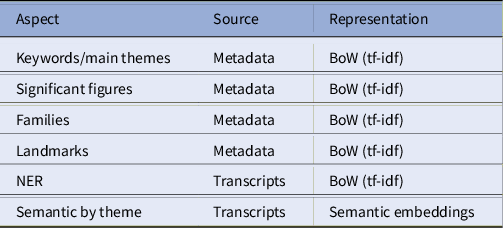
Our primary interest in this analysis is determining when two narratives, as presented through interviews, are more cohesive. To this end, we use textual similarity as a proxy for cohesion. We measure cohesion among interviews by comparing their similarities on different representations. We use multiple facets of the interviewee’s narratives to construct these representations. Table 1 outlines the different aspects we encode into representations and the methods used. We employ two main forms of representation:
-
Bag-of-words (BoW): Applied primarily to metadata to represent specific entities and themes (denoted by curated keywords). Also applied to extracted entities from the transcripts using NER methods; weighted by tf-idf.
-
Semantic embeddings: Dense vector representations obtained from the transcripts using a large language model, interpreted as capturing broader semantic similarity. We describe the procedure in further detail in the “Semantic embeddings from transcripts” section.
Aspects that we represent in different vectors and the sources for representation, specifying which ones use a BoW representation and which ones use a semantic embedding using an LLM
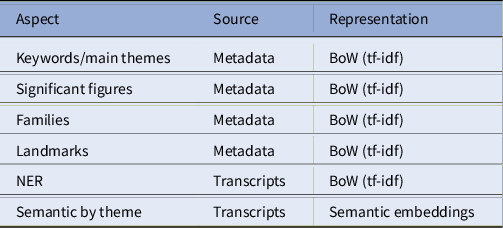
Table 1 Long description
Three columns - Aspect, Source, Representation - with six data rows. Keywords/Main Themes, Metadata, BoW (tf-idf). Significant Figures, Metadata, BoW (tf-idf). Families, Metadata, BoW (tf-idf). Landmarks, Metadata, BoW (tf-idf). NER, Transcripts, BoW (tf-idf). Semantic by theme, Transcripts, Semantic Embeddings. The four metadata-derived aspects and the transcript-derived named entities all use tf-idf weighted bag-of-words vectors; only the thematic aspect uses semantic embeddings.
In the following sections, we provide more specifics on these representations.
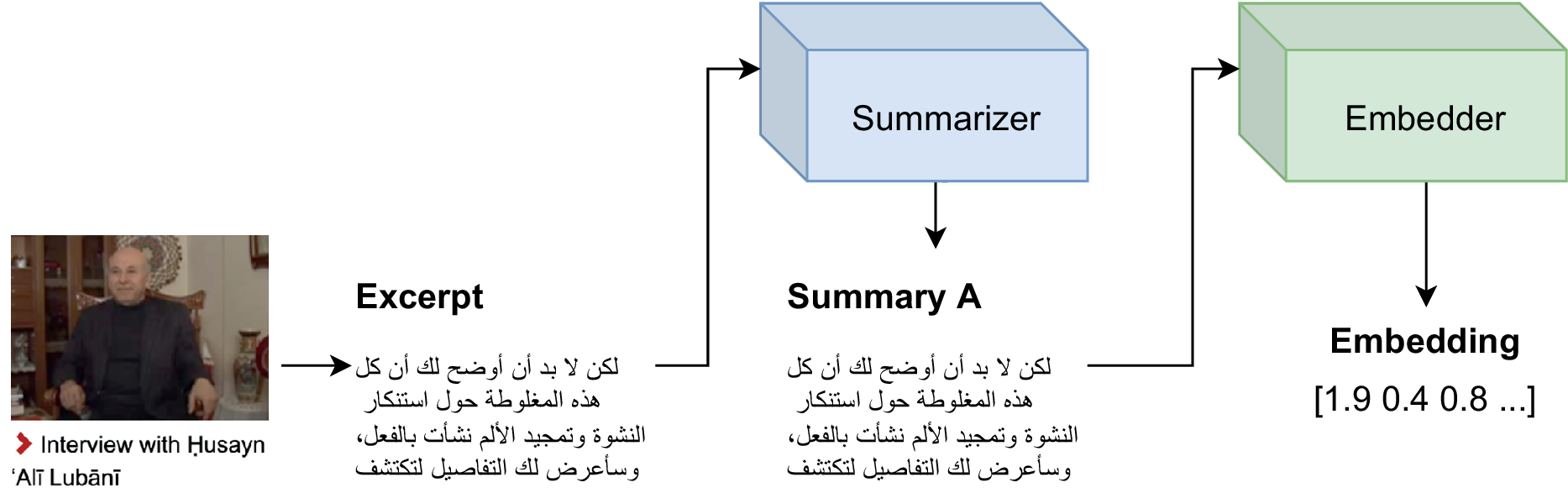
Visual representation of the process to generate semantic embeddings of thematic summaries derived from interview transcripts. These embeddings are used downstream to compute narrative similarity (based on themes) across different interviews. The photo used in this figure is a sample from a full interview with Ḥusayn‘Al
$\bar {\text {i}}$
 Lub
$\bar {\text {a}}\mathrm {n}\bar {\text {i}}$
 , conducted by Maḥm
$\bar {\text {u}}$
 d Zayd
$\bar {\text {a}}$
 n, from the American University of Beirut Palestinian Oral History Archives, POHA Al-Nakba Collection, Record ID: nn_0262 (Al-Nakba Archive 2004).
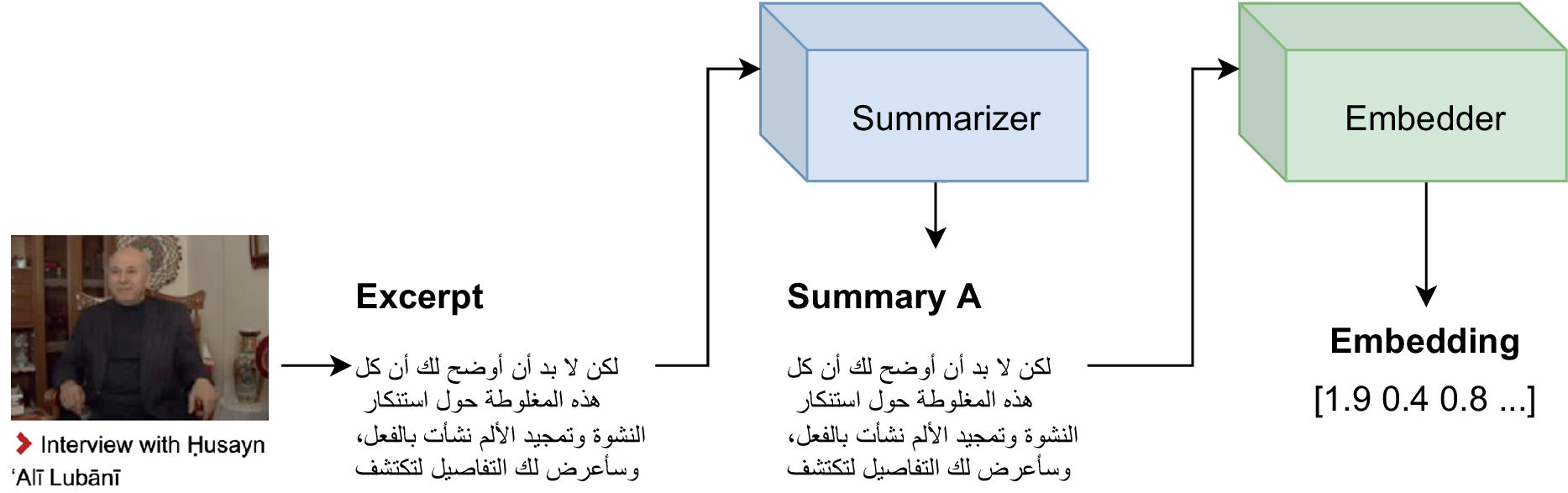
Figure 1 Long description
Four stages run left to right, joined by arrows. A still photograph of an interviewee, captioned ‘Interview with Husayn ‘Ali Lubani’, sits beside a block of Arabic transcript text labelled ‘Excerpt’. An arrow carries the excerpt into a blue three-dimensional box labelled ‘Summarizer’. A downward arrow from that box produces a shorter block of Arabic text labelled ‘Summary A’. A further arrow carries Summary A into a green three-dimensional box labelled ‘Embedder’, whose downward arrow yields the heading ‘Embedding’ above a numeric vector shown as [1.9 0.4 0.8...]. The diagram shows that raw interview excerpts are first summarised and only then converted into vectors.
Bag-of-words representations of key entities
We use BoW representations to capture specific entities related to various aspects of the interviews. These are listed in the metadata curated by archivists, focusing on landmarks, families, significant figures, and keywords. The keywords are curated to form a thematic representation of the interview (Sleiman and Chebaro Reference Sleiman and Chebaro2018). Additionally, we extract general named entities from the transcripts using an Arabic NER model from the CAMeL Tools library (Obeid et al. Reference Obeid, Zalmout, Khalifa, Taji, Oudah, Alhafni, Inoue, Eryani, Erdmann and Habash2020) (details in the “Methods Appendix” section of the Supplementary Material). These entities capture mentions of places or landmarks without proper names, contributing to a nuanced understanding of similarity. All BoW vectors are weighted by tf-idf, so that distinctive terms and entities contribute more to the similarity than common ones. Comparisons using BoW representations emphasize narrative similarity based on shared entities like families or significant figures. In contrast, keyword-based similarity reflects shared broad themes between interviews.
Semantic embeddings from transcripts
We measure narrative similarity through semantic embeddings of thematic summaries derived from interview transcripts. This multi-step approach addresses the challenge of comparing lengthy and diverse interviews by first distilling excerpts into focused thematic summaries and then generating embeddings from these summaries. This technique draws inspiration from the use of LLMs to decompose text for social scientific purposes in other contexts, particularly as described in (Hoyle et al. Reference Hoyle, Sarkar, Goel, Resnik, Bouamor, Pino and Bali2023; Benara et al. Reference Benara, Singh, Morris, Antonello, Stoica, Huth and Gao2024). The procedure involves three main steps: (1) thematic classification of transcript excerpts, (2) summary generation focused on interviewee experiences, and (3) embedding generation and validation. Figure 1 gives a visual representation of the process.
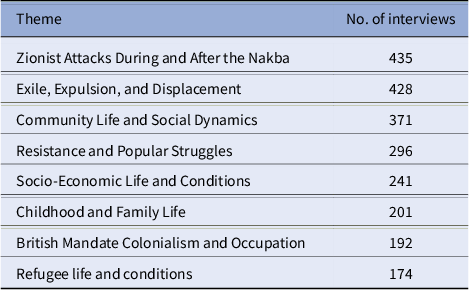
First, we partitioned transcripts thematically using archivist-curated TOCs, which provide descriptive headers for interview sections. We categorized TOC headers into consistent themes to enable cross-interview comparison of relevant excerpts (detailed in the “Methods Appendix” section of the Supplementary Material). For the remainder of this article, we focused on a subset of themes that were more prevalent across interviews and closely related to the Nakba: Zionist Attacks During and After the Nakba; Exile, Expulsion, and Displacement; British Mandate Colonialism and Occupation; Refugee Life and Conditions; Community Life and Social Dynamics; and Resistance and Popular Struggles. Table 2 contains the list of curated themes and the associated number of interviews that contain excerpts classified as belonging to the theme, as present in the analysis sample.
For each thematic excerpt, we used gpt-4.1 (OpenAI, 2025) to generate summaries focused specifically on the interviewee’s experience within the theme. This summarization step serves multiple purposes: it focuses on relevant narrative elements, improves manageability for validation (as comparing raw excerpts proved mentally taxing for expert evaluators), and enhances interpretability. We designed the summarization prompts to comprehensively capture experiential aspects while maintaining thematic focus. We validated summary quality using a sample of 40 summaries, with 20 percent evaluated by multiple raters. These evaluations indicated good performance with high interrater reliability. The summarization made similarity comparisons more tractable than direct excerpt comparison for complex themes, such as the “British Occupation.” Details on the summarization process and validation are provided in the “Methods Appendix” section of the Supplementary Material.
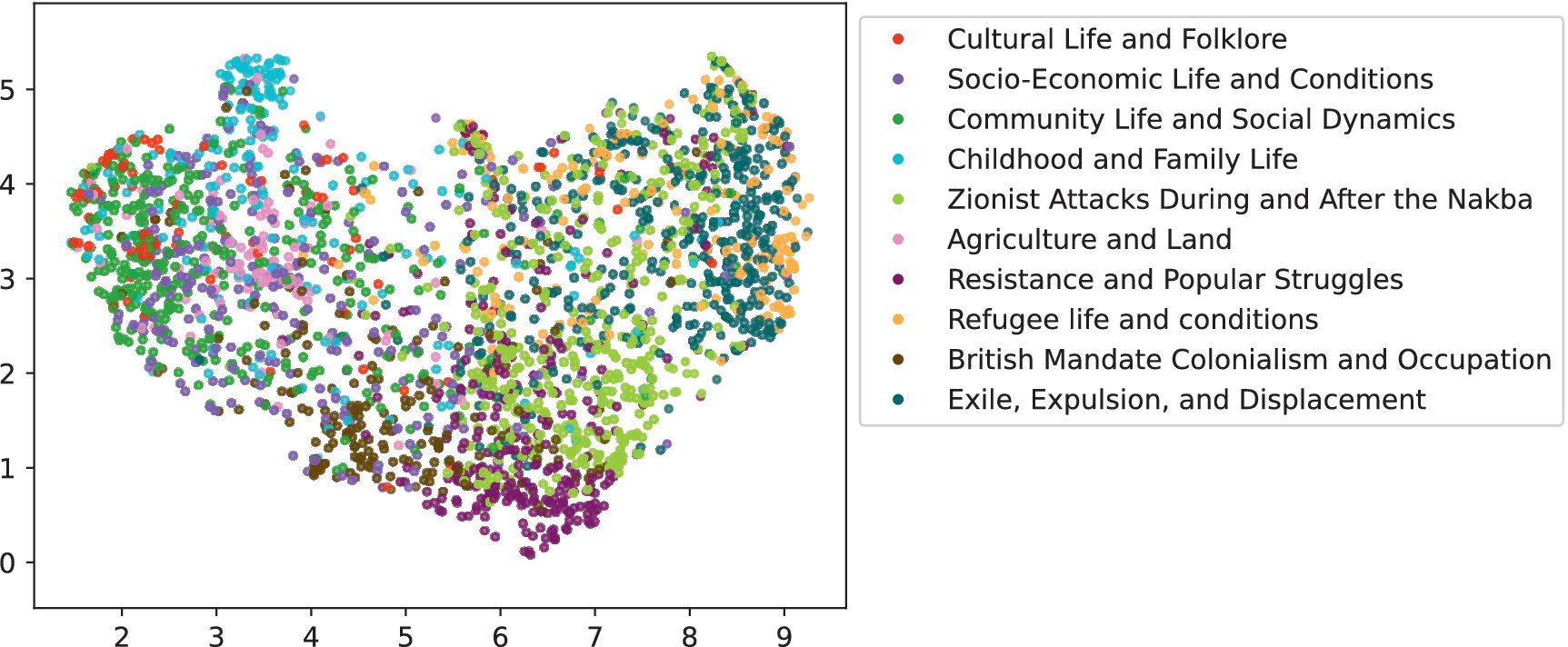
After summarization, we generated embeddings from the thematic summaries using OpenAI’s text-embedding- 3-large model (Su et al., Reference Su, Shi, Kasai, Wang, Hu, Ostendorf, Yih, Smith, Zettlemoyer, Tao, Rogers, Boyd-Graber and Okazaki2023; Vector embeddings—OpenAI API, 2025). We tested various embedding processing techniques, including normalization and all-but-the-top component removal (Mu, Bhat, and Viswanath Reference Mu and Viswanath2018; Su et al. Reference Su, Cao, Liu and Yangyiwen2021), but ultimately used the unprocessed embeddings. We hypothesize that component removal might be too aggressive, as our summaries were already thematically focused (validation results are presented in the “Methods Appendix” section of the Supplementary Material). We validated the embedding similarity measures using triplet comparisons, which are more efficient and reliable for complex data than direct similarity assessments (Hermans, Beyer, and Leibe Reference Hermans, Beyer and Leibe2017; Tamuz et al. Reference Tamuz, Liu, Belongie, Shamir and Kalai2011; Thurstone Reference Thurstone1927). Our triplet sampling ensured diversity across location, gender, and difficulty pairings. Figure 2 visualizes the resulting embeddings using UMAP (McInnes, Healy, and Melville Reference McInnes, Healy and Melville2020), showing clear separation between distinct themes.
Selected themes and count of interviews with at least one section classified under the theme
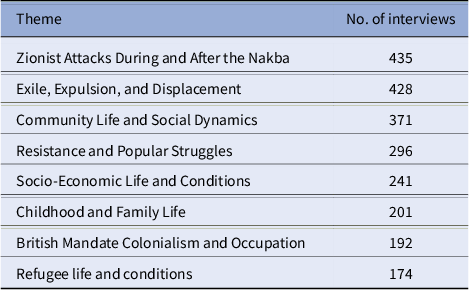
Table 2 Long description
Two columns - Theme and No. Interviews - with eight data rows ordered from most to least frequent. Zionist Attacks During and After the Nakba, 435. Exile, Expulsion, and Displacement, 428. Community Life and Social Dynamics, 371. Resistance and Popular Struggles, 296. Socio-Economic Life and Conditions, 241. Childhood and Family Life, 201. British Mandate Colonialism and Occupation, 192. Refugee life and conditions, 174.
Note: The themes were selected for their higher prevalence in the data and their relevance to the Nakba analysis.
UMAP projection of embeddings derived from thematic summaries. Related themes appear visually indistinguishable, while distinct themes are clearly separated.
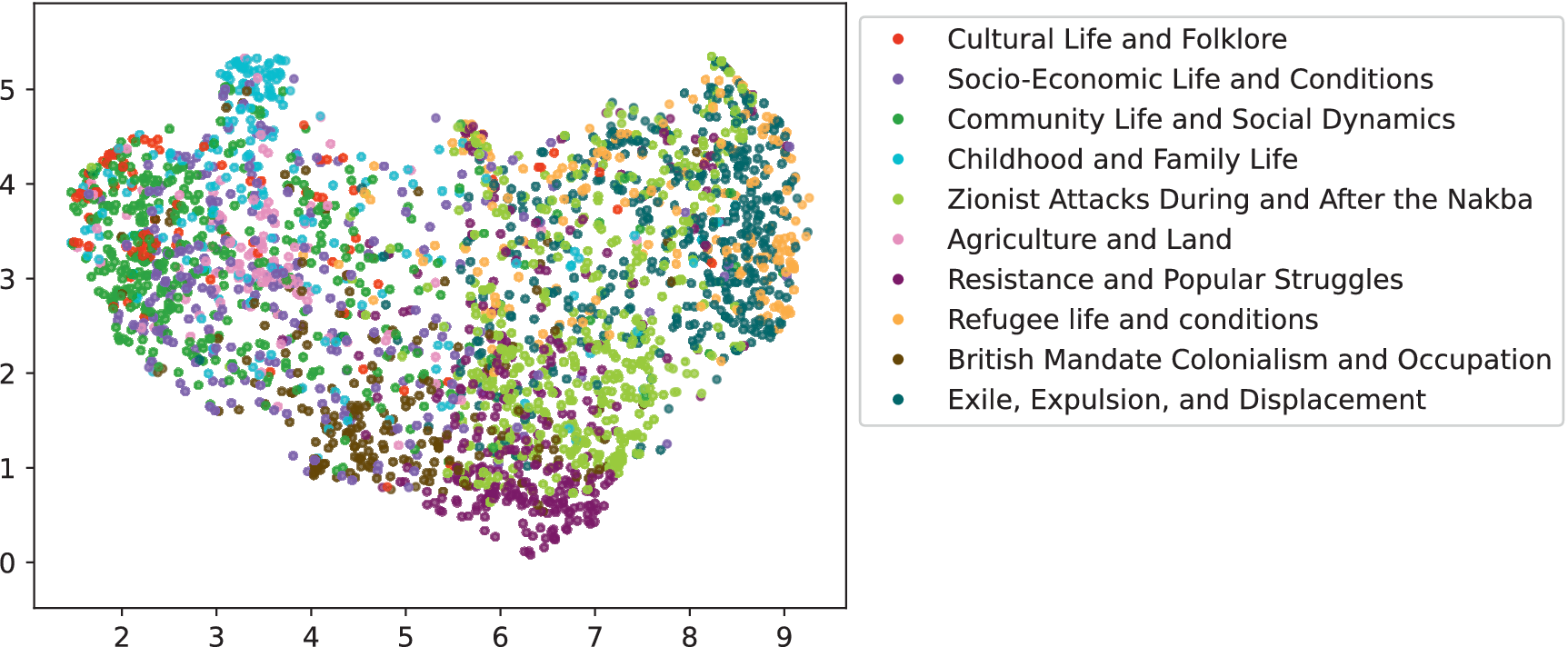
Figure 2 Long description
A dense scatter of roughly two thousand points. The horizontal axis runs from about 1 to 9 and the vertical axis from about 0 to 5; UMAP coordinates have no units and are not individually interpretable. A legend lists ten colour-coded themes: Cultural Life and Folklore; Socio-Economic Life and Conditions; Community Life and Social Dynamics; Childhood and Family Life; Zionist Attacks During and After the Nakba; Agriculture and Land; Resistance and Popular Struggles; Refugee life and conditions; British Mandate Colonialism and Occupation; Exile, Expulsion, and Displacement. Distinct themes occupy separate regions: Exile, Expulsion and Displacement at the upper right; Zionist Attacks at the lower centre-right; Resistance and Popular Struggles at the bottom centre;
Similarity as cohesion
Given representations
$\mathbf {e}^A_i, \mathbf {e}^A_j$
 of interviews
$i, j$
 , where the
$e^A_i$
 could be BoW representations of metadata entities or semantic embeddings of the transcripts, we measure the cohesion of the interviews via the cosine similarity
$\sigma (\mathbf {e}^A_j, \mathbf {e}^A_j)$
 between the representations:
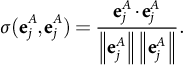
We use cosine similarity for both kinds of representation. The BoW vectors, weighted by tf-idf, capture the terms and entities that two interviews share, and cosine similarity measures this overlap in a way that is insensitive to interview length. For the dense summary embeddings, cosine similarity is the standard measure, and because these embeddings are normalized, it ranks pairs identically to Euclidean distance. Although cosine similarity can be problematic in some settings (Zhou et al. Reference Zhou, Ethayarajh, Card, Jurafsky, Muresan, Nakov and Villavicencio2022), we validate its use in the summary setting by examining low- and high-similarity pairs. This measure is used for assessing all vectorized representations in this article; however, we rely on the distinct meanings of each feature to develop a full picture of narrative cohesion.
Statistical analysis of narrative cohesion
This section describes our statistical approach for testing whether narrative similarity varies systematically with interviewee identity markers. Our primary research questions examine whether interview pairs sharing specific characteristics (e.g., gender or location) exhibit greater narrative cohesion than pairs with different characteristics. To address these questions while accounting for the complex dyadic structure of pairwise similarity data, we employ fixed-effects models with robust covariance estimation.
Modeling framework for dyadic data
Pairwise similarity data present statistical challenges because each interview appears in multiple pairs, violating the independence assumption of standard regression models. Our modeling framework addresses this dependency by including fixed effects for each interview, effectively comparing how the same interview varies in similarity across different partners.
The general model specification for theme T is

where
$\sigma ^T_{ij}$
 represents the cosine similarity between interviews i and j for theme T, and
$z(\sigma ^T_{ij})$
 is the standardized similarity score (mean-centered and scaled by the standard deviation within each theme). This standardization ensures the comparability of coefficients across themes while maintaining the original interpretation of the similarity metric. We evaluated the appropriateness of the standardization by noting that the similarity distributions for each aspect (metadata/semantic themes) possess low kurtosis and are close to normality with few outliers. We provide additional analysis on the matter in the “Methods Appendix” section of the Supplementary Material.
This specification has several advantages for our research questions. First, the fixed effects
$\mu _i$
 and
$\eta _j$
 absorb all time-invariant characteristics of individual interviews, ensuring that our estimates of
$\beta $
 reflect within-interview variation across partners rather than between-interview differences. Second, the model naturally handles the dyadic structure by symmetrically accounting for both interviews in each pair.
We estimate models using the feols function from the fixest package and calculate dyadic-robust covariance matrices using the methods of Aronow, Samii, and Assenova (Reference Aronow, Samii and Assenova2017) and Fafchamps and Gubert (Reference Fafchamps and Gubert2007) to account for residual correlation among pairs sharing common interviews. This approach produces conservative standard errors appropriate for hypothesis testing in dyadic data.
We estimate separate models for each theme and also fit a pooled model that combines data across all themes to obtain overall estimates of pairing effects. The pooled model includes theme fixed effects to account for baseline differences in similarity levels across themes.
Gender pairing analysis
To test whether gender composition affects narrative similarity, we specify a categorical model:

where
$I[g_{ij} = X]$
 are indicator variables for gender pairings (Female–Female, Female–Male, and Male–Male). This categorical specification allows for nonlinear effects of gender composition on similarity.
The model is identified through variation in similarity scores for the same interview across partners of different genders. Note that when we estimate this model with fixed effects, one gender pairing category is absorbed into the interview fixed effects, so the regression coefficients
$\beta _X$
 represent differences between pairing types rather than absolute levels.
To obtain interpretable estimates of similarity levels for each gender pairing type, we use estimated marginal means (EMMs) computed via the emmeans package. We then calculate pairwise contrasts between these EMMs, using Female–Male pairs as the reference category. This approach allows us to test specific hypotheses about gender homophily (e.g., whether same-gender pairs show greater similarity than mixed-gender pairs) while controlling for multiple comparisons using the Holm adjustment. All EMMs and contrasts incorporate the dyadic-robust covariance matrix to ensure valid inference.
We apply inverse probability weighting based on the empirical distribution of gender pairings to address potential imbalance in pairing prevalence and ensure that our estimates are not unduly influenced by the most common pairing types.
Community pairing analysis
For location-based analysis, we use a categorical specification that allows for full flexibility in how different location-sharing patterns affect similarity:

where
$I[\ell _{ij} = L]$
 are indicators for location pairing types: None (N), Origin only (O), Residence only (R), or Both origin and residence (B). This categorical approach is more flexible than a factorial specification with main effects and interactions, as it does not impose additivity constraints on the effects of shared origin and residence.
We employ inverse probability weighting based on the empirical distribution of pairing types to address substantial imbalance in pairing prevalence, particularly the rarity of pairs sharing both origin and residence.
As with the gender model, one location pairing category is absorbed into the interview fixed effects during estimation. We therefore compute EMMs for each location pairing type to obtain interpretable estimates and calculate contrasts using pairs that share no locations as the reference category. Our contrast analysis tests several specific hypotheses: (1) whether any shared location (origin only, residence only, or both) increases similarity compared to no shared location and (2) whether the combination of shared origin and residence produces greater similarity than would be expected from their additive effects alone. We test this synergy hypothesis using a custom contrast that compares the EMM for the “Both” category against the sum of the individual effects:

This contrast tests whether sharing both locations produces an additional boost in similarity beyond the sum of their individual effects. A positive synergy term indicates that the effects of shared origin and residence are superadditive, while a negative synergy term indicates interference between the two factors.
Complementary analyses and robustness checks
We complement our primary fixed-effects models with two alternative approaches documented in the Appendix of the Supplementary Material. First, we estimate Mundlak-corrected random effects models (Mundlak Reference Mundlak1978; Wooldridge Reference Wooldridge2010) that partially pool information across interviews while controlling for interview-level means. Second, we implement Bayesian versions of these models using the brms package (Bürkner Reference Bürkner2017), which provides full posterior distributions for parameters and naturally handles uncertainty quantification.
These alternative specifications serve as robustness checks, providing complementary perspectives on our research questions. The consistent qualitative results across modeling approaches strengthen confidence in our findings.
Findings
Using the outlined models, we test cohesion for both gender and location across a set of aspects. As discussed in our “Theoretical Framework” section, we hypothesize that narrative cohesion will be higher 1) among same-gender pairs and 2) among same-community pairs (place of origin and place of residence). We refer to analyses of BoW representations of metadata and extracted named entities as relating to “factual” aspects of the interviews and the analyses using embeddings of different interview sections as “thematic.”
Same gender narratives are more cohesive
We begin by testing cohesion within same-gender pairs. Palestinian women testify to diverse experiences of the three temporalities represented in POHA’s biographies (pre-1948 village life, the Nakba, and refugee life); we also assume that collective memory is at work on some level. While we do not expect that woman–woman or man–man pairs will necessarily display more or less cohesion according to our measure, we do expect that their levels of cohesion will be separable compared to the standard of man–woman pairs.
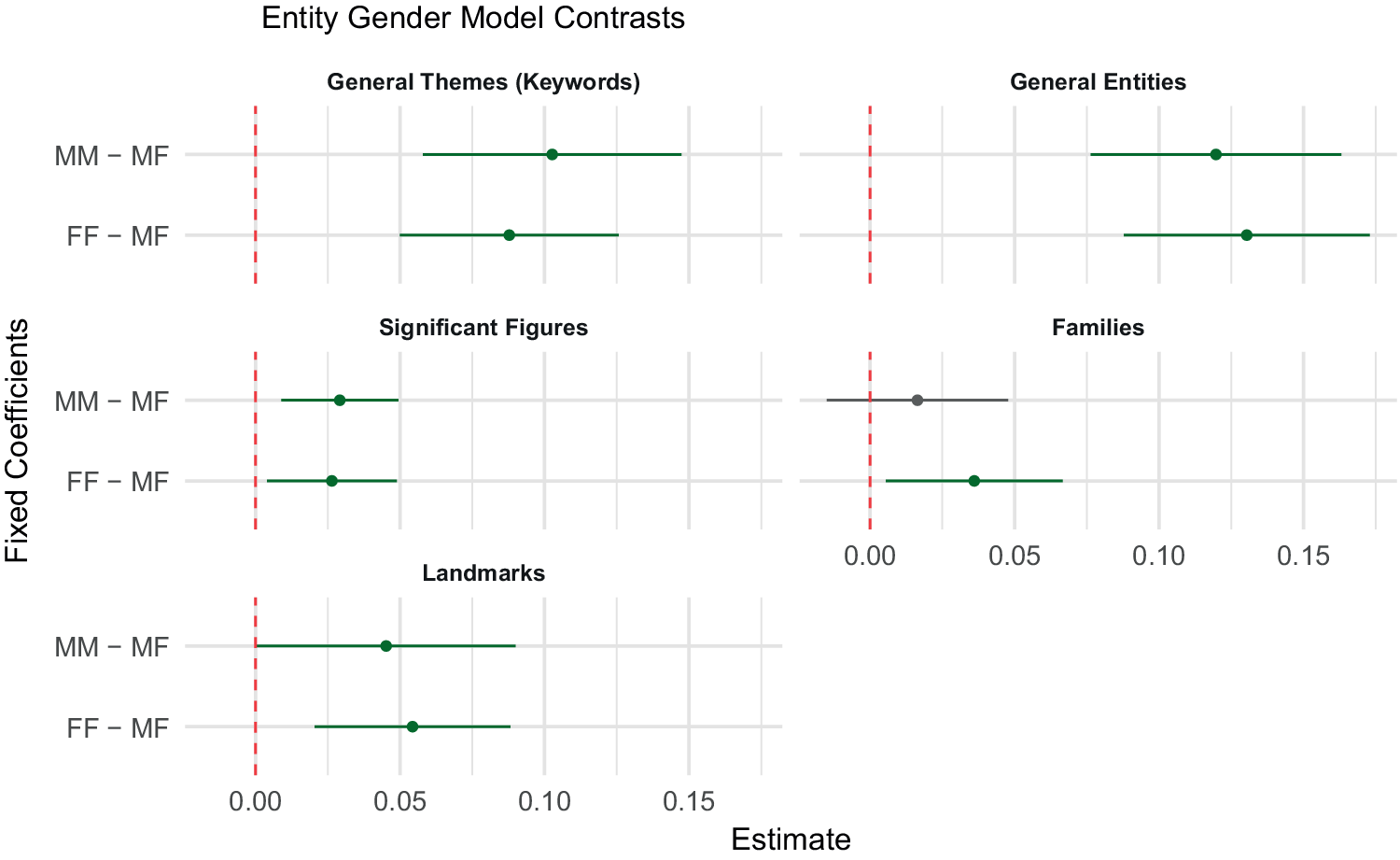
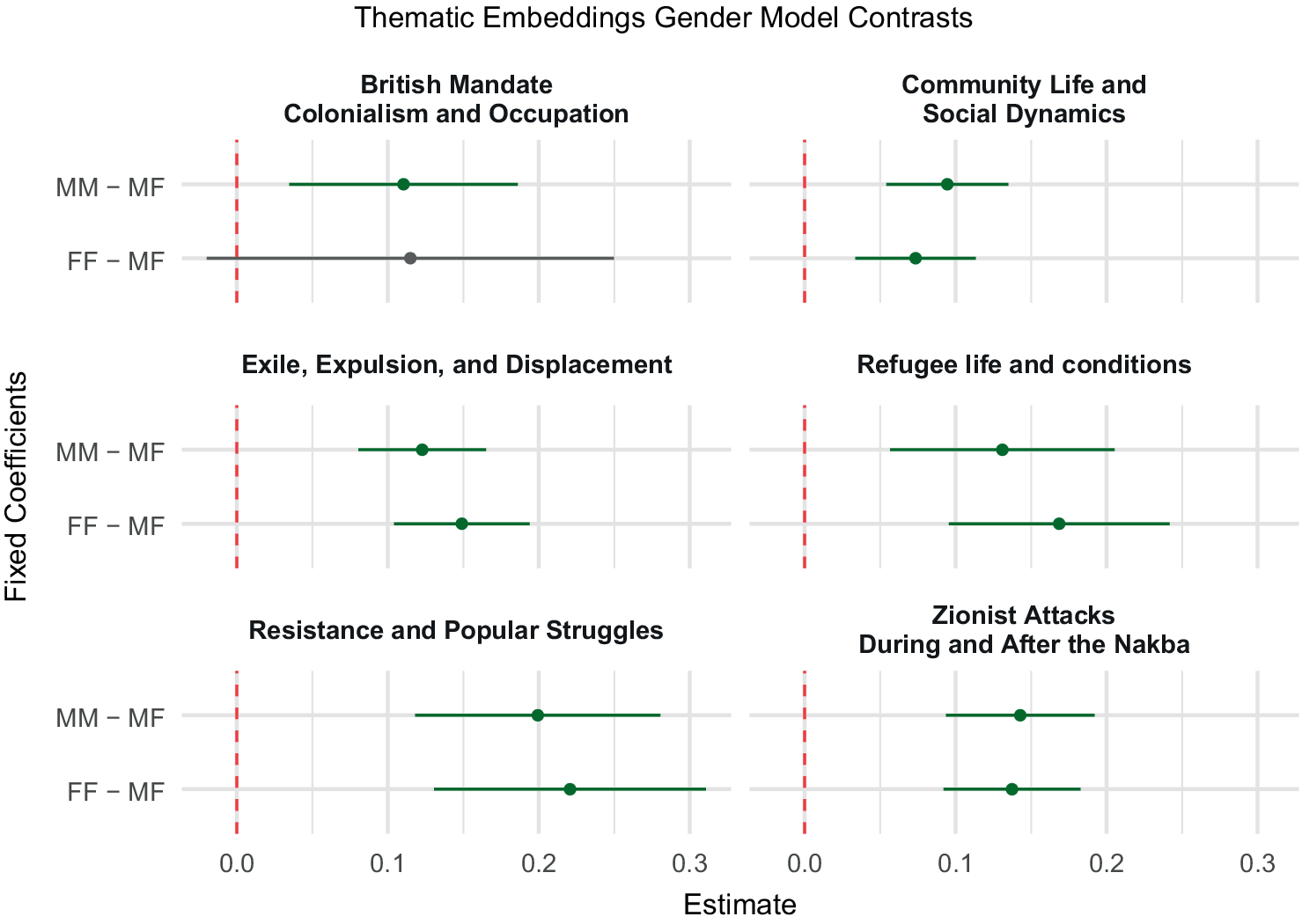
We use the model specified above for gender analysis to iteratively test the relationship between gender and different BoW descriptors of the narrative. This yields the coefficients displayed in Figure 3. We then repeat the exercise using the thematic embedding representations, shown in Figure 4. Our results suggest that there is evidence for women displaying thematic narrative cohesion but not necessarily factual cohesion.
Model coefficients reflecting the relationship between factual mention-based cohesion and gender. Pairs of interviews where both interviewees are men tend to be less similar than those where both interviewees are women or those where one is a man and one is a woman. Interviews where both interviewees are women tend to be more similar, especially for less specific measures.
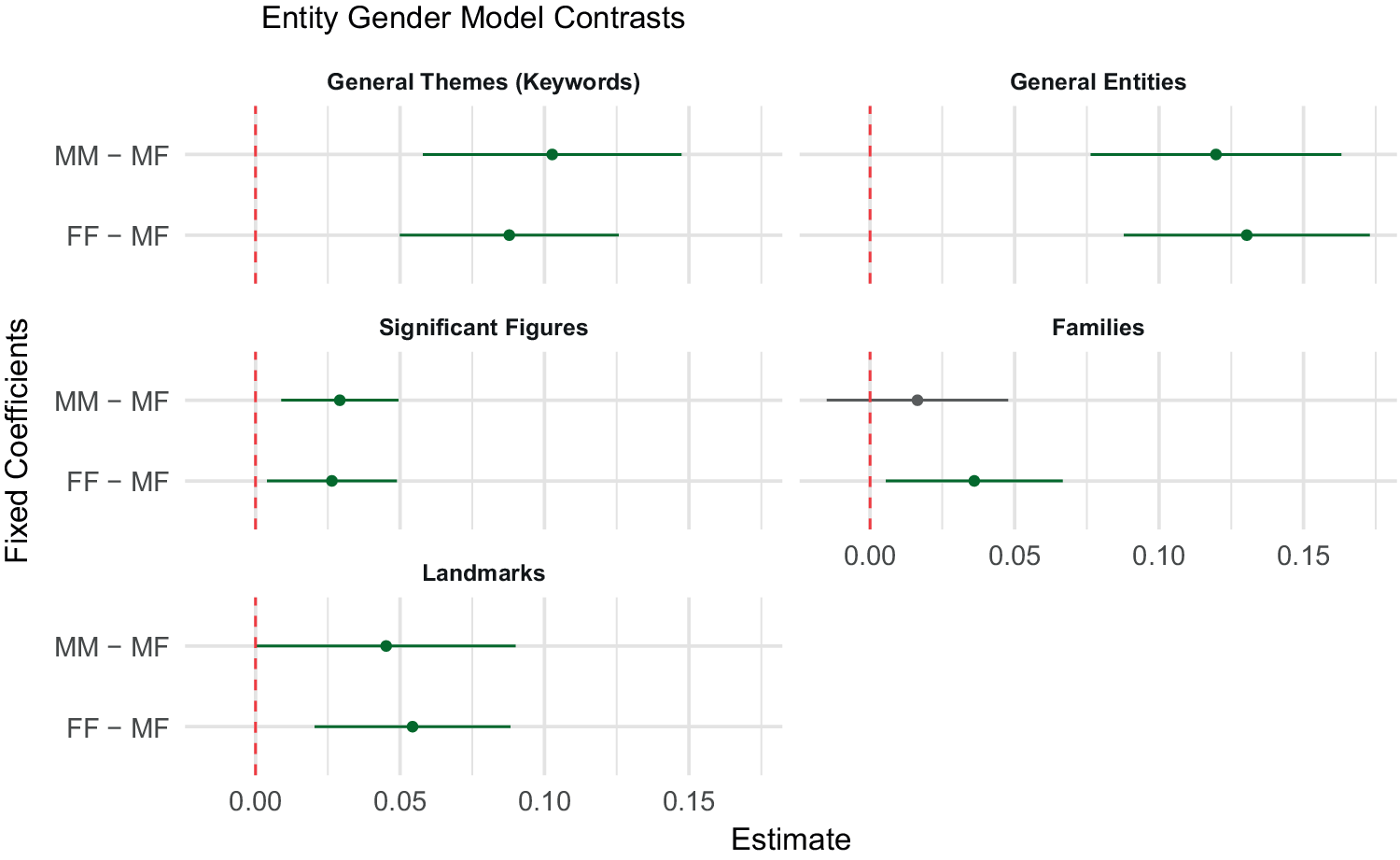
Figure 3 Long description
Same-gender interview pairs are more similar than man-woman pairs on nearly every factual measure. Five panels, one per metadata aspect, each plot two contrasts against a zero reference line: woman-woman versus man-woman pairs (FF - MF) and man-man versus man-woman pairs (MM - MF), shown as an estimate with a 95% confidence interval. Estimates, with an asterisk marking intervals that exclude zero: General Themes (Keywords), FF 0.088* and MM 0.103*; General Entities, FF 0.130* and MM 0.120*; Significant Figures, FF 0.026* and MM 0.029*; Families, FF 0.036* and MM 0.016, the only estimate whose interval includes zero; Landmarks, FF 0.054* and MM 0.045*. Full confidence intervals appear in the appendix model-comparison tables.
Model coefficients reflecting the relationship between thematic cohesion within topics and gender. Pairs of interviews where both interviewees are men may be slightly more similar than the reference class of man–woman pairs, and pairs of interviewees where both interviewees are women are the most similar of all.
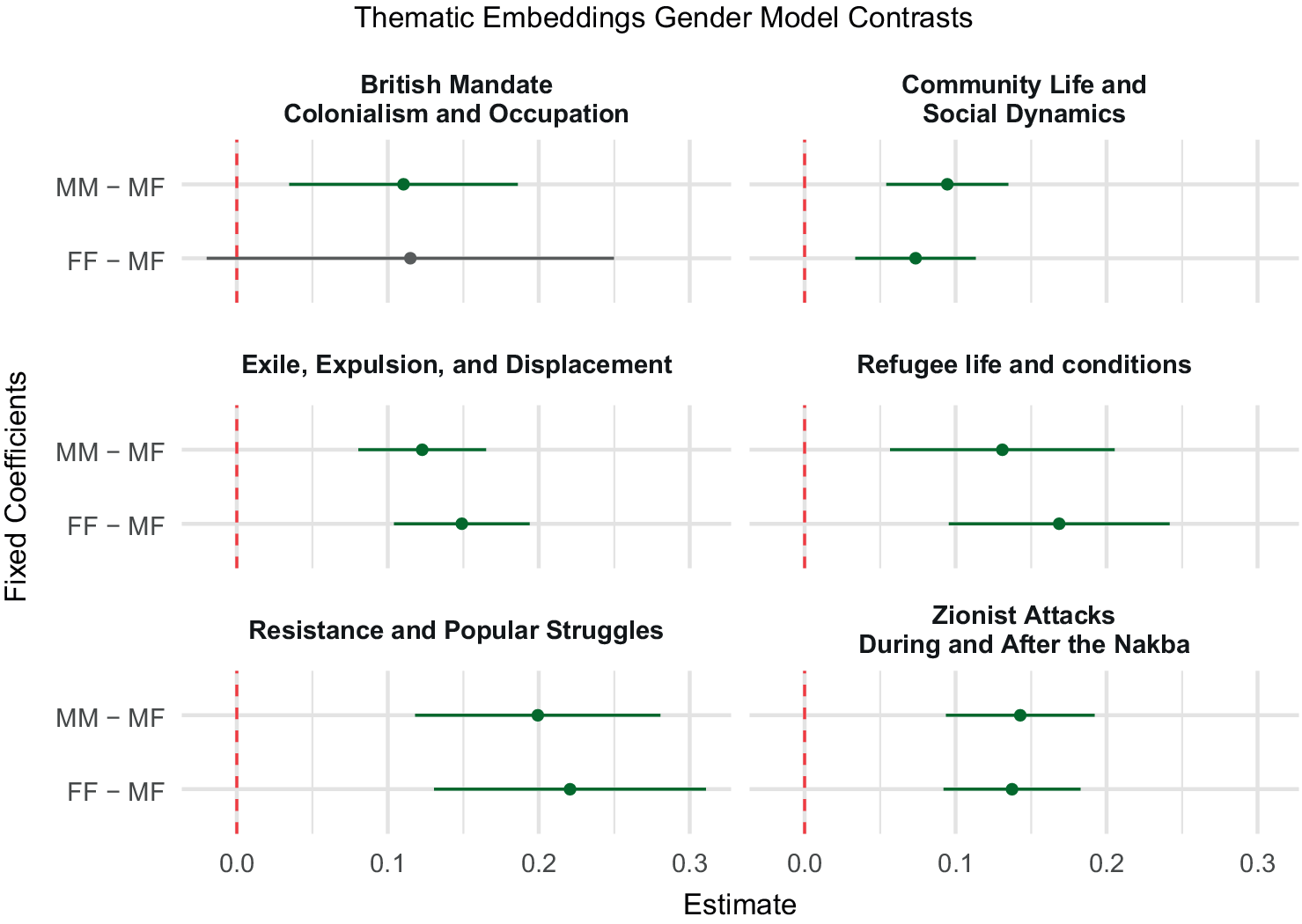
Figure 4 Long description
Same-gender pairs show higher thematic similarity than man-woman pairs across all six themes. Six panels, one per theme, each plot two contrasts against a zero reference line: woman-woman versus man-woman pairs (FF - MF) and man-man versus man-woman pairs (MM - MF), shown as an estimate with a 95% confidence interval. Estimates, with an asterisk marking intervals that exclude zero: British Mandate Colonialism and Occupation, FF 0.115 (interval includes zero) and MM 0.110*; Community Life and Social Dynamics, FF 0.073* and MM 0.094*; Exile, Expulsion, and Displacement, FF 0.149* and MM 0.123*; Refugee life and conditions, FF 0.169* and MM 0.131*; Resistance and Popular Struggles, FF 0.221* and MM 0.199*, the largest effects shown; Zionist Attacks During and After the Nakba, FF 0.137* and MM 0.143*. Full intervals appear in the appendix model-comparison tables.
Our original hypothesis about the particularity of women’s experiences is supported by these results. However, men are also quite cohesive – indicating that gendered cohesion is not exclusive to women. As we note later, Palestinian men and women experienced gender-specific challenges before, during, and after the Nakba; they also engage in different types of memory work related to these experiences. The only feature for which same-gender similarity is not significant is the presence of mentioned families in the context of male–male pairs, which is suggestive but may be a consequence of the field being sparse.
The many contexts in which observable similarities are evident within gender pairs confirm arguments made in the qualitative literature we review in our “Background” section. Same-gender pairs display significant similarity in both themes and factual mentions, suggesting that the specific actors and locations that interviewees consider salient are also mediated by gender.
Shared communities lead to shared narratives
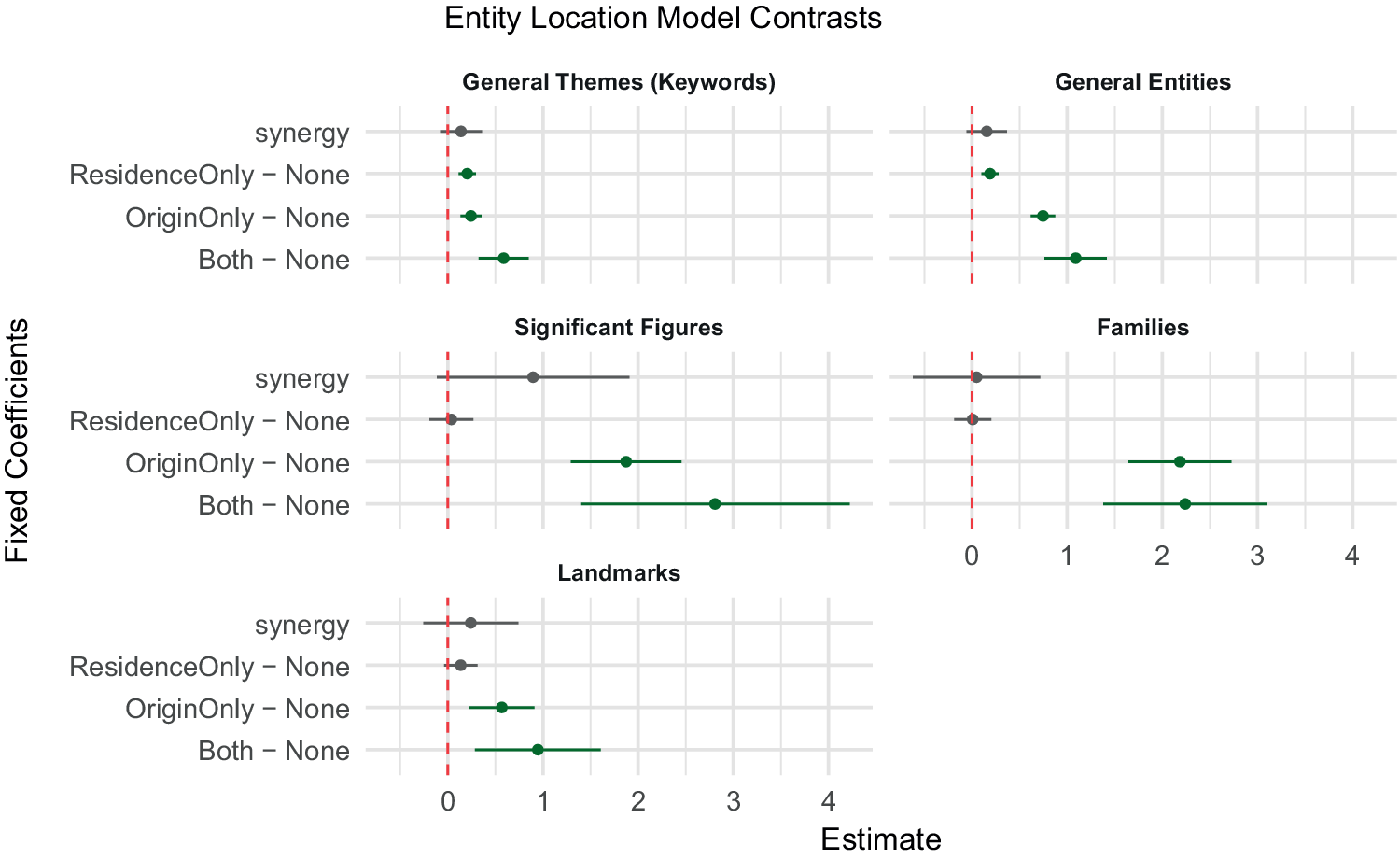
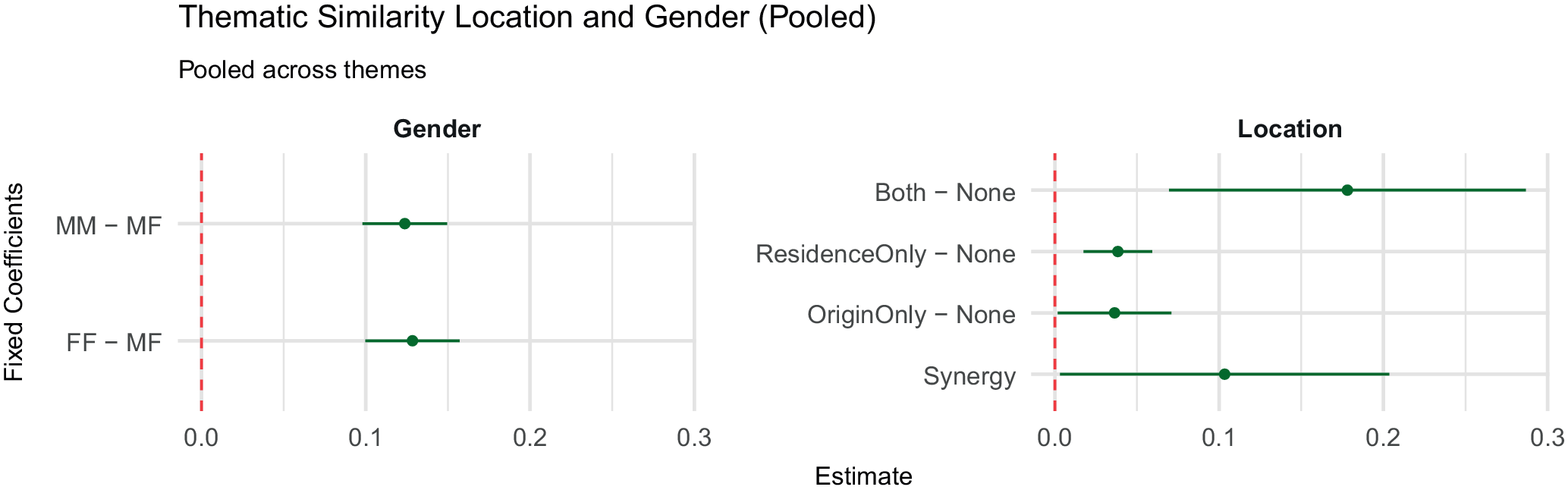
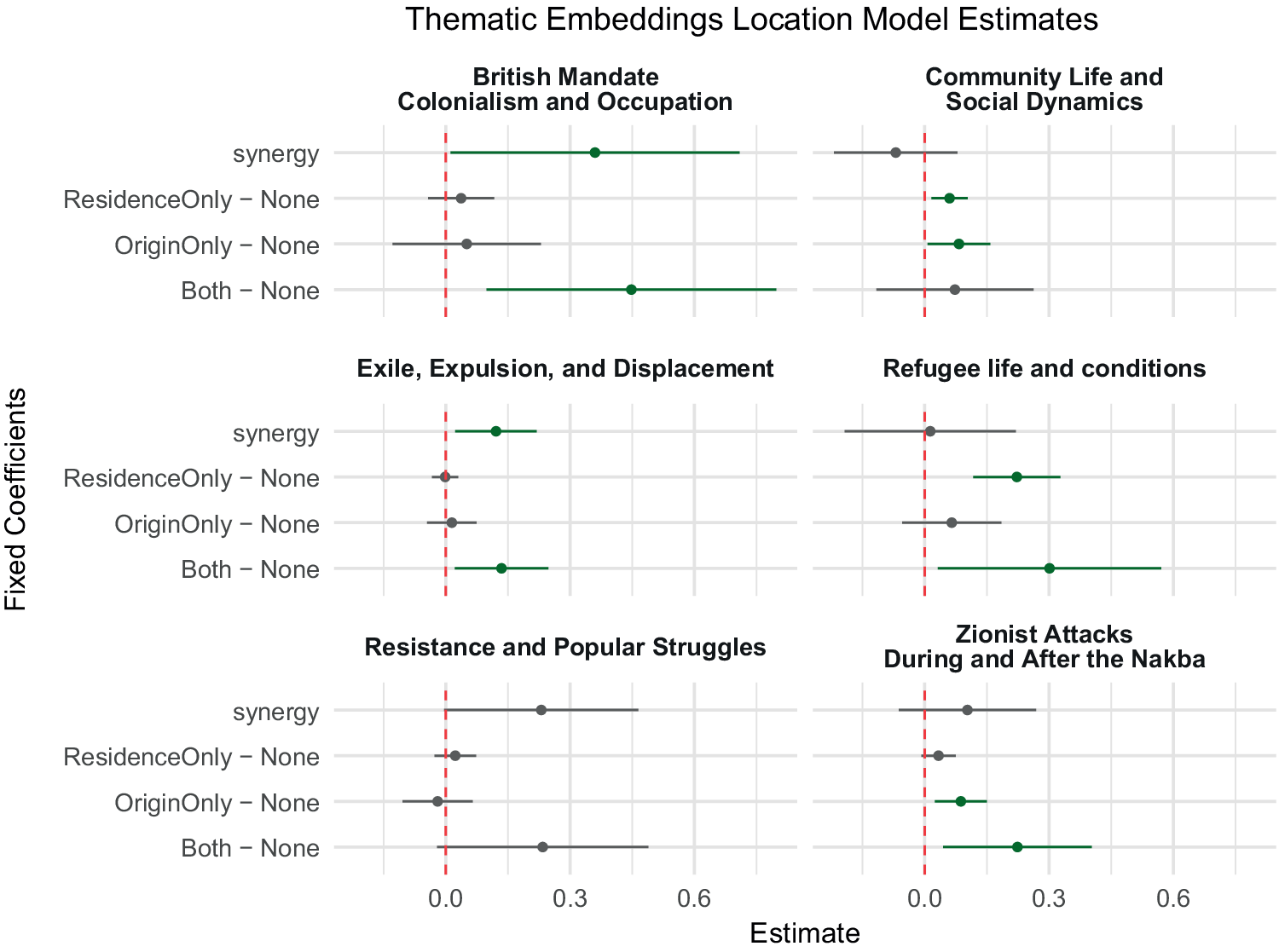
We examine how shared geographic connections, both places of origin and current residences in Lebanon, relate to narrative cohesion among Palestinian refugees. Our analysis compares pairs of interviews across different location-sharing conditions: sharing neither origin nor residence (reference category), sharing only origin, sharing only residence, or sharing both. We analyze narrative similarity through two complementary approaches. First, we examine factual cohesion through metadata and named entities mentioned in interviews, which we refer to as the factual aspects of narratives. Second, we analyze semantic similarity through embeddings of interview transcripts, capturing the thematic and experiential dimensions of how people narrate their histories. For both approaches, we test whether sharing both origin and residence produces effects beyond the sum of sharing each independently, a synergy that we interpret as evidence of community continuity, in line with our theoretical framework. Figure 5 presents our findings for factual cohesion across multiple metadata dimensions, while Figures 6 and 7 show results for thematic cohesion at both aggregate and theme-specific levels.
Model coefficients reflecting the relationship between factual mention-based cohesion and shared location. Same origin and residence consistently predict the mention of similar entities and (for the keywords) broader concepts. Being from and residing in the same place often shows a positive correlation with similarity.
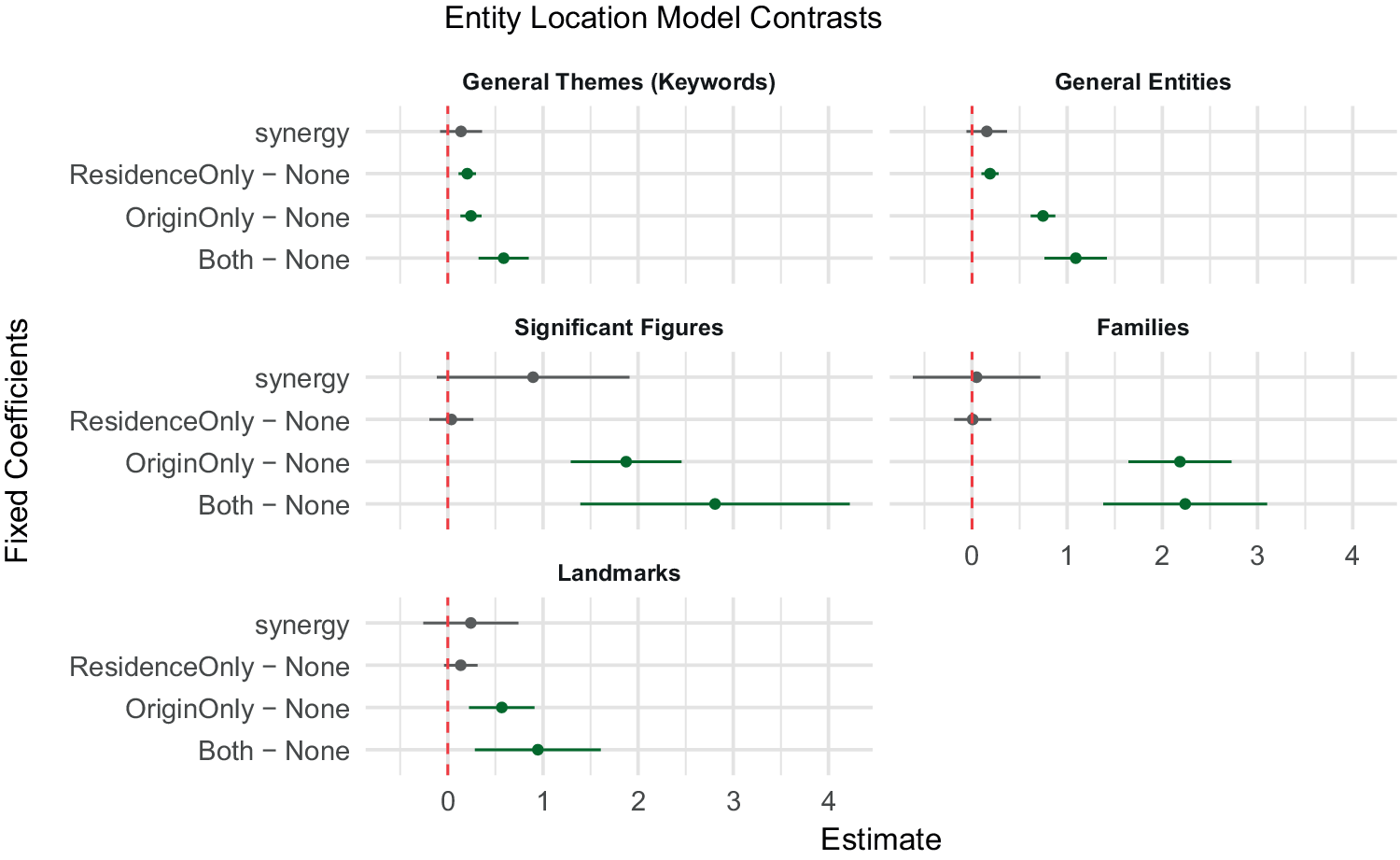
Figure 5 Long description
Shared place of origin strongly predicts similar factual mentions, and sharing both origin and residence predicts more still. Five panels, one per metadata aspect, each plot four contrasts against a zero reference line: pairs sharing both origin and residence, origin only, residence only, and the synergy between them, shown as estimates with 95% confidence intervals. Estimates for sharing both, then origin only, with an asterisk marking intervals that exclude zero: General Themes (Keywords), 0.587* and 0.243*; General Entities, 1.090* and 0.746*; Significant Figures, 2.807* and 1.874*; Families, 2.240* and 2.184*; Landmarks, 0.946* and 0.568*. Residence alone is far smaller, excluding zero only for keywords (0.204*) and general entities (0.189*). The synergy term is positive in every panel but its interval always includes zero. Full intervals are in the appendix tables.
Model coefficients reflecting the relationship between thematic cohesion (pooled across all themes) and shared location. Results from a fixed-effects model with dyad-robust standard errors show that sharing both origin and residence predicts substantially higher narrative similarity than sharing either alone.
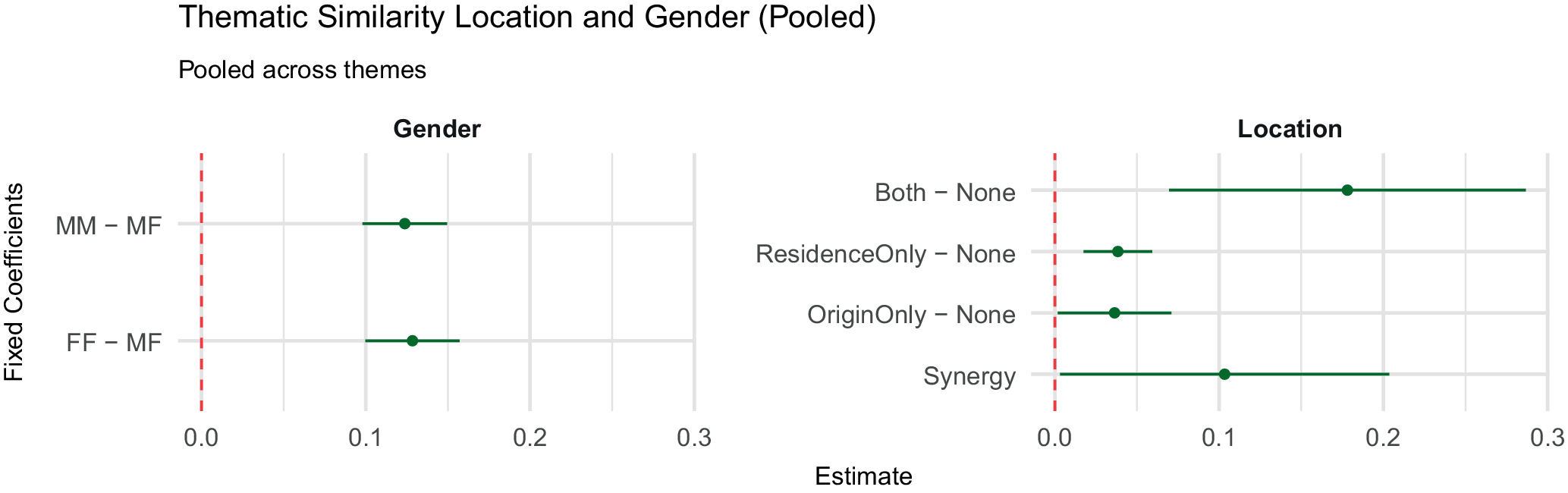
Figure 6 Long description
Sharing both origin and residence predicts substantially higher thematic similarity than sharing either alone. Subtitled ‘Pooled across themes’, the figure has two panels sharing a horizontal axis, Estimate, from 0.0 to 0.3. The left panel, Gender, plots woman-woman versus man-woman pairs at about 0.13 and man-man versus man-woman pairs at about 0.125, both with narrow intervals excluding zero. The right panel, Location, plots four contrasts: sharing both origin and residence, b = 0.235, SE = 0.058, z = 4.03, p < .001; residence only, b = 0.048, SE = 0.012, z = 4.05, p < .001; origin only, b = 0.045, SE = 0.018, z = 2.45, p = .014; and a positive synergy term of about 0.10. The effect of sharing both locations exceeds the sum of the two individual effects.
Model coefficients reflecting the relationship between thematic cohesion within topics and shared location. Similar to Figure 5, being from the same homeplace or residence consistently predicts higher similarities in every major theme. Living in the same place and being from the same location is quite predictive of narrating major historical events similarly.
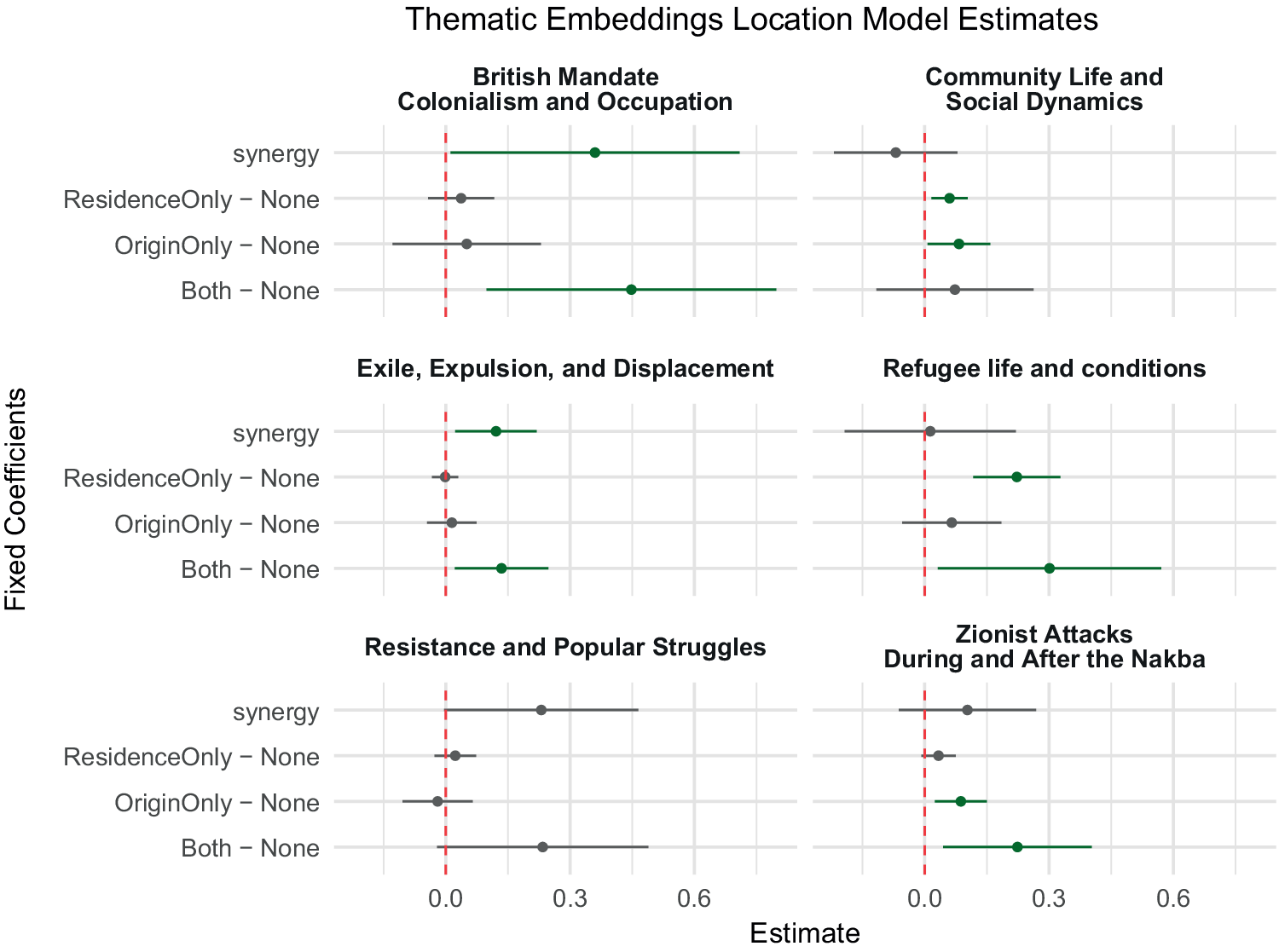
Figure 7 Long description
Sharing both origin and residence predicts higher thematic similarity in most themes, though the pattern varies by theme. Six panels, one per theme, each plot four contrasts against a zero reference line: pairs sharing both origin and residence, origin only, residence only, and the synergy between them, shown as estimates with 95% confidence intervals. Estimates for sharing both locations, with an asterisk marking intervals that exclude zero: British Mandate Colonialism and Occupation 0.448*; Refugee life and conditions 0.301*; Resistance and Popular Struggles 0.234; Zionist Attacks During and After the Nakba 0.224*; Exile, Expulsion, and Displacement 0.135*; Community Life and Social Dynamics 0.073. Origin alone excludes zero only for Zionist Attacks (0.087*) and Community Life (0.083*); residence alone only for Refugee life (0.222*) and Community Life (0.060*). Synergy excludes zero for British Mandate (0.360*) and Exile (0.121*).
For factual aspects of narratives (Figure 5), we find directional evidence for the continuity effect, though statistical detection remains weak due to the rarity of pairs sharing both locations and our conservative error modeling approach. A shared place of origin consistently predicts higher similarity across metadata dimensions – interviewees from the same original communities tend to mention similar entities, landmarks, and broader thematic keywords. Shared current residence also predicts increased factual similarity, though estimates are somewhat smaller for certain categories, such as general entities and landmarks. Notably, shared residence alone shows no clear effect on mentions of families and significant figures, suggesting that factual narratives emphasize the past and original communities rather than current life in refugee camps – though this effect may also be absorbed into the continuity category when pairs share both locations.
When we examine thematic cohesion across all themes (Figure 6), we find strong evidence that community continuity shapes narrative similarity. Using fixed-effects estimation with dyad-robust standard errors, we observe that pairs sharing only origin show modestly increased similarity compared to those sharing neither location (
$b = 0.045$
 ,
$SE = 0.018$
 ,
$z = 2.45$
 , and
$p = 0.014$
 ), as do pairs sharing only residence (
$b = 0.048$
 ,
$SE = 0.012$
 ,
$z = 4.05$
 , and
$p < 0.001$
 ). However, pairs sharing both locations demonstrate substantially higher thematic similarity (
$b = 0.235$
 ,
$SE = 0.058$
 ,
$z = 4.03$
 , and
$p < 0.001$
 ), indicating a synergistic effect that exceeds the sum of individual location effects. This pattern supports our hypothesis that continuity of community from origin through displacement fundamentally shapes how Palestinian refugees construct their historical narratives.
Breaking down the analysis by individual themes (Figure 7) reveals more nuanced patterns that depend on the experiential basis of different narrative content. We find mixed evidence for the continuity effect across themes – it appears clearly in most, but not in discussions of community life and social dynamics, or of refugee life and conditions. Similarly, the effects of sharing only origin or only residence vary by theme. Shared origin most clearly predicts similarity for themes connected to pre-expulsion experiences: the British Mandate period, community life, refugee conditions, and especially discussions of Zionist attacks. Shared residence shows stronger associations with themes more connected to post-displacement experiences: community life, refugee conditions, and resistance movements. Discussions of Zionist attacks – present in nearly all interviews – follow our expected pattern most clearly, with both shared origin and shared residence predicting similarity (origin showing stronger effects), and sharing both locations further amplifying similarity. These theme-specific patterns indicate that different historical experiences are narrated through different community lenses, with origin-based communities shaping narratives of the past and current communities shaping narratives of exile and resistance.
Across both factual and thematic dimensions, we find that sharing both origin and residence predicts substantially higher narrative similarity than sharing either location alone, with shared origin and shared residence each showing generally positive though sometimes non-significant individual effects.
Discussion
We observe evidence of cohesion in collective memory within several different scenarios concerning boundary-making identity markers. We observe weak evidence that gender is an indicator of similarity. On average, the narratives of interviewees of different genders are dissimilar. On the other hand, when interviewees share the same gender, their narratives tend to be more similar when compared to pairs of interviewees of different genders. Additionally, we observe weak evidence that the continuity of the group in relation to location is an indicator of higher similarity. More often than not, interviewees who share the same place of origin and place of residence result in a positive effect on cohesion. Sharing either origin only or place of residence only also results in higher cohesion between interviewees’ narratives; however, this depends on particular themes pertaining to life before, during, and after the Nakba. This indicates that the continuity of group boundaries before and after forced displacement has an impact on how different aspects of individuals’ narratives are remembered.
The cohesion of narratives based on gender can be reasonably explained through the theoretical framework of collective memory. Extant scholarship has shown that though Palestinian women and men share a fundamental national identity based on the ongoing struggle for liberation and return (Holt Reference Holt2010; Sayigh Reference Sayigh1979). However, the differences in their gender identities have engendered different lived experiences in relation to the Nakba and have in turn shaped their recollections in divergent ways (Humphries and Khalili Reference Humphries, Khalili, Sa’di and Abu-Lughod2007; Khoury Reference Khoury, Abdo-Zubi and Masalha2018; Sayigh Reference Sayigh1998, Reference Sayigh2007). First, one of the roles in the family of Palestinian women is to maintain social relations with other women in extended family networks and the larger village community (Sayigh Reference Sayigh1998), giving them insight into family and local histories. This focus on social rather than political history highlights domestic practices, cultural traditions, community life, and alternative modes of resistance that are often overlooked in national and archival histories (Nimr Reference Nimr2008; Sayigh Reference Sayigh2007; Tamari Reference Tamari2008; Yahya Reference Yahya2017). Second, men’s narratives tend to diverge from women’s because their recollections are more strongly shaped by their interactions with political systems rather than the social and familial spheres (Sayigh Reference Sayigh1998, Reference Sayigh2015). Experiences with the resistance movements of the British Mandate period, the Zionist colonization of Palestine, and the revolution of the refugee camps in Lebanon heavily influence how Palestinian men understood themselves in relation to national events (Masalha Reference Masalha, Abdo-Zubi and Masalha2018; Barakat Reference Barakat2019, 16). The ways in which men and women remember the Nakba are defined within boundaries marked by the social expectations of their gender in Palestinian society. Overall, cohesion reflects the collective memory fostered by women’s and men’s roles in village life, under colonial rule, and in exile, even as factual details vary.
Our findings regarding location merit further discussion, as cohesion is more variable based on the factual or thematic dimensions of the narratives, in addition to the interviewees’ location-sharing conditions. Existing research states that the collective memory of diaspora groups is shaped by both the homeland and the host country (Toivanen and Baser Reference Toivanen and Baser2019; Voytiv Reference Voytiv2024). This explains why narratives are similar among individuals who share at least one location, whether their original village in Palestine or the place to which they were displaced in Lebanon. Moreover, it is not unexpected that Palestinians who share the same past and present location have a stronger similarity in their narratives than those who share only one location. When pairs of interviewees share at least one location, this is an indicator that major historical events and aspects such as landmarks, significant figures, and families will be similar between personal narratives. However, this is not the case for all thematic aspects of interviewees’ narratives, as cohesiveness can vary across particular themes. Other scholars have found that Palestinian oral histories accurately outline historical events, but the details are often situated within deeply personalized accounts (Ben-Ze’ev Reference Ben-Ze’ev2002; Masalha Reference Masalha, Abdo-Zubi and Masalha2018; Pappé Reference Pappé2007). In these cases, individuals’ memories could likely be influenced by new additions to their communities in Lebanon and the loss of other members from their original villages. Considering the trauma exerted on the group boundaries of Palestinian communities, through their violent expulsion from Palestine and the ongoing denial of return, it is unsurprising that outside influences would have some impact on how interviewees remember the Nakba.
The type of location shared between interviewee pairs also has an impact on similarity. Interviewees who share the same origin but different residences exhibit consistent factual cohesiveness in their narratives and, in general, show greater thematic similarity when narrating their experiences. This is especially salient when interviews narrate events before the Nakba, demonstrating that individuals’ bond to their original village and to other community members is not severed, even after being forcibly displaced. As Toivanen and Baser (Reference Toivanen and Baser2019) state, diasporic memory is not constrained by spatial boundaries; therefore, memories continue to be shaped within the social framework of refugees’ original villages even when they are physically separate. When traumatic experiences threaten group bonds, the community will “erase from its memory all that might separate individuals” (Halbwachs Reference Halbwachs1992, 183), allowing for a collective narrative to be maintained between individual memories. Therefore, the similarity of narratives between pairs of refugees who share the same origin but not the same residence is evidence of the strength and continuity of their community bond despite the violent expulsion of the Nakba.
Refugees who share the same residence but not the same origin also have cohesive factual narratives, which shows that the Nakba itself was a catalyst for the formation of a new group boundary. It is anticipated that place of residence impacts group formation because studies (Brubaker Reference Brubaker2005; Butler Reference Butler2001; Safran Reference Safran1991) show that different segments of a diaspora will engage in boundary-maintenance and preserve a distinct identity due to self-segregation or social exclusion from the host society. Considering Palestinian refugees in Lebanon continue to be denied citizenship, legal identity, or work visas, their isolation from the rest of Lebanese society has caused refugees to turn inward and develop strong group bonds with each other. This phenomenon is further evidenced by our findings, which show that when interviewees narrate events that occurred after their displacement, narratives are more similar when they share the same place of residence in Lebanon. Sharing the same place of residence, even without a continuous bond stretching back to the homeland, therefore, contributes to preserving a shared identity and cohesive memory as a group.
Finally, the narratives of interviewees who share both origin and place of residence have a substantially higher narrative similarity than interviewees who share only one location. This is consistent with the theoretical framework of collective memory, which states that groups maintain cohesive memories so long as they are resistant to outside influences (Halbwachs Reference Halbwachs1992). As Khoury (Reference Khoury, Abdo-Zubi and Masalha2018) has found in her research of oral histories told in Palestinian refugee camps, pre-Nakba social frameworks often endure after displacement. The process of memory recollection is shaped within these frameworks, wherein community members will draw on each other’s memories of shared lived experiences to give individual memories “depth, coherence, or stability” (Halbwachs Reference Halbwachs1992, 44).
These findings are further exemplified by a qualitative analysis of micro-narratives in individual interviews, which exhibit a high degree of narrative cohesion at the macro-level. Though an in-depth qualitative evaluation is beyond the scope of this article, which prioritizes a computational narrative analysis to measure cohesion on a larger scale, a comparison of two narratives demonstrates how cohesion appears in the personal nuances of individual interviews. The following pair of interviews was provided by two interviewees who share the same gender and geographical identity (find the complete excerpts in the “Interviews Appendix” section of the Supplementary Material). Both are male, exiled from’Amqa in Palestine, and reside in Nahr al-Barid refugee camp at the time of the interview. This study’s models show that this pair of interviews presents high thematic cohesion in how they narrate their experiences of exile, expulsion, and displacement. This is confirmed in a comparison of how the two interviewees describe their displacement to Nahr al-Barid refugee camp, where they were forced to live in tents for multiple years under harsh environmental conditions:
Interview 4634 (ll. 143–149)
-
143 شو بدي أحكيلك؟ مأساة؟ الشوادر؟ مأساة الشوادر كان بالليل لما تقوم عواصل ينمزع الشابر أو يفلت الأوقات يمزعه ويناموا تحت.
What can I tell you? The tents were a tragedy. The tents were a disaster. At night we would wake up, and because of the strong winds the tent would tear or come loose; sometimes it would rip completely, and we would still sleep underneath it.
-
144 عملوا حراب بالأول للشهداء، أول ما حطينا ما أعرف لا أحراف ولا شي، بعدين صاروا يجيبوا فحصات النسوان والوكالة يعملوا له داير.
At the beginning they used to bury the martyrs quickly and roughly. When we first settled, I don’t really know about tents or anything like that. Later they started bringing examinations for women, and the UN agency would handle arrangements for them.
-
145 انفلت ودي هالليل إن صارت عواصف، إشي يتمزق عليه الشهادة، إشي ينام تحت الشادر، إشي ينطق عند جيرانا بشادر ثانيه، مأساة الشوادر، مأساة، يعني تم ويعطونا شوادر لفترة.
That night things got out of control. When storms came, some tents would tear, some people would sleep under the same torn tarp, and some would go to neighbors in another tent. The tents were a tragedy, a real disaster. They would only give us tents for a limited period.
-
146-148 ده اللي هنا بزعشات. وبعدين صاروا. يعمل الناس هشاش؟ ويحطو عليها الشاذلي، يصبو، يحطو عليها قصب، ويحطو الشابر.
This here was just chaos, and then they started making temporary shelters for people – they would put “al-Shadali” over them, pour in materials, add reeds, and cover them with tarps.
-
149 بقينا بالمأساة للثلاثة لسنة ال58 المأساة بالشوادر الكبيرة كثير. يعني ما حدا بيقدر يوصفلك قد ما كانت مأساة للثمانية و50، أكثر الناس بدأت بالشوادر لغاية ال58 لما صارت الثورة.
We stayed in this tragedy until 1958. The tents were large and it was a huge disaster. No one can describe how bad things were in 1958. Most people were living in tents until 1958, until the revolution happened.
Interview 4637 (ll. 69–75)
-
69 المشموم والحياه المؤم تحت الخيم والشوادر.
The hardships and the painful life under tents and tarps.
-
70 لأنه حياة الشادر، ما لها حياة أبدا نهائيا بحيث إنه أحيانا آه يصير شادر عن. عن عن الأحيان، آه إنه سبته أحيان،
Because life in tents is not really a life at all – to the point that sometimes the tent $\ldots $
 sometimes it gets torn or breaks down.
-
71-72 نلاقي الضغط الحمو والشوب. والسياسي السنين.
We face the pressure, the heat and the sun – and the political years.
-
73 كانت حياة الإنسان بالشاذن ما فيها ألم منها.
Human life in the tent had no hope in it.
-
74-75 يحجم الله سبحانه وتعالى عنا. وتوصلنا. لنتيجة.
May God Almighty protect us, and may we reach some conclusion.

Both of these interviewees describe the harsh conditions of exile resulting from living without any permanent structure for multiple years. They narrate how they were exposed to the elements, including storms and intense heat and cold, leading the first interviewee to characterize this life as a “tragedy” and the second interviewee to characterize it as “a hardship” and a “painful life.” A comparison of these two interviews demonstrates how this shared memory of living with only the basic necessities strongly resonates with both of them. More than just a description of the difficulties of refugee life, there is semantic cohesion in how the interviews feel bitterness and sorrow at how they were forced to live a life without dignity.
In addition, both interviewees describe the inhumane treatment they received from Lebanese society, which deepened their sense of deprivation in exile.
Interview 4634 (ll. 159–162)
-
159 طيب شو كان موقف اللبنانيين؟ بس نزلتوا على رميش أهل رميش وغير كمان المناطق اللي نزلتوها؟
Okay, what was the stance of the Lebanese people? Starting from when you arrived in Rmeish, how were the people of Rmeish, and the people in the other areas where you stayed as well?
-
160 كل اللبنانيين بشكل عام؟
How were the Lebanese people overall?
-
161 قرشين أو 5 قروش فلسطيني، حق الشوربة، وبتسقيكي قد ما بدهم أنا من الناس اللي شرب قرشين صبتلي بتم، بس بلا يعني.
Two or five Palestinian “qirsh” for soup, and they would serve you as much as they wanted. I was among the people who drank for two qirsh; they poured it into my mouth, but without much care.
-
162 والكل يرفض حتى يسقيكي. بعدين الشيعة ما بتعرفي إنت إذا شربتي من إبريئهم؟ هم بيسؤوكي؟
And everyone would even refuse to give you water. As for the Shia, you wouldn’t even know if you’d drunk from their water sources – would they give you water?
Interview 4637 (ll. 29–57)
-
29 محكوم إنه بده يدور على عمل وينتج منه.
He is forced to look for work and earn from it.
-
30 معيشة ولاده وأهل بيته وعائلته.
For the livelihood of his children, household, and family.
-
31 بأي مشكلة كانت؟
In what kind of problem was it?
-
32 هذا يشغل البتورية، هذا يشرب من الرفش، هذا يشرب ب. ب بإعتراض الشاقة.
This one works in construction (or hard manual labor), this one drinks from the ladle, and this one lives through hardship and difficulty.
-
33 أنا شخصيا شو بدي أسلمك؟ شو بدي أكمل؟ فا فكرت إلا بدي أشتغل في ال.
Personally, what should I tell you? What should I go on about? So I thought I would work in the $\ldots $
-
34 وباللحماد، صرت أبيع وعشري.
And in the “Lahmad” (a place/market), I started selling and making a living.
-
35 بالعجل، ببعض اللحم ببعرة الحليب؟
Cattle, some meat, in dairy production?
-
36 وأشعى، وأعمى يكون جهدي لأطلع معيشة بيتي، وأستر بيتي، ومستقبل بيتي،
And I struggle and work hard to earn my family’s livelihood, protect my household, and secure my family’s future.
-
37 وأكلت وقت طويل معانا في هذه الحالات وفي هاي.
And we spent a long time suffering in these situations and in others.
-
38 إنه توصلنا لهذه الأيام.
Until it brought us to these days.
-
39-44 إنه زي. الأيام. الكئيب. ويمحجني. لوجودنا ب. بحياة. بحياة ذنب. واضطهاد.
It’s like the gloomy days – and it weighs me down that we are living a life of guilt and oppression.
-
45 في حياتي اللي عايشها بالاضطهاد والذل الفلسطيني ما بن حمد ولا بن طع.
In my life, lived in oppression and humiliation, there is nothing to be thankful for or tolerated in Palestinian life.
-
46 في مخلوق بيقدروا يحمله؟
Can any human being endure it?
-
47 فأنا دائما برددها وبقول يجب على الشعب الفلسطيني أن يهب هب بوحدة ويطالب الأنظمة العربية ككل أنه يابا، أنتم عم بتعاملوا لنا هذه عادة معاملة بهالشكل، ليش إذا كانكم مضغوطين مننا ومش قادرين تتحملونا.
So I always repeat it and say that the Palestinian people must rise in unity and demand of all the Arab regimes: “You treat us like this – why? If you feel pressured by us and cannot tolerate us $\ldots $
” -
48 تحملونا ب. ب. ب ببواخر، وجدتونا في البحر، وخلصم من همنا، ومن.
Take us away on ships, throw us into the sea, and rid us of our suffering, and of $\ldots $
-
49-50 من؟ من مدعنا؟ يا إما إن كنت نسبونا. معاملة مواطنين.
Who is even claiming us? Either grant us nationality and recognize us – treatment as citizens –
-
51-52 ليش لحتى تعاملونا هاي المعاملة الكئيبة اللي إذا. إذا. إذا الإنسان عم بموت ما بشوف لا أخوة، بشوف إبنه ولا بيشوف. بين عمو.
or else why treat us with this miserable treatment, where a dying person sees neither his brothers, nor his son, nor anyone – not even his uncle.
-
53-57 هذه حياتنا، مالنا، حياة. دخلناها في لبنان. مع. الأخلاء والمعاملة كانت. غير مقبولة، وغير مرضية من ناحية إنسانية وعدم إنسانية.
This is our life – we don’t really have a life. We entered it in Lebanon, and the displacement and the treatment were unacceptable, unsatisfactory in human terms, and inhumane.


In both these interviews, the interviewees describe the poor treatment Palestinians suffered in Lebanon, being forced to rely on undesirable jobs, such as hard labor, as they struggled to earn income, and the humiliation they felt in their persecution by Lebanese society. They both describe being treated inhumanely, the first narrating how Lebanese would discriminate against Palestinians by charging them extra or refusing them water. The second describes how the Lebanese would turn a blind eye to Palestinians’ suffering in the camps and treat them as a burden rather than a brother. The semantic similarity between these two narratives is high in a qualitative sense, as both interviewees stress how being persecuted in what was meant to be a place of refuge was what caused their experience of displacement to be truly unbearable.
In sum, when communities that were originally formed within the same Palestinian village continue to be maintained in Lebanon, their members are more likely to support each other’s individual recollections, develop a collective memory, and sustain similarity between their narratives. This indicates that the cohesiveness of narratives depends on the continuity of the community, which in turn depends on the continuity of shared space.
Limitations
From a substantive standpoint, the analysis and interviews (which represent just a fraction of the Palestinian refugee population in Lebanon) provide only a partial perspective on the Nakba. Capturing the depth of this historical tragedy in a single analysis is inherently difficult, especially when the Nakba remains an ongoing condition of exile.
Our analysis uses fixed-effects and mixed-effects models to explore the relationship between cohesion and community membership; here, we identify assumptions that may not be robust. Although we tried a triangulation approach with different aspects, the textual representations are limited in capturing narrative structure. Generally, our focused approach only begins to characterize POHA. Future research could explore other methods for understanding oral history archives, complementing interpretive approaches that engage directly with individual interviews. In addition, the metadata results in this article partly reflect curation decisions by the POHA team. Archivists’ positionality often influences descriptive practices (Carbajal and Caswell Reference Carbajal and Caswell2021; King Reference King2024), introducing potential bias in metadata terminology. Discrete metadata fields also risk reducing the rich lived experiences in interviews to simplified categories, although we use semantic embeddings to counteract these limitations.
Finally, because POHA is public, our pipeline relies on third-party APIs for transcription, summarization, and embedding. This particular configuration is not suited to archives whose sensitivity requires that raw testimony remain on controlled infrastructure. The approach is nonetheless portable to such settings: the summarization step already abstracts away specific identifying details (cf. the “Methods Appendix” section of the Supplementary Material), the downstream analysis operates only on embeddings and similarity matrices rather than on the interviews themselves, and the upstream steps can, in principle, be run with open-weight models on secure infrastructure. We detail this in the “Methods Appendix” section of the Supplementary Material.
Conclusion
This article constitutes a large-scale computational analysis of an oral history archive of the Nakba using NLP. Drawing from qualitative literature on Palestinian refugees’ experiences, we explore how boundary-making identity markers shape their life narratives. Comparing the narratives of Palestinians beyond Lebanon or the narratives of those from rural versus urban contexts are opportunities for further research into how locality shapes narrative cohesion. This study, however, is bound by the scope of POHA, which focuses solely on Lebanon and offers a preliminary foray into one means of capturing multidimensional narrative cohesion in an archive. The Nakba disrupted geographic, social, and familial ties, yet the stories preserved within POHA reveal patterns of shared memory and identity that transcend these ruptures. The integration of computational tools allows us to scale our understanding of these narratives while preserving their richness and depth, honoring the voices who lived through the Nakba, and continuing the ongoing Palestinian struggle for recognition and liberation. With these findings, we hope to both reaffirm and extend prior scholarship on Palestinian collective memory by providing empirical evidence of how oral narratives allow refugees to build continuity and counteract the violent fragmentation of Palestinian society after the Nakba.
Supplementary material
The supplementary material for this article can be found at https://doi.org/10.1017/chr.2026.10046.
Data availability statement
Cleaned data on interview transcripts, interview metadata, thematic summaries, calculated embeddings, and similarities are available on Zenodo (DOI: 10.5281/zenodo.17241621). The analysis code is archived separately on Zenodo (DOI: 10.5281/zenodo.21801150). Because the deposited data include the intermediate thematic summaries, embeddings, and similarity matrices, the analyses reported here can be reproduced without re-running the summarization and embedding models, whose specific versions (gpt-4.1 and text-embedding-3-large) may not remain available. The original interview recordings and archival metadata can be accessed directly through the Palestinian Oral History Archive (POHA) at the American University of Beirut (https://libraries.aub.edu.lb/poha/).
Acknowledgements
We deeply honor the courage and resilience of Palestinians who have shared their powerful and often overwhelming experiences. Their stories are a testament to the unyielding spirit of resistance, serving not only as a bridge to future generations but as a vital contribution to the ongoing journey toward justice and liberation. We are also grateful to the librarians at the American University of Beirut for their support in addressing our inquiries and the Nakba-NLP 2025 Workshop for providing feedback on a previous draft of this article.
Author contributions
Conceptualization: G.A., L.D., D.G., and T.N.R.; Data curation: G.A., D.G., and T.N.R.; Formal analysis: G.A., L.D., D.G., and T.N.R.; Investigation: G.A., D.G., and T.N.R.; Methodology: L.D. and D.G.; Software: L.D. and D.G.; Validation: G.A., L.D., and T.N.R.; Visualization: D.G.; Writing – original draft: G.A., L.D., D.G., and T.N.R.; Writing – review and editing: G.A., L.D., D.G., and T.N.R. All authors read, edited, and approved the final manuscript.
Funding statement
This research received no specific grant from any funding agency in the public, commercial, or not-for-profit sectors.
Competing interests
The authors declare no competing interests.
Ethical standards
The research meets all ethical guidelines, including adherence to the legal requirements of the study country.
Disclosure of use of AI tools
We used large language model AI assistants to support several aspects of this research. AI tools were used to refine portions of the manuscript text for clarity and conciseness. We also utilized AI assistance in developing certain aspects of our data cleaning and processing pipeline, which are explicitly documented in our “Methods” section or appendices of the Supplementary Material. Additionally, AI tools aided in code development, particularly for data cleaning procedures and generating visualizations. Finally, we used AI assistance to propose and explore variations of statistical analyses presented in this work. All AI-generated code and analysis suggestions were reviewed, validated, and adapted by the authors.




 Open access


Rapid Responses
No Rapid Responses have been published for this article.