





Plain language summary
This article studies how poems were used as examples in books about poetry, pronunciation, grammar, and literary instruction. This means that we have to follow the smaller pieces of poems – lines, phrases, and stanzas – that teachers and writers quoted to explain how verse worked. We use the Princeton Prosody Archive, a large collection of historical books about poetry and language, together with a large database of English-language poems. Text-reuse methods help us find likely quotations, and statistical models help us trace how often poems appeared over time. The article shows that poetic authority was often made through use: poems became important because their lines could be copied, taught, remembered, and reused. Across the long nineteenth century, older classical and Augustan examples gradually gave way to a more Romantic and lyric repertoire. The result is a history of poetry’s practical afterlife: how poems lived on in the ordinary books that taught readers what poetry was.
Introduction
A poem’s afterlife often begins when its lines are called into service. In manuals, handbooks, and treatises on verse, scholars and teachers reach for borrowed passages so readers can hear a rhythm, follow a comparison, or settle a definition. Such borrowings do double work. They illustrate a local point about how poetry sounds and scans, and at the same time, they certify what actually counts as usable, authoritative wording for the point being made. Thomas Gray’s Elegy Written in a Country Churchyard (1751) had barely settled into the republic of letters before it started doing this kind of secondary labor. Its opening stanzas appear in Sheridan’s and Henderson’s practical method of reading and reciting English poetry (Reference Sheridan and Henderson1796) to do exactly what the title promises: drill students in the enunciation of long vowels and a slow, solemn delivery (Figure 1, top left). Half a century later, a mid-Victorian primer on the music of speech (Reference Gardiner1856) sets the Elegy’s opening stanza to staff notation to teach common time meter (Figure 1, top right). A literary history of the same period invokes it as a textbook case of plagiarism, tracing the opening line back to a passage in Dante’s Divine Comedy (Figure 1, middle left). Stopford Brooke, in Theology in the English Poets (Reference Brooke1880), pulls a different couplet and presses it into an argument about Pope and the eighteenth century’s turn toward rural feeling. In the process, Brooke silently rewrites the lines: Gray’s plural “they kept [
$\ldots $
 ] their way” becomes a singular “has kept [
$\ldots $
 ] his way” (Figure 1, middle right). By the end of the century, the poem has been broken up further still. W. W. Skeat’s Scansion of English Poetry (Reference Skeat1898) lists 32 metrical archetypes and illustrates them with single lines plucked from across the Elegy (Figure 1, bottom left). The same poetry-as-scrapyard move appears in an early-twentieth-century English grammar, where a few words of a single line are lifted from their stanza – leaving the iambic pentameter mutilated – and recruited into an exercise on the use of adjectives (Reference Hyde1906, Figure 1, bottom right).
Six moments at which Thomas Gray’s Elegy Written in a Country Churchyard (1751) is quoted by a work in the PPA. Top left: Sheridan’s and Henderson’s practical method of reading and reciting English poetry (Reference Sheridan and Henderson1796, 3). Top right: The music of nature [
$\ldots $
 ] (Reference Gardiner1856, 51). Middle left: Modern English literature (Reference Breen1857, 231). Middle right: Theology in the English poets (Reference Brooke1880, 22). Bottom left: On the Scansion of English Poetry (Reference Skeat1898, 488). Bottom right: Two-book course in English (Reference Hyde1906, 87).
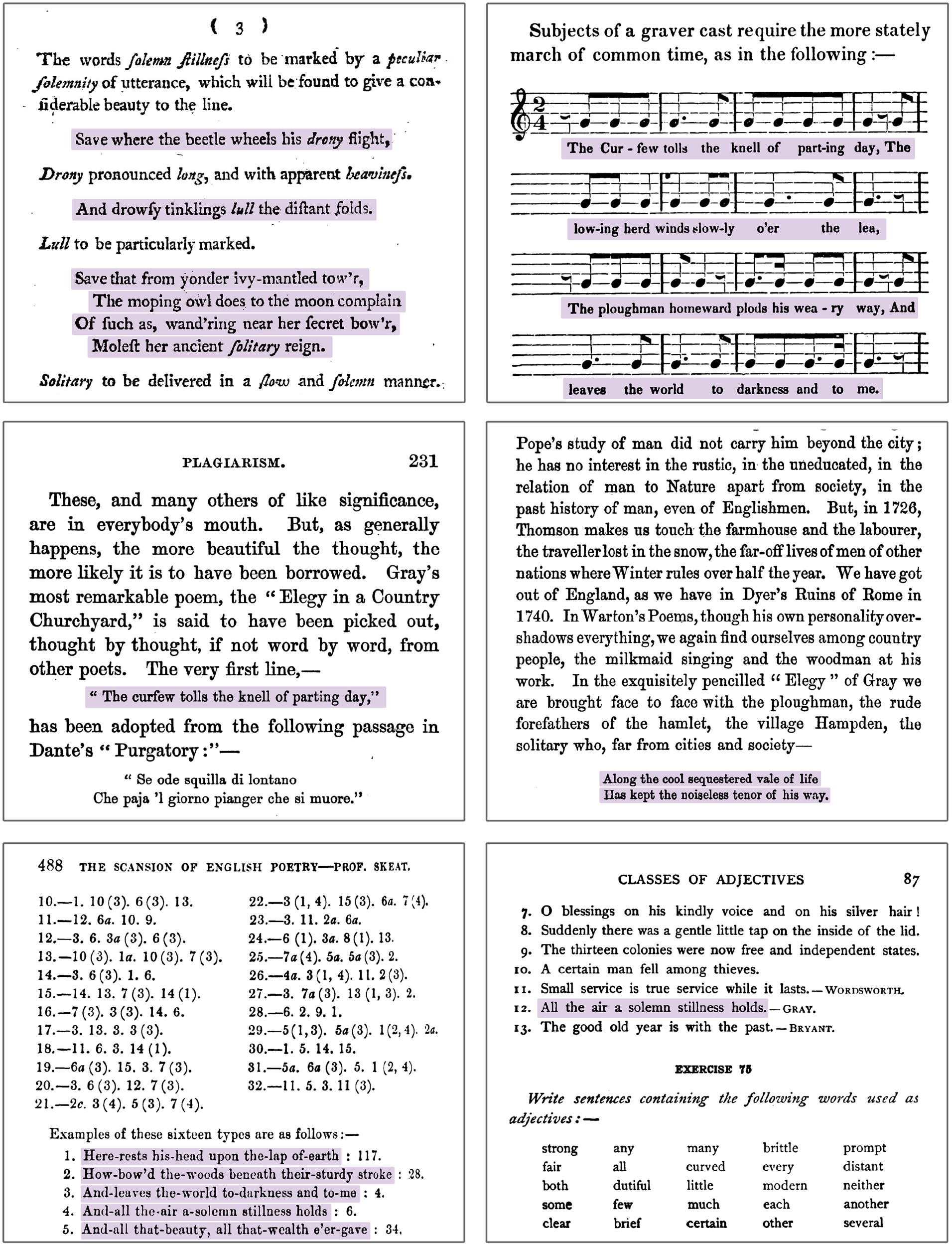
Figure 1 Long description
A multi-panel layout of six scanned book pages from the P P A collection, each containing highlighted purple text quoting Gray's Elegy.
* Top left: A page numbered 3 from Sheridan and Henderson's method. Highlighted text includes ‘And drowsy tinklings lull the distant folds’ and a four-line stanza beginning with ‘Save that from yonder ivy-mantled tow'r’.
* Top right: A page numbered 51 from The Music of Nature showing musical notation in 2 4 time. The lyrics ‘The Cur-few tolls the knell of part-ing day’, ‘low-ing herd winds slow-ly o'er the lea’, ‘The ploughman homeward plods his wea-ry way’, and ‘leaves the world to darkness and to me’ are highlighted in purple bars across the staves.
* Middle left: A page numbered 231 titled PLAGIARISM. The highlighted line is ‘The curfew tolls the knell of parting day,’ followed by a comparison to Dante's Purgatory.
* Middle right: A page numbered 22 from Theology in the English Poets. A two-line indented quote is highlighted: ‘Along the cool sequestered vale of life / Has kept the noiseless tenor of his way.’
* Bottom left: A page numbered 488 titled THE SCANSION OF ENGLISH POETRY-PROF. SKEAT. In a list of examples, lines 2, 3, and 4 are highlighted, including ‘How-bow'd the-woods beneath their-sturdy stroke’ and ‘And-all the-air a-solemn stillness holds’.
* Bottom right: A page numbered 87 titled CLASSES OF ADJECTIVES. Under a list of sentences, item 12 is highlighted: ‘All the air a solemn stillness holds. - GRAY.’
Poetry is everywhere in the writing that teaches readers how to read verse, but rarely as itself. It enters these books as a resource, a store of lines familiar enough that an author can reach for one and trust it to make an instruction concrete. Once this happens, the poem begins to live at two scales. The title and author still lend authority, but the work of explanation falls to a smaller unit – a phrase, a line, and a couplet – that can be moved around. Guillory has called this the condition under which the canonical poem operates: its staying power depends less on qualities recoverable by close reading than on its success as a store of quotable phrases (Guillory Reference Guillory1993). Of Gray’s Elegy in particular, Guillory argues that its popularity is largely due to the effect of turning “classical literacy into an anthology of quotable vernacular phrases.” Figure 1 shows that process in its everyday mechanics for one well-traveled poem, but the logic is general: a poem’s authority is sustained through the game of cutting and grafting (Compagnon Reference Compagnon1979). A line is removed from one frame and stitched into another, where it serves a purpose its author did not intend.
This article studies some of those traces of use. We first explain how we recover likely poetry quotations in the Princeton Prosody Archive (PPA) and attach them to identifiable anglophone poems where the evidence allows. We then ask what that record of poetic traces can teach us about how poems move through time in this kind of writing. Some poems become anchors in prosody writing; others surface around a particular period; others again appear only briefly. By following these trajectories, we treat reception as a practical history of availability. We build a pipeline for recovering quoted poems at scale, assemble a dataset of citation events in the PPA, and ask what a poem’s presence in the record of prosody writing can tell us about how poetic authority is made and sustained. Which poems entered this economy of borrowing? And what do their trajectories through it look like?
Finding poetic needles in the PPA haystack
The Princeton Prosody Archive
The PPA collects the scattered history of poetic instruction. The six Gray examples in Figure 1 come from this archive, which gathers the long, uneven record of English-language thinking about prosody, versification, and pronunciation. The PPA grew from the bibliographical and historical work behind Martin’s The Rise and Fall of Meter (Reference Martin2012), itself shaped by T. V. F. Brogan’s English Versification, 1570–1980 (Reference Brogan1981), and is now a full-text searchable collection of public-domain materials drawn from HathiTrust, Gale/ECCO, and EEBO-TCP (Martin et al. Reference Martin, Wilson, Naydan and Koeser2018). Its current dataset contains 7,122 works, ranging from Leonard Cox’s The art or crafte of rhetoryke (1532) to I. A. Richards’s Practical Criticism (1929). The center of gravity is the nineteenth century, when questions of meter, pronunciation, and literary instruction converged on the quoted line (Prins Reference Prins and Hall2011). That makes the PPA especially useful for studying poems as examples: it preserves a print world in which verse was repeatedly broken into usable fragments and made to carry the work of explanation.
That usefulness does not make the evidence easy to collect. Even though the PPA has a powerful search interface, a quoted poem is not a stable search object. Quotation loosens the poem from the signs by which we would usually find it. Even for a poem as familiar as Gray’s Elegy, searching for its title, first line, or author name surfaces only a fraction of its traces. In the PPA, poetry washes ashore in bits and pieces.Footnote 1
Text-reuse detection
Digital humanities research has built up a tradition of computationally tracing how texts circulate and leave evidence in subsequent writing. The tools built for this task generally travel under the umbrella of “text-reuse detection” (though the label covers practices different enough that it can obscure as much as it reveals). Early computational work was highly targeted: researchers had to know roughly where to look and what to look for. For example, working on Virgil and Lucan, Coffee et al. (Reference Coffee, Koenig, Poornima, Ossewaarde, Forstall and Jacobson2012) searched for exact or near-exact word matches between specific, pre-selected classical texts. Their method systematically recovered the loci similes that commentators had long identified through close reading, now at scale. While powerful, this approach was also constrained: it required researchers to manually select the two texts for comparison, assume rough passage boundaries, and rely on relatively clean transcriptions for word-level matching to succeed. Yet, even within these constraints, Coffee et al. clearly envisioned the horizon of this methodology, noting that “digital approaches [
$\ldots $
 ] can accelerate this research and provide new large-scale perspectives on intertextuality” (Coffee et al. Reference Coffee, Koenig, Poornima, Ossewaarde, Forstall and Jacobson2012).
The shift they anticipated arrived with tools designed to scale up open-ended detection, such as TextPAIR (Gladstone, Horton, and Olsen Reference Gladstone, Horton and Olsen2008; Olsen, Horton, and Roe Reference Olsen, Horton and Roe2011), TRACER (Büchler Reference Büchler2013; Büchler et al. Reference Büchler, Burns, Müller, Franzini, Franzini, Biemann and Mehler2014), textreuse (Mullen Reference Mullen2015; Mullen and Li Reference Mullen and Li2026), and passim (Smith et al. Reference Smith, Cordell, Dillon, Stramp and Wilkerson2014). Passim, which we use in this article, was developed in the context of the Viral Texts project to discover reprinted passages across a large corpus of nineteenth-century American newspapers.Footnote 2 The tool was built for unstructured discovery: it is robust to OCR noise, relatively indifferent to passage boundaries, and requires no prior hypothesis about which texts will align. For Viral Texts, the method changed the scale of the question. Using passim, Cordell (Reference Cordell2015) could follow reprinted passages across antebellum newspapers and show that the most widely circulating texts were often invisible to scholarly methods organized around named authors and titles. The newspaper exchange network had its own literary record, and text-reuse detection made that record available for study.
To reveal the similarly invisible labor of poetic quotation, we adapted this computational approach to a structurally asymmetric problem. Where Viral Texts tracked the horizontal circulation of articles within a single corpus of newspapers, recovering poems from inside prosody writing requires us to coordinate two distinct textual domains: the PPA, in which quotations appear, and a reference corpus of poetry against which they can be matched. We know, in broad terms, what the PPA contains. Shakespeare is quoted, and Milton, and – as Martin has shown (Reference Martin2019) – Elizabeth Barrett Browning. What we do not know are the specifics of those quotation histories: when particular histories of citation began, which obscure manuals first reached for them, or what poems beyond the poetic big guns turn up at all. The PPA contains nearly two million pages. To find these traces in a haystack of that size, we cannot rely on metadata or known authorial signposts. We need a text-reuse system that can match the fragmented quotations scattered through the archive against a reference body of poetry large enough to capture both the famous and the forgotten.
The Chadwyck-Healey Poetry Corpus
We find that reference corpus in the Chadwyck-Healey English Poetry Database. The database was originally conceived in 1990 by Sir Charles Chadwyck-Healey, who, browsing the reference shelves of the British Library, resolved to create “a database of all of English poetry” (Chadwyck-Healey Reference Chadwyck-Healey2020). The core English Poetry Full-Text Database was released in 1992, was shipped on five CD-ROMs, and comprised some 165,000 poems by more than 1,250 poets, spanning the eighth century to the start of the twentieth century. The version we work with is substantially larger. Aggregating the original core with later Chadwyck-Healey collections – the second edition, American Poetry, African-American Poetry (1760–1900), and Twentieth-Century English Poetry – brings our reference corpus to approximately 310,000 individual poems.Footnote 3
The database was conceived from the outset as what Karlin, in his introduction to the second edition, called “a utopian library.” Unbound from their original materiality, its texts have “soared into an electronic heaven where they rejoice in an infinity of potential combinations with other texts” (Karlin Reference Karlin1995). For our purposes, the most consequential feature of that utopia is its democratic scope. The database’s organizing canon is the New Cambridge Bibliography of English Literature (NCBEL), which meant including not just the acknowledged and well-established poetic tradition, but also what a New Yorker review described as “the racket” made by “the mute inglorious Miltons” (Lane Reference Lane1995). This long tail of “ungreat” poets is an important signal for our study: precisely because we do not know in advance which poems the PPA’s prosodists reached for, we need a reference corpus wide enough to catch not just the canonical anchors, but also the obscure and the forgotten.
Wide as it is, however, the database has one conspicuous gap: it excludes Shakespeare’s plays (which Chadwyck-Healey marketed separately as the English Verse Drama database). The New Yorker review captured the absurdity well, likening the omission to visiting a liquor store and finding it out of Scotch–“let’s face it, out of alcohol” (Lane Reference Lane1995). To resolve this, we manually supplemented the Chadwyck-Healey corpus with a curated set of additional texts known to be present in PPA works but absent from the Chadwyck-Healey database (first and foremost Shakespeare’s dramatic verse, but also several other poems encountered during expert adjudication of manual annotation data).Footnote 4 The result is a reference corpus that accounts for what is in all likelihood the single most-quoted author in the PPA, alongside a wider repertoire of texts that the standard Chadwyck-Healey collections do not cover.Footnote 5
Alignment, filtering, and binding
Running passim over the full PPA and against a subset of the Chadwyck-Healey reference textsFootnote 6 (plus our supplementary additions) – 246,724 reference poems in all – yields 1,263,587 local alignment records in the raw export. Each record ties a character span on a PPA page to a span in a reference poem.Footnote 7 These alignments resolve to 509,030 distinct poem appearances – (poem, PPA host work) pairs in which a given poem is matched at least once inside a given host – across 7,061 PPA works. Throughout the article, we analyze reuse at the level of the poem appearance – a poem’s presence in a given host work – rather than the individual alignment record.Footnote 8 Running passim does not yet result in an analytical corpus. Instead, it results in a set of reuse events that must be filtered on both the PPA “host” side (i.e., which PPA works do the borrowing and therefore “host” a poem?) and the poem side (i.e., which poems are admissible to be found?) before it can support any historical claims. Figure 2 traces these successive filtering steps.
Pipeline from raw passim alignments to poem-side temporal filter, with record counts at each stage.
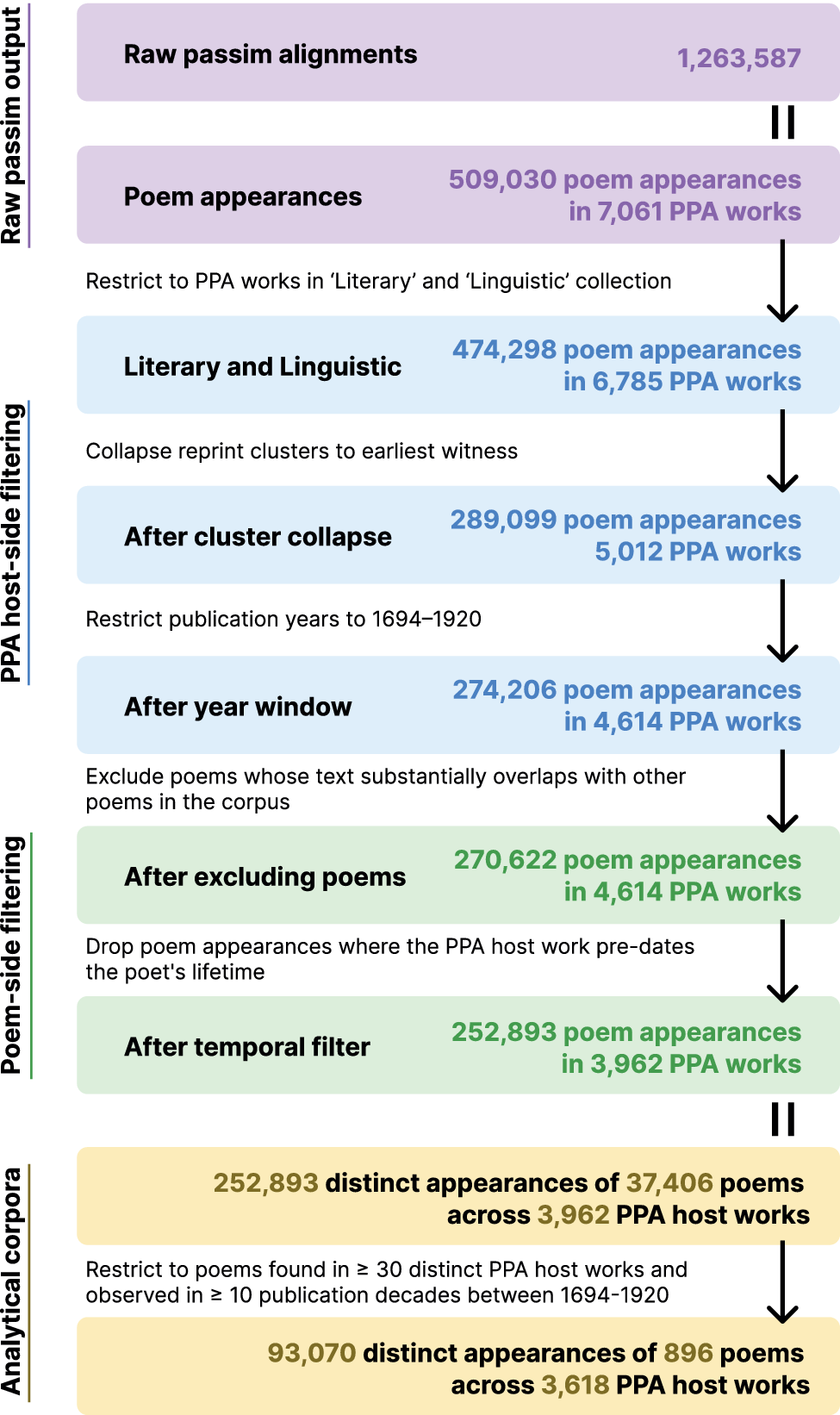
Figure 2 Long description
The flowchart is divided into four vertical sections.
1. Raw passim output (purple boxes):
- Raw passim alignments: 1,263,587.
- Poem appearances: 509,030 poem appearances in 7,061 P P A works.
2. P P A host-side filtering (blue boxes):
- Step: Restrict to P P A works in Literary and Linguistic collection. Result: 474,298 poem appearances in 6,785 P P A works.
- Step: Collapse reprint clusters to earliest witness. Result: After cluster collapse, 289,099 poem appearances in 5,012 P P A works.
- Step: Restrict publication years to 1694 to 1920. Result: After year window, 274,206 poem appearances in 4,614 P P A works.
3. Poem-side filtering (green boxes):
- Step: Exclude poems whose text substantially overlaps with other poems in the corpus. Result: After excluding poems, 270,622 poem appearances in 4,614 P P A works.
- Step: Drop poem appearances where the P P A host work pre-dates the poet's lifetime. Result: After temporal filter, 252,893 poem appearances in 3,962 P P A works.
4. Analytical corpora (yellow boxes):
- Summary: 252,893 distinct appearances of 37,406 poems across 3,962 P P A host works.
- Step: Restrict to poems found in greater than or equal to 30 distinct P P A host works and observed in greater than or equal to 10 publication decades between 1694 to 1920.
- Final Result: 93,070 distinct appearances of 896 poems across 3,618 P P A host works.
On the host side, we restrict the PPA to works tagged as belonging to its Literary or Linguistic collections. The PPA is divided into six curated collections that reflect the broad scope of historical prosody as a discipline, ranging from dictionaries and rhyming guides to works that use specialized metrical notation.Footnote 9 The Literary collection gathers versification manuals, handbooks, and treatises, while the Linguistic collection gathers grammar books and guides to rhetoric, composition, and elocution. Together they cover the host works in which most prosodic instruction – and most poetic quotation – takes place.Footnote 10 Restricting to these two collections leaves 474,298 poem appearances across 6,785 host works. We then collapse reprint clusters to their earliest dated witness (Hostetler, Naydan, and Koeser Reference Hostetler, Naydan and Koeser2023), so that the same edition appearing in multiple digitization sources is not counted twice. This step brings the dataset to 289,099 poem appearances across 5,012 host works. We also restrict the host record to PPA works published between 1694 and 1920. The lower bound is the first year in which the PPA contains at least five works (anything earlier sits on too thin a host record to support claims); the upper bound is close to the corpus horizon, but set back to avoid edge-of-corpus artifacts where the last few years of digitized works thin out before the corpus formally ends. After the year-window restriction, the host side contains 274,206 poem appearances across 4,614 host works.
Two filters at this stage cannot be derived from the corpus metadata as it ships. The first targets a small group of poems whose textual character makes them unreliable as reference targets; we identify these by hand.Footnote 11 The second filter targets biographical plausibility: a PPA work published in 1720 cannot quote a poem by a poet born in 1770. Screening for this requires reliable dates of birth and death for every poet in the reference corpus, and the metadata that ships with Chadwyck-Healey does not support that screening directly. Birth and death years are inconsistently formatted, frequently incomplete, and in some cases simply absent. Using OpenRefine (Delpeuch et al. Reference Delpeuch, Morris, Huynh, Mazzocchi, Jacky, Guidry, elebitzero, Stephens, Matsunami, Larsson, Sproat, Santos, Mayer, Kushthedude, Magdinier, [Sannita], Fauconnier, Mishra, Beaubien, Liu, Giroud, Ong, Tacchelli, Nordhøy, Kanye, Shahrabani and Saby2026), we cleaned the Chadwyck-Healey metadata and reconciled it against Wikidata, supplementing and correcting each poet record – where possible – with date of birth (P569), date of death (P570), and a handful of additional properties.Footnote 12 When does a poet’s work become available for quotation? For filtering purposes, we treat eighteen as the earliest viable age at which a poet’s verse could enter circulation – that is, no PPA work published before a poet’s eighteenth year is treated as a credible quotation of that poet, regardless of what passim found.Footnote 13 The temporal filter leaves an analytical corpus of 252,893 poem appearances of 37,406 poems across 3,962 PPA host works (Figure 2). This is the corpus we use in the “Holding the archive constant” section, where we describe the corpus-wide rate of poetry quotation. In the “Poetry’s trajectories” section, we apply a further restriction, keeping only poems that appear in at least 30 distinct PPA works and are observed in at least 10 publication decades. This second analytical corpus contains 93,070 distinct appearances of 896 poems across 3,618 PPA host works. We explain the rationale for the sustained-presence threshold when we introduce the model.
What does the temporal filter actually remove? The largest single source – Henry Baker’s 1737 anthology Medulla Poetarum Romanorum – accounts for 320 passim alignment records, all of them found in PPA works published before Baker’s eighteenth year. The pattern reflects a structural mismatch between catalog and corpus: the Medulla is recorded as a single Chadwyck-Healey poem, but its content is made up of translated extracts from Latin poets who are centuries older. The alignments found by passim are real; the attributions are not. Similar ambiguities arise in works that incorporate earlier texts. Longfellow’s Christus: A Mystery (1872) is built substantially from scriptural paraphrase and passages that elocution manuals like Blair’s Lectures on Rhetoric (Reference Blair1783) and Sheridan’s Lectures on the Art of Reading (Reference Sheridan1775) had been quoting compulsively for a century before Longfellow set them in dramatic verse. The alignment detects biblical commonplaces that the rhetorical tradition had consecrated; it is not detecting an anachronistic reading of Longfellow in 1780.Footnote 14 Pound’s Cantos (published in installments between 1917 and 1969) presents an even more telling case. The phrase “the evil that men do lives after them” is found in roughly 30 PPA works,Footnote 15 but the corresponding passage in Canto LXXX reads:
The evil that men do lives after them’
well, that is from Julius Caesar
unless memory trick me
who crossed the Rubicon up near Rimini
Pound is not being quoted by the elocutionists; he is quoting Shakespeare, even naming the source, and turning the act of citation itself into poetic material. The biographical filter discards the alignment correctly (Pound was born in 1885, so the cited manuals all precede his eighteenth year) but the deeper point is that the Canto’s passage and the rhetorical tradition share a single Shakespearean ancestor, not a line of transmission. What passim has caught in cases like these is the shared language of a literary culture: scripture, Shakespeare, the Latin poets in translation. The temporal filter reduces the risk of silently misattributing that language to a later poet.
The shape of the reception record
The 1694–1920 analytical window is where will spend most of our interpretive time, but before we do so we want to give a picture of the full dated PPA record. Among poems whose first appearance in the PPA can be dated between 1532 and 1929, the picture of poetic quotation is one of extreme concentration. Most poems enter the record only lightly: 16,378 poems (42 percent of the population) are quoted in only one PPA work across the entire 1532–1929 window. At the other end of the curve, a small core of canonical anchors carries a disproportionate share of the evidence: the top 15 poems alone, listed in Table 1, account for nearly 5 percent of all appearances.
Most and least frequently hosted poems in the full dated PPA record
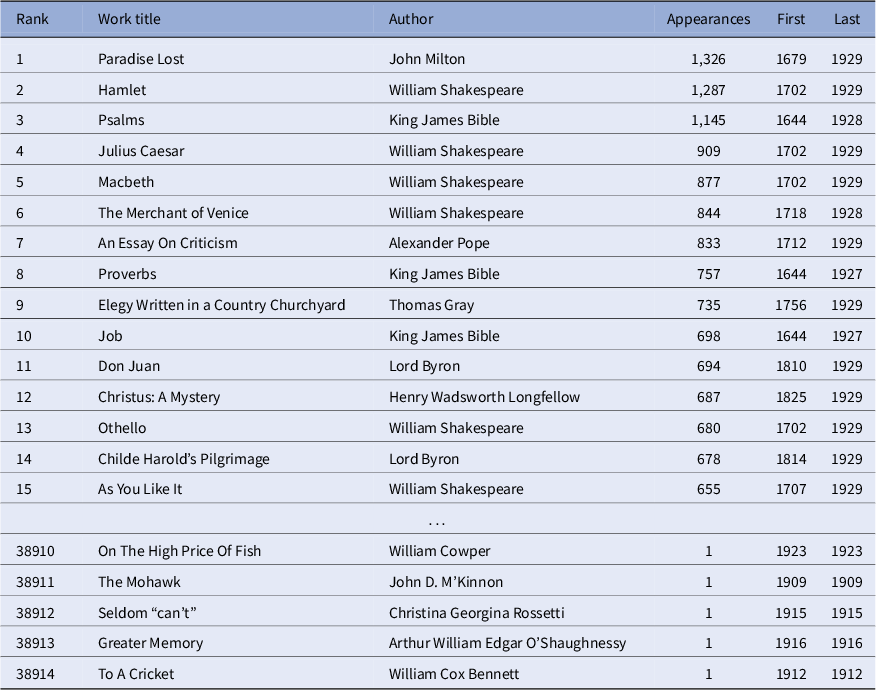
Table 1 Long description
The table contains six columns: Rank, Work title, Author, Appearances, First, and Last.
Top 15 most frequent works:
1. Paradise Lost by John Milton: 1,326 appearances (1679 to 1929).
2. Hamlet by William Shakespeare: 1,287 appearances (1702 to 1929).
3. Psalms from the King James Bible: 1,145 appearances (1644 to 1928).
4. Julius Caesar by William Shakespeare: 909 appearances (1702 to 1929).
5. Macbeth by William Shakespeare: 877 appearances (1702 to 1929).
6. The Merchant of Venice by William Shakespeare: 844 appearances (1718 to 1928).
7. An Essay On Criticism by Alexander Pope: 833 appearances (1712 to 1929).
8. Proverbs from the King James Bible: 757 appearances (1644 to 1927).
9. Elegy Written in a Country Churchyard by Thomas Gray: 735 appearances (1756 to 1929).
10. Job from the King James Bible: 698 appearances (1644 to 1927).
11. Don Juan by Lord Byron: 694 appearances (1810 to 1929).
12. Christus: A Mystery by Henry Wadsworth Longfellow: 687 appearances (1825 to 1929).
13. Othello by William Shakespeare: 680 appearances (1702 to 1929).
14. Childe Harold’s Pilgrimage by Lord Byron: 678 appearances (1814 to 1929).
15. As You Like It by William Shakespeare: 655 appearances (1707 to 1929).
Bottom 5 least frequent works (all with 1 appearance):
38910. On The High Price Of Fish by William Cowper (1923).
38911. The Mohawk by John D. M’Kinnon (1909).
38912. Seldom ‘can’t’ by Christina Georgina Rossetti (1915).
38913. Greater Memory by Arthur William Edgar O’Shaughnessy (1916).
38914. To A Cricket by William Cox Bennett (1912).
Note: “Appearances” counts distinct PPA host works in which the poem is matched at least once; repeated matches inside the same host work count once. “First” and “Last” give the earliest and latest publication dates of host works in which a poem is matched.
The top of Table 1 reads as a list of the usual suspects. Milton, Shakespeare, and Pope between them account for eight of the top 15 rows; the King James Bible occupies three of them; Byron, Longfellow, and Gray fill out the rest. What kind of distribution produces this shape, and what kind of process sustains it? The PPA’s “quotation economy” resembles what economists since Rosen (Reference Rosen1981) have called an “economy of superstars” – a market in which small differences in initial visibility translate into very large differences in eventual reach, sustained by the reproducibility of whatever is being consumed. Once a PPA work quotes Hamlet (e.g., to illustrate a point about iambic pentameter), that line “costs” nothing to copy into the next manual. In other words, once Hamlet has become the canonical illustration, reaching for it is easier than searching out an unused alternative.
We can also put this imbalance into a single number. The Gini coefficient, introduced by Gini (Reference Gini1912) to measure inequality, tells us how unevenly appearances are distributed across poems. A value of zero would mean that every poem appears in the same number of PPA host works; a value of one would mean that all appearances belong to a single poem. In the full dated PPA record, across 38,914 poems and 267,237 appearances, the Gini coefficient is 0.72.Footnote 16 The number confirms what Figure 3 shows visually: quotation in the PPA is highly concentrated. A small group of poems is used again and again, while most poems appear only lightly. The 16,378 poems quoted in a single PPA host work – such as William Cowper’s On the High Price of Fish (1803), John D. M’Kinnon’s The Mohawk (1802), and Christina Rossetti’s Seldom “can’t” (1872) – make up 42 percent of the distinct poems in the corpus, but only 6 percent of all quotation events.
The number of distinct PPA host works quoting each poem, plotted against the poem’s rank, on log–log axes, for all 38,914 poems in the full dated PPA record. The line is approximately straight across most of its range, the visual signature of a heavy-tailed distribution: a small core of poems is quoted very widely, while the great majority appear in only a handful of host works. We have manually annotated a selection of poems along the curve to indicate where familiar works sit relative to the broader population.
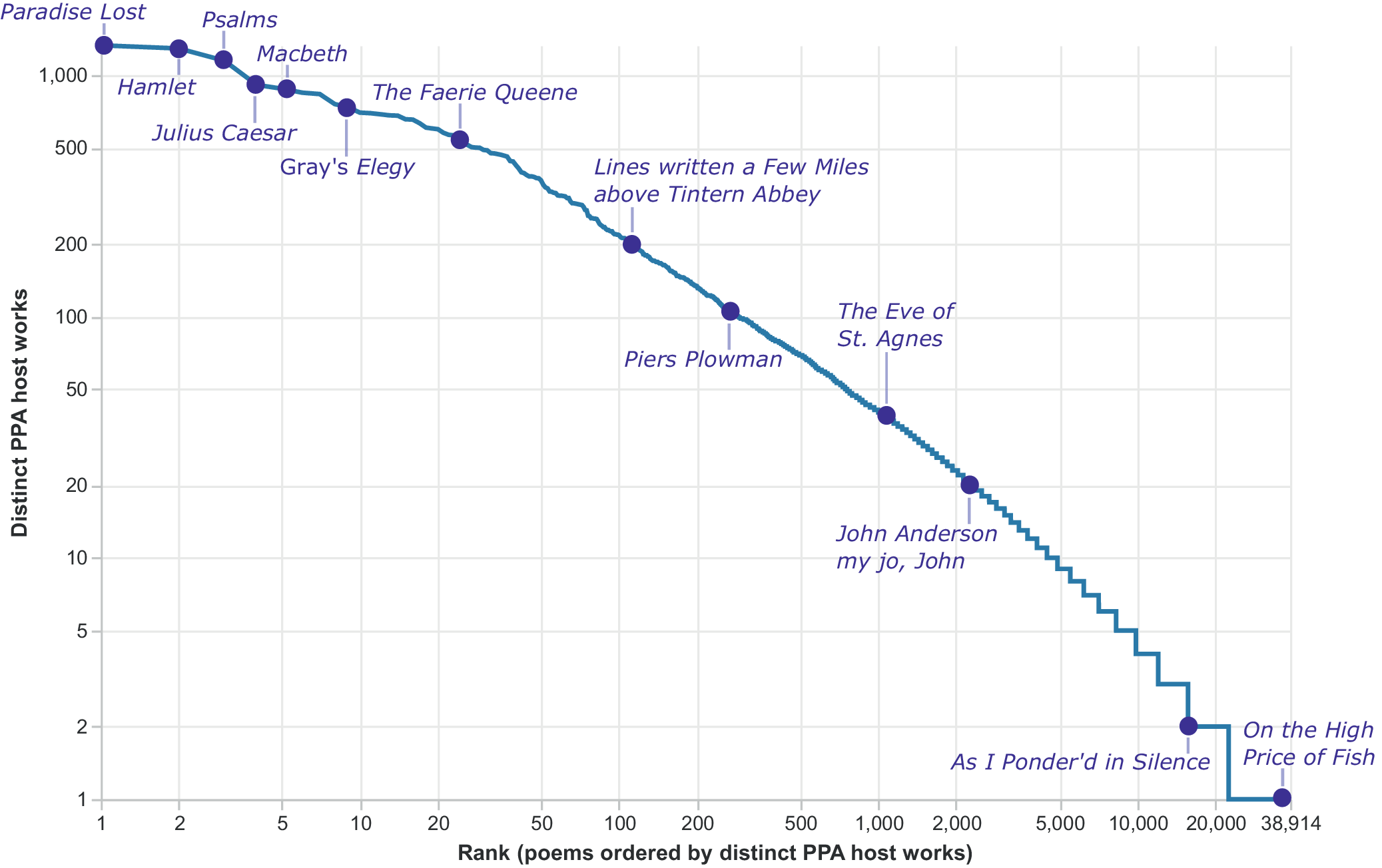
Figure 3 Long description
The vertical Y axis is labeled Distinct P P A host works on a logarithmic scale from 1 to 1,000. The horizontal X axis is labeled Rank (poems ordered by distinct P P A host works) on a logarithmic scale from 1 to 38,914. A dark blue line begins at the top left and descends in a nearly linear diagonal toward the bottom right, with a stepped pattern appearing at the lower end.
Specific poems are marked with dots and labels along the curve from left to right:
* Rank 1: Paradise Lost, at over 1,000 host works.
* Rank 2: Hamlet.
* Rank 4: Psalms.
* Rank 5: Macbeth.
* Rank 7: Julius Caesar.
* Rank 10: Gray's Elegy.
* Rank 25: The Faerie Queene.
* Rank 110: Lines written a Few Miles above Tintern Abbey.
* Rank 300: Piers Plowman.
* Rank 1,000: The Eve of St. Agnes.
* Rank 2,500: John Anderson my jo, John.
* Rank 15,000: As I Ponder'd in Silence.
* Rank 38,914: On the High Price of Fish, at 1 host work.
The rank view, however, flattens time. Knowing that Paradise Lost sits at the top across the entire archive tells us something about its total mass in the record, but nothing about its momentum – whether it gained or lost ground after its first appearance in 1679, or whether the population of poems below it is growing, shrinking, or churning. Concentration of the kind we have just described could in principle be produced in several ways: by a stable core of canonical anchors that have been quoted at a steady rate for two centuries, or by a much narrower historical regime – for example, a late-Victorian boom in pedagogical publication that mechanically inflates the head of the distribution at the expense of everything around it. To tell these stories apart, we look at the record as it unfolded over time.
Figure 4 plots, for each PPA host publication year between 1532 and 1929, the number of distinct poems quoted at least once in PPA works dated to that year (blue), alongside the number of distinct poets to whom those poems are attributed (orange). Both series are smoothed with a ten-year rolling mean to quiet year-to-year noise. A gray ribbon beneath the main panel reports total host-work pages per year, a reminder that the archive itself is changing across the same window. Before about 1700, the archive is relatively thin. From then on it thickens, slowly through the eighteenth century and more steeply through the nineteenth century. That changing thickness is worth keeping in view alongside the two curves above it, because it sets the conditions under which any quotation can happen at all. A year for which the PPA holds only a few hundred pages offers fewer occasions on which a poem could be quoted than a year that holds tens of thousands.
Distinct poems and distinct poets quoted in PPA host works dated to each publication year, 1532–1929 (10-year rolling mean). The gray ribbon below the main panel reports total host-work pages per year, with a dashed reference at 15,000 pages.
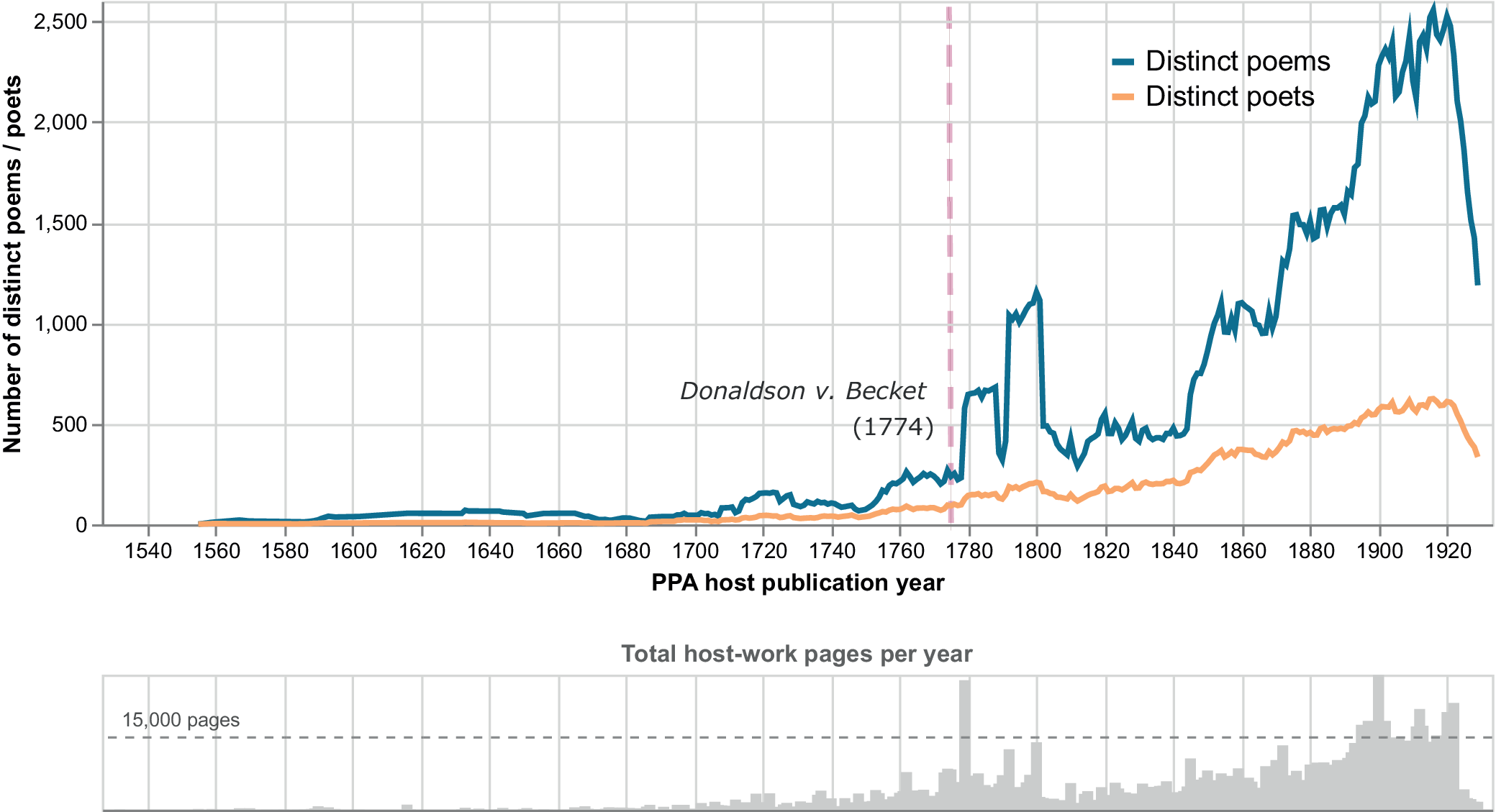
Figure 4 Long description
The top panel is a line graph with the x-axis labeled P P A host publication year from 1540 to 1920 and the y-axis labeled Number of distinct poems / poets from 0 to 2,500.
* A teal line represents Distinct poems. It remains near zero until 1700, shows a gradual increase to 250 by 1774, then spikes sharply after 1780, reaching a peak of over 2,500 around 1910 before a sharp drop.
* An orange line represents Distinct poets. It follows a similar but much flatter trajectory, staying below 250 until 1840 and peaking around 600 near 1910.
* A vertical dashed pink line is positioned at the year 1774, labeled Donaldson v. Becket (1774).
The bottom panel is a gray bar chart titled Total host-work pages per year. It shares the same x-axis. A horizontal dashed reference line is marked at 15,000 pages. The bars show low volume until the late 1700s, with significant spikes exceeding the 15,000-page line occurring around 1780, 1800, and frequently after 1880.
Against that backdrop, the curves tell a story of two regimes. Through the seventeenth century and the early eighteenth century, the counts of distinct poems and distinct poets run close together near the floor; only a few dozen poems are quoted in a typical year, drawn from a similarly thin pool of poets. A first sharp jump arrives in the late 1770s and again in the 1790s, when a relatively small set of compendious PPA works briefly lifts the count to between 700 and 1,000 distinct poems in a single year. Largely, what we are seeing here is the effect of multi-volume editions of the English poets and the literary histories that proliferated after Donaldson v. Becket (1774) (Bonnell Reference Bonnell2008; St. Clair Reference St. Clair2004). That decision struck down the London booksellers’ claim to perpetual copyright and pulled a large body of older verse into a clearly defined public domain, where competing publishers could now reprint it in bulk.Footnote 17 The count falls back through the early nineteenth century as that wave passes; from the mid-1840s, it begins a longer and steadier climb, reaching some 2,000 distinct poems quoted per PPA host year by 1900. The sharp drop at the very right edge of the plot reflects the PPA’s coverage horizon rather than any change in the practice.
Figure 4 is useful for scale and timing, but the count it reports is a relatively naive tally: each point records how many different poems and poets appear in PPA works published that year, without any sense of how the figures relate to the actual volume of writing dated to the same year. Years in which the archive adds large host works – anthologies, literary histories, and elocution readers – will register as years in which many more poems were quoted, even when the underlying instructional habit barely shifts. The next section asks what remains of the rising curve once that confound is accounted for.
Holding the archive constant
The trouble with a year-by-year count of distinct poems is that it cannot distinguish between two situations: the practice of quoting verse itself may have been expanding – prosodists in 1850 reaching for more poetry than their predecessors in 1750 – or the practice may have actually been stable, and the rising count may reflect nothing more than the fact that there were more host works in which a poem could be quoted at all (i.e., more pages of opportunity, an increase the gray ribbon makes visible). The way to tell these stories apart is to ask, for each year, not how many distinct poems were quoted, but how many were quoted per page of available host text. This gives us a common scale for comparing years with very different amounts of archived writing.
The simplest version of the measure is to take the count of distinct poems in year y, call it
$A(y)$
 , for the size of the active repertoire that year, and divide it by the total number of host-work pages dated to that year,
$P(y)$
 .Footnote 18 The result,
$A(y)/P(y)$
 , is a rate: events per unit of opportunity. In our setting, the events are distinct poems appearing in the PPA corpus and the opportunity is the pages on which they could have appeared. A rising rate means that more distinct poems are represented per page of archived host text. Simply plotting that ratio year by year, however, would produce a curve too jagged to read. Some years carry only a few hundred pages of host writing, and in those years, a single dense anthology can push the ratio to extreme values; other publication years carry tens of thousands of pages spread across many host works and produce a much steadier figure. The signal we want is that of the underlying trend, which sits buried inside this year-to-year noise. To recover it, we have to fit a model that lets us separate the trend from the fluctuation. In short, the model has to do three things:
-
• it has to express the rate, $A(y)/P(y)$
 , rather than the raw count
$A(y)$
;
-
• it has to let that rate rise and fall smoothly with time, since we have no reason to believe the practice was constant;
-
• it has to accommodate the fact that the year-to-year counts are highly variable in a way that simple count models cannot handle.


We discuss these one at a time. Although the estimand is a rate, the observed outcome we model year by year is the count
$A(y)$
 ; the rate enters through an offset on page volume. An offset is a term added to the right-hand side whose coefficient is fixed at one, so the model still predicts counts, but its parameters describe the poems-per-page rate and how that rate changes over time. The natural model for a count outcome is the Poisson family, which puts a logarithm on the expected count:

where
$\alpha $
 is a baseline log-count, the average level the count tends toward across the window. To turn this into a model of the rate rather than the count, we add
$\log P(y)$
 to the right-hand side and fix its coefficient at one. By forcing the coefficient to one, we tell the model that the relationship between pages and poems is structural – if the available host writing doubles, we assume that the count of quoted poems should roughly double with it – rather than something the model has to discover from the dataFootnote 19:

What this equation gives us is an estimate of how many different poems are quoted per page of host writing. Subtracting
$\log P(y)$
 from both sides and exponentiating gives
$\mathbb {E}[A(y)] / P(y) = e^{\alpha }$
 , the rate of distinct poems quoted per page of host writing. The page-volume term has, in effect, been pulled out of the response and absorbed into the denominator; the intercept
$\alpha $
 now stands for the log of the per-page rate, which is the quantity we set out to measure.
The second requirement is that the rate be allowed to change with time. As written, the model above assumes a single rate throughout the window – it gives us one overall level, but cannot show us how the rate changes across two centuries. What we want to recover, however, is something whose shape we do not yet know: the model should be free to discover the historical trajectory from the data. We therefore augment the intercept with a smooth function of year:

Here,
$\alpha $
 is an intercept and
$s(y)$
 is a natural cubic spline. Together they describe the log-rate as a flexible curve fitted to the data, free to bend where the evidence calls for it to bend.Footnote 20 The number of bends the spline is allowed to take is a tuning choice: we fit the model at several candidate complexities and keep the one with the best statistical fit.Footnote 21
The third requirement concerns how the model represents the year-to-year variability in the data – the inevitable wobble of any count series around its underlying trend. In statistical terms, this is the choice of likelihood, the assumption the model makes about how the observed counts are distributed around the values it predicts. Different likelihoods make different assumptions about how variable the data can be. The Poisson family, which we have been working with implicitly so far, assumes that the variance of the response equals its mean.Footnote 22 In our case, this assumption is violated. The year-to-year variance of
$A(y)$
 is several times its mean: a single dense anthology landing in one publication year can pull the count far away from the smooth trend the spline is trying to follow, and the Poisson has no room to accommodate that kind of departure. We therefore use a more permissive likelihood, the Negative Binomial, which adds a single parameter – call it
$\alpha _{\mathrm {disp}}$
 , for dispersion – that allows the variance to grow faster than the mean. Conceptually, the Negative Binomial says: the count fluctuates around the model’s prediction, but it is allowed to fluctuate more than a strict count-distribution would predict. How much more is itself fitted from the data. The full model can now be written down compactly:


Equation (4) says that the count of distinct poems in a given year is a draw from a Negative Binomial distribution with mean
$\mu _y$
 and a dispersion
$\alpha _{\mathrm {disp}}$
 controlling how widely the actual counts may scatter around that mean. Equation (5) says that the mean itself is determined by three things: the intercept
$\alpha $
 , the smooth time trend
$s(y)$
 , and the page-volume offset
$\log P(y)$
 that holds the corpus thickness constant.Footnote 23
One last decision concerns the window across which we fit. We restrict the model to the years 1694–1920. We treat 1694 as the start of the modeled window because it is the earliest year in which at least five PPA host works appear in our corpus, a practical starting point that avoids the sparsest early years of the archive.Footnote 24 At the other end, 1920 is set by the PPA’s coverage horizon, beyond which the archive thins again for reasons of digitization and copyright rather than historical practice.
Figure 5 shows the result. The fitted rate is plotted as a solid line, with a 95 percent confidence interval around it; the raw per-year ratios are plotted as faint dots. The eighteenth century holds relatively steady. From 1700 through the 1780s, the rate sits between 7 and 11 distinct poems per hundred pages of host writing – roughly one quoted poem for every 9 to 13 pages of instructional prose. That low and stable floor is consistent with what we know from individual pedagogical texts of the period: William Enfield’s Speaker of 1774, perhaps the most widely used elocution anthology of the late eighteenth century, drew 75 of its 113 oratorical extracts from Shakespeare alone (Salamone Reference Salamone2017). A pedagogy organized around so narrow a base of authoritative passages would not be expected to produce a high per-page rate, and our figure confirms that it did not.
Distinct poems quoted per hundred pages of writing about verse, for each year between 1694 and 1920. The solid line is the fitted rate from a Negative Binomial model with a natural cubic spline on year and a log-page-volume offset; the shaded band is the 95 percent confidence interval; the blue points are the raw annual rates. The ribbon below reports total host-work pages per year.
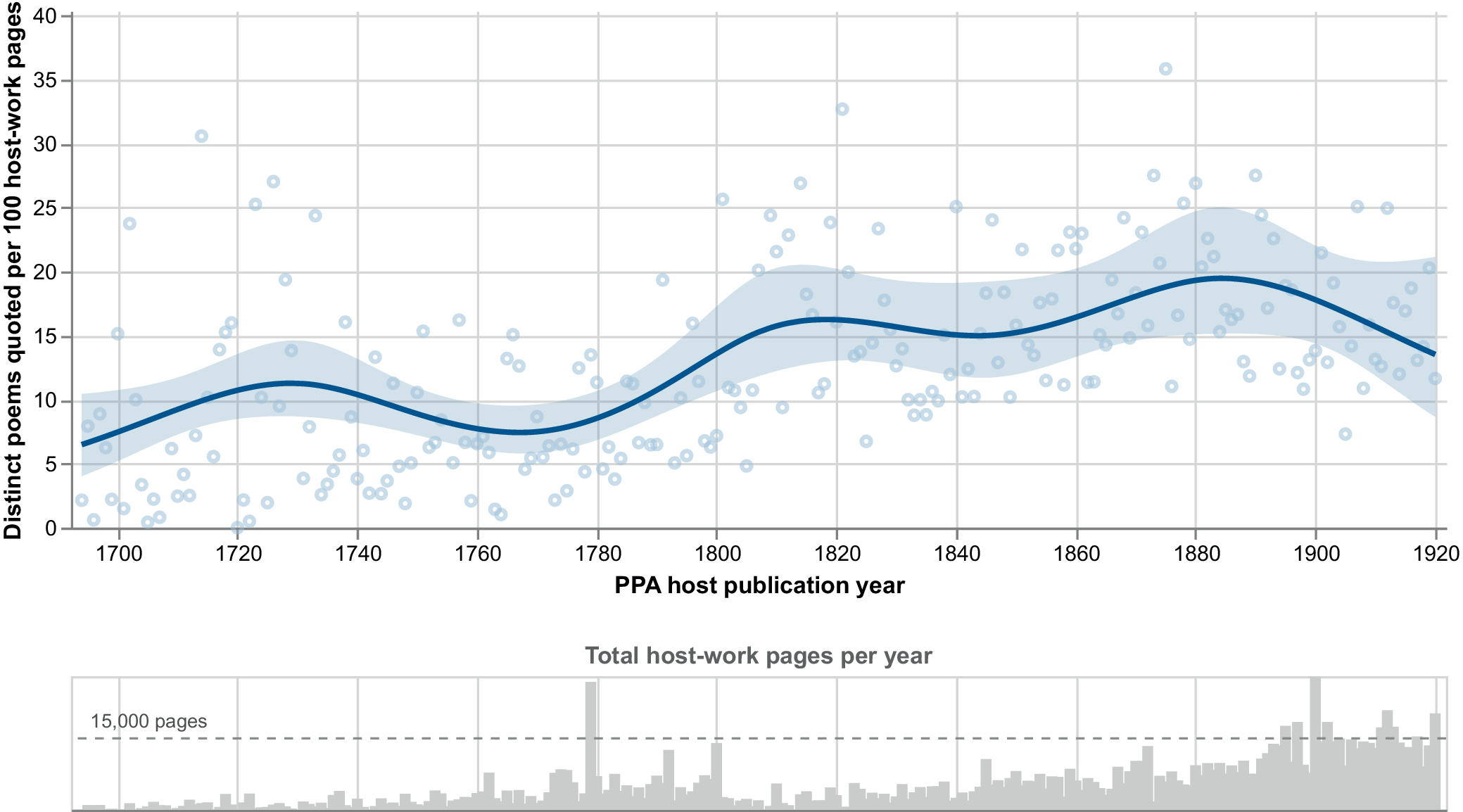
Figure 5 Long description
The main graph uses a horizontal x-axis labeled P P A host publication year, ranging from 1700 to 1920 in 20-year increments. The vertical y-axis is labeled Distinct poems quoted per 100 host-work pages, ranging from 0 to 40.
Data Flow:
* Blue open circles represent annual raw rates, scattered widely between 0 and 35.
* A thick dark blue line shows a fitted trend that begins around 7 in 1700, rises to a peak of 12 near 1730, dips to 8 around 1770, and then climbs steadily to a peak of nearly 20 by 1880 before slightly declining toward 1920.
* A light blue shaded ribbon surrounds the trend line, representing the 95 percent confidence interval.
Secondary Chart:
* Located below the main plot, a bar chart titled Total host-work pages per year shows annual volume.
* A horizontal dashed line marks the 15,000 pages threshold.
* The volume is relatively low and stable until approximately 1880, where it begins to increase significantly, with several peaks exceeding the 15,000-page mark between 1880 and 1920.
From the 1780s, the curve begins to climb. The rise is at first gradual, reaching about 16 poems per hundred pages by 1820 and then holding at roughly that level through the 1830s and into the 1840s. This first phase of the climb falls in the decades we have already discussed in connection with the multi-volume reprint editions that followed Donaldson v. Becket: the available reservoir of English poetry was widening, and pedagogical and prosodic writing were beginning to reach into it. From the late 1860s onward, however, the rate makes a second push upward, peaking near 20 poems per hundred pages around 1880 before softening slightly through the rest of the modeled window. That second acceleration coincides with a set of changes in the institutional setting of pedagogical writing itself: in 1867, English literature was introduced as an optional special subject in British schools, and in 1870, Forster’s Education Act established school boards to expand elementary education, with English literature recognized the following year as a class subject in the upper grades (Martin Reference Martin2012). The kind of writing the PPA captures after 1870 was being produced for, and in response to, a vastly expanded teaching apparatus. That the per-page rate moves upward in those decades suggests that the practice was widening not only because there was more poetry to draw on, but because more pedagogical writing was being produced for classrooms that asked it to draw from a wider pool.
Poetry’s trajectories
The model in our previous section treats quotation as a single, undifferentiated practice and smooths over the movements of specific poems that compose it. A natural extension of the model presented above is to take that trendline apart and look at which poems were being reached for while others were perhaps being quietly set aside. To see those individual movements, we need a different kind of model: one that gives every poem its own trajectory – its own rising or falling line across the centuries – while pooling information across the corpus, so that poems with thinner evidence behind them can be read against the better-attested ones. Pope’s Essay on Criticism and Wordsworth’s Tintern Abbey make this analytically possible in different ways: both have decades of repeated appearance in prosodic writing, with enough quotations distributed across enough host works that a curve can be fit through them. The object of study is the population of poems that look like these – poems with what we will call sustained presence, reached for repeatedly by PPA authors across multiple decades of their available life in print. Some of these poems are familiar canonical anchors quoted across the entire 1694–1920 window; others are less obvious, with concentrated reception in particular decades, or with a quiet persistence that registers across two centuries without ever rising to prominence. What changes within this population – which sustained-presence poems rose, which fell, and which held steady – is what the model is built to recover.
To model how a poem’s presence in the PPA changes over time, we need two things from the evidence: a meaningful number of host works that quote the poem, and those host works distributed across enough decades that we can actually see change. We require, for inclusion in the model, at least 30 distinct PPA host works quoting a poem somewhere within the 1694–1920 modeled window, with those host works spread across at least 10 distinct decades.Footnote 25 The resulting modeled population contains 896 poems – a long way from the 37,406 distinct poems in the full found-poems corpus, but considerably wider than the small set of canonical anchors that dominate the rank distribution discussed in “The shape of the reception record” section.Footnote 26
To recover the per-poem movements that the model described in the “Holding the archive constant” section smooths over, we need something more flexible. Every poem now needs its own trajectory across the decades in which it was eligible to be quoted, and these individual trajectories need to live alongside a shared backdrop: a corpus-wide tendency that describes the practice as a whole and that each poem either follows, exceeds, or falls behind. The model that does both at once is a hierarchical one: it estimates the shared trend and the poem-specific deviations simultaneously. Those two estimates then inform each other through pooling: evidence about how poems behave on average partly stabilizes estimates for any individual poem. A poem with less attestation in a particular decade has its trajectory partly pulled toward the shared trend; a poem with dense attestation pulls the shared trend in its direction. Where a poem is well attested, its fitted trajectory depends more strongly on its own record; where evidence is sparse, information from other poems has more influence. The fitted trajectories therefore read each poem against the corpus, with the shared trend serving as the regularizing context against which individual poems are interpreted.
The quantity the model is built to fit, at the level of a single poem in a single decade, is the share of prosodic writing that quoted the poem. For each eligible poem i and each decade t in its eligibility window, we capture two numbers. The first,
$k_{it}$
 , is the number of distinct PPA host works published in decade t that quote poem i at least once. The second,
$n_t$
 , is the total number of distinct PPA host works in scope in decade t. The ratio
$k_{it} / n_t$
 is the prevalence of poem i in decade t: the share of prosodic writing in that decade that engaged the poem at all. A prevalence of 0.10 in the 1850s, for instance, means that 1 in 10 PPA host works published in that decade quoted the poem; a prevalence of 0.40 means 4 in 10. This quantity – one number per poem per decade across each poem’s eligibility window – is what the model takes as input and what its fitted trajectories ultimately describe.
The natural starting model for a count out of a known total is the binomial:

where
$p_{it}$
 is the probability that any given PPA host work in decade t quotes poem i. As in the “Holding the archive constant” section, however, the simple count distribution understates the variability we actually observe in the data. We therefore use the beta-binomial instead, which adds a single parameter
$\kappa $
 that allows the variance to grow beyond what the binomial would permit.Footnote 27 The mean of the beta-binomial is still
$n_t \cdot p_{it}$
 ; what changes is how tightly the actual counts are required to cluster around that mean.
What remains is to say what determines
$p_{it}$
 – each poem’s prevalence in each decade. This is where the hierarchical structure of the model enters. We write the log-odds of
$p_{it}$
 as the sum of three pieces, each describing a different layer of what makes a poem visible in prosodic writing at any given moment:

The first piece,
$\alpha + s(t)$
 , is the shared time curve: a corpus-wide tendency that captures whatever prosodic writing in the sustained-presence population was doing on average at a particular time. Every poem in the model inherits the shape of this curve as its baseline trajectory. The shared curve is what the average poem looked like across the modeled window. Holding the shape of that average in view is what makes the per-poem trajectories interpretable as deviations from it: a poem whose fitted trajectory carries a positive slope was not necessarily rising in absolute terms across its eligibility window, but outpacing the average poem; a poem with a negative slope was not necessarily fading from the practice in absolute terms, but lagging behind it.
The second piece,
$b^0_i + b^1_i \cdot t$
 , is the poem-level deviation: this is the part in the model that gives each poem its own trajectory. The intercept
$b^0_i$
 captures whether poem i tends to sit above or below the corpus average across its eligibility window. The slope
$b^1_i$
 captures whether the poem is gaining or losing prevalence in prosodic writing (on top of whatever the shared trend is doing in the same decades). A poem with a positive slope was gaining ground relative to the shared corpus trend; a poem with a negative slope was losing ground within the quotation repertoire, falling behind the shared corpus trend. These two parameters are drawn jointly from a prior distribution, which is what allows the model to pool information across poems. A canonical poem quoted in hundreds of host works will have its intercept and slope estimated almost entirely from its own data points. A poem with sparse evidence will have its estimates partly stabilized by the corpus-wide distribution of intercepts and slopes, so that its trajectory is read as a plausible variation on what other poems are doing rather than as a wild swing supported by limited data.
The third piece,
$u_{a(i)}$
 , is an author-level shift: an adjustment, shared across all poems by the same author a, that allows the model to account for authors whose works tend systematically to be quoted more or less than the average across the corpus. Some authors contribute many poems to the modeled population – for example, Shakespeare contributes 37 plays alongside his sonnets, while Thomas Gray’s presence rests almost entirely on his Elegy – and a poem’s prominence in the PPA may reflect, in part, the standing of its author. Treating each of an author’s works as a fully independent observation would overlook this shared tendency. The author shift captures that tendency as a constant adjustment across the modeled window. Each poem still has its own intercept and slope, allowing poems by the same author to differ both in their overall prevalence and in how they gain or lose ground relative to the shared time curve.Footnote 28
Once fitted, the model offers us, for each poem in the sustained-presence population, not a single trajectory but a distribution of trajectories that the evidence could support – all the plausible ways that poem’s life in the PPA might have unfolded given what we observe in the PPA.Footnote 29 From this distribution, we can read two things about each poem. The first is the poem’s overall standing relative to its peers across the modeled window – whether it sat above or below what prosody writing was doing on average – captured by the intercept
$b^0_i$
 . The second is the direction in which the poem moved through the window relative to the shared trend, captured by the slope
$b^1_i$
 : a positive slope means the poem was gaining ground relative to the shared trend, while a negative slope means it was losing ground relative to that trend. The width of the distribution around each of these tells us how confident we can be: tighter for canonical anchors with abundant evidence, wider for poems whose record is thinner.
Risers, decliners, and anchors
The fitted model lets us ask which poems gained ground relative to the shared trend over the long nineteenth century, and which lost ground. Table 2 lists 15 poems with credibly negative slopes; Table 3 lists 15 with credibly positive slopes. Each entry gives the poem and its author, the posterior-mean slope
$b^1_i$
 , and the 95 percent credible interval for that slope.
Top 15 credibly declining poems in the sustained-presence population, ranked by posterior-mean slope
$b^1_i$
 (log-odds per decade) against the corpus-wide trend
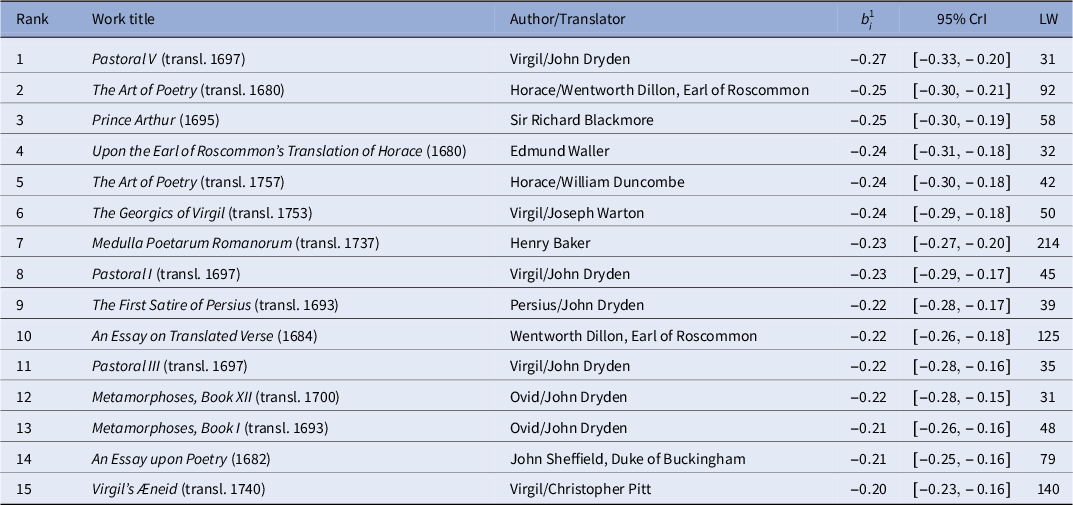
Table 2 Long description
The table lists the fifteen poems in the sustained-presence population whose share of prosodic writing fell most steeply, relative to the corpus-wide trend, across the modeled window. It has six columns: rank; work title, with the year of publication or of the translation in parentheses; author, or original author and translator; the slope b, which is the model's estimate of how much the poem's log-odds of being quoted changed per decade, compared with the average modeled poem; the 95 percent credible interval for that slope, that is, the range within which the true slope lies with 95 percent probability; and the lifetime number of PPA host works that quote the poem. A poem counts as credibly declining when its whole credible interval lies below zero. The rows, in order of rank, are as follows. Each gives the work, the author, the slope, the credible interval, and the number of host works:
* Rank 1: Pastoral V, translated 1697, by Virgil in John Dryden's translation. Slope −0.27, interval from −0.33 to −0.20, 31 host works.
* Rank 2: The Art of Poetry, translated 1680, by Horace in Wentworth Dillon, Earl of Roscommon's translation. Slope −0.25, interval from −0.30 to −0.21, 92 host works.
* Rank 3: Prince Arthur, 1695, by Sir Richard Blackmore. Slope −0.25, interval from −0.30 to −0.19, 58 host works.
* Rank 4: Upon the Earl of Roscommon's Translation of Horace, 1680, by Edmund Waller. Slope −0.24, interval from −0.31 to −0.18, 32 host works.
* Rank 5: The Art of Poetry, translated 1757, by Horace in William Duncombe's translation. Slope −0.24, interval from −0.30 to −0.18, 42 host works.
* Rank 6: The Georgics of Virgil, translated 1753, by Virgil in Joseph Warton's translation. Slope −0.24, interval from −0.29 to −0.18, 50 host works.
* Rank 7: Medulla Poetarum Romanorum, translated 1737, by Henry Baker. Slope −0.23, interval from −0.27 to −0.20, 214 host works.
* Rank 8: Pastoral I, translated 1697, by Virgil in John Dryden's translation. Slope −0.23, interval from −0.29 to −0.17, 45 host works.
* Rank 9: The First Satire of Persius, translated 1693, by Persius in John Dryden's translation. Slope −0.22, interval from −0.28 to −0.17, 39 host works.
* Rank 10: An Essay on Translated Verse, 1684, by Wentworth Dillon, Earl of Roscommon. Slope −0.22, interval from −0.26 to −0.18, 125 host works.
* Rank 11: Pastoral III, translated 1697, by Virgil in John Dryden's translation. Slope −0.22, interval from −0.28 to −0.16, 35 host works.
* Rank 12: Metamorphoses, Book XII, translated 1700, by Ovid in John Dryden's translation. Slope −0.22, interval from −0.28 to −0.15, 31 host works.
* Rank 13: Metamorphoses, Book I, translated 1693, by Ovid in John Dryden's translation. Slope −0.21, interval from −0.26 to −0.16, 48 host works.
* Rank 14: An Essay upon Poetry, 1682, by John Sheffield, Duke of Buckingham. Slope −0.21, interval from −0.25 to −0.16, 79 host works.
* Rank 15: Virgil's Æneid, translated 1740, by Virgil in Christopher Pitt's translation. Slope −0.20, interval from −0.23 to −0.16, 140 host works.
Note: Credibly declining poems are those whose 95 percent credible interval on
$b^1_i$
 excludes zero on the negative side. LW, lifetime PPA host works.
Top 15 credibly rising poems in the sustained-presence population, ranked by posterior-mean slope
$b^1_i$
 (log-odds per decade) against the corpus-wide trend
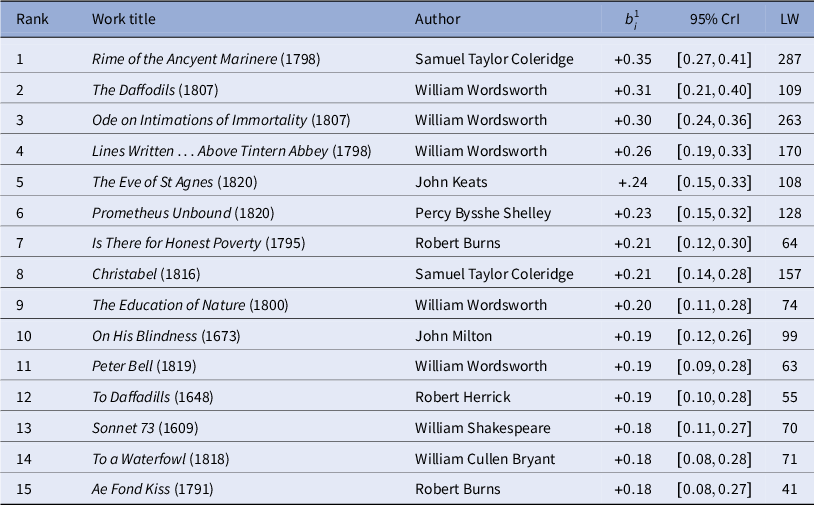
Table 3 Long description
The table lists the fifteen poems in the sustained-presence population whose share of prosodic writing rose most steeply, relative to the corpus-wide trend, across the modeled window. It has six columns: rank; work title, with the year of publication in parentheses; author; the slope b, which is the model's estimate of how much the poem's log-odds of being quoted changed per decade, compared with the average modeled poem; the 95 percent credible interval for that slope, that is, the range within which the true slope lies with 95 percent probability; and the lifetime number of PPA host works that quote the poem. A poem counts as credibly rising when its whole credible interval lies above zero. The rows, in order of rank, are as follows. Each gives the work, the author, the slope, the credible interval, and the number of host works:
* Rank 1: Rime of the Ancyent Marinere, 1798, by Samuel Taylor Coleridge. Slope +0.35, interval from 0.27 to 0.41, 287 host works.
* Rank 2: The Daffodils, 1807, by William Wordsworth. Slope +0.31, interval from 0.21 to 0.40, 109 host works.
* Rank 3: Ode on Intimations of Immortality, 1807, by William Wordsworth. Slope +0.30, interval from 0.24 to 0.36, 263 host works.
* Rank 4: Lines Written a Few Miles above Tintern Abbey, 1798, by William Wordsworth. Slope +0.26, interval from 0.19 to 0.33, 170 host works.
* Rank 5: The Eve of St Agnes, 1820, by John Keats. Slope +0.24, interval from 0.15 to 0.33, 108 host works.
* Rank 6: Prometheus Unbound, 1820, by Percy Bysshe Shelley. Slope +0.23, interval from 0.15 to 0.32, 128 host works.
* Rank 7: Is There for Honest Poverty, 1795, by Robert Burns. Slope +0.21, interval from 0.12 to 0.30, 64 host works.
* Rank 8: Christabel, 1816, by Samuel Taylor Coleridge. Slope +0.21, interval from 0.14 to 0.28, 157 host works.
* Rank 9: The Education of Nature, 1800, by William Wordsworth. Slope +0.20, interval from 0.11 to 0.28, 74 host works.
* Rank 10: On His Blindness, 1673, by John Milton. Slope +0.19, interval from 0.12 to 0.26, 99 host works.
* Rank 11: Peter Bell, 1819, by William Wordsworth. Slope +0.19, interval from 0.09 to 0.28, 63 host works.
* Rank 12: To Daffadills, 1648, by Robert Herrick. Slope +0.19, interval from 0.10 to 0.28, 55 host works.
* Rank 13: Sonnet 73, 1609, by William Shakespeare. Slope +0.18, interval from 0.11 to 0.27, 70 host works.
* Rank 14: To a Waterfowl, 1818, by William Cullen Bryant. Slope +0.18, interval from 0.08 to 0.28, 71 host works.
* Rank 15: Ae Fond Kiss, 1791, by Robert Burns. Slope +0.18, interval from 0.08 to 0.27, 41 host works.
Note: Credibly rising poems are those whose 95 percent credible interval on
$b^1_i$
 excludes zero on the positive side. LW, lifetime PPA host works.
Read side by side, the two lists describe a renewal of pedagogical use as much as a substitution of one canon for another. The decliners (Table 2) are dominated by the verse pedagogy of the Augustan and neoclassical tradition. What fades is the eighteenth-century apparatus that had made ancient poetry available to English readers as instruction: translations, verse-essays, and compiled loci through which classical authority was carried into the English schoolroom (Benedict Reference Benedict2015). Virgil is the clearest case. Three of Dryden’s translated Pastorals (1697) sit among the strongest decliners. Joseph Warton’s verse-translation of the Georgics (1753) falls with them, and Christopher Pitt’s Æneid (1740) closes the table. Horace follows the same pattern. The Art of Poetry declines twice, once in Roscommon’s 1680 version and again in William Duncombe senior’s 1757 translation. Roscommon’s own Essay on Translated Verse (1684) belongs to the same economy of classical mediation, and Waller’s commendatory poem on Roscommon’s Horace – originally part of the paratext that presented the translation to readers – declines beside it. Dryden’s verse-translations of Ovid’s Metamorphoses (Books I and XII; 1693 and 1700) and the First Satire of Persius (1693), together with Henry Baker’s Medulla Poetarum Romanorum (1737) – a much-used compendium of translated Latin poetic passages – belong inside the same instructional economy. Sheffield’s Essay upon Poetry (1682) belongs to the verse-critical tradition that helped readers understand poetry as an art governed by doctrine. And it did so in a form – heroic couplets – that revered classical literature as the standing measure of poetic value.
Blackmore’s Prince Arthur (1695) gives the table of decliners a sharper edge. It came to serve as a negative exemplar within the same neoclassical pedagogy: a failed Whig epic through which readers could recognize false grandeur and epic overreach. Pope helped fix that role. In Peri Bathous, Or the Art of Sinking in Poetry (1728) and the Dunciad (1728–1743), Blackmore was preserved as “Everlasting Blackmore” and as a poet so dull that he could put lawyers to sleep. His decline, however, was already under way. Even though Blackmore had enjoyed real support – and his Prince Arthur was widely read – by the 1720s, his audience was narrowing, and later references often preserved him as a name for poetic failure rather than as a poet to be read (Rounce Reference Rounce2014).
The risers, presented in Table 3, give this change its nineteenth-century center of gravity. Coleridge’s Rime (1798) leads the table, Wordsworth appears five times, and Keats, Shelley, and Burns help define a repertoire built around inward feeling and narrative imagination. Across the eighteenth century, verse translation and verse criticism had supplied many of the examples through which poetry was taught. By the late nineteenth century, that work was being done by Tintern Abbey (1798), the Ode on Intimations (1807), the Rime (1798), Christabel (1816), and The Eve of St Agnes (1820). This movement belongs to a larger revaluation of poetic authority. The “Pope controversy” of 1819–1826 was never only a quarrel over Pope’s reputation; it reopened the question of what kinds of verse could still stand near the center of the English canon, and on what grounds (Chandler Reference Chandler1984).Footnote 30 The same pressure can be described as a gradual lyricization of poetry: an uneven nineteenth-century process in which older distinctions among verse kinds lost some of their force, and poetry came to be imagined more narrowly through the prestige of the lyric (Jackson Reference Jackson2005, Reference Jackson2016; LeGette Reference LeGette2017). The lower ranks show how that shift entered pedagogical use. Herrick’s To Daffadills (1648), Shakespeare’s Sonnet 73 (1609), Bryant’s To a Waterfowl (1818), and Burns’s Ae Fond Kiss (1791) are short lyrics that anthologies could preserve, and pupils could learn by heart (Coiro Reference Coiro1990; Robson Reference Robson2012).
Table 4 adds a third shape to this history. A small body of poems stayed put across the whole modeled window, holding their position through both the Augustan apparatus and the lyric-recitation regime that succeeded it.Footnote 31 What the model labels as stability is the durability of works that remained useful across changing regimes. The King James Bible (1611) occupies the first positions in the table, with Psalms, Proverbs, and Job all remaining steadily available across the modeled window. A verse from Proverbs shows how that stability worked in practice:
Top 15 stable poems in the sustained-presence population, ranked by lifetime PPA host works
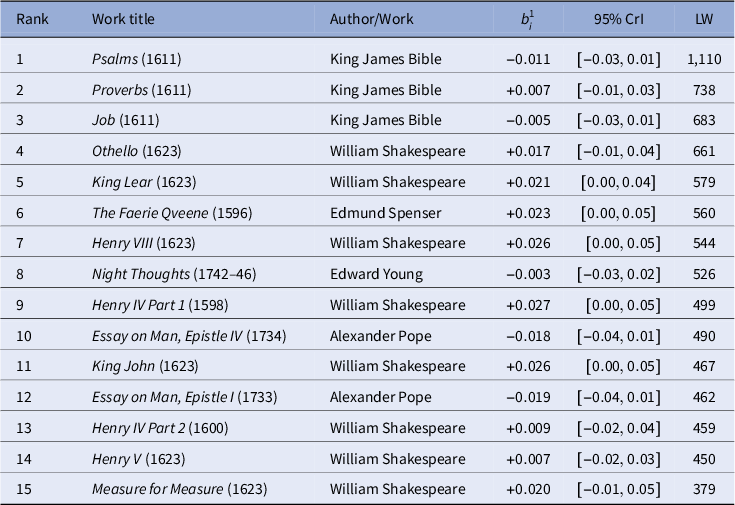
Table 4 Long description
The table lists the fifteen most widely quoted poems in the sustained-presence population whose share of prosodic writing neither rose nor fell appreciably relative to the corpus-wide trend. It has six columns: rank; work title, with the year of publication in parentheses; author or source work; the slope b, which is the model's estimate of how much the poem's log-odds of being quoted changed per decade, compared with the average modeled poem; the 95 percent credible interval for that slope, that is, the range within which the true slope lies with 95 percent probability; and the lifetime number of PPA host works that quote the poem. A poem counts as stable when its slope is no larger than 0.03 in either direction and its credible interval is no wider than 0.15. The rows, in order of rank, are as follows. Each gives the work, the author or source, the slope, the credible interval, and the number of host works:
* Rank 1: Psalms, 1611, King James Bible. Slope −0.011, interval from −0.03 to 0.01, 1,110 host works.
* Rank 2: Proverbs, 1611, King James Bible. Slope +0.007, interval from −0.01 to 0.03, 738 host works.
* Rank 3: Job, 1611, King James Bible. Slope −0.005, interval from −0.03 to 0.01, 683 host works.
* Rank 4: Othello, 1623, by William Shakespeare. Slope +0.017, interval from −0.01 to 0.04, 661 host works.
* Rank 5: King Lear, 1623, by William Shakespeare. Slope +0.021, interval from 0.00 to 0.04, 579 host works.
* Rank 6: The Faerie Qveene, 1596, by Edmund Spenser. Slope +0.023, interval from 0.00 to 0.05, 560 host works.
* Rank 7: Henry VIII, 1623, by William Shakespeare. Slope +0.026, interval from 0.00 to 0.05, 544 host works.
* Rank 8: Night Thoughts, 1742 to 1746, by Edward Young. Slope −0.003, interval from −0.03 to 0.02, 526 host works.
* Rank 9: Henry IV, Part 1, 1598, by William Shakespeare. Slope +0.027, interval from 0.00 to 0.05, 499 host works.
* Rank 10: Essay on Man, Epistle IV, 1734, by Alexander Pope. Slope −0.018, interval from −0.04 to 0.01, 490 host works.
* Rank 11: King John, 1623, by William Shakespeare. Slope +0.026, interval from 0.00 to 0.05, 467 host works.
* Rank 12: Essay on Man, Epistle I, 1733, by Alexander Pope. Slope −0.019, interval from −0.04 to 0.01, 462 host works.
* Rank 13: Henry IV, Part 2, 1600, by William Shakespeare. Slope +0.009, interval from −0.02 to 0.04, 459 host works.
* Rank 14: Henry V, 1623, by William Shakespeare. Slope +0.007, interval from −0.02 to 0.03, 450 host works.
* Rank 15: Measure for Measure, 1623, by William Shakespeare. Slope +0.020, interval from −0.01 to 0.05, 379 host works.
Note: Stable poems are those whose posterior-mean slope
$|b^1_i| \leq 0.03$
 and whose 95 percent credible interval is tight (width
$\leq 0.15$
 ) – poems pedagogical writers reached for repeatedly across the whole modeled window, neither gaining nor losing ground relative to the corpus trend. LW, lifetime PPA host works.
Train up a child in the way he should go:
and when he is old, he will not depart from it.
Thomas Dilworth’s New Guide to the English Tongue (1751) uses the lines to teach spelling and reading. Robert Ross’s American Grammar (1782) and John Walker’s Rhetorical Grammar (1785) cite the same verse, and more than a century later, John Baker Opdycke’s Composition Planning (1913) identifies it as an example of parallel construction.
Shakespeare supplies the second great reservoir. A passage from Othello shows how dramatic speech became schoolroom material. Bysshe’s Art of English Poetry (1702) already breaks the play into keyed examples. Several handbooks return to Iago’s lines on reputation:
Good name in man and woman
Is the immediate jewel of their souls.
Pope’s Essay on Man remains stable where it yields lines that can be lifted from the larger argument. A couplet from Epistle IV appears in Daniel Fenning’s New Grammar of the English Language (1771) and Sheridan’s Lectures on the Art of Reading (1775) and is still present in PPA works more than a century later. This mostly happens through couplets like these that do not require the rest of the poem around them:
Honour and shame from no condition rise;
Act well your part, there all the honour lies.
Selected poem trajectories, centered within poem. Each panel shows changes in a poem’s quotation prevalence relative to the average modeled poem, on a log-odds scale. The horizontal dashed line marks the poem’s mean fitted position over the decades shown: positive values indicate a stronger relative presence than this mean, and negative values a weaker one. The blue line shows the Bayesian fit; shading shows pointwise 95 percent credible intervals with the estimated baseline and poem mean held fixed. Gray points show observed deviations, and the orange line is a smoothed empirical comparison. Vertical dotted lines mark the publication decades. All panels use the same scales; portions of curves and credible bands, and observations, outside the vertical range are not shown.
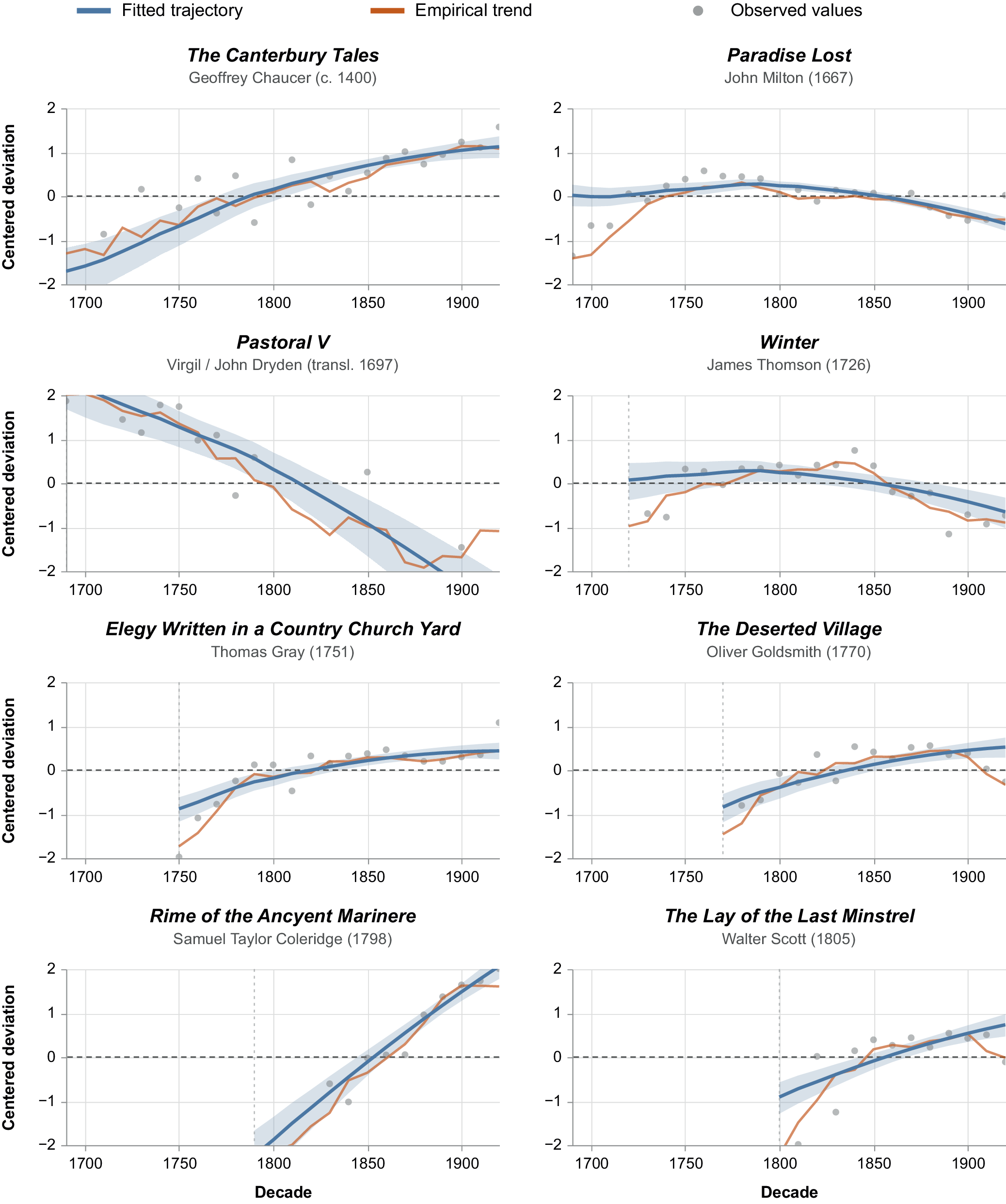
Figure 6 Long description
A grid of eight line graphs arranged in two columns and four rows. Each graph shares a common X-axis labeled Decade, ranging from 1700 to 1900, and a Y-axis labeled Centered deviation, ranging from negative 2 to 2. A horizontal dashed line at 0 represents the mean.
Legend at the top: Blue line for Fitted trajectory, orange line for Empirical trend, and gray dots for Observed values.
1. The Canterbury Tales (Chaucer): Shows a steady logarithmic increase from negative 1.5 in 1700 to positive 1.2 by 1920.
2. Paradise Lost (Milton): Starts near negative 1, rises to a peak near 0.3 around 1780, then gradually declines back toward negative 0.5.
3. Pastoral V (Virgil/Dryden): Shows a sharp linear decrease starting from positive 2 in 1700 down to negative 2 by 1880.
4. Winter (Thomson): Begins at 1726. The fitted blue line stays relatively flat near 0, while the orange empirical line fluctuates below it, ending near negative 1.
5. Elegy Written in a Country Church Yard (Gray): Begins at 1751. Shows a steady upward trend from negative 1 to positive 0.5.
6. The Deserted Village (Goldsmith): Begins at 1770. Shows an upward trend from negative 1 to positive 0.5.
7. Rime of the Ancyent Marinere (Coleridge): Begins at 1798. Shows a steep, nearly linear increase from negative 2 to positive 2 by 1920.
8. The Lay of the Last Minstrel (Scott): Begins at 1805. Shows a moderate upward trend from negative 1 to positive 0.8.
Distribution of poem-level slopes by Chadwyck-Healey literary period. Each ridge shows the distribution of posterior-mean poem slopes
$b^1_i$
 for poems assigned to that period, measured in log-odds per decade against the shared corpus trend. Values to the right of zero indicate poems gaining ground relative to the corpus-wide trend; values to the left indicate poems losing ground. The dashed vertical line marks zero, and the solid vertical line within each ridge marks that period’s median slope. Rows are sorted by median slope and include only periods with at least 20 modeled poems.
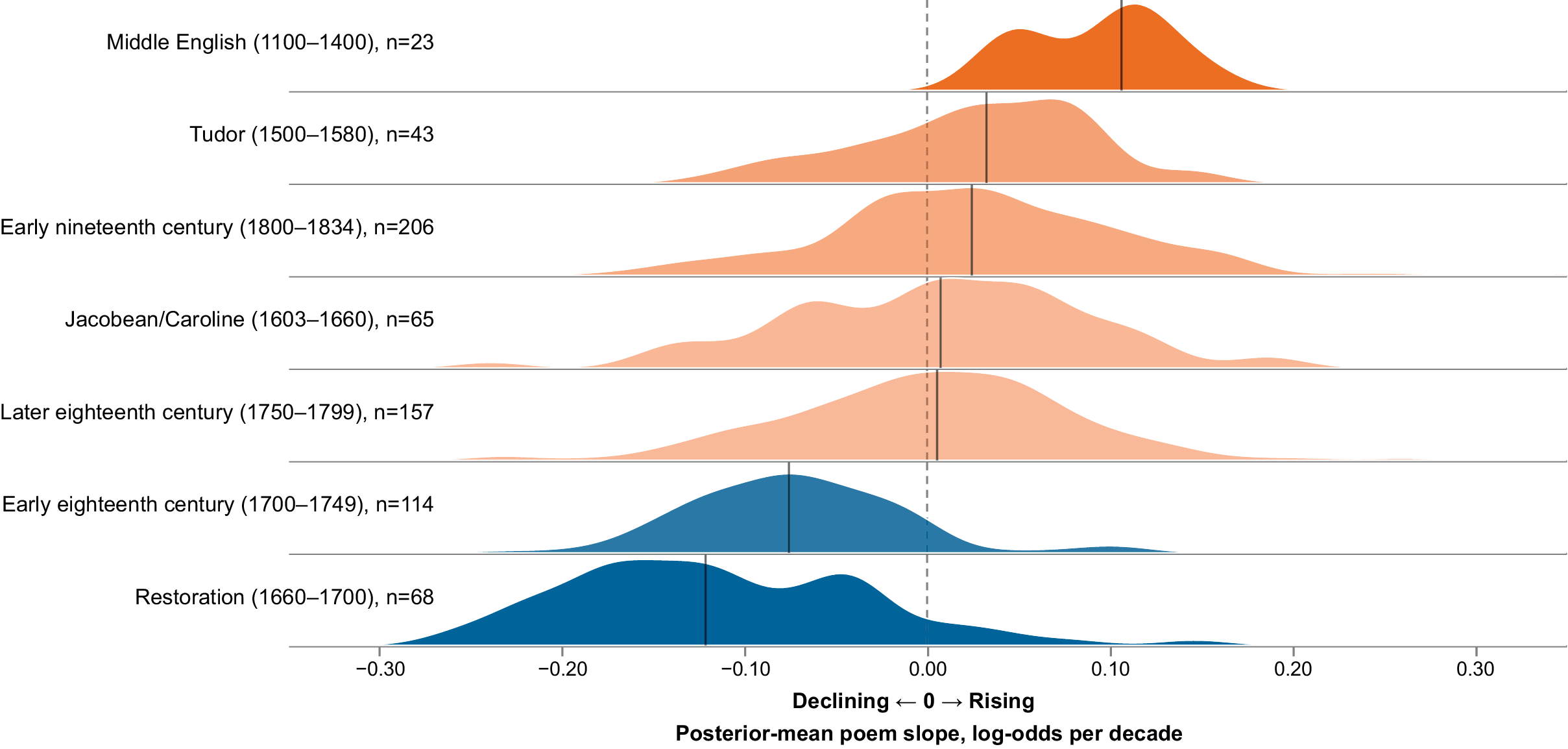
Figure 7 Long description
A ridge plot with a horizontal x-axis labeled Posterior-mean poem slope, log-odds per decade. The axis ranges from negative 0.30 to positive 0.30, with a dashed vertical line at zero. Values to the left are labeled Declining and values to the right are labeled Rising. Seven rows represent literary periods, each containing a density ridge with a solid vertical line marking the median.
* Middle English (1100–1400), n=23: An orange ridge positioned furthest to the right, entirely above zero with a median near 0.11.
* Tudor (1500–1580), n=43: A light orange ridge mostly to the right of zero with a median near 0.04.
* Early nineteenth century (1800–1834), n=206: A light orange ridge centered slightly right of zero with a median near 0.02.
* Jacobean/Caroline (1603–1660), n=65: A light orange ridge centered almost exactly on zero with a median near 0.01.
* Later eighteenth century (1750–1799), n=157: A light orange ridge centered on zero with a median near 0.00.
* Early eighteenth century (1700–1749), n=114: A blue ridge mostly to the left of zero with a median near negative 0.08.
* Restoration (1660–1700), n=68: A dark blue ridge positioned furthest to the left with a bimodal distribution and a median near negative 0.12.
Figure 6 shows the fitted trajectories of selected poems. Each panel shows how a poem’s quotation prevalence changed relative to the average modeled poem. The dashed line marks that poem’s mean relative position over the decades shown; values above or below it indicate a stronger or weaker relative presence. This centers large and small presences on the same scale, so that Paradise Lost – the single most-cited work in the corpus by raw host-work count (Table 1) – can be read alongside poems entering prosody writing much later and more modestly. Dryden’s Pastoral V and Coleridge’s Rime are already familiar from Tables 2 and 3: the first traces the sharpest decline in the panel, and the second the sharpest rise. The more telling case here is James Thomson’s Winter (1726). The Seasons, of which Winter was the first-published book, was one of the most widely read long poems of the eighteenth and early nineteenth centuries (St. Clair Reference St. Clair2004), and through most of the modeled window, its first book sits close to its own mean – neither gaining nor losing ground – before bending into a gradual late decline. Paradise Lost peaks around the 1760s and recedes from there, even as the poem remains the most-cited text in the archive by raw host-work count (Table 1). The panel shows relative displacement: a poem crowded out at the margin by a broadening quotation economy while retaining absolute dominance. That trajectory sits inside a long reception history in which Milton’s epic had already been made canonical through eighteenth-century editorial labor and commentary before Romantic and later critical discourse recast its cultural function (Kolbrener Reference Kolbrener and Schwartz2014). Elegy Written in a Country Churchyard (1751) and The Deserted Village (1770) trace the opposite movement, climbing slowly through the window from below their eventual means. Both were finding their footing after their initial publication moment. Goldsmith’s poem was listed as a text for recitation in women’s training colleges in the 1860 curriculum cycle, alongside Paradise Lost and Wordsworth’s The Excursion (Robson Reference Robson2012). That institutionalization came ninety years after its publication, and that timing is what the panel shows: a poem entering prosody writing well below its own eventual mean, then climbing as the curriculum caught up with it. The Canterbury Tales has the longest arc of all. Starting well below its own mean in the 1690s and rising steadily across the full two centuries of the modeled window, it traces the nineteenth-century construction of Chaucer as an object of literary history and national instruction (Utz Reference Utz, Parker and Wagner2020) – a poem that had to wait for a new kind of reader to find its place in prosody writing.
Periods rising and declining
The riser and decliner patterns visible at the poem level also show up when poems are grouped by the literary period to which they belong. Each poem in the population carries a period label from the Chadwyck-Healey metadata.Footnote 32 Figure 7 takes the same poem-level slope estimates that underlie Tables 2 and 3 and asks how those slopes are distributed within each period. Each ridge shows that distribution for one period.Footnote 33 The ridges are sorted from bottom to top by their median slope, so the figure can be read directionally: periods whose poems were collectively losing ground in the PPA sit at the bottom, and those whose poems were gaining ground sit at the top. The dashed vertical line marks zero – the corpus-wide trend – and the solid vertical line within each ridge marks that period’s median.
The two bottom ridges – Restoration (1660–1700) and Early eighteenth century (1700–1749) – sit clearly to the left of zero: these are the periods that produced the top decliners in Table 2, and the figure shows a broad pattern of decline across the cohort. The Restoration ridge shows a pronounced internal split: two humps are visible. The left hump, centered around
$-0.15$
 , is the classical-translation and didactic-verse apparatus: Roscommon’s The Art of Poetry (
$ -0.25$
 ), his Essay on Translated Verse (
$ -0.22$
 ), Blackmore’s Prince Arthur (
$ -0.24$
 ), Dryden’s translations of Persius (
$ -0.22$
 ), Ovid’s Metamorphoses (
$ -0.21$
 ), Juvenal (
$ -0.19$
 ), Sheffield’s Essay upon Poetry (
$ -0.20$
 ), and Garth’s Dispensary (
$ -0.18$
 ). Many of the poems named in Table 2 reappear here, and the cluster confirms that the decline was a collective fall of the entire apparatus. The right hump, centered near
$-0.05$
 , is a different kind of Restoration poem: Dryden’s original verse – Absalom and Achitophel (
$ -0.05$
 ), Mac-Flecknoe (
$ -0.04$
 ), and Annus Mirabilis (
$ -0.03$
 ) – alongside Prior’s Henry and Emma (
$ -0.10$
 ) and Addison’s Campaign (
$ -0.15$
 ). These decline too, but more mildly, and most of their credible intervals straddle zero. What the bimodal ridge shows is that within the Restoration cohort, the translation apparatus fell hard, the original verse less so.
The Jacobean/Caroline ridge (1603–1660) also brings together poems with different trajectories. Its median sits just above zero, but the distribution extends to both sides of zero. The upper tail, rising clearly above zero, is almost entirely short lyric and dramatic song: Milton’s sonnets, Shakespeare’s individual sonnets and songs excerpted from the plays, Herrick’s To Daffadills (
$ +0.19$
 ), Lovelace’s To Lucasta (
$ +0.15$
 ), Jonson’s songs to Celia, Herbert’s Virtue (
$ +0.12$
 ), and Marlowe’s Passionate Shepherd (
$ +0.09$
 ). The main body of the ridge, centered just above zero, is the Shakespeare plays and Milton’s longer poems – L’Allegro, Il Penseroso, Lycidas, and Samson Agonistes – holding their position through the modeled window. Below zero, a declining tail: Dryden’s adaptations of Jacobean drama, Denham’s Cooper’s Hill (
$ -0.08$
 ), Cowley’s Davideis (
$ -0.14$
 ), the longer neoclassical narrative poems that belonged to the same tradition as the Restoration apparatus declining alongside them. The ridge is, in miniature, the lyricization process Jackson has described at the macro level (Jackson Reference Jackson2005, Reference Jackson2016): short lyric and song gained ground, plays and longer meditative poems held, and the heroic-narrative tradition gave way.
The Middle English ridge (1100–1400) lies furthest to the right. With only 23 modeled poems, the ridge is small, but its authors are the founding figures of the English literary tradition as the nineteenth century understood it: Chaucer above all, but also Langland’s Piers Plowman (
$ +0.12$
 ), Layamon’s Brut (
$ +0.13$
 ), Barbour’s Bruce (
$ +0.10$
 ), and Gower’s Confessio Amantis (
$ +0.06$
 ). Within Chaucer’s own work, his dream-visions rose fastest: The Book of the Duchess (
$ +0.16$
 ) and The Legend of Good Women (
$ +0.15$
 ) sit a little above Troilus and Criseyde and the individual Canterbury Tales (which cluster together around
$+0.10$
 ).
Conclusion
The PPA holds four centuries of writing about verse, and scattered through it, in fragments, are the poems that writers reached for when they needed an example. This study begins to recover that record at scale: which poems were quoted, in which works, and what their trajectories through the writing looked like. That recovery was not achieved through simple tallying. A poem’s presence in a host work is already an interpretation: of what counts as a quotation, of which poem is being quoted, of whether a passage that looks like Virgil is really Virgil or a later poet who has absorbed his lines. The host works are no less complicated. Anthologies copy from anthologies; a passage in circulation for fifty years may say less about contemporary taste than about the persistence of a “convenient” text. Rounce has called this the central problem of database-driven poetic reception study: a citation record is “a mechanism for producing data, rather than interpreting it,” and “flattened out results lack context” (Rounce Reference Rounce2014). Simple counts would have flattened interpretive ambiguities into definitive-looking trends. We used statistical modeling to separate changes in quotation practice from the uneven growth of the archive and to estimate poem-level trajectories without treating sparse evidence as equally certain. Our entire pipeline – its filters, plausibility checks, and models – was a sustained attempt to interpret rather than merely produce.
That interpretive work begins with the corpora themselves. Our counts depend on two curated corpora: the PPA and the poetry corpus against which we read it. The PPA is not a neutral container for “prosody” as such, but a historically assembled archive of English-language works about language, poetry, and the places where the two overlap. In this archive, works of versification and elocution sit alongside grammar books, literary histories, school readers, anthologies, and miscellanies – genres that do not merely record a discourse on verse, but helped produce one. What we have traced, then, is a history of poetic quotation drawn from the works collected in the PPA and shaped by the standards of relevance that brought these works into relation with one another.
The Chadwyck-Healey poetry reference corpus introduces a second constraint. Because it is built around anglophone poetry, it lets us follow the English-language poems and translations that prosodic writers used, but it cannot tell the same story for every poetic tradition that entered the PPA. Latin and Greek citation, almost certainly heavy in early PPA works, is invisible to our pipeline; so are the French, German, and other modern-language poetic traditions that later PPA works occasionally draw on when making nationalist arguments about the distinctiveness of English versification. Both limitations are ones we can name but cannot remedy within the present study.
Within these limits, the evidence reveals a dense culture of poetic contact. Passim was useful precisely because it did not begin from titles, authors, or declared sources; it searched for shared wording wherever that wording appeared. But that strength also means that the alignments have to be read as evidence of contact before they can be read as evidence of quotation. The King James Bible, for example, emerges in our results as one of the PPA’s major sources of poetic citation, but biblical language also travels through later poems, paraphrases, hymns, and commonplace phrases. The same is true of Shakespeare, Virgil, Gray, and other heavily sedimented sources. A match may indicate that a prosody manual quotes a canonical poem; it may also indicate that a minor poem in the reference corpus contains a canonical line, and that the PPA host is really reaching for the older source through the later one. What is historically the familiar condition of poetic intertextuality thus becomes, in our technical operationalization, a problem of attributional bleed-through or poetic “contamination.” We can see this clearly in the example of Alaric Alexander Watts’s elegy To the Memory of George Barret (1842). In the modeled data, the poem appears as a strong riser throughout the PPA; yet the signal is almost entirely carried by the canonical borrowings woven through it. Watts echoes Shakespeare’s Tempest – “cloud-capped towers” and “gorgeous palaces” – and closes on Gray’s Elegy: “leaves the world to darkness and to me.” The quotation marks are Watts’s own. He knows he is borrowing. Passim catches the shared wording too, but it cannot know, without interpretation, whether the historical object is Watts, Gray, Shakespeare, or the culture that made such lines available for reuse. Similar cases run through the long tail of the corpus: cento poems composed from borrowed lines, compilers such as Nathaniel Crouch reproducing other poets’ verse under a pseudonym (Axon Reference Axon1885). Together they remind us that, for much of the period studied here, the boundary between quoting a poem and writing with poetry was permeable.
Samuel Johnson’s Lives of the Poets (1779–1781) is perhaps the most celebrated record of poetic authority being claimed and assigned. The PPA preserves the longer, much quieter record of that authority being used – or not. By the time a poet’s lines were reaching prosody manuals, grammar books, and elocution treatises, something had already happened to them: they had entered the daily working life of a literary culture that needed examples. Recovering that record at scale, for the full range of poets whose lines circulated through four centuries of writing about verse, is what this study has attempted. The verdicts in the Lives shaped which poets entered that circulation. The record traced in our contribution follows what happened after poetic authority entered use: how poems became examples, and how those examples moved through the prose that taught readers how verse worked.
Data availability statement
Replication data and code are openly available. The Found Poems Dataset is archived at https://doi.org/10.5281/zenodo.20044417. The cleaned and reconciled poet metadata is archived on Zenodo at https://doi.org/10.5281/zenodo.20597001. The analysis code and computational notebooks are available at https://github.com/WHaverals/quotable_canon. The PPA full-text dataset on which the alignments were run is available at https://doi.org/10.34770/bze8-xk08 (Martin, Koeser, and Naydan Reference Martin, Rebecca and Mary2026) and described in Koeser et al. (Reference Koeser, Naydan, Thompson and Martinforthcoming).
Acknowledgements
We are grateful to Mary Naydan, who kept this many-handed effort moving, curated the supplementary reference corpus, and adjudicated the manual annotations used to evaluate passim. We also thank Anthony Nathan, Olivia Roslansky, and Molly Taylor for annotating poetry quotations in the evaluation set.
Author contributions
Conceptualization: W.H., M.M., R.S.K., and L.T.; Data curation: W.H., R.S.K., and L.T.; Formal analysis: W.H.; Methodology: W.H., R.S.K., and L.T.; Resources: M.M., R.S.K., and L.T.; Software: W.H., R.S.K., and L.T.; Supervision: M.M.; Visualization: W.H.; Writing – original draft: W.H.; Writing – review and editing: W.H., M.M., R.S.K., and L.T. All authors approved the final submitted draft. CRediT taxonomy: https://credit.niso.org/.
Funding statement
This research was supported by a Collaborative Research Grant from the Center for Digital Humanities at Princeton University and a grant from Princeton University’s University Committee for Research in the Humanities and Social Sciences.
Competing interests
The authors declare no competing interests.
Use of AI tools
In preparing this manuscript, we made minimal, non-generative use of Claude Sonnet 4.6 for spelling and language checking of author-written prose, review of author-written analysis code, and feedback on figure presentation. The research design, analysis, and interpretation are the authors’ own. Every line of code has been checked, and the authors take responsibility for the final manuscript, code, and figures.


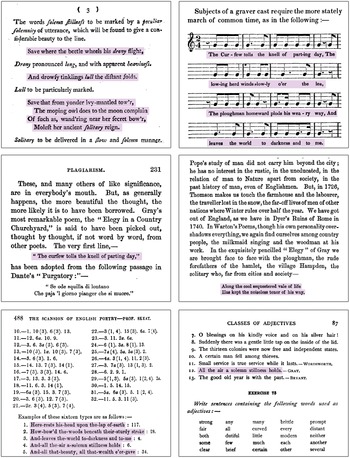

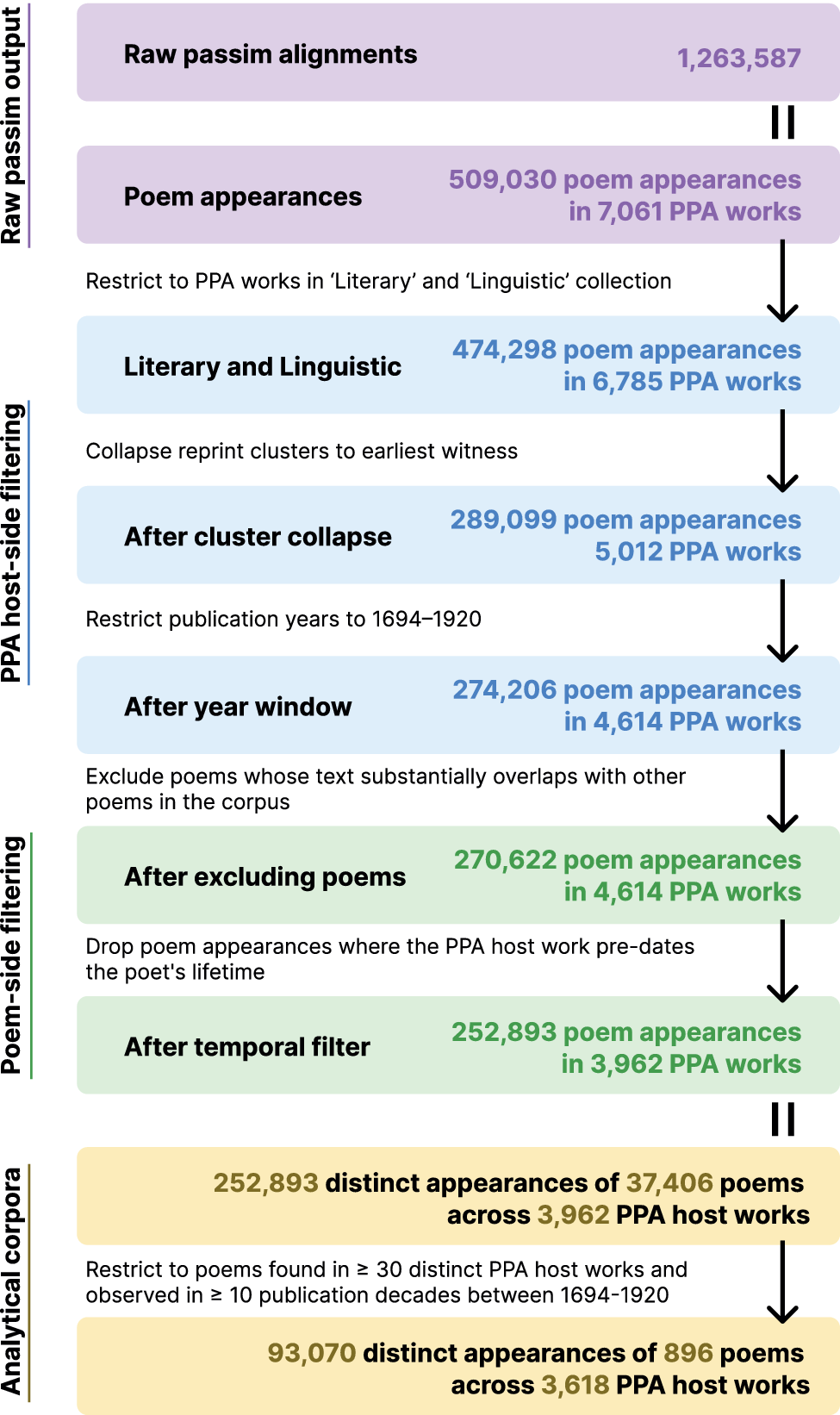
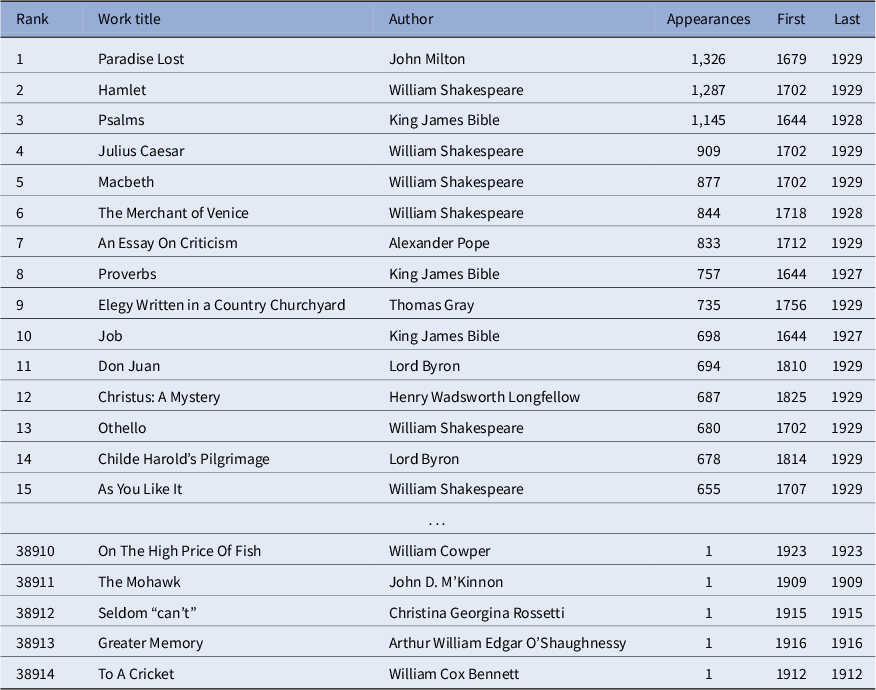
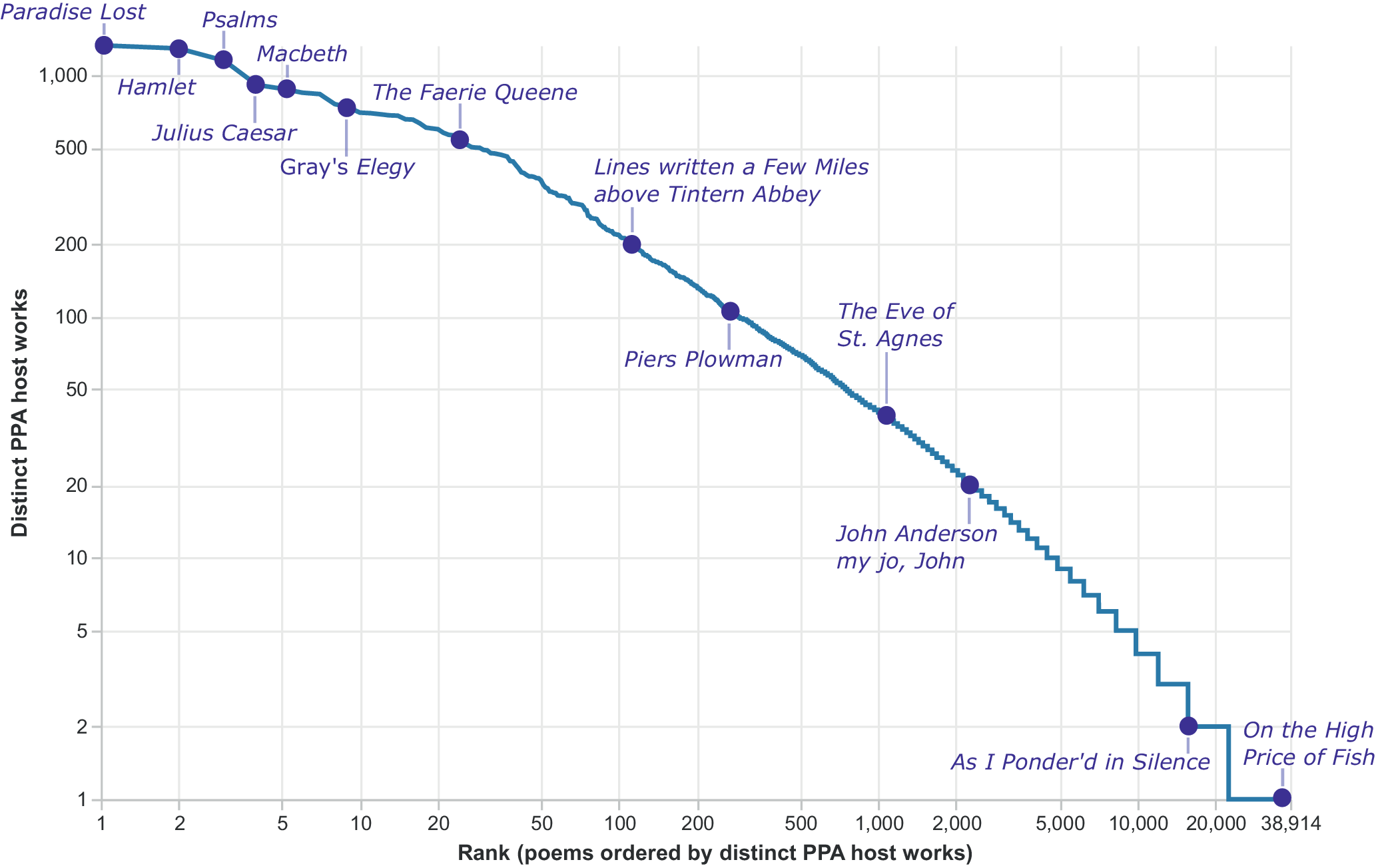
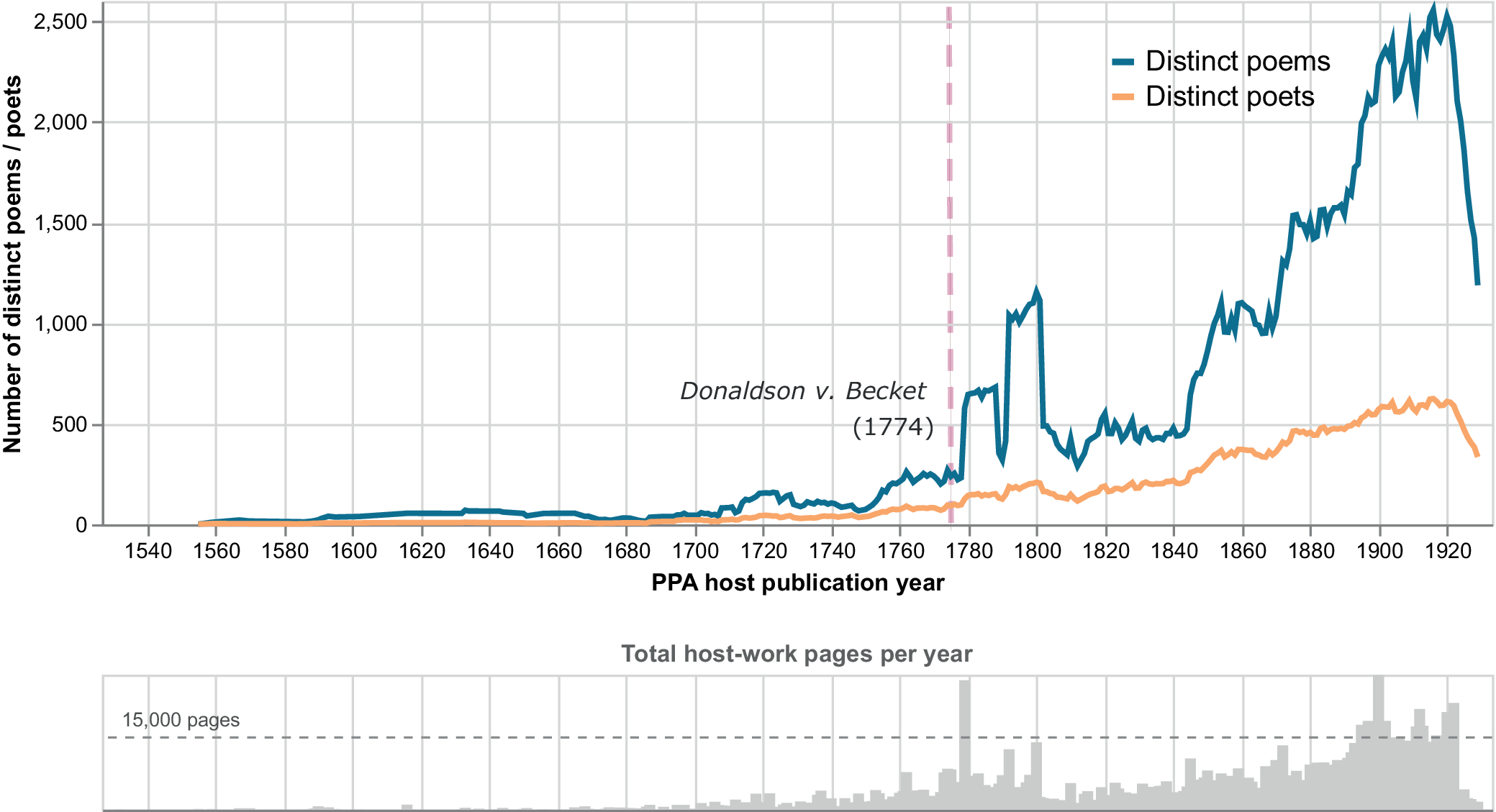
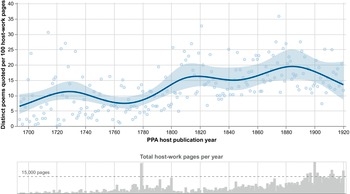
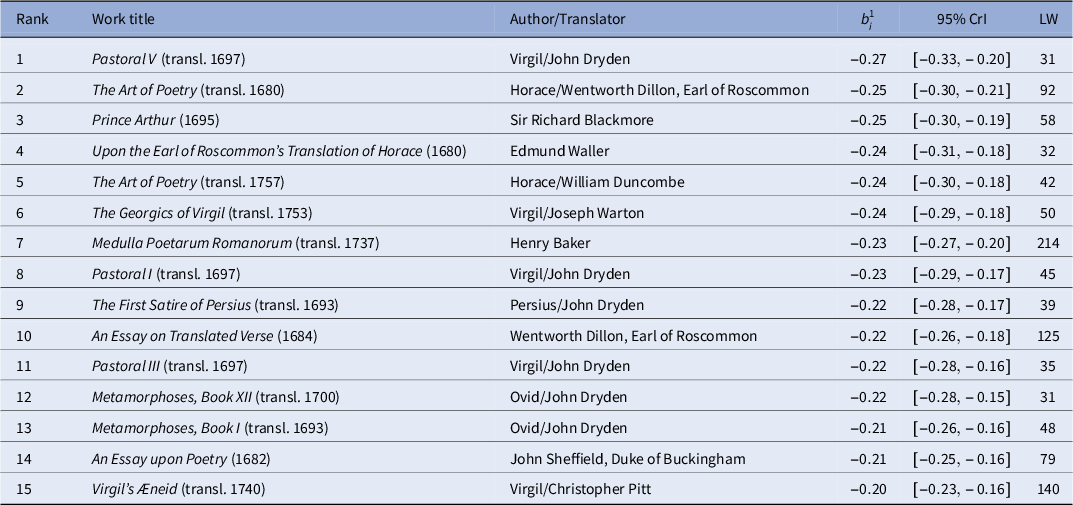

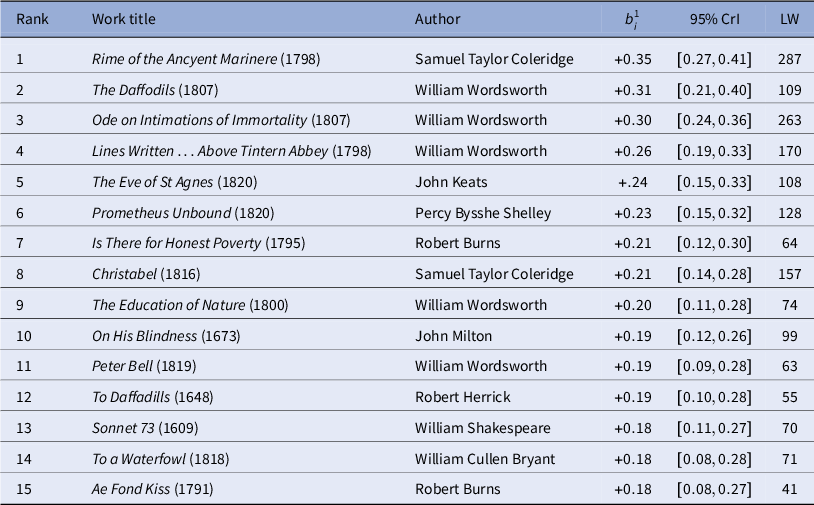

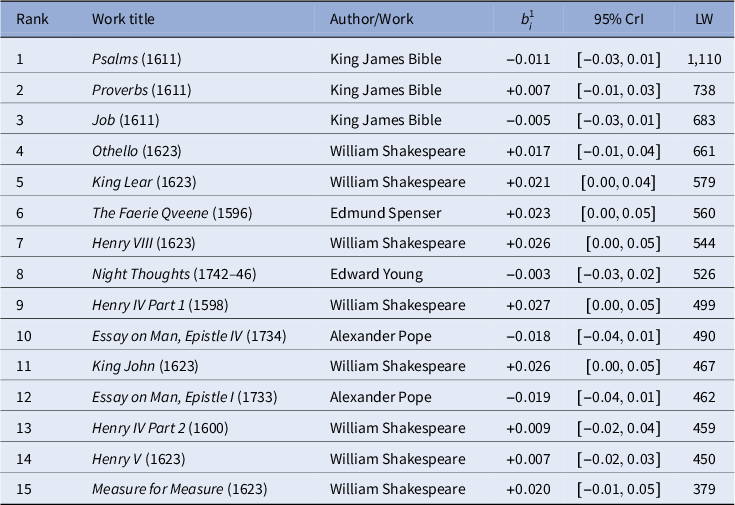

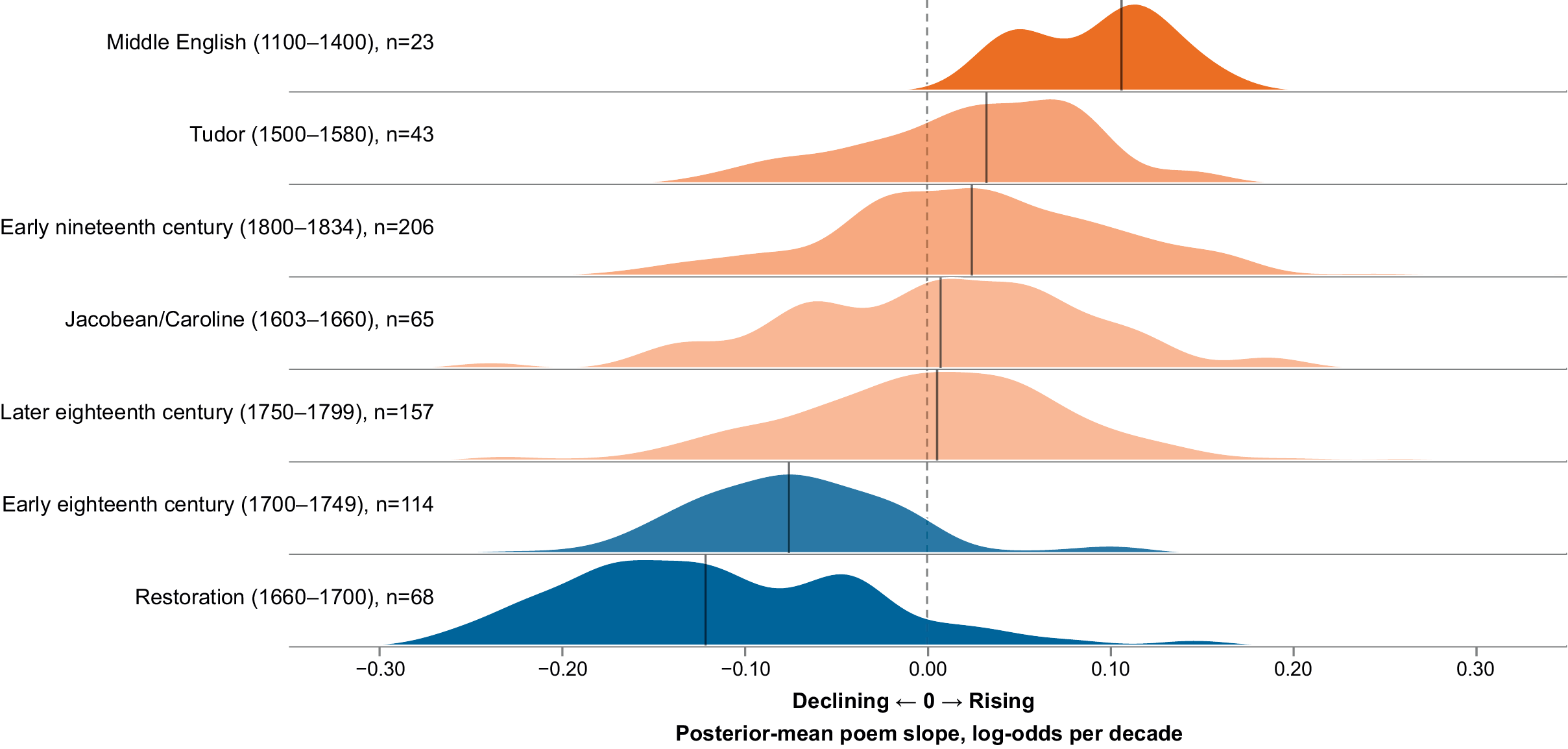


 Open access


Rapid Responses
No Rapid Responses have been published for this article.