





Introduction
Depression among adolescents has become increasingly prevalent in the last two decades, coinciding with the widespread adoption of digital media (Daly, Reference Daly2022; Orben & Przybylski, Reference Orben and Przybylski2019; Twenge et al., Reference Twenge, Martin and Campbell2018). Digital media includes a wide array of communication on and content distributed through digital platforms such as social media, texting, videochat, gaming, and other online interactive platforms. In today’s digital age, teens report that a large proportion of their interactions with peers happen via digital media (Throuvala et al., Reference Throuvala, Griffiths, Rennoldson and Kuss2019). Recent theories propose that negative peer interactions on digital media may significantly contribute risk for depression, whereas positive online peer experiences on digital media could offer protective effects (Choukas-Bradley et al., Reference Choukas-Bradley, Kilic, Stout and Roberts2023; Nesi, Reference Nesi2020). Yet, little is known about how online peer interactions may be differentially related to teens’ daily experiences of depressive symptoms at the within-person level compared to in-person interactions. The current study aims to use ecological momentary assessment (EMA) to explore how negative and positive peer interactions are associated with depressive symptoms in daily life, and whether the impact of these interactions differs based on whether they are via digital media or in-person, in a sample of adolescents assigned female at birth at high-risk for depression and suicidality.
Adolescent depression and the peer context
Adolescence is characterized as a sensitive period for the development of depressive symptoms, making it crucial to understand risk factors for depression (Lu, Reference Lu2019; Gore et al., Reference Gore, Bloem, Patton, Ferguson, Joseph, Coffey, Sawyer and Mathers2011). Indeed, depression is one of the most commonly diagnosed psychiatric disorders in adolescence, with prevalence rates of approximately 16% among all adolescents and 23% among female adolescents (Daly, Reference Daly2022). Previous meta-analyses have shown that gender differences emerge around the age of 12, with girls beginning to exhibit higher levels of depressive symptoms compared to boys, and this disparity persists throughout adulthood (Salk et al., Reference Salk, Hyde and Abramson2017). Notably, over the last two decades, the prevalence of depressive symptoms among youth has increased, with girls experiencing larger increases than boys (Brody, & Hughes, Reference Brody and Hughes2025; Duffy et al., Reference Duffy, Twenge and Joiner2019).
In the transition to adolescence, youth experience a wide range of biological, cognitive, and socioaffective changes, resulting in greater sensitivity to interpersonal stress, which has been linked to the rise in depressive symptoms (Somerville, Reference Somerville2013). Adolescents’ social contexts shift as they begin to spend increasingly more time with peers and less time with their parents (Larson & Richards, Reference Larson and Richards1991). As peer relationships gain the utmost importance with this shift, teenagers develop a heightened sensitivity to peer evaluation and feedback (Jones & Newman, Reference Jones and Newman2009). This increased social sensitivity also may be driven by neural and pubertal changes during adolescence, including maturation in brain regions associated with socioaffective processing and hormonal shifts that heighten sensitivity to social evaluation in the peer context (Albert et al., Reference Albert, Chein and Steinberg2013; Guyer et al., Reference Guyer, Choate, Pine and Nelson2012; Nelson et al., Reference Nelson, Leibenluft, McClure and Pine2005; Somerville, Reference Somerville2013).
Negative peer interactions and depression
Negative interactions with peers may increase the risk for depression by influencing teens’ daily affective experiences (King & Merchant, Reference King and Merchant2008; Vannucci et al., Reference Vannucci, Ohannessian, Flannery, De Los Reyes and Liu2018). Especially for girls, higher levels of stress in peer relationships (e.g., social exclusion, teasing, restricted friendships) have been shown to contribute to higher levels of depressive symptoms and affective reactivity compared to boys (Conley et al., Reference Conley, Rudolph and Bryant2012; Owens et al., Reference Owens, Helms, Rudolph, Hastings, Nock and Prinstein2019; Rose & Rudolph, Reference Rose and Rudolph2006; Rudolph, Reference Rudolph2002; Shih et al., Reference Shih, Eberhart, Hammen and Brennan2006). Certain forms of negative peer interactions, such as peer rejection, exclusion or conflict may lead youth to feel socially threatened – defined as a fear of being negatively evaluated by others – further leading to depressive symptoms (Nolan et al., Reference Nolan, Flynn and Garber2003; Silk et al., Reference Silk, Davis, McMakin, Dahl and Forbes2012). A recent daily diary study found that youth report higher levels of negative affect on days when they experience more friendship conflicts, and that this negative affect persists the next day, pointing to temporal associations between negative peer experiences and depressive functioning (Vannucci et al., Reference Vannucci, Ohannessian, Flannery, De Los Reyes and Liu2018). Teens who experience high levels of peer rejection have been shown to exhibit more negative mental health outcomes including depressive symptoms at the between-person level (Prinstein & Aikins, Reference Prinstein and Aikins2004). In both cross-sectional and longitudinal studies, peer rejection emerged as a strong predictor of internalizing symptoms, especially for girls (Beeri & Lev-Wiesel, Reference Beeri and Lev-Wiesel2012; Sentse et al., Reference Sentse, Lindenberg, Omvlee, Ormel and Veenstra2010). Furthermore, experiences of social isolation and peer victimization are linked to higher rates of depressive symptoms and even suicidal ideation longitudinally (Heilbron & Prinstein, Reference Heilbron and Prinstein2010). However, no studies to date have specifically investigated depressive symptoms in daily life following real-life peer interactions.
Positive peer interactions and depression
On the other hand, the experience of being acknowledged, appreciated, and accepted by others serves to fulfill fundamental psychological needs for social connection and belongingness, especially for adolescents (Baumeister & Leary, Reference Baumeister and Leary1995; Newman et al., Reference Newman, Lohman and Newman2007). Thus, teens who experience acceptance and validation from their social interactions may perceive a sense of social reward, contributing to feelings of happiness and overall well-being (Telzer et al., Reference Telzer, Van Hoorn, Rogers and Do2018). Perceived social reward can arise from various sources, including supportive friendships, social acceptance or validation. Increased friendship support and sense of belongingness have been shown to predict lower levels of depressive symptoms (McCallum & McLaren, Reference McCallum and McLaren2010; van Harmelen et al., Reference van Harmelen, Gibson, St Clair, Owens, Brodbeck, Dunn, Lewis, Croudace, Jones, Kievit and Goodyer2016). Similarly, peer acceptance has been shown to buffer against internalizing symptoms, even in the presence of other risk factors such as parental rejection (Sentse et al., Reference Sentse, Lindenberg, Omvlee, Ormel and Veenstra2010).
Digital media as a new peer context
Digital media has transformed adolescent peer interactions, now serving as the primary socializing context for many teens (Vogels et al., Reference Vogels, Gelles-Watnick and Massarat2022) – one they often prefer to in-person contact for initiating and maintaining friendships (Angelini & Gini, Reference Angelini and Gini2024; Di Gesto et al., Reference Di Gesto, Matera, Policardo and Nerini2022). To date, studies have investigated how teens’ digital media interactions might be reflective of their in-person peer interactions, failing to recognize the unique properties of digital media platforms that might have differential implications for teens’ affective experiences (Laghi et al., Reference Laghi, Schneider, Vitoroulis, Coplan, Baiocco, Amichai-Hamburger, Hudek, Koszycki, Miller and Flament2013; Nesi, Reference Nesi2020; Yau & Reich, Reference Yau and Reich2018). Alternatively, the transformation framework proposes that peer relations in the context of social media have unique characteristics such as increased availability, quantifiability, asynchronicity, and visualness, compared to in-person peer interactions (Nesi et al., Reference Nesi, Choukas-Bradley and Prinstein2018a, Reference Nesi, Choukas-Bradley and Prinstein2018b). With these unique characteristics, social media can alter the frequency, immediacy, and the qualitative nature of interpersonal experiences and communication patterns (Nesi et al., Reference Nesi, Choukas-Bradley and Prinstein2018a, Reference Nesi, Choukas-Bradley and Prinstein2018b). For instance, increased availability of digital platforms enables teens to communicate with their peers anytime regardless of physical proximity, allowing for ongoing interactions virtually, and the text-based nature of communication via direct messages (DMs) or texts may increase feelings of disinhibition, influencing both the form and function of digital social interactions (Nesi et al., Reference Nesi, Choukas-Bradley and Prinstein2018a, Reference Nesi, Choukas-Bradley and Prinstein2018b).
Notably, most of the research on the associations between digital media interactions and socioemotional outcomes in teenagers has relied on cross-sectional between-person data and retrospective recall over long periods of time, thereby lacking ecological validity (Valkenburg et al., Reference Valkenburg, Meier and Beyens2022). Additionally, most prior research on the links between depression and digital media use in teens has relied heavily on screen time, a metric for how much time users spend on their electronic devices (Odgers & Jensen, Reference Odgers and Jensen2020). Further, no studies to date have investigated digital media use in relation to levels of depressive symptoms in the daily lives of adolescents, which have been shown to fluctuate within and across days in adult populations (Hankin et al., Reference Hankin, Fraley and Abela2005; Peeters et al., Reference Peeters, Nicolson, Berkhof, Delespaul and deVries2003). Hence, a growing consensus in the field points to the need for a more nuanced understanding of the aspects of digital media experiences that are linked to mental health, including how the subjective experience of these interactions may differ from in-person interactions (Choukas-Bradley et al., Reference Choukas-Bradley, Kilic, Stout and Roberts2023; Nesi, Reference Nesi2020; Orben, Reference Orben2020; Silk et al., Reference Silk, Sequeira, James, Kilic, Grad-Freilich, Choukas-Bradley and Ladouceur2024; Weinstein, Reference Weinstein2018).
In the realm of social media, negative peer experiences, such as receiving a limited number of likes or virtual validation, may increase depressive symptoms (Di Gesto et al., Reference Di Gesto, Matera, Policardo and Nerini2022). Teens who experience cyberbullying, such as being targeted with hurtful comments or malicious messages, have also been shown to exhibit higher levels of depressive symptoms (Mitchell et al., Reference Mitchell, Ybarra and Finkelhor2007; Ybarra et al., Reference Ybarra, Mitchell, Wolak and Finkelhor2006). More passive peer-related experiences on digital media platforms, such as fear of missing out or constant exposure to idealized body images, have also been associated with depressive symptoms as teens may compare their lives to curated, often embellished versions of others presented online (Choukas-Bradley et al., Reference Choukas-Bradley, Maheux, Roberts, Hutchinson, Lu, Ladouceur and Silk2022; Hunt et al., Reference Hunt, Marx, Lipson and Young2018; Marengo et al., Reference Marengo, Longobardi, Fabris and Settanni2018). Thus, negative peer interactions on digital platforms encompass a wide range of experiences that can have detrimental effects on depressive symptoms, mirroring or perhaps surpassing the impact of negative in-person interactions.
On the other hand, positive online interactions, such as direct communication and disclosure with peers, have been associated with higher levels of connectedness and better affective well-being (James et al., Reference James, Silk, Scott, Hutchinson, Wang, Sequeira, Lu, Oppenheimer and Ladouceur2023; Weinstein, Reference Weinstein2018). For instance, in qualitative interviews, teens report that engaging in supportive conversations through messaging apps or online forums can foster feelings of belongingness, akin to face-to-face interactions with friends (Weinstein et al., Reference Weinstein, Kleiman, Franz, Joyce, Nash, Buonopane and Nock2021). Additionally, in qualitative research, teens have reported that sharing personal experiences and seeking advice from peers in online support groups or virtual communities can provide emotional support and validation, leading to enhanced feelings of connectedness and improved mental health outcomes (Weinstein, Reference Weinstein2018). Especially for adolescents who do not receive enough in-person social support from real-life friends, digital interactions – such as receiving positive comments and expressions of support, as well as the presence of online-only friends – may reduce depressive symptoms (Karim et al., Reference Karim, Choukas-Bradley, Radovic, Roberts, Maheux and Escobar-Viera2022; Massing-Schaffer et al., Reference Massing-Schaffer, Nesi, Telzer, Lindquist and Prinstein2022). However, the relationship between positive digital media experiences and depression is not straightforward. One longitudinal study found that positive social media interactions at baseline, such as receiving likes, comments, and engaging with others, were linked to adolescents’ increased levels of depressive symptoms one year later (Nesi et al., Reference Nesi, Rothenberg, Bettis, Massing-Schaffer, Fox, Telzer, Lindquist and Prinstein2022), and intimate disclosure in online-only friendships has been shown to predict depressive symptoms but not vice versa (Kilic et al., Reference Kilic, Maheux, Nesi, Silk and Choukas-Bradley2026). Thus, associations between well-being and digital media experiences appear complex in nature and person-specific. Intensive longitudinal measures of in-person and digital media peer experiences, as well as depressive symptoms, can be used to disentangle these complexities at the individual level.
Importantly, previous EMA work has shown that in-person positive peer interactions are linked to more sustained positive affect compared to positive peer interactions on digital media, and negative peer interactions on digital media have been linked to more sustained negative affect compared to in-person negative peer interactions (Hamilton et al., Reference Hamilton, Do, Choukas-Bradley, Ladouceur and Silk2021). Similarly, another recent EMA study found that teens who browsed or posted on social media showed higher negative affect concurrently and at the next assessment compared to teens who did not report social media engagement, again suggesting that social media may lead to more sustained negative affect (Politte-Corn et al., Reference Politte-Corn, Dickey, Abitante, Pegg, Bean and Kujawa2024). Altogether, these findings suggest that, when peer interactions occur on digital media, versus in-person, they may have fewer positive impacts and greater negative emotional consequences, while in-person peer interactions may offer more long-lasting benefits. It is possible that youth experience positive interactions on digital media on a more fleeting basis since it lacks in-person cues, leading to lesser positive affect, potentially also contributing to the development of depression. If true, this could help explain a mechanism through which digital media might lead to increased levels of depression in teens. It is also possible that negative interactions on digital media feel more overwhelming and uncontrollable due to the permanent, asynchronous, and public nature of social media, as suggested by the transformation framework (Nesi et al., Reference Nesi, Choukas-Bradley and Prinstein2018a, Reference Nesi, Choukas-Bradley and Prinstein2018b). Previous EMA and daily diary studies showed that on days when adolescents spent more time on social media or used it more frequently than usual, they also reported more negative affect (Irmer & Schmiedek, Reference Irmer and Schmiedek2023; Maza et al., Reference Maza, Kwon, Jorgensen, Capella, Prinstein, Lindquist and Telzer2024). However, despite these links between momentary affect and general social media use, no studies have investigated how the context of peer interactions (i.e., digital media vs. in-person) relate to depressive symptoms in real life.
The current study
Here, we aim to investigate whether real-time negative and positive peer experiences are associated with changes in levels of depressive symptoms during the same survey period, and whether these fluctuations differ based on the context of the interaction (digital media vs. in-person). Furthermore, because a previous study using similar methodologies found that negative interactions on social media were associated with more negative affect compared to in-person interactions, and that positive interactions in-person were associated with more positive affect (Hamilton et al., Reference Hamilton, Do, Choukas-Bradley, Ladouceur and Silk2021), we investigated negative and positive affect during peer interactions and their potential links to depressive symptoms. Of note, given the study design, we were unable to test causal mediation effects. Consistent with Weems’ (Reference Weems2025) associational variable analysis framework, we instead aimed to explore the changes in the association between the context of peer interactions and depressive symptoms, after adding the affect variables to the models.
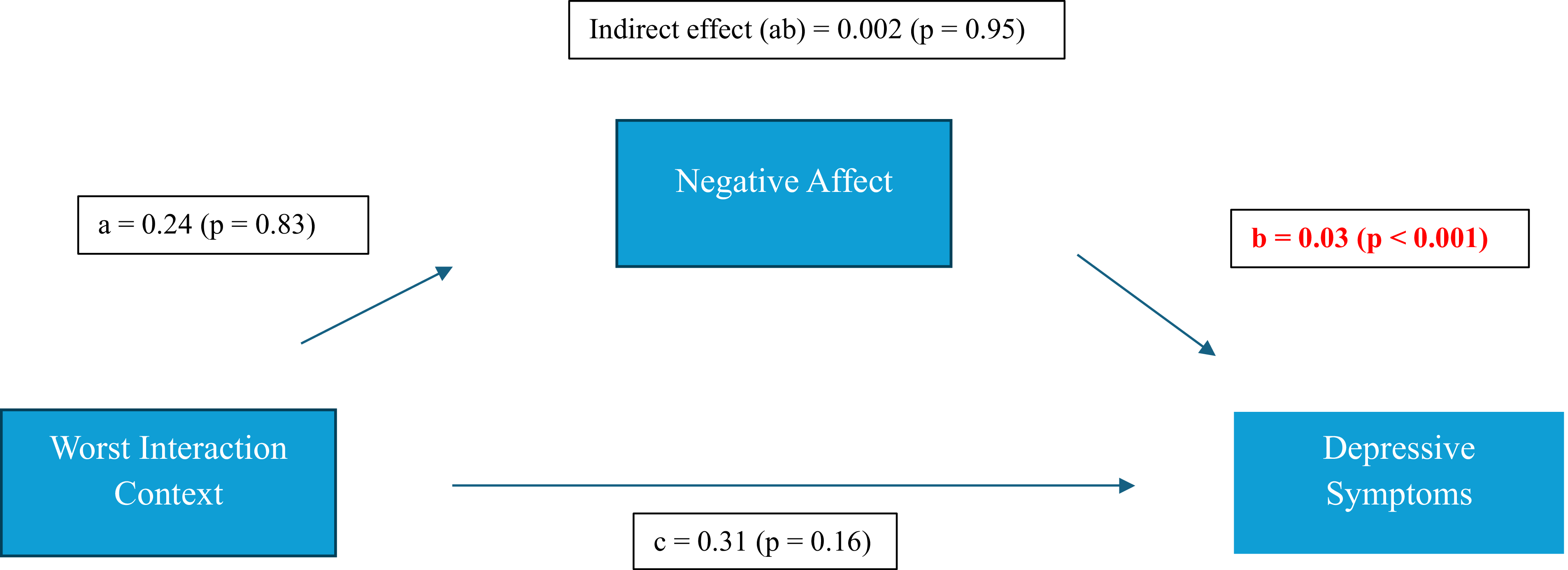
For negative peer interactions, we hypothesized that, at the within-person level, teens would experience higher momentary levels of negative affect during negative peer interactions (Hypothesis 1; Figure 1, path a) and higher depressive symptoms during the associated survey period (Hypothesis 2; Figure 1, path c), when the negative peer interaction occurred on digital media, compared to in-person. Further, we hypothesized that increased negative affect during negative peer interactions would have an indirect effect on the link between the context of negative peer interactions and depressive symptoms, such that greater negative affect during negative digital media interactions compared to in-person would be associated with higher levels of depressive symptoms during the same within-day survey period (Hypothesis 3; Figure 1, path ab).
Main model for negative peer interactions.
Note: Unstandardized coefficients are reported for each path with p-values in parentheses. Worst Interaction Context was coded as 0 = in-person and 1 = digital media.

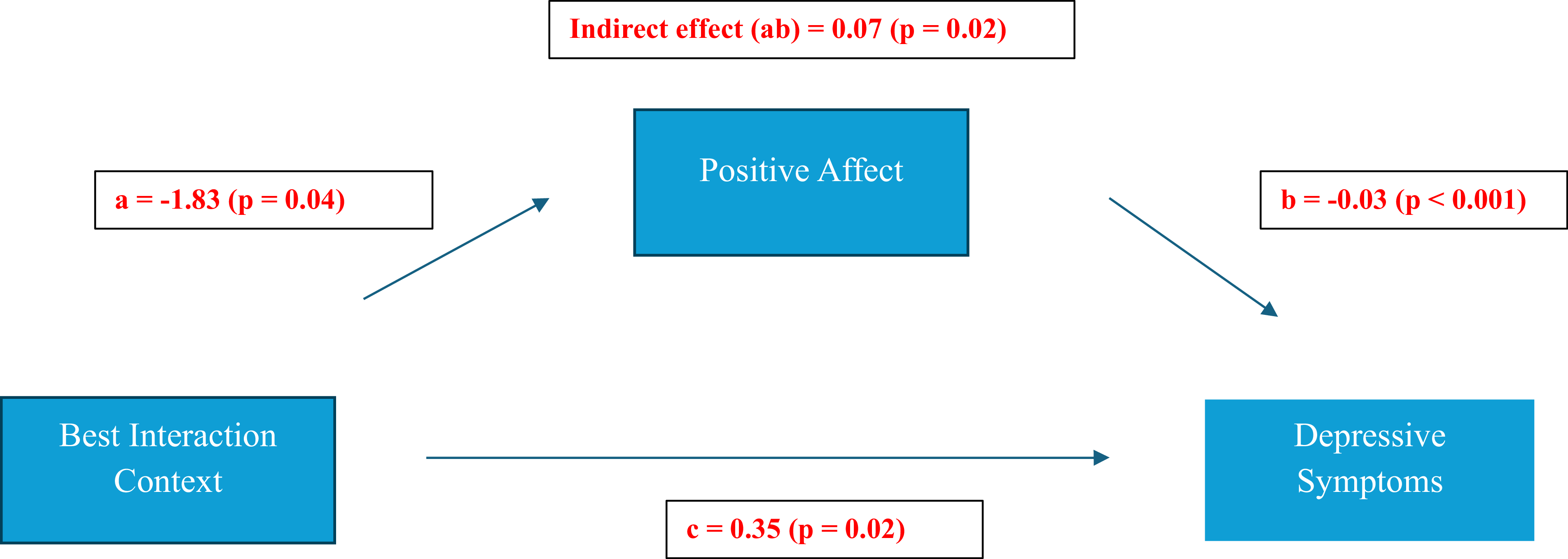
For positive peer interactions, we hypothesized that at the within-person level, teens would experience higher momentary levels of positive affect during positive peer interactions (Hypothesis 4; Figure 2, path a), and lower levels of depressive symptoms during the associated survey period (Hypothesis 5; Figure 2, path c), when the positive peer interaction occurred in-person, compared to digital media. We also hypothesized that increased positive affect during positive peer interactions would have an indirect effect on the link between the context of positive peer interactions and depressive symptoms, such that greater positive affect during positive in-person interactions compared to digital media would be associated with lower levels of depressive symptoms during the same within-day survey period (Hypothesis 6; Figure 2, path ab).
Main model for positive peer interactions.
Note: Unstandardized coefficients are reported for each path with p-values in parentheses. Best Interaction Context was coded as 0 = in-person and 1 = digital media.

Finally, we conducted exploratory analyses using a lagged design, examining whether interaction context and affect at time t predicted depressive symptoms at the subsequent assessment, t+1. Because these lagged analyses were underpowered, we present these analyses to inform future study designs, rather than as the main tests for our hypotheses.
Method
Participants
Participants from this study were drawn from the Teen Screen Time, Emotional Experiences and Neuroscience Study (Teen SCREEN Study), a longitudinal study investigating social experiences as potential risk factors for suicidality, self-harm and depressive symptoms in adolescent girls. The sample included 122 adolescents assigned female at birth ages 12–17. Participants were recruited from the broader community and outpatient clinics via flyers, online advertisements, and the University of Pittsburgh’s research portal. Sixty-nine percent (n = 82) of the sample was at high-risk for suicide based on one or more of the following; (a) recurrent suicidal ideation (including passive death wish) within the past 6 weeks, (b) five or more episodes of non-suicidal self-injury (NSSI) in the past year, or (c) suicide attempt in the past year. Additionally, to ensure variation in severity, at least 25% of participants were required to have had a suicide attempt in the past year, and no more than 25% of the high-risk participants could only report passive death wishes. The remaining low-risk participants (n = 40) had no history of self-injurious thoughts and behaviors.
Exclusion criteria for all participants included: inability to read and understand study procedures; lifetime presence of a neurological or serious medical condition; lifetime presence of a DSM-5 diagnosis of psychotic disorder or autism spectrum disorder; current severe substance use disorder; pregnancy; presence of MRI contraindications (braces, metal in body); presence of head injury or neurological anomalies; and history of a severe concussion where consciousness was lost for more than five minutes.
Procedure
The Teen SCREEN study was designed with multiple waves of data collection. The present analysis focuses on the first wave, during which participants completed a clinical interview visit consisting of a diagnostic interview, a series of online questionnaires, a laboratory visit, an fMRI scan visit, and a 30-day at-home EMA protocol. For the purposes of this study, all the measures described below are from the first wave, specifically from the at-home EMA protocol.
EMA protocol
Three 10-day EMA assessments over the course of three months – which spanned both school year and summer months for some participants depending on enrollment date – were conducted where participants received three prompts per day (morning, afternoon, and evening). The surveys were sent via WebDataExpress, a secure remote data collection platform, for 10 consecutive days at a time (six school days, four weekend days; starting on a Friday for all participants), for a total of 90 prompts. Morning prompts were delivered depending on participant-specific wake and school start times. Afternoon and evening prompts were randomly sent between 3:30–6:30 pm and 6:30–9:30 pm, respectively, and participants were given 60 minutes to complete each prompt before the survey expired. At each prompt, participants responded to a series of questions about their recent social interactions with peers, how they felt about those interactions and levels of depressive symptoms that they had experienced since the last prompt.
Because the study was oversampled for high-risk adolescents, and the EMA prompts assessed suicidal ideation, a safety protocol was in place throughout data collection. If participants endorsed suicidal ideation with method, intent, or preparatory behaviors, an on-call clinician contacted them to assess risk level and follow through with appropriate safety procedures.
Measures
Context of peer interactions
Participants reported their “best” and “worst” social interactions with their peers in response to the following question: “Of the interactions with other teens your age that occurred since [your last completed survey] (in-person or digital), can you think of one that made you feel the worst/best?” which are referred to here as positive and negative peer interactions. After briefly describing the nature of the interactions, participants indicated the context of the interaction (in-person vs. digital) with the following specific options for digital interactions: text or iMessage; DM using social media; viewing social media content; phone call without video; videochat (FaceTime, Skype, Zoom, webcam); gaming (discord, xbox live, playstation network, etc); group chat; and other (allowing for further free-text specification). For the purposes of these analyses, any interactions that occurred digitally, with the exception of audio-only phone calls, were included as digital media interactions, and the context of peer interactions was coded on a binary as 0 (in-person) or 1 (digital media).
For our study, “peer interactions” was defined broadly to include any engagement with peers even if asynchronous through digital media, given that this may be a primary mode through which digital media functions. To illustrate the range of peer interactions, example responses for negative in-person interactions included “during my lunch period, it felt like no one wanted to talk to me or be near me” and “I’m at my friends basketball game. She didn’t introduce me to any of her friends. She didn’t talk to me that much once she got here.” Example responses for positive in-person interactions included “my teammates cheered for me when I did a new thing at gymnastics.” or “I walked around with my friend and she makes me happy and i was laughing all morning.” For negative digital media interactions, examples included “My friends posted that they were hanging out and I wasn’t invited,” “Someone called me fat,” or “My friends did not reply to me on time, even though I did immediately,” while for positive digital media interactions, examples included “Someone liked my comment” or “My friend sent a funny tiktok.”
Additionally, participants were asked when the interaction took place with the following prompt: “When did this interaction occur?”; and were asked to choose from the following options: within the last 15 minutes; within the last 30 minutes; within the last hour; about 2 hours ago; about 3 hours ago; about 4 hours ago; today, but more than 4 hours ago; last night; yesterday during the day; before yesterday. We restricted our analyses to interactions that had occurred within four hours of the EMA prompts in order to minimize recall bias.
Depressive symptoms
Levels of depressive symptoms were assessed at each survey using the Patient Health Questionnaire (PHQ-9), with a modified EMA timeframe to assess the period between surveys instead of assessing the last two weeks. PHQ-9 is a nine-item self-report questionnaire asking participants to report how often they have been bothered by experiences such as “little interest or pleasure in doing things” and “feeling down, depressed or hopeless” rated on a scale of 0 (not at all), 1 (some of the time), 2 (about half of the time), and 3 (most of the time), since the last time they completed the survey. Total scores range from 0 to 27, with higher scores indicating higher levels of depressive symptoms.
Positive and negative affect during peer interactions
Participants also reported their positive (happy, joyful, excited, interested) and negative (sadness, worry, stress, anger) affect during the peer interactions on a sliding scale from 0 to 100 with the following question: “Please rate how you felt during this interaction.” Average of sums were computed for positive and negative affect separately in response to peer interactions.
Covariates
Each covariate was tested after running main models to determine significance levels (see Analytic Plan). Age was included as a covariate to account for developmental differences. To minimize recall bias, time elapsed since the event was included as a covariate. To account for differences in social interactions based on time of day and week, we included the within-person covariates of day of the week (dummy-coded as 0 = weekday, 1 = weekend) and time of day (0 = morning, 1 = afternoon, 2 = evening). Finally, because EMA procedures were completed in three different bursts over the course of three months, in order to account for potential variations based on burst timing, burst number was added as a covariate.
Analytic plan
All analyses were conducted in R (RStudio Team, 2023). First, we examined the means and standard deviations among all variables for normality and the assumptions of multilevel modeling. Then, bivariate correlations were computed between the primary study variables and frequencies of in-person versus social media negative and positive interactions.
Main analyses were completed using multilevel modeling to detect within-person changes in levels of depressive symptoms during survey periods in which participants reported positive and negative peer interactions. The multilevel models included random intercepts and slopes to allow for individual variability and were conducted separately for positive and negative peer interactions. For the main models, the context of the negative and positive peer interactions (digital media vs. in-person) was used as a binary independent variable, negative or positive affect during peer interactions was used as another predictor in the model, and depressive symptoms were used as the dependent variable, with aforementioned covariates. Figures 1 and 2 display the present study’s conceptual model. Path a in each model is in line with Hypotheses 1 and 4 and represents the direct effect of the context of peer interactions on negative or positive affect during the peer interactions. Patch c in each model represents the total relation between the context of peer interactions and survey-level depressive symptoms, in line with Hypotheses 2 and 5. The indirect effects in each model, which should be interpreted as exploratory associations rather than causal mediation pathways, are the products of path a and b (ab).
Finally, exploratory lagged analyses were conducted to examine whether interaction context and affect at time t predicted depressive symptoms at the subsequent assessment (t+1). Because lagged analyses require two consecutive valid prompts, the analytic sample for lagged analyses substantially decreased compared to the main models (see Missing Data section for full details). Due to this decrease in sample size, we conducted power analyses to assess whether the analyses were powered enough to detect lagged effects. Given that lagged effect sizes are consistently smaller than concurrent effect sizes in the literature, we estimated lagged effect sizes to be 20% smaller than our observed concurrent effects and used these as inputs for power analyses. Power to detect lagged effects ranged from 22% to 56% across models, well below the recommended 80% threshold (Cohen, Reference Cohen2013); therefore, these analyses should be interpreted with caution.
Results
Preliminary analyses
Missing data
Out of the initial 122 participants who completed the full 90-day EMA protocol, we obtained a total of 10,982 observations. The compliance rates for the first, second, and third bursts were 75.3%, 62.0%, and 54.6%, respectively. The compliance rates for the morning, afternoon, and evening surveys across the study were 65.1%, 59.9%, and 67.2% respectively. Overall average compliance rate was 64.2% with an average of 58 prompts (min = 5, max = 88) completed per participant. Two separate datasets were created to include data for the worst and best interactions.
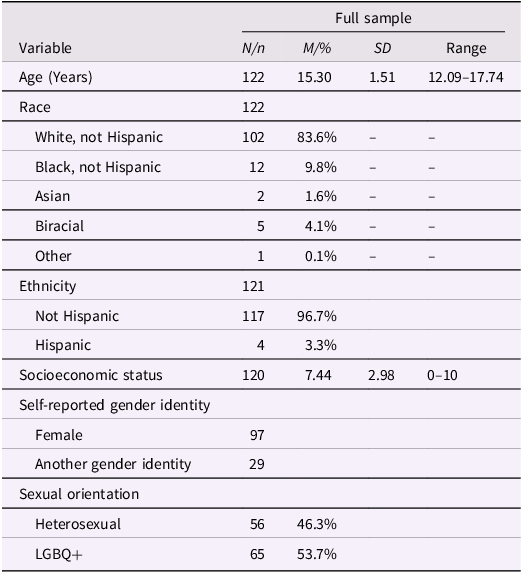
We first excluded any interactions teens reported having with a non-peer, resulting in 5,367 observations, and then excluded any interactions that occurred more than four hours prior to the prompt, resulting in 2,775 observations for the worst interaction dataset. We then excluded interactions that happened via audio-only phone calls (which are not generally classified as digital media; Faverio, & Sidoti, 2024; Rideout et al., Reference Rideout, Peebles, Mann and Robb2022), resulting in 2,752 observations. For the dataset including the best interactions, we applied the same exclusion criteria – non-peer interactions and those reported more than four hours after they occurred – resulting in 3,691 observations. After additionally excluding interactions that took place over phone calls, the dataset included 3,643 observations. Next, we excluded prompts that were missing PHQ-9 sum scores, leaving 2,747 observations for the worst interactions and 3,635 observations for the best interactions. Furthermore, because multilevel indirect effects models require at least two observations per participant, we excluded any participants who had only one data point: three participants were removed from the worst interaction dataset, and none were removed from the best interaction dataset. Finally, because the analyses focus on within-person fluctuations based on the context of interactions, we excluded participants who reported peer interactions occurring only in one context (i.e., either digital media or in-person), resulting in the exclusion of 13 participants for the worst interactions dataset, and 8 participants for the best interactions dataset. Therefore, the final analytic sample included 106 participants with 2,535 observations for worst interactions and 114 participants with 3,455 observations for best interactions. For worst interactions, the final prompts in the analytic sample included 37.2%, 32.7%, and 30.1% of available prompts in the first, second, and third burst, respectively, and 15.5%, 41.8%, and 32.7% in the morning, afternoon, and evening surveys respectively. For best interactions, the final prompts in the analytic sample included 38.7%, 32.0%, and 29.3% prompts in the first, second, and third burst, respectively, and 15.1%, 42.2%, and 42.7% in the morning, afternoon, and evening surveys respectively. Thus, emotional interactions were relatively evenly spread across bursts, but more likely to occur in afternoon and evening prompts compared to morning prompts, which makes sense given that adolescents may be more likely to interact with peers later in the day, both digitally and in-person. Descriptive statistics for the analytic sample which combines the two datasets are presented in Table 1.
Descriptives and frequencies

Table 1. Long description
A table with 12 rows and 5 columns presenting descriptive statistics and frequencies for a sample of participants. The columns are labeled Variable, Full sample, N/n, M/%, SD, and Range. The table includes data on age, race, ethnicity, socioeconomic status, self-reported gender identity, and sexual orientation. Each row provides specific values for these variables. For example, the age row shows an average age of 15.30 years with a standard deviation of 1.51, ranging from 12.09 to 17.74 years. The race row breaks down the sample into categories like White, not Hispanic (83.6%), Black, not Hispanic (9.8%), and others. The table also includes data on ethnicity, socioeconomic status, gender identity, and sexual orientation, with percentages and counts provided for each category.
Note: Percentages may not add up to 100% due to rounding. Risk status of “high risk” indicates participants who were recruited based on increased risk for depression and suicidality; “low risk” participants had no history of self-injurious thoughts and behaviors at the time of recruitment. Socioeconomic status was assessed on a scale from $0–$10,000 (1) to $100,000+ (10) for total family income. Gender was assessed with the following item: “Which term(s) best express how you describe your gender identity (Select all that apply).” Response options included female, male, nonbinary, transgender, “none of these describe me and I’d like to specify,” and “prefer not to answer.” Any participant who selected a response other than, or in addition to, “female” was categorized as having “another gender identity.” LGBQ+ included the following options: bisexual, pansexual, polysexual, lesbian, queer, “mostly straight but sometimes attracted to people of your own gender,” asexual, “questioning/unsure/in the process of figuring out your sexuality,” “none of these describe me and I’d like to specify,” and “prefer not to answer”.
For exploratory lagged analyses, we applied the following filters to the time t prompt: (1) excluding non-peer interactions, (2) excluding interactions that occurred more than four hours ago, (3) excluding phone calls which were not classified as digital media. The subsequent prompt (t +1) was required to have a valid PHQ-9 score. We also excluded prompt pairs with overnight lags to ensure that we were capturing short-term within-day fluctuations among variables of interest, which restricted analyses to subsequent within-day prompt pairs (morning to afternoon and afternoon to evening). Therefore, the analytic sample decreased from 119 participants with 2,744 observations to 109 participants with 1,269 observations for worst interactions, and from 122 participants with 3,635 observations to 115 participants with 1,654 observations for best interactions.
Descriptive analyses
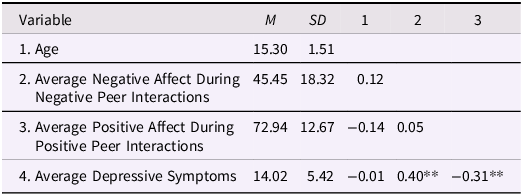
Table 3 displays descriptive statistics for all primary variables of interests and covariates. At the between-person level, depressive symptoms were negatively correlated with average positive affect during positive peer interactions (r = −.31, p < .001) and positively correlated with average negative affect during negative peer interactions (r = .40, p < .001).
Frequency of digital media versus in-person contexts for best and worst interactions

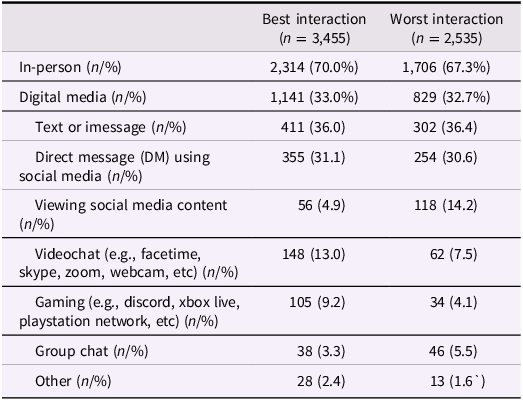
Table 2. Long description
A table comparing the frequency of digital media versus in-person contexts for best and worst interactions among teens. The table has 9 rows and 3 columns. The columns are labeled ‘Best interaction (n = 3,455)’, ‘Worst interaction (n = 2,535)’, and interaction types. The rows are labeled with different interaction types: In-person, Digital media, Text or imessage, Direct message (DM) using social media, Viewing social media content, Videochat, Gaming, Group chat, and Other. Each row shows the number and percentage of interactions for both best and worst interactions. For example, in-person interactions are 2,314 (70.0 percent) for best and 1,706 (67.3 percent) for worst. Digital media interactions are 1,141 (33.0 percent) for best and 829 (32.7 percent) for worst. Text or imessage interactions are 411 (36.0 percent) for best and 302 (36.4 percent) for worst. Direct message (DM) using social media interactions are 355 (31.1 percent) for best and 254 (30.6 percent) for worst. Viewing social media content interactions are 56 (4.9 percent) for best and 118 (14.2 percent) for worst. Videochat interactions are 148 (13.0 percent) for best and 62 (7.5 percent) for worst. Gaming interactions are 105 (9.2 percent) for best and 34 (4.1 percent) for worst. Group chat interactions are 38 (3.3 percent) for best and 46 (5.5 percent) for worst. Other interactions are 28 (2.4 percent) for best and 13 (1.6 percent) for worst.
Means, standard deviations, and correlations with confidence intervals

Table 3. Long description
The table presents descriptive statistics for primary variables and covariates. It has four rows and four columns. The columns are labeled Variable, M, SD, 1, 2, and 3. The rows are labeled with different variables and their corresponding values. Row 1: Age, M: 15.30, SD: 1.51. Row 2: Average Negative Affect During Negative Peer Interactions, M: 45.45, SD: 18.32, 1: 0.12. Row 3: Average Positive Affect During Positive Peer Interactions, M: 72.94, SD: 12.67, 1: -0.14, 2: 0.05. Row 4: Average Depressive Symptoms, M: 14.02, SD: 5.42, 1: -0.01, 2: 0.40**, 3: -0.31**. The table includes correlations with significance values indicated by asterisks.
Note: M and SD are used to represent mean and standard deviation, respectively. Values in square brackets indicate the 95% confidence interval for each correlation. The confidence interval is a plausible range of population correlations that could have caused the sample correlation (Cumming, 2014). *indicates p < .05. **indicates p < .01. Average Negative Affect During Negative Peer Interactions and Average Positive Affect During Positive Peer Interactions reflect participants’ mean ratings of affective responses (0–100 scale) to their most recent peer interactions: negative affect items included sadness, worry, stress, and anger; positive affect items included happy, joyful, excited, and interested. Average Depressive Symptoms reflects mean scores on the Patient Health Questionnaire (PHQ-9), to assess depressive symptoms since the last survey.
Table 2 displays the numbers of best and worst interactions reported across each context: teens reported having most of their most recent emotionally salient interactions in-person rather than via digital media. Of note, for worst interactions, participants reported an average of 16.1 (range: 1–49) in-person and an average of 7.82 (range: 1–33) digital interactions. For best interactions, participants reported an average of 20.3 (range: 1–62) in-person and an average of 10.0 (range: 1–43) digital interactions. Table 2 further displays the breakdown of different modalities of digital media interactions for those who reported having their interactions online. These results reveal that teens reported experiencing most of their emotionally salient interactions via text messaging, direct messaging on social media, followed by video chatting and viewing social media content.
Main models
Figure 1 displays the model used to test whether negative affect during negative peer interactions has an indirect effect on the association between the context of negative interactions and depressive symptoms. Contrary to Hypotheses 1 and 2, we found that teens did not experience significantly higher levels of momentary negative affect (a path; B = 0.24, p = .83) or depressive symptoms during the same survey period (c path; B = 0.31, p = .16) during negative peer interactions on digital media, compared to negative peer interactions in-person. We also did not find support for Hypothesis 3: negative affect did not statistically account for the relation between the context of negative peer interactions and depressive symptoms (ab path; B = 0.002, p = .95). However, there was a main effect of negative affect during peer interactions on depressive symptoms (B = 0.03, p < .001), such that, regardless of context, teens experienced increases from their typical levels of depressive symptoms during survey periods that contained negative interactions with peers. Direct and indirect path estimates are presented in Table 4.
Summary of main within-person results for negative and positive peer interactions adjusted for covariates

Table 4. Long description
The table presents data on the effects of different interaction contexts on depressive symptoms through mediating variables. It has two rows and ten columns. The columns are labeled as Model, Independent variable (IV), Mediating variable (MV), Dependent variable (DV), Effect of IV on MV (a), Effect of MV on DV (b), Direct effect of IV on DV (c’), Indirect effect (a x b), 95% CI for indirect effect, and Total effect (c). The rows are labeled as Model 1 and Model 2. Model 1: Worst interaction context, Negative Affect, Depressive Symptoms, 0.24 (1.12), 0.025 (0.004), 0.31 (0.21), 0.002 (0.04), -0.06-0.07, 0.31 (0.22). Model 2: Best interaction context, Positive Affect, Depressive Symptoms, -1.83 (0.86), -0.03 (0.01), 0.27 (0.15), 0.07 (0.03), 0.01-0.15, 0.35 (0.15).
Note: CI = confidence interval. Unstandardized coefficients are reported with standard errors in parentheses. IV and DV were person-mean-centered. Both models were adjusted for age, time elapsed since the interaction, time of day, day of week, and burst number. ***p < .001, **p < .01, *p < .05.
The main model testing whether positive affect has an indirect effect on the association between the context of positive interactions and depressive symptoms is displayed in Figure 2. In line with Hypothesis 4, we found that teens reported significantly higher levels of momentary positive affect during positive peer interactions in-person, compared to positive peer interactions on digital media (a path; B = −1.83, p = .04). Similarly, in line with Hypothesis 5, teens reported significantly lower levels of depressive symptoms during survey periods that contained positive peer interactions in-person, compared to positive peer interactions on digital media (c path; B = 0.35, p = .02). Furthermore, in line with Hypothesis 6, we found a significant effect of positive affect, such that positive affect was higher during in-person interactions compared to digital media interactions, which in turn partially accounted for the negative relation between the digital media context and depressive symptoms when included in the regression model (ab path; B = 0.08, p = .01). Direct and indirect path estimates are presented in Table 4.
Exploratory models
Given that the study was underpowered to detect lagged effects (power range: 22%–56%), the following results should be interpreted with caution. For negative interactions, there was not a significant association between context and subsequent negative affect (a path; B = −0.75, p = .60) or context and subsequent depressive symptoms (c path; B = −0.05, p = .81). There was also no indirect effect of negative affect on the link between the context and depressive symptoms (ab path; B = −0.01, p = .52). Similarly, for positive interactions, we did not find a significant association between context and subsequent positive affect (a path; B = −1.99, p = .08) or context and subsequent depressive symptoms (c path; B = 0.13, p = .56). There was not an indirect effect of positive affect on the association between the context and depressive symptoms (ab path; B = 0.04, p = .38).
Discussion
With the rise of digital media, adolescents’ social landscapes have shifted dramatically, raising questions about how peer interactions on digital media relate to mental health in teenagers’ daily lives. The current study examined the links between in vivo peer interactions and levels of affect and depressive symptoms in a sample of adolescents at high-risk for depression and suicidality. To our knowledge, this is the first study to assess the associations between peer interactions, affect and depressive symptoms in daily life in an adolescent population. When teens experienced more negative affect during a recent negative peer interaction, they also experienced higher levels of depressive symptoms during the same time period, supporting interpersonal theories of depression (Hames et al., Reference Hames, Hagan and Joiner2013; Rudolph et al., Reference Rudolph, Flynn, Abaied, Abela and Hankin2008), and extending the ecological validity of this work. However, neither negative affect nor depressive symptoms differed by the context of negative peer interactions (in-person vs. digital media). For positive peer interactions, while the context was not directly associated with levels of depressive symptoms, we found that in-person positive interactions were associated with greater positive affect compared to positive interactions on digital media, which in turn were associated with lower levels of depressive symptoms during the same survey period.
The finding that in-person positive interactions were associated with greater positive affect and lower levels of depressive symptoms compared to digital positive interactions may point to a mechanism through which social media use contributes to depressive symptoms: the benefits of peer interactions may be diminished when they occur on digital media. This possibility is in line with previous work that found positive interactions on social media are associated with lower levels of sustained positive affect compared to in-person interactions (Achterhof et al., Reference Achterhof, Kirtley, Schneider, Hagemann, Hermans, Hiekkaranta, Lecei, Lafit and Myin-Germeys2022; Hamilton et al., Reference Hamilton, Do, Choukas-Bradley, Ladouceur and Silk2021). Another EMA study found that when teens reported using social media, they also reported reduced positive affect compared to times when they were not using social media (Politte-Corn et al., Reference Politte-Corn, Dickey, Abitante, Pegg, Bean and Kujawa2024). Here, we extended this work and found that not only are positive digital media interactions associated with reduced positive affect, but this diminished positive affect may also serve as a pathway through which daily life depressive symptoms increase.
Notably, texting and messaging on social media were the two most common modalities for positive digital experiences, followed by videochatting, suggesting that the most positively salient interactions are those that are interactive in nature and involve reciprocal engagement. Thus, it is possible that positive interactions are commonly reported when teens are using digital media platforms to connect with others in a more personal and relational manner, even when they induce significantly less positive affect compared to in-person interactions. In line with these results, findings from a qualitative study suggest that teens most commonly report an increased sense of connection and closeness through such relational interactions on social media (Weinstein, Reference Weinstein2018). However, one study conducted with undergraduates found that although online social support was negatively associated with depressive symptoms, it was perceived as a weaker source of social connection compared to in-person social support (Cole et al., Reference Cole, Nick, Zelkowitz, Roeder and Spinelli2017). Another study conducted with young adults found that while face-to-face social support is associated with lower odds of depression, social support received through social media is associated with increased odds of depression (Shensa et al., Reference Shensa, Sidani, Escobar-Viera, Switzer, Primack and Choukas-Bradley2020). Therefore, although digital technologies can allow youth to engage in direct communication with others, digital interactions may still fall short in their positive emotional impact – potentially due to the unique qualities of digital media interactions such as lack of interpersonal cues, asynchronicity, and quantifiable features (Nesi et al., Reference Nesi, Choukas-Bradley and Prinstein2018a, Reference Nesi, Choukas-Bradley and Prinstein2018b).
Digital interactions often lack key interpersonal cues (e.g., facial expressions, vocal tone, pitch qualities or touch) – which makes it possible that the benefits of positive interactions such as emotional support, intimacy or trust are attenuated (Nesi et al., Reference Nesi, Choukas-Bradley and Prinstein2018a, Reference Nesi, Choukas-Bradley and Prinstein2018b). Even video chatting, which most closely mimics in-person communication by providing real-time responsiveness, facial expressions, and vocal tone, is limited by the lack of physical touch or embodiment of emotion, and potential lags in timing that can diminish the emotional intensity of interpersonal exchanges. Teens also report heightened awareness of their own appearances during videochats, which is linked to higher levels of depressive symptoms (Choukas-Bradley et al., Reference Choukas-Bradley, Maheux, Roberts, Hutchinson, Lu, Ladouceur and Silk2022), and may detract from positive feelings.
Similarly, the asynchronous nature of many digital interactions may limit the benefits of positive experiences. Unlike in-person interactions, which are generally immediate and responsive, texting or messaging often involves delays in communication that can reduce emotional closeness. For example, waiting for a reply can introduce uncertainty or lead to misinterpretation, making interactions feel more impersonal or less rewarding (Holtzman et al., Reference Holtzman, DeClerck, Turcotte, Lisi and Woodworth2017). Consistent with this idea, previous EMA work has found that there are small negative associations between digital technology use and friendship closeness, suggesting that interactions on social media may not necessarily foster emotional intimacy (Pouwels et al., Reference Pouwels, Valkenburg, Beyens, Van Driel and Keijsers2021). Additionally, qualitative research has shown that young adults perceive in-person interactions as deeper, richer and more intimate compared to social media interactions, likely due to the lack of real-time responsiveness online (Scott et al., Reference Scott, Stuart and Barber2022).
Lastly, the quantifiable digital media metrics such as number of likes, comments, and followers may further limit their positive emotional impacts by amplifying the salience of social evaluation and feedback. This quality has been associated with more engagement in upward social comparison, which has been linked to higher levels of depressive symptoms and lower life satisfaction (Nesi & Prinstein, Reference Nesi and Prinstein2015). However, it is worth noting that the majority of digital interactions in our sample involved texting, direct messaging, and video chatting, which may not have as many quantifiable features as viewing social media content. Thus, it is possible that other qualities discussed above (i.e., lack of interpersonal cues, or asynchronicity) may offer more meaningful explanations in the current study.
Another aspect to consider is that digital media presents a mix of simultaneous content and interactions. Even when positive exchanges happen between peers, they may be accompanied by unrelated or even negative content, which could lessen their emotional benefit. In contrast, in-person interactions may provide a more immersive and focused experience, allowing teens to be more present and emotionally engaged, thus enhancing their positive affect. The digital stress literature suggests that there are unique interpersonal demands of online environments. These include the pressure to remain constantly available, the need for peer approval, exposure to harmful or distressing content, and the passive consumption of media – all of which can serve as stressors for modern day adolescents (Nick et al., Reference Nick, Kilic, Nesi, Telzer, Lindquist and Prinstein2022; Winstone et al., Reference Winstone, Mars, Haworth and Kidger2023). Because all these experiences could simultaneously occur when using digital media, the overall emotional benefit of positive interactions may be diminished. In comparison, the personal attention and emotional salience of in-person interactions may more effectively support the development of positive affect.
Regarding negative interactions, we found that negative affect during peer interactions was similar across both social media and in-person contexts. Additionally, regardless of context, negative affect during negative peer interactions was associated with increased levels of depressive symptoms in daily life. This finding aligns with interpersonal theories of depression, which suggest that negative interpersonal experiences, such as feelings of rejection, contribute to the development, maintenance, and chronicity of depressive symptoms (Alden & Phillips, Reference Alden and Phillips1990; Gotlib et al., Reference Gotlib, Krasnoperova, Yue and Joormann2004; Hames et al., Reference Hames, Hagan and Joiner2013; Van Orden et al., Reference Van Orden, Witte, Cukrowicz, Braithwaite, Selby and Joiner2010). Our findings are also consistent with developmental changes in adolescence, a period marked by increased importance of peer relationships, during which social experiences become especially salient for emotional well-being (Bukowski & Adams, Reference Bukowski and Adams2005; Hankin et al., Reference Hankin, Young, Abela, Smolen, Jenness, Gulley, Technow, Gottlieb, Cohen and Oppenheimer2015). Previous longitudinal work with adolescents has shown that negative peer interactions may predict depressive symptoms over time through a variety of neurological, psychological and cognitive mechanisms (Buck & Dix, Reference Buck and Dix2012; La Greca & Harrison, Reference La Greca and Harrison2005; Prinstein & Aikins, Reference Prinstein and Aikins2004; Silk et al., Reference Silk, Siegle, Lee, Nelson, Stroud and Dahl2014). In line with this work, our study shows that the negative affect that teens experience during negative peer interactions is associated with depressive symptoms in real life.
Importantly, while we predicted that in-person negative interactions would be more strongly associated with depressive symptoms and negative affect compared to digital media, we found that there were no contextual differences. This suggests that negative interactions on digital media are on average just as emotionally impactful as those happening face-to-face, but not more impactful. Notably, the two most common modalities for negative peer interactions on digital media were texting and messaging on social media, followed by viewing social media content. Texting and messaging on social media remain visible for a long time, potentially making them harder to forget or disengage from and thereby generating negative affect more frequently than other modalities. For our study “peer interactions” was defined broadly to include any engagement with peers even if asynchronous, given that this is a primary mode through which digital media functions. Thus, while it includes active real-time engagement such as video chatting, it might also include viewing of a post previously made by a peer or waiting on a response from a peer to one’s own text message or post. Although viewing social media content may be qualitatively different from more interactive forms of digital media engagement, participants self-identified these experiences as emotionally salient peer interactions. Research on social comparison and fear of missing out processes suggest that even passive exposure to peer content on social media may have implications for affect and well-being (Burnell et al., Reference Burnell, George, Vollet, Ehrenreich and Underwood2019). Nevertheless, it would be useful for future research to further break down the effects of digital peer interactions that occur synchronously versus asynchronously. It is also plausible that teens are commonly exposed to negative content they would not be seeking otherwise due to the algorithmic nature of social media (Nesi et al., Reference Nesi, Choukas-Bradley and Prinstein2018b). Ultimately, even if for different reasons, negative peer interactions regardless of context are meaningfully associated with adolescents’ momentary emotional states and mental health in real time.
Strengths and limitations
The current study offers many strengths related to methodologies and novelty. First, by utilizing EMA procedures, we were able to capture real-time data on peer interactions, associated affect, and depressive symptoms, with a dynamic and ecologically valid perspective. Of note, this is the first study, to our knowledge, to assess depressive symptoms in daily lives of high-risk adolescents. Further, the use of a high-risk sample while investigating peer dynamics and depressive symptoms allowed us to observe greater variability in negative peer experiences, affective reactivity, and depressive symptoms.
Despite these strengths, our study also has several limitations to consider. First, our use of a high-risk, assigned female at birth sample may limit the generalizability of our findings to youth on a broader level. While the use of a high-risk sample ensured increased variability in our variables of interest, we were not able to explore model differences based on degree of suicidality due to high collinearity between suicidality and depressive symptoms. Future work should examine how findings may differ between youth with and without suicidality, and in other high-risk and clinical samples. Furthermore, about half of our sample identified as sexual and gender minority (SGM) youth, which may also reduce generalizability. Although this is beyond the scope of this study, due to these sample characteristics, it is possible that participants had more supportive digital experiences (e.g., SGM youth seeking affirmation and connection online), or conversely, they may have encountered more negative experiences than their low-risk peers (e.g., experiences of discrimination or rejection). Future work should replicate these findings in other adolescent samples. Notably, our proportion of SGM participants is similar to those of other recently recruited samples of high-risk participants (Arango et al., Reference Arango, Brent, Grupp-Phelan, Barney, Spirito, Mroczkowski, Shenoi, Mahabee-Gittens, Casper and King2024; Bettis et al., Reference Bettis, Thompson, Burke, Nesi, Kudinova, Hunt, Liu and Wolff2020; Cafferty et al., Reference Cafferty, Leonard, Gillette, Bagg, Haasz, O’Leary and Ambroggio2024).
Importantly, our study assessed peer interactions across digital media as a single category, rather than distinguishing between specific types of media (e.g., direct messaging, viewing content on specific platforms, video chatting), which limits our ability to draw conclusions about unique effects of specific digital media platforms or communication methods. While some prior work has shown that different forms of digital media engagement have different associations with adolescents’ well-being (Garrett et al., Reference Garrett, Burnell, Armstrong-Carter, Prinstein and Telzer2023; James et al., Reference James, Silk, Scott, Hutchinson, Wang, Sequeira, Lu, Oppenheimer and Ladouceur2023), there has also been a growing call to assess subjective experiences of digital interactions and to understand their links to adolescent well-being (Choukas-Bradley et al., Reference Choukas-Bradley, Kilic, Stout and Roberts2023; Hamilton et al., Reference Hamilton, Nesi and Choukas-Bradley2022; Maheux et al., Reference Maheux, Burnell, Maza, Fox, Telzer and Prinstein2025). For that reason, we focused on the unique question of how person-specific peer interactions via digital media make adolescents feel and relate to depressive symptoms, in comparison to in-person interactions. We allowed adolescents to nominate their own emotionally charged peer interactions on digital media regardless of platform. It is also important to note that adolescents often use different types of digital media for similar purposes (e.g., messaging and video chatting on social media platforms), therefore the distinctions between platforms have become somewhat blurred, and knowing media type may be less informative than knowing what participants are doing within the media (e.g., interacting with peers). However, future work should examine how the associations observed about affect and depressive symptoms in this study may vary specifically across different types of digital media.
Further, data about peer interactions and affective responses were collected retrospectively at each prompt, and the study design did not provide the appropriate temporal sequence among our primary predictors and outcomes to indicate directionality or causality. Participants reported on a specific event and their affect during the event, while their depressive symptoms were assessed based on how frequently they had experienced them since the last prompt, which could also encompass the period before the reported peer interaction. Thus, while our findings are an important first step in identifying potential pathways between our study variables, our indirect effects analyses should be interpreted as a series of associations or covariances, rather than as evidence for a mechanistic process. Although we present the lagged analyses preliminarily, null effects in the context of low power should be interpreted cautiously as they may reflect insufficient statistical power rather than absence of associations. Conducting bidirectional lagged models examining the direction of effects between digital and in-person interactions, affect, and depressive symptoms within a protocol that includes more intensive within-day sampling (e.g., five to six prompts per day with distinct temporal ordering of peer interactions, affect and depressive symptoms) would be an important future direction for increasing statistical power and disentangling the direction of effects. With the current design, we cannot rule out the possibility that participants’ depressive symptoms prior to their peer interactions influenced whether the interaction was perceived as positive or negative, as well as affective responses to the interactions. Furthermore, we cannot establish that depressive symptoms were caused by peer interactions rather than pre-existing symptom levels.
Additionally, the overall compliance rate for the EMAs was below the target threshold of 70% (Heron et al., Reference Heron, Everhart, McHale and Smyth2017), which may be due to the high-risk nature of the sample. While previous EMA work conducted with various high-risk populations also reported similarly low compliance rates and patterns (Esposito et al., Reference Esposito, Duan, Kearns, Kleiman, Conwell and Glenn2022; Heron et al., Reference Heron, Everhart, McHale and Smyth2017; Van Roekel et al., Reference Van Roekel, Keijsers and Chung2019), future work should aim to increase these compliance rates, especially considering the challenges of collecting time-intensive data with high-risk populations, and replicate these findings with more data points (Glenn et al., Reference Glenn, Kleiman, Kandlur, Esposito and Liu2022; Vachon et al., Reference Vachon, Viechtbauer, Rintala and Myin-Germeys2019). Finally, our variables and methods relied on self-report only, raising the possibility of common method variance, which could inflate some of these observed associations. Future work may benefit from using multiple informants, and behavioral and observational measures to address this concern.
Conclusion and implications
This study provides unique insight into ongoing research efforts to identify whether digital media may be contributing to the mental health crisis in teens. Our findings suggest that positive in-person peer interactions are associated with more positive affect and lower levels of depressive symptoms highlighting a potential mechanistic association that should be tested in future research. Further, rather than digital negative interactions being inherently more harmful, it may be the absence of emotionally rewarding in-person experiences that contributes to elevated depressive symptoms. Of note though, the majority of reported positive and negative interactions in our study occurred in-person, despite ongoing concerns about teens’ high engagement with digital platforms. Altogether, these findings raise the following possibilities: (a) teens are not experiencing as many emotionally meaningful interactions on digital media compared to their in-person interactions, and (b) most of the emotionally salient interactions on digital media still involve direct communication with peers, especially for positive interactions.
Therefore, these findings have important implications for intervention as well: efforts may be directed toward increasing in-person social connectedness or designing social media features that better mimic the emotionally rewarding qualities of in-person interactions such as immersive virtual reality that would increase the levels of embodied emotion (Kruzan, & Won, Reference Kruzan and Won2019). Further, this study adds to the ongoing research efforts to disentangle the links between social media experiences and well-being in youth and highlights the importance of focusing on unique experiences on digital spaces.
Data availability statement
The code that supports the findings of this study is available on: https://osf.io/eu95y/overview?view_only=abebfa64897d43c1b5718c8b0a3c9329Data are being prepared for submission to the NIMH Data Archive where they will be publicly available. The materials that support the findings of this study will be available on OSF at the conclusion of the larger study.
Acknowledgements
We are thankful to the families who participated in this research and we greatly appreciate the assistance of research assistants, project coordinators, and graduate researchers for their contributions to the project.
Funding statement
This project was supported by the National Institute of Mental Health R01 MH124866 (MPIs J. S. Silk and C. D. Ladouceur).
Competing interests
JN writes Techno Sapiens, a psychology newsletter for which she receives subscription and sponsor payments. She is co-owner of Tech Without Stress, LLC, which provides free and paid resources for parents raising children in the digital age. On behalf of all authors, the corresponding author states that there is no other conflict of interest.
Pre-registration statement
The design of the larger study was preregistered on: https://osf.io/f6d7w However, the specific analyses of the current paper were not preregistered.


 Open access

