





Introduction
Attention-Deficit/Hyperactivity Disorder (ADHD) is a highly prevalent mental health condition, affecting an estimated 5.9% of children and 2.8% of adults worldwide (Faraone et al., Reference Faraone, Banaschewski, Coghill, Zheng, Biederman, Bellgrove, Newcorn, Gignac, Al Saud, Manor, Rohde, Yang, Cortese, Almagor, Stein, Albatti, Aljoudi, Alqahtani, Asherson and Wang2021). It is characterized by persistent patterns of inattention, hyperactivity, and impulsivity that cause significant impairment (American Psychiatric Association, 2013). ADHD is often accompanied by other mental health problems (both internalizing and externalizing) and, if inadequately treated, predicts poor outcomes (American Psychiatric Association, 2013; Cherkasova et al., Reference Cherkasova, Roy, Molina, Scott, Weiss, Barkley, Biederman, Uchida, Hinshaw, Owens and Hechtman2022; Faraone et al., Reference Faraone, Banaschewski, Coghill, Zheng, Biederman, Bellgrove, Newcorn, Gignac, Al Saud, Manor, Rohde, Yang, Cortese, Almagor, Stein, Albatti, Aljoudi, Alqahtani, Asherson and Wang2021). Beyond these co-occurring mental health problems, ADHD is associated with contextual risk factors such as more conflicted parent–child relationships, and increased parental stress and psychopathology (Deault, Reference Deault2010; Thapar et al., Reference Thapar, Cooper, Eyre and Langley2013; Văidean et al., Reference Văidean, Dobrean, Predescu, Yap and Georgescu2025). Such adverse family environments are known to hinder the development of secure attachment (De Wolff & Van Ijzendoorn, Reference De Wolff and Van Ijzendoorn1997), suggesting that children exhibiting ADHD-related behavior may be more likely to develop insecure attachment.
Attachment reflects an inborn system motivating children to seek care from caregivers in moments of distress (Bowlby, Reference Bowlby1969). When caregivers respond sensitively and consistently, children develop trust in their availability, ultimately leading to a secure attachment representation (Ainsworth et al., Reference Ainsworth, Blehar, Waters and Wall1978; Bowlby, Reference Bowlby1973, Reference Bowlby1988). Conversely, repeated experiences of caregiver inconsistency or unavailability may lead to insecure attachment, reflected in ambivalent (i.e., heightened focus on the caregiver to ensure availability following inconsistent responsiveness) or avoidant behavioral patterns (i.e., directing attention away from the caregiver to minimize anticipated rejection after consistently unsupportive responses) (Ainsworth et al., Reference Ainsworth, Blehar, Waters and Wall1978; Cassidy & Shaver, Reference Cassidy and Shaver2018; Main & Solomon, Reference Main, Solomon, Brazelton and Yogman1986). Insecure attachment has been linked to a wide range of adverse outcomes, including internalizing and externalizing mental health problems (Bosmans & Borelli, Reference Bosmans and Borelli2022; Madigan et al., Reference Madigan, Brumariu, Villani, Atkinson and Lyons-Ruth2016). Emerging evidence also suggests that insecure attachment may affect (the intensity of) ADHD-related behavior (e.g., Ladnier & Massanari, Reference Ladnier and Massanari2000; Roskam et al., Reference Roskam, Stievenart, Tessier, Muntean, Escobar, Santelices, Juffer, Van Ijzendoorn and Pierrehumbert2014; Wylock et al., Reference Wylock, Borghini, Slama and Delvenne2023), for instance through weaker self-regulation skills essential for attention and behavioral control (Barkley & Murphy, Reference Barkley and Murphy2011; Cavicchioli et al., Reference Cavicchioli, Stefanazzi, Tobia and Ogliari2022).
Empirical research in both non-clinical and clinical ADHD samples has indeed documented significant associations between ADHD behavior and insecure attachment (e.g., Al-Yagon et al., Reference Al-Yagon, Forte and Avrahami2020; Cavicchioli et al., Reference Cavicchioli, Stefanazzi, Tobia and Ogliari2022; Dekkers et al., Reference Dekkers, Hornstra, Van Den Hoofdakker, De Jong, Schaaf, Bosmans and Van Der Oord2021; Rasmussen et al., Reference Rasmussen, Elmose, Lien, Musaeus, Kirubakaran, Ribeiro and Storebø2022; Storebø et al., Reference Storebø, Rasmussen and Simonsen2016; Wylock et al., Reference Wylock, Borghini, Slama and Delvenne2023). Herein, authors have suggested the plausibility of associations in both directions – i.e., ADHD-related behavior complicating secure attachment development and insecure attachment contributing to ADHD behavior (Al-Yagon et al., Reference Al-Yagon, Forte and Avrahami2020; Cavicchioli et al., Reference Cavicchioli, Stefanazzi, Tobia and Ogliari2022; Dekkers et al., Reference Dekkers, Hornstra, Van Den Hoofdakker, De Jong, Schaaf, Bosmans and Van Der Oord2021; Wylock et al., Reference Wylock, Borghini, Slama and Delvenne2023).
From one perspective, ADHD-related behaviors may interfere with the development of secure attachment. Characteristics such as inattention, hyperactivity, and impulsivity – often accompanied by greater emotional lability – may evoke more negative reactions from the environment and consequently increase children’s stress levels (French et al., Reference French, Nalbant, Wright, Sayal, Daley, Groom, Cassidy and Hall2024; Staff et al., Reference Staff, Oosterlaan, van der Oord, de Swart, Imeraj, van den Hoofdakker and Luman2023; Van der Oord et al., Reference Van der Oord, Tripp, Dekkers, Vandycke, Verschueren, Hulsbosch, Houbrechts, Van de Weyer, Danckaerts, Vertessen and Bosmans2026; Van Liefferinge et al., Reference Van Liefferinge, Sonuga-Barke, Danckaerts, Van Broeck and van der Oord2021). As a result, children with ADHD may more frequently turn to their parents for support than children without ADHD. However, this increased need may not always be met in a sensitive and timely manner. Parents of children with ADHD are themselves at increased risk for higher parental stress, ADHD, and other forms of psychopathology due to shared genetic and environmental risk (Cheung & Theule, Reference Cheung and Theule2016; Faraone & Larsson, Reference Faraone and Larsson2019; Wiener et al., Reference Wiener, Biondic, Grimbos and Herbert2016). This may in turn limit their ability to respond sensitively to their child’s heightened support needs. Consistent with this, studies have shown that ADHD is associated with more conflicted parent–child relationships, parental hostility, and inconsistent parenting (Deault, Reference Deault2010; Thapar et al., Reference Thapar, Cooper, Eyre and Langley2013; Văidean et al., Reference Văidean, Dobrean, Predescu, Yap and Georgescu2025). Together, this mismatch between children’s needs and caregiver responses may hinder the development of secure attachment.
From another perspective, insecure attachment may contribute to ADHD-related behavior, as attachment theory emphasizes the importance of early parent–child relationships in the development of different self-regulation capacities (emotional, attentional, and behavioral) (Cavicchioli et al., Reference Cavicchioli, Stefanazzi, Tobia and Ogliari2022; Mikulincer et al., Reference Mikulincer, Shaver and Pereg2003). Difficulties in these self-regulatory processes have been implicated in ADHD-related behavior (Barkley, Reference Barkley2015; Roskam et al., Reference Roskam, Stievenart, Tessier, Muntean, Escobar, Santelices, Juffer, Van Ijzendoorn and Pierrehumbert2014). For example, Roskam et al. (Reference Roskam, Stievenart, Tessier, Muntean, Escobar, Santelices, Juffer, Van Ijzendoorn and Pierrehumbert2014) showed that greater exposure to early attachment deprivation in adoptees predicted higher levels of ADHD characteristics later in development, with effects specific to ADHD rather than general psychopathology. Taken together, these perspectives suggest a potentially bidirectional association between ADHD behavior and attachment (in)security.
Despite these different hypotheses concerning underlying mechanisms and directionality, the evidence base, however, remains limited and is characterized by considerable methodological constraints. These include limitations in design (i.e., cross-sectional designs with absent bidirectional modelling), conceptual framework (i.e., limited consideration of ODD behavior as possible explanatory factor, minimal attention to biological sex-specific patterns, and a lack of research focusing on middle childhood), and measurement (i.e., reliance on single or outdated attachment measures). The current study addresses these limitations by (1) employing a longitudinal design, (2) accounting for ODD behavior, (3) considering biological sex differences, (4) focusing on middle childhood, and (5) using multi-method attachment assessment, with the rationale for each of these methodological choices outlined in more detail below.
First, longitudinal research is needed, as the directionality of the association between ADHD behavior and insecure attachment remains untested. One small two-wave study of children with ADHD (N = 31) found that rates of insecure attachment were markedly higher than those typically observed in the general population (85% vs. approximately 38%) and further increased over a three-year period (i.e., to 90%; Rasmussen et al., 2022). These findings raise the possibility that ADHD-related difficulties may interfere with the development or maintenance of secure attachment. On the other hand, prospective research (for a review see Cavicchioli et al., Reference Cavicchioli, Stefanazzi, Tobia and Ogliari2022) provides some support for the opposite direction. For example, Thorell et al. (Reference Thorell, Rydell and Bohlin2012) found that attachment disorganization at T1 was associated with higher levels of ADHD characteristics one year later (T2). However, no work has assessed both constructs (i.e., ADHD behavior and attachment (in)security) across multiple waves in a way that allows for the direct testing of bidirectionality, leaving the temporal ordering of effects unknown. Moreover, both ADHD-related behavior and attachment show meaningful variability over time rather than displaying the fixed stability often assumed in earlier work, further underscoring the need for longitudinal modelling (Franke et al., Reference Franke, Michelini, Asherson, Banaschewski, Bilbow, Buitelaar, Cormand, Faraone, Ginsberg, Haavik, Kuntsi, Larsson, Lesch, Ramos-Quiroga, Réthelyi, Ribases and Reif2018; Grevet et al., Reference Grevet, Bandeira, Vitola, de Araujo Tavares, Breda, Zeni, Teche, Picon, Salgado, Karam, da Silva, Sibley, Rohde, Cupertino, Rovaris and Bau2024; Norman et al., Reference Norman, Price, Ahn, Sudre, Sharp and Shaw2023; Sibley et al., Reference Sibley, Arnold, Swanson, Hechtman, Kennedy, Owens, Molina, Jensen, Hinshaw, Roy, Chronis-Tuscano, Newcorn, Rohde and Group2022; Verhees et al., Reference Verhees, Ceulemans, Finet, van IJzendoorn, Bakermans-Kranenburg and Bosmans2023; Waters et al., Reference Waters, Yang, Finet, Verhees and Bosmans2022).
Second, the nature of the link between ADHD behavior and attachment insecurity remains debated. Some studies suggest that this association is not specific to ADHD but explained by comorbid oppositional behavioral problems (Franke et al., Reference Franke, Michelini, Asherson, Banaschewski, Bilbow, Buitelaar, Cormand, Faraone, Ginsberg, Haavik, Kuntsi, Larsson, Lesch, Ramos-Quiroga, Réthelyi, Ribases and Reif2018; Wylock et al., Reference Wylock, Borghini, Slama and Delvenne2023), whereas other studies report persistent associations after controlling for ODD (e.g., Dekkers et al., Reference Dekkers, Hornstra, Van Den Hoofdakker, De Jong, Schaaf, Bosmans and Van Der Oord2021; Thorell et al., Reference Thorell, Rydell and Bohlin2012). Including ODD is essential to determine whether insecure attachment relates uniquely to ADHD behavior or reflects broader behavioral difficulties.
Third, prior research has often overlooked biological sex differences, as most existing ADHD research – and thus much of what is known about the ADHD behavior-attachment link – is based on boys. Given that boys and girls frequently show different ADHD behavior – girls more often meeting the inattentive and boys more often the combined presentation – it remains unclear whether associations with attachment insecurity generalize across biological sexes (e.g., Gaub & Carlson, Reference Gaub and Carlson1997; Willcutt, Reference Willcutt2012). Sex-related patterns have also been reported in attachment development, with some studies reporting higher avoidance in boys and more ambivalent patterns in girls, although findings are inconsistent (e.g., Bakermans-Kranenburg & van IJzendoorn, Reference Bakermans-Kranenburg and van IJzendoorn2009; Del Giudice, Reference Del Giudice2019). Considering biological sex is therefore essential to determine whether the association between ADHD behavior and attachment insecurity is similar for boys and girls.
Fourth, research in middle childhood is scarce despite the developmental importance of this period for both constructs. Middle childhood involves major neural maturation associated with changes in self-regulation relevant to ADHD and is characterized by significant shifts in attachment functioning from reliance on physical proximity toward a greater emphasis on emotional availability of the caregiver (e.g., Heylen et al., Reference Heylen, Budniok, Van de Walle, De Raedt, Bijttebier, De Winter and Bosmans2024; Waters et al., Reference Waters, Yang, Finet, Verhees and Bosmans2022). Studying this developmentally relevant period is therefore crucial to understand how ADHD behavior and attachment insecurity relate.
Finally, attachment can be assessed with a wide range of tools, broadly categorized into implicit measures (e.g., story stem tasks) and explicit measures (e.g., questionnaires) (Bosmans & Kerns, Reference Bosmans and Kerns2015). A key distinction between these approaches concerns the extent to which children can strategically influence their responses, with implicit measures aiming to assess attachment processes at a less strategic level and explicit measures capturing children’s more deliberate self-reports of attachment-related experiences and perceptions. Although conceptually related, these methods show only modest correlations (Petrowski et al., Reference Petrowski, Imhoff, Schmalbach, Strauß and Banse2025; Wylock et al., Reference Wylock, Borghini, Slama and Delvenne2023). In addition, methodological characteristics of these measurement methods may systematically influence outcomes. Explicit measures may be more susceptible to social desirability and positive illusory biases, thereby yielding relatively more positive representations of attachment, whereas implicit measures may be more susceptible to inflation of insecurity scores due to overlap between indicators of insecure (particularly disorganized) attachment and hyperactive or impulsive behavior (Dekkers et al., Reference Dekkers, Hornstra, Van Den Hoofdakker, De Jong, Schaaf, Bosmans and Van Der Oord2021; Scholtens et al., Reference Scholtens, Rydell, Bohlin and Thorell2014). These factors may be particularly relevant in populations with more ADHD behaviors, as positive illusory biases are commonly reported, and hyperactivity/impulsivity constitute core behavioral manifestations of the condition (Volz-Sidiropoulou et al., Reference Volz-Sidiropoulou, Boecker and Gauggel2016). Consequently, a multi-method assessment – the concurrent use of multiple attachment instruments within the same sample – is essential for capturing a more comprehensive picture of children’s attachment (Bosmans & Kerns, Reference Bosmans and Kerns2015; Hornstra et al., Reference Hornstra, Bosmans, Van Den Hoofdakker, De Meyer and Van Der Oord2019).
The current study addressed these gaps through three research questions, using Random Intercept Cross‑Lagged Panel Models (RI‑CLPMs), which distinguish stable between‑person differences from within‑person changes, allowing more precise estimation of prospective associations (Hamaker et al., Reference Hamaker, Kuiper and Grasman2015). We examined the longitudinal relation between ADHD behavior and children’s attachment (in)security in middle childhood and hypothesized both cross‑sectional and longitudinal associations, including bidirectional cross‑lagged effects (RQ1). ODD behavior was included in all models to test whether associations persisted after accounting for broader externalizing problems, and although we expected associations to attenuate when accounting for ODD behavior, we hypothesized that the core ADHD-attachment links would remain (RQ2). We examined biological sex differences, hypothesizing weaker associations between ADHD and insecure attachment among girls, given that girls’ ADHD behavior tends to be less overt and externalizing (RQ3). Throughout all models, attachment was assessed in a multi-method approach, combining implicit (Middle Childhood Attachment Script Assessment) and explicit (questionnaires) measures. Based on prior evidence, we expected larger effects for the implicit assessment (Dekkers et al., Reference Dekkers, Hornstra, Van Den Hoofdakker, De Jong, Schaaf, Bosmans and Van Der Oord2021; Hornstra et al., Reference Hornstra, Bosmans, Van Den Hoofdakker, De Meyer and Van Der Oord2019).
Method
Participants and procedure
The data were collected as part of the larger longitudinal Methylation in Development (MIND) project which investigates social and emotional development during the transition from childhood to adolescence. Families were informed about the study through letters distributed in schools, public places, and via social media. Data were collected in the Dutch-speaking region of Belgium. Data were available for 614 children at Wave 1 (M age = 10.28, SD = 0.58, range 9–12; 44% boys, 54% girls), 470 at Wave 2 (M age = 11.28, SD = 0.61, range 10–13; 44% boys, 54% girls), and 385 at Wave 3 (M age = 12.01, SD = 0.58, range 10–14; 45% boys, 54% girls). Attrition analyses are reported in Supplementary File 1. Mother-reported data were available for 65, 50, and 52% of children at Waves 1, 2, and 3, respectively. Most children lived with cohabiting biological parents (73% at Waves 1–2, 74% at Wave 3). The majority identified as Belgian (87, 94, and 96% at Wave 1, 2, and 3), with a small subset reporting another nationality (10, 8, and 4%, respectively).
Prior to participation, parents provided active informed consent, and children provided informed assent. Children’s attachment, ADHD behavior, and ODD behavior were assessed at three waves, each separated by one year. Data was collected through home visits, at the research center, or in schools between 2017 and 2021. Children received a small reward as compensation for participation. The study procedure was approved by the Ethics Committee Research UZ/KU Leuven (protocol number: S60215).
Measures
Attachment
Trust in mother. Children’s trust in maternal availability and support was assessed using the trust scale of the People in My Life questionnaire (PIML; Ridenour et al., Reference Ridenour, Greenberg and Cook2006). Previous research has demonstrated strong reliability, construct validity, and a stable factor structure for the PIML (Ridenour et al., Reference Ridenour, Greenberg and Cook2006). The subscale includes 10 items (e.g., “My mother accepts me the way I am”) which are rated on a 4-point scale from 1 (not at all true) to 4 (completely true). Cronbach’s alpha was 0.84 at Wave 1, 0.87 at Wave 2, and 0.91 at Wave 3.
Insecure attachment. Attachment anxiety and avoidance toward the mother were measured using the short form of the Experiences in Close Relationships – Revised for Children (ECR-RC; Brenning et al., Reference Brenning, Van Petegem, Vanhalst and Soenens2014). The ECR-RC has demonstrated good reliability, construct validity, and a clear two-factor structure assessing attachment anxiety and avoidance in children (Brenning et al., Reference Brenning, Van Petegem, Vanhalst and Soenens2014; Marci et al., Reference Marci, Moscardino and Altoè2019). The scales assessing attachment anxiety (e.g., “I worry that my mom doesn’t really love me”) and attachment avoidance (e.g., “I prefer not to show my mom how I feel deep down”) each consist of six items that are rated on a 7-point scale from 1 (strongly disagree) to 7 (strongly agree). Cronbach’s alpha for attachment anxiety was 0.86 at Wave 1, 0.71 at Wave 2, and 0.81 at Wave 3; and for attachment avoidance 0.73 at Wave 1, 0.86 at Wave 2, and 0.92 at Wave 3.
Secure base script knowledge. Children’s secure base script (SBS) knowledge was assessed using the Middle Childhood Attachment Script Assessment (MC-ASA; Waters et al., Reference Waters, Bosmans, Vandevivere, Dujardin and Waters2015). Prior work has supported the convergent validity of the MC-ASA through associations with children’s socioemotional adjustment, self-reported attachment quality, and early caregiving (Cuyvers et al., Reference Cuyvers, Verhees, Van IJzendoorn, Bakermans-Kranenburg, Rowe, Ceulemans and Bosmans2023; Houbrechts et al., Reference Houbrechts, Bijttebier, Calders, Goossens, Van Leeuwen, Van Den Noortgate and Bosmans2023; van Aswegen, Reference van Aswegen2025; Waters et al., Reference Waters, Bosmans, Vandevivere, Dujardin and Waters2015). Children were asked to narrate three attachment-themed stories based on word prompts describing everyday mildly stressful situations in which they might seek support from their mother (e.g., losing a soccer game). Two neutral practice stories were administered first to familiarize children with the task. Narratives were transcribed verbatim and coded on a 7-point scale, with higher scores reflecting more secure base script knowledge. Interrater reliability was established by coding 121 narratives from Wave 1 by three independent coders. Intraclass correlation coefficients for the three story types ranged from 0.76 to 0.94. Disagreements were resolved through discussion. The remaining narratives were coded independently by a single coder. Cronbach’s alpha was 0.60 at Wave 1, 0.58 at Wave 2, and 0.62 at Wave 3.
ADHD behavior
Children’s ADHD behavior during the past 6 months was measured using the DSM-Oriented Attention Deficit/Hyperactivity Problems Scale of the Child Behavior Checklist for Ages 6–18 (CBCL/6–18; Achenbach & Rescorla, Reference Achenbach and Rescorla2001). The CBCL has demonstrated strong reliability and validity in extensive prior research (Achenbach et al., Reference Achenbach, Dumenci and Rescorla2003; Achenbach & Rescorla, Reference Achenbach and Rescorla2001). Mothers rated seven items (e.g., cannot sit still, is restless or hyperactive) on a 3-point scale ranging from 0 (not true) to 2 (very true). Cronbach’s alpha was 0.80 at Wave 1, 0.78 at Wave 2, and 0.77 at Wave 3.
Oppositional defiant behavior
Children’s ODD behavior during the past 6 months was measured using the DSM-Oriented Oppositional Defiant Problems Scale of the Child Behavior Checklist for Ages 6–18 (CBCL/6–18; Achenbach & Rescorla, Reference Achenbach and Rescorla2001). Mothers rated five items (e.g., Argues a lot, is stubborn) on a 3-point scale ranging from 0 (not true) to 2 (very true). Cronbach’s alpha was 0.75 at Wave 1, 0.77 at Wave 2, and 0.74 at Wave 3.
Across all waves, the majority of children scored within the normative range for both ADHD and ODD behavior, based on age-appropriate Flemish DSM-oriented CBCL norm scores. At Wave 1, 85% of children were in the normative range for ADHD behavior (11% subclinical, 4% clinical) and 89% for ODD behavior (8% subclinical, 3% clinical). At Wave 2, 86% of children scored within the normative range for ADHD behavior (12% subclinical, 2% clinical) and 89% for ODD behavior (subclinical 10%, clinical 1%). At Wave 3, 90% of children fell within the normative range for ADHD behavior (8% subclinical, 2% clinical) and 92% for ODD behavior (8% subclinical, 0% clinical). These rates closely mirror population-level prevalence estimates (e.g., Polanczyk et al., Reference Polanczyk, Salum, Sugaya, Caye and Rohde2015).
Data analyses plan
Potential bidirectional associations between ADHD behavior and attachment (in)security were examined using RI-CLPMs. The RI-CLPMs separate stable between-child differences (time-invariant) from within-child fluctuations (time-varying), allowing for precise estimation of within-child change over time (Mulder & Hamaker, Reference Mulder and Hamaker2021). RI-CLPMs were estimated using the lavaan package (Rosseel, Reference Rosseel2012) in R (Version 4.4.1; R Core Team, 2025).
For each model, four kinds of parameters were examined: the random intercept variances that represent stable child-specific levels in ADHD behavior and (in)secure attachment; correlations between random intercepts, indicating associations between these stable levels; autoregressive associations, reflecting within-child stability over time; and cross-lagged associations, representing directional associations between ADHD behavior and (in)secure attachment.
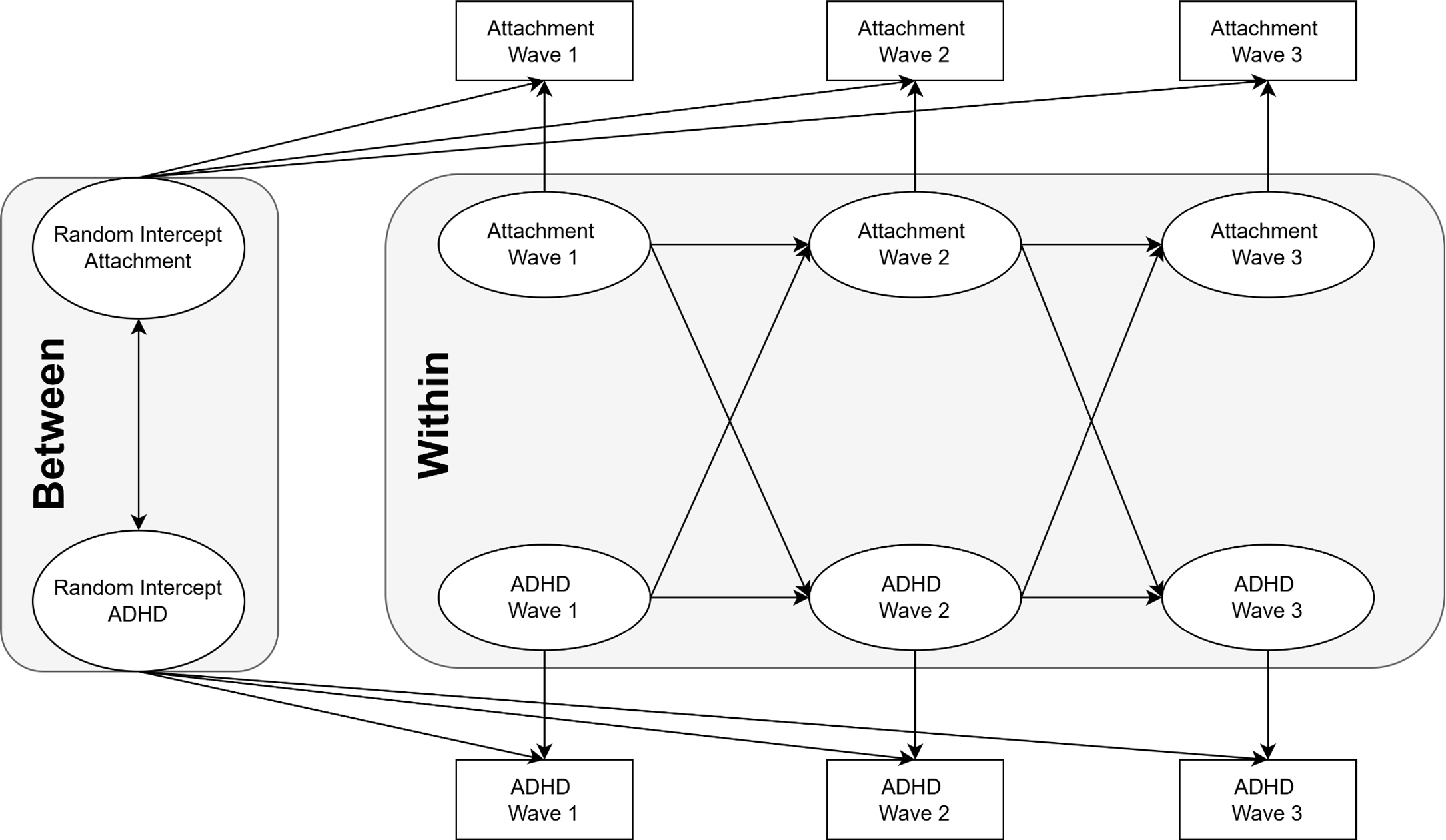
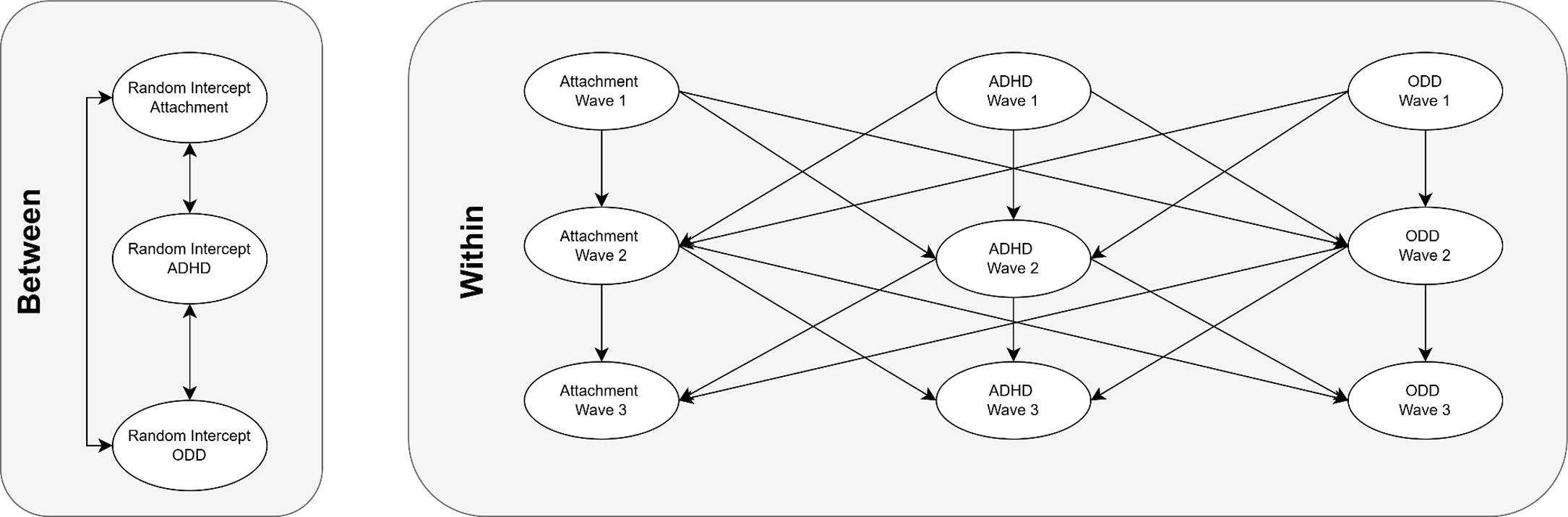
Separate models were estimated for each attachment indicator. Three sets of models were fitted. The first set included bivariate models examining the potential bidirectional relation between ADHD behavior and each attachment indicator (RQ1). The second set included trivariate models incorporating ODD behavior as a time-varying covariate to test whether cross-lagged associations remained significant after accounting for co-occurring ODD behavior (RQ2). A graphical representation of the bivariate and trivariate models is provided in Figures 1 and 2, respectively. A third set of multiple group RI-CLPMs examined potential biological sex differences (RQ3). We used the code for multiple‑group RI‑CLPMs provided by Hamaker (Reference Hamaker, Mulder and van IJzendoorn2020) to estimate the models separately for boys and girls in both the bivariate and trivariate specifications, allowing all parameters to vary freely across groups (i.e., without constraining lagged paths or intercepts). The bivariate and trivariate models were preregistered on AsPredicted (AsPredicted #238180). The multi-group RI-CLPM were not preregistered and added post hoc to explore potential biological sex differences.
Graphical representation of the bivariate RI-CLMPs estimating the longitudinal links between ADHD behavior and attachment (in)security. Rectangles represent the observed scores at each wave. Ovals represent the between-child and within-person factors estimated in the RI‑CLPMs. Arrows are used to represent associations among random intercepts, cross-lagged and autoregressive associations.

Graphical representation of the trivariate RI-CLMPs estimating the longitudinal links between ADHD and ODD behavior, and attachment (in)security. Ovals represent the between-child and within-person factors estimated in the RI‑CLPMs. Arrows are used to represent associations among random intercepts, cross-lagged and autoregressive associations.

All models were estimated using a maximum likelihood robust estimator to address potential skewness and kurtosis. Model fit was evaluated using the comparative fit index (CFI), Tucker–Lewis index (TLI), root mean square error of approximation (RMSEA), and standardized root mean square residual (SRMR). Following preregistered criteria, CFI and TLI values greater than 0.95 and RMSEA and SRMR values less than 0.05 were considered indicative of good fit.
Standardized estimates were reported for the cross-lagged associations, autoregressive associations, and associations between the random intercepts. Effect sizes were interpreted as slight (< 0.10), small (0.10 to < 0.30), moderate (0.30 to < 0.50), or large (≥0.50) (Mulder & Hamaker, Reference Mulder and Hamaker2021).
Results
Preliminary analyses
Descriptive statistics
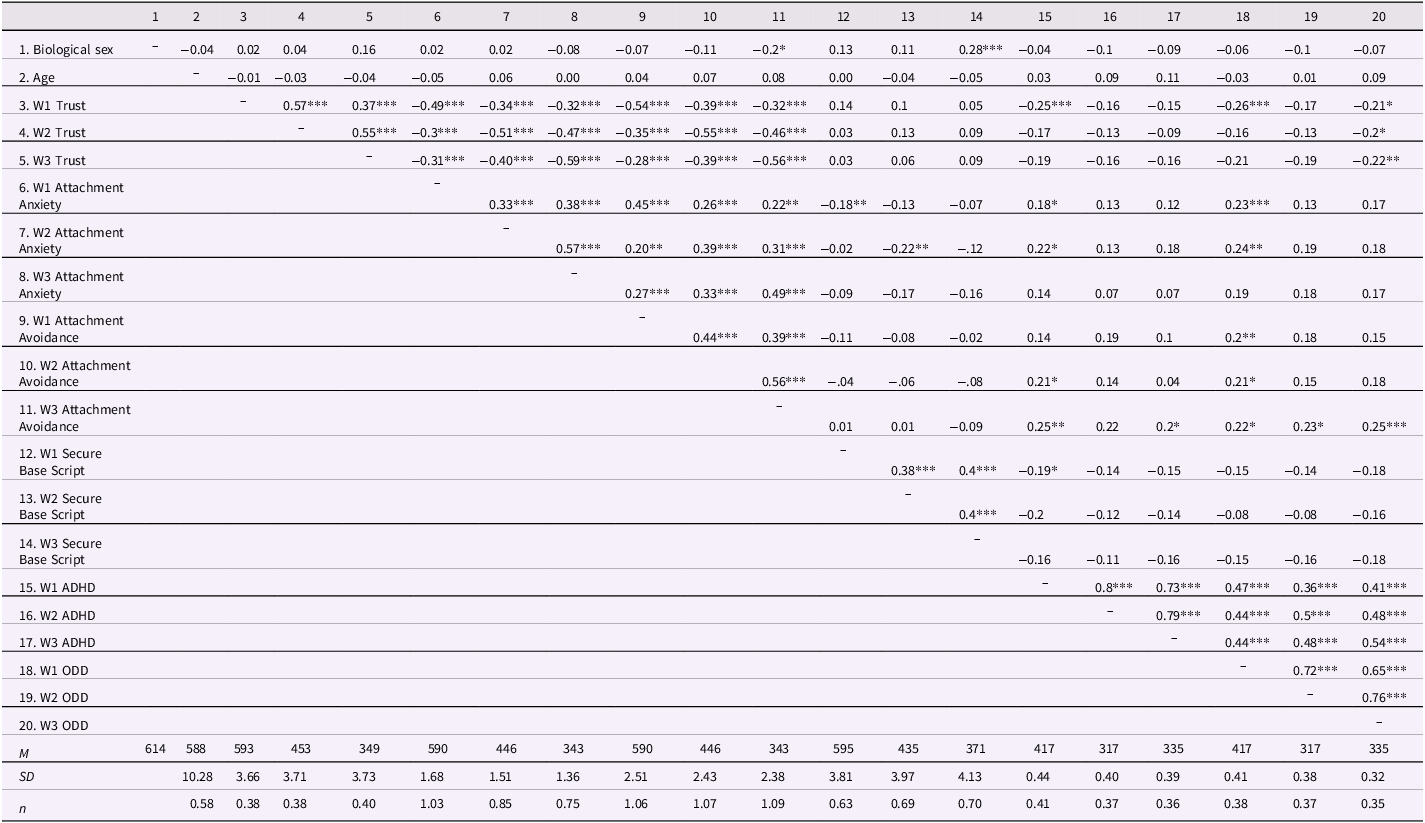
Means, standard deviations and bivariate correlations of measures for the three waves are provided in Table 1.
Means, standard deviations, and bivariate correlations

Table 1. Long description
Table providing descriptive statistics of study measures.
Note. Significance levels are indicated as follows: .05 > p >.01*, .01 ≥ p >.001**, and p ≤.001***. ADHD = ADHD behavior; ODD = ODD behavior.
Missing value and attrition analyses
Overall, 32% of the data were missing, and Little’s MCAR test indicated that this missingness was not completely at random, χ 2(1123) = 1,242.00, p = .01. Full Information Maximum Likelihood (FIML) estimation was employed to handle missing data. Of the total sample, 54% participated in all three waves. Attrition analyses indicated that children who completed all waves did not differ from those who participated in only one or two waves on most demographic characteristics and Wave‑1 study variables, including age, gender, family situation, trust, attachment anxiety, attachment avoidance, ADHD behavior, and ODD behavior. However, children who did not participate at all waves were more likely to have a non‑Belgian nationality and showed slightly lower levels of secure base script knowledge at Wave 1 compared to children who participated in one or two waves (M = 3.75 vs. 3.86; SD = 0.63). A more detailed description of the attrition analyses is provided in the supplementary materials.
Data preprocessing
Scores more than three standard deviations above or below the mean were considered outliers and were winsorized by replacing the values with the corresponding ± 3 SD value. After winsorizing, all variables were standardized within each wave. We opted for wave-specific standardization to preserve the relative ordering of participants at each measurement occasion. Applying standardization to address estimation problems is in line with recommendations for handling estimation difficulties in Structural Equation Modeling (Hamaker et al., Reference Hamaker, Kuiper and Grasman2015; Mulder & Hamaker, Reference Mulder and Hamaker2021).
RQ1: Longitudinal relation between ADHD behavior and attachment (in)security
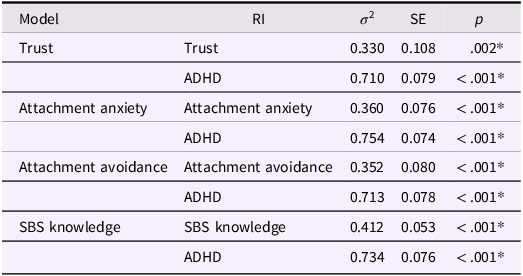
A full description of the bivariate RI‑CLMPs is provided in Supplementary File 1, including fit indices and autoregressive associations. In each model, the variances of the random intercepts were significant, indicating between-child differences in the level of ADHD behavior and attachment (in)security, as shown in Table 2.
Random intercept variances, representing variation in stable child-specific levels in ADHD behavior and attachment (in)security

Table 2. Long description
In each model, the variances of the random intercepts of ADHD behavior and attachment (in)security are significant (p<.05).
Note. ADHD = ADHD behavior. p < .05*.
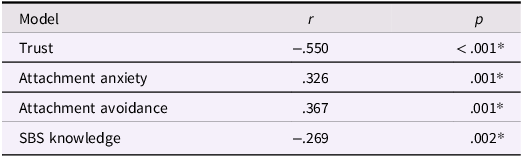
Small to moderate-sized associations between the random intercepts of ADHD behavior and attachment (in)security, presented in Table 3, indicated that stable between-child differences in attachment (in)security and ADHD behavior were consistently associated across different measures of attachment. Specifically, negative associations with secure base script knowledge and trust suggested that higher levels of ADHD behavior were linked to lower levels of secure attachment. In addition, positive associations with anxious and avoidant attachment indicated that higher levels of ADHD behavior were linked to higher levels of insecure attachment.
Correlations between random intercepts of ADHD behavior and attachment, representing the association between the child-specific levels in ADHD behavior and attachment (in)security

Table 3. Long description
Correlations between the random intercepts of ADHD behavior and attachment (in)security show small to moderate-sized associations. Specifically, ADHD behavior is negatively associated with secure base script knowledge (r=-.269) and trust (r=-.550), whereas it is positively associated with anxious (r=.326) and avoidant attachment (r=.367)(p<.05).
Note. p < .05*.
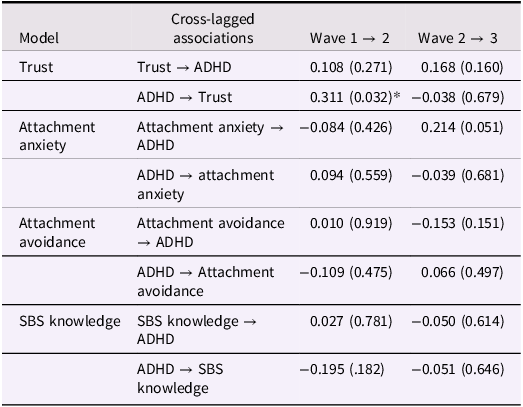
Cross-lagged associations, displayed in Table 4, were largely non-significant. Only one prospective association emerged: higher ADHD behavior at Wave 1 predicted higher trust at Wave 2. This isolated finding did not replicate across other waves or attachment measures. Together, these results suggest that ADHD and attachment (in)security are related at a trait‑like, between‑person level but show little evidence of bidirectional prospective associations over time.
Cross-lagged association between ADHD behavior and attachment (in)security

Table 4. Long description
Cross-lagged associations are largely non-significant. Only one prospective association emerged: higher ADHD behavior at Wave 1 predicted higher trust at Wave 2 (0.311, p<.05). This isolated finding did not replicate across other waves or attachment measures.
Note. The p‑values of the standardized estimates of the cross-lagged associations are presented in parentheses; p < .05*. ADHD = ADHD behavior.
RQ2: The role of ODD behavior
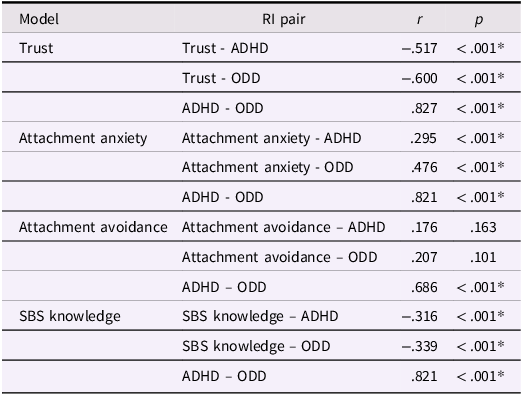
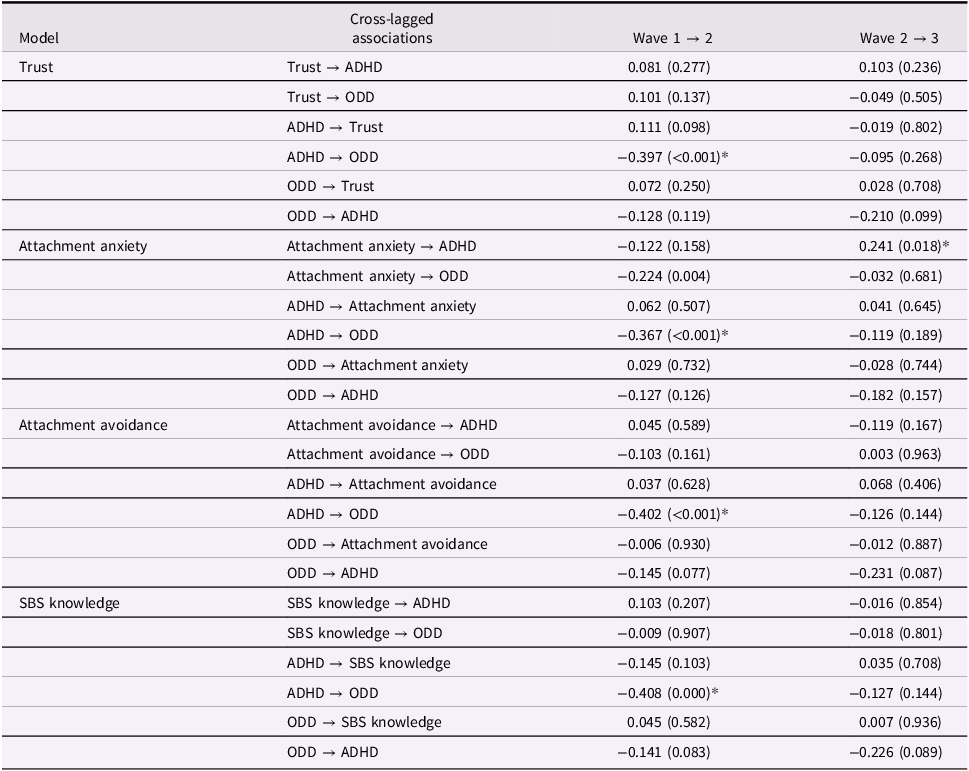
A full description of the trivariate RI‑CLPMs is provided in Supplementary File 1, including fit indices and autoregressive associations. When ODD behavior was included in the RI‑CLMPs, the significant random-intercept associations between ADHD behavior and (in)secure attachment were largely replicated (see Tables 5 and 6). ADHD behavior remained associated with higher attachment anxiety and with lower trust and secure base script knowledge, whereas the association with attachment avoidance was no longer significant. Cross-lagged associations between ADHD behavior and (in)secure attachment, displayed in Table 7, remained largely non‑significant in the trivariate models. One small prospective association emerged: higher attachment anxiety at Wave 2 predicted higher ADHD behavior at Wave 3. Overall, these results replicate the pattern that ADHD and attachment (in)security are linked at a trait‑like, between‑person level, while providing little evidence for bidirectional prospective associations over time – also when ODD behavior is taken into account.
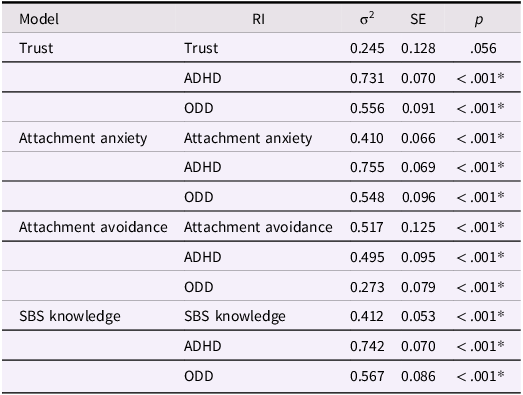
Random intercept variances, representing stable between-child differences in ADHD and ODD behavior, and attachment (in)security

Table 5. Long description
In the trivariate RI-CLPMs, including ODD behavior, the random intercepts of ADHD behavior and attachment (in)security show continued significant associations (p<.05).
Note. ADHD = ADHD behavior; ODD = ODD behavior. p < .05*.
Correlations between random intercepts of ADHD, ODD behavior and attachment, representing the between-child association between ADHD and ODD behavior, and attachment (in)security

Table 6. Long description
In the trivariate RI-CLPMs, including ODD behavior, the significant random-intercept associations between ADHD behavior and (in)secure attachment are largely replicated. ADHD behavior remains associated with higher attachment anxiety (r=.295, p<.001) and with lower trust (r=-.517, p<.001) and secure base script knowledge (r=-.316, p<.001), whereas the association with attachment avoidance is no longer significant.
Note. ADHD = ADHD behavior; ODD = ODD behavior. p < .05*.
Cross-lagged association between ADHD and ODD behavior, and attachment (in)security

Table 7. Long description
In the trivariate RI-CLPMs, including ODD behavior, cross-lagged associations between ADHD behavior and (in)secure attachment remain largely non‑significant. One small prospective association emerges: higher attachment anxiety at Wave 2 predicted higher ADHD behavior at Wave 3 (.241, p<.05).
Note. The p‑values of the standardized estimates of the cross-lagged associations are presented in parentheses; p < .05*. ADHD = ADHD behavior; ODD = ODD behavior.
RQ3: Biological sex differences
RQ3a: Biological sex differences in longitudinal associations between ADHD behavior and attachment (in)security
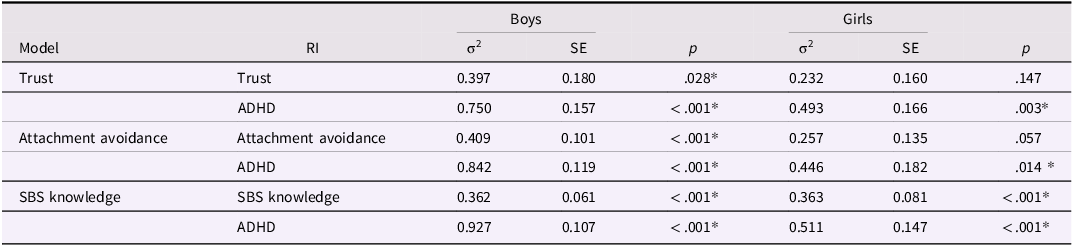
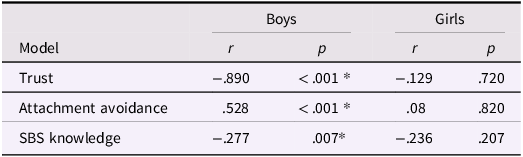
A full description of the bivariate multigroup RI‑CLPMs is provided in Supplementary File 1, including fit indices and autoregressive associations. The RI‑CLPM for attachment anxiety produced a Heywood case (negative variance; Cooperman & Waller, Reference Cooperman and Waller2022) and was therefore excluded from interpretation. Significant variances in the random intercepts for ADHD behavior, attachment avoidance, and secure base script knowledge were observed for both boys and girls, suggesting significant stable between-child differences in these constructs. For trust, the variance of the random intercept was significant for boys but not for girls, indicating that stable between-child differences in trust were less pronounced in girls (see Table 8). Correlations between random intercepts suggested that stable between child differences were associated with higher levels of attachment avoidance and lower levels of secure base script knowledge in boys but not in girls (see Table 9).
Random intercept variances, representing stable between-child differences in ADHD behavior and attachment (in)security

Table 8. Long description
Significant variances in the random intercepts for ADHD behavior, attachment avoidance, and secure base script knowledge are observed for both boys and girls (p<.05). For trust, the variance of the random intercept was significant for boys but not for girls.
Note. ADHD = ADHD behavior. p < .05*.
Correlations between random intercepts of ADHD behavior and attachment (in)security, representing the association between stable between-child differences in ADHD behavior and attachment (in)security

Table 9. Long description
Correlations between random intercepts suggest that stable between child differences are associated with higher levels of attachment avoidance (r=.528, p<.001) and lower levels of secure base script knowledge (r-.277, p=.007) in boys but not in girls.
Note. p < .05*.
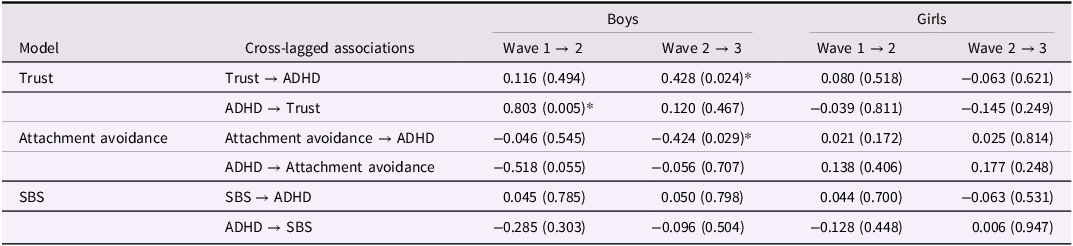
Cross-lagged associations, shown in Table 10, showed distinct patterns for boys and girls. For boys, trust and ADHD behavior were bidirectionally related over time: ADHD behavior at Wave 1 predicted higher levels of trust at Wave 2 (large effect) and trust at Wave 2 predicted higher levels of ADHD behavior at Wave 3 (moderate effect). Attachment avoidance showed a moderate negative association with later ADHD behavior for boys from Wave 2 to Wave 3. No significant cross-lagged associations were observed in girls.
Cross-lagged association between ADHD behavior and attachment (in)security

Table 10. Long description
For boys, trust and ADHD behavior are bidirectionally related over time: ADHD behavior at Wave 1 predicts higher levels of trust at Wave 2 (.803, p=.005) and trust at Wave 2 predicts higher levels of ADHD behavior at Wave 3 (.428, p=.024). Attachment avoidance shows a moderate negative association with later ADHD behavior for boys from Wave 2 to Wave 3 (-.424, p=.029). No significant cross-lagged associations are observed in girls.
Note. The p‑values of the standardized estimates of the cross-lagged associations are presented in parentheses; p < .05*. Note. ADHD = ADHD behavior.
RQ3b: Biological sex differences in longitudinal associations between ADHD and ODD behavior and attachment (in)security
A full description of the trivariate multigroup RI‑CLPMs is provided in Supplementary File 1, including fit indices and autoregressive associations. The RI‑CLPMs for attachment anxiety and trust yielded negative variance estimates (Heywood cases) and were therefore not interpreted.
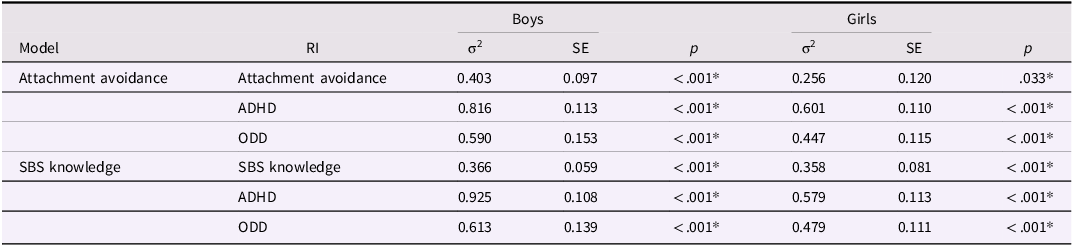
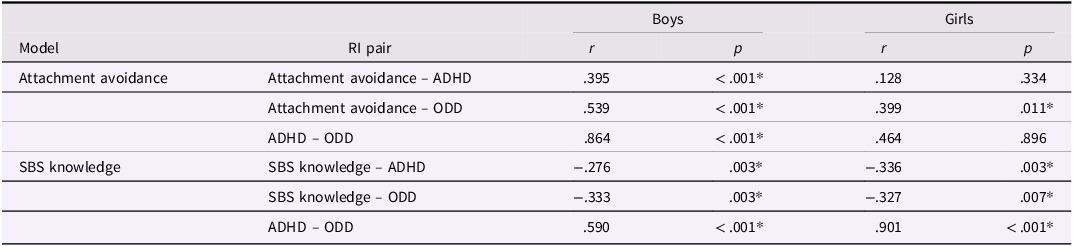
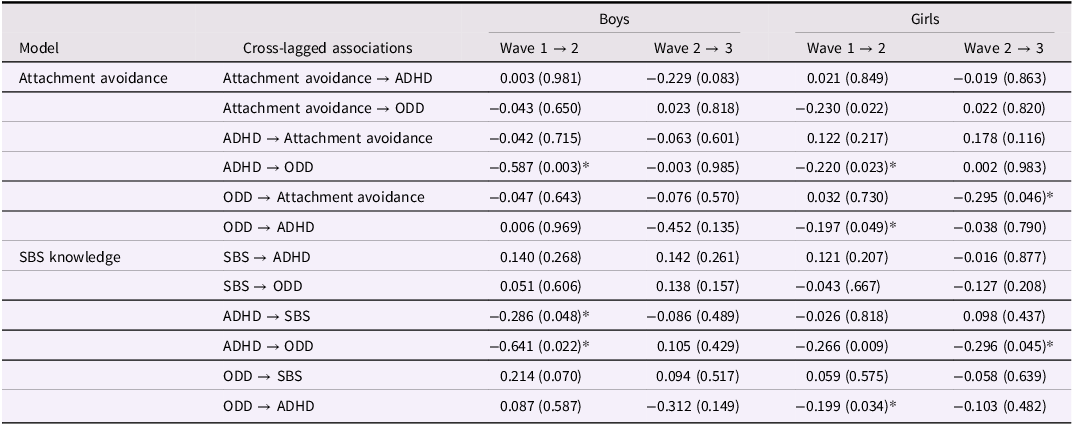
When ODD behavior was included in the model, a different pattern of biological sex differences in the associations among the random intercepts of ADHD behavior and attachment (in)security emerged (see Tables 11 and 12). Biological sex differences were observed in the association between ADHD behavior and attachment avoidance. ADHD behavior was associated with higher levels of attachment avoidance in boys, but not in girls. In addition, biological sex differences in the association between secure base script knowledge and ADHD behavior were no longer observed when ODD was included: stable between‑child differences in ADHD behavior were significantly associated with lower secure base script knowledge in both biological sexes. None of the cross-lagged associations between ADHD behavior and attachment (in)security that were observed in the bivariate model remained significant. A significant cross-lagged association between higher ADHD behavior at Wave 1 and lower secure base script knowledge at Wave 2 was observed for boys (see Table 13).
Random intercept variances, representing stable between-child differences in ADHD and ODD behavior, and attachment (in)security

Table 11. Long description
In the trivariate RI-CLPMs, including ODD behavior, the random intercepts of ADHD behavior and attachment (in)security show continued significant associations for boys and girls (p<.05).
Note. ADHD = ADHD behavior; ODD = ODD behavior. p < .05*.
Correlations between random intercepts of ADHD and ODD behavior, and attachment (in)security, representing the association between stable between-child differences in ADHD and ODD behavior, and attachment (in)security

Table 12. Long description
In the trivariate RI-CLPMs, including ODD behavior, the associations among the random intercepts of ADHD behavior and attachment (in)security show a different pattern of biological sex differences. ADHD behavior is associated with higher levels of attachment avoidance in boys (r=.395, p<.001), but not in girls. Biological sex differences in the association between secure base script knowledge and ADHD behavior are no longer observed when ODD is included: stable between‑child differences in ADHD behavior are significantly associated with lower secure base script knowledge in both biological sexes (boys: r=--.276, girls: r=-.336, p=0.003).
Note. ADHD = ADHD behavior; ODD = ODD behavior. p < .05*.
Cross-lagged association between ADHD and ODD behavior, and attachment (in)security

Table 13. Long description
None of the cross-lagged associations between ADHD behavior and attachment (in)security that were observed in the bivariate model remain significant. A significant cross-lagged association between higher ADHD behavior at Wave 1 and lower secure base script knowledge at Wave 2 is observed for boys (-.286, p=.048).
Note. The p‑values of the standardized estimates of the cross-lagged associations are presented in parentheses; p < .05*. ADHD = ADHD behavior; ODD = ODD behavior.
Discussion
Prior research has documented significant cross-sectional associations between ADHD behavior and insecure attachment across non-clinical and clinical ADHD samples, whereas only one small two‑wave study has examined this link longitudinally in a way that offers preliminary evidence on directionality (Al-Yagon et al., Reference Al-Yagon, Forte and Avrahami2020; Cavicchioli et al., Reference Cavicchioli, Stefanazzi, Tobia and Ogliari2022; Dekkers et al., Reference Dekkers, Hornstra, Van Den Hoofdakker, De Jong, Schaaf, Bosmans and Van Der Oord2021; Rasmussen et al., 2022; Storebø et al., Reference Storebø, Rasmussen and Simonsen2016; Wylock et al., Reference Wylock, Borghini, Slama and Delvenne2023). Using a multi-method, longitudinal design, we here examined whether the relation between ADHD behavior and attachment (in)security operated in both directions over time (RQ1), while accounting for comorbid ODD behavior (RQ2), and examining potential biological sex differences (RQ3). We found that stable, trait‑like individual differences in ADHD behavior were consistently associated with higher insecure attachment and lower secure attachment. Prospective associations between fluctuations in attachment and ADHD behavior over time were largely absent and did not replicate across attachment measures or time points (RQ1). These patterns remained largely unchanged when taking comorbid ODD behavior into account (RQ2). Finally, the association between ADHD behavior and insecure attachment was primarily present in boys but largely absent in girls (RQ3).
RQ1: Longitudinal relation between ADHD behavior and attachment (in)security
Consistent with our hypothesis, children who, on average, displayed higher levels of ADHD behavior also showed lower levels of secure attachment (i.e., SBS knowledge and trust) and higher levels of insecure attachment (i.e., anxious and avoidant attachment). These associations were small to moderate in size yet consistent across attachment measures. This pattern aligns with prior work reporting robust covariation between ADHD-related difficulties and attachment insecurity across samples and methods (Al-Yagon et al., Reference Al-Yagon, Forte and Avrahami2020; Cavicchioli et al., Reference Cavicchioli, Stefanazzi, Tobia and Ogliari2022; Dekkers et al., Reference Dekkers, Hornstra, Van Den Hoofdakker, De Jong, Schaaf, Bosmans and Van Der Oord2021; Storebø et al., Reference Storebø, Rasmussen and Simonsen2016; Wylock et al., Reference Wylock, Borghini, Slama and Delvenne2023).
In contrast, changes within individual children over time rarely predicted one another across domains. Deviations from a child’s own baseline in ADHD behavior did not reliably predict later changes in attachment (in)security, nor did changes in attachment (in)security predict later changes in ADHD behavior. The single exception was that higher ADHD behavior at Wave 1 predicted higher trust at Wave 2, an unexpected finding that was contrary to our initial expectations. However, this effect did not replicate across later intervals or across attachment measures and should therefore be interpreted with caution. Overall, these findings suggest that, in late childhood (ages 9–14 in our sample), ADHD behavior and attachment (in)security do not reliably influence one another within individuals over one-year periods, even though they show clear associations between children. These findings align with Heylen et al. (Reference Heylen, Budniok, Van de Walle, De Raedt, Bijttebier, De Winter and Bosmans2024), who reported that insecure attachment was associated with lower levels of effortful control – a temperament trait that has been shown to correlate with ADHD (Gagne et al., Reference Gagne, Saudino and Asherson2011; Kostyrka-Allchorne et al., Reference Kostyrka-Allchorne, Wass, Yusuf, Rao, Bertini and Sonuga-Barke2023) – but that changes in effortful control were not systematically linked to attachment throughout middle childhood.
The observed pattern – robust between-child associations and limited within-child change – could reflect several non–mutually exclusive explanations. First, ADHD behavior and attachment insecurity may share stable influences, including genetic factors. Although early attachment theory and research emphasized environmental contributions for variation in preschoolers’ attachment (in)security (e.g., Bokhorst et al., Reference Bokhorst, Bakermans-Kranenburg, Fearon, van IJzendoorn, Fonagy and Schuengel2003; O’Connor & Croft, Reference O’Connor and Croft2001; Roisman & Fraley, Reference Roisman and Fraley2008), some studies suggest that over the course of development genes may have an increased influence on the emergence of individual differences in attachment (in)security (Fearon et al., Reference Fearon, Shmueli-Goetz, Viding, Fonagy and Plomin2014; Fearon & Roisman, Reference Fearon and Roisman2017). Several candidate gene studies have for example suggested associations with dopamine-related gene polymorphisms (e.g., Fearon et al., Reference Fearon, Shmueli-Goetz, Viding, Fonagy and Plomin2014; Lakatos et al., Reference Lakatos, Toth, Nemoda, Ney, Sasvari-Szekely and Gervai2000). If ADHD behavior and attachment insecurity partly share genetic liability, stable differences between children would be expected, even in the absence of systematic changes within individuals over time, because shared genetic factors can create covariance without requiring changes in one domain to directly cause changes in the other.
Second, ADHD behavior and attachment insecurity may be linked through common self-regulatory capacities. Self-regulation—“those processes, internal and/or transactional, that enable an individual to guide his/her goal-directed activities over time and across changing circumstances (contexts)” (Karoly, Reference Karoly1993, p. 25) – has been linked to a broad range of developmental outcomes, including ADHD and insecure attachment (Eisenberg et al., Reference Eisenberg, Fabes, Guthrie, Wolchik and Sandler1997, Reference Eisenberg, Valiente and Eggum2010, Reference Eisenberg, Hernández, Zuffianò and Spinrad2024, Heylen et al., Reference Heylen, De Raedt, Verbruggen and Bosmans2019; Heylen et al., Reference Heylen, De Raedt, Verbruggen and Bosmans2019). Limitations in self-regulatory abilities may therefore simultaneously manifest as higher ADHD behavior and less secure attachment, yielding between-child covariation in the absence of consistent within-child directional dynamics. In this view, a third, unmeasured variable (e.g., self-regulatory difficulties) may account for the observed covariation, such that the association between ADHD behavior and insecure attachment does not necessarily reflect a direct causal pathway.
Third, associations between ADHD behavior and attachment insecurity may emerge earlier in development and then stabilize by late childhood, resulting in pronounced differences between children but minimal within‑child change over annual intervals in this age range. This interpretation is consistent with evidence that ADHD-attachment associations emerge early in development (Wylock et al., Reference Wylock, Borghini, Slama and Delvenne2023) and that attachment patterns show moderate stability across early and middle childhood (Opie et al., Reference Opie, McIntosh, Esler, Duschinsky, George, Schore, Kothe, Tan, Greenwood and Olsson2021). Moreover, this longitudinal study was limited (three annual waves), and meaningful changes in ADHD trajectories may unfold over longer periods for many children, reducing the likelihood of detecting within‑child cross‑lagged effects within a three‑year interval.
Together, these possibilities outline several promising directions for future work, including genetically informed designs, direct assessments of self‑regulatory abilities, and studies focusing on earlier developmental periods with a longer time frame.
RQ2: The role of ODD behavior
When considering ODD behavior in our sample, we found that children with higher levels of ADHD behavior on average also showed more ODD behavior, replicating the well‑known co‑occurrence of these conditions (Harvey et al., Reference Harvey, Breaux and Lugo-Candelas2016; Noordermeer et al., Reference Noordermeer, Luman, Weeda, Buitelaar, Richards, Hartman, Hoekstra, Franke, Heslenfeld and Oosterlaan2017; Pliszka, Reference Pliszka2000; Strine et al., Reference Strine, Lesesne, Okoro, McGuire, Chapman, Balluz and Mokdad2006). Children with more ODD behavior also showed less secure attachment (SBS knowledge, trust) and more insecure attachment (anxious attachment). Importantly, the association between ADHD behavior and attachment insecurity discussed above largely remained after accounting for this overlap: children with more ADHD behavior still showed lower trust and secure base script knowledge and higher attachment anxiety. This suggests that observed links are not uniquely attributable to ADHD or ODD behavior alone but instead reflect broader patterns across behavior dimensions (Theule et al., Reference Theule, Germain, Cheung, Hurl and Markel2016). In contrast, the small bivariate association between ADHD behavior and avoidant attachment disappeared once ODD behavior was considered, suggesting that this ADHD-avoidance link is likely not robust and may be sensitive to model specification rather than reflecting a unique association. As in the bivariate models, most prospective associations over time were not significant. Two isolated findings emerged: higher ADHD behavior at the first wave predicted lower ODD behavior later on, and higher attachment anxiety at the second wave predicted higher ADHD behavior at the next wave. Because these effects did not replicate across waves or attachment measures, they should be interpreted with caution.
RQ3: Biological sex differences
When looking at boys and girls separately, we found that the associations between ADHD behavior and attachment (in)security were primarily present in boys and largely absent in girls. For both biological sexes, changes within individual children over time were rare. When ODD behavior was added to the models, this pattern persisted: boys continued to show clear links between ADHD behavior and multiple attachment indicators, whereas in girls these associations were limited to SBS knowledge. As in the main analyses, prospective effects over time were scarce and did not replicate across waves, supporting the idea that the connection between ADHD behavior and attachment in late childhood may be predominantly trait‑like.
These biological sex differences should be interpreted with caution for two reasons. First, prior research suggests that ADHD behavior may differ by sex – such as more inattentive features and less externalizing behavior in girls – potentially reducing observability of ADHD behavior and, consequently, the detectable covariance with insecure attachment (Gaub & Carlson, Reference Gaub and Carlson1997; Skogli et al., Reference Skogli, Teicher, Andersen, Hovik and Øie2013). However, given the established association between ODD and insecure attachment (RQ2), and the fact that girls typically show lower levels of externalizing behavior, it is plausible that biological sex differences in externalizing behavior contribute to somewhat weaker ADHD-attachment associations in girls. Second, several multigroup models were not interpretable due to inadmissible variance estimates (i.e., Heywood cases). In the bivariate multigroup analyses, the attachment anxiety model yielded a Heywood case; in the trivariate models, both attachment anxiety and trust produced Heywood cases and were excluded. Consequently, biological sex comparisons relied more on avoidant attachment and not on attachment anxiety. This is important, because avoidant attachment has been suggested to be typically more characteristic in boys, whereas attachment anxiety may be more informative for girls, based on prior research (Choi et al., Reference Choi, Kang, Hong, Kim and Yi2016; Del Giudice, Reference Del Giudice2008, Reference Del Giudice2015, Reference Del Giudice2019; Gloger-Tippelt & Kappler, Reference Gloger-Tippelt and Kappler2016). While these measures revealed robust trait‑level links with ADHD primarily in boys, the absence of multigroup results for attachment anxiety may thus have attenuated observable associations in girls.
Differences across attachment measures
The multi-method assessment of attachment revealed both convergent and measure-specific patterns. Trust emerged as the most robust indicator, showing consistent temporal stability and strong between-child associations with levels of ADHD and ODD behavior. Attachment anxiety also showed clear between-child links with externalizing behavior, but stability emerged only from Wave 2 to Wave 3, potentially suggesting ongoing developmental consolidation in late childhood. In contrast, avoidant attachment proved least robust: its small association with ADHD behavior disappeared once children’s levels of ODD behavior were taken into account, and it showed no associations with ODD behavior. This suggests that, for children this age, avoidance is not central to the relation between ADHD behavior and attachment. Finally, SBS knowledge showed a different pattern: although it did not remain stable over time, children with less developed scripts tended to show more ADHD and ODD behavior. This is consistent with the idea that script-based representations are still developing between ages 9 and 14 and may therefore fluctuate even when other aspects of attachment are becoming more consolidated.
Contrary to our hypothesis that associations with ADHD behavior would be larger when attachment was assessed using a more implicit measure, the observed pattern of findings provided no support for this prediction. Although SBS knowledge was significantly associated with ADHD behavior, the results did not suggest stronger associations for SBS knowledge than for the questionnaire-based attachment measures. This expectation was based on previous studies suggesting that attachment-related differences in children with more ADHD behavior may be more readily detected using implicit attachment assessments than self-report questionnaires (Dekkers et al., Reference Dekkers, Hornstra, Van Den Hoofdakker, De Jong, Schaaf, Bosmans and Van Der Oord2021; Hornstra et al., Reference Hornstra, Bosmans, Van Den Hoofdakker, De Meyer and Van Der Oord2019). Differences between these studies and the current study, including the longitudinal design, analytic approach, and the use of the MCASA rather than story stem procedures, may help explain the divergence in findings.
Together, these findings underscore the multidimensionality of attachment and demonstrate the value of a multi-method design for clarifying which components of attachment relate most strongly to child behavior.
Strengths and limitations
To our knowledge, this is the first study to assess the potential bidirectional longitudinal relation between ADHD behavior and children’s attachment, while accounting for ODD behavior, testing biological sex differences, and using a multi-method assessment of attachment.
Despite these strengths, several limitations should be acknowledged. First, the sample primarily consisted of children from a general, non-clinical population, which raises questions about the generalizability of findings to clinical ADHD/ODD populations. Second, the sample contained a high proportion of higher-educated families, which may limit generalizability to more socio-economically diverse contexts. Third, the study faced substantial and non-random attrition across waves, potentially introducing bias and reducing statistical power. Children who did not participate at all waves were, for example, more likely to have a non‑Belgian nationality. Fourth, several multigroup RI-CLPMs yielded Heywood cases, narrowing the set of attachment measures available for examining biological sex differences. This restriction might have attenuated detectable associations in girls. Finally, SBS measure showed modest internal consistency (Cronbach’s alpha = 0.60 at Wave 1, 0.58 at Wave 2, and 0.62 at Wave 3), possibly due to the small number of items (i.e., three), which may have constrained its precision and underestimated true stability.
Conclusion
To conclude, ADHD behavior and attachment show robust associations at the trait-like, between-person level, but little evidence is found for a bidirectional prospective relation over annual intervals in late childhood. This pattern suggests that links between ADHD behavior and attachment insecurity are relatively stable over time in this age range. When ODD behavior was included, the trait‑level pattern persisted, and within‑child directionality remained sparse, underscoring that these associations are not uniquely attributable to either ADHD or ODD behavior. The multi‑method approach was essential for identifying measure‑specific profiles, highlighting which components of attachment most consistently covary with ADHD and ODD behavior in this age group.
Looking ahead, future research should aim to replicate these findings in clinical ADHD/ODD populations, incorporate earlier and more extensive developmental windows to capture emerging dynamics, integrate genetically informed designs and direct assessments of self‑regulation, and ensure biological sex measurement invariance and sufficient reliability for key attachment indicators – particularly anxiety and trust. Together, such efforts will help clarify the developmental mechanisms underlying the ADHD-attachment link and inform more targeted assessment and intervention strategies.
Supplementary material
The supplementary material for this article can be found at https://doi.org/10.1017/S0954579426102077.
Data availability statement
Data sets generated during the current study are not publicly available due to restrictions specified in the informed consent. Analytic code is publicly available on OSF and can be accessed at: https://osf.io/vtf62/. Standardized questionnaires (PIML, ECR‑RC, CBCL) and the MC‑ASA coding manual are copyrighted and cannot be shared publicly. This data‑sharing approach adheres to TOP Level 2 guidelines.
Funding statement
This work was funded by the Research Foundations FWO and F.R.S.-FNRS under the Excellence of Science (EOS) program (EOS 40007528/G0I2422N) and by FWO grant 0D6721N and KU Leuven grants C14/16/040 and C16/24/003.
Competing interests
SVDO has received a speaker fee for a talk on non-pharmacological interventions for ADHD by MEDICE. MD and KV have received research funding from Takeda. TD is in the steering committee of the European Network for ADHD (EUNETHYDIS), which receives funding from MEDICE and Takeda for educational purposes.
Pre-registration statement
The analysis plan was preregistered on AsPredicted (AsPredicted #238180; https://aspredicted.org/n4kp-x6pt.pdf). Part of the data had been collected prior to preregistration, as the dataset used here consists of secondary data from a larger longitudinal study. Some authors have previously analyzed and published subsets of this dataset (i.e., the attachment data). However, the analytic decisions of the current study were specified before accessing or analyzing the relevant variables (i.e., ADHD-related behavioral data) for the present research question.
AI use statement
The authors used Microsoft Copilot (GPT-5-based chat model; Microsoft) to assist with language editing and text refinement during manuscript preparation (2025–2026). All content was reviewed and approved by the authors.


 Open access

