Predominant theories and research in psychology suggest that adverse contexts (e.g., poverty, harsh and insensitive parenting) impair children’s competent development and well-being (e.g., Evans et al., Reference Evans, Li and Whipple2013). With respect to children’s problem-solving, research to date has primarily documented the association between adverse environments and compromised problem-solving (e.g., Brooks-Gunn & Duncan, Reference Brooks-Gunn and Duncan1997; Caughy, & O’campo, Reference Caughy and O’campo2006). In contrast, an emerging line of research has also reported enhanced cognitive performance in certain aspects for children growing up in risky environments (e.g., Mittal et al., Reference Mittal, Griskevicius, Simpson, Sung and Young2015; Suor et al., Reference Suor, Sturge-Apple, Davies and Cicchetti2017; Young et al., Reference Young, Griskevicius, Simpson, Waters and Mittal2018). Thus, heterogeneity may exist in cognitive capacities when children are exposed to an adverse environment, with some skills undermined by stress, whereas others retained or even enhanced. Guided by the evolutionary developmental perspective and the specialization hypothesis (Ellis et al., Reference Ellis, Bianchi, Griskevicius and Frankenhuis2017), we sought to evaluate child problem-solving skills across different contexts (i.e., an abstract task vs. an ecologically relevant, reward-oriented [RO] task) via the person-centered approach. One advantage of this approach is that it allows for the flexibility of not making any a-priori assumptions that children who perform well in one context will necessarily do well in the other. In addition, we aimed to examine how contextual risks within and outside the family may be associated with profiles of child problem-solving by focusing on neighborhood and family risks. Furthermore, we sought to explore the functional links between child problem-solving skills (within different contexts) and child subsequent developmental sequelae.
Testing specialization hypothesis with a pattern-based approach
Grounded in evolutionary frameworks, life-history theory offers important insights in understanding child functioning under adverse contexts. Specifically, life-history theory postulates that individuals make trade-offs, often unconsciously, among competing life tasks due to limited time and resources (e.g., growth, reproduction) to adapt to the environment and maximize one’s fitness (e.g., Belsky et al., Reference Belsky, Steinberg and Draper1991; Ellis et al., Reference Ellis, Figueredo, Brumbach and Schlomer2009). Individuals exposed to harsh and unpredictable environments are theorized to develop a variety of characteristics traditionally regarded as risky and dysfunctional but may nevertheless be adaptive under risky environments (e.g., elevated risk-taking and behavioral problems; Li et al., Reference Li, Liu, Hartman and Belsky2018; greater preference for immediate rewards, Humphreys et al., Reference Humphreys, Lee, Telzer, Gabard-Durnam, Goff, Flannery and Tottenham2015; Sturge-Apple et al., Reference Sturge-Apple, Davies, Cicchetti, Hentges and Coe2017).
The specialization hypothesis shares a similar underlying rationale (Ellis et al., Reference Ellis, Bianchi, Griskevicius and Frankenhuis2017; Frankenhuis et al., Reference Frankenhuis, Panchanathan and Nettle2016; Frankenhuis & de Weerth, Reference Frankenhuis and de Weerth2013). According to the specialization hypothesis, adverse developmental experiences do not exclusively impair development, but rather shape it in the way that the developing person becomes adapted and/or specialized to solve certain ecologically relevant problems. Thus, instead of showing universally compromised functioning, individuals growing up under adversity may exhibit comparable, or even enhanced performance for certain cognitive functioning, which should promote the adaptive fitness of the individuals in the stressful context (see Ellis et al., Reference Ellis, Bianchi, Griskevicius and Frankenhuis2017 for a more detailed review). Consistent with the specialization hypotheses, an emerging line of research documented improved performance in a variety of cognitive functioning indices for individuals experienced environmental hardship, including attention shifting (Mittal et al., Reference Mittal, Griskevicius, Simpson, Sung and Young2015), working memory updating (Young et al., Reference Young, Griskevicius, Simpson, Waters and Mittal2018), working memory capacity (Nweze et al., Reference Nweze, Nwoke, Nwufo, Aniekwu and Lange2020), and deception detection (Frankenhuis et al., Reference Frankenhuis, Roelofs and de Vries2018), all presumed to help individuals better navigate a stressful developmental context.
Towards building on this line of work, Frankenhuis et al. (Reference Frankenhuis, Young and Ellis2020) advocated for adopting a design that measures and contrasts children’s capacities across different contexts (e.g., abstract vs. ecologically relevant), with the expectation that performance for children exposed to environmental hardships may vary more depending on the nature of the task. That is, children with stressful experiences may exhibit impaired functioning in some tasks (e.g., abstract, decontextualized tasks), but comparable or even strengthened performance in others (e.g., ecologically relevant tasks). Given this, the person-centered approach offers a unique opportunity to reveal such within-person, contextual-specific differences in children’s capacity, including problem-solving. More specifically, the person-centered approach assumes that there might be unobserved subgroups within the population and seeks to identify these subgroups based on unique configuration of several key characteristics of interest (e.g., problem-solving across different contexts). Thus, the person-centered approach gives the flexibility in not making any a-priori assumptions that different forms of capacities (e.g., problem-solving within different task contexts) will be positively correlated (i.e., child who performed well in one task will do well at the other as well), allowing for the examination of any less common problem-solving patterns (e.g., children perform well in one task but poorly in another task). Furthermore, the person-centered approach parsimoniously summarizes multiple characteristics into a few latent memberships, enhancing the power to explore how latent profiles are linked to any environmental antecedents and developmental sequelae. Taken together, this inquiry sought to delineate conceptually meaningful profiles in child problem-solving within different contexts, which is the first effort to do so to our knowledge.
Neighborhood risks, maternal sensitivity, and children’s problem-solving skills
In the present study, we next sought to examine profiles of children’s problem-solving capacity within the context of environmental adversity. We note, however, although theory and empirical research has provided some guidance for this inquiry, how different features (e.g., types of adversity, dosage) of the environment may be linked to child problem-solving skills remains to be explored (Ellis et al., Reference Ellis, Bianchi, Griskevicius and Frankenhuis2017). This is particularly true given that we are considering different forms of problem-solving within different contexts in the current study. Towards this, previous research has highlighted that risks within and outside the family context are associated with young children’s problem-solving skills (e.g., Caughy & O’Campo, Reference Caughy and O’campo2006; Minh et al., Reference Minh, Muhajarine, Janus, Brownell and Guhn2017; Tamis-LeMonda et al., Reference Tamis-LeMonda, Shannon, Cabrera and Lamb2004). In accordance with this, we focused on both neighborhood characteristics (i.e., economic disadvantage, crime) as well as more proximal characteristics (e.g., maternal parenting) as indicators for the quality of the developmental context outside and within the family. Given that scant work has examined how context may be linked to profiles of problem-solving, we draw evidence from studies using a linear dose–response approach.
More specifically, two critical dimensions of neighborhood characteristics that we focused on in the present study, neighborhood economic disadvantage and crime, have been associated with poorer problem-solving skills measured via standard test batteries in early childhood. For instance, Caughy and O’Campo (Reference Caughy and O’campo2006) examined the role of neighborhood risks as well as family risks on young children’s cognitive development in a sample of African-American families living in diverse neighborhoods. Greater neighborhood impoverishment (e.g., greater neighborhood poverty rate, higher unemployment rate) was significantly associated with lower levels of young children’s problem-solving assessed by standardized tests. This association was above and beyond the effects of family socioeconomic status. Turning to the role of neighborhood crime, although it has more often been studied with respect to socioemotional development (see review in Minh et al., Reference Minh, Muhajarine, Janus, Brownell and Guhn2017), some studies also linked exposure to neighborhood crime with poor cognitive problem-solving skills. For example, in a sample recruited from diverse neighborhoods, Caughy et al. (Reference Caughy, Hayslett-McCall and O’Campo2007) reported that a greater crime rate within the neighborhood, in addition to neighborhood impoverishment, was significantly associated with lower child problem-solving skills assessed in standard battery.
Furthermore, the role of sensitive parenting on child problem-solving has also been established (e.g., Lugo-Gil & Tamis-LeMonda, Reference Lugo-Gil and Tamis-LeMonda2008; Ryan et al., Reference Ryan, Martin and Brooks-Gunn2006; Tamis-LeMonda et al., Reference Tamis-LeMonda, Shannon, Cabrera and Lamb2004). For instance, Tamis-LeMonda and associates (Reference Tamis-LeMonda, Shannon, Cabrera and Lamb2004) observed parenting behavior during a parent–child interaction and measured children’s cognitive development (e.g., problem-solving skills, memory) at two occasions during early childhood. Greater parental supportiveness, characterized by greater sensitivity as well as more signs for love and respect for their children, was linked to elevated child cognitive functioning both concurrently and one year later, even after accounting for the stability of the cognitive capacity.
Notably, these works often conceptualized problem-solving as a unidimensional construct that would be negatively shaped by adverse experiences in general. Yet, problem-solving under different circumstances (e.g., receiving reward as an incentive vs. no reward) may reflect unique processes that respond differently to environmental stress. For example, Suor and colleagues (Reference Suor, Sturge-Apple, Davies and Cicchetti2017) investigated the relations between harsh environments and children’s problem-solving skills within (a) a decontextualized, abstract visual-spatial task, and (b) a task about solving a puzzle box in order to retrieve an attractive reward (i.e., toy). Consistent with previous research, environmental harshness (i.e., lower household income and greater maternal disengagement during parent–child interaction) was associated with compromised abstract problem-solving ability, manifested by poorer performance in the abstract problem-solving task. However, greater environmental harshness was also found to be related to enhanced performance in the RO problem-solving task for children with temperament traits associated with greater likelihood to approach novel objects, evidenced by substantially more signs of focused attention and more resourceful strategy use during the task. Taken together, this study clearly highlighted the how performance within different task contexts (i.e., ecologically relevant vs. not relevant) may become stress-adapted and respond differently to adverse experiences. That is, harsh environments may shape children’s problem-solving to place greater preferences and/or priority for securing and rewards and resources (i.e., enhanced RO problem-solving), which ultimately may enhance the likelihood of survival and fitness.
Notably, this tendency to become reward-driven in adverse environments (i.e., showing enhanced performance only in the RO task) documented in Suor et al. (Reference Suor, Sturge-Apple, Davies and Cicchetti2017) appears consistent with previous research. That is, children growing up under adverse contexts have been shown to exhibit a preference to prioritize quick acquisition of rewards even in the face of significantly larger but delayed rewards (Griskevicius et al., Reference Griskevicius, Tybur, Delton and Robertson2011; Humphreys et al., Reference Humphreys, Lee, Telzer, Gabard-Durnam, Goff, Flannery and Tottenham2015; Sturge-Apple et al., Reference Sturge-Apple, Davies, Cicchetti, Hentges and Coe2017). Taken together, this line of work has illuminated (a) the heterogeneity of child problem-solving that may vary according to the task contexts; and (b) adverse environments may both undermine and promote problem-solving, depending on the types of problem-solving of interest. As such, these studies further call for adopting a person-centered approach when assessing the role of the environment on problem-solving profiles.
Exploring the Developmental Implication for Problem-solving Profiles
In addition to evaluating contextual factors associated with the child problem-solving profiles, this inquiry also sought to explore the developmental implication for problem-solving profiles. In doing so, we examined whether problem-solving profiles were linked to meaningful differences in child socioemotional functioning including externalizing and internalizing symptomatology. Importantly, this aim advanced the previous literature (e.g., Suor et al., Reference Suor, Sturge-Apple, Davies and Cicchetti2017) in furthering the understanding of developmental cost and benefits of unique patterns of problem-solving strategies that emerged within stressful context.
Our rationale to focus on this link (i.e., problem-solving profiles and child socioemotional functioning) lies in the two following aspects. First, as highlighted by previous research (e.g., Belsky et al., Reference Belsky, Steinberg and Draper1991; Doom et al., Reference Doom, Vanzomeren-Dohm and Simpson2016; Sturge-Apple et al., Reference Sturge-Apple, Davies, Cicchetti, Hentges and Coe2017; Suor et al., Reference Suor, Sturge-Apple, Davies and Cicchetti2017), profiles of problem-solving and child socioemotional functioning (e.g., externalizing and internalizing problems) may vary along with each other that consistently reflect children’s adaptations to stress that is regulated by developmental experiences. Yet, given the potential nuances in problem-solving highlighted before (i.e., harsh environment shapes problem-solving performance in a context-specific manner; Suor et al., Reference Suor, Sturge-Apple, Davies and Cicchetti2017), our current effort offers an opportunity to understand how problem-solving across different contexts, collectively, may be linked to child developmental sequelae. By doing this, again, we are not limited to examining the linear association between problem-solving and child functioning. Second, this inquiry is also supported by existing evidence documenting the association between greater early cognitive functioning with socioemotional functioning later, including lower externalizing and internalizing problems (e.g., Metcalfe et al., Reference Metcalfe, Harvey and Laws2013; Morgan et al., Reference Morgan, Farkas, Tufis and Sperling2008).
The present study
In summary, the present study adopted a person-centered approach towards examining the heterogeneity of children’s problem-solving skills within different task contexts. More specifically, we evaluated children’s problem-solving under two tasks similar to Suor et al. (Reference Suor, Sturge-Apple, Davies and Cicchetti2017): an abstract problem-solving task involving decontextualized stimuli and a RO problem-solving task that encompasses ecologically relevant task stimuli. In both tasks, we included different indices to capture children’s problem-solving more comprehensively, including an indicator for children’s performance (i.e., the performance score in the abstract task and the observed strategy use in the RO task) as well as the strength of the task engagement and focused attention. Upon identifying different problem-solving patterns, we sought to evaluate how contextual risks within and outside the family may be linked to children’s problem-solving patterns. It is important to note that although theory and empirical research has highlighted how harsh (and unpredictable) environments may foster the development of stress-adapted skills (i.e., problem-solving; Ellis et al., Reference Ellis, Bianchi, Griskevicius and Frankenhuis2017; Frankenhuis et al., Reference Frankenhuis, Panchanathan and Nettle2016), how specific types and dosages of environmental adversity are linked to different patterns of problem-solving remains largely unknown and thus exploratory. In other words, individuals may pursue particular skill sets depending on what cues are relevant in their developmental context (Ellis et al., Reference Ellis, Bianchi, Griskevicius and Frankenhuis2017; e.g., abuse vs. neglect). Towards this, we explore different risk factors that are within and outside the family context that may indicate a harsh (and/or unpredictable) environment.
More specifically, given that neighborhoods are the immediate context that families reside in and have been documented to operate as a critical ecological context for child development (e.g., Minh et al., Reference Minh, Muhajarine, Janus, Brownell and Guhn2017), we focused on two critical aspects of neighborhood risks: neighborhood economic disadvantage and neighborhood crime. Turning to risks within the family, we examined the role of maternal sensitivity given it has been conceptualized as one of the most crucial aspects of the parenting and/or early relationship quality (e.g., Raby et al., 2014) Furthermore, although ecological theory highlights the interconnected nature of these contextual factors (Bronfenbrenner & Morris, Reference Bronfenbrenner, Morris, Damon and Lerner2006), we sought to examine neighborhood characteristics and parenting as separate factors which allow us to see the similarity and differences in these distal vs. more proximal environmental contexts. The third goal of this study is to evaluate whether profiles of child problem-solving might be linked to meaningful differences in children’s socioemotional functioning later. This goal aimed at exploring the child developmental sequelae associated with their stress-adapted problem-solving profiles. Given children with stress exposure may shift their preferences and priorities, our exploration helps to gain insights in understanding the developmental implications for stress-adapted problem-solving skills.
The present study advances previous research in several ways. First, whereas most of the previous research may consider problem-solving as a unidimensional capacity, the present work is guided by the evolutionary perspective and sought to assess profiles of children’s problem-solving within different contexts. In doing so, we adopted a person-centered approach, which enabled us to consider problem-solving in different contexts simultaneously. Second, in addition to studying the role of family context, we also consider sources of environmental adversity outside the family context (i.e., neighborhood risks). Third, as the first endeavor to our knowledge, our goal to link problem-solving profiles with child adjustment allows us to better understand the developmental implications of stress-adapted problem-solving.
Method
Participants
Participants consisted of 235 children and both of their parents recruited from a mid-sized city in the northeast United States. Families were recruited broadly through child-care centers, head start programs, and via flyers and internet sites. During recruitment, families were informed that this study aimed at investigating family relationships and parenting, and that young children and both parents would participate in laboratory tasks (e.g., games) and family interactions during laboratory visits. Interested families were screened for eligibility and were included in the study if the following criteria were fulfilled: (a) the target child was at least three years of age, and both parental figures were at least 18; (b) at least one of the parental figures was the biological parent to the child, and the two parental figures were of the opposite sex; (c) the two parental figures lived in the same house with the target child for at least the entire time of the previous year; (d) the target child did not have cognitive or developmental disabilities; and (e) all family members are fluent in English. Families were followed for three consecutive annual measurement occasions, and the present inquiry focused on the first two waves for which the data collection is completed. Children were on average 2.97 years of age (Age range: [2,4]) at the first measurement occasion (due to the difficulty in scheduling family visits, we allowed for one month before and after children were age three, resulting in the age range herein), and 55.3% were female (N = 130). The first and second waves were roughly one year apart, and children were on average 3.88 years of age (SD = 0.51; range: [3–5]) at the second wave. 56.2% of the children were identified as White, 21.3% were identified as African American, and 16.2% as mixed race. In addition, 17.4 % of children were reported by mothers as being Hispanic or Latino ethnicity. The median household income fell within the range of $55,000 to $74,999, however, 25.5% of the families reported an annual household income below $23,000. Of all these families, 218 families (92.8%) returned during the second measurement occasions. The protocol of the present study was reviewed and approved by Institutional Review Board of the University of Rochester (Title of the study: Interparental Relationship and Parenting, case number: RSRB939). We obtained written consent from both parental figures before enrolling families in the study.
Procedure
At each measurement occasion, the mother, father, and the target child completed a single 2.5-3-hour laboratory visit. The visiting room was equipped with audiovisual equipment to videotape the tasks, and the room was decorated to resemble a living room. Child tasks as well as parent–child interactions took place in the visiting room. In addition, there were comfortable survey rooms in which mothers competed survey measures alone in the room. Turning to child tasks, we focused on two problem-solving tasks children completed during the first measurement occasion, one involved a prize and another not. Maternal sensitivity was observed during a parent–child discipline discussion task.
Measures
Problem-solving (Wave 1)
In both problem-solving tasks administered at the first wave, we adopted two different indicators to capture children’s problem-solving capacity, one reflecting children’s level of engagement and persistence in solving the task, and another reflecting how well children were problem-solving during the task. The inclusion of two indicators in each task was to provide a more thorough caption for children’s capacity in problem-solving, due to the variability in their behavior during the tasks (e.g., some appeared distracted but performed relatively well, others may be fairly focused but did not do well in solving the problems). Behavioral observations (i.e., persistence and focused attention code for both tasks, and careful exploration and strategy use in the RO problems-solving task) were performed by three independent undergraduate research assistants under the supervision of the first author. Coding proceeded in two stages: the reliability and the independent-coding stage. During the reliability stage, coders, after extensive initial training (familiarization with the coding scheme, watching and discussing sample videos), completed several commonly assigned families per week. These families were randomly drawn from the entire sample (i.e., 22% families) at the beginning of the reliability stage. Discrepancies in the codes were discussed and addressed during weekly coding-group meetings, and we used the commonly agreed scores as the final scores for families in the reliability stage. After completing the randomly selected families and reaching satisfactory reliability (see intraclass correlation coefficient [ICC] values under each scale below), each coder completed 1/3 of the remaining families during the independent-coding stage. To prevent coder drift, an additional family was coded by all three coders during the middle of the independent-coding, and no discrepancy was found.
Abstract problem-solving
Children’s abstract problem-solving was measured by the standardized Block Design subtest of the Wechsler Preschool and Primary Scale of Intelligence – Third Edition (WPPSI; Wechsler, Reference Wechsler2002). During the task, children were instructed to recreate the designs using color blocks following either the experimenter’s constructed patterns or picture stimulus. Experimenter recorded children’s performance and discontinued the task following three consecutive failing trials. The present study adopted two different indicators to reflect children’s problem-solving during the abstract task.
First, a raw performance score of the task was calculated following the procedure described in WPPSI, with a greater score reflecting more correct responses (e.g., Suor et al., Reference Suor, Sturge-Apple, Davies and Cicchetti2017). Second, to capture children’s behavior during the problem-solving process, we coded the video-recordings of the task based on the persistence and focused attention scale that was developed for the task. According to Ruff and colleagues (Ruff et al., Reference Ruff, Capozzoli and Weissberg1998), the persistence and focused attention scale captures the extent to which children stayed focused and engaged with the task and made an effort to solve the problem. Focused attention was reflected by, for example, intent facial expressions (e.g., furrowed brow), minimal extraneous bodily activity irrelevant to the task, and body postures reflecting children’s concentration on the problem (e.g., looking forward closely at the experimenter’s block pattern). Ratings were obtained globally on a 9-point Likert scale (1 = “Not at all characteristic” to 9 = “Mainly characteristic”). The ICC for an overlap of 22% randomly selected families equaled to 0.90, suggesting excellent inter-rater reliability.
RO problem-solving
RO problem-solving was measured in a five-minute task during which children solve a transparent puzzle box to get an attractive toy inside (Ashley & Tomasello, 2001). The box was separated by a sliding plywood door into two compartments, and the toy was in the second compartment that was blocked by the plywood door and could not be reached. The plywood door was connected to a pulley system on the back of the box, and children could lift the plywood door up by pulling the rope from the backside of the box. In addition, the box had a gap on the bottom of the front side. To retrieve the toy, children needed to pull the rope to lift the plywood door up from the backside of the box. Second, children needed to secure the plywood door to reveal the toy by putting a short stick inside a hole on the plywood door. In the final step, children needed to reach for the toy using a long stick through the gap underneath the front side of the box.
RO problem-solving was indicated by two behavioral scales developed for this task. First, persistence and focused attention was the same scale as described in the abstract problem-solving task, with higher score reflecting children’s remarkable levels of focused attention and persistence during the task (1 = “Not at all characteristic” to 9 = “Mainly characteristic”; ICC = 0.97 based on 22% randomly selected overlapped families). Second, careful exploration and strategy use scale measured children’s exploration for the utility of the material and innovative and systematic strategy use during the task (Dennis et al., Reference Dennis, Cole, Wiggins, Cohen and Zalewski2009). This scale was used to capture children’s performance during the RO problem-solving, because the task itself is complicated for three-year-olds and rarely anyone solved the task at this age in our sample. More specifically, behavioral indicators of exploration and strategy use involved exploring the properties of all objects (e.g., inspecting the box from different directions), and the use and combination of multiple strategies to solve the task (e.g., yanking the pulley system in different directions, tapping the box). Additional problem-solving methods were also observed (e.g., trying to open the box with hands, using the short stick as a screwdriver). Ratings were obtained on 9-point Likert scale (1 = “No careful exploration and strategy use” to 9 = “Intense careful exploration and strategy use”) with perfect reliability (ICC = 0.93 based on 22% randomly selected overlapped families).
Environmental predictors (Wave 1)
Maternal sensitivity
Maternal sensitivity was observed during the parent–child discipline discussion task at the first measurement occasion. During the task, mothers were asked to talk to the child about a recent situation in which the child broke a rule (Wieland Reference Wieland, Green, Ellingsen and Baker2014). Maternal sensitivity was rated globally based on the Caregiving around Discipline System (Author citation) on a nine-point Likert scale (1 = “Not at all characteristic” to 9 = “Mainly characteristic”). Two independent coders who received extensive training coded the families with an excellent reliability (ICC = 0.83). Higher scores reflected mothers’ ability to notice and accurately interpret child signals (even if the cues are subtle), in addition to their capabilities to respond to child communications in an appropriate and prompt manner (e.g., showing empathy, being fair and kind).
Neighborhood crime
Mothers completed the Neighborhood and Organization Affiliation Assessment-Revised questionnaire (NOAA-R, Knight et al., Reference Knight, Smith, Martin and Lewis2008) at Wave one, rating neighborhood risks on a four-point scale (1 = “Strongly disagree” and 4 = “Strongly agree”). As we were interested in obtaining the indicator for neighborhood crime activity, an average score of four items in NOAA-R that were related to crime within the neighborhood was created (Cronbach α = 0.84). Higher scores reflected mother perception for more incidences of (a) vandalism; (b) open drug activity; (c) homes or businesses get broken into; and (d) people being victims of crime like muggings and beatings within the neighborhood.
Neighborhood poverty
Neighborhood-level information was retrieved from census data (http://www.city-data.com/) based on mothers’ reports of the zip codes linked to their family residential addresses at Wave one. Neighborhood poverty reflected the percentage of residents with income below the poverty level at the first measurement occasion, an index commonly used in previous literature to capture neighborhood concentrated impoverishment (e.g., Kirby et al., Reference Kirby, Coyle and Gould2001).
Covariates in the sensitivity test
Maternal education
During the first wave, mothers reported the highest education degree or certificate they held on a 12-level scale, ranging from 1 = “7 th grade or less” to 6 = “Some trade school or vocational training”, and to 12 = “Doctoral degree (M.D., Ph.D., J.D.)”.
Child functioning (Wave 2)
Externalizing problems
Externalizing problems were measured at the second wave by experimenter report on the MacArthur Health Behavior Questionnaire (HBQ, Albow et al., Reference Albow, Measelle, Kraemer, Harrington, Luby and Smider1999) at the second measurement occasion (21 items, e.g., “is easily annoyed by others”, “angry and resentful”). Responses were on three-point Likert scale (0 = “Never or not true”, 1 = “Sometimes or somewhat true” and 2 = “Often or very true”), and a sum score was created (α = 0.92), with higher score reflecting greater externalizing problems.
Internalizing problems
Experimenter completed 29-item internalizing problems subscale of the MacArthur HBQ (Albow et al., Reference Albow, Measelle, Kraemer, Harrington, Luby and Smider1999) at the second measurement occasion. Responses were again on the three-point Likert scale (0 = “Never or not true”, 1 = “Sometimes or somewhat true” and 2 = “Often or very true”), and a greater sum score reflected more internalizing problems (e.g., “cries a lot”, “nervous, high strung, or tense”, α = 0.89).
Data analysis plan
Data analyses consisted of two stages. In the first stage, we adopted the person-centered latent profile analysis (LPA) approach to identify subgroups of children based on their multiple indicators of problem-solving during abstract vs. RO tasks. Upon identifying the latent profiles, we examined how environmental antecedents were linked to the latent profiles, and how the latter were associated with child socioemotional functioning.
First, we relied on LPA to examine the patterns of children’s problem-solving along multiple dimensions (i.e., abstract vs. RO problem-solving; Hagenaars & McCutcheon, Reference Hagenaars and McCutcheon2002), which allows researchers to decide the number of unobserved latent groups based on theory as well as data-driven model comparison results, and is well suited to examine the heterogeneity in problem-solving along multiple dimensions (i.e., abstract vs. RO problem-solving). Given that the performance and behavioral ratings (e.g., persistence and focused attention) were on different scales, we standardized all the indicators within the sample for easier interpretation before performing LPA. As such, negative scores for each indicator reflected below-average level and vice versa for positive scores. To determine the class solution, we ran LPA models from one to five classes while considering the theoretical interpretation and multiple fit indices. First, lower values of Akaike information criteria, Bayesian information criteria (BIC), and adjusted BIC indicated a relatively better model fit. Second, entropy reflected the confidence or accuracy of the classification, with a value greater than 0.8 indicating clearly distinguished classes. Third, Lo–Mendell–Rubin, Vuong–Lo–Mendell–Rubin, and bootstrapped likelihood ratio tests (LRT) refers to LRT comparing models with k vs. k−1 classes. Signifciant resutls for these tests indicate that the model with k classes is favored over the one with k-1 classes (Lo, Mendell, & Rubin, Reference Lo, Mendell and Rubin2001).
Upon identifying the appropriate latent-class solution, we then examined how environmental factors were linked to the latent profiles via Vermunt’s three-step approach (Vermunt, Reference Vermunt2010). This method first performs LPA without the environmental factors, and then conduct the multinomial logistic regression predicting the latent-class membership. Given that the identification of class solution and multinomial logistic regression are done in separate steps, this method is advantageous in that the inclusion of environmental predictors will not change the latent profile solution. To do so, we performed the three-step approach including our primary environmental predictors of interest: neighborhood crime, neighborhood percentage poverty, and maternal sensitivity. Finally, to test how problem-solving profiles were linked to child functioning, we relied on the Bolck–Croon–Hagenaars method (BCH method, Bolck et al., Reference Bolck, Croon and Hagenaars2004), which was a recommended approach to compare outcomes among latent profiles. Specifically, BCH method carries out an omnibus test among all latent profiles, followed by pairwise comparisons in child outcome between groups. Significant results suggest that there are meaningful differences in child functioning between profiles. Notably, examining the contextual factors and child socioemotional functioning linked to problem-solving profiles within the LPA framework is more advantageous than traditional subgroup analysis (i.e., many pairwise comparisons conducted between groups created based on the combination of each characteristic) in reducing the possibility of type one error, given that LPA parsimoniously summarize multiple characteristics into membership in a few latent classes (Lanza & Rhoades, Reference Lanza and Rhoades2013). All analyses were performed in Mplus 8.2 (Muthén, & Muthén, Reference Muthén and Muthén1998–2011).
With respect to missing data, in the LPAs, all four problem-solving indicators had very small proportions of missingness (1.28%–6.81%), and Little’s test suggested that the data were missing completely at random (MCAR, Little, Reference Little1988; X 2(5) = 4.18, p = .52). Missing data were addressed via the full information maximum likelihood (FIML) procedure. Yet, three children did not have information on any of the four profile indicators, resulting in a final sample size of 232 in the LPAs. Turning to the multinomial logistic regression with environmental predictors, and BCH method with child functioning, missingness was still at very low levels (i.e., 0%–2.55% for environmental predictors, and 8.09% for child outcome), and Little’s MCAR test again suggested that data were MCAR (X 2(66) = 60.43, p = .67). Given these results and that numerical integration was not available with the three-step approach to estimate the whole sample, the listwise deletion was applied in the multinomial logistic regression (i.e., environmental prediction), yielding a sample size of 226 with environmental predictors in the model. Finally, FIML was applied with the child outcomes in the model, resulting in a sample of 232 children when examining the differences in child outcomes among latent profiles.
Results
Descriptive information
Descriptive information and the linear bivariate correlation of the study variables can be found in Table 1. With each task, the two indices (i.e., persistence and focused attention vs. performance [abstract task] or strategy use [RO] task) were moderately to highly correlated. Yet, across the two tasks, these indices were not significantly correlated or were only correlated at a low level (e.g., persistence and focused attention scales were not significantly correlated in the abstract vs. RO task). Bivariate correlation indicated that the contextual risks, as well as child socioemotional functioning, were more strongly linked to indicators within the abstract task, compared to those from the RO task.
Descriptive information for the primary study variables

Note. *: p < .05, **: p < .01. PFA: Persistence & Focused Attention. RO: Reward-oriented problem-solving task. W2: wave 2.
Identifying profiles of child problem-solving
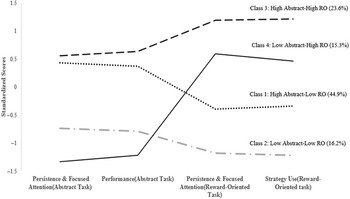
We ran LPA with one to five classes (see Table 2 for fit statistics) and identified the four-profile model being the most appropriate solution considering both (a) conceptual meaning and the interpretation of the identified profiles; and (b) model-fit indices (See more details for the rationale of our decision in Supplemental material and Figure S1 & S2). Specifically, within the four-class solution (see Figure 1, here we talk about the class from top to bottom on the right side for easy comprehension), class three showed fairly high abstract problem-solving, and even higher RO-problem-solving and was labeled as high abstract-high RO class. Notably, class four displayed very low levels of abstract problem-solving, however, they exhibited fairly high levels of RO-problem-solving and was labeled as low abstract-high RO class. In addition, class one exhibited higher abstract problem-solving and performance, and relatively lower RO problem-solving, this class was labeled as high abstract-low RO class. Finally, class two at the bottom of the figure demonstrated fairly low-abstract problem-solving, and even lower RO-problem-solving, which was labeled as low abstract-low RO class.
Fit indices for latent profile solutions (N = 232)

Note. LMR LRT: Lo–Mendell–Rubin Adjusted Likelihood Ratio Test. VLMR LRT: Vuong–Lo–Mendell–Rubin Likelihood Ratio Test. BLRT: Bootstrapped likelihood ratio test.
Latent profiles of the four-class solution.
Note. Class 1: High Abstract and Low Reward-Oriented Problem-Solving (44.9%); Class 2: Low Abstract and Low Reward-Oriented Problem-Solving (16.2%); Class 3: High Abstract and High Reward-Oriented Problem-Solving(23.6%); Class 4: Low Abstract and High Reward-Oriented Problem-Solving(15.3%).

Profiles of child problem-solving and environmental risks
Next, environmental risk factors were included in the model as auxiliary predictors of the latent profiles via the three-step approach, which affords tests of environmental prediction without changing the original latent profile solution. As shown in Table 3, compared to the low abstract-high RO class (i.e., class four), greater neighborhood crime was associated with lower likelihood for children to be categorized into the high abstract-low RO class (i.e., class one, Z = −2.07, p = .04), the low abstract-low RO class (i.e., class two, Z = −1.98, p < .05), and marginally the high abstract-high RO class (i.e., class three, Z = −1.73, p = .08). In other words, the results indicated that greater neighborhood crime was associated with (at least marginally) greater likelihood for children to be classified into the low abstract-high RO class than the rest of the sample. Furthermore, greater neighborhood percentage of poverty was associated with a marginally greater likelihood for children to be classified into the low abstract-low RO class (i.e., class two) in comparison to the low abstract-high RO class (i.e., class four).
Logistic regression coefficients for four-class solution (N = 226)

Note. RO: reward-oriented problem-solving. *: p < .05, †: p < .10.
Class 1: High Abstract and Low Reward-Oriented Problem-Solving; Class 2: Low Abstract and Low Reward-Oriented Problem-Solving; Class 3: High Abstract and High Reward-Oriented Problem-Solving; Class 4: Low Abstract and High Reward-Oriented Problem-Solving. Also note the relation between the parameter estimates in the table with odds ratio from logistic regression: odds ratio = e(parameter). Thus, negative parameters indicate an odds ratio that is below one (i.e., lower likelihood), and positive parameters reflect the odds ratio above one (i.e., elevated likelihood).
In addition, greater maternal sensitivity was linked to a greater likelihood for children to be categorized into the high abstract-high RO class (i.e., class three) in comparison to the low abstract-high RO (i.e., class four; Z = 2.16, p = .03) and the high abstract-low RO class (i.e., class one, Z = −2.49, p = .01). Finally, a sensitivity test was carried out to examine the robustness of our finding by including additional covariates (i.e., maternal age and education) given the documented association between maternal age and education with maternal parenting (e.g., Tamis-LeMonda et al., Reference Tamis-LeMonda, Briggs, McClowry and Snow2009) and child cognitive development and problem-solving (e.g., Zadeh et al., Reference Zadeh, Farnia and Ungerleider2010). All results reported above remained significant (See Supplemental material, Table S1).
Child problem-solving profiles and socioemotional functioning
Turning to how latent profiles of problem-solving were linked to child functioning at a later age, externalizing and internalizing problems were included in the four-class solution as outcome associated with latent profiles via the BCH method (Bolck et al., Reference Bolck, Croon and Hagenaars2004). As shown in Table 4, the overall test indicated that there were significant differences among the latent profiles in externalizing problems at the second measurement occasion. Significant results emerged in pairwise comparisons such that the low abstract-low RO class (i.e., class two) exhibited significantly higher externalizing problems than the high abstract-low RO (i.e., class one) and the high abstract-high RO class (i.e., class three). In addition, the low abstract-high RO class (i.e., class four) also demonstrated significantly more externalizing problems than the high abstract-low RO class (i.e., class one), and marginally more than the high abstract-high RO class (i.e., class three).
Problem-Solving Profiles and Child Functioning (N = 232).

Turning to internalizing problems, although the overall test was not significant, pairwise comparisons suggested that the low abstract-low RO class (i.e., class two) exhibited significantly more internalizing problems than the high abstract-low RO (i.e., class one) and high abstract-high RO class (i.e., class three). In contrast, no significant differences in internalizing problems were observed when comparing the low abstract-high RO class (i.e., class four) and other classes.
Discussion
Guided by specialization hypothesis (Ellis et al., Reference Ellis, Bianchi, Griskevicius and Frankenhuis2017), this multi-method (behavioral observation, questionnaire) longitudinal study adopted a person-centered approach to explore children’s problem-solving skills within different contexts. This work also investigated how contextual risks within and outside the family were associated with children’s problem-solving patterns, and how the latter may be related to meaningful differences in children’s functioning. Latent profile analyses suggested that there were four distinguishable problem-solving profiles, including (a) a high abstract-low RO, (b) a low-abstract-low RO, (c) a high abstract-high-RO, and (d) a low-abstract-high-RO problem-solving class. Contextual risks, including neighborhood crime, maternal sensitivity, and neighborhood impoverishment were all (at least marginally significantly) linked to likelihood differences among profiles. Turning to child functioning, differences emerged in both externalizing and internalizing problems when comparing problem-solving profiles, such that the two profiles with low-abstract problem-solving seemed to exhibit (at least marginally) greater externalizing problems, but only the low-abstract-low RO group demonstrated elevated internalizing problems. As an additional note, the present study evaluated these issues within early childhood given it is a period of rapid development of cognitive and socioemotional functioning (e.g., Bruchhage et al., Reference Bruchhage, Ngo, Schneider, D’Sa and Deoni2020). Thus, studying individual differences in problem-solving as well as the contextual factors associated with these differences may contribute to the understanding of long-term developmental trajectories. Furthermore, given the critical role of family and neighborhood contexts in young children’s development (e.g., Tucker-Drob & Harden, Reference Tucker-Drob and Harden2012), our focus on family and neighborhood risk factors is relevant and appropriate.
The four profiles reflected potential differences in child’s performance in the abstract, decontextualized task vs. the RO problem-solving tasks. That is, through inspection of our four profiles, children scoring high vs. low on abstract problem-solving task did not necessarily score at consistent levels in the RO task (e.g., high abstract-low RO). This pattern aligns with the low to non-significant bivariate correlations in children’s engagement and performance among different tasks in the present sample (see Table 1), both indicating potentially different underlying processes for the two tasks. That is, the former does not involve a salient reward that may tap on children’s ability to stay engaged and solve problems on the more abstract level, the latter involves a salient reward that is hedonically attractive, curiosity evoking and of interest to children (Sturge-Apple et al., Reference Sturge-Apple, Davies, Cicchetti, Hentges and Coe2017; Suor et al., Reference Suor, Sturge-Apple, Davies and Cicchetti2017).
By comparing the profiles, we found that greater neighborhood crime was associated with higher likelihood for children to be from the low-abstract-high-RO profile. Greater maternal sensitivity, however, emerged as a significant predictor for greater likelihood for children to be from the high-abstract-high-RO in contrast to high-abstract-low RO, as well as the low-abstract-high-RO profiles. Furthermore, marginally significant differences also emerged comparing the two profiles with low-abstract problem-solving, such that greater neighborhood impoverishment tended to be linked to greater likelihood to be from the low-abstract-low RO in contrast to the low-abstract-high-RO profile. We discuss these findings point-by-point subsequently.
First, children from the low-abstract-high-RO profile seemed to experience the highest neighborhood crime and low maternal sensitivity. This finding proved consistent with previous research that documented an adverse impact of neighborhood crime and maternal sensitivity in children’s cognitive problem-solving assessed through standard test batteries (e.g., Caughy et al., Reference Caughy, Hayslett-McCall and O’Campo2007; Lugo-Gil & Tamis-LeMonda, Reference Lugo-Gil and Tamis-LeMonda2008; Minh et al., Reference Minh, Muhajarine, Janus, Brownell and Guhn2017; Ryan et al., Reference Ryan, Martin and Brooks-Gunn2006; Tamis-LeMonda et al., Reference Tamis-LeMonda, Shannon, Cabrera and Lamb2004). In contrast to compromised problem-solving in the abstract task, however, children from this profile exhibited fairly high levels of engagement and strategy use in the RO task. We speculate that this unique pattern may reflect children’s stress-adaptation that calibrated their problem-solving skills based on their developmental context. That is, when the external environment conveys information for heightened danger, violence, and lack of support, individuals may develop greater motivation and preferences to secure reward that are fleeting or unpredictable (Belsky et al., Reference Belsky, Steinberg and Draper1991; Ellis et al., Reference Ellis, Figueredo, Brumbach and Schlomer2009; Griskevicius et al., Reference Griskevicius, Tybur, Delton and Robertson2011; Humphreys et al., Reference Humphreys, Lee, Telzer, Gabard-Durnam, Goff, Flannery and Tottenham2015; Sturge-Apple et al., Reference Sturge-Apple, Davies, Cicchetti, Hentges and Coe2017; Suor et al., Reference Suor, Sturge-Apple, Davies and Cicchetti2017). Certainly consistent with this perspective, problem-solving in the abstract, less ecologically relevant task, may be placed at a lower priority that was undermined.
Towards this, it is important to note that greater neighborhood crime and lower maternal sensitivity have both been regarded as indicators of environmental harshness that foster the development of risky behavioral strategies (Ellis et al., Reference Ellis, Figueredo, Brumbach and Schlomer2009). More specifically, living in neighborhoods with elevated crime, violence, and danger likely indicates shorten life-expectancy, premature illness and mortality, and limited and/or uncontrollable access to resources, which may all promote the development of risky behavioral strategies (e.g., greater rates of adolescent sexual intercourse, Lauritsen, Reference Lauritsen1994; earlier age of female childbearing, Wilson & Daly, Reference Wilson and Daly1997; elevated externalizing problems, Manly et al., 2012). In addition, lower parent investment in the form of lower maternal sensitivity has been conceptualized to convey information about the external environment (Belsky et al., Reference Belsky, Steinberg and Draper1991; Quinlan, Reference Quinlan2007) and has been linked with a variety of indicators for risky behavioral strategies (e.g., greater sexual risk taking; Belsky et al., Reference Belsky, Schlomer and Ellis2012; greater externalizing problems; Wang et al., Reference Wang, Christ, Mills-Koonce, Garrett-Peters and Cox2013).
Second, when comparing the two profiles with low-abstract problem-solving, we found that greater neighborhood impoverishment was marginally significantly associated with greater likelihood to be from the low-abstract-low-RO profile. This finding was consistent with previous research (e.g., Caughy and O’Campo, Reference Caughy and O’campo2006; McCoy et al., Reference McCoy, Connors, Morris, Yoshikawa and Friedman-Krauss2015). Yet, it was somewhat surprising that the low-abstract-low-RO profile was not significantly linked with any other contextual risks in this study. This was because this profile demonstrated compromised abstract problem-solving, which appears generally consistent with a riskier behavioral strategy (Li et al., Reference Li, Liu, Hartman and Belsky2018; Suor et al., Reference Suor, Sturge-Apple, Davies and Cicchetti2017). Another indicator for the low-abstract-low-RO profile adopting the risky strategy is that this profile exhibited high levels of externalizing and internalizing problems, which we discuss later. Compared to the low-abstract-high-RO class, the low-abstract-low-RO profile did not exhibit heightened RO problem-solving skill, and thus may reflect the potential heterogeneity in children’s responses to stress exposure when considering problem-solving across multiple dimensions (i.e., abstract vs. RO).
We speculate the differences in the RO task between the two low-abstract problem-solving profiles may be accounted by two reasons. First, compared to neighborhood poverty, exposure to crime may operate as a more direct cue for unexpected, unpredictable injury and premature mortality that may more strongly enhance children’s preference to approach and seize immediate reward (e.g., Griskevicius et al., Reference Griskevicius, Tybur, Delton and Robertson2011; Sturge-Apple et al., Reference Sturge-Apple, Davies, Cicchetti, Hentges and Coe2017) Alternatively, unlike neighborhood crime that happens more sporadically, stress experienced by children living in impoverished neighborhood may affect their daily experiences and then subsequently undermine their motivation to approach and persistent on the novel puzzle-solving tasks. Towards this, previous research linked exposure to neighborhood poverty with greater learned helplessness in children when working on challenging tasks (e.g., children’s learned helplessness when solving difficult puzzles, Brown et al., Reference Brown, Seyler, Knorr, Garnett and Laurenceau2016). That said, the null finding for the link between contextual risks and low-abstract-low-RO class may be due to certain factors related to children’s learned helplessness and dampened motivation not being examined in this study, and thus warrants future exploration.
Third, between the two profiles with high abstract problem-solving, children with greater maternal sensitivity were more likely to be from the high abstract-high-RO profile, compared to high abstract-low RO profile. Whereas these two profiles both seemed to adopt a less risky strategy in general, reflected by high abstract problem-solving, their differences in RO problem-solving might be attributed to curiosity and persistence. Towards this, a body of work documented that children raised by sensitive and supportive parents demonstrated greater interest and persistence in solving novel puzzle-like tasks (e.g., Martin et al., Reference Martin, Ryan and Brooks-Gunn2013). According to Martin et al. (Reference Martin, Ryan and Brooks-Gunn2013), this association may be accounted by two reasons: (a) sensitive parenting that fosters the development of emotion-regulation may enable children to better direct their attention toward problem-solving, particularly when children work alone on themselves (in the puzzle-box task); (b) parent sensitivity may allow children to form a better sense of secure base that promotes exploration for novel stimuli (i.e., puzzle box). These explanations, however, warrant future validation.
Turning to child functioning, we found that the two profiles with low-abstract problem-solving exhibited (at least marginally) greater externalizing problems compared to the other two profiles. This result aligns with previous literature linking undermined cognitive abilities with greater externalizing problems (e.g., Metcalfe et al., Reference Metcalfe, Harvey and Laws2013; Morgan et al., Reference Morgan, Farkas, Tufis and Sperling2008). This finding also indicated that weakened abstract problem-solving and elevated externalizing problems may correlate with each other, consistently reflecting children’s adaptation to contextual stress (e.g., Belsky et al., Reference Belsky, Steinberg and Draper1991; Doom et al., Reference Doom, Vanzomeren-Dohm and Simpson2016). After all, lower abstract problem-solving skills, either related to difficulties in sustaining attention and maintaining patience (Belsky et al., Reference Belsky, Pasco Fearon and Bell2007), or regulating task-related emotions (e.g., frustration, Rydell et al., Reference Rydell, Berlin and Bohlin2003), may promote the development of behavioral problems.
It is also noteworthy that among the two profiles showing low-abstract problem-solving, only the low-abstract-low RO problem-solving profile exhibited greater internalizing problems. In other words, these findings documented a co-occurrence of reduced RO problem-solving (when abstract problem-solving was low) and elevated internalizing problems, which has been revealed in previous research. More specifically, previous work indicated that early deprivation, particularly in the form of material deprivation, may reduce children’s responsivity to rewards (e.g., Dennison et al., Reference Dennison, Rosen, Sambrook, Jenness, Sheridan and McLaughlin2019; Sheridan et al., Reference Sheridan, McLaughlin, Winter, Fox, Zeanah and Nelson2018). Such blunted reward responsivity, in turn, was found to be a risk factor for elevated internalizing problems and depression (e.g., Sheridan et al., Reference Sheridan, McLaughlin, Winter, Fox, Zeanah and Nelson2018). That said, it seemed that the low-abstract-high-RO pattern, consistent with the specialization hypothesis, may somewhat benefit children by shielding them from developing internalizing problems after all. The underlying mechanism for such beneficial effect, however, warrants future exploration.
Several limitations of this study are worth mentioning. First, our sample consisted of low- to middle-Socioeconomic status (SES), two-parent families, and thus the generalization of these findings should be cautious. That said, as one of our goals was to examine the association between contextual risks and child problem-solving, it is crucial for future studies with at-risk samples to replicate the present finding. Second, although consisting of more than 200 families, our sample size is on a lower side for latent profile analyses (e.g., Tein et al., Reference Tein, Coxe and Cham2013). Future research is thus encouraged to replicate our findings in a larger sample. Third, although we consider our analytic approach to be an important first step and an appropriate approach to evaluate the present research questions, it nevertheless has its own limitations (e.g., classifying children into categorical profile membership). We note, however, that an alternative method that could examine the within-person performance across different tasks is the mixed model approach. This approach can be used to model child performance across different contexts while accounting for the nesting nature of the tasks (within each child). We thus encourage future research to explore this promising direction. Fourth, with all the contextual factors and child problem-solving assessed at the first measurement occasion, this study was limited in its capacity to document causal relations. In addition, we only examined the link between problem-solving skills and wave-two child functioning, thus were unable to assess whether problem-solving may shape the change in child functioning over time. Fifth, the present study measured problem-solving in two different tasks. Although both tasks were well-established and captured variability in children’s behavior and performance, one informed by the sensitization hypotheses (e.g., Frankenhuis et al., Reference Frankenhuis, Young and Ellis2020) may also be wondering how children from adverse contexts vary in their performance in the same task with vs. without the reward as an incentive, as hypothesized by the sensitization hypotheses (i.e., children from adverse contexts only perform better, or comparably, when reward is present in the task; in contrast, children from adverse environment does not show enhanced or comparable performance when reward is absent). As such, we urge future research to adopt a within-person design (i.e., the same task under reward vs. no-reward conditions) to see if the pattern of the findings holds.
Finally, turning to our contextual predictors, although we tried to obtain the more objective measurement of neighborhood-level risks (i.e., census information on neighborhood poverty rate), our assessment of neighborhood crime was rated by mothers based on four items from NOAA-R. This measure may reflect mothers’ perception and only capture limited types of crime. As such, future research is recommended to obtain more objective indicators for neighborhood crime and/or violence, such as crime-rate information from the police department (Caughy et al., Reference Caughy, Hayslett-McCall and O’Campo2007). In addition, given the limited items in NOAA-R capturing neighborhood crime, we did not separate violent vs. property crime (see evidence that these two types of crime are moderately to highly correlated, Harries, Reference Harries2006). Future research with a more detailed measure of neighborhood crime may see if these two types of crime may have different implications (e.g., Ellis et al., Reference Ellis, Figueredo, Brumbach and Schlomer2009).
Despite the limitations, the present study was guided by the evolutionary specialization hypothesis and applied a person-centered approach to examine heterogeneity in child problem-solving in an abstract, visual-spatial and an ecologically relevant RO problem-solving task. Testifying to greater precision and potential clinical utility, we documented four unique profiles in child problem-solving skills across tasks, with one of the profiles exhibiting undermined abstract but enhanced RO problem-solving, which was consistent with the specialization hypotheses. Furthermore, different contextual risks within and outside the family were linked to child problem-solving profiles. Children from different profiles were also found to exhibit different levels of socioemotional functioning later. Taken together, findings from the present study advance a more balanced view for children exposed to adverse contexts, in that stressful contexts seemed to specialize some children in solving ecologically relevant problems. Moreover, findings with respect to different problem-solving profiles and the associated contextual risks and child developmental sequelae may inform future research seeking to identify potential processes through which children adapt to stressful contexts.
Supplementary material
To view supplementary material for this article, please visit https://doi.org/10.1017/S0954579421001322.
Acknowledgments
We are grateful to the children and parents who participated in this project. Our gratitude is expressed to the staff on the project at Mt. Hope Family Center and the graduate and undergraduate students at the University of Rochester.
Funding statement
This research was supported by the Eunice Kennedy Shriver National Institute of Child Health & Human Development awarded to Melissa L. Sturge-Apple and Patrick T. Davies (5R01HD087761).
Conflicts of interest
The authors declare that they have no conflict of interest.