





Hostile attribution bias (HAB), the tendency to interpret ambiguous social cues as intentionally hostile, is a central component of children’s social cognition (Yaros et al., Reference Yaros, Lochman, Rosenbaum and Jimenez-Camargo2014). It is also a well-established precursor of aggressive behavior, conduct problems, and externalizing psychopathology, including oppositional defiant disorder (De La Osa et al., Reference De La Osa, Penelo, Navarro, Trepat, Domènech and Ezpeleta2018; Houssa et al., Reference Houssa, Volckaert and Nader-Grosbois2018). As HAB becomes increasingly stable across elementary school (Orobio de Castro et al., Reference Orobio de Castro, Veerman, Koops, Bosch and Monshouwer2002; Yamamoto et al., Reference Yamamoto, Ohigashi, Todo and Moriguchi2025), identifying the early factors that shape its development is critical. These factors carry direct implications for prevention and intervention (Lee et al., Reference Lee, Chang, Ip and Olson2019).
Within the social information processing (SIP) framework, HAB is shaped by both (a) accumulated relational experiences which populate children’s social database with hostile schemas; and (b) internal cognitive capacities that regulate how deliberately children process social cues (Crick & Dodge, Reference Crick and Dodge1994; Verhoef et al., Reference Verhoef, van Dijk and de Castro2022). Yet longitudinal evidence linking these specific factors to HAB remains limited. With respect to relational experiences, existing work has largely focused on parent–child relationships and on behavioral rather than social–cognitive outcomes (e.g., Kochanska et al., Reference Kochanska, Kim and Herbert2026), leaving the role of teacher-child conflict largely unexamined. This is a meaningful gap, as the classroom is the primary context in which children encounter ambiguous peer interactions that activate hostile attributions. As such, conflict with teachers may represent a theoretically proximate and potentially formative influence on children’s emerging social–cognitive schemas. With respect to internal capacities, although executive functions (EFs) have been linked to social–cognitive development more broadly, prospective evidence for their specific role in predicting HAB remains limited. Such evidence is also inconsistent across developmental periods (Badarneh et al., Reference Badarneh, Arbel and Ziv2024).
Finally, boys and girls differ in their socialization experiences, regulatory demands, and responses to relational conflict (Endendijk et al., Reference Endendijk, Groeneveld, Bakermans-Kranenburg and Mesman2016; Hosokawa & Katsura, Reference Hosokawa and Katsura2019), suggesting they may follow distinct developmental pathways to HAB. The present study addresses these gaps by examining whether mother- and teacher-child conflict and EFs in kindergarten predict HAB in late elementary school. It also examines whether these pathways are gender-differentiated.
Hostile attribution bias
HAB is commonly conceptualized within the SIP framework, which describes how children interpret social cues, infer others’ intentions, and select behavioral responses (Crick & Dodge, Reference Crick and Dodge1994). Within this framework, HAB is described as the tendency to interpret others’ ambiguous social behaviors as intentional and hostile (e.g., Dodge, Reference Dodge2006; Osgood et al., Reference Osgood, Kase, Zaroukian and Quartana2021). When individuals interpret others’ intentions as hostile, they are more likely to adopt aggressive goals and engage in aggressive responses (e.g., Yao & Enright, Reference Yao and Enright2022; Yaros et al., Reference Yaros, Lochman and Wells2016). Although findings on gender differences in HAB are somewhat mixed (e.g., Nelson et al., Reference Nelson, Mitchell and Yang2008; Yagmurlu, Reference Yagmurlu2014), a recent meta-analysis found that boys tend to show slightly higher levels of HAB than girls (Xu et al., Reference Xu, Wu, Xu, Ding, Zhou and Long2024).
Importantly, during early childhood, children are still developing the ability to distinguish others’ intentions from the outcomes of social interactions, a capacity that typically strengthens across this period (Call & Tomasello, Reference Call and Tomasello1998; Dodge, Reference Dodge2006). As a result, younger children may show a normative tendency to equate negative outcomes with hostile intent and thus HAB may be somewhat diffuse or inconsistently expressed in early childhood (Dodge, Reference Dodge2006; Ziv, Reference Ziv2012). As children grow older, and especially during middle childhood, individual differences in HAB become increasingly stable and predictive of adjustment (e.g., Orobio de Castro et al., Reference Orobio de Castro, Veerman, Koops, Bosch and Monshouwer2002; Yamamoto et al., Reference Yamamoto, Ohigashi, Todo and Moriguchi2025). Recent work also indicates that meaningful and reliable assessments of HAB are feasible from kindergarten onward (e.g., Schultz et al., Reference Schultz, Groth, Vanderwalde, Shannon, Shuttlesworth and Shanty2018). This makes kindergarten a useful starting point for examining how early HAB, alongside key developmental factors such as conflictual relationships with significant adults and children’s EFs, relates to HAB in middle and late childhood.
Possible predictors of hostile attribution bias
Research suggests that a range of early factors may contribute to the development of HAB. Existing literature has primarily focused on negative antecedents, including negative relational experiences and deficits in self-regulatory capacities. These factors may heighten children’s sensitivity to threat and increase reliance on hostile schemas when interpreting ambiguous social cues (Dodge, Reference Dodge2006; Kochanska et al., Reference Kochanska, Kim and Herbert2026; Verhoef et al., Reference Verhoef, van Dijk and de Castro2022). Accordingly, the present review focuses on two such categories of predictors that have not been sufficiently examined in relation to the development of HAB: conflictual relationships with significant adults and children’s EFs.
Conflictual relationships with significant adults
The quality of children’s relationships with significant adults is recognized as a cornerstone of healthy development (e.g., Magro et al., Reference Magro, Nivison, Englund and Roisman2023). This is particularly evident in early childhood, when children are highly dependent on caregivers for emotional regulation and social learning (Pianta & Stuhlman, Reference Pianta and Stuhlman2004).
Relational dimensions such as closeness and conflict have been linked not only to children’s behavioral and emotional adjustment, but also to the development of social–cognitive processes. For example, a study of preschoolers found that lower-quality mother–child and father–child relationships, characterized by higher conflict and lower relational closeness, were associated with more aggressively biased SIP (Arbel et al., Reference Arbel, Sofri, Elizarov and Ziv2021). Longitudinal evidence further suggests that higher levels of mother–child conflict, but not father–child conflict, are associated with children’s later ability to encode social cues (Li et al., Reference Li, Ding, Zheng, Lin, Wang and Liu2025). Extending this work, a longitudinal study found that mothers’ power-assertive control, assessed observationally from toddlerhood to preschool age, predicted children’s hostile mindsets in early school age (Kochanska et al., Reference Kochanska, Kim and Herbert2026). Similar effects were observed for father–child dyads. In addition, research has shown that severe adverse relational experiences, including harsh parenting and physical maltreatment, are associated with later hostile attribution tendencies and hostile SIP patterns (e.g., Dodge et al., Reference Dodge, Bai, Godwin, Lansford, Bates, Pettit and Jones2022; Griffith et al., Reference Griffith, Cho, Gusler, McGuire and Jackson2021). Although some of this work focused on discipline-related negativity and maltreatment rather than relational conflict itself, it aligns with the broader view that adverse relational experiences may shape children’s hostile social cognition. Together, these findings suggest that conflictual parent–child relationships may shape how children interpret ambiguous social situations, increasing the likelihood of hostile attributions.
Beyond the family context, the relationship between children and their teachers plays a central role in shaping children’s social and emotional development (e.g., Rucinski et al., Reference Rucinski, Brown and Downer2018). This role is especially salient in early childhood, when children spend substantial time in educational settings and rely on teachers for emotional support, behavioral regulation, and socialization (Camodeca & Coppola, Reference Camodeca and Coppola2019; Valiente et al., Reference Valiente, Swanson, DeLay, Fraser and Parker2020).
Borrowing from terminology used in parent–child relationships, teacher–child relationship quality is commonly conceptualized in terms of relational closeness and conflict. Conflict reflects persistent tension or negativity in teacher–child interactions (Partee et al., Reference Partee, Alamos, Williford and Downer2022; Sabol & Pianta, Reference Sabol and Pianta2012). Empirical research indicates that conflictual teacher–child relationships are linked to poorer socio-emotional adjustment, including higher levels of externalizing and internalizing behaviors (e.g., Elizarov et al., Reference Elizarov, Benish-Weisman and Ziv2023) and difficulties in school adjustment (e.g., Nur et al., Reference Nur, Aktaş-Arnas, Abbak and Kale2018). However, despite robust evidence for behavioral and emotional outcomes, little is known about the links between conflictual teacher–child relationships and children’s social–cognitive processes, particularly HAB. Because teachers are central figures in children’s daily school experiences, conflictual teacher–child relationships may be especially influential for the development of HAB. Indeed, unlike the home environment, the classroom context more closely approximates the peer situations (e.g., Choi et al., Reference Choi, Wen, Boros, Lin, Huang and Yin2025) in which hostile attribution processes are most likely to be activated. Within this setting, children continuously navigate ambiguous social interactions with peers alongside their ongoing relationship with the teacher. This may render conflict in this context a particularly formative influence on their emerging social–cognitive schemas.
In addition to these relational experiences, children’s interpretation of social cues may also depend on their cognitive regulatory capacities, particularly EFs.
Children’s executive functions
EFs are higher-order cognitive processes that regulate thoughts, behaviors, and emotions. A widely accepted framework identifies three core EF components: inhibitory control, working memory, and cognitive flexibility (Diamond, Reference Diamond2013). Inhibitory control involves managing attention, behavior, thoughts, and/or emotions to override automatic responses in favor of goal-directed actions. Working memory refers to the ability to temporarily store and manipulate information to perform complex tasks and harness conceptual knowledge (Baddeley, Reference Baddeley1992; Ziermans et al., 2012). Cognitive flexibility refers to the ability to adapt thoughts and behaviors in response to changing environmental demands, goals, or task rules (Diamond, Reference Diamond2013).
EFs are associated with key developmental outcomes, including social competence (e.g., Patwardhan et al., Reference Patwardhan, Nelson, McClelland and Mason2021) and socio-cognitive abilities such as emotion understanding (Badarneh et al., Reference Badarneh, Arbel and Ziv2024) and general information processing (Sung & Wickrama, Reference Sung and Wickrama2018). Yet, relatively little empirical attention has been devoted to examining links between EF and HAB (for a systematic review, see Badarneh et al., Reference Badarneh, Arbel and Ziv2024).
The few studies examining these associations show inconsistent results which are likely age-dependent. A study of preschoolers failed to find associations between EF and HAB (Caporaso et al., Reference Caporaso, Marcovitch and Boseovski2021). In contrast, research in later developmental stages suggests a different pattern. Goldweber et al. (Reference Goldweber, Bradshaw, Goodman, Monahan and Cooley-Strickland2011) examined EF in relation to patterns of SIP in elementary school–aged children using a one-year longitudinal design. Using latent transition analysis, they identified a “high aggressive SIP” profile that included HAB, aggressive response generation, and the justification of aggression. Higher EF (a composite score of inhibition, shifting, and emotion regulation) was associated with a greater likelihood of transitioning out of this profile over time. In contrast, poorer EF was linked to remaining in this profile.
As children’s ability to represent others’ intentions independently of outcomes improves with development (e.g., Schultz et al., Reference Schultz, Groth, Vanderwalde, Shannon, Shuttlesworth and Shanty2018; Ziv, Reference Ziv2012), links between EF and HAB may become more evident. Theoretically, working memory and inhibitory control may support the maintenance and regulation of social information. In addition, cognitive flexibility may enable children to shift between competing mental representations (Diamond, Reference Diamond2013). These abilities may facilitate the consideration of alternative, non-hostile interpretations in ambiguous situations.
Gender as a moderator
Boys and girls may differ in how they are socialized (e.g., Brazzelli et al., Reference Brazzelli, Pepe and Grazzani2022), regulate their behavior and emotions (e.g., Gestsdottir et al., Reference Gestsdottir, von Suchodoletz, Wanless, Hubert, Guimard, Birgisdottir and McClelland2014; Wanless et al., Reference Wanless, McClelland, Lan, Son, Cameron, Morrison and Sung2013), and respond to conflict within significant relationships (e.g., Ogg et al., Reference Ogg, Anthony and Wendel2024). These differences may shape their social–cognitive processing. The possibility that associations between EF and HAB differ by gender has yet to be examined. This gap is important, as gender-differentiated socialization practices (e.g., Brazzelli et al., Reference Brazzelli, Pepe and Grazzani2022; Mesman & Groeneveld, Reference Mesman and Groeneveld2018) and developmental differences in EF (e.g., Li, Reference Li2024) may lead girls and boys to rely on self-regulatory processes differently. This, in turn, may shape how they interpret and navigate social contexts.
With respect to mother–child relational conflict, empirical findings suggest that boys may be particularly vulnerable to conflictual or controlling environments in the family. For example, in a study of fourth-grade children, paternal psychological control was associated with boys’ HAB in both instrumental and relational provocation contexts. In contrast, this pattern was not observed for girls. Maternal self-reported parenting practices, however, were not significantly associated with children’s HAB for either gender (Nelson & Coyne, Reference Nelson and Coyne2009). Although prior work has linked severe adverse parent–child experiences to children’s HAB, little is known about gender differences in the associations between mother–child conflict and children’s HAB or other SIP processes.
In the school context, to our knowledge, no study has directly examined whether conflictual teacher–child relationships predict children’s HAB or other SIP processes, or whether these associations differ for boys and girls. Related work, however, suggests that boys may be particularly vulnerable to negative teacher–child relationships at the behavioral and emotional levels. For example, a longitudinal study found that teacher–child relational conflict in kindergarten predicted higher externalizing behavior through third grade for boys, but not for girls (Ogg et al., Reference Ogg, Anthony and Wendel2024). Meta-analytic and longitudinal evidence further indicates that boys may be more sensitive than girls to low emotional support and conflictual teacher–student relationships, particularly with respect to emotional engagement (Archambault et al., Reference Archambault, Vandenbossche-Makombo and Fraser2017; Opdenakker, Reference Opdenakker2021; Roorda et al., Reference Roorda, Koomen, Spilt and Oort2011). However, some studies have reported no gender differences in links between supportive teacher–student relationships and engagement (e.g., Tucker et al., Reference Tucker, Zayco, Herman, Reinke, Trujillo, Carraway and Ivery2002). Taken together, these findings suggest meaningful gender differences in children’s sensitivity to conflictual teacher–child relationships. However, it remains unclear whether such differences extend to their SIP, particularly their interpretations of ambiguous social situations.
The current study
Despite growing evidence linking relational conflict and EF to children’s hostile attribution bias, three important gaps remain. First, no study has examined whether teacher–child conflict – which, as mentioned, occurs within the very ecological context in which HAB is most commonly activated – longitudinally predicts children’s hostile attribution tendencies. Second, while gender differences in HAB and in children’s responses to relational conflict are documented, it remains unknown whether the pathways from early relational conflict and EF to later HAB differ for boys and girls. Third, studies have rarely integrated both relational and cognitive predictors of HAB within a single longitudinal model spanning the transition from early to late childhood.
The present longitudinal study addresses these gaps by examining whether children’s HAB, EFs (i.e., inhibitory control, working memory, and cognitive flexibility), and conflictual relationships with mothers and teachers in kindergarten predict HAB in late elementary school. It also examines whether these associations differ between boys and girls. We expected that higher HAB and conflict, and lower EFs, in kindergarten would predict higher HAB at follow-up, and that these associations would differ by gender.
Method
Participants
The sample included 279 Arab and Jewish children recruited from kindergartens in northern Israel. The data presented in this study were drawn from a larger research project, with the first phase (T1) conducted between 2017 and 2019, and the second phase (T2) carried out from 2022 to early 2024. The sample included 301 children at T1 and 280 children at T2 (see attrition section below). One additional child was excluded from this sample due to being older than 13 years at T2, in order to maintain a developmentally homogeneous late elementary school sample. Thus, the final analytic sample included 279 children (138 girls; 106 Arabs and 173 Jews). At T1, the mean age was 5.7 years (SD = 0.53), with an age range of 4.3 to 7 years. At T2, the mean age was 10.6 years (SD = 0.86), with an age range of 9 to 12.75 years. Children came from Arabic- and Hebrew-speaking families. Assessments were conducted in the child’s native language by trained research assistants who were native speakers of that language. Arab children were assessed in Arabic, whereas Jewish children were assessed in Hebrew. Teacher-report questionnaires were completed in the same language, as teachers typically shared the same linguistic background as the children.
Information on maternal education was collected through maternal reports and categorized into six levels. Specifically, 3.3% of mothers reported less than 12 years of education, 7.4% completed 12 years of education without a secondary school matriculation certificate, 9.4% held a secondary school matriculation certificate, 11.1% attended higher education without completing a degree, 38.5% held a bachelor’s degree, and 30.3% held a master’s degree or higher. Mothers also ranked their household income using a five-point ordered scale relative to the average monthly income in Israel (well below average, slightly below average, average, slightly above average, well above average). Of the mothers, 8% reported well below average income, 15% slightly below average, 22% average, 28% slightly above average, and 27% well above average.
Attrition
At T2, we attempted to contact the families to participate in a follow-up study. However, we were unable to reach all of them (21 of 301), with one family relocating out of the country, and 11 were unreachable. Nine other families declined to participate. Ultimately, from the 280 of 301 families T2 recruitment represents a very high retention rate of 93%. No significant T1 mean differences in EFs (i.e., inhibitory control, working memory, and cognitive flexibility), mother–child relational conflict, or teacher–child relational conflict, were found between children who participated at T2 (n = 280) and those who did not participate at T2 (n = 21). This suggests that attrition was not systematically related to key study variables (see Table S1).
Missing data were handled using full information maximum likelihood (FIML). In addition, Hawkins’ test for normality and homoscedasticity was non-significant, suggesting that the missingness pattern was consistent with missing completely at random (MCAR; p = .100).
Procedures
Participants were recruited from public kindergartens across the northern region of Israel, encompassing both Arab and Jewish communities. At both data collection points, we first received approval from the University’s Institutional Review Board (Approval No. 464/16 at T1 and No. 262/23 at T2) and from the Department of Education Chief Scientist Office (Approval No. 9312 at T1 and No. 14099 at T2). At T1, flyers were distributed to kindergarten teachers who then passed them on to the parents of the children. Parents who were interested in participating completed their details on the flyers and returned them to the kindergarten teacher. We subsequently contacted these parents to confirm their participation in the study. Parents were thanked and provided with payment for participation ($40 at T1 and $50 at T2). Additionally, at both times, children received small (age-appropriate) gifts as a token of appreciation for their participation.
Materials
Time 1
Demographic and background data
Mothers completed a questionnaire to provide information on family background characteristics, including ethnicity, family income, maternal education, and the child’s age and gender.
Child’s hostile attribution bias
HAB at T1 was assessed using the Social Information Processing Interview, Preschool Version (SIPI-P; Ziv & Sorongon, Reference Ziv and Sorongon2011), a structured interview designed to examine children’s social information processing in peer contexts. The measure includes four illustrated stories depicting nonhostile rejection, ambiguous rejection, accidental provocation, and ambiguous provocation. Stories were presented using a storybook easel with illustrated bear characters and parallel versions for boys and girls. After each story, children were asked whether the peer protagonist acted on purpose or not. Responses indicating that the peer acted on purpose were coded as 1, whereas responses indicating that the peer did not act on purpose were coded as 0. Scores were summed across the four stories, with higher scores reflecting a greater tendency to attribute hostile intent to peers (possible range: 0–4). Internal consistency was modest (α = 0.57), which is consistent with the small number of items, as reliability is a function of scale length (Widaman et al., Reference Widaman, Little, Preacher, Sawalani, Trzesniewski, Donnellan and Lucas2011). Following recommendations for short, limited domain scales, we emphasize the mean inter item correlation (MIC) as an index of item homogeneity (Briggs & Cheek, Reference Briggs and Cheek1986); the MIC was 0.25, within the recommended 0.20 to 0.40 range for focused, limited domain scales. Together, these indices suggest that the T1 HAB items demonstrate adequate coherence.
Mother–child relational conflict
The Child–Parent Relationship Scale (CPRS; Driscoll & Pianta, Reference Driscoll and Pianta2011) was administered to assess conflict in the mother–child relationship. This self-report instrument evaluates parents’ perceptions of their relationships with their children using 15 items rated on a 5-point Likert scale. We used the 8-item Conflict subscale (e.g., “My child and I always seem to be struggling with each other”; “My child remains angry or is resistant after being disciplined”), which measures the extent to which parents perceive their relationship with their child as characterized by negativity. Mean scores across items were computed, with higher scores indicating greater mother–child conflict. Internal consistency for this subscale was good (α = 0.76).
Teacher–child relational conflict
Teacher-child relational conflict was assessed using the conflict subscale of the Student–Teacher Relationship Scale (STRS; Pianta & Steinberg, Reference Pianta and Steinberg1992). The subscale includes 12 items (e.g., “This child and I always seem to be struggling with each other”; “This child easily becomes angry at me”) that teachers rate to indicate the extent of conflict and discord experienced in their relationship with a specific child. Items are rated on a 5-point Likert scale ranging from 1 (does not apply) to 5 (definitely applies). Mean scores across items were computed, with higher scores indicating greater teacher-child conflict. The conflict subscale has been extensively used with preschool and early school-age children and has demonstrated very good internal consistency in prior research (αs = 0.83–0.94; e.g., Acar et al., Reference Acar, Kutaka, Rudasill, Torquati, Coplan and Yıldız2018; McCormick & O’Connor, Reference McCormick and O’Connor2015; Varghese et al., Reference Varghese, Vernon-Feagans and Bratsch-Hines2019). Internal consistency in the present study was also good (α = 0.80).
Inhibitory control
Inhibitory control was evaluated using a measure based on the Stroop tasks (Carlson & Moses, Reference Carlson and Moses2001; Montgomery & Fosco, Reference Montgomery and Fosco2012). This task requires the child to respond counter to a prepotent tendency and assesses the ability to inhibit automatic cognitive responses. This evaluation consisted of two subtests. In the first subtest, children were instructed to quickly respond with “lion” upon seeing an image of an elephant, and vice versa. In the second subtest, they were required to quickly say “red” when presented with a blue card, and “blue” when presented with red. Prior to starting these tasks, the experimenter confirmed the child could correctly identify and name the relevant words involved in the tasks (elephant, lion, red, and blue) before beginning the task (all children in the sample correctly identified and named the relevant words). Each subtest consisted of 10 sets, with scoring as follows: 0 points were awarded for an incorrect response, 1 point for rectifying an incorrect response with the correct one, 2 points for a correct but delayed response, and 3 points for an immediate correct answer. The total score for inhibitory control was calculated by summing the points across both subtests, resulting in possible scores ranging from 0 to 60. The split-half (odd/even) sample reliability was 0.82.
Working memory
Working memory was evaluated using the Working Memory Test Battery for Children (WMTB-C: Pickering & Gathercole, Reference Pickering and Gathercole2001). In this task, children were required to memorize a target picture, shown by the experimenter for a fixed duration (three or five seconds). Following the presentation of each target picture, children were immediately shown a set of pictures and were asked to identify the target picture from this set. The test consisted of 12 sets of pictures, and each picture contained two to seven shapes or numbers. One point was awarded for each correctly answered question. The final score for children’s working memory was calculated by summing the points earned across all sets, with possible scores ranging from 0 to 12. Studies have reported high test–retest reliability (Alloway, Reference Alloway2006).
Cognitive flexibility
Cognitive flexibility was assessed using the border/frame version of the Dimensional Change Card Sort task (DCCS: Zelazo, Reference Zelazo2006). The DCCS task requires children to sort a series of bivalent, multidimensional test cards. In the pre-switch phase, children were asked to sort cards according to one dimension (color), and in the post-switch phase, they were asked to sort them according to another dimension (shape). Those children who passed the post-switch phase (five out of six correct) then completed the border phase, where they were required to alternate between sorting on each dimension depending on whether the card had a lined border or not (sort by color if the card had a border and sort by shape if it did not). Cognitive flexibility score was based on the performance on the border/frame phase. Each incorrect answer was scored 0, and each correct answer was scored 1. The final score was calculated by summing up the points earned in each of the six rounds, with possible scores ranging from 0 to 6. This task is frequently used to assess children’s cognitive flexibility and demonstrates high content validity (Zelazo, Reference Zelazo2006) and high test–retest reliability in childhood (r = .78–.94; Patwardhan et al., Reference Patwardhan, Nelson, McClelland and Mason2021).
Time 2
Additional background data
To account for external factors that could indirectly influence child development, mothers reported whether ten significant life events had occurred within the past five years. These events included: death of a spouse, divorce, marital separation, death of a close family member, serious injury or illness, being fired from a job, significant change in the health or behavior of a family member, difficulties with the partner’s family, difficulties with a boss, and a change in the child’s school. This selection was adapted from the Social Readjustment Rating Scale (Holmes & Rahe, Reference Holmes and Rahe1967) to focus on events most pertinent to the study’s context. Each event was coded as 1 if it occurred and 0 if it did not. The total life events score was calculated by summing the number of events experienced, yielding a possible range from 0 to 10.
Child’s hostile attribution bias
Children’s HAB at T2 was assessed using two developmentally appropriate stories from the Social Information Processing Interview, Preschool Version (SIPI-P; Ziv & Sorongon, 2011), which was based on the original SIP Interview developed by Dodge and Price (Reference Dodge and Price1994) for early school-aged children. The stories were adapted with age appropriate illustrations depicting children rather than bears for participants in Grades 4 to 6, with parallel versions for boys and girls (see Figure 1 for example illustrations from one story showing the bear-based and child-based versions). The nonhostile rejection and ambiguous rejection stories were not included at T2 because these scenarios were considered less developmentally appropriate for older children. The two retained vignettes depicted accidental provocation and ambiguous provocation situations in which another child’s behavior could be interpreted as either accidental or intentional (e.g., a peer passing by and spilling the child’s drink while saying “Oops”). Each vignette was followed by a set of questions assessing children’s social information processing. Specifically, for each vignette, children were asked two questions assessing hostile interpretations of the peer’s intent: a closed-ended question (“Do you think the other child spilled the drink on purpose or not?”) and an open-ended question (“Why do you think the other child spilled the drink?”). The closed-ended question was scored 1 if the child attributed intentionality to the peer’s behavior and 0 otherwise. Responses to the open-ended question were coded as 1 when they reflected hostile intent (e.g., “He wanted to hurt him/her”; “He wanted to leave him/her without food”) and 0 when they reflected accidental, benign or ambiguous intent (e.g., “It was an accident”; “He didn’t mean to”; “I think he did not mean to, but maybe he did”). The inclusion of an open-ended question allows for a more nuanced assessment of children’s attributions. This is particularly appropriate for elementary school children, who are typically able to generate more elaborated explanations. Scores were summed across questions and vignettes to create a composite HAB score (possible range: 0–4), with higher scores indicating a stronger tendency to interpret ambiguous peer interactions as hostile. Internal consistency was modest (α = 0.53). The MIC was 0.22, which falls within the recommended 0.20 to 0.40 range for focused, limited domain scales (Briggs & Cheek, Reference Briggs and Cheek1986), indicating adequate coherence among the items.
Example illustrations from one social information processing vignette. Note. The panels show the girl version of the preschool bear‑based format (left) and the corresponding elementary‑school child‑based format (right). Similar parallel adaptations were used for the second story, with versions matched for boys and girls.

Analytic strategy
To test the hypothesized model, a multi-group path analysis was conducted using the lavaan package in R (Rosseel, Reference Rosseel2012). The model examined the direct pathways from children’s HAB, mother–child conflict, teacher–child conflict, and children’s EFs (i.e., inhibitory control, working memory, and cognitive flexibility) at Time 1 to children’s HAB at Time 2. All predictors were entered simultaneously to estimate their unique contributions to later HAB, and the Time 1 predictors were allowed to co-vary. Robust maximum likelihood estimation (MLR) was used to account for non-normality (i.e., skewness and kurtosis) in the study variables, particularly the positively skewed teacher-child conflict scores.
Gender differences were examined by comparing boys and girls within a multi-group framework. First, a configural model in which all regression paths were freely estimated across groups was estimated. Next, a constrained model in which all regression paths were set equal across gender groups was tested. Model fit was compared between the two models to determine whether the associations differed for boys and girls.
To account for potential non-independence of observations due to children being nested within kindergartens, models were estimated using cluster-robust standard errors, with kindergarten specified as the clustering variable.
Background variables were considered as candidate covariates on the basis of prior empirical research linking them to HAB, including age, family income, maternal education, ethnicity, grade level, and life events (e.g., Bookhout et al., Reference Bookhout, Hubbard, Zajac, Mlawer and Moore2021; Buck et al., Reference Buck, Cima, Lancel and Van Marle2012; Nelson & Perry, Reference Nelson and Perry2015; Schultz et al., Reference Schultz, Groth, Vanderwalde, Shannon, Shuttlesworth and Shanty2018). To evaluate their potential role in the model, T1 age, family income, maternal education, and life events were examined in relation to the primary study variables, and group differences across ethnicity and grade level were also tested. We then estimated the models both with and without the relevant covariates to determine whether their inclusion altered the pattern of associations among the focal variables (Simmons et al., Reference Simmons, Nelson and Simonsohn2011). Covariates were retained only if they were significantly related to the outcome and changed the main results; otherwise, they were omitted to preserve parsimony and statistical power. The time interval between T1 and T2 was retained in all models to account for variability in follow-up duration.
Results
Descriptive statistics and bivariate correlations
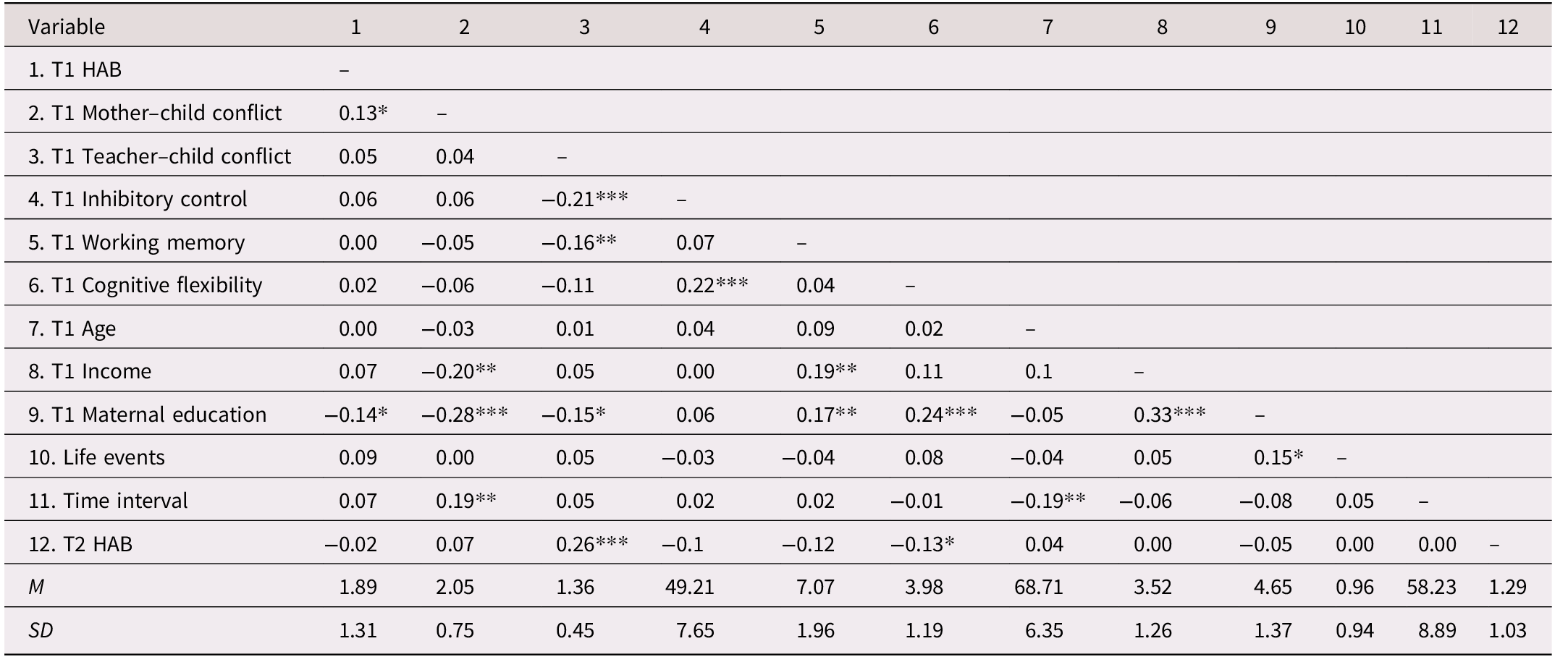
Descriptive statistics and bivariate correlations are presented in Table 1 (for complete descriptive statistics, see Table S2 in the supplementary material, and for descriptive statistics by gender, see Tables S3–S4). Teacher-child conflict scores were relatively low overall and somewhat positively skewed, a pattern commonly observed in community samples using the STRS conflict subscale (e.g., Stipek & Miles, Reference Stipek and Miles2008; Zee & de Bree, Reference Zee and de Bree2017).
Descriptive and bivariate correlations for study variables

Table 1. Long description
The table presents descriptive statistics and bivariate correlations for various study variables. It consists of 12 rows and 12 columns, including a header row and a row for means (M) and standard deviations (SD). The variables include T1 HAB, T1 Mother-child conflict, T1 Teacher-child conflict, T1 Inhibitory control, T1 Working memory, T1 Cognitive flexibility, T1 Age, T1 Income, T1 Maternal education, Life events, Time interval, and T2 HAB. Each cell in the table contains correlation coefficients or statistical values. Notable trends include significant correlations such as a negative correlation between T1 Mother-child conflict and T1 Income (-0.20**), and a positive correlation between T1 Maternal education and T1 Cognitive flexibility (0.24***). The means and standard deviations for each variable are also provided at the bottom of the table.
Note. HAB = hostile attribution bias. *p < .05; **p < .01; ***p < .001.
Bivariate correlations among the main study variables indicated that cognitive flexibility was negatively associated with T2 HAB, whereas conflictual teacher–child relationships were positively associated with T2 HAB.
For T1 age, family income, maternal education, and life events, bivariate associations with the primary study variables were examined. Among these background variables, only household income and maternal education were significantly associated with at least one predictor, and none was significantly associated with the outcome variable (T2 HAB).
For categorical demographic variables, group differences in ethnicity were examined across all study variables using independent-samples t-tests. Grade-level differences were examined only for T2 HAB using a one-way analysis of variance. Independent-samples t tests showed no ethnic differences in T1 HAB or T2 HAB or inhibitory control (ps > .23). Arab children showed higher levels of mother–child and teacher–child conflict, whereas Jewish children showed higher levels of cognitive flexibility and working memory (ps < .05). Grade-level differences in T2 HAB across Grades 4–6 were not significant, F(2, 275) = 0.35, p = .704.
Covariate selection and model specification
To determine whether any of the three covariates (ethnicity, maternal education, and household income) should be included in the final model, each potential covariate was entered individually into the full-sample structural equation model (SEM) alongside the main predictors. Ethnicity was dummy-coded (0 = Jewish, 1 = Arab). For each covariate, we examined whether it significantly predicted T2 HAB and whether its inclusion altered the magnitude or significance of the primary paths in the model. None of the covariates significantly predicted T2 HAB within the full-sample SEM, and their inclusion did not change the pattern of associations among the main variables. Therefore, these covariates were omitted from the final model. Finally, the time interval between assessments was included as a covariate to account for variability in the duration between T1 and T2.
Because significant gender-specific pathways were identified, the results and discussion focus primarily on the multi-group analyses. For completeness, results from the full-sample SEM are reported in the Supplementary Materials (Table S5 and Figure S1).
Multi-group structural equation model of early predictors of HAB
A multi-group SEM was estimated to examine whether the longitudinal associations between Time 1 predictors (i.e., children’s HAB, child EFs, mother–child conflict, and teacher–child conflict) and children’s HAB at Time 2 differed by gender. Direct paths were specified from each Time 1 predictor to T2 HAB, and the main Time 1 predictors were allowed to co-vary. A configural model in which all regression paths were freely estimated across groups was first fit, followed by a constrained model in which regression paths were held equal across groups. Model fit was compared using a chi-square difference test. The results indicated that constraining the regression paths to be equal across gender significantly worsened model fit, Δχ2 (7) = 19.11, p = .008, suggesting that at least one structural path differed between boys and girls. The freely estimated model demonstrated good fit to the data, χ2 (12) = 13.66, p = .323, robust CFI = 0.956, robust RMSEA = 0.038, and SRMR = 0.036 (Shi et al., Reference Shi, DiStefano, Maydeu-Olivares and Lee2022).
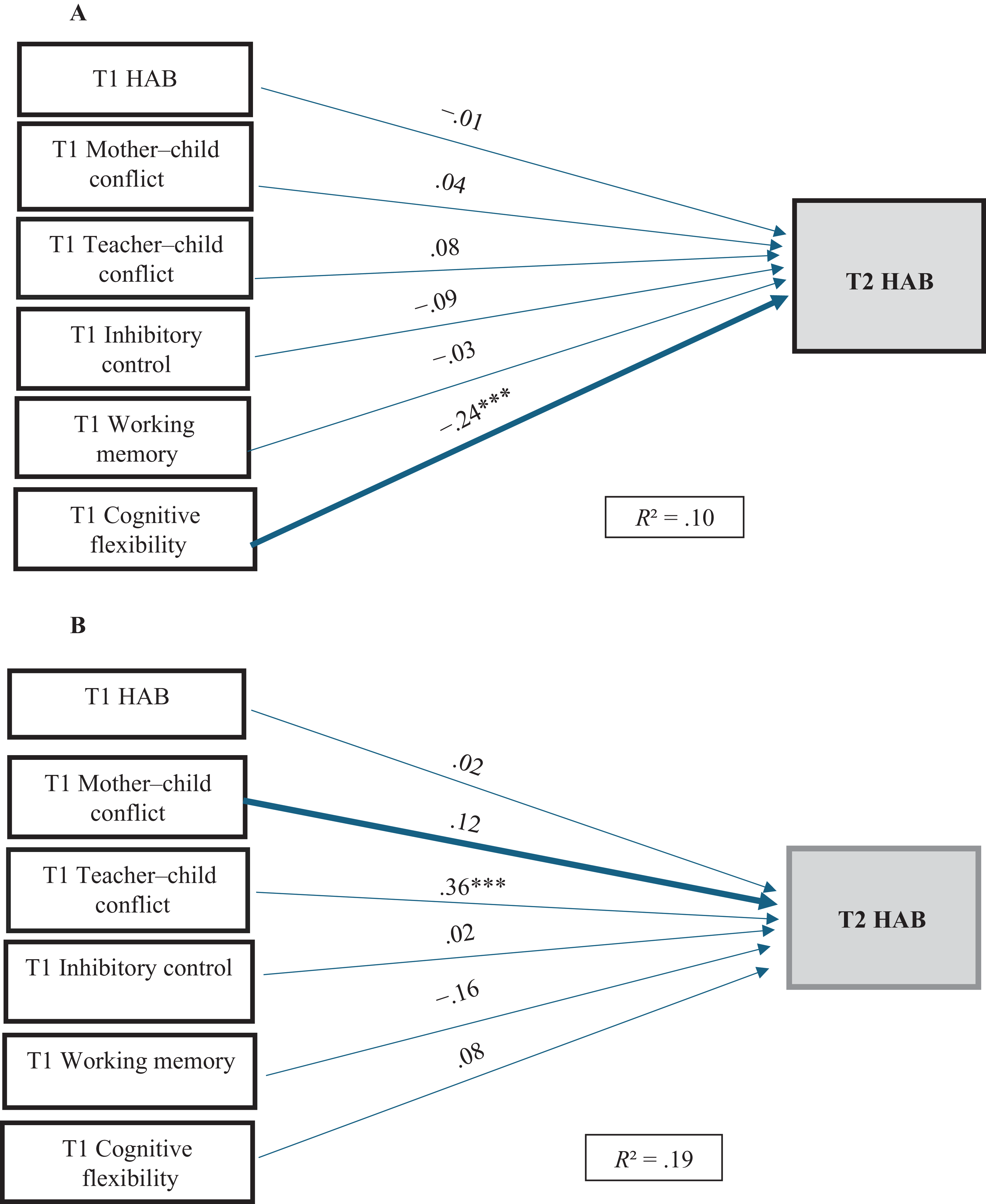
Results from the freely estimated model are presented in Figure 2 (for full parameter estimates, see Table S6). Among boys, cognitive flexibility at Time 1 significantly and negatively predicted HAB at Time 2 (β = −0.24, p = .001). T1 HAB (β = −0.01, p = .850), inhibitory control (β = −0.09, p = .363), working memory (β = −0.03, p = .658), mother–child conflict (β = 0.04, p = .530), teacher–child conflict (β = 0.08, p = .440), and interval time (β = −0.04, p = .623) were not significant predictors. Together, the predictors explained 10% of the variance in boys’ HAB (R 2 = 0.10).
Multi-group SEM predicting T2 HAB by gender. Note. Panel A = boys; Panel B = girls. Bolded paths indicate regression coefficients that significantly differed by gender based on chi-square difference tests. *p < .05; **p < .01; ***p < .001.

Among girls, teacher–child conflict at Time 1 significantly and positively predicted HAB at Time 2 (β = 0.36, p < .001). In contrast, T1 mother–child conflict (β = 0.12, p = .112), HAB (β = 0.02, p = .837), inhibitory control (β = 0.02, p = .805), working memory (β = −0.16, p = .067), cognitive flexibility (β = 0.08, p = .512), and interval time (β = −0.01, p = .870) were not significantly associated with HAB at Time 2. Overall, the model explained 19% of the variance in girls’ HAB (R 2 = 0.19).
Follow-up tests of gender differences in the regression coefficients indicated that the paths from teacher–child conflict (Δβ = 0.29, p = .016) and cognitive flexibility (Δβ = 0.32, p = .018) to T2 HAB differed significantly between boys and girls. In contrast, the paths involving T1 HAB (Δβ = 0.03, p = .780), mother–child conflict (Δβ = 0.08, p = .458), inhibitory control (Δβ = 0.11, p = .388), and working memory (Δβ = −0.13, p = .226) did not significantly differ by gender.
Discussion
The present study examined whether early conflictual relationships, executive functions, and children’s hostile attribution bias predict later HAB, and whether these developmental pathways differ between boys and girls. Multi-group analyses revealed two distinct gender-specific pathways: teacher–child conflict predicted later HAB among girls, whereas cognitive flexibility predicted lower later HAB among boys. Together, these findings suggest that HAB develops through both relational and cognitive pathways that differ by gender. The findings are discussed below, beginning with the role of relational conflict in the development of HAB.
Relational conflict and hostile attribution bias
Among girls, teacher–child conflict in kindergarten predicted higher HAB in late elementary school. This finding is consistent with SIP theory, which posits that children’s interpretations of social cues are shaped by accumulated relational experiences with significant adults (Crick & Dodge, Reference Crick and Dodge1994; Dodge, Reference Dodge2006). Given the central role of teachers as salient authority figures in early schooling (e.g., Hamre & Pianta, Reference Hamre and Pianta2001), repeated exposure to conflictual interactions with teachers may contribute to the development of hostile social schemas. Over time, such experiences may foster the internalization of hostile interpretive schemas. These schemas may extend beyond the teacher–child relationship and influence children’s interpretations of social situations more broadly. Furthermore, conflictual relationships are emotionally stressful. Such experiences may involve feelings of threat to the self (Brobeck et al., Reference Brobeck, Marklund, Haraldsson and Berntsson2007). With repeated exposure, these experiences may bias children’s interpretations of ambiguous social cues and increase the likelihood of attributing hostile intent to others.
One possible explanation for the gender-differentiated association between teacher–child conflict and later HAB is that girls may be more attuned to interpersonal and emotional cues within adult-child relationships. Developmental research indicates that girls are socialized from early childhood to attend more closely to emotional meanings, relational harmony, and interpersonal feedback. They are also more frequently engaged in caregiver–child discussions about emotions and interpersonal experiences (e.g., Chaplin, Reference Chaplin2015). Such gender-differentiated socialization may increase the salience of conflictual interactions with teachers for girls. These experiences may therefore be more likely to be incorporated into developing social–cognitive schemas and to shape attributional styles over time. Moreover, whereas boys’ responses to teacher–child conflict have been linked to externalizing behaviors (e.g., Ogg et al., Reference Ogg, Anthony and Wendel2024), girls may be more likely to exhibit internalized social–cognitive responses, such as biased interpretations of others’ intentions.
Two alternative explanations warrant consideration. First, teacher-reported conflict may partly reflect teachers’ observations of children’s broader behavioral and social tendencies, rather than the relational experience itself. Teachers who perceive high conflict with a child may be identifying early signs of hostile or maladaptive behavioral patterns. These patterns may subsequently manifest as HAB. In other words, teacher-reported conflict may serve as a proxy indicator of children’s early social difficulties rather than a causal antecedent. Second, reverse causality cannot be ruled out: children with higher levels of hostile attribution may evoke more conflictual interactions with teachers, reflecting a transactional process. However, the absence of longitudinal stability in HAB from kindergarten to late elementary school makes this reverse-direction explanation less likely to account for the observed association among girls.
Contrary to expectations, mother–child relational conflict in kindergarten did not significantly predict later HAB for either boys or girls. This finding suggests that not all conflictual relational experiences exert equivalent influence on the development of hostile attribution tendencies and points to the ecological context of conflict as a potentially important factor. Teacher–child conflict occurs within the same social arena in which peer provocations typically arise. This is a group-based, peer-saturated environment in which children must continuously interpret ambiguous social cues. In contrast, mother–child conflict unfolds within a dyadic, home-based context that is structurally distinct from the peer environment. These findings suggest that relational experiences occurring within peer-relevant contexts may play a particularly important role in shaping hostile social interpretations, particularly among girls.
Executive functions and hostile attribution bias
The present study further revealed gender differences in the path from cognitive flexibility to later HAB, with higher cognitive flexibility in kindergarten predicting lower HAB in late elementary school among boys, but not girls. Developmental research suggests that girls, on average, demonstrate earlier maturation of EFs, including cognitive flexibility. In contrast, boys show more protracted development and greater variability in these skills across childhood (e.g., Li, Reference Li2024; Kalkut et al., Reference Kalkut, Han, Lansing, Holdnack and Delis2009). These developmental differences may help explain why cognitive flexibility predicted HAB only among boys. For boys, higher cognitive flexibility may play a particularly important regulatory role in ambiguous social situations. It may facilitate the ability to switch between alternative interpretations (Caporaso et al., Reference Caporaso, Marcovitch and Boseovski2021) and to consider non-hostile explanations of others’ behavior. However, girls’ earlier development of cognitive flexibility may attenuate the long-term predictive value of early individual differences in this skill. As a result, it may be less predictive of HAB by late elementary school.
In contrast, inhibitory control and working memory did not significantly predict later HAB for either boys or girls. Although EFs have been linked to later social–cognitive abilities, including Theory of Mind (ToM) and emotion understanding (Badarneh et al., Reference Badarneh, Arbel and Ziv2024; Wang et al., Reference Wang, Liu and Feng2021), their contribution to later HAB may differ across EF components and developmental contexts. One possible explanation is that inhibitory control and working memory primarily support children’s moment-to-moment adaptation to social situations. These EF components may be less involved in the long-term consolidation of hostile attributional schemas over time. Cognitive flexibility, in contrast, may play a more specific role in enabling children, particularly boys, to shift between alternative interpretations of ambiguous social situations and consider non-hostile explanations of others’ behavior. Moreover, because EFs undergo substantial developmental change across childhood (Diamond, Reference Diamond2013), early individual differences in some EF components may not adequately capture later regulatory capacities.
Longitudinal stability of hostile attribution bias
Importantly, early HAB in kindergarten did not significantly predict later HAB for either boys or girls. This finding is consistent with suggestions that young children are still acquiring the capacity to differentiate intentions from outcomes (Schultz et al., Reference Schultz, Groth, Vanderwalde, Shannon, Shuttlesworth and Shanty2018; Ziv, Reference Ziv2012). Accordingly, hostile attribution tendencies in early childhood may remain relatively context-sensitive and not yet fully consolidated into stable attributional styles. This interpretation is consistent with findings from related socio-cognitive abilities, such as ToM, which often show weak longitudinal associations across long developmental intervals, particularly when developmentally distinct manifestations of the construct are assessed (Osterhaus & Koerber, Reference Osterhaus and Koerber2021). In addition, measurement errors may have attenuated estimates of longitudinal stability. This issue may be particularly relevant in early childhood, where measurement tends to be less reliable. As a result, longitudinal associations among cognitive and social abilities may be underestimated (Burchinal, Reference Burchinal2008).
Explained variance and gender-specific predictors
Importantly, the present model accounted for only 10% of the variance in boys’ HAB, compared to 19% for girls, suggesting that the predictors examined here may play a less prominent role in the developmental trajectory of HAB among boys. Future research should examine additional predictors that may be particularly relevant to boys’ social–cognitive development. Father–child conflict and paternal socialization practices warrant further investigation. The quality of the father–son relationship, including paternal psychological control and aversive parenting, may shape how boys interpret their social world (Nelson & Coyne, Reference Nelson and Coyne2009). Aggressive parenting practices more broadly, including corporal punishment and physical aggression, have also been shown to longitudinally predict increases in boys’ hostile attributions (Yaros et al., Reference Yaros, Lochman and Wells2016). Peer-related experiences such as peer rejection and exposure to hostile peer norms may additionally carry stronger predictive weight for boys. Finally, emotional distress and depressive symptoms may represent additional within-child pathways worthy of examination (Ding et al., Reference Ding, Zhao, Huang and Lei2026).
Implications
The present findings have important theoretical implications for the SIP model. The results suggest that hostile attribution tendencies may develop through gender-differentiated pathways that integrate relational experiences and children’s internal cognitive processes. For girls, links with conflictual teacher–child relationships highlight the contribution of socialization processes within the school context in shaping interpretations of ambiguous social situations. For boys, the association between HAB and cognitive flexibility underscores the relevance of internal regulatory processes for adjusting interpretations of others’ intentions. Together, these findings suggest that different mechanisms may contribute to the development of hostile attribution tendencies among boys and girls. Future research should examine whether gender-differentiated pathways extend to other stages of SIP beyond interpretation.
These findings also have practical implications for prevention and intervention. In particular, they suggest that efforts to reduce HAB may benefit from targeting both conflictual relationships in the school context and children’s cognitive regulation. However, these pathways may differ by gender. Because teacher–child conflict was linked to later HAB, supporting more positive teacher–child interactions may help foster more adaptive interpretations of ambiguous social situations. At the same time, teacher-reported conflict may serve as an accessible early indicator of children’s emerging social difficulties. This suggests that teachers’ perspectives could be informative for identifying children at risk for developing maladaptive social–cognitive patterns, particularly among girls. The association between cognitive flexibility and later HAB in boys further suggests that activities designed to strengthen flexible thinking may be useful. These activities may be particularly relevant as part of broader school-based efforts to reduce risk for maladaptive social–cognitive patterns, at least for boys.
Limitations and future directions
Several limitations of the current study should be acknowledged. First, the relatively long time gap between the two assessment points may have introduced uncontrolled variability and allowed for additional unmeasured external influences (although we did control for life events between assessments). Future research would benefit from incorporating more frequent assessment points to better capture short-term changes and provide a more detailed picture of developmental trajectories.
Second, the present study focused on prospective associations between early predictors and later HAB. As a result, the study did not examine the contribution of concurrent Time 2 factors to children’s HAB.
Third, the current study focused primarily on relationships with adult authority figures. Future research should also examine peer experiences and father–child conflict, as these factors may contribute to children’s SIP and HAB development (Arbel et al., Reference Arbel, Sofri, Elizarov and Ziv2021; Lansford et al., Reference Lansford, Malone, Dodge, Pettit and Bates2010).
Fourth, the present sample included both Arab and Jewish children, and group differences in several key predictors were observed: Arab children showed higher levels of mother– and teacher–child conflict, whereas Jewish children showed higher levels of working memory and cognitive flexibility. Although ethnicity was not significantly associated with T2 HAB and its inclusion did not alter the pattern of findings, the mechanisms linking early relational conflict and EFs to HAB may operate differently across cultural contexts. Future research should examine whether the pathways identified here replicate and generalize across culturally diverse samples.
Finally, the present sample was relatively highly educated (38.5% of mothers held a bachelor’s degree and 30.3% held a master’s degree or higher). This may limit the generalizability of the findings to populations with greater socioeconomic diversity. Families with higher educational attainment may have greater access to social, educational, and economic resources that support children’s EF development (e.g., Morales et al., Reference Morales, Bowers, Shuffrey, Ziegler, Troller-Renfree, Hernandez, Leach, McGrath, Ola, Leve, Nozadi, Swingler, Lai, Schweitzer, Fifer, Camargo, Khurana Hershey, Shapiro, Keating and Elliott2024). Higher parental education has also been associated with more responsive and autonomy-supportive parenting practices, which may reduce parent–child conflict and shape the quality of parent–child relationships (e.g., Nomaguchi & Allen, Reference Nomaguchi and Allen2023). Consequently, the relatively advantaged nature of the present sample may have influenced the magnitude of the observed associations.
Conclusion
The present study demonstrates that early relational and cognitive factors differentially predict children’s hostile attribution tendencies in late childhood, with developmental pathways that diverge by gender. Among girls, higher teacher–child conflict in kindergarten predicted higher HAB five years later, whereas among boys, higher cognitive flexibility in kindergarten predicted lower HAB. Together, these findings extend social information processing theory by highlighting the ecological specificity of relational inputs to children’s social database. They also demonstrate that the balance between relational and cognitive pathways to HAB is gender differentiated. The findings further underscore the practical relevance of early teacher–child relationships and children’s EFs. These factors may represent important targets for prevention and intervention efforts aimed at reducing risk for hostile social cognition.
Supplementary material
The supplementary material for this article can be found at https://doi.org/10.1017/S0954579426101849.
Data availability statement
The data, analytic code, and materials necessary to reproduce the analyses presented in this study are publicly available via the OSF repository at: https://osf.io/shc6q/overview
Acknowledgments
The authors thank the participating children, families, and educational staff for their time and cooperation. We also thank the research assistants who contributed to data collection and coding.
Funding statement
This study is part of a larger longitudinal research project funded by the Israel Science Foundation (Grant No. 35685 for Time 1 and Grant No. 64011 for Time 2).
Competing interests
The authors declare that they have no competing interests.
Pre-registration statement
The analyses presented in this study were not pre-registered. The study was part of a broader longitudinal project, and the present analyses were developed after data collection to address the research questions of interest.
AI declaration
The authors used AI-based language tools (e.g., ChatGPT, OpenAI) to assist with language editing and writing statistical analysis code. All scientific content, statistical analyses, and interpretations are the responsibility of the authors.



 Open access

