





Parent training as an effective treatment for psychopathology in children
Parenting is a critical skill, and parent training programs (PTPs) have served various purposes for decades. Although underpinned by different theoretical models, all PTPs share the common goal of addressing children’s problematic behavior, primarily by enhancing parenting skills through structured curricula and manuals (traditional: Dreikurs & Grey, Reference Dreikurs and Grey1970; psychodynamic: Marvin et al., Reference Marvin, Cooper, Hoffman and Powell2002; humanistic: Gordon, Reference Gordon1970; behavioral: Kazdin et al., Reference Kazdin, Bass, Ayers and Rodgers1990; Patterson et al., Reference Patterson, Chamberlain and Reid2016; mindful parenting approach: Bögels et al., Reference Bögels, Hellemans, van Deursen, Römer and van der Meulen2014). PTPs aim to help caregivers deal effectively with children’s problems by successfully changing their parenting behaviors and attitudes toward children (Rapee et al., Reference Rapee, Kennedy, Ingram, Edwards and Sweeney2005; Santacruz et al., Reference Santacruz, Méndez and Sánchez-Meca2006).
PTPs are generally implemented to prevent or reduce externalizing problems in children (Ansar et al., Reference Ansar, Nissen Lie, Zahl-Olsen, Bertelsen, Elliott and Stiegler2022; Beelmann et al., Reference Beelmann, Arnold and Hercher2023; Helander et al., Reference Helander, Asperholm, Wetterborg, Öst, Hellner, Herlitz and Enebrink2024; Mingebach et al., Reference Mingebach, Kamp-Becker, Christiansen and Weber2018) that often increase parental stress and negatively affect parent–child interactions. PTPs have been shown to alleviate aggression and rule-breaking behaviors (Ansar et al., Reference Ansar, Nissen Lie, Zahl-Olsen, Bertelsen, Elliott and Stiegler2022), antisocial behaviors (e.g., aggression, violence, and delinquency; Beelmann et al., Reference Beelmann, Arnold and Hercher2023), and behavioral problems related to attention-deficit/hyperactivity disorder, with effects that are maintained in the long term (Doffer et al., Reference Doffer, Dekkers, Hornstra, van der Oord, Luman, Leijten, Hoekstra, van den Hoofdakker and Groenman2023).
Although less extensively studied than in externalizing disorders, PTPs also address internalizing problems in children (Bloss et al., Reference Bloss, Brown and Sawrikar2022; Buchanan-Pascall et al., Reference Buchanan-Pascall, Gray, Gordon and Melvin2018; Jewell et al., Reference Jewell, Wittkowski and Pratt2022). Some systematic reviews and meta-analyses suggest that PTPs effectively reduce internalizing symptoms (Bloss et al., Reference Bloss, Brown and Sawrikar2022; Yap et al., Reference Yap, Morgan, Cairns, Jorm, Hetrick and Merry2016; Zarakoviti et al., Reference Zarakoviti, Shafran, Papadimitriou and Bennett2021), whereas others argue that such effects have not been consistently identified (Ansar et al., Reference Ansar, Nissen Lie, Zahl-Olsen, Bertelsen, Elliott and Stiegler2022; Buchanan-Pascall et al., Reference Buchanan-Pascall, Gray, Gordon and Melvin2018).
Despite mixed findings, examining both externalizing and internalizing problems is crucial because psychological issues in children are often less differentiated than in adults, as symptom manifestations and boundaries between domains are blurred (Cicchetti & Rogosch, Reference Cicchetti and Rogosch2002; Ghizzoni et al., Reference Ghizzoni, Mirandi, Garofalo, Mazzeschi and Delvecchio2025). Furthermore, children with externalizing symptoms are at high risk of developing internalizing symptoms (Polier et al., Reference Polier, Vloet, Herpertz-Dahlmann, Laurens and Hodgins2012; Stalk et al., Reference Stalk, Love and Mueller2015), and nearly half of those with one disorder have a comorbid condition, often including internalizing problems (Egger & Angold, Reference Egger and Angold2006; Patterson & Capaldi, Reference Patterson and Capaldi1990; Wichstrøm et al., Reference Wichstrøm, Berg-Nielsen, Angold, Egger, Solheim and Sveen2012). Given this intertwining of externalizing and internalizing domains, it is important to investigate whether PTPs produce transdiagnostic benefits across both emotional and behavioral problems in children.
Previous studies have validated the effects of PTPs on both internalizing and externalizing problems in children (Ansar et al., Reference Ansar, Nissen Lie, Zahl-Olsen, Bertelsen, Elliott and Stiegler2022; Caiado et al., Reference Caiado, Góis, Pereira, Canavarro and Moreira2022; Canário et al., Reference Canário, Pinto, Silva-Martins, Rienks, Akik, Stanke, David, Kızıltepe, Melendez-Torres, Thongseiratch and Leijten2025; Evans et al., Reference Evans, Weisz, Carvalho, Garibaldi, Bearman and Chorpita2020), and reviews have examined their effects on internalizing problems among children with and without externalizing symptoms (Bloss et al., Reference Bloss, Brown and Sawrikar2022; Buchanan-Pascall et al., Reference Buchanan-Pascall, Gray, Gordon and Melvin2018; Schleider & Weisz, Reference Schleider and Weisz2017; Wergeland et al., Reference Wergeland, Riise and Öst2021; Yap & Jorm, Reference Yap and Jorm2015; Yap et al., Reference Yap, Pilkington, Ryan and Jorm2014, Reference Yap, Morgan, Cairns, Jorm, Hetrick and Merry2016; Zarakoviti et al., Reference Zarakoviti, Shafran, Papadimitriou and Bennett2021). These findings are in line with recent clinical trends such as the transdiagnostic approach, which emphasizes unified treatments that address diverse symptoms across diagnostic categories (Forbes et al., Reference Forbes, Ringwald, Allen, Cicero, Clark, DeYoung, Eaton, Kotov, Krueger, Latzman, Martin, Naragon-Gainey, Ruggero, Waldman, Brandes, Fried, Goghari, Hankin, Sperry and Wright2024; Sawrikar et al., Reference Sawrikar, Macbeth, Gillespie-Smith, Brown, Lopez-Williams, Boulton, Guestella and Hickie2022; Schaeuffele et al., Reference Schaeuffele, Schulz, Knaevelsrud, Renneberg and Boettcher2021). From this standpoint, adopting a transdiagnostic perspective that captures the shared mechanisms underlying symptom domains may be particularly useful for understanding and treating child psychopathology. PTPs primarily seek to modify everyday parenting practices that shape children’s emotional and behavioral development (e.g., supportive responses to children’s emotions, consistent limit-setting). Changes in these caregiving patterns may therefore contribute to improvements across both internalizing and externalizing problems (Kazdin, Reference Kazdin1997; Morris et al., Reference Morris, Silk, Steinberg, Myers and Robinson2007). Building on prior evidence that PTPs can reduce symptoms in both domains, we regarded them as transdiagnostic interventions and included studies that either (a) targeted both internalizing and externalizing problems or (b) focused primarily on one domain but reported outcomes for the other. We further examined whether interventions originally developed for one domain could yield improvements across domains, thereby evaluating their transdiagnostic potential. To this end, we categorized studies based on their primary target (internalizing or externalizing) as reported by the original authors.
Given that transdiagnostic models conceptualize psychopathology along continua rather than categorical diagnoses, dimensional frameworks such as the Hierarchical Taxonomy of Psychopathology (HiTOP; Kotov et al., Reference Kotov, Krueger, Watson, Achenbach, Althoff, Bagby, Brown, Carpenter, Caspi, Clark, Eaton, Forbes, Forbush, Goldberg, Hasin, Hyman, Ivanova, Lynam, Markon and Zimmerman2017) are particularly relevant to this perspective. Accordingly, the HiTOP framework was applied to define the internalizing and externalizing spectra and guide the inclusion of representative disorders within each domain. To maintain conceptual coherence, disorders typically classified within these spectra (e.g., anxiety, depression, conduct problems, ADHD, etc.) were included, and neurodevelopmental disorders primarily associated with cognitive or intellectual impairments (e.g., autism spectrum disorder, intellectual disability) excluded, since their placement within the HiTOP model remains less established. This framework ensured conceptual clarity and consistency in delineating both domains in children.
Heterogeneity in the effects of PTPs
Although PTPs have demonstrated efficacy across different symptom domains, the findings have been inconsistent. PTPs’ effects on children’s internalizing and externalizing problems have been reported to differ among studies, and significant heterogeneity in effect sizes has been consistently observed (Bloss et al., Reference Bloss, Brown and Sawrikar2022; Buchanan-Pascall et al., Reference Buchanan-Pascall, Gray, Gordon and Melvin2018; Canário et al., Reference Canário, Pinto, Silva-Martins, Rienks, Akik, Stanke, David, Kızıltepe, Melendez-Torres, Thongseiratch and Leijten2025; Korest & Carlson, Reference Korest and Carlson2022). Several potential moderators have been identified that may account for the heterogeneity in treatment effects: for example, the severity of child behavior (Korest & Carlson, 2022), treatment format (Bloss et al., Reference Bloss, Brown and Sawrikar2022), and risk of bias (Buchanan-Pascall et al., Reference Buchanan-Pascall, Gray, Gordon and Melvin2018). Nevertheless, such moderators have not been consistently observed across studies. Therefore, the present study examined potential moderators to better understand the sources of heterogeneity observed across studies. Specifically, we investigated whether the treatment effects of PTPs differ according to several study- and intervention-related factors, including child participation (a factor contributing to variability in outcomes and an indicator of the effectiveness of parent-only interventions), treatment format (e.g., online vs. face-to-face), treatment dosage (i.e., total duration and number of sessions), risk of bias, and whether the participating children had a clinical diagnosis.
The current meta-analysis evaluated the effects of PTPs on both externalizing and internalizing problems in children. The analysis focused on children aged 3–12 years, as this range encompasses early and middle childhood, developmental periods during which parenting practices play a central role in children’s emotional and behavioral regulation (National Research Council & Institute of Medicine, 2000). Specifically, we tested the following hypotheses. First, we hypothesized that PTPs would significantly reduce symptoms, regardless of whether the primary target was internalizing or externalizing problems. However, because PTPs were originally developed to address behavioral problems, we anticipated larger effect sizes for externalizing outcomes than for internalizing outcomes. Second, we examined potential moderators to better understand the heterogeneity in treatment effects, including factors such as child participation, treatment format, treatment dosage, primary treatment target, risk of bias, and clinical status of participating children.
Methods
Search strategy
This meta-analysis was preregistered in PROSPERO (CRD42023457373) and followed the PRISMA guidelines (Moher et al., Reference Moher, Liberati, Tetzlaff, Altman and Group2009). An electronic search was conducted in April 2025 to identify studies on PTPs for parents of children with internalizing and externalizing problems. All studies published from January 2000 to April 2025 were included. From the 2000s, changing parenting roles and the adoption of evidence-based interventions have led to an increase in systematic reviews on PTPs. Therefore, this meta-analysis examined studies from 2000 onward to better reflect the efficacy and effectiveness of PTPs in contemporary contexts. The databases searched included Cochrane, Embase, Scopus, Medline, OVID, PsycArticles, CINAHL, and Google Scholar. The search terms used were “(child* OR preschool) AND (internali* OR depressi* OR anxiety OR mood dysregulation OR OCD OR panic OR phobia OR Separat* OR dysthymia OR GAD OR MDD OR PTSD) AND (externali* OR behavior* problem OR ODD OR ADHD) NOT (adolesc* OR adult*) AND (parent* program* OR parent* intervent* OR parent* management training OR parent* nurture OR parent* education OR parent* early intervention OR parent* coach*).”
Inclusion and exclusion criteria
This meta-analysis considered studies on parent training program that addressed internalizing or externalizing or both problems in children, or in which parents reported related concerns. Studies were included if they met the following criteria: (a) focused on children aged 3–12 years, omitting studies targeting infants or adolescents because these developmental stages involve distinct intervention targets and developmental processes (National Research Council & Institute of Medicine, 2000). Specifically, adolescence is characterized by increased autonomy and greater salience of peer contexts, which may alter the mechanisms through which PTPs exert their effects (Steinberg & Morris, Reference Steinberg and Morris2001); (b) assessed internalizing or externalizing or both problems in children through clinical interviews, standardized measures, or parental reports of concern; (c) implemented and evaluated PTPs; (d) followed a randomized controlled trial (RCT) design, comparing the intervention group with a control group (e.g., waitlist, treatment as usual, or active controls); (e) measured internalizing and externalizing problems in children pre- and post-intervention; and (f) were published in English-language journals. Studies were excluded if (a) the targeted problems or disorders did not align with the patient/problem–intervention–comparison–outcome (PICO) framework (e.g., autism spectrum disorder) and (b) the intervention focused solely on children, excluding parents. To supplement our database search, we screened the reference lists of Bloss et al. (Reference Bloss, Brown and Sawrikar2022) and Buchanan-Pascall et al. (Reference Buchanan-Pascall, Gray, Gordon and Melvin2018); further, to address the limited number of internalizing behavior-focused interventions, Bolton et al.’s (Reference Bolton, Rooney, Hughes, Hopkins and Mancini2023) and Yap et al.’s (Reference Yap, Morgan, Cairns, Jorm, Hetrick and Merry2016) references were reviewed. This process led to the inclusion of 17 studies that had not been retrieved through the database search. SL, SY, and YK independently selected studies on the basis of these inclusion and exclusion criteria. In cases of disagreement between the authors, JA reviewed the study to resolve the conflict.
Data extraction
Data extraction was completed by SL, SY, and YK, all of whom reviewed the extracted data for completeness and accuracy (i.e., means, standard deviations, the number of treated individuals, and treatment characteristics such as total treatment time). For 27 studies that did not specify the data required for the meta-analysis, we contacted the authors to request the information. Eleven studies were excluded from the final analysis because the required data could not be obtained.
Assessment of study quality: risk of bias
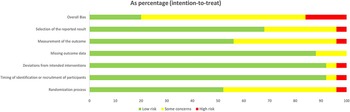
The risk of bias for each study was primarily assessed by a single author using the Cochrane Risk of Bias 2 tool (Higgins et al., Reference Higgins, Savović, Page, Elbers, Sterne, Higgins, Thomas, Chandler, Cumpston, Li, Page and Welch2019). To ensure objectivity, the assessment was cross-checked by two independent investigators who were not involved in this study. In the case of a disagreement between the author and the two independent researchers, JA made the final decision. Each study was evaluated on six domains – “randomization process,” “timing of identification or recruitment of participants,” “deviations from intended interventions,” “missing outcome data,” “measurement of the outcome,” and “selection of the reported result” – and categorized as “low risk,” “some concerns,” or “high risk” of bias.
Data items and summary measures
Standardized mean differences were calculated using the R package metafor, specifically the escalc function (version 3.8-1). Mean differences between the pre- and post-data of the treatment and control groups were divided by the pooled standard deviation of the two groups. The positive bias in the standardized mean difference was automatically corrected within the function, resulting in Hedges’ g (Hedges, Reference Hedges1981).
Synthesis of results and meta-analysis
Given that the data included multiple outcome measures, we used robust variance estimation (RVE) for the main analysis to test the first hypothesis, which considered the effects of PTPs on internalizing and externalizing outcomes separately. This method allows for the inclusion of dependent effect sizes in meta-analysis, even when the dependence structure is unknown (Pustejovsky & Tipton, Reference Pustejovsky and Tipton2022). A correlated-effects working model was employed to estimate the marginal variance-covariance matrix of effect sizes within each study, with the required correlation ρ set at .80 (Fisher et al., Reference Fisher, Tipton and Zhipeng2017). This model was also used to calculate the standard errors of effect sizes, with which we determined the weights of multiple effect sizes and performed significance tests (Hedges et al., Reference Hedges, Tipton and Johnson2010; Pustejovsky & Tipton, Reference Pustejovsky and Tipton2022). Publication bias was evaluated using Egger’s test to detect funnel plot asymmetry, and a trim-and-fill procedure was applied when significant bias was detected (Duval & Tweedie, Reference Duval and Tweedie2000). Additionally, sensitivity analyses were conducted to identify studies that exerted an unusually large influence on the basis of influence diagnostics such as studentized residuals (outlier detection), dffits (influence on model fit), Cook’s distance (overall influence of each effect size), and changes in τ 2 and QE when individual effect sizes were removed (impact on heterogeneity).
Regarding testing of the second hypothesis, subgroup analyses were performed to examine differences in treatment effects based on study- and intervention-related factors, including child participation (present vs. absent), delivery mode (face-to-face, online, or hybrid), and risk of bias. In addition, we assessed cross-domain effects by comparing interventions that primarily targeted internalizing rather than externalizing domains. Because only one study targeted internalizing symptoms alone (Özyurt et al., Reference Özyurt, Gencer, Özturk and Özbek2019), it was combined with those addressing both domains, yielding a comparison between combined or internalizing behavior-focused and externalizing behavior-focused interventions. Meta-regression analyses were then performed to investigate whether total treatment time and the number of sessions influenced the treatment effects.
All analyses were conducted under a random-effects model using R (version 4.3.3; R Foundation for Statistical Computing, Vienna, Austria). The main analyses were performed in RStudio with the robumeta package with a small-sample adjustment. Subgroup analyses and meta-regression were conducted using metafor and sensitivity analyses with the meta package.
Results
Literature search
Figure 1 depicts the PRISMA flow diagram outlining the process of selecting studies to be included in the literature review. Initially, 3,356 records were identified through database searches, of which 198 duplicate records were excluded. After title and abstract screening, 2,751 records were excluded. Consequently, 424 articles were selected for a full-text review. During the full-text review, 390 articles were excluded for not meeting the inclusion and exclusion criteria, and 34 studies were selected for inclusion in this meta-analysis (including 17 studies identified through prior meta-analyses: 11 from Bloss et al., Reference Bloss, Brown and Sawrikar2022, and 6 from Buchanan-Pascall et al., Reference Buchanan-Pascall, Gray, Gordon and Melvin2018).
PRISMA flow diagram.

Figure 1. Long description
The flowchart is divided into three main sections: Identification, Screening, and Included. In the Identification section, records are identified from databases (3,356) and additional records from previous reviews (17). Duplicate records (198) are removed before screening, leaving 3,175 records. In the Screening section, these records are screened, and 2,751 are excluded. The remaining 424 reports are assessed for eligibility. Reports are excluded for various reasons, including children’s age, intervention type, not being a parenting intervention, not being a randomized controlled trial (RCT), data unavailability, lack of child outcomes, no measure of child internalizing or externalizing symptoms, and language. Finally, 34 studies are included in the review.
Study characteristics
Tables 1 and 2 summarize the characteristics of the 34 studies included in the meta-analysis. Among these, four studies were conducted in the United States; five in Australia; four in Turkey; three each in the Netherlands, Norway, and Germany; two each in Belgium and the United Kingdom; and one each in Brazil, Denmark, Finland, Ireland, Japan, New Zealand, Switzerland, and Sweden. All studies were designed as RCTs. Most studies compared treatment groups with a waitlist, whereas a few compared them with a control group (e.g., treatment as usual or an education control). All studies included children between the ages of 3 and 12 years. Outcome variables were typically assessed using standardized behavioral measures of children’s emotional and behavioral problems, including the Child Behavior Checklist (CBCL), the Eyberg Child Behavior Inventory (ECBI), the Social Competence and Behavior Evaluation scales (SCBE), and the Strengths and Difficulties Questionnaire (SDQ); in some studies, these instruments were also used to identify children within the clinical range. Nine of the 34 PTPs involved parents and children, while the remaining studies included only parents. Moreover, of the 34 PTPs, 10 were individual therapies, 20 were group therapies, and 4 were combined individual and group therapies. Among the 10 individual therapy studies, parents and children visited therapy rooms in three of them; one involved the therapist making home visits, and two were non-face-to-face PTPs wherein parents read a parenting book and the therapist conducted phone consultations. All studies reported the number of weekly treatment sessions, which ranged from 1 to 28. Twenty-six of the 34 studies reported the total treatment time, ranging from 130 minutes to 4,200 minutes.
Summary of study characteristics

Table 1. Long description
A table summarizing characteristics of 34 studies in a meta-analysis. The table has 34 rows and 7 columns. Column headers are Study, Country, Sample size, Comparison group, Outcome measures, Treatment format, and Treatment duration. Row 1: Study, Country, Sample size, Comparison group, Outcome measures, Treatment format, and Treatment duration. Row 2: Bagner and Eyberg, United States, 50, Waitlist, ECBI, Group, 12 weeks. Row 3: Bodden et al., Netherlands, 106, Waitlist, CBCL, Group, 12 weeks. Row 4: Borregaard et al., Norway, 50, Waitlist, SDQ, Group, 12 weeks. Row 5: Breinholt et al., Denmark, 60, Waitlist, CBCL, Group, 12 weeks. Row 6: Comer et al., United States, 50, Waitlist, ECBI, Group, 12 weeks. Row 7: de Haan et al., Netherlands, 106, Waitlist, CBCL, Group, 12 weeks. Row 8: de Zwart et al., Netherlands, 50, Waitlist, SDQ, Group, 12 weeks. Row 9: Fjose et al., Norway, 50, Waitlist, SDQ, Group, 12 weeks. Row 10: Fisak and Keyes, United States, 50, Waitlist, ECBI, Group, 12 weeks. Row 11: Gardner et al., United Kingdom, 50, Waitlist, CBCL, Group, 12 weeks. Row 12: Gledhill et al., United Kingdom, 50, Waitlist, SDQ, Group, 12 weeks. Row 13: Hahlweg et al., Germany, 50, Waitlist, ECBI, Group, 12 weeks. Row 14: Havik et al., Norway, 50, Waitlist, SDQ, Group, 12 weeks. Row 15: Heidgerken et al., United States, 50, Waitlist, ECBI, Group, 12 weeks. Row 16: Hekler et al., United States, 50, Waitlist, CBCL, Group, 12 weeks. Row 17: Hoath and Sandland, Australia, 50, Waitlist, SDQ, Group, 12 weeks. Row 18: Hudson et al., Australia, 50, Waitlist, ECBI, Group, 12 weeks. Row 19: Jones and Evans, United Kingdom, 50, Waitlist, CBCL, Group, 12 weeks. Row 20: Kazdin et al., United States, 50, Waitlist, ECBI, Group, 12 weeks. Row 21: Kling et al., Sweden, 50, Waitlist, SDQ, Group, 12 weeks. Row 22: Koch and Fisher, Australia, 50, Waitlist, CBCL, Group, 12 weeks. Row 23: Kuhlmann et al., Germany, 50, Waitlist, ECBI, Group, 12 weeks. Row 24: Lenz and Miller, United States, 50, Waitlist, SDQ, Group, 12 weeks. Row 25: Lindahl et al., Sweden, 50, Waitlist, CBCL, Group, 12 weeks. Row 26: Little et al., United States, 50, Waitlist, ECBI, Group, 12 weeks. Row 27: McDonald and Budden, Australia, 50, Waitlist, SDQ, Group, 12 weeks. Row 28: McMahon and Forehand, United States, 50, Waitlist, ECBI, Group, 12 weeks. Row 29: Morawska and Sanders, Australia, 50, Waitlist, CBCL, Group, 12 weeks. Row 30: Nix et al., United States, 50, Waitlist, SDQ, Group, 12 weeks. Row 31: O’Brien et al., Ireland, 50, Waitlist, ECBI, Group, 12 weeks. Row 32: Pincus et al., United States, 50, Waitlist, CBCL, Group, 12 weeks. Row 33: Quittner et al., United States, 50, Waitlist, SDQ, Group, 12 weeks. Row 34: Serketich and Dumas, United States, 50, Waitlist, ECBI, Group, 12 weeks.
ACT = Adults and Children Together; ADHD = Attention-Deficit/Hyperactivity Disorder; CBCL = Child Behavior Check List; CD = Conduct Disorder; ECBI = Eyberg Child Behavior Inventory; ODD = Oppositional Defiant Disorder; SCBE = Social Competence and Behavior Evaluation; SDQ = Strengths and Difficulties Questionnaire; PKBS-2 = Preschool and Kindergarten Behavior Scales-Second Edition; ROB = Risk Of Bias.
Summary of child outcomes across studies
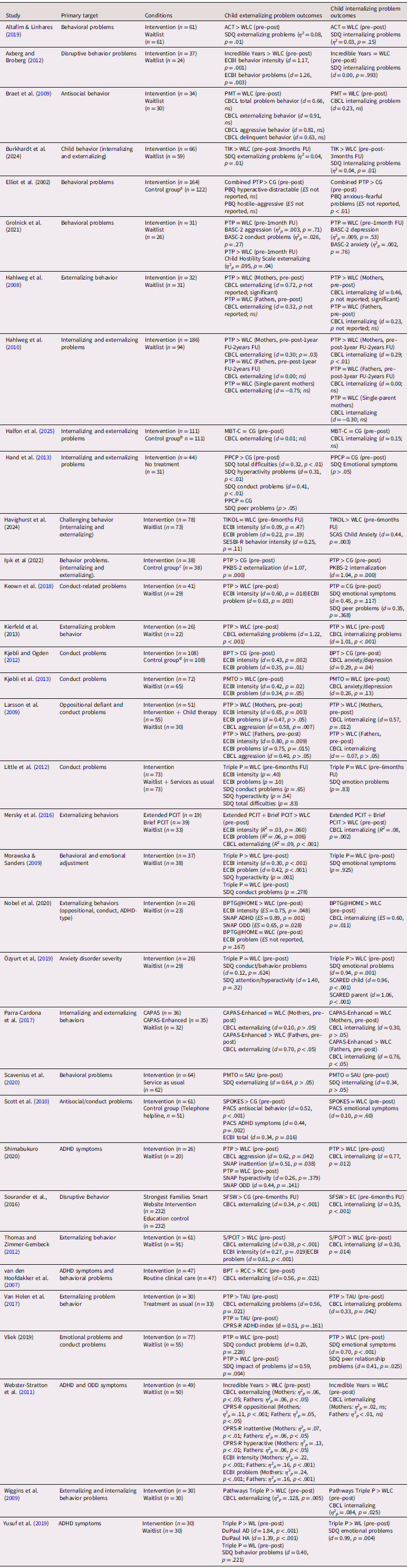
Table 2. Long description
The table presents the characteristics of 34 studies included in a meta-analysis. It has 34 rows and 7 columns. The columns are labeled as Author & Country, Sample size, Intervention, Comparison, Outcome measures, Child characteristics, and Other characteristics. Each row provides details for a specific study. For example, Row 1: Author & Country, Stahr et al. (2016), Germany; Sample size, N = 102; Intervention, Group (n = 51); Comparison, Waitlist control group (n = 51); Outcome measures, CBCL, ECBI; Child characteristics, Age 3 to 7 years; Other characteristics, 10 group sessions, 200 min per session. Row 2: Author & Country, Thompson et al. (2018), United States; Sample size, N = 120; Intervention, Individual (n = 60); Comparison, Treatment as usual (n = 60); Outcome measures, SDQ, SCBE; Child characteristics, Age 6 to 12 years; Other characteristics, 12 individual sessions, 60 min per session. The table continues in this format, detailing each study’s characteristics.
ACT = Adults and Children Together; ADHD = attention-deficit/hyperactivity disorder; BASC-2 = Behavior Assessment System for Children, Second Edition; BPT = Brief/Behavioral Parent Training; BPTG@HOME = Behavioral Parent Training Groningen At Home; CAPAS = Criando con Amor, Promoviendo Armonía y Superación; CBCL = Child Behavior Check List; CD = Conduct Disorder; CG = Control Group; CPRS-R = Conners’ Parent Rating Scale Revised; DuPaul AD = DuPaul ADHD Scale - Attention/Deficit; DuPaul HA = DuPaul ADHD Scale – Hyperactivity; EC = Education Control; ECBI = Eyberg Child Behavior Inventory; MBT-C = Mentalization-Based Treatment for Children; ODD = Oppositional Defiant Disorder; PACS = Parental Account of Childhood Symptoms; PBQ = Preschool Behavior Questionnaire; PCIT = Parent–Child Interaction Therapy; PKBS-2 = Preschool and Kindergarten Behavior Scales-Second Edition; PMT = Parent Management Training; PMTO = Parent Management Training, the Oregon model; PPCP = Parents Plus Children’s Program; PTP = Parent Training Program; RCC = Routine Clinical Care; S/PCIT = Standard Parent–Child Interaction; SAU = Service As Usual; SCARED = Screen for Anxiety-Related Emotional Disorders; SCAS = Spence Child Anxiety Scale-Parent version; SCBE = Social Competence and Behavior Evaluation; SDQ = Strengths and Difficulties Questionnaire; SESBI-R = Sutter-Eyberg Student Behavior Inventory Revised; SFSW = Strongest Families Smart Website; SNAP = Swanson, Nolan, and Pelham Rating Scale; SPOKES = Supporting Parents On Kids Education in Schools; TAU = Treatment As Usual; TIK = Tuning In to Kids; TIKOL = Tuning In to Kids Online; WLC = Waitlist Control.
a This group received the universal intervention based on advice from consultations with local community resources and preschool teachers.
b This group received a manualized 12-week parenting and child social skills intervention.
c This group had access to routine care, such as external mental health services.
d This group received regular services in primary care setting.
Risk of bias in studies
According to the risk of bias assessment, 9 studies were rated as low risk, 19 as having some concerns, and 6 as high risk (Figure 2; Table 1). Regarding individual domains, most studies demonstrated low risk in the randomization process, which evaluates whether the allocation sequence was adequately randomized and concealed (17 were low, 14 had some concerns, 3 was high), and in the timing of participant identification or recruitment, which assesses whether participants were identified and recruited prior to randomization (29 were low, 4 had some concerns, 1 was high). Similarly, low risk was observed in the domains assessing deviations from intended interventions, which evaluates participant blinding and adherence to assigned conditions (27 were low, 6 had some concerns, 1 was high), and in missing outcome data, which examines the extent and potential impact of missing data (30 were low, 4 had some concerns). For the measurement of the outcome, which assesses the appropriateness of outcome measurement methods and the potential for measurement bias, most studies were rated as low risk (20 were low, 13 had some concerns, 1 was high). Likewise, in the selection of the reported result domain, which evaluates the risk of selective outcome reporting, the majority of studies demonstrated low risk or some concerns, with relatively few rated as high risk (18 were low, 15 had some concerns, 1 was high). For studies incorporated from previous review articles, risk of bias ratings was based on the evaluations reported in those reviews.
Risk of bias graph.

Meta-analysis of treatment effects of PTP on externalizing and internalizing outcomes
Main effect
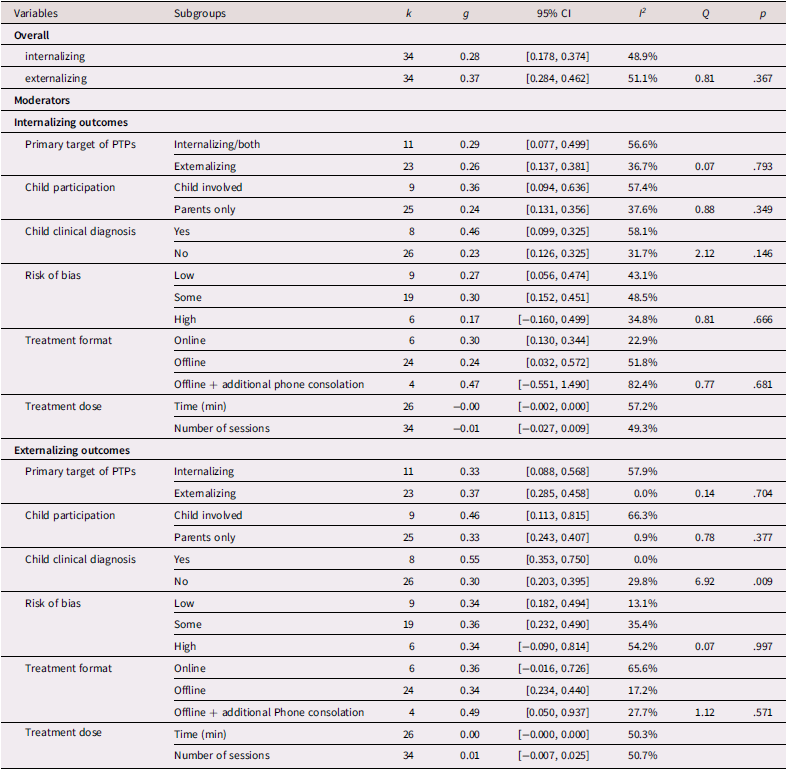
Thirty-four studies reporting post-treatment internalizing and externalizing problem outcomes were included in the meta-analysis to assess the treatment effects of PTP, compared with control groups (Table 3). RVE results for the random-effects meta-analysis showed a more significant treatment effect of PTP compared with the control group, with small effect sizes for internalizing (g = 0.28, 95% CI [0.178 0.347], p < .001) and externalizing problem outcomes (g = 0.37, 95% CI [0.284, 0.462], p < .001). No significant difference was found between the two types of outcomes in the RVE analyses (Q(1) = 0.81, p = .367). Heterogeneity was moderate for internalizing (I 2 = 42.9%, Q(33) = 57.80, p = .005) and externalizing problem outcomes (I 2 = 31.3%, Q(33) = 48.02, p = .044). This level of heterogeneity suggests that treatment effects varied across studies, indicating that the impact of PTPs may differ depending on study characteristics or implementation context, which should be considered when making clinical decisions regarding PTP deployment.
Summary of overall and moderator effects

Table 3. Long description
A table with 34 rows and 8 columns summarizing the effects of PTP on internalizing and externalizing problem outcomes. The columns are Variables, Subgroups, k, g, 95% CI, I^2, Q, and p. The table is divided into sections for overall effects and moderators, with subgroups for internalizing and externalizing outcomes. Each row provides specific data points for different variables and subgroups, including the number of studies (k), effect size (g), confidence intervals (95% CI), heterogeneity (I^2), Q statistic, and p-value. The table captures the impact of various moderators such as primary target of PTPs, child participation, child clinical diagnosis, risk of bias, treatment format, and treatment dose on the outcomes.
Q represents the test of between-group heterogeneity, and p indicates the p-value associated with Q.
Publication bias and sensitivity analysis
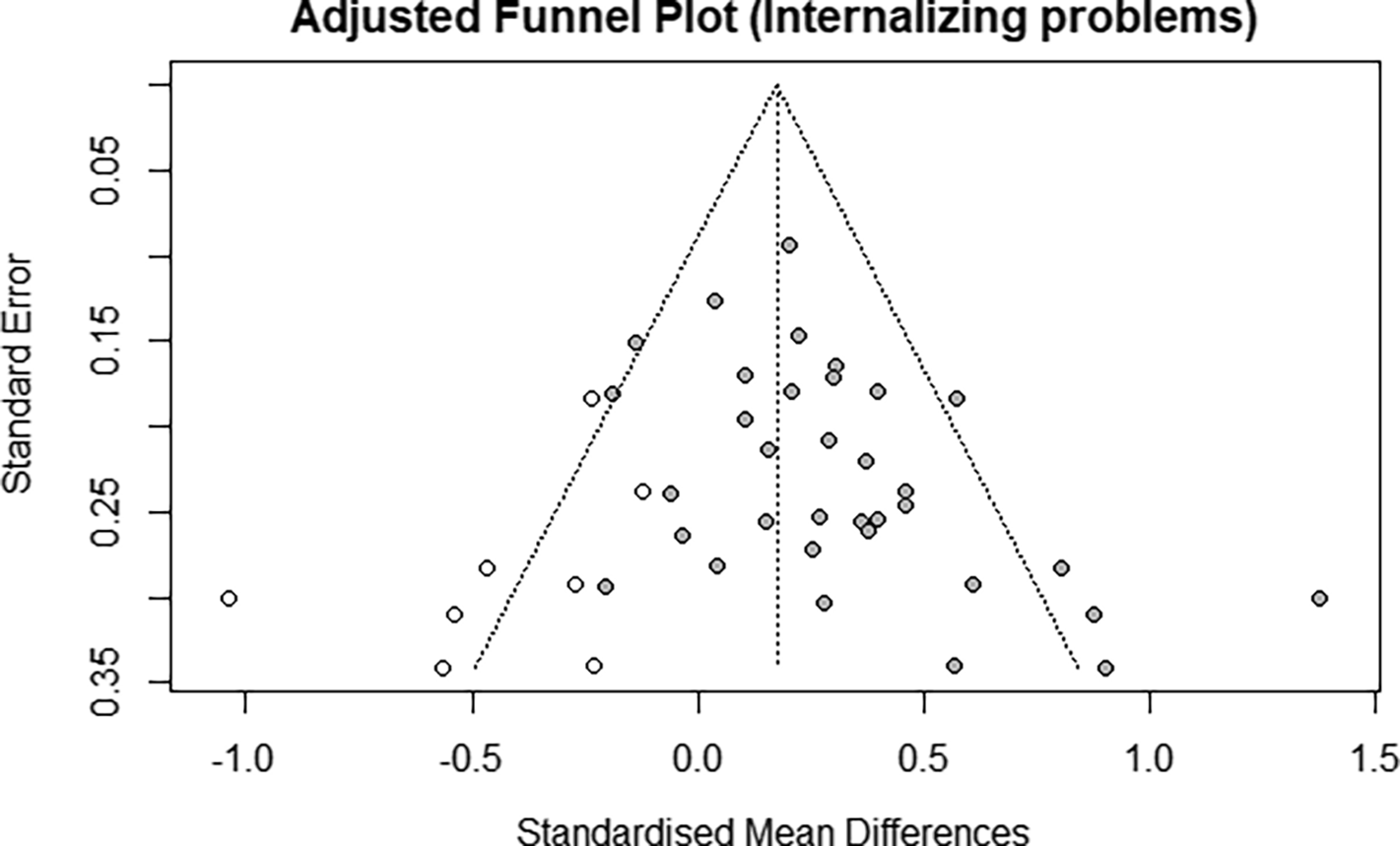
Examination of the funnel plot (Figures 3 and 4) and Egger’s test revealed significant evidence of publication bias for internalizing and externalizing problems outcomes (internalizing: t(32) = 2.64, p = .013; externalizing: t(31) = 4.05, p = .000). We adjusted the results for both problem outcomes using the trim-and-fill method, and the effect size remained significant (internalizing: g = 0.17, p = .008; externalizing: g = 0.25, p < .001).
Adjusted funnel plot of internalizing problem outcomes.

Adjusted funnel plot of externalizing problem outcomes.

As shown in Supplementary Figures S1 and S2, sensitivity analyses indicated that the pooled effect size for internalizing outcomes varied when certain effect sizes were removed, particularly for studies using the SDQ emotional problems subscale (Özyurt et al., Reference Özyurt, Gencer, Özturk and Özbek2019; Yusuf et al., Reference Yusuf, Gonka and Pekcanlar Aynur2019). For externalizing outcomes, the effect size based on the SDQ attention-deficit and hyperactivity problems subscale reported in Özyurt et al. (Reference Özyurt, Gencer, Özturk and Özbek2019) showed a comparatively stronger influence on the pooled estimate than other measures. These findings suggest that a small number of specific effect sizes produced relatively larger shifts in the pooled estimates, although they do not fundamentally alter the overall pattern of results.
Moderator analysis
To examine whether treatment effects varied according to the primary target of PTPs, we conducted additional subgroup analyses for each outcome domain (Figures 5 and 6; Table 3). PTPs targeting externalizing problems also produced significant improvements in internalizing symptoms (g = 0.26, 95% CI [0.014, 0.381]; Q(1) = 0.07, p = .793). Similarly, interventions targeting internalizing or combined problems yielded significant reductions in externalizing symptoms (g = 0.33, 95% CI [0.088, 0.568], Q(1) = 0.14, p = .704).
Forest plot of internalizing/Combined problem outcomes by primary treatment target. Note. 0 = combined/internalizing-focused interventions; 1 = externalizing-focused interventions.

Figure 5. Long description
The table presents a comparison of standardized mean differences (SMD) in parenting interventions across various studies. It is divided into two subgroups. Subgroup 1 includes studies with 30 rows and 5 columns labeled Author, g, SE, Standardised Mean Difference, SMD, and 95%-CI. Subgroup 0 includes studies with 15 rows and the same 5 columns. Each row lists the author, the values for g, SE, SMD, and the 95% confidence interval. The table also includes random effects models for each subgroup and an overall heterogeneity test. Notable trends include varying SMD values across different studies, with some showing positive effects and others showing negative or negligible effects. The random effects models provide a summary SMD for each subgroup, indicating the overall effect size.
Forest plot of externalizing problem outcomes by primary treatment target. Note. 0 = combined/internalizing-focused interventions; 1 = externalizing-focused interventions.

In the moderator analysis, children’s clinical diagnosis status demonstrated a notable moderating effect for externalizing outcomes: PTPs produced significantly larger effects among clinically diagnosed children (g = 0.55, 95% CI [0.353, 0.750]) than among non-diagnosed samples (g = 0.30, 95% CI [0.203, 0.395]) (Q(1) = 6.92, p = .009), whereas no significant subgroup difference was observed for internalizing outcomes (Q(1) = 2.12, p = .146).
Other moderators did not yield significant subgroup differences. Specifically, no significant subgroup differences were observed for child participation (internalizing: Q(1) = 0.88, p = .349; externalizing: Q(1) = 0.78, p = .377), delivery mode (face-to-face, online, or hybrid; internalizing: Q(2) = 0.77, p = .681; externalizing: Q(2) = 1.12, p = .571), or risk of bias (internalizing: Q(2) = 0.81, p = .666; externalizing: Q(2) = 0.07, p = .997). Meta-regression analyses further revealed that neither total treatment time (internalizing: g = −0.00, p = .429; externalizing: g = 0.00, p = .145) nor the total number of sessions (internalizing: g = −0.00, p = .292; externalizing: g = 0.00, p = .208) significantly moderated treatment outcomes.
Taken together, these findings suggest that, while PTPs are broadly effective across formats and dosage, they may yield greater benefits for clinically diagnosed children with externalizing problems.
Discussion
This meta-analysis aimed to provide evidence on the treatment effects of PTPs on internalizing and externalizing problems in children aged 3–12 years. Across 34 studies, PTPs significantly reduced these problems, compared with those in control groups, although the effect sizes were small. This finding aligns with previous meta-analyses reporting reductions in internalizing and externalizing symptoms following participation in PTPs (Bloss et al., Reference Bloss, Brown and Sawrikar2022; Buchanan-Pascall et al., Reference Buchanan-Pascall, Gray, Gordon and Melvin2018). A trim-and-fill analysis following Egger’s test indicated that, although the treatment effects decreased slightly after adjusting for potential publication bias, they remained statistically significant for both problem outcomes. Although these effects were modest in magnitude, even small statistical improvements may still have meaningful clinical implications when interventions are implemented at a population level or within preventive contexts, as these benefits can accumulate over time.
Besides demonstrating the overall efficacy of PTPs, this study extends prior findings by clarifying how treatment effects differ according to intervention targets. Specifically, significant cross-domain effects emerged, suggesting that PTPs designed primarily for externalizing problems also reduced internalizing symptoms, and vice versa. These findings indicate that the benefits of PTPs are not confined to the initially targeted symptom domain but instead extend across internalizing and externalizing spectra, serving as empirical support for the transdiagnostic applicability of PTPs. Crucially, it is necessary to distinguish between interventions that are transdiagnostic by design and those that are transdiagnostic in effect. Preventive parenting interventions are often transdiagnostic by design, as they are designed to address broader developmental risk processes and may therefore target a wide range of behavioral and emotional difficulties (Sandler et al., Reference Sandler, Ingram, Wolchik, Tein and Winslow2015). Conversely, given that the overall effect sizes were modest, other PTPs may be transdiagnostic in effect; the findings may partly reflect broader therapeutic processes – such as changes in general parenting practices (e.g., more consistent caregiving) – that operate across multiple symptom domains despite an initial symptom-specific focus. More specifically, improvements in consistent limit-setting and reductions in coercive parent–child interaction may reduce behavioral dysregulation while also increasing the predictability of the caregiving environment, thereby indirectly reducing children’s emotional distress (Smith et al., Reference Smith, Dishion, Shaw, Wilson, Winter and Patterson2014). Similarly, increases in parental warmth, emotion coaching, and supportive responses to children’s distress may strengthen children’s emotion regulation capacities, which may in turn reduce both internalizing symptoms and behavior problems (Morris et al., Reference Morris, Silk, Steinberg, Myers and Robinson2007). Thus, the observed cross-domain effects suggest that PTPs may influence internalizing and externalizing outcomes through overlapping, rather than entirely separate, parenting processes.
Additional analyses indicated evidence of heterogeneity and publication bias for both internalizing and externalizing outcomes. This may be because PTPs yield relatively small or inconsistent effect sizes when outcomes across both domains are assessed simultaneously, and their effects on internalizing symptoms have not been consistently supported (Bloss et al., Reference Bloss, Brown and Sawrikar2022; Buchanan-Pascall et al., Reference Buchanan-Pascall, Gray, Gordon and Melvin2018; Jewell et al., Reference Jewell, Wittkowski and Pratt2022). The observed variability across studies, particularly in treatment dose, may also reflect the broad implementation contexts in which PTPs are delivered, an issue that has similarly been examined through moderator analyses in previous meta-analyses (Bloss et al., Reference Bloss, Brown and Sawrikar2022; Buchanan-Pascall et al., Reference Buchanan-Pascall, Gray, Gordon and Melvin2018); therefore, more fine-grained investigation of this issue is warranted. Importantly, this heterogeneity may reflect not only methodological variation but also differences in the parenting processes emphasized across programs. Programs that primarily focused on behavioral management may be more directly linked to externalizing outcomes, whereas those emphasizing parental sensitivity, emotion socialization, or supportive responses to children’s distress may be more directly relevant to internalizing outcomes. Such variability in intervention focus may help explain why effects appear smaller and more heterogeneous when broad outcome domains are examined together. When meta-analytic targets are more specific (e.g., only internalizing outcomes or single behavioral dimensions such as disruptive behavior), treatment effects tend to be larger; indeed, recent studies have shown medium to large effect sizes of PTPs for particular internalizing or externalizing problems (attention-deficit/hyperactivity disorder: Hornstra et al., Reference Hornstra, Groenman, Oord, Luman, Dekkers, Veen-Mulders, Hoekstra and van den Hoofdakker2023; anxiety: Jewell et al., Reference Jewell, Wittkowski and Pratt2022). This pattern may partly explain the relatively small overall effect sizes observed in the present meta-analysis. Furthermore, PTPs encompass not only treatment-oriented interventions but also prevention-oriented programs (e.g., Triple P; Sanders, Reference Sanders1999; ACT Raising Safe Kids; Portwood et al., Reference Portwood, Lambert, Abrams and Nelson2011). Preventive parenting interventions are often designed to address broader developmental risk processes and may therefore target a wide range of behavioral and emotional difficulties (Sandler et al., Reference Sandler, Ingram, Wolchik, Tein and Winslow2015). The inclusion of both prevention- and treatment-focused programs in the present meta-analysis may represent an additional factor contributing to the relatively modest overall effect sizes and the heterogeneity observed across studies, as preventive approaches may yield more diffuse, cross-domain improvements compared to symptom-specific treatments. Therefore, given the high comorbidity between internalizing and externalizing problems in children, researchers should consider how PTPs might be further refined to address both domains effectively. Similar to well-established disorder-specific treatments, dismantling studies are needed to identify the most potent components of PTPs, and research examining how these components may be applied according to intervention purpose (preventive vs. therapeutic) would also be informative.
Moreover, because both analyses revealed evidence of publication bias, the observed treatment effects may, to some extent, reflect selective reporting. Future research should employ transparent methodologies and report both significant and non-significant outcomes. Expanding datasets that include both internalizing and externalizing outcomes would also help clarify treatment effects and inform more targeted, sequential intervention strategies.
Taken together, the presence of heterogeneity and publication bias highlights the need to advance PTP research toward mechanism-focused approaches that clarify the underlying processes driving treatment effects. In particular, the cross-domain effects and variability observed in the present study suggest that different components of PTPs may contribute to internalizing and externalizing outcomes in highly complex and interconnected ways. Identifying these specific active ingredients could help refine PTPs to more effectively target specific symptom domains, reducing reliance on “one-size-fits-all” programs. Consequently, future studies should adopt flexible, scalable designs – such as brief or modular interventions – to directly address this heterogeneity, enabling clinicians to tailor treatments to a child’s unique transdiagnostic profile. Additionally, incorporating longitudinal or micro-level assessments will help capture mechanisms of change more precisely, ultimately advancing the field toward more personalized, efficient, and reproducible clinical care.
Second, moderator analyses indicated that the only significant effect was children’s clinical diagnosis status on externalizing outcomes, whereas other variables were not associated with significant differences in treatment effects. This finding suggests that PTPs may be particularly beneficial for clinically diagnosed children with externalizing problems (e.g., oppositional or conduct problems). Despite variation across studies in delivery formats and intervention dosage, these factors were not significantly associated with treatment outcomes. This pattern indicates that PTPs can be implemented flexibly across various contexts. Given the considerable costs and resources required for treatment implementation – and in light of the present findings together with prior evidence on treatment dosage (Bloss et al., Reference Bloss, Brown and Sawrikar2022; Buchanan-Pascall et al., Reference Buchanan-Pascall, Gray, Gordon and Melvin2018; Canário et al., Reference Canário, Pinto, Silva-Martins, Rienks, Akik, Stanke, David, Kızıltepe, Melendez-Torres, Thongseiratch and Leijten2025; Korest & Carlson, 2022) – developing more cost-efficient and accessible delivery formats may be advantageous.
Brief, focused, and online versions of PTPs could enhance accessibility while maintaining therapeutic benefits. Such scalable adaptations may help reduce treatment barriers and costs, particularly for families with limited resources or logistical constraints. Moreover, the tendency for disorder-specific interventions to yield larger effect sizes may underscore the need for mechanism-focused, transdiagnostic approaches capable of addressing more blurred and overlapping symptom presentations in children. Finally, parent-only interventions may represent another promising and resource-efficient option, particularly when children show low motivation or difficulty participating in therapy. Future studies should examine whether parent-focused formats can produce treatment effects comparable to those of standard PTPs (Helander et al., Reference Helander, Asperholm, Wetterborg, Öst, Hellner, Herlitz and Enebrink2024; Jewell et al., Reference Jewell, Wittkowski and Pratt2022; Lebowitz et al., Reference Lebowitz, Omer, Hermes and Scahill2014). In addition, assessing short-term efficacy and evaluating outcomes according to children’s symptom severity could provide further insights for refining stepwise and mechanism-based intervention strategies.
Limitations
This study has some limitations. First, because the number of eligible studies was limited, we broadly included studies involving children with internalizing or externalizing problems or both and those studies wherein caregivers reported related concerns. Despite these broad criteria, only one study exclusively targeted internalizing symptoms; thus, during the estimation of effect sizes by primary target, this study was grouped with those with combined interventions addressing both domains. In particular, the grouping of the single internalizing-only study with combined interventions limits the strength of inferences regarding domain-specific effects and warrants interpretive caution when interpreting the cross-domain patterns observed in this meta-analysis.
Second, the information available from the included studies was insufficient to fully assess the sources of heterogeneity and potential publication bias, which may have influenced the observed effect sizes. Variability in outcome measures and informants likely contributed to this heterogeneity (e.g., SDQ-based effect sizes showed relatively greater influence in sensitivity analyses). Additionally, the relatively small number of studies in certain subgroup analyses may have limited the statistical power to detect potential moderator effects. Future studies would benefit from more rigorous reporting practices, including preregistered protocols and transparent reporting of null findings, to improve the interpretability and cumulative value of evidence in this area.
Third, although the risk-of-bias assessment included cross-checking procedures, the initial ratings were conducted by a single primary reviewer, which may have introduced bias and could have affected the consistency of the evaluations. As some of the included studies overlap with those in prior meta-analyses, these factors highlight the importance of interpreting the present findings cautiously in relation to the existing body of evidence.
Fourth, neurodevelopmental disorders were excluded to maintain conceptual consistency with the HiTOP framework; however, this decision may limit the generalizability of the findings to broader clinical populations in which such conditions frequently co-occur. Cultural and contextual factors were also not systematically coded in the present meta-analysis, although parenting practices and the effectiveness of PTPs may vary across cultural and social contexts. Future studies should therefore examine the effectiveness of PTPs across more diverse clinical populations and cultural contexts. In addition, identifying practical and therapeutic factors that contribute to treatment outcomes, such as parental involvement in symptom-specific interventions, may help clarify how these programs produce change. Finally, meta-analyses based on dismantling studies or comparable research designs could further help clarify potential mechanisms and moderators underlying treatment effects.
Conclusion
This meta-analysis provides comprehensive evidence that PTPs are effective in reducing both internalizing and externalizing problems in children, although the overall effects are small. Importantly, significant cross-domain effects were observed, suggesting that the benefits of PTPs extend beyond their primary targets, thereby supporting their transdiagnostic applicability. Moderator analyses indicated that PTPs are broadly effective across different delivery formats and dosages, with greater benefits observed among clinically diagnosed children with externalizing problems. These findings highlight the flexibility and generalizability of PTPs, while also underscoring the need for future research to refine their efficiency and accessibility through internet-delivered, brief, and parent-focused formats. Developing mechanism-based, transdiagnostic models of parent training may further enhance their capacity to address complex and overlapping symptom profiles in children.
Supplementary material
The supplementary material for this article can be found at https://doi.org/10.1017/S0954579426101850.
Acknowledgements
The authors gratefully acknowledge Sun-Jung Kim, Su-Been Kim, and Heon-Jin Lee, members of the S.A.L.T. Lab, for their assistance with this study.
Author contributions
Seo-Hui Lee, Seol-Hye Yoo, and Yu-Na Kim performed data extraction and analysis and drafted the manuscript. Jung-Kwang Ahn conceptualized and supervised the study and critically revised the manuscript. All authors reviewed and approved the final manuscript.
Funding statement
This work was supported by the National Research Foundation of Korea (NRF) grant funded by the Korea government (MSIT) (RS-2022-00166444).
Competing interests
The authors declare none.
Pre-registration statement
-
• Active link: This meta-analysis was preregistered in PROSPERO (PROSPERO 2023 CRD42023457373. Available from https://www.crd.york.ac.uk/PROSPERO/view/CRD42023457373).
-
• Date stamped: 04 September 2023.
-
• Deviation
-
• Search Update: The literature search was updated through April 2025 to reflect recent developments during the extended review and submission process.
-
• Eligibility Criteria: The eligible age range was restricted from ≤12 years to 3–12 years to exclude infants, whose developmental characteristics and intervention targets differ from those of older children.
-
• Supplementary Search: Reference lists of key prior reviews were screened, identifying 17 additional eligible studies not retrieved through the electronic database search.
-
• Statistical Analysis: Robust variance estimation with a correlated-effects working model (ρ = .80) was used within a random-effects framework to account for dependent effect sizes within studies.
Data availability statement
-
• Availability of Data: The extracted dataset is available from the corresponding author upon reasonable request.
-
• Availability of Code: The analysis code is available from the corresponding author upon reasonable request.
-
• Availability of Methods/material: The methods are described in the manuscript, and additional materials are available from the corresponding author upon reasonable request.
GenAI use disclosure statement
The authors used generative AI solely to enhance the clarity and readability of the manuscript. All AI-assisted revisions were reviewed and revised by the authors, who take full responsibility for the manuscript.




 Open access

