



%20--%3e%3c!DOCTYPE%20svg%20PUBLIC%20'-//W3C//DTD%20SVG%201.0//EN'%20'http://www.w3.org/TR/2001/REC-SVG-20010904/DTD/svg10.dtd'%3e%3csvg%20version='1.0'%20id='Layer_1'%20xmlns='http://www.w3.org/2000/svg'%20xmlns:xlink='http://www.w3.org/1999/xlink'%20x='0px'%20y='0px'%20width='64px'%20height='64px'%20viewBox='5.5%20-3.5%2064%2064'%20enable-background='new%205.5%20-3.5%2064%2064'%20xml:space='preserve'%3e%3cg%3e%3ccircle%20fill='%23FFFFFF'%20fill-opacity='0'%20cx='37.785'%20cy='28.501'%20r='28.836'/%3e%3cpath%20fill='%23595959'%20d='M37.441-3.5c8.951,0,16.572,3.125,22.857,9.372c3.008,3.009,5.295,6.448,6.857,10.314%20c1.561,3.867,2.344,7.971,2.344,12.314c0,4.381-0.773,8.486-2.314,12.313c-1.543,3.828-3.82,7.21-6.828,10.143%20c-3.123,3.085-6.666,5.448-10.629,7.086c-3.961,1.638-8.057,2.457-12.285,2.457s-8.276-0.808-12.143-2.429%20c-3.866-1.618-7.333-3.961-10.4-7.027c-3.067-3.066-5.4-6.524-7-10.372S5.5,32.767,5.5,28.5c0-4.229,0.809-8.295,2.428-12.2%20c1.619-3.905,3.972-7.4,7.057-10.486C21.08-0.394,28.565-3.5,37.441-3.5z%20M37.557,2.272c-7.314,0-13.467,2.553-18.458,7.657%20c-2.515,2.553-4.448,5.419-5.8,8.6c-1.354,3.181-2.029,6.505-2.029,9.972c0,3.429,0.675,6.734,2.029,9.913%20c1.353,3.183,3.285,6.021,5.8,8.516c2.514,2.496,5.351,4.399,8.515,5.715c3.161,1.314,6.476,1.971,9.943,1.971%20c3.428,0,6.75-0.665,9.973-1.999c3.219-1.335,6.121-3.257,8.713-5.771c4.99-4.876,7.484-10.99,7.484-18.344%20c0-3.543-0.648-6.895-1.943-10.057c-1.293-3.162-3.18-5.98-5.654-8.458C50.984,4.844,44.795,2.272,37.557,2.272z%20M37.156,23.187%20l-4.287,2.229c-0.458-0.951-1.019-1.619-1.685-2c-0.667-0.38-1.286-0.571-1.858-0.571c-2.856,0-4.286,1.885-4.286,5.657%20c0,1.714,0.362,3.084,1.085,4.113c0.724,1.029,1.791,1.544,3.201,1.544c1.867,0,3.181-0.915,3.944-2.743l3.942,2%20c-0.838,1.563-2,2.791-3.486,3.686c-1.484,0.896-3.123,1.343-4.914,1.343c-2.857,0-5.163-0.875-6.915-2.629%20c-1.752-1.752-2.628-4.19-2.628-7.313c0-3.048,0.886-5.466,2.657-7.257c1.771-1.79,4.009-2.686,6.715-2.686%20C32.604,18.558,35.441,20.101,37.156,23.187z%20M55.613,23.187l-4.229,2.229c-0.457-0.951-1.02-1.619-1.686-2%20c-0.668-0.38-1.307-0.571-1.914-0.571c-2.857,0-4.287,1.885-4.287,5.657c0,1.714,0.363,3.084,1.086,4.113%20c0.723,1.029,1.789,1.544,3.201,1.544c1.865,0,3.18-0.915,3.941-2.743l4,2c-0.875,1.563-2.057,2.791-3.541,3.686%20c-1.486,0.896-3.105,1.343-4.857,1.343c-2.896,0-5.209-0.875-6.941-2.629c-1.736-1.752-2.602-4.19-2.602-7.313%20c0-3.048,0.885-5.466,2.658-7.257c1.77-1.79,4.008-2.686,6.713-2.686C51.117,18.558,53.938,20.101,55.613,23.187z'/%3e%3c/g%3e%3c/svg%3e)
%20--%3e%3c!DOCTYPE%20svg%20PUBLIC%20'-//W3C//DTD%20SVG%201.0//EN'%20'http://www.w3.org/TR/2001/REC-SVG-20010904/DTD/svg10.dtd'%3e%3csvg%20version='1.0'%20id='Layer_1'%20xmlns='http://www.w3.org/2000/svg'%20xmlns:xlink='http://www.w3.org/1999/xlink'%20x='0px'%20y='0px'%20width='64px'%20height='64px'%20viewBox='5.5%20-3.5%2064%2064'%20enable-background='new%205.5%20-3.5%2064%2064'%20xml:space='preserve'%3e%3cg%3e%3ccircle%20fill='%23FFFFFF'%20fill-opacity='0'%20cx='37.637'%20cy='28.806'%20r='28.276'/%3e%3cg%3e%3cpath%20fill='%23595959'%20d='M37.443-3.5c8.988,0,16.57,3.085,22.742,9.257C66.393,11.967,69.5,19.548,69.5,28.5c0,8.991-3.049,16.476-9.145,22.456%20C53.879,57.319,46.242,60.5,37.443,60.5c-8.649,0-16.153-3.144-22.514-9.43C8.644,44.784,5.5,37.262,5.5,28.5%20c0-8.761,3.144-16.342,9.429-22.742C21.101-0.415,28.604-3.5,37.443-3.5z%20M37.557,2.272c-7.276,0-13.428,2.553-18.457,7.657%20c-5.22,5.334-7.829,11.525-7.829,18.572c0,7.086,2.59,13.22,7.77,18.398c5.181,5.182,11.352,7.771,18.514,7.771%20c7.123,0,13.334-2.607,18.629-7.828c5.029-4.838,7.543-10.952,7.543-18.343c0-7.276-2.553-13.465-7.656-18.571%20C50.967,4.824,44.795,2.272,37.557,2.272z%20M46.129,20.557v13.085h-3.656v15.542h-9.944V33.643h-3.656V20.557%20c0-0.572,0.2-1.057,0.599-1.457c0.401-0.399,0.887-0.6,1.457-0.6h13.144c0.533,0,1.01,0.2,1.428,0.6%20C45.918,19.5,46.129,19.986,46.129,20.557z%20M33.042,12.329c0-3.008,1.485-4.514,4.458-4.514s4.457,1.504,4.457,4.514%20c0,2.971-1.486,4.457-4.457,4.457S33.042,15.3,33.042,12.329z'/%3e%3c/g%3e%3c/g%3e%3c/svg%3e)
Adolescence is a developmental period in which peer belonging, social identity, school safety, and psychological adjustment become increasingly intertwined. During this period, peer mistreatment that targets socially meaningful identity characteristics may be especially consequential because it communicates not only interpersonal rejection but also devaluation of who adolescents are or are perceived to be. Bias-based victimization, including harassment based on race/ethnicity, national origin, religion, sexual orientation, gender identity, and immigration status, can therefore be conceptualized as a form of identity-linked peer stress. Unlike generalized peer conflict, identity-linked peer stress may threaten adolescents’ sense of social recognition, safety, and belonging within school and peer contexts. Recent nationally representative evidence suggests that bias-based harassment is not rare among US adolescents; in one national sample of 13- to 17-year-olds, 28.2% reported bias-based victimization and 12.4% reported bias-based perpetration, with harassment most often targeting race, sexual orientation, and gender identity (Green et al., Reference Green, Ramirez, Merrin and Holt2024). Adolescents involved in bias-based harassment report more anxiety and depression symptoms than uninvolved peers, and those targeted by bias-based harassment report less school social support (Fusco et al., Reference Fusco, Holt, Merrin and Green2025; Galán et al., Reference Galán, Stokes, Szoko, Abebe and Culyba2021; Russell et al., Reference Russell, Sinclair, Poteat and Koenig2012). Less is known, however, about whether bias-based victimization and internalizing distress unfold together in the same way for all adolescents, or whether adolescents follow heterogeneous developmental pathways.
Bias-based victimization as identity-linked peer stress
Bias-based victimization is developmentally important because it targets dimensions of identity that are often socially visible, socially evaluated, and embedded in broader systems of inequality. Minority stress theory suggests that stigma, prejudice, and identity-related stress can have consequences for mental health by exposing individuals to chronic social threat and exclusion (Meyer, Reference Meyer2003). Although this framework was developed primarily in relation to sexual minority populations, its core insight is relevant for understanding bias-based victimization more broadly, such that mistreatment tied to identity can carry meanings beyond a single interpersonal event. It may signal that an adolescent’s racial/ethnic background, sexual orientation, gender identity, religion, national origin, or immigrant-origin status is devalued in a peer or school context.
Research on homophobic and bias-based harassment similarly indicates that identity-related peer victimization is linked with adolescent adjustment difficulties. Poteat and Espelage (Reference Poteat and Espelage2005) conceptualized homophobic verbal content as a distinct dimension of bullying that reflects peer regulation of social norms and identities, and Russell et al. (Reference Russell, Sinclair, Poteat and Koenig2012) found that harassment based on discriminatory bias was associated with adolescent health risks beyond general harassment. More recent work using nationally representative adolescent data has highlighted that bias-based harassment is associated with social–emotional functioning, including anxiety, depression, substance use, and school social support (Fusco et al., Reference Fusco, Holt, Merrin and Green2025; Green et al., Reference Green, Ramirez, Merrin and Holt2024). These studies support the view that bias-based victimization is not simply another form of peer conflict; it is a socially situated stressor that may be particularly salient during adolescence, when identity development and peer belonging become increasingly central.
Much of the existing literature has examined bias-based victimization as a predictor of later outcomes or as a correlate of current distress. Such approaches are valuable, but they may obscure heterogeneity in how identity-linked peer stress and internalizing distress co-develop. Some adolescents may experience elevated bias-based victimization and elevated depression and anxiety simultaneously; others may experience elevated internalizing distress without frequent bias-based victimization; still others may remain relatively low on both forms of risk. Understanding these possibilities requires a developmental framework that attends to heterogeneity rather than assuming a single average pathway.
Developmental heterogeneity in internalizing pathways
A developmental psychopathology perspective provides a useful framework for studying heterogeneous pathways of identity-linked peer stress and internalizing distress. Developmental psychopathology emphasizes that pathways of risk and adaptation are probabilistic, dynamic, and contextually embedded (Cicchetti, Reference Cicchetti1984), and that similar outcomes may emerge through different developmental pathways – the principle of equifinality (Cicchetti & Rogosch, Reference Cicchetti and Rogosch1996). Applied to bias-based victimization, this perspective implies that adolescents exposed to identity-linked peer stress may not all follow the same psychological trajectories, and that elevated depression and anxiety may arise through multiple pathways.
Adolescents’ responses to peer victimization may vary with developmental timing, available supports, prior mental health, family resources, and social positioning, so average associations may mask meaningful subgroups. Growth mixture models address this by identifying subgroups that follow qualitatively different trajectories over time (Muthén, Reference Muthén and Kaplan2004; Nylund-Gibson & Choi, Reference Nylund-Gibson and Choi2018), and we use this approach to examine whether adolescents show distinct joint patterns of bias-based victimization, depression, and anxiety across two years in adolescence.
Co-development of bias-based victimization, depression, and anxiety
Bias-based victimization, depression, and anxiety are developmentally connected but conceptually distinct. Victimization reflects a social-contextual stressor embedded in peer and school environments, whereas depression and anxiety reflect internalizing distress that may arise from social stress, preexisting vulnerability, family conditions, or other developmental contexts. Modeling them separately cannot show whether high victimization co-occurs with high depression and anxiety, or whether internalizing distress emerges with or without frequent identity-linked peer stress. Meta-analytic evidence indicates prospective bidirectional associations between peer victimization and internalizing problems (Christina et al., Reference Christina, Magson, Kakar and Rapee2021; Reijntjes et al., Reference Reijntjes, Kamphuis, Prinzie and Telch2010); although that work concerns general rather than bias-based victimization, it supports modeling these processes jointly.
A multidimensional growth mixture modeling approach allows latent classes to be defined by configurations of change across multiple indicators rather than by change in a single domain alone. Adolescent risk often unfolds across domains, as peer experiences, emotional symptoms, family context, and school adjustment may become mutually embedded over time. In the present study, we use multidimensional growth mixture modeling to examine joint trajectories of bias-based victimization, depression, and anxiety across four waves.
Modeling depression and anxiety separately also matters. The two often co-occur but are not identical, and including both allows us to examine whether adolescents’ internalizing distress unfolds in parallel with identity-linked peer stress and whether distinct subgroups show different configurations of social stress and psychological symptoms.
Family-process contexts of trajectory membership
Adolescents’ developmental pathways unfold within family contexts. From a family-process perspective, parenting behaviors and family stress may shape adolescents’ capacity to interpret, cope with, and recover from peer stress. Positive parenting may provide warmth, support, autonomy granting, and reasoning-based regulation, which can help adolescents manage peer difficulties and internalizing symptoms. Negative parenting may reflect coercion, hostility, or punitive discipline, which may increase emotional strain or reduce adolescents’ willingness to seek support. Parenting stress may mark a broader family-context vulnerability, reflecting caregiver strain and reduced emotional resources within the family system.
Research on family processes and adolescent development suggests that parenting and family stress are important contexts for adolescents’ adjustment. Steinberg (Reference Steinberg2001) emphasized the continuing importance of parent–adolescent relationships during adolescence, even as youth become more peer-oriented. Conger et al. (Reference Conger, Conger and Martin2010) argued that socioeconomic and family stress processes shape individual development through family relationships and emotional climate. Classic parenting frameworks also distinguish dimensions of warmth, control, and discipline that may be relevant to adolescent adjustment (Maccoby & Martin, Reference Maccoby, Martin, Mussen (Series Ed.) and Hetherington (Vol. Ed.)1983). Longitudinal work further suggests that parenting stress and children’s internalizing and externalizing behaviors can be transactionally related over time, supporting the view that parenting stress may be part of a broader family-context vulnerability rather than an isolated parent characteristic (Van Dijk et al., Reference Van Dijk, de Moor, Oosterman, Huizink and Matvienko-Sikar2022). In the context of identity-linked peer stress, family processes may be especially important because adolescents may need support in interpreting stigmatizing peer experiences, regulating distress, and maintaining a sense of belonging. In the present study, we examine positive parenting, negative parenting, and parenting stress as baseline family-process indicators associated with trajectory membership. These indicators capture different aspects of the family environment: parenting stress reflects caregivers’ overall strain and available resources, whereas positive and negative parenting describe specific socialization behaviors directed at the adolescent. Including both allows us to ask whether family context is associated with adolescents’ internalizing pathways broadly or through particular parenting practices.
Selected social-location contexts
Adolescents’ experiences of bias-based victimization and internalizing distress are also embedded in broader social-location contexts. Race/ethnicity, gender identity, immigrant-origin context, and socioeconomic position may shape adolescents’ exposure to identity-linked peer stress, access to support, and likelihood of experiencing internalizing distress. These characteristics are not simply demographic controls; they are social-positioning indicators that may pattern developmental pathways.
Intersectional perspectives emphasize that systems of inequality and identity do not operate independently and that social locations are shaped by overlapping structures of power and marginalization (Collins, Reference Collins2015; Crenshaw, Reference Crenshaw1991), making bias-based victimization potentially experienced differently across adolescents’ social positions. The present study, however, does not provide a direct test of intersectionality, as it does not model combinations or interactions among identity categories. Instead, we include selected social-location indicators – gender identity, race/ethnicity, immigrant-origin context, household income, and parental education – to examine whether trajectory membership is socially patterned, a framing consistent with a socially situated developmental psychopathology perspective.
The present study is further informed by a bioecological perspective, in which adolescent development is embedded in nested family, school, peer, and sociocultural systems (Bronfenbrenner & Morris, Reference Bronfenbrenner, Morris, Damon and Lerner2006; Bronfenbrenner, Reference Bronfenbrenner1979); it examines the family-process and social-location levels available in these data.
School and peer adjustment
Trajectory classes may have implications for later school and peer adjustment. If identity-linked peer stress and internalizing distress co-develop in heterogeneous ways, then these pathways may be associated with later differences in adolescents’ sense of school safety, perceived peer rejection, and academic functioning. School safety is especially relevant because bias-based victimization often occurs in peer and school contexts, and because feeling unsafe may reflect broader threats to belonging and recognition. Peer rejection is also developmentally salient during adolescence, when peer acceptance and social inclusion are closely tied to well-being. Academic achievement, indexed here by self-reported grades, provides an additional indicator of school functioning, though it may be more distal and shaped by many influences beyond social–emotional trajectories.
Recent longitudinal work on direct and witnessed bias-based harassment indicates that school belonging, peer support, adult support, and perceived school safety are linked to adolescents’ anxiety, depression, and broader functioning in the context of identity-linked peer stress (Holt et al., Reference Holt, Merrin, Wyatt, Green, Gini and Fogelman2025; Marsico et al., Reference Marsico, Wyatt, Parodi, Holt, Green and Merrin2026), and school connectedness research more broadly shows similar prospective links with internalizing symptoms (Raniti et al., Reference Raniti, Rakesh, Patton and Sawyer2022). These findings support examining school safety and peer rejection as developmentally meaningful correlates of adolescents’ joint trajectories of identity-linked peer stress and internalizing distress.
Outcomes may also differ in their proximity to the processes under study. School safety and peer rejection reflect adolescents’ immediate social contexts and are dynamically related to victimization and internalizing problems during adolescence, although the direction and strength of these associations may differ for depression and anxiety (Sentse et al., Reference Sentse, Prinzie and Salmivalli2017). Grades may be less directly linked, because academic performance is shaped by instruction, school resources, prior achievement, family educational supports, and grading practices. Examining all three helps clarify whether trajectory classes relate broadly to school functioning or more specifically to social–emotional adjustment.
The present study
The present study uses a socially situated developmental psychopathology framework to examine heterogeneous joint trajectories of identity-linked peer stress and internalizing distress across two years in adolescence. Using four waves of data from US adolescents, we apply multidimensional growth mixture modeling to identify subgroups characterized by distinct joint trajectories of bias-based victimization, depression, and anxiety. We then examine whether baseline family-process indicators and selected social-location factors are associated with class membership and whether trajectory classes differ in later school safety, peer rejection, and self-reported grades. The conceptual model is shown in Figure 1.
Conceptual Multidimensional Growth Mixture Model of Joint Trajectories, Predictors, and Outcomes. Note: C = latent class; VIC = bias-based harassment victimization; DEP = depression; ANX = anxiety; I and S denote intercept and slope, respectively.

We addressed four research questions. First, are there distinct subgroups of adolescents who show qualitatively different joint trajectories of bias-based victimization, depression, and anxiety across two years in adolescence? Second, do baseline family-process factors – including positive parenting, negative parenting, and parenting stress – predict membership in these trajectory classes? Third, do selected social-location factors – including gender identity, race/ethnicity, immigrant-origin context, and family socioeconomic position – predict trajectory membership? Fourth, do trajectory classes differ in later school and peer adjustment, including school safety, peer rejection, and academic achievement?
Based on a developmental psychopathology framework, we hypothesize that adolescents would not follow a single uniform trajectory. Instead, we anticipated distinct joint developmental pathways reflecting heterogeneity in the co-development of identity-linked peer stress and internalizing distress. We further expected that family-process indicators, particularly parenting stress, and selected social-location indicators would be associated with trajectory membership. Finally, we expected higher-risk trajectory classes to show poorer later school and peer adjustment, particularly lower school safety and higher peer rejection.
Method
Sample and procedure
Data were drawn from the Peer Experiences Project, a four-wave longitudinal study of US adolescents nested within the AmeriSpeak Teen Panel administered by NORC at the University of Chicago (Montgomery et al., Reference Montgomery, Dennis and Ganesh2016). AmeriSpeak is a probability-based national household panel that oversamples housing units in areas with high concentrations of Latinx and non-Latinx Black residents, and the Teen Panel comprises adolescents ages 13–17 whose parents/guardians had previously consented to research recruitment. Parents/guardians of eligible adolescents were contacted via the website, email, and phone, and asked to provide consent for their adolescent’s participation; adolescents then provided assent.
Wave 1 (W1) data collection began in November 2021, with three follow-up waves at approximately six-month intervals through Summer 2023. Of 1,479 parents invited at W1, 1,051 completed the parent survey (71.1% response rate). Of 1,059 adolescents subsequently invited, 639 completed the W1 adolescent survey (60.3% response rate); when more than one adolescent per household was invited, the data set retained one adolescent per household. Retention among W1 respondents was 82.9% at W2 (n = 530), 76.1% at W3 (n = 486), and 72.5% at W4 (n = 463). Adolescents completing each survey received 20,000 AmeriPoints (≈$20). Parent surveys were administered online and by phone in English and Spanish; adolescent surveys were administered online only and in English.
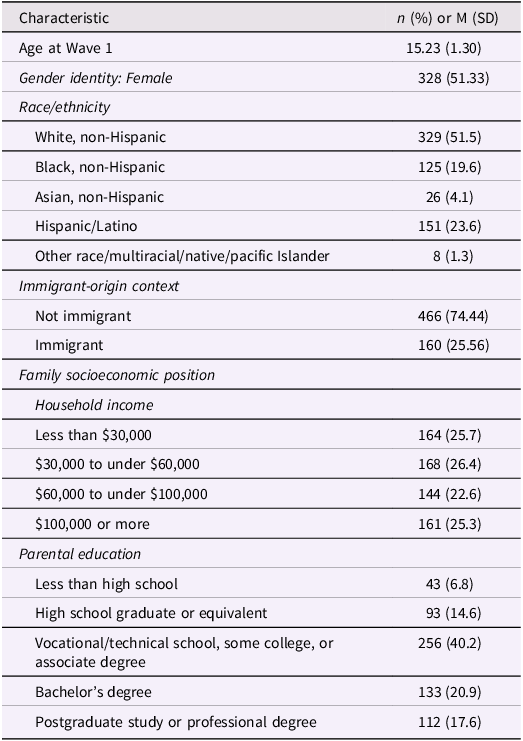
All procedures were approved by the NORC Institutional Review Board, and participants were provided with a list of mental health resources, including crisis hotlines. The analytic sample comprises the N = 639 adolescents who completed the W1 survey. At Wave 1, 51.3% of participants identified as female; 51.5% identified as White (non-Hispanic), 23.6% as Hispanic/Latino, 19.6% as Black (non-Hispanic), 4.1% as Asian (non-Hispanic), and 1.3% as multiracial or another race/ethnicity. Additional sample sociodemographic characteristics are presented in Table 1.
Sociodemographic characteristics of participants (N = 639)

Table 1. Long description
A table summarizing sociodemographic characteristics of participants. The table has 16 rows and 3 columns. The columns are labeled ‘Characteristic’, ‘n (%)’ or ‘M (SD)’. The table includes characteristics such as age at Wave 1, gender identity, race/ethnicity, immigrant-origin context, family socioeconomic position, household income, and parental education. Row 1: Age at Wave 1, 15.23 (1.30). Row 2: Gender identity: Female, 328 (51.33). Row 3: White, non-Hispanic, 329 (51.5). Row 4: Black, non-Hispanic, 125 (19.6). Row 5: Asian, non-Hispanic, 26 (4.1). Row 6: Hispanic/Latino, 151 (23.6). Row 7: Other race/multiracial/native/pacific Islander, 8 (1.3). Row 8: Not immigrant, 466 (74.44). Row 9: Immigrant, 160 (25.56). Row 10: Less than $30,000, 164 (25.7). Row 11: $30,000 to under $60,000, 168 (26.4). Row 12: $60,000 to under $100,000, 144 (22.6). Row 13: $100,000 or more, 161 (25.3). Row 14: Less than high school, 43 (6.8). Row 15: High school graduate or equivalent, 93 (14.6). Row 16: Vocational/technical school, some college, or associate degree, 256 (40.2). Row 17: Bachelor’s degree, 133 (20.9). Row 18: Postgraduate study or professional degree, 112 (17.6).
Note: Percentages are based on available valid responses for each characteristic. Age is reported as M (SD) at Wave 1. Race/ethnicity is reported as mutually exclusive categories.
Measures
Bias-based harassment victimization
At each wave, adolescents completed six items adapted from the California Healthy Kids Survey (Austin et al., Reference Austin, Polik, Hanson and Zheng2016) assessing past-year (W1) or past-six-month (W2–W4) bias-based harassment across six identity domains: race/ethnicity, national origin, religion, sexual orientation, gender identity, and immigration status. Responses ranged from 0 (0 times) to 3 (4 or more times), with intermediate categories indicating 1 time and 2 or 3 times, and were averaged within wave, with higher scores reflecting more frequent victimization (αs = 0.82–0.84). Because items explicitly index harassment targeting socially meaningful identities rather than peer conflict in general, this variable is conceptualized as identity-linked peer stress.
Depression
Depressive symptoms were assessed at each wave with eight items from the Patient Health Questionnaire–9 (PHQ-9; Kroenke et al., Reference Kroenke, Spitzer and Williams2001); the suicidal-ideation item was omitted per institutional review board guidance. Adolescents rated past-two-week symptoms (e.g., feeling down, depressed, or hopeless) on a 4-point scale from 0 (not at all) to 3 (nearly every day). Items were averaged within wave, with higher scores indicating greater symptomatology (αs = 0.92–0.93).
Anxiety
Anxiety symptoms were assessed at each wave using the seven-item Generalized Anxiety Disorder–7 (GAD-7; Spitzer et al., Reference Spitzer, Kroenke, Williams and Löwe2006). Adolescents rated past-two-week symptoms (e.g., feeling nervous, anxious, or on edge) on a 4-point scale from 0 (not at all) to 3 (nearly every day), and items were averaged within wave (αs = 0.93–0.94).
Family-process predictors
At W1, parents/guardians completed the short form of the Parenting Styles and Dimensions Questionnaire (PSDQ; Robinson et al., Reference Robinson, Mandleco, Olsen, Hart, Perlmutter, Touliatos and Holden2001) on a 5-point scale from 0 (never) to 4 (always). Positive parenting averaged the authoritative-style items indexing warmth, reasoning-based regulation, and autonomy granting (α = 0.90); negative parenting averaged the authoritarian-style items indexing physical coercion, verbal hostility, and non-reasoning/punitive discipline (α = 0.90). Parents also completed the 18-item Parental Stress Scale (Berry & Jones, Reference Berry and Jones1995) to index parenting stress, rated on a 5-point scale from 0 (strongly disagree) to 4 (strongly agree) with positively worded items reverse-scored before averaging (α = 0.90).
Social-location predictors and developmental covariates
At W1, adolescents reported age (M = 15.23, SD = 1.30), gender identity, race, and Hispanic ethnicity. Gender identity was represented by a binary female gender indicator (0 = all other gender identities, 1 = female). We combined race and Hispanic ethnicity into a single race/ethnicity variable (1 = White, non-Hispanic; 2 = Black, non-Hispanic; 3 = Asian, non-Hispanic; 4 = Hispanic/Latino; 5 = other) and created dummy variables with non-Hispanic White adolescents as the reference group in the analyses. Immigrant-origin context indicated whether one or more parents were born outside the United States (0 = non-immigrant origin, 1 = immigrant origin). Family socioeconomic position was indexed by two W1 parent-reported indicators: household income (1= Less than $30,000; 2 = $30,000 to under $60,000; 3 = $60,000 to under $100,000; 4 = $100,000 or more) and the highest education completed (1 = Less than high school, 2 = High school graduate or equivalent, 3 = Vocational/tech school/some college/associates, 4 = Bachelor’s degree, 5 = Post-grad study/professional degree) by either caregiver. Demographic variables were reported in Table 1. These variables are treated as selected indicators of social positioning; identity combinations and interactions were not modeled, and the study is therefore informed by but not a direct test of intersectionality.
Distal outcomes
Three W4 outcomes were examined. School safety was a single adolescent-report item asking whether the adolescent felt safe at school (0 = no, 1 = yes); higher class-level means indicate a greater proportion of adolescents reporting feeling safe. Peer rejection was assessed with two items from Zimmer-Gembeck et al. (Reference Zimmer-Gembeck, Nesdale, McGregor, Mastro, Goodwin and Downey2013; e.g., “It’s hard for peers to like me”), rated on a 5-point scale from 0 (not at all true) to 4 (very true), with the positively worded item reverse-coded and items averaged so that higher scores reflect greater perceived rejection (α = 0.60). Academic achievement was a single self-report item on typical grades, recoded so that higher values denote better grades.
Analytic plan
Analyses were conducted in SPSS 31.0 for data cleaning and descriptive analyses and in Mplus Version 8.11 (Muthén & Muthén, Reference Muthén and Muthén1998–Reference Muthén and Muthén2024) for the main models. Models were estimated using robust maximum likelihood estimation. Missing data on the repeated-measures indicators in the trajectory model were handled using full information maximum likelihood, which retained all 639 participants by incorporating all available observations under the missing-at-random assumption (Enders & Bandalos, Reference Enders and Bandalos2001; Enders, Reference Enders2010). Finite mixture modeling provides a general framework for identifying unobserved subgroups within heterogeneous populations (McLachlan & Peel, Reference McLachlan and Peel2000). Multidimensional growth mixture modeling (MGMM; Connell & Frye, Reference Connell and Frye2006; Muthén, Reference Muthén and Kaplan2004) was used to identify latent classes of adolescents defined by qualitatively distinct joint developmental trajectories of bias-based harassment victimization, depression, and anxiety across the four waves. By estimating parallel growth processes within a shared latent class structure, MGMM identifies subgroups defined by configurations of co-development across several indicators rather than by change in any single indicator.
To assess whether attrition was systematically associated with baseline characteristics, we regressed the number of missing follow-up waves across Waves 2 through 4 (range = 0–3) on the Wave 1 demographic covariates from the class-membership model, including age, gender, race/ethnicity, parental education, and household income (n = 637 with complete covariate data). Hispanic/Latino adolescents missed more follow-up waves than non-Hispanic White adolescents (b = 0.25, SE = 0.10, p = .014); no other characteristic was associated with attrition (ps ≥ .319). Because race/ethnicity is included in the conditional class-membership model, the conditional analyses account for potential bias due to missing data on this variable, consistent with a missing-at-random mechanism given the observed information.
Freely estimating the anxiety slope variance produced a Heywood case, so that variance and its covariances were fixed to zero in all class solutions (Chen et al., Reference Chen, Bollen, Paxton, Curran and Kirby2001). Freeing the remaining depression–anxiety covariances did not yield an admissible solution, so those constraints were retained as well. Because the four- and five-class solutions additionally required fixing the depression slope variance, information criteria are not strictly comparable across solutions.
The analysis followed a three-phase MGMM workflow. In Phase 1 (class enumeration), one- through five-class solutions were estimated, with the 1-class solution serving as the unconditional latent growth model baseline. To reduce the risk of local-maximum solutions, multi-class models used 500 random starts, retaining the 100 for final-stage optimization (Hipp & Bauer, Reference Hipp and Bauer2006). Class enumeration drew on (a) information criteria (AIC, BIC, sample-size–adjusted BIC); (b) the Lo–Mendell–Rubin adjusted likelihood ratio test (LMR-A) comparing k- and (k−1)-class models (Lo et al., Reference Lo, Mendell and Rubin2001); (c) entropy, with values ≥0.80 indicating well-separated classes (Clark & Muthén, Reference Clark and Muthén2009); (d) replication of the best loglikelihood across random starts (Hipp & Bauer, Reference Hipp and Bauer2006); and (e) substantive criteria including theoretical interpretability, parsimony, and minimum class size (≥5% of the sample; Nylund-Gibson & Choi, Reference Nylund-Gibson and Choi2018). To examine the different victimization reporting windows, we estimated a sensitivity model in which the W1 victimization intercept was freely estimated within each class, allowing W1 to deviate from the linear trajectory.
In Phase 2 (predictors of class membership) and Phase 3 (distal outcomes), auxiliary analyses examined associations of class membership with baseline predictors and Wave 4 distal outcomes using a manual three-step approach that preserves the original class enumeration when adding auxiliary variables (Asparouhov & Muthén, Reference Asparouhov and Muthén2014; Vermunt, Reference Vermunt2010). Phase 2 modeled class membership using multinomial logistic regression, with the largest (low-symptom) class as the reference, entering family-process and selected social-location predictors simultaneously. The female gender indicator was included as a social-location indicator, and baseline age was entered as a developmental covariate, so that associations between family-process and social-location indicators and class membership were estimated net of adolescents’ age at Wave 1. Covariate means and variances were estimated in the model, so all 639 participants were retained in the class-membership analyses under full information maximum likelihood. As diagnostic checks, we re-estimated the Phase 2 model using conventional maximum likelihood and with the predictors treated as exogenous; the latter analysis excluded 19 participants with missing predictor data (n = 620). Phase 3 examined W4 distal outcomes using the BCH (Bolck–Croon–Hagenaars) procedure, which accounts for classification uncertainty and accommodates differing outcome distributions across classes (Asparouhov & Muthén, Reference Asparouhov and Muthén2021; Bolck et al., Reference Bolck, Croon and Hagenaars2004). BCH comparisons were based on participants with observed data for each respective distal outcome: 402 for school safety, 313 for grades, and 458 for peer rejection.
Results
Preliminary analyses
Correlations among the latent growth factors are provided in Table S1 in the online supplemental materials. Across the sample as a whole, bias-based victimization remained low and relatively stable across waves, whereas depression and anxiety declined modestly from W1 to W4. Univariate distributions showed substantial clustering at the scale minimum, particularly for bias-based victimization, for which 71.9%–74.3% of respondents reported zero victimization across waves. The corresponding proportions at the minimum were 27.4%–31.7% for depression and 22.1%–30.9% for anxiety. Responses at the scale maxima were uncommon across all three indicators (<3%). These distributional features were considered when interpreting the Low-Stable (LS) class and the precision of the estimated growth-factor variances.
Phase 1: class enumeration
Fit indices for the two- through five-class MGMM solutions are presented in Table 2. The information criteria decreased monotonically as classes were added and did not reach a minimum within the range examined, a pattern that is common in growth mixture models and that does not by itself identify a preferred solution (Nylund-Gibson & Choi, Reference Nylund-Gibson and Choi2018). As noted above, they are also not strictly comparable across all solutions. Class enumeration therefore rested on the remaining criteria. Four considerations supported the three-class solution: (a) the LMR-A test was significant moving from two to three classes (p = .018) but not from three to four (p = .223) or four to five (p = .210); (b) the best loglikelihood of the five-class solution was achieved by only one of 100 retained random starts and was not replicated, indicating instability, whereas the three-class best loglikelihood was replicated across multiple starts; (c) entropy was highest for the three-class solution (0.940); and (d) the three-class solution yielded the most theoretically interpretable trajectory configurations, with the smallest class comprising 7.5% of the sample, above the recommended 5% minimum. Classification quality was high, with average posterior probabilities of 0.983, 0.957, and 0.978 for Classes 1, 2, and 3, respectively (Nagin, Reference Nagin2005).
Fit indices for two- through five-class multidimensional growth mixture models

Table 2. Long description
The table presents fit indices for two-through five-class multidimensional growth mixture models. It has six columns: Classes, FP, LL, AIC, BIC, aBIC, LMR-A p, Entropy, and LL repl. The table has five rows corresponding to the number of classes. Row 1: Classes, 2; FP, 38; LL, -4,242.30; AIC, 8,560.59; BIC, 8,730.07; aBIC, 8,609.42; LMR-A p, .0006; Entropy, .917; LL repl, Yes. Row 2: Classes, 3; FP, 45; LL, -3,957.57; AIC, 8,005.14; BIC, 8,205.84; aBIC, 8,062.97; LMR-A p, .0182; Entropy, .940; LL repl, Yes. Row 3: Classes, 4; FP, 48; LL, -3,796.60; AIC, 7,689.21; BIC, 7,903.28; aBIC, 7,750.89; LMR-A p, .2234; Entropy, .916; LL repl, Yes. Row 4: Classes, 5; FP, 55; LL, -3,665.68; AIC, 7,441.37; BIC, 7,686.66; aBIC, 7,512.04; LMR-A p, .2101; Entropy, .932; LL repl, No.
Note: AIC = Akaike Information Criterion; BIC = Bayesian Information Criterion; aBIC = sample-size–adjusted BIC; LMR-A = Lo–Mendell–Rubin adjusted likelihood ratio test (compared with k−1 class); LL repl. = whether the best loglikelihood replicated across multiple random starts. The three-class solution was selected as the final model.
Description of the three-class solution
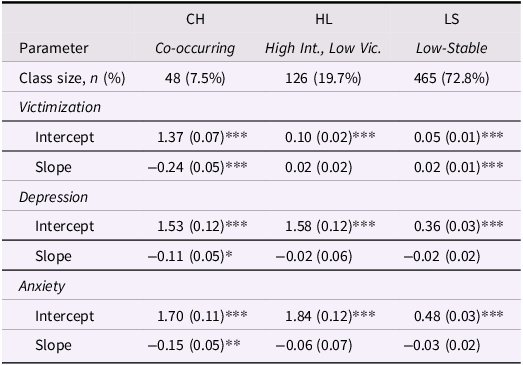
Model-implied means of growth intercepts and slopes and class proportions are presented in Table 3, and the corresponding model-implied trajectories are shown in Figure 2 (Panels A–C). Class 1 (Co-Occurring High–Decreasing; n = 48, 7.5%) showed elevated W1 levels of victimization (M = 1.37, SE = 0.07), depression (M = 1.53, SE = 0.12), and anxiety (M = 1.70, SE = 0.11), followed by significant declines on all three indicators in the primary model (slopes: victimization = −0.24, p < .001; depression = −0.11, p = .014; anxiety = −0.15, p = .006). This class represents a small subgroup of adolescents with elevated co-occurring identity-linked peer stress and internalizing symptoms at baseline, followed by declines in model-implied means in the primary model.
Model-implied mean trajectories of bias-based victimization, depression, and anxiety across four waves by latent class. Note: Points are model-implied class-specific means. All indicators range from 0 to 3. victimization referred to the past year at wave 1 and the past six months at waves 2–4.

Model-implied growth factor means and class sizes for the three-class multidimensional growth mixture model

Table 3. Long description
The table presents data on three classes: Co-occurring High Decreasing (CH), High Intensity Low Victimization (HL), and Low Stable (LS). It includes class size percentages, and model-implied means for victimization, depression, and anxiety with their respective intercepts and slopes. The table has 10 rows and 4 columns. Column headers are Parameter, CH, HL, and LS. Row labels include Class size, Victimization Intercept, Victimization Slope, Depression Intercept, Depression Slope, Anxiety Intercept, and Anxiety Slope. Each row provides specific values for each class. Notable trends include higher initial values for victimization, depression, and anxiety in the CH class with significant declines over time, while the LS class shows lower initial values and minimal changes.
Note: Values are model-implied estimates of growth factor means within each latent class, with standard errors in parentheses. Slopes represent linear change per wave (∼6 months). Class sizes are based on most-likely class membership. CH = Co-Occurring High–Decreasing (Class 1); HL = High Internalizing, Low Victimization (Class 2); LS = Low-Stable (Class 3).
* p < .05;
** p < .01;
*** p < .001.
Because W1 victimization referred to the past year whereas W2–W4 referred to the past six months, we examined a model in which W1 victimization could deviate from the linear trajectory. Class assignment was nearly unchanged (636 of 639 adolescents, 99.53%), and the class sizes were 47, 129, and 463. Within the Co-Occurring High–Decreasing class, the W1 deviation was positive (b = 0.431, SE = 0.142, p = .002), and the victimization slope was smaller and nonsignificant (b = −0.070, SE = 0.061, p = .254). The depression (b = −0.109, SE = 0.050, p = .029) and anxiety (b = −0.150, SE = 0.056, p = .008) slopes remained significant. Thus, class assignment was stable, but the victimization slope was sensitive to the treatment of W1 (Table S2).
Class 2 (High Internalizing, Low Victimization; n = 126, 19.7%) showed low and stable victimization (M = 0.10; slope = 0.02, p = .265) alongside persistently elevated depression (M = 1.58; slope = −0.02, p = .757) and anxiety (M = 1.84; slope = −0.06, p = .394) across all four waves. This class represents a subgroup with sustained internalizing symptoms in the absence of frequent bias-based victimization.
Class 3 (LS; n = 465, 72.8%) constituted the largest class, with low and largely stable levels of victimization (M = 0.05), depression (M = 0.36), and anxiety (M = 0.48). A statistically significant but small increase in victimization was observed (slope = 0.02, p < .001); depression and anxiety slopes were not statistically distinguishable from zero.
Phase 2: predictors of class membership
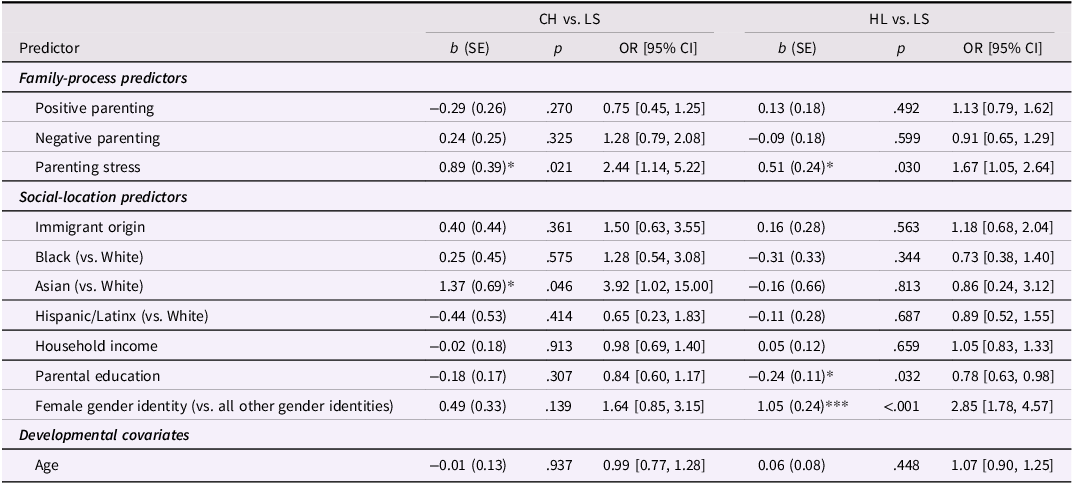
Multinomial logistic regression results are presented in Table 4, with Class 3 (LS) as the reference.
Multinomial logistic regression of latent class membership on family-process and social-location predictors (Reference class = low-stable, LS)

Table 4. Long description
A table with 15 rows and 10 columns comparing family-process and social-location predictors on latent class membership. The columns are labeled as Predictor, CH vs. LS b (SE), CH vs. LS p, CH vs. LS OR [95% CI], HL vs. LS b (SE), HL vs. LS p, HL vs. LS OR [95% CI]. The rows are grouped under Family-process predictors, Social-location predictors, and Developmental covariates. Family-process predictors include Positive parenting, Negative parenting, and Parenting stress. Social-location predictors include Immigrant origin, Black (vs. White), Asian (vs. White), Hispanic/Latinx (vs. White), Household income, Parental education, and Female gender identity (vs. all other gender identities). Developmental covariates include Age. Each row provides values for b (SE), p, and OR [95% CI] for CH vs. LS and HL vs. LS comparisons.
Note: CH = Co-Occurring High–Decreasing (Class 1); HL = High Internalizing, Low Victimization (Class 2); LS = Low-Stable (Class 3; reference). The Other-race indicator was retained in the N = 639 model, but its coefficient is not reported because the category included only eight participants. Diagnostic comparisons are reported in Table S3. *p < .05; **p < .01; ***p < .001.
Family-process predictors. Relative to Class 3, higher parenting stress was associated with greater odds of membership in both Class 1 (b = 0.89, SE = 0.39, p = .021, OR = 2.44, 95% CI [1.14, 5.22]) and Class 2 (b = 0.51, SE = 0.24, p = .030, OR = 1.67, 95% CI [1.05, 2.64]). Neither positive parenting nor negative parenting was significantly associated with membership in either class.
Social-location predictors. Relative to Class 3, Class 1 membership was more likely for Asian adolescents (b = 1.37, SE = 0.69, p = .046, OR = 3.92) compared with non-Hispanic White adolescents; Class 2 membership was associated with lower parental education (b = −0.24, SE = 0.11, p = .032). Adolescents who identified as female had greater odds of Class 2 membership (b = 1.05, SE = 0.24, p < .001, OR = 2.85) but not Class 1 membership (b = 0.49, SE = 0.33, p = .139, OR = 1.64). Immigrant-origin context, household income, and Black and Hispanic/Latinx indicators were not significantly associated with class membership in either contrast. The model returned a non-positive-definite first-order derivative product-matrix warning involving the variance of the binary Black indicator. This warning reflects the mean–variance dependency that arises when both the mean and variance of a binary covariate are estimated in the likelihood, rather than a problem with the class-on-covariate coefficients (Asparouhov & Muthén, Reference Asparouhov and Muthén2022). Diagnostic comparisons yielded identical regression coefficients under maximum likelihood estimation and ML, with modest differences in standard errors, and similar estimates when covariates were treated as exogenous. Statistical significance for all predictors reported in the class comparisons was unchanged across specifications (Table S3).
Developmental covariates. Baseline age was not significantly associated with class membership in either contrast (Class 1 vs. Class 3: b = −0.01, SE = 0.13, p = .937, OR = 0.99, 95% CI [0.77, 1.28]; Class 2 vs. Class 3: b = 0.06, SE = 0.08, p = .448, OR = 1.07, 95% CI [0.90, 1.25]), providing no evidence that trajectory-class membership differed across the 13–17 year age range represented at Wave 1.
An alternative parameterization of the multinomial model used the High Internalizing, Low Victimization class as the reference category to compare the two higher-risk classes directly. None of the baseline predictors significantly distinguished the Co-Occurring High–Decreasing class from the High Internalizing, Low Victimization class (all ps ≥ .084). The largest contrast involved Asian race/ethnicity (b = 1.52, SE = 0.88, p = .084, OR = 4.58, 95% CI [0.82, 25.74]), but this estimate was imprecise and did not reach conventional statistical significance.
Phase 3: distal outcomes
BCH equality tests of the W4 distal outcomes are presented in Table 5. Classes differed significantly in school safety (p < .001): adolescents in the LS class (M = 0.94, SE = 0.01) were more likely to report feeling safe at school than adolescents in the Co-Occurring High–Decreasing class (M = 0.53, SE = 0.10; p < .001) and the High Internalizing, Low Victimization class (M = 0.74, SE = 0.05; p < .001). The two higher-risk classes did not differ significantly, χ 2(1) = 3.26, p = .071. Classes also differed significantly in peer rejection (p < .001): the LS class (M = 0.92, SE = 0.05) reported lower peer rejection than the Co-Occurring High–Decreasing class (M = 1.58; p < .001) and the High Internalizing, Low Victimization class (M = 1.52; p < .001). The two higher-risk classes did not differ, χ2(1) = 0.11, p = .739. Classes did not differ overall in self-reported grades (p = .971), and the two higher-risk classes also did not differ directly, χ2(1) = 0.004, p = .950.
Equality tests of wave 4 distal outcome means across latent classes using the BCH procedure

Table 5. Long description
The table presents data on three outcomes: school safety, academic achievement (grades), and peer rejection across different classes labeled as CH M, HL M, and LS M. It includes columns for the number of participants (n), mean values with standard errors (SE), overall chi-square values (χ²) with p-values (p), and pairwise contrasts. Row 1: School safety, 402 participants, CH M 0.53 (SE 0.10), HL M 0.74 (SE 0.05), LS M 0.94 (SE 0.01), Overall χ² 28.50 (p < .001), Pairwise contrasts: CH < LS, HL < LS; CH vs. HL p = .071. Row 2: Academic achievement (grades), 313 participants, CH M 1.71 (SE 0.23), HL M 1.69 (SE 0.13), LS M 1.73 (SE 0.05), Overall χ² 0.06 (p = .971), Pairwise contrasts: ns; CH vs. HL p = .950. Row 3: Peer rejection, 458 participants, CH M 1.58 (SE 0.17), HL M 1.52 (SE 0.10), LS M 0.92 (SE 0.05), Overall χ² 39.14 (p < .001), Pairwise contrasts: CH > LS, HL > LS; CH vs. HL p = .739.
Note: CH = Co-Occurring High–Decreasing (Class 1; n = 48); HL = High Internalizing, Low Victimization (Class 2; n = 126); LS = Low-Stable (Class 3; n = 465). Sample sizes per outcome reflect participants with valid W4 data on that outcome. Valid Ns were 402 for school safety, 313 for grades, and 458 for peer rejection. Pairwise contrasts report which classes differed at p < .05, followed by the direct comparison between the two higher-risk classes. For school safety, higher class-level means indicate a greater proportion of adolescents reporting feeling safe at school. ***p < .001; ns = not statistically significant.
In sum, latent trajectory classes were significantly linked to later school- and peer-context adjustment but not to self-reported grades, suggesting that joint developmental trajectories of identity-linked peer stress and internalizing distress are more closely tied to adolescents’ social and identity-relevant school experiences than to broad academic outcomes captured by a single grades item.
Discussion
The present study used multidimensional growth mixture modeling to examine heterogeneous joint trajectories of bias-based victimization, depression, and anxiety across two years in adolescence. The study conceptualized bias-based victimization as identity-linked peer stress and examined how it co-developed with internalizing distress over time. Rather than supporting a single average developmental pattern, findings identified three distinct trajectory classes: a small Co-Occurring High–Decreasing class, a High Internalizing, Low Victimization class, and a large LS class. These classes were meaningfully associated with baseline family-process and selected social-location indicators as well as with later school and peer adjustment. Together, the findings indicate that adolescents followed different joint pathways of risk and adaptation rather than a single average pattern.
Interpreting the three trajectory classes
The three-class solution highlights meaningful developmental heterogeneity in adolescents’ experiences of identity-linked peer stress and internalizing distress. The Co-Occurring High–Decreasing class represented a small subgroup of adolescents who began the study with elevated levels of bias-based victimization, depression, and anxiety, followed by declines in depression and anxiety across waves; the victimization slope depended on how W1 was modeled. This pattern may reflect change in internalizing distress, but the data do not establish a comparable linear decline in victimization. These changes should not be interpreted as evidence of recovery caused by any specific process measured in the study. Rather, they may reflect changes in peer or school contexts, shifts in exposure to bias-based harassment, or adolescents’ adaptation to changing social circumstances. From a developmental psychopathology perspective, this class illustrates that elevated early risk does not necessarily imply stable or worsening distress.
Because the Co-Occurring High–Decreasing class began with elevated scores and included only 48 adolescents, regression to the mean remains a plausible contributor to its declining trajectory. W1 victimization also covered the past year, whereas W2–W4 covered the past six months. In the sensitivity model, 99.53% of assignments were unchanged, but the victimization slope became smaller and nonsignificant; the depression and anxiety slopes remained significant. Several features nevertheless support treating this class as a substantively distinguishable model-based configuration rather than simply a group defined by extreme Wave 1 scores. Class membership was estimated from the joint pattern of victimization, depression, and anxiety across all four waves rather than from a threshold applied at baseline. The class represented 7.5% of the sample and was well separated from the other classes, with an average posterior probability of .983. Moreover, the High Internalizing, Low Victimization class began with slightly higher depression and anxiety levels but remained comparatively stable, whereas the Co-Occurring High–Decreasing class was distinguished by elevated victimization together with declining internalizing symptoms.
Under the primary model, its model-implied Wave 4 levels remained above those of the LS class on all three trajectory indicators, and its members reported lower school safety and higher peer rejection at Wave 4 than the LS class. These findings support the substantive relevance of the class but do not establish that the victimization decline was unaffected by the reporting-window difference or regression to the mean. The differences between the two classes’ slopes were not formally tested, and regression to the mean cannot be ruled out as a contributing explanation.
The High Internalizing, Low Victimization class was substantively informative. Adolescents in this class showed persistently elevated depression and anxiety despite low levels of bias-based victimization. This pattern indicates that internalizing distress can remain elevated even when adolescents do not report frequent identity-linked victimization. In other words, high internalizing symptoms may emerge through multiple developmental pathways, not all of which involve high exposure to bias-based peer stress. This finding is consistent with the principle of equifinality, in which similar outcomes may arise from different developmental conditions (Cicchetti & Rogosch, Reference Cicchetti and Rogosch1996). It also cautions against assuming that elevated depression and anxiety among adolescents involved in marginalized or socially diverse contexts always reflect the same social stress exposure.
The LS class, which included the majority of adolescents, showed low and largely stable levels of all three indicators. That most adolescents followed this pathway, while two smaller higher-risk classes were also identified, illustrates the value of person-centered longitudinal approaches for detecting subgroups that average trends obscure (Handley et al., Reference Handley, Duprey, Russotti, Levin and Warmingham2024; Valentino & Edler, Reference Valentino and Edler2024).
Distinguishing the two higher-risk classes
The two higher-risk classes were distinguished most clearly by their victimization levels and configurations. The Co-Occurring High–Decreasing class began with elevated victimization alongside elevated depression and anxiety, whereas the High Internalizing, Low Victimization class showed persistently low victimization despite sustained internalizing distress. The High Internalizing, Low Victimization class represented 19.7% of the sample, approximately 2.6 times the size of the Co-Occurring High–Decreasing class. Thus, elevated internalizing distress was more commonly identified without frequent identity-linked victimization than with it. The joint model identified two different configurations of elevated internalizing risk, but the present findings do not establish that the identity-linked victimization configuration had distinct baseline predictors or more adverse Wave 4 outcomes.
Direct comparisons provided little evidence that the measured predictors or distal outcomes differentiated the two higher-risk classes. None of the baseline predictors reached conventional statistical significance in the direct comparison. Asian race/ethnicity produced the largest predictor contrast, but the estimate was imprecise and did not reach significance (p = .084). The two classes also did not differ significantly in school safety, peer rejection, or grades. The school-safety comparison was less conclusive because the class means were 0.53 and 0.74, p = .071, and the Co-Occurring High–Decreasing class contained only 48 adolescents. Accordingly, these findings do not demonstrate that frequent identity-linked victimization was associated with additional Wave 4 difficulty beyond that observed in the sustained-internalizing class. At the same time, the nonsignificant comparisons should not be interpreted as evidence that the classes were equivalent, given the limited precision of estimates involving the smaller class.
Parenting stress and trajectory membership
Among the family-process indicators, parenting stress was the only variable that distinguished both higher-risk classes from the LS class. The associations were modest and imprecisely estimated: OR = 2.44, 95% CI [1.14, 5.22] for the Co-Occurring High–Decreasing class and OR = 1.67, 95% CI [1.05, 2.64] for the High Internalizing, Low Victimization class, with both intervals extending close to 1. The association held for both classes rather than specifically for the one characterized by frequent identity-linked victimization. Such family strain may be especially consequential during adolescence, when youth are navigating peer relationships, identity-related experiences, and increasing autonomy (Conger et al., Reference Conger, Conger and Martin2010; Steinberg, Reference Steinberg2001).
Positive parenting and negative parenting were not significantly associated with class membership after accounting for other predictors. In these data the family-process signal came from caregivers’ overall strain rather than from the specific parenting behaviors assessed. Global parenting stress may capture broader family strain more directly than parenting style indicators do, or positive and negative parenting may operate through more specific mechanisms, such as emotion socialization, parent–adolescent communication, or support following peer victimization, which were not tested here. Future work should examine whether parenting behaviors moderate the association between identity-linked peer stress and internalizing symptoms.
Social-location patterns
Several selected social-location indicators were associated with class membership, although these findings should be interpreted cautiously. Adolescents who identified as female were more likely to belong to the High Internalizing, Low Victimization class than to the LS class. Because the model contrasted female identity with all other gender identities combined, we do not interpret this pattern further.
Parental education was also associated with class membership. Lower parental education predicted greater likelihood of membership in the High Internalizing, Low Victimization class relative to the LS class. This finding suggests that family socioeconomic resources may be associated with adolescents’ internalizing pathways, although the direction and meaning of this association should be interpreted carefully. Socioeconomic position may shape access to mental health resources, school supports, family stress exposure, and other contextual resources relevant to adolescent adjustment (Conger et al., Reference Conger, Conger and Martin2010).
Race-related findings involving the Co-Occurring High–Decreasing class require particular caution. Asian adolescents had higher odds of membership in the Co-Occurring High–Decreasing class relative to non-Hispanic White adolescents. However, this class was small, and the estimate had a wide confidence interval. This finding should therefore be interpreted as preliminary evidence of possible social patterning rather than as stable or deterministic group differences.
Links to later school and peer adjustment
Trajectory classes differed in later school safety and peer rejection but not in self-reported grades. Adolescents in both higher-risk classes reported lower school safety and higher peer rejection at Wave 4 than adolescents in the LS class. Elevated internalizing distress, whether or not accompanied by high bias-based victimization, was linked to adolescents’ later experiences of school and peer adjustment. Thus, adolescents with elevated depression and anxiety may experience social difficulties even when they do not report frequent identity-linked victimization. School safety may be especially relevant in the context of identity-linked peer stress because bias-based victimization can threaten adolescents’ sense of belonging and recognition in school environments. The finding that both higher-risk classes reported lower school safety suggests that later perceived safety may reflect broader social–emotional adjustment, not simply current exposure to victimization. Peer rejection similarly represents a proximal social-developmental outcome, closely tied to adolescents’ belonging, interpersonal confidence, and social adaptation.
In contrast, trajectory classes did not differ significantly in self-reported grades. This null finding should not be interpreted as evidence that identity-linked peer stress or internalizing distress has no relevance for academic development. Rather, grades may be shaped by many additional factors, including instruction, school resources, family educational supports, grading practices, and adolescents’ prior achievement. School safety and peer rejection may be more proximal to the social and emotional processes captured by these trajectories, whereas grades may be a more distal and multiply determined outcome. This pattern is consistent with a bioecological view of development in which adjustment outcomes vary depending on their proximity to the processes under study (Bronfenbrenner & Morris, Reference Bronfenbrenner, Morris, Damon and Lerner2006; Masten, Reference Masten2014).
Contributions and future directions
Two features of these findings are worth drawing out. Modeling bias-based victimization, depression, and anxiety jointly across four waves shows the configurations in which they co-occurred in this sample, rather than treating victimization only as a predictor of later symptoms. Most prior work has examined bias-based victimization cross-sectionally or as an antecedent of later distress, and the present design instead characterizes how the three processes moved together in a national probability-based panel that oversampled areas with high concentrations of Latinx and non-Latinx Black residents.
Adolescents with elevated internalizing distress also did not form a homogeneous group. Among adolescents assigned to the two higher-risk classes, 72.4% belonged to the sustained-internalizing, low-victimization class. Elevated internalizing distress was therefore more often identified in this sample without frequent identity-linked victimization than with it, which underscores the importance of assessing internalizing distress and bias-based victimization separately rather than inferring one from the other.
The study also situates these developmental pathways within family-process and selected social-location contexts. Parenting stress emerged as the most consistent family-process correlate of higher-risk trajectory membership, while selected social-location indicators showed more specific and cautious patterns. These findings support a socially situated developmental psychopathology approach in which adolescent adjustment is understood as developing within overlapping peer, family, school, and social-positioning contexts.
Several next steps follow from this work. First, future longitudinal research should extend trajectory modeling into earlier childhood and into the transition to adulthood, where identity-relevant stress and internalizing distress may take additional forms. Second, larger and more demographically targeted samples are needed to support genuine intersectional analyses that test identity combinations and interactions rather than treating social-location indicators only as separate predictors. Third, multi-level designs incorporating school-, neighborhood-, and policy-level contexts could clarify how bioecological factors moderate identity-linked peer stress and internalizing pathways. Finally, intervention research is needed to evaluate whether family-process supports, school-based bystander programs, and identity-affirming school climates can shift adolescents away from higher-risk joint trajectories.
Limitations
Several limitations should be considered when interpreting the findings. First, mixture modeling remains an exploratory and model-dependent approach, and the identified classes should be understood as model-based approximations of heterogeneous developmental pathways rather than naturally occurring types of adolescents. Future studies should replicate the class structure in independent samples and across different developmental periods, school contexts, and measurement approaches.
The constraints required to obtain an admissible solution also limit interpretation of the depression–anxiety growth processes. Because the corresponding within-class growth-factor covariances were fixed to zero, the model did not estimate the extent to which individual differences in depression and anxiety growth covaried within classes. The classes should therefore be interpreted as configurations of mean trajectories rather than as evidence that the depression and anxiety growth processes were uncorrelated.
A further set of limitations concerns the alternative explanations that these data cannot rule out. Ruling out plausible alternative accounts is what is required to establish a causal link, and this is possible in non-experimental as well as experimental designs (Shadish et al., Reference Shadish, Cook and Campbell2002); the present design leaves several such accounts open. First, adolescents’ internalizing symptoms prior to Wave 1 were not assessed, so associations between baseline family-process indicators and trajectory membership may reflect confounding by pre-existing symptoms. Second, parenting stress and adolescent symptoms are plausibly reciprocal: caregiver strain may increase adolescent vulnerability, and adolescent distress may increase caregiver strain. Third, 72.5% of the Wave 1 sample (n = 463) was retained at Wave 4, raising the possibility of selection on variables related to both trajectory membership and later adjustment. Although Hispanic/Latino ethnicity, which is included in the conditional models, was the only measured Wave 1 characteristic associated with the number of missing follow-up waves, attrition related to unmeasured characteristics or an MNAR mechanism cannot be ruled out. Fourth, the Wave 4 outcomes were measured at the end of the trajectory window, so lower school safety and higher peer rejection may reflect ongoing social contexts that shaped both the trajectories and the outcomes. Future work could address these threats by specifying the assumed causal structure through directed acyclic graphs (Greenland et al., Reference Greenland, Pearl and Robins1999) and by cataloging and testing the corresponding validity threats (Matthay & Glymour, Reference Matthay and Glymour2020); designs incorporating earlier baseline symptom assessment, within-family comparisons, or exogenous variation in exposure to identity-based harassment would be particularly informative.
Measurement also has limitations. All primary adolescent indicators were self-reported, which may increase shared method variance, although it is appropriate for assessing subjective experiences such as perceived victimization, distress, safety, and rejection. Bias-based victimization was assessed using identity-domain harassment items, which do not fully capture severity, context, perpetrator characteristics, or school responses. Victimization also referred to the past year at W1 but the past six months at W2–W4. Although class assignment was nearly unchanged in the sensitivity model, the victimization slope in the Co-Occurring High–Decreasing class became smaller and nonsignificant. The W1-to-W2 difference may therefore reflect actual change, the reporting-window difference, regression to the mean, or some combination. Depression was assessed using the PHQ-9 without the suicidal-ideation item, omitted for ethical and institutional reasons; this modification should be considered when comparing results with studies using the full PHQ-9. Self-reported grades may also be a limited indicator of academic achievement. Future studies would benefit from multi-informant and multi-method measurement, including teacher reports, school records, and observational data on school climate.
The social-location analyses are similarly bounded. The models included selected social-positioning indicators but did not examine combinations of identities, interactions among social positions, or the structural processes that produce inequality, so the findings indicate social patterning in trajectory membership rather than intersectional mechanisms (Collins, Reference Collins2015; Crenshaw, Reference Crenshaw1991). Larger and more diverse samples are needed to examine how multiple social positions jointly shape exposure to identity-linked peer stress and internalizing pathways.
The study’s observational window is also limited. The four waves span approximately two years in mid-adolescence, so the trajectories described here characterize change over a relatively short developmental interval rather than across adolescence as a whole. Whether these classes remain stable, converge, or diverge over longer periods cannot be determined from these data, and the observed changes may not persist. Identity-linked peer stress and internalizing distress may also take different forms in earlier childhood and across the transition to adulthood, and replication across broader developmental windows would help clarify the timing and continuity of the pathways identified here.
Some class-specific results require caution because the Co-Occurring High–Decreasing class included only 48 adolescents. Although this exceeded the commonly used 5% minimum and the class was substantively interpretable, its size limits precision, and the association involving Asian race membership had a wide confidence interval that should be read as preliminary. The same limitation applies to the direct comparisons with the High Internalizing, Low Victimization class: the absence of statistically significant predictor and distal-outcome differences should not be taken as evidence that the two configurations are equivalent. The available outcomes may also not capture all domains on which the two configurations differ. Larger samples, outcomes more proximal to identity-linked victimization, and peer, teacher, caregiver, or administrative reports would help resolve both questions.
Finally, data were collected during the COVID-19 pandemic and a period of heightened public attention to racial injustice, anti-Asian racism, and anti-LGBTQ+ legislation, conditions that may have shaped adolescents’ experiences of identity-linked peer stress and internalizing distress. Whether similar patterns appear in later cohorts and in schools with different climates and policies remains open.
Conclusion
This study identified heterogeneous joint trajectories of bias-based victimization, depression, and anxiety across two years in adolescence. The three-class solution distinguished adolescents with initially elevated co-occurring victimization and internalizing distress, adolescents with persistently elevated internalizing distress despite low victimization, and a large, LS group. Depression and anxiety declined in the first class; the victimization slope was sensitive to the treatment of W1. Both higher-risk classes reported lower school safety and higher peer rejection at Wave 4, but classes did not differ in self-reported grades. These findings underscore the value of socially situated developmental psychopathology models that connect identity-linked peer stress, family context, and internalizing distress over time. They also suggest that adolescent adjustment is best understood through heterogeneous developmental pathways rather than a single average developmental pattern.
Supplementary material
The supplementary material for this article can be found at https://doi.org/10.1017/S0954579426102181.
Data availability statement
The data supporting the findings of this study are available through the National Archive of Criminal Justice Data at ICPSR (study 39,385; https://doi.org/10.3886/ICPSR39385.v1). Access is subject to ICPSR requirements.
Acknowledgments
The authors thank all participating families and the NORC AmeriSpeak Panel team for their support in data collection.
Author contribution
Bo Jian conceptualized the study, performed visualization, drafted and revised the manuscript; Wusirige performed the formal analysis, visualization, and reviewed and revised the manuscript; Gabriel J. Merrin designed the methodology, provided supervision, and reviewed and revised the manuscript critically for important intellectual content. All authors read and approved the final manuscript.
Funding statement
This project was supported by Award No. 2020-CK-BX-0005, awarded by the National Institute of Justice, Office of Justice Programs, US Department of Justice. The opinions, findings, and conclusions or recommendations expressed in this publication are those of the authors and do not necessarily reflect those of the Department of Justice.
Competing interests
The authors have no conflicts of interest to disclose.
Ethical standards
The study was approved by the NORC at the University of Chicago IRB (Protocol #21-04-261), with Boston University’s IRB ceding review under an IRB authorization agreement (BU IRB #6070B).
Pre-registration statement
This study was not pre-registered.
Reasons
The current manuscript involved secondary analyses of data from an existing longitudinal project. The research questions and person-centered analytic plan for the present study were developed after data collection had been completed.
Availability of code
Analytic code used for the present analyses is available from the corresponding author upon reasonable request.
Availability of methods/material
Study materials and methodological information relevant to the present analyses are available from the corresponding author upon reasonable request.
Consent statement
Consent was obtained from guardians and assent from adolescents.






 Open access

