





Introduction
Despite widespread use of the term resilience in developmental and clinical science, this construct has been operationalized inconsistently, limiting cumulative knowledge and translational impact. Resilience is often defined using a single domain (e.g., the absence of psychopathology) and treated as a binary classification (Bonanno, Reference Bonanno2012), or framed as a fixed personal trait within the individual. These approaches obscure the multidimensional, developmentally dynamic nature of adaptation following adversity (Luthar & Brown, Reference Luthar and Brown2007; Ungar, Reference Ungar2013). Building on frameworks advanced by several researchers, including Suniya Luthar, Ann Masten, and Sir Michael Rutter (Luthar et al., Reference Luthar, Cicchetti and Becker2000, Reference Luthar, Crossman, Small and Lerner2015; Masten, Reference Masten2001; Rutter, Reference Rutter2012), we define resilience as an inference that is made about observed functioning, reflected in better-than-expected adaptation across one or more domains among individuals exposed to comparable adversity. This definition shifts attention from immutable individual characteristics toward modifiable supports and resources (biological, psychological, social, and contextual) that can be mobilized following adversity (Masten & Barnes, Reference Masten and Barnes2018).
In this review, we apply this definition to the Bucharest Early Intervention Project (BEIP), the only randomized trial to evaluate the causal impact of family-based care as an alternative to institutional care for children exposed to severe early deprivation. We synthesize evidence from the BEIP across multiple domains including neurodevelopment, cognition, socioemotional functioning, and physical health, emphasizing that resilience is often partial and domain-specific rather than global. We conclude with key lessons from BEIP findings and highlight how ongoing adult and intergenerational follow-up can address outstanding questions about how resilience is best defined, measured, and mechanistically explained.
Conceptual and measurement approach
Operationalizing resilience
Under a process-oriented definition, resilience is inferred from a better-than-expected adjustment given the level and type of adversity experienced and is most meaningfully evaluated by comparing outcomes among individuals exposed to comparable adversity (Luthar et al., Reference Luthar, Cicchetti and Becker2000, Reference Luthar, Crossman, Small and Lerner2015; Masten, Reference Masten2001; Rutter, Reference Rutter2012). Because individuals may show strengths in some domains alongside persistent difficulties in others, one-domain operationalizations can be misleading. Accordingly, we emphasize domain-specific resilience (e.g., socioemotional, cognitive, physical health) while also recognizing the value of global indices that summarize functioning across domains when the goal is to characterize broader patterns of adaptation and improve interpretability and statistical power. Importantly, resilience is not fixed: it can shift over development as exposure, supports, or demands change, underscoring the importance of longitudinal measurement. Consistent with contemporary frameworks, resilience reflects the resources and processes (e.g., biological, psychological, social, contextual) that a system (e.g., an individual, families, economies, ecosystems, organizations) can draw on when faced with adversity (Masten & Barnes, Reference Masten and Barnes2018). Resilience can be context-dependent, such that its definition varies in the context of individuals, families, organizations, societies, and cultures (Southwick et al., Reference Southwick, Bonanno, Masten, Panter-Brick and Yehuda2014).
Resilience, in our framework, is an inference that is made about observed functioning, rather than a property or trait of the child. We do not describe children as resilient in the way that we describe them as left-handed or brown-eyed. Rather, resilience is observed when functioning following adversity exceeds what would be expected, given the severity of the exposure. Thus, resilience is relative to (1) a developmental domain, (2) a period of development, and (3) the criterion used to specify what is expected. Different mechanisms, including biological, psychological, social, and contextual processes, may produce the patterns of functioning from which we infer resilience. These mechanisms are what we study to understand resilience; resilience itself is the descriptive inference, rather than the underlying process.
Furthermore, because resilience is domain- and time-specific, it must be examined longitudinally and across multiple domains. Adaptive functioning during one developmental period (e.g., childhood) may confer protection against later maladjustment (e.g., adulthood). Similarly, adaptive functioning in one domain (e.g., enhanced cognitive functioning) may support adaptive functioning in another domain (e.g., reduced psychopathology) through mechanisms (e.g., attachment security). However, adaptive functioning during an earlier developmental period (or in one domain) does not necessarily guarantee adaptive functioning later in development (or in other domains). Moreover, mechanisms underlying observed resilience may themselves shift across development. Thus, longitudinal approaches that examine mechanisms underlying resilience and delineate how these processes unfold over time are imperative.
Protective factors and modifiable targets
Over the past few decades, researchers have identified a number of protective factors associated with resilient outcomes following early life adversity. Although varying definitions of resilience in prior literature make it difficult to identify consistent and robust protective factors, several key factors have nonetheless emerged across studies examining resilience following early adversity. The most consistently corroborated factors include stable, high-quality caregiving, supportive and close social relationships (e.g., peers, mentors), as well as community support and safety (Abate et al., Reference Abate, Sendekie, Tadesse, Engdaw, Mengesha, Zemariam, Alamaw, Abebe and Azmeraw2024; Crouch et al., Reference Crouch, Radcliff, Strompolis and Srivastav2019; Gee & Cohodes, Reference Gee and Cohodes2023; Keane & Evans, Reference Keane and Evans2022; Masten, Reference Masten2014). Child-level factors including executive functioning and emotion regulation skills have also been linked to resilient outcomes following adversity, and these factors may also reflect indicators or components of resilience (Abate et al., Reference Abate, Sendekie, Tadesse, Engdaw, Mengesha, Zemariam, Alamaw, Abebe and Azmeraw2024; Gee & Cohodes, Reference Gee and Cohodes2023; Keane & Evans, Reference Keane and Evans2022; Masten, Reference Masten2014). Although interventions that target a specific child behavior (e.g., executive functioning, emotion regulation) can be beneficial, resilience research has historically placed substantial emphasis on individual characteristics within the child. We argue that the focus on individual interventions should be considered on balance with those directed toward external systemic factors that promote resilience following adversity, including caregiving, family relationships, schools, and communities. Greater emphasis on external factors would reduce the burden placed on the adversity-exposed child to adapt in the absence of adequate environmental support. Importantly, interventions targeting systemic factors ultimately aim to promote more adaptive child functioning, highlighting the dynamic interplay between child- and context-level processes in resilience.
Risks of early institutionalization as a severe form of early life adversity
Prior research has identified protective factors across heterogeneous forms of early life adversity that vary widely in severity, timing, and context. Examining resilience in the context of a severe and well-characterized form of adversity, namely profound psychosocial neglect in the form of early institutionalization, can offer novel policy-relevant insights into the mechanisms underlying resilience. Moreover, examining resilience in the context of significant caregiving disruptions may be particularly informative for identifying which protective factors are most critical and amenable to intervention. Early institutionalization is a severe form of early life adversity characterized by marked psychosocial deprivation that can have profound, long-lasting, adverse effects on development (Van IJzendoorn et al., Reference Van IJzendoorn, Bakermans-Kranenburg, Duschinsky, Fox, Goldman, Gunnar, Johnson, Nelson, Reijman, Skinner, Zeanah and Sonuga-Barke2020). In institutions, staff often have little training, and lack time and resources to provide consistent, high-quality care to children (Van IJzendoorn et al., Reference Van IJzendoorn, Bakermans-Kranenburg, Duschinsky, Fox, Goldman, Gunnar, Johnson, Nelson, Reijman, Skinner, Zeanah and Sonuga-Barke2020; Zeanah et al., Reference Zeanah, Nelson, Fox, Smyke, Marshall, Parker and Koga2003). Decades of research have shown that early institutionalization is most strongly linked to delayed physical growth (e.g., height and weight) (Johnson et al., Reference Johnson, Guthrie, Smyke, Koga, Fox, Zeanah and Nelson2010), smaller brains (Nelson et al., Reference Nelson, Zeanah, Fox, Marshall, Smyke and Guthrie2007; Sheridan et al., Reference Sheridan, Fox, Zeanah, McLaughlin and Nelson2012), and lower scores on cognition tests (Bos et al., Reference Bos, Fox, Zeanah and Nelson2009; Smyke et al., Reference Smyke, Koga, Johnson, Fox, Marshall, Nelson and Zeanah2007; Van IJzendoorn et al., Reference Van IJzendoorn, Bakermans-Kranenburg, Duschinsky, Fox, Goldman, Gunnar, Johnson, Nelson, Reijman, Skinner, Zeanah and Sonuga-Barke2020). Early institutionalization is also associated with adverse effects on mental health and socioemotional development, including higher rates of psychopathology (Humphreys et al., Reference Humphreys, Guyon-Harris, Tibu, Wade, Nelson, Fox and Zeanah2020) and atypical attachment patterns (Van IJzendoorn et al., Reference Van IJzendoorn, Bakermans-Kranenburg, Duschinsky, Fox, Goldman, Gunnar, Johnson, Nelson, Reijman, Skinner, Zeanah and Sonuga-Barke2020; Zeanah et al., Reference Zeanah, Smyke, Koga and Carlson2005). There is also evidence that more time spent in institutional care is associated with greater and more persistent developmental delays, with physical growth exhibiting the strongest effects, followed by cognitive and socioemotional development (Nelson et al., Reference Nelson, Zeanah, Fox, Marshall, Smyke and Guthrie2007; Van IJzendoorn et al., Reference Van IJzendoorn, Bakermans-Kranenburg, Duschinsky, Fox, Goldman, Gunnar, Johnson, Nelson, Reijman, Skinner, Zeanah and Sonuga-Barke2020).
Although the hazards of institutional care are well documented, there is substantial variability in outcomes among children exposed to this type of severe neglect. For example, some previously institutionalized children demonstrate difficulties in several domains, whereas others experience difficulties in fewer or even no domains. It is essential to pinpoint the factors that help explain this variability, as this knowledge can guide improvements in post-institutional care and inform prevention and treatment approaches for previously institutionalized individuals.
BEIP study design, ethical considerations, and foster care intervention details
The BEIP is a randomized controlled trial, initiated in 2001, designed to examine the effects of family-based care for young children who had experienced early institutional rearing in Bucharest, Romania (Zeanah et al., Reference Zeanah, Nelson, Fox, Smyke, Marshall, Parker and Koga2003). The BEIP enrolled 136 institutionalized infants and toddlers (6–31 months) residing in six government institutions and then randomly assigned to either a newly developed, high-quality foster care intervention (foster care group; FCG) or to care as usual in the institutions (care-as-usual; CAUG). At the trial’s inception, no formal foster care system existed in Bucharest, and the BEIP team worked with Romanian authorities to create and support this foster care program. In parallel, 72 never-institutionalized children from the surrounding community were recruited as a comparison group (never-institutionalized group; NIG). At later follow-up waves, the NIG was partially refreshed with additional age-matched community children, such that the composition and sample size of the comparison group could vary across assessments. In addition to the baseline assessment (mean age 22 months), trial participants have been longitudinally followed from early childhood into early adulthood (30, 42, and 54 months; 8, 12, 16, and 22 years), providing a rare opportunity to trace long-term developmental trajectories after severe early psychosocial deprivation. Across all three groups (FCG, CAUG, NIG), the BEIP used multimodal, multi-informant assessments to evaluate brain development, cognition, socioemotional functioning, physical growth, and stress physiology from infancy to early adulthood. The combination of randomized design, rich longitudinal follow-up, and comprehensive assessment makes BEIP uniquely positioned to address complex questions about resilience following severe early life adversity. The BEIP is particularly valuable for the science of resilience because its randomized design allows researchers to move beyond simply identifying individuals with favorable outcomes following adversity, toward examining whether changes in early caregiving environments causally shape adaptation trajectories.
The BEIP was conceptualized as both a scientific and humanitarian effort aimed at determining whether placing children into foster care families following institutional care could remediate the deficits caused by severe deprivation (Zeanah et al., Reference Zeanah, Koga, Simion, Stanescu, Tabacaru, Fox and Nelson2006). Interestingly, at the time of study conception, institutional care was the accepted form of care in Romania, whereas many Romanians were highly suspicious of foster care and believed that institutional care was preferable. Furthermore, institutional care was widespread globally, and rigorous evidence regarding its developmental effects and potential for recovery was limited. Causal evidence was needed to inform child welfare policy, as observational studies could not adequately test whether recovery was possible, when intervention may be most effective, or which developmental domains were most affected by early deprivation. Importantly, the BEIP investigators did not institutionalize children or alter existing child welfare placement decisions made by Romanian authorities. Rather, the BEIP examined a naturally occurring system of institutional care that already existed in Romania at the time.
The study’s design and implementation were subject to extensive ethical review and oversight by four institutional review boards in the United States, an Ethics Commission appointed by the Romanian government, Romanian child protection authorities, two study sections reviewing grants for the National Institutes of Health, and by prominent bioethicists including Franklin Miller, Joseph Millum, and Ezekiel Emanuel (Zeanah et al., Reference Zeanah, Nelson, Fox, Smyke, Marshall, Parker and Koga2003). The ethics of BEIP have been discussed in detail by the principal investigators of the BEIP as well as ethics experts (Millum & Emanuel, Reference Millum and Emanuel2007; “The Ethical Neuroscientist,” 2008; Zeanah et al., Reference Zeanah, Nelson, Fox, Smyke, Marshall, Parker and Koga2003).
Placement decisions (including foster care or adoption) were made by the Romanian child protection system; thus, the BEIP team did not have authority to control placement decisions and did not interfere with those decisions, nor did they withhold treatment (Millum & Emanuel, Reference Millum and Emanuel2007). Children in the CAUG continued to receive the services and placement that they would have normally received at the time. Children in the CAUG or FCG could return to their biological parents or be adopted, in coordination with Romanian child protection authorities. If foster homes (other than the one supported by BEIP) became available, BEIP participation did not limit the removal of children in the CAUG to these homes. The exception to the rule of noninterference was that the BEIP advocated that children in the FCG could not be moved back into institutional care at the conclusion of the formal foster care intervention trial at 54 months of age. At the end of the formal RCT (i.e., 54 months), the BEIP foster care system was transitioned to Romanian government oversight. At the end of the RCT, the majority of the children in the CAUG had been adopted within Romania, reunited with their biological parents, or placed in government foster care that did not exist when the BEIP launched (Zeanah et al., Reference Zeanah, Koga, Simion, Stanescu, Tabacaru, Fox and Nelson2006).
The BEIP investigators considered implementing a “stop rule,” in which the trial would end early if foster care demonstrated clear benefits over institutional care. However, because the study lacked resources to provide foster care to all participants, the intervention could not be expanded to the CAUG. Instead, once preliminary findings suggested substantial benefits of the foster care intervention, the BEIP investigators shared results with the Romanian ministries to directly inform child welfare policies (Zeanah et al., Reference Zeanah, Koga, Simion, Stanescu, Tabacaru, Fox and Nelson2006).
The BEIP team was cognizant of the cultural and economic differences between Romania and the United States when determining compensation for foster parents. Salaries were intended to fairly reflect participants’ contributions while avoiding undue financial influence or coercion to participate in the study. To ensure compensation was appropriate and consistent with local standards, the BEIP team consulted with Romanian government authorities and nongovernmental organizations (Zeanah et al., Reference Zeanah, Koga, Simion, Stanescu, Tabacaru, Fox and Nelson2006).
The BEIP incorporated extensive ethical oversight and safeguards appropriate for this vulnerable population (Millum & Emanuel, Reference Millum and Emanuel2007). Because the BEIP involved a vulnerable population, ethical issues surrounding exploitation, cultural sensitivity, and risk–benefit balance were central considerations throughout the study’s design and implementation (Zeanah et al., Reference Zeanah, Koga, Simion, Stanescu, Tabacaru, Fox and Nelson2006). Extensive ethical review concluded that study participation was unlikely to impose net harm to children, while offering the possibility of substantial direct and societal benefit (Millum & Emanuel, Reference Millum and Emanuel2007). The BEIP has addressed a critical global public health and child welfare question for which no prior randomized evidence existed. The BEIP’s randomized design provided novel causal evidence that has substantially influenced international advocacy for deinstitutionalization and family-based care. The BEIP foster care program provided a family-based alternative where none had previously existed, while respecting local legal authority and evolving child welfare reforms.
The foster care intervention in the BEIP was carefully developed and emphasized high-quality, attachment-informed care. Foster parents were recruited through extensive screening, including background checks and verification of education and employment history. Recruiters specifically sought parents who demonstrated emotional availability and a strong understanding of children’s needs. Foster parents were supported to make a psychological commitment to the child, with the intention that children would experience these placements as true family homes rather than temporary arrangements focused solely on meeting children’s instrumental needs (Smyke et al., Reference Smyke, Zeanah, Fox and Nelson2009).
Foster parents received formal training using manuals that were developed in the United States which were then modified for and by Romanians. Foster parents received ongoing support and supervision from in-country bilingual social workers, which included regular communication over the phone as well as frequent in-person home visits. Social workers had weekly video consultations with US-based clinicians who had expertise in the care of children exposed to severe adversity. These calls involved problem-solving various challenges and needs of the children, as well as reviewing and modifying the cultural appropriateness of the foster parent training as needed. Additionally, US clinicians visited Romania quarterly to meet with the social workers and research assistants, and accompanied social workers on home visits to provide further support to the parents. This intensive support structure substantially exceeds what is typically available to caregivers in the general public.
The foster care intervention model was attachment-informed, with an emphasis on stable, sensitive, and responsive caregiving. Parent training underscored the importance of forming attachments with the child for long-term development, of managing common behavioral challenges, and of understanding the consequences of early institutional care. The intervention was child-centered, meaning that it was designed to provide extensive emotional and developmental support to each child, which required close assessment of the intervention and the child’s development. This child-centered approach was designed to provide the developmental conditions (e.g., stability, sensitivity, predictability, attachment), that early caregiving research identifies as supporting healthy development.
Early intervention of foster care linked to resilience during childhood and adolescence following early institutionalization in the BEIP
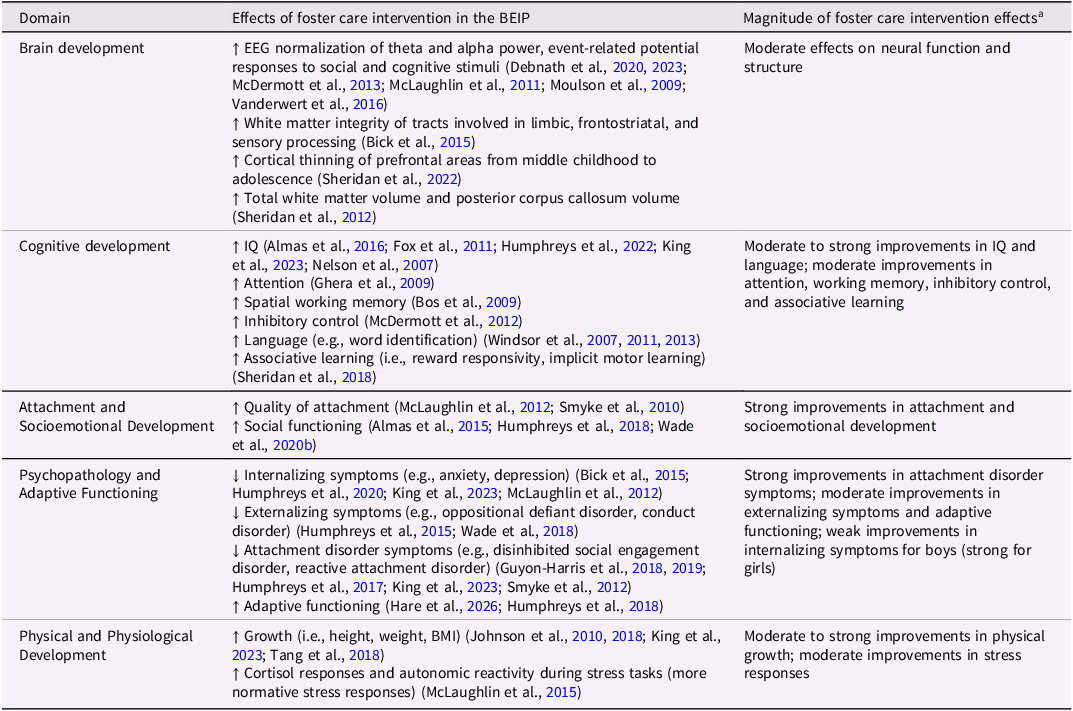
The foster care intervention administered to previously institutionalized youth in the BEIP has been shown to lead to substantial improvements in numerous domains across infancy, childhood, and adolescence (Table 1), often moving outcomes closer to those of the never institutionalized community comparison group. These improvements have been observed in neurobiological, cognitive, socioemotional, and physical domains. Across electroencephalography (EEG) studies spanning early childhood through adolescence, foster care intervention has been shown to promote more normative neural development following early institutionalization (Debnath et al., Reference Debnath, Tang, Zeanah, Nelson and Fox2020, Reference Debnath, Troller-Renfree, Zeanah, Nelson and Fox2023; McDermott et al., Reference McDermott, Troller-Renfree, Vanderwert, Nelson, Zeanah and Fox2013; McLaughlin et al., Reference McLaughlin, Fox, Zeanah, Sheridan, Marshall and Nelson2011; Moulson et al., Reference Moulson, Fox, Zeanah and Nelson2009; Vanderwert et al., Reference Vanderwert, Zeanah, Fox and Nelson2016). For example, children randomized to CAUG demonstrated increased theta power, reduced alpha power, and blunted neural responses to social and cognitive stimuli, all of which were partially normalized among youth in the FCG, with effects most pronounced for those who were placed into foster care before 24 months of age (Debnath et al., Reference Debnath, Tang, Zeanah, Nelson and Fox2020, Reference Debnath, Troller-Renfree, Zeanah, Nelson and Fox2023; McDermott et al., Reference McDermott, Troller-Renfree, Vanderwert, Nelson, Zeanah and Fox2013; McLaughlin et al., Reference McLaughlin, Fox, Zeanah, Sheridan, Marshall and Nelson2011; Moulson et al., Reference Moulson, Fox, Zeanah and Nelson2009; Vanderwert et al., Reference Vanderwert, Zeanah, Fox and Nelson2016). Diffusion tensor imaging (DTI) studies indicate that foster care intervention increased white matter integrity in various tracts involved in limbic, fronto-striatal, and sensory processing (Bick et al., Reference Bick, Zhu, Stamoulis, Fox and Nelson2015). In regard to brain structure, foster care is linked to smaller decreases in total cortical white matter and posterior corpus callosum volume during middle childhood (Sheridan et al., Reference Sheridan, Fox, Zeanah, McLaughlin and Nelson2012), as well as greater cortical thinning of prefrontal areas from middle childhood to adolescence compared to youth randomized to the CAUG, reflecting more normative brain maturation (Sheridan et al., Reference Sheridan, Mukerji, Wade, Humphreys, Garrisi, Goel, Patel, Fox, Zeanah, Nelson and McLaughlin2022). Collectively, extant evidence indicates that foster care intervention can at least partially normalize brain development following early institutionalization.
Effects of foster care intervention following early institutionalization in the BEIP

Table 1. Long description
A table with five rows and three columns. The columns are labeled Domain, Effects of foster care intervention in the BEIP, and Magnitude of foster care intervention effects. The rows are labeled Brain development, Cognitive development, Attachment and Socioemotional Development, Psychopathology and Adaptive Functioning, and Physical and Physiological Development. Each row details the specific effects of foster care intervention in the respective domain and the magnitude of these effects. For example, under Brain development, the table lists increased EEG normalization, white matter integrity, cortical thinning, and total white matter volume, with moderate effects on neural function and structure. Under Cognitive development, the table lists increased IQ, attention, spatial working memory, inhibitory control, language, and associative learning, with moderate to strong improvements in IQ and language, and moderate improvements in other areas. Under Attachment and Socioemotional Development, the table lists improved quality of attachment and social functioning, with strong improvements in attachment and socioemotional development. Under Psychopathology and Adaptive Functioning, the table lists decreased internalizing and externalizing symptoms, attachment disorder symptoms, and increased adaptive functioning, with strong improvements in attachment disorder symptoms, moderate improvements in externalizing symptoms and adaptive functioning, and weak improvements in internalizing symptoms for boys and strong for girls. Under Physical and Physiological Development, the table lists increased growth and normative cortisol responses, with moderate to strong improvements in physical growth and moderate improvements in stress responses.
Note. All effects are reported for children randomized to the foster care group (FCG) relative to children randomized to care-as-usual (CAUG), based on intent-to-treat analyses.
a Magnitude ratings reflect the authors’ qualitative synthesis of the BEIP literature. “Strong” indicates large and/or highly consistent intervention effects across multiple studies; “moderate” indicates consistent but variable effects across multiple studies; “weak” indicates small, inconsistent, or limited effects. Ratings were not based on a formal meta-analysis or standardized effect-size thresholds.
In regard to cognition, children randomized to foster care exhibited higher IQ scores (Almas et al., Reference Almas, Degnan, Nelson, Zeanah and Fox2016; Fox et al., Reference Fox, Almas, Degnan, Nelson and Zeanah2011; Humphreys et al., Reference Humphreys, King, Guyon-Harris, Sheridan, McLaughlin, Radulescu, Nelson, Fox and Zeanah2022; King et al., Reference King, Guyon-Harris, Valadez, Radulescu, Fox, Nelson, Zeanah and Humphreys2023; Nelson et al., Reference Nelson, Zeanah, Fox, Marshall, Smyke and Guthrie2007), as well as better performance on attention (Ghera et al., Reference Ghera, Marshall, Fox, Zeanah, Nelson, Smyke and Guthrie2009), working memory (Bos et al., Reference Bos, Fox, Zeanah and Nelson2009), inhibitory control (McDermott et al., Reference McDermott, Westerlund, Zeanah, Nelson and Fox2012), language (Windsor et al., Reference Windsor, Glaze and Koga2007, Reference Windsor, Benigno, Wing, Carroll, Koga, Nelson, Fox and Zeanah2011, Reference Windsor, Moraru, Nelson, Fox and Zeanah2013), and associative learning (Sheridan et al., Reference Sheridan, McLaughlin, Winter, Fox, Zeanah and Nelson2018) tasks compared to children randomized to the CAUG, whereby improvements in cognition were strongest for foster care youth placed before 24 months. Foster care intervention was also associated with greater odds of developing a secure attachment relationship (McLaughlin et al., Reference McLaughlin, Zeanah, Fox and Nelson2012; Smyke et al., Reference Smyke, Zeanah, Fox, Nelson and Guthrie2010), fewer attachment disorder symptoms (Guyon-Harris et al., Reference Guyon-Harris, Humphreys, Fox, Nelson and Zeanah2018, Reference Guyon-Harris, Humphreys, Degnan, Fox, Nelson and Zeanah2019; Humphreys et al., Reference Humphreys, Nelson, Fox and Zeanah2017; King et al., Reference King, Guyon-Harris, Valadez, Radulescu, Fox, Nelson, Zeanah and Humphreys2023; Smyke et al., Reference Smyke, Zeanah, Gleason, Drury, Fox, Nelson and Guthrie2012), as well as improved peer relationships, social functioning (Almas et al., Reference Almas, Degnan, Radulescu, Nelson, Zeanah and Fox2015; Humphreys et al., Reference Humphreys, Miron, McLaughlin, Sheridan, Nelson, Fox and Zeanah2018; Levin et al., Reference Levin, Fox, Zeanah and Nelson2015; Wade et al., Reference Wade, Zeanah, Fox and Nelson2020b) and adaptive functioning (Hare et al., Reference Hare, Humphreys, Cosmoiu, Fox, Nelson and Zeanah2026; Humphreys et al., Reference Humphreys, Miron, McLaughlin, Sheridan, Nelson, Fox and Zeanah2018) compared to CAUG. In regard to psychopathology, foster care intervention was linked to fewer internalizing symptoms during childhood and adolescence, particularly among girls (Bick et al., Reference Bick, Fox, Zeanah and Nelson2015; Humphreys et al., Reference Humphreys, Guyon-Harris, Tibu, Wade, Nelson, Fox and Zeanah2020; King et al., Reference King, Guyon-Harris, Valadez, Radulescu, Fox, Nelson, Zeanah and Humphreys2023; McLaughlin et al., Reference McLaughlin, Zeanah, Fox and Nelson2012). Disruptive behavior disorder/externalizing symptoms (e.g., ADHD, conduct disorder) during childhood and adolescence were also lower in foster care youth compared to youth randomized to the CAUG (Humphreys et al., Reference Humphreys, Gleason, Drury, Miron, Nelson, Fox and Zeanah2015; Wade et al., Reference Wade, Fox, Zeanah and Nelson2018). Taken together, findings suggest that stable family-based care can support more adaptive cognitive, socioemotional, and behavioral trajectories following early institutionalization.
Foster care intervention has been linked to improvements in physical development and physiological functioning following early institutionalization. For example, foster care youth demonstrated greater physical growth (i.e., height, weight, BMI) during infancy and adolescence (Johnson et al., Reference Johnson, Guthrie, Smyke, Koga, Fox, Zeanah and Nelson2010, Reference Johnson, Tang, Almas, Degnan, McLaughlin, Fox, Nelson and Zeanah2018; King et al., Reference King, Guyon-Harris, Valadez, Radulescu, Fox, Nelson, Zeanah and Humphreys2023; Tang et al., Reference Tang, Slopen, Nelson, Zeanah, McDade, Fox and McLaughlin2018) compared to youth in the CAUG, with growth trajectories more closely approximating those of never-institutionalized children. Furthermore, foster care has been linked to more normalized stress responses (reflected in both cortisol and autonomic reactivity) during stress tasks (McLaughlin et al., Reference McLaughlin, Sheridan, Tibu, Fox, Zeanah and Nelson2015), particularly when placed earlier (i.e., before 24 and 18 months, respectively), indicating that foster care intervention can partially normalize stress responses. Together, a large body of evidence from the BEIP indicates that foster care intervention can support recovery, and in many cases, patterns of adaptive functioning, across neurobiological, cognitive, socioemotional, and physical domains following early neglect.
It is important to recognize that domains (e.g., cognition, mental health) do not operate independently. Rather, developmental functioning across neurobiological, cognitive, socioemotional, and physical domains interacts dynamically over time, such that adaptive functioning in one domain may promote more favorable outcomes in another. Indeed, BEIP studies have demonstrated cross-domain developmental associations (Fox et al., Reference Fox, Nelson and Zeanah2017; McGoron et al., Reference McGoron, Gleason, Smyke, Drury, Nelson, Gregas, Fox and Zeanah2012; Wade et al., Reference Wade, Zeanah, Fox and Nelson2020a). For example, greater attachment security predicted fewer future psychiatric symptoms (McGoron et al., Reference McGoron, Gleason, Smyke, Drury, Nelson, Gregas, Fox and Zeanah2012), and preadolescent executive functioning deficits mediated links between neglect and adolescent psychopathology (Wade et al., Reference Wade, Zeanah, Fox and Nelson2020a). These findings suggest that resilience following adversity may unfold through developmental cascade processes, whereby adaptive functioning in one domain shapes adaptation in others over time.
Plausible “active ingredients” of the foster care intervention in the BEIP
There are various components that may underlie foster care intervention effects observed in the BEIP. It is important to distinguish between placement in family-based care per se and placement in the high-quality BEIP foster care intervention. Additionally, it is critical to distinguish between the qualities of the foster care environment and reduced cumulative exposure to institutional care.
Several lines of evidence suggest that the BEIP foster care intervention operated primarily through the quality and stability of caregiving relationships, supported by an intensive professional infrastructure, rather than through family placement alone or through reduced institutional exposure alone. For example, early caregiving quality has been associated with psychopathology symptoms a few years later (McGoron et al., Reference McGoron, Gleason, Smyke, Drury, Nelson, Gregas, Fox and Zeanah2012) as well as consistency of competent functioning during childhood and adolescence (Guyon-Harris et al., Reference Guyon-Harris, Humphreys, Miron, Tibu, Fox, Nelson and Zeanah2021). Furthermore, caregiving quality at 30 and 42 months partially mediated the association between intervention assignment and adolescent cortical structure (Lurie et al., Reference Lurie, Gruhn, Garrisi, McLaughlin, Humphreys, Zeanah, Fox, Nelson and Sheridan2025), pointing to caregiving processes rather than family setting alone as the active component. Within the FCG, more stable caregiving placements have been associated with improved mental health outcomes during adolescence (Humphreys et al., Reference Humphreys, Guyon-Harris, Tibu, Wade, Nelson, Fox and Zeanah2020), suggesting that the quality and continuity of family caregiving matter above and beyond removal from institutional care.
Thus, based on prior literature, components likely underlying observed intervention effects in the BEIP include stable, sensitive, predictable, attachment-supportive caregiving relationships sustained by an intensive professional support structure of trained social workers, weekly US clinician consultation, and ongoing supervision. The BEIP intervention differs in important ways from typical foster care, wherein caregivers do not commonly receive this level of support. The BEIP design cannot definitively isolate the active ingredients, and fully disentangling reduced institutional exposure, family setting, caregiving quality, and professional support would require designs not feasible in the BEIP. Overall, findings suggest that attachment-informed, well-supported, stable caregiving likely represented key active ingredients of the foster care intervention.
Resilience in the context of the BEIP
In the current review, we do not classify individual BEIP participants as “resilient” or “non-resilient.” Past BEIP work has used person-centered approaches (e.g., latent profile analysis) to identify subgroups of children showing different patterns of functioning across domains (King et al., Reference King, Guyon-Harris, Valadez, Radulescu, Fox, Nelson, Zeanah and Humphreys2023; Wade et al., Reference Wade, Fox, Zeanah and Nelson2018). Person-centered approaches can be valuable for capturing within-group heterogeneity. The current review focuses on group-level comparisons because our central aim is to identify caregiving conditions under which resilient functioning is more likely to emerge. The BEIP’s randomized design directly enables the investigation of this question of identifying causal caregiving conditions that lead to adaptive patterns of functioning. Within the BEIP framework, resilience is inferred when functioning exceeds what would be expected from the severity of early adversity (i.e., early neglect in the form of institutional care). The “expected” outcomes refer to the developmental difficulties across domains (e.g., cognitive, socioemotional, physical) commonly associated with early institutional rearing, drawing on extensive prior research (Nelson et al., Reference Nelson, Fox and Zeanah2016; Van IJzendoorn et al., Reference Van IJzendoorn, Bakermans-Kranenburg, Duschinsky, Fox, Goldman, Gunnar, Johnson, Nelson, Reijman, Skinner, Zeanah and Sonuga-Barke2020). Children exposed to improved caregiving environments following institutionalization (e.g., FCG) who demonstrate more adaptive patterns of functioning than would be expected following early deprivation would be interpreted as evidence of resilience. Similarly, children in the CAUG who exhibit more adaptive functioning than expected despite early deprivation would also be interpreted as evidence of resilience. These observations underscore that resilience can emerge through multiple pathways and is not reducible to intervention group membership alone.
The BEIP is one of the only experimental models capable of testing causal mechanisms underlying resilience following severe adversity. A core aim of the BEIP is to evaluate the effects of the foster care intervention – that is, whether modifying the caregiving environment through family-based care is associated with more adaptive developmental trajectories across domains (e.g., mental health, cognition, physical growth, etc.) following early institutionalization. Critically, resilience is not synonymous with the foster care intervention itself. A reasonable rival interpretation is that differences between FCG and CAUG may reflect reduced exposure to institutional care, rather than the specific caregiving conditions provided in the foster care intervention. The BEIP design cannot fully disentangle dosage of institutional exposure from caregiving quality, since children in the FCG on average spent less time in institutions than children in the CAUG. However, several lines of evidence within the BEIP point to caregiving quality as a meaningful contributor, beyond reduced institutional exposure. First, observed caregiving quality during early childhood is associated with developmental outcomes years later. Specifically, caregiving quality at 30 months has been associated with fewer psychiatric symptoms at 54 months (McGoron et al., Reference McGoron, Gleason, Smyke, Drury, Nelson, Gregas, Fox and Zeanah2012). Another study found that early caregiving quality predicted consistency of competent functioning across middle childhood and adolescence (Guyon-Harris et al., Reference Guyon-Harris, Humphreys, Miron, Tibu, Fox, Nelson and Zeanah2021). Second, caregiving quality assessed at 30 and 42 months partially mediated the association between foster care intervention assignment and cortical structure during adolescence (Lurie et al., Reference Lurie, Gruhn, Garrisi, McLaughlin, Humphreys, Zeanah, Fox, Nelson and Sheridan2025). Third, within the FCG, more stable caregiving environments during childhood have been associated with better mental health outcomes in adolescence (Humphreys et al., Reference Humphreys, Guyon-Harris, Tibu, Wade, Nelson, Fox and Zeanah2020), suggesting that both caregiving quality and consistency matter above and beyond the initial removal from institutional care. Taken together, the available evidence is more consistent with the foster care intervention operating through specific caregiving processes, particularly those that promote stable, sensitive, and predictable caregiving relationships, instead of through reduced institutional exposure alone. Thus, the foster care intervention in the BEIP provides a rare opportunity to identify modifiable caregiving processes associated with more adaptive patterns of functioning following early adversity, even though the BEIP cannot definitively isolate active ingredients.
Key resilience “lessons” from extant findings from the BEIP
Beyond documenting the effects of foster care intervention on multidomain resilient outcomes in the BEIP, this study has provided key insights into capturing and understanding resilience following severe early life adversity. These lessons extend beyond intent-to-treat group comparisons (i.e., between FCG, CAUG, and NIG) and can provide an empirical foundation for shaping how the field defines resilience as a developmentally dynamic, context-dependent process, rather than a fixed individual trait within the child. In this review, we present three concrete lessons from the BEIP.
A central lesson from the BEIP is that resilience following severe early neglect (i.e., institutionalization) is largely driven by the modifiable caregiving environment, rather than fixed attributes within the child. This lesson is evidenced by the abundance of extant research from the BEIP (outlined in the previous section above) demonstrating that enriched caregiving environments (i.e., foster care intervention) are associated with higher functioning during childhood and adolescence across multiple domains (e.g., mental health, cognition, physical growth, etc.), compared to children who remained in CAUG (including institutional care). Crucially, the BEIP provides rare causal evidence that improving the early caregiving context directly leads to more favorable long-term resilient outcomes following severe early adversity.
A second lesson from the BEIP is that resilience following early adversity is often partial, domain-specific, and time-specific, rather than simply a global, dichotomous outcome (i.e., resilient vs. non-resilient). While improved caregiving (i.e., foster care intervention) resulted in significant improvements in some domains (e.g., physical growth, attachment, stress responses), other domains (e.g., executive functioning) demonstrated more limited or inconsistent gains. In other words, resilience following early adversity is better understood as co-existing strengths and vulnerabilities than as a global, uniform outcome. This heterogeneity underscores the value of person-centered approaches that detect heterogenous patterns of resilience across individuals, alongside more commonly used variable-centered approaches. Tracking outcomes across multiple domains and developmental periods, rather than relying on single-domain or cross-sectional assessments, is therefore essential for advancing resilience science.
A final key lesson about resilience from the BEIP is that the likelihood of resilient outcomes following early life adversity heavily depends on the timing and stability of improved caregiving (i.e., age of foster care placement and stability of foster care placement over time). Earlier placement into foster care (i.e., before 24 months of age) and greater placement stability have been consistently linked to more resilient outcomes across various domains, whereas later placement (i.e., after 24 months of age) and more placement disruptions have been linked to less favorable outcomes (i.e., no group-level differences among FCG compared to CAUG) (Van IJzendoorn et al., Reference Van IJzendoorn, Bakermans-Kranenburg, Duschinsky, Fox, Goldman, Gunnar, Johnson, Nelson, Reijman, Skinner, Zeanah and Sonuga-Barke2020). These BEIP findings indicate that while improved caregiving environments play a critical role in promoting resilient outcomes following early adversity, there are sensitive periods of development during which the timing and stability of caregiving interventions matter most for resilient outcomes.
These three lessons from the BEIP align closely with Suniya Luthar’s research on resilience as multidimensional, contextually grounded, and developmentally dynamic, and support her work demonstrating the critical role of caregiving in fostering resilience following early adversity (Luthar & Brown, Reference Luthar and Brown2007; Luthar et al., Reference Luthar, Cicchetti and Becker2000, Reference Luthar, Crossman, Small and Lerner2015). Luthar’s work has long emphasized that resilience should not be defined by a single domain, nor attributed primarily to individual traits within the child. The aforementioned BEIP lessons are aligned with Luthar’s framework that resilience should be conceptualized as patterns of positive adaptation that emerge from favorable caregiving contexts across development. The BEIP provides rare causal evidence supporting Luthar’s framework by showing that improvements in the caregiving context following early neglect can lead to favorable outcomes across some domains but not others throughout development, and that the timing and stability of improved caregiving shape which resilient outcomes are possible. Overall, the BEIP provides empirical evidence that resilience following severe early life adversity is not a fixed characteristic, but rather a dynamic process that unfolds differently across time and domains in response to caregiving experiences.
Outstanding questions in resilience after early adversity: insights from the BEIP
Although decades of research have advanced our understanding of resilience following early life adversity, including transformative work from the BEIP, a number of outstanding questions in the field remain that the BEIP is uniquely positioned to address. Table 2 summarizes outstanding questions in the field of resilience, ways that BEIP has addressed key questions about resilience, and that the BEIP can address remaining questions in the future using recently collected data on the participants as young adults. The BEIP’s randomized design, multimodal methods, and more than two decades of longitudinal follow-up make it uniquely positioned to test causal effects of improved caregiving environments on long-term adaptation and resilience. In addition, the BEIP provides a rich context for examining how different ways of defining and measuring resilience perform and which factors most strongly predict resilience outcomes. For example, variable-centered approaches (e.g., regression models) and person-centered approaches (e.g., latent profile analysis) can be leveraged to capture heterogeneity in resilience outcomes across individuals, contexts, and developmental periods. A further key gap involves identifying the sensitive periods during which protective factors exert their strongest effects; the BEIP’s design allows tests of how age at placement and subsequent placement stability relate to patterns of recovery and resilient functioning. Because most prior work on resilience has been correlational rather than mechanistic, the BEIP offers a rare opportunity to probe causal mechanisms by linking randomized changes in caregiving environments to long-term trajectories of brain, cognitive, socioemotional functioning that may explain differences in resilience in adulthood. Finally, recent data collection on the BEIP participants’ offspring will permit examination of the intergenerational transmission of both risk and resilience.
How the BEIP has and can further address outstanding questions in the field of resilience

Table 2. Long description
A table with four rows and three columns. The columns are labeled ‘Outstanding question(s) in the field of resilience’, ‘Ways that the BEIP has addressed outstanding question(s) in the field of resilience’, and ‘Examples of ways that the BEIP can further address outstanding question(s) in the field of resilience’. The rows detail specific questions and the BEIP’s approaches to addressing them. Row 1 discusses defining and measuring resilience, highlighting the BEIP’s multi-domain assessments and future plans to identify multidimensional resilience profiles. Row 2 examines the stability of resilience across development, noting the BEIP’s longitudinal assessments and plans to quantify trajectories. Row 3 explores sensitive periods for protective factors, mentioning the BEIP’s randomization to foster care and future examinations of placement timing. Row 4 identifies early factors predicting long-term resilience, with the BEIP assessing various factors and planning to examine their predictive strength. Row 5 delves into mechanisms underlying resilience, citing the BEIP’s causal evidence and future examinations of caregiving environments. Row 6 investigates interactions between different domains of functioning, noting the BEIP’s cross-domain assessments and future examinations of these interactions. Row 7 considers intergenerational transmission of resilience, with the BEIP planning to assess offspring outcomes.
Future directions in the BEIP: leveraging the adult and intergenerational data to further capture resilience
Although there have been more than 140 papers published using BEIP data that identify various effects of early caregiving quality on long-term resilient outcomes, the majority of work has focused up to adolescence (i.e., prior to age 18). Thus, a critical future direction in the BEIP includes examining recently collected adult (i.e., age 22) multidomain resilience outcomes. The BEIP team will soon be launching a follow-up at 27 years old that will assess mental health, physical health, neurodevelopment, and cognition, thereby providing additional opportunities to critically examine long-term resilient outcomes following early neglect. Additionally, the BEIP has recently started data collection on the offspring of BEIP participants (n = 54 born; n = 31 with data as of June 2026), including attachment and caregiving quality as well as offspring cognition and socio-emotional development. This offers a rare opportunity to test whether risk and resilience is transmitted across generations, and identify pathways (e.g., caregiving quality) that may mediate this transmission. In Table 2, we present specific examples of outstanding questions regarding resilience that can be answered in future work using the recently collected adult and intergenerational data.
Ultimately, leveraging BEIP findings to inform interventions and policies represents a critical future direction, specifically for strengthening family-based care systems, identifying optimal timing of interventions, clarifying the systemic supports required for stable caregiving environments, and ultimately preventing institutionalization. Focusing efforts towards improving the design of scalable interventions (e.g., caregiver coaching, community-level supports) that target modifiable external factors is an important step towards improving outcomes for at-risk children. Taken together, novel findings from the BEIP have the immense potential to improve the identification and fostering of resilience following early life adversity.
Conclusions
In conclusion, the BEIP offers an unparalleled opportunity to advance our mechanistic understanding of resilience following early caregiving-related adversity. By integrating randomized early foster care intervention with deep longitudinal phenotyping from infancy to adulthood, the BEIP can identify when, how, and for whom resilience emerges across development. Findings thus far underscore that resilience is shaped by modifiable external factors, particularly caregiving quality, and that strengthening caregiving environments can support more adaptive long-term outcomes. BEIP findings build upon Suniya Luthar’s research by conceptualizing resilience as multidimensional, contextually grounded, and developmentally dynamic, and by foregrounding the central role of caregiving quality in fostering resilience following adversity. The BEIP provides a unique platform for researchers to refine and test theoretical models of resilience and to guide policy and practice, for example, by motivating investments in high-quality family-based care to prevent institutionalization.
Data availability statement
Data sharing is not applicable in this article as no new data were created or analyzed in this review paper. However, BEIP study data used in various published empirical papers can be found on the Harvard Dataverse (https://dataverse.harvard.edu/).
Acknowledgments
We thank the families and children who participated in the Bucharest Intervention Project, as well as the research team and staff in Romania for their support in this project.
Funding statement
This work was supported by the NIMH (R01MH091363) to CAN, the Binder Family Foundation to CAN, and the John D. and Catherine T. MacArthur Foundation to CAN. BHG is supported by 5T32MH112510. KLH is supported by the NSF CAREER Award (2042285).
Competing interests
The authors (BHG, FA, KLH, CAN) declare no competing interests.
Pre-registration statement
No pre-registration was completed because this article is a narrative review.


 Open access

