





Introduction
Internalizing disorders are the most common mental disorders in late adolescence and contribute significantly to the global disease and economic burden (Arias et al., Reference Arias, Saxena and Verguet2022; Kieling et al., Reference Kieling, Buchweitz, Caye, Silvani, Ameis, Brunoni, Cost, Courtney, Georgiades, Merikangas, Henderson, Polanczyk, Rohde, Salum and Szatmari2024). In Canada, 6-month prevalence rates among youth (ages 12–17) are 7.53% for major depressive disorder and 14.85% for anxiety (Georgiades et al., Reference Georgiades, Duncan, Wang, Comeau and Boyle2019). Because over half of adult mental disorders emerge in adolescence (Jones, Reference Jones2013) and are linked to adverse outcomes like school dropout and unemployment (Clayborne et al., Reference Clayborne, Varin and Colman2019), identifying environmental factors that modify internalizing functioning during critical periods is essential, especially given the high comorbidity between depression and anxiety (Garber & Weersing, Reference Garber and Weersing2010; Melton et al., Reference Melton, Croarkin, Strawn and Mcclintock2016).
A prominent, nearly universal environmental change in adolescence is the secondary school transition (OECD, 2023), which involves shifts in school structure, peer groups, social hierarchies, academic expectations, and developmental demands (Benner, Reference Benner2011; Eccles et al., Reference Eccles, Midgley, Wigfield, Buchanan, Reuman, Flanagan and MacIver1993; Evans et al., Reference Evans, Borriello and Field2018). The co-occurring environmental and psychosocial changes associated with the secondary school transition layered on top of biological changes associated with adolescence compels students to adapt to multiple changes concurrently (Eccles et al., Reference Eccles, Midgley, Wigfield, Buchanan, Reuman, Flanagan and MacIver1993), making this transition a key context for understanding developmental change (Cicchetti & Rogosch, Reference Cicchetti and Rogosch2002).
The short-term changes in internalizing symptoms around school transitions are well documented; however, much of this work does not account for longer periods of functioning before or after the school transition and therefore cannot discern whether transitions reflect continuity, temporary disruption, or turning points in development (Benner, Reference Benner2011; Evans et al., Reference Evans, Borriello and Field2018; Jindal-Snape et al., Reference Jindal-Snape, Hannah, Cantali, Barlow and MacGillivray2020). This distinction is critical for timing supports; temporary disruptions may require short-term school-based programs, whereas enduring turning points may require sustained monitoring and intervention. Although progress has been made in understanding how developmental pathways can change as a function of school transitions (e.g., Nelemans et al., Reference Nelemans, Hale, Branje, Meeus and Rudolph2018), more can be learned about when internalizing symptoms are sensitive to change and which factors shape these changes, before, during, and after the transition. Because students enter secondary school with different prior experiences and supports, the school transition may exacerbate vulnerabilities for some youth, leading to maladaptation (Cicchetti & Rogosch, Reference Cicchetti and Rogosch2002).
In the current study, we first examined if, on average, internalizing symptoms development was better understood as a continuous developmental process across an 8-year span of adolescence or as a domain that was impacted by the transition to secondary school. Second, we examined whether various individual, relational, and contextual factors were associated with changes in the development of internalizing symptoms at different points in time. Third, we explored if subgroups of students followed different pathways and if specific pathways were associated with elevated risk for early adulthood mental health disorder and interpersonal difficulties.
School transitions as developmental turning points
During the transition from elementary to secondary school, students move from environments with consistent structure and support to those that are larger and more complex with departmentalized instruction, increased academic demands, greater autonomy, shifting peer group dynamics, and reduced adult guidance and oversight (Benner, Reference Benner2011; Eccles et al., Reference Eccles, Midgley, Wigfield, Buchanan, Reuman, Flanagan and MacIver1993; Evans et al., Reference Evans, Borriello and Field2018), leaving students feeling uncertain, worried, and concerned (Beatson et al., Reference Beatson, Quach, Canterford, Farrow, Bagnall, Hockey, Phillips, Patton, Olsson, Ride, McKay Brown, Roy and Mundy2023; Rice et al., Reference Rice, Ng-Knight, Riglin, Powell, Moore, McManus, Shelton and Frederickson2021). Because this transition coincides with cognitive, social–emotional, and biological changes of adolescence (Best & Ban, Reference Best and Ban2021), it has long been conceptualized as a potential developmental turning point (Benner, Reference Benner2011). Specifically, the overlap between a significant life event and an ongoing developmental process can be understood as a transition-linked turning point, with implications for immediate and long-term psychosocial functioning (Graber & Brooks-Gunn, Reference Graber and Brooks-Gunn1996).
Students may respond to transitional life events through continuity, emergence of new symptoms, discontinuation of existing symptoms, or changes in symptom patterns (Graber & Brooks-Gunn, Reference Graber and Brooks-Gunn1996). Accordingly, internalizing symptoms may remain stable for some adolescents but increase, plateau, or decline for others following the secondary school transition. Continuity and discontinuity in development depend on exposure to risk factors, whether biological, psychological, or environmental, that increase the likelihood of maladaptive outcomes. Resilience may buffer these risks, particularly when adolescents have supportive adult and peer relationships during developmentally salient periods (Benner et al., Reference Benner, Boyle and Bakhtiari2017; Cicchetti & Rogosch, Reference Cicchetti and Rogosch2002).
Research on how students respond to this change is mixed, and likely reflects the use of short-term designs that overlook long-term change and adjustment (Benner, Reference Benner2011; Evans et al., Reference Evans, Borriello and Field2018; Jindal-Snape et al., Reference Jindal-Snape, Hannah, Cantali, Barlow and MacGillivray2020). It remains unclear whether the transition to secondary school is associated with average changes in internalizing symptoms in the long term, whether these changes represent continuity or discontinuity in developmental trajectories, and whether adolescents differ in their patterns of response. For some, this major life event may exacerbate existing symptoms, for others, it may serve a protective role by interrupting worsening distress.
Internalizing symptoms across adolescence
Studies using latent growth curves to examine the trajectories of internalizing symptoms across the span of adolescence have generally yielded non-linear development (Kwong et al., Reference Kwong, Manley, Timpson, Pearson, Heron, Sallis, Stergiakouli, Davis, Leckie and Payne2019; Rawana & Morgan, Reference Rawana and Morgan2014) or piecewise trajectories with distinct “developmental knots” (Cohen et al., Reference Cohen, Andrews, Davis and Rudolph2018; Katsantonis, Reference Katsantonis2024; Rowland et al., Reference Rowland, Mohebbi, Kelly, Benstead, Herde, Clancy, Bailey, Hallam, Sharkey, Horner and Toumbourou2023). These findings suggest that growth is rarely uniform, yet the extent to which these nonlinear shifts coincide with the school transition remains largely unexplored.
In one of the first studies to explicitly examine school transition by including multiple assessments of before and after the transition, Benner and Graham (Reference Benner and Graham2009) examined social anxiety and loneliness across eight assessments, twice per year in a multiethnic American sample (N = 1,979). They used a piecewise growth model centered on the transition to secondary school, allowing them to test immediate transition-related disruption and subsequent change in psychological functioning. Results indicated that symptoms declined before the transition and increased at transition entry, and loneliness increased, with stable anxiety levels over the first two years of secondary school. The authors documented that girls reported higher social anxiety and loneliness than boys immediately before and after the transition.
Troop-Gordon et al. (Reference Troop-Gordon, Thomas, Brigham, Xu and Rudolph2024) modeled depression symptoms before (Grades 2–5) and after (Grades 6–9) the middle school transition using latent growth curve models that permitted a post-transition slope to deflect from pre-transition trends, finding declining symptoms pre-transition and an initial decline, and for girls, subsequent increase at the end of middle school into secondary school (Grade 9), particularly for those who experienced being bullied in both phases. These studies demonstrate that school transitions can coincide with discontinuity in the developmental course of internalizing symptoms rather than simply ongoing age-related trends. However, relatively little research has distinguished different forms of discontinuity, including abrupt changes in symptoms levels at the transition, extending across periods of elementary and secondary school, which, as highlighted by Troop-Gordon et al., may be an especially vulnerable period for stress amplification. Thus, examining changes over a longer period, specifically the entire secondary school period, may allow for emergence of different pathways of adaptation. Further, such sample-level trajectories cannot determine whether transition-linked discontinuity is broadly shared across adolescents. It is possible that not all students followed the same path or responded similarly to the transition; some may experience continuity in high or low symptoms, whereas others may experience marked increases or declines. Indeed, mapping trajectories of internalizing symptoms over adolescence often reveals heterogeneity (e.g., Brière et al., Reference Brière, Janosz, Fallu and Morizot2015; Crocetti et al., Reference Crocetti, Klimstra, Keijsers, Hale and Meeus2009; Nelemans et al., Reference Nelemans, Hale, Branje, Raaijmakers, Frijns, van Lier and Meeus2014, Reference Nelemans, Hale, Branje, Meeus and Rudolph2018; Olivier et al., Reference Olivier, Morin, Leo and Salmela-Aro2023).
Few studies have documented heterogenous internalizing symptoms trajectories relative to school transition. Olivier et al. (Reference Olivier, Morin, Leo and Salmela-Aro2023) followed academic-track Finnish students across the last 3 years of elementary school (Grades 7, 8 and 9) and 2 years of upper secondary school (year 2 and 3; year 1 not recorded). Using a piecewise growth mixture model, they identified 5 depression symptoms classes: low increasing, low stabilizing, moderate stabilizing, mild increasing, and high stable. Because non-academic-track students were not included, it is unclear if results would generalize to non-academic track students who may respond differently to the changing demands of secondary school. Wang et al. (Reference Wang, Chan and Chen2018) examined depression trajectories separately across junior high school (JS; Grades 7–9) and senior high school (HS; Grades 10–12) in Taiwanese youth and identified transitions between trajectory groups across the school transition. Using latent transition growth mixture modeling, they found that students shifted from one of three trajectories in junior high school, (JS-low-stable, cumulative, and high-improving), to one of three trajectories in senior high school (HS-low-stable, moderate-stable, and heightening). Although most stayed on a low-stable trajectory, others transferred to worsening pathways after the transition. Similar transition-linked heterogeneity has also been found for anxiety symptoms.
Nelemans et al. (Reference Nelemans, Hale, Branje, Meeus and Rudolph2018) followed American students prospectively from Grades 2 through 8 through the transition from elementary to middle school (5th grade). Using growth mixture modeling they modeled the school transition as a knot allowing different slopes in elementary and middle school. They found that children followed one of three trajectories. Although most students experienced consistently low or high anxiety, some experienced sharp increases and others showed decreases following the middle school transition. Youth increasing reported more school hassles, peer victimization, lower parent–child relationship quality, and friendship support in middle school, than youth with low or declining symptoms. Because contextual factors were only measured post transition, it remains unclear how pre-transition experiences may shape responses to the changing school environments. In another study of co-occurring trajectories of anxiety and depression (parallel growth mixture modeling; age 10–17), Olino et al. (Reference Olino, Stepp, Keenan, Loeber and Hipwell2014) found group differences in interpersonal functioning, externalizing problems, parental psychopathology, and home environment. However, the measures were assessed only at age 10 and do not reflect changes over time, such as declines in bullying victimization from elementary to secondary school (Vaillancourt et al., Reference Vaillancourt, Brittain, Farrell, Krygsman and Vitoroulis2023). Importantly, class comparisons do not test differences in specific symptom levels or slopes.
Early adulthood outcomes
Beyond identifying predictors and correlates of group membership, linking adolescent symptom trajectories to early adulthood outcomes provides a more integrated understanding of longer-term functioning. Olino et al., (Reference Olino, Klein, Lewinsohn, Rohde and Seeley2010) reported lifetime (i.e., < age 30) prevalence of internalizing disorders within each latent trajectory class; however, these estimates do not capture temporal associations between adolescent symptom patterns and risk for mental disorders in early adulthood. Youth with internalizing problems are also at elevated risk for secondary school noncompletion and unemployment (Clayborne et al., Reference Clayborne, Varin and Colman2019). Comparing early adulthood mental health and functional outcomes across groups of students following distinct adolescent pathways can establish the developmental significance of continuity or discontinuity in symptoms at the transition. For a subset of youth, the school transition may therefore act as a sensitizing event, putting them at risk for maladaptive outcomes.
Current study
In a cohort of adolescents (i.e., Grade 5–12; G5–G12; age 11–18), we examined if internalizing symptoms followed a continuous developmental trend or showed discontinuity at the secondary school transition (G8–G9). We integrated variable-centered and person-centered approaches to address complementary questions (see S2.1 for further discussion). Using a piecewise latent growth curve model, we tested whether the transition functioned as a sample-level developmental turning point in symptom level and developmental growth. We examined individual risk factors such as sex, child maltreatment, SES, and malleable risk and protective factors (e.g., bullying victimization, school climate, peer support), in relation to changes in symptoms before, during, and after the school transition. We expected that being cis female, having experienced child maltreatment, and poorer family, peer, and school relations, and poorer transition experiences would be related to elevated symptoms levels and increasing rates concurrently (Gardner et al., Reference Gardner, Thomas and Erskine2019; Nelemans et al., Reference Nelemans, Hale, Branje, Meeus and Rudolph2018; Olino et al., Reference Olino, Klein, Lewinsohn, Rohde and Seeley2010; Shore et al., Reference Shore, Toumbourou, Lewis and Kremer2018), and to find longitudinal associations with elementary school bullying victimization and secondary school internalizing symptoms (Bowes et al., Reference Bowes, Maughan, Ball, Shakoor, Ouellet-Morin, Caspi, Moffitt and Arseneault2013; Troop-Gordon et al., Reference Troop-Gordon, Thomas, Brigham, Xu and Rudolph2024). Although this approach models individual differences in symptoms changes and discontinuity, it does not identify qualitatively distinct subgroups of youth following different trajectories. It is possible that a finding of discontinuity in a variable-centered model may be driven by a small group with a large response. It is also possible that a finding of overall null effects could be explained by different subgroups following opposing pathways: some could have a notable negative response to the secondary school transition whereas others may benefit.
Accordingly, the piecewise latent growth curve model provided the primary test of the turning-point discontinuity hypothesis. We conducted a complementary latent class growth analysis as a person-centered analysis to examine whether qualitatively differing responses to the transition were concealed by the sample-level growth model. We expected 2–5 trajectory classes (Nelemans et al., Reference Nelemans, Hale, Branje, Raaijmakers, Frijns, van Lier and Meeus2014; Shore et al., Reference Shore, Toumbourou, Lewis and Kremer2018), some of which would demonstrate discontinuity at the secondary school transition, with others showing low or high symptoms (Nelemans et al., Reference Nelemans, Hale, Branje, Meeus and Rudolph2018; Wang et al., Reference Wang, Chan and Chen2018). If distinct trajectory classes were identified, we expected that youth in classes characterized by elevated symptoms or increasing symptoms would be at greater risk for mental disorders and functional problems in early adulthood (ages 19–22; Olino et al., Reference Olino, Klein, Lewinsohn, Rohde and Seeley2010; Wang et al., Reference Wang, Chan and Chen2018). By identifying whether, and for whom, internalizing symptoms fluctuated relative to the secondary school transition, which changeable factors were associated with symptom development, and which symptoms patterns conferred long term risk, findings can directly inform the timing and targets of school-based screening and preventative support, offering a proactive framework for reducing the long-term burden of internalizing disorders.
Methods
Participants and procedure
Data were drawn from the McMaster Teen Study, a longitudinal cohort study of Canadian youth designed to examine associations between peer victimization, mental health, and academic achievement. In spring of 2008 (Time 1; G5) participants were recruited from a random sample of 51 schools with Grade 5 classrooms within a single public schoolboard. All Grade 5 students within the selected schools were eligible. A total of 875 participants were recruited to take part in the longitudinal arm of the study with 701 participating in at least one follow-up time point. Data collection occurred annually (i.e., age 11 in 2008; age 26 in 2023) with participants having the option to take part in a survey at each wave and mental health interview at age 19/20 and age 21/22 (n = 365 completed at least one interview), receiving renumeration (e.g., age 11: a pack of gum; Age 12: $10; age 22: $50; $50/interview). Parents had the option to participate in a telephone interview in Time 1-8. Research ethics approval was obtained annually by the corresponding author’s home university as was assent from youth participants and consent from parent/guardians.
Measures
Internalizing symptoms (age 11–18)
Participants completed The Behavior Assessment System for Children-2 (BASC-2; Reynolds & Kamphaus, Reference Reynolds and Kamphaus2004), self-report of personality child version in G5 and G6 and adolescent version in grades 7 through 12. Twelve items measuring depression symptoms were common to both versions. Per the coding scheme, four items were rated on a 4-point scale (0 = never; 1 = sometimes; 2 = often; 3 = almost always) and eight were rated true (2) or false (0) (e.g., “I feel sad”). Following procedures by Krygsman et al. (Reference Krygsman, Farrell, Brittain and Vaillancourt2022), two items were allowed to be missing, therefore effectively being scored 0. Scores with three or more missing depression items were considered not scorable. Ten items that assess anxiety symptoms that are common across child and adolescent self-report versions. Eight items were rated on a 4-point scale and two items rated true or false (e.g., “I get nervous”). Because anxiety had fewer items, one item was allowed to be missing. See S2.2 for additional details on missingness. Scores with two or more missing anxiety items were considered not scorable. Where participants had sufficient complete items on both depression and anxiety subscales, all items were summed to create an internalizing composite score. Higher scores reflected higher symptoms. Within each time the internalizing symptoms scale had excellent internal consistency reliability (Cronbach’s α = 0.90–0.93).
Correlates
Elementary school type. Some students were enrolled in a kindergarten to G8 school (coded 0), and others experienced a middle school transition in G6 or G7 (coded 1).
Child maltreatment. The Childhood Experiences of Violence Questionnaire – Short Form (CEVQ-SF; Walsh et al., Reference Walsh, MacMillan, Trocmé, Jamieson and Boyle2008) was used to evaluate experiences of child maltreatment. This retrospective assessment consists of 7 questions regarding physical and sexual abuse, with responses measured on a 5-point scale (ranging from never to over 10 times). A threshold score of 3–5 instances for any item was used to classify abuse, except in the case of sexual abuse, where any reported experience was sufficient for classification as abuse (Tanaka et al., Reference Tanaka, Jamieson, Georgiades, Duku, Boyle and MacMillan2011; Walsh et al., Reference Walsh, MacMillan, Trocmé, Jamieson and Boyle2008). The CEVQ-SF was administered to participants once at age 19 or 20 (T9 or T10). Based on established criteria (Tanaka et al., Reference Tanaka, Jamieson, Georgiades, Duku, Boyle and MacMillan2011; Walsh et al., Reference Walsh, MacMillan, Trocmé, Jamieson and Boyle2008), maltreatment was classified as maltreated (1 = any instance of physical or sexual maltreatment or both) and no maltreatment (0 = no reported physical or sexual maltreatment).
Demographics. Parents provided their highest completed level of education (Years 1, 7, and 8; 1, did not complete secondary school to 5, graduate degree), as well as their household income in Canadian dollars (Years 1, 3, 5, 7, and 8; 1,<$20 000–8,>$80000). Because of the high stability in parental education (r = .813–.907, p < .001) and household income (r = .713–.946, p < .001), only the first, most complete, time point was used.
Family Functioning. Parents reported on family functioning in G5 to G12. The Impact on Child Functioning scale of the Brief Child and Family Phone Interview (BCFPI-3; Cunningham et al., Reference Cunningham, Boyle, Hong, Pettingill and Bohaychuk2009) includes six statements about an individuals’ family (e.g., “We express feelings to each other”) that are rated using a 4-point Likert scale (4 = Strongly agree, 3 = Agree, 2 = Disagree, 1 = Strongly disagree). A composite score is created from the 6 items (reverse scoring 1 item). In the current sample, the family functioning scale had good internal consistency (α = 0.72–0.86). Elementary school (G5–G8) and secondary school (G9–G12) scores were averaged, respectively.
Bullying victimization. Self-reports of bullying victimization were collected from youth annually over 8 years (i.e., G5 to G12) using the Vaillancourt and Hymel Bullying Involvement Questionnaire (Vaillancourt et al., Reference Vaillancourt, Trinh, McDougall, Duku, Cunningham, Cunningham, Hymel and Short2010) which includes a definition of bullying before asking youth to report how often in the last 3 months that they have experienced bullying. The scale consists of five questions including a general question (Olweus, Reference Olweus1996), physical, verbal, social, and cyber bullying, which include several examples of what the targeted behavior entailed. Youth responded using a 5-point frequency scale (0 = never, 1 = only once or twice, 2 = 2 or 3 times a month, 3 = once a week, 4 = several times a week). In the current sample, the internal consistency (α = 0.79–0.82). Elementary school (G5-G8) and secondary school (G9–G12) scores were averaged, respectively.
School climate. In G5 and G6 the Sense of School as a Community Scale (Developmental Studies Centre, 1997) was used to assess participants’ feelings of how supported, welcomed, and safe they feel about their school as a whole by answering 14 items using a 5-point scale (0 = disagree a lot, 1 = disagree a little, 2 = maybe, 3 = agree a little, 4 = agree a lot). The scale was adapted for the current study; item 12 (“I feel that I can talk to the teachers in this school about problems that are bothering me”) was removed and replaced with an additional item (“We help new students feel accepted in this school”). The internal consistency for the scale was high (α = 0.91–0.93).
Transition to secondary school experiences. Participants reported on the quality of their transition to secondary school in G9 (McDougall & Hymel, Reference McDougall and Hymel1998). Experiences were measured with five questions (e.g., “How happy are you about your first year of high school?”). Scale items were rated with 1 representing a more positive experience and 5 representing a more negative experience. (α = 0.85).
School bonding. In G9–G12, participants completed the People in My Life Scale, School Bonding subscale (Cook et al., Reference Cook, Greenberg and Kusche1995). They are asked to respond to 8 items using a 4-point scale (0 = almost never or never true, 1 = sometimes true, 2 = often true, and 3 = almost always or always true). These items ask students feelings about school (e.g., “Most mornings I look forward to going to school”; Murray & Greenberg, Reference Murray and Greenberg2006). The school bonding subscale had adequate reliability (α = 0.84–0.85).
Peer social support. Social support from peers was measured in G9–G12 with the intimacy and group integration subscales of the Relational Provision Loneliness Questionnaire (RLPQ), which measures intimacy (emotional connection) and group integration (social connection) in personal peer relationships (Hayden, Reference Hayden1989). The RPLQ assesses perceptions of social support and items relate to thoughts and evaluations of social situations (Terrell-Deutsch, Reference Terrell-Deutsch, Rotenberg and Hymel1999). The intimacy and the group integration subscales both consist of seven items, which are measured along a 5-point scale (4 = YES; 3 = yes, 2 = sometimes, 1 = no, 0 = NO). Peer social support had acceptable reliability (α = 0.93–0.94).
Early-adulthood outcomes
Job risk. In the four years after secondary school (i.e., ages 19–22) participants were asked if they had walked off a job, or quit, without giving notice; quit a job without any other means of support; or quit your main job without having enough savings to live on. Those agreeing with any of these statements at any of the four follow-up time points were classified as job-risk (0 = no job-risk; 1 = job-risk).
Postsecondary education. In the four years after secondary school (i.e., ages 19–22) participants were asked if they attended a postsecondary institution (i.e., college, university, technical/vocational, or apprenticeship/trade school). Participants were coded as having postsecondary education or not (0 = postsecondary; 1 = no postsecondary education).
Mental disorders. At ages 19–20 and 21–22 participants took part in the short (15–30 minutes) M.I.N.I. International Neuropsychiatric Interview (Sheehan et al., Reference Sheehan, Janavs, Baker, Sheehan, Knapp and Sheehan2016). The MINI is based on DSM-IV (DSM-5 in later years) and ICD-10 criteria (Sheehan et al., Reference Sheehan, Lecrubier, Klein, Kelley, Mann, Richer, Rapp, Brown, Friedrich and Eisele1998) and demonstrates strong agreement with the Structured Clinical Interview for DSM (SCID) and the Composite International Diagnostic Interview (CIDI). Disorders assessed included current major depressive episode, Generalized Anxiety Disorder (GAD), Obsessive–Compulsive Disorder (OCD), Social Anxiety Disorder (SAD), Panic Disorder (PD), and Agoraphobia. Responses were coded according to the manual to determine diagnosis status (0 = no diagnosis; 1 = diagnosis at either age 19–20 or 21–22). The M.I.N.I was administered by trained graduate level counseling psychology students supervised by the second author (Ph.D. level clinical psychologist) and another Ph.D. level psychotherapist.
Internalizing symptoms (age 19–22). Participants completed the BASC-2, self-report, college version (SRP-COL) (Reynolds & Kamphaus, Reference Reynolds and Kamphaus2004) at ages 19–22. For depression, four items were rated on a 4-point Likert-type scale of 0 = never to 3 = almost always and nine items as 2 = true or 0 = false (e.g., “I feel sad”). For anxiety, ten items were rated on the 4-point scale and four items as true/false (e.g., “I get nervous”). Items were summed to create depression and anxiety scores, respectively. Cronbach’s α was excellent for depression (α = 0.90–0.92) and anxiety (α = 0.93–0.94). Using norms for the BASC-2 SRP-COL, the scores were trichotomized using clinical cutoff of t = 70 (depression raw = >17; anxiety raw = >28) and subclinical cutoff score of t = 60 (depression raw score = >11; anxiety raw score = >21; 2 = clinical; 1 = subclinical; 0 = not at risk).
Statistical analysis
Descriptive statistics and missingness
Using SPSS v29.0.2.0, the analytic sample was compared to those without longitudinal data on demographics. Analyses included independent-samples, 2-tailed t-tests and χ 2 tests of independence. Little’s Missing Completely at Random (MCAR) test was performed.
Latent growth curve models
Mplus version 8.11 (Muthén & Muthén, Reference Muthén and Muthén1998) was used to estimate models using full information maximum likelihood (FIML) allowing for missing data. Increasingly complex models were fit to test whether internalizing symptoms followed a continuous developmental trend or showed discontinuity at the secondary school transition. We first estimated linear and quadratic effects. Following Rioux et al., (Reference Rioux, Stickley and Little2021), we then tested three transition models: a level discontinuity model, which added a secondary school factor to capture a shift in symptom levels at G9; a curve discontinuity model, which specified a piecewise trajectory with a knot at G9 to allow different rates of change before and after the transition; and a level-and-curve discontinuity model, which estimated distinct G5–G8 and G9–G12 trajectories, each with slope and quadratic parameters, along with a level shift at secondary school onset. This parameterization allowed us to test whether symptom levels changed at the transition and whether growth differed across elementary and secondary school (see Supplemental Figure 1). Estimated G8–G9 differences were derived from model-implied values and, for direct tests of transition effects, the final model was reparametrized with the elementary curve centered at G8 and the secondary curve centered at G9.
Correlates. Covariates were averaged within each schooling period to capture period average exposure (see S2.3 for further discussion on this approach). Using the best fitting model, we regressed latent growth curve parameters on same period and prior-period correlates. Single-covariate models were first estimated, and significant covariates were retained in the final multivariate model. To test covariate associations with G8–G9 transition change, the model was estimated using the transition-focused reparameterization. Correlates were centered and effects interpreted at average levels of the other covariates.
Group-based trajectory models
Group-based trajectory models (GBTM; also known as Latent Class Growth Analysis (LCGA)) were used to identify homogenous subgroups (within-class variance estimates constrained to 0). Fit was evaluated using the Bayesian Information Criterion (BIC), the Lo-Mendell-Rubin Likelihood Ratio Test (LMR-LRT), and the Bootstrapped Likelihood Ratio Test (BLRT), with classification quality evaluated by posterior probabilities and entropy (Masyn, Reference Masyn and Little2013). Final model selection also considered theoretical validity, clinical utility, and conceptual clarity, that is, sufficient individuals in each group, and patterns consistent with the literature (Nagin, Reference Nagin2005). Once the number of classes was finalized, additional analyses were conducted to assess whether the sample-level pattern of discontinuity characterized adolescents broadly or varied in form and magnitude across sub-groups. We examined continuity and discontinuity within each trajectory class using the same transition-centered methods used to evaluate the latent growth curve analysis (LGCM). Curve discontinuity was evaluated by comparing elementary- and secondary-school growth parameters using Wald tests, whereas level discontinuity was evaluated by comparing the estimated symptoms levels in G8 and G9 to assess changes around the transition to secondary school.
Early adulthood outcomes
To account for classification uncertainty in latent class assignment, categorical early adulthood outcomes were compared across latent classes using the DCAT auxiliary-variable procedure (Asparouhov & Muthén, Reference Asparouhov and Muthén2014). These analyses tested whether developmental pathways characterized by different patterns of continuity and discontinuity were associated with differences in longer-term functioning. See S2.4 and 2.5 for further discussion on alternative conceptual and analytical approaches to examining outcomes.
Results
Participants
Of 875 participants, 701 had data on depression and anxiety symptoms and were included in the analytic sample. In G5, participants were on average 10.91 years old (SD = 0.36), 52.9% were girls, and 75.9% were white (16.3% non-white; 7.8% missing). Most parents had completed postsecondary education (69.6%) and a median household income of $70,000–80,000 CAN, representing city and province medians (Statistics Canada, n.d.). Participants included in the analytic sample had higher mean levels of parental education (t = −5.147, p < .001) and household income (t = −5.608, p < .001) were more likely to be white (82.4%; χ 2 = 22.804, p < .001) than those who did not provide longitudinal data (64.1% white). The analytic sample and those not included did not differ on sex (χ 2 = 0.550, p = .479) or G5 internalizing symptoms (t = 1.320, p = .094). Within the analytic sample, internalizing symptoms data were not MCAR (χ 2 (442) = 524.154, p = .004). Students with missing data had higher observed internalizing scores at some observed timepoints. Because the probability of missingness could be explained by observed variables, data were assumed missing at random.
Descriptive statistics
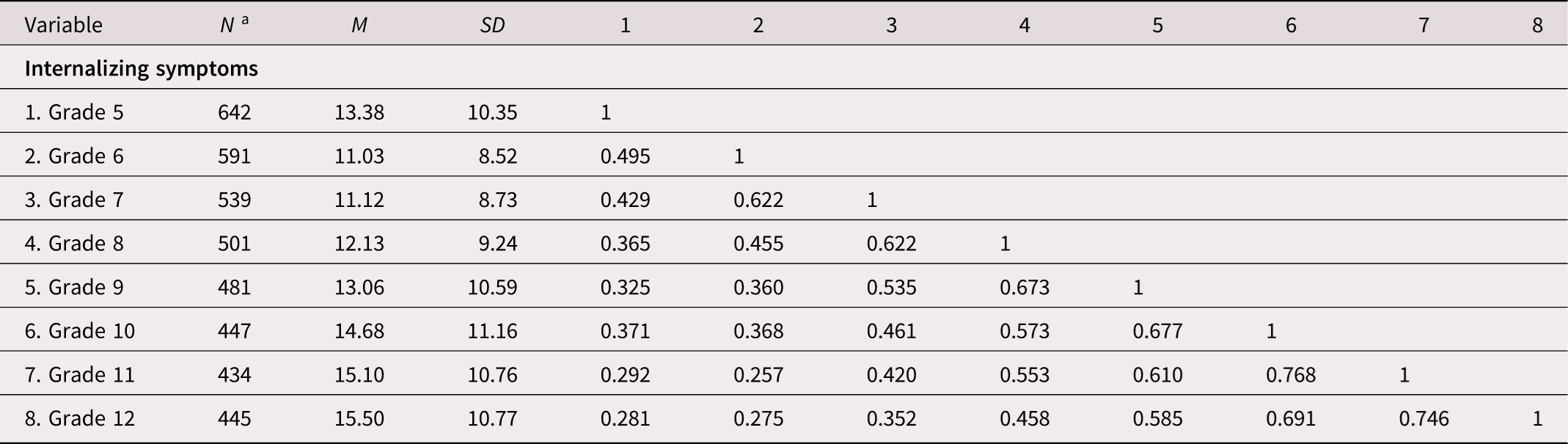
Descriptive statistics for internalizing symptoms (G5-12) are presented in Table 1. Across-time associations were moderate (r = .281–.768, p < .001).
Descriptive statistics and correlations among observed scores on internalizing symptoms Grades 5 through 12

All correlations statistically significant at p < .001.
a Number of participants is variable due to participants opting in or out at specific time points or skipping questions and/or measures.
Statistical models latent growth curve models
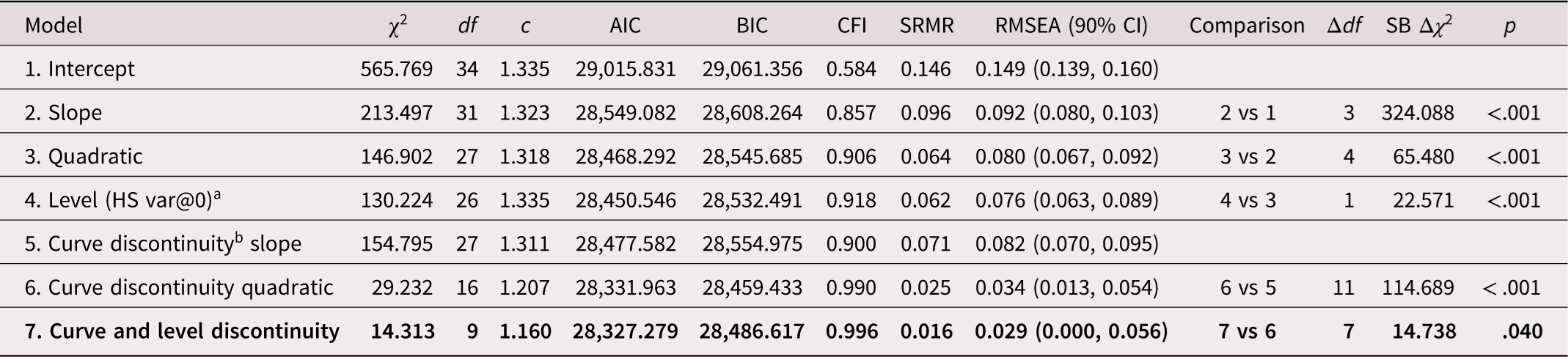
Level discontinuity. Initial intercept only, slope, and quadratic models were estimated with statistical improvement at each step (see Table 2). Addition of the secondary school level resulted in a non-positive definite PSI matrix and the non-significant variance of the secondary school level factor was fixed to zero. The resulting model was an improvement beyond the quadratic, with acceptable fit.
Model fit

a Model 4 Level includes variance of the secondary school level parameter fixed at zero for model estimation.
b discontinuity models are piecewise models with the knot at G9.
Note. c scaling correction factor for computing Satorra–Bentler (SB) scaled chi-square difference test under MLR; CFI Comparative Fit Index; RMSEA Root Mean Square Error of Approximation; SRMR Standardized Root Mean Square Residual; AIC Akaike Information Criterion. Bolded models are the final univariate models. See S2.6 for comments about comparisons across variable- and person-centered approaches.
Curve discontinuity. The linear piecewise model (knot at G9) had acceptable fit, with comparable AIC and CFI to the single curve quadratic model. Adding quadratic factors in elementary and secondary school resulted in a model with excellent fit to the data.
Discontinuity level and curve. The discontinuity level and curve model was examined by adding the secondary school level factor to the curve discontinuity model. The model had a good fit to the data and was an improvement over the prior model (see Table 2).
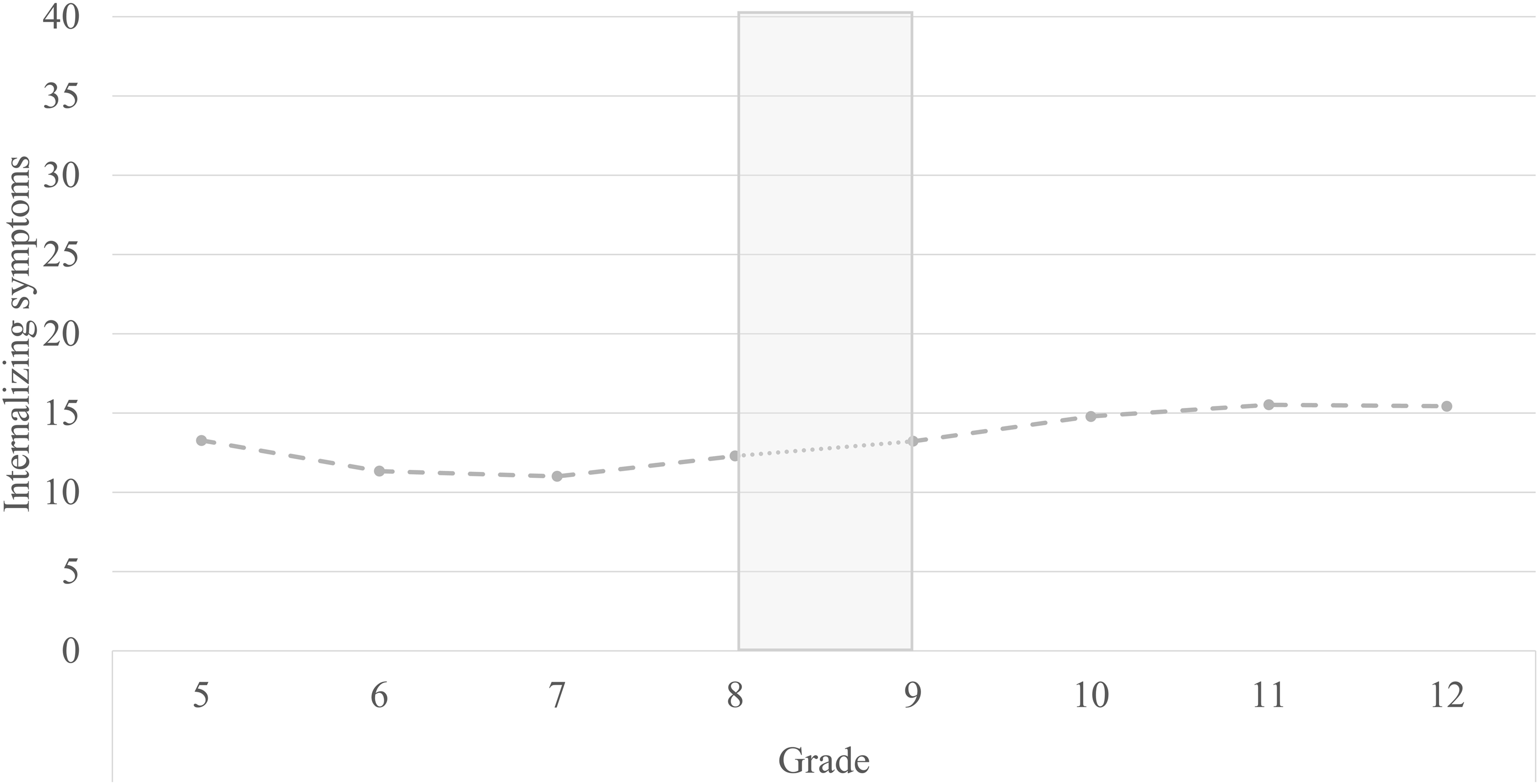
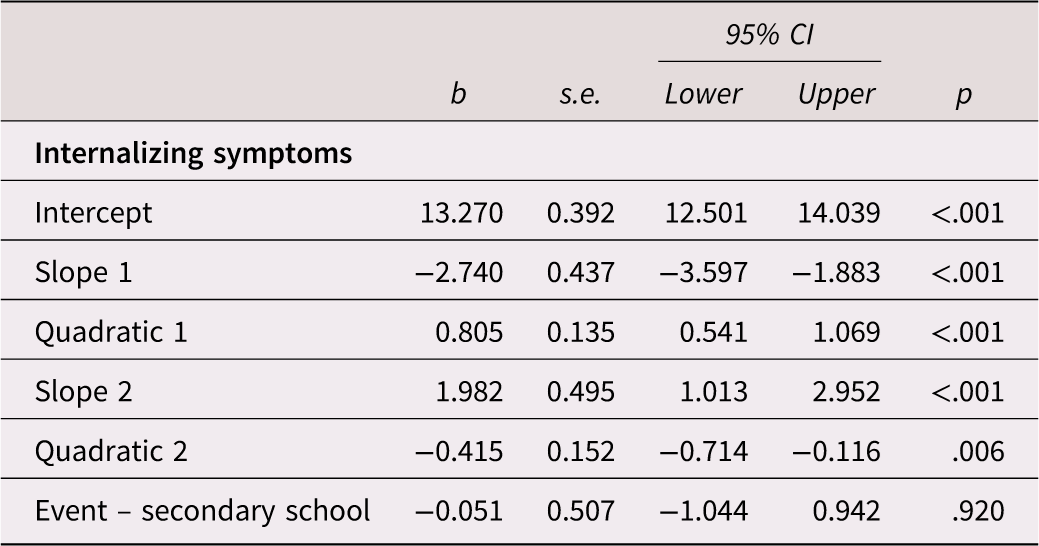
The model was re-parameterized following Rioux et al. (Reference Rioux, Stickley and Little2021) so slope factors could be compared. In this model, all parameter estimates had significant means except for secondary school level,Footnote 1 and all had significant variation (see Table 3 for parameter estimates). The elementary and secondary school curves were different, Wald χ 2(2) = 54.723, p < .001. The elementary school portion of the curve was characterized by concave upward quadratic growth across G5–G8 illustrated by decreasing (G5–G6) then increasing growth. The second curve, representing change during secondary school, demonstrated a convex shape G9–G12 with an initial increase and plateau (see Figure 1).
Internalizing symptoms latent growth curve model with level and curve discontinuity. Discontinuity level and curve latent growth curve model for internalizing symptoms around the secondary school transition. Vertical shaded region between Grade 8 and Grade 9 represents the level discontinuity in the trajectories. Grades 5–8 are elementary school and Grades 9–12 are secondary school.

Parameter estimates for internalizing symptoms discontinuity latent growth curve model

Note. Level and curve discontinuity latent growth curve models. Slope 1 and quadratic 1 are parameter estimates representing the average elementary school curve and slope 2 and quadratic 2 are parameter estimates representing the average secondary school curve. The event is the additional level change associated with secondary school (i.e., Grade 9 relative to the intercept at Grade 5). Covariance terms between latent curve factors also estimated in the models.
Transition linked discontinuity. Estimated average internalizing symptoms in G8 and G9 were statistically different (unstandardized = 0.923, SE = 0.378, Wald χ 2 (1) = 5.949, p = .015).
Correlates associated with LGCM growth parameters
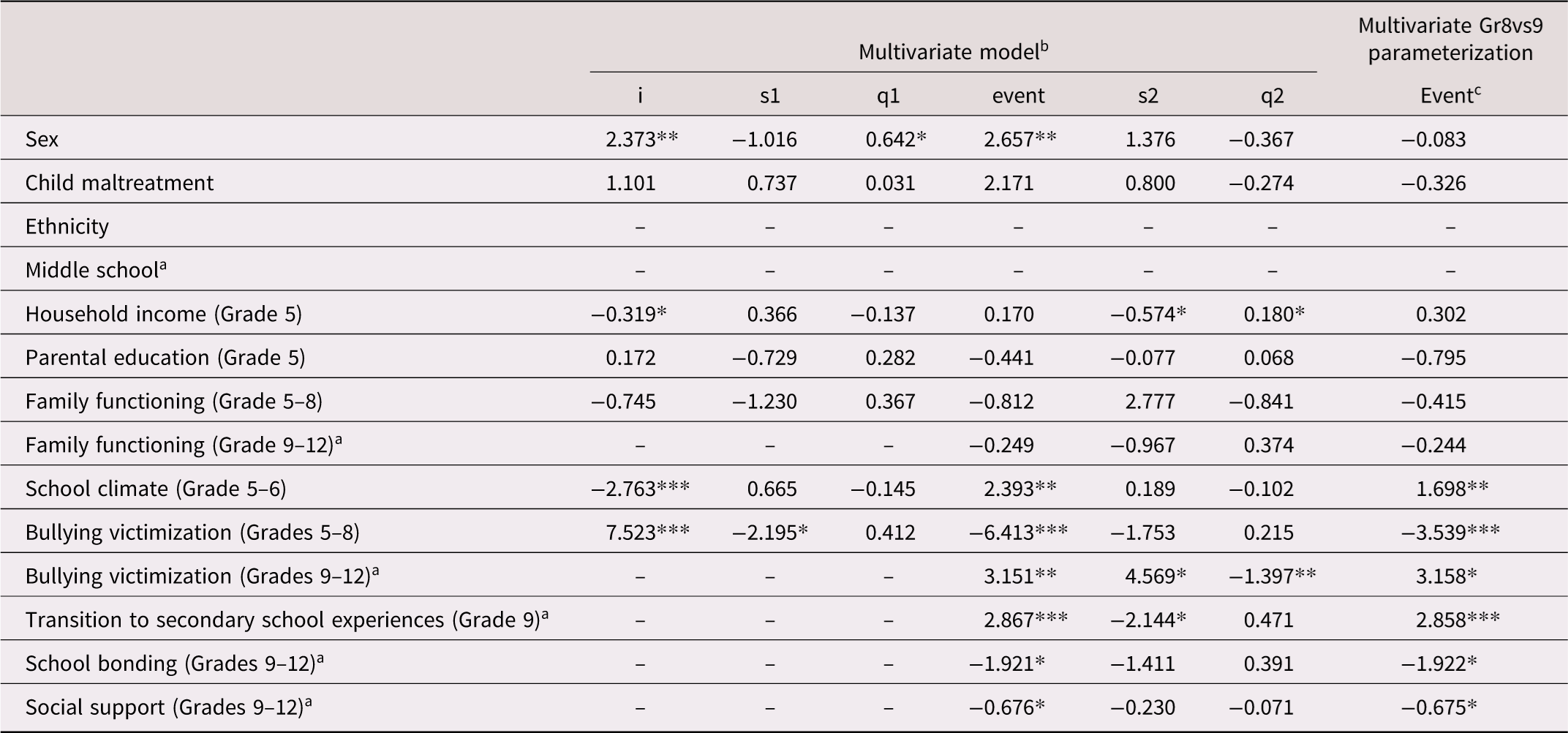
Intercept, elementary slope, and elementary quadratic factors were regressed on time-invariant and elementary period covariates and secondary school level, slope, and quadratic factors on time invariant covariates as well as both elementary and secondary school period covariates. In the preliminary univariate models, race/ethnicity and middle school attendance were not associated with any growth parameters and were therefore not included in the multivariate model. The multivariate model was reparametrized to estimate associations between the transition change (G8–G9) with covariates and re-estimated. See Table 4 (Table S1 for univariate estimates).
Associations with covariates

Table 4. Long description
The table includes unstandardized regression coefficients from a multivariate model examining associations between covariates and parameters of internalizing symptom trajectories. Parameters include the intercept, linear and quadratic slopes before and after the school transition, and the event parameter representing change between Grades 8 and 9. Statistically significant associations are observed for sex, household income, school climate, bullying victimization, transition-to-secondary-school experiences, school bonding, and social support, with the direction and magnitude of associations varying across trajectory parameters. Parental education and family functioning did not demonstrate statistically significant associations with any curve parameters in the multivariate model.
Note. Estimates in table are unstandardized regression coefficients. - = parameter not estimated. i = intercept, s = slope, q = quadratic, event = secondary school level change (difference between G5 and G9). ***p < .001, **p < .01, *p < .05.
a Covariates measured in the future were not permitted to estimate prior parameters in the internalizing symptoms trajectory.
b Only parameters statistically significant in univariate models were entered in the multivariate model.
c Results from secondary school model reparameterization with event interpreted as the difference between Grade 8 and Grade 9.
Sex. In the univariate and multivariate model, sex was associated with the intercept, elementary quadratic, and secondary school level. Compared to boys, girls reported higher initial internalizing symptoms, a stronger positive curvature in elementary school, and larger increase across G5–G9. Using the secondary school reparameterization, sex was not associated with change between G8–G9.
Child maltreatment. Child maltreatment was associated with elevated symptoms in univariate analyses but not in the multivariate model.
Demographics. In both the univariate and multivariate models, higher household income was associated with lower initial levels of internalizing symptoms. Household income was also associated with post-transition linear and quadratic growth parameters, indicating that adolescents from higher-income households demonstrated a less steep increase in symptoms across secondary school, relative to those from lower income households. In the univariate model, higher parental education was associated with lower initial internalizing symptoms and a less pronounced deceleration in symptom change during secondary school but not in the multivariate model.
Family Functioning. Higher elementary school family functioning was associated with lower internalizing symptoms in the univariate model only.
Bullying victimization. In univariate and multivariate models, average elementary school bullying victimization was associated with higher initial internalizing symptoms and negatively with elementary school slope (likely to coincide with such elevated scores). Elementary school bullying victimization was negatively associated with symptoms changes at the transition whereas secondary school bullying victimization was positively associated with elevated secondary school level changes (b = 3.158, p = .011; G8–G9), as well as faster increases in early secondary school followed by greater attenuation toward the end of secondary school.
School climate. In univariate and multivariate models, a more positive elementary school climate was associated with lower initial internalizing symptoms. Elementary school climate was negatively associated with secondary school level. Regarding the change between G8 and G9, adolescents reporting higher elementary school climate had larger increases in internalizing symptoms at the transition (b = 1.698, p = .003).
Transition to secondary school experiences. More negative transition to secondary school experiences were associated with higher secondary school level changes. Specifically, those reporting more negative experiences had higher increases in internalizing symptoms between G8 and G9 (b = 2.858, p < .001). They also had less steep increase in symptoms over secondary school.
School bonding. Higher school bonding scores were associated with lower internalizing symptoms level changes. Students reporting higher bonding reported decreased internalizing symptoms from G8 to G9 (b = −1.922, p = .014).
Peer social support. Higher peer support scores were associated with lower internalizing symptoms level changes. Students reporting higher social support reported decreases in internalizing symptoms from G8 to G9 (b = −0.675, p = .048).
Group-based trajectory models
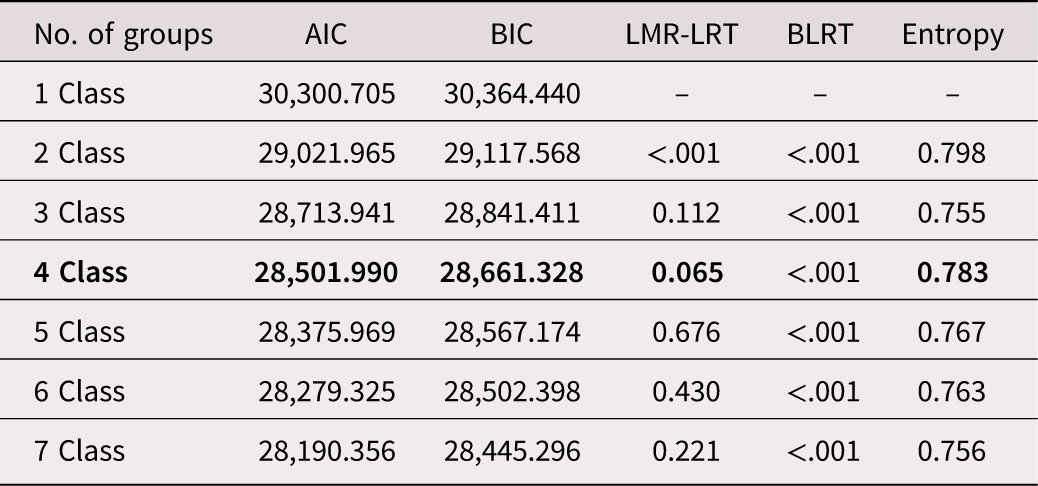
Fit indices are presented in Table 5. BIC values declined from the 2-class solution through the 7-class solution, with notable declines >100 through class 4. All solutions yielded posterior probabilities > 0.70. Entropy fell between 0.755 and 0.798. BLRT was significant for each additional class solution. The LMR-LRT was significant for class 2, dropping slightly for classes 3 and 4 (p < .15), and negligible declines for subsequent solutions. Solutions with 5 classes and higher yielded classes with small cell sizes (<5%). The 4-class solution had sufficient class sizes (>5%) while yielding clinically meaningful differences between classes and was selected as the final GBTM based on parsimony and content expertise. See Table S2 for parameter estimates and Figure 2 for trajectory plots.
Internalizing symptoms group-based trajectory model with level and curve discontinuity. Discontinuity level and curve group-based trajectory model for internalizing symptoms around the secondary school transition. Vertical shaded region between Grade 8 and Grade 9 represents the level discontinuity in the trajectories. Grades 5–8 are elementary school and Grades 9–12 are secondary school.

Figure 2. Long description
Estimated internalizing symptom trajectories are shown for four latent classes. The Low class has the fewest symptoms throughout, declining modestly during elementary school and increasing slightly during secondary school. The Moderate class declines slightly from Grades 5 to 6, remains relatively stable through Grade 7, and then gradually increases through Grade 12. The Increasing class begins with moderate symptoms, declines initially, and then increases substantially from Grade 6 onward, including a marked increase across the Grade 8-to-9 school transition; symptoms remain high through secondary school. The Decreasing class begins with the highest symptom levels, peaks around Grade 6, and then declines through Grade 11 before remaining relatively stable.
Fit indices for GBTM for internalizing symptoms

Note. BIC = Bayesian information criterion; LMR-LRT = Lo-Mendell-Rubin likelihood ratio test; BLRT = bootstrapped likelihood ratio test. Bold are the final selected class solutions. See S2.6 for comments about comparisons across variable- and person-centered approaches.
Class 1 included 51.78% of the sample and demonstrated consistently low stable internalizing symptoms, with slight decline in elementary school and slight incline in secondary school (“Low”). The shape of elementary growth and secondary school growth differed, Wald χ 2(2) = 59.447, p < .001. Class 2, termed “Moderate” (32.53%) was characterized by moderate symptoms that slightly increased over time. The shape of elementary growth and secondary school growth did not differ, Wald χ 2(2) = 4.752, p = .093. Class 3 (“Increasing”; 10.56%) began with moderate internalizing symptoms that increased in elementary and through secondary school, with a notable increase at the school transition, G8–G9 mean diff = 7.090, p < .001. The shape of elementary growth and secondary school growth differed, Wald χ 2(2) = 18.312, p < .001. Class 4, termed “Declining,” was the smallest containing 5.14% of the sample. The curve was characterized by elevated internalizing symptoms that initially increased then began to decline in late elementary school, and plateaued in secondary school, although not statistically different, χ 2(2) = 4.752, p = .093.
Transition linked discontinuity. The only class showing a statistically significant level discontinuity at the transition was the Increasing class (10.56%), where estimated means jumped 7.090 points from G8 to G9 (p < .001). In the Declining class, the 3-point decrease from G8 to G9 was not statistically significant, mean diff = −3.624, p = .208. The Low (mean diff = −0.178 p = .586) and Moderate (mean diff = 0.431 p = .663) classes demonstrated negligible change between G8 and G9.
Early adulthood outcomes
Prevalence of early adulthood functional and mental health problems are presented in Table 6. With few exceptions, the Low class was at the lowest risk for vocational and mental health outcomes in early adulthood. However, the Low and Moderate classes did not differ in risk for postsecondary attendance, panic disorder, and sub-clinical depression. The Low and Declining classes did not differ on postsecondary attendance or clinically assessed mental health disorders or self-reported and (sub)clinical depression; however, did differ on subclinical and clinical anxiety. Across many mental health outcomes, the Increasing class was at higher risk than the Moderate class (exception sub-clinical anxiety and depression and postsecondary attendance). The Increasing class was at greater risk for most clinically assessed mental health disorders compared to the Declining class, but did not differ on panic disorder, subclinical anxiety or depression, and functional outcomes.
internalizing symptoms classes – early adulthood functional outcomes and mental health problems

Table 6. Long description
The table presents observed prevalence and model-estimated probabilities of early-adulthood functional and mental health outcomes across four internalizing symptom trajectory classes. Significant class differences were found for job risk, current depressive episode, generalized anxiety disorder, social anxiety, obsessive-compulsive disorder, panic disorder, agoraphobia, and self-reported anxiety and depression clinical status. Across most mental health outcomes, the Increasing class had the highest estimated probability, whereas the Low class had the lowest. The Declining and Moderate classes generally showed intermediate probabilities, although the pattern varied by outcome. No significant overall class difference was found for no postsecondary education.
Note. SR = self-reported. Class-specific percentages are estimated probabilities from categorical distal outcomes analysis using DCAT, accounting for classification uncertainty. For self-reported anxiety and depression clinical status, the omnibus test was used to examine clinical status by class. For pairwise comparisons between classes, clinical and subclinical categories were each analyzed as separate binary outcomes (category vs. all other categories); percentages shown are from these binary DCAT models. Different superscripts indicate significant pairwise differences between latent classes (p < .05); classes sharing a superscript did not differ significantly.
1 Assessed via survey.
2 Assessed via clinical interview.
3 Number of participants is variable due to participants opting in or out at specific time points, assessments (i.e., survey, interviews), or skipping questions and/or measures.
4 Pairwise comparisons not examined due to not significant omnibus test.
Discussion
Guided by a turning points perspective, we found that internalizing symptoms from G5 to G12 were not best characterized by a single continuous adolescent trend, but by nonlinear curve and level discontinuity around the secondary school transition. This pattern extends prior evidence of nonlinear symptom development (e.g., Katsantonis, Reference Katsantonis2024) and school-transition-related piecewise growth (Benner & Graham, Reference Benner and Graham2009; Nelemans et al., Reference Nelemans, Hale, Branje, Meeus and Rudolph2018; Troop-Gordon et al., Reference Troop-Gordon, Thomas, Brigham, Xu and Rudolph2024) by distinguishing elementary and secondary school developmental processes across an eight-year span. The person-centered findings qualified the sample-level pattern. The average pattern of discontinuity reflected different forms of developmental response rather than a uniform disruption experienced by all adolescents. Variability in growth was associated with individual, peer, and contextual factors, underscoring that transition-linked change depends on adolescents’ broader risk and support contexts. Further, different pathways were associated with different risk of early adulthood mental health and functional outcomes. Symptom levels, transition-related change, and rates of growth were associated with several factors, suggesting that internalizing symptom development reflects both pre-existing vulnerabilities and concurrent risk and protective factors. Importantly, different factors were associated with different components of developmental change, including symptoms level, transition-linked changes, and the developmental course following the transition. Girls reported higher initial symptoms and faster elementary rate of change, consistent with evidence that adolescent girls are at greater risk for internalizing symptoms and increase earlier than boys (Kwong et al., Reference Kwong, Manley, Timpson, Pearson, Heron, Sallis, Stergiakouli, Davis, Leckie and Payne2019). Higher household income was associated with lower initial symptoms and attenuated secondary school growth, consistent with socioeconomic advantage (Bradley & Corwyn, Reference Bradley and Corwyn2002). Lower parental education, childhood maltreatment, and lower family functioning were associated with heightened symptoms in the univariate but not in the multivariate model. This attenuation may reflect shared variance, with more proximal peer experiences, such as bullying victimization, better explaining variation in internalizing symptom changes (Lereya et al., Reference Lereya, Copeland, Costello and Wolke2015). Although higher family functioning was related to lower initial levels of internalizing symptoms, it was not related to the change of symptoms over time, suggesting greater relevance to continuity rather than developmental change. The lack of association to change may be due to the relative stability of family interactions (Loeber et al., Reference Loeber, Drinkwater, Yin, Anderson, Schmidt and Crawford2000) or adolescents’ increasing autonomy, changing parental relationships, and greater investment in peers (Smetana & Rote, Reference Smetana and Rote2019; Steinberg & Morris, Reference Steinberg and Morris2001).
Bullying victimization emerged as a robust covariate of internalizing symptoms. Elevated elementary school bullying victimization was associated with higher initial symptoms and steeper initial declines, likely reflecting regression from elevated symptom levels. Although the negative association between elementary bullying and the symptoms change at the transition to secondary school may seem counterintuitive, it may signal a promising feature of discontinuity, a marked decline in internalizing symptoms at the transition for those who were targets of bullying. The transition to secondary school affords an opportunity for peer group reorganization, with notable declining victimization for those experiencing the highest rates (Vaillancourt et al., Reference Vaillancourt, Brittain, Farrell, Krygsman and Vitoroulis2023). In contrast, higher secondary school bullying victimization was associated with greater symptom increases from G8 to G9 and continued growth across secondary school, even after accounting for elementary victimization. These findings underscore bullying as a salient interpersonal risk factor linked to marked fluctuations in internalizing symptoms across the secondary school transition, complementing recent research on the middle school transition (Troop-Gordon et al., Reference Troop-Gordon, Thomas, Brigham, Xu and Rudolph2024).
Concurrent contextual factors also shaped internalizing symptoms development across the transition. Although more positive G5/G6 school climate was associated with lower initial symptoms, it also predicted greater increases at the transition, suggesting that students from more supportive elementary environments may experience greater disruption when entering secondary school. In contrast, supportive secondary school contexts appeared protective: higher social support was associated with declining symptoms from G8 to G9, suggesting that supportive relationships may foster resilience during transition periods (Cicchetti & Rogosch, Reference Cicchetti and Rogosch2002). More negative transition experiences were associated with symptom increases from G8 to G9, consistent with evidence that transition stress predicts internalizing difficulties (Rice et al., Reference Rice, Ng-Knight, Riglin, Powell, Moore, McManus, Shelton and Frederickson2021), followed by attenuated growth across secondary school. These findings suggest that consistent with the transition-linked turning point framework, changes in the direction and course of internalizing symptoms depends on adolescents’ configuration of risk and resilience factors (Graber & Brooks-Gunn, Reference Graber and Brooks-Gunn1996).
Because average growth models identify correlates of change but not distinct developmental pathways, we next examined heterogeneity in symptom trajectories. This person-centered analysis identified four subgroups differentiated by symptom level, direction of change, and degree of transition-linked discontinuity. One class had consistently low symptoms (Low, 51.8%) and one moderate symptoms (Moderate, 32.5%) while others followed dynamic paths; one had moderate increasing symptoms (Increasing, 10.6%), and one had high decreasing symptoms (Declining, 5.1%). Importantly, the classes differed in symptoms level and direction as well as in the form of continuity or discontinuity at the transition to secondary school. The increasing class showed the clearest evidence of both level and curve discontinuity, whereas the low class showed a change in developmental course without an abrupt transition-linked level shift. In contrast, the moderate class showed continuity in level and developmental course. Although the difference in symptoms from G8 to G9 was only statistically significant for the increasing class, the magnitude of the difference for the Decreasing class was higher than for the overall sample-level change. This descriptive decline did not demonstrate statistical significance, likely due to power given the class included only 5% of the sample.
Our four-class finding complements limited research on internalizing symptoms variation across school transitions. Similar to Nelemans et al. (Reference Nelemans, Hale, Branje, Meeus and Rudolph2018), who identified persistent-low, decreasing, and increasing anxiety trajectories across the middle school transition, we found low, declining, and increasing internalizing symptom classes. However, whereas Nelemans et al. identified a persistent-high class, our solution included a moderate class. In contrast, Olivier et al. (Reference Olivier, Morin, Leo and Salmela-Aro2023) found no declining depression class, potentially reflecting differences in sample context, including their focus on Finnish academic-stream students. These findings suggest that heterogeneity across adolescence, and specifically school transitions, reflect differences in symptoms severity and different patterns of developmental continuity and discontinuity.
For some adolescents, the transition marked symptom improvement; for others, it precipitated increasing internalizing problems. Changes that began in G8 (Figure 2) may reflect anticipatory stress about new environments, academic demands, and shifting peer groups (Beatson et al., Reference Beatson, Quach, Canterford, Farrow, Bagnall, Hockey, Phillips, Patton, Olsson, Ride, McKay Brown, Roy and Mundy2023; Benner, Reference Benner2011; Evans et al., Reference Evans, Borriello and Field2018; Rice et al., Reference Rice, Ng-Knight, Riglin, Powell, Moore, McManus, Shelton and Frederickson2021), suggesting discontinuity may begin prior to school entry rather than after. Conversely, declining symptoms may reflect removal from a problematic peer contexts and anticipation of a fresh start, suggesting adaptive discontinuity for some, rather than a uniform maladaptive response.
The longer-term outcomes further support the developmental significance of examining heterogeneity in pathways to identify continuity and discontinuity. Individuals with initially high and moderate symptoms levels converged to similar G12 levels, consistent with equifinality (Cicchetti & Rogosch, Reference Cicchetti and Rogosch1996; Masten & Cicchetti, Reference Masten and Cicchetti2010). Despite different symptom histories, the Moderate and Declining classes had equivalent risk for most early adulthood functional outcomes and mental disorders, but those who declined were at lower risk for self-reported clinical anxiety symptoms. In line with multifinality, although the Increasing and Moderate classes began with similar internalizing symptoms levels, their developmental courses diverged, with the Increasing class showing transition-linked discontinuity and had elevated risk for early adulthood mental health problems, as well as job risk. Findings in the current study suggest that divergence and convergence in symptoms pathways, including transition-linked discontinuity at the secondary school transition, was differentially associated with risk in early adulthood. Notably, adolescents demonstrating discontinuity with marked increases in symptoms at the transition were at elevated risk.
Strengths and limitations
This study addresses limitations of prior research by using eight annual assessments to model internalizing symptoms across the secondary school transition in a representative population-based sample, supported by multi-informant data, psychometrically strong measures, clinical diagnostic assessments, and rigorous longitudinal analyses over 12 years. Notwithstanding these strengths, there are also limitations. First, per the study ethics protocol, the second author contacted participants with clinical depression scores following annual survey completion. Since we lacked information on interventions, we could not account for treatment effects, potentially reducing observed clinical mental health cases. Second, although parents participated in the study, we lacked assessments of parental psychopathology, which is linked to trajectories of internalizing symptoms (Olino et al., Reference Olino, Stepp, Keenan, Loeber and Hipwell2014). Third, the internalizing symptoms composite was composed of common elements of child and adolescent questionnaires and may thus not be directly comparable to studies using the original scales. Also, using self-reported assessments of internalizing problems to create the trajectory groups and self-reported peer and school relations may have inflated associations through shared method variance (Podsakoff et al., Reference Podsakoff, MacKenzie, Lee and Podsakoff2003); however, trajectory classes were generally similarly associated with clinical interviews and self-reported clinical status in early adulthood, supporting the robustness of associations regardless of reporter type. Fourth, although anxiety and depression commonly co-occur and share symptoms and risk processes, anxiety often precedes depression (Garber & Weersing, Reference Garber and Weersing2010); the internalizing composite may have obscured heterotypic continuity and differential associations with later outcomes (Cohen et al., Reference Cohen, Andrews, Davis and Rudolph2018). Fifth, although FIML retained participants with partially missing data under a MAR assumption, attrition may have led to underestimated symptom severity or worsening trajectories if adolescents with increasing symptoms were more likely to drop out. Sixth, LGCA and GBTM are robust methods for identifying average curves and clusters of participants following similar patterns, but they cannot establish directionality or causality between the pathways of internalizing problems and the covariates assessed in this study. Seventh, using period specific averages does not permit us to make inferences regarding temporal priority. Specifically, the associations between bullying victimization and growth calls for more granular year-by-year, within-person examination of whether changes in peer, family, and school contexts buffer or exacerbate internalizing symptoms before, during, and after the school transition. Finally, although the latent class analysis identified classes with different patterns of continuity and discontinuity at the school transition, these analyses do not isolate the independent contributions of initial level, pre-transition, transition-linked, or post-transition symptom change to early adulthood outcomes. Because the growth parameters were interrelated, estimating unique contributions to later outcomes would require including them simultaneously; however, this was not possible in the current study given the number of parameters used to characterize growth in internalizing symptoms over time.
Conclusions
The transition to secondary school is a time of substantial developmental and contextual change and can function as a transition-linked turning point, although it is not universally disruptive. Most adolescents follow pathways of continuity with low or moderate symptoms, whereas for some, the transition was associated with amplified internalizing symptoms and elevated risk for early adulthood psychopathology. For others, the transition marked symptom decline and attenuated risk. The degree of change is associated with individual, peer, and contextual factors, including sex, household income, bullying victimization, and social support.
Findings suggest that screening for internalizing symptoms should begin in elementary school, before symptoms escalate across the transition. Supportive interventions across elementary and secondary school, including mental health promotion, bullying prevention, and efforts to strengthen school belonging, may help reduce later mental health and educational difficulties (Beatson et al., Reference Beatson, Quach, Canterford, Farrow, Bagnall, Hockey, Phillips, Patton, Olsson, Ride, McKay Brown, Roy and Mundy2023; Fraguas et al., Reference Fraguas, Díaz-Caneja, Ayora, Durán-Cutilla, Abregú-Crespo, Ezquiaga-Bravo, Martín-Babarro and Arango2021).
Supplementary material
The supplementary material for this article can be found at https://doi.org/10.1017/S095457942610203X.
Data availability statement
The data that support the findings of this study are available on reasonable request to the corresponding author. The data are not publicly available due to the privacy and ethical restrictions associated with longitudinal studies.
Acknowledgments
We thank the participants for their continued support in the study. We also thank Dr. Amanda Krygsman for her support with the study. Heather Brittain had full access to all the data in the study and takes responsibility for the integrity of the data and the accuracy of the data analysis
Funding statement
This work was funded by grants awarded to Tracy Vaillancourt by the Social Sciences and Humanities Research Council of Canada [grant numbers 833-2004-1019, 435-2016-1251]; Ontario Mental Health Foundation [grant number PA-13-303]; and Canadian Institutes of Health Research [grant numbers 201009MOP-232632-CHI-CECA-136591, 201603PJT-365626-PJT-CECA-136591]. Heather Brittain was supported by a Social Sciences and Humanities Research Council of Canada Vanier Scholarship; Ontario Graduate Scholarship; and Brain-Heart Interconnectome doctoral award.
Competing interests
The authors declare no known conflicts of interest.
Pre-registration statement
The study was not pre-registered because analyses were conducted using pre-existing longitudinal data.
Declaration of generative AI and AI-assisted technologies in the manuscript preparation process
During manuscript preparation, the authors used ChatGPT and Anara to improve some of the writing clarity and verify references. The authors take full responsibility for the final manuscript.



 Open access

