





Introduction
Adolescence constitutes a sensitive developmental period during which extensive biological, emotional, and cognitive changes increase susceptibility to depressive symptoms (Thapar et al., Reference Thapar, Collishaw, Pine and Thapar2012). This vulnerability is particularly pronounced among South Korean multicultural adolescents, a rapidly growing yet understudied population that confronts unique psychosocial stressors beyond the normative challenges of this period (Li & Yang, Reference Li and Yang2026; Ling et al., Reference Ling, Luo and Zhao2025). While extensive research has established perceived social support as a vital protective resource against depressive symptoms in general adolescent populations (for a review, see Rueger et al., Reference Rueger, Malecki, Pyun, Aycock and Coyle2016), two critical gaps persist in the literature. First, it remains unclear whether the protective mechanisms of perceived social support operate uniformly across distinct sources, namely family, peers, and teachers, or exhibit source-specific patterns within the multicultural context. Although the transactional, social causation, and symptoms-driven models have been proposed to characterize the longitudinal associations between perceived social support and depressive symptoms (Ren et al., Reference Ren, Qin, Zhang and Zhang2018), empirical tests of these frameworks have rarely differentiated among perceived support sources, particularly in non-Western or minority adolescent populations. Second, prior studies have largely relied on analytical approaches that conflate stable between-person differences with dynamic within-person changes (e.g., Burns et al., Reference Burns, Deschênes and Schmitz2016; Ren et al., Reference Ren, Qin, Zhang and Zhang2018), thereby obscuring the true direction of effects and limiting causal inference. To address these gaps, the present four-wave longitudinal study employs a random intercept cross-lagged panel model (RI-CLPM) to rigorously disentangle between-person and within-person associations between three distinct sources of perceived social support and depressive symptoms among South Korean multicultural adolescents.
Depressive symptoms among South Korean multicultural adolescents
Multicultural adolescents represent a distinct and growing demographic in South Korea. In the Korean context, multicultural adolescents are defined as young people raised in families where one or both parents are foreign nationals, including those formed through international marriage or naturalization (Korea Ministry of Government Legislation, 2025). This population has expanded substantially over the past thirteen years, with the number of students from multicultural families rising from approximately 46,000 in 2012 to 202,208 in 2025, representing 4% of the total student population in South Korea (National Center for Multicultural Education, 2025). Given the country’s persistently declining birth rates, this proportion is projected to continue rising in the coming years (Ahn et al., Reference Ahn, Lee and An2025). Yet despite their increasing demographic presence, multicultural adolescents continue to face substantial barriers to social integration. South Korea’s historically homogeneous ethnic identity and strong collectivist cultural orientation create an environment in which adolescents whose language, appearance, and cultural backgrounds visibly differ from the majority are particularly susceptible to discrimination, peer rejection, and social exclusion (Kang, Reference Kang2016; Won, Reference Won2017). As a result, these youth are disproportionately exposed to acculturative stress, identity confusion, and a diminished sense of social belonging, all of which compound the normative developmental challenges of adolescence (Bae, Reference Bae2020; Choi et al., Reference Choi, Kruis and Lee2022; Yoo, Reference Yoo2024).
These compounding vulnerabilities are reflected in consistently elevated rates of psychological distress. Empirical evidence robustly demonstrates that multicultural adolescents in South Korea experience higher levels of depressive symptoms than their monocultural peers (Hwang et al., Reference Hwang, Kwon, Kim and Kim2024; Jang & Park, Reference Jang and Park2019). Longitudinal investigations further reveal that depressive symptoms among this population do not remain static but follow an escalating trajectory, with symptom levels rising progressively from late elementary school through secondary school (Choe & Yu, Reference Choe and Yu2022; Han, Reference Han2020). This upward pattern is particularly concerning given that adolescent depressive symptoms are associated with a broad range of adverse long-term consequences, including impaired academic attainment, social dysfunction, and heightened risk of psychopathology in adulthood (Thapar et al., Reference Thapar, Collishaw, Pine and Thapar2012). Identifying modifiable protective factors, particularly those rooted in adolescents’ immediate social environments, that are capable of alleviating depressive symptoms in this growing and vulnerable population therefore represents an urgent empirical and public health priority.
Source specificity of perceived social support in the multicultural context
Perceived social support refers to one’s subjective appraisal of the potential availability of emotional, instrumental, or informational assistance within a social network (Uchino, Reference Uchino2009), as distinct from the actual receipt of supportive behaviors from others. As a critical protective resource, perceived social support plays a pivotal role in promoting adolescents’ psychosocial adjustment (Rueger et al., Reference Rueger, Malecki, Pyun, Aycock and Coyle2016) and buffering against the detrimental effects of stress (Gong, Reference Gong1994). However, perceived social support is not a unitary construct; rather, it represents a multidimensional structure derived from distinct sources. Within the framework of bioecological theory (Bronfenbrenner, Reference Bronfenbrenner, Lerner and Castellino2013), perceived family, peer, and teacher support are conceptualized as reflecting adolescents’ proximal processes within the family, peer, and school microsystems, respectively, through which they engage in reciprocal interactions with significant others. Perceived family support, as the earliest and most foundational social resource in adolescents’ lives, promotes emotional stability and psychological security while fostering social–emotional competence through early parent–child interactions (Takahashi et al., Reference Takahashi, Okada, Hoshino and Anme2015). As adolescents enter puberty, perceived peer support grows increasingly salient, with egalitarian friendships providing a critical sense of belonging, companionship, and validation that supports identity formation during this transitional period (Kiefer et al., Reference Kiefer, Alley and Ellerbrock2015). Perceived teacher support, enacted through academic guidance, emotional encouragement, and the cultivation of a positive classroom climate, helps adolescents build academic self-efficacy and cope with the diverse challenges of their developmental journey (Liang et al., Reference Liang, Gao, Tian, Xu and Liu2025).
For multicultural adolescents in South Korea, however, the functional impact of these perceived support sources may diverge significantly due to unique cultural and contextual factors. In the family domain, although multicultural families in South Korea are ethnically diverse in origin, the prevailing host cultural context of South Korea, characterized by Confucian emphases on family cohesion and intergenerational interdependence (Song et al., Reference Song, Bong, Lee and Kim2015), likely shapes the normative expectations surrounding perceived family support for these adolescents. Notably, the majority of foreign-born parents in Korean multicultural families originate from East and Southeast Asian countries (National Youth Policy Institute, 2025) whose cultural traditions broadly align with these collectivist values, despite specific ethnic differences, further reinforcing the centrality of familial bonds. Consequently, perceived family support may serve as a particularly salient source of psychological security for multicultural adolescents, offering a meaningful buffer against external acculturative stressors such as discrimination and social isolation (Ling et al., Reference Ling, Luo and Zhao2025). In contrast, the protective capacity of perceived peer and teacher support may be more vulnerable to contextual constraints, particularly within the school environment. For multicultural adolescents, schools simultaneously function as essential sites for socialization and as primary settings for acculturative stress (Li & Yang, Reference Li and Yang2026) and implicit bias (Oczlon et al., Reference Oczlon, Bardach and Lüftenegger2021). Such contextual pressures, including cultural misunderstandings and social marginalization, may impede multicultural adolescents’ consistent access to perceived support from peers and teachers (Ling et al., Reference Ling, Luo and Zhao2025), thereby limiting their protective function relative to that of the family. Consistent with this source-specific pattern, Ling et al. (Reference Ling, Luo and Zhao2025) found in a longitudinal investigation that perceived family support positively predicted subsequent life satisfaction among multicultural adolescents, whereas perceived peer and teacher support showed no significant within-person effects.
These theoretically and empirically grounded distinctions underscore the importance of examining perceived social support in a source-specific manner rather than as a single aggregate construct, as collapsing across sources would likely obscure meaningful differences in their protective functions and reduce the interpretability of findings. Moreover, when multiple perceived support sources are examined simultaneously within a single model, the substantial intercorrelations among them may introduce statistical suppression, potentially attenuating the unique predictive contribution of each individual source. Therefore, to elucidate the distinct and potentially divergent contributions of specific perceived support systems, it is essential to examine perceived family, peer, and teacher support both simultaneously within a unified analytical framework and independently, so as to disentangle their unique versus shared predictive variance in relation to depressive symptoms among South Korean multicultural adolescents.
Longitudinal associations between perceived family, peer, and teacher support and depressive symptoms
The longitudinal associations between perceived social support and depressive symptoms have been conceptualized most broadly through a transactional lens (Lazarus & Folkman, Reference Lazarus and Folkman1984), which holds that these two constructs are mutually reinforcing across development: insufficient perceived support elevates the risk of depressive symptoms, which in turn erodes social resources, generating a self-perpetuating cycle of maladjustment (Hansell & Damour, Reference Hansell and Damour2005). Two more specific directional frameworks have been proposed as component hypotheses within this broader transactional perspective. The social causation model (Kaniasty & Norris, Reference Kaniasty and Norris2008) isolates the forward pathway, positing that perceived social support prospectively reduces depressive symptoms. The symptoms-driven model (Joiner, Reference Joiner, Gotlib and Hammen2002) isolates the reverse pathway, proposing that depressive symptoms erode perceived social support over time through maladaptive interpersonal behaviors, including social withdrawal and excessive reassurance-seeking, that progressively alienate others and precipitate rejection (Rudolph et al., Reference Rudolph, Flynn, Abaied, Abela and Hankin2008). Treating these three frameworks as distinct yet theoretically nested hypotheses allows for a more precise examination of directionality within specific support contexts, as the relational structure and contextual stability of each support source may render it differentially susceptible to transactional, social causation, or symptoms-driven dynamics. Critically, these directional processes are not only source-specific but also likely timescale-dependent, as within-person associations between perceived social support and depressive symptoms have been shown to differ substantially across temporal resolutions (Boele et al., Reference Boele, Nelemans, Denissen, Prinzie, Bülow and Keijsers2023), such that the directional pattern identified in any given study may partly reflect the temporal grain of its measurement design rather than the full picture of the underlying process.
With respect to the longitudinal association between perceived family support and depressive symptoms, the available evidence presents a theoretically nuanced picture. Higher perceived parental support has been found to prospectively predict reductions in depressive symptoms among adolescents (Stice et al., Reference Stice, Ragan and Randall2004), and perceived family support remains a significant predictor of depressive symptoms one year later when examined alongside other support sources (Pössel et al., Reference Pössel, Burton, Cauley, Sawyer, Spence and Sheffield2018). In high-risk adolescent samples, perceived family support has similarly been found to mediate the link between childhood family adversity and later depressive symptoms (van Harmelen et al., Reference van Harmelen, Gibson, St Clair, Owens, Brodbeck, Dunn and Goodyer2016). Regarding the reverse pathway, Boele et al. (Reference Boele, Nelemans, Denissen, Prinzie, Bülow and Keijsers2023) employed RI-CLPMs across five timescales and found that increases in adolescent depressive symptoms predicted subsequent decreases in perceived parental support at biweekly and three-monthly intervals within families, whereas the forward pathway from perceived parental support to depressive symptoms was not significant in the preregistered models at most timescales. Notably, however, an exploratory analysis within the same study (Boele et al., Reference Boele, Nelemans, Denissen, Prinzie, Bülow and Keijsers2023) revealed that increases in perceived parental support predicted fewer depressive symptoms at a biennial timescale, suggesting that the social causation pathway may not be absent altogether but rather requires longer developmental periods to manifest. Taken together, the evidence positions perceived family support closer to the social causation end of the theoretical spectrum, while acknowledging the possibility of symptoms-driven erosion at shorter timescales.
Regarding the longitudinal association between perceived peer support and depressive symptoms, the available evidence presents a more contested picture. Evidence for the social causation direction is inconsistent. Some studies document prospective protective effects of perceived peer support on depressive symptoms, particularly among high-risk adolescents exposed to early life stress (van Harmelen et al., Reference van Harmelen, Gibson, St Clair, Owens, Brodbeck, Dunn and Goodyer2016) and in middle adolescence but not early adolescence (Yang et al., Reference Yang, Chen, Zhang, Ji and Zhang2020). Others have failed to identify significant forward effects (Auerbach et al., Reference Auerbach, Bigda-Peyton, Eberhart, Webb and Ho2011; Stice et al., Reference Stice, Ragan and Randall2004). Notably, Pössel et al., (Reference Pössel, Burton, Cauley, Sawyer, Spence and Sheffield2018) found that perceived peer support did not significantly predict depressive symptoms when examined alongside family and teacher support, despite showing a significant bivariate association. In contrast, the symptoms-driven direction has received more consistent support. Elevated depressive symptoms have been found to predict subsequent declines in perceived peer support across multiple samples and methodological approaches (Krygsman & Vaillancourt, Reference Krygsman and Vaillancourt2017; Ren et al., Reference Ren, Qin, Zhang and Zhang2018; Stice et al., Reference Stice, Ragan and Randall2004). This pattern was corroborated by recent longitudinal evidence showing that prior depressive symptoms negatively predicted subsequent perceived friendship support and its developmental trajectory over an eighteen-month follow-up in Chinese adolescents (Gu et al., Reference Gu, Zhu, Li, Fu, Jin and Yang2026). Among socially vulnerable adolescents in China, baseline depressive symptoms similarly and negatively predicted perceived peer support four months later (Yu et al., Reference Yu, Yu, Li and Du2022). Transactional patterns involving reciprocal influences have also been reported, including in Swiss adolescents (Burke et al., Reference Burke, Sticca and Perren2017) and in middle adolescence among Chinese youth (Yang et al., Reference Yang, Chen, Zhang, Ji and Zhang2020). The available evidence thus tentatively positions the longitudinal association between perceived peer support and depressive symptoms closer to the symptoms-driven end of the theoretical spectrum, though the possibility of transactional dynamics cannot be ruled out.
Evidence regarding the longitudinal association between perceived teacher support and depressive symptoms is comparatively sparse, and existing studies have predominantly examined the social causation direction without testing bidirectional pathways. Within this literature, perceived teacher support has generally been found to prospectively buffer against depressive symptoms. Pössel et al. (Reference Pössel, Burton, Cauley, Sawyer, Spence and Sheffield2018) found that perceived teacher support significantly predicted depressive symptoms one year later when examined jointly with other support sources, and Zhang et al. (Reference Zhang, Jin and Cui2022) similarly found that teacher autonomy support and teacher–student relationship quality buffered against increases in depressive symptoms across a three-year follow-up in Chinese primary and middle school students. However, this protective association appears context-dependent, as Pössel et al. (Reference Pössel, Rudasill, Sawyer, Spence and Bjerg2013) found that teacher emotional support benefited students experiencing average to high levels of stress but showed no consistent direct effect across the full sample over five years. Whether depressive symptoms reciprocally predict changes in perceived teacher support remains largely untested. The limited available evidence suggests that this reverse pathway is not significant (Ren et al., Reference Ren, Qin, Zhang and Zhang2018), and teacher–student relationships, being institutionally defined and less contingent on mutual emotional investment, may be relatively insulated from symptoms-driven erosion. The overall pattern tentatively supports a social causation interpretation, though the evidence base remains insufficiently consistent to draw firm conclusions, and the absence of rigorous bidirectional tests leaves the full temporal dynamics of this relationship unresolved.
The foregoing review reveals source-specific variation in the longitudinal associations between perceived social support and depressive symptoms. However, a critical gap persists, as the vast majority of this evidence derives from general adolescent populations in monocultural Western or East Asian contexts, leaving open the question of whether these directional patterns generalize to South Korean multicultural adolescents. This gap is particularly consequential because the unique psychosocial ecology of this population, marked by acculturative stress, social marginalization, and identity threats that differentially implicate each support source (Ling et al., Reference Ling, Luo and Zhao2025), may fundamentally alter the directionality and magnitude of these associations in ways that cannot be inferred from existing evidence. The structural centrality of perceived family support as a buffer against acculturative stressors suggests that the social causation pathway may be amplified in this context, as parental bonds provide a stable foundation of psychological security that extrafamilial sources are less equipped to offer in this context. For perceived peer support, the structural vulnerabilities these adolescents face within the school environment, including discrimination and social exclusion, may intensify symptoms-driven erosion of peer relationships, rendering this population particularly susceptible to the downward spiral of depression and social isolation. The directional dynamics of perceived teacher support remain most uncertain, as the compounding effects of acculturative stress and implicit bias within school settings introduce competing forces that may simultaneously limit its protective capacity and alter its sensitivity to adolescent mood states. Empirically establishing which theoretical model best characterizes each of these source-specific associations in South Korean multicultural adolescents not only advances theoretical understanding of the boundary conditions of these three models, but also carries direct practical implications for designing targeted interventions for this vulnerable and growing population.
The importance of disentangling within-person dynamics
Another critical limitation of the existing literature concerns its predominant reliance on between-person approaches. Such approaches, by focusing on differences across individuals, can establish that adolescents who generally perceive lower levels of support report more depressive symptoms than those who perceive higher levels (e.g., Pössel et al., Reference Pössel, Burton, Cauley, Sawyer, Spence and Sheffield2018; Ren et al., Reference Ren, Qin, Zhang and Zhang2018), yet remain silent on whether a given adolescent experiencing an increase in perceived support will subsequently show reductions in depressive symptoms. However, the theoretical models under investigation, namely the transactional (Lazarus & Folkman, Reference Lazarus and Folkman1984), social causation (Kaniasty & Norris, Reference Kaniasty and Norris2008), and symptoms-driven (Joiner, Reference Joiner, Gotlib and Hammen2002) frameworks, all posit processes that unfold within individuals over time rather than between them (Hamaker et al., Reference Hamaker, Kuiper and Grasman2015). Conflating these two levels of analysis risks the ecological fallacy, whereby inferences based on between-person differences are erroneously applied to within-person processes, potentially mischaracterizing stable trait correlations as dynamic causal pathways. This distinction is especially pertinent for the present study, as the developmental utility of perceived social support for multicultural adolescents lies not only in its overall availability across individuals but also in its time-specific fluctuations within individuals. To address this limitation, the present study employs the RI-CLPM, which rigorously decomposes data variance into two independent components (Hamaker et al., Reference Hamaker, Kuiper and Grasman2015; Mulder & Hamaker, Reference Mulder and Hamaker2021). At the between-person level, the model captures stable trait-like correlations reflecting individual differences in typical levels of perceived support and depressive symptoms. At the within-person level, it isolates dynamic state-like fluctuations by controlling for these stable differences, thereby enabling precise examination of how deviations from one’s own average level of perceived social support predict subsequent changes in depressive symptoms, and vice versa (Hamaker, Reference Hamaker2026). This analytical framework thus provides the methodological foundation necessary for rigorously testing the transactional, social causation, and symptoms-driven models within this population.
The current study
The present study utilized four waves of longitudinal data drawn from a nationally representative sample of South Korean multicultural adolescents to investigate the longitudinal associations between perceived family, peer, and teacher support and depressive symptoms. Employing the RI-CLPM to rigorously disentangle stable between-person differences from dynamic within-person processes, this study pursued two primary objectives. The first was to examine between-person associations among the three perceived support sources and depressive symptoms. The second was to elucidate the within-person directionality of effects by determining whether the longitudinal associations between each perceived support source and depressive symptoms are best characterized by the transactional, social causation, or symptoms-driven model. To comprehensively test these objectives, the current study employed a dual analytical framework. Specifically, a primary four-variable RI-CLPM was estimated to account for the shared variance among the three support sources, while supplementary bivariate RI-CLPMs were utilized to isolate the independent prospective effects of each source and evaluate potential statistical suppression.
Based on the theoretical framework and empirical evidence reviewed above, two hypotheses and three exploratory analyses were formulated. First, at the between-person level, adolescents with generally higher levels of perceived family, peer, and teacher support were expected to report consistently lower levels of depressive symptoms (H1). Second, at the within-person level, perceived family support was hypothesized to negatively predict subsequent depressive symptoms, whereas the reverse pathway from depressive symptoms to perceived family support was not expected to reach significance, supporting the social causation model (H2). Given the mixed and inconclusive evidence regarding the longitudinal association between perceived peer support and depressive symptoms, no specific directional hypothesis was formulated, and both directions of this association were examined exploratorily. Regarding perceived teacher support, no specific directional hypotheses were formulated given that prior empirical evidence regarding its longitudinal associations with depressive symptoms has been inconsistent and largely limited to unidirectional examinations. Additionally, whether these within-person longitudinal pathways were invariant across sex was explored as a supplementary analysis, given documented sex differences in depressive symptoms and social support during adolescence (Li & Yang, Reference Li and Yang2026; Rueger et al., Reference Rueger, Malecki, Pyun, Aycock and Coyle2016).
Method
Participants and procedure
This study utilized data from the Multicultural Adolescents Panel Study (MAPS), an ongoing, government-funded longitudinal project managed by the National Youth Policy Institute (NYPI) in South Korea. Initiated to monitor the long-term developmental processes of youth from diverse cultural backgrounds, the MAPS relies on a nationally representative cohort (National Youth Policy Institute, 2025). The initial 2011 sampling frame incorporated elementary schools across 16 provincial education offices. To guarantee a comprehensive representation of this demographic, researchers applied a stratified multistage cluster sampling approach, selecting institutions via probability proportional to size. Annual data collection began in 2011. During these waves, certified interviewers conducted in-person sessions at either the respondents’ homes or schools utilizing Computer-Assisted Personal Interviewing (CAPI). This procedure was entirely quantitative in nature; interviewers were present solely to administer structured, standardized questionnaires and to assist with comprehension, and no qualitative interviewing techniques were employed. Questionnaires were administered in Korean, and these interviewers offered reading support to respondents with limited language proficiency. The NYPI Institutional Review Board granted ethical approval for the primary study, ensuring that all adolescents and their legal guardians provided written informed consent before participation. Comprehensive methodological details can be accessed through the official NYPI data repository.
For the present analysis, we extracted information spanning Wave 2 (2012) through Wave 5 (2015). We deliberately restricted our focus to this four-year window to ensure methodological rigor: the systematic evaluation of depressive symptoms was only introduced in the second wave, and subsequent alterations to the perceived social support questionnaires in Wave 6 posed a risk to establishing longitudinal measurement invariance (National Youth Policy Institute, 2025). Consequently, Wave 2 served as our baseline assessment (Time 1), capturing the cohort during their fifth-grade year. The baseline analytical sample comprised 1,500 adolescents of multicultural descent (50.67% female; M age = 10.98 years, SD = 0.37). The study maintained robust retention throughout the observation period, tracking 1,426 individuals at Time 2 (Wave 3), 1,364 at Time 3 (Wave 4), and 1,329 at Time 4 (Wave 5), representing cumulative attrition rates of 4.93%, 9.07%, and 11.40% relative to the baseline sample, respectively. Missing responses primarily resulted from school transfers, emigration, or voluntary withdrawal. Little’s Missing Completely at Random (MCAR) test did not indicate a significant deviation from MCAR, χ 2(64) = 55.21, p = .775 (Little, Reference Little1988), suggesting that the overall missingness pattern did not significantly deviate from MCAR. To further examine potential attrition bias, participants with complete data on all study variables across the four waves (n = 1,321) were compared with those who had at least one missing value across the study period (n = 179). No significant baseline differences were observed in perceived family support, peer support, teacher support, or depressive symptoms (all ps ≥ .271). Among the covariates assessed at T1, no significant group differences were observed in age, maternal education level, or sex. However, participants with at least one missing value had higher paternal education levels and household income than those with complete data, ts = −3.11 and −3.09, respectively, ps = .002. Detailed descriptive statistics and group comparisons are reported in Supplementary Table S1. Full information maximum likelihood (FIML) was used to retain all available information and account for missing values during model estimation (Enders, Reference Enders2013). Given our reliance on publicly available, anonymized records, the current secondary investigation did not require additional ethical board oversight.
To confirm that the sample size was adequate for the proposed analytical framework, power considerations were informed by simulation benchmarks established for the RI-CLPM (Mulder, Reference Mulder2023). Although current automated power analysis tools (e.g., the powRICLPM package) are primarily configured for bivariate models, they provide a robust and conservative baseline for evaluating core cross-lagged paths. Given that within-person cross-lagged effects in RI-CLPMs are typically small after controlling for stable between-person variance, our power justification was grounded in the detection of small lagged effects (e.g., β = 0.05). Simulation benchmarks indicate that detecting such effects at a power level of .80 in a four-wave design requires a sample size exceeding 1,000 (Mulder, Reference Mulder2023), a threshold our sample of N = 1,500 substantially surpasses. To further contextualize the adequacy of our sample for the four-variable model, we note that recently published studies employing four-variable RI-CLPMs in adolescent mental health research have yielded robust parameter estimates with sample sizes ranging from 562 to 877 (Dang et al., Reference Dang, Zhai, Kam, Su and Wu2026, N = 877; Raemen et al., Reference Raemen, Claes, Buelens, Vankerckhoven, Van Oudenhove and Luyckx2023, N = 599; Tran et al., Reference Tran, Liu and Cole2023, N = 562). Our nationally representative sample of 1,500 adolescents considerably exceeds this range, providing robust statistical power to support both the supplementary bivariate models and the more complex four-variable analytical framework.
Measures
Perceived family support (T1-T4)
Perceived family support was measured using the Social Support Appraisal Scale (SSAS), originally developed by Dubow and Ullman (Reference Dubow and Ullman1989) and adapted and validated for Korean populations by Han (Reference Han1996). Seven items were used to assess adolescents’ perceptions of familial support (e.g., “My family cares about me”). Participants rated items on a 4-point Likert-type scale ranging from 1 (strongly disagree) to 4 (strongly agree). Higher average scores indicated greater levels of perceived family support. In the present study, McDonald’s ω coefficients for the four waves were 0.94, 0.94, 0.95, and 0.95, respectively.
Perceived peer support (T1-T4)
Perceived peer support was assessed using seven items from the SSAS (Dubow & Ullman, Reference Dubow and Ullman1989), adapted into Korean by Han (Reference Han1996). A representative item is “My friends care about me.” All items were rated on a 5-point Likert-type scale ranging from 1 (strongly disagree) to 5 (strongly agree), with higher average scores indicating greater levels of perceived peer support. In the present study, McDonald’s ω coefficients for the four waves were 0.96, 0.97, 0.97, and 0.97, respectively.
Perceived teacher support (T1-T4)
Perceived teacher support was evaluated using six items from the SSAS (Dubow & Ullman, Reference Dubow and Ullman1989), validated for Korean youth by Han (Reference Han1996). A representative item is “My teachers care about me.” Participants indicated their level of agreement on a 5-point Likert-type scale ranging from 1 (strongly disagree) to 5 (strongly agree), with higher average scores indicating greater levels of perceived teacher support. In the present study, McDonald’s ω coefficients for the four waves were 0.95, 0.96, 0.96, and 0.96, respectively.
Depressive symptoms (T1-T4)
Depressive symptoms were assessed using a modified version of the Symptom Checklist-90-Revised (SCL-90-R). The original scale was developed by Derogatis et al. (Reference Derogatis, Rickels and Rock1976) and subsequently standardized for Korean populations by Kim et al. (Reference Kim, Kim and Won1984). Although the original SCL-90-R depression subscale contains 13 items, three items considered inappropriate for children and adolescents were excluded, resulting in a 10-item version (e.g., “I feel unhappy and depressed”). Participants rated items on a 4-point Likert-type scale ranging from 1 (strongly disagree) to 4 (strongly agree), with higher average scores indicating greater levels of depressive symptoms. In the present study, the scale demonstrated high internal consistency, with McDonald’s ω coefficients of 0.91, 0.92, 0.92, and 0.91 across the four waves, respectively.
Covariates (T1)
Demographic and socioeconomic covariates were assessed at T1. Adolescents reported their sex (1 = male, 2 = female) and age. Parents reported socioeconomic characteristics, including parents’ educational levels (1 = middle school or below to 5 = graduate school) and average monthly household income (measured in units of 10,000 KRW).
Statistical analyses
Data management and preliminary analyses were conducted in SPSS 26.0 (IBM Corp., 2019), whereas all subsequent structural analyses were performed in Mplus 8.3 (Muthén & Muthén, Reference Muthén and Muthén1998–Reference Muthén and Muthén2017). Confirmatory factor analyses (CFAs) were conducted to verify the longitudinal measurement invariance of the primary constructs prior to the main analyses. Following Chen’s (Reference Chen2007) recommendations, we evaluated configural, metric, and scalar invariance across waves, with stability supported if decrements in fit did not exceed.010 for ΔCFI and.015 for ΔRMSEA.
Guided by Mulder and Hamaker’s (Reference Mulder and Hamaker2021) analytical framework, we constructed a four-variable RI-CLPM simultaneously incorporating perceived family support, perceived peer support, perceived teacher support, and depressive symptoms across four annual waves (T1–T4). This model decomposes each observed variable into two components: a stable random intercept capturing trait-like between-person differences (i.e., individuals’ typical levels across time), and time-specific within-person components reflecting state-like deviations from those stable levels. The cross-lagged effects of primary interest represent prospective within-person associations – specifically, whether a deviation above one’s own average level on one variable at a given wave predicts a subsequent deviation on another variable at the next wave, over and above that variable’s own autoregressive continuity. By simultaneously modeling all three sources of perceived social support alongside depressive symptoms, this approach accounts for potential interdependencies and shared variance among perceived support sources within a unified analytical framework. To handle potential deviations from multivariate normality, the robust maximum likelihood (MLR) estimator was applied throughout.
To address potential confounding at the between-person level, the random intercepts were regressed on five time-invariant covariates assessed at T1: age, sex, maternal education level, paternal education level, and household income. This adjustment ensures that the random intercepts capture genuine trait-like individual differences net of background demographic influences, such that the between-person associations among perceived social support sources and depressive symptoms are not attributable to these sociodemographic factors. The within-person cross-lagged estimates reflect each individual’s deviations from their own stable average level and are identified through within-person variation alone. As this covariate adjustment operates primarily at the between-person level, the within-person estimates remain the primary focus of interpretation and are not directly influenced by the covariate structure imposed on the intercepts.
For model trimming, we iteratively applied temporal equality constraints on the autoregressive and cross-lagged coefficients. Model selection relied on the Satorra–Bentler scaled chi-square difference test (S-Bχ2), prioritizing the more parsimonious constrained structure unless a significant degradation in fit was observed (Satorra & Bentler, Reference Satorra and Bentler2010). Overall goodness-of-fit was evaluated using standard criteria (Browne & Cudeck, Reference Browne and Cudeck1992): CFI and TLI values above 0.90 combined with RMSEA below 0.08 indicated acceptable fit, whereas values above 0.95 and below 0.06, respectively, indicated excellent fit.
To examine potential sex differences in the longitudinal associations, we implemented a multigroup extension of the RI-CLPM. Using the optimal constrained baseline model as the starting point (with sex removed as a covariate), we compared a fully unconstrained multigroup model against a model in which cross-lagged paths were constrained to equality across boys and girls. Significant structural variation by sex was inferred if the S-Bχ2 difference test yielded a significant result (Satorra & Bentler, Reference Satorra and Bentler2001). As a concluding sensitivity check, multiple imputation (MI) with 200 generated datasets was employed to verify that the FIML-based estimates were not unduly influenced by the pattern of missing data.
Beyond the primary sensitivity check, three separate bivariate RI-CLPMs were estimated, each pairing depressive symptoms with a single source of perceived social support (i.e., perceived family support, perceived peer support, or perceived teacher support). When all three support sources are modeled simultaneously, within-person correlations among them may suppress the unique cross-lagged effect of each individual source; examining each source in isolation provides an independent estimate of its prospective association with depressive symptoms and further contextualizes the findings from the primary four-variable model. Specifically, this comparison allows us to determine whether null effects observed in the joint model reflect a genuine absence of prospective association or statistical suppression arising from overlapping within-person variance among perceived support sources.
Transparency and openness
This study involved the secondary analysis of an existing, publicly available dataset for which data collection had been completed prior to the present investigation. As such, prospective preregistration was not conducted. The Mplus syntax files used for all analyses are publicly available on the Open Science Framework (https://osf.io/jc4sd/overview). The original data can be accessed through the National Youth Policy Institute archive (https://www.nypi.re.kr/archive).
Results
Preliminary analyses
Descriptive statistics and bivariate correlations for all study variables are presented in Table 1. Perceived family support, perceived peer support, and perceived teacher support were significantly and negatively correlated with depressive symptoms across all time points (all ps < .001). Additionally, independent samples t-tests revealed significant sex differences in several study variables (see Table S2).
Descriptive statistics and correlation results of key variables
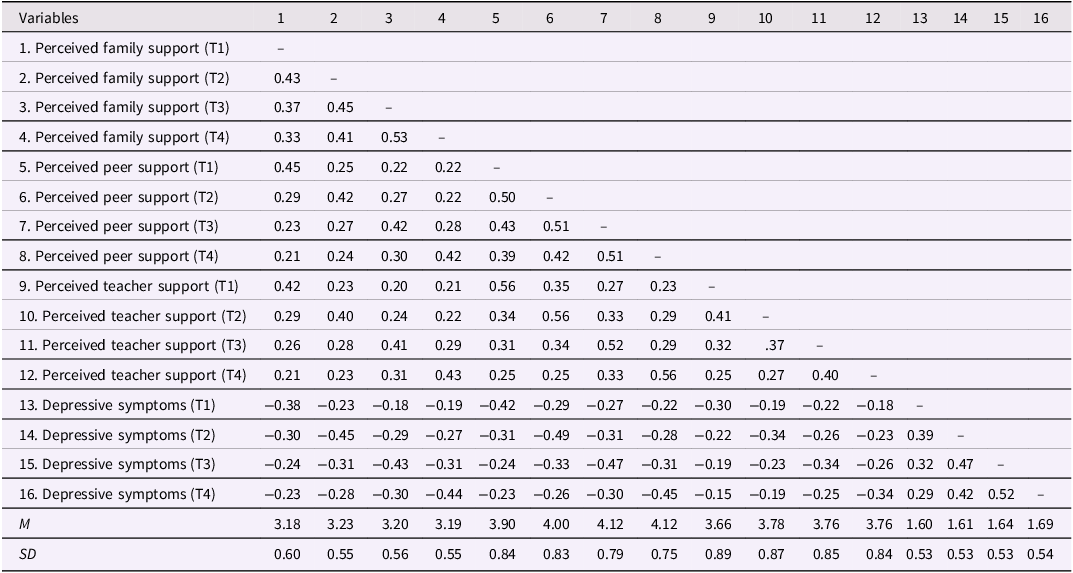
Table 1. Long description
The table presents descriptive statistics and bivariate correlations for perceived family support, perceived peer support, perceived teacher support, and depressive symptoms across four time points. It includes 16 variables and their intercorrelations. The table has 16 rows and 16 columns, with row labels and column headers indicating the specific variables and time points. Each cell contains correlation coefficients. Notable trends include significant negative correlations between perceived support (family, peer, teacher) and depressive symptoms across all time points. The means (M) and standard deviations (SD) for each variable are listed at the bottom of the table.
Note. T1 = Time 1; T2 = Time 2; T3 = Time 3; T4 = Time 4; M = mean; SD = standard deviation.
All correlation coefficients are statistically significant at p < .001.
Longitudinal measurement invariance
The measurement models for perceived family support, perceived peer support, perceived teacher support, and depressive symptoms demonstrated acceptable model fit. Model comparisons supported scalar measurement invariance across waves for all constructs (ΔCFI ≤ 0.010, ΔRMSEA ≤ 0.015; see Table 2). These results established sufficient longitudinal invariance to justify the use of the RI-CLPM to meaningfully interpret between-person differences and within-person dynamics.
Fit indices for longitudinal measurement invariance of key variables
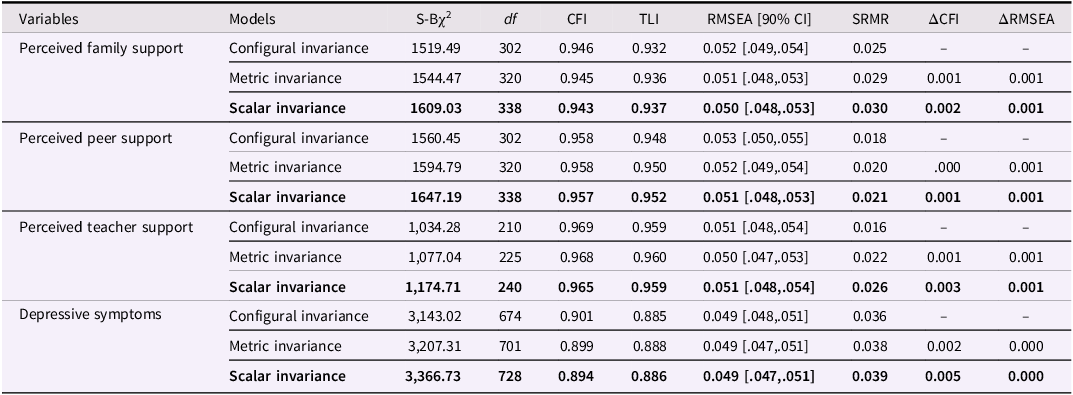
Table 2. Long description
A table comparing fit indices for longitudinal measurement invariance of key variables. The table has 4 rows and 10 columns. The columns are labeled Variables, Models, S-BY2, df, CFI, TLI, RMSEA [90% CI], SRMR, DeltaCFI, and DeltaRMSEA. The rows are labeled with different variables and their respective models. For Perceived family support, the models are Configural invariance, Metric invariance, and Scalar invariance with corresponding values. Similarly, for Perceived peer support, Perceived teacher support, and Depressive symptoms, the models and their values are listed. Each row provides specific values for S-BY2, df, CFI, TLI, RMSEA [90% CI], SRMR, DeltaCFI, and DeltaRMSEA.
Note. S-Bχ2 = Satorra–Bentler scaled chi-square; df = degrees of freedom; CFI = comparative fit index; TLI = Tucker–Lewis index; RMSEA = root mean square error of approximation; CI = confidence interval; SRMR = standardized root mean square residual. ΔCFI and ΔRMSEA were computed by subtracting the fit index value of the more constrained model from that of the less constrained model. Bolded values indicate the accepted level of measurement invariance.
Primary four-variable RI-CLPM
To account for interdependencies among multiple sources of perceived social support within a single analytical framework, an RI-CLPM including perceived family, peer, and teacher support, as well as depressive symptoms, was estimated. The model comparison results for the unconstrained and constrained RI-CLPMs are presented in Table 3. Constraining the autoregressive paths (Model 1b) or both autoregressive and cross-lagged paths (Model 1d) to be equal over time significantly reduced the model fit compared to the unconstrained model (Model 1a). However, constraining only the cross-lagged paths (Model 1c) did not significantly worsen the model fit. Therefore, based on the principle of model parsimony, Model 1c was selected as the final model for interpretation.
Model comparison and fit for the primary four-variable RI-CLPM

Table 3. Long description
The table presents a comparison of four models (M1a, M1b, M1c, M1d) of RI-CLPM, each with different constraints. It includes columns for model fit indices such as S-Bχ², df, Scaling factor, RMSEA with 90% CI, CFI, TLI, ΔS-Bχ², Δdf, Comparison model, and p-value. Row 1: M1a, 440.24, 108, 1.01, 0.045 [0.041, 0.050], 0.956, 0.918, -, -, -, -. Row 2: M1b, 476.40, 116, 1.02, 0.046 [0.041, 0.050], 0.952, 0.917, 35.75, 8, M1b vs. M1a, <.001. Row 3: M1c, 459.49, 132, 1.04, 0.041 [0.037, 0.045], 0.956, 0.934, 28.28, 24, M1c vs. M1a, .248. Row 4: M1d, 491.37, 140, 1.04, 0.041 [0.037, 0.045], 0.953, 0.933, 58.17, 32, M1d vs. M1a, .003.
Note. S-Bχ2 = Satorra–Bentler scaled chi-square; df = degrees of freedom; Scaling factor = MLR scaling correction factor; RMSEA = root mean square error of approximation; CI = confidence interval; CFI = comparative fit index; TLI = Tucker–Lewis index. M1a = baseline unconstrained model; M1b = autoregressive paths constrained to time-invariance; M1c = cross-lagged paths constrained to time-invariance; M1d = autoregressive and cross-lagged paths constrained to time-invariance. Bolded values indicate the most parsimonious model selected for interpretation.
Significant standardized estimates are shown in Figure 1, with all statistical results reported in Table 4. With respect to H1, all three sources of perceived social support were significantly related to depressive symptoms at the between-person level (rs = –0.68 to –0.63, ps < .001), and H1 was therefore supported. This indicates that adolescents who generally reported higher levels of perceived family, peer, and teacher support were more likely to report lower levels of depressive symptoms.
Standardized parameter estimates for the primary four-variable RI-CLPM
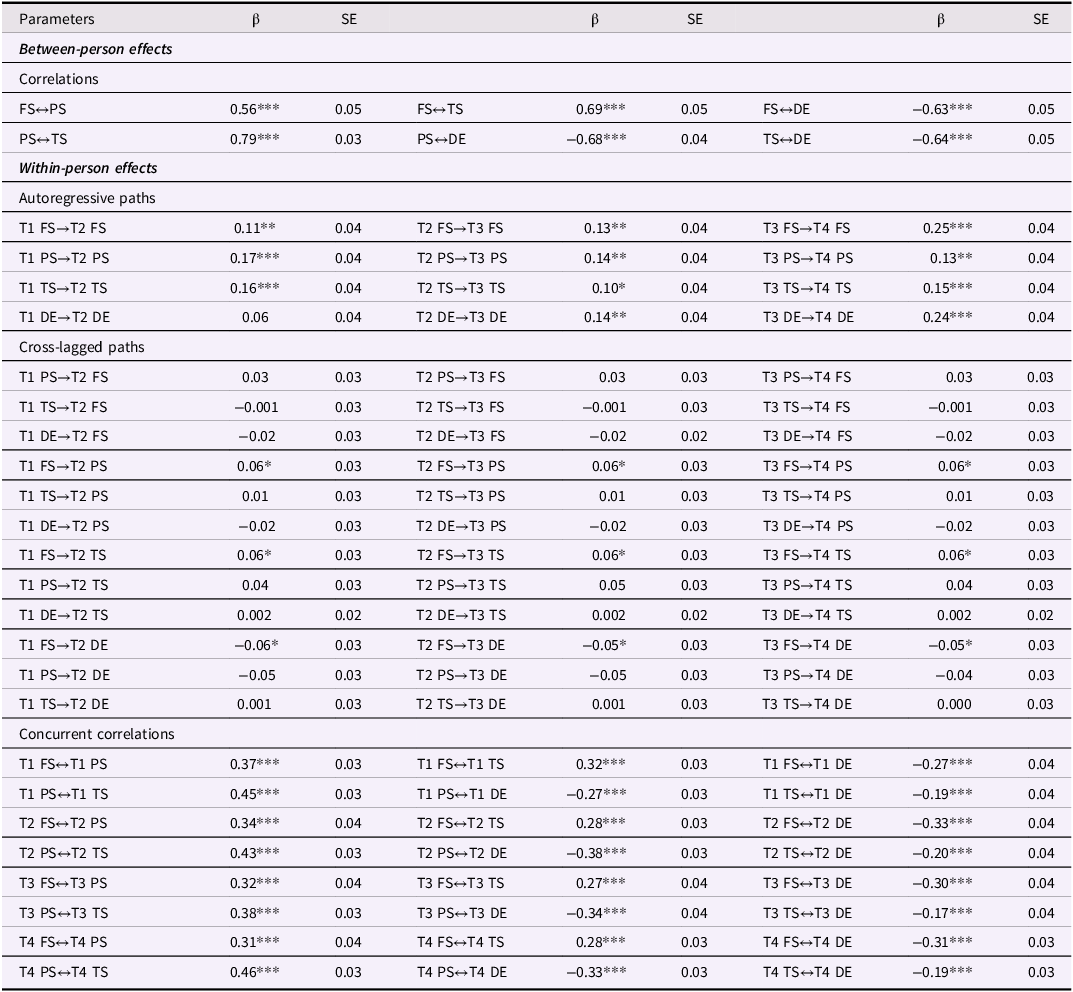
Table 4. Long description
A table with standardized parameter estimates for a four-variable RI-CLPM. The table has 30 rows and 8 columns. Column headers are Parameters, beta, SE, beta, SE, beta, and SE. Row labels include Between-person effects, Within-person effects, Autoregressive paths, Cross-lagged paths, and Concurrent correlations. Each row provides beta values and standard errors for different parameters. Notable trends include significant correlations and autoregressive paths, with specific values and standard errors listed for each parameter.
Note. FS = perceived family support; PS = perceived peer support; TS = perceived teacher support; DE = depressive symptoms; T1 = Time 1; T2 = Time 2; T3 = Time 3; T4 = Time 4. *p < .05. **p < .01. ***p < .001.
The primary four-variable RI-CLPM of perceived social support sources and depressive symptoms. Note. Solid lines represent significant paths (p < .05); dotted lines represent nonsignificant paths. Only significant standardized coefficients are displayed. FS = perceived family support; PS = perceived peer support; TS = perceived teacher support; DE = depressive symptoms; T1 = Time 1; T2 = Time 2; T3 = Time 3; T4 = Time 4.
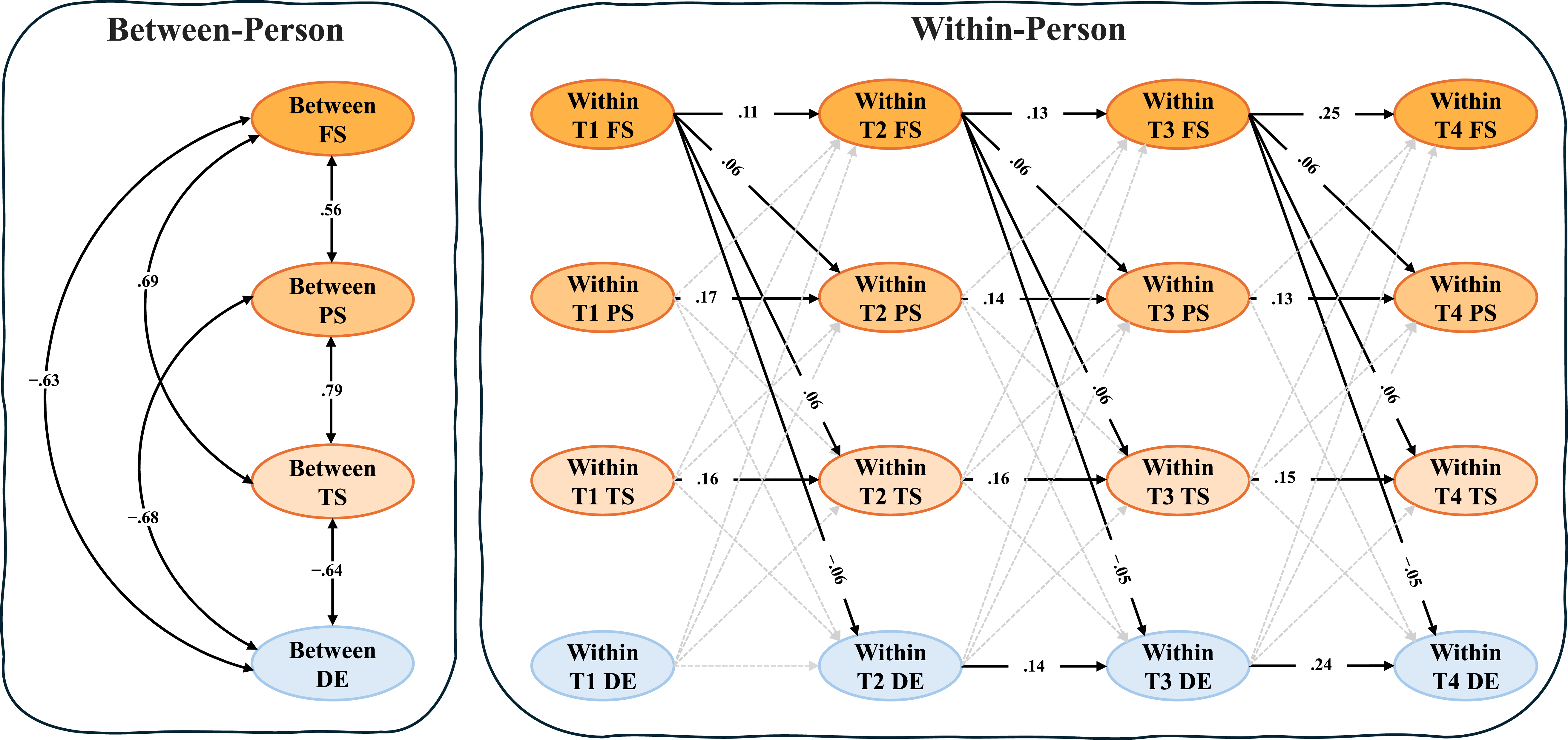
Turning to the within-person level, elevations in perceived family support at a given time point significantly predicted decreases in depressive symptoms at the subsequent time point (βs = −0.06 to −0.05, ps < .05), supporting H2 and consistent with the social causation model. This implies that at the state level, when adolescents experienced higher perceived family support relative to their own average levels, they tended to experience fewer depressive symptoms subsequently. The reverse pathway from depressive symptoms to perceived family support was not significant, further corroborating the directional specificity predicted by H2. Regarding the exploratory examination of perceived peer support, neither the forward pathway from perceived peer support to depressive symptoms nor the reverse pathway from depressive symptoms to perceived peer support reached significance in the primary four-variable model. Perceived teacher support similarly did not significantly predict depressive symptoms at the subsequent time point, and the cross-lagged paths from depressive symptoms to perceived teacher support were non-significant. With respect to both exploratory support sources, no significant within-person associations were observed in either direction in the primary model. In addition, all autoregressive effects were positive and statistically significant across perceived family support, perceived peer support, and perceived teacher support, with the exception of the autoregressive path from Time 1 to Time 2 for depressive symptoms (β = 0.06, p = .13), suggesting general within-person continuity across waves. Beyond the primary hypotheses, perceived family support also significantly predicted subsequent increases in perceived peer support (βs = 0.06, p = .03) and perceived teacher support (βs = 0.06, p = .03) at the within-person level across all waves, whereas neither perceived peer support nor perceived teacher support significantly predicted subsequent changes in other support sources.
Multigroup RI-CLPM for sex differences
As a supplementary exploratory analysis, multigroup analysis was conducted to examine potential sex differences in the longitudinal associations. When the cross-lagged paths were constrained to be equal across sex, the model comparison revealed no significant difference between the constrained and unconstrained models, ΔS-Bχ2 (12) = 10.15, p = .603. These results indicated that the within-person cross-lagged associations were invariant across sex.
Sensitivity analyses
Sensitivity analysis was conducted to assess the robustness of the estimates. Although the primary model was estimated using FIML, we utilized multiple imputation (MI) with 200 generated datasets for sensitivity testing. The results from the MI analysis yielded standardized coefficients that were virtually identical to the FIML estimates (see Table S3), suggesting that the findings are robust to different missing data handling techniques.
Supplementary bivariate RI-CLPMs
To complement the primary four-variable model and examine whether the effects of individual support sources are subject to suppression when modeled jointly, three separate bivariate RI-CLPMs were estimated. Model fit was excellent across all three models (see Table S4). Full standardized parameter estimates are reported in Table S5, and path diagrams are displayed in Figure S1.
At the between-person level, results were fully consistent with the primary model, with perceived social support from family, peers, and teachers each significantly and negatively associated with depressive symptoms across all bivariate specifications (rs = −0.69 to −0.64, ps < .001).
At the within-person level, a partial divergence from the primary model emerged. Consistent with the four-variable model, perceived family support significantly predicted subsequent reductions in depressive symptoms (βs = −0.07 to −0.06, ps < .05), further supporting H2. Notably, perceived peer support also emerged as a significant prospective predictor of lower depressive symptoms when modeled independently (βs = −0.07 to −0.06, ps < .05), an effect that was not observed in the primary four-variable model, suggesting a social causation pattern for perceived peer support under less constrained modeling conditions. This pattern suggests that the null effect of perceived peer support in the joint model likely reflects statistical suppression arising from overlapping within-person variance among support sources rather than a genuine absence of association. Perceived teacher support did not significantly predict depressive symptoms in either modeling framework. Regarding the reverse direction, depressive symptoms did not significantly predict subsequent changes in perceived support from any source across all three bivariate models.
Discussion
Understanding the longitudinal associations between perceived social support and depressive symptoms is essential for identifying modifiable protective factors among vulnerable adolescent populations, yet existing research has been constrained by the conflation of distinct support sources and the predominant reliance on between-person approaches that obscure within-person dynamics. These limitations are especially salient for South Korean multicultural adolescents, whose unique psychosocial vulnerabilities may differentially implicate each support source in ways that existing evidence cannot adequately address. The present study addressed these gaps by disaggregating perceived family, peer, and teacher support and employing RI-CLPMs to clarify the directionality of their within-person associations with depressive symptoms across four annual waves, supplemented by source-specific bivariate analyses to account for potential suppression effects. At the between-person level, all three perceived support sources were robustly and inversely associated with depressive symptoms. At the within-person level, perceived family support consistently and prospectively predicted reductions in depressive symptoms, a pattern further corroborated by bivariate analyses which additionally revealed an independent protective role of perceived peer support that was obscured when all support sources were modeled simultaneously. Depressive symptoms, however, did not predict changes in any perceived support source. The findings supported a source-specific social causation model and underscore the family system as the most strategically important intervention target for alleviating depressive risk in this vulnerable population.
Between-person associations between perceived family, peer, and teacher support and depressive symptoms
Consistent with H1, adolescents who reported higher average levels of perceived support from family, peers, and teachers also reported consistently lower average levels of depressive symptoms at the between-person level. These findings corroborate extensive research on general adolescent populations (e.g., Liang et al., Reference Liang, Gao, Tian, Xu and Liu2025; Pössel et al., Reference Pössel, Burton, Cauley, Sawyer, Spence and Sheffield2018; Ren et al., Reference Ren, Qin, Zhang and Zhang2018) and, importantly, extend the generalizability of these associations to the understudied population of South Korean multicultural adolescents, suggesting that the protective function of perceived social support operates as a universal developmental asset that transcends cultural boundaries. Despite the unique psychosocial vulnerabilities and acculturative stressors they face, multicultural adolescents appear to derive comparable psychological benefits from perceived social support networks as adolescents in ethnically homogeneous contexts. Prior research has documented that such benefits encompass enhanced emotional regulation, greater self-esteem, and reduced vulnerability to stress-induced psychological distress among general adolescent populations (Rueger et al., Reference Rueger, Malecki, Pyun, Aycock and Coyle2016; van Harmelen et al., Reference van Harmelen, Gibson, St Clair, Owens, Brodbeck, Dunn and Goodyer2016), suggesting that these protective mechanisms may similarly operate among multicultural youth. This pattern is further consistent with evidence from the same cohort, in which all three perceived support sources were similarly associated with greater life satisfaction at the between-person level (Ling et al., Reference Ling, Luo and Zhao2025), pointing to the broader relevance of perceived social support for overall well-being in this population. Collectively, these between-person findings highlight perceived social support as a stable, trait-like resource whose consistent availability across the family, peer, and school microsystems is fundamentally linked to lower depressive symptom levels among South Korean multicultural adolescents.
Within-person associations between perceived family, peer, and teacher support and depressive symptoms
Turning to the within-person level, the findings supported a source-specific social causation model (Kaniasty & Norris, Reference Kaniasty and Norris2008), with perceived family support emerging as the sole significant prospective predictor of depressive symptoms in the primary four-variable model, consistent with H2. When adolescents experienced higher perceived family support relative to their own average levels, they subsequently reported fewer depressive symptoms, whereas the reverse pathway was not significant. This directional specificity was further corroborated by the additional bivariate analyses, in which the protective effect of perceived family support was replicated with comparable magnitude. Several converging explanations account for this primacy. Drawing on attachment theory (Bowlby, Reference Bowlby1982), parental figures serve as the principal source of emotional security for developing youth, and for multicultural adolescents who frequently encounter social marginalization in external environments (Kang, Reference Kang2016), the parental bond functions as a fundamental secure base that buffers against psychological distress (Liang et al., Reference Liang, Gao, Tian, Xu and Liu2025). Although multicultural families in South Korea are ethnically diverse in origin, the prevailing Confucian-influenced host cultural norms emphasizing family cohesion and intergenerational interdependence may amplify the psychological salience of perceived family support regardless of the family’s specific cultural background (Song et al., Reference Song, Bong, Lee and Kim2015), and parental support within this context may tend toward greater unconditional availability, potentially rendering it less susceptible to erosion by adolescents’ transient mood fluctuations. A developmental perspective further contextualizes these findings, as research consistently indicates that parental figures serve as the primary source of emotional support during childhood and early adolescence, with the relative influence of peers and teachers increasing in later developmental stages (Bokhorst et al., Reference Bokhorst, Sumter and Westenberg2010; Liang et al., Reference Liang, Gao, Tian, Xu and Liu2025; Song et al., Reference Song, Bong, Lee and Kim2015). The present sample, spanning the transition from upper elementary to early middle school, represents a period in which reliance on parental support remains predominant. Beyond its direct protective function, perceived family support also prospectively predicted subsequent increases in both perceived peer support and perceived teacher support at the within-person level. This asymmetric pattern is consistent with spillover theory (Parke & Ladd, Reference Parke and Ladd2016), suggesting that positive resources originating in the family microsystem spill over into peer relationships and the school environment by fostering adolescents’ interpersonal confidence and capacity to elicit support from peers and teachers. This finding further underscores the generative centrality of the family system within the broader social ecology of multicultural adolescents.
Regarding perceived peer support, neither the forward nor the reverse pathway reached significance in the primary four-variable model. However, the additional bivariate analyses revealed that perceived peer support significantly and prospectively predicted reductions in depressive symptoms when modeled independently, a pattern consistent with the social causation model (Kaniasty & Norris, Reference Kaniasty and Norris2008). This divergence is most plausibly attributable to statistical suppression arising from substantial overlap in within-person variance between perceived family and peer support (Pössel et al., Reference Pössel, Burton, Cauley, Sawyer, Spence and Sheffield2018), suggesting that the null effect in the joint model may not reflect a genuine absence of association, and underscoring the methodological value of examining perceived support sources both simultaneously and independently. The independent protective effect of perceived peer support is theoretically consistent with the stress-buffering model, which posits that perceived social support mitigates the adverse impact of stressful experiences on depressive symptoms by providing emotional validation and a sense of social belonging (Rueger et al., Reference Rueger, Malecki, Pyun, Aycock and Coyle2016). This buffering function may be particularly consequential for multicultural adolescents, whose chronic exposure to acculturative stress and social exclusion renders them especially dependent on peer relationships as a compensatory source of psychological validation outside the family. Consistent with this reasoning, Kang et al. (Reference Kang, Min and Min2022) found that perceived peer support was a significant protective factor against depressive symptoms among South Korean multicultural adolescents, even after accounting for individual-level characteristics, providing direct empirical grounding for the present findings in this specific population. Concerning the reverse pathway, the absence of a significant effect from depressive symptoms to perceived peer support diverges from prior studies documenting symptoms-driven erosion of perceived peer support using traditional cross-lagged approaches (e.g., Krygsman & Vaillancourt, Reference Krygsman and Vaillancourt2017; Ren et al., Reference Ren, Qin, Zhang and Zhang2018; Stice et al., Reference Stice, Ragan and Randall2004). A plausible explanation is that for multicultural adolescents already embedded in a context of chronic acculturative stress and social marginalization, transient within-person elevations in depressive symptoms may not constitute a sufficiently salient additional signal to further erode peer relationships against this persistently challenging backdrop.
Perceived teacher support did not significantly predict depressive symptoms in either modeling framework, nor did depressive symptoms predict changes in perceived teacher support. The absence of a forward effect may partly reflect the culturally and institutionally structured nature of teacher–student relationships in the Korean educational context. In particular, the strong emphasis on academic achievement and examination-related demands in the Korean education system may shape the roles and forms of support that teachers provide (Kwon et al., Reference Kwon, Lee and Shin2017). As students progress into middle school, teachers’ roles may become increasingly oriented toward academic instruction and classroom management, rather than the provision of emotionally intimate or caregiver-like support. Consequently, students may interpret teachers’ caring or supportive behaviors primarily through the lens of academic guidance rather than emotional closeness. This interpretation may be particularly relevant to the present findings because items assessing perceived teacher support may capture relational or caring aspects of teacher support that are not necessarily aligned with the forms of support that are most salient in a more academically oriented school environment. Such context-specific interpretations may help explain why within-person fluctuations in perceived teacher support were not associated with corresponding changes in depressive symptoms. This possibility is also consistent with the broader view that schools function as important developmental contexts in which teachers, curricular demands, and classroom environments shape adolescents’ social–emotional experiences (Eccles & Roeser, Reference Eccles and Roeser2011), as well as with evidence that teacher emotional support may be highly context-dependent, benefiting students experiencing average to high levels of stressful events but showing no consistent protective effect across the full sample (Pössel et al., Reference Pössel, Rudasill, Sawyer, Spence and Bjerg2013). Moreover, multicultural adolescents may additionally encounter acculturative stressors and implicit biases within school environments (Li & Yang, Reference Li and Yang2026; Liang et al., Reference Liang, Gao, Tian, Xu and Liu2025). The absence of a reverse effect is consistent with Ren et al. (Reference Ren, Qin, Zhang and Zhang2018) and may likewise reflect the relatively institutionally structured nature of teacher–student relationships, which may make perceived teacher support less responsive to adolescents’ transient mood states.
Across all three perceived support sources, depressive symptoms consistently failed to predict subsequent changes in perceived support at the within-person level, a pattern that warrants careful interpretation. Prior studies employing traditional cross-lagged panel models have reported symptoms-driven effects (e.g., Burns et al., Reference Burns, Deschênes and Schmitz2016; Ren et al., Reference Ren, Qin, Zhang and Zhang2018; Stice et al., Reference Stice, Ragan and Randall2004), yet the present study found no such effects after rigorously decomposing stable between-person differences from dynamic within-person fluctuations via the RI-CLPM, suggesting that symptoms-driven effects in prior research may have partly reflected stable individual differences whereby chronically more depressed individuals also tend to perceive less social support, rather than genuine dynamic within-person processes. Beyond this analytical consideration, the timescale of measurement may offer a further explanation. Boele et al. (Reference Boele, Nelemans, Denissen, Prinzie, Bülow and Keijsers2023) demonstrated that the erosion of perceived parental support by adolescent depressive symptoms was detectable at biweekly and three-monthly intervals but not at the annual timescale, and Bülow et al. (Reference Bülow, Boele, Lougheed, Denissen, van Roekel and Keijsers2025) similarly found that depressive symptoms predicted parent–adolescent conflict over weeks rather than months. The annual measurement interval employed in the present study may therefore fall outside the temporal window within which symptoms-driven erosion of perceived social support is detectable. It is further possible that some of these null effects reflect heterogeneity in within-person dynamics across individuals, such that meaningful effects present for specific subgroups may not be detectable at the sample average level.
The multigroup analysis indicated that all within-person cross-lagged pathways were invariant across sex, suggesting that the source-specific social causation pattern generalizes equivalently to both male and female multicultural adolescents and that the family system functions as an equally central protective resource regardless of sex, despite documented sex differences in depressive symptom levels in this population (Li & Yang, Reference Li and Yang2026).
Strengths, limitations, and future directions
The present study possesses several noteworthy strengths. First, the utilization of a four-wave longitudinal design combined with the RI-CLPM represents a significant methodological advancement. By strictly disentangling stable between-person traits from dynamic within-person processes, this approach provides a more precise estimation of the directional associations between perceived social support and depressive symptoms than traditional cross-lagged panel models. Second, this study is among the first to longitudinally differentiate the within-person effects of perceived family, peer, and teacher support within this vulnerable population, offering critical empirical evidence for a source-specific social causation model and identifying perceived family support as the primary within-person protective factor against depressive symptoms among South Korean multicultural adolescents. Finally, the reliance on a large, nationally representative sample enhances the ecological validity and generalizability of our findings. Given the rapid growth of this multicultural population and its continued underrepresentation in psychological research, these findings provide timely, culturally specific insights to inform the development of targeted interventions.
Despite these strengths, several limitations should be acknowledged. First, perceived social support was assessed exclusively through adolescent self-reports, and future research should incorporate multi-informant assessments, such as reports from parents and teachers, to provide a more objective evaluation of adolescents’ support systems. A related but conceptually distinct limitation concerns the exclusive focus on perceived rather than received social support. Given that these two constructs show divergent associations with psychological outcomes, with perceived support being more consistently linked to positive mental health whereas received support can have both beneficial and adverse effects depending on context (Zee et al., Reference Zee, Bolger and Higgins2020), future research examining received family, peer, and teacher support may yield different directional patterns, and would provide a more comprehensive picture of the support-depression relationship in multicultural adolescent populations.
Second, the RI-CLPM captures average within-person effects at the sample level, which necessarily neglects the heterogeneity that may exist between individuals. This consideration is particularly relevant for interpreting the consistently null findings observed for perceived teacher support across both modeling frameworks, as well as the absence of symptoms-driven effects across all perceived support sources. As Bolger et al. (Reference Bolger, Zee, Rossignac-Milon and Hassin2019) demonstrated, causal processes in psychology are often heterogeneous, such that positive and negative within-person effects may cancel out at the aggregate level, potentially obscuring meaningful effects for specific subgroups of multicultural adolescents. Theoretically, each adolescent may be characterized by their own unique dynamic system shaped by their specific acculturation experiences and social contexts, and recent empirical work supports this idiographic nature of social dynamics (Boele et al., Reference Boele, Bülow, Beltz, de Haan, Denissen, de Moor and Keijsers2024). Future research employing person-centered approaches or dynamic structural equation modeling would be valuable for examining whether perceived teacher support plays a more prominent protective role for particular subgroups, and whether symptoms-driven erosion of perceived support operates within specific subpopulations that are obscured in aggregate analyses (Kuper et al., Reference Kuper, Andresen, Beck, Costantini, Hamaker, Wright and Zimmermann2025).
Third, this study focused solely on the direct associations between perceived social support and depressive symptoms, without exploring underlying mediating mechanisms. Elucidating the psychological pathways through which perceived family support influences depressive symptoms would provide deeper insight into the processes underpinning the source-specific social causation pattern identified here. Future research incorporating potential mediators such as emotion regulation, coping strategies, and self-efficacy would contribute to a more complete theoretical account of these associations.
Fourth, the present study utilized an annual panel dataset, which is well-suited for examining longitudinal associations over longer developmental periods but captures only one temporal resolution of a phenomenon that may unfold across multiple timescales. The findings are therefore most applicable to the annual timescale and may not generalize to shorter-term dynamics. Psychological adaptation processes are likely to occur across a range of temporal resolutions, from day-to-day fluctuations to long-term developmental trajectories (Neubauer & Schmiedek, Reference Neubauer and Schmiedek2024), and the associations between perceived social support and depressive symptoms among multicultural adolescents may manifest differently at finer temporal resolutions. Future research combining panel designs with intensive longitudinal components, such as the measurement burst design (Hamaker & Berkhout, Reference Hamaker and Berkhout2025), which integrates short-term intraindividual variation with long-term intraindividual change within a unified framework, would provide a more comprehensive understanding of how perceived social support shapes depressive symptom dynamics across multiple timescales in this population.
Finally, although the present study examined sex as a potential moderator of within-person cross-lagged pathways through multigroup analyses and found these pathways to be invariant across sex, it did not fully capture the structural diversity inherent to the multicultural family context. Factors such as the foreign-born parent’s country of origin and generational status may moderate the associations between perceived social support and depressive symptoms by shaping the cultural norms and relational dynamics within which parental and peer support are enacted. Future research explicitly examining these within-group variations would provide a more nuanced understanding of the boundary conditions of the source-specific social causation pattern identified in the present study.
Implications
The present findings carry important theoretical and practical implications. Theoretically, the application of the RI-CLPM enabled a rigorous empirical test of three directional models. The results provide support for a source-specific social causation model, identifying perceived family support as the primary within-person protective factor against depressive symptoms among South Korean multicultural adolescents, while yielding no evidence for symptoms-driven or transactional processes across any perceived support source. Notably, further bivariate analyses revealed an independent protective role of perceived peer support that was obscured by statistical suppression in the joint model, suggesting that the social causation pattern extends beyond the family domain under less constrained modeling conditions. Together, these findings advance theoretical understanding of the boundary conditions of the social causation model and underscore the importance of source-specific, within-person analytical approaches for disentangling the directionality of support-depression associations in minority adolescent populations.
Practically, the primacy of perceived family support as the proximal driver of depressive symptom reduction highlights family-centered intervention as the most strategically important target for alleviating depressive risk in this population. Structured family skills training programs represent a promising avenue for strengthening the quality of parent–child relationships and enhancing parents’ capacity to provide consistent emotional support within multicultural family contexts. The Strengthening Families Program (SFP; Kumpfer et al., Reference Kumpfer, Alvarado, Tait, Whiteside, Tolan, Szapocznik and Sambrano2007), an evidence-based multicomponent intervention that targets parenting skills, parent–child communication, and family relationship quality across diverse family populations, exemplifies this approach and has demonstrated sustained positive effects on family functioning and child adjustment across long-term follow-ups. Beyond the family domain, the independent protective function of perceived peer support identified in the further bivariate analyses suggests that peer-inclusive approaches warrant consideration as a complementary intervention strategy, particularly if implemented within school settings where acculturative barriers to peer relationship formation can be simultaneously addressed. Critically, the finding that perceived family support prospectively predicted subsequent increases in both perceived peer and teacher support at the within-person level implies that strengthening the family foundation may generate positive spillover effects across adolescents’ broader social support networks, further reinforcing the strategic priority of family-centered intervention as the entry point for comprehensive support enhancement among multicultural youth.
Conclusion
The present four-wave longitudinal study examined whether the associations between perceived family, peer, and teacher support and depressive symptoms among South Korean multicultural adolescents are best characterized by the transactional, social causation, or symptoms-driven model, addressing a critical gap in the literature by rigorously decomposing stable between-person differences from dynamic within-person processes via the RI-CLPM. At the between-person level, all three perceived support sources were robustly and inversely associated with depressive symptoms across both the joint and bivariate models, suggesting that perceived social support serves as a stable trait-like protective resource for this underrepresented population, consistent with findings in general adolescent samples. At the within-person level, the findings supported a source-specific social causation model, wherein perceived family support consistently and prospectively predicted reductions in depressive symptoms, whereas depressive symptoms did not predict subsequent changes in perceived support from any source. Further bivariate analyses revealed that perceived peer support also emerged as a significant prospective predictor of lower depressive symptoms when modeled independently, an effect most plausibly attributable to overlapping within-person variance between perceived family and peer support in the joint model rather than a genuine absence of association, indicating that the social causation pattern extends beyond the family domain under less constrained modeling conditions. These within-person pathways were invariant across sex. Beyond serving as a direct buffer against depressive symptoms, perceived family support also prospectively predicted subsequent increases in both perceived peer and teacher support at the within-person level, suggesting that the family system further operates as a generative foundation for adolescents’ broader social support networks. Collectively, these findings position perceived family support as the primary proximal protective factor against depressive symptoms in this population, with perceived peer support representing a secondary yet genuine protective resource whose independent contribution warrants targeted attention. These findings underscore the need for family-centered interventions as the strategic entry point for alleviating depressive risk among multicultural adolescents, while highlighting the timescale dependency of support-depression dynamics as an important direction for future theoretical development and empirical investigation.
Supplementary material
The supplementary material for this article can be found at https://doi.org/10.1017/S0954579426102028.
Data availability statement
The data used in this study cannot be publicly shared by the authors due to user agreement restrictions. Researchers can request access to the original data directly from the National Youth Policy Institute (NYPI) archive (www.nypi.re.kr/archive). The Mplus syntax files used for all analyses are publicly available on the Open Science Framework at https://osf.io/jc4sd/overview.
Acknowledgments
The authors thank all the adolescents and parents who participated in the Multicultural Adolescents Panel Study (MPAS).
Funding statement
This research received no specific grant from any funding agency, commercial or not-for-profit sectors.
Competing interests
The author(s) declare none.
Ethical standards
The MAPS data collection was approved by the Institutional Review Board of the NYPI. As the present study involved secondary data analysis of publicly available, de-identified data, it was exempt from further ethical review.
Pre-registration statement
This study involved the secondary analysis of an existing, publicly available dataset for which data collection had been completed prior to the present investigation. As such, prospective preregistration was not conducted.
Participants’ consent statement
Participation was voluntary, and informed consent was obtained by the NYPI from all participants and their legal guardians.
AI statement
Artificial intelligence was not used in this manuscript.
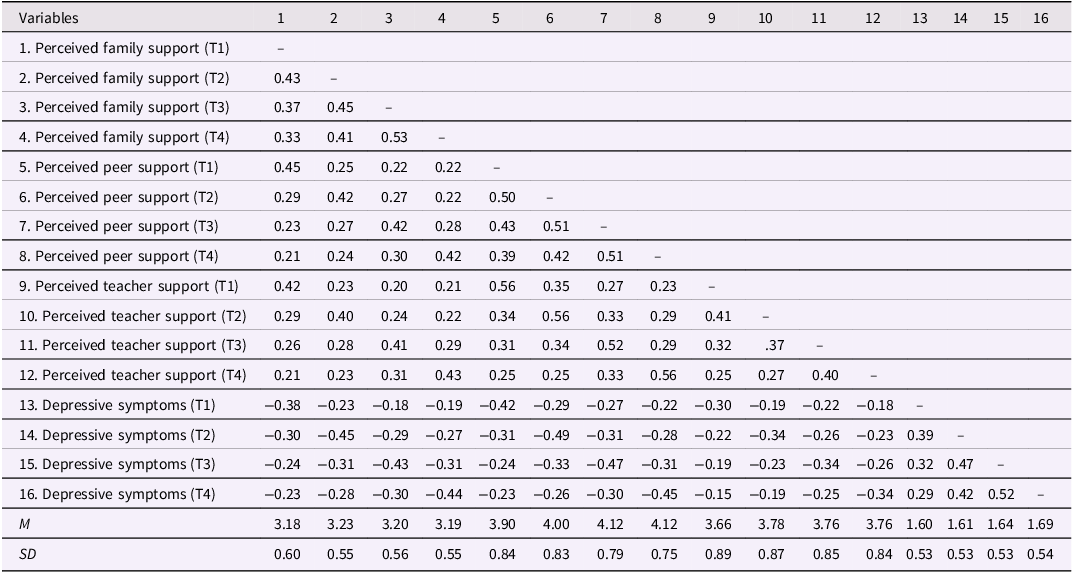
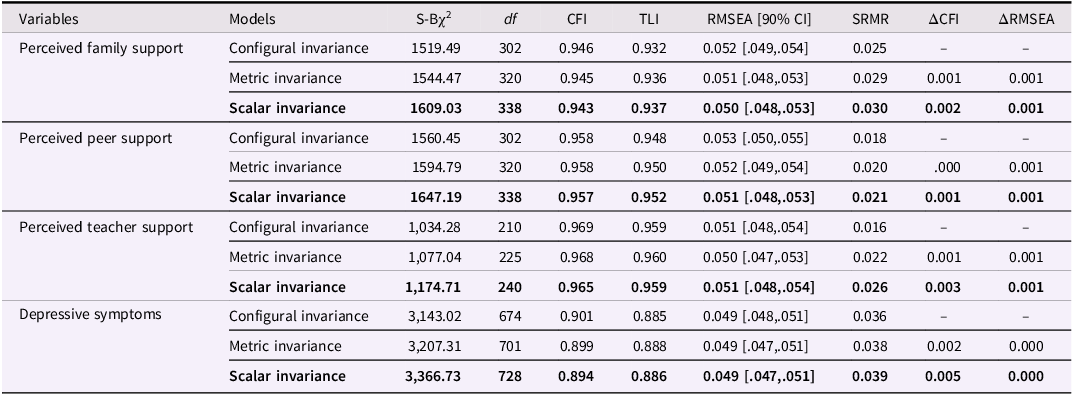

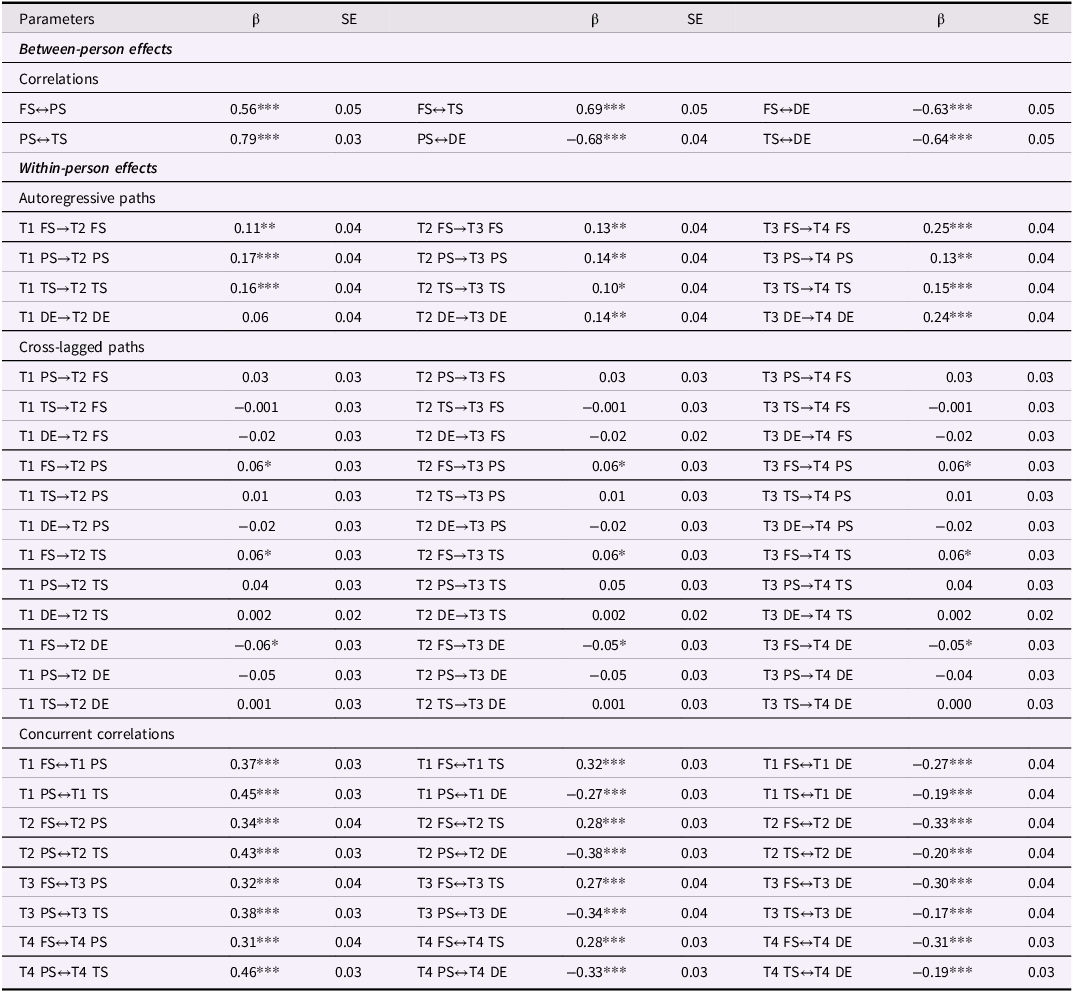


 Open access

