Over the past decade, there has been an increase in natural disaster events across Australia, including the 2009 Black Saturday bushfires, the 2014 Victorian Heat Wave, the 2019-2020 bushfires along the southeast coast of Australia, and the COVID-19 pandemic. 1 , Reference Hammad, Arbon and Gebbie 2 Unfortunately, this is not isolated to Australia, with similar trends occurring worldwide. Examples of these include the 2023 Canada wildfires, the 2020 Philippine typhoon and floods, and the 2020 hurricane season across the US.Reference Noh, Oh and Kim 3 –Reference Al Harthi, Al Thobaity and Al Ahmari 5 Alarmingly, the frequency and intensity of natural disasters in Australia, and globally, is predicted to increase due to climate change. 1 Emergency department nurses must be adequately prepared to respond to emergency disaster incidents now and into the future.Reference Hammad, Arbon and Gebbie 2 , Reference Duong 6 , Reference Brinjee, Al Thobaity and Almalki 7
Internationally, the nursing workforce is the largest in the health care sector and ED nurses are at the front line of a hospital’s disaster response.Reference Hammad, Arbon and Gebbie 2 , Reference Al Harthi, Al Thobaity and Al Ahmari 5 , Reference Labrague, Hammad and Gloe 8 Nurses are a vital resource of health emergency disaster management systems.Reference Duong 6 , 9 –Reference Park and Kim 11 Despite this role, ED nurses’ have reported being under prepared to respond to emergency disaster incidents.Reference Brewer, Hutton and Hammad 12 –Reference Ranse, Ituma and Bail 14 A lack of preparedness could be due to a deficit in specific emergency disaster incident response education and training that is appropriate and relevant to ED nurses.Reference Hammad, Arbon and Gebbie 2 Compounding this situation is that over half of ED nurses report having limited lived experience responding to a disaster event.Reference Hammad, Arbon and Gebbie 2
Throughout health emergency management literature, the definition of disaster is varied.Reference Hammad, Arbon and Gebbie 2 , Reference Labrague, Hammad and Gloe 8 For this study, disaster is defined as “what is beyond current arrangements, thinking, experience, and imagination that has overwhelmed our technical and non-technical social systems and resources, and has degraded or disabled governance structures and strategic and operational decision-making functions.9(p.17) There is agreement that an effective response to emergency disaster events involves 4 phases of disaster management.Reference Al Harthi, Al Thobaity and Al Ahmari 5 , 9 These phases include planning, preparedness, response, and recovery.Reference Al Harthi, Al Thobaity and Al Ahmari 5 , 9 Disaster preparedness, for the purpose of this study, refers to ED nurses having adequate confidence and knowledge to appropriately respond to the health consequences of an emergency disaster incident.Reference Hammad, Arbon and Gebbie 2 , Reference Duong 6 , Reference Labrague, Hammad and Gloe 8 , Reference Chapman and Arbon 10
The disaster management cycle highlights the strong correlation between responders being adequately prepared and their ability to appropriately respond to emergency disaster incidents. 1 , 9 Education (formal theory and content knowledge) and training (skill acquisition and development) have been identified as key strategies to increase preparedness.Reference Noh, Oh and Kim 3 In Australia, as in other parts of the world, there is minimal emergency disaster incident response education within undergraduate nursing degrees, leaving hospitals to address the gap in preparedness within the clinical setting.Reference Ranse, Ituma and Bail 14 Furthermore, Australian hospital accreditation bodies require staff to complete annual mandatory training regarding emergency response.Reference Hammad, Arbon and Gebbie 2 , 15 This is usually delivered online and explores an organization’s approach to both internal and major external emergency disaster incidents.Reference Brinjee, Al Thobaity and Almalki 7 , Reference Chapman and Arbon 10 , Reference Park and Kim 11 This approach has been identified as the most common form of emergency disaster incident response education for ED nurses and the only minimum required education on this specific topic.Reference Hammad, Arbon and Gebbie 2 , Reference Duong 6
Disaster nursing is a relatively new specialty with limited education programs to support preparedness to respond to incidents.Reference Al Harthi, Al Thobaity and Al Ahmari 5 , Reference Ranse, Hammad and Ranse 16 –Reference Verheul and Dückers 19 A low number of ED nurses have reported completing post graduate tertiary level education, such as master’s degrees in emergency management and disaster response, to increase their theoretical knowledge.6.8 Additionally, low numbers of ED nurses have completed a range of internationally recognized training programs, such as the Major Incident Medical Management Support (MIMMS) and EMERGO TRAIN System exercises.Reference Hammad, Arbon and Gebbie 2 , Reference Duong 6 , 20 During these programs, participants can learn and practice applying specific role-based skills in preparedness to respond to incidents.Reference Hammad, Arbon and Gebbie 2 , Reference Duong 6 , Reference Ranse, Hammad and Ranse 16 –Reference Hammad, Arbon and Gebbie 17
Current formal education opportunities that target emergency disaster incident response preparedness are sparse. Organizations need to identify new and innovative ways of providing training to ED nurses in the clinical setting to ensure that this vital workforce is appropriately prepared to respond to emergency disaster incidents.
Aim
The purpose of this study was to evaluate if a practical face-to-face disaster response training program delivered in the clinical setting would improve ED nurses self-reported confidence and assessed knowledge to respond to emergency disaster incidents. The primary outcomes of the study were to evaluate ED nurses’ self-reported confidence level and ED nurses’ assessed knowledge regarding emergency disaster incident response.
Methods
Study Design
A single site prospective pre-test, post-test randomized controlled trial was adopted for this study. The study was registered with the Australian & New Zealand Clinical Trials Registry (ACTRN12620000775910). The trial had 2 arms (Figure 1). Following enrolment into the study, all subjects completed the pre-test survey and then completed the organization standardized annual mandatory online emergency disaster incident response training.
Study design.

The mandatory online training was already developed by the organization and required all employees to work through several self-paced modules. This training explored both internal and external major incidents including fire, power outages, patient surge/mass casualty, and chemical biological and radiation (CBR) incident responses. Participants on average across the organization only took approximately 30 minutes to complete this training. Knowledge and comprehension of the content was assessed using 10 multiple choice questions with a pass rate of 100% required to satisfactorily pass the online training.
Following completion of the online training, the intervention group participated in the structured face-to-face emergency disaster incident response training program. All subjects completed the post-test survey, identical to the pre-test survey, 1-month after the intervention. This timeframe was chosen as it is consistent with recommendations for education assessment and measurement.Reference Brown, Irving and Keegan 21
Ethical considerations
This study was approved by the local Human Research Ethics Committee (755/19) and conformed to the National Statement on Ethical Conduct in Research Involving Humans by the National Health and Medical Research Council of Australia. 22
Setting
This study occurred in 1 metropolitan health service in Melbourne, Australia. The health service has 2 EDs. At the time of the study, the largest of the EDs treats more than 64 000 emergency presentations per year and is 1 of the 3 major trauma receiving hospitals in Victoria, Australia. The smaller community-based ED treats over 30 000 patients annually. This study involved only subjects working in the larger ED due to challenges with COVID-19 restrictions limiting cross-campus training.
Sample
As ED nurses´ knowledge, confidence, and experience were being sought, purposive sampling was deemed appropriate for this study.Reference McDonagh, Ferguson, Whitehead, Ferguson, LoBiondo-Wood and Haber 23 Power calculations were performed to identify the sample size for demonstrating a difference in the percentage of subjects achieving a satisfactory post-test score of 50% (alpha of 0.05 and power of 0.8). For this to occur, each group required 49 subjects. Fifty-five subjects per group were targeted to accommodate a 10% drop out rate.
Recruitment
An introductory email seeking expressions of interest to participate in the study was sent to all nurses employed in the ED via their work email account. Emergency nurses expressing interest via email response and who met the inclusion and exclusion criteria listed below were consented and recruited into the study.
Inclusion criteria. Registered nurses employed at the study site ED either in a part-time or full-time capacity.
Exclusion criteria. Nurses working at the study site ED on a casual basis; new registered nurses who commenced employment in the ED once the intervention had commenced; and nurses who had extended periods of planned leave (e.g., long service and parental leave) during the implementation phase of the intervention.
Randomization and blinding
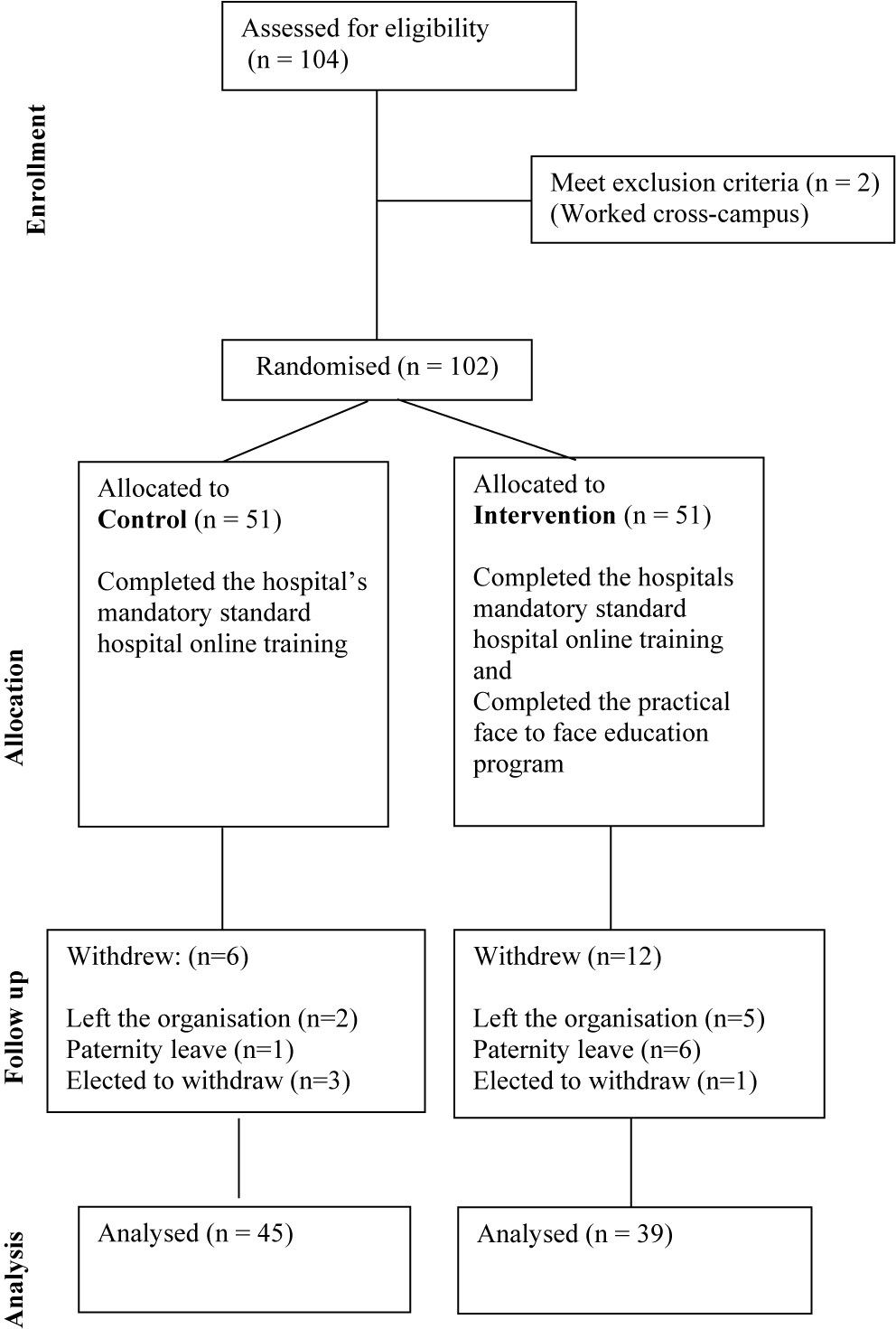
A total of 102 subjects were enrolled in the study in January 2020. Subjects were blinded by a unique study identification number before being randomized. Using a 1:1 ratio, subjects were allocated a number based on when they expressed interest to participate in the study. Those with an odd number were allocated to the control group and even numbers allocated to the intervention group. Two subjects were excluded due to working in the smaller ED. The data analyst was blinded to randomization groups for the primary analysis. Members of the investigative team were blinded to the randomization process. The consort diagram in Figure 2 illustrates the randomization process.
Consort RCT diagram.

Intervention
Those randomized to the intervention group were required to participate in a face-to-face practical 3-part education program during nursing in-service time. The intervention was developed by the investigation team. Three members of the team were subject matter experts with formal qualifications in both education and emergency disaster incident response management. These team members also had lived experience in health emergency disaster incident response preparedness and response. Although not widely validated, the program was peer reviewed by external colleagues who held formal qualifications in the field.
The intervention followed FitzGerald and colleagues’ proposed Australian National Standard for Disaster Education Program and targeted levels 2 and 3 of the frameworks.Reference FitzGerald, Aitken and Arbon 24 This focused on health workers awareness of principles of health emergency disaster incident response management and reviewed key knowledge and skills that are required of clinicians who will be directly involved in an emergency disaster incident response. 15 , Reference McDonagh, Ferguson, Whitehead, Ferguson, LoBiondo-Wood and Haber 23 Specific content and conceptual knowledge delivered in the program focused on 3 main topics (i.e. disaster triage, patient surge mass casualty incidents, and CBR response), which were identified in the literature as being important aspects of ED emergency disaster incident response.Reference Hammad, Arbon and Gebbie 2 , Reference Duong 6 , Reference Chapman and Arbon 10 , Reference Hammad, Arbon and Gebbie 17 , Reference Elgie, Sapien and Fullerton 25 Each topic had a dedicated practical face-to-face session developed that focused on the knowledge and skills required in emergency disaster response for ED nurses. Key aspects of validated health emergency disaster incident response management principles and frameworks that are vital to these responses were also included in the program, such as command, control, and communication.Reference Duong 6 , Reference Chapman and Arbon 10 , Reference Hammad, Arbon and Gebbie 17
Program development was guided by Bloom’s taxonomy, which outlines a process of learning that starts at the fundamental levels of knowing and understanding, progressing to application and analysis, and ending with evaluating and creating. Reference Amberson, Wells and Gossman 4 , Reference Al Harthi, Al Thobaity and Al Ahmari 5 , Reference FitzGerald, Aitken and Arbon 24 , Reference Elgie, Sapien and Fullerton 25 –Reference Berragan 31 This was further built upon using Kolb’sReference Kolb 26 constructivist experiential theory to learning, where students were provided a concrete experience to build upon; the students participated in reflective observation, abstract conceptualization, and active participation.Reference Sonneborn, Miller and Head 27 , Reference Saiboon, Jaafar and Harunarashid 28 Applying the above learning and teaching approaches, each session commenced with a 30-minute presentation where subjects could acquire foundational concepts and skills relating to the topic of focus. Subjects were then able to consolidate and apply this learning in an interactive practical hands-on simulation that ran for 60 minutes. Activities ranged from case studies of mass casualty trauma patients who required triage sieve and sort, a tabletop exercise where subjects assumed specific response roles and responded to a patient surge mass casualty scenario relating to a heatwave, and a response where subjects set up a decontamination area with level C PPE donning and doffing to support a CBR response scenario. Further details outlining session objectives and key content can be found in Table 1.
Practical face-to-face disaster education learning objectives

CBR = Chemical Biological and Radiation; ED = Emergency Department; MIMMS = Major Incident Medical Management Support; PPE = Personal Protective Equipment.
There was no formal debrief or after-action review undertaken following completion of the interventions, apart from a psychological safety check-in. Although subjects could only attend each of the 3 sessions once, each session was repeated on 3 separate occasions over a 3-week period to ensure all subjects in the intervention group could attend each session. The program was delivered over a 12-month period.
Intervention assessment
To establish base-line self-reported confidence and assessed knowledge of ED nurses, all subjects were asked to complete a pre-test survey following enrolment into the study. An existing validated survey tool that accurately assessed both knowledge and confidence of ED nurses in the Australian context was unable to be found. Therefore, drawing on current evidence and assessment principles, a survey tool was developed by the investigation team to assess subjects’ emergency disaster incident response confidence and knowledge.
The survey was divided into 3 sections and subjects were allocated 40 minutes to complete. Part A of the survey included 9 items relating to demographic data including, level of nursing experience, education, and previous exposure to emergency disaster incident responses. Part B assessed confidence levels, subjects were asked to self-report their confidence to respond to emergency disaster incident response via 9 statements using a 5-point Likert scale - where 1 was strongly disagree and 5 was strongly agree. Subjects could achieve an overall individual confidence score between 9 (low confidence) and 45 (high confidence).
Part C assessed participant knowledge of emergency disaster incident response via 11 multiple choice questions that related to key concepts of disaster triage, patient surge, and CBR response as identified in the literature and emergency disaster incident response management doctrines, such as MIMMS. 20 The questions assessed subjects’ knowledge, comprehension, and application of skills. Questions were deemed correct or incorrect based on the answer guide developed by the investigation team. A pass rate was deemed as 50% correct answers out of a possible 11 questions. These were graded by the investigation team and an independent reviewer. Once developed, the survey was sent to 10 experienced ED nurses, not involved in the study, to assess face and content validity and to complete pilot testing prior to implementation. No changes where required to the survey tool following pilot testing.
Data collection
Data collection for this study occurred via the survey that was delivered using the electronic REDCaps platform. 32 REDCaps is a secure web application that is housed on a server at the organization where the study was conducted. 32 Subjects completed the pre-test and post-test surveys in REDCaps. Access to the REDCaps database was restricted to the research team.
Data Analysis
Data were analysed using descriptive statistics and central tendencies (mean and standard deviation (SD)). Median and interquartile range (IQR) were used for any skewed data. Frequency of data were presented as a percentage (%). Spearman’s co-efficient was used to determine effect association and effect size. A P value of less than 0.05 was considered to be statistically significant.
Results
Demographics
Participant characteristics are presented in Table 2. A total of 102 subjects were enrolled and randomized into the study. Eighteen subjects withdrew from the study due to being redeployed to other clinical areas out of the ED during the COVID-19 pandemic or resigned during the study period. In total, 84 subjects completed the study, 45 in the control group and 39 in the intervention group. In the control group 89% (n = 40) of subjects were female, and 11% (n = 5) were male. The mean age of subjects in the control group was 33 years (SD = 9). In the intervention group, 95% (n = 37) of subjects were female and 5% (n = 2) were male, with a mean age of 31 years (SD = 8).
Demographic data

ANM = Associate Nurse Manager, CNE = Clinical Nurse Educator, CNS = Clinical Nurse Specialist, ED = Emergency Department, IQR = Interquartile Range, NP = Nurse Practitioner, SD = Standard Deviation.
Subjects in the control group had a mean of 2 (SD = 1) years’ total experience as a registered nurse, and 1 (SD = 1) year experience working in an ED setting. Similarly, the intervention group had a mean of 2 (SD = 1.2) years’ total experience as a registered nurse, and 2 (SD = 1) years’ experience working in the ED setting.
The control group had a greater number of subjects who held a qualification higher than a bachelor’s degree, indicated by the number of trained critical care registered nurses (36%, n = 16) and clinical nurse specialists (11%, n = 5) when compared to the intervention group (18%, n = 7; 8%, n = 3, respectively). Over half of the intervention group held a bachelor level qualification as their highest level of education (56%, n = 22). Both groups had limited emergency disaster incident response experience, with subjects in the control group indicating they had responded to a median of 1 (IQR = 0-2) emergency disaster incidents in the past and the intervention group responding to a median of 0 (IQR = 0-2) events. Likewise, subjects in the control group had completed a median of 1 (IQR = 0-2) formal emergency disaster incident response education sessions; the control group, 1 (IQR = 1-1).
Self-reported Confidence
Data relating to subjects self-reported confidence levels pre-test and post-test are presented in Table 3. The intervention group had an increase in the mean confidence score from 21 (SD = 6) pre-test to 36 (SD = 4) post-test. This is compared to the control group that had an increase in mean confidence score from 22 (SD = 5) pre-test to 25 (SD = 6) post-test. On comparison, the intervention group had a higher mean confidence score change of 15 (SD = 5) points compared to 3 (SD = 4) points in the control group. Using medians, there was a difference (P<0.001) in post-test median confidence score of 10 of 45. The difference was 36 in the intervention group and 26 in the control group.
Confidence and knowledge difference between control and study group

IQR = Interquartile Range, SD = Standard Deviation.
The intervention group also had a higher increase in the proportion of subjects who achieved a total confidence score of greater than 50% between the pre-test and post-test. This was from 44% (n = 17) of subjects pre-test to 100% (n = 39) post-test. The control group had an increase from 44% (n = 20) pre-test to 62% (n = 28) post-test. This amounts to a significant difference (P < 0.001) in the proportion of subjects who reached satisfactory levels of confidence post-test (difference of 38%, 95% CI: 48 to 76%) with 100% achieving satisfactory levels of post-test confidence in the intervention group and 62% in the control group. There was a strong correlation (0.77, P < 0.001) between the intervention and control groups post-test confidence using spearman’s correlation coefficient.
Assessed Knowledge
The intervention group had an increase in mean assessed knowledge score from 4 (SD = 2) pre-test to 7 (SD = 1) post-test. The control group had a smaller increase in mean confidence score from 5 (SD = 2) pre-test to 6 (SD = 2) post-test. The intervention group had a greater mean knowledge score change of 3 (SD = 2) points compared to 1 (SD = 2) in the control group. Using medians, there was a difference (P<0.001) in post-test median knowledge score of 2 out of 11. The difference was 7 in the intervention group and 5 in the control group.
The proportion of subjects in the intervention group who achieved a pass knowledge score (greater than 50% of the possible score) increased from 15.3% (n = 6) pre-test to 79.4% (n = 31) post-test. The control group increased from 31.1% (n = 14) to 44.4% (n = 20) post-test. Refer to table 3 for assessed knowledge results. This amounts to a significant difference (P = 0.001) in the proportion of subjects who reached satisfactory levels of knowledge post-test (difference of 35%, 95% CI: 16 to 54%) with 79% achieving satisfactory levels of post-test knowledge in the intervention group and 44% in the control group. There was a relatively weak (0.35, P = 0.001) but real correlation between the intervention and control groups knowledge using Spearman correlation coefficient.
Performance of the Survey Tool
The level of agreement for the survey between the 2 randomly selected groups at baseline was determined. Specifically, for the pre-test of self-reported confidence, the median scores for the 2 groups of 45 were 21 and 22 (a difference in medians of 1), with a P value of 0.39. In comparing the proportion of subjects who achieved an overall satisfactory self-reported confidence score (>50%) between the 2 groups at baseline, there was a small and non-statistically significant difference of 1% (95% CI: −20 to +22%).
For the pre-test of assessed knowledge, the median scores for the 2 groups of 11 were 5 and 4 (a difference in medians of 1), with a P value of 0.09. In comparing the proportions of subjects who achieved an overall satisfactory knowledge score >50% between the 2 groups at baseline, these were 31% and 15%, with a difference in proportions of 16% (95% CI: −2 to +33%).
These results assessing Survey Tool performance are consistent with an effective randomization procedure and supports the assumption that the level of survey agreement and consistency between like groups was strong.
The alternative hypothesis for the study was that the intervention would have an effect on self-reported confidence and assessed knowledge. This hypothesis was supported by a reduced level of pre-test and post-test agreement in the intervention group versus the control group. In the control group, there was moderate agreement between pre-test and post-test confidence and knowledge (Kappa of 0.6 and 0.4, respectively). In the intervention group, there was no agreement between pre-test and post-test confidence nor knowledge (Kappa of 0.0 for both). Regarding the internal consistency of the survey for confidence (11 scaled items), this was determined to be good, with a Cronbach’s Alpha of 0.84.
Discussion
The results of this study indicate a statistically significant difference in emergency nurses’ self-reported confidence and assessed knowledge to respond to an emergency disaster incident following the completion of a practical face-to-face education program delivered in the clinical setting. Given that the frequency and intensity of natural disasters across the globe is predicted to increase, these results provide some guidance for organizations on how to better prepare their ED nursing work force for emergency disaster incident response.
Both groups had an increase in self-reported confidence and assessed knowledge after completing the training program. There was a large difference in the post-test median confidence between the control and the intervention group, as well as a large difference in the proportion of subjects who reached satisfactory levels of confidence post-test. There was a moderate difference in post-test median knowledge between groups, and a moderate difference in the proportion of study subjects who reached satisfactory levels of knowledge post-test. These results, along with participant demographics, raise some concepts that need to be considered.
The control group held higher academic qualifications and had greater experience responding to emergency disaster incidents. Logically, one could consider that this group, with greater knowledge and experience, would perform better in confidence and knowledge testing. However, the results in this study demonstrate that the intervention group performed better. This suggests that other factors, such as knowledge transference or frequency of exposure to disaster concepts, may impact ED nurses’ confidence and knowledge to respond to emergency disaster incidents.
The program developed and used in this study provided ED nurses in the intervention group with the opportunity to be exposed to disaster concepts on several occasions to practice essential skills and become familiar with specific concepts relevant to emergency disaster incident response. This continued and repeated exposure to concepts could have also contributed to the intervention group, with less experience, achieving higher confidence and knowledge scores. This notion is supported in part by Gladwell’s 10 000-hour theory, stating it takes 10 000 hours of practice to become an expert, 33 with the idea of deliberate practice indicating that to master a skill, it should be practiced repeatedly, and that the practice should be targeted, specific, and effortful.Reference Ericsson, Krampe and Tesch-Römer 34
Furthermore, adopting a hands-on practical component to emergency disaster incident response education and training in the clinical setting simulates a real-world environment.Reference Austin, Bastepe-Gray and Nelson 35 , Reference Evans and Schwartz 36 Here ED nurses can conceptualize, problem-solve, and build confidence to advance their learning and, ultimately, their ability to respond to an emergency disaster incident in a safe space.Reference Sonneborn, Miller and Head 27 , Reference Saiboon, Jaafar and Harunarashid 28 , Reference Koukourikos, Tsaloglidou and Kourkouta 37 The use of this experiential learning approach in the setting of emergency disaster incident response education gave the intervention group an opportunity to actively apply learned knowledge and skills in a practical manner, rehearsing what they will be required to do during disaster response.Reference Austin, Bastepe-Gray and Nelson 35 , Reference Koukourikos, Tsaloglidou and Kourkouta 37 –Reference Coyne, Calleja and Forster 39 The disaster management cycle outlines that preparedness such as this is intimately linked with a responder’s ability and their readiness to respond to an emergency disaster incident,Reference Najafi Ghezeljeh, Mohammad Aliha and Haghani 40 as evidenced by the results of this study.
Building knowledge and skill in a targeted and deliberate manner may have also contributed to the improved confidence and knowledge scores of the intervention group. While Kolb’s experiential learning was used to guide the program development, Bloom’s taxonomy was used to scaffold learning for each session.Reference Kolb 26 , Reference Abualhaija 41 This ensured that subjects in the intervention group first built knowledge and understanding of key emergency disaster incident response concepts prior to the practical application and analysis during the face-to-face practical sessions.Reference Amberson, Wells and Gossman 4 , Reference Al Harthi, Al Thobaity and Al Ahmari 5 , Reference Hammad, Arbon and Gebbie 17 , Reference FitzGerald, Aitken and Arbon 24 This approach supported each participant’s ability to complete abstract thinking, evaluation, and complex decision making, all which are vital for ED nurses in emergency disaster incident response.Reference Saiboon, Jaafar and Harunarashid 28 , Reference Saiboon, Zahari and Isa 42 The practical activities also allowed instructors to assess subjects’ application and decision-making during each activity at the higher order of comprehension.
Additionally, a lack of familiarization and knowledge relating to emergency disaster management has shown to increase staff vulnerability, stress, anxiety, and, ultimately, a general sense of feeling underprepared to respond to disaster incidents.Reference Duong 6 , Reference Chapman and Arbon 10 , Reference Brewer, Hutton and Hammad 12 These can all lead to reduced confidence. Knowledge alone is beneficial; however, without the confidence to apply knowledge in a meaningful way, the ability to respond in an emergency disaster incident may not occur.Reference Park and Kim 11 , Reference Lucero and Dunn 43 Continued frequent exposure to disaster concepts and the practical application of skills can improve familiarization and increase confidence.Reference Sultan, Mary and Al Grad 13 , Reference Najafi Ghezeljeh, Mohammad Aliha and Haghani 40
Finally, all participants were required to complete the annual mandatory online training. Online learning has shown benefits in improving knowledge and understanding of concepts at the lower end of Bloom’s taxonomy.Reference Leidl, Ritchie and Moslemi 29 , Reference Kirkwood and Price 30 Educators who use online learning as a teaching approach are often challenged when providing learning opportunities at the application, analysis, and evaluation levels of the taxonomy. Elgie et al.Reference Elgie, Sapien and Fullerton 25 supports this and has raised concerns around the inability of online learning approaches to effectively teach specific practical skills that are required for nurses to manage disaster incidents in the acute care setting. Nurses also believe they required more specific training opportunities to compliment the online training to ensure they are adequately prepared to perform their role in an emergency disaster incident response.Reference Sonneborn, Miller and Head 27 The results of this study highlight the potential benefits of hospitals using a practical structured face-to-face emergency disaster incident response education program to complement and enhance any online training.
Limitations
Although this study did produce encouraging results, there are a few study limitations that must be acknowledged. This study was only conducted in a single ED setting; therefore, results may not be generalizable to other EDs, or professions, both nationally and internationally. Furthermore, despite achieving the original sample size during recruitment, this study was under-powered, as several subjects withdrew from the study. The survey tool and training program was developed locally by the investigation team. Although based on the latest evidence, it has not been widely validated. Recognizing this, statistical analysis was conducted on the performance of the tool and found to be fit for the purpose for our study.
Duration of knowledge and confidence attainment, or the frequency of emergency disaster incident response education required to maintain knowledge and confidence to appropriately respond to incidents, was not investigated in this study.
Conclusion
Disaster events are predicted to increase globally. 1 , Reference Hammad, Arbon and Gebbie 2 , Reference Duong 6 Given that emergency disaster incidents are high-pressure and time-sensitive environments, ensuring that front line ED nurses are adequately prepared to respond is vital. The most common approach to emergency disaster incident response education for ED nurses involves mandatory annual online training. Despite this, emergency nurses report a lack of confidence and knowledge to respond to emergency disaster incidents.
Our study demonstrated a large difference in the post-test median confidence and a moderate difference in post-test median knowledge between the control and study groups. These results strongly support the use of a face-to-face practical education programs to increase ED nurses´ confidence and knowledge to adequately respond to emergency and disaster incidents. Given these results, hospital leaders should consider incorporating a practical face-to-face training component to emergency disaster response education that compliments annual mandatory online training.
As highlighted by the limitations of this study, further research across the health disaster education field is also required to develop, validate, and agree on a standard tool that consistently assesses knowledge and confidence to respond to disaster incidents. Having a widely accepted and validated tool would allow for future comparison of the most effective education approach to ensure all health care workers are prepared to respond to a disaster.
Acknowledgements
Rebecca Chapman for her support during the implementation phase of this study. Dr Helen Webb for her review of the manuscript.
Author contribution
ND, EH, MS, AW, JT, GO: Conceptualization and Methodology. ND, EH, AW: Program development and Data collection. ND, JT, GO: Data analysis. ND: Writing- Original draft preparation. JT, GO: Writing- Editing. ND, EH, MS, AW, JT, GO: Writing- Reviewing.
Competing interests
All authors declare none.