INTRODUCTION
Do women running for elective office attract female voters on account of gender affinity? Scholars have debated a “gender affinity effect” whereby women candidates running for office achieve group solidarity with female voters when their “identity” as a woman becomes a salient aspect of the campaign (Dolan Reference Dolan2008; Paolino Reference Paolino1995; Rosenthall Reference Rosenthal1995; Plutzer and Zipp, Reference Plutzer and Zipp1996; Sanbonmatsu Reference Sanbonmatsu2002). In theory women candidates increase the propensity for voters of the same sex to become more interested, actively engaged in electoral politics (Dolan Reference Dolan2008). The extant literature suggests that women are more likely to pay attention and proselytize—that is, to persuade someone through dialogue, or one-on-one political communication, to join their cause or vote a particular way (Atkeson Reference Atkeson2003; Burns et al., Reference Burns, Lehman Schlozman and Verba2001; Hansen Reference Hansen1997; Sapiro and Conover, Reference Sapiro and Conover1997; Stokes-Brown and Neal, 2001). They are also more likely to express an intention to vote, trust in government, external efficacy (Atkeson and Carrillo, Reference Atkeson and Carrillo2007; Campbell and Wolbrecht, Reference Campbell and Wolbrecht2006; High-Pippert and Comer, Reference High-Pippert and Comer1998; Koch Reference Koch1997; Wolbrecht and Campbell, Reference Wolbrecht and Campbell2007), and participate in other ways in American elections (Stokes-Brown and Dolan, Reference Stokes-Brown and Dolan2010). Whether women candidates can achieve group solidarity on this basis, as presidential candidates, is a particularly important and timely question, given women’s slightly higher rate of voter turnout and the gender gap in American presidential elections, not to mention the historic nature of the 2008 Democratic nominating contest and the 2016 American presidential election (Plutzer and Zipp, Reference Plutzer and Zipp1996).
Scholars have yet to consider the impact of Hillary Clinton’s 2008 presidential campaign on this basis with regard to “gender affinity,” or what others call “affective preference” (Rosenthal Reference Rosenthal1995), “in-group favoritism” (Paolino Reference Paolino1995), and a “baseline gender preference” for descriptive representation (Sanbonmatsu Reference Sanbonmatsu2002). Footnote 1 Past researchers have concentrated on state, local, and national elections where women either hold public office or run as newcomers, treating female voters as a largely monolithic group whereby only partisanship and ideology account for differences between and among them (Atkeson Reference Atkeson2003; Dolan Reference Dolan2006; Hansen Reference Hansen1997; Lawless Reference Lawless2004; Reingold and Harrell, Reference Reingold and Harrell2011). The present study treats women voters as a diverse group on the basis of race, ethnicity, and generation when they have the opportunity to vote for a viable female presidential candidate. By adopting an intersectional approach, we do not suggest that African American women and Latinas experience race and gender or race and ethnicity in the same way; instead, we highlight similarities and differences among these women, including and especially those attributable to generational status. The ways in which they both experience the intersection of race and gender or ethnicity and gender expose the processes and conditions by which certain aspects of their identities would be primed during the presidential selection process. And so, an intersectional analysis is especially useful for broadening the discourse around female candidates who have come to “stand for” women voters.
Such a high-profile Democratic nominating contest as 2008 offers a fascinating case for which to investigate the impact of Clinton’s candidacy on women across racial, ethnic, and generational cohorts with regard to emotional attachments. As the candidates, campaigns, and the media hyped the Democratic presidential primaries, framing the election as one in which gender and race as well as ethnicity and generation mattered, many observers predicted that various groups would be especially mobilized into mass-level participation. To that point, we seek answers to the following questions: (1) Were women who expressed gender affinity toward Clinton more likely to vote in the primaries? (2) Were women who indicated that Clinton made them feel “prideful” more likely to proselytize during the primaries and express an intention to vote in the general election? (3) Did Clinton’s mobilizing effect vary by race, ethnicity, and generation among women?
Emotional Attachments: Gender Affinity and Pride
“We have to be able to say: I’m supporting [Clinton] because she’ll be a great president and because she’s a woman,” wrote Gloria Steinem in a New York Times Op-Ed in January 2008. Steinem’s call for women to support Clinton’s candidacy reflects a common assumption among political analysts and news pundits at the time that women voters would or should have a natural affinity for the first viable female candidate for the U.S. presidency. Yet the reality of such gender affinity was also regularly questioned in media outlets as well. “It is insulting to all women to expect us to automatically rally to her just because she is a woman. We are not a monolithic entity,” wrote one woman in a letter to the editor for The Philadelphia Inquirer (Witt Reference Witt2008). It is clear that Clinton and many of her supporters attempted to instill pride in women voters, and to capitalize on expressed feelings of gender affinity by proselytizing in the above ways via mainstream media outlets during her 2008 presidential campaign. However, the extant literature offers a far more complex and nuanced picture of said emotional attachments and their effect on political engagement from proselytizing during the campaign and expressing an intention to vote in the general election to actually casting a ballot in the Democratic presidential primaries.
Both gender affinity and pride are positive emotions that are collectively felt and experienced by individuals who as members of a group value their identity and demonstrate a keen sense of awareness (Dolan Reference Dolan2008). They share similar appraisals of the same historic event and public figure when proselytizing during the campaign and expressing their intention to vote in the general election (Sullivan Reference Gavin Brent2014). In the case of the 2008 Democratic nominating contest, these emotional attachments are expected to serve as a psychological resource for women who sought to empower themselves and promote change by voting and in other ways participating as aforementioned. Gender affinity refers to the extent to which individual members feel close to their group and possess an acute psychological bond that implies a willingness to say “we” while, at the same time, experiencing pride when another member—for example, a candidate running for elective office does well during the campaign (Dolan Reference Dolan2008; Kinder and Dale-Riddle, Reference Kinder and Dale-Riddle2012). The act of voting for the candidate in question then simultaneously becomes an expressive act of self-affirmation and group solidarity (Dolan Reference Dolan2008; Kinder and Dale-Riddle, Reference Kinder and Dale-Riddle2012; Marcus et al., Reference Marcus, Russell Neuman and MacKuen2000). Women voters could express their gender affinity at the polls during the primary season. This activity could also facilitate the process by which they became “prideful” and vested in taking credit for a socially-valued outcome, evidenced when proselytizing and expressing an intention to vote. By definition, pride is “the enhancement of one’s ego-identity by taking credit for a valued object or achievement, either our own or someone or group with whom we identify” (Lazarus Reference Lazarus1991, p. 271). At the core of this definition are two corresponding elements: credit claiming and ego enhancement. Thus, we predict that gender affinity and pride will have important and distinguishable effects on women voters across race, ethnicity, and generation. Here we focus on those who participated in the primaries and the range of potential voters who proselytized during the campaign and expressed an intention to vote in the general election.
Using data from the 2008 American National Election Studies (ANES) time series study, we rely on a feeling thermometer to measure such an emotional attachment as gender affinity—specifically, warm feelings toward Clinton—in our model of voter turnout in the primaries. The feeling thermometer served as a means to determine whether Clinton had a “natural” base of support among women across race and ethnicity as well as generation during the nominating contest. Using data from the 2008 ANES panel wave study, we rely on one survey item to measure another emotional attachment—pride—to determine its effect on proselytizing during the primary season and the expressed intention to vote in the general election. Along the way, we take an intersectional approach and examine the differential impact of Clinton’s candidacy on women voters across race and ethnicity as well as generation. Because African American women and Latinas are “doubly bound” and “triply oppressed,” it is reasonable to posit that they have developed a group identity and consciousness, separate from that of White women who might differ between and among themselves on the basis of generation (Gay and Tate, Reference Gay and Tate1998; Mansbridge and Tate, Reference Mansbridge and Tate1992; Montoya et al., Reference Montoya, Hardy-Fanta and Garcia2000). Even though a combined race and gender (or ethnic and gender) consciousness is more likely to occur among women of color, there is reason to suspect that African American women’s emotional attachments will differ from that of Latinas (and vice versa). The evidence supporting this claim will become clear once we examine the relatively few studies devoted to this subject.
Review of the Literature
Given that voters rely on information short cuts or contextual cues to make electoral judgments, the presence of a “historic first” who mirrors a marginalized group pictorially—in this case, women voters—signals greater access to electoral opportunities and, at the same time, motivates political agency (Bobo and Gilliam, Reference Bobo and Gilliam1990). Our expectation that the emotional attachment a historic first like Hillary Clinton elicits also stokes the desire to become politically engaged is based on a twofold assumption drawn from the literature on intragroup emotion: 1) self-identification with a group promotes the experience of emotional attachments like gender affinity and pride that is driven by an ego-enhancing appraisal of a salient event or public figure (Dolan Reference Dolan2008; Parkison et al., Reference Parkinson, Fischer and Manstead2005; Sullivan 2014); and 2) said attachments function to bolster self-worth and group status, simultaneously, while directing actions toward behaviors that conform to social standards of worth like voting and in other ways participating in the electoral process (Sullivan 2014; Tangney and Fischer, Reference Tangney, Fischer, Price Tangney and Fischer1995). From this perspective follows the notion that citizens are most motivated to participate when the stakes are high and the identity of the candidate running for elective office serves a priming influence (Downs Reference Downs1957; McDermott Reference McDermott1997, Reference McDermott1998; Popkin Reference Popkin1991). Hansen (Reference Hansen1997), for example, discovered increased levels of proselytizing by female eligible voters when women candidates were on the ballot for major elective office in the “Year of the Woman.” These results were limited to 1992, a year when the underrepresentation of women and the women candidates themselves received a considerable amount of media attention. And so, researchers have raised doubts about whether the mere presence of women candidates enhances political engagement for female eligible voters in alternative years—for example, Jeffrey Koch (Reference Koch1997) found no effect in 1990 and Hansen (Reference Hansen1997) reported insignificant findings for 1988, 1990, and 1994. Since then, Lonna Rae Atkeson (Reference Atkeson2003) has shown that “it is not simply the presence of female candidates that mobilize women voters, but the presence of viable female candidates” in races that are hard fought (Atkeson Reference Atkeson2003, p. 1045). Jennifer Lawless (Reference Lawless2004) later discovered that what we thought was the effect of gender congruence (between women in Congress and women in the electorate) was really the effect of party congruence. Kathleen Dolan (Reference Dolan2006) has since shown that regardless of party, female candidates rarely have an impact on political attitudes and behaviors. Her analysis concluded that there is no clear pattern of influence and therefore, we cannot say anything definitively over time about whether women of a particular party demonstrate influence, if it is only those women in competitive races or even women running for one or the other chamber (Dolan Reference Dolan2006).
Taken together, these studies have yielded somewhat mixed and contradictory results with one notable thing in common—the principal focus being on women candidates with little attention paid to intragroup differences between and among women voters insofar as emotion served as a catalyst for political engagement. The present study aims to remedy this shortcoming. Rather than treat the category “women” as homogenous for the purpose of scientific generalizations that purportedly apply to all women, we employ a different approach than that which has been advanced thus far in the scholarly literature. Taking seriously the critiques of the category “women,” we recognize the plurality of differences between and among women by being less concerned with comparing women with men and more concerned with examining how different subgroups of women in this electoral context respond with emotional affect. And so, what we call for is a more complicated and nuanced approach to the very category of women. All too often, political scientists have failed to consider differences between and within groups—particularly, among women of color. Such an approach guarantees that the uniqueness of their “doubly-bound” and “triply oppressed” situation will be ignored even when it plays a significant role in determining electoral outcomes. Footnote 2 To better understand how group-based (or intragroup) emotion shapes attitudes and behaviors among women, we must also understand that emotional response is conditional on group identity and consciousness.
Group Identity and Consciousness
Relying heavily on data from the ANES, scholars have not always differentiated between the components of group consciousness and identification, but rather used the terms interchangeably, or inconsistently, as evidenced by its measurement and the use of “closeness” items or the heuristic linked fate (McClain et al., Reference McClain, Johnson Carew, Walton and Watts2009). The work of such scholars as Richard Shingles (Reference Shingles1981), Ethel Klein (Reference Klein1984), Patricia Gurin (Reference Gurin1985), and Elizabeth Cook (Reference Cook1989) examines the implications of group consciousness on political attitudes and behavior along the lines of a Black-White paradigm and not in terms of racial or ethnic diversity. Shingles (Reference Shingles1981) focused on African Americans who identified themselves as members of an “oppressed group,” expanding the model of Black political behavior by demonstrating how mistrust, low political efficacy, and group consciousness related to heightened political participation. Ethel Klein (Reference Klein1984), for example, focused on women who had identified themselves as “feminists” and defined group consciousness as a “critical precondition to political action,” citing three prerequisites: group identification, discontent (or system blame), and collectivist action orientation (p. 3). Gurin (Reference Gurin1985) demonstrated that gender consciousness increased during the seventies when women increasingly questioned the legitimacy of their social position and relative lack of influence compared to men in the workplace and outside of the home. Cook (Reference Cook1989) later developed and validated a measure of feminist consciousness and assessed its impact on political attitudes toward the Equal Rights Amendment (ERA) and abortion. More specifically, she combined a feeling thermometer rating for the women’s liberation movement with a “close to women” item to measure this construct among women. While these seminal studies were essential for understanding the unique position of respective groups, they all possess a blind spot that ignores multiple group identity across race, ethnicity, and generation. Notable exceptions are those scholars who examined whether race takes precedence over gender among African American women or gender-specific cultural traditions among Latinas (Bejarano Reference Bejarano2014; Dawson Reference Dawson2001; Gay and Tate, Reference Gay and Tate1998; Hardy-Fanta Reference Hardy-Fanta1993; Harris-Lacewell Reference Harris-Lacewell2006; Pardo Reference Pardo1990; Wilcox Reference Wilcox1990; Mansbridge and Tate, Reference Mansbridge and Tate1992; Simien Reference Simien2006, Reference Simien and Crotty2009).
Newer scholarship is moving toward a more comprehensive and expansive understanding of group consciousness relative to other racial and ethnic groups. In fact, there is a growing body of literature on ethnic identity and cultural solidarity for Latino and African American relations (Bedolla Reference Bedolla2005; Kaufman Reference Kaufman2003; McClain et al., Reference McClain, Carter, DeFrancesco Soto, Lyle, Grynaviski, Nunnally, Scotto, Alan Kendrick, Lackey and Cotton2006; Nunnally Reference Nunnally2012; Sanchez Reference Sanchez2006; Sanchez and Masouka, Reference Sanchez and Masouka2010; Stokes-Brown Reference Stokes-Brown2012). This same literature, however, remains relatively silent on the question of gender and its influence on group consciousness and political behavior (notable exceptions being Hardy-Fanta (Reference Hardy-Fanta1993) and Bejarano (Reference Bejarano2014)). While there are only a few empirical investigations of this relationship, the existing literature supports the proposition that interlocking systems of oppression—racism and sexism—predispose African American women to double or dual consciousness (Baxter and Lansing, Reference Baxter and Lansing1983; Collins Reference Collins2000; Gay and Tate, Reference Gay and Tate1998; Simien Reference Simien2006; Wilcox Reference Wilcox1990). Similarly, Latinas are said to face racism and sexism as well as cultural traditions that encourage their passivity and submissiveness in mainstream politics (Montoya et al., Reference Montoya, Hardy-Fanta and Garcia2000).
Given their objective condition or structural position in the United States, it is likely women of color possess a heightened sense of awareness of inequality on account of their unique disadvantaged status in the occupationally segregated labor market (Browne Reference Browne1999; Collins Reference Collins2000; Simien Reference Simien2006). Both African American women and Latinas occupy the lower stratum of the social hierarchy, falling short on practically every acceptable measure of socioeconomic well-being (Browne Reference Browne1999). They have historically experienced lower median family incomes and higher rates of poverty and unemployment, creating a sense of belonging and conscious loyalty to the group in question based on their perceived commonality and lack of resources compared to other groups (Sanchez Reference Sanchez2008). So, for example, Gabriel Sanchez and Natalie Masuoka (2010) discovered that a shared collective identity for Latinos is based on marginalization derived from economic status and immigration experiences.
Race and class identities (to name but two) help shape how one experiences being a woman, and women of color may be more likely to consider themselves part of a movement to combat societal inequalities on account of both an acute sense of awareness of the group’s status in society relative to other groups and a conscious commitment to act collectively for the betterment of the group as a whole (Sanchez Reference Sanchez2008; Simien Reference Simien2006; Stokes Reference Stokes2003). In fact, Masuoka (Reference Masuoka2006) found that strong panethnic identification and perceptions of inequality among Latinas increased their likelihood of active participation in politics. And so, there is reason to anticipate a collectivist action orientation that exceeds mere group identification. Whereas group identification exerts normative pressure on individuals to think in communal ways and to contribute to special interest goals that improve their collective status, consciousness combines identity formation with a set of ideological beliefs about the group’s social location and strategies for which to improve it (Shingles Reference Shingles1981). That is to say, group consciousness can be conceptualized as a “politicized group identification” involving a sense of status deprivation and a collectivist action orientation (Miller et al., Reference Miller, Gurin, Gurin and Malanchuk1981, p. 495).
Arguing that both—African American women and Latinas—experience sexism differently, both historically and in contemporary times, Benita Roth (Reference Roth2004) suggests that differences based on race and class like ethnicity and immigration status set them apart in highly situation-specific ways and resulted in organizational distinctiveness. African American women have long been socialized to perform specific leadership tasks behind the scenes on behalf of civil rights for local movements that were organized by the National Association for the Advancement of Colored People and the Student Nonviolent Coordinating Committee (Greene Reference Greene2005; Robnett Reference Robnett1997; Sartain Reference Sartain2007). Far from unique to them, a similar pattern of grassroots activism has been exhibited by Latinas. Mary Pardo (Reference Pardo1990) and Carol Hardy-Fanta (Reference Hardy-Fanta1993) found that Latinas were more likely to emerge as community leaders and actively engage in politics, if they had interacted with school boards, local churches, or other civic organizations to improve neighborhood services and raise awareness about environmental justice. Such organizational involvement in grassroots movements aimed at improving the status of the group as a whole has been shown to facilitate the process by which women of color develop a sense of racial or ethnic identity and critical consciousness (Collins Reference Collins2000; Hardy-Fanta Reference Hardy-Fanta1993; Pardo Reference Pardo1990; Simien Reference Simien2006). However, this understanding of consciousness and its effect on political behavior is cognitive and lacks an explanation of the role of gender affinity and pride insofar as they determine the enhancement of one’s ego identity when the individual group member takes credit for a valued achievement of someone with whom they identify—in this case, a historic first. Thus, we turn our attention to said attachments and begin our work by anticipating how women voters will react to the candidacy of Hillary Clinton.
Hypothesizing the Differences among Women in Response to Clinton’s Candidacy
In the remainder of this article, we investigate the following five hypotheses, drawing upon the extant literature on differences between and among women voters.
H1: We expect that some women, but not all, will respond with emotional attachments [gender affinity, pride] toward Clinton’s candidacy.
Prior researchers have yet to consider the impact of representation when women have the opportunity to vote for a viable female presidential candidate. Wary of monolithic claims, we believe that there are theoretical reasons to expect that some women voters but not all will possess a heightened sense of awareness of the historic significance of Clinton’s candidacy, and respond accordingly with emotional affect. Using data from the 2008 ANES panel wave and times series, we investigate whether women who report feelings of warmth (or gender affinity) toward Clinton will be more likely to vote in the Democratic primaries and whether women who express an intragroup emotion—pride—will be more likely to proselytize during the nominating contest and express an intention to vote in the general election. While we begin our analysis by investigating the effects of said emotional attachments for women voters generally, we predict that gender affinity and pride will have distinguishable effects on women voters across race, ethnicity, and generation on account of historic circumstances that have come to define their social location in the United States.
To more fully understand how different aspects of identity are primed during the presidential selection process, we contextualize their status as women voters who have been most supportive of Democratic candidates. Take, for example, the story of the gender gap—a major frame for discussing turnout in American presidential elections and the differences in male and female voting patterns (Bejarano Reference Bejarano2014; Carroll Reference Carroll1999). Party strategists and news pundits have routinely focused on the voting patterns of White women who have been labeled soccer moms in 1996 and 2000, security moms in 2004, and Walmart moms in 2008 (Carroll Reference Carroll1999). The extant literature, however, suggests that when the gender gap is examined by race, women of color largely account for the consistent claim that women in general have come to represent the “Democratic voter” in American presidential elections (Bejarano Reference Bejarano2014; Simien Reference Simien and Crotty2009, Reference Simien2013; Smooth Reference Smooth2006). Even when they support the same candidate, women do so by different margins with a greater proportion of African American and Latina women preferring the Democratic candidate (Bejarano Reference Bejarano2014). While we acknowledge that identity categories like race and ethnicity can be construed as exclusionary and reify one difference while erasing and obscuring others—class and generation—we contend that the hierarchy of interests generated by these categories are profoundly inscribed in historical and societal terms that prime certain aspects of identity that get prioritized by women of color, given the electoral context and the historic nature of the 2008 Democratic nominating contest. This important caveat acknowledges a fundamentally unresolvable tension as we proceed with our discussion and anticipate how women across race, ethnicity, and generation are likely to respond emotionally to Hillary Clinton’s campaign.
H2: We expect that African American women will respond with an emotional attachment to Clinton’s candidacy, but this response will not boost their likelihood of participating in the Democratic primaries.
In the case of African American women, we predict that gender affinity toward Clinton will not boost the probability of their voting in the Democratic primaries. Curiously, the status of African American women as both Black and female puts them in the most precarious position (Mansbridge and Tate, Reference Mansbridge and Tate1992; Simien Reference Simien2006). African American women grapple with a tension between support for the women’s movement and the mandate to “stand by your man” on account of linked fate, a Black utility heuristic that explicitly links perceptions of self-interest to perceptions of racial group interests (Dawson Reference Dawson1994; Hutchings and Stephens, Reference Hutchings, Stephens and Mayer2008; Mansbridge and Tate, Reference Mansbridge and Tate1992). Take, for example, the way in which memories of the 1960s were invoked to contextualize the historic candidacy of Barack Obama. It has been argued that the significance of racial group identification in predicting African American political behavior is indicative of a connection between Obama’s candidacy and an investment in the promise that his candidacy offered to those previously denied representation at the presidential level (Simien Reference Simien2015; Walters Reference Walters2007). In this sense, Obama’s quest for the U.S. presidency became synonymous with an end goal of the Civil Rights Movement that exceeded a mere exercise of the franchise and included a more expansive claim to full citizenship. To that point, Donald Kinder and Allison Dale-Riddle (Reference Kinder and Dale-Riddle2012) affirm that racial group identification constituted a major force in generating support for Obama among African Americans. Here we find that the electoral context matters in the prioritization of certain aspects of identity—specifically, racial group identity—for African American women in determining their vote choice.
There is a long-standing belief that a Black candidate opposite a White opponent (no matter how liberal) will be more committed to issues of social and economic justice involving minority rights and helping the poor because of first-hand experience with racial discrimination (McDermott Reference McDermott1998; Reeves Reference Reeves1997; Terkildsen Reference Terkildsen1993). African American voters—men and women alike—could perceive Obama as better equipped to handle issues perceived as “racial” such as welfare, poverty, and affirmative action (McDermott Reference McDermott1998; Reeves Reference Reeves1997). Assuming that Obama held views closer to their own and would be more likely to champion the policy interests of African Americans as a group once elected to office, African American women considered the collective nature of their racial identity and weighed it alongside their intersectional identities to make an electoral choice (Dawson Reference Dawson1994; Hutchings and Stephens, Reference Hutchings, Stephens and Mayer2008). African American women deemed it beneficial to cast a decisive vote in favor of the candidate of their race when forced to choose between the most serious Black and the most serious female contenders for a major-party presidential nomination (Bositis Reference Bositis2012; Simien Reference Simien and Crotty2009). Such a choice draws critical attention to the complicated way in which certain aspects of identity can be mobilized in a highly situation-specific way.
H3: We expect that Latinas will respond with emotional attachments—gender affinity and pride—to Clinton’s candidacy and this response will boost their likelihood of participating in the Democratic primaries and general election, respectively.
If voter turnout in the Democratic primaries is predictive of political behavior, more generally, we can expect African American women to be a unique case in expressing affinity for both the candidate of their race and the candidate of their gender; but when forced would choose to cast a ballot in favor of the candidate of their race (Simien Reference Simien and Crotty2009). At the same time and, no less importantly, we predict that gender affinity will boost the probability of Latinas voting for Clinton in the Democratic primaries. Neither torn nor conflicted by having to choose between the candidate of their race or gender in the Democratic primaries, Latinas can bask in the glory of Clinton’s candidacy as the most serious female contender for a major-party presidential nomination in U.S. history and become prideful through proselytizing during the nominating contest and expressing their intention to vote in the general election. Research outside of political science suggests that their interest and engagement may be related to a sense of social responsibility and a culture of collective uplift promoted by civic organizations. Latinas have engaged in a number of community-based grassroots organizations that were women-based and labor-oriented support groups (Hardy-Fanta Reference Hardy-Fanta1993; Pardo Reference Pardo1990). To be sure, the importance of such organizational involvement on the grassroots level cannot be overemphasized—that is, in its ability to normalize political behavior through a generative process that provides members with a sense of group membership and critical consciousness around their identity.
H4: We expect White women to respond to Clinton’s candidacy with less of an emotional attachment than women of color, but when White women do experience warm feelings for Clinton’s candidacy, we expect this affinity to boost their participation in the Democratic primaries.
In the case of White women, we predict that pride in Clinton’s candidacy will not be as salient as it is for women of color. That is to say, we cannot anticipate that White women will experience said emotion—pride, which by its very definition requires a heightened sense of group identity and critical consciousness. To that point, Kinder and Dale-Riddle (Reference Kinder and Dale-Riddle2012) found that gender solidarity had little or nothing to do with support for Clinton in 2008. They conclude that group identity is less prevalent among women, and lacks potency in terms of building support for Clinton. Correspondingly, Michael Tesler and David Sears (2010) found that gender conservativism was positively correlated with support for Clinton in the primaries. She won over the gender traditionalists, who possessed conservative views on women’s issues, not the feminists. It should be noted, however, these scholars did not track differences across race, ethnicity, and generation. Such an investigation would provide an important, and rarely explored, analysis of the range of female voters. Here we think the wave approach has merit when used to describe two age cohorts with distinct gender equality attitudes confined to the historic eras in which women came of age during either the 1960s and 1970s (second wave) or the 1980s and 1990s (third wave).
H5: We expect that older women will respond to Clinton’s candidacy with an emotional attachment and that this response will increase their likelihood of participating in the Democratic primaries.
The idea that gender equality norms and feminist priorities developed gradually, over time as a function of new discourse that arose out of a critique of the second wave feminist movement, makes a comparative approach attentive to differences between and among female voters in their emotional attachments to the first viable female presidential candidate across generations possible. Hillary Clinton can claim that in addition to exemplary public service on issues that disproportionately affect women like healthcare and education, she offers an alternative image of political leadership when the default category for President of the United States has always been that of a White male. By so doing, she trumps traditional beliefs (or gendered norms) about the appropriateness of elective office for women and girls. And so, many women asked themselves whether voting for then Senator Obama constituted a betrayal of their feminist convictions as the campaign got underway and gained momentum. Such a question was far more likely to be asked by a new generation of young female voters who came of age in the 1980s and 1990s than those who had been active during the second wave of the feminist movement in the 1960s and 1970s, says Deb Kelly in an editorial for Indiana’s Tribune-Star.
Hundreds of thousands of women over age 50 who experienced the heady feminism of the 1960s and 70s feel that this is their opportunity – perhaps their last good opportunity – to see a woman become president of the United States. That could influence them to vote for Hillary Clinton. At the same time, younger generations of women are questioning whether the feminist movement somehow obligates them to vote for a woman (2008).
During the 1960s and 1970s, the women’s liberation movement reflected White middle-class bias and emphasized the homogeneity of experience by downplaying differences among women (Mann and Huffman, Reference Mann and Haufmann2005; Roth Reference Roth2004; Thompson Reference Thompson2002). Its membership and leadership treated the interests of Black and Chicana feminists as secondary to their own by excluding them from the movement’s “whitewashed” agenda (Roth Reference Roth2004, p. 7). White women upheld certain class privileges while maintaining their innocence and capitalizing on their own victim status to mask other power dynamics from which they benefitted upon entering the workforce like the economic exploitation of domestic labor (Roth Reference Roth2004). As women of more privileged statuses, their social location can mute recognition of the deprived circumstances of multiply disadvantaged women who are low-income racial and ethnic minorities. More specifically, the structural condition of their lives have been shown to obstruct the development of a strong gender or feminist consciousness consistent with third wave feminism and necessary for prideful feelings to arise as previously described (Gurin and Townsend, Reference Gurin and Townsend1986). During the 1980s and 1990s, the women’s liberation movement was harshly criticized by Black and Chicana feminists on the grounds that White women had limited perceptions of their middle-class backgrounds. They also lacked a class critique that could have facilitated group comparisons whereby they might have concluded their subgroup’s rank is both disadvantaged vis-à-vis the men of their race yet still advantaged compared to poor, non-White women in the United States (Mann and Huffman, Reference Mann and Haufmann2005; Roth Reference Roth2004; Thompson Reference Thompson2002). Thus, we posit that they are less likely to report pride and more apt to express gender affinity, feelings of warmth toward Clinton consistent with the essentialist “we” of second wave (White) feminism.
Described as the “hot-flash” cohort, we anticipate that female voters of the second wave who express gender affinity toward Clinton will be more likely to participate in the 2008 Democratic nominating contest (Fortini Reference Fortini2008). We are particularly interested in whether an older aged cohort who came of age during the 1960s and 1970s is more likely to express feelings of warmth toward Clinton. At the same time, we expect the combination of the two—gender affinity toward Clinton and second wave generational status—to increase the likelihood that female voters cast a ballot in the Democratic primary.
Data and Measures
The 2008 ANES surveys are the most recent and appropriate source of data to test the questions considered here—especially, in light of its stratified random oversample of various racial, gender, and ethnic groups. Footnote 3 Additionally, both datasets offer useful measures for testing the impact of emotions on voter turnout and on prospective voter mobilization in the 2008 Democratic presidential primary. The 2008 ANES time series contained a representative sample of Americans with 2323 respondents in total, including 1323 women (African American women, N = 345; Latinas, N = 296). Respondents were asked the same questions, allowing researchers to make statistically valid comparisons between and among women of various racial and ethnic groups. While it does not provide a wide range of questions related to respondents’ emotional attachment to primary candidates, it does provide one measure of positive feelings toward Clinton that captures gender affinity (a feeling thermometer that asked respondents to rate a candidate on a scale from 0 to 100) with which we built a model to determine the relationship between feelings of warmth and voter turnout in the primaries. Scores below 50 indicate that respondents felt cool toward the individual, while those above 50 represent warmth; a score of 50 indicates that respondents neither especially liked nor disliked the individual. In order to control, to some extent, for problems with interpersonal comparability, we created this scale around the mean thermometer score and its standard deviations across all respondents, rather than using the straight 0–100 scale. Footnote 4 This measurement strategy is consistent with the approaches of Pamela Conover (Reference Conover1988) and Elizabeth Cook (Reference Cook1989), who combined feeling thermometer ratings for the women’s movement with one additional item that asked the respondent whether they felt “close to women” to measure gender consciousness. Such an approach was used to capture an emotional attachment to the group in question (read: women).
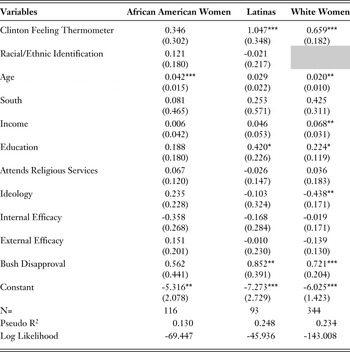
The feeling thermometer was used to measure one aspect of the emotional attachment described above, which Dolan (Reference Dolan2008) has described as “gender affinity,” but her approach has since been criticized for its lack of attentiveness to race and ethnicity among women (Zamfirache Reference Zamfirache2010). While the 2008 ANES time series study provided a feeling thermometer for each candidate, we relied on this single measure featured in Table 1 and labeled it the Clinton Feeling Thermometer. It was the best measure available in the 2008 ANES time series for assessing the degree to which a gender-based affinity for Clinton predicts voter turnout in the primaries. Our dependent variable, voter turnout, was a simple binary variable with (1) indicating that the respondent voted in the primaries and (0) that the respondent did not.
Measuring the Impact of Feelings for Clinton on Women’s Voter Turnout in the 2008 Democratic Presidential Primaries

Source: 2008 ANES Time Series Study. *p<.10; **p<.05; ***p<.01.
The baseline in these models are women within each ethnic or racial group who did not cast a vote in the 2008 Democratic Presidential Primaries.
All models from both the 2008 ANES time series study and the 2008 ANES panel study feature the following control variables that are validated measures, which typically set the standard: Age, Income, Education, Ideology, Footnote 5 Internal and External Political Efficacy, Footnote 6 and region (for which we use a binary control for South). In addition, we consider other factors suggested by previous research—for example, anti-Bush sentiment (Bush Disapproval) and racial/ethnic group identification (Racial/Ethnic Identification) as well as the frequency of religious practice (Attends Religious Services).
Several studies that model voter turnout and political behavior have established that racial/ethnic group identification and frequency of attendance at religious services are important determinants for African Americans and other ethnic groups (Bobo and Gilliam, Reference Bobo and Gilliam1990; Calhoun-Brown Reference Calhoun-Brown1996; Dawson Reference Dawson1994; Gurin et al., Reference Gurin, Hatchett and Jackson1989; Harris Reference Harris1999; Philpot et al., Reference Philpot, Shaw and McGowen2009; Shingles Reference Shingles1981; Simien Reference Simien2006, Reference Simien2013; Tate Reference Tate1993). Such measures were included here and respondents were asked: “Do you think what happens to [Black people/Hispanic-Americans] in this country will have something to do with your own life?” Respondents were also asked to indicate the frequency of their religious practice, ranging from several times a week to never.
Unfortunately, the 2008 ANES time series does not include questions that would allow us to measure respondents’ feelings toward the candidate and gauge their interest in the election at various points during the Democratic nominating contest, as Clinton’s chances of securing the nomination rose and fell over time. Fortunately, the 2008 ANES panel wave study could be used in addition to the 2008 ANES time series study because it does indeed contain the necessary items. For theoretical reasons discussed above, we analyzed those questions that presumably captured the intragroup emotion—pride—in questions such as, “How proud does candidate x make you feel?” and “How hopeful does candidate y make you feel?” We deliberately chose “pride” as the variable that best captured this intragroup emotion among the range of prospective voters. While both survey questions elicited very similar responses, we determined that the use of “hope” as a slogan by the Obama campaign made “pride” a less primed term so as to assess respondents’ feelings of prideful emotion toward Clinton. Other scholars have used these same items from the ANES for measuring emotional response evoked by politicians (Finn and Glaser, Reference Finn and Glaser2010; Marcus et al., Reference Marcus, Russell Neuman and MacKuen2000).
Using data from the 2008 ANES panel study, we also test whether or not the candidacy of Hillary Clinton had a differential impact on women voters in terms of “proselytizing” and an expressed “intention to vote.” Measuring respondents’ intention to vote was the only available item that came closest to capturing direct political involvement since voting had not yet taken place. Indicating an intention to vote is not the same thing as casting a vote in an election, to be sure, but it was the most useful variable for indicating prospective voters’ interest in, and commitment to, the upcoming elections. Proselytizing, however, offers us a more direct measure of respondents’ full-fledged engagement with the electoral political process during the primary season. Footnote 7 Considering that the number of female voters has exceeded men in every presidential election since 1964 and, as a result, the emergence of a statistically significant gender gap in American presidential elections has persisted since the 1980s, the study of political proselytizing affords us the opportunity to legitimize a “different voice” in politics and complicate the familiar image of public man and private woman by studying the impact of women’s voices during the presidential selection process (Hansen Reference Hansen1997; Gilligan Reference Gilligan1982).
The 2008–2009 ANES panel study was conducted between January 2008 and September 2009. It asked a battery of questions on political topics that sometimes varied by wave and sometimes were asked consistently across several waves for a total of ten waves—for example, respondents were asked “How proud does Hillary Clinton make you feel?” in February 2008 and not again. In our models using ordered logit for predicted probabilities we featured this item in addition to those the 2008–2009 ANES panel data asked consistently over several waves starting in January of 2008 and ending in September 2008. Respondents were asked: “How many days per week do you talk about politics?” and “So far as you know now, do you expect to vote in the national elections this coming November, or not?” Additional waves were conducted by external investigators, which asked a variety of nonpolitical questions. As a result, the study does not include those waves. Each wave ranged in the number of respondents from 1420 to 2665 respondents per wave. Participants were initially recruited via telephone, and then asked to complete internet surveys at monthly intervals. The 2008 ANES panel wave study offered a representative sampling of Americans. Figures 1–3 were constructed using predicted probabilities derived from logistic regression models which utilized the variables discussed above.
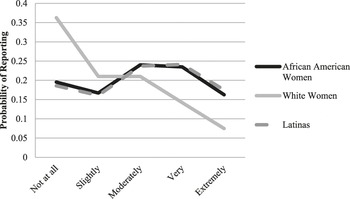
Ordered Logit Predicted Probabilities - How Proud Does Clinton Make You Feel?

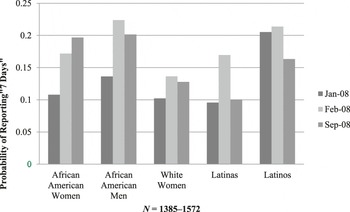
How Many Days Per Week Do You Talk About Politics?

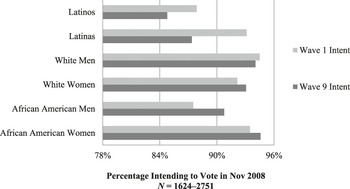
Respondent Intent to Vote Jan 2008 and Sept 2008

Evidence from the 2008 ANES Time Series Study
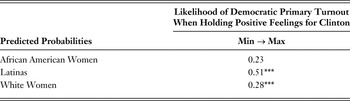
We ran regression models for each subset of women primary voters Footnote 8 to determine whether or not those who felt especially warm toward Clinton were more likely to cast a ballot in the Democratic primaries. Our analysis of the 2008 ANES time series study provides evidence that warm feelings toward a candidate can translate to higher voter turnout. As Tables 1 and 2 demonstrate, women who reported feelings of warmth toward Hillary Clinton were significantly more likely to turn out and vote in the Democratic primaries. Such an emotional response has the greatest impact on voter turnout for Latinas and White women. Footnote 9 Consistent with our expectations, a warm response to Clinton, for instance, predicted a 54% greater likelihood that Latinas would vote in the 2008 Democratic presidential primary. Additionally, a warm response to Clinton predicted a 20% greater likelihood that White women would vote in the Democratic primaries. This evidence strongly supports our theory that a historic first like Clinton had a mobilizing effect and the gender affinity she elicits predicted voter turnout in the 2008 Democratic presidential primaries. As we anticipated, however, African American women were the exception and qualified as a unique case in this regard.
Predicted Probabilities for the Impact on Feelings for Clinton on Women’s Turnout in the 2008 Democratic Presidential Primaries

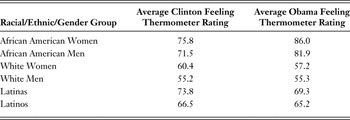
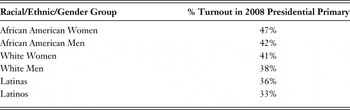
It is the case that warm feelings expressed by African American women toward Clinton did not reach statistical significance and so, the correlation between their feelings and voter turnout was null. We suspect that this has nothing to do with African American women withholding said emotion from Clinton, or transferring this emotion to another candidate because when we ran a similar model, which replaced the feeling thermometer for Clinton with one for Obama, African American women’s warm feelings toward Obama did not reach statistical significance. Gender affinity did not boost the probability of their voting for either Clinton or Obama in the Democratic nominating contest. A look at the raw data suggests why these results were insignificant. African American women in fact rated both Clinton and Obama very highly on respective feeling thermometer scales. Given that we already know they were the most likely to participate in the Democratic primaries of all racial, gender, and ethnic groups, we suspect that this null result is due to a lack of variation in these measures for African American women in particular (Lopez and Taylor Reference Lopez and Paul2009; Simien Reference Simien and Crotty2009). See Tables 3 and 4 for descriptive statistics.
Average Feeling Thermometer Ratings (0–100 scale) by Group

Source: 2008 ANES Time Series Study.
Likelihood of Turnout in the 2008 Presidential Primary by Group

Source: 2008 ANES Time Series Study.
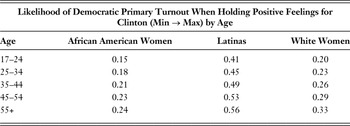
Our results also support the expectation that women who came of age during the second-wave of the feminist movement would be more likely to express gender affinity toward Clinton and, in turn, vote in the Democratic primaries (see Table 1 for results). Age is both significant and positive, indicating that older women in these models were more likely to turn out and vote in the Democratic presidential primaries. In order to test whether this voter turnout was linked to Clinton’s candidacy, we turn to predicted probabilities for specific details (see Table 5). These results were generated by holding feelings for Clinton at a minimum, and then at a maximum for each age group, Footnote 10 and tracking the changes. While this approach clearly demonstrates that older female voters were more likely to turn out in the Democratic nominating contest, it also shows that the combination of both—warm feelings and generational status—mattered in terms of predicting turnout for each subgroup of women across race and ethnicity. The relationship between warm feelings for Clinton and Democratic primary turnout was strong for older women voters generally; however, it was especially strong for Latinas and White women. Latinas in the oldest age category (55+) were 16% more likely than Latinas in the youngest age category (17–24) to turn out and vote in the Democratic primaries when they reported extremely warm feelings for Clinton. Similarly, older White women with extremely warm feelings toward Clinton were 13% more likely than younger White female voters to cast a ballot in the Democratic primaries, compared to African American women for whom the predicted likelihood of turnout only changed 9% across these age categories.
Predicted Probabilities for the Impact on Feelings for Clinton on Women’s Turnout in the 2008 Democratic Presidential Primaries – by Age

Evidence from the 2008–2009 ANES Panel Study
As stated earlier, we were interested in whether or not women who indicated that Clinton made them feel “prideful” were more likely to proselytize during the primaries and express an intention to vote in the general election. We were also especially interested in whether Clinton’s effect would vary by race and ethnicity among women. Our analysis of the 2008–2009 ANES panel study again yields evidence that Clinton’s candidacy had an empowering effect, specifically, on Latinas. However, Clinton did not elicit “pride” among the group to whom she descriptively represents pictorially (White women). In fact, they were among the most likely to declare that Clinton made them feel “not at all” proud. We might conclude that not just any woman will do (Dovi Reference Dovi2002). After all, Hillary Clinton was no “typical” female candidate (Carroll Reference Carroll2009; Lawrence and Rose, Reference Lawrence and Rose2010). Several factors made Clinton’s campaign distinct and unusual. Given that she was already a popularly well-known and controversial figure, it is reasonable to assume that her status as such might complicate our measure of “pride” between and among women of different racial and ethnic backgrounds (see Figure 1 for results). Footnote 11 It was Latinas who felt the most “prideful” when they considered Clinton’s candidacy in February 2008. This result would seemingly suggest that Latinas, who like African American women occupy a unique space at the intersection of race and gender, could identify and be mobilized by Clinton’s candidacy. Obviously, the connection between Latinas and the female candidate (Clinton), and particularly the strength of this connection relative to White women, is a matter that warrants further investigation as we will discuss further in our conclusion.
Another interesting finding is the sharp decrease in Latinas’ enthusiasm for the election as the primary season progressed and it became clearer that Obama would win the Democratic nomination. For instance, our analysis of the 2008–2009 ANES panel data from the early primary season (February 2008) show that Latinas reported talking seven days a week about politics at a rate on par with African American women and above White women (see Figure 2 for results). Footnote 12 The same question asked in September 2008, however, depicted quite a different story. Latinas’ enthusiasm for talking about politics dropped considerably below that of African Americans and White women. In fact, by two months prior to the general election, Latina’s likelihood to report talking about politics seven days a week was lower than all other racial, ethnic, and gender groups. Latinas’ drop of 6% in their expressed intention to vote is the most dramatic shift between the two waves of panel surveys. As such, these results suggest that Latinas as a group had a unique response—cognitive and emotional—to Hillary Clinton’s candidacy for President of the United States (see Figure 3 for results). Footnote 13
As the campaign shifted, so did emotional responses. The evidence supporting said dynamics whereby emotions reacted to changes in the informational environment were easily shown—that is, the enthusiasm once expressed by Latinas changed over time, having waned from January to September and significantly dropped by two months prior to the general election. Such findings support a widely held view of the presidential nomination process—that is, a negative “carryover effect” initially divides the party, making supporters (Latinas) of the nomination-round loser (Clinton) less likely to support their party’s eventual nominee (Obama) than those who originally backed the winner (African Americans). It goes to show that a sense of pride is not a permanent feature of the electoral environment but a dynamic one, closely linked to the “horse race” aspect of the campaign: who’s ahead in the polls and who’s behind, who has momentum and who does not, and who is leading in fundraising.
Of course, several editorials and opinion pieces suggest that there may be other factors to explain the rise and fall of proselytizing among Latinas during the primary season. In February, Clinton fired her Latina campaign manager, Patti Solis Doyle. The Clinton campaign had stressed that Solis Doyle had been the first Latina to manage a presidential campaign. As Ruben Navarrette pointed out in California’s San Gabriel Valley Tribune, Solis Doyle’s departure may have been one reason that some in the Latino community—which at one point supported Clinton in states like California nearly 2–1 over Obama—became disenchanted with the candidate:
Of course, many Latinos have probably never heard of Patti Solis Doyle. But the bad news for the Clinton campaign is that those who have are the same people to whom the campaign made a point of showcasing Solis Doyle’s appointment. So while the campaign might not pay a price for firing her, it isn’t likely to get the benefit it might have had she stayed on (Navarrette Reference Navarrette2008).
The variation in political proselytizing between and among women of different racial and ethnic groups across time signals that they are proactive citizens, who are attempting to exert influence. Moreover, the impact of gender on their discourse depends on the historical context with which the appearance of a viable female presidential candidate like Clinton contrasts sharply with the myth of the invisible apolitical woman. These results are consistent with prior research that challenges prevailing myths about Latinas and their supposed passivity or submissiveness in the realm of politics. Said literature examines gender as a factor of importance in an attempt to redress their absence in the political science literature (Bejarano Reference Bejarano2014; Hardy-Fanta Reference Hardy-Fanta1993; Montoya et al., Reference Montoya, Hardy-Fanta and Garcia2000; Pardo Reference Pardo1990). Future research must therefore continue to explore culture-specific gender differences between and among various racial and ethnic groups, especially Latino immigrant populations (Bejarano Reference Bejarano2014; Hardy-Fanta Reference Hardy-Fanta1993).
CONCLUSION
The purpose of this study was to investigate whether women who expressed gender affinity toward Hillary Clinton would be more likely to participate in the Democratic primaries. The authors also sought to examine whether or not women who reported feeling “prideful” on account of Clinton’s candidacy were more likely to proselytize during the primaries and express an intention to vote in the general election. To date, scholars have yet to consider whether the presence of a female candidate for a major elective office like the U.S. presidency has a gender affinity effect or triggers such an intragroup emotion as pride. Instead, the focus of a growing body of literature on the subject of representation has been limited to examining whether the presence of female candidates in state, local, and national elections increases the level at which women proselytize and increases the likelihood of their expressed intention to vote (Atkeson Reference Atkeson2003; Hansen Reference Hansen1997; Koch Reference Koch1997, Reference Koch2000; Lawless Reference Lawless2004; Stokes-Brown and Neal, Reference Stokes-Brown and Neal2008). In that vein, this article makes several important contributions to the study of American presidential elections.
The present study shows the importance of studying both within and between racial, ethnic, and gender groups—especially, with regard to women across generations. Contrary to the conclusion one might reasonably draw from the campaign—women rather than men would be more likely to support Clinton for president—the real question is: which women? As our results indicate, Latinas expressed the greatest sense of pride in Clinton’s candidacy. Given that Latinas have been recognized as leaders in state and local politics (Montoya et al., Reference Montoya, Hardy-Fanta and Garcia2000) and, at the same time, have sought to raise group consciousness and political awareness within their communities (Hardy-Fanta Reference Hardy-Fanta1993; Pardo Reference Pardo1990), they cannot be subsumed by the category “women” or ignored by academic accounts that effectively conceal their political orientations and behaviors. As Atiya Kai Stokes (Reference Stokes2003, Reference Stokes-Brown2012) argues the term “Latina” itself is dynamic and includes many subgroups identified in terms of national origin—the separation and investigation of which can tell us much about the formation of both ethnic and panethnic identity insofar as it influences get-out-the-vote campaigns and political mobilization for this demographic population (Bedolla and Michelson, Reference Bedolla and Michelson2012). Taken together, these studies suggest that future research should avoid viewing race, ethnicity, and gender as fixed mutually exclusive identity categories. Thus, we recommend that large-scale data collection projects such as the ANES incorporate new and improved measures that help clarify the meaning of representation and its relationship to identity—for example, sexual identity and multi-group or intersecting identities.
For example, let us examine African American women. Their group membership is tied to a unique set of circumstances surrounding a complicated history of race and gender relations in this country, which pushes members of this demographic group to view a particular event like the election of the first African American president as more important than the election of the first woman president. In this case, exploring the connection between emotions and group consciousness might prove useful in this regard. Of course, the way the media presented the choice between Clinton and Obama as simply a matter of “race trumps gender” suggests that when forced to choose African American women will prioritize their race over gender via candidates who represent these respective identity categories (Simien Reference Simien and Crotty2009). While we view identity categories like race and gender as fluid and provisional, we must acknowledge the fact that privileging one axis of identity is common in the realm of politics, given the electoral context and candidates of choice (Brown Reference Brown2014). The mainstream press could cleverly reduce the candidates to their physical attributes due to the historic nature of the Democratic nominating contest. Nonetheless, African American women could express feelings of warmth toward both candidates—Clinton and Obama—and bask in the glory of each running as a successful “other.” We can only speculate whether our findings would generalize to a wider spectrum of state, local, and national elections involving a similar context that is highly competitive, intergender and interracial.
Results cited here illustrate the ways in which statistical research can answer certain questions and yet raise others, such as: Why were Latinas more supportive of Clinton’s candidacy than Obama’s? Why did African American female voters subordinate the candidacy of Clinton for the sake of advancing the position of Obama in 2008? The present study demonstrates the need to identify culturally relevant factors that matter for respective groups. Knowing that Latinas experienced pride as a result of Clinton’s candidacy and not Obama’s begs the question—Does shifting racial identity formation in Latino communities in the United States yield a gender affinity effect toward Clinton on account of her Whiteness? From the analysis presented here, we can conclude that Latina voters do feel positively toward Clinton. What is less clear, however, is whether their warm and prideful feelings could be the result of racial distancing on account of Obama’s Blackness. Nevertheless, our results confirm associations between emotional attachments and candidate preference.
By demonstrating that emotion influences both what we think and what we do, the present study has broad implications for future research on campaigns and electoral judgments as it relates to the relationship between affect and reason—specifically, affect-driven candidate evaluations in light of historic circumstances. To study the way in which a historic first like Hillary Clinton activates gender affinity and an intragroup emotion like pride while contributing to voter turnout in the primaries and other variables of political interest, like proselytizing and the expressed intention to vote, is of the utmost importance during the presidential selection process. At a time when Clinton must mobilize voters for a second primary season, results cited here are all the more relevant as they pertain to which women the campaign might target aggressively across race and ethnicity as well as generations. This study clearly advances the women and politics literature that to date has mixed findings with regard to women running for elective office and their ability to mobilize female voters.