

INTRODUCTION
Language is the first condition of humanity.2
This is a slight variation from Wole Soyinka (1999), who asserts that “Justice constitutes the first condition of humanity” (p. 31). It is obvious that the right to language is essential to justice. Indeed, one could consider the right to language as logically prior to justice.
I utilize the term necrolinguistics having read Achille Mbembe's 2003 “Necropolitics” (translated by Libby Meintjes). In that paper, Mbembe discusses the work of death in which he points out that “Slave life, in many ways, is a form of death-in-life,” which to me raised the question of language-death-in-life (2003, p. 21). Integrating Mbembe with Derrida and Senghor, the term comes to refer to not just language death leaving the body intact, but also the impediments of discordant monolingualism, and the complex weave of psychosocial palliatives and pathologies present in the bilingualism of the other or in asymmetrical bilingualism.
This essay begins with a brief elaboration of the symbolism of the “muzzle” used in the essay. The muzzle is followed by a discussion of linguistic incarceration through a number of epochs, leading to the introduction of semilingualism or linguistic in-betweenness. From both linguistic incarceration and semilingualism follow the identification and elaboration of the burgeoning discordant monolingualism of Black folk, and the vagaries of unilateral or asymmetrical bilingualism. African slaves, contemporary Africans, White Thunder (a Native American), Jacques Derrida (a Franco-Maghrebian Jew), and Léopold Sédar Senghor (former President of Senegal) are used not only to illustrate a variety of uses of the muzzle ranging from the literal to the highly nuanced, but also to recognize (in some of these cases) the resilience of Black folk to linguistically adapt and overcome, as the other side of the story, in combating necrolinguistics.
THE MUZZLE
The highly provocative image of a muzzled African shown here is used on the cover of Paul Lovejoy's (1986) edited volume Africans in Bondage. Lovejoy does not provide details as to what the picture meant, and rightly so. This picture has to be seen to be believed, for it is truly beyond words. The “Who?”, “Where?”, and “When?” questions are absurd, since they are precisely the ones erased by the treatment of the human beings thus muzzled. The muzzle muffles the identity, the location, and the dignity of the person. The picture records the animal-like treatment of Africans and is reminiscent of what steps were taken to control Africans during slavery. The picture is as unbearable as the questions it raises and the ideas it insinuates. It is reminiscent of the chilling and often ugly epithets of racism.4
Since the muzzle is popularly used on dogs and other animals, the picture is especially reminiscent of the language written all over the racist environments of slavery and apartheid, no dogs or colored people allowed (found especially on bathroom doors, parks, recreational places, etc.).
The image of the “muzzle” recurs in several forms in late eighteenth- and early nineteenth-century engravings of slaves being punished in North America, the West Indies, and South America. In most cases, the images of total or partial masks (usually made of tin) are accompanied by texts explaining why slaves were forced to wear them. An early image of the muzzle is found in a broadside from 1794, Die Act wie die Familien getrennt werden. Sclaven-Handel. Three of the twelve vignettes presented in the broadside depict slaves wearing masks. The same twelve vignettes were also published in 1813 in English as A Short Account of the Treatment of Slaves in the West Indies. In 1814, the same images were used as illustrations of an antislavery tract, The Mirror of Misery; or Tyranny Exposed. In addition, volume II of Jean-Baptiste Debret's three-volume Voyage pittoresque et historique au Brésil, ou Séjour d'un artiste français au Brésil, depuis 1816 jusqu'en 1831, inclusivement, which was published in 1835, includes an image of a young female slave wearing such a mask. Debret indicates that the woman was made to wear the mask in order to prevent her from revolting through eating dirt in order to bring about her own death. I am grateful to Karen Dalton for bringing these historical sources to my attention.

Subduing Africans required simultaneously arresting the body and containing the language and remanding it into custody within the person. It is therefore not difficult to see that Black languages have faced the same fate as their speakers. In taking the Akan, Bambara, Fon, Igbo, Mande, and the hundreds upon hundreds of other African identities apart, it was important to incarcerate the language and to pass a death sentence upon the language in a way that reduced individual ethnicities to merely African. Under the label African, specificity was lost in a sea (or better still, the silence) of generality. Since the times of slavery, Ebonics (here used to include all Black sounds, Black English vernacular (BEV), Creole, Patois, and indigenous African languages)6
By “indigenous African languages” is meant languages that fall under any of the four language families of Africa: Niger-Congo, Nilo-Saharan, Afro-Asiatic, and Khoisan.
LINGUISTIC INCARCERATION
The control of human bodies is undermined by linguistic freedom. Through the use of the muzzle, Africans were forced to keep it all (physical and mental) inside, to never say what they thought, not even to the wind. This confinement of languages in people's minds is the initial step in erasing them. Speaking had in some cases led to the organization of successful revolts, as one can glean from the remark in the 1744 book A New Voyage to Guinea, in which
William Smith spoke of the dangers of having a shipload of captives all speaking the same language—they were sometimes able to overpower the crew. “But the safest way,” he wrote, “is to trade with the different Nations on either side of the River, and having some of every sort on board there will be no more likelihood of their succeeding than finishing the Tower of Babel” (Bolinger 1980, p. 46).
It is thus on record that the strategy in slave ships was to simulate the Tower of Babel in order to firmly control the human cargo. Even on reaching North America's Chesapeake Bay, the slave trade deliberately scattered men and women from various nations in order to diminish any sense of solidarity that they would have formed while cramped together on the transatlantic journey (Berlin 1998, p. 115). To make these people seen but not heard was an important initial dehumanizing act. To be enslaved involved the confounding of tongues as a means of separating slaves through packaging them in close proximity, with no one speaking the other's language. Under such conditions, ideas could not be ferried from head to head. Perhaps the muzzle may thus have been needed in part as it became apparent that many sub-Saharan Africans were multilingual (or some languages mutually intelligible), allowing communication between slaves. Without language, plans could neither be made nor executed. In the case of slave ships, the Africans, though perfectly able to speak, were rendered mute. They were effectively mute in a crowd of languages, though obviously full of thoughts in the mind. This meant that slavery was an absurd space populated by a crowd of talkative mutes. This was true both during the journey as well as on arrival.
Unmediated by a common pidgin or creole language, newly arrived Africans often stood mute before their enslavers, estranged from the new land and from the white men who … asserted their domination in the form of the repetition of some unfathomable gibberish (Berlin 1998, p. 115).
When a language is taken away (or is confined to only one's own mind) communication atrophies to basic instincts—an inhuman existence particularly brutal to oral cultures. For Africans, verbal interaction is the quintessential activity that buoys humanism:
In Africa, songs, tales, proverbs, and verbal games served the dual purpose of not only preserving communal values and solidarity but also providing occasions for the individual to transcend, at least symbolically, the inevitable restrictions of his environment and his society by permitting him to express deeply held feelings (Levine 1977, pp. 7–9).
Oral cultures live and die with the spoken word. To take the African person apart, the separation of African languages from their cultures is a very effective strategy for rendering the African personality irrecoverable within a very short time (perhaps a couple of generations). This muffling or denial of language, or curtailing its mastery by Black folk, is a central pillar of human erasure. The muzzle muffled expression, and without expression the humanity of people is considerably undermined. The arrestation and incarceration of African languages did not affect slavery only in snapshots; it was sustained through successive generations after the end of slavery. We learn that as late as 1908 the Gullah dialect spoken in the South Carolina Sea Islands was regarded as savage:
In 1908 … John Bennet … called it “a grotesque patois … the quite logical wreck of once tolerable English, obsolete in pronunciation, dialectal in its usage, yet the natural result of a savage and primitive people's endeavor to acquire for themselves the highly organized language of a very highly civilized race.” In 1922, Ambrose Gonzales, one of the most accurate and meticulous recorders of Sea Island languages, gave his version of its genesis: “slovenly and careless of speech, these Gullahs seized upon the peasant English used by some of the early settlers and by the white servants of the wealthier colonists, wrapped their clumsy tongues about it as well as they could, and, enriched it with certain expressive African words, it issued through their flat noses and thick lips….” Both Bennett and Gonzales were convinced that the Gullah dialect's economy of words and elision of syllables stemmed from the Negro's “characteristic laziness” (Levine 1977, pp. 146–147).
There can be little doubt that such “expert” witnesses provided the logic for the flagrant incarceration of Black languages wherever they were found. But we also learn that the Gullah were suspicious of people they did not know, and closer familiarity revealed that the “vocabulary and syntax the Sea Islanders used when speaking to strangers differed markedly from that they employed in addressing friends and relatives” (Turner 1947, cited in Levine 1977, p. 146). This means that the folklorists Bennett and Gonzalez may well have collected gibberish as data, which explains their “expert” opinions. Experts were important contributors to linguistic racism both in the new world and on the African continent. The practice of linguistic incarceration was reinforced by experts. Though colonialism was cast in racial and cultural racism by the British, the Germans, and the Portuguese, and in cultural racism by the French, an important part of its execution was the demonizing of native languages as inferior and subhuman, a clear case of linguistic racism. Alice Werner, Professor of Swahili and Bantu Languages at the School of Oriental and African Studies, went on record saying that in Sudanic languages,
Complex sentences are quite unknown; what we should make into subordinate clauses are principal—consequently, for one thing, there are no relative pronouns. All statements are grammatically of equal importance; in other words, the construction is co-ordinative. “When he came I saw that he was in trouble” would be: “He came. I saw him. He was in trouble” (Werner 1930, p. 31).
Examples of this kind, simplifying Africa and Africans at face-value, abound. The amateur linguist F. W. H. Migeod, a transport officer in Ghana (at that time, the Gold Coast), referring to the more than 2000 languages of Africa, opined in 1911 that,
As a matter of fact the majority of languages of Africa are simple both in structure and their grammatical forms, and it is of course perfectly possible to convey ideas of considerable complexity and with abundance of detail, even with a simple means of communication. Brute beasts, with a very limited number of sounds, seem able to convey a considerable number of ideas to others of the same species (Migeod 1911, pp. 72–73).
Further, regarding the humanity that occupies the vast continent, Migeod saw a connection between the vast riches of Africa and the downfall of its inhabitants.7
Migeod did “explain” why African languages were simple: abundance left Africans lazy and in a soporific state, speaking very simple languages whose words always had transparent meanings. Referring to Africans, Migeod said that “Plentifully supplied by nature, most of his necessities being near at hand, or obtainable with a relatively small amount of labor, the Negro is indifferent in many matters, therefore nice distinction in language is unnecessary. The individual words too, as a rule have a perfectly clear meaning, and the use of metaphor is uncommon” (1911, p. 75).
The first person to bring understanding to the African linguistic forest was Joseph Greenberg (1963), who presented a discovery that revolutionized African linguistics, namely, that each of the more than 2000 African languages belonged to one of four large families (phyla): Niger-Kordofanian, Afro-Asiatic, Nilo-Saharan, and Khoisan.
It is noteworthy that linguistic incarceration for some has been total: not merely the shutting off of the sub-Saharan language, but also the keeping of Western languages beyond the reach even of those who have wished to learn them. For the bid to linguistically dominate Africans, there was no hiatus even during World Wars I and II. When Africans were conscripted to fight European wars, denying African soldiers' language was a strategy much used by the French. Frantz Fanon observed that one of the strangest legacies of World War I was Petit Nègre,
… a simplified, deformed version of French that the military codified and taught to African soldiers as they came to fight in Europe, as a means both to infantilize them and to control their modes of interaction with their mainly white commanding officers (Fanon cited in Edwards 2003, p. 52).
The phonological and syntactic structure of Petit Nègre was constructed using the subversive approach of reinforcing mispronunciation and other deformations in grammar.9
Petit Nègre is illuminated by the following analogy offered by Brent Hayes Edwards (2003): “Suppose that having to teach our language to the Englishman, we carefully took note of all the deformations his first attempts inflict on French pronunciation and syntax, and that from then on, we draw on them to present him with a French reduced to his English compatibilities” (p. 52).
Arresting the development and the use of sub-Saharan African languages has been at the center of most domestic development policies in sub-Saharan Africa. The de-emphasis of vernaculars (the native local languages of acquisition and interaction) in deference to the dominant language (usually English, French, or Portuguese, but also domestic ones such as Swahili, Amharic, etc.) has led many to live in state of linguistic stagnation that places them in a downward spiral of declining linguistic acumen. Neglect of the mother tongue greatly compromises mastery of any subsequent language, as T. H. Baldwin, Acting Assistant Director of Education in Nigeria's Northern Provinces, observed in 1944:
In an ideal world there is no conflict between the vernacular and a foreign language. On the contrary, a literary command of the one is an aid to acquiring the other, while the foreign tongue in turn fertilizes the other. Conversely, superimposition of a foreign language—especially if the latter is much more highly developed—on a weak vernacular foundation leads to feebleness in both … even where the English is tolerably correct it may be very difficult to discover what the man is thinking. He is the victim of words, not their master (Baldwin cited in Goke-Pariola 1993, p. 34).
Ignoring the obviously loaded concept of “more highly developed language,” the point here is that a strong command of the vernacular yields vital dividends in second language acquisition and learning. The prohibition of African languages from formal education, and with it the stealth muzzling of Black students, has a long history. By passing Decree 77 in 1921, the Portuguese forbade the use of African languages in Namibia schools, including publications in African languages, and by 1950, Portuguese became the sole medium of instruction in all schools, including private ones (Goke-Pariola 1993, p. 35). This bludgeoning of indigenous African languages out of schooling has culminated in what is now a widespread consequence: many Africans regard their own vernacular as orthogonal to pursuits of modern life, and even more so to intellectual endeavors. Of the French in Belgian Congo, a place with more than 200 languages, Goke-Pariola writes that “the Belgium strategy was first and foremost to avoid multilingualism. If that failed a ranking of national languages was to be done with French at the apex and African languages (regional vehicular languages) were to be helped to develop ‘rationally’” (1993, p. 35). By policy, mostly by decree, the traditional Black school was/is shut down by the incarceration of Black languages, and Black folk were/are forced to “pay attention” in languages they do not for the most part speak, nor even understand. Thus, like Petit Nègre mentioned above, we see the only dominant language available to Africans being used to the detriment of African languages, and, in the cases of Belgian Congo and Namibia, the use of some of the dominant languages to the same effect. Apartheid South Africa provides a case where a dominating language collided head on with the powerful Nguni languages (Xhosa and Zulu) in the infamous Soweto uprising.
Apartheid South Africa made it policy to remove African languages from formal intellectual pursuits when on June 16, 1974, Minister of Bantu Education and Development M. C. Botha issued a decree making Afrikaans the compulsory medium of instruction in Black schools. What followed was the Soweto uprising, in which over 30,000 students rioted against the policy, with the result that more than 500 people were killed.10
Figures taken from the CNN News report of June 15, 2001, available at: 〈http://archives.cnn.com/2001/WORLD/africa/06/15/inside.africa/〉 (accessed December 5, 2005), and the City of Johannesburg's official website: 〈http://www.joburg.org.za/june_2002/hector.stm〉 (accessed December 5, 2005).
Hector, who was only twelve years old, was one of the first casualties of the Soweto uprising. He is the famous child whose face is unknown. See 〈http://www.joburg.org.za/june_2002/hector.stm〉 (accessed December 5, 2005).
Sometimes the domineering language is also historically of indigenous stock, as is the case with Amharic imperialism. In the kingdom of Ethiopia, Amhara political and cultural dominance was buttressed by the insistence that Amharic be the language of the governments, the courts, the schools, and even of Protestant and Roman Catholic missionaries. The missionaries were for instance required to conduct a service in Amharic before it could be repeated in the local language (Nelson and Kaplan, 1981, p. 87). The muzzle has been thus imposed to control people and action in precisely those public spheres that are supposed to protect human rights.
THE CONTEMPORARY MUZZLE
From what I have said so far, it is reasonable to state that African languages have been rounded up and incarcerated by various regimes and institutions, not only in the past, but also in the present. Today the muzzle still holds Black tongues in place in very real and concrete ways, especially in sociopolitical spheres. The modern day equivalent of the muzzle is evident in sub-Saharan Africa, in the mismatches observed between language use for functions and activities that logically belong together. Taking Kenya, for example, there is no explicit gain associated with the mastery of local languages, with the exception of Swahili. Consider the following incongruities in language used between things that ought to go together, if reason were to prevail (≠ reads is not equal to or very seldom is):
- The language of local knowledge (indigenous) ≠ the language of education (English).
- The language of the home (indigenous) ≠ the language of instruction (English).
- The language of the child (indigenous) ≠ the language of the textbook (English).
- The language of daily life (indigenous) ≠ the language of the textbook (English).
- The language of play (indigenous) ≠ the language of learning (English).
- The language of acquisition (the child's own) ≠ the language of the school (English).
- The language of comprehension (indigenous) ≠ the language of exams (English).
- The language of practical problem solving (indigenous) ≠ the language of exams (English).
- The language of the teacher (indigenous) ≠ the language of instruction (English).
- The language of survival (indigenous) ≠ the language of education (English).
In the area of education, there are pronounced incongruities between the language the child understands, the language of the parent, and the language of schooling. Often the language of the child is also different from that of the teacher, and neither has a command of the language of instruction. It has been vehemently argued that schooling in indigenous languages is not viable, politically and economically, except perhaps for the woefully inadequate provision of mother-tongue instruction in the first three years of primary school education, as a bridge from vernaculars to English in Kenya.12
UNESCO has for over half a century held the view that vernacular languages are essential in the development of a child's cognitive skills (1953, pp. 47–49).
Other than Kiswahili objectives (59 per cent), geography, history and civics (55.92) and religion (56.43), the rest had a mean score of less than 50 per cent. The lowest mean score was in English composition (30.64 per cent) and Kiswahili composition (41.73). Others were science (42.74 per cent), mathematics (44.22), English objectives (44.86)… What this means is that the majority of the candidates did not score more than 50 per cent in the subjects. “The low mean score in English, mathematics and science is worrying, because these are key subjects for future education as well as our national goals for economic development and industrialization,” the Education minister said. “I urge teachers to re-sharpen their teaching skills and make deliberate efforts to improve candidates' performance in these subjects” (Oduda 2003).
The language of the child is incarcerated, reducing education to the pursuit of fluency in English mediated by markedly non-proficient instructors. Whenever the switch is made from the child's language to the language of the school, there is always an instructional blackout. For the vast majority of children, the blackout is total and final. Learning then is reduced to verbatim memorization (and handwriting!). To arrest the use of indigenous languages when they are most needed initiates the process of necrolinguistics, the erasure or non-mastery of the vernacular under the linguistically impoverished conditions imposed in order to learn English.
It is well known that adult language learners need intensive formal training even in the target language environment. To make language matter, Africans would have a virtually intractable problem of trying to learn English as adults in the absence of native speakers of English and with highly contaminated linguistic and cultural input. This situation establishes inferiority in perpetuity, where one strives to reach the unreachable. While working so hard to learn Portuguese, French, and English, sub-Saharan Africans have abandoned their indigenous languages and modes of thinking, and without much practice in indigenous languages, many of the educated occupy a linguistic no-man's-land, speaking peculiar English, French, or Portuguese, which is unintelligible to native speakers. This, too, is necrolinguistics—the extraction from Africans of native languages while letting grossly impoverished input inform African English proficiency creates esoteric linguistic beings:
in spite of all the desperate attempts to become European, these Africans never quite attain a European identity. European society never accepts them as full participants; they always remain outsiders. The more European the Africans become in cultural terms the more they are regarded by European society as exotic or even quixotic (Mazrui and Mazrui, 1998, p. 59).
Further instances of linguistic incarceration are indicated by the linguistic incongruities in Kenya and many other sub-Saharan states. Lacking a meaningful connection between society and language, no linguistic equations seem to work in Kenya's economics. The languages of the people producing Kenya's wealth (in agriculture and tourism) are not even recognized. Indigenous languages produce the goods and drive the demand, yet they are not the languages of upward mobility, nor the languages of essential services (health care, justice system, school, etc.). Indeed, the languages of production are not the languages of distribution. This is econolinguistics13
Econolinguistics, advanced by John Baugh of Stanford University, is an approach that studies the effects of language in economics.
- The language of production (indigenous) ≠ the language of distribution (Swahili).
- The language of production (indigenous) ≠ the language of upward mobility (English).
- The language of goods (indigenous) ≠ the language of services (Swahili/English).
- The language of the majority (indigenous) ≠ the language of essential services (Swahili/English).
- The language of the informal sector (indigenous) ≠ the language of the formal sector (English).
- The language of demand (indigenous) ≠ the language of supply (Swahili/English).
- The language of innovation (indigenous) ≠ the language of technology (English).
These mismatched linguistic identities immediately suggest some of the reasons for the challenges facing Kenya in its attempt to democratize and engage its citizens in determining the country's future. Linguistic disenfranchisement is a muzzle that serves to ensure the longevity of the existing linguistic regime designed to exclude the majority. This is why in matters of justice and politics the language of the civilian is not the language of governance, nor that of jurisprudence. Seldom is the language of the plaintiff or the accused the same as that of the counsel; nor is the policeman's language that of the defendant, of the counsel, or that of the judge. Likewise, the language of the civilian is hardly ever the language of political debates or that of leadership (≠ reads is not equal to or very seldom is):
- The language of law enforcement (Swahili) ≠ the language of jurisprudence (English).
- The language of rural-rural (e.g., regarding land) disputes (indigenous) ≠ the language of the law courts (English).
- The language of law enforcement (Swahili) ≠ the language of a majority of the population (indigenous).
- The language of proficiency for the vast majority (indigenous) ≠ the language of the Constitution (English).
- The language of the majority of citizens (indigenous) ≠ the language of governance (English).
- The language of the average citizen (indigenous) ≠ the language
of parliament14(English/Swahili).
Swahili is rarely used by Kenya's parliamentarians in their deliberations.
- The language of the voter (indigenous) ≠ the language of the ballot (English/Swahili).
- The language of proficiency for most Kenyans (indigenous) ≠ the language of power (English).
Wherever one looks, Kenya is riddled with mismatches between language proficiency and language deployment. Here are yet more to consider (≠ reads is not or is very rarely the case):
- The language of the patient (indigenous) ≠ the language of health care and physicians (English).
- The language of the nurse (indigenous/Swahili) ≠ the language of the physician (English).
- The language of the patient (indigenous) ≠ the language of hospital records (English).
- The language of memory (indigenous) ≠ the language of written records and of archiving (English).
- The language of speaking (indigenous) ≠ the language of writing (English).
- The languages most widely spoken (indigenous) ≠ the languages of prime time broadcasting (English/Swahili).
- The language used in religious practice (indigenous) ≠ the language used in critical thinking (English/to a much lesser extent Swahili).
Traditional and Western religions appear to have a match between language proficiency and language deployment. It is not surprising, then, that some of the most effective institutions in sub-Saharan Africa are faith based. That the institutions which are the least tribal and the most united in purpose (whether in combating HIV-AIDS, clothing the poor, mobilizing people for political participation, etc.) are also the ones that have managed to deploy indigenous languages, speaks to the reality of the benefits that accrue from the linguistic capital of local initiative, indigenous know-how, and even the adaptation of technology. Here are some interesting consistencies (= reads is often the same as):
- The language of the bible (indigenous) = the language of worship (indigenous).
- The language of liturgy (indigenous) = the language of the worshippers (indigenous).
- The language of prayer (indigenous) = the language of the supplicant
(indigenous).15
Except of course for Muslims whose use of Arabic is an essential religious imperative.
- The language of conflict resolution (indigenous) = the language of the majority (indigenous).
With all the mismatches mentioned above, the point should be clear: the modern linguistic muzzle in Kenyan (and in sub-Saharan Africa, more generally) is institutionalized, and is fast becoming conventional. When Kenya's linguistic posture and practice is scrutinized, the picture that emerges is grossly untoward, to say the least, for the non-elite majority of citizens. The mismatches and inconsistencies listed above go beyond merely requiring proper linguistic alignment: they also embody the untold violation of human rights through language. The inconsistencies raise questions regarding the nature of justice meted out by the justice system, the kind of health care provision possible, and even the nature of governance and issues of suffrage. The muzzle is thus in place primarily through disregard of indigenous tongues and the promotion of the hegemonic aspirations of regional linguistic monopolies in the global culture currently in formation. Ngugi wa Thiong'o observes that,
One of the worst robberies is that of language. In the realm of culture, Africa has been robbed of languages in a most literal and figurative sense … their imprisonment is what I have called the linguistic maximum security prisons of English, French, and Portuguese. Africa was made speechless, and its sons and daughters who should have come back to free the imprisoned tongues came back as prisoners themselves, caught in the capitals of Europe and Africa, holding a dialogue between themselves within the prison walls of their language acquisitions (Thiong'o 2000, p. 156).
Clearly, modern Kenya continues to remand most of its indigenous languages, essentially holding them in custody. It is therefore not surprising to find the linguistic incompetence that characterizes a large portion of the young population. Children and young people are products of their elders, so they learn rather quickly that indigenous languages are of no value. They abandon them, turning to regional or Western languages which in turn elude them because of the lack of good linguistic models for those high-premium languages. Given globalization, linguistic incarceration does not look as though it will be eligible for parole any time soon. Indeed, the muzzle, first literal and now figurative, continues to muffle African association of sound with meaning. The incongruent deployment of languages in Kenya aptly conveys the modern Tower of Babel, where the diversity of languages is underutilized in favor of the confounding yet-to-be-mastered but nonetheless privileged regional and Western tongues. Over the years this incarceration has come full circle, leading finally to the non-mastery of local language and thus condemning many Black folk to semilingualism or linguistic in-betweenness.
LINGUISTIC IN-BETWEENNESS
Semilingual or quasi-languaged folk should not exist, at least as far as the discipline of linguistics is concerned. In linguistics, one is monolingual, bilingual, or multilingual, whether using sound or sign. People whose language ability and practice cannot be uniquely associated with a particular spoken or sign language supposedly do not exist. The “word” from the discipline of linguistics is that, absent catastrophe, any child born healthy and hearing (in a human environment) develops a language triggered by the surrounding linguistic input. It is indeed a marvel of humanity that children the world over develop language ability at roughly the same age, achieving total mastery without deliberate or demonstrable effectiveness or even the necessity of instruction, and continuing to improve it rather rapidly through life. Steven Pinker (1999) writes that,
Children begin to learn words before their first birthday, and by their second they hoover them up at a rate of one every two hours. By the time they enter school children command 13,000 words, and then the pace picks up, because new words rain down on them from both speech and print. A typical high school graduate knows about 60,000 words; a literate adult, perhaps twice that number (Pinker 1999, p. 3).16
See also Pinker (1994, pp. 149–151).
With regard to word recognition, it has been claimed that the listener knows the meaning of a spoken word in mid-pronunciation, in about one-fifth of a second,17
while the written word is accessed even faster, in about one-eighth of a second.18 In terms of orality,
People produce words almost as rapidly: It takes the brain about a quarter of a second to find a word to name an object, and about another quarter of a second to program the mouth and the tongue to pronounce it (Levelt et al., 1998, cited in Pinker 1999, p. 3).
How could linguistic in-betweenness exist if language were an instinct, as Pinker persuasively suggests? That would be the equivalent of being “semi-instinctual.”
Semilingualism is not entirely unknown in the literature. Bloomfield (1927) describes a young Menomini19
Menomini (also called Menominee) is an Algonquian language spoken in parts of Wisconsin and belonging to the Algonquian-Wakashan languages.
White Thunder, a man around forty, speaks less English than Menomini, and that is a strong indictment, for his Menomini is atrocious. His vocabulary is small; his inflections are often barbarous; he constructs sentences of a few threadbare models. He may be said to speak no language tolerably. His case is not uncommon among younger men, even when they speak but little English (Bloomfield 1927, p. 395).
The case of this Menomini person is equally descriptive of a growing population of children and young adults in many sub-Saharan African countries: restricted vocabularies, highly limited grammar ability, and fixation on a limited set of constructions not as a matter of preference, but because of a paucity in the command of the requisite grammatical structures available in the language. In the case of the Menomini, linguistic-death-in-life left many young people linguistically deficient and barbaric, and with that their fate was sealed: they were equivalent to zombies, linguistically speaking. Within East Africa's urban areas, and increasingly in rural areas, many children, youth, and young adults are unable to master any one of East Africa's languages, including Swahili.20
A modern Ocol in Okot P' Bitek's (1966) book Song of Lawino and Song of Ocol is linguistically dead to his cultural roots, identifying the Acoli language as the frontline enemy to progress.
The lower one is on the economic ladder of Nairobi, the more Swahili one speaks and the more intricate one's Sheng is going to be. To the group from the English sectors, to know Swahili is to be ghetto, and the closest one comes to Swahili is a highly Anglicized Swahili, or English with Swahili debris.
There are several varieties of SHENG. Here we identify three broad types: A, B, and C, which are not entirely distinct, and are often used seamlessly. Type A SHENG is the most common in the poor sections of Kenya's urban areas (especially in Nairobi). Type A SHENG combines the phonology of the various indigenous languages to form words which are pronounced with Swahili stress patterns (penultimate stress).
In the examples below under SHENG A, the word oshago, with its use of o-morphology on both the beginning and the end of a noun, is a feature common in Dholuo (a Nilotic language). The word shag is taken from the Gikuyu word gichagi (village), which has been stripped of its vital noun class marker gi- and to which has been added a nominalizer extension -i, to leave chag (-ch- is also pronounced as -sh- and -s-). In fact, each word in SHENG A is a linguistically intricate (and also orderly or rule-governed) construction. In Nairobi's Eastlands and other working-class neighborhoods, Gikuyu and Dholuo are well represented. The A variety has very little or nothing to do with English and ought to be called “Swahili-Other.”
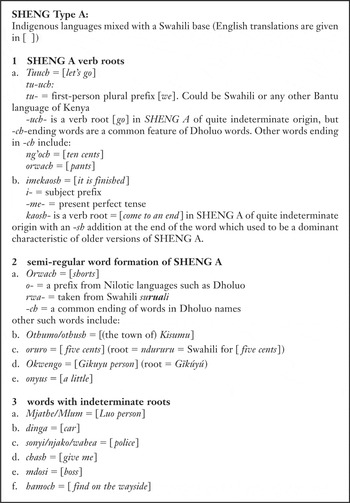
Some varieties of SHENG A are used as private languages among young people who, for lack of spatial privacy, resort to a linguistically constructed space allowing the younger generation to gain communicative privacy from their parents and other authority figures. The need to exclude authority figures (such as parents, teachers, law enforcement agents, etc.) from communication between young people is a defining characteristic of SHENG A. The need for privacy in congested space also requires secret vocabulary to be changed from time to time so that authority figures do not get to catch on to what the youth are doing. SHENG A has over forty words for girl; over twenty words denoting police, over ten words for marijuana, and ten words for money:22
Many of the words in the examples are familiar to me and some of them can be found in Mbaabu and Nzuga (2003).
Girl: babe (pronounced [bahbeh]), bebi, besta, boksa, buksi, chikii, chile, demu, gathoni, gibenje, kago, kamadu, kangongo, kashano, kasunda, kasupu, kenge, kifaranga, kingwati, kipusa, kirenge, Kiyegiyegi, korona, kromu, kuro, malaika, mame, manduano, manyanga, manzi, mauzi, mashrobe, matunda, mbitu, mkasoo, mkuki, ndito, ndogondogo, ngeke, ngochino, ombachi, ong'ura, wanga
Police: njako, sonyi, sinya, ponyi, ponye, karao, wahea, karai, flik, pai, paire, popi, kachero, ako, kahio itina, danse, gava, mambuchbuch, sanse, hindra, pije, wakorino
Marijuana: bhangi, boza, ganja, gode, khronic, ngwai, kaya, ngoto, poti
Money: beksi, chapaa, chums, do (pronounced [dough]), kege, kenge, michuzi, mnago, munde, nyandu
To live while speaking only some version of a patois is what urban youth in the slums are condemned to. There are a variety of Type A SHENGs, some of which are restricted to inner-city neighborhoods and specifically designed to exclude everyone outside the locale, age-set, or group.
In SHENG B, the roots no longer come from indigenous language sources, but from English, even when retaining the Dholuo o- marking at the beginning and the end of the word. In the word othato, the root -that- is taken from [thirty]. In the word nakulove, na- is the present tense prefix that follows a truncated ni-, which is the first person singular. The -ku- that follows is a prefix for second-person singular [you], such that nakulove means [I love you]. SHENG B is very systematic in its use of English roots and may be regarded as English which is morphologized mostly with Swahili affixes. In the B variety, pronunciation is Swahili driven.
SHENG C is the reverse of SHENG B: the C variety is English-morphologized Swahili and should really be called ENGSH (or English Swahili). In this case, all roots are English, and all the affixal morphology is Swahili. The pronunciation however is English driven. The word unbwagable [one who cannot be wrestled down], which has become popular among incumbent politicians, uses English morphology. The strings un- and -able are familiar morphemes attached to any verb in English to reverse its meaning or the state of the verb. Of all of the different types of SHENG, variety B influenced the naming of Swahili-English.

SHENG A is common in the poorer sections of Kenya's urban areas; SHENG B is spoken by those who have benefited from an English education and may live in upper-middle-class neighborhoods; SHENG C is spoken by educated Kenyans. SHENG A is the most fascinating, for it is developing as a distillation of Kenya's rich linguistic heritage and arising from multilingual abilities of the speakers. SHENG B Swahilicizes English, enriching itself by foraging word roots (primarily from English), and SHENG C anglicizes Swahili. Both SHENG B and C, however, are building up from a very impoverished (and phony) Anglo environment. SHENG C demonstrates English speaking with code-switching involving substitutions of English words for Swahili ones and using English word formation rules on Swahili words and then incorporating them into Kenyan English usage. Because of speakers' lack of proficiency in English, it is through SHENG B and C that semilingualism is being incubated. In urban settings, more and more children and young people are moving away from SHENG A, but are also failing to learn either their native tongue or Swahili adequately. In addition, they have little or no real interaction in English with native speakers. Since they lack adequate Swahili and wish to move closer to English, SHENG B will remain debilitating to these people. SHENG C can be subsumed under English, as it is often heard in upper-middle-class residential areas and almost never in Kenya's shanty urban sections. The trouble is that some now speak only B and C varieties of SHENG and no other language. Like the Menomini man White Thunder, these folks speak no language well or beyond the confines of inner city life—and worse, sometimes not beyond an immediate neighborhood within, say, Nairobi's Eastlands. In a sense, they occupy a squeezed space between languages, mastering a language neither within nor outside their group.

The assumption has been that Kenyans are losing the forty-two or so indigenous languages to English and Swahili, the latter being the largest regional language of Eastern Africa. But there is ample evidence that neither English nor Swahili is being mastered by Kenyans, whichever age group one considers. In the case of children, this fact is reflected by their poor performance on language exams. The use of the vernacular as the standard language appears to be axiomatic, but the lack of a stable vernacular (or semilingualism) is undermining the efforts of language education and serves as a near guarantee of failure, with only rare exceptions (Goke-Pariola 1993, p. 34; Rickford 1999). Small wonder that, even after four decades of concentrating on Swahili and English and neglecting other Kenyan languages, little progress has been made.
With regard to English, the situation in Kenya is being replicated across sub-Saharan Africa. A check on the status of Europe's languages in Africa overwhelmingly reveals that the “phonic” part of Anglophone, Francophone, and Lusophone Africa is in fact phony. European languages have not fared at all well in sub-Saharan Africa. Paulin Djite observes that “… French has failed to hold sway and spread [in Côte d'Ivoire], especially beyond the urban centers” (Djite 2003, p. 39). Ngugi wa Thiong'o (2000) estimates that 90% of Africans speak only African languages (cited in Skutnabb-Kangas 2000, p. 232). Bernd Heine (1992) estimates that up to 20% of Nigerians speak English (especially Nigerian English), and no more than 10% speak French in “Francophone” Africa, while Portuguese is spoken by only 5 to 10% in “Lusophone” Africa (cited in Skutnabb-Kangas 2000, p. 233). Skutnabb-Kangas (2000) correctly observes that South Africa is in fact more Zuluphone or Xhosaphone than anything else.23
More correctly, perhaps, Ngoniphone, to include all Ngoni languages, among which are IsiZulu, IsiXhosa, SiSwati (in Swaziland), IsiNdembele (in Zimbabwe), etc. Ngoni speakers usually find each other intelligible.
The loss of vernacular indigenous languages through semilingualism is a feature diagnosed by necrolinguistics. The supreme paradox is that, in spite of the poor report card on the use of European languages, many of the indigenous languages are at the same time threatened. It is this highly limited use of English, French, and Portuguese, going hand in hand with the loss of indigenous languages, that is a milestone of linguistic-death-in-life: the taking away or curtailing of people's linguistic wherewithal with no discernible compensatory gains. In Western cultures, a loss of language may not necessarily mean a loss of connection to the land, but in oral cultures, loss of language means loss of geography (in the sense of place and orientation). The word Gikuyu refers not only to the language, but also the people and the land. In addition, Gikuyu is also the name of the father of all Gikuyu people. Loss of Gikuyu, the language, is at the same time a loss of the land, the people, and the traces of one's identity, for knowledge gained through centuries of experience in the Gikuyu environment is thus lost (the flora and fauna of Gikuyuland, the topography of the land, its historical importance, etc.). Unmistakably, then, loss of Gikuyu creates in situ heritage communities of people who must now reconstruct knowledge of their environment in a new language. But if the new linguistic resource for thinking and deliberating is only half of what it formerly was, then the result can only be stagnation. Semilingualism in this case can be said to be a form of linguistic zombiism. Oliver Sacks observes that
… to be defective in language, for a human being, is one of the most desperate of calamities, for it is only through language that we enter fully into our human estate and culture, communicate freely with our fellows, acquire and share information. If we cannot do this we are bizarrely disabled and cut off—whatever our endeavors, or capacities. And indeed, we may be so little able to realize our intellectual capacities as to appear mentally defective (Sacks 1990, pp. 8–9).
Linguistic in-betweenness or semilingualism is not a healthy state of being. But since the message in sub-Saharan societies is that indigenous languages are an impediment that should remain sidelined, people pursue regional and international languages which are only in the airwaves and therefore cannot be mastered by the majority of people. But, beyond semilingualism, discordant monolingualism is also caused by linguistic incarceration and the silencing of indigenous languages.
DISCORDANT MONOLINGUALISM
Discordant monolingualism arises when the language one speaks is not the language of the culture one practices. Discordant monolinguals are primarily found in urban areas, although their numbers are on the rise in rural areas as well. It is a central claim of necrolinguistics (being advanced here) that when the languages of oral cultures fall into disuse, the immediate effect is to distance those cultures from the environments of their formation, in addition to all of the associated knowledge borne and transmitted by those languages. What results is a bizarre situation in which people are aliens at home. With the loss of language, it is as though the land pushes people away, reducing them to mere residents. People who were once inseparably linked to the land are thus transformed from natives to heritage communities, albeit in situ. According to the Gikuyu proverb riika na nyumba itiumagwo, “the age and the clan have no exit.” But the ethnic age and the clan cease to exist not long after the language is lost. This is the effect of discordant monolingualism.
In East Africa, one's mother tongue has often been the vehicle of culture. Thus if one speaks Chagga (a language spoken on the northeastern slopes of Mt. Kilimanjaro, Mt. Meru, and in the Moshi area, in the United Republic of Tanzania) as a mother tongue, one also by and large lives a Chagga cultural life. A Chagga cultural life means that the relevant construal of kinship structures, ritual adherence, relation to the environment, and the deployment of symbolic meaning are all principally predicated upon the system, attitudes, and beliefs of the Chagga. If that were not so, there would be no Chagga culture and world view to talk about. Urban areas are particularly instrumental in separating language from culture. To my knowledge, the individual who speaks one language while existing in another culture has not been treated in the linguistic literature. Does language shift imply cultural shift? What does it mean to be a Swahili monolingual Mchagga, an English monolingual

,
24This is a person who speaks the Kikuyu language, spoken by 19.8% of the population (1987) of Kenya (falling under Anglophone Africa), primarily in West central Kenya, in the Kiambu, Murang'a, Nyeri, and Kirinyaga districts, Central Province, according to Ethnologue: 〈http://www.ethnologue.com〉 (accessed December 5, 2005).
Bangubangu is spoken by about 85,000 people in Maniema Province, Kasongo District, Kabambare Territory of the Democratic Republic of Congo (formerly Zaire). See languages of the Democratic Republic of Congo (described as part of Francophone Africa) at: 〈http://www.ethnologue.com〉 (accessed December 5, 2005).
A language spoken by over 1.5 million people in Mozambique (falling within Lusophone Africa), and also spoken in South Africa, Swaziland, and Zimbabwe. In total, Shitsonga is spoken by 3,165,000 people. See this link to the languages of the four countries mentioned: 〈http://www.ethnologue.com〉 (accessed December 5, 2005).
This is the term that Mazrui and Mazrui (1998) use to describe “a growing number of African families that are using English as the language of the home” (p. 23).
Tanzania is Africa's shining example of the rise of monolingualism, where Swahili has been praised not only for uniting the country but also for achieving levels of literacy far superior to many other sub-Saharan countries. But a closer look does not leave one with a rosy picture at all. Tanzania is another great example of the linguistic tsunami that Swahili is causing in the region: the demise of the more than 120 languages indigenous to Tanzania is imminent. Clearly, when Wole Soyinka suggested that Swahili could serve well as the language for Africa,28
Soyinka has on many occasions suggested Swahili as the lingua franca for the entire continent of Africa. He recently made this suggestion during his Du Bois Institute Colloquium talk, “Vectors of Language,” at Harvard University on April 20, 2005.
Discordant monolinguals include children who have a receptive understanding of their parental language but never utter a word in it. There are many children who respond to requests by their parents whether made in Gikuyu or in English. So a dialogue is English-Gikuyu on the parents' side, but exclusively English is spoken by the child. This Afro-Saxon in the making grows up in total disregard of his or her parental language and has hostile attitudes toward the local language as backward, old-fashioned, and embarrassing. But due to the lack of proper interaction in English with its native speakers, more and more young people are becoming like White Thunder, the Menomini man described above.
There are also children who, though native in one language (say, Chagga), have parents who speak their second language (say, Swahili) to them, while for all intents and purposes living the Chagga culture. This is the emergence of the Afro-Swahili: the creation of a heritage group whose members speak Swahili while having ethnic attachment to their country of origin. If heritage communities are established in foreign lands, and the loss of indigenous languages creates in situ heritage communities, it follows, then, that losing the indigenous language converts traditional lands into foreign ones, making strangers of the inhabitants. In this way, language is connected to the land (or the soil, as many Africans are wont to say). By using a language that is discordant with the lived culture, children live the life of foreigners in their own country. But there is an even greater issue involved in this form of monolingualism.
Language loss forfeits intellectual advantage (Sommer 2004, p. 20) and may in fact lead to an abyss riddled with what Derrida terms a “disorder of identity,” in which intricate sociopathological and psychopathological connotations abound, buoyed by a peculiar monolingualism described in Monolingualism of the Other or the Prosthesis of Origin (Derrida 1998, p. 14). Why would Derrida, with a Judeo-Franco-Maghrebian geneaology, find his French monolingualism so thoroughly lacking with respect to his Judeo and Maghrebian self? In monolingualism of the other, there is no possibility of subverting convention and creating a subsidiary dialect that one could then call “one's own.” Monolingualism of the other produces serious turbulence in one's otherwise progressive corporeal life, in the sense that it is couched in an impasse: a perfectly rich language (French, in Derrida's case), with a long intellectual history, nonetheless remains detached and unfeeling for those who (like Derrida's people), while adapting to French for centuries, have remained excluded by it over the course of those same centuries. We may thus assume that there are many who, like Derrida, make strides in many spheres, while at the same time being unable to cross the multiple rifts caused by linguistic peril over time, and are left clinging to merely prosthetic notions such as residence or citizenship, which can and has been conferred and withdrawn in various epochs, as Derrida observes. Thus while monolingualism is hopelessly unidirectional in the sense in which Sommer (2004) describes it,29
Sommer observes that speaking different codes (languages) “could keep us flexible, ironic, and in love with the world, not with just one defensive representation of it” (2004, p. 27).
ASYMMETRICAL BILINGUALISM
The eminent scholar, philosopher, poet extraordinaire,30
As described by Soyinka, who also describes Senghor as a priest and an evangelist (1999, pp. 93–94).
The French [man] wants above all to imprint his personality on the vanquished, not because it is his, but because it is the quintessence of the good and the beautiful … he believes that he can do nothing that would benefit the world more than to give it his ideas, customs, and ways of doing things (Michelt translated in Vaillant 1990, p. 37).
Senghor is reported to have said that “France wants bread for all, culture for all, liberty for all, but this liberty, this culture, and this bread will be French” (Vaillant 1990, p. 53). Over half a century after Michelt, in 1902, William Ponty, French Governor General of Senegal, made it clear that “the basic precondition of the success of our domination, of its continuation lies in the use of our language …by the local population” (Vaillant 1990, p. 53). And, more than a century later, we find the French desperate and quite unhappy, claiming that the dominance of English has caused the erosion of French, as is illustrated by the following complaint made by a member of the French parliament on Newshour:
when you import a language, you import the way to think … French as the main language of diplomacy in Eastern Europe is on the decline. Recently ten new members joining the European Union were being offered a crash course in French—by a French government which is worried about the decline of the French language. French used to be the language of the EU. In 2002, 57% of European documents were written originally in English, only 29% in French. All the economic studies produced by the commission are published in English only, even though Britain is not in the Euro zone.31
From “Use of English/French in the European Union,” broadcast on Newshour BBC World Service, with Alex Brodie reporting, on March 9, 2003.
Small wonder that Senghor's life had to be meticulous and deliberate: his Serer-French bilingualism32
Serer was Senghor's native African language.
That Senghor is a complex individual is amply demonstrated by Soyinka (1999, pp. 93–144). In a poem expressing his love for France, Senghor wishes to follow what France says, not what France does, for he must hate the sin but love the sinner:
Yes Lord, forgive France, who expresses
The right way so well, and makes her
Own so deviously … (Senghor cited in Soyinka 1999, p. 116).
Senghor broke through that almost impenetrable racial, cultural, and cognitive barrier that defines Africanism, but he is said to have remarked that “je ne peux pas pleurer en français [I cannot cry in French].”34
I was made aware of this by Stephen Howard, Director of African Studies at Ohio University. Senghor made the remark in an interview.
It is therefore not a trivial matter for Senghor to say that he could not cry in French. Whatever is embodied by crying has a language, and that language is the mother tongue, which is also (we may assume) the language of real laughter. One might then say that Senghor's soul belonged to his native Serer, but French possessed his mind, and his body belonged to both Serer and French, albeit ambiguously. A vital component of necrolinguistics is to recognize the phenomenon of languages in conflict within mental spaces, to understand which languages lose out to others and what anxieties accrue to the body in the process.
The declaration “je ne peux pas pleurer en français” is intriguing because it suggests that deeply felt or experienced mental exhalations35
I adapt mental exhalation from Kwame Gyekye (1995), who uses the expression to define proverbs.
In a keynote speech at the 27th Annual Conference in African Linguistics (ACAL), the renowned Kenyan writer Ngugi wa Thiong'o (who had previously announced his farewell to writing in the English) explained that, when he began writing in Gikuyu, he fell in love with languages in general and became curious about the developments of other languages, including English. In order to be able to love the foreign, he had to engage his own native language. This is a position unattainable in semilingualism, for in the latter there is no base of grid for comparison.
He had awakened from a dream in panic. He had dreamed that he had become white. The panic derived, he wrote, from the knowledge that if he were white there would be no reason for his suffering. He could no longer be the leader of his black people. Under such circumstances, he would have no choice but suicide (Vaillant 1990, p. 342).
For Senghor, “turning White” would mean losing everything about himself and his suffering, which was absolutely intolerable: “For Senghor it was a question of honor, the honor of the Serer” (Vaillant 1990, p. 59). We learn that on his seventieth birthday Senghor gave his benediction in Latin, a departed language survived by French and the other rich progeny of Romance languages:
… Now I can say “nunc dimittis servum tuum, Dominee” let now thy servant depart, Lord, since my dearest wish has been accomplished. Give my black people pride in their own values; at the same time let them realize their weakness.37
Senghor's interview with Abbia, cited in Vaillant (1990, p. 330) from the Africa Contemporary Record, 1976–1977, edited by Colin Legume.
It remains an open question whether Senghor gave any benediction in Serer, the living language in which he could cry. But there is an interesting interplay between vernaculars and foreign languages: it is axiomatic that vernaculars enhance (rather than hinder) second language acquisition, and the converse is true as well; learning a second language inescapably leads to one's appreciation of one's own language. But asymmetrical bilingualism, while having the traditional benefits of bilingualism (principle among them the ability to traverse two cultures), is couched in a combat, with one side seeking to dominate the other. In Senghor's case, this combat informed his Négritude and developed in him a great longing to study African linguistics. Symmetrical bilingualism, on the other hand, has existed for millennia in sub-Saharan Africa, where knowing two or more languages is not one's transition to monolingualism of the dominant but an asset for developing human networks that form the backbone of African humanism.
CONCLUSION
Léopold Sédar Senghor stands as the polar opposite of White Thunder. While the latter occupied a place between two languages, mastering neither, Senghor occupied another kind of middle, that between two unequally weighted languages, Serer and French. White Thunder (and Bloomfield (1927) claimed there were many like him in his generation) displayed a form of linguistic zombiism that was just above pantomime and gesticulation. In contrast, Senghor demonstrated linguistic excellence bordering on wizardry.
We have claimed that increasingly a majority of people in Africa and the African diaspora either answer to the description of the semilingual Menomini man White Thunder, being semilingual to the extreme, or else reflect one of two forms of monolingualism: monolingualism of one's own language or monolingualism of another's language. Beyond monolingualism is the arena of bilingualism, most remarkably that of Senghor, which far surpassed that of other Black folk. But Senghor was a unique exception, not the rule. Far more commonly, semilingualism and monolingualism impede human development to varying extents, the former through the impoverished non-mastery of language, the latter through the mastery of only one. Senghor's case is the idealized sub-Saharan African whom many sub-Saharan government language policies have become fixated on. SHENG falls at the boundaries of semilingualism, monolingualism, and bilingualism, much as Black English Vernacular (BEV) does in the United States.38
A point made by Professor Henry Louis Gates, Jr., in a September 30, 2004, article in the New York Times, “Changing Places.” In that article Gates observes that, unlike twenty-five years ago, Black vernacular has become the recreational lingua franca, and Black Americans have become more monolingual in Black vernacular since the 1960s.
“Confounding” in all of its dictionary meanings: causing distraction from the big issues confronting Africa; causing shame and embarrassment; impediments to success; being a source of the kind of destruction that ruins; being the mainstay of ever-increasing confusion and failure of thought and action.
The attack upon and loss of Black languages is waged by and sustained within people. The muting of native tongues of Black people has been an ever-present condition in Africa as well as the African Diaspora. With the muting of languages comes the erasure of essential parts of what constitutes the humanity of those whose language is muted. These facts were well understood by colonizing and enslaving nations throughout world history. That language occupies and constitutes some of the terrain most fiercely contested is obvious. Language has been the rallying cry for many individual and group struggles40
Major battles include Catalonia, which opposed Franco in Spain; Belgium, where language riots unseated the government in 1968; Quebec, which wanted to secede from Canada in 1979; Brittany, which in demanding autonomy teaches Breton in defiance of French law; and the U.S. “English only” movement.
Rickford (1999) reports that the Reverend Jesse Jackson called the Oakland School District's proposal to teach in Ebonics “an unconditional surrender bordering on disgrace,” a statement which he soon thereafter retracted. I find the statement telling as regards sub-Saharan Africa on the language question.
In this linguistic world war, language has become a place, a zone which can be occupied: a place of cognitive retreat, of mobility or of stagnation, a place of freedom or of incarceration, indeed a place of human growth or human erasure. This paper argues that there are many in Africa and the African Diaspora who are linguistically incarcerated or stuck in linguistic halfway houses, or whose monolingualism is in deep conflict with their cultural practice. Indeed, there are many who could answer to combinations of these humanistically discordant states. Some of those linguistically incarcerated find that, while they master languages of their own, they are reduced to stammering through life. They find themselves tongue-tied (multilingual though they be, as in the case of sub-Saharan Africans) through their failure to master the high premium linguistic code (that used in law enforcement, economics, health, education, etc.). Those living in linguistic halfway houses are linguistically stranded. They appear to be semilingual, unable to speak the language of their origin and groping for the language of their dreams, always just out of reach, though seductively audible. Discordant monolinguals are linguistically disjointed from the cultures they live and practice, and this is not without consequence.
All is not lost, however. In spite of often blatant linguistic violations, the resilience of Black folk in situations of linguistic restriction has in some cases resulted in their development of creative linguistic codes of their own. For example, in some places Patois developed, which in a generation or two became transformed into a Creole, a total language which became a “means of resistance” according to Miller (1998, p. 44), much as BEV has provided many with a character and a voice, “representing” and “keeping it real.”42
According to Marcyliena Morgan (personal communication) “representing” and “keeping it real” are shorthand not just for a whole outlook on life by the Hip Hop Nation but also the outlet (or mouthpiece) of critically analyzing and narrating experience. Morgan (2001) writes that “at Hip Hop's core is the commitment and vision of youth who are agitated, motivated, and willing to confront complex and powerful institutions and practices to improve their world. The same is being observed in sub-Saharan African Hip Hop” (p. 187). See also Rickford and Rickford (2000); Morgan (2002); Alim (2003).
With regard to creoles, Mufwene (1993) observes that the contributions of African “substrate languages to the structures of creoles and semi-creoles in various parts of the world is more significant than has heretofore been acknowledged” (p. 1). Comment attributed to T. H. Baldwin, Acting Assistant Director of Education, Northern Nigeria Provinces in 1944 by Goke-Pariola, Abiodun (1993, p. 34).
Maureen Warner-Lewis's 1991 book, Guinea's Other Suns: The African Dynamic in Trinidad Culture, provides extensive illustrations of the presence of Yoruba practices as part of West Indian life with significant insight into the Creoles spoken there.
This term derives from the Buffalo soldiers (African American soldiers in the U.S Army during the period between the Civil War and World War I), whose circumstances as Black soldiers in that era epitomized what W. E. B. Du Bois described as “unreconciled strivings” (1903[1999], p. 11).


