



No CrossRef data available.
Article contents
A Conversation on Econometric Methodology
Published online by Cambridge University Press: 11 February 2009
Abstract
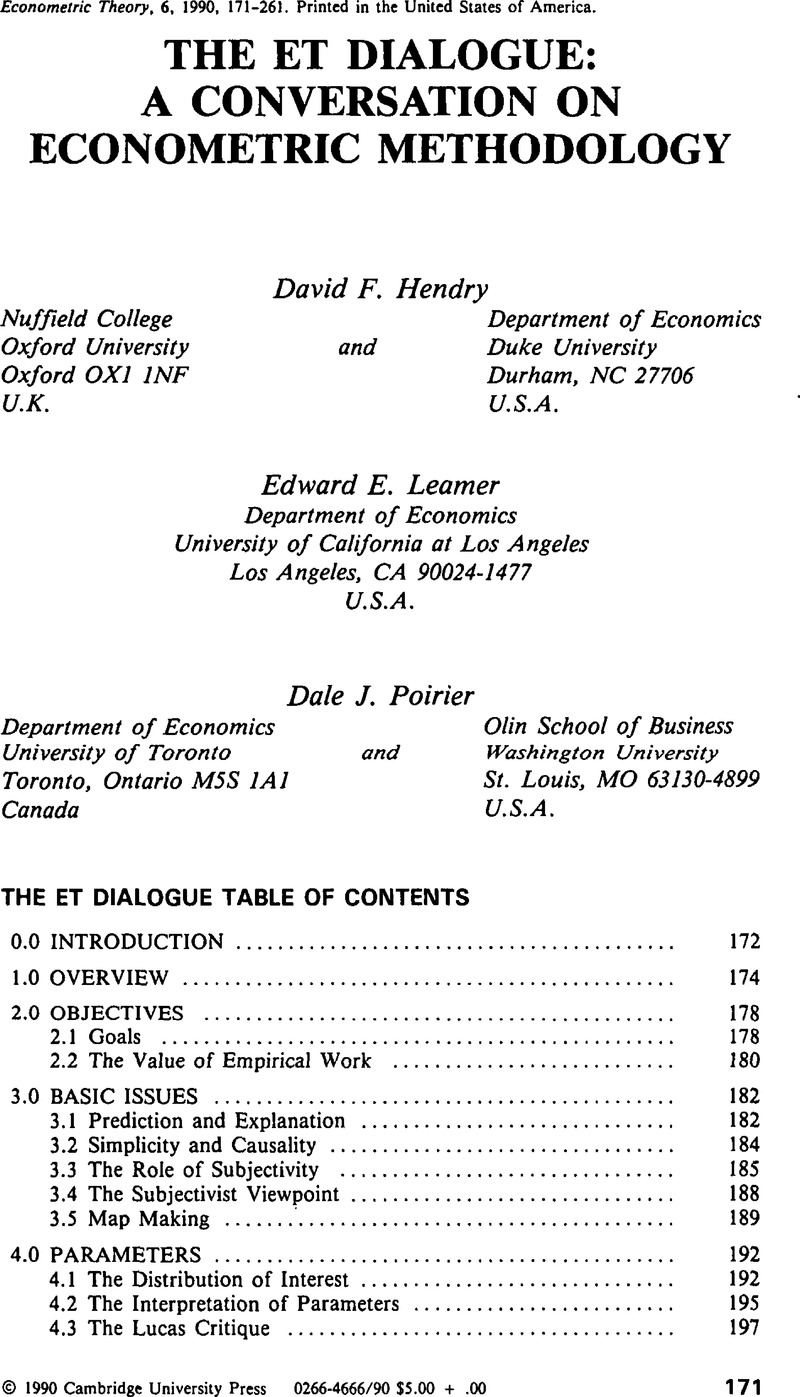
An abstract is not available for this content so a preview has been provided. Please use the Get access link above for information on how to access this content.
Information
- Type
- The ET Dialogue
- Information
- Copyright
- Copyright © Cambridge University Press 1990
References
1.Baba, Y., Hendry, D.F., & Starr., R.M. U.S. Money Demand, 1960–1984. Discussion Paper in Economics, No. 27, Nuffield College, Oxford, 1988.Google Scholar
2.Berger, J.O. & Wolpert, R.L.. The likelihood principle. (2nd ed.) Hayward, California: Institute of Mathematical Statistics, 1988.CrossRefGoogle Scholar
3.Cox, D.R. Tests of separate families of hypotheses. In Proceedings of the Fourth Berkeley Symposium on Mathematical Statistics and Probability, Vol. I. Berkeley: University of California. 1961: 105–123.Google Scholar
4.Davidson, J.E.H., Hendry, D.F., Srba, F., & Yeo, S.. Econometric modelling of the timeseries relationship between consumers' expenditures and income in the United Kingdom. Economic Journal 88 (1978): 661–692.CrossRefGoogle Scholar
5.Doan, T., Litterman, R., & Sims, C.. Forecasting and conditional projection using realistic prior distribution (with discussion). Econometric Reviews 3 (1984): 1–100.CrossRefGoogle Scholar
6.Engle, R.F. & Granger, C.W.J.. Co-integration and error correction: Representation, estimation, and testing. Econometrica 55 (1987): 251–267.CrossRefGoogle Scholar
7.Engle, R.F., Hendry, D.F., & Richard, J.-F.. Exogeneity. Econometrica 51 (1983): 277–304.Google Scholar
8.Ferguson, T.S.Mathematical statistics: A decision theoretic approach. New York: Academic Press, 1967.Google Scholar
9.Florens, J.-P. & Mouchart, M.. Bayesian specification tests. In Cornet, B. & Tulkens, H. (eds.), Contributions to operations research and economics. The XXth anniversary of CORE. Cambridge, Massachusetts: M.I.T. Press, 1989.Google Scholar
10.Geweke, J.Bayesian inference in econometric models using Monte Carlo integration. Discussion Paper No. 87–02 (revised), Department of Economics, Duke University, 1987.Google Scholar
11.Gilbert, C.L.Professor Hendry's methodology. Oxford Bulletin of Economics and Statistics 48, 283–307, 1986.CrossRefGoogle Scholar
12.Granger, C.W.J. & Uhlig, H.F.. Reasonable extreme bounds analysis. Institute for Empirical Macroeconomics, Discussion Paper 2, Federal Reserve Bank of Minneapolis, 1988.CrossRefGoogle Scholar
13.Hendry, D.F. Predictive failure and econometric modelling in macroeconomics: The transactions demand for money. In Ormerod, P. (ed.), Modelling the economy. London: Heinemann Educational Books, 1979.Google Scholar
14.Hendry, D.F.On the credibility of econometric evidence. Walras-Bowley Lecture, Duke Meeting of the Econometric Society, 1986.Google Scholar
15.Hendry, D.F. Econometric methodology: A personal perspective. In Bewley, T.F. (ed.), Advances in econometrics: Fifth World Congress II. Cambridge U.K.: Cambridge University Press, 1987: 29–48.Google Scholar
16.Hendry, D.F.Empirical modelling in dynamic econometrics. Applied Mathematics and Computation 21 (1987): 1–36.Google Scholar
17.Hendry, D.F.The encompassing implications of feedback versus feedforward mechanisms in econometrics. Oxford Economic Papers 40 (1988): 132–149.CrossRefGoogle Scholar
19.Hendry, D.F.PC-GIVE. An interactive econometric modelling system. Oxford: Institute of Economics and Statistics, 1989.Google Scholar
20.Hendry, D.F. & Ericsson, N.R.. An econometric analysis of U.K. money demand, in Monetary Trends in the United States and the United Kingdom by Milton Friedman and Anna J. Schwartz. American Economic Review, forthcoming, 1989.Google Scholar
21.Hendry, D.F. & Richard, J.-F.. On the formulation of empirical models in dynamic econometrics. Journal of Econometrics 20 (1982): 3–33.CrossRefGoogle Scholar
22.Hendry, D.F. & Richard, J.-F.. The econometric analysis of economic time series. International Statistical Review 51 (1983): 111–163.Google Scholar
23.Hendry, D.F. & Richard, J.-F.. Recent developments in the theory of encompassing. In Cornet, B. & Tulkens, W. (eds.), Contributions to operations research and economics: The XXth anniversary of CORE. Cambridge, Massachusetts: M.I.T. Press, 1989.Google Scholar
24.Klein, L.R. Use of econometric models in the policy process. In Omerod, P. (ed.), Econometric modelling. London: Heise Educational Books, 1978: Chapter 13.Google Scholar
25.Koopmans, T.C.Identification problems in economic model construction. Econometrica 17 (1949): 125–143.CrossRefGoogle Scholar
27.Learner, E.E.Let's take the con out of econometrics. American Economic Review 73 (1983): 31–44.Google Scholar
28.Learner, E.E.Sources of international comparative advantage. Cambridge, Massachusetts: M.I.T. Press, 1984.Google Scholar
29.Learner, E.E. A Bayesian analysis of the determinants of inflation. In Belsley, D.A. & Kuh, E. (eds.), Model reliability. Cambridge, Massachusetts, M.I.T. Press, 1986.Google Scholar
30.Learner, E.E. Econometric metaphors. In Bewley, T.F. (ed.), Advances in econometrics: Fifth World Congress II. Cambridge, U.K.: Cambridge University Press, 1987: 1–28.Google Scholar
31.Learner, E.E.Things that bother me (with discussion). Economic record, Proceedings from the 1988 Australian Economics Congress 64 (1988): 331–335.Google Scholar
32.Learner, E.E.Planning, criticism and revision. Journal of Applied Econometrics, forthcoming, 1989.Google Scholar
33.Lindley, D.V.The choice of variables in multiple regression. Journal of the Royal Statistical Society 31, Series B (1968): 31–66.Google Scholar
34.Lubrano, M., Pierce, R.G., & Richard, J.-F.. Stability of a U.K. money demand equation: A Bayesian approach to testing exogeneity. Review of Economic Studies 53 (1986): 603–634.Google Scholar
35.Lucas, R.E. Econometric policy evaluation: A critique. In Brunner, K. & Meltzer, A.H. (eds.), The Phillips curve and labor markets. Amsterdam: North-Holland, 1976: 19–46.Google Scholar
36.McAleer, M., Pagan, A.R., & Volcker, P.A.. What will take the con out of econometrics? American Economic Review 75 (1985): 293–307.Google Scholar
37.McCloskey, D.N.The rhetoric of economics. Madison: University of Wisconsin Press, 1985.Google Scholar
38.Pagan, A. Three econometric methodologies: A critical appraisal. Journal of Economic Surveys 1 (1987): 3–24.Google Scholar
39.Poirier, D.J. & Klepper, S.. Model occurrence and model selection in panel data sets. Journal of Econometrics 17 (1981): 333–350.CrossRefGoogle Scholar
40.Poirier, D.J.Frequentist and subjectivist perspectives on the problems of model building in economics (with discussion). Journal of Economic Perspectives 2 (1988): 120–170.Google Scholar
41.Poirier, D.J.Causal relationships and replicability. Journal of Econometrics 39 (1988): 213–234.Google Scholar
42.Poirier, D.J. & Ruud, P.A.. On the appropriateness of endogenous switching. Journal of Econometrics 16 (1981): 249–256.CrossRefGoogle Scholar
43.Spanos, A. The statistical foundations of econometric modelling. Cambridge, U.K.: Cambridge University Press, 1986.CrossRefGoogle Scholar
44.Trundle, J. The demand for Ml in the U.K. Bank of England Discussion Paper, 1, 1982.CrossRefGoogle Scholar
- 68
- Cited by