1 Introduction
The relationship between form and meaning (Saussure Reference Saussure1959) has been extensively investigated in cognitive linguistics (Bolinger Reference Bolinger1968; Langacker Reference Langacker2008). The underlying notion that ‘a difference in syntactic form always spells a difference in meaning’ (Bolinger Reference Bolinger1968: 127) indicates that different forms in a language are associated with different meanings. This principle applies to synonymous expressions; although two different forms can seemingly indicate the same meaning (e.g. she gave the man the book versus she gave the book to the man), certain semantic or functional variations tend to exist. Therefore, each form of synonymous expressions should be paired with idiosyncratic functions, and these form–function pairings are called constructions and considered as the basic unit for human language (Goldberg Reference Goldberg1995, Reference Goldberg2006).
The identification of constructional features is an important task for linguistic research (Hilpert Reference Hilpert2014; Perek & Patten Reference Perek and Patten2019; Liu & Lu Reference Liu and Lu2020) but not an easy one, especially when multiple constructions appear to serve the same function. For example, speakers of English can make suggestions using three different constructions: let's, what/how about and why don't you/we. The investigation of such synonymous expressions can greatly benefit from the examination of large-scale corpus data, which reveals subtle variations in the way people use the expressions and leads to a refined identification of their constructional features.
The importance of corpus data in the study of constructions has been highlighted in the literature (Goldberg Reference Goldberg and MacWhinney1999, Reference Goldberg2006; Gries et al. Reference Gries, Hampe and Schönefeld2005; Perek Reference Perek, Glynn and Robinson2014, Reference Perek2015; Groom Reference Groom2019; Römer & Berger Reference Römer and Berger2019; Sung Reference Sung2020; Sung & Park Reference Sung and Park2023), and Gries and Stefanowitsch conducted two seminal works related to this issue. Stefanowitsch & Gries (Reference Stefanowitsch and Gries2003: 236) investigated the interaction of words and constructions in the British component of the International Corpus of English and increased the adequacy of grammatical descriptions by taking into consideration ‘which lexical items are strongly associated with or repelled by a particular construction’. For example, they found that the into-construction (i.e. S V O into V-ing) was most strongly associated with trick and fool and concluded that the two verbs instantiated a novel sub-sense of the into-construction – namely trickery. Meanwhile, Gries & Stefanowitsch (Reference Gries and Stefanowitsch2004) extended the corpus-based lexical approach to the study of semantically equivalent constructions such as the variants of dative alternation (give someone something versus give something to someone) and particle placement constructions (pick up the book versus pick the book up). They noted that each member of such alternating pairs is strongly associated with a different set of lexical items and thus should be seen as ‘a construction in its own right with its own meaning’ (Reference Gries and Stefanowitsch2004: 124).
Another benefit that constructional research generates from looking into corpora or other types of naturally occurring language data is that discoursal characteristics of target constructions, which often remain obscure in the lexical analysis, can be disclosed by examining neighboring utterances near the constructions (Oh Reference Oh2000; Gries Reference Gries2003; Vázquez Rozas & Miglio Reference Vázquez Rozas, Miglio, Yoon and Gries2016; Groom Reference Groom2019). For example, Oh (Reference Oh2000) examined the real discourse contexts of two interchangeable constructions, actually and in fact, in the Switchboard Corpus and the Brown Corpus. She demonstrated that the two constructions share a sense of unexpectedness but tend to express different types of the sense: ‘actually is frequently found in the context of contradiction and disagreement, whereas in fact tends to mark an increase in the strength of a previous assertion’ (Reference Oh2000: 266). Meanwhile, Gries (Reference Gries2003) examined the issue of particle placement (e.g. pick the book up versus pick up the book) from a constructional perspective by looking into many variables, including discourse-functional factors such as the news value of the direct object's referent and the distance to or frequency of preceding mention of the referent. The results indicated that several discourse-functional factors along with other types of variables serve as different motivations for the two particle placement constructions. These findings imply that the constructional investigation of discourse factors in corpora enables researchers to understand important idiosyncrasies of each construction and avoid using a unitary category for multiple constructions with varying forms and functions.
These corpus-based approaches to construction studies have increased the adequacy of grammatical description of more or less synonymous constructions (Gries & Stefanowitsch Reference Gries and Stefanowitsch2004) and enabled researchers to explain the distributional patterns that these constructions show in a variety of registers and modes. For example, actually is used more frequently than in fact in spoken discourse, but this distributional pattern is inexplicable unless one considers the previously mentioned semantic differences between actually and in fact (i.e. contradiction versus strengthened assertion) in the corpus data (Oh Reference Oh2000). Thus, the frequent occurrence of actually in spoken discourse should be explained by the tendency for face-threatening acts such as contradiction to occur more frequently in spoken discourse as ‘speakers normally take turns in ordinary conversation, and in doing so, overtly interact with each other to a greater extent than readers do with writers’ (Oh Reference Oh2000: 254). Similarly, Gilquin (Reference Gilquin2015) and Vázquez Rozas & Miglio (Reference Vázquez Rozas, Miglio, Yoon and Gries2016) conducted corpus-based analyses of constructional characteristics to examine verb–particle constructions in English and subject/object experiencer constructions in Spanish and Italian, respectively; their findings accounted for constructional distributions in spoken and written discourse. For example, spoken language ‘is more likely than written language to include pronouns’ (Gilquin Reference Gilquin2015: 65), and pronouns should be placed between the verb and the particle. This may explain why the frequency of the verb–object–particle construction was greater than that of the verb–particle–object construction in spoken discourse.
Although corpus-based analyses of constructions have fed into the more precise identification of constructional features based on lexical associations and discourse structures and helped explain constructional distributions in different modes (Oh Reference Oh2000; Wulff et al. Reference Wulff, Stefanowitsch, Gries, Radden, Köpcke, Berg and Siemund2007; Gilquin Reference Gilquin2015), such an advantage of corpus-based analysis in the study of constructions has not yet been fully explored as most studies have focused on either type of analysis alone. To my knowledge, twofold methods that combine lexical and discourse analyses of constructions have been employed in only a few studies, including Liu & Lu (Reference Liu and Lu2020). They examined N1 of N2 constructions (e.g. study of constructions) in a corpus of introductory sections of 100 applied linguistics research articles. The lexical patterns of the head nouns in N1 and N2 were analyzed to determine constructional functions, and some of these constructional functions were found to be significantly associated with the discoursal (or rhetorical) patterns of academic writing such as moves and steps (Swales Reference Swales1990).
Such a comprehensive description of lexical and discoursal features of constructions is expected to increase descriptive adequacy in the research of English constructions, especially for seemingly synonymous ones, and account for how functional idiosyncrasies of different but related constructions manifest themselves in varying types of discourse. Therefore, the present study applies both the lexical and discourse analyses of corpus data to disclose meaningful differences among three seemingly interchangeable English constructions for suggesting – namely, let's, what/how about and why don't you/we – and examine how the constructional idiosyncrasies are made use of in different spoken registers.
2 Target constructions
Suggesting is one of the most important functions (i.e. social purposes of utterances) in human language communication. For example, Wilkins’ (Reference Wilkins1976: 25–54) classified two notional categories in English communication – namely, conceptual meanings (e.g. time, space) and functional meanings (e.g. suasion, argument) – and included ‘suggest’ as a functional meaning for suasion. Similarly, van Ek & Alexander (Reference van Ek and Alexander1980: 41–54) identified six categories of language functions and presented ‘suggesting a course of action’ in the fifth category of getting things done.
The functional meaning of suggesting can be expressed not only by specific lexical verbs such as suggest and advise, but also by grammatical constructions such as shall we, let's and you might. Among the grammatical constructions, the present study focuses on three suggesting constructions (i.e. let's, what/how about and why don't you/we) based on the following reasons.
First of all, both Wilkins (Reference Wilkins1976) and van Ek & Alexander (Reference van Ek and Alexander1980) listed these constructions, except the why don't you construction,Footnote 1 under the function of suggesting. In addition, it seems that the three constructions commonly have unique constructional features that are not easily attributable to their components or other constructions (Goldberg Reference Goldberg2006). The let's construction is a contraction of let us, but the two forms show notable functional differences (e.g. let's go first versus let us go first). Similarly, both the what/how about and why don't we/you constructions express functional meanings related to ‘suggest’ that are difficult to claim to be motivated by their components such as what, how, why, about and don't. Finally, the three constructions are frequently presented as interchangeable in major dictionaries and language teaching materials.
To figure out how the three target constructions have been understood, I examined four online dictionaries, Oxford English Dictionary (OED), Longman Dictionary of Contemporary English (LDCE), Macmillan Dictionary (MD) and Collins Dictionary (CD), and three descriptive grammar references, The Cambridge Grammar of English (Huddleston & Pullum et al. Reference Huddleston and Pullum2002), A Comprehensive Grammar of the English Language (Quirk et al. Reference Quirk, Greenbaum, Leech and Svartvik1985) and Longman Grammar of Spoken and Written English (Biber et al. Reference Biber, Johansson, Leech, Conrad and Finegan1999).
The LDCE provides a list of suggesting constructions in its thesaurus, where the three target constructions of the present study and four other constructions are listed under the category of ‘what you say to suggest something’. The three target constructions are presented as less formal constructions that are used to make suggestions in general situations whereas the other four constructions appear to be confined to specific contexts, such as formal settings (I propose that), being polite about others’ mistakes (can/may I make a suggestion?), suggesting something in a gentle way (maybe/perhaps) and suggesting something that is not very interesting (we may as well).
According to the dictionaries, the let's construction is a short form (LDCE) or contraction (CD) of let us, one of the first-person imperatives where the preposed verb let is followed by a first-person pronoun in the objective case (i.e. us and me). The let us construction is ‘rather archaic and elevated in tone’ (Quirk et al. Reference Quirk, Greenbaum, Leech and Svartvik1985: 830), so in colloquial English, the let's construction is more commonly used. The let's construction can be used in negative forms, with let's not being a general negation form, but don't is also inserted to form a negation, as in don't let's or let's don't, corresponding to British and American English, respectively (Quirk et al. Reference Quirk, Greenbaum, Leech and Svartvik1985).
The let's construction has the illocutionary force of suggestion and, thus, is used for suggesting that the speaker and one or more other people do something. In other words, the let's construction usually presumes the co-participation of the speaker and the listener(s). However, the let's construction is also ‘used for a 1st singular imperative; Let's give you a hand’ (Quirk et al. Reference Quirk, Greenbaum, Leech and Svartvik1985: 830); in this case, the suggested action is performed only by the speaker as long as the listener approves or the conversation is one-sided, such as between a parent and an infant. It is also possible, albeit infrequent, that the let's construction is used to propose an action to be performed only by the hearer; for example, You all have something to do, so let's do it please (Biber et al. Reference Biber, Johansson, Leech, Conrad and Finegan1999: 1117). The let's construction is frequently collocated with some verbs such as go, have and hope or some verbal idioms such as face it, hear it and be fair.
The what/how about construction is ‘generally followed by noun phrases or -ing clauses’ (Quirk et al. Reference Quirk, Greenbaum, Leech and Svartvik1985: 839), but can be followed by a tensed clause without an overt conjunction, e.g. how about we leave the others until next week? (Huddleston & Pullum et al. Reference Huddleston and Pullum2002: 909), or a tensed clause with an overt conjunction, e.g. how about if we tell the police where Newley is hiding? (LDCE). The dictionaries do not provide a separate entry for the what/how about construction, but its two subconstructions, what about and how about, are presented as either independent entries with their own headings or one of the usage patterns of what or how. The LDCE lists the what about and how about constructions as synonymous spoken phrases of what and how, with both being used for the function of making a suggestion. This constructional function appears to correspond to a directive, a term Quirk et al. (Reference Quirk, Greenbaum, Leech and Svartvik1985: 839) use when proposing that the what/how about construction is ‘principally used as directives’.
Another function of the what/how about construction is a metadiscoursal one, as in how about Philip? For this function, there is some variation among the dictionary definitions. According to the LDCE and MD, the what about construction is used to introduce a new subject that needs to be considered, whereas the how about construction is used to ask about another person, thing or aspect. The descriptions of the two subconstructions are quite the reverse in CD: the what about construction is used to ask for hearers’ opinions or feelings, whereas the how about construction is used to introduce a new subject. This inconsistency may be attributable to the usage pattern whereby the act of introducing a new subject and the act of asking about the new subject tend to occur simultaneously (e.g. what/how about the wine?). Therefore, the present study defines the metadiscourse function of the what/how about construction as encompassing various subfunctions, such as introducing, asking about and reminding another relevant subject (Quirk et al. Reference Quirk, Greenbaum, Leech and Svartvik1985).
There appears to be a general assumption that the directive function is more prominent for the what/how about construction than the metadiscourse function. However, in CD, the metadiscourse function is presented first and followed by the directive function, which may indicate that the question as to which function is primary for the what/how about construction is still unresolved. This issue will be also addressed in the corpus-based analyses of the present study.
Finally, the why don't you/we construction is generally followed by a base form of a verb, and the subject form is determined as either we or you by whether the speaker is included or not in the suggested activity. The OED remarks on the contrastive form–meaning mapping that the construction uses the negative form of the simple present tense in formulating a positive suggestion for the near future. Biber et al. (Reference Biber, Johansson, Leech, Conrad and Finegan1999: 206) note that the why don't you/we construction is distinguished from typical wh-questions in the sense that it does not ask for information. Instead, the construction is used to express invitations (e.g. why don't you come with us for an hour or so?) or suggestions (e.g. why don't we go next week?). The LDCE presents the why don't you/we construction as the third usage pattern of why (i.e. why doesn't somebody do something) and describes the construction as being a spoken phrase used ‘when you think it would be a good idea to do something’, as in why don't you wait for me downstairs? It won't be long. MD employs a different heading for the construction (i.e. why not) and explains that it is used for suggesting, e.g. why don't we share the cost of accommodation?
3 Methodology
The present study analyzes the usage patterns of the three suggesting constructions in a corpus using two types of constructional analyses.
3.1 Target corpus
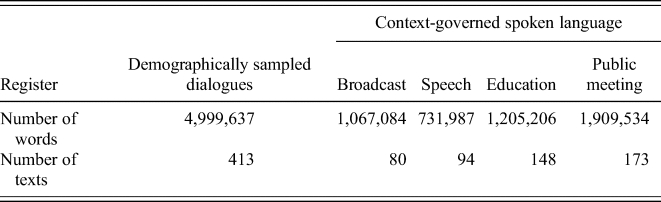
As previously mentioned, the three suggesting constructions considered here are primarily spoken phrases in British English, so the present study analyzed their usage patterns in the spoken part of the British National Corpus at BNCweb CQP-Edition (Hoffmann & Evert Reference Hoffmann and Evert1996). This is a 10-million-word spoken corpus (9,913,448 words in 908 texts) that accounts for approximately 10 percent of the total size of the BNC. It is composed of two parts: (a) demographically sampled dialogues (4,999,637 words in 413 texts) and (b) context-governed spoken language (4,913,811 words in 495 texts).
The demographically sampled dialogues contain transcriptions of spontaneous natural conversations made by members of the public selected from different ages, regions and social classes in a demographically balanced way. The context-governed spoken language is divided into four registers related to social contexts: broadcast, speech, education and public meeting. Each register includes various types of texts: broadcast (e.g. sports commentary, radio program, news), speech (e.g. political speech, after-dinner speech, sermon), education (e.g. college lecture, company training program, tutorial lesson) and public meeting (e.g. debate, auction, court hearing). The quantitative information about the two components is provided in table 1.
Composition of the spoken part of the BNC

3.2 Analysis
The search for the three suggesting constructions was conducted using BNCweb CQP-Edition (http://bncweb.lancs.ac.uk). Every token of the three constructions was collected via the query function of the BNCweb and downloaded as dataset files for additional annotations and register-based analyses. The dataset files included the metainformation of every token (e.g. register, text code, speaker code and sentence number), the hit sentence where a suggesting construction is used, and the preceding and following sentences.
Frequency analyses were performed on the collected dataset. First, the absolute frequency and the total number of texts for each construction were measured to examine which constructions were more frequent and how many texts of each register had the constructions. Second, between-register frequency analyses were conducted to figure out which of the five spoken registers were more relevant to each of the suggesting constructions. Considering that the spoken registers in the BNC varied in size (i.e. the number of words), normalized frequencies were calculated on the one-million-word base, following BNCweb, to examine the frequency ranks of the spoken registers for each construction. Third, the relationship between the registers and the construction frequencies was further examined by Poisson regression using glm in R version 4.1.3. Poisson regression is an instance of generalized linear models which describes the relationship between predictors and a count outcome variable (e.g. the frequency of a construction). The Poisson regression model in this study examined whether the text-specific frequencies of the constructions (outcome) significantly varied among the five registers (predictor). In addition, given that the texts in the spoken corpus varied in length (i.e. number of words) and that longer texts tend to have higher construction frequencies, the number of words in each text was incorporated as an offset variable into the Poisson regression model. In other words, the construction frequencies were modulated to meet the assumption that every text has the same number of words. Accordingly, the data entered into the model were the register type, the frequencies of the three suggesting constructions and the number of words in each of the 908 texts.
A preliminary examination of dispersion using qcc package found overdispersion in every construction model, which indicates that the frequency data violated the assumption of Poisson regression that ‘the mean is equal to the variance’ (Winter & Bürkner Reference Winter and Bürkner2021: 11). To address the overdispersion of the data, the quasipoisson family of glm was employed.
Following the frequency-based investigation, two levels of constructional analyses – namely, lexical and discoursal analyses – were performed to unveil the formal and functional characteristics of the suggesting constructions. The lexical analysis was based on the collocation database of the BNCweb, which showed what words were frequently used in the first right-hand (R1) slot of the suggesting constructions. For example, the let's construction was most frequently followed by have, see and say. The database listed out all R1 lexemes for each construction and estimated the association strengths between each construction and its R1 lexemes by the log-likelihood (LL) value based on the observed (O) and expected (E) frequencies in the four cells of a 2-by-2 contingency table (Dunning Reference Dunning1993), as follows:
 $$LL = 2\sum \left({O\ln \displaystyle{O \over E}} \right)$$
The greater the log-likelihood value, the more significant the difference between the expected and the observed frequency. When the log-likelihood value of a lexical item for a suggesting construction was calculated to be greater than 6.63 (i.e. p < .01), the lexical item was considered a significant collocate of the construction. However, if there was only a single speaker who had used the lexical item in the construction, it was excluded regardless of its association strength with the construction because the significant association could represent an individual speaker's style rather than the constructional knowledge of the wider population.
On the other hand, the discourse analysis qualitatively investigated a variety of discourse-related features, such as interlocutors (e.g. family members), discourse contexts (e.g. a card game) and preceding or following sentences. This sort of multidimensional approach was intended to reveal constructional functions that would be difficult to find using lexical approaches. In order to identify the dominant functions of each construction, I examined the cases in which the constructions were used with their significant collocates. As noted earlier in the examination of the dictionaries, the suggesting constructions are known to serve multiple functions, such as directive and metadiscourse marker, but the question about which function is primary still seems unresolved, although several references tend to assume that directive is a primary function. The examination of discourse patterns of significant collocates in the suggesting constructions may help disambiguate the primary and secondary functions of each construction.
4 Results and discussion
This section is composed of two subsections. The first subsection reports the results of frequency-based analyses that examined the three suggesting constructions in the five spoken registers. The second subsection discusses the results of lexical and discoursal analyses of the constructions.
4.1 Frequency analysis
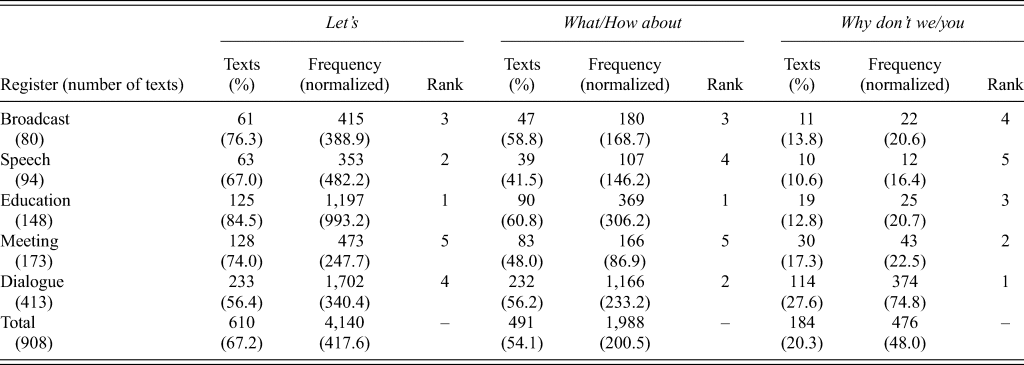
A frequency-based analysis of the three suggesting constructions in the 10-million-word spoken corpus of the BNC reported considerable variations, as shown in table 2. The most frequent construction was the let's construction, appearing 4,140 times in 610 out of 908 texts, which is more than twice as frequent as the second most frequent construction, i.e. the what/how about construction, which appeared 1,988 times in 491 texts. The least frequent construction is why don't we/you construction, appearing only 476 times in 184 texts.
Normalized-frequency-based ranks of registers for suggesting constructions

Note. The rank information is based on the normalized frequencies of each construction.
A register-based analysis found that these frequency variations may pertain to register effects. While the let's construction was the most frequent in every speech register, each construction showed distinctive usage patterns for certain registers, as evidenced by the normalized frequency and rank information in table 2. The normalized frequencies of the let's and what/how about constructions were highest in education, but second highest in different registers; the let's construction was the second most frequently used in speech, and the what/how about construction in dialogue. In addition, the why don't we/you construction was most frequently used in the registers of dialogue and meeting.
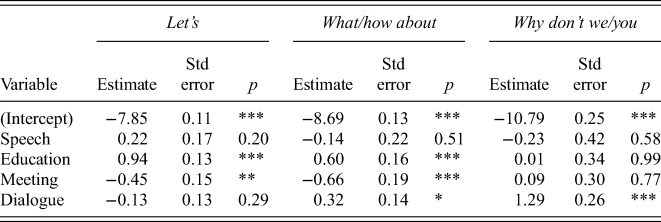
The frequency distributions of each construction in the five speaking registers were examined by Poisson regression. The baseline was broadcast in the regression model. As shown in table 3, every Poisson regression model reported significant frequency variations between the baseline and other types of register.
Poisson regression coefficients: construction frequencies in different registers

*p < .05, **p < .01, ***p < .001
For the let's construction, the register of education, which has the highest normalized frequency of the construction, was significantly distinguished from the baseline (p < .001), and the register of meeting was found to have a significantly lower frequency (p = .003). As to the what/how about construction, significantly higher frequencies were reported for education (p < .001) and dialogue (p = .024), and a significantly lower frequency for meeting (p < .001). Finally, the why don't we/you construction showed a significantly higher frequency in the register of dialogue (p < .001).
These variations among the three constructions may imply that they serve different functions of suggestion. For example, they may suggest different actions or ideas in different contexts. This issue is addressed in the following lexical and discoursal analyses of the constructions.
4.2 Constructional analysis
This section investigates the functional features of each suggesting construction by looking into neighboring lexemes and discourse structures. More specifically, significant collocates in the first right-hand slot (e.g. let's ___) were identified for each construction based on two criteria: (a) having an alpha level below .01 (i.e. log-likelihood value > 6.63) and (b) appearing in two or more texts. The significant collocates were then analyzed to discuss their semantic features and discourse patterns.
4.2.1 Let's construction
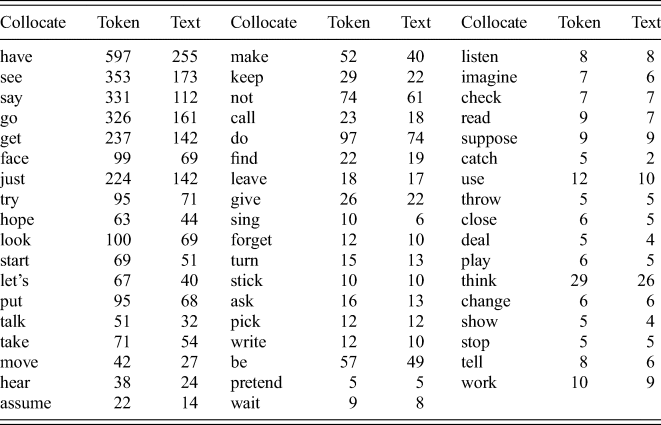
The lexical analysis based on the log-likelihood value found 53 significant collocates for the let's construction, ranging from the verb have (597 tokens) to the verb work (10 tokens), as in table 4. Most of the collocates are verbs with three exceptions: just, let's and not.
Significant R1 collocates with the let's construction

The usage patterns of the verb collocates indicate that the let's construction was primarily used as an interactional metadiscourse marker to engage listeners’ attention to and participation in the speaker's verbal behavior. In other words, the let's construction was frequently used to design interactional discourse rather than to suggest physical actions (e.g. let's play soccer). For example, the most frequent collocate have appeared 597 times in 255 texts, and 334 tokens exemplified let's have a look, which was usually used to maintain the topic of the preceding discourse and introduce a specific application or example of the topic in the following discourse, as seen in (1) and (2).
(1) You add on that fifty percent or whatever it happens to be to the hundred percent which gives you the new figure. You change that into a decimal that is what you multiply by. So, let's have a look. If something is increased by fifty percent it is multiplied by one point five. A new town plans to increase its population by fifty percent during the next five years.
(2) For example, if you spent four thousand pounds on the hardware, then you could well spend fifteen hundred or two thousand pounds on the software. And so on. Let's have a look at some of the applications. You mentioned accounts. What are the advantages of actually using a computer to keep accounts as opposed to a gentleman sitting on a tall stool with a quill pen?
Similar discourse functions were observed for the second most frequent verb see. This verb has both visual (e.g. see a show) and conceptual meanings (e.g. see if we can work out what it is), but a majority of let's see constructions (323 tokens: 91.5%) provided conceptual meanings that linked the preceding discourse to the following one, as in (3). Likewise, the verb say (third rank) was frequently used for metadiscourse functions (326 tokens: 98.5%) and rarely for directive functions (5 tokens: e.g. let's say boo). In (4), for example, the speaker provided a hypothetical situation of seeing clients and used the expression let's say to begin detailed conditioning of the situation over a prolonged discourse.
(3) So we're doing a hundred and three which is a hundred add X, X being three. Times ten add Y and Y is seven. So let's see if we've got these, we've got one thousand, yes. A hundred Y, Y is? No Y isn't seventeen.
(4) Question, you go to see Mr. and Mrs. Client tonight, and they need, let's say they need a hundred thousand pounds worth of life cover, and to fit their lifestyle …
Similarly, interactional metadiscourse functions appeared prominent for other verb collocates, such as introduction of a question (let's start with a question), introduction of a topic (let's talk about), topic management (let's stick to; let's leave it here) and summarization (let's call it omega).
The let's construction, especially with the be verb, also served as a discourse hedge which made the following argument less critical and strong. In (5), for example, the speaker first complained about the lack of information and then used the let's construction with be honest as a discourse hedge before providing a more critical complaint about the trustworthiness of the conference report.
(5) I was very disappointed that there's no comment in here at all. Let's be honest, I didn't wanna see good sections, I wanna see strong sections, I wanna see vibrant sections, but I also want to see the truth in those documents when it comes back afterwards, so I'm disappointed on this issue and er I hope something in future will be done about to report the real things that we discussed at conference as well.
The hedge function of the let's construction is especially obvious in the observation that the most frequent first left-hand slot of the let's construction was well, one of the most widely used hedge markers in English. Out of the total 4,140 tokens of the let's construction, 255 tokens (6.16%) were immediately preceded by the hedge marker well, as exemplified in (6). A similar effect was observed for just, the most frequent non-verb collocate in the first right-hand slot of let's (224 tokens): just is an adverbial hedge to soften what the speaker says in the subsequent discourse, as in (7).
(6) Yeah. Er obviously when you first start and Kim found this as well, when she first started Well she said she, well let's be honest, she really hated it.
(7) you're able to er continue through er the courses. Now we we just mentioned Tarmac's Tarmac's objectives. Let's just go through them er after the course you should be able to make clear logical and well organised case presentations.
Some verb collocates focused on behavioral suggestions. For example, the verb get was used to suggest actions of transfer (let's get you a book) and movement (let's get in a line), and the verb do was used to suggest anaphoric (that's a good idea actually, let's do that) or cataphoric behaviors (let's do this first. It's bit easier, plus five take away plus three). However, these behavioral suggestions rarely led to the termination of the speakers’ discourse. Speakers’ behavioral suggestions provided physical contexts pertaining to their following discourse. In (8), for example, the teacher explained how Shakespeare (he) had developed his experience of reading a poem into composing Romeo and Juliet and then suggested a drama activity of hot seating; this suggestion was followed by further explanations of the rules over an extended discourse. Therefore, even behavioral suggestions of the let's construction seemed to have metadiscourse effects.
(8) So he got the basic idea from a poem, but obviously the play he wrote himself. Right, now let's do a bit of hot seating hey, where one of you will sit on a chair and pretend to be one of the characters and then the others will ask a question. …
Ultimately, the let's construction seems to enable the speaker to create a discourse link between the preceding and following utterances and progressively construct the ongoing discourse. The suggested verbal or cognitive action in the let's construction is often performed only by the speaker. In (4), for example, the let's construction was used to suggest the action of saying, but only the speaker actually performed the action. In this case, the let's construction is used for a first singular imperative (Quirk et al. Reference Quirk, Greenbaum, Leech and Svartvik1985: 830), and the pronoun us in the let's construction appears to refer not to the first-person plural (us) but rather to the first-person singular (me).
However, the let's construction effectively engages the listener(s) in the speaker's action. Even when the suggested action was performed only by the speaker, the listener(s) co-participated in the construction of the discourse as an attentive audience. For example, when the speaker in (4) performed the action of saying a condition (let’s say they need a hundred thousand pounds worth of life cover), the listeners may have shared the same condition and used it to understand the subsequent discourse.
Therefore, the pronoun us in the let's construction should be considered inclusive we, a metadiscourse marker used to bring together a speaker and listeners (or a writer and readers). In many cases, the suggested discoursal actions are automatically accepted without overt agreement from the listener, as indicated by the speakers’ unobstructed speeches. This may be the reason why the let's construction occurred most frequently in the registers of speech and education, where the speaker usually has greater authority than the listener and the consentient audience must agree with and participate in the discoursal suggestions in a tacit manner.
4.2.2 What/how about construction
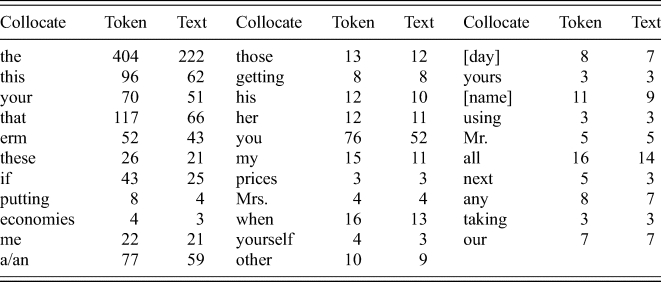
The present study found 32 significant collocates in the first right-hand slot of the what/how about construction. Most of the collocates belong to (parts of) nominal phrases, with six exceptions: erm, putting, getting, taking, if and when (see table 5). This result indicates that the what/how about construction is generally followed by nominal phrases. Among the non-nominal collocates, the use of erm after the what/how about construction was found to be related to the process of self-repair, where the speaker searched for an appropriate word (34 tokens: e.g. what about erm political affiliations?) or restructured their own speech (18 tokens: e.g. how about erm do you know how …).
Significant R1 collocates with the what/how about construction

The three gerundive collocates putting, getting and taking (in total, 19 tokens) may show that the construction was frequently followed by gerundive phrases, but not as frequently as by nominal phrases. This skewed result between 3 gerundive and 26 nominal collocates was rather unexpected because the what/how about construction has been understood to be ‘generally followed by noun phrases or -ing clauses’ (Quirk et al. Reference Quirk, Greenbaum, Leech and Svartvik1985: 839). In the corpus data of the present study, the what/how about construction was generally followed by nominal expressions (1,605 tokens: 80.7%), not by gerundives (101 tokens: 5.1%).
According to Quirk et al. (Reference Quirk, Greenbaum, Leech and Svartvik1985), the what/how about question has two main functions: directive and metadiscourse. The former function corresponds to a suggestion of or offer for the following action (e.g. How about another kiss?), whereas the latter function means to introduce, ask about, or remind another relevant subject (e.g. How about Philip? Is he coming too?). Quirk et al. (Reference Quirk, Greenbaum, Leech and Svartvik1985: 839) proposed that the what/how about construction is ‘principally used as directives’. However, the present study found the reverse pattern: the what/how about construction was principally used for metadiscourse functions.
When the construction was followed by the most frequent collocation the, a vast majority (388 out 404 tokens: 96.0%) performed metadiscourse functions, introducing another relevant subject as in (9) or reminding a person or thing as in (10).
(9) A: The carbon monoxide. What about the nitrogen and the carbon dioxide?
Do they burn?
B: No.
(10) A: He was a proper gentleman.
B: What about the lady?
A: Pardon?
B: What about the lady of the house?
A: Oh she was there too.
Only 7 tokens (1.7%) of what/how about the X made directive suggestions, but even these tokens had a metadiscoursal sense because the directive suggestions were related to the contents of the preceding discourse, as exemplified in (11).
(11) A: [Line 835] I agree with what you're saying but when I've done it before and involved the pupil in such a report I put it on a separate sheet, so that. […]
A: [Line 849] it affords the opportunity to be inclusive and I think that's important.
B: Well a po, what about the reverse?
A: Sorry?
B: Put it on the reverse of the sheet.
Similar observations were made for the cases when the what/how about construction was followed by demonstrative (i.e. this, that, these, those) or pronominal collocates (i.e. your, me, his, her, you, my, yourself, yours, our). These types of collocates generally performed metadiscourse functions of introducing or asking about relevant subjects, either by themselves (what about this?) or with the following nouns (how about your wife?). In contrast, the function of the directive suggestion (i.e. suggestion of actions) was rarely observed for these collocates (31 out of 473 tokens: 6.55%), and the suggested actions were generally specified in the preceding discourse (I'll do the primary, you do the secondary … What about that?) or in the following discourse (How about you constructing your own worksheet on this?). Therefore, even the directive suggestion of the what/how about construction followed by a demonstrative or pronoun had a metadiscoursal sense.
The present study also identified 64 tokens of the what/how about construction followed by a finite clause, and a majority of the finite clauses began with either if or when. This usage pattern, although exemplified in certain dictionaries such as the LDCE, has not been explicitly discussed in the literature on descriptive grammar (e.g. Quirk et al. Reference Quirk, Greenbaum, Leech and Svartvik1985; Huddleston & Pullum et al. Reference Huddleston and Pullum2002). For example, Huddleston & Pullum et al. (Reference Huddleston and Pullum2002: 909) state that a tensed clause without an overt conjunction can be used in the how about construction (e.g. How about we leave the others until next week?), but not in the what about construction. However, the present study found that both what about and how about were followed by tensed clauses and that most of the tokens (58 out of 64 tokens: 90.6%) began with an overt conjunction such as if and when.
This usage pattern generally performs metadiscourse functions such as providing a possible scenario about the situation established in the preceding discourse or asking about another aspect of the topic having been discussed (62 out of 64 tokens: 96.9%). In (12), for example, a lecturer and students were speaking about first aid for people in shock. After hearing and repeating a student's answer, the lecturer used the how about construction with an if-clause to provide another possible scenario of the situation. Similarly, in (13), a doctor asked a patient with an ear problem about his condition. The patient's first answer seemed less informative, so the doctor asked about another aspect (=when lying in bed) of the topic.
(12) Student: Lay them down and raise their legs.
Lecturer: If it's humanly possible, lay them down, raise the legs,
how about if they're shivering?
Student: Maintain their body heat.
(13) Doctor: You didn't notice any?
Patient: No.
Doctor: What, what about when you're lying in bed at night?
Patient: No, it's just a dullness.
The prominence of metadiscourse functions in the what/how about constructions might be attributable to the semantic nature of the previously mentioned collocates, including the definite article, demonstratives, pronouns and subordinate finite clauses. These collocates are known to refer to (a) given information that has been established in the previous discourse or is identifiable from the communication context or (b) dependent information to be combined with the information of a main clause. The referring or dependent nature of these collocates might explain why the what/how about construction was mainly used not as directives (i.e. suggestions of actions), but as metadiscourse markers (i.e. suggestions of topics).
Moreover, even when the collocate had a weak sense of reference or dependence (e.g. a, any), the what/how about construction was primarily used to serve metadiscourse functions. For example, there were 77 tokens of the construction collocated with the indefinite article a(n), and the lion's share (51 out of 77 tokens: 66.2%) fulfilled metadiscourse functions, as in (14), while 23 tokens (29.9%) suggested actions by means of deverbal nouns (15), a theme relevant to the current action (16), or future events (17).
(14) A: That beats a full house.
B: What about a flush? Does that beat a full house?
(15) A: What about a nice long walk go and pick up Jesse?
(16) A: Hold on, there's a nice whisky somewhere!
B: How about a vodka?
(17) A: What about a concert this Friday?
The directive function of the what/how about construction was prominent only when it was collocated with gerundive phrases. There were 86 tokens of 52 gerundive collocates, ranging from asking to working, and three gerundives (i.e. putting, getting and taking) were found to be significant collocates. The suggested actions were to be performed immediately, as in (18), or at some time in the future, as in (19). Even the usage of these gerundive collocates appeared to have metadiscourse senses, especially when the suggested action is future-related. In (19), the suggested future action in the how about getting construction is closely related to the previously discussed benefits of a raffle. Thus, the speaker may have been able to suggest the action because the acceptance of the suggestion would allow listeners to enjoy the previously discussed benefits.
(18) A: I've not got a very good hand.
B: Put those cards.
C: What about putting some in the middle?
(19) In the right place, a raffle can be a winner, by persuading a friendly car dealer to loan you a car to put in a shopping centre, or at a country show. Many branches have raised a hundred and fifty to two hundred pounds a day, or even more. Check as there may be insurance problems, but don't be put off, or how about getting a dealer to supply a cardboard mock-up of a car and using this? It still grabs the attention.
In sum, the what/how about construction frequently preceded nominal phrases and performed metadiscourse functions. The construction was also followed by gerundive phrases or finite clauses in 86 and 64 tokens, respectively, each accounting for 4.3% and 3.2% of the total tokens. This finding is in contrast with previous claims that the what/how about construction is generally followed by nominal and gerundive phrases and that the primary function of the construction is directives.
It seems that the primary function of the what/how about construction is to remind or ask about a subject relevant to the spoken discourse. Therefore, the construction usually invites listeners to respond (e.g. yes, no, well), which may explain why it was not as frequently used in the speech register as the let's construction was. Instead, the what/how about construction was frequent in the education register, where the lecturer's question about a subject relevant to the preceding education contents could be answered by students. The what/how about construction was also frequent in the dialogue register, where one reminded another of a particular issue or asked about another aspect of the ongoing discussion, and the other responded accordingly. In most cases, the introduction of another issue had been effectively established in the previous discourse, so the speakers rarely provided the reasons for doing so in an explicit manner.
4.2.3 Why don't you/we construction
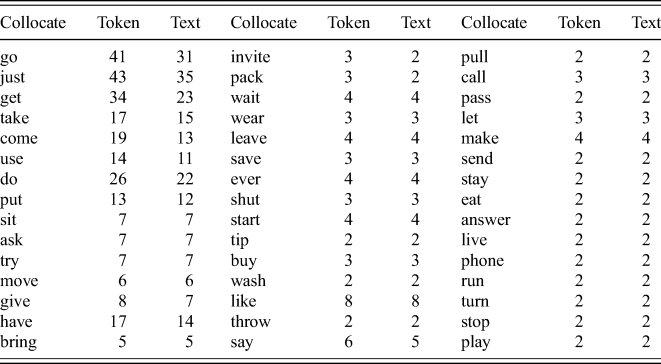
The present study found 45 significant collocates in the first right-hand slot of the why don't you/we construction (see table 6). As predicted from the formal aspects of the constructions, most of the collocates were found to be verbs, with two exceptions: just and ever.
Significant R1 collocates with the why don't you/we construction

The usage patterns of the significant collocates were examined to identify the primary function of the why don't you/we construction (e.g. directive versus metadiscourse). In contrast with the prominence of metadiscourse functions for the let's and what/how about constructions, only a small number of why don't you/we constructions (23 out of 476 tokens: 4.8%) were used for the metadiscourse function of asking about reasons, as in (20) and (21).
(20) A: Mum, why don't you ever enroll me in those?
B: Cos you, were rubbish.
(21) A: Why don't you like being called that?
B: Why? Because the only time my mother calls me M** is when I'm in trouble!
Notably, a vast majority of the why don't you/we constructions (451 tokens: 94.7%) were used for directive functions, i.e. suggesting certain activities. For example, the most significant collocate go was principally used to suggest specific activities, such as chasing frogs (22) or sleeping (23).
(22) A: Sam, why don't you go and chase frogs? He spends almost his whole time sitting by the pond.
B: Does he?
(23) A: Tired? Why don't you go to bed?
B: Not yet.
Suggestions of specific activities were common in the other frequent verb collocates such as get (e.g. why don't you get a piece of paper and a pencil and jot it down then?), take (e.g. why don't you take one for a test drive?) and do (e.g. why don't we do a game or something?).
Another noteworthy usage pattern of the why don't you/we construction was observed for the most frequent collocate just (43 tokens). This adverbial hedge preceded a variety of activity verbs (29 types: from adopt to use) to soften the tone of the suggestion. In (24), for example, speaker A and speaker B had an argument and refused to apologize to one another, but after speaker C's sarcastic evaluation of the problem, speaker A carefully suggested the activity of mutual apology. Another example of the adverbial hedge just in the why don't you/we construction was found in (25), a conversation on a TV show. In the conversation, the host A and the guest B talked about a sensitive issue (i.e. B's loss of hair), and a member of the audience used not only the adverbial hedge just but also the hedge expression you know to soften the suggestion of not wearing a hairpiece.
(24) A: I'm not gonna apologize to you and you're not gonna apologize.
B: Apologize.
C: Yeah but there's so much starving in Ethiopia and you're bothered because you're not talking to one another.
A: Why don't we just apologize together?
(25) A: Howard. When did you start going bald?
B: I started losing mine when I was nineteen …
A: … did it ever bother you?
B: Well I was a drama student at the time and I suppose erm
A: Yes listen, can you just shut up, one at a time, lady there.
C: Yeah, I wanna know, right, why don't you just you know go bald? you know normally, why do you have to hide it?
The hedge usage seems to pertain to the why don't you/we construction because the directive function of suggesting an activity demands great physical and cognitive efforts of conversation opponents (e.g. chase or apology) that go beyond less effortful verbal behaviors, such as listening and answering. This may also explain why the directive suggestion of the why don't you/we construction was often followed by I mean to provide additional reasoning or interpretation, as shown in (26) and (27).
(26) A: Why don't you sit down and tell me what you want for Christmas?
I mean that would be useful.
B: Oh darling. Tut. Nothing I particularly want for Christmas.
(27) A: … why don't you go and have a look. I mean, the thing is the, they're not,
you know, some of them are not that nice but er
B: Well it sells, it's got to.
Interestingly, the suggestion of a specific activity made by the why don't you/we construction was often rejected, and the rejection was presented explicitly (e.g. no) as well as implicitly. For example, in (28) and (29), the suggestions made by the construction were implicitly rejected by the subsequent utterances beginning with because.
(28) A: Why don't we start right at the beginning of the tape?
B: Because we're not bothering watching any more now.
(29) A: Why don't you just do it here?
B: Because, because you can do it properly there, you can get really plastered.
Overall, the why don't you/we construction was principally used to offer directive suggestions of certain activities in the spoken data included in the BNC. This finding is in sharp contrast with the prominence of metadiscourse functions for the other suggesting constructions (i.e. let's and what/how about). When speakers made such suggestions of activities, the why don't you/we construction was often collocated with the hedge adverbial just or additive expression I mean. These epistemic markers appeared to reduce the force of the suggestion and make it sound more polite (Gray & Biber Reference Gray, Biber, Aijmer and Rühlemann2014). Despite the speakers’ careful use of the why don't you/we construction, the suggestions were often rejected either explicitly (e.g. no) or implicitly (e.g. because I …; cos we …). This interactional nature of the construction may explain why it was most frequently used in the dialogue register and least frequently in the broadcast and speech registers. In other words, the why don't you/we construction is likely to be used in the context where coordinative interlocutors co-construct a conversation and try to figure out the best of possible activities by means of suggestion, rejection and acceptance.
5 Summary and conclusion
This article combined lexical and discoursal analyses in the corpus-based research of constructions and revealed idiosyncratic characteristics of the three suggesting constructions used in five spoken registers. First, the results indicated that the let's construction primarily performed metadiscourse functions such as engagement and transition in a speaker's prolonged discourse (e.g. education, speech) where the consentient audience participated in the discoursal suggestions in a tacit manner. Second, the what/how about construction was predominantly followed by nominal phrases to serve metadiscourse functions of introducing and/or asking about someone/something, and these functions were usually followed by other interlocutors’ immediate response, as in teacher–student interactions. Third, the why don't you/we construction was frequently used in dialogue to suggest an activity with a specific reason, but the suggestion was often immediately rejected by another interlocutor.
These idiosyncrasies helped explain the varying frequencies of the constructions in different spoken registers, which remained inexplicable from the previous descriptions in dictionaries or grammar books. Thus, the synthesis of lexical and discoursal analyses of corpus data in the present study has provided more refined descriptions of the three suggesting constructions, thereby increasing the descriptive adequacy of constructional approaches to English linguistics.
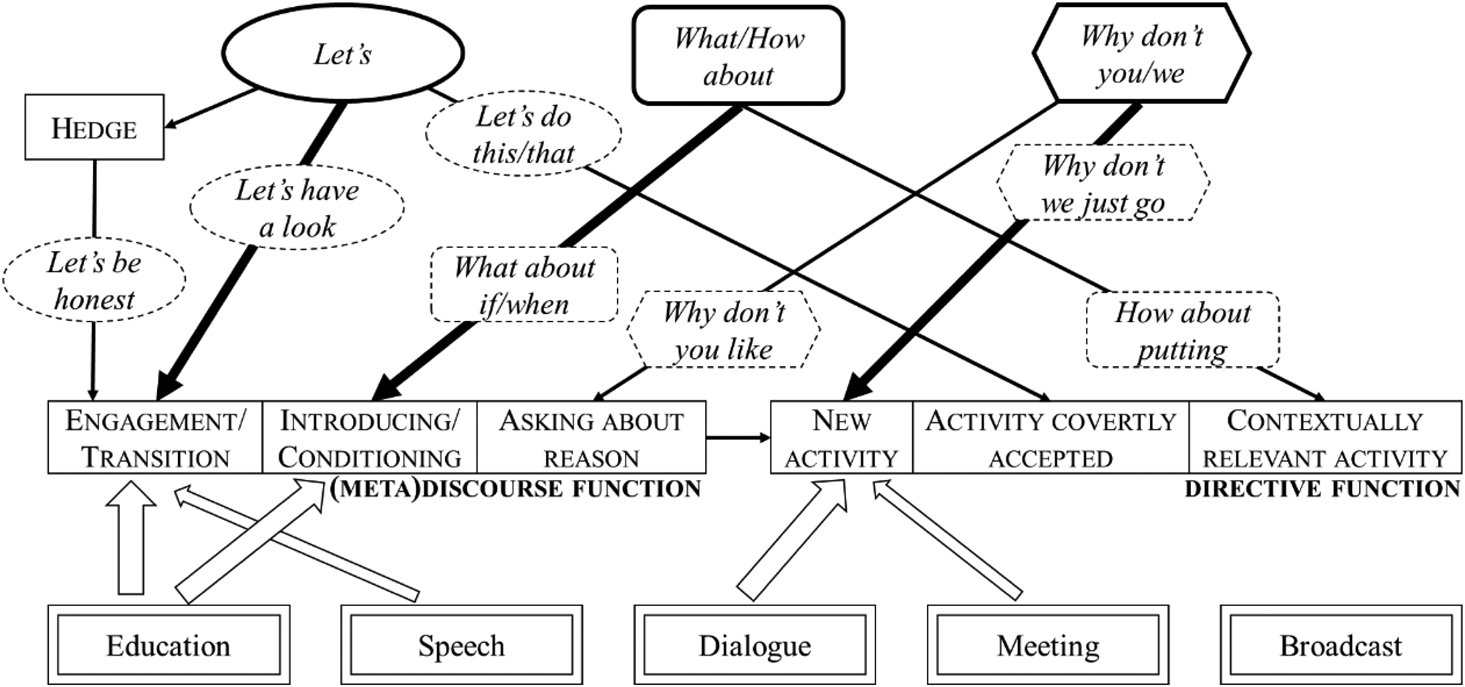
The major findings about constructional forms, functions and registers are summarized in figure 1. The three constructional forms are presented in three shapes at the top (i.e. an oval, a rounded rectangle and a hexagon) and linked to their primary and secondary functions in two domains, i.e. (meta)discourse and directive. Each link is tagged with a dotted shape which contains a major example of the form–function pairing. In addition, the five spoken registers are placed at the bottom, and the degree to which a register requires the use of a certain function is expressed by a thick or thin block arrow between the register and the function. For example, the let's construction is connected to its primary metadiscourse function (i.e. engagement and transition) along with the tagged example of let's have a look, and this function is particularly required by the education and speech registers.
Forms, functions and registers of suggesting constructions

The form–function–register network in figure 1 may highlight the importance of lower-level generalizations (Perek & Patten Reference Perek and Patten2019). Instead of investigating the general functional category of ‘suggest’ (Wilkins Reference Wilkins1976), the present study has examined three lower-level constructions, which leads to novel generalizations (see figure 1) that can explain how speakers of British English use form–function pairings to address varying needs for suggestion in different registers. It seems that such lower-level generalizations are psychologically valid because they account for how people use languages in actual situations.
Constructionists have endeavored to build the constructicon that captures the entirety of the English grammar (e.g. Fillmore, Lee-Goldman & Rhodes Reference Fillmore, Lee-Goldman, Rhodes, Boas and Sag2012). The entirety of grammar may need to be discussed not only in terms of width but in terms of depth. In other words, efforts to examine less-studied constructions and widen the English constructicon should be matched with interest in varying depths of formal, functional and contextual features of the constructions. In this regard, the present appears to contribute to increasing both the width and depth of the English construction: the three suggesting constructions are novel elements that may widen the unfinished constructicon, and the combination of lexical and discoursal analyses in the present study may offer a glimpse of a way to deeper layers of the constructicon.
The present study focused on only a small number of constructions in spoken British English, so it is important to extend the synthetic approach adopted here to other constructions in different types of written or spoken corpora. Such an extension will lead to more refined identifications of English constructions, especially seemingly synonymous ones, and contribute to the development of English constructicons (Perek & Patten Reference Perek and Patten2019).