




1. Introduction
The distinction between RAISING and CONTROL in English has been one of the most debated topics in syntactic theory. While the empirical contrast between the two is well understood, it has remained unclear what factors determine whether a given lexical item is a raising predicate, a control predicate, or both. In this study, we approach this question from the perspective of acquisition and diachrony. Specifically, we use quantitative methods to study the emergence and spread of raising verbsFootnote 1 in Early Modern English (1500–1720) and compare them against both novel corpus-based and existing empirical data in child language acquisition.
Scholars have long noted parallel patterns between language acquisition and change (e.g. Paul Reference Paul1880; Kiparsky Reference Kiparsky1965; Andersen Reference Andersen1973; Lightfoot Reference Lightfoot1979; Kroch Reference Kroch, Baltin and Collins2001; Cournane Reference Cournane, Mathieu and Truswell2017). Both processes are fundamentally dynamic: languages undergo change in speech communities whose linguistic compositions are constantly in flux over time. Words enter and leave grammars over time, which may result in either the emergence or disappearance of linguistic patterns. Similarly, children must construct grammars based on learning individual words as they develop over time to become mature speakers. Some linguistic patterns emerge early, whereas others are attested only after the child has accumulated sufficient lexical experience over several years.
In general terms, this study aims to add to the literature on potential parallels between acquisition and change. Our specific research questions are the following. First:
-
• How are TO-infinitives distributed across verb lemmas in child-directed and child-naturalistic speech? We ask the same question, using data from Early Modern English. This is an important first step in trying to understand the emergence of the raising–control distinction both in acquisition and diachrony since somehow verbs that take TO-infinitives must have developed separate distributional properties that ultimately led to the distinction.
-
• Does the spread of raising in Early Modern English pattern with children’s learning trajectories? Expletive subjects have been argued to be the primary linguistic cues for the child learner in acquisition (see, e.g., Irani Reference Irani2019). However, it has been unclear how these cues arise in the first place and are transmitted across generations. Therefore, we specifically ask whether the emergence of expletive subjects diachronically may have carved the way for raising as an independent syntactic structure from control.
Secondly:
-
• Could other distributional subject-related properties have contributed to the emergence of raising in the history of English? In this respect, we look at animacy and voice (co-occurrence in passives) which have been proposed as diagnostics to distinguish between the two structures. Have these properties been found to guide children’s inferences in acquisition about whether – or not – a predicate can raise?
Our findings indeed demonstrate parallels between acquisition and change: raising plausibly emerged, as an independent structure from control, entirely via lexical learning both in acquisition and diachronically. Furthermore, we argue that the rise of raising in the history of English was facilitated by the requirement for an overt subject in English.
The article is organized as follows: section 2 provides an overview of the empirical contrasts between raising and control. The history of the distinction is outlined in section 3, followed by a discussion of different views on the acquisition of the raising–control distinction and the parallels between acquisition and diachrony in section 4. Section 5 spells out our methodology. The results of our corpus studies are presented in section 6, followed by a discussion in section 7. Section 8 concludes this article.
2. Background: raising versus control
Present-day English makes a distinction between two argument structures that have traditionally been referred to as raising (1) and control (2), respectively:
(1)
Subject raising:
Kate seems to like syntax.
(2)
Subject control:
Kate wants to like syntax.
While, prima facie, the two structures seem identical, they differ in crucial ways. The matrix verb SEEM in (1) does not assign a thematic role to its subject Kate, whereas WANT in (2) does. Most generative accounts have explained the difference between the two structures in terms of movement versus non-movement (see, among many, Landau Reference Landau2013; Polinsky Reference Polinsky and den Dikken2013). In (1), the subject has moved (raised) out of the non-finite clause to the external argument position, as schematized in (3a). By contrast, as schematized in (3b), no cross-clausal movement has taken place in (2). Instead, the matrix subject is coindexed and coreferential with a phonologically null subject in the non-finite clause, referred to as PRO (Chomsky Reference Chomsky1981). Therefore, both the matrix and the embedded subject in (2) are assigned their thematic role locally.
(3)
(a)

(b)

Movement has been contested as the explanatory factor for the distinction between raising and control structures (for alternative analyses see Hornstein Reference Hornstein1999; Boeckx & Hornstein Reference Boeckx and Hornstein2004; Boeckx, Hornstein & Nuñes Reference Boeckx, Hornstein and Nuñes2010; Vincent Reference Vincent and Darymple2023). Theoretical differences aside, there is general consensus that the crucial difference between the raising and control resides in whether or not the matrix subject bears a thematic role.
The difference between the two structures results in a number of empirical contrasts.
First, expletive subjects are only possible with predicates that can occur in a raising configuration (4b), whereas they are impossible in a control configuration (5b):
(4)
(a)
Kate seems to like syntax.
Raising
(b)
It seems that Kate likes syntax.
(5)
(a)
Kate hopes to like syntax.
Control
(b)
*It hopes that Kate likes syntax.
Since raising verbs do not assign a thematic role to their matrix subject, (4a) and (4b) are synonymous. In (4b), the matrix expletive subject simply serves the requirement for an overt subject in English, rather than adding any semantic content to the sentence. By contrast, (5b) is ungrammatical precisely because of the requirement for a control predicate to assign a thematic role to its external argument.
Second, there are semantic properties associated with thematic role assignment: control predicates typically co-occur with animate subjects, whereas raising predicates can co-occur with either animate or inanimate subjects. As a result, (6a) is acceptable because the raising verb TEND does not have an agentive matrix subject. Conversely, (6b) is unacceptable because of the agentive nature of the matrix subject of TRY.
-
(6)
-
(a) This stone tends to erode.
-
(b) #This stone tries to erode.
-
The formal and semantic contrasts in the subject properties of raising versus control predicates also result in differences in their interpretation under passivization. For example, the sentences in (7a,b) are synonymous because of the absence of thematic role assignment to the matrix subject: both can be paraphrased by ‘It tends to be the case that the specialist examines Kate’. By contrast, the sentences in (8a,b) have different interpretations depending on whether The specialist or Kate occupies the matrix subject position.
(7)
(a)
The specialist tends to examine Kate.
Raising
(b)
Kate tends to be examined by the specialist.
(8)
(a)
The specialist tried to examine Kate.
Control
(b)
Kate tried to be examined by the specialist.
Other diagnostics, including scope ambiguity and interpretation in idiomatic chunks, have been proposed in order to distinguish between raising and control predicates (for an overview, consult Davies & Dubinsky Reference Davies and Dubinsky2004). However, in this study we will focus on co-occurrence with expletive subjects, inanimate subjects and passives as potentially important distributional properties in the emergence of raising, both historically and in acquisition. This empirical decision is motivated by the fact that these are distributional properties that can be relatively easily quantified in a corpus study, whereas the other diagnostics require native speaker judgements to obtain the relevant evidence.
An important complicating factor in the study of raising and control is that the distinction is not entirely dichotomous (Perlmutter Reference Perlmutter, Jacobs and Rosenbaum1970): some predicates may vacillate between the two structures, like, for example, the verbs BEGIN and PROMISE, as the sentences in (9) and (10) demonstrate:
-
(9)
-
(a) Kate deliberately began to eat the kebab.
-
(b) It began to snow.
-
-
(10) Sam promised to work hard.
In (9a), the matrix subject is assigned the thematic role of agent, as the agent-oriented adverb deliberately clearly shows, and hence this is a case of control. In (9b), on the other hand, the matrix subject is a semantically empty placeholder, and hence this can only be a case of raising. As for (10), the sentence has two readings: either (i) it is likely (and viewed favourably by the speaker) that Sam will work hard, corresponding to a raising interpretation, or (ii) Sam made a promise that he would work hard, corresponding to a control interpretation.
While the synchronic properties of raising versus control are well understood, it has been unclear what makes a predicate either raise or control. An obvious place to look for generalizations is the predicate’s lexical meaning: one might hypothesize, for example, that all aspectual predicates are control predicates, either within a given language or universally. Yet few robust generalizations both within and across languages have been detected (see Stiebels Reference Stiebels2007 for a cross-linguistic survey and a discussion of lexical idiosyncrasies in this domain in Polinsky Reference Polinsky and den Dikken2013: 579). For instance, corpus-based studies of contemporary English (e.g. Mair Reference Mair1990; Noël Reference Noël, Mondorf and Rohdenburg2003; Egan Reference Egan2008) suggest that the distinction between the two structures is simply lexically listed. However, if that is indeed the case, then how did the distinction emerge in the first place in the history of English – and how do children discover it in acquisition?
3. The history of raising and control
Relatively little research has explored the emergence of raising in TO-infinitives in the history of English; a summary and critical evaluation of the twentieth-century literature can be found in Denison (Reference Denison1993: 218–51). Subject control with TO-infinitives, including complement TO-infinitives, is robustly attested in the earliest Old English texts, but the same is not true of raising: as yet, unambiguous examples of subject raising with TO-infinitives from before the second half of the Middle English period have not yet been identified (see Denison Reference Denison1993: 221, 224–5, 239–40, and the references discussed there). The earliest true examples of raising are found in fourteenth-century texts such as the Middle English Wycliffite sermons (Warner Reference Warner1982; Allen Reference Allen1984), and then only in very restricted contexts, such as with the verb SEME (‘seem’), as in (11), and under passivization, as in (12).Footnote 2 The spread of raising to more and more predicates is a gradual development which unfolds over the following five centuries.
(11)
Godis
children
seem
to
don
euyl
God’s
children
seem
to do
evil
‘God’s children seem to do evil’
(Wycliffite Sermons, c.1400; CMWYCSER-M3,254.538)
(12)
Þat
man
is
seyd
to
haue
a
feend
that
man
is
said
to
have
an
enemy
‘That man is said to have an enemy’
(Wycliffite Sermons, c.1400; CMWYCSER-M3,419.3464)
As regards the origin of raising, several potential sources (bridging contexts) have been identified; see Denison (Reference Denison1993: 242), Vincent (Reference Vincent and Darymple2023: §13) and Björnsdóttir, Gotthard & Walkden (Reference Björnsdóttir, Gotthard and Walkden2024: section 3) for discussion. The most influential proposal, originating in unpublished work by Higgins (Reference Higgins1990) and adopted by Barron (Reference Barron, Butt and King1997, Reference Barron, Butt and King2001), Traugott (Reference Traugott, Swan and Westvik1997) and Heine & Miyashita (Reference Heine and Miyashita2008), is that raising in TO-infinitives arises diachronically via a reanalysis of control TO-infinitives, including perception verbs (Barron Reference Barron, Butt and King1997, Reference Barron, Butt and King2001) and commissive verbs (Traugott Reference Traugott, Swan and Westvik1997; Heine & Miyashita Reference Heine and Miyashita2008). In this development, the crucial change is the (perceived) loss of the thematic-role-assignment property of control predicates. Thus, for instance, hei promises PROi to be a good student, in which he is the agent of promising, can be reanalyzed as hei promises ti to be a good student, in which the situation in which he is a good student is merely a likely one, with no act of promising taking place.Footnote 3
The idea that raising arises diachronically from control is an appealing one, since it establishes a direct parallel between ontogeny and phylogeny: in acquisition, too, most accounts claim that raising emerges from control, as we discuss in section 4. Still, much remains to be understood about this development. Higgins (Reference Higgins1990), Barron (Reference Barron, Butt and King1997, Reference Barron, Butt and King2001), Traugott (Reference Traugott, Swan and Westvik1997) and Heine & Miyashita (Reference Heine and Miyashita2008) each focus on the development of a small number of predicates, but one of the big questions is why and how raising came to characterize a whole class of predicates; for this, a broader, corpus-informed perspective is required. Furthermore, these studies do not attempt to address why raising emerged when it did – linking it, for instance, to ongoing independent changes in the syntax of subjecthood during the period in question, such as the loss of null subjects (Walkden & Rusten Reference Walkden and Rusten2017), overt case-marking on non-pronominal DPs, or verb-second (van Kemenade Reference van Kemenade1987, Reference van Kemenade, Nevalainen and Traugott2012), or the rise of expletives (Breivik Reference Breivik1983; Williams Reference Williams, Pintzuk, Tsoulas and Warner2000). As Boucher (Reference Boucher1998) points out, many of the changes that occur during this period of the history of English are linked to the establishment of an obligatorily filled subject slot. We present a proposal in section 7.1 in which the rise of overt expletives is a crucial catalysing factor in the rise of raising.
4. The emergence of raising in child language acquisition
4.1. Learning to raise
Corpus studies have shown that TO-infinitives in contemporary English are attested in children’s naturalistic production from early on (e.g. Bowerman Reference Bowerman1973; Brown Reference Brown1973). Both raising and control structures are attested in child-directed input at all ages, and their uses do not increase as a function of age (Irani Reference Irani2019; MacWhinney Reference MacWhinney2000). However, raising and control structures seem to follow different learning trajectories in child language acquisition. On the one hand, comprehension studies have demonstrated that control structures are in place by the age of three (e.g. Goodluck Reference Goodluck1981; Hsu et al. Reference Hsu, Cairns and Fiengo1985; Sherman & Lust Reference Sherman and Lust1993; Goodluck et al. Reference Goodluck, Terzi and Diaz2001; Hirsch & Wexler Reference Hirsch, Wexler, Dubinsky and Davies2007). On the other hand, children have been found to fail at comprehending subject-to-subject raising structures beyond the age of seven: they do not seem to perceive the matrix subject of raising predicates as derived and, hence, interpret them as identical to control (e.g. Hirsch Reference Hirsch2011).
The developmental asymmetry between raising and control has raised several important questions in acquisition research (see, among many, Borer & Wexler Reference Borer, Wexler, Roeper and Williams1987; Frank Reference Frank1998; Diessel Reference Diessel2004; Hirsch & Wexler Reference Hirsch, Wexler, Dubinsky and Davies2007). In this study, we focus specifically on the question of what distributional properties in the input may guide children’s inferences about whether or not a predicate can occur in a raising configuration. This is an important issue because the distinction between raising and control is highly language-specific: some languages have it – others do not – and the correlation between lexical meaning and raising is also subject to cross-linguistic variation (see, e.g., Polinsky & Potsdam Reference Polinsky and Potsdam2006 for case studies).
Most acquisition accounts have acknowledged the role of expletive subjects in the acquisition of raising (e.g. Borer & Wexler Reference Borer, Wexler, Roeper and Williams1987; Irani Reference Irani2019). However, Becker (Reference Becker2006, Reference Becker2009, Reference Becker2014) has proposed that since inanimate subjects are more frequently attested with raising than control predicates, animacy may guide the child learner’s inferences about whether or not a predicate can either raise or control. Therefore, by hypothesis, children may learn that a predicate does not raise if it co-occurs with a lower rate of inanimate subjects. Furthermore, Becker has pointed out that ambiguous predicates like, for example, BEGIN can also co-occur with expletive subjects; they are not useful for the child learner in order to disambiguate between raising and control predicates (for a comprehensive overview and critique of Becker’s learning proposal, consult Irani Reference Irani2019).
4.2. Productivity and the acquisition of raising
Productivity has long been a contested notion in linguistic theory: what conditions trigger the onset of productivity and what conditions prevent it? What is the role of productivity in language acquisition and change? Is productivity categorical or gradient? However, there is general agreement that productivity represents speakers’ intuitive ability to extend linguistic patterns to novel ones (see, e.g., Bauer Reference Bauer2001 and references therein for a comprehensive overview).
Distributional properties have standardly been assumed to be involved in the productivity of linguistic patterns. However, frequency and productivity do not necessarily go hand in hand: High-frequency linguistic patterns may be unproductive (see, e.g., Legate & Yang Reference Legate and Yang2007 for the English stress system), whereas low-frequency linguistic patterns may be productive (see, e.g., Marcus et al. Reference Marcus, Brinkmann, Clahsen, Wiese, Woest and Pinker1995 for the German plural ending -s). Therefore, there is a need for a mechanism that allows acquirers to process the distributional information that they encounter in the input data.
Yang (Reference Yang2005, Reference Yang2016) has proposed a quantitative measure, the Tolerance Principle (TP), to distinguish between productive and unproductive processes in language. The principle is stated in (13):
-
(13) The Tolerance Principle
-
If R is a productive rule applicable to N candidates, then the following relations hold between N and e, the number of exceptions that could but do not follow R: e ≤ θN where θN =N/lnN.
The TP quantifies the precise conditions for productive rule formation. The model hypothesizes that a general rule will be formed when doing so is computationally more efficient than storing lexical items. Computational efficiency is calculated by comparing the time complexity required for forming a rule and for accessing individual lexical forms.
The model is essentially a single threshold function which formulates the number of exceptions a linguistic generalization can tolerate in order to be productive. Crucially, the model can also formulate predictions as to when a linguistic generalization is not productive, resulting in lexical idiosyncrasies that need to be memorized in acquisition. The model’s predictions have been borne out empirically for children on a diverse set of linguistic phenomena (Björnsdóttir Reference Björnsdóttir2021; Lee & Kodner Reference Lee, Kodner and Eren2020; Li & Schuler Reference Li and Schuler2023). In addition, several studies have explored the potential of the TP to predict diachronic change (Kodner Reference Kodner2020, Reference Kodner2022, Reference Kodner2023; Trips & Rainsford Reference Trips and Rainsford2022).
The TP has a corollary, the Sufficiency Principle (SP), which specifies the conditions under which a productive linguistic pattern can be formed when exceptions are not attested in the input data, but cannot be ruled out, on the grounds that absence of evidence is not evidence of absence (see Yang Reference Yang2018 for the relation between the two principles). In a study of three longitudinal corpora of child-directed speech and production (MacWhinney Reference MacWhinney2000), Irani (Reference Irani2019) made use of Yang’s SP to evaluate the productivity of raising, control and ambiguous predicates based on their co-occurrence with TO-infinitives. Her analysis predicted there to be no productive generalization in the acquisition of raising versus control structures. As a result, she argued that the distinction is learned on a lexically specific basis. Similarly, the number of pure raising and ambiguous predicates was not large enough in child-directed input for the learner to form a productive generalization. As a result, in Irani’s analysis, the distinction between pure raising and ambiguous predicates was also predicted to be learned on a lexically specific basis.
However, if the distinction between raising and control is lexically idiosyncratic, how is it learned and transmitted between different generations of acquirers? Irani found that pure raising predicates co-occurred with expletive subjects at a significantly higher rate than ambiguous predicates in child-directed speech. Therefore, she concluded that co-occurrence with expletive subjects is the primary linguistic cue for raising. Furthermore, the protracted development of raising – as opposed to control – may be explained in terms of the fact that expletive subjects are rare in child-directed input. As a result, raising requires more lexical experience than control. Moreover, this may explain why children seem to treat ambiguous predicates initially as control predicates since the evidence for their raising status is sparser than for pure raising predicates.
4.3. Studying parallels between language acquisition and change
Language communities consist of learners who mature over time and pass on samples of the languages generated by their grammar to younger people. This alternation between output and input is repeated again and again across time and populations and may result in an accumulation of innovations that constitute language change at the population level. The process of change has been viewed as a cycle of abductive and inductive learning which may be prone to errors in the transmission process (Andersen Reference Andersen1973).
Linguistic innovations can also carry across generations of learners. Therefore, both language acquisition research and historical linguistics are faced with the question of under what conditions linguistic patterns may – or may not – emerge. In the case of language change at the community level, there must have been some changes in the composition of the input data that led later generations of learners to converge on a novel generalization.
In order to understand the nature of this process, it is important to take findings from language acquisition into consideration. First, typically developing children are excellent language learners. For instance, German-speaking children master productive generalizations about complex inflectional patterns by the age of three (Szagun et al. Reference Szagun2006). However, at that age they know, on average, fewer than one thousand words in total (Hart & Risley Reference Hart and Risley1995, Reference Hart and Risley2003). These findings suggest that children discover productive linguistic patterns based on very modest vocabularies.
The sparsity of the input data is also a confounding factor; very few words are frequent, and most words are very infrequent, as mandated by Zipf’s law (Reference Zipf1948). As a result, the input data in acquisition will, in most cases, consist of repetitions of high-frequency words (for a formalization of input data sparsity see Chan Reference Chan2008). These facts resonate well with findings showing that the age at which children learn words correlates with their token frequencies (Goodman et al. Reference Goodman, Tenenbaum, Feldman and Griffiths2008).
While these findings about the composition of child-directed input data remain largely uncontested, the question is how they can inform a corpus-based quantitative study of language change. Historical corpora and child language corpora are of very different sizes and belong to different genres. However, research on corpora comparability has shown that, once trimmed for frequency, the main difference between them resides in low-frequency words. For instance, Kodner (Reference Kodner2019, Reference Kodner2020) demonstrated how once adult literary corpora had been trimmed by frequency, they had statistically similar type counts to child-directed corpora in spite of lexical differences. If child language acquisition is largely driven by high-frequency words, then the same may apply for language change. As a consequence, by approximating a child’s vocabulary size in acquisition, predictions may be formulated about the emergence of a new linguistic pattern across time.
The emergence of raising – as opposed to control – in the history of English lends itself ideally to the study of parallels between language acquisition and change: it has been extensively studied in acquisition research and there are sufficient historical data to investigate its diachronic trajectory. Such a study may also be able to reveal causal factors that led to the change in the first place with implications for how the distinction may emerge in acquisition.
5. Methodology
5.1. Child language corpora and data retrieval
Child-directed and child naturalistic speech were automatically extracted, using bi/tri-gram searches: v1-TO-v2, from the North America data in the Child Language Data Exchange System (CHILDES; MacWhinney Reference MacWhinney2000). All items were lemmatized. The data consisted of longitudinal corpora from English acquirers ranging from six months to eleven years old, as well as the input they received in the form of child-directed speech. The data were manually checked for tagging errors. Furthermore, purposive and locative uses of TO were excluded. The objective of the analysis was to get an estimation of the number and frequencies of lemmas across verb classes, raising, control and ambiguous, in order to approximate the child’s lexical experience in the acquisition of the raising–control distinction.
5.2. Historical corpora and data retrieval
For the historical data collection, we made use of a digital parsed corpus – that is, syntactically annotated digitized text data. Such corpora allow us to make precise, automated, searches for tokens in the form of syntactic structures with particular traits, and retrieve quantifiable outputs, in a fraction of the time it would take to retrieve the same results from an un-tagged corpus (see Taylor Reference Taylor2020). Specifically, we have used the Penn–Helsinki Parsed Corpus of Early Modern English (PPCEME; Kroch et al. Reference Kroch, Santorini and Delfs2004) as our primary data source, as it covers the relevant time period of the rise of raising structures. The Penn Parsed Corpora of Historical English framework (PPCHE; Kroch Reference Kroch2020; see Santorini Reference Santorini2022) aims to facilitate automated searches, and, in doing so, offers a flatter parsing system which generalizes across different generative analyses and can be applied to a range of languages (see, e.g., Truswell et al. Reference Truswell, Alcorn, Donaldson, Alcorn, Kopaczyk, Los and Molineaux2019). In order to further streamline work on and with PPCHE-type corpora, the CorpusSearch 2 (CS; Randall et al. Reference Randall, Kroch and Santorini2004; Randall Reference Randall2010) tool has been developed for automatic revision and querying.
While PPCHE corpora are excellent resources for studying diachronic change and historical synchronic variation, they lack more detailed lexical annotation and lemmatization as part of their base annotation. For the current study (see also Björnsdóttir, Gotthard & Walkden Reference Björnsdóttir, Gotthard and Walkden2024: section 5.1), it was therefore necessary to annotate the corpora with more information, in order to correlate the structures of interest with verbal semantics, animacy of subject, and the presence of expletive it (which, as opposed to expletive there, does not have a distinct category from the non-expletive pronoun it in the PPCHE format).Footnote 4 For this, we followed a similar methodology to Gotthard (Reference Gotthard2022: 32–46, 102–3), adapted to fit the requirements of the present study. That is, the workflow of our historical data collection, which is described in detail in Björnsdóttir, Gotthard & Walkden (Reference Björnsdóttir, Gotthard and Walkden2024: section 5.1), used a combination of manual and automatic methods to generate an output which allowed us to target the diagnostic raising and control features under investigation in our search queries; in short, this involved adding annotation and targeted lemmatization to the PPCEME and then querying the new version of the data, which subsequently generated a final output with values specifying (i) the presence of a TO-infinitival complement clause, (ii) voice (active or passive), (iii) the matrix verb lemma (see description below), (iv) the presence and type of expletive subject (it or there), (v) animacy of the subject.
The targeted lemmatization of verbs was done by gathering lists of raising and control verbs in Present-day English, based on descriptive literature (Boguraev & Briscoe Reference Boguraev and Briscoe1987; Huddleston & Pullum et al. Reference Huddleston and Pullum2002; Davies & Dubinsky Reference Davies and Dubinsky2004). The thirty-six most frequent raising and control verbs from this list, seen in (14), were used to query the PPCEME so that their historical equivalents could be extracted and annotated (cf. Gotthard Reference Gotthard2022: 43).
- (14)
-
-
(a) Present-day pure control verbs:
AGREE, ARRANGE, ATTEMPT, CHOOSE, DECIDE, DESERVE, DETERMINE, FORGET, HATE, HOPE, LEARN, LIKE, MANAGE, MEAN, OFFER, PRETEND, TRY, WANT
-
(b) Present-day pure raising verbs:
APPEAR, CHANCE, COME, GET, GROW, HAPPEN, HAVE, SAY,Footnote 5 SEEM
-
(c) Present-day control/raising ambiguous verbs:
BEGIN, CONTINUE, FAIL, NEED, PROMISE, START, TEND, THREATEN, USE
-
The manual annotation involved tagging the corpora for subject animacy, and expletive status in the case of it: clauses with non-pronominal subjects, and the third-person singular subject it, which also had other relevant clause features present (e.g. a TO-infinitival complement), were extracted, and the animacy and expletive status of the subject were determined based on the semantic context. Pronominal subjects, except it, were assumed to be animate. Once a decision was made about a subject’s animacy or expletive status, the annotation label for that subject was changed accordingly so that it could be found with a search query – e.g. animate subjects could be found by searching for NP-SBJ-AN, denoting an animate subject where the extension -AN was added for our purposes.
5.3. Data analysis
The frequencies of verb lemmas in both child-directed speech and child naturalistic production were generated in order to estimate the number of verbs children encounter with TO-infinitives in acquisition and their distribution across verb types (raising, control, ambiguous). These were compared against existing findings in language acquisition research.
In parallel, the frequencies of pure raising, pure control and ambiguous verbs in Early Modern English were generated. Furthermore, their co-occurrence with subject-related properties (animacy, expletive subjects, voice) was studied. Inferential statistical tests were conducted to test for significant associations between verb type (raising, control, ambiguous) on the one hand and (i) expletive vs non-expletive, (ii) subject animacy and (iii) voice on the other hand, in separate analyses.
In addition, we carried out quantitative analyses using the Tolerance Principle to study two hypotheses related to the rise of raising in Early Modern English more specifically:
-
• Are inanimate subjects productive evidence for raising?
-
• Are passives productive evidence for raising?
Inanimate subjects occur with control predicates in our dataset, as will be shown below. While the interpretations of raising and control predicates differ under passivization of the embedding predicate, as shown by the contrast in (8a,b) above, as a distributional property passivization is found with both raising and control predicates. Hence, once again, it is possible to check whether its occurrence is productive with particular classes of verb using the TP.
We cannot be sure, of course, whether the verbs that we classified as pure raising, pure control or ambiguous in (14) for Present-day English had the same classification in earlier stages of the language. Indeed, it seems certain that they did not: under the standard story in section 3, raising with TO-infinitives is unattested before late Middle English, and spread via a process of control verbs being reanalysed as raising verbs. So in all likelihood the set of raising verbs is smaller, and the set of control verbs bigger, than what we see today. Since we cannot be sure of the status of each verb type in Early Modern English, co-occurrence with an expletive subject was considered as evidence for raising in analyses using the Tolerance Principle.
The quantitative data reported here include only TO-infinitives. Tokens with expletive it were checked manually to ensure non-referentiality. While expletive subjects were coded as inanimate, they were excluded from the animacy analysis and analysed separately.
6. Results
6.1. Child language corpora
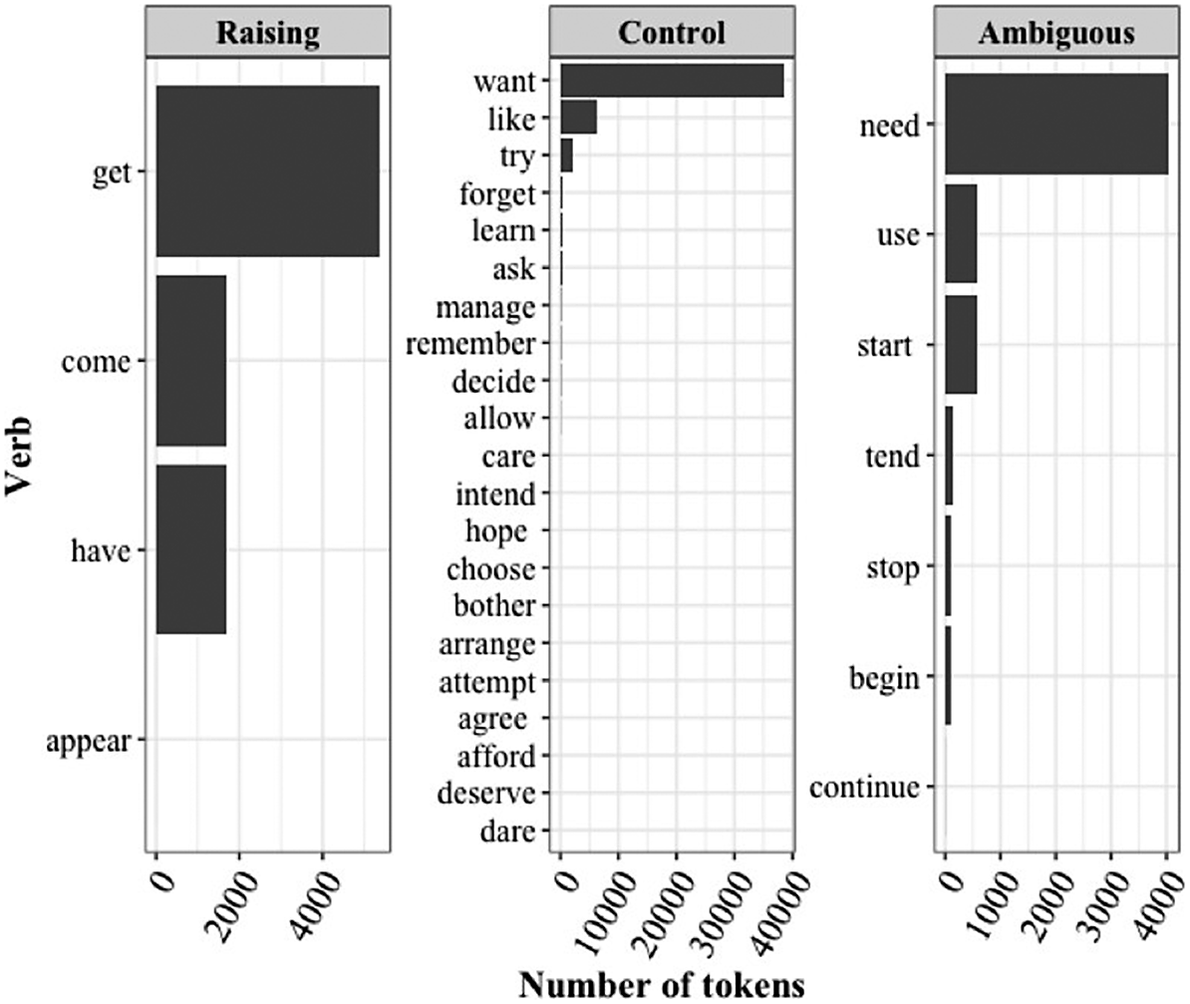
Figure 1 demonstrates the distribution of verbs that take TO-infinitives in child-directed speech.
The distribution of verbs that take TO-infinitives in child-directed speech

Figure 1. Long description
The chart consists of three vertical panels. The shared Y-axis on the left is labeled Verb, and the shared X-axis at the bottom is labeled Number of tokens.
Panel 1, Raising: The X-axis ranges from 0 to 4000. The verb ‘get’ has the highest frequency, exceeding 4000 tokens. It is followed by ‘come’ and ‘have’, both around 1500 tokens. The verb ‘appear’ has a negligible frequency near zero.
Panel 2, Control: The X-axis ranges from 0 to 40000. The verb ‘want’ dominates with nearly 40000 tokens. This is followed by ‘like’ at approximately 5000 tokens and ‘try’ at roughly 2000 tokens. A long list of verbs follows with very low frequencies, including forget, learn, ask, manage, remember, decide, allow, care, intend, hope, choose, bother, arrange, attempt, agree, afford, deserve, and dare.
Panel 3, Ambiguous: The X-axis ranges from 0 to 4000. The verb ‘need’ is the most frequent at 4000 tokens. It is followed by ‘use’ and ‘start’, both around 500 tokens. Verbs with minimal frequency include tend, stop, begin, and continue.
A total of thirty-two verb lemmas were detected in North American child-directed speech. The frequencies of individual verb lemmas in child-directed speech are very uneven, as evident from figure 1. Pure control verbs have much higher type frequency than either pure raising or ambiguous verbs. However, most pure control verbs are very infrequent; WANT is, by far, most frequent. A similar trend can be observed for both pure raising and ambiguous verbs: GET is statistically dominant for pure raising verbs and NEED takes the lead for ambiguous verbs. This empirical result suggests that children must learn the raising–control distinction based on a few high-frequency verbs.
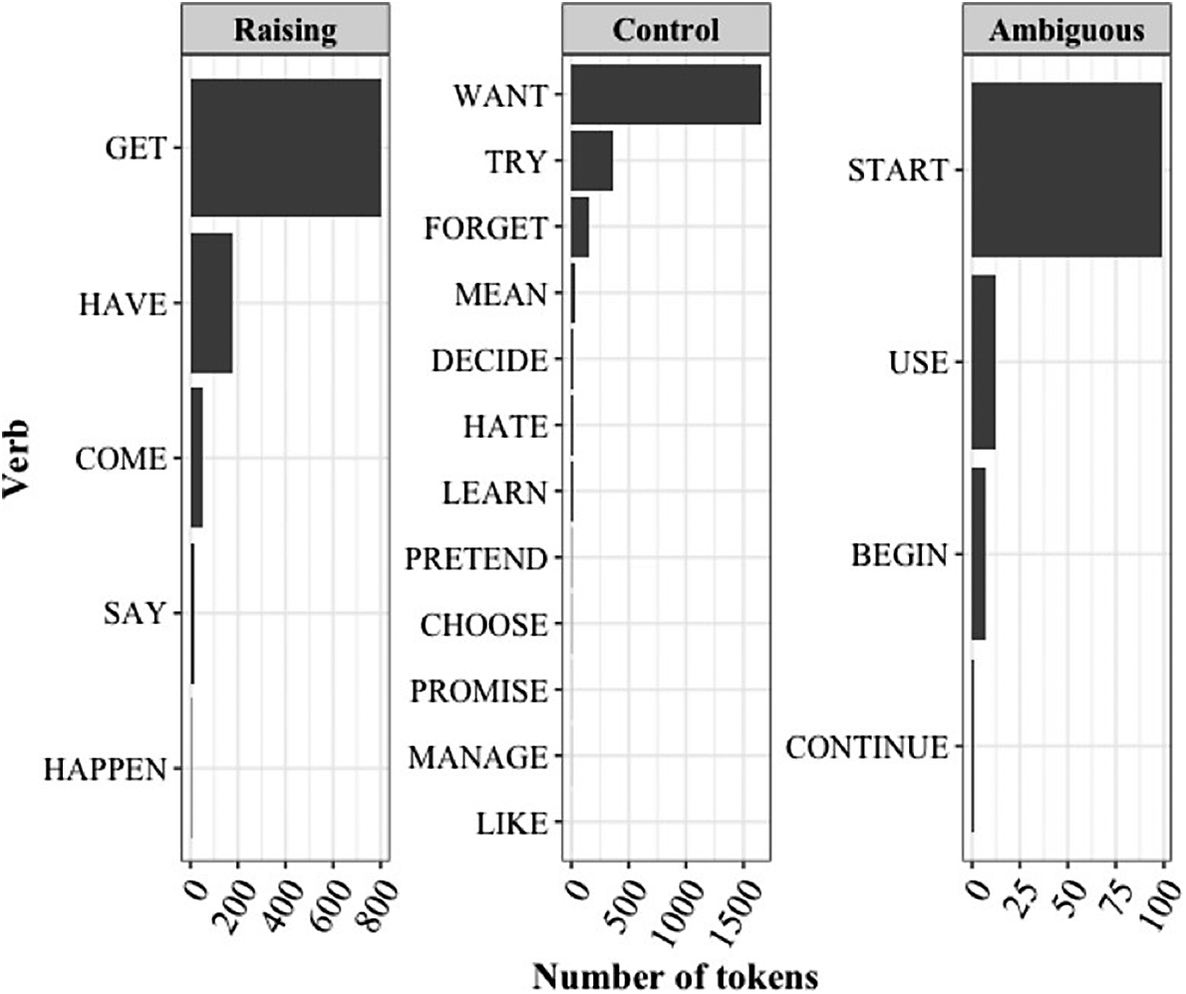
Figure 2 shows the distribution of verbs that take TO-infinitives in child naturalistic speech.
The distribution of verbs that take TO-infinitives in child naturalistic speech

Figure 2. Long description
The chart consists of three vertical panels. The Y-axis for all panels is labeled Verb and the X-axis is labeled Number of tokens.
Panel 1, Raising. The X-axis ranges from 0 to 800. Verbs from highest to lowest frequency are:
* GET: approximately 800 tokens.
* HAVE: approximately 180 tokens.
* COME: approximately 50 tokens.
* SAY: approximately 10 tokens.
* HAPPEN: near 0 tokens.
Panel 2, Control. The X-axis ranges from 0 to 1500. Verbs from highest to lowest frequency are:
* WANT: approximately 1600 tokens.
* TRY: approximately 350 tokens.
* FORGET: approximately 150 tokens.
* MEAN, DECIDE, HATE, LEARN, PRETEND, CHOOSE, PROMISE, MANAGE, and LIKE all have very low frequencies near 0.
Panel 3, Ambiguous. The X-axis ranges from 0 to 100. Verbs from highest to lowest frequency are:
* START: approximately 100 tokens.
* USE: approximately 15 tokens.
* BEGIN: approximately 10 tokens.
* CONTINUE: near 0 tokens.
A total of twenty-one verb lemmas were attested in North American child naturalistic production data, which is a considerably smaller number than in the adult production data – a function of the fact that the child-directed speech dataset is much larger than the child production dataset. Yet, the two data sets were distributed similarly: pure control verbs had higher type frequency than the other verb types. WANT was statistically dominant for pure control verbs and GET was the most frequent pure raising verb. There were some differences between the distribution of ambiguous verbs in child-directed and child naturalistic speech. However, despite minor lexical differences, children seemed to be faithful to the input data.
6.2. Early Modern English
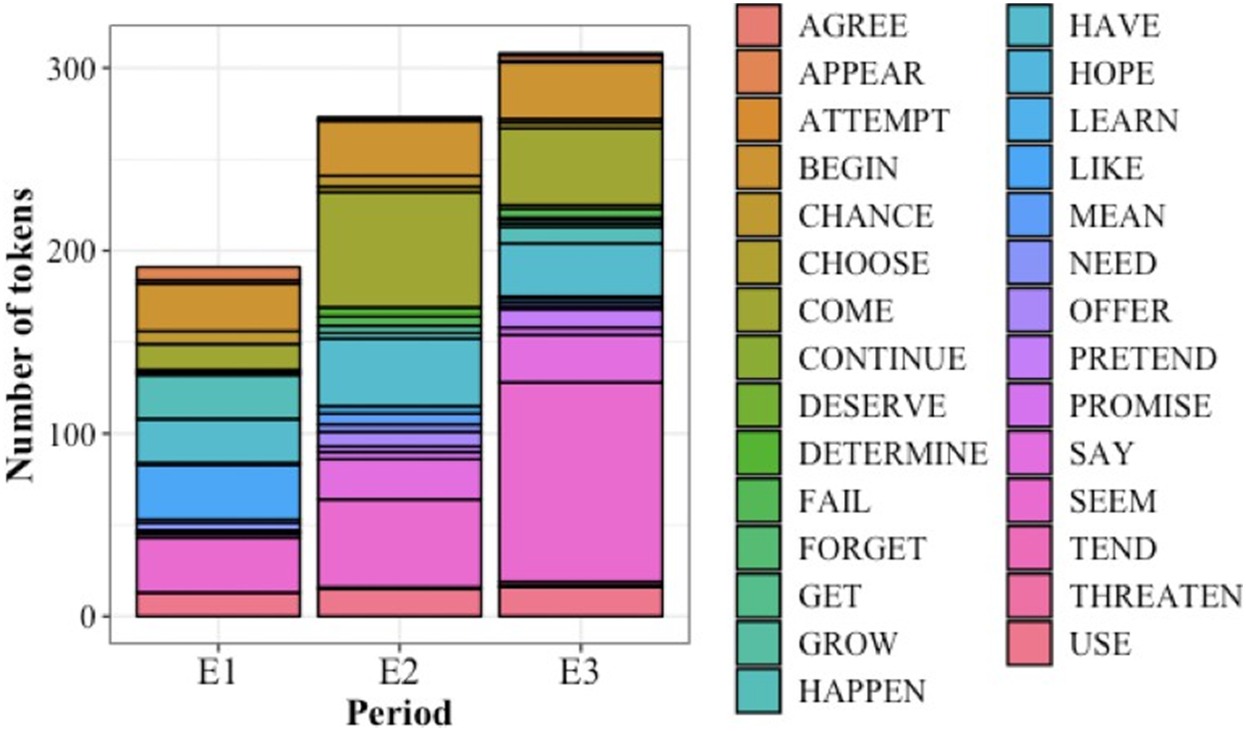
Twenty-nine out of the thirty-six verbs in the approximated data set were attested with TO-infinitive complements in a total of 774 tokens: twelve pure control, nine pure raising and eight ambiguous verb lemmas. Their numerical distribution across periods is demonstrated in figure 3.Footnote 6
The number of verbs attested with TO-infinitive complements in Early Modern English across periods

Figure 3. Long description
A stacked bar chart with the Y axis labeled Number of tokens ranging from 0 to 300 and the X axis labeled Period with three categories.
* The X axis categories are E1, E2, and E 3, showing a progressive increase in total tokens from approximately 190 in E 1 to over 300 in E3.
* Each bar is composed of colored segments representing different verbs. A legend to the right lists 30 verbs in two columns.
* Column 1 of the legend includes AGREE, APPEAR, ATTEMPT, BEGIN, CHANCE, CHOOSE, COME, CONTINUE, DESERVE, DETERMINE, FAIL, FORGET, GET, GROW, and HAPPEN.
* Column 2 of the legend includes HAVE, HOPE, LEARN, LIKE, MEAN, NEED, OFFER, PRETEND, PROMISE, SAY, SEEM, TEND, THREATEN, and USE.
* In period E1, the largest segments are light blue and gold.
* In period E2, the total count rises to about 270, with a significant increase in the pink and light blue segments.
* In period E3, the total count exceeds 300, dominated by a large pink segment at the bottom and a gold segment at the top, indicating these specific verbs became much more frequent.
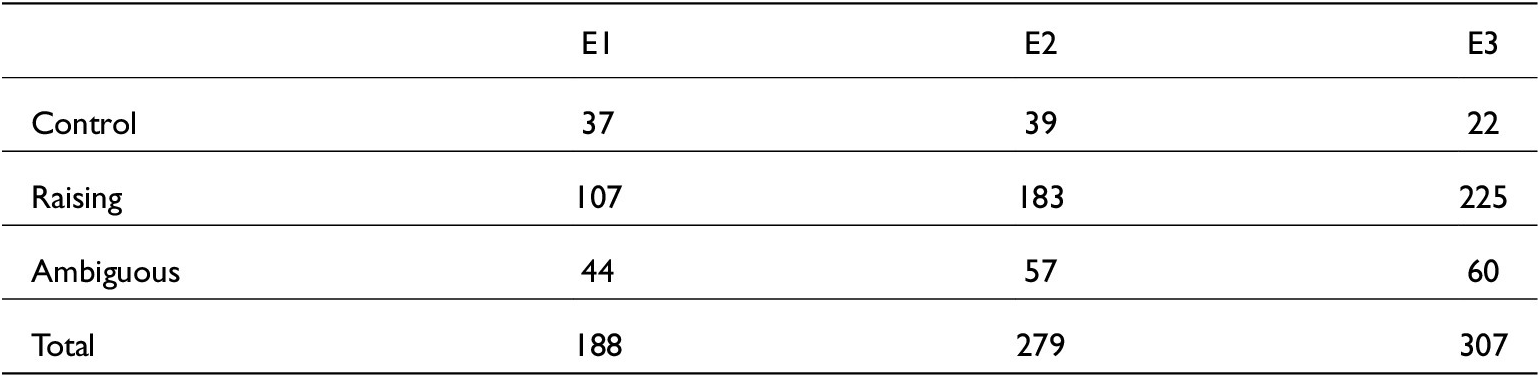
The number of verb lemmas attested with TO-infinitives and both their type and token frequencies increased significantly during the Early Modern period. Table 1 demonstrates their distribution by verb type across periods.
The number of verbs attested with TO-infinitive complements in Early Modern English by verb type

Table 1. Long description
The table consists of four columns and five rows. The header row identifies three chronological periods: E1, E2, and E3.
* The first data row, Control, shows 37 verbs in E1, 39 in E2, and 22 in E3.
* The second data row, Raising, shows a significant increase with 107 verbs in E1, 183 in E2, and 225 in E3.
* The third data row, Ambiguous, shows 44 verbs in E1, 57 in E2, and 60 in E3.
* The final row, Total, provides the sum for each period: 188 verbs in E1, 279 verbs in E2, and 307 verbs in E3.
While pure control verbs had a higher type frequency, pure raising verbs constituted overall the majority of tokens, 66.8 per cent (516/772). However, the distribution of individual pure raising verb lemmas was very uneven; SEEM was by far the most frequent one, 36.2 per cent (187/516).
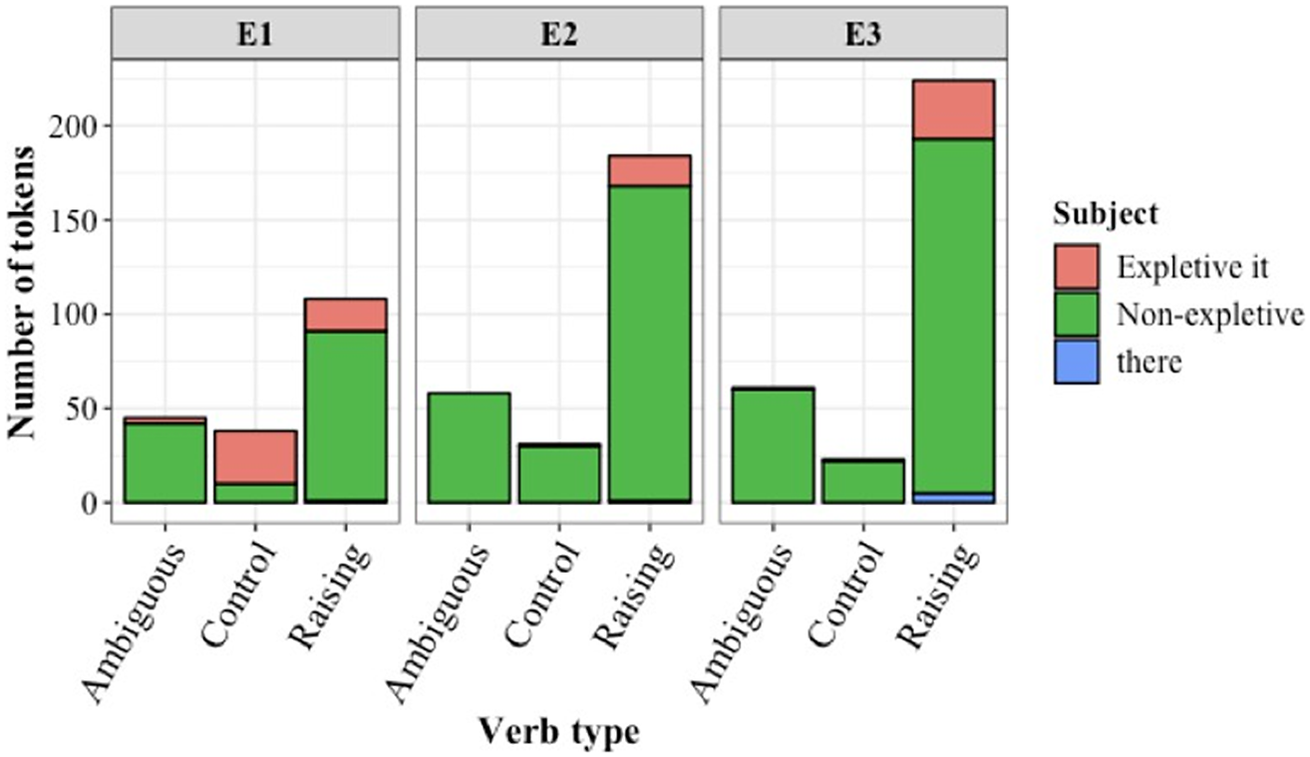
Figure 4 demonstrates the distribution of expletive subjects by verb type.
The distribution of expletive subjects by verb type in Early Modern English

Figure 4. Long description
The chart consists of three panels labeled E 1, E 2, and E 3. The Y-axis represents the number of tokens from 0 to 200. The X-axis lists three Verb types: Ambiguous, Control, and Raising. A legend on the right identifies three subject types: Expletive it (red), Non-expletive (green), and there (blue).
* Panel E 1:
- Ambiguous: Approximately 45 tokens, mostly green with a thin red sliver at the top.
- Control: Approximately 40 tokens, with a green base of 10 and a larger red section reaching 40.
- Raising: Approximately 110 tokens, with a green base reaching 90 and a red top section.
* Panel E 2:
- Ambiguous: Approximately 60 tokens, entirely green.
- Control: Approximately 30 tokens, green with a very thin red line at the top.
- Raising: Approximately 185 tokens, with a green base reaching 170 and a red top section.
* Panel E 3:
- Ambiguous: Approximately 60 tokens, entirely green.
- Control: Approximately 25 tokens, entirely green.
- Raising: The highest peak at approximately 225 tokens. It features a small blue base (there), a large green middle section reaching nearly 200, and a red top section.
There were 106 tokens that co-occurred with expletive subjects: ninety-eight with expletive it, seven with there and one empty. Expletive it was attested with fourteen verb lemmas. Of these, three were pure control verbs: LIKE (28), AGREE (1), MEAN (1). Eight were pure raising verbs: SEEM (25), HAVE (22), HAPPEN (6), COME (4), CHANCE (3), GROW (3), APPEAR (2), SAY (1). Three were ambiguous verbs: NEED (1), TEND (1), USE (1). There was a significant association between verb type and expletive subjects, as measured by a two-sided Fisher’s Exact test (p<.001): expletives occurred significantly more often with raising verbs. Furthermore, the proportion of expletive subjects with pure raising verbs doubled between periods E2 (5.4%) and E3 (10.2%).
Present-day English disallows expletive subjects in control constructions. Verbs that in Present-day English are control predicates co-occurred with expletive subjects only exceedingly rarely in the historical data, with the exception of LIKE. The examples of LIKE with an expletive subject are instances of an earlier argument structure it i likes me [to …]i, with cataphoric expletive it; in such structures, the controller is the oblique argument me, not it. Thus these instances are not counterexamples to the generalization that control predicates do not have expletive controllers. See Björnsdóttir, Gotthard & Walkden (Reference Björnsdóttir, Gotthard and Walkden2024) for further discussion of such cases. One of only two other co-occurrences with another verb lemma involved AGREE in the passive in the E3 period (15).
-
(15) it was agreed on both parties to keep the Laws of Edgar (Milton; MILTON-E3-H,X,277.163)
Here, the expletive is cataphoric and associated with the TO-infinitive. In this example we are not dealing with obligatory subject control: the controller is of course not it, but rather this is a case of arbitrary control. The only other example, involving MEAN in the passive (EDMONDES-E2-P1,399.29), can be analysed similarly.
Seven tokens were attested with expletive there with three verb lemmas: SEEM (4), HAPPEN (2), SAY (1). The only instantiation of an empty expletive subject was attested with SEEM in the E1 period:
-
(16) *exp* semeth to be a mutual concorde and loue in the nature of man (ELYOT-E1-H,147.79)
The rate of expletive subjects with pure raising and ambiguous verbs, respectively, was significantly different, as measured by a two-sided Fisher’s Exact Test (p<.001).
Irani (Reference Irani2019) uses the Tolerance Principle to show that raising should not be productive across the class of verbs that take TO-infinitive complements: there are far too many exceptions, i.e. verbs with TO-infinitive complements that do not take non-thematic subjects. Thus, raising must be a lexically learned property. We can use the same reasoning to test for productivity of raising in our Early Modern English data. The Tolerance Principle predicts an exception threshold of eight based on the twenty-nine verb lemmas attested with a TO-infinitive (29/ln29=8.61). Thus, in order to form a productive generalization, a total of twenty-one verb lemmas would be required. This exceeds the number of verb lemmas attested with an expletive subject, which is a mere eleven (excluding the false positives for LIKE, SAY and MEAN, as discussed above). Thus, the TP predicts raising not to be a productive property of TO-infinitives in general in this period, as Irani found for Present-day English acquirers and as we would expect.
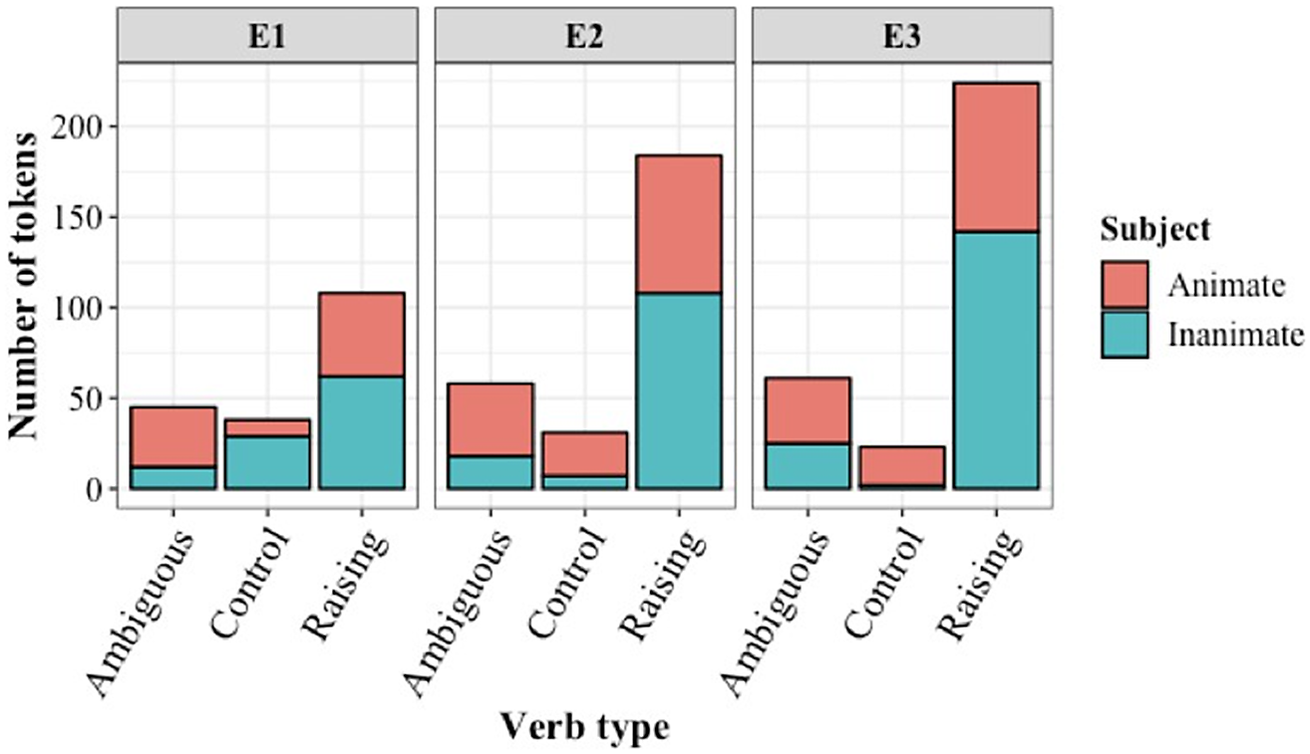
Figure 5 shows the distribution of animate versus inanimate subjects by verb type.
The number of animate versus inanimate subjects by verb type in Early Modern English

Figure 5. Long description
The chart consists of three panels labeled E 1, E 2, and E 3 from left to right. The Y-axis represents the number of tokens ranging from 0 to over 200. The X-axis represents Verb type with three categories: Ambiguous, Control, and Raising. A legend on the right identifies pink as Animate and teal as Inanimate subjects.
* Panel E 1: Ambiguous has approximately 45 tokens (mostly animate). Control has approximately 40 tokens (mostly inanimate). Raising has approximately 110 tokens (roughly equal split).
* Panel E 2: Ambiguous has approximately 60 tokens (mostly animate). Control has approximately 30 tokens (mostly animate). Raising has approximately 185 tokens (majority inanimate).
* Panel E 3: Ambiguous has approximately 60 tokens (roughly equal split). Control has approximately 25 tokens (almost entirely animate). Raising has the highest count at approximately 225 tokens (majority inanimate).
Across all three panels, the Raising verb type consistently shows the highest number of tokens, with a notable increase in inanimate subjects from E 1 to E 3.
There was a total of 288 tokens with inanimate subjects with fifteen verb lemmas attested in the data. Of these, eight were pure raising verbs: SEEM (104), COME (80), SAY (18), HAVE (14), APPEAR (10), HAPPEN (10), GROW (3) and CHANCE (3). Four were pure control verbs: PRETEND (3), LEARN (2), OFFER (2) and DETERMINE (1). Three were ambiguous: BEGIN (32), FAIL (4) and NEED (2). Thirty-eight per cent of all inanimate subjects were attested with SEEM. A two-sided Fisher’s Exact Test revealed a significant association between verb type and animacy (p<.001).
Of these fifteen verb lemmas, eight were also attested with an expletive subject in the data (SEEM, COME, SAY, HAVE, APPEAR, HAPPEN, GROW, CHANCE); we thus take these to be our raising predicates. This allows us to test whether raising is a productive property for the class of verbs that take inanimate subjects. The Tolerance Principle predicts the need for ten verb lemmas to form a productive generalization since the number of exceptions to the pattern cannot exceed five verb lemmas (15/ln15=5.54). As a result, raising is not predicted to be a productive property of the class of verbs that take inanimate subjects.
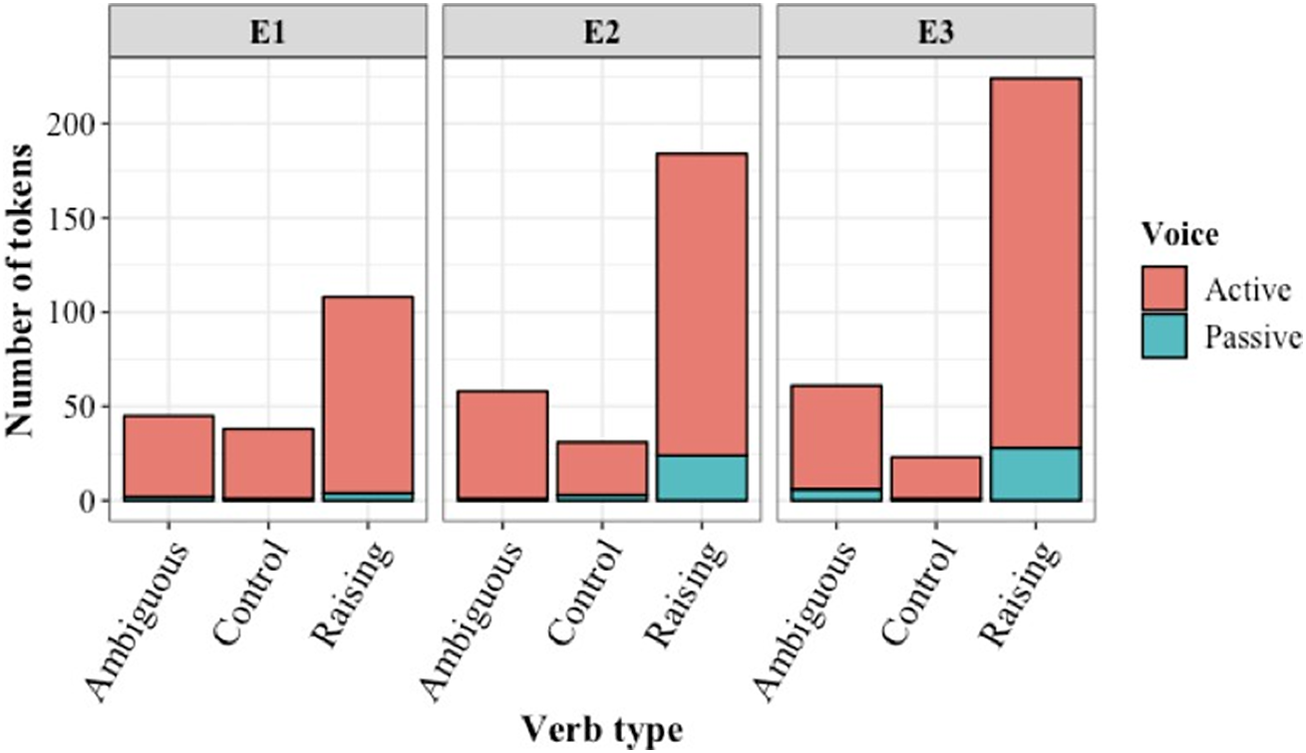
Figure 6 demonstrates the distribution of verb type by voice.
The distribution of verb type by voice in Early Modern English

Figure 6. Long description
The chart consists of three panels labeled E 1, E 2, and E 3 from left to right. The Y axis represents the number of tokens from 0 to 200. The X axis represents Verb type with three categories: Ambiguous, Control, and Raising. A legend on the right identifies active voice as salmon pink and passive voice as teal blue.
* Panel E 1: Ambiguous and Control verbs have low counts under 50, almost entirely active. Raising verbs reach approximately 110 tokens, with a very small Passive base.
* Panel E 2: Ambiguous and Control verbs remain under 60 tokens and are predominantly active. Raising verbs show a significant increase to nearly 190 tokens, with the passive portion growing to approximately 25 tokens.
* Panel E 3: Ambiguous verbs are around 60 tokens with a small passive sliver. Control verbs drop to approximately 25 tokens. Raising verbs show the highest frequency, exceeding 225 tokens, with the passive voice component reaching its largest volume at approximately 30 tokens.
There was a total of fifty-eight tokens, 8.3 per cent of all tokens, of sentences in the passive with six verb lemmas. Of these two were pure raising verbs: SAY (47) and GET (1). Two were pure control verbs, LEARN (1) and OFFER (1), and two were ambiguous, CONTINUE (1) and USE (6). Pure raising verbs were significantly more likely to occur in the passive than other verb types in the Early Modern period, as measured by a two-sided Fisher’s Exact Test (p < .001). However, this trend was largely driven by the predominance of SAY.
An analysis using the Tolerance Principle (6/ln6=3.34) predicts that raising is not a productive property of the class of verbs that passivize, since only two of the six passivized verb lemmas were also attested with an expletive subject (SAY, USE) which is below the estimated number (three) needed to form a productive generalization.
7. Discussion
A corpus-based study of both child-directed and child naturalistic production in North American English revealed that children produce a subset of the verbs that they encounter with TO-infinitives in the input data. In spite of some lexical differences between child and adult corpora, the distributional similarities are striking: very few verbs that take TO-infinitives are frequent and most are infrequent in both adult and child production. In parallel, the emergence of raising in Early Modern English occurred on the basis of a similar number of verb lemmas (29) to that found in child-directed (32) and child naturalistic (21) production. The present findings lend support to Irani’s (Reference Irani2019) argument that the distinction between raising and control is learned on a lexically specific basis. Therefore, we propose that the raising–control distinction also spread on a lexically specific basis diachronically.
However, the question remains as to how novel linguistic patterns can emerge from lexical idiosyncrasies in grammar in the first place. We made use of both inferential statistical methods and a learning model, the Tolerance Principle (TP), to predict productivity in the association between pure raising verbs and subject-related distributional properties (animacy, voice). These properties have been argued to be important linguistic cues in the acquisition of the raising–control distinction, with divergent findings and conclusions.
There was a significant statistical tendency for raising verbs to co-occur with inanimate subjects and in the passive voice. However, the TP did not predict that raising would productively be a property of the whole class of verbs that take TO-infinitive complements, nor did it predict that raising would productively be a property of those verbs that occur with inanimate subjects or in the passive. In the remainder of this section, we outline a potential diachronic pathway in which the emergence and spread of expletives acts as a catalyst for the rise of raising (section 7.1).
7.1 Expletives and the rise of raising
With the partial exception of Boucher (Reference Boucher1998), the rise of expletives has not been adduced as a potential causal factor in the rise of raising. Yet it is clear that, like raising verbs, expletives do indeed rise dramatically in frequency during the Middle English period (Breivik Reference Breivik1983; Williams Reference Williams, Pintzuk, Tsoulas and Warner2000) as part of a general development towards an obligatory overtly filled subject position, as discussed in section 3. How are we to understand the link between these developments?
We propose, following the consensus in the literature, that raising arises via a reanalysis of control. As noted in section 2, an example like (10) Sam promised to work hard is ambiguous in Present-day English between a control and a raising reading, with various factors (for instance, context) aiding the hearer in resolving the ambiguity. We propose that hearers – and hence acquirers – are guided by a violable parsing principle such as (17).
-
(17) Local theta-completeness
-
All else being equal, assume that all overt elements bearing grammatical functions (e.g. subject) receive a thematic role in the local clausal domain in which they surface.
The existence of a principle like (17) receives substantial independent motivation from the parsing literature. For instance, Pritchett’s (Reference Pritchett1988) Theta Reanalysis Constraint, originally proposed to account for garden path phenomena, states that the occurrence of theta-marked constituents outside their theta-domain, though by no means ruled out, incurs a cost in online processing. More generally, (17) is a special case of a family of constraints that Hawkins (Reference Hawkins2004) captures under Minimize Domains: ‘The human processor prefers to minimise the connected sequences of linguistic forms and their conventionally associated syntactic and semantic properties in which relations of combination and/or dependency are processed’ (Reference Hawkins2004: 32).
Thematic role assignment is a dependency relation in Hawkins’ sense. Effects of constraints of this type – known in more recent literature as dependency length minimization – have been found using corpus evidence for English (Temperley Reference Temperley2007) and cross-linguistically (Futrell, Mahowald & Gibson Reference Futrell, Mahowald and Gibson2015). Thus, although (17) in this form is new, it builds on established ideas. Clearly a principle like (17) disfavours raising, as the overt subject receives its thematic role in the lower clause before raising to the subject position of the higher clause. The acquirer will thus normally be predisposed to a control parse, as indeed seems to be the case empirically (see Hirsch Reference Hirsch2011 and section 3).
Whenever the acquirer encounters an expletive, however – in any structure, TO-infinitive or not – this is counterevidence to (17). This, we propose, acts to reduce the learner’s reliance on (17) in general, and to increase the likelihood that an overt subject is not parsed as receiving its theta-role locally, and hence of a raising analysis. In other words, faced with two possible parses, raising and control, the acquirer becomes more and more likely to prefer a raising parse the more counterexamples to (17) they encounter, and expletives count as clear positive distributional evidence that non-thematic overt elements may bear grammatical functions. When expletives come to co-occur with raising predicates themselves, of course, we have a smoking gun, since such examples are unambiguous evidence for a raising analysis.
This account predicts that the rise of expletive subjects is likely to play a central role in the rise of raising not just in the history of English, but cross-linguistically; we leave the testing of this prediction to future work.
Finally, our findings lend support to existing findings from other linguistic phenomena that call a direct relationship between token frequency in language and learning into question. While the emergence of the raising–control distinction in both acquisition and diachrony was probably driven by high-frequency predicates, these did not trigger the onset of productivity.
8. Conclusion
The distinction between raising and control is well understood synchronically, but a unifying learnability and diachronic account of its emergence has been lacking. We argue that the emergence of raising was the consequence of independent changes in the syntax of subjects in English during the Early Modern period and the time leading up to it, notably the requirement for an overt subject (Walkden & Rusten Reference Walkden and Rusten2017) and the concomitant rise of expletive subjects (Breivik Reference Breivik1983; Williams Reference Williams, Pintzuk, Tsoulas and Warner2000).
Expletive subjects have also been argued to be the primary linguistic cue in the acquisition of the distinction between raising and control within different theoretical frameworks (Wexler & Culicover Reference Wexler and Culicover1987; Irani Reference Irani2019). Therefore, there are parallel patterns in both the learning process and diachronic trajectory of the raising–control distinction. Furthermore, it has been debated why raising seems to develop out of control structures. We argue that this is the result of the composition of the input data; expletive subjects are infrequent, which results in protracted development in both acquisition and diachrony, but expletives provide evidence against a consistently local assignment of theta-roles to subjects and, hence, bias the acquirer towards a raising parse.
As an anonymous reviewer notes, the fact that the TP predicts raising to be unproductive throughout the history of English sits uneasily with the fact that raising did spread diachronically – through a process which can be, and has been, described as lexical diffusion. The tension is only apparent, however, since it is independently clear that not all extension across the lexicon can be understood as expansion in the scope of a productive rule. Ringe & Yang (Reference Ringe, Yang, Los, Cowie, Honeybone and Trousdale2022: 103–5) discuss the irregularizing verb form stuck (from stick) in the history of English and show that it cannot be accounted for by the TP, hence requiring a special kind of lexical analogy. Under our proposal in section 7.1, the raising property needs to be learned on a verb-by-verb basis during the course of parsing, but the rise of expletives leads to an increased likelihood that any potentially ambiguous predicate will be analysed as raising rather than control. When a predicate is learned as a raising predicate, sooner or later it will occur with expletives in that speaker’s usage, which will increase this likelihood even further for future generations – leading to a domino effect.
We highlight the importance of the application of learning models and quantitative methods in order to gain an understanding of the spread of linguistic patterns both synchronically and diachronically. Finally, we argue that studies such as this one demonstrate that insights from diachrony can inform theories of language acquisition – and vice versa.
Acknowledgements
This research was funded by the Deutsche Forschungsgemeinschaft (DFG, German Research Foundation) – Project number 469307102 (Modelling lexical diffusion in syntax: non-finite complementation in Modern English), project H4 of the SILPAC research unit. We would like to thank Jordan Kodner, Marc Meisezahl, Michael Percillier, Thomas Rainsford, Chiara Riegger, Carola Trips, Nigel Vincent, Laura Weisshaar and Charles Yang for their various helpful contributions while this work was in progress, as well as the creators of the Penn parsed historical corpora and of CHILDES, audiences at DiGS 24 (Paris, 2023) and ICHL 26 (Heidelberg, 2023), editor Laurel Brinton and the anonymous reviewers for ELL.

 Open access

