Introduction
The English language as a symbolic resource holds more notable cultural and social significance in South Korea than any other foreign language. In the current trend of globalisation, proficient English skills have been identified by the government as a critical resource for the country's survival, and developing these skills has been a major priority in all areas. A number of elite universities and sought-after conglomerates such as Samsung, LG and Hyundai have policies which noticeably favour and recruit students with high English proficiency levels (Lee, Reference Lee2006: 67). In particular, scores achieved in the international proficiency tests such as the TOEIC (Test of English for International Communication) and TOEFL (Test of English as a Foreign Language), in preference to scores gained in other English tests, have become a major determining factor in gaining employment and promotion. According to the Samsung Economic Research Institute between 2004 and 2005, 102,340 Koreans sat for TOEFL. Koreans represented 18.5% of the total 554,942 people taking the test worldwide and they spend 700 billion Won (approximately US$700 million) a year on tests to evaluate their English proficiency.
In order to reduce the amount spent on examination fees, to replace the grammar oriented college scholastic ability test (CSAT) as well as to undermine the social currency of the TOEIC and TOEFL, the government has developed a new English proficiency test called the National English Ability Test (NEAT). The NEAT was developed in cooperation with the Korea Institute for Curriculum and Evaluation (KICE), the National Institute for International Education (NEIID) and the Korean Ministry of Education (KME). The NEAT consists of four sections, listening, reading, speaking, and writing, and takes 155 minutes to complete. The listening and reading sections include questions assessing candidates' ability to provide appropriate responses to factual information, to infer meaning and to identify main ideas or the purpose of a speech. The speaking component includes questions such as problem solving and picture description, while the writing section assesses skills related to composing a short essay or e-mail, and describing pictures in detail.
The test aims to ‘develop and implement a national standardised English proficiency test to improve practical English communication skills required in the era of globalisation’ (KICE & MEST, 2011) so that South Koreans can participate in today's globalised world. Since this announcement, there has been a boom in private English cram schools and a number of universities have adopted scores in the NEAT as a key criterion for the selection of new students. Thus the NEAT has already had a significant impact on English education in South Korea.
The NEAT ostensibly assesses the practical English proficiency of Korean students for international communication. However, little research has been done into the extent to which the NEAT actually reflects its stated aims. This paper examines all of the 38 published sample questions of the 2011 ‘National English Ability Test’ (NEAT) to investigate how the NEAT defines English proficiency through the design of its tests (KICE & MEST, 2011: 161–99). This analysis investigates the varieties of English included in the test, its representative English speakers, and the kinds of skills being assessed in the oral and written questions.
English in Korea: English Fever
South Korea's pursuit of English is unparalleled in the world. Hierarchical structures are ingrained in South Korean society through the education system (Seth, Reference Seth2002), and the series of government education policies, which have placed great emphasis on learning English, have led to an excessive pursuit of English study, which is often called ‘English fever’ (Jeong, Reference Jeong2004: 40; J. Park, Reference Park2009). A special emphasis has been given to developing English proficiency and this has been used as a major criterion for success in all areas, not only in education but also in job-performance evaluations (Lee, Reference Lee2006). According to an estimate by the Samsung Economic Research Institute, South Koreans spend a total of 14.3 trillion Won (approximately US$14 billion) annually on private English education. And each student spends 15,548 hours on English language education from middle school through to college (Jeon, Reference Jeon2006). Together with the 14.3 trillion Won (approximately US$14 billion) spent on private English education, a further 700 billion Won (approximately US$ 7 million) is spent on application fees for tests, making the total yearly amount spent on English education a staggering 806.6 trillion Won (US$800 billion), which made up 1.9% of Korea's nominal GDP in 2005 (Jeon, Reference Jeon2006).
The main driving forces behind English fever have been criticised by Song (Reference Song2011) and Ahn (Reference Ahn2013), who argue that the obsession with English learning is largely the result of English being used as a means of attaining social status and power within South Korea's hierarchical society:
The obsession of English learning, despite official government claims to the contrary, does not play a critical role in promoting the country's global competitiveness. Instead learning English has merely continued to serve as a means by which individuals access status, power and success in South Korea. (Ahn, Reference Ahn2013: 1)
Ahn critically evaluates the special role that English plays in South Korean society and finds that English is not in fact used as a ‘critical linguistic tool’ essential for survival in a globalised world as claimed by the government. Instead, the reality is that English has been adopted as a tool for evaluation: ‘English has been recruited in the guise of globalisation’ to provide ‘a mechanism of elimination that conserves and reproduces the hierarchy of power relations already established in South Korean society’ (Song, Reference Song2011: 35). As Ahn (Reference Ahn2013) argues, the overwhelming desire to learn English is closely associated with the prestige and social status historically attributed to American English (AmE), rather than South Koreans' desire to become proficient speakers of English in an international context. This is also evident in the negative attitudes held by South Koreans towards non-Inner Circle varieties of English that do not have the same symbolic value as AmE (Ahn, Reference Ahn2014).
Proficiency in English as an international language (EIL)
The status of English as an International Language (EIL) can be attributed to its dominance in a variety of international, economic and cultural arenas. English is currently spoken in more than 70 countries as a first language or as an official (second) language and approximately 380 million people speak English as a first language (L1). However, a decade ago, Crystal (Reference Crystal2003) estimated that more than a billion people use it as a second (or additional) language (L2) and it was expected that these numbers would increase. The Outer Circle and Expanding Circle countries use English largely to communicate with those who do not share a similar cultural and linguistic background. This has created a new landscape of English-speaking contexts, where there are diverse interactions between speakers from each circle and mixtures of various communicative situations, changing the landscape of English-speaking contexts and the types of skills needed for speakers to become proficient.
As a result, Canagarajah (Reference Canagarajah2006) argues for the need to reconsider the definition of English proficiency. Proficiency is defined as the ability to perform some defined tasks that use language as a part of communicative competence (Davies, Reference Davies, Cook and Seildhofer1996, Reference Davies2003). Traditionally, only ideal native users of the language were entitled to claim ownership of the language. Accordingly, evaluating levels of proficiency and appropriateness have been equated with native speaker use (Nunn, Reference Nunn2007).
However, in the globalised world, where intercultural communication between different varieties of English and speakers largely constitutes the English-speaking contexts, the traditional view of proficiency can no longer be justified. Successful communication in these situations, therefore, requires competence beyond the proficiency found in a native English speaker's language behaviour, and distinctions between native and non-native speaker become almost irrelevant (Sharifian, Reference Sharifian and Sharifian2009, Reference Sharifian, Sharifian and Jamarani2013). Proficiency in communicating with native speakers from Inner Circle countries is not sufficient for successful international communication; instead English learners must be ready to engage with a wider range of Inner Circle, Outer Circle and Expanding Circle speakers of English (Canagarajah, Reference Canagarajah2006). Canagarajah (Reference Canagarajah2006) also argues that proficiency in English should be defined in close association with speakers' intercultural pragmatic skills, including speakers' awareness of cultural differences, strategies for the negotiation of meaning and an accommodation of the needs of one's interlocutors. Lowenberg (Reference Lowenberg and Matsuda2012: 97) also suggests that proficient speakers of English should have ‘the ability to interact with others in a broad range of contexts and situations, which often requires switching across varieties in lexicons, styles and discourse strategies’. Accordingly, proficient speakers of English in today's English-speaking contexts are those who show familiarity with various systems of cultural schema, and linguistic varieties capable of flexibly participating in intercultural communication in a wide range of speech contexts (Canagarajah, Reference Canagarajah2006; Kirkpatrick, Reference Kirkpatrick2008; Sharifian & Clyne, Reference Sharifian and Clyne2008; Sharifian, Reference Sharifian and Sharifian2009, Reference Sharifian, Sharifian and Jamarani2013).
This suggests the need to revisit the dominant paradigms of assessment and to change pedagogical priorities. Traditionally, the aim of ELT was to enable learners to communicate with native speakers of the English language (Kachru, Reference Kachru1996). However, the traditional purpose for learning English has more recently become problematic. In a globalised context, Canagarajah (Reference Canagarajah2006) argues that English education should focus on intercultural communication skills that include a linguistic and cultural awareness of varieties of English and foster effective communicative strategies, rather than only focussing on mastering the linguistic manipulation of one or two particular varieties of English.
The dynamic model of new Englishes
Since the introduction of ‘The other Tongue’ (Kachru, Reference Kachru1982), the field of World Englishes (WE) has advanced arguably one of the most critical and influential arguments for the now diversified English language. Studies of WE have been undertaken extensively and have discovered that the English language is one of the most hybrid and rapidly changing languages in the world, and new Englishes have emerged in many countries (Graddol, Reference Graddol2000, Reference Graddol2006; Crystal, Reference Crystal2003; Schneider, Reference Schneider2003; Jenkins, Reference Jenkins2006, Reference Jenkins2009; Kirkpatrick, Reference Kirkpatrick2007, Reference Kirkpatrick2008, Reference Kirkpatrick2010; Bolton, Reference Bolton2010; Xu Reference Xu2010; Bolton, Graddol & Meierkord, Reference Bolton, Graddol and Meierkord2011).
Schneider (Reference Schneider2003) argues that changes in linguistic norms are natural, thus it is absolutely necessary for linguists to strive for a description of these changes. He proposes a five-phase ‘dynamic model of the evolution of new Englishes’ to describe the typical developmental trajectory of New Englishes in five characteristic stages: Foundation; Exonormative stabilisation; Nativisation; Endonormative stabilisation; and Differentiation (Schneider, Reference Schneider2003: 243–53). The Foundation stage involves complex language contact situations between a local language and English. The second stage, Exonormative stabilisation, demonstrates a similar process of creolisation. Lexical borrowings and structural innovations happen, although these changes tend to be overlooked or regarded as more or less ‘good’ or ‘broken’. The third stage, Nativisation, is regarded as the most important and vibrant phase of linguistic transformation. During this stage, phonological innovations and structural nativisation occur. For instance, a number of distinctive accents, the practical usage of new word formation, a localised set of phrases, new types of prepositional usage and verb complementation are realised. Lowenberg (Reference Lowenberg and Matsuda2012) identifies the major transformation of linguistic norms of English varieties in the Nativisation stage in terms of morphology, syntax and semantics. He illustrates some of the most frequently occurring features of the nativisation process such as the conversion to countability of non-count nouns and prepositional phrases. For example, ‘luggages’ and ‘a hard work’ are used as countable nouns in Philippine English and Korean English (KoE) respectively. The prepositional phrases, ‘at Belmind Road’ and ‘across the Saik Eatery’ are used in Malaysian English, while ‘on’ and ‘across from’ are used in other varieties of English. Another example of a verbal collocation phrase that shows the nativisation process of KoE can be found in the use of ‘come on’ as in ‘Gardens come on life again’ (Shim, Reference Shim1994; 251) which would be ‘come to’ in most other native varieties. Schneider (Reference Schneider2003) notes that tension between conservative language observers and sociolinguists also occurs during this stage. Conservatives would claim the nativisation process as a sign of the language being deteriorated, and should therefore be avoided.
The fourth stage, Endonormative stabilisation, is marked by a high degree of linguistic independence. The local linguistic norms are accepted in public use and formal contexts, and the new variety has not only lost its former stigma but is positively evaluated. The symbolic difference between phase three and four can also be found in how the variety is described. ‘English in X’ becomes a newly coined phrase ‘X English’ in the fourth phase (e.g., English in Hong Kong becomes Hong Kong English). By the fifth phase, Differentiation, the emergence of a new variety of English tails off. Such Englishes are mostly the Inner Circle Englishes that are often used interchangeably with the terms ‘native varieties of English’. These varieties of Englishes also coexist. Rohdenburg & Schluter (Reference Rohdenburg and Schlüter2009) provide a comprehensive analysis of the different grammar rules in AmE and BrE. For example, it is suggested the use of the irregular past en-participle such as proven and gotten is gaining ground in AmE (Rohdenburg & Schluter, Reference Rohdenburg and Schlüter2009: 22). In addition, differences between AmE and BrE can also be found in the past participle form of burn, dream, leap and spell. Tottie (Reference Tottie2002: 150) summarises that although there is variation in both varieties, ed is more common in AmE and t is generally more frequent in BrE.
Korean English (KoE)
A number of studies have proposed that the English used in Korea is different from Inner Circle English varieties in a number of ways and shows significant aspects of nativisation (Shim, Reference Shim1994, Reference Shim1999; Jung & Min, Reference Jung and Min1999; K. Park, Reference Park, Murata and Jenkins2009). The development of KoE reflects the dynamic linguistic norm changes and variations in the South Korean context. The frequent use of English in public domains in South Korea, in particular, in choruses of Korean pop songs and in television commercials for brand name products, demonstrates the popular use of code switching and mixing, described as linguistic hybridisation (Lee, Reference Lee2004, Reference Lee2006; Lawrence, Reference Lawrence2012) or the verbal arts of borrowings (Lawrence, Reference Lawrence2010). K. Park (Reference Park, Murata and Jenkins2009: 95), also describes KoE as ‘the spoken English used by most educated Korean speakers when communicating internationally as well as intra-nationally’.
Shim (Reference Shim1994, Reference Shim1999) investigated English used in the revision for high school curricula, focusing on lexico-semantic, morphosyntactic and pragmatic features. In addition to this, Jung & Min (Reference Jung and Min1999) examined the English used in KoE newspapers, focusing on the use of modal verbs and prepositions. Shim (Reference Shim1999), in particular, argued that the emergence of a codified KoE was evident and it has served as the endonormative standard for English education in South Korea. K. Park (Reference Park, Murata and Jenkins2009) proposed that KoE included not only specific lexicons but also unique culture-laden linguistic and paralinguistic phenomena that reflect Korea's distinctive value system and cultural and social perspectives: indirectness, modesty, seniority, hierarchism, formality, collectivism and emotionalism. However, Ahn (Reference Ahn2014) argues that these studies need more empirical rigour in order to define the characteristics of KoE, and there still remains a pervasive confusion between KoE and Konglish within public and scholarly journals. For example, Lawrence (Reference Lawrence2012: 73) argues that Konglish entails a mixture of English and Korean but defining it is rather difficult. Konglish words include ‘skinship’ (intimacy) and ‘Home P’ (home page). Despite the title of his article, ‘The Korean English linguistic landscape’, Lawrence's article mainly focuses on the use of Konglish in South Korea.
Critical analysis and findings
Despite the government's expressed intention of training its citizens to participate in a globalised English-speaking environment, an investigation of the content of the NEAT shows clearly that the outcomes it values are not those which would prepare its candidates for international English language use. What follows are the results of an investigation into samples from the 2011 NEAT. The analyses contain three sections. The first part is informed by Schneider's dynamic model of the evolution of new Englishes (Schneider, Reference Schneider2003: 245–55). It examines whether there are any nativised features present that can be claimed to be KoE (Shim, Reference Shim1999, Reference Shim1994; Jung & Min, Reference Jung and Min1999; K. Park, Reference Park, Murata and Jenkins2009). The second and third parts of the analyses are based on the required level of proficiency needed to use EIL (Canagarajah, Reference Canagarajah2006).
A variety of Englishes in the NEAT
From an analysis of the NEAT it is evident that mainly Inner Circle varieties of English, particularly AmE, have been used in a majority of the test items. For example, there are the AmE lexical features and phrases like (e.g., ‘cell phone’ and ‘emergency room’) and AmE spelling patterns using ‘o’, ‘er’ and a single ‘l’ (e.g., mom, center and jewelry), compared with the BrE variety using ‘u’, ‘re’ and a double ‘l’. See the examples from 1 to 3 below. However, since there are minimal differences across all native English varieties, it should be noted that the examples shown in (1)–(3) can be shared with other English varieties such as that used in the Philippines (Lowenberg, Reference Lowenberg and Matsuda2012).
(1) [cell phone rings]
M: Hi, Mom! Have you already picked up Granda at the airport? (script, listening question 4)
(2) If you take too much Bnonima, drink a full glass of milk and call your local poison control center or emergency room right away. (Reading question 1)
(3) Jewelry orders. (Reading question 5–6)
However, some nativised, non-Inner Circle English features of English also appear in the NEAT. First of all, localised expressions are found in examples (4) and (5), such as: ‘the filling of new blood’ and an ‘unattackable belief’. Such expressions are unlikely to be used in other Inner Circle varieties of English.
(4) For example, their high rate of turnover permits the filling of ‘new blood,’ and therefore new ideas and talents. (Reading question 3)
(5) … People in the Old World were convinced that all swans are white, an unattackable belief as it seemed completely confirmed by empirical evidence. (Reading question 4–5)
In addition, the regular use of punctuation, a comma, after ‘Hi’ might also be considered as a localised feature. The examples (6) to (9) show the repeated use of ‘hi’ followed by the comma (e.g., Hi,).
(6) Hi,Mom! (script, Listening question 4)
(7) Hi,everyone! (script, Listening question 8–9)
(8) Hi,I'm Mary Baker, John's mother. (script, Listening question 7)
(9) Hi,Mrs. Baker. Please, go ahead. (script, Listening question 7)
Lowenberg (Reference Lowenberg and Matsuda2012) identified varietal differences in certain prepositional collocations occurring in a number of nativised English varieties. This process also appears in the NEAT. In example (10) ‘in the meanwhile’, other Inner Circle varieties would use ‘in the meantime’ or ‘meanwhile’ without the use of the locative preposition, ‘in’, with ‘meanwhile’.
(10) Sounds great. In the meanwhile, let's get something to eat. (script, Listening question 6)
Another nativised feature of English found in the NEAT is the use of the definite and indefinite article which differs from Inner Circle varieties of English. In example (11), while other Inner Circle varieties would use the indefinite article ‘a’, the definite article ‘the’ is used. Example (12) shows a case of no-article while other Inner Circle varieties would use the definite article ‘the’.
(11) Afternoon showers are expected on Tuesday with the minimum temperature of 2 C°. (script, Listening question 5)
(12) The International Reading Association (IRA) for Ø literacy program is looking for … (Reading question 2)
The following example (13) also demonstrates a nativised feature in the use of tense, and the mixed use of present and past tense in one sentence. Inner Circle varieties of English would consider this to be grammatically incorrect.
(13) Gordon is anxious for his friends to have a great time, so he heads to the front of the boat, grabs the wheel, and turns it ninety degrees to the left, now headed south, and then he goes back to rejoin his friends … (Reading question 6–8)
The following example (14) demonstrates the process of navitisation of a conversion to the countability of certain uncountable nouns, the use of verbs for replacing the preposition, and a collocation involving verbs and following nouns.
(14) The graph shows Sumi's spending behavior. She spends her money eating snack(s), buying clothes, and enjoying entertainment. (Speaking question 3)
The word ‘snacks’ appeared twice in Speaking question 3 where it is used first as a countable noun, with the plural marker ‘s’ and then as an uncountable noun without the ‘s’.
Although the author demonstrates a proportion of nativised English features in the NEAT, it would be safe to say that most test items come essentially from an external source, in particular, from AmE, which most surely defines the type of English that needs to be studied by students.
English speakers in the NEAT
An examination of the speakers included in the NEAT finds that the majority of the contexts of test dialogue take place exclusively between English speakers (e.g., named Helen or Kerry Brown), representing native English speakers, or between native English speakers and Korean-named speakers. The analysis reveals that the possibility of conversation between non-native English speakers is barely acknowledged. Example (16) shows some of the names used for the dialogues in the test: ‘Helen’, ‘Kerry Brown’, ‘Brian’, etc. In the sample exam paper, a total of 13 names are used, and 11 out of 13 names are anglicised while only two names are Korean (i.e., Sumi and Jiwon).
(15) M: Helen, what are you doing with your cell phone? (script, Listening question 2)
W: Hey, Brian. I'm sorry I'm late. (script, Listening question 6)
M: Hello. May I speak to Mr. Smith? (Script, Listening question 7)
W: Hi, I'm, Mary Baker, John's mother (Script, Listening question 7)
This is significant because by far the majority of English language interactions in the world today are solely between non-Inner Circle English speakers who do not necessarily have anglicised names such as Helen and Brian. The extensive use of anglicised names and the dialogues between them and KoE speakers in the overall test contents exemplify the NEAT's lack of acknowledgment of the use of English in wider international contexts. Although the author acknowledges that it cannot be assumed that all anglicised names represent ‘native English speakers’, the omission of non-anglicised names from diverse backgrounds is a solid indication of the NEAT's exclusion of English speakers from the international English-speaking context.
Oral and written proficiency assessment
In terms of the relative measurement of oral and written proficiency, there are four questions in the oral task and from two to four questions in the writing task. The questions for both sections include asking candidates to describe pictures (see examples (16) and (18)), or graphs in one or two full sentences, to answer short questions in one to two full sentences (see examples (17)), and to answer problem-solving tasks:
(16) Listening test Type 1
You will see six pictures showing what Minsoo did yesterday. You should talk about how Minsoo spent his day based on the pictures … Tell a story based on the following six pictures. (Part 2, Level 2)
(17) Listening test Type 2
Qa: To what country would you like to travel in the future?
Qb: How long do you want to stay there? (Part 1, Level 2)
(18) Writing test type 1
다음 그림을 보고, 버스 정류장에 있는 등장 인물들의 행동을 묘사한 글을 완성 하시오
Please describe the behaviours of individual people at the bus stop in the picture below.

There are some people at the bus stop
A tall man … … (1) … …
An old lady … …(2) … …
A little boy … …(3) … …
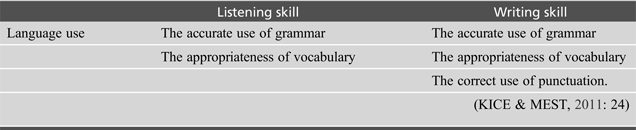
The assessment criteria for speaking and writing in terms of language use are shown in Table 1.
Listening and writing assessment criteria
These types of questions and the assessment criteria in Table 1 exhibit the NEAT's focus on accuracy and correct use of standard grammar in speaking and writing as a way of assessing a participant's proficiency. The production of grammatically ‘correct’ English is likely to be rewarded, and deviations from these judged to be errors and penalised in the test. It can, therefore, be assumed that the candidates taking the NEAT are almost universally expected to demonstrate formal and informal command of correct lexico-grammar and the syntax of ‘Standard’ English.
Discussion
Two questions arise. The first is regarding the ambiguity related to the perspective on correctness and appropriateness as a benchmark of proficiency. Would a candidate's production of nativised features shown in the examples from (5) to (16) be considered as inaccurate and inappropriate, and thus penalised? Secondly, what is the rationale for the inclusion of questions that aim to assess knowledge of Inner Circle English grammar exclusively? To what extent is the assessment of these types necessary in the NEAT that states one of its aims as evaluating candidates' practical English skills?
English is a heterogeneous language with multiple norms, and many Englishes have evolved in different developmental stages. Defining ‘accurate and appropriate production’ based on Inner Circle English usage should be called into question. Such a perspective shows that the NEAT draws upon English language use in communication from a ‘native speaker-ism’ mindset (Holliday, Reference Holliday2006: 385). This promotes the hegemony of purely English-speaking countries, as it assumes that knowledge of the forms and functions of English must be oriented to the usage in those countries. It also reinforces the perception that all second-language speakers are incomplete or deficient in their communicative competence, while striving for the target competence of idealised ‘native speakers.’ Consequently, Korean students are always measured against the standard of a native English speaker and found to be ‘incomplete’ and ‘deficient’. Lowenberg (Reference Lowenberg and Matsuda2012: 94) argues that in order to assess one's proficiency accurately, ‘examiners must be able to distinguish deficiencies in the second language acquisition of any variety of English by non-native speakers from varietal differences in the speakers’ usage'. For example, those differences in count/non-count noun, preposition and tense usage that appear in examples (5) to (16) need to be taken into account when assessing proficiency.
Conservatives may argue that such features cannot be allowed in the test like NEAT, as there is a lack of codification of KoE. However, such an attitude prevents the development of codification processes for local Englishes and the readiness to accept localised forms of English (Schneider, Reference Schneider2003; Canagarajah, Reference Canagarajah2006). The inclusion of local features of English, being pervasively used in the local communities (e.g., Korean communities) in high stake tests encourages scholarly attempts at more codification. Thus, the NEAT's inclusion of nativised features of English, whether this is intentional or accidental, is the beginning of the codification of KoE and would encourage more codification.
Canagarajah (Reference Canagarajah2006: 229) also argues that it is unwise to believe that the production of a standard-variety lexico grammar and syntax is a sign of proficiency that leads to successful communication outcomes. He asserted that success in communicating in English as an international language is not driven by the ‘accurate’ production of the native variety of English, nor by the use of this lexico grammar at all. Instead, ‘multidialectal competence is the key: the skills that allow you to understand and shuttle between diverse varieties of English to facilitate and negotiate the communication’ (Canagarajah, Reference Canagarajah2006: 233). In addition, Firth (Reference Firth1996: 243) also argues that many types of ungrammatical production in real speaking situations are ‘non-fatal’ and go unnoticed. It is also common to see the use of the ‘let it pass’ strategy or other linguistic devices for mutual understanding in communication.
Knowledge of the lexico grammar of Inner Circle varieties of English alone does not guarantee successful communication outcomes. This does not mean that testing candidates' grammar does not have its place. However, it is contradictory for it to be given priority on the assessment criteria in a test that claims to assess students' practical English skills. Instead, a test like the NEAT should seek to evaluate students' readiness to engage in interactions in an increasingly multilingual and multicultural English-using world. This could be done by assessing candidates' understanding of how pragmatic norms differ across cultures, with a focus on evaluating strategies for negotiation, situated performance, communicative repertoire, the awareness of cultural differences, and the ability to accommodate one's interlocutors.
Concluding remarks
The analysis has revealed some discrepancies between the NEAT's stated aims and what is actually being assessed. The NEAT has made little progress in assessing students' proficiency in English as an international language. The brief analysis presented in this paper calls into question the view of proficiency as posited in the NEAT, which aims to assess candidates' practical English skills in the global era. The NEAT has been shown to measure proficiency mainly through knowledge of Inner Circle Englishes. Focussing on assessing students' English proficiency solely based on the traditional view of proficiency, regarding the knowledge of Inner Circle English norms as the only valid benchmark, hinders the teaching of intercultural pragmatic skills and discourages the use of non-Inner Circle varieties of English. In addition, it prevents the development of an understanding of, and a positive attitude towards, other varieties of English.
Given the reality of the washback effect due to the competiveness of South Korean educational settings, the introduction of the NEAT has not only continued to reinforce the learning of Inner Circle English to the exclusion of other varieties, but also may hinder the teaching of intercultural pragmatic skills and discourage the use of non-Inner Circle varieties of English. In recognition of the fact that the language now has a growing number of varieties in regard to its characteristic accents, its syntactic structures, its lexis, and its pragmatic features, it is argued that the view of practical English proficiency as projected in the NEAT needs to be reconsidered so that accessing skills which lead to successful communication outcomes with diversified English speakers can be developed.
Therefore, it is extremely important to focus on ways of assessing students' pragmatic skills and of rewarding students' knowledge of other internationally used Englishes in a wider range of English-speaking contexts. In addition, a reconsideration of the assessment of norms of correctness in the usage of English needs to take place. This would improve the validity and adequacy of the NEAT, allowing its stated aim of measuring students' practical proficiency in English as an international language to be truly reflected.
Hyejeong Ahn is a PhD candidate in the Higher Degree Program of Linguistics and Applied Linguistics in the Faculty of Arts at Monash University, Melbourne, Australia. Her research interests include attitude to language, Korean English, English as an International language and World Englishes.