Introduction
One of the most striking linguistic changes to affect the English language in recent decades is the ongoing spread of be like, shown in (1), as a new member of the quotative system (Ferrara & Bell, Reference Ferrara and Bell1995; Macaulay, Reference Macaulay2001; Buchstaller & Van Alphen, Reference Buchstaller, Van Alphen, Buchstaller and van Alphen2012). The opportunity to study language change ‘in action’ (Tagliamonte & D'Arcy, Reference Tagliamonte and D'Arcy2004: 493) brought by this innovation has spurred a vast body of research on quotation in American English, where the new form is presumed to have originated (Ferrara & Bell, Reference Ferrara and Bell1995).
(1) I was like ‘Okay I don't understand.’ (ICE-JAM, S1A-029)
Despite the initial focus on American English, more recent research has revealed what is perhaps an even more striking aspect of be like, that is, the form's ‘regional promiscuity’ (Meyerhoff & Niedzielski, Reference Meyerhoff and Niedzielski2003: 540). The new quotative has now spread over many varieties of English worldwide, travelling at a fast pace to geographically separated locations, even in the apparent absence of face-to-face transmission channels. So far, be like has been documented in the speech of mostly younger generations in varieties of English in England (Cheshire & Fox, Reference Cheshire and Fox2007; Buchstaller, Reference Buchstaller2008), Scotland (Macaulay, Reference Macaulay2001), Canada (Tagliamonte & Hudson, Reference Tagliamonte and Hudson1999; D'Arcy, Reference D'Arcy2004), Australia (Winter, Reference Winter2002) and New Zealand (D'Arcy, Reference D'Arcy2010).
While the ongoing diffusion of be like across world Englishes has been well established, less is known about the actual mechanisms of this quotative's adoption in particular local communities. On one hand, the form could simply be transplanted into a new locale with all its original grammatical and social functions. Alternatively, we could expect this form and its meaning to be locally adapted by speakers, in line with their pre-existing norms and practices. Predicting the outcome of this type of transmission is not a straightforward matter. Social theory and cultural studies have shown that when partaking in global innovations and trends, local communities do so in idiosyncratic ways, as globalization tends to be accompanied by increasing localization (McGrew, Reference McGrew, McGrew and Lewis1992; Wollons, Reference Wollons2000). While it may make sense to assume that the same is true with linguistic innovation, the relationship between global currents and local responses has been far less explored in language study (Coupland, Reference Coupland2003). However, more recently, linguistic research has exhibited a growing awareness of the matter. The apparently paradoxical links between globalization and localization have been upheld as highly relevant to the study of language variation and change (Meyerhoff & Niedzielski, Reference Meyerhoff and Niedzielski2003; Buchstaller, Reference Buchstaller2008; Kohn & Franz, Reference Kohn and Franz2009)and the spread of innovative quotatives has been observed as a good site for investigation on the topic (Tagliamonte & Hudson, Reference Tagliamonte and Hudson1999; Bonnici, Reference Bonnici2010). Nevertheless, the predominant focus on quotatives in the Western anglophone world means that these issues remain largely unexplored.
The present paper addresses this gap by looking at the properties of be like in a distinctive postcolonial variety of English, namely Jamaican English, whose still-emerging norms are characterized by increasing influence from American English (Mair, Reference Mair2009). I examine whether the same constraints found to condition the use of be like in American English operate in Jamaican English, or whether certain features are adapted in locally specific ways. More broadly, the findings are expected to contribute to understanding how global linguistic innovations are spread into and adopted by local speech communities. The research focus on Jamaica, with the country's complex sociolinguistic history, shifting language ideologies and vibrant language-status discussions, is bound to shed original light on the topic in question.
Background
Globalization, linguistic innovation and World Englishes
In the human sciences globalization has become an increasingly influential paradigm for understanding sociocultural change (see e.g. Beck et al., Reference Beck, Giddens and Lash1994; Wollons, Reference Wollons2000). In its somewhat late adoption of this trend, sociolinguistics has mainly been concerned with the growing influence of English on other languages, and the dangers posed to smaller languages by the rise of world Englishes (Machin & Leeuwen, Reference Machin and Leeuwen2003). However, interest in globalization is now finding its way into all areas of sociolinguistics, including the study of language variation and change. In particular, the diffusion of global linguistic innovations across geographically distant communities has been upheld as highly relevant for variationist sociolinguistics (Buchstaller & D'Arcy, Reference Buchstaller and D'Arcy2009).
One productive site for exploring the interplay of global and local forces is provided by the range of post-colonial Englishes around the world. It is a well-established fact that, despite English becoming the lingua franca of international communication, it has in post-colonial settings continued to diversify, developing regionally distinctive forms and uses (Schneider, Reference Schneider2007). At the same time, world English varieties are today increasingly affected by global (American) English currents. Investigating global linguistic innovations in such settings evokes some major questions. Will globalization lead to increased convergence of post-colonial Englishes, as they eventually ‘subsume their heterogeneous identities into the sweeping current of the American variety of English’ (Anchimbe, Reference Anchimbe2006: 3)? Or do some local forces lead to the local adaptation of global processes (Buchstaller, Reference Buchstaller2008)?
Some hints to the answer may be found in existing work in the social sciences, and in research on linguistic levelling. It has generally been shown that when global currents enter local communities they are always locally adapted in some way. For instance, in examining the constructions of female identity in different countries' versions of the Cosmopolitan magazine, Machin & van Leeuwen (Reference Machin and Leeuwen2003) observe that the magazine universalizes women's lifestyles, but also accommodates local specificities in line with local norms. Similarly, Wollons's (Reference Wollons2000) study shows that when the kindergarten is adopted as an educational innovation in different parts of the world, this innovation is always recontextualized to fit national values. In the realm of language, research on regional dialect levelling suggests that when an innovation comes into contact with a traditional local form, it produces locally specific outcomes (Britain, Reference Britain2002).
However, none of this research directly addresses the question of what happens when linguistic innovations diffuse globally, beyond national boundaries. One fruitful way to explore such processes is to look at the spread of linguistic trends from the American epicentre into other post-colonial varieties of English. Accordingly, this paper examines the adoption of a new, US-originating quotative into Jamaican English. In order to contextualize the analysis, a brief overview of the language situation in Jamaica is given.
Jamaican English: The local and the global in an emerging standard
Jamaica has been part of the English-speaking world since it was first conquered by Britain in 1655 (Schneider, Reference Schneider2007). Following the influx of slaves from Africa, there was intensive language contact between these speakers and speakers of various British dialects, leading to the development of a creole language, i.e. Jamaican Creole or patois(Lalla & d'Costa, Reference Lalla and d'Costa1990). Today, English remains the official language of the nation (Devonish, Reference Devonish1986), though its status is controversial. As Mair (Reference Mair2007) explains, the language situation in Jamaica could technically be classified as diglossic, with official English complementing the local English-lexifier creole as a ‘high’ variety. However, in practice the two codes are mixed extensively along a continuum, and most Jamaicans see themselves as English-speaking (see Mair, Reference Mair2002).
Research on the language situation in Jamaica has mainly focused on the Jamaican Creole, with less attention given to what now appears as an emergent national variety of Standard English. Mair (Reference Mair2009) draws attention to this emerging variety and observes that it is currently being shaped by three major influences, i.e. traditional British English, the Jamaican Creole substrate and American English. Importantly, Mair's (Reference Mair2009) analysis shows that while the influence of colonial British norms persists, it now seems to be diminishing. Conversely, American English influences appear to be growing. One new feature in the Jamaican English system providing further evidence of American English influences is the quotative marker be like (Mair, Reference Mair2009; Höhn, Reference Höhn2012). The current paper examines this quotative within conversational Jamaican English, with a view to comparing the findings with those reported for American English. Before moving on to the analysis, existing research on the quotative be like is presented.
Be like as a new quotative: Findings from American English
The appearance of be like as a quotative marker in English was first observed in an editor's note by Butters in 1982. Since then, the form has received attention in a vast body of work, mostly in the US context (Ferrara & Bell, Reference Ferrara and Bell1995; Singler, Reference Singler2001; Cukor-Avila, Reference Cukor-Avila2002; Dailey-O'Cain, Reference Dailey-O'Cain2000; Buchstaller, Reference Buchstaller2008). These researchers have identified linguistic constraints on the use of be like, such as the preference for the quotative to be used in first-person contexts and for reporting internal thought. These constraints that are commonly cited in the literature are summarized below.
• Tense/temporal reference. A strong correlation of be like with the present tense has been confirmed in several studies on American English (Blyth et al., Reference Blyth, Recktenwald and Wang1990; Romaine & Lange, Reference Romaine and Lange1991; Singler, Reference Singler2001). However, some authors point out that occurrences of the present tense tend to involve instances of the Historical Present (e.g. Singler, Reference Singler2001).
• Grammatical person. Earlier studies have shown that be like is favoured with first person subjects over third person subjects (Blyth et al., Reference Blyth, Recktenwald and Wang1990, Ferrara & Bell, Reference Ferrara and Bell1995). However, Buchstaller & D'Arcy (Reference Buchstaller and D'Arcy2009) find a slight favouring of the first person; complementing their findings with a look at another, more recent corpus, they conclude that person levelling does not seem to be taking place in American English.
• Content of the quote. Existing studies on American English show that be like appears to have originated as a marker of internal thought and non-lexicalized sounds (Butters, Reference Butters1982), and only later started spreading into direct speech (Ferrara & Bell, Reference Ferrara and Bell1995). Such changes could indicate the weakening of the quote content constraint. However, other studies show that a preference for introducing thought seems to prevail (Buchstaller & D'Arcy, Reference Buchstaller and D'Arcy2009).
However, certain studies indicate that be like in American English is now expanding in function (Ferrara & Bell, Reference Ferrara and Bell1995). The underlying assumption is that the new quotative represents a case of grammaticalization in progress (Romaine & Lange, Reference Romaine and Lange1991), and that its continuing grammaticalization will lead to the weakening of the observed constraints.
As for the origins of the quotative, researchers generally agree that be like comes from the USA (Romaine & Lange, Reference Romaine and Lange1991; Ferrara & Bell, Reference Ferrara and Bell1995; Tagliamonte & Hudson, Reference Tagliamonte and Hudson1999), though it has now spread to many other varieties. The present study thus takes American English as a point of departure, in order to investigate if the same internal constraints of usage on be like operate in Jamaican English.
Data and method
This analysis is based on data from the Jamaican component of the International Corpus of English (ICE). Given the study's purposes, only the spoken segment of the corpus was used (100 recorded conversations, totalling 20,909 words). The corpus material was collected between 1993 and 2004, and includes 322 speakers (65 males and 257 females, aged 17–64).
The quantitative analysis examines the internal linguistic constraints on the use of be like in Jamaican English. The methodology largely follows that used in Buchstaller & D'Arcy (Reference Buchstaller and D'Arcy2009), allowing for some comparison with their American English data.Footnote 1
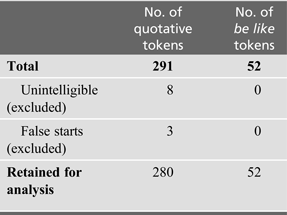
As a starting point, all instances of quotatives were extracted from the corpus (291 tokens). Cases in which what followed the quotative was marked as unintelligible in the transcription were excluded from analysis because such cases do not allow the analysis of quote content/structure. Cases in which quotatives were parts of false starts were also excluded from the analysis because in such cases the speakers subsequently abandon the quotative utterance and start a new one. This left a total of 280 quotative tokens (see Table 1).
Data

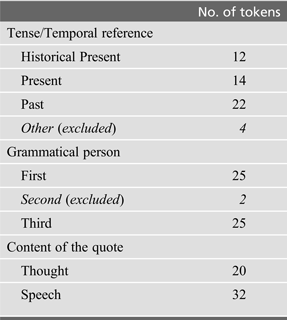
There were 52 tokens of be like quotatives, which were submitted to further coding and analysis. Each token of be like was coded for linguistic factors (for details, see Table 2). The linguistic factors investigated include grammatical person, tense/temporal reference and content of the quote. Grammatical person was coded following Tagliamonte & Hudson (Reference Tagliamonte and Hudson1999) and Buchstaller & D'Arcy (Reference Buchstaller and D'Arcy2009). The main distinction was that between the first and the third person, while second person subjects in this category were excluded from consideration, given their low frequency of occurrence (in line with earlier approaches, e.g. Buchstaller & D'Arcy, Reference Buchstaller and D'Arcy2009). In the category of tense/temporal reference, a distinction was made between past tense, present tense and the Historical Present. Other tense forms, which were far less frequent, were excluded from consideration following Tagliamonte & D'Arcy (Reference Tagliamonte and D'Arcy2007).
Distribution of be like quotatives
Content of the quote, involving the contrast between speech and thought, was found to be somewhat more difficult to code. As already pointed out by Ferrara & Bell (Reference Ferrara and Bell1995), an absolute differentiation between thought and speech can be problematic, and the two may more appropriately be seen as end-points of a continuum, rather than binary opposites (Buchstaller, Reference Buchstaller2008). In this analysis the broader narrative context was used when identifying instances of reported speech and thought. The method adopted followed Buchstaller & D'Arcy (Reference Buchstaller and D'Arcy2009). Thus, if the reported utterance entailed a thought, attitude or general feeling then it was considered internal thought (as in 2); if it was apparently spoken and responded to by other participants, advancing the story in a ‘he-said-she-said’ manner (3), then it was coded as speech.
(2) She just took the book and tossed it at the back of the class
And I was like ‘Oh my god this is so embarrassing.’ (ICE-JAM, S1A-082)
(3) And he came back with like two emails
I was like ‘Oh my God those emails are real.’
He's like ‘What you thought I made them up?’ (ICE-JAM, S1A-031)
Results
Distribution and constraints
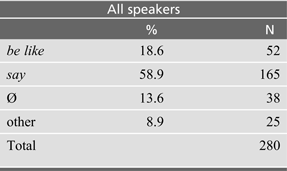
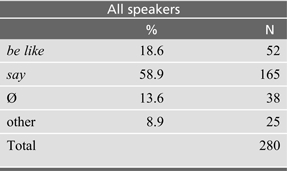
The overall distribution of quotative forms in the Jamaican English corpus is presented in Table 1. Be like represents 18.6% of the total number of quotatives, being the second most frequent form. The dominant form is say, accounting for 58.9% of all quotatives included in the analysis. The figure for the null/zero form is 13.6%. Less frequent quotatives (such as ask, suppose, decide) were placed in the category Other, accounting for 8.9% of the total. The form think, relatively robust in American English (Buchstaller & D'Arcy, Reference Buchstaller and D'Arcy2009) and in some other varieties (e.g. British English, see Tagliamonte & Hudson, Reference Tagliamonte and Hudson1999), was found to be very infrequent with the quotative function in Jamaican English, and was therefore classified within the Other category. Go was placed in the same category, as only one instance of this quotative was found. This single example is nevertheless relevant, showing that this innovative quotative is just entering the Jamaican English system. Be as a quotative is not found in the corpus.
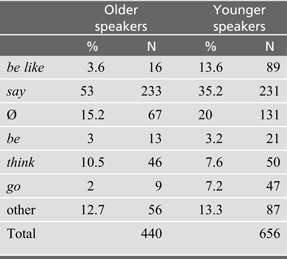
A basic comparison can be made between the present results and those of Buchstaller & D'Arcy (Reference Buchstaller and D'Arcy2009) for American English (reproduced in Table 4). Apart from the infrequency of go and think, another noteworthy result concerns be like. The form seems well established in the Jamaican English quotative system: at 18%, its frequency is higher than in Buchstaller & D'Arcy's (Reference Buchstaller and D'Arcy2009) corpus, compared with both their younger (13.6%) and older (3.6%) speaker subsets. This rate of acceptance of be like in Jamaican English is somewhat surprising, given that the form has presumably originated in American English and only later diffused to other varieties.
Overall distribution of quotative verbs in Jamaican English
Overall distribution of quotative verbs in American English, older/younger speakers (from Buchstaller & D'Arcy, Reference Buchstaller and D'Arcy2009)
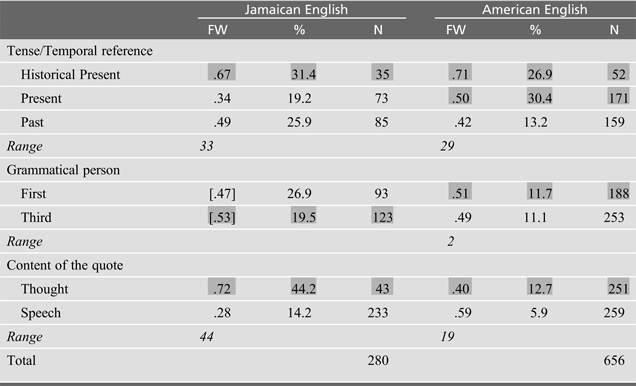
In what follows, results of a multivariate analysis, conducted to determine which linguistic constraints favour be like in Jamaican English, are presented. The analysis was conducted using SPSS. In order to increase comparability with Buchstaller & D'Arcy's (Reference Buchstaller and D'Arcy2009) Goldvarb analysis, the present analysis follows the procedures for obtaining Goldvarb-like data in SPSS (Morrison, Reference Morrison2005). Jamaican English results are presented alongside existing findings on American English (Buchstaller & D'Arcy, Reference Buchstaller and D'Arcy2009 is selected as a reference point), in order to draw comparisons. The results are summarized in Table 5 (FW denotes factor weight;Footnote 2 factor weights that are not statistically significant are given in square brackets).
Factors affecting the probability of be like in Jamaican and American English (American English data taken from Buchstaller & D'Arcy Reference Buchstaller and D'Arcy2009)*
* Shading denotes favoured factors.
In the tense/temporal reference category, the correlation between be like and the Historical Present found in earlier studies is confirmed in the Jamaican English data. The use of be like in Jamaican English is highly favoured with the Historical Present, at .67. Conversely, present and past tense categories pattern together in disfavouring be like; the rather strong disfavouring of be like with the present tense, at .34, must be noted here. Comparing these findings with the American data, the situation is similar in the favouring of the Historical Present and the disfavouring of the past tense. A major difference between the two varieties, however, is presented by the present tense contexts – be like is on the median in American English, but is highly disfavoured in Jamaican English. This result for Jamaican English also stands in contrast with other studies of American English (Blyth et al., Reference Blyth, Recktenwald and Wang1990; Ferrara & Bell, 1990) as well as with some other varieties of English, such as English in England (Buchstaller & D'Arcy, Reference Buchstaller and D'Arcy2009) or Canadian English (D'Arcy, Reference D'Arcy2004). Crucially, the findings for Jamaican English indicate a strong dispreference for using be like for the present temporal reference, which is not the case in this quotative's variety of origin. This result confirms the need to analytically distinguish between morphology and temporal reference. An analysis only distinguishing between the present and the past tense could not capture this tendency.
The effect of the grammatical person does not reach significance in the analysis. Still, it can be seen that the direction of the effect favours the third over the first person, which is opposite to that found in American English. Thus, the hierarchy found may still be taken as suggestive of be like's advancement along the grammaticalization path, or of its distinctive introduction in Jamaican English.Footnote 3
Regarding the content of the quote category, Jamaican English exhibits a pattern similar to American English, with thought favoured over speech (even though the range achieved is higher for Jamaican English). The finding is in line with existing research, suggesting that the content of the quote may be a universal constraint on be like, at least at the initial stages of its adoption (Buchstaller & D'Arcy, Reference Buchstaller and D'Arcy2009).
In sum, the linguistic constraints on be like in Jamaican English involve both some similarities (in the content of the quote effects) and differences (in tense and person effects) from American English. The content of the quote has the same direction in Jamaican and American English (thought over speech). The major difference between the two varieties is represented by the strong disfavouring of be like with the (morphologically) present tense in Jamaican English, which is not the case in American English. However, it should be noted that within the tense category both varieties strongly favour be like with the Historical Present. Finally, the direction of the effect for grammatical person is opposite in the two varieties, but the effect of person does not reach statistical significance in the Jamaican English data. On the whole, there may be some evidence to suggest that the form in Jamaican English is undergoing grammaticalization, being used in first and third person contexts, but in other respects, such as the quote content, it has not yet expanded in function.
Discussion
The present study has analysed the use of be like in Jamaican English. The findings supplement the now very extensive body of research on this new quotative in countries where English is spoken as a standard language (USA, UK, Canada, Australia), by showing that be like has also firmly made its way into Jamaica, a geographically isolated speech community where a national variety of standard English is just emerging. The form is found to feature as an already prominent member of the Jamaican English quotative cohort, with a frequency that is even higher than in most other English varieties studied so far. While this rate of adoption is hard to account for, the spread of this innovation can in broadest terms be attributed to the growing influences from American English, the quotative's variety of origin.
Not unexpectedly, the analysis of linguistic factors conditioning the use of be like in Jamaican English has shown some similarities with the corresponding findings from English in the USA, i.e. the effects of quote content and the preference for the Historical Present. However, some notable differences between the two varieties have been found, concerning the overall effects of tense/temporal reference and the grammatical person. Importantly, these idiosyncratic constraints prove that be like is not simply transferred into Jamaican English with all its functional properties, but is reconstructed in the local system, in locally specific ways.
Importantly, in understanding the mechanisms behind be like's spread in Jamaica, the country's specific language situation cannot be disregarded. The variety investigated here is an emerging national form of English, one spoken by educated Jamaicans and one currently being shaped by standard (British and especially American) English influences and increasing influences of the Jamaican Creole. In this way, the ongoing changes in the quotative system can be seen as reflective of the ongoing changes in Jamaican English usage, where multiple sources of influence are intertwining.
However, the adoption patterns of the new quotative be like identified in this analysis are by no means limited to the Jamaican language. More accurately, the study highlights the importance of the local sociolinguistic context for understanding any process of globally diffusing linguistic innovation. The findings can thus be seen as reflective of the language tensions in Jamaica, but their implications are far broader. The adaptations of the US-originating quotative marker illustrate that globally available linguistic resources are not simply copied into a new language system with all their formal and functional properties, but are adapted in locally specific ways. The observation extends the claims from dialect levelling research that cases of contact between innovative and traditional local forms always involve ‘local outcomes determined by local circumstances’ (Britain, Reference Britain2002: 618). Without a doubt, the fast-spreading innovative quotative be like is a fruitful site for future explorations of language change, globalization and localization.
KSENIJA BOGETIĆ obtained a BA in English language at the University of Belgrade, Serbia, and an MA in English linguistics at Oxford University. Her research interests include language ideologies, language and globalization, as well as language, gender and sexuality. She is currently a lecturer and PhD candidate at the English department, University of Belgrade. Email: ksenija.bogetic@gmail.com