Introduction
Characterized by a politically censorious and highly regulated society, Singapore is widely considered to be one of the most sophisticated authoritarian systems in history (Lee, Reference Lee2005). As in many other public and private domains, the government, well known for its paternalistic attitude (Schiffman, Reference Schiffman2003), usually practices an active interventional policy on linguistic life, which is extensively explored in language planning and policy study. However, in a few areas where less official intervention is exercised, the linguistic reality has received relatively scant attention. This study sets out to examine to what extent grassroots individuals can use shop signs to express their personal inclinations regarding language use, which may partly demonstrate the virtual vitality of various languages in the multilingual society.
Shop names form one of the most familiar and significant parts of the linguistic landscape or environmental print of a city or region. In official signs, such as road names, street names and government building names the code choice is centrally manipulated by the authorities in order to manifest official ideology. Unlike official signs, shop names, as private signs designed and displayed by individual business owners, largely exhibit ordinary people's preference and empathy to certain languages in the language repertoire of the society. On the linguistic level, shop name signs constitute an ideal venue to observe language use patterns, language contact and linguistic creativity, while on a sociopolitical level, the visibility of specific languages on these signs is a manifestation of the ethnolinguistic vitality and viability of the language groups in multilingual settings (Landry & Bourhis, Reference Landry and Bourhis1997). Thus, an investigation of the language use in shop names can provide us an insight into the subtleties of sociolinguistic realities.
In this paper, we examine the features of code choice in Singapore's shop name signs in an attempt to reveal the social meanings and significance of the English language in relation to other languages. This study can provide a lens for readers to observe the diversified language representation in Singapore's multilingual society, thus revealing features of its bottom-up linguistic landscape.
Public signage in multilingual Singapore
Singapore is a multiracial and multilingual city state with three major ethnic groups, i.e. Chinese, Malays and Indians. As an approach to manage ethnic diversity at home and maintain socioeconomic mobility, four languages, i.e. English, Mandarin, Malay and Tamil, are stipulated as official languages of the country. Among them, English is the language of administration, education, commerce, science and technology, and it is the de facto national language. In contrast, Mandarin, Malay and Tamil are the designated mother tongues of the three ethnic groups. Since Singapore gained its independence in 1965, the implementation of the so-called ‘English-knowing bilingualism’ policy (Pakir, Reference Pakir1991) has produced a large population pool who are particularly proficient in English. According to the Census of Population released in 2010, nearly 80% of Singaporeans are literate in English and more than 70% of the population are literate in two or more languages (Department of Statistics, 2010).
It is easily observable that the ambient language in Singapore's public domain is mainly English. That is, the official signs such as road signs and street names are generally written in English. This practice marks off the privileged status of English as compared to other languages in Singapore's official sectors. As the lingua franca of different language communities, English presented on public signs is presumably the most efficient and effective way for the government to convey the intended information to all readers. By contrast, the languages displayed on private signs such as shop signs are more diversified. Shop signs are prevalent in marketplaces, and the print on these signs may consist of text, trademarks, icons, images or other symbols. With regard to the text, a number of Asian and European languages are found on various store signs, such as English, Chinese (simplified and traditional characters), Malay, Tamil, Japanese, Korean, Thai, French and Italian (Ong, Ghesquière & Serwe, Reference Ong, Ghesquière and Serwe2013).
A review of the literature shows that the spatial representation of multilingualism, i.e. languages displayed on public and private signs, had not drawn much attention until recent years. Tan (Reference Tan, Ahrens, Embleton and Lapierre2009, Reference Tan2011a,Reference Tan and Brunnb, Reference Tan2014) has been attending to the linguistic landscape in Singapore, and his studies largely focus on official or top-down signs, including building names, signs at schools, road signs and warning signs, street names, urban rail stations and names of places of interest. One of Tan's main concerns is about the official policies on linguistic harmony between the four official languages as displayed through the control of the linguistic landscape in the official domain. He notes that in Singapore, language is linked to ethnicity in an essentialistic fashion and thus local languages have to be treated even-handedly (Tan, Reference Tan and Brunn2011b: 2010).
Lim, Zulhelmy and Goh (Reference Lim, Zulhelmy and Goh2012) investigated the linguistic landscape in Singapore's Changi Airport, where English is the priority language and a number of tourist languages are also highly visible. For private signs, Ong et al. (Reference Ong, Ghesquière and Serwe2013) documented shop owners’ agency in presenting French in private commercial entities. They found that in order to appeal to the increasingly cosmopolitan and sophisticated patrons in Singapore, code-switched blends characterized by French, pseudo-French and French-English shop signs are employed by food and beauty shop owners as a way to connote style and tastefulness in high-end upscale districts, showing the role of self-presentation in the diversification of the linguistic landscape. Ong et al.’s (Reference Ong, Ghesquière and Serwe2013) findings are partially supported by Neo and Samantha's (Reference Neo and Samantha2012) study, in which they found that there were other foreign languages beyond English and the other three state-designated official languages on the signs and menus of food establishments in a rather affluent district in the highly urbanized multicultural Singapore. The current study is intended to investigate the social roles of English in Singapore's marketplaces, a topic that has not been dealt with to date.
The current study
The purpose of this study is to examine the value and significance of English in Singapore's multilingual society in the private domain where there is less of authoritative intervention. Shop names, as typical bottom-up signs, are focused upon. The research questions are as follows:
-
(1) How is English represented on Singapore's commercial signs?
-
(2) What is the social value of English for business operators in Singapore?
This inquiry aims to gain a greater understanding of how English is perceived and positioned by grassroots individuals in a pragmatism-oriented society like Singapore.
In order to reveal the language use patterns on shop name signs, empirical data from various neighbourhood centres were collected. Neighbourhood centres, established in densely populated residential areas, are hubs of commercial stores, service organizations and dining places that provide services and goods to residents living in the vicinity and satisfy their basic consumption needs. These neighbourhood stores constitute Singapore's lower-end consumer market and target medium- or low-income consumers dwelling in nearby flats.
The shops in ten neighbourhood centres in the western region of Singapore were exhaustively photographed from January to March 2014. To ensure the impartiality of the data, we adopted a one-shop-one-sign principle in data collection, i.e. only one name sign (normally the shopfront sign) was shot for each store. A total of 1,097 shop name signs was collected and then coded as the basis of this study. The coding mainly included the following items: shop names; number of languages used; font size (e.g. English bigger, Chinese bigger, same size, etc.); layout of the text (e.g. top-bottom, left-right); name structure (see later discussion); business types (e.g. fashion, grocery, service) and location. The following sections exhibit our major findings.
Prevalence of English on shop name signs
Shop name signs are the outdoor signs whereby the shop names are displayed to the public. Apart from shop names materialized in one or more languages, we found that some other written information may be presented on the signs as well, such as a list of commodities, the scope of service, advertising slogan, store address, contact number, affiliation and so forth. For instance, on the shop name sign ‘GNC Live Well’ placed in a top-bottom layout, the top part ‘GNC’ is the formal name, while the bottom part ‘Live Well’ is its slogan. We focus only on the shop names on signs.
In light of the purpose of this study, we first examine the distribution of English in shop names. Our data show that over 96% (1,057 out of 1,097) of the neighbourhood stores present English names (English-only or English plus other code(s)) on their shop signs, while the rest of the stores (about 4%) present shop names in other language(s), such as Chinese or French. The ubiquity of English in the commercial market affirms the predominant role of English for general communication in the society. Apart from English, Chinese appear on 565 shop name signs, accounting for 51.5% of the total signs, while Malay and Tamil are presented only on 40 signs (or 3.6% of all signs). This contrast affirms the relative importance of English vis-à-vis other official languages in Singapore. Moreover, one of the main functions of shop name signs is to provide information about the business scope of the stores, thus persuading potential customers to consume at the stores (El-Yasin & Mahadin, Reference El–Yasin and Mahadin1996). In this sense, shop names bear a resemblance to the commercial advertisements of the stores. Since English is the lingua franca of all language communities in Singapore, the presence of English on shop name signs is presumably the most effective way to address potential customers from all language backgrounds.
Different types of English shop names
Although English is a prevalent language on shop name signs, it is not necessarily the only code used to codify the shop names in neighbourhood markets. In other words, the shop names of individual stores may be presented in one, two or more different languages or codes, thus forming monolingual, bilingual and multilingual name signs. Here the English-present shop signs are examined. Among the three types of signs, monolingual signs are English-only signs, while bilingual signs display code pairs such as English-Chinese, English-Malay, English-Tamil, English-Japanese, English-Korean and so forth, and multilingual signs mainly present the four official languages in Singapore. The distribution of different types of signs containing English names in neighbourhood centres is shown in Table 1.
Distribution of different types of English name signs

Table 1 shows that in the lower-end market, English-monolingual and English-present bilingual signs are predominant, with bilingual name signs slightly outweighing monolingual signs in quantity. Moreover, our data show that an English-Chinese combination is the most popular code pair (526 in number), and over 45% of these bilingual signs present Chinese (either simplified or traditional scripts) as a visually salient code (i.e. with a relatively bigger font size). English-salient signs account for only 19% of the signs. Since Chinese is the largest ethnic group in Singapore, the presence and salience of Chinese language on shop signs is readily understandable. As for multilingual signs, they are relatively few in number, and most of them are found in pawn shops, where four official languages are presented.
According to Spolsky (Reference Spolsky, Shohamy and Gorter2009), one of the key principles for the choice of languages on signs is to select languages that the expected audience are able to read. The statistical distribution of various types of English name signs suggests that the customers in neighbourhood markets have a repertoire of various languages, and English-Chinese bilingual and English-monolingual shop names may cater to the linguistic needs of the majority of neighbourhood market clients.
Structural patterns of shop names
Our data show that the internal structure of a full shop name can be divided into two segments, i.e. a specific name and a generic name. The specific name is a written identifier of the store, serving as a brand to be recognized by readers and a marker that is distinctive from other stores, while the generic name is the common category term usually indicating the nature of business, scope of commodities/services or functions of the stores such as grocery store, clinic, restaurant, beauty salon and so forth. For instance, in the shop name ‘Imperial Restaurant’, ‘Imperial’ is the specific name, assuming the role of an identifier for the store, while ‘Restaurant’ is the generic name, denoting the nature of business run by the store. Here, the specific segment is conceptual while the generic segment is categorical in function. In terms of word sequence, the specific name usually precedes the generic name. Notably, the two segments of shop names are not always coexistent on shop signs. In other words, either the specific name or generic name can be omitted, forming specific-only signs and generic-only signs. For example, ‘Natorny’ and ‘Minimart’, are two shop names composed of specific-only and generic-only names, respectively.
The structural patterns of shop names in neighbourhood centres are examined and the distribution of different types of names is shown in Table 2.
Distribution of various patterns of names

The data in Table 2 show that the prevalent structural pattern of the shop names displayed in Singapore's neighbourhood markets is the full name form, i.e. a specific name followed by a generic name. This name pattern is preferred probably because it enables the store owners to offer sufficient information about who they are (the specific name serving as an identifier) and what they do (the generic name denoting the business or service scope of the stores). Moreover, it is fairly common for the specific name to be given prominence by various means, such as through the use of bigger and/or bold fonts, marked print colours, or other special artistic styles. By contrast, the generic name is rarely given particular prominence. Such designs are deliberately produced by shop owners to facilitate potential customers’ recognition of the store. For instance, in the English shop name in Figure 1, the specific name ‘Rapha’ is given prominence via bold and bigger fonts vis-à-vis the generic name ‘Specialist Clinic’. However, in the Chinese name neither segment is highlighted.
Prominence of specific name ‘Rapha’

Table 2 also demonstrates that over a quarter of the English shop names present only the identifier (specific name) or the categorical segment (generic name). Especially for fashion stores, the brand of the apparel is often presented as a specific-only name on the shopfront signs. For those small stores where shop signs are limited in size, generic-only names tend to be displayed. These types of name patterns may have special symbolic meanings. Specific-only shop names appear to be consistent with the marketing strategies of modern, upmarket merchants who place emphasis on brand effects. On the other hand, generic-only shop names demonstrate a more practical approach in business operation, that is, providing information that shop owners assume to be essential for neighbourhood customers who mainly shop there for convenience.
Spelling of dialect pronunciation in shop names
The language elements selected as specific names of neighbourhood stores may include the brand of products, names of shop owners or founders, terms expressing best wishes, self-created lexical items or other forms. We notice that on Chinese-English bilingual shop signs, the spellings of the specific segment of the English names may be either a transliteration of the Chinese characters according to their dialect pronunciation or Hanyu Pinyin (i.e. Romanized phonetic transcription system) forms of the Chinese characters according to their Mandarin pronunciation. This kind of language contact phenomena of two or more code varieties of the same language being found on signs can be termed graphic code-mixing. Given Singapore's consistent policy towards dialects, the presence of dialect spellings on private signs is very unusual and merits observation.
In Singapore, before Mandarin Chinese was promoted as the official language, a number of southern Chinese vernaculars such as Hokkien, Cantonese, Hakka, Hainanese and Teochew were widely spoken by ethnic Chinese residents, whose ancestors were mainly early immigrants from Southern China. After independence in 1965, Mandarin was designated as the official language, and Hanyu Pinyin and simplified characters were gradually introduced to schools as standard forms. Despite their role as the de facto mother tongues for the majority of ethnic Chinese, these vernaculars, termed ‘dialects’ in official discourses, have been denigrated as unwelcome heritage languages by the government in that these mutually intelligible varieties may hinder children's learning of Mandarin Chinese, a major school subject in Singapore. Since 1979, the government has launched the well-known Speak Mandarin Campaign, wherein a series of measures have been taken in order to rule out the spread of dialects in favour of Mandarin Chinese. Consequently, this annual event has resulted in the continual decrease of the dialect-speaking population in the past three decades. Nowadays, such dialects are mainly spoken among the elder generation of Chinese people, and few young people are proficient in speaking dialects.
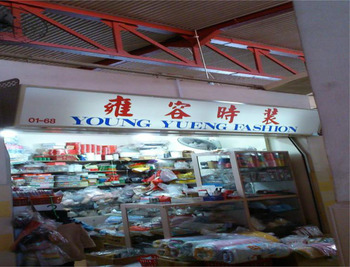
It is interesting to see that dialect pronunciations are found in some shop names. That is, the Chinese specific names tend to be transliterated into Romanized forms according to their dialect pronunciation. For example, ‘Young Yueng’ in the English name is the transliteration of the Chinese specific name ‘雍容’ (meaning ‘elegant and aristocratic’) according to Cantonese pronunciation, in comparison to Hanyu Pinyin ‘Yong Rong’ (Figure 2).
Dialect pronunciation ‘YOUNG YUENG’ in English Name

For other instances, in the name ‘Fook Loi Trading Pte Ltd’, the specific name ‘Fook Loi’ is a spelling of Cantonese pronunciation, meaning the advent of bliss. The specific names ‘Heng Huat’ and ‘Hwa Kim’ in the shop names ‘Heng Huat Curtin Shop’ and ‘Hwa Kim Trading Company’ are spellings of Hokkien pronunciations. These dialectal representations in material practice are clearly not in line with the prevailing social ideologies. Despite their non-standard status in national language policy, the dialectal spellings are highly likely to be used by shop owners to demonstrate their identity as members of certain dialectal communities. As individuals, the dialect-speaking grassroots traders can do little to change the country's language policy. The use of dialect names may be seen as an active attempt to conserve their linguistic legacy.
Presence of pseudo-English names
Although English is established as the working language of the society and the first language in school education, there are quite a number of local people whose English proficiency is very low. According to the Department of Statistics (2010), nearly 10% of residents, most of them elderly people, know little English.
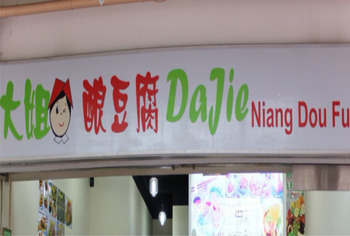
We notice that in some bilingual shop names, the alphabetic spellings are not English words, but Hanyu Pinyin of the characters. Some even annotate tone marks on the alphabets. We call this type of English name a pseudo-English name. For instance, in Figure 3, the English shop name ‘DaJie Niang Dou Fu’, literally ‘elder sister's stuffed bean curd’, is the Hanyu Pinyin of the Chinese shop name on the left.
Pseudo-English name ‘Dajie Niang Dou Fu’

The functions of pseudo-English names may be twofold. On the one hand, such shop names may function to appeal to senior customers. Since a sizable portion of the neighbourhood customers are elderly residents whose literacy in Chinese characters is relatively low, the Pinyin annotated on shop name signs might be helpful for these people to recognize and understand the meaning of the characters. On the other hand, the pseudo-English name may help shop owners construct an inclusive public image and a special language identity. In a utilitarian society like Singapore, English is the predominant language which is often associated with meritocracy, economic advantage, and upper class in the social hierarchy. Illiteracy in English would be a stigma that few individuals are willing to bear. Those shop owners with low English literacy surely do not want to be prejudiced and marginalized by the mainstream population, and the presence of pseudo-English names might be a relatively simple and decent way for them to stay inclusive in the major language community.
Discussion and Conclusion
The linguistic landscape is a component of a state's implementation of language planning or policies in easing the tension of the balancing act between the official languages (Tan, Reference Tan2014). In the public domain, Singapore's official language planning supports a ‘well-developed and comprehensive bilingual education program for its three major linguistic communities on an egalitarian basis’ (Schiffman, Reference Schiffman2003: 105), so private domains like shop signs can be a sort of ‘test-case’ to examine the actual use of language by masses, and to reflect local trends (Backhaus, Reference Backhaus2007). As bottom-up linguistic items marking the commercial space, shop signs provide a symbolic clue to the value and status of such languages vis-à-vis other languages from the perspective of private business operators.
In this paper we have demonstrated that English is the predominant code on shop signs, and English-Chinese pairs are the most frequently presented code combinations on such signs. However, compared to English, Chinese is more often represented in larger fonts, thus forming the most salient code on bilingual signs. In terms of internal structure, a full name form, i.e. specific name plus generic name, is the preferred pattern for practical purposes. The paper has also shown that graphic code-mixing exists in English shop names, and spellings of dialect pronunciation are used as a measure to preserve the heritage language as a cultural legacy. This suggests that dialects are generally regarded as having low instrumental but high affective value. Moreover, pseudo-English names are sometimes presented by shop owners to construct a special identity in the English-dominant society.
The analysis in this study has also shed some light on the multilingual ecology in the context where government intervention is largely absent. The perception of English as a privileged language of the country has taken root, and the significance of English in the society is well recognized by the general public. Chinese is also an important language, whereas the vitality of the other two official languages, i.e. Malay and Tamil, is extremely low in public space. Here, the representations of non-official code (e.g. dialectal pronunciation or traditional Chinese scripts) and the lukewarm visibility of minor official languages stand in contrast to the official discourse and in effect features what Blommaert & Dong (Reference Blommaert, Dong and Coupland2010) call ‘disproportional indexicality’.
The findings show that there are two types of multilingualism in the contested space. Official multilingualism is a top-down mode of regulation that reflects the desired construction of social reality, or in Leeman and Modan's (Reference Leeman and Modan2009: 333) words, is ‘conceived as a perspectivized, ideological representation of space’ and serves national planning goals of unity in diversity. On the other hand, the bottom-up multilingualism demonstrates how certain groups in Singapore attempt to employ possible means to find their voice and seek their desired commercial, social, and cultural ends.
Acknowledgements
This work is partly supported by China's National Social Science Foundation (Grant No. 15BYY050).
 GUOWEN SHANG is currently an associate professor at the School of International Studies, Zhejiang University, China. He received his PhD in linguistics from the National University of Singapore in 2011. His research interests mainly include sociolinguistics, language policy, and cognitive-functional grammar. Email: rickshang@163.com
 SHOUHUI ZHAO, associate professor with University of Bergen (Norway), obtained his PhD in linguistics from the University of Sydney. His work appeared in Language Policy, Current Issues in Language Planning, Asia-Pacific Education Researcher, Language Problem and Language Planning and numerous other Chinese journals. Professionally trained as a language teacher, Dr Zhao has taught and researched Chinese language and culture in six different countries since 1988 upon completion of his MA study at Renmin University of China in Beijing. Email: shouhui.zhao@gmail.com