Introduction
According to the Institute of International Education, China has become a major receiving country of international students, like the United States, United Kingdom, Australia, and Canada. The rapid development of international education in China evidences a major progress in the infrastructure of Chinese higher education. While internationalization creates unprecedented opportunities for the knowledge economy in China, it simultaneously poses unparalleled challenges for Chinese higher education (An & Chiang, Reference An and Chiang2015) and one of these challenges is the medium of instruction (MOI). While English has been widely taught in China since 1978 (McArthur, Reference McArthur2005), it was not until the turn of the century that English was endorsed as the medium of instruction for the so-called Chinese-English bilingual education.
One of the driving forces for English-medium instruction (EMI) is the internationalization of Chinese universities. The EMI programs are not designed for language education but for majors like computer, engineering, business, medicine, and so forth. The Chinese Ministry of Education (MOE) reviews and regulates these EMI programs. China is not an English-speaking country and most international students are not from English-speaking countries (China Daily, 2012). Hence, the critical issue is the medium of instruction. Although a few scholars (Botha, Reference Botha2015; Hu, Reference Hu2009) have raised concerns about EMI, its quality is rarely reported in China. Drawing upon a group of international students' reports, this article provides a learners' view of the EMI programs at a major university in southern China.
International education in China
International education has thrived in the processes of globalization. As a remarkable example of globalization, China has been making a great effort to internationalize its national universities. In the 1990s, the Chinese central government launched a series of educational reforms and projects in an effort to develop globally competitive universities. China is keen on building international exchange programs, through which students and staff can go to study at their partner universities abroad (Huang, Reference Huang2007). A recent form of exchange is the ‘2 + 2’ dual degree program that allows students to study at a Chinese university for the first two years and then at its partner university abroad for two more years, enabling them to receive a diploma from both institutions.
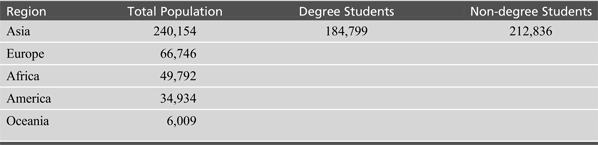
International education in China is no longer a one-way street. Fully aware of the commercial advantage and the long-term knowledge exchange in international education, the Chinese central government strives to recruit foreign students. Before the 1990s, international education meant a one-way process of sending Chinese students and instructors to Western countries and importing educational approaches/activities from the West. In 2015, over 800 Chinese universities enrolled 397,635 students from 202 countries or regions, according to China Association for International Education (see Table 1). In 2010, the Chinese Ministry of Education (MOE) also launched an ambitious program entitled ‘Study in China’ which aims to recruit 500,000 overseas students by 2020.
Geographical Distribution and Total Number of International Students in China

Source: Statistics of International Students in China (CAFSA, 2015)
Medium of Instruction in China
The medium of instruction (MOI) is considered as a serious problem for international students in existing studies (Myles & Cheng, Reference Myles and Cheng2003). MOI poses a more serious challenge to international students in China than in an English-speaking country as Chinese is less taught world-wide than is English. Aware of English as a global lingua franca, the Chinese MOE began to advocate EMI at the turn of the century, and in 2007 it enacted its first policy – ‘Provisions for Quality Control Standards on Undergraduate Medical Education in English for International Student in China.’ In 2009 the Chinese MOE announced 34 state-approved medical schools and 34 universities that offer multiple EMI programs of various academic degrees.
Chinese education adopts a government-regulated approach that implements a nation-wide system of policies and practices. In other words, when an educational policy is issued, different voices may be drowned in the governmental discourse of advocacy. However, Chinese scholars overseas expressed their concern about the educational and socioeconomic consequence of EMI. While the quality of EMI is rarely reported, the Chinese MOE makes every effort to standardize its operations across the nation. As shown in its official website, the Chinese MOE organizes a special committee to assess and select the best English-taught classes with a quota for different universities every year.
English-Medium Education
This article provides a learners' view of how EMI is practiced at a national university in southern China. This university admits over two thousand international students in 2015. It started its first EMI program in 2006 and currently it offers about a dozen EMI programs. The regular faculty of the EMI programs consists of native-speaking Chinese teachers, and some of them received their graduate education overseas. There are three or four foreign teachers from the US, UK, Canada, or Australia, but they are employed on a short-term basis. 60 international students from Asia (24), Africa (20), Europe (12), and North America (4) were gathered together in a classroom, and asked to write about their educational experiences at this university and their thoughts about the EMI programs of the university.
These open-ended reports were thematically grouped in terms of the procedure for qualitative content analysis. The matter of analytic interest is the participants' shared experiences and views of the EMI programs of the university. All the participants come to China for two reasons. First, they find Chinese education affordable. Second, they feel impressed by China's socioeconomic advances. All the participants expressed their appreciation for the infrastructure of the university and its EMI programs, but they all experienced some difficulties. The two critical issues that are commonly reported are: (1) language difficulties and (2) instructional problems.
The overall attitude of these participants toward the EMI programs is positive. They claimed that they had learned English but not Chinese in their home countries. Even the descendants of overseas Chinese in Indonesia did not learn any Chinese because the Indonesian government did not allow them to learn Chinese. Thus the EMI programs serve as a gateway for the descendants of overseas Chinese to learn about their original culture. For those from culturally distant places like Africa, Europe, or North America, the Chinese language is too difficult to master in a short time. This dilemma is solved by the EMI programs wherein international students can pursue a major immediately after arrival. Therefore, all the participants ask for more EMI programs.
Language Difficulties
Language difficulties are described as a common experience for international students in existing studies (e.g. Cheng & Urben, Reference Cheng and Urben2011). In contrast to international students in the English-speaking countries, all the participants here attributed their language difficulties to the Chinese instructors. While all these participants appreciate their EMI programs, they feel frustrated with the Chinese teachers' English proficiency. A Nepalese student says:
Most of the Chinese teachers lack fluency in spoken English. They are unable to express themselves in international language. As a matter of fact their pronunciations are baffling, and usages of grammars are almost incorrect. Due to this, students misunderstand things. Students do not actually catch what the teacher is trying to explain. No matter how much knowledge a teacher has, it is useless if he is bad at eloquence …
An African student says:
Many teachers find it difficult to deliver information to international students in English language easily. This causes weak students not understanding some topics well. I think the university should test teacher's levels on English language before employing them to teach degree programs in English language because language barrier problem is a big factor in education.
This describes a common issue for international education in China. Instructors and students are non-native speakers of English (NNSE). Unlike international students in an English-speaking country, all these participants, although being NNSE themselves, complained about their NNSE instructors' spoken English. The reports above contain obvious mistakes, but they blamed their Chinese teachers for using bad English. Communication is a two-way process. The participants claim that they find it hard to understand their Chinese teachers' English, but it may be equally hard for Chinese instructors to understand international students' English. As a Thai student puts it:
Communication is one of the biggest problem most of the International students have in class, especially when their native languages are not the same plus each student has different ability in communicating and understanding which makes it harder for class to go well. So it is very important that a person who is going to be teaching has a high level in communicating in English and is able to understand different accents from different continents and countries.
This Thai student's observation indicates that the Chinese instructors can also find it difficult to understand their international students' English due to different accents. While the participants consider the Chinese instructors' oral English as the source of problematic communication in the classroom, it should be evident that most international students also have language problems. An acute issue is that these students may not be aware of their own language problems.
Instructional Problems
Language problem is considered as a significant factor that affects NNSE instructors' articulation and presentation of course materials in existing studies (cf. Tyler, Reference Tyler1992). All the participants here find the Chinese teachers' instructional style problematic, and attribute this partly to a lack of English proficiency and partly to the culture-specific mode of teaching and learning in China. An African student says:
Chinese teachers cannot make a student understand the concept when they are teaching you, […] When you tell you didn't understand they can say maybe your background is not good, tried to review again or ask anybody else later. I think the problem is language problem. I think they don't know how to speak until they make you understand.
Another African student says:
[…] At some points the teachers tend not to be competitive with the students who have knowledge on a particular topic that the teacher would be at it at that time of the lecture. Moreover, the idea of teachers narrating exactly what has been jolted down from the text books without explanations really disturbs me a lot because I find it so pointless since I myself could just buy the book and read it like a novel at home.
A Thai student says:
In most Chinese schools students will be mostly learning through listening, note-taking and reading the textbook. Activities such as problem solving, critical analysis, collecting evidence and experimentation are rare, and there is little emphasis on study skills in many schools.
In the view of these participants, Chinese instructional practices are largely affected by English proficiency deficiencies and are also culturally conditioned. International students often find it difficult to understand course concepts because the Chinese instructors do not possess adequate language resources to explain course content clearly, and international students may also lose interest in learning because the Chinese instructional practice is not very interactional. The Chinese instructors often play the role of information provider, and students are usually positioned as information receivers. This type of instruction is typical of Chinese university classrooms but may be alien to some international students.
Some Concluding Remarks
EMI is borne of practical needs associated with educational globalization. The case of EMI in China poses a contrast to international education in English-speaking countries largely owing to linguistic and sociocultural differences which find a clear expression in the medium of instruction. In an English-speaking country, instructors are dominantly native speakers of English (NSE). When NNSE students cannot fully understand, NSE instructors can simplify their English in order to facilitate students' understanding (Hellstén & Prescott, Reference Hellstén and Prescott2004), or even when teachers are NNSE, NSE students may repair understanding problems (cf. Chiang, Reference Chiang2009). The participants' reports here may be informative for the Chinese faculty to learn to cope with communication issues.
The EMI programs in China also may be comparable to international education in other non-English-speaking countries, especially in terms of language difficulties. However, there are some culture-specific practices in the Chinese instructional communication. Existing studies on the US international education have shown that Asian-born instructors may be perceived as incapable of lecturing coherently due to their linguistic differences (Tyler, Reference Tyler1992) and Asian students favor the information-driven learning style whereas Americans prefer using the participant learning style (Rubin, Reference Rubin1993). The participants' reports here may help the Chinese faculty better understand the fact that international education is essentially intercultural education.
Acknowledgements
The authors are grateful to the partial support of Guangdong Provincial Research Foundation for Public Diplomacy and Intercultural Communication and to the partial funding of Guangdong Provincial Higher Education Reform Project (GDJG: 2014062)
 JI-JUN HE (PhD., Shanghai Normal University) is an associate professor of linguistics at South China University of Technology. His primary research interests include language education and Chinese language communication. He has produced numerous publications in major Chinese academic journals.
 SHIAO-YUN CHIANG (PhD., State University of New York at Albany) is a professor of international education at Shanghai Jiao Tong University and a professor of intercultural communication at the State University of New York. His primary research interests include intercultural pragmatics, instructional discourse, and language education. He has produced numerous publications in major international academic journals. Email: John.Chiang@oneonta.edu