Introduction
China has since 2000 started marketing itself as a hub for international education, and there has been a push by the government to attract a large number of foreign students to the country's universities.Footnote 1 Sharma (Reference Sharma2011) reported that there were around 260,000 foreign students studying in China's universities, and that the aim of the Ministry of Education was to attract around 500,000 foreign students by 2020.Footnote 2 However, as China is a so-called ‘emerging destination’ for foreign students, perhaps not surprisingly, the vast majority - around two-thirds - of its foreign student population is currently from the Asia region (Study in China, 2012). Although the largest number of foreign students in China study Chinese language programs, an increasing number are attracted by such programs as engineering and medicine. These courses are also being promoted as English-medium programs, with whole degree programs offered from undergraduate to postgraduate levels in English. Little research has been carried out on how these programs are being conducted, the reception of these programs by foreign students in China, and the impact this is having on China's universities. The attraction of international students to China's higher education institutions would no doubt alter the dynamics of language use on these university campuses. This article reports on the reception and use of English by foreign university students in one such international degree program: international undergraduate students studying for a degree in Bachelor of Medicine and Bachelor of Surgery (MBBS) in the School of Medicine of one of China's leading universities. This case study provides an example of how English-medium instruction programs are currently being used to attract foreign students to China's universities, partly in order for these universities to promote themselves as ‘international’ institutions (see also Botha, Reference Botha2014; and Bolton and Botha, Reference Bolton and Botha2015).
Background to the study
The university where this project was carried out has an undergraduate student population of some 32,000 students. This university is also one of the universities which has official approval to offer medical degrees taught through the medium of English (Chinese Ministry of Education, 2011).Footnote 3 The international Bachelor of Medicine and Bachelor of Surgery program (hereafter MBBS) is reportedly open to 100 non-Chinese nationals per year, but during the period of research, the university was not able to meet this target. As a result, only 35 students from the MBBS program took part in the survey, the findings of which are reported on in this article. Of these students, 20 were in Year 1, and 15 were in Year 2.
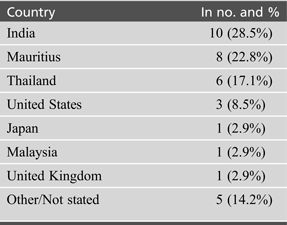
The international student sample in the survey consisted of a diverse range of students drawn mainly from the greater Asia region. Regarding the demographic details of the sample, 28.5% (10/35) reported that they came from India, 22.8% (8/35) from Mauritius, 17.1% (6/35) from Thailand, and 8.5% (3/35) students from the United States (see Table 1). The remaining three students came from the United Kingdom, Japan, and Malaysia respectively. What is evident from the students' countries of origin is that the vast majority came from developing countries, which suggests that students from such countries view China (and this university) as an affordable new destination for international higher education and learning.
International students' country of origin in the MBBS program

With reference to the language background of students, 94% (33/35) reported not speaking English as a native language, while 32.3% (11/35) of these students reported speaking more than one language at home, which gave a clear indication of their multilingual backgrounds. The survey also revealed that the non-native speakers of English had a total of 17 home languages, and several of them reported a degree of super-multilingualism in their lives. For example, one student reported speaking Manipuri, Hindi, and English as a home language, while another student, also from India, reported speaking Tamil, English, Thai, and Hindi as home languages with various members of her family.
The use of English for education by international students at the university
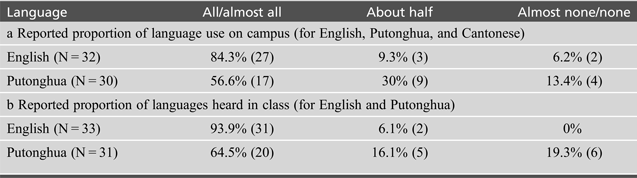
The MBBS students' use of English in educational settings are reported on in this section, and here it is evident that the MBBS students are exposed to a great deal of English in their lectures, with 74.2% of the respondents stating that ‘all’ or ‘almost all’ of their lectures were being conducted in English. Table 2 presents results relating to the students' use of English and Putonghua on the university campus, as well as their proportionate language exposure in their lectures. From the results displayed in Table 2a it appears that students use English most frequently on campus, where some 84% report that ‘all/almost all’ of their language use was in English. However, one question in the survey asked about the use of other languages, and as can be seen in Table 2a, 56.6% of the students reported using Putonghua ‘almost all’ to ‘all’ the time on campus, suggesting that the language is important in their day-to-day lives on campus. In Table 2b, the students' reported exposure to English in their classes is presented in the context of Putonghua. From this table it is evident that the students hear English predominantly, with some 93% of the students stating that they hear the language ‘all/almost’ all the time. Interestingly, the students also reported hearing a lot of Putonghua in their classes, with 64.5% of the students reporting that they heard Putonghua ‘all/almost all’ the time in class. The use of Putonghua in the students' classes could be explained by the fact that these students were taking Putonghua courses as part of their formal MBBS program.
MBBS students' exposure and use of English in educational settings (in % and no.)
The results of the MBBS students' responses to the questions regarding their exposure to English through their prescribed reading reveal that the majority, or some 74% (26/35) of the students are reportedly required to read their study material in English ‘a lot’ or ‘all’ the time. In addition, 96.8% (31/32) of the students reported that they had ‘little’ or ‘no’ difficulty when reading their course material through the medium of English, which is somewhat surprising when one considers that many of these students come from backgrounds where English is presumably not widely used in their high school education (e.g. Thailand). In terms of writing in English, 62.8% (22/35) of the MBBS students reported to do ‘a lot’ to ‘all’ of their writing for their studies in English.
The attitudes of international students toward English-medium instruction
A widely held view among the MBBS students is that English helps to ‘internationalize’ the university. The fact that most of the students are international students, most of whom come from multilingual backgrounds, suggests that these students value the role of English in higher education in China. In Figure 1, the majority (97% or 33/34) of the students agreed with the view that ‘English internationalizes the university’ if courses are conducted in the language. Generally, MBBS students' attitudes to the value of English are also confirmed by the results concerning their attitudes towards Chinese as a language of teaching and learning. From Figure 2 it can be seen that 82.4% (28/35) of the students did not agree with the view that ‘The university is better off if all courses are taught in Chinese’, while only 17.6% (6/34) of the students agreed with this notion.
MBBS students' attitudes regarding English as an international language, by no. of respondents to Question 52: The university would be more international if courses are conducted in English.
MBBS students' attitudes regarding Chinese as a language of teaching, by no. of respondents to Question 53: The university is better off if courses are taught in Chinese.
The students were also asked in interviews how they felt about the way their courses were conducted in English. From these interviews, and in terms of English as a medium of instruction, it appears that the MBBS program was received negatively by many of the students, with one student in an interview stating that the program was ‘very dissatisfying’ and that ‘we all come from very far […] but all we got till now is disappointment’. The same student explained that a major concern was that, even though the teaching staff in this program was well-educated, ‘they can't speak English properly and all they do is just read the PowerPoint presentation in class’. In terms of English-medium instruction, the student explained that one of the few courses she and her fellow students enjoyed was one where the teacher was from another department and that ‘there was no communication barrier at all [and] attendance for this class was 100%’, because ‘students could understand the teacher and the teacher could understand us as well’. Another student noted that ‘[if] I have to rate the implementation of English-medium MBBS program I would give […] a 6 out of 10’ because of the ‘teachers’ oral English […] and the teaching method’. Responses such as these indicate that some of the students felt that their teachers' proficiency in English was a concern and contributed to their negative appraisal of the MBBS program.
The perceived impact of English medium teaching and learning in the personal lives of students
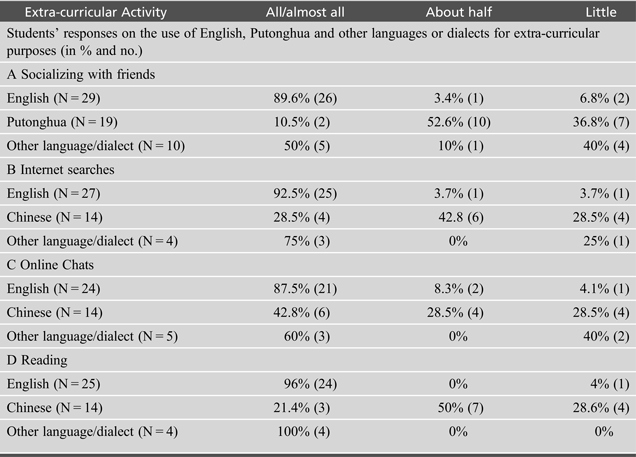
The MBBS students were all international students studying at the university, yet from the survey only 20.5% (7/34) reported that English was their native/first language. The survey also explored these students' reported extra-curricular use of English outside of the university context, and Table 3 presents their reported use of English, Putonghua, and other languages and/or dialects in the students' leisure time. Results for the extra-curricular use of English indicate the most frequent linguistic activities that the students reportedly engaged in. This table reveals that the most frequently reported use of English in the international students' leisure time is when they are ‘socializing with friends’, with 93.5% of the respondents claiming to socialize in English in their spare time. Of the students who claimed to socialize in English in their spare time, some 89.6% socialize ‘a lot’ or ‘all’ in English. In comparison, 61.2% of the students reported socializing in the medium of Putonghua, with a surprising 63.1% of these students socializing ‘about half’ to ‘all’ in Putonghua. After arriving at the university, most of these students reportedly used Putonghua when socializing with friends, and many of these students who are able to socialize in Putonghua do so quite regularly. The students' use of Putonghua can be explained by their need for Putonghua as a language of wider communication on campus, as well as in the city where this study was carried out. However, it is not surprising that these students reported that most of their socializing is in English, as the language is a natural lingua franca for these students and, at least among the international student population, it would appear that these students prefer using English among themselves. Besides English and Putonghua, most of the students' additional language and/or dialect use was also for this category, with 32.2% socializing in another language or dialect, and of this number, 60% socialize ‘about half’ to ‘all’ in a third language or language variety.
Reported extra-curricular use of English, Putonghua, and other dialects/languages for selected activities
The students' second most frequent use of English was reported for ‘Internet searches', with 87% of the respondents using English when doing searches on the Internet, compared with some 41% who do searches in Chinese. Of the students who reported using English for this activity, some 92.5% of the students claimed to use English ‘all/almost’ the time. In comparison, of the number of students who reported using Chinese when doing their Internet searches, 71.3% use the language ‘about half’ to ‘all’ the time. The next most frequent extra-curricular use of English was with ‘reading’, with 80.6% of the respondents claiming to use English for this activity, while some 41% of the students reported reading in Chinese.
Regarding the use of English for reading, 96% of the students stated that they read ‘about half’ to ‘all’ their material in English, compared with 71.4% who reportedly read in Chinese. Frequent reported use of English was also found to occur with ‘online chats’, with 77.4% of students using English for this activity, and 87.5% chatting in English ‘all/almost all’ the time. In comparison, some 42% of students claimed to use Chinese for online chats ‘all/almost all’ the time.
Discussion
It appears from the data presented in the previous section that English is predominantly used in the formal education of the international students, as evidenced by the reported exposure these students have to English in their studies. What is noteworthy about these results is the issue of English proficiency, as only 28.5% (10/35) international students took an English language proficiency exam two years prior to taking the survey, compared with the large number of Chinese students that took such an exam. Interestingly, only one student in the MBBS group replied that they had taken a local Chinese proficiency test. It was also found that the university's MBBS program officially requires applicants to have an IELTS (band 6) or TOEFL (530) test score, or that they come from an ‘English-speaking’ country in order to be admitted to the program. However, most of the students in this survey reported not having taken such a proficiency test prior to the survey.
Another interesting finding is that some 56% of the MBBS students claimed to use Putonghua often as a language of communication, even if some 84% of these students also reportedly use English frequently. It certainly appears that these students used Putonghua quite often as a language of communication on campus, which would suggest that many of these students were at the time of the study incorporating Putonghua (and to a lesser extent Cantonese) into their already multilingual linguistic repertoires. Furthermore, it was found that many of these students were already multilingual, with some speaking up to 5 different languages and language varieties. As mentioned earlier, many of the students also reported that they are required to take Chinese lessons (Putonghua), and that a requirement of the MBBS program was that the students graduate with a proficiency score in the Hanyu Shuiping Kaoshi (HSK).Footnote 4
It was generally evident that English was widely used in the MBBS program. Regarding the officially promoted use of English by the School of Medicine, the school claims that internationalization is an important notion tied to its vision for this program. It appears that the School of Medicine also equates ‘internationalization’ with the English language, as it claims the School's ‘all-English preclinical medical education program’ is evidence of internationalism that is apparently being promoted by the college. The reality of English in the MBBS program referred to in the statement above is that the language is widely used as a medium of teaching in the program. However, English appears to be limited in its use as a medium of teaching in the rest of the school as a whole, with Chinese postgraduate students (and undergraduate students) reportedly being exposed to very little English in their classrooms (see Botha, Reference Botha2014; Bolton and Botha, Reference Bolton and Botha2015). As was indicated above, the majority of the students surveyed felt that English ‘internationalizes’ the university. Some 91% (31/34) of the international students felt that it was important that the university offer more courses taught through the medium of English.
The attitudes of the international students at this university appear to indicate that these students predominantly view the English language as an important ‘international’ language, and also that English-medium instruction is an important aspect relating to the so-called internationalization of their university. The students also appear to value the importance of English as a language of international communication, and the majority strongly felt that English was a necessity at the university, and that it was important the university increasingly use the language as a medium of teaching. These students' attitudes to English a medium of teaching are no doubt influenced by the fact that many of these students were attracted to this university to study medicine, and that English-medium teaching was the main reason for them coming to the university. Nevertheless, it also appears that Putonghua is an important language of communication for these students on the university campus, in order to socialize with other students, many of whom were local, Chinese students.
The international students surveyed in this study also reported using English very often in their lives. Some 91% of the sample reportedly speaking English within the same day of the survey, and 85% wrote and read in English on the same day of the survey. However, it is not evident that there are correlations between increased exposure to English in these students' education and their extra-curricular use of English. What is evident, however, is that these students have to use English as an educational lingua franca, especially since these students come from all over the world, mostly from greater Asia. What is also notable is that the international students were aware of a Chinese variety of English, with some 96% reportedly hearing a Chinese variety of English in their lectures, while some 72% reported hearing American English, and some 46% reportedly hearing British English.
Conclusion
It certainly appears that Chinese universities' English-medium programs seek to attract an increasing number of international students. The rhetoric of internationalization associated with these programs may also be designed to appeal to local Chinese students, in that it indicates to these students that the universities can support them in developing international perspectives and world-class knowledge. Sociolinguistic research on the spread and use of English in China's higher education is still very limited, however, and much more work remains to be done. In particular, most studies on the use of English in the country's higher education have been restricted to providing accounts of the spread and teaching of English language subjects, with very little mention of how English is increasingly being used as a language of instruction (especially in courses designed for foreign students), and how English is actually being used and perceived in higher education in China. Along with a previous study reported on in Botha (Reference Botha2014), the study presented in this current article has begun to fill this research gap by providing a quantitative and qualitative macro-sociolinguistic profile of the use of English in one of China's leading universities. As mentioned in Botha (Reference Botha2014, see also Bolton and Botha, Reference Bolton and Botha2015), research on the spread and use of English in mainland China's universities needs to be contextualized within multilingual contexts of language use and language ecologies in the region, especially with regard to the rich multilingual worlds of students in China's higher education. The increase in the number of international students, from Asia and elsewhere, at China's universities is another example of how diverse the language ecologies at these universities are. A key finding from this present study is that these international students are required to graduate from their English-medium programs with a certain level of proficiency in Putonghua. This requirement provides additional opportunities for these international students to expand their already multilingual repertoires even further, thus adding to the linguistic diversity in their lives. In conclusion, it is hoped that the research presented in this article may provide future researchers in this area with a better understanding of the dynamics of the use of English (and other languages and language varieties) in the Chinese context.
Acknowledgment
I wish to express my sincere thanks to Kingsley Bolton for his valuable comments during the preparation stages of this paper.
WERNER BOTHA is Assistant Professor at Nanyang Technological University in Singapore. His research interests include the use of English in Asian higher education, educational linguistics, multilingualism, and language variation, with particular reference to the Asian region. Recent publications include research articles on the spread and use of English in China's higher education and on sociolinguistic variation in Cantonese. Email: wbotha@ntu.edu.sg