Introduction
With the intensification of globalization and advancement of digital communication, interactions online have gained increasing vitality in our life. Online communication now influences the spread of various languages (e.g., English) and semiotic signs (e.g., emoticons) to many countries, especially for those characterized by Kachru (Reference Kachru1986) as belonging to the Expanding Circle (e.g., Japan, China — countries where English is usually practiced as a foreign language). Recent inquiries of digital discourse analysis have researched how English and its features are adopted in countries of the Expanding Circle (e.g., Crystal, Reference Crystal2008; Zhang, Reference Zhang2012). This paper continues to explore the linguistic landscape of English practices online, and specifically focuses on how micro-blogging users in mainland China adopt English as a resource for meaningful multilingual communication.
Previous research on Chinese online communication
As one of the fastest growing countries in the world, China today is witnessing striding progress of digital communication. The 40th China Statistical Report on Internet Development estimates a total of 751 million Internet users by June, 2017, and the Internet penetration rate as 54.3% (China Internet Network Information Center, 2017, July). The vibrant Internet environment, although subjected to stringent censorship, contributes to thriving online interactions via different modalities.
Over the past two decades, scholars have actively explored digital communication by users in China and its diaspora. Studies show that a plethora of linguistic and semiotic signs are utilized by Chinese users, including various languages, dialectal expressions, writing systems and so forth. English as one of the most learned and practiced foreign languages has played an important role in the linguistic landscape of online communication by Chinese users (e.g., Cheng, Reference Cheng2002; Lee, Reference Lee2002; Lee, Reference Lee, Danet and Herring2007). Previous studies suggest that code-mixing strategies through Chinese Mandarin, English, Romanized letters and Cantonese dialects are frequently adopted by Hong Kong netizens (e.g., Lee, Reference Lee, Danet and Herring2007), and they reflect characteristics of typing efficiency and linguistic creativity of younger generations (Cheng, Reference Cheng2002). Lee (Reference Lee, Danet and Herring2007) also pointed out that compared with the input system of Chinese characters, users seem to prefer other types of scripts, such as Romanized letters, Arabic numerals and English.
Similar online literacy practices were later observed in mainland China. The adoptions of English by Chinese users have been reported on social networking sites, online forums, online chatting and so forth (e.g., Botha, Reference Botha2017; Li & Yarowsky, Reference Li and Yarowsky2008; Lotherington & Xu, Reference Lotherington and Xu2004). Studies on the above digital spaces suggest that Chinese users’ ability to use English is often influenced by available linguistic and semiotic resources (Yang, Reference Yang2007), and users from the mainland adopt English as a resource to inflict ‘rebellious’ literacy practices and discussions against stringent online censorship and linguistic control by the government (General Administration of Press and Publication, 2010, December 20). English as a linguistic resource and cultural reference is often used to code-mix with Chinese characters, radicals and pinyin for language plays and humorous communication on social media sites (e.g., Bolton & Botha, Reference Bolton and Botha2015; Zhang, Reference Zhang2012; Zhang, Reference Zhang2017a). Users of these practices identify with others in different online communities, and certain Chinese-English code-mixing strategies may be unidentifiable if one is not familiar with the target community (Yuan, Reference Yuan and Amant2011).
In the last five years, online literacy practices by Chinese users have kept evolving especially with the growth of domestic sites (e.g., Sina WeiboFootnote 1, YouKuFootnote 2, etc.), and studies on Chinese online communication via English require further investigations. In addition, with the recent push of digital and media linguistic purity movement by the Chinese government (e.g., the sanction list of forbidden expressions established by the governmental Xinhua News Agency, published by Henan Daily, 2018, February 26), it is worth revisiting the literacy practices of foreign languages, such as English, by Chinese online users, which were often characterized with language mixing and language play (Chen, Reference Chen2014; Zhang, Reference Zhang2012). In this paper, I specifically focus on the adoptions of English in a less researched, yet dynamic and communicative digital space - micro-blogging - and attempt to answer the following research questions: (a) how do Chinese users apply English and English language features in micro-blogging activities?; and (b) what is the potential influence of adopting English for Chinese users’ online literacy practices towards the digital linguistic ecology in China?
Research context and methods
The target data were collected from Weibo (微博Wēi bó), which is the most popular micro-blogging site for users in China. Weibo claims 376 million active users by September, 2017 (Weibo Data, 2017, December 25). The website demography is mainly composed of users between 19 and 35 years old, accounting for 72% of the total users per month (Weibo Data Center, 2014). Weibo users are able to post micro-blogging messages with up to 140 Chinese characters or Romanized letters. The site shares many similarities with Twitter through which users can post, read and respond messages with word/character limitations (140 characters/letters/emoji). In addition, users are able to use ‘@’ and ‘#’ to follow other users or popular topics. The screenshot below (Figure 1) is a typical Weibo posting with comments.
A screenshot of a sample Weibo posting and comments (Zhang, Reference Zhang2017b)

The focal data are part of a larger research project that investigates online literacy practices of Chinese users (Zhang, Reference Zhang2017b). For the current study, a screen-based approach was adopted and I focused on the online multi-modal texts posted by Weibo users. Data were collected in two months from a Weibo section called ‘Hot Weibo’ (‘热门微博’ – Hot micro-blogging topics). In this section, Weibo postings are updated daily to reflect the popular topics and events of the day. I examined the top five ‘Hot Weibo’ postings and the first five comments for each hot topic posting on a daily basis.
In two months, a total of 310 ‘Hot Weibo’ postings and 1,550 related comments were collected and saved both in texts and screenshots to reflect the contextual information of Weibo. In order to investigate how English is adopted by Chinese online users, postings and comments that contain English or English language features were sampled for analysis. Moreover, precautions were taken to protect the privacy and anonymity of online users, and identifications such as user IDs and photos have been blocked according to the latest document of online research ethics (Association of Internet Researchers, 2012). I coded the data in terms of how English and English features were adopted by Weibo users. Specifically, the following English strategic categories emerged: (a) Entire use of English; (b) English code-mixing: (c) Syllabic adoptions of English; (d) Phonetic transliterations of English; and (e) Capitalization of Chinese. Each occurrence of the proposed categories was counted under corresponding classifications. Furthermore, representative examples of the observed categories were analyzed in terms of their meanings and communicative functions.
Findings
Among the collected 310 ‘Hot Weibo’ postings and 1,550 Weibo comments in two months, a total of 177 instances of expressions in/with English were identified. The adoptions of English and English features by Chinese users should not come as surprising as mainland China promotes English teaching as a foreign language in various levels of education (He & Zhang, Reference He and Zhang2010). Compared with other regions (e.g., Hong Kong) in China, English is usually not practiced as a lingua franca (Bolton, Reference Bolton2006). The result shows that on Weibo, English remains the most frequently adopted language after Mandarin Chinese. For the current study, Weibo users’ utilization of English is manifested through various communicative strategies which are exhibited in the following sections through representative postings and comments.
Entire use of English
Only a few of the Weibo postings and comments were composed entirely in English. Among the collected data, there are altogether seven instances, and two of the postings were in fact posted by celebrities of other countries (Portugal and Argentina) via their official Weibo accounts. Besides these two, a total of five postings and comments entirely in English were identified. Below is a representative example (Figure 2).
Entire use of English (Zhang, Reference Zhang2017b)

In the above example, the user typed the entire comment in English as ‘step by step , dreamer , i'll be there forever’ with an ending of a heart emoji. The sentence clearly follows the English grammar with a few grammatical issues. First, the first letter ‘s’ and first-person pronoun ‘I’ were not capitalized, and there is a missing full-stop at the end; in addition, the user misuses the spaces between clauses. Nevertheless, the sentence itself is complete in terms of the intended meaning. This is a typical example of all five observed instances in which English was adopted completely. In these cases, the Weibo users attempt to orchestrate their English use according to the native speaker norms – a language ideology that still perpetuates English education as the preferred standard in mainland China (Adamson, Reference Adamson2004).
English code-mixing
Besides using English to construct the entire online message, Weibo users frequently code-mix among English, Chinese and other languages when editing their postings or comments. The focal study yields 133 instances of English-Chinese code-mixing in both Weibo postings and comments, contributing the largest bulk of the collected data. There are three observed types of English code-mixing as complementary code-mixing, paralleled code-mixingFootnote 3, and code-mixing for novel expressions. The example below in Figure 3 demonstrates an example of complementary code-mixing.
Complementary code-mixing (Zhang, Reference Zhang2017b)

In Figure 3, the Chinese and English texts do not share meanings, and the comment can only be entirely understood by bilinguals of Chinese and English. In this case, the two parts of texts complement each other for meaning making of the entire comment. The meaning is demonstrated below:
好久/不见/啊/cool man!!
Literal meaning:
Long time/no see/ah /cool man!!
Figurative meaning:
Haven't seen you for a long time. Cool man!!
In addition, Weibo users can adopt English to duplicate the text in Chinese and other languages as well. In this way, the code-mixing strategy offers a paralleled translations in the sense that users choose various scripts to express the same meaning (see Figure 4).
Paralleled code-mixing (Zhang, Reference Zhang2017b)

The first sentence in the comment ‘Oppa, It's you’ was typed in English. ‘Oppa’ is the English transliteration of a Korean expression that means ‘an older brother’ or someone that one adores. Here the user adopts the Korean expression to show his/her fondness of a Korean pop star. Beyond the first sentence in English, which is a sentence-level code-mixing, the rest of the texts are in Korean, English and Mandarin Chinese scripts, which all mean ‘I love you.’ In this case, the English text ‘I love u’ with a shorthand strategy (‘you’ becomes ‘u’ due to their phonetic similarity) is used as a paralleled code with Korean and Chinese. Interestingly, only one case of paralleled code-mixing with English features was identified in the samples from Weibo for this study.Footnote 4
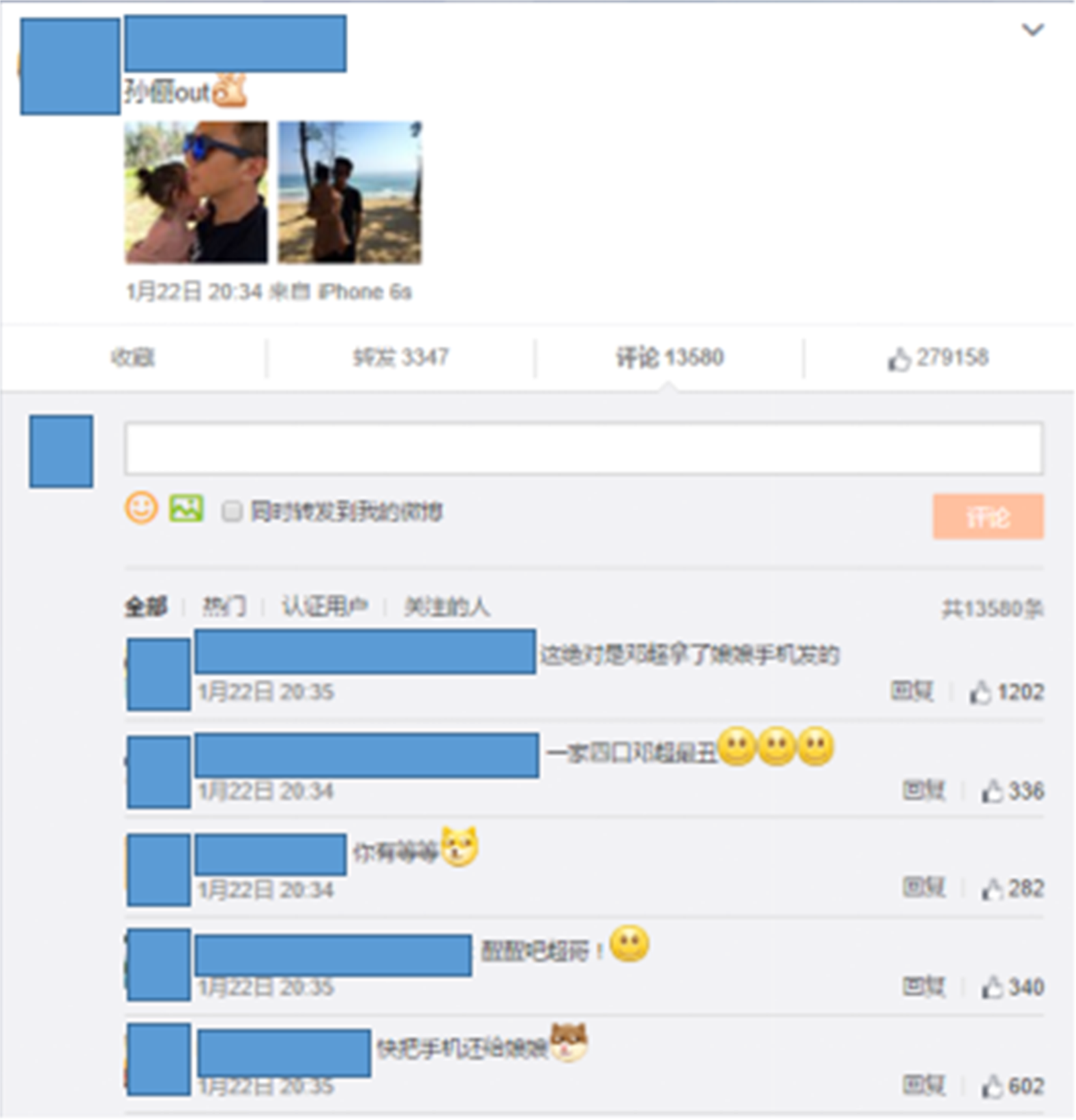
The third type of code-mixing demonstrates a higher level of complexity in the sense that English and Chinese codes are joined together to form new linguistic conventions. In this type, a new expression is created via both Chinese and English, and one needs to know both languages to understand the meaning of the coined expression. An example is shown below in Figure 5.
Complementary code-mixing (Zhang, Reference Zhang2017b)

In the above example, the English word ‘cry’ needs to be understood with the previous Chinese characters ‘感动’ which means ‘touched’ or ‘moved’ in emotions. Together, the expression ‘感动 cry’ means ‘moved to tears.’ Besides the focal example, there are also other code-mixing creations of new expressions identified in Weibo (e.g., ‘get 到’: combine ‘get’ with ‘到’ which means get to/result, to form the new meaning of ‘get to know’ or ‘understand’).
The adoptions of various English code-mixing strategies exhibit Weibo users’ complex communicative strategies. Judging from the Chinese Weibo community at large, it is unlikely that the adoptions of English for code-mixing are meant for comprehension of users who do not speak Chinese; rather, it is more of a stylization choice that draws from Weibo users’ available English resources. The sample complementary code-mixing expressions are also representative cases that show Weibo users’ linguistic novelty in localizing English codes for new linguistic conventions.
Syllabic adoptions of English
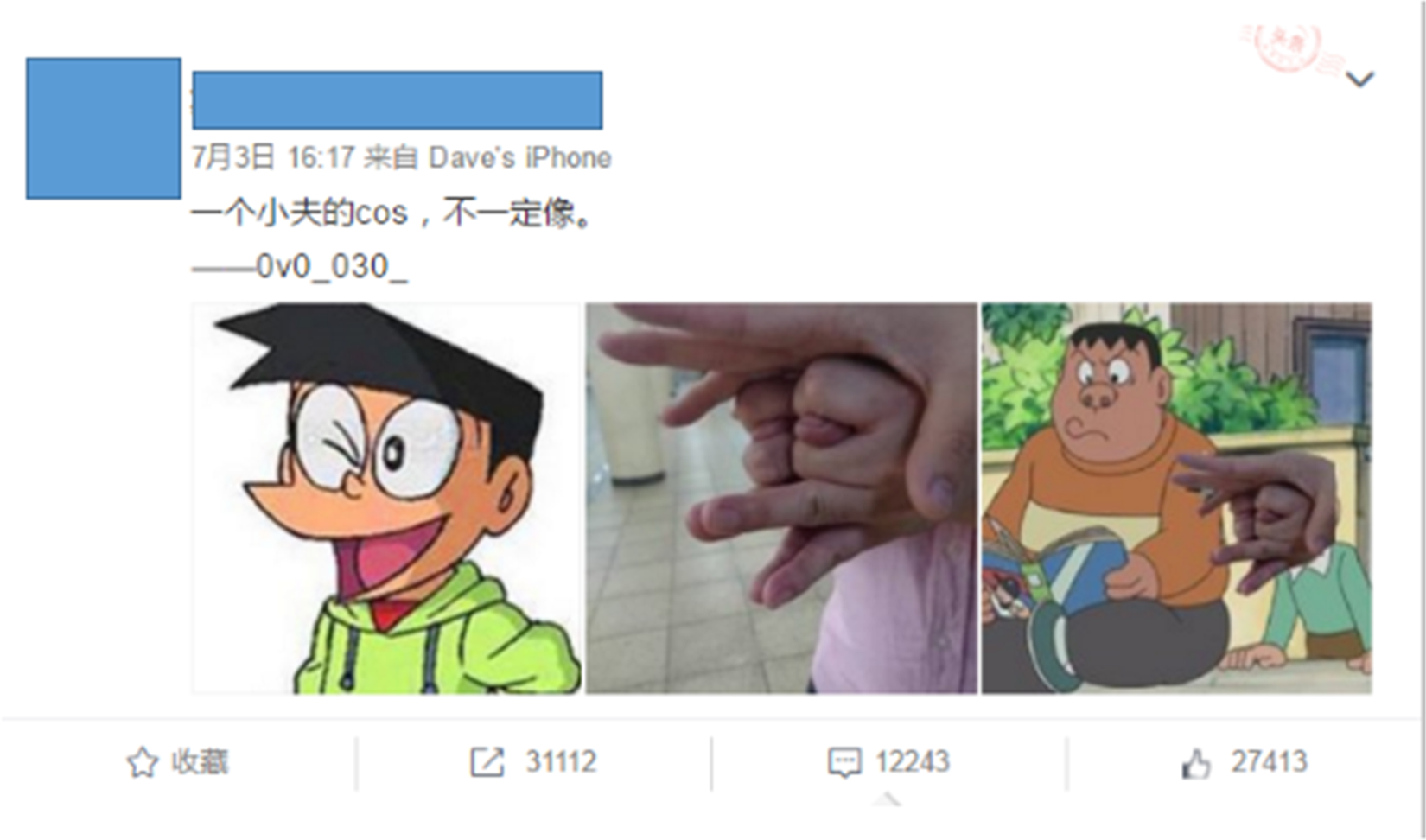
Weibo users often go beyond vocabulary or phrasal levels in their use of English. They pay attention to the syllabic features of English as well. I observed three cases of syllabic adoptions of English. For instance, the user may choose a syllabic section of an English expression and use it with Chinese text (see Figure 6).
Syllabic recreation of English (Zhang, Reference Zhang2017b)

The expression ‘cos’ found in the posting represents the word ‘cosplay’ (costume play) which means the act of dressing up as a character from movies, novels, and especially Japanese anime. The Weibo user adopts the first syllabus of the expression for the meaning of ‘cosplay.’
一个/小夫的/cos, 不一定/像。— 0v0_030_
Literal meaning:
A/Xiaofu's/cos, not surely/similar. — 0v0_030_
Figurative meaning:
A cosplay of Xiaofu; does not look exactly the same. (emoticons for Xiaofu's face)
In this example, the syllabic feature of an English expression was adopted instead of the original version. The word ‘cos’ has retained the original meaning as a noun. The focal example seems to reflect the characteristics of typing efficiency and communicative simplicity in computer-mediated communication which were revealed in previous research of Chinese online interaction (Chen, Reference Chen2014; Lotherington & Xu, Reference Lotherington and Xu2004).
Phonetic transliterations of English
Another strategy of English adoptions is Weibo users’ phonetic transliterations of English. Phonetic transliterations of English have been observed previously as well by Chinese online users (e.g., Li & Yarowsky, Reference Li and Yarowsky2008; Yuan, Reference Yuan and Amant2011). Weibo users focus on the sounds of certain English expressions, and select homophonetically similar Chinese characters for substitution. I observed a total of 33 instances of phonetic transliterations.
In Figure 7, a Chinese transliteration of English was adopted in the form of ‘艾特’ (Ai tè) to phonetically resemble the sound of ‘at’, which is often used as ‘@’ social media sites to address others. The first sentence can be understood as follows:
评论/全是/艾特!!!/ (emoji: goodbye)
Literal meaning:
Comments/all are/ Ai tè!!!/ (emoji: goodbye)
Figurative meaning:
All these comments (under this posting) contain ‘@’!!! (emoji: goodbye)
Phonetic transliterations of English (Zhang, Reference Zhang2017b)

Capitalization of a Chinese expression (Zhang, Reference Zhang2017b)

In this case, the user was complaining that every other user under this posting was trying to address their friends on Weibo without paying attention to the posting itself. Through the phonetic transliteration, the user stylizes his/her comment with phonetic English features recreated via Chinese script. Compared with the use of either ‘@’ or ‘at’, typing the Chinese characters of ‘艾特’ may require more work; yet, the user still choose the Chinese stylization, suggesting a different purpose against typing efficiency.
Capitalization of Chinese
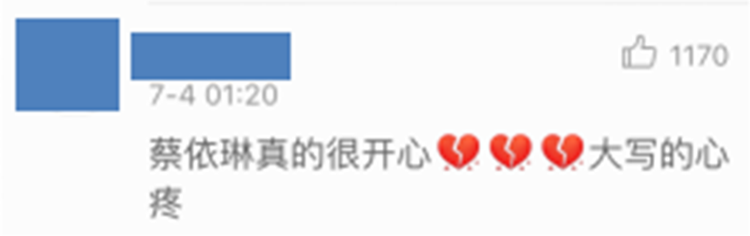
There is another peculiar type of English adoption as capitalization of Chinese. Unlike in Latin-based languages, capitalization is not found in the logographic Chinese writing system. Yet a Chinese Weibo user has demonstrated how capitalization can be utilized in Chinese online communication. Figure 8 shows the only instance of Chinese capitalization identified in this study.
The text after the emoji is ‘大写的心疼,’ which literally means ‘capitalized heartache.’ The user adopts the linguistic function of capitalization to emphasize the feeling of ‘heartache.’
蔡依琳/真的/很开心/(emoji: heartbreak*3)/大写的/心疼
Literal meaning:
Cai Yilin/really/very happy/(emoji: heartbreak*3)/capitalized/heartache
Figurative meaning:
Yilin Cai is really happy (emoji: heartbreak*3) HEARTACHE.
In this example, the user adopts the function of capitalization and its corresponding Chinese translation to demonstrate greater intensity of his/her feeling. This is a particularly interesting case in the sense that the user did not follow the simplicity objective in online communication, but labored to type the Chinese translation of ‘capitalization.’ Therefore, the communicative purpose of intensification was achieved. The example described above also provides a contextual communicative strategy for cross-linguistic adaptations through topologically different linguistic and writing systems.
Conclusion and implications
The findings suggest Weibo users in China exhibit creative and complex communicative strategies by adopting the English language and its linguistic features for localized communication. As a typical country that has been conventionally categorized within the Expanding Circle (Kachru, Reference Kachru1986), English is largely regarded as a foreign language in mainland China until today. Although in certain regions, such as Hong Kong, English is adopted as a lingua franca (Bolton, Reference Bolton2012; Lee, Reference Lee, Danet and Herring2007), the majority of Chinese people rarely use English for daily spoken or written interactions. Nevertheless, English as an important linguistic and symbolic resource is adopted for various communicative purposes online. As demonstrated in this study, Weibo users utilize English via strategies such as code-mixing and transliterations, and English represents a popular meaning-making resource. The investigated code-mixing strategies demonstrate the linguistic complexity of micro-blogging users, and various English language features of lexicons, syllabi and grammar were utilized for text stylization. Some of the observed examples have appeared multiple times, which is likely to have become conventionalized in the Weibo community.
The language plays examined in the study exhibit the localization of English in mainland China. Although there are a few examples of English adoptions (e.g., comments entirely in English and some phrasal level English-Chinese code-mixing) that appear to follow the so-called Standard English grammar, the majority of the data reflect characteristics of language localization. Expressions such as ‘感动 cry’ and ‘cos’ are typical results of localization, which may lead to creations of new linguistic conventions. These practices demonstrate the complementary linguistic strategies of both English and Chinese (Li, Reference Li2015; Pennycook, Reference Pennycook2007). The micro-blogging site Weibo, as a discursive web of discourse (Tagg, Reference Tagg2015) similar to Twitter, offers a productive space for such language plays to develop which may catalyze the spread and modifications of English. Some communicative strategies, such as capitalization of Chinese, demonstrate other possible stylization methods of English which have not been reported before (e.g., Cheng, Reference Cheng2002; Gao, Reference Gao2006; Lee, Reference Lee, Danet and Herring2007; Zhang, Reference Zhang2012). These strategies exhibit the linguistic complexity of users in mainland China and their semiotic flexibility with regard to localizing English features in online interactions.
The investigated online literacy practices with English reflect the multilingual creativity of Weibo users, which to some extent reaches beyond the current situation of English education as well as the language policy proposed in mainland China. Until today, English teaching in China still largely follows the Standard American and British English norms as the mainly accepted paradigms, which are often reflected via the design of English teaching curricula and standard tests (Wang, Reference Wang2016). A further complication is the existing governmental regulation regarding online language use that aims at the purification of online communication (Ministry of Education, PRC, 2016, June 20). However, judging from the result of the focal study, it appears that users of Weibo are not necessarily confined within the ‘standardization’ and normalization of language use. Code-mixings, transliterations, and recreations of linguistic conventions are common and exhibit communicative complexity and multi-functionalities. While the government efforts in the standardization process of English and language use online in China are likely to continue, digital platforms such as Weibo may provide space for further practices of language mixing, bending of meanings, and conventionalization of new expressions (with English), contributing to the possible turbulence of language practices online (Li & Zhu, Reference Li and Zhu2019). With the advancement of information communication technology and cross-cultural interactions, it can be predicted that localization of English and other semiotic resources in Chinese online communication will continue to develop, further complicating the plurilingual ecology of digital space in mainland China and its diaspora.
 Dr. YI ZHANG is a Lecturer in the Department of English at Xi'an Jiaotong-Liverpool University. He obtained his MA-TESOL from the Pennsylvania State University, and a PhD in Second Language Acquisition/Instructional Technology from the University of South Florida. He is interested in topics of sociolinguistics, computer-mediated communication, and multilingualism. Dr. Zhang has published several papers in Discourse, Context & Media, Language@Internet, and International Multilingual Research Journal. He also teaches various courses of applied linguistics and TESOL. Email: Yi.Zhang01@xjtlu.edu.cn