The ubiquitous spread of English is vividly observed in local linguistic landscapes and urban spaces around the world, and Turkey is no exception. Emerging as a bona fide line of inquiry at the nexus of sociolinguistics, sociology, social psychology, geography and media studies (Sebba, Reference Sebba2010), linguistic landscaping examines the dynamic relationship of English vis-à-vis the local languages, and documents, analyzes and interprets the attributes, patterns, characteristics, meanings and the creative uses of English in such domains as advertising (Kelly-Holmes, Reference Kelly-Holmes2005; Vettorel, Reference Vettorel2013) and shop signs (MacGregor, Reference MacGregor2003; Ong, Ghesquière & Serwe, Reference Ong, Ghesquière and Serwe2013; Schlick, Reference Schlick2002). These studies provide contextualized accounts of language contact situated in local sociolinguistic contexts and contribute to the representation of reflections from various parts of the world (e.g. see Backhaus (Reference Backhaus2007) and MacGregor (Reference MacGregor2003) for Japan; McArthur (Reference McArthur2000) for Switzerland and Sweden; Griffin (Reference Griffin2004) and Ross (Reference Ross1997) for Italy; Schlick (Reference Schlick2002) for Austria, Italy and Slovenia; Dimova (Reference Dimova2007) for Macedonia; Hasanova (Reference Hasanova2010) for Uzbekistan; Ong, Ghesquière & Serwe (Reference Ong, Ghesquière and Serwe2013) for Singapore; El-Yasin & Mahadin (Reference EL-Yasin and Mahadin1996) for Jordan; Wang (Reference Wang2013) for China; Ben Said (Reference Ben Said2010) for Tunisia; Schlick (Reference Schlick2003) for Slovenia, Austria, Italy, and the UK; Stewart & Fawcett (Reference Stewart and Fawcett2004) for Portugal; Thonus (Reference Thonus1991) for Brazil; and Baumgardner (Reference Baumgardner2006) for Mexico).
Despite the fact that the English language fulfills neither intra-national communication nor the basic communicational needs of people in contemporary Turkey, its symbolic value is perhaps more conspicuous than ever in the local business discourse (Selvi, Reference Selvi2011). Business signs, commercial malls and brand names in the real and virtual world utilize English (and other languages) so as to consciously and advantageously appropriate the symbolic value and power associated with and conveyed through these languages. Building upon this idea, the current study aims to shed light on the extent to which English is used in business naming practices in a centrally located district in Ankara, Turkey. More specifically, the paper opens with a review of the ‘Englishization’ of business naming practices around the world as well as in Turkey. It goes on to present evidence of business naming practices from the research context, which includes (1) foreign signs, (2) hybrid signs, and (3) ‘Englishized-Turkish’ signs. The study concludes with a discussion on the localized uses of English, and connects the overall discussion to the burgeoning ideological discussions of foreignization at the linguistic, cultural and societal levels.
The Englishization of business naming practices around the world
The growing body of literature on the exponential infusion of English in linguistic landscapes across the world has demonstrated a multitude of uses, roles and functions of English in business spheres. Studies conducted in both linguistically homogenous (MacGregor, Reference MacGregor2003; Ross, Reference Ross1997; Stewart & Fawcett, Reference Stewart and Fawcett2004; Thonus, Reference Thonus1991) and multilingual contexts (McArthur, Reference McArthur2000; Ong et al., Reference Ong, Ghesquière and Serwe2013; Schlick, Reference Schlick2002, Reference Schlick2003) have documented these divergent uses of English in various strata of business life. As Ross (Reference Ross1997: 31) concludes, the use of English in business discourse ‘lends an aura of chic prestige to a business, suggesting that it is part of the international scene, following the latest trends, up-to-date with the newest ideas’. This affords a symbolic way of appreciating the lifestyles, values and prestige associated with the traditional English-speaking cultures and societies as well as with other cultures by means of English. In other words, the owners of these businesses aim to attract the ordinary local consumer by manipulating the symbolic power of English and obtaining a perceived sense of modernization through adopting a name in English, since English names represent a shared experience between the Western world and developing countries (Said, Reference Said1993).
The Englishization of business naming practices in Turkey
From a legal perspective, the constitutional provisions regulating foreign language use in the Turkish business discourse can be traced back to the early years of the Republic, when the Parliament enforced the Law on Mandatory Use of Turkish in Commercial Enterprises (İktisadi Müesseselerde Mecburi Türkçe Kullanılması Hakkında Kanun) in 1926. Parallel to the reform and policies supporting the Turkish language, this law stipulated that all kinds of corporations, enterprises and businesses were to prepare and conduct any kind of transaction, contract, correspondence, account and registers in Turkish (Government Code of the Republic of Turkey, 1926). However, the legislative regulations authorizing and regulating the language use of legal and corporate bodies were discontinued by an executive order by the Turgut Özal administration in the 1980s, during which Turkey followed liberal, free, open-market policies that transformed the economy, mainly through privatization. While this initiative has served as a catalyst for economic development and growth, it was nevertheless perceived as an unfortunate milestone for the Turkish language (Mengi, Reference Mengi2010).
The growing body of literature on business naming practices in the Turkish business discourse corroborates the globally dominant inclination of multilingualism in commercial landscapes, spearheaded by English (Aydoğan; Reference Aydoğan2001; Boyraz, Reference Boyraz2003; Danacı, Reference Danacı2005; Demircan, Reference Demircan2001; Doğan, Reference Doğan1999; Gözaydın; Reference Gözaydın2000; Özyıldırım, Reference Özyıldırım2001; Selvi, Reference Selvi2007; Şeyda, Reference Şeyda2010; Üstünova et al., Reference Üstünova, Aydın, Çetinoğlu Berberoğlu, Üstünova, Akkök and Akgün2010). More specifically, the research results pointed out that business owners adopt various forms of foreign names in order to be interesting or different, bring commercial benefits, establish a link to the cultures of English-speaking societies, ensure greater compatibility with the specific type of business (Boyraz, Reference Boyraz2003; Doğan, Reference Doğan1999), and evoke stereotypes of better service and high quality associated with imported products (Danacı, Reference Danacı2005; Doğan, Reference Doğan1999; Özyıldırım, Reference Özyıldırım2001).
Methodology
Situated within the larger sociolinguistic and sociopolitical context of Turkey, the current study aimed to explore the factors and influence of foreign languages, particularly English, in business naming practices by focusing on Çankaya, the central and most cosmopolitan district in Ankara, the capital of Turkey and the central hub of the nation's governmental bodies and foreign relations. More specifically, the study investigated the following questions:
-
1. What is the role of English in Turkish business discourse, particularly in business naming practices?
-
2. What are some factors influencing the role that English plays in Turkish business discourse?
In order to scrutinize these questions in its local context, the data collection process in the present study followed the elements of ‘ethnographic’ approach to language contact and linguistic landscaping. More specifically, it relied on field observations, which involved registering the occurrences of naming practices that utilized English as well as other languages (n = 1,200) in the pre-determined zone of the city of focus. The intention behind this was to create a repository of business names with foreign words so as to develop knowledge of patterns of language contact for further linguistic analysis and a typology of linguistic landscaping through the lens of business naming practices. In order to better understand the reasons behind and factors influencing the business naming practices in the local business discourse, a random sample of businesses (n = 120, accounting for 10% of the businesses in the sample) was selected for the interview stage. In-depth, semi-structured, face-to-face interviews were conducted with the owners/directors of these businesses. The interviewing stage was guided by a brief questionnaire, which I adapted from Doğan (Reference Doğan1999). The form included three sections, namely (1) Demographic Information, (2) Business Place Information, which consisted of questions specifically about the name of the business place (e.g. establishment date, pronunciation, meaning, the perceived consistency between the name and the goods or services being sold as well as the physical location), and (3) Business Naming Processes, which included such questions as the interviewee's opinion about foreign-named business places, their primary motivation for adopting a foreign name, and their beliefs about the relationship between foreign (or Turkish) names and commercial advantage. Since the form was administered as a roadmap for the interview session, it had been designed to maintain a reasonable length in terms of number of questions (15 items), and time for its completion (3–5 minutes).
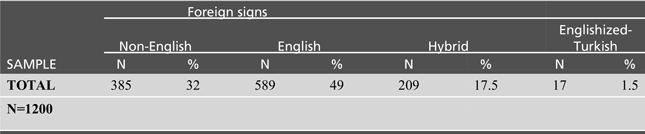
The ethnographic nature of the study necessitated and guided the analysis of business naming practices in a situated fashion (i.e. through documentation and interview) and aimed to connect reflections to broader sociolinguistic and ideological arguments where language and language contact play a central role (Backhaus, Reference Backhaus2007). Following the established tradition in linguistic landscaping (Backhaus, Reference Backhaus2007; Scollon & Scollon, Reference Scollon and Scollon2003), the field-observation data (i.e. the business names) for the present research were first analysed quantitatively for the distribution of various languages used in the names by focusing on orthographic, phonological and morphosyntactic features of these business names (see Table 1). This step allowed to develop a typology of local business names which may ultimately be replicated in other settings and studies. While developing a typology of linguistic classification of the business names yielded a useful distribution of various languages in the public space under scrutiny, it limits the analysis to the overall distribution of languages and fails to shed light on the relationship between the presence and distribution of these languages and specific communities. Therefore, and to respond to recent calls for ‘more maturely semiotic approach’ (Blommaert & Maly, Reference Blommaert and Maly2014), ‘multi-layered analysis’ (Hult, Reference Hult2010) and ‘methodological mix’ (Blommaert, Reference Blommaert2013), semi-structured interviews were conducted. The interviews were analysed qualitatively with an overarching goal of zooming into the local business landscape and scrutinizing the role of English at nexus of public spaces, languages and business naming practices within the broader context of urban multilingualism (Backhaus, Reference Backhaus2007).
A linguistic classification of the business names in the study

Findings
Field observations
The results of the current study revealed a differential susceptibility to English language in various domains within the local business discourse. In other words, certain sectors such as cosmetic stores, restaurants, cafés and electronics retail stores were more prone to the use of English, whereas others such as stores selling durable consumer goods, pharmacies, car dealerships, gas stations, mechanics, museums, libraries, driving schools, bookstores, publishing houses, law offices, insurance agencies, and NGOs almost had no place for the English language occurrences. The linguistic analysis of the names of business names in the survey, as described in Table 1 below, revealed that the language contact in the local business discourse might be grouped into three major categories:
-
1. Foreign names: This group includes businesses that adopted non-Turkish lexical items. This category is further divided into two subcategories, namely, (1.a.) non-English signs and (1.b.) English signs.
-
1.a. Non-English names: This group includes businesses that adopted non-English lexical items. Some examples of this category include Café des Cafés (café), Pittoresque (jewellery), Ares (hairdresser), and Monami (tailor). The businesses with non-English foreign words (n = 385) corresponded to 32.1% of the business places in the survey.
-
1.b. English names: This group includes businesses that adopted English lexical items for their names. Some examples include One Way Car Wash (car cleaning), Datasoft (tech store), Blue Way (shoe store), and Free Style (clothing store). The businesses with English foreign words (n = 589) corresponded to 49% of the business places in the survey.
-
-
2. Hybrid names: This group includes businesses that adopted lexical items both from Turkish and a foreign language. Some examples include Happy Hamile (literally meaning ‘Happy Pregnant’, a clothing store for expectant mothers), Ankara Home Center (a department store), Cep Land (literally meaning ‘Pocket Land’, a store selling mobile phones and accessories), and many others. The businesses with hybrid names formed by Turkish and foreign lexical items (n = 209) accounted for only 17.4% of the business places in the survey.
-
3. ‘Englishized’ Turkish names: Most interestingly, this group includes businesses that adopted artificially created signs, which employed the English orthographic and phonological conventions at the sound level to represent Turkish phonological rules at the word level. Consequently, they may seem meaningless to any speaker of Turkish who does not understand the conventions of English spelling or any speaker of English who does not know Turkish at the phonological and semantic levels. Some examples of this category include Chilek (representation of Turkish ‘ç’ by English orthographic and phonological conventions ‘ch’, to refer to ‘çilek’, meaning strawberry. When pronounced in accordance with the phonological conventions of Turkish, it becomes meaningless), and Dishy (representation of Turkish ‘ş’ by English orthographic convention of ‘sh’, and of Turkish ‘i’ by ‘y’. Similarly, when pronounced in accordance with the phonological conventions of Turkish, it becomes meaningless), as well as many others.
Table 1 represents the linguistic classification of business names in the survey and suggests that the local business discourse was under the major influence of English. Most remarkably, the research results indicated that almost one in every two foreign business names (49%) was English-only. The aggregate of the business names in the ‘English’, ‘hybrid’ and ‘Englishized-Turkish’ categories clearly demonstrate the centrality of English as a primary language of contact, accounting for 67.9% or 815 business names in the sample. This figure is followed by non-English foreign names (non-Turkish, non-English business names), which accounted for 385 business names or 32.1% of the sample. The third dominant category in the survey was hybrid business names (209 names, representing 17.4% of the sample). The last domain is ‘Englishized-Turkish’ signs, a unique feature of the local business discourse. Despite the fact that the signs in this category represent the smallest group in the sample (n = 17, accounting for only 1.41% of the sample), the existence of such practices was rather significant in terms of language contact in the local linguistic landscape and localized uses of English blended with linguistic creativity by employing techniques at the phonological and orthographic levels. In conclusion, it needs to be mentioned that the sphere of influence of English was not limited to business names. From the products sold in these stores to window displays, advertising and billboards, the omnipresence of English in the business domain was widely observed.
Interviews
As the next step in the data collection process, individual, brief, semi-structured and face-to-face interviews were conducted with the owners of the business places that adopted foreign (non-English or English), hybrid (Turkish-English, English-Turkish) or Englishized-Turkish business names (the names composed of Turkish words following English orthographical conventions to seem like English, pronounced as English yet have a Turkish meaning). The interviews were designed to serve as conceptual tool elaborating the assumptions gathered from field-based observations and a methodological tool contributing to the ethnographic nature of the research by investigating the subject matter in its own context. Essentially, the business owners were asked a series of questing trying to uncover their views on and reasons for adopting their foreign business names. Overall, the interview results revealed that the owners of those businesses had a relatively higher degree of education (graduates of high schools and universities account for 45.8% and 37.5% of the sample, respectively). This could be attributed to the fact that exposure to the English language is at its peak during secondary and post-secondary education in the Turkish education system. Almost two thirds of these owners reportedly had varying degrees of proficiency in English, whereas the remaining one third described themselves as monolingual. When the business owners were asked to pronounce the names of their businesses, about 80% of them were able to pronounce the names correctly and almost all of them stated the actual meaning of their business names accurately.
When asked about their reasons for adopting a non-Turkish name for their business, the top responses of the owners included: (1) ‘sounds interesting’ (n = 71), (2) ‘might generate positive commercial outcomes’ (n = 54), (3) ‘personal reasons’ (n = 49), (4) ‘desire to be different from competing business places’ (n = 32), (5) ‘positive attitudes towards the Western goods/cultures’ (n = 30), (6) ‘other reasons’ (n = 12), (7) ‘the global impact of English’ (n = 8), (8) ‘prejudice against Turkish goods’ (n = 7), and (9) ‘negative attitudes towards local goods’ (n = 6). Along this line, an owner attributed his rationale for using the English language using a supply-demand balance as follows: ‘The reason that forced me to adopt an English name is actually public desire. The interest in anything foreign and interest in foreign brands create an attractive context for us to use English names’ (INT 3).
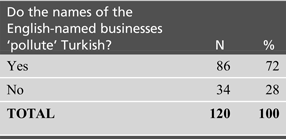
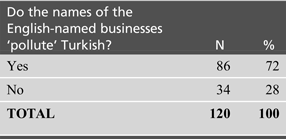
The business owners were also asked their opinions about the sociolinguistic consequences of language contact evident in the business naming practices across Turkey (see Table 2 below). More specifically, they were asked whether their non-Turkish business names actually contributed to the so-called ‘degeneration’ or ‘pollution’ of Turkish, a general sentiment among Turkish society and intelligentsia. A great majority of business owners who named their stores with an English name believed that it might have contributed to the degeneration of Turkish. A business owner expressed her sentiment of ‘in-betweenness’ (i.e. being stuck in between the symbolic and financial value of English and the current status of English-Turkish contact) as follows: ‘… though it might have a deteriorating impact on the current status of Turkish, I feel obliged to use an English name, when thinking financially’ (INT 3).
The business owners’ opinions on the ‘pollution’ of Turkish by English-named business places
Along the same lines, several respondents realized the role and function of English in the process of brand creation:
‘English is an international language and used all around the world. Though we might use a Turkish name, we favored an English name thinking that it sounds more like a brand name.’ (INT 7)
‘I sell goods from Bursa. Marks and Spencer sells 100% cotton, and so do I. All they have [different] is a brand.’ (INT 3)
‘I adopted such a name to attract attention with an intention that it might be more memorable in the minds of the customers. We are trying to be a brand and this name will help us.’ (INT 8)
Overall, these reflections represented the general sentiment of the business owners who were in line with the argument that the Englishization of business places is a commercial necessity, and therefore it should not be seen as a decisive and destructive force causing the degeneration of Turkish.
Discussion and conclusion
The ubiquitous spread of English is vividly observed in local linguistic landscapes around the world, particularly in urban spaces where business names occupy a central role. Building upon an ethnographic research tradition and the examination of both qualitative and quantitative data, the scope of investigation in the present research study scrutinized the role and influence of English (and other foreign languages) in the local business discourse in the Çankaya district of Ankara, Turkey. As a result, it was concluded that the foreign language influence in the local context might be grouped under three major categories: (a) foreign signs (both English and non-English signs), (b) hybrid signs, and (c) Englishized-Turkish signs, and the study validated the undisputed influence of the English language. In general, the business owners acknowledged the role, function and the present-day global status of English, and its centrality in bringing a different “aura” to the recognition of their businesses. The primary motivation behind their utilization of English (or any other language, for that matter) is to distinguish their products, services or businesses from that of the others. However, the omnipresence of English in the local business discourse nullifies the perceived cachet attributed to such businesses. To be more specific, generic names like VIP, star, collection, club, inter, elite, prefixes like my-, and suffixes like -shop, -home, -store, -art, -house and -club are found in almost any business sector and in any major city around the country, thus making Englishization a haphazard process.
The present study illustrated the instances of Englishization (English-only, English-Turkish and Englishized-Turkish) in Turkish business discourse, a phenomenon which may be perceived as being at the nexus of the global status of English, the market economy and the local processes of language contact. In the local context, the Englishization became the zeitgeist of ‘marketspeak’ and generated orthographic, phonological and morphosyntactic creative constructions employed in the business naming practices. Therefore, on the one hand, it may be perceived as a savage indictment of globalization leading to unidirectional homogenization and perceived destruction of the local; on the other hand, it is regarded as a driving force of localization, contributing to the complexity and diversity of the local linguistic landscape. For this reason, it is far more constructive not to juxtapose these perspectives and treat them as mutually exclusive constructs, but rather to conceive them as different local manifestations of the world's global language.
 ALI FUAD SELVI is an Assistant Professor of TESOL and Applied Linguistics in and the Coordinator of Teaching English as a Foreign Language Program at Middle East Technical University, Northern Cyprus Campus. His research interests include the sociolinguistics of English as an international language and its implications on language learning, teaching, teacher education, and language policy/planning; issues of equity and professionalism in TESOL; and second language teacher education (teacher identity, the notion of praxis, and the SLA and L2 pedagogy interface). Email: selvi@metu.edu.tr