Introduction
Medium of instruction (‘MOI’) issues have long been identified as the most important decisions in the internationalization of higher education (HE) (Hamid, Nguyen & Baldauf, Reference Hamid, Nguyen and Baldauf2013). The adoption of internationally influential languages as MOIs may attract international students who aspire to undertake higher education in these languages, which in turn helps to sustain the status of these languages as internationally influential. Among all these languages, English is certainly the most powerful academic lingua franca and boosted by its use as MOI in globally leading universities worldwide. However, the elevated position of English in international higher education seems not without competition, as many governments in non-English-speaking countries have made efforts to internationalize their higher education by providing parallel higher learning programs both with English and with their native language (usually the official language) for international students. For instance, the German Academic Exchange Service (DAAD), in which it first promoted higher education in the medium of German and later expanded to the medium of English in the 2000s, plays a critical role in attracting and recruiting international students to study in German universities (e.g. Erling & Hilgendorf, Reference Erling and Hilgendorf2006).
China aims to become the largest education hub for international students in Asia by 2020 according to The Study in China Program (MOE, 2010b; Kuroda, Reference Kuroda2014). In line with universities in many other contexts such as Germany, Chinese universities have started to adopt English as the medium of instruction for non-language-related academic programs since the 2000s. Similarly, to extend China's soft power and influence, the Chinese government has also promoted university programs with Chinese as the medium of instruction for international students in various academic disciplines such as medicine, engineering, law, and business (Hu, Reference Hu2009; MOE, 2010a, 2010b). In the context of Chinese universities’ internationalization, one may wonder how international students perceive the use of English and Chinese as mediums of instructions. Existing research on the issue of MOI in Chinese universities has largely explored domestic Chinese students’ perceptions of English-medium instruction (‘EMI’) and their practice (e.g. Hu, Reference Hu2009; Tian & Hennebry, Reference Tian and Hennebry2016). It is necessary to examine the following questions in China's internationalized higher learning programs (e.g. He & Chiang, Reference He and Chiang2016):
1) How do international students perceive the use of the two international (English) and local (Chinese) languages as MOIs?
2) What language(s) do they report using for academic studies?
The research context
The study took place within a Chinese university with a good reputation for pharmaceutical education, which offers pharmacy-related degrees in both Chinese and English to international students. The majority of the international students in this university are from Asian and African countries. Up to 30% of these international students receive scholarships either from the Chinese government or from other funding agencies. The English pharmacy programs are taught separately by a select group of lecturers who have overseas experiences and who have published research in international journals. International students following the Chinese pharmacy programs attended all the same classes (except English classes) as their fellow Chinese students.
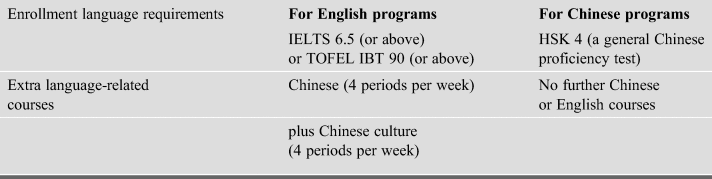
The pharmacy programs have clear language requirements for prospective international students (as indicated in Table 1). To enroll in the English-medium programs (either as undergraduates or postgraduates), international students must meet the minimum English language requirement of IELTS 6.5 or above or TOEFL IBT 90 or above. These students also need to take Chinese language courses for around eight hours per week, which constitute 32 credits of study for each academic year. To enroll in Chinese-medium programs, international students should pass the HSK 4 (an international Chinese proficiency test) or above. Applicants who fall short of the university's language entry requirements can opt to study at the Chinese Language Training Centre (CLTC) to undertake intensive Chinese training for one year, so as to improve their Chinese for study purposes.
The language requirements for international students’ enrollment in university programs

Research participants
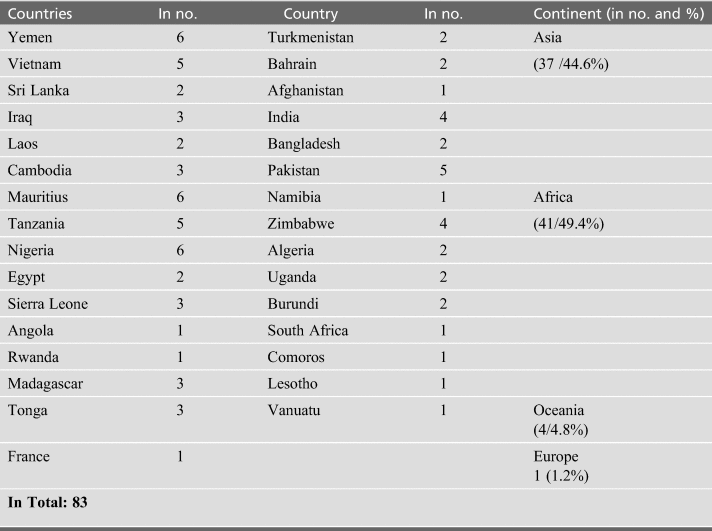
The study surveyed 83 international students. As can be seen from Table 2, 49.4% (41 out of 83) reported that they came from 16 African countries, 44.6% (37 out of 83) came from 11 Asian countries, and the remaining five students came from Europe and Oceania respectively. The fact that most international students come from developing countries explains why they see learning in China as affordable and therefore select China as their destination of higher learning (see also, Botha, Reference Botha2016).
The international students’ countries of origin and student numbers

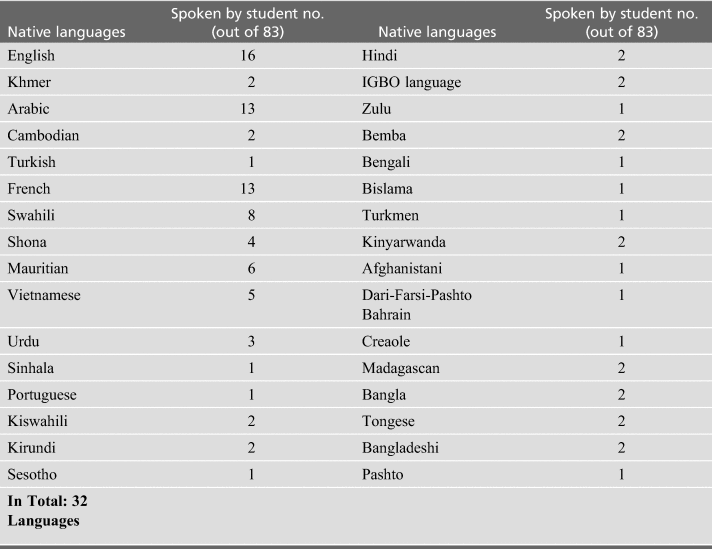
Among the participants, 23 (27.7%) were enrolled in the Chinese-as-Medium-of-Instruction Pharmacy programs (CMIP) and the rest (60) were enrolled in the English-as-Medium-of-Instruction Pharmacy programs (EMIP). The participants spoke a variety of languages, including 32 languages as their mother tongues or official languages (see Table 3). While only 19.3% (16/83) of these students reported speaking English as native language, all the other students in the study claimed having started English learning since primary schools. These students were also found to be highly multilingual. For example, one student from Mauritius reported speaking Mauritian, French, and English as mother tongues, while another Indian student reported speaking English, Bengali, Khmer and Hindi in his daily communications at home.
The international students’ reported native languages and student numbers

Data collection
The data for the study were collected via a questionnaire and face-to-face interviews. The questionnaire included three parts, with the first recording the participants’ demographic information, the second part (16 statements) examining participants’ views on the roles and value of English and Chinese in their academic learning, and the third part investigating learners’ reported MOI choices in practice. While the questionnaire helped us to examine how the participants perceived and practiced the different MOIs in their learning process, we also conducted interviews to further understand the participants’ perceptions and practices as captured by the questionnaire.
Using qualitative content analysis (Dörnyei, Reference Dörnyei2007), the interview data were analyzed via a cyclical process including initial coding and second-tier coding. In the initial coding phase we carefully read and coded descriptive quotations related to the students’ perceptions and practices concerning English and Chinese, and their explanations for motivating such perceptions and practices. In the second-tier coding phase the data were re-coded and categorized so that thematic patterns could be identified from the labeled segments (i.e. perceptions, practice) in the initial coding stage. Then, the categories emerging from the second-tier coding were repeatedly compared to the survey data in order to identify and explain underlying forces behind the students’ perceptions and practices with EMI and CMI.
The results
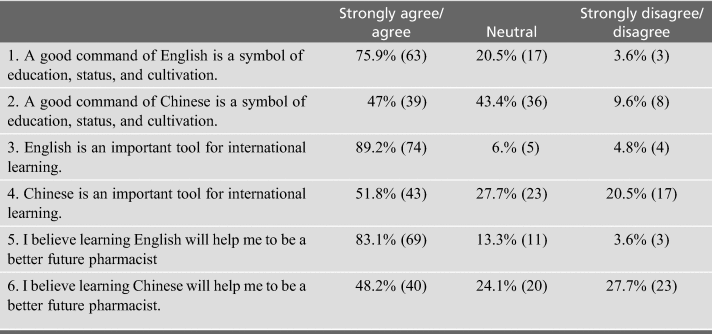
The inquiry documented an overall pro-English attitude among the international students (see Table 4). In the statements concerning their perceptions of ‘English’ or ‘Chinese’ as ‘a symbol of education, status, and cultivation’, 75.9% of them regarded a good command of English as ‘a symbol of education, status, and cultivation’, while 47% of students attached the same value to Chinese. In addition, 89.2% of the participants endorsed the statement that English is an important tool for international learning, while 51.8% of the international students believed in the role of Chinese for international learning. Despite the fact that the students were studying in China at that time, most of them regarded English as an international lingua franca for academic studies. Likewise, in the statements concerning which language will better prepare the international students for their future career, while 83.1% of the participants believed that English competence better prepares them for careers beyond graduation, there were also 48.2% of the participants who had a similar view with regard to Chinese.
The international students’ perceptions of the roles and value of English and Chinese (in % and numbers)

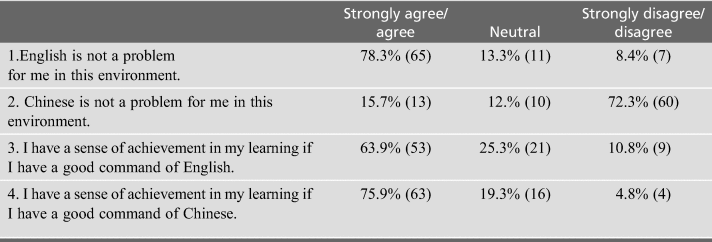
Understandably, the participants’ emphasis on the importance of English does not mean that they think lightly of Chinese. As can be seen in Table 5, when asked whether English or Chinese had posed any difficulties or challenges to the international students, the data showed that the participants in both international (English medium) and Chinese programs were quite concerned with learning Chinese, since over 70% of the participants regarded the learning of Chinese as a challenge and more of them reported a sense of achievement if they overcame the challenge of learning Chinese (75.9%) than the challenge of learning English (65.9%). Therefore, 75.9% students attached higher sense of achievement for Chinese learning instead of English (63.9%). This suggests the possible strong impact from the learning environment and the students’ varied perceptions of the values and roles associated with English and Chinese when they are used as mediums of instruction in academic learning.
The international students’ views about the difficulties of English and Chinese in their academic learning (in % and no.)

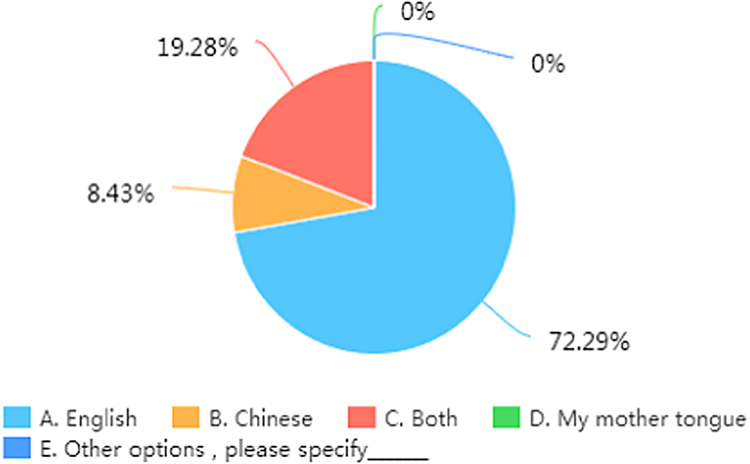
Given the widespread perceived challenge of learning Chinese, it is no surprise that the participants reported using more English in their academic studies than Chinese (as indicated in Figure 1). When asked to report which language they adopted as medium of learning, all the EMI students (72.29%, 60 out of 83) reported using English as the medium for their academic studies, while 16 out of the 23 participants in the Chinese program reported using both English and Chinese as the medium for their academic studies, even though the Chinese program is delivered in Chinese and has no subject courses in the medium of English. Only seven of the participants in the Chinese program reported using Chinese as the medium for academic studies.
Participants’ reported language use for academic studies

The interviews
The analysis of interview data with the participants confirmed the importance of English for them during their studies in China. They revealed both pull and push effects in maintaining English as their preferred medium of learning, even though they undertook their studies in a Chinese context. The participants reiterated the significance of English as a medium of instruction in the internationalization of Chinese universities, for their career development and in the policy discourses at the university where they undertook their academic studies. The following interview except with a student from Madagascar (EMIS1) reflects what many international students think about English:
Excerpt 1
Interviewer: How has English influenced your study?
EMIS1: It has influenced me in many ways. To be frank, without the English language, maybe I can't communicate with Chinese people or I can't study in China. The English language is useful for me … My English is good, after I graduate from this university I probably will go to Europe or Australia. With English, I will be able to attend their courses.
Interviewer: Why do you think the courses should be taught in English?
EMIS1: English is more widely used in the world, I think, also it is because I can understand English well, so I think it is good to have courses taught in English.
As can be seen in the excerpt above, the participant believed that English would enable them to be internationally mobile as they pursued their academic studies. For all the interviewed participants, a Chinese university degree was not the end of their studies; they were all planning to undertake further studies in Western countries or China. The significance of English for their future academic studies and careers pulled the participants to put more effort into using English.
The participants’ choice to use more English was also found to have been closely associated with institutional language policy and practices, which promote English as an important language and favors it over other languages. An international student from Africa (EMIS3), who spoke both English and French as native languages, describes how she dealt with different languages in the university:
Excerpt 2
Interviewer: Do you speak Chinese in school?
EMIS3: Yes, but just a little.
Interviewer: When do you use Chinese to communicate with people around you?
EMI3: Oh, when I go to the dining hall, I want to order some food, hah, I will say some Chinese, 鱼香肉丝,西红柿炒蛋,红烧大排 (names of Chinese dishes).
Interviewer: How do you communicate with your classmates and staff in class?
EMIS3: I mostly speak English, but sometimes French (with my fellow students) … I don't have problems to communicate with the Chinese; my Chinese friends can speak good English.
Interviewer: So all the stuff in your program is delivered in English?
EMIS3: Yes, all in English, the books, seminars, assignments, etc.
Interviewer: All the academic activities you attend are also in English?
EMIS3: Yes … for example, we hold an academic forum every year, and we use English to present and communicate.
What the participant did probably reflects the pro-English practice in institutional policies, which pushed them to use more English. For instance, the university recruits more students for international programs than for Chinese programs. It also has clear enrollment language requirements for applications to the international programs. While English is treated as a major language for academic studies, Chinese is apparently considered more or less a tool for daily communication, not a medium for academic studies. The participants in the Chinese programs felt that passing the required Chinese proficiency test did not provide them with sufficient linguistic competence for academic studies in the medium of Chinese, because the proficiency test focuses more on basic communication rather than academic Chinese literacy (e.g. Wang & Curdt–Christiansen, Reference Wang and Curdt–Christiansen2016). A female student from Vietnam (CMIS2) reflected on her educational experiences in China and made the following proposal to address her challenges:
Excerpt 3
I think HSK is not enough for my learning. You know, my major has a lot of terminologies in pharmacy subjects … It will be very helpful if the university could provide a detailed list of pharmacy vocabularies in both Chinese and English for us. I don't know why we cannot get English resources when we are in a Chinese-instructed program. Frankly, we have better English than Chinese.
In light of the participants’ struggles to learn subject content in Chinese, they resorted to the use of English to help them overcome these difficulties. As indicated in the excerpt above, this Vietnamese student even claims that international students in the Chinese programs have better English than Chinese, and their English competence could be used for academic studies in Chinese. Therefore, these students reported using English resources, such as online resources or English-Chinese dictionaries, like a student from Pakistan (CMIS3):
Excerpt 4
Interviewer: So you think different languages can help you to learn?
CMIS3: Sure. I read English materials, searched on the Internet for English, and I often looked up Chinese terms in a Chinese-English dictionary so that I can understand what the words mean … I sometimes take notes with my native language, and I translate it into English and then into Chinese, hahhah.
Apparently, the participants made efforts to ‘(re-)establish the normatively prescribed medium of instruction in their academic learning’ (Amir, Reference Amir2013: 84; see also Amir & Musk, Reference Amir and Musk2013), since most participants regarded Chinese as a very difficult language to learn. Without sufficient support to help these international students develop the required academic Chinese literacy skills for their studies, the participants had to strategically use their own linguistic repertoires or resources, including English and other languages, to solve problems in the learning process.
Conclusion
We started the inquiry to assess how the internationalization of Chinese universities with two mediums of instruction and the Chinese government's commitment to promoting Chinese as an international language might somehow influence learners’ perceptions and practices concerning the status of English and Chinese as de facto lingua franca in internationalized university programs in China. Indeed, MOI issue is often regarded more than language itself, and is believed to bear certain socially divisive nature, for stakeholders fear it might undermine a nation's identity (Dearden, Reference Dearden2015) or engender the possible competing role of the foreign language versus the first language (Wang & Curdt–Christiansen, Reference Wang and Curdt–Christiansen2016). Although the study was conducted within only one Chinese university, the evidence we gathered so far reveals the international students’ seemingly competing views and complementary practices with the two mediums of instruction in the process of international learning.
First, the participants in the study displayed overwhelmingly positive perceptions with regard to English as a medium of instruction in internationalized higher learning programs, no matter whether they were in the EMI or CMI programs. English maintains its pull for the participants, as they still saw the language as being closely associated with their future studies and careers. During their educational experiences at the Chinese university the participants reported using English to overcome challenges in learning subject content through the medium of Chinese. Indeed, Chinese universities rely much on English to maintain their international competitiveness and attract more international students, as demonstrated by the fact that they usually have more international program places than Chinese ones for international students.
Second, quite a proportion of the participants in both English and Chinese programs attached high importance to Chinese. However, Chinese was reported to be a highly challenging language to learn, which might have discouraged them from investing further efforts in learning it and pushed them to use more English in the process. The findings also revealed that the participants in the Chinese programs were not well prepared for learning subject content in the medium of Chinese, even though they had passed the required Chinese proficiency test. This mismatch between the official Chinese proficiency test and the linguistic demands of academic studies in the medium of Chinese suggests that the proponents of Chinese as an international language have yet to realize the power of using medium of instruction to elevate the status of a language, especially when compared with that of English (e.g. Wang & Curdt–Christiansen, Reference Wang and Curdt–Christiansen2016).
Finally, the participants in this study reported to turn to different linguistic reservoir, including English, Chinese and even their own native languages, to solve their language problems in their international higher learning. For example, there were participants both in the Chinese and English programs, who either saw English or Chinese as playing a facilitative role in helping them to learn subject content, though at this stage English plays a seemingly more significant role than Chinese. While it is true that language policy makers and education administrators in China have yet to appreciate the difficulties that international students may have in learning subject content through the medium of Chinese, we believe that this also provides insightful hints for researchers to deem how English, Chinese and other native languages could work more collaboratively to promote international students’ higher learning attainment, if such co-existence of different mediums in internationalized learning has become an irresistible trend.
Acknowledgements
The first author is grateful to the research funding of the Project of Philosophy and Social Science Research in Higher Education Department of Jiangsu Province, China (2017SJB0048).
 ZHONGYAN WAN is a lecturer in Foreign Languages Department, China Pharmaceutical University. Her research interests include language teacher development with technology, English education, and language policy in internationalization of higher education. Email: jessica2292@163.com
 XUESONG GAO is associate professor in TESOL at the School of Education, University of New South Wales. He has published extensively on topics including language learning strategy, language teacher education and language education policy Email: xuesong.gao@unsw.edu.au