1. Introduction
Most English speakers around the globe today are additional language (AL) speakers of English.Footnote 1 The value of sharing a global lingua franca increases as people become more geographically and digitally mobile, either by choice or by force. Thus, we have seen an upsurge in AL English globally since the middle of the 20th century in the wake of increased mobility. Within the various spaces of AL English learning, we see various language learning patterns. In this article, I address English language learning among permanent residents in Norway with histories of forced mobility.
Most residents in Norway have learnt English formally in school, supplemented with informal learning outside of school through the consumption of English speaking media and engaging in English speaking social media and gaming. However, with increasing numbers of English‑speaking immigrants in Norway, AL English learning patterns have become more diverse. One such group of English speaking migrants being resettled in Norway in the last five years are United Nations (UN) quota refugees originally from the Democratic Republic of the Congo (DRC) with decades‑long transits in Uganda (Steien and Monsen Reference Steien, Monsen and Guri Bordal Steien.2022). During their transit in Uganda, many of these refugees learnt English. Steien (Reference Steien and Guri Bordal Steien.2022) found AL learning patterns among this group of refugees that differ from most Norwegian residents’ AL learning patterns, i.e., that they have mainly learnt English informally, supplemented with some formal classroom learning. In this article, I explore such learning patterns further and ask: What characterises informal English learning patterns among newly‑arrived Congolese refugees in Norway?
Based on ethnographic fieldwork, I explore key examples representing AL English learning patterns among Congolese refugees in Norway. I build on Blommaert (Reference Blommaert2008, Reference Blommaert2010) and Han (Reference Han2013) and argue that many of these learning patterns can be analysed as ‘grassroots learning’ of English. ‘Grassroots’ here refers to ‘local’, ‘“non‑elite” forms of’ learning (Blommaert Reference Blommaert2008, xiv, 7) that exhibit ‘a degree of autonomy vis‑à‑vis … elite, normative’ forms of learning (Blommaert Reference Blommaert2010, 85). In other words, ‘grassroots learning’ refers to informal language learning intentionally initiated by the learners themselves, as opposed to formal language learning or more ‘forced’ informal learning.
In the following two sections (section 2 and 3), I present a brief literature review on English language learning and background information about English in Norway and in Uganda. In section four, I describe methods for data collection and analysis, and ethical considerations. Next, I present findings related to AL English learning patterns in the fifth section. Finally, in section six, I discuss the findings and end the article with some concluding remarks.
2. Informal language learning
Language learning can occur on a scale from more formal, instructed language learning (e.g., Jessner Reference Jessner2008), to more informal, naturalistic language learning (e.g., Dressman Reference Dressman, Dressman and Sadler2020). Across this scale, a combination of different aspects may be important for successful AL learning, like exposure; interaction; language awareness, understood as conscious attention to, noticing and understanding of language (Schmidt Reference Schmidt, Chan, Chin, Bhatt and Walker2012); and investment in the learning process (e.g., Norton Reference Norton1997). Much of AL learning research has been conducted in mostly formal language learning contexts (Dressman Reference Dressman, Dressman and Sadler2020), i.e., in classrooms and taught by language teachers. Some general trends that have been observed in more formal AL (English) learning contexts include stronger written language proficiency than spoken among many learners and emphasis on documentation of language proficiency (e.g., Dressman Reference Dressman, Dressman and Sadler2020; Piller et al. Reference Piller2024).
In recent years, there has been growing interest in informal AL (English) learning (e.g., Bokamba Reference Bokamba2018; Dressman Reference Dressman, Dressman and Sadler2020; Piller et al. Reference Piller2024; Steien Reference Steien and Guri Bordal Steien.2022; Sundqvist Reference Sundqvist2009). Such self‑initiated informal learning may be referred to as AL learning ‘in the wild’ (e.g., Eskildsen Reference Eskildsen, Hellermann, Eskildsen, Doehler and Piirainen-Marsh2019), i.e., that learners are intentionally creating explicit AL learning spaces outside formal contexts; ‘Extramural English’ (e.g., Sundqvist Reference Sundqvist2009), i.e., English exposure and communication outside the walls of the classroom; and ‘Street English’ (Piller et al. Reference Piller2024), i.e., English learnt ‘in the street’ in an English‑speaking country (Piller et al. Reference Piller2024, 25; see also Steien Reference Steien and Guri Bordal Steien.2022). Some general trends that have been observed in more informal AL (English) learning contexts include stronger spoken proficiency, a lack of documentation of proficiency, and language learning potentially being an incidental byproduct of another activity, like seeking food or entertainment (e.g., Piller et al. Reference Piller2024; Steien Reference Steien and Guri Bordal Steien.2022; Sundqvist Reference Sundqvist2009).
The fact that English language learning may be incidental highlights how AL English may serve an instrumental role. For some learners, English may be desirable for acquiring different forms of capital for oneself and others (e.g., Syvertsen Reference Syvertsen2025) or for positioning oneself with certain identities (e.g., Rindal Reference Rindal2014). For others, learning English may not be a choice; they may need English to survive, for example for accessing food (Steien Reference Steien and Guri Bordal Steien.2022; see also Syvertsen Reference Syvertsen2025). Not having a choice may especially be the case for forced migrants. Just like Canagarajah (Reference Canagarajah2021, 575) has stressed regarding choice to migrate, ‘[r]efugees do not’ necessarily ‘have the luxury of claiming that they are’ learning English ‘in search of new ideas and identities’.
3. English in Uganda and Norway
The participants in the present study lived in transit in the former British protectorate Uganda for ten to 30 years. Most speakers in Uganda are multilingual with linguistic resources from multiple pedigrees, including Luganda, Swahili and English, and they use these resources in monolingual and translingual practices across multiple social spaces (see e.g., Nakayiza Reference Nakayiza, Meierkord, Isingoma and Namyalo2016; Steien Reference Steien and Guri Bordal Steien.2022). English is an official language in Uganda; the education system mainly uses English as the medium of instruction (EMI) and English serves as a lingua franca for both intranational and international communication (e.g., Nakayiza Reference Nakayiza, Meierkord, Isingoma and Namyalo2016). Since the 1990s, the country has been hosting high numbers of refugees from neighbouring countries, including from the DRC following the war in Eastern DRC (UNHCR, n.d.a).
Norway is also a multilingual country with several indigenous minority groups, like the Sámi people, and linguacultural diversity increasing over the last 50 years following increased labour migration and forced migration (Røyneland et al. Reference Røyneland2018). Most people in Norway are often bilingual with Norwegian and English, while the minoritised population is often multilingual with Norwegian, either one of Norway’s indigenous languages or a non‑European language, and sometimes English (Røyneland et al. Reference Røyneland2018). Norwegians tend to rank among the top five countries in the world in the past few years with very high AL English proficiency (Education First Reference First2023). Thus, like in Uganda, English plays an important role in people’s lives in Norway as well, especially for digital and international communication, and, unlike Uganda, to a lesser extent for intranational communication. With a growing presence of English‑speaking expatriates and migrants in Norway, however, the role of English as a lingua franca for intranational communication increases (Syvertsen Reference Syvertsen2025).
4. Research context and ethics
The participants in this study have life histories that have been dominated by war and trauma, long‑lasting precarity, and migration trajectories with limited agency (Steien and Monsen Reference Steien, Monsen and Guri Bordal Steien.2022). They are originally from the Kivu region in Eastern DRC, which has seen war and conflict since the 1990s (e.g., Meger Reference Meger2010; Steien and Monsen Reference Steien, Monsen and Guri Bordal Steien.2022; UNHCR, n.d.b). They lived in Uganda as UN refugees between 10 and 30 years, having fled the DRC at different times, and came to Norway in the spring of 2019 and the autumn of 2020 (Steien and Monsen Reference Steien, Monsen and Guri Bordal Steien.2022). The present article is based on data from six of these participants. One is female and five are men; their current ages range from 22 years to 69 years; most of them are married with young children; and they all volunteered to be research participants in the longitudinal research project (Steien and Monsen Reference Steien, Monsen and Guri Bordal Steien.2022). They all have multilingual repertoires, consisting of Swahili, one or more other Bantu languages, English and/or French, and gradually more and more Norwegian (Steien and Monsen Reference Steien, Monsen and Guri Bordal Steien.2022). An overview of the six participants is presented in Table 1.
Overview of participants

A challenge that has become clear through linguistic ethnography among these participants is what words we use to talk about language learning during interviews and conversations in order to access the type of data we are interested in, and even to determine what type of data is interesting. We assumed at first that asking the participants about English language learning would include both formal and informal ways of learning English. However, the participants understand ‘learning’ to mean formal learning that takes place in a classroom (Steien Reference Steien and Guri Bordal Steien.2022). Thus, only asking about English language learning gives the impression that English is mainly learnt in formal context, which previous research has shown is not the case. Instead, AL learning in Uganda and the DRC mainly took place informally with any formal learning as a bonus (Steien Reference Steien and Guri Bordal Steien.2022; see also Bokamba Reference Bokamba2018). Thus, while some of the participants have had some formal English learning, this is not how they have primarily learnt English. For example, some of the participants, or their children, have EMI primary education from refugee settlements in Uganda. However, according to one Congolese refugee, children might not have any packed or served lunch, schooldays might be long, and children have long walks to school, during which the young girls might risk attacks and rape (Syvertsen Reference Syvertsen2025). Furthermore, one participant has explained that there may have been up to 200–300 children in a classroom with one teacher (Fidèle, linguistic background interview). Thus, such formal AL English learning contexts are very different from typical formal AL English learning contexts in the Global North. This means that findings regarding formal learning of English have to be treated critically and seen within the Southern language learning context in Uganda, where additional languages are predominantly learnt informally. It is simply the case that we fieldworkers might not have known how best to access the data we were looking for. In this article, I therefore focus on findings outside traditional formal contexts.
The challenge of what words to use touches on the ethical challenge of privileging certain ways of communicating knowledge and experiences while marginalising other ways of communicating knowledge and experiences (e.g., Pennycook and Makoni Reference Pennycook and Makoni2019). In this case, we fieldworkers privileged academic knowledge and terminology for language learning over more local, and Southern, knowledge and ways of talking about language learning. This is a potential challenge that it is important to be reflexive about in research among non‑elite English speakers, like former refugees. In order to give them voice, we have to be willing to admit that we might not be able to hear them if we privilege academic ways of communicating knowledge and experiences over more local ways of communicating knowledge and experiences (cf. Spivak Reference Spivak, Nelson and Grossberg1988).
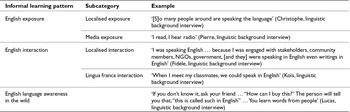
In the present article, I mainly conduct thematic analysis (see e.g., Corbin and Strauss Reference Corbin and Strauss1990) on extracts from linguistic background interviews conducted in 2019–2020, during which they were inter alia asked about why they and/or Congolese refugees are so proficient in English. First, I coded the interview data according to whether the participants explicitly mention something related to informal English language learning. Second, I zoomed in on the extracts with explicit mention of informal English language learning and coded these according to learning patterns (see section 5). A summary of the second part of the thematic analysis is presented in Table 2.
Summary of thematic analysis

5. Informal AL English learning in the context of forced migration
I have coded the main informal ways of learning English that the participants focus on into English exposure (section 5.1), English interaction (section 5.2), and English language awareness in the wild (section 5.3). Here I will present an overview of the thematic analysis. In section six, I discuss how some of the participants’ learning patterns may be analysed as ‘grassroots learning’ of English.
5.1 English exposure
Several of the participants focus on the fact that Uganda is an English‑speaking country, which means that it was vital to know English and that picking up English from daily input is more or less inevitable (see examples 1–4).
(1) Uganda is an English country and so many people around are speaking the language which facilitated me to improve a little bit (Christophe, linguistic background interview)
(2) Because it is anglophone country, many things are in English … Because Uganda, it is anglophone country, I will not‑ I will not manage to live in this country if I don’t know English (Pierre, linguistic background interview)
(3) You know everything, like items, like food and other stuffs are – in what? – in English … when they buy thing, they buy – in what? – in English and you go to the shop … in English (Lucas, linguistic background interview)
(4) Uganda is an English‑speaking country, that’s why when they are there … they try to learn English because … it is the language used in all the offices (Zépherin, linguistic background interview)
(1)–(4) all revolve around receiving English exposure from English being spoken in the area around the participants, which I have coded as localised exposure. By ‘localised’ I mean exposure situated by the participants in a physical location, either nationally or locally. In three of these (1, 2 and 4), the participants specifically relate such exposure of English to the fact that English is a privileged language nationally in Uganda – ‘Uganda is an English country’ (1), ‘it [Uganda] is an anglophone country’ (2), ‘Uganda is an English‑speaking country’ (4) – while (3) and (4) focus on more local situations like the social practice of obtaining supplies (3) and English being experienced to be the dominant language ‘in the offices’ (4), possibly referring to workplaces and/or contact with stakeholders in refugee settlements. Furthermore, (1) explicitly mentions how localised exposure enables extensive spoken English input, ‘… and so many people around are speaking the language’ (1).
(3) leaves the connection between exposure and language learning implicit, while localised exposure of English is explicitly linked to language learning in (1), (2) and (4). In (1), localised exposure is constructed as a facilitator for English language learning: ‘so many people around are speaking the language which facilitated me to improve a little bit’ (1). In (2) and (4) localised exposure is constructed as instrumental motivation to learn English: ‘I will not manage to live in this country if I don’t know English’ (2) and ‘they [Congolese refugees] try to learn English because … it is the language used in all the offices’ (4); see also section 5.2.
Some participants also mention learning English from being exposed to English‑speaking radio and films, and from reading English texts, which I have coded as media exposure. ‘Media’ exposure is different from ‘localised’ exposure in that it is detached from physical locations and more associated with global and/or digital spaces. In these cases, the participants explain that they are seeking out such media exposure for entertainment and/or English learning (see 5–6).
(5) I used to watch TV, I love Americans‑ I love their movies. I enjoy to watch American movie … I did that in Uganda. I used to watch at home [in the DRC], but I did not understand anything. Since I’ve started understand some English [in Uganda], then I started watching those movies to getting some words (Christophe, linguistic background interview)
(6) I forced myself to learn as fast as possible … I read, I hear radio (Pierre, linguistic background interview)
In (5), the participant expresses enjoyment in consuming American media, ‘I used to watch TV, I love Americans‑ I love their movies. I enjoy to watch American movie’ (5). Later in the example, the participant states that with a more solid foundation in English, like from localised exposure (see 1) or English language awareness in the wild (see 10), this type of media exposure could serve to further his English language learning, ‘Since I’ve started understand some English [in Uganda], then I started watching those movies to getting some words’ (5). In (6), on the other hand, the motivation to seek out media exposure is not linked to enjoyment, but rather to accelerating his language learning process: ‘I forced myself to learn as fast as possible … I read, I hear radio’ (6). In this case, the participant mentions English‑speaking media in the form of written texts and radio as sources for language learning rather than in the form of film and television from a particular geographical location, like the Unites States of America, as was the case in (5).
5.2 English interaction
In addition to being exposed to English, either physically or through English‑language media, several participants also focus on learning English informally through interacting with others in English. The participants had to engage in English interaction themselves in order to buy food (see 3), to communicate with office workers (see 4), with NGO workers, government officials, and other community members. As one participant sums it up (7):
(7) I was speaking English out of school because I was engaged with stakeholders, community members, NGOs, government, [and they] were speaking in English even writings in English (Fidèle, linguistic background interview)
In these cases, the participants learnt English incidentally through using the language themselves in communicative situations where it was outside of their control that English was the language of communication: ‘I was engaged with stakeholders, community members, NGOs, government, [and they] were speaking in English even writings in English’ (7). Thus, the participants had many opportunities for practicing the language through English interaction, e.g., ‘I was speaking English out of school’ (7). I have coded this type of English interaction as localised interaction, i.e., that the communication takes place in a location, either nationally or locally, where English happens to be the privileged language.
A similar type of English interaction can be seen in how several participants chose themselves to use English as a neutral lingua franca with interlocutors with whom they did not share any other languages. In the refugee settlements, this type of interaction could be used to facilitate friendships with refugees from other places than the DRC. These I have coded as lingua franca interaction, i.e., that the choice of English is not related to privileged languages in the location, but rather English being a more neutral means of communicating among equals. In the refugee settlements, the participants explained that some of the refugees were from the DRC, others from Rwanda, and others from the Republic of South Sudan (see 8 and 9). There were even a few local Ugandans who went to school in the refugee settlements (9), possibly because it was cheaper than the regular schools nearby.
(8) Those who come from Sudan, they don’t speak Swahili like us … and not Kinyabwisha. For them they speak English, and that’s how I came to know English earlier, that I started communicating with Sudanese. Yeah, I started friendship with them (Lucas, linguistic background interview)
(9) When I meet my classmates, we could speak in English … there were others there from Congo and others from Uganda (Koïs, linguistic background interview)
Thus, several of the participants mention friendships where English was used in lingua franca interaction as another way that they learnt English. In (8), the participant explains this in more detail, that ‘Those who come from Sudan, they don’t speak Swahili like us … and not Kinyabwisha’ (8), i.e., that the content of his linguistic repertoire from the DRC did not match these Sudanese peoples’ linguistic repertoires. However, they did have English in their repertoires: ‘For them they speak English’ (8). Thus, interacting with these people from South Sudan in English in order to build friendships became a source of English language learning for this participant: ‘that’s how I came to know English earlier, that I started communicating with Sudanese. Yeah, I started friendship with them’ (8). Similarly, in (9), another participant explains that she could interact with classmates in English, since her school in the refugee settlement had pupils with different linguistic backgrounds and English was a shared language among them: ‘When I meet my classmates, we could speak in English … there were others there from Congo and others from Uganda’ (9).
5.3 English language awareness in the wild
Finally, there are examples in the data material that may be described as the participants learning English informally by initiating more or less explicit conversations about the English language in order to develop their English competence. Based on Schmidt’s (Reference Schmidt, Chan, Chin, Bhatt and Walker2012) notion of language awareness and Eskildsen’s (Reference Eskildsen, Hellermann, Eskildsen, Doehler and Piirainen-Marsh2019) use of ‘in the wild’ to refer to informal language learning outside formal classrooms (see section 2), I have coded these examples as English language awareness in the wild (see 10‑12).
(10) I used to do my own research, to teach myself English … I used to, myself, actually do some research, asking a lot of questions (Christophe, linguistic background interview)
(11) When I came to Uganda, I start to hear people say boda bodas. Boda bodas is a kind of motorcycle riders … I first learnt from these people some key words, some key words when they are speaking. Example when they say, ‘What do you want?’ … ‘I want this’ … ‘I want banana’ … some key words like that, my name, yeah, like that … I got some skills from that people whom I was living with (Pierre, linguistic background interview)
(12) When you spend almost one year, you start speaking little with help from people … If you don’t know it, ask your friend … ‘How can I buy this?’ The person will tell you that, ‘this is called such in English’ … You learn words from people (Lucas, linguistic background interview)
One participant focused on how he would take control of his own language learning: ‘I used to do my own research, to teach myself English’ (10). He explains that he did this by asking questions about the language in order to learn more English, ‘I used to, myself, actually do some research, asking a lot of questions’ (10). Others give credit to other people, like motorcycle riders, for their English language learning: ‘I first learnt from these people … I got some skills from that people whom I was living with’ (11) and ‘you start speaking little with help from people … You learn words from people’ (12). These people helped them by teaching them ‘some key words’ (11), which could be vocabulary related to obtaining food: ‘“What do you want?” … “I want this” … “I want banana”’ (11) and ‘If you don’t know it, ask your friend … “How can I buy this?” The person will tell you that, “this is called such in English”’ (12). Thus, the participants have initiated English language awareness in the wild through talking explicitly about relevant English vocabulary needed for living in Uganda.
Together, these examples in 5.1 to 5.3 display what the learning patterns of exposure, interaction and language awareness may look like for Congolese refugees learning AL English in transit in Uganda. In the next section, I take a ‘grassroots’ approach (cf. Blommaert Reference Blommaert2008, Reference Blommaert2010; Han Reference Han2013) and outline aspects of their English language learning which might be analysed as ‘grassroots learning’ of English, and see this together with, e.g., previous findings on English‑Swahili bilingual sermons as a way of learning English (Syvertsen Reference Syvertsen2025).
6. Discussion and concluding remarks
Many of the specific examples of informal English learning through exposure, interaction or language awareness in the wild in the present data can be analysed as ‘grassroots’ ways of learning English, which, as I mentioned in the introduction, I define as intentionally initiating ways of learning language informally (cf. Blommaert Reference Blommaert2008, Reference Blommaert2010; Han Reference Han2013). Firstly, learning English through media exposure, like radio, films and reading, is something that the participants sought out themselves, for English learning purposes and/or entertainment purposes. Secondly, learning English through lingua franca interaction was also initiated by the participants and their interlocutors to make friends where they did not share any other language than English. The interlocutors in lingua franca interaction seem to be mainly refugees from South Sudan or local Ugandan pupils at the school in the refugee settlements, i.e., all minoritised speakers, which means that the power relations between the interlocutors seem to have been more symmetric. In this case, English seems to truly function as a ‘neutral instrument for ‘international’ communication’ (Phillipson Reference Phillipson2008, 250), rather than being chosen as the medium of communication primarily because of the historical British presence in Uganda. Finally, learning English through English language awareness in the wild is again something the participants initiated themselves, intentionally to learn AL English. A parallel to these conversations about the English language with different people can be found in Syvertsen (Reference Syvertsen2025), where one of the Congolese refugees, a pastor in a Congolese church in Uganda, explicitly expressed that he initiated AL English learning for his church members by providing English‑Swahili bilingual sermons in order to help church members pick up some AL English during services. Even if these quota refugees had no agency in where they were to be resettled, this Congolese pastor wanted to help church members learn English as it would likely be useful as a lingua franca regardless of their ultimate placement (Syvertsen Reference Syvertsen2025). What does not feature in any of the data from ethnographic fieldwork among this group of refugees is any ambition to settle in a specific country, anglophone or otherwise; they rather emphasise that it is not their decision where they will be resettled (Syvertsen Reference Syvertsen2025; Steien, personal communication). Nevertheless, the AL English learning in church may not have been initiated by and explicit for the church members, although the Congolese pastor intentionally facilitated potential English language awareness in the wild for these church members.
In these three AL English learning patterns, which I have analysed as ‘grassroots learning’ of English, language learning may potentially take place incidentally or intentionally. However, the specific activities seem to have been initiated intentionally by the participants themselves, e.g., choosing to listen to the radio, choosing to use English as a neutral lingua franca, and choosing to initiate explicit conversations about the English language. Thus, these ‘grassroots’ ways of learning English seem to be the participants’ responses to a personal wish to or imposed need to learn English.
In addition to ‘grassroots learning’ of English, there are informal AL English learning patterns that may be analysed as ‘imposed learning’ of English, where English is forced upon the refugees due to its dominant role among people with more power than the refugees. I analyse learning English through localised exposure and localised interaction as ‘imposed learning’ of English. Here language learning is solely incidental, as language learning or the activities that may lead to language learning are not initiated by the participants themselves. It is rather a natural consequence that you will eventually learn AL English incidentally through spending time in an English‑dominated space for more than a decade, where you are exposed to English daily and have to take part in English interaction because English happens to be the language that is used among, e.g., stakeholders, office workers, and other people in power. Given this asymmetric power relation, I do not analyse localised interaction with English resources as a ‘neutral instrument for ‘international’ communication between speakers who do not share a mother tongue’ (Phillipson Reference Phillipson2008, 250), or a lingua franca. In the case of ‘imposed learning’ of English, English is no longer a ‘neutral instrument for ‘international’ communication’, but rather a practice forced upon refugees.
The fact that the participants must learn English in Uganda, which one of the participants also mentioned explicitly (‘I will not manage to live in this country if I don’t know ‘English’), see (2), is related to the privileged position of English in Uganda resulting from historical British presence. Knowing English may in this case be interpreted as what Bourdieu (Reference Bourdieu1990) refers to as ‘the rules of the game’, i.e., that it is vital to know English in order to function in that social space with its particular political history. However, as this article has shown in the case of AL English learning among Congolese refugees in Uganda, this historical backdrop may not necessarily be directly relevant for AL English learning alone. The situation is more nuanced.
These present findings further challenge the view that ‘[t]he choice for English … rather than indigenous languages in education is at the grassroots level often motivated by means of discourses of “getting out of here” and towards particular centres – metropolitan areas – where upward social mobility at least looks possible’ (Blommaert Reference Blommaert2010, 46). It may be the case for these Congolese refugees that English is sought as a future way out of poverty and precarity and for international opportunities (see Syvertsen Reference Syvertsen2025). However, such motivations do not feature in the present data. Rather, on a more local and immediate level, the participants focus on enjoying entertainment from e.g., films that happen to be in English; that they want friends, where English happens to be a useful shared language; or that they experience English as forced upon them and not something they would want to seek out for its own sake were it not for the sociolinguistic situation in Uganda.
These participants have now been permanently settled in Norway and diversify AL English learning patterns among people residing permanently in Norway. In the future, it may be interesting to explore whether this group of Congolese refugees experience their ways of learning AL English informally to be transferrable to AL Norwegian learning. Furthermore, it would also be good to explore whether their AL English learning patterns are recognised, valued and built upon by AL Norwegian teachers for migrants and AL English teachers in Norwegian primary and secondary school. As Dressman (Reference Dressman, Dressman and Sadler2020, 2) asks, ‘[i]s there a way for formal instruction to integrate or incorporate insights from informal language learning, or are the two as alien and difficult to mix as oil and water?’. In Norway, we have started to recognise, value and build upon informal AL English learning from Extramural English among the majority population. Might there be room for recognising, valuing and building upon ‘grassroots learning’ of English among former refugees in Norway as well?
Competing interests
The author declares none.
 IDA SYVERTSEN is an applied linguist at Østfold University College where she teaches (applied) linguistics in teacher education. She has a PhD in applied linguistics from the University of Inland Norway. In her doctoral research she conducted a critical sociolinguistic study on English practices among individuals with histories of forced mobility. The participants were newly arrived Congolese refugees with long transits in Uganda taking part in a collaborative longitudinal research project on language across time and space. Methodologies included linguistic ethnography with acoustic phonetic analysis and ethnographic interviews. Her current research interests include language and migration, Global English, intercultural communication, multilingualism, indexicalities and language ideologies, phonetics and phonology, and language awareness in English language teaching. Email: ida.syvertsen@hiof.no