


1. Introduction
English is used across a wide range of institutional and everyday domains in contemporary India, where it coexists with numerous regional and local languages (Bhatt Reference Bhatt2008; Kachru Reference Kachru, Nelson, Proshina and Davis2019; Schneider Reference Schneider2007). As a result of long‑standing multilingual contact, Indian speakers frequently draw upon linguistic resources from more than one language within the same interaction, giving rise to phenomena such as code‑switching, code‑mixing, borrowing and other forms of bilingual language use (Auer Reference Auer2013; Gumperz Reference Gumperz1982; Myers–Scotton Reference Myers–Scotton1993). Among these, the interaction between Hindi and English has attracted particular scholarly attention and is commonly discussed under the broad label of Hinglish (Bhatia and Ritchie Reference Bhatia and Ritchie2008; Kachru Reference Kachru1990; Sailaja Reference Sailaja, Low and Pakir2021). The increasing visibility of Hinglish in education, popular culture, advertising, digital communication and social media has generated considerable interest in how bilingual speakers combine linguistic resources to create meaning in contemporary India (Androutsopoulos Reference Androutsopoulos2015; Bhatia Reference Bhatia, Low and Pakir2021).
Indian English is widely recognised as one of the most established postcolonial varieties of English (Kachru Reference Kachru1990; Schneider Reference Schneider2007). Previous research has documented distinctive phonological, lexical, grammatical and pragmatic features that reflect the influence of local linguistic environments on English use in India (Mesthrie and Bhatt Reference Bhatt2008; Sailaja Reference Sailaja2012; Sedlatschek Reference Sedlatschek2009). Although these studies have considerably advanced our understanding of Indian English, much research on language contact has focused on lexical innovation, borrowing and hybrid word formation, while comparatively less attention has been paid to grammatical features in bilingual English use. Existing research on Hinglish has likewise documented hybrid formations, lexical borrowing, innovative word‑formation processes and the sociocultural functions of mixed‑language vocabulary (Bhatia and Ritchie Reference Bhatia and Ritchie2008; Muysken Reference Muysken2000; Parshad et al. Reference Parshad, Bhowmick and Chand2016; Sailaja Reference Sailaja, Low and Pakir2021). More recently, research on multilingual communication has highlighted the flexible use of linguistic resources across languages in everyday interaction (Canagarajah Reference Canagarajah and Braine2013; Gazzola et al. Reference Gazzola, Templin and McEntee–Atalianis2020; Wei and García Reference Wei and García2022). Despite these developments, the grammatical dimension of bilingual English use remains comparatively underexplored.
One way of exploring this dimension is through the Hindi complementizer ki. Originally borrowed from Persian and subsequently integrated into Hindi, ki has become a well‑established clause‑linking device in Modern Hindi. In addition to introducing subordinate clauses, it also functions as a marker of both indirect and direct (quotative) speech, making it a productive complementizer in Modern Hindi (Koul Reference Koul2008; Subbārāo Reference Subbārāo2012). In many contexts, ki corresponds to the English complementizer that. However, ki is also frequently encountered in utterances that are otherwise largely English, as in expressions such as I think ki this topic is interesting, We know ki social media affects students and The problem is ki nobody has studied this issue. Its occurrence in such contexts is particularly noteworthy because English offers two readily available alternatives, namely the complementizer that and zero complementation, both of which are common in spoken English. The availability of these alternatives makes the continued occurrence of ki especially noteworthy and provides a useful opportunity to examine how the Hindi complementizer ki remains active within English‑dominant bilingual discourse.
This persistence raises an important question. Unlike lexical borrowings, whose use may be motivated by semantic specificity, cultural meaning, or lexical gaps, the use of ki cannot readily be attributed to communicative necessity. Nor can its occurrence be straightforwardly attributed to limited English proficiency, given that the participants were university students enrolled in an English‑medium institution and engaged in English‑language academic work. Its continued use suggests that highly routinised grammatical features may fulfil functions extending beyond clause linkage. Research on language contact has shown that highly frequent functional elements, including discourse markers and complementizers, often persist in bilingual communication because of their grammatical entrenchment as well as their interactional and symbolic functions (Maschler and Schiffrin Reference Maschler, Schiffrin, Tannen, Hamilton and Schiffrin2015; Matras Reference Matras and Marcantonio2009; Schiffrin Reference Schiffrin1987). Likewise, Muysken (Reference Muysken2000) proposes the notion of back flagging, whereby elements from the less dominant language remain embedded in otherwise dominant‑language discourse and may index bilingual affiliation or linguistic identity. Although the present study does not seek to test this interpretation directly, these perspectives provide a useful theoretical context for understanding the continued occurrence of ki in English‑dominant interaction.
Against this background, the present study contributes to ongoing discussions of language contact, bilingual discourse and World Englishes by examining how a grammatical feature participates in English‑dominant bilingual communication. Rather than focusing on lexical mixing, it investigates the distribution of the Hindi complementizer ki to examine how grammatical influence operates within English‑dominant bilingual discourse and what this reveals about English use in multilingual settings.
To address this gap, the present study investigates the use of the Hindi complementizer ki in English‑dominant bilingual interaction among Indian university students. Specifically, the study pursues the following objectives:
RQ1: to examine the linguistic contexts in which ki occurs in bilingual interaction;
RQ2: to identify the discourse environments in which ki is most frequently used; and
RQ3: to explore what the distribution of ki reveals about the role of local grammatical resources in English‑dominant Hindi–English discourse.
The analysis focuses on English‑dominant discourse, understood here as bilingual interaction in which English provides the principal medium of communication while accommodating elements from Hindi. This descriptive label should be distinguished from the theoretical constructs of dominant language, matrix language and embedded language, which are discussed in the analytical framework that follows.
To realise these objectives, the study analyses a corpus of task‑based group discussions produced by 800 university students. The corpus comprises 100 group recordings and contains 570 occurrences of ki identified through a combination of automated retrieval and manual verification. By examining bilingual interaction within a task‑based academic setting, the study provides an empirically grounded account of how the Hindi complementizer ki occurs within predominantly English discourse despite the availability of English clause‑linking alternatives.
The organisation of the paper is as follows. Section 2 reviews relevant literature on clause complementation, bilingual discourse and language contact, and presents the analytical framework adopted in the study. Section 3 describes the corpus, data retrieval procedures and analytical methods. Section 4 presents the findings, which are discussed in relation to previous research and theories of bilingual language use. The final section summarises the principal findings, acknowledges the study’s limitations and outlines directions for future research.
2. Clause linking, bilingual discourse and analytical framework
Clause‑linking devices are grammatical elements that connect one clause to another and help speakers establish relationships between ideas. In English, this function is commonly performed by complementizers such as that, as in constructions such as I think that this topic is important, she said that the results were surprising and the reason is that students use social media extensively. Such constructions are particularly common in spoken interaction because they enable speakers to express opinions, report information, provide explanations and evaluate events. Complement‑clause constructions therefore play an important role in discourse organisation and the management of interpersonal communication (Halliday and Hasan Reference Halliday and Hasan1976; Quirk et al. Reference Quirk, Greenbaum and Leech1985). Indeed, complement clauses have been widely recognised as one of the principal grammatical resources through which speakers express stance, attribute information and organise discourse in interaction (Biber Reference Biber1999; Kärkkäinen Reference Kärkkäinen2003).
Hindi likewise employs clause‑linking devices to introduce subordinate propositions. One of the principal devices used for this purpose in Hindi is the complementizer ki, which occurs in a range of constructions involving cognition, reporting, explanation and evaluation (Kachru Reference Kachru, Nelson, Proshina and Davis2019; Masica Reference Masica1991; Montaut Reference Montaut2006a). Examples include mujhe lagta hai ki yeh vishay mahatvapurn hai (‘I think that this topic is important’) and usne kaha ki vah aayega (‘He said that he would come’). Although ki functions as a conventional complementizer in Hindi, it is also frequently encountered in bilingual interaction, where it introduces complement clauses in utterances that are otherwise predominantly English. Examples from the present corpus include:
(1) I think ki this topic is interesting. [G02]
(2) I know ki social media affects students nowadays. [G09]
(3) She said ki the sample size was too small. [G12]
(4) The reason is ki students use social media frequently. [G23]
In each example, ki introduces a complement clause while the remainder of the utterance is largely English. Its occurrence in these contexts illustrates how bilingual speakers draw upon grammatical resources from both Hindi and English when organising discourse, even where English provides the principal medium of communication.
Such discourse‑organisational resources can also contribute to the management of relationships between propositions and to the organisation of spoken interaction (Fraser Reference Fraser1999). The present study focuses on five discourse environments identified in the corpus: cognition, reporting, explanation, evaluation and other contexts. Cognition constructions typically occur in expressions such as I think that . . . and I know that . . . , where speakers present beliefs, opinions or knowledge claims (Kärkkäinen Reference Kärkkäinen2003). Reporting constructions include forms such as she said that . . . and they told us that . . . , which attribute information to another source. Explanation commonly occurs in constructions such as the reason is that . . . , while evaluation is frequently expressed through forms such as the problem is that . . . and related evaluative expressions. The residual ‘other’ category captures occurrences that did not fit the preceding four analytical categories. These discourse environments provide the analytical framework for examining the distribution of ki in bilingual interaction.
Research on bilingual discourse has shown that language contact influences not only vocabulary but also patterns of grammar and discourse organisation (Backus Reference Backus2000; Gardner–Chloros Reference Gardner–Chloros2009; Matras Reference Matras and Marcantonio2009; Montaut Reference Montaut2006b). While lexical borrowing is often the most visible outcome of contact, grammatical elements may also cross language boundaries and become integrated into recurring bilingual communicative practices. Similarly, studies of World Englishes have demonstrated that contact with local languages can influence grammatical and discourse features of English in multilingual settings (Kachru Reference Kachru1990; Mesthrie and Bhatt Reference Bhatt2008; Schneider Reference Schneider2007). Because grammatical elements contribute to the organisation of discourse rather than simply to lexical meaning, they provide a useful perspective on how contact‑induced influence becomes embedded in everyday bilingual language use (Backus Reference Backus2000; Matras Reference Matras and Marcantonio2009).
Several theoretical frameworks have been proposed to explain the organisation of bilingual discourse. Among the most influential is Myers–Scotton’s (Reference Myers–Scotton1993) Matrix Language Frame model, which distinguishes between the matrix language, providing the principal morphosyntactic frame of a bilingual utterance, and the embedded language, from which lexical or grammatical material may be introduced. Related research has also employed the broader notion of a dominant language to refer to the language that predominates within a particular interaction or discourse event (Auer Reference Auer2013; Gardner–Chloros Reference Gardner–Chloros2009). These concepts have been widely used to explain the structural organisation of bilingual speech.
The present study adopts a complementary analytical perspective. Rather than classifying utterances according to the Matrix Language Frame model, it employs the descriptive term English‑dominant discourse to refer to bilingual interactions in which English constitutes the principal medium of communication while accommodating the recurrent use of the Hindi complementizer ki. This terminology enables the analysis to describe observable patterns of language use without assuming a particular model of bilingual production, while remaining compatible with established research on bilingual discourse.
Muysken (Reference Muysken2000) proposes the notion of back flagging, whereby elements from one language are retained within otherwise dominant‑language discourse, thereby signalling bilingual affiliation or symbolic identity. Although the present study does not seek to test this interpretation directly, it provides a useful perspective for understanding why a high‑frequency functional element such as ki may continue to occur in predominantly English interaction despite the availability of functionally equivalent English alternatives.
The present study adopts a discourse‑functional perspective in which grammatical forms are examined in relation to the communicative contexts in which they occur (Biber Reference Biber1999; Halliday and Hasan Reference Halliday and Hasan1976). From this perspective, complementizers are not viewed simply as structural markers linking clauses; they also contribute to the organisation of discourse by enabling speakers to express stance, attribute information, provide explanations and evaluate propositions. Examining the distribution of clause‑linking resources across different discourse environments therefore provides insights into how bilingual speakers organise relationships between ideas during interaction.
Building on this perspective, the analysis examines the distribution of ki across five discourse environments: cognition, reporting, explanation, evaluation and other contexts. These categories were selected because they capture the principal recurrent discourse functions represented in the corpus and provide a consistent analytical framework for examining patterns in the use of ki. Consequently, performative constructions were not treated as a separate analytical category but were subsumed within the residual ‘other’ category where applicable.
Within this framework, the Hindi complementizer ki is examined as a clause‑linking resource in English‑dominant bilingual discourse rather than as an isolated instance of code‑switching. Particular attention is paid to the linguistic contexts in which ki occurs, the discourse environments in which it is most frequently employed and the recurrent patterns associated with its use. This approach makes it possible to examine the role of ki within bilingual interaction in a task‑based academic setting while relating its distribution to broader questions of language contact, discourse organisation and English use in multilingual India.
3. Methods
The analysis presented in this study is based on task‑based group discussions produced by undergraduate students at an English‑medium private university in India. The data are examined quantitatively and qualitatively to investigate the use of the Hindi complementizer ki across different linguistic and discourse environments. The analysis also compares ki with the English complementizer that and zero complementation in comparable clause‑linking contexts.
3.1 Participants and data collection
The data for this study consist of task‑based group discussions produced by students enrolled in a Technical Communication course at an English‑medium private university in India. A total of 800 undergraduate students across ten classes participated in the study. Participation was voluntary, and all students provided verbal consent to participate in the recorded discussions. Each class comprised 80 students and was randomly divided into ten groups of approximately eight members, yielding 100 discussion groups. The random allocation of students was intended to minimise pre‑existing group effects and facilitate relatively natural interaction during the discussions.
The data were collected through an in‑class research idea generation task. Students were provided with broad instructions regarding the task and were subsequently allowed to continue their discussions without further intervention from the instructor. No restrictions were imposed on language choice, allowing participants to draw freely upon their Hindi and English linguistic repertoires. Because the objective was to capture bilingual interaction without directing participants’ attention to a particular linguistic feature, participants were not informed that the study focused on any specific linguistic feature.
Each group produced a single audio recording ranging from approximately 20 to 30 minutes in length. To facilitate corpus management, each class was assigned a unique recording slot, and groups were instructed to label their recordings using a combination of slot number and group number. The final dataset comprised 100 group recordings, yielding approximately 34 hours of recorded interaction and a corpus of approximately 220,000 words of transcribed speech.
For corpus examples, group‑level source codes (G01–G100) are used to identify the discussion recording from which each extract was taken. The letter ‘G’ denotes the discussion group, while the numerical component identifies the corresponding group recording. These codes identify the source recording rather than individual speakers, as speaker‑level attribution was not consistently possible.
The corpus represents English‑dominant bilingual interaction within a task‑based academic setting and provides a suitable context for examining how local grammatical resources operate within English‑oriented communication. English served as the principal language of classroom instruction, while participants drew upon Hindi as an additional communicative resource during interaction.
3.2 Corpus preparation and data retrieval
All recordings were initially transcribed using OpenAI Whisper, an automatic speech recognition (ASR) system (Radford et al. Reference Radford, Kim and Tao2023), and subsequently checked manually against the original recordings to ensure transcription accuracy. The verified transcripts were then compiled into a searchable corpus. Next, a Python‑based search script was developed to retrieve every occurrence of the orthographic form ki, together with its immediate co‑text, including the surrounding words and the complete utterance in which it occurred. This procedure generated an initial set of candidate instances for analysis. Each retrieved occurrence was then examined manually to determine whether ki functioned as a clause‑linking device, to identify its linguistic and discourse environment, and to exclude cases in which ki served other grammatical functions or appeared in incomplete or unclear utterances. To examine competing clause‑linking strategies, the corpus was subsequently searched for occurrences of the English complementizer that and zero complementation in comparable clause‑linking environments. Because zero complementation has no overt marker, such instances were identified through syntactic pattern matching and subsequently verified manually against the surrounding discourse context. These occurrences were manually examined and assigned to the same discourse‑environment categories used for the analysis of ki. Only cases functioning as clause‑linking strategies within the analytical scope of the study were included in the comparison (see Table 1).
Overview of the corpus

Table 1 Long description
The table has two columns, Feature and Value. It lists 100 discussion groups, 800 participants, the discussion task as research idea generation, a total duration of 34 hours, a corpus size of 220,000 words, and 570 total ki tokens.
The final dataset consisted of 570 analysable occurrences of ki, corresponding to approximately 2.6 occurrences per 1,000 corpus words.
3.3 Coding procedure
The extracted instances were coded according to their linguistic and discourse characteristics. First, the utterance containing each occurrence of ki was classified as English‑dominant, mixed Hindi–English, or Hindi‑dominant according to the language providing the principal grammatical and lexical resources. This descriptive classification was adopted to characterise patterns of language use in the corpus rather than to assign the utterances to a particular theoretical model of bilingual production.
Second, each occurrence was assigned to a discourse environment on the basis of its immediate communicative function. Through iterative examination of the corpus, five analytical discourse categories were identified to capture the principal recurrent communicative functions represented in the dataset: cognition (e.g. I think ki, I know ki), reporting (e.g. she said ki), evaluation (e.g. the problem is ki), explanation (e.g. the reason is ki) and other contexts that did not fit the preceding categories. These categories were developed specifically for the purposes of the present analysis and are not intended to provide an exhaustive functional classification of complement‑clause environments. Performative constructions were therefore not treated as a separate analytical category, reflecting both the limited scope of the coding framework and the distribution of relevant constructions in the corpus. In addition, recurrent lexical expressions preceding ki were recorded to identify frequently occurring discourse routines.
The classification of language categories and discourse environments was undertaken by two researchers using the coding framework described above. Following independent coding, the classifications were compared, and any disagreements were resolved through discussion, repeated examination of the relevant extracts and reference to the coding framework until consensus was reached. This procedure provided a systematic basis for resolving coding differences.
3.4 Data analysis
The recordings captured group discussions rather than individually identified speakers, so speaker‑level attribution was not consistently possible. Consequently, the analysis focuses on occurrences of ki within the corpus rather than on individual speakers. The quantitative analysis involved the calculation of raw frequencies and percentages for language categories, discourse environments, lexical environments and the three clause‑linking strategies examined in the study: ki, that and zero complementation. The qualitative analysis involved close examination of representative extracts to explore how ki functioned as a clause‑linking resource across different discourse environments and what its use revealed about the role of local grammatical resources in English‑dominant bilingual interaction.
The study combines corpus‑based quantitative analysis with qualitative examination of representative extracts to investigate the distribution and discourse functions of ki in English‑dominant bilingual interaction within a task‑based academic setting. This approach is consistent with corpus‑based research on multilingual discourse and World Englishes (Gardner–Chloros Reference Gardner–Chloros2009; Matras Reference Matras and Marcantonio2009; Schneider Reference Schneider2007) and provides an appropriate methodological framework for examining how a local grammatical resource operates within English‑oriented communication.
4. Results
This section presents the distribution of ki in the corpus across language categories, discourse environments, recurrent lexical environments and competing clause‑linking strategies. The findings are presented in Tables 2–5 and Figures 1–2.
Distribution of Utterances Containing ki

Table 2 Long description
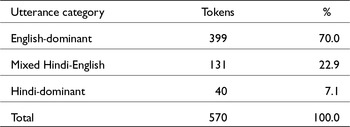
The table has three columns: Utterance category, Tokens, and %. English-dominant has 399 tokens (70.0%); Mixed Hindi-English has 131 (22.9%); Hindi-dominant has 40 (7.1%); the total is 570 (100.0%).
Distribution of ki Across Discourse Environments

Table 3 Long description
The table summarizes the makeup of a discussion-based corpus and the count of ki tokens within it. Data come from 100 discussion groups involving 800 participants. The discussions focused on research idea generation and ran for a total of 34 hours. The resulting corpus contains 220,000 words. Across this corpus, 570 ki tokens were identified. The table reports overall totals only, so it does not show how ki use varies by group, participant, or time.
Recurrent Lexical Environments Preceding ki

Table 4 Long description
The table has three columns: Lexical environment, Tokens, and %. I think: 146 (25.7%); We think: 32 (5.6%); I know: 41 (7.2%); We know: 29 (5.1%); He/She said: 85 (14.9%); The problem is: 48 (8.4%); The reason is: 41 (7.2%); Other: 148 (25.9%); total 570 (100.0%).
Distribution of Clause‑Linking Strategies across Discourse Environments

Table 5 Long description
The table reports how utterances containing ki are distributed across language-dominance categories, using token counts and percentages. English-dominant utterances account for 399 tokens, representing 70.0 percent of the total. Mixed Hindi-English utterances contribute 131 tokens, or 22.9 percent. Hindi-dominant utterances are least common at 40 tokens, or 7.1 percent. Overall, English-dominant usage is about three times the mixed category and about ten times the Hindi-dominant category. Percentages sum to the full set of 570 tokens, so results reflect this datasets composition and may not generalize beyond it.
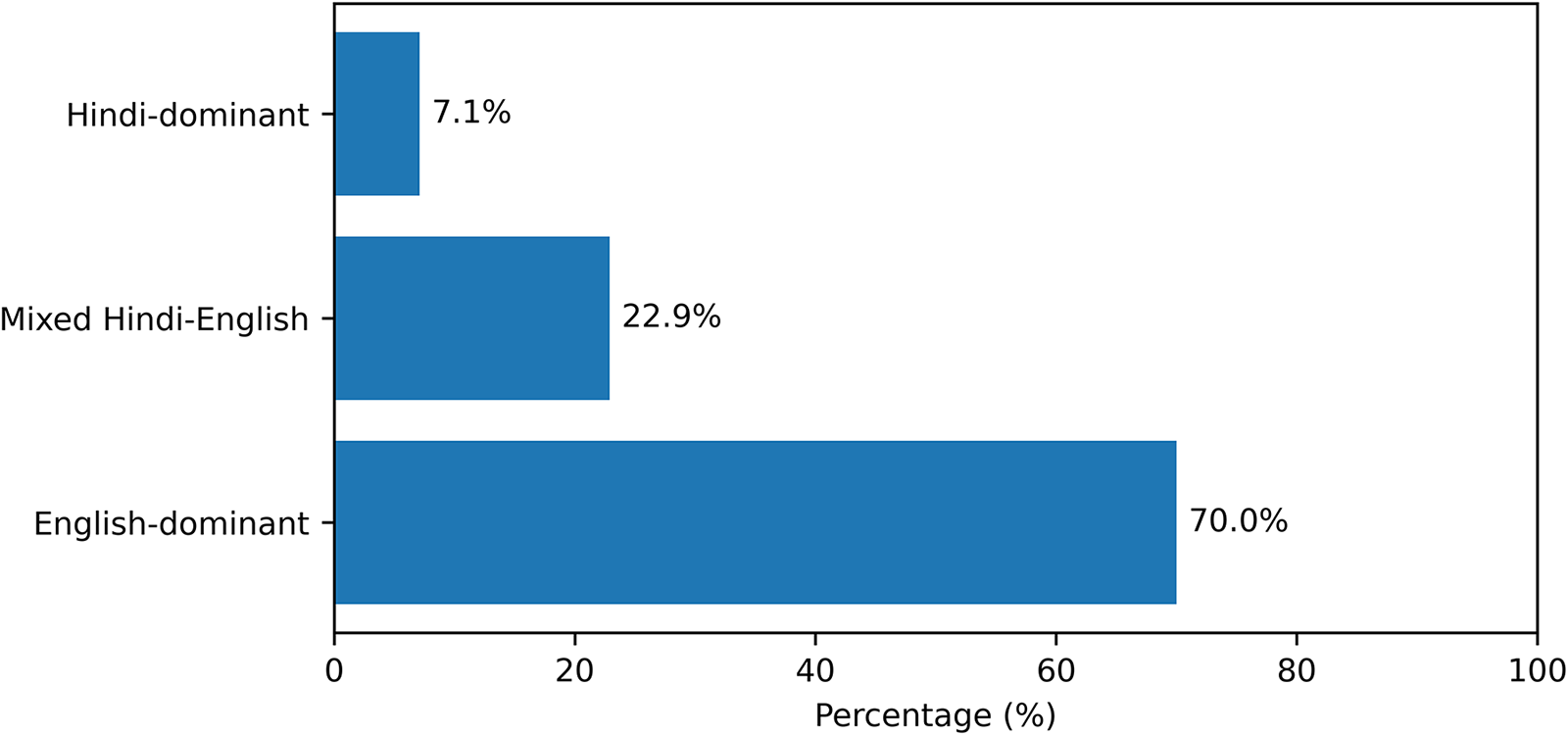
Distribution of utterances containing ki.

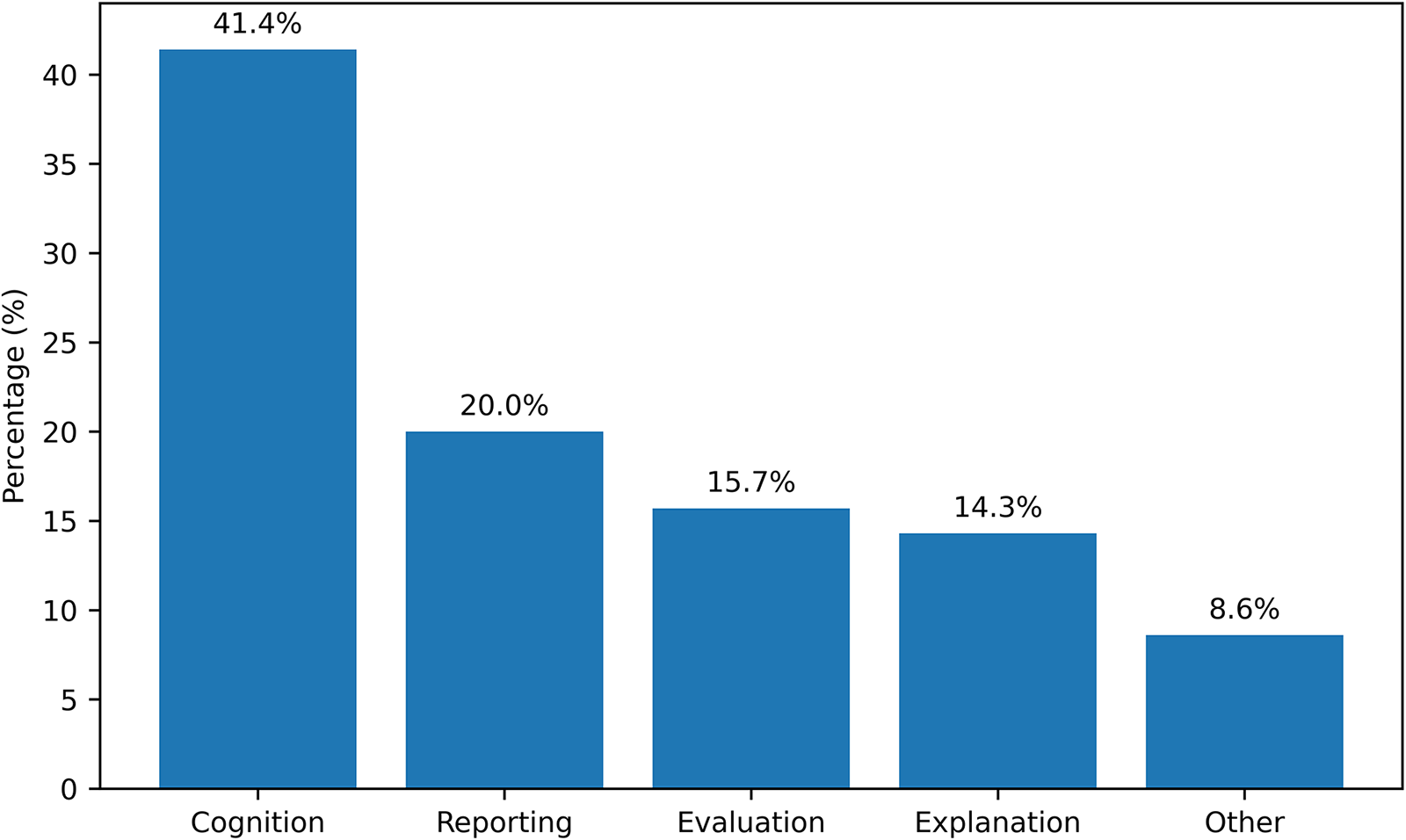
Distribution of ki across discourse environments.

4.1 Distribution of ki across English‑dominant, mixed and Hindi‑dominant utterances
Table 2 and Figure 1 present the distribution of utterances containing ki across the three language categories identified in the corpus. Of the 570 analysed occurrences, 399 (70.0%) occur in English‑dominant utterances, 131 (22.9%) in mixed Hindi–English utterances and only 40 (7.1%) in Hindi‑dominant utterances. The findings indicate that ki occurs predominantly in English‑dominant bilingual discourse rather than in utterances whose grammatical and lexical structure is primarily Hindi.
A notable feature of the distribution is the relatively small proportion of occurrences in Hindi‑dominant utterances. Of the 570 analysed occurrences, 399 (70.0%) appear in English‑dominant utterances, whereas only 40 (7.1%) occur in Hindi‑dominant utterances. This pattern indicates that ki frequently occurs in utterances that are otherwise structurally English.
This distribution suggests that the occurrence of ki cannot be explained solely by the use of Hindi during interaction. It is also consistent with the study context, in which participants were enrolled at an English‑medium university and completed the task in an academic setting where English served as the principal language of instruction. Example (5) illustrates this pattern.
(5) Guys, sir said ki we can choose the research topic which should be novel and has some kind of societal impact. [G33]
Apart from the complementizer ki, the remainder of the utterance is in English. Similar instances occurred throughout the corpus.
A similar pattern occurs in cognition constructions, as illustrated in Example (6).
(6) I think ki if we consider AI’s role in interpreting health communication, it will create a real impact on common people’s lives. [G41]
Here, ki follows the cognition expression I think and introduces a complement clause that is otherwise entirely in English.
The quantitative distribution and the representative extracts point to the same pattern. Although ki originates in Hindi, the majority of occurrences are found in English‑dominant utterances rather than in Hindi‑dominant discourse. The findings therefore suggest that Hindi‑English language contact within contemporary bilingual interaction may be reflected not only in lexical borrowing but also in the organisation of grammatical relationships between clauses.
4.2 Distribution of ki across discourse environments
Table 3 and Figure 2 present the distribution of ki across the discourse environments identified in the corpus. Cognition constructions constitute the largest category, accounting for 236 occurrences (41.4%), followed by reporting constructions with 114 occurrences (20.0%). Evaluation and explanation occur at broadly comparable frequencies, accounting for 89 (15.7%) and 82 (14.3%) occurrences respectively, while the remaining 49 occurrences (8.6%) fall into other discourse environments.
The findings indicate that cognition constructions constitute the principal discourse environment in the corpus, with reporting representing the second most frequent category. Evaluation and explanation occur at comparable frequencies, whereas other contexts account for fewer than one‑tenth of all occurrences.
4.3 Cognition constructions
Cognition constructions represent the largest discourse environment, accounting for 236 occurrences (41.4%) of all tokens. Typical examples include I think ki, I know ki, we think ki, and related expressions through which speakers express beliefs, opinions and knowledge claims. The predominance of cognition constructions is consistent with the collaborative discussion task, which required participants to generate, evaluate and justify research ideas. Example (7) demonstrates this pattern in a cognition construction.
(7) I think ki this topic can help students improve their communication skills. [G54]
The frequent occurrence of ki following cognition verbs suggests that speakers commonly employed it when introducing beliefs, assumptions and knowledge claims during discussion.
4.4 Reporting constructions
Reporting constructions account for 114 occurrences (20.0%) and represent the second most frequent discourse environment. Common patterns include he said ki, she said ki, sir told us ki, and similar attribution structures through which speakers introduce information obtained from other sources. A further instance is provided in Example (8), where ki introduces reported information.
(8) Sir told us ki the topic should address a practical social problem. [G60]
Reporting constructions were frequently used when participants referred to classroom instructions, previously encountered information, or ideas introduced by other members of the discussion group.
4.5 Evaluation constructions
Evaluation constructions account for 89 occurrences (15.7%). These constructions typically occur when speakers assess situations, identify limitations, or emphasise the significance of particular issues under discussion. This pattern is also evident in the evaluative construction presented in Example (9).
(9) The problem is ki very few studies have examined this issue in rural areas. [G73]
The occurrence of ki in evaluative contexts indicates that its use extends beyond the expression of beliefs and reported information to contexts involving assessment and critical reflection.
4.6 Explanation constructions
Explanation constructions account for 82 occurrences (14.3%). These constructions typically introduce reasons, justifications and elaborations that support claims made during interaction. Example (10) provides a further illustration of ki in an explanatory context.
(10) The reason is ki students spend a lot of time on social media nowadays. [G78]
Such constructions were commonly used when participants explained or justified their proposed research ideas, reflecting the argumentative nature of the discussion task.
Cognition and reporting constructions account for 350 occurrences (61.4%) of the corpus, whereas evaluation and explanation together account for 171 occurrences (30.0%). The concentration of ki in cognition and reporting environments indicates that it most frequently occurs in contexts involving the expression of opinions, knowledge claims and attributed information, while its presence in evaluation and explanation demonstrates that its use extends across a broader range of discourse functions.
4.7 Recurrent lexical environments of ki
Table 4 presents the recurrent lexical environments preceding ki. The results indicate that ki occurs within a relatively limited set of recurring lexical patterns rather than being distributed randomly across discourse. Among the named patterns, I think ki is the most frequent (25.7%), followed by He/She said ki (14.9%), The problem is ki (8.4%), I know ki (7.2%), The reason is ki (7.2%), We think ki (5.6%) and We know ki (5.1%).
A notable feature of the distribution is the concentration of occurrences within a small number of recurring constructions. As shown in Table 4, the seven named lexical patterns account for 422 of the 570 occurrences (74.0%) in the corpus. This concentration suggests that speakers repeatedly draw upon relatively stable discourse routines rather than selecting ki in an entirely ad hoc manner. Thus, the findings indicate that the occurrence of ki is associated with identifiable discourse routines that recur across speakers and discussion groups.
The predominance of patterns such as I think ki, I know ki and He/She said ki closely mirrors the functional distribution reported in Table 3. In this respect, the lexical environments reinforce the broader finding that ki is strongly associated with stance expression and information attribution. The concentration of occurrences within a limited number of recurring lexical frames therefore strengthens the argument that ki functions as a regular clause‑linking resource within English‑dominant bilingual interaction rather than as an isolated instance of code‑switching.
4.8 Distribution of competing clause‑linking strategies
Table 5 compares the distribution of the three clause‑linking strategies identified in the corpus across the discourse environments analysed in the present study. Overall, ki was the most frequently observed of the three clause‑linking strategies examined, with 570 occurrences, compared with 163 instances of zero complementation and 139 instances of the English complementizer that. Because the three strategies were identified through different retrieval procedures, the comparison is intended as a descriptive account of their observed distribution within the analytical categories rather than as a normalized estimate of complementizer choice.
The comparison shows that ki is widely represented across the same broad communicative environments in which English that and zero complementation occur. Because the three strategies were identified through separate retrieval procedures, the raw frequencies should not be interpreted as evidence of relative selectional preference. Nevertheless, their distribution demonstrates that ki functions as a recurrent clause‑linking resource alongside established English alternatives in the bilingual interaction represented in the corpus. Thus, bilingual speakers retained access to the English complementizer that and zero complementation while also using ki across the discourse environments examined.
The English complementizer that occurred most frequently in cognition constructions (63 occurrences) and reporting constructions (37 occurrences), together accounting for more than two‑thirds of all that tokens. A similar pattern is observed for zero complementation, with 74 occurrences in cognition constructions and 35 in reporting constructions. Evaluation, explanation and other contexts account for comparatively smaller proportions of both English strategies.
The comparison indicates that the occurrence of ki cannot be attributed simply to the absence of English alternatives. Rather, the corpus shows that bilingual speakers employed three clause‑linking strategies within the same broad communicative environments. This pattern is particularly evident in cognition and reporting constructions, where all three strategies occur within the same broad communicative environments.
These findings extend the preceding analyses by showing that ki occurs across the principal discourse environments represented in the corpus. The results indicate that ki functions as an established clause‑linking resource in English‑dominant bilingual interaction, coexisting with the English complementizer system rather than replacing it.
5. Discussion
This study examined the occurrence of the Hindi complementizer ki in English‑dominant bilingual interaction and explored its distribution across language categories, discourse contexts, recurrent lexical environments and competing clause‑linking strategies. The present findings suggest that grammatical influence represents an important, though comparatively underexplored, dimension of Hindi–English bilingual discourse. These findings provide new insights into the role of local grammatical resources in Hindi–English bilingual discourse and their contribution to English use in multilingual settings.
The predominance of ki in English‑dominant utterances has broader implications for understanding grammatical influence in bilingual communication (Hickey Reference Hickey2020; Matras and Sakel Reference Matras and Sakel2007). Previous research on Hindi‑English bilingualism has focused predominantly on lexical manifestations of language contact, including borrowing, hybrid formations and code‑mixing (Bhatia and Ritchie Reference Bhatia and Ritchie2008; Sailaja Reference Sailaja, Low and Pakir2021). Consequently, bilingual influence has often been examined through the movement of lexical items across language boundaries. The present findings indicate that language contact may also be reflected in the grammatical organisation of discourse. Rather than occurring solely through the transfer of vocabulary, language contact may also be reflected in the clause‑linking resources that bilingual speakers employ when organising relationships between propositions. In this respect, the results are consistent with broader arguments in bilingualism and translanguaging research, which emphasise that multilingual speakers draw upon integrated linguistic repertoires rather than maintaining rigid boundaries between named languages (Canagarajah Reference Canagarajah and Braine2013; Gazzola et al. Reference Gazzola, Templin and McEntee–Atalianis2020; Wei and García Reference Wei and García2022).
In addition, the educational context of the study makes the findings particularly significant. All participants were enrolled in an English‑medium university and completed a task requiring discussion of academic topics within a classroom setting. Consequently, the widespread occurrence of ki is not readily explained by limited exposure to English alone. Instead, the findings suggest that bilingual speakers continue to draw upon locally available grammatical resources even when English serves as the principal medium of communication. This pattern is consistent with an established bilingual communicative practice rather than necessarily reflecting a compensatory strategy arising from limited linguistic competence. This may reflect the multilingual communicative ecology in which educated Indian speakers routinely operate, where English and Hindi coexist across educational, professional and everyday domains. Similar observations have been reported in World Englishes research, where local linguistic resources remain active within English‑language interaction and contribute to the development of distinctive communicative practices (Heine and Kuteva Reference Heine, Kuteva and Hickey2020; Kachru Reference Kachru1990; Schneider Reference Schneider2007).
The present findings also contribute to discussions of World Englishes by highlighting the role of local grammatical resources in contemporary English use. Previous research has convincingly demonstrated that contact with local languages contributes to distinctive lexical, phonological and pragmatic features of postcolonial Englishes (Kachru Reference Kachru1990; Mesthrie and Bhatt Reference Bhatt2008; Schneider Reference Schneider2007). Comparatively less attention, however, has been devoted to how local grammatical resources participate in everyday English discourse. The recurrent occurrence of ki in English‑dominant interaction suggests that grammatical features, alongside lexical innovations, provide valuable evidence of how multilingual speakers adapt English to local communicative environments.
Despite the predominance of ki in English‑dominant discourse, the findings also reveal considerable variation in the discourse environments in which it occurs. As shown in Table 3, cognition constructions account for the largest proportion of occurrences, followed by reporting constructions. Together, these two categories represent more than sixty percent of all identified tokens. By contrast, evaluation and explanation constructions occur less frequently, while other contexts account for less than ten percent of the dataset.
The prominence of cognition constructions is unsurprising given the collaborative nature of the discussion task. Students were required to generate, evaluate and refine potential research ideas, activities that necessarily involve the expression of opinions, beliefs and assumptions. Previous studies of spoken discourse have demonstrated the central role of cognition expressions such as I think and I know in the management of stance and epistemic positioning (Biber Reference Biber1999; Kärkkäinen Reference Kärkkäinen2003). The present findings extend these observations by showing that bilingual speakers routinely employ ki within such constructions while maintaining English as the principal language of interaction. Rather than functioning as an isolated insertion, ki appears to operate as an integrated clause‑linking resource through which speakers introduce opinions, beliefs and knowledge claims during collaborative discussion. This pattern suggests that local grammatical resources may become associated with recurring discourse environments in which speakers negotiate opinions, beliefs and knowledge claims during collaborative interaction.
In addition, reporting constructions constitute the second most frequent discourse environment identified in the corpus. As shown in Table 3, one‑fifth of all occurrences occur in reporting contexts. Participants frequently referred to teachers, classroom instructions, previous discussions and external sources while developing research ideas. Consequently, reporting constructions provided an important mechanism through which information could be attributed to others. The recurrent occurrence of constructions such as he/she said ki and sir told us ki further suggests that the use of ki extends beyond the expression of personal stance to encompass the organisation of reported discourse.
By contrast, evaluation and explanation constructions occur less frequently, accounting for approximately thirty percent of the corpus when considered together. Nevertheless, their presence remains important. Evaluation constructions commonly occurred when participants identified research gaps, practical problems or limitations associated with particular topics. Explanation constructions, on the other hand, frequently appeared when speakers justified their claims or elaborated on proposed ideas. Although these discourse environments are less frequent than cognition and reporting, they demonstrate that the use of ki is not confined to a single communicative function but extends across a broader range of interactional contexts involving assessment, reasoning and justification.
Apart from the variation observed across discourse environments, the findings also reveal a high degree of concentration within a relatively small number of recurrent lexical environments. As shown in Table 4, constructions such as I think ki, he/she said ki, the problem is ki and the reason is ki account for a substantial proportion of all occurrences. This concentration may indicate that the use of ki is not randomly distributed throughout discourse. Rather, the distribution points to the existence of recurring bilingual discourse routines.
Similar formulaic patterning has been documented in studies of spoken discourse, where recurrent lexical frames frequently serve as organisational resources that facilitate interaction and reduce processing demands (Aijmer Reference Aijmer2002; Biber Reference Biber1999). The concentration of ki within a relatively small number of recurring lexical frames suggests that bilingual speakers repeatedly draw upon familiar discourse routines rather than selecting clause‑linking strategies on an ad hoc basis. While the present study does not investigate language change directly, the regularity of these patterns suggests that the use of ki forms part of recurring communicative practices within the interactional context represented in the corpus. In this respect, the occurrence of ki appears systematic rather than incidental.
The comparison of ki, that and zero complementation further shows how the local complementizer occurs alongside established English clause‑linking strategies in the corpus. As shown in Table 5, ki occurs alongside both the English complementizer that and zero complementation. This finding is particularly significant because English provides well established resources for introducing subordinate clauses. Speakers could have employed either that or a zero complementation, both of which are common in spoken English (Biber Reference Biber1999). Nevertheless, ki emerges as a recurrent clause‑linking strategy within the dataset.
The occurrence of ki despite the availability of English alternatives suggests that its recurrent use cannot be explained simply by the absence of other clause‑linking options. Rather, bilingual speakers appear to maintain multiple clause‑linking options within the same interaction while using the local complementizer across the discourse environments examined. This finding extends the descriptive analysis presented in the results by suggesting that the use of ki reflects a recurrent bilingual discourse practice rather than a gap in the English complementizer system.
This interpretation is broadly consistent with Muysken’s (Reference Muysken2000) notion of back flagging, whereby functional elements from one language remain embedded within otherwise dominant‑language discourse and continue to signal bilingual affiliation or local linguistic identity. Although the present study does not seek to test the back‑flagging hypothesis directly, the persistence of a high‑frequency functional element such as ki within predominantly English interaction is compatible with this perspective. Similarly, Matras (Reference Matras and Marcantonio2009) argues that highly frequent grammatical elements often remain particularly resistant to replacement in situations of language contact because they become deeply embedded in speakers’ everyday communicative practices. The findings are consistent with the possibility that the recurrent use of ki reflects more than the availability of an English equivalent, although the present data do not directly establish speakers’ motivations for using it.
The findings should not be interpreted as evidence that ki is replacing English complementizers. Rather, they suggest the coexistence of multiple clause‑linking resources within bilingual interaction. Similar to observations reported in translanguaging and bilingual discourse research (Canagarajah Reference Canagarajah and Braine2013; Wei Reference Wei2018), the results indicate that speakers draw flexibly upon resources associated with different linguistic traditions. The coexistence of ki, that and zero complementation therefore suggests that bilingual speakers retain access to alternative clause‑linking strategies while using ki across the discourse environments examined in the present corpus. This may help explain why ki occurs so frequently in English‑dominant utterances despite the availability of structurally acceptable English alternatives.
In addition, the findings contribute to ongoing discussions of language contact in contemporary India. Previous research on Hindi‑English interaction has focused largely on vocabulary, lexical innovation and mixed‑language expressions (Bhatia and Ritchie Reference Bhatia and Ritchie2008; Sailaja Reference Sailaja2012). While such work has generated important insights into the lexical dimensions of bilingual communication, grammatical resources have received comparatively limited attention. The present findings suggest that grammatical elements may provide equally valuable insights into the dynamics of bilingual discourse. In particular, the persistence of ki within English‑dominant interaction indicates that bilingual influence may be visible not only in lexical choice but also in the mechanisms through which speakers connect propositions and organise discourse. This situation may also be seen in other multilingual contexts where local linguistic resources remain active within English‑language interaction despite the availability of established English alternatives.
At the same time, the findings should be interpreted cautiously. The corpus was drawn from a specific educational context involving university students engaged in collaborative academic discussion. The analytical framework adopted in the study was intentionally designed to capture the principal recurrent discourse environments represented in the corpus rather than provide an exhaustive functional classification of complement‑clause constructions. Consequently, less frequent discourse environments, including performative constructions, were not analysed as separate categories. Different communicative settings may exhibit different patterns of usage. Future research could therefore examine the occurrence of ki across a wider range of spoken and written contexts, including professional communication, social media interaction and everyday conversation. Comparative studies involving speakers from different linguistic backgrounds and regions of India may also help clarify the extent to which the patterns identified here reflect broader tendencies in contemporary bilingual communication.
The findings therefore suggest that ki functions as a recurrent clause‑linking resource within English‑dominant academic interaction. Its predominance in English‑dominant discourse, concentration in cognition and reporting constructions, and association with recurring lexical environments indicate that its use forms part of identifiable bilingual discourse practices. More broadly, the study suggests that local grammatical resources deserve greater attention within research on bilingual discourse and World Englishes because they provide insight into how multilingual speakers organise discourse, negotiate meaning and adapt English to local communicative contexts.
6. Conclusion
This study has explored how the Hindi complementizer ki functions within English‑dominant bilingual interaction among Indian university students. Using a corpus of collaborative academic discussions, it examined the language categories in which ki occurs, the discourse contexts in which it is employed, the lexical environments associated with its use, and its relationship to competing clause‑linking strategies. The results show that ki occurs predominantly in English‑dominant discourse and is most frequently associated with cognition and reporting constructions. In addition, ki occurs within a relatively small number of recurrent lexical environments and across all five discourse environments examined in the study. Because these strategies were retrieved through separate procedures, this difference should not be interpreted as evidence of relative complementizer preference. These patterns indicate that speakers regularly draw upon ki as a clause‑linking resource even when English provides the principal medium of communication. The findings therefore suggest that bilingual influence may be visible not only in lexical choice but also in the organisation of grammatical relationships between clauses.
The study contributes to research on Hindi‑English bilingualism by drawing attention to a grammatical feature that has received comparatively little systematic investigation. While previous work has focused largely on lexical borrowing, code‑mixing and hybrid expressions, the present findings highlight the importance of examining grammatical resources in bilingual discourse. Rather than viewing contact‑induced influence primarily through lexical innovation, the present findings show that local grammatical resources also contribute to the organisation of English‑dominant bilingual interaction. The study also identifies the principal environments in which ki occurs, providing a basis for future research on clause‑linking practices in bilingual communication. More broadly, the findings contribute to discussions of language contact, multilingual discourse and World Englishes. They indicate that local grammatical resources may coexist with established English grammatical options and remain active within everyday bilingual communication. In this respect, the study demonstrates that contact‑induced influence may extend beyond vocabulary and discourse markers to include grammatical resources that speakers employ when connecting propositions and organising interaction.
Although the present study has focused on ki in university‑based academic discussions, other grammatical and discourse‑organisational resources used in Hindi‑English bilingual communication require investigation. Future research could examine comparable phenomena across different communicative contexts, other Indian languages and multilingual settings. Comparative corpus‑based studies involving different varieties of Indian English and multilingual communities would further clarify the extent to which the patterns observed here represent broader tendencies in bilingual English use. Such work would contribute not only to our understanding of Hindi‑English bilingualism but also to broader discussions of language contact, multilingual Englishes and the role of local grammatical resources in contemporary English use.
AI use statement
During the preparation of this manuscript, the authors used Grammarly to assist with language refinement, grammatical editing and clarity; all output was critically reviewed and revised by the authors, who take full responsibility for the manuscript’s content, accuracy, interpretation and conclusions.

Dr. MD. TAUSEEF QAMAR is Assistant Professor of English Linguistics at VIT Bhopal University, India. His research interests include applied linguistics, AI and language education, translanguaging, multilingualism, language contact and applied communication. His work examines the intersections of language, technology and communication, with particular attention to artificial intelligence in language education and multilingual contexts. His research has appeared in journals including Business and Professional Communication Quarterly, Innovations in Education and Teaching International and Translation and Translanguaging in Multilingual Contexts, among others. His publications address AI‑assisted language learning, academic writing, linguistic creativity, Hindi–English code‑mixing, translanguaging and multilingual practices. Email: tauseefqamar007@gmail.com

Dr. JUHI YASMEEN is Assistant Professor of English Linguistics at VIT Bhopal University, India. Her research interests include academic writing, academic discourse socialization, multilingualism, translanguaging, generative AI in higher education, writing development and academic identity. Her work explores multilingual academic communication and the intersections of language, pedagogy, identity, and emerging technologies in higher education. Her research has appeared in journals including Cogent Arts & Humanities, Cogent Education, Discover Education, Translation and Translanguaging in Multilingual Contexts and Business and Professional Communication Quarterly, among others. Her publications address academic writing and AI, translanguaging practices, technology acceptance, multilingual communication, and language learning in higher education. Email: juhi1421@gmail.com