

Introduction
The influence of corpus-based grammars has been pervasive in the past two decades in language learning as an important reference for researchers, teachers, and language enthusiasts alike. Yet such advances in the compilation of large digitized samples of language have not yet resulted in many practical implementations in EFL contexts. This is certainly due to the reluctance of many teachers to introduce corpora into their practice, in the belief that such a shift is technically cumbersome and time-consuming (Boulton Reference Boulton2010). I shall take up this issue in the last section of this paper.
Taking a single speech unit (hedging strings [HSs], a part of my Conversational Formulaic Core [CFC]) as a model for the principled treatment of other types of conversational elements, I outline a step-by-step approach to the teaching of conversational grammar (CG) in the EFL context. This is predicated on a twofold model of CG characterized as both performative (corpus driven) and competence based. I claim that, to be useful, a model of CG should depart from the assumption that language is fluid and changing, and that only on this basis can pedagogical practices meet the real communicative needs of learners in EFL contexts in terms of pragmalinguistic relevance. The distinction between speech discourse and written discourse is also revisited. My conclusion is that both spontaneous speech and written discourse are built on similar structural patterns to assemble utterances. (In the particular case of conversation, these patterns are constrained by the demands of real-time processing.) I then discuss the relevance and applicability of formulaic sequences (a category to which HSs such as kind of and sort of belong) in the encoding-decoding process taking place in spontaneous speech. I conclude the article with a summary of activities drawing on large language corpora such as the BNC (British National Corpus), the COCA (Corpus of Contemporary American English), and Intellitext University of Leeds, as well as personal corpora collected ad hoc for my own ELT classroom practice.
Towards a new model of corpus-based CG in EFL
Although it is a fact that a sentence-based approach to analyzing written texts does not fully accommodate the patterns observed in spontaneous speech (McCarthy & Carter, Reference McCarthy and Carter1997), it is equally true that both ‘grammars’ are not mutually exclusive (Biber et al., Reference Biber, Johansson, Leech, Conrad and Finegan1999; Quirk et al., Reference Quirk, Greenbaum, Leech and Svartvik1985; Halliday, Reference Halliday1989). The model of CGFootnote 1 presented in this paper presupposes that speech and written discourse are not so different from one another and that both of them draw on the same syntactic constituents (many of them consisting of prefabricated lexical strings) to create meaning and convey pragmalinguistic information.
Another important point to consider is whether corpus-based grammars can guarantee a seamless transition from corpus-based data to EFL pedagogical practice. Because I attach myself to the notion that there is much more than ‘realistic’ or ‘authentic’ usages to English language pedagogies, it is clear that language learners should be encouraged to use their own cross-linguistic strategies (involving ‘cross-linguistic influences’ if necessary; Jarvis & Pavlenko, Reference Jarvis and Pavlenko2008) to either negotiate meaning or convey emotions while engaged in conversation, moving beyond the rules of a given prestige variety of English.
Functions of CG vs. conversational models
In their now canonical reference Grammar of Spoken and Written English, Biber et al. (Reference Biber, Johansson, Leech, Conrad and Finegan1999) examine English from a frequency-based and functional perspective. Regarding speech functions, the authors explore the features of spoken grammar from a genre-based perspective. According to the authors, both frequency and use of grammatical functions are strongly determined by the genre of occurrence. In this sense, when compared with three registers (fiction, news, and academic writing), conversation appears to be organized around several features determined by its synchronous nature: shared context, reference reduction (my coinage), interactivity, affect, restricted repertoire and real-time processing.
Of course, at this point, we are confronted with three different sets of circumstances regarding speaker background: (i) communication between L1 speakers; (ii) communication between L1 and L2 speakers; and (iii) communication between L2 speakers (i.e. the ELF context). Although native speaker interactions take place in a shared socio-cultural context facilitating interrelated speech functions such as reference reduction, restricted repertoire, interactivity, affective content, and real-time processing, L1/L2 communication is best described in terms of bottom-up reception and production of linguistic elements and less as a top-down processing of background information and shared beliefs. This type of conversation is to some extent ‘pragmatically asymmetrical’. In contrast, other functions related to reference reduction and real-time processing remain unaffected provided that a similar linguistic knowledge is present. One could make the claim that in L2/L2 (ELF/EFL) conversation models, speakers would rely on language use rather than on common socio-cultural backgrounds. Indeed, speech functions in ELF converge to create a communicational model based on the exchange of factual information and, also, pragmalinguistic content (Baker & Hüttner, Reference Baker and Hüttner2011).
These differences in the use of speech functions are illustrated in the four models of conversation in Figures 1–3.
The L1-L1 (native) interactional model.

The L1-L2 (EFL/ELF) interactional model.
The L2-L2 (ELF/EFL) interactional model.
The picture emerging from this is that the L1/L1 (native) model has a strong component of shared context linked to interactivity. This allows speakers to reduce language complexity while the affective content is developed by means of the interplay between the speakers' common pragmalinguistic background. Shared context is also associated with the reference reduction function, whereby reference is reduced by the action of a restricted repertoire of words and expressions, divided into three main categories: vagueness, non-assertiveness, and filler components.
In turn, restricted repertoire is affected by the constraints of real-time processing, a speech function that relies largely on speakers' ability to retrieve language from their mental lexicon. On the other hand, the L1-L2 (EFL/ELF) model of conversation is strongly conditioned by real-time processing (and the functions associated with it) and only intermittently by a shared context. This lends support to the idea that interactivity and affective content are to some extent downplayed to favour fluency and correct syntactic organization of discourse. The extent to which socio-cultural performance is achieved depends on L2 knowledge of shared context. The third model operates on a mutually supportive context (context 1 and context 2). These contexts contribute to create a shared background of indistinct, albeit complementary, experiences which facilitate interaction. On this account, language is used in a context in which no specific variety of English comes into play, thereby summoning speakers' own culture to make up for a potential lack of shared background. This type of interaction is also conditioned by the restrictions of real-time processing. However, the richness of the repertoire used to negotiate meaning via reference reduction is, again, determined by the linguistic background of the speakers.
Sentence, clause or C-unit?
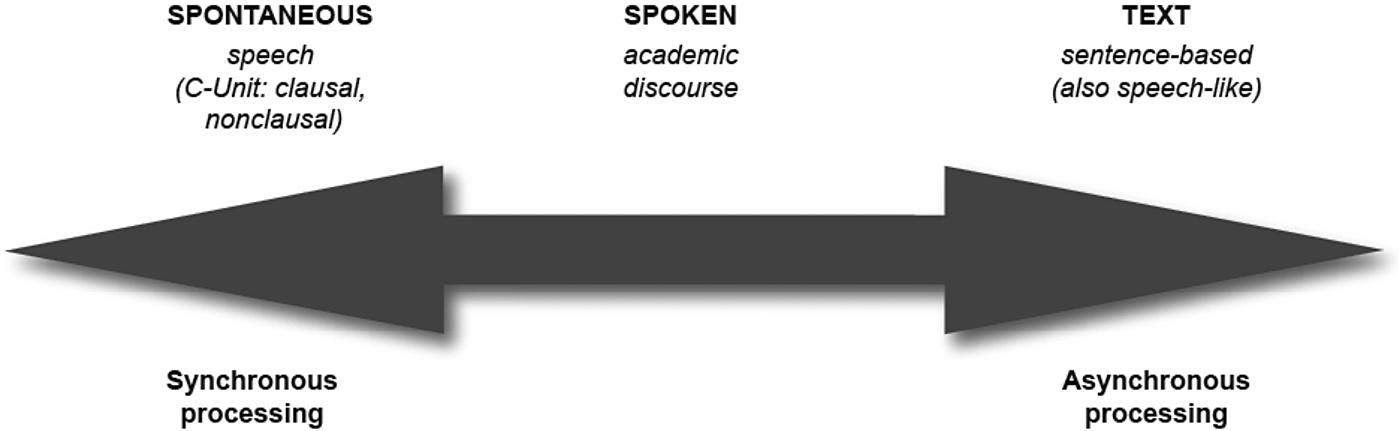
Traditionally, the discussion regarding the definition of what counts as maximal or minimal units in conversation and in written text has been framed within the paradigm of the comparative ‘sentencehood’ (Biber et al., Reference Biber, Johansson, Leech, Conrad and Finegan1999) and non-sentencehood, respectively. However, it is possible to assert that both speech and written text represent distinctive end points on a language continuum where sentences and micro-clauses account for different registers used by speakers in both synchronous (online) processing and asynchronous, text-based communication. The more one moves to the text end on the continuum, the greater the amount of text-like sentences there will be. Conversely, the more one moves to the speech end on the continuum, the higher the level of spontaneous utterance production. It is obvious that, at the centre of the continuum represented in Figure 4, the written and spoken systems are indistinguishable from one another, especially from the practitioner's perspective. Certainly, the teacher's primary task consists in defining the pedagogical tenets of CG in the classroom and not of presenting a review of discrete categories.
Register continuum.
The transcription of a video interview (see Figure 5) shows how information (added in an incremental pattern) allows discourse elements to attach themselves to other structures in the discourse. I have called this process ‘micro-clausing’, because it describes the segmentation process of discourse into small meaningful units, C-units (clausal, non-clausal), a term coined by Biber et al. (Reference Biber, Johansson, Leech, Conrad and Finegan1999). The term micro-clausing is somewhat more useful in that it simultaneously describes the way C-units attach themselves to other syntactic constituents, thereby broadening the notion of add-on principle used by Biber et al. (Reference Biber, Johansson, Leech, Conrad and Finegan1999).
Summary of speech functions in a sample text.
In the particular sample described in Figure 5, the frequency of clausal units (S + V) is extremely high; this reveals that speech is not only a ‘chain-of-phrases-instead-of- sentences’ phenomenon. On the other hand, the frequency of inserts (like you know) is a characteristic of spontaneous speech, indicating the synchronous elaboration of discourse constrained by real-time processing. Interestingly, real-time processing does not affect the production of content words here (verbs, adjectives, adverbs, and nouns), whereas only two HSs (‘kind of’) are produced. In contrast, dysfluencies, hesitation pauses, and incompletions are more frequent in the first part of the sample.
Establishing the relevance of HSs to EFL teaching
I now turn to explore the inclusion of formulaic sequences (lexical phrases) in the EFL classroom. Defined as syntactically and paradigmatically stable strings of words functioning as lexical units, lexical phrases have a significant role in conversation given their ready-made nature (Nattinger & DeCarrico, Reference Nattinger and DeCarrico1992). Indeed, formulaic sequences provide speakers with a repertoire of prefabricated pieces of information that can be stored and retrieved holistically from the mental lexicon and can be attached to creatively assembled structures to increase fluency. The use of ready-made sequences serves a number of pragmalinguistic purposes as well. In this sense, the choice of HSs for the teaching of spoken grammar in EFL contexts serves two main purposes: firstly, lexical units such as kind of and sort of contribute to reduce reference specification; secondly, they are easy to slot into utterances without altering the structure of neighbouring syntactic constituents, resulting in fluency increments. To illustrate, consider:
(1) I'd kind of gone to the movies all my life.
Indeed, this type of lexical sequence shares the same lexico-grammatical nature of other functional structures used in spontaneous speech (part of the CFC), such as retrospective vagueness tags (e.g. and things like that, something like that), modifying expressions (a bit, a little bit), and inserts (you know, I mean), etc., a characteristic that makes them rank high in the scale of teachability.
The CFC
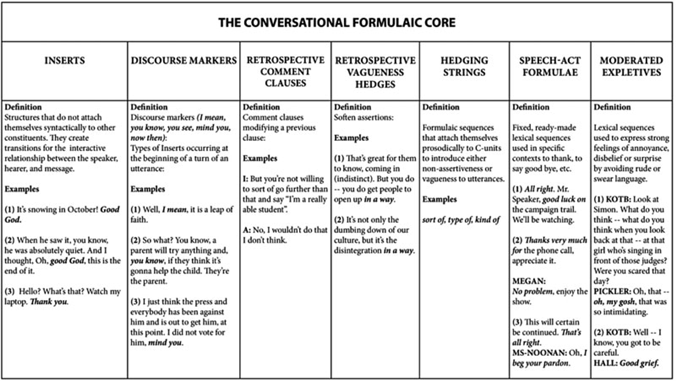
The CFC is intended to provide teachers with a set of formulaic sequences conveying pragmalinguistic meaning. These sequences follow generalizable slotting patterns that can be used in the EFL classroom for conversational models of interaction. Some of the core formulaic strings are: modifying expressions, inserts, discourse markers, retrospective comment clauses, speech formulae, and moderated expletives. Table 1 provides an overview of the whole set.
The CFC
The CFC is a practical turn drawing on specific features, such as:
(1) Ready-made structure;
(2) Predictable attachment patterns to other syntactic constituents, or peripheral (prosodic) attachment by means of micro-clausing;
(3) Construction-led input enhancement (formation of concrete-abstract pairings);
(4) Pragmalinguistic value to convey meaning in various types of informal interactions;
(5) Learnability through the medium of noticing tasks in order to develop form-function-context mappings;
(6) Socio-pragmatic relevance.
Towards a teachable taxonomy of HSs
The first advantage of HSs is the way in which they attach to other syntactic constituents in any given utterance. HSs follow predictable slotting patterns that contribute to their generalizability in the teaching of CG. More explicitly, certain adjacency patterns (the term is not used here in the sense of Chomskyan generative grammars) predict that HSs are placed next to specific constituents in the clause. Thus, HSs are adjacent to other syntactic constituents such as adverbs, adjectives, noun phrases, verbs, past participles, and other lexical sequences. These patterns provide valuable information that introduces learners to productive combinations of prefabricated language in spontaneous speech.
It is precisely the way in which these lexical phrases combine with each other in socio-pragmatic contexts that learners are expected to produce in EFL context. To this end, it is proposed that a balanced combination of informal conversation strategies and interactional discourse strategies (of the type used in lectures, classroom exchanges, etc.) be in place. It is argued that this type of instruction will have a beneficial effect on language acquisition, for example, by improving levels of self-efficacy (learners' interpretation of the results of previous performance that regulates motivation; Bandura, Reference Bandura1993, Reference Bandura1997).
From a pragmatic perspective, I define HSs as word strings bestowed of pragmatic qualities labeled under the umbrella term of hedging. Authors like Fraser (Reference Fraser2010) have divided hedging-driven words into two main categories: propositional hedging (‘lack of commitment to either the full semantic membership of an expression’, e.g. He's really like a geek, p. 22) and speech act hedging (‘the full commitment to the force of the speech act being conveyed’, e.g. Come over here, can you? p. 22).
From a pragmalinguistic perspective, I have divided HSs into three main categories: utterance softeners, vagueness prompters, and conversational fillers. This classification takes into account pedagogically productive semantic nuances of specific lexical sequences (kind of, sort of) to convey pragmalinguistic information. Each of these will now be discussed in turn. (All examples are taken from the COCA.)
Utterance softeners
This type of HS is used in spontaneous speech to soften assertions or personal attitudes implied in an utterance. Utterance softeners contribute to the stability of relationships by making the speaker sound less assertive in stating the value of truth of an utterance or his/her degree of conviction about what is being said. These devices draw largely on shared context, as in the following example:
SNYDERMAN: ‘Of course it's sexy because there is a barrier and allows you to sort of < HS > be < V > a little more flirtatious than if you were being face to face < C > .’
Structure: HS + V + C (Hedging string + verb + complement)
Pragmalinguistic function: Makes the utterance sound less assertive.
Source:Star Jones, Nancy Snyderman and Donny Deutsch discuss Demi Moore, Starbucks, sexting and cuddling, NBC Today, 2012.
Vagueness prompters
One of the key aspects that distinguish utterance softeners from vagueness prompters is that the latter introduce a shade of uncertainty to the description of events, concepts, people, etc. Vagueness prompters create mental pictures of concepts, thereby reducing cognitive load in real-time processing, as in the following:
Mr–JOHNSON: ‘A lot of people get stuck behind the screen at work, so we're going to sort of < HS > like < CV > unlock < V > them.’
Structure: HS + CV (conversational filler) + V
Pragmalinguistic function: Introduces vagueness.
Source:Kathie Lee and Hoda discuss current events, NBC Today, 2012.
Conversational fillers
As the name suggests, conversational fillers are used to keep the discourse flowing. They prevent silent pauses that could impede successful communication. The following example is typical:
ROBIN-ROBERTS-1-A#: ‘It's kind of < HS > like < CF > emotional < Adj > roulette that you went through.’
Structure:HS (conversational filler) + CF (conversational filler) + Adj
Pragmalinguistic function: Fosters fluency by avoiding silent pauses.
Source:TAKEN; 12 HOURS OF TERROR CAUGHT ON TAPE, ABC 20/20, 2012.
A constructionist approach to language processing
The next step in designing a rationale for the implementation of a speech-based teaching of HSs (or of other conversational elements) consists in defining a suitable approach to language processing. Since the overall aim of this article is to determine the extent to which speech functions (perforce a categorial construct) are susceptible to being taught, the contribution of an approach to language processing largely grounded on categorizations (constructions) seems to provide justification for the development of teaching practices aiming at providing access to corpus-based language. In this sense, constructionist approaches to language processing (Gentner, Loewenstein & Hung, Reference Gentner, Loewenstein and Hung2007; Goldberg, Reference Goldberg1995; Goldberg, Reference Goldberg2006) are particularly promising. Constructionist approaches start from the assumption that knowledge is based on form-function pairings termed ‘constructions’ (Culicover & Jackendoff, Reference Culicover and Jackendoff2005; Goldberg, Reference Goldberg1995, Reference Goldberg2006). These constructions are perceived as concrete-abstract instances of concepts (form-meaning pairings) that can be actually learned without the intervention of innate language frameworks (Universal Grammars) through the medium of general cognitive mechanisms.
The process of language acquisition is therefore viewed as one of categorization. This means that, once a set of abstract constructions is in place, further constructions can be built on the patterns of the first constructions. In this sense, language is not ‘generated’ on the basis of a genetic endowment, but ‘constructed’ from the association of form and meaning in a process leading to the assembling of novel structures following already learned patterns. To illustrate the relationship between concrete and abstract structures (bearing the underlying form-function pairings to be acquired and applied to a further categorization of novel structures), consider the following analyses of two samples from the COCA:
Sample 1:
CONCRETE: ‘And was it the first time that you kind of <HS> leaned on <NP> somebody else?’
ABSTRACT: HS + V + NP
Sample 2:
CONCRETE: ‘I think they're kind of < HS > like < Prep > Bruce Willis < O > in “The Sixth Sense < A > ”.’
ABSTRACT: HS + Prep + O + A
The association of form (abstract construction) with meaning (concrete construction) allows the construction of novel utterances drawing on the pattern HS + V + __ (V, Adj, NP, etc.). Thus, the large construction ‘I bought a book yesterday' and the abstract Subj + V + Ob + A configure a large construction pair. This correspondence between concrete and abstract constructions allows learners to associate form and function. Therefore, learners become aware of the dynamics of novel construction on the basis of the first pattern.
However, the learner-input relationship (a psycholinguistic approach) must be paired with a clear definition of the nature of the rules needed to make the target structure accessible to the learners (pedagogical approach). This leads us to a consideration of what kinds of classroom activities might promote this.
Activities
We may now begin to take a closer look at corpus-aided grammar from a task-led perspective. As stated in the introduction to this article, the use of corpora in EFL does not always entail the mediation of technological tools in the classroom. It therefore follows that, by looking outward from a corpus-driven framework, tasks may adopt a range of different forms, such as the following:
(1) Paper-based materials: assorted samples of natural language extracted from free-access corpora such as the BNC and COCA can be adapted to paper formats for classroom use;
(2) Newspaper articles, magazines, etc., can be used as corpora to search collocations to further language learning offline;
(3) Video interviews can be downloaded from sites like YouTube and played offline in the classroom.
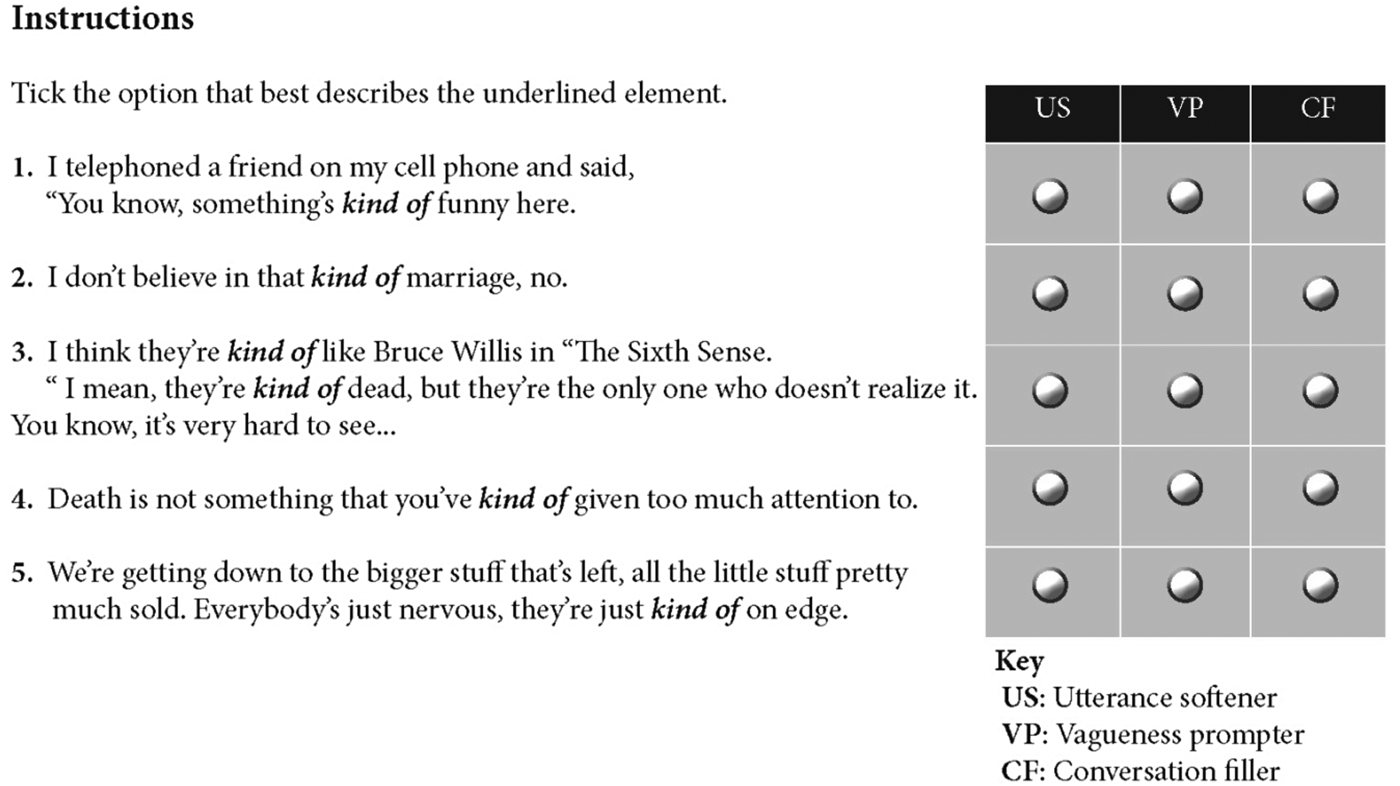
An illustrative example of one such corpus-aided grammar task is provided in Figure 6.
An example of a corpus-aided grammar task.
The benefits that both teachers and learners can accrue from analyzing specific context-based samples of natural language (native and non-native) in this way are manifold and go far beyond the debate over how much technology is really necessary in language learning. It is evident, on the other hand, that the proliferation of internet-based resources in conjunction with developments in technology like mobile devices have widened the scope for the exploration of language teaching modes inspired by conversational features. Such kinds of innovative practices may also result in enhanced learning experiences of the type that Warschauer, Shetzer & Meloni (Reference Warschauer, Shetzer and Meloni2000) summarize with the acronym ALIVE: authenticity, literacy, interaction, vitality, and empowerment.
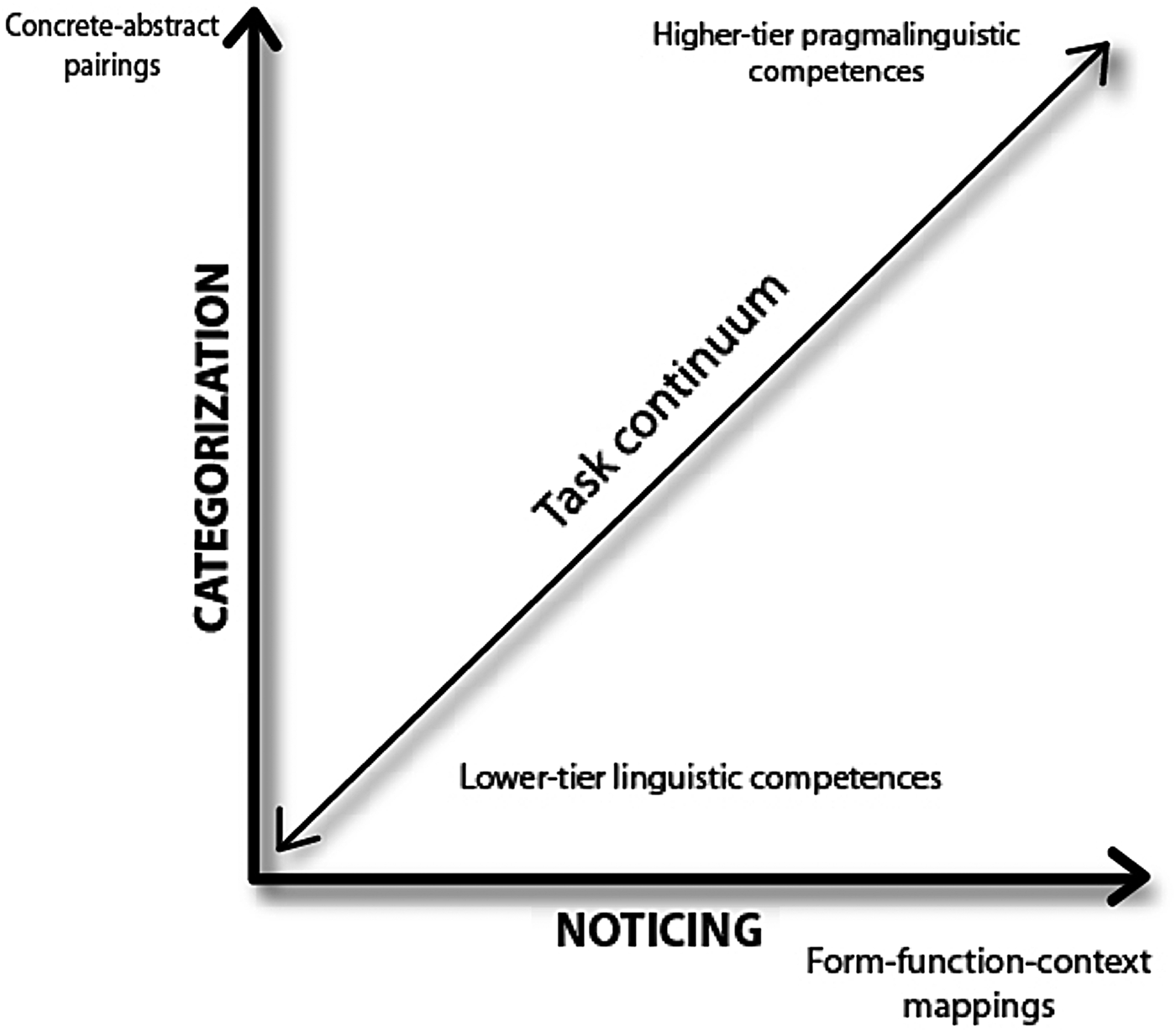
The activities suggested in this paper can be divided into two categories: noticing and categorization activities. There is no binding set of rules as to when to introduce either noticing or categorization tasks. However, activities should be classified in a gradient way in a continuum ranging from lower-tier (linguistically led) to higher-tier (pragmatically led) levels of use, as shown in Figure 7. On the whole, this continuum represents instances tailored to and contingent upon specific learning goals in courses drawing on conversational features.
Task continuum.
Conclusion
In this article, I have attempted to put forward a rationale for the teaching of CG. This rationale has been structured from the point of view of both the terminological elaboration of concepts and the instructional re-evaluation of what should be considered as a pedagogically driven conceptualization of spontaneous speech in EFL classrooms. I have argued that both a pragmalinguistic acquisition model and a constructionist language processing approach are necessary to tackle the complexities of the implementation of L1 models in L2 contexts, serving as a nexus between corpus-based data and learners' needs. I have therefore bypassed the discussion of language ownership to concentrate on the core aspects of a comprehensive corpus-competence-motivated grammar, describing the influence of speech functions on the actual production of utterances in spontaneous conversation. In this vein, I have attached myself conceptually to a constructionist approach to language processing, coupled with a pragmalinguistic and socio-pragmatic structuring of knowledge by means of noticing-driven input. Thus, the terms hedging strings describing conversational elements, micro-clausing defining the patterns of utterance attachment in spontaneous speech, and reference reduction describing hedging functions have been utilized to introduce clear distinctions where the vagueness of ‘grammatical descriptivism’ may conspire against a more practical application of these important theoretical concepts in EFL teaching.
SERGIO TORRES-MARTÍNEZ holds a PhD in Applied
Linguistics. He has created a number of tools designed to bridge the gap between
technology and language teaching in Colombia. Among his main interests are interaction
design, Content and Language Integrated Learning (CLIL) and English for Academic
Purposes (EAP) curricula design in English and French, and the definition of best
practices in the teaching of spoken grammar in English. Email: surtr_2000@yahoo.es