Introduction
Terms of address are universally seen as a tool used to build social relations between speakers and hearers. Terms of address ‘help establish or maintain social bonds, strengthen solidarity and control social distance’ (Gu, Reference Gu1990: 249), although ways of addressing vary from culture to culture. Therefore, the proper choice of address terms is a prerequisite for a successful interaction. Inappropriate use of address terms may lead to misunderstandings and hinder communication.
China, where there is a ‘large power distance situation’ (Hofstede, Reference Hofstede2007: 101), is widely known as a nation of social hierarchy and rituals, meaning that a speaker in an interaction consciously chooses different and complicated address terms based on certain communication rules that may significantly differ from more solidarity-oriented Western situations. Gu (Reference Gu1990: 249–50) notes three differences between Chinese and English address systems which are likely to cause problems in intercultural communications: (1) a Chinese proper name is arranged in the order of surname + given name whereas the reverse is the case with an English proper name; (2) some Chinese kinship terms have extended and generalized usage, which is usually unacceptable in English (for example, shushu ‘uncle’ can be used to address a man who is the age of the addresser's father but who is not a relative); (3) most occupational titles can be used as address terms in Chinese but not necessarily in the same manner as in English, the most typical example being laoshi ‘teacher’. How to address teachers in English has aroused great interest among researchers, many of whom think it unacceptable to use teacher as an address term. However, the authors of this paper supported by a survey, argue that teacher is a more culturally and contextually appropriate address term than the Western way of title + surname/Sir or Miss/given name, as it better represents the Chinese sense of respect and politeness.
Teacher as an address term in China
In China, a student meeting a teacher will employ the greeting laoshi hao! If English is used, this will be ‘Hello, teacher!’ Other greetings are ‘How are you, teacher?’ and ‘Good morning/afternoon/evening, teacher!’ (‘Good morning, teacher’ is used hereafter to refer to all of these terms).
Laoshi, as an occupational title, can also be used as an honorific address term in Chinese, but in English teacher refers to a profession and is not a form of address. Oatey (Reference Oatey and Hu1988: 47), a British researcher, found that Chinese speakers frequently have problems with knowing how to address foreigners and errors often occur, one of the most frequent being the use of the word teacher. Chinese textbooks train pupils from an early age to use expressions like ‘Good morning, teacher’. In a morning English class in many primary and middle schools, the teacher enters the classroom and the following greeting is likely to occur:
Monitor (loudly): Stand up! Students: (standing up together, simultaneously uttering their greeting energetically): Good morning, teacher!
Teacher: Good morning, students! Sit down please! Now class begins!
Oatey thinks this greeting is unacceptable if English is used and holds that the usual forms of address for teachers in Britain should be employed:
Primary and secondary schools: title + surname or Sir/Miss
University or college: title + surname or given name (Oatey, Reference Oatey and Hu1988: 47).
Oatey's view is shared by many Chinese researchers (Gu, Reference Gu1992; Lin, Reference Lin1996; Tang and Liu, Reference Tang and Liu2004; Wang, Reference Wang2011; Yang, Reference Yang2014, etc.). They view ‘Good morning, teacher’ as unacceptable because it is either a case of ‘misuse’ or ‘pragmatic failure’.
Despite these views, Chinese students to this day when using English are still unaccustomed to calling their teachers by their title + surname, Sir/Miss or given name. Instead, they habitually address them as teacher. Tang (Reference Tang2005: 22), in her survey investigating how 60 university students addressed their teachers in English, found that it was ‘unavoidable for them to transfer their habitual Chinese mode of address into English’. In another survey, Wang (Reference Wang2011: 50) reported that the great majority of her university respondents addressed both their Chinese English teachers and expatriate teachers as teacher.
The word teacher as an address form has clearly become fossilized. This is illustrated by the following instances collected by the first author of the paper.
-
1) At a recent thesis defence for the 2015 bachelor degree graduates majoring in English at the authors’ university, which she attended as a member of the board of examiners, she noticed that 10 out of the 12 graduates began their defense with ‘Good afternoon, my dear teachers …’
-
2) In an interview recently held at the same university for those students who were applying to do a master's degree, the same author noted the following exchange between a female candidate (C) and a teacher (T):
C: Good morning! Distinguished professors and teachers, my name is …
T: Your greeting is a little bit redundant. Just say ‘distinguished teachers’.
C: Thank you, teacher, for correcting my mistake!
-
3) In a recent China Central Television programme entitled Journey to Civilization: Knowledge about Greetings (2011), the host asked two guests from the audience to act out how a teacher and a student greeted each other in their day-to-day life. This is what they said:
Teacher: Chenhong,nihao! (subtitle: ‘Hello, Chen Hong!’)
Student: Laoshi hao (subtitle: ‘Hello, teacher!’)
Further evidence for the use of teacher as an address form can be provided. From the above examples, we can see that teacher as an address term is not only used by students ranging from primary school to university age, but also by Chinese English teachers. It is found in the influential media in China regardless of the addresser's English level. This raises the following questions: Is the greeting ‘Good morning, teacher’ really unacceptable as Oatey and many other researchers think it is? Is the Western way of title + surname/Sir or Miss/given name really appropriate in a Chinese situation? Before endeavouring to answer these questions, we need to find out why teacher has become so frequently used as an address term by Chinese speakers of English and what the connotations of teacher are in Chinese traditional culture.
Teacher and Confucius
Confucius (551–479 B.C.), as a great thinker, educator, transmitter of culture and the founder of the philosophy to which he gave his name, is perhaps better known in the West than any other Chinese person. Regarded as the first person in Chinese history to teach large numbers of students in a private capacity, Confucius taught his disciples the ancient classics. As an educator, he put forward many educational theories and ideas, one of the most influential being the emphasis on the importance of students’ moral education. Under the influence of Confucius, Chinese teachers of later generations all believed that teachers should not only devote themselves to increasing students’ knowledge, but also help to broaden their minds and enhance their spiritual ethos.
Confucius was primarily a teacher, one among many. But after his death, he gradually came to be considered as the teacher, superior to all others, regarded as even more than a king, a divine being (Fung, Reference Fung and Zhao2012: 381). As ‘a great mountain of knowledge and morality’ in China, he ‘held a position rather similar to that held in ancient Greece by Socrates’ (Hofstede, Reference Hofstede2007: 354). This image of the teacher has profoundly influenced all the teachers of later generations up to the present time who consider that when they are addressed as ‘teacher’, they are being linked with the great learning and great virtue associated with Confucius. Furthermore, addressing a teacher as ‘teacher’ is a Chinese way to show addressers’ politeness.
Teacher and Chinese politeness
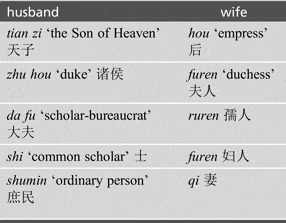
Confucianism is still the mainstream of Chinese thought. Living at a time when there were constant wars between feudal states, and social and political turmoil prevailed, Confucius advocated measures that he hoped would change the situation. He maintained that an ideal society could be built if what he called zhengming (the rectification of names) was practised, meaning ‘to put each individual in their place according to their social position’ (Gu, Reference Gu1990: 238). The right principle of practising zhengming in order to establish a good society is to let ‘the ruler be ruler, the subject subject, the father father, the son son’ (Chen, Reference Chen2007: 186). This kind of social order, based on unequal relationships between people, gave rise to power-based li (rituals) and limao (politeness), from which a strict and complicated address system derives. This system requires that address terms should be properly used and at all times adhered to. For example, in The Book of Rituals (Jin & Ge, Reference Jin and Ge1998: 895), there is a special section about hierarchical address terms for a wife according to the husband's social status in ancient China (see Table 1).
Hierarchical address terms for husband and wife in ancient China

As Fung notes, ‘[e]very name contains certain implications which constitute the essence of that class of things to which this name applies. Such things, therefore, should agree with this ideal essence’ (2012: 374–375). The essence of a teacher is what the teacher ideally ought to be, or what, in Chinese, is called wei shi zhi dao, ‘the way of the teacher’, that is, a person of great knowledge and sound virtue who, as a model, educates students in the full sense of the word. The teacher-student relationship is more like that of father and son. An old Chinese saying vividly depicts this relationship, i.e. yi ri wei shi, zhong shen wei fu ‘a teacher for a day is a father for a lifetime’.
Addressing a teacher as ‘teacher’ indicates teachers’ high social status and students’ respect, which typically conforms to the core of Chinese limao (politeness) in the sense of ‘denigrating self and elevating others’, the most important principle in The Book of Rituals. A writer might tend to use a self-denigrating expression zhuo zhu ‘bad works’ to refer to their own writing but call that of others dazuo,‘a great work’. When two Chinese people (S1 and S2) meet, they may start to talk like this:
-
S1: Nin zunxing daming?
You precious surname great given name?
‘Your precious surname and great given name, please?’
-
S2: Jian xing Wang. Liulao nin gaoshou?
Worthless surname Wang. Liu old you great age
‘My worthless surname is Wang. How many years have you reached, venerable Mr. Liu?’
In Chinese tradition, if you say ‘you are my teacher’, you put yourself in the position of student. It means that you should definitely view yourself as one who has not learned enough and is not good enough in any respect, while viewing the teacher as somebody from whom you can learn, ask advice and whom you can respect. That is how Chinese people communicate.
The Chinese or Western way?
The address rule requires that you address your interlocutor with an appropriate address term, which is based on the notions of respectfulness and attitudinal warmth and can be seen as being essentially an expression of linguistic politeness (Gu, Reference Gu1990: 248). Influenced by Confucian ethics, laoshi ‘teacher’ becomes a culture-specific expression. As we saw earlier, the true meaning of laoshi is that of somebody who not only imparts knowledge to students, but who is also a learned person of high morals and whose mission it is to pass on the great features of human civilization. Great learning and moral integrity make a teacher a model for students. Title + surname, or Sir/Miss or given name are not, as suggested by Oatey (Reference Oatey and Hu1988: 47), the equivalent of laoshi and therefore are unsuitable in the Chinese setting. Only if one is addressing a teacher who is also a professor might the first English form of address be used.
The titles of Sir, Mr. + surname, usually seen in Western societies, are used as general honorifics for men from all walks of life, be they professors, politicians, policemen or street cleaners. However, teacher carries special weight, only referring to laoshi, and so is a much more polite address term than Sir or Mr. + family name. The given name is used as a common address form in the solidarity-based West regardless of the addressee's age, social status, occupational title and kinship. But this is seldom the case in China. In a vertical relationship, it would be extremely impolite for the younger generation to address the elderly by their names except in unusual situations. A few years ago, some students in a Chinese university put up a slogan on the balcony of their dormitory which read ‘Zheng Jianlong, come to eat in the students’ canteen!’ (Meng, Reference Meng2010: 35). The name of Zheng Jianlong, the university president, was used without his title to show the students’ great anger and dissatisfaction with the canteen food. Also, the use of given names may cause misunderstandings. If a Chinese lady's full name is Li Yulan and she is addressed by her given name, Yulan, by a male who is neither a relative nor a close friend, she may feel greatly embarrassed, thinking that the addresser is hoping for an intimate relationship.
Using the term Miss, as pointed out by Oatey (Reference Oatey and Hu1988: 47), to address a female teacher, is even more inappropriate. The closest equivalent of Miss in Chinese is xiaojie,which actually does not have much to do with laoshi. Xiaojie as an address form has semantically gone full circle and after hundreds of years has gone back to its original meaning. It made its debut applied to girls in brothels during the Song Dynasty (960–1279). The meaning changed dramatically, however, in the Yuan Dynasty (1271–1368) when the expression was used to refer to unmarried ladies in high status families. From the Ming Dynasty (1368–1644), xiaojie became an honorific to refer to respectable ladies in boudoirs (Tian, Reference Tian1998: 310–11). The quick tempo of life in the modern material society brings about rapid semantic changes in language. Xiaojie, after leading an aristocratic life for some time, has lost its status, falling back from referring to girls in decent families to its original meaning of girls in brothels. Nowadays, xiaojie is often associated with pornographic services such as zuo tai xiaojie (bar girls offering a sex service) (Yang, Reference Yang2004: 85). Due to its derogatory meaning, some young women now refuse to be addressed as xiaojie.
Survey
In order to find out how non-Chinese view teacher as an address term, a survey was conducted at China Three Gorges University involving seven non-Chinese teachers and 182 non-Chinese students, mainly from Asia (India, Pakistan, Nepal, Bangladesh) with a small number from Europe, America and Africa. The students were all asked to go to a big classroom on the same day where the authors distributed the questionnaire sheets and gave instructions. It took the students approximately 15 minutes to answer the questionnaire. The teachers’ answers were collected via email. The following questionnaire was distributed and all the participants were required to give a written response:
In China, teachers are always greeted by their students in English like ‘Good morning, teacher!’
-
(1) Do you think this way of greeting in Chinese English style is acceptable?
Why or why not?
-
(2) If not, what is your preferred way?
The results of the survey indicate that 177 (94%) of the participants view ‘Good morning, teacher’ as acceptable with only 12 (6%) viewing it as unacceptable (see Table 2).
Acceptability of ‘Good morning, teacher’

The words polite, respect and love are the most frequently employed by most of the participants to account for their choice. An Indian student sets out his reason as follows:
This greeting is awesome. Here the students together say ‘Good morning, teacher!’ This is the symbol of a good culture. In India, teachers were called guru which had a similar meaning to teacher or master, a high position in students mind. There is a metaphor that ‘teacher comes first and then God’ because teacher is the person that gives us the knowledge about God. Teachers are the ones who show us good path like our parents, so they definitely deserve a respectful greeting. But sadly, then the western civilization came to be formed, our country like many others is now changing. We address teachers as madam/sir instead of guru.
This view is strongly supported by a Bangladeshi girl who writes:
The teacher-student relationship is really amazing here. I see that the Chinese students here greet by saying ‘Good morning teacher’. I really like that thing. I feel they are really attached with their teachers and have a different kind of emotional bond between them, which in our country does not exist. Even though I don't really know Chinese well I feel that the word teacher (laoshi) holds a lot of respect, gratitude, honesty and love.
An American teacher responds:
In China the respect students give to their teachers is far greater than in any other country. It's an honorific title given to teachers but in English there is no such hierarchical addressing of teacher. Chinese people are fortunate to be part of this good culture.
Of all the 189 respondents, 12 consider ‘Good morning, teacher’ unacceptable, saying that ‘teacher’ as an address term makes them feel ‘strange’, ‘not used to it’, preferring the Sir/Miss type. It is likely that after they stay in China longer, they will get used to this form of address and begin to appreciate it after understanding the underlying meaning. One Danish girl writes:
In my country teacher just means an occupation but here teacher means showing respect; the job is highly appreciated here. Calling one person as a teacher and respecting their occupation creates a bond of love and respect. Students feel good attending the class, the teacher loves the students and this bond grows stronger. The first day I attended the class, I was quite surprised seeing students call teacher as teacher, strange feeling to me, but now got used to it and really like the way. Chinese teachers here have been really good to us. It's like ‘a home far away from home’.
The excerpts above show that, after staying in China for some time, the respondents find that teacher, which can be used as an address form, indicates students’ respect for teachers. Teachers are looked upon as ‘gurus’ by students. The respondents positively interpret this address form as ‘a symbol of a good culture’ where students are seen to be ‘really attached with their teachers’ and caught in a close bond. Interestingly, these respondents all compare this way of addressing teachers with their own ways back home. The Indian student is sad that teachers are addressed as ‘madam/sir’ instead of ‘guru’ due to the influence of Western civilization. The Bangladeshi participant writes that the ‘amazing’ teacher-student relationship she sees in China ‘does not exist’ in her country. The American respondent, a teacher himself, finds that teachers in China are much more respected than in any other country. In a similar vein, the Danish respondent observes that calling somebody a teacher creates a bond of love. She also finds that students ‘feel good attending the class, the teacher loves the students and this bond grows stronger’. Although she was quite surprised at seeing teachers called teacher at the beginning, she has become used to it soon and even finds pleasure in using this form of address.
These respondents’ findings were also observed by Dolton (Reference Dolton2013), who conducted a survey involving 21,000 people across 21 Asian, European, South American and Middle-Eastern countries regarding teacher status, the first large-scale international comparison of the status of teachers. The results show that teachers had the highest status in China and that in European countries, between only 10 and 25% of people tended to think that pupils respected teachers, compared to 75% in China. Teaching is indeed treated with reverence in China, and one of the ways to show reverence, is the use of teacher as an honorific, which, as the respondents have rightly come to realize, is associated with love, respect, knowledge and morality. Therefore, they feel that calling a teacher teacher is culturally even more meaningful and respectful than any other way of doing so commonly practised in Western countries.
Conclusion
Address terms fall into two categories: reciprocal/symmetrical and nonreciprocal/asymmetrical. Influenced by social structures, traditional ethics and kinship, the Chinese address system tends to be more nonreciprocal and power-based, which is a symbol of the vertical structure (Jia, Reference Jia2013: 334), and ‘Good morning, teacher’ is the manifestation of this structure. However, in many Western countries influenced by individualism, the address system is more reciprocal and solidarity-based and people employ expressions like ‘Good morning’ + addressee's given name. The great majority of the international participants in the survey realize this difference and readily accept the power-based form of the address ‘Good morning, teacher’.
Therefore, it is important to remember that addressing rules are both culturally and contextually bound. Expatriate teachers in China, Chinese English teachers and researchers need to know that ‘Good morning, teacher!’ conveys the unique Chinese concept of politeness for teachers, which is more culturally appropriate than the ‘English way’ of addressing teachers, especially when used in the Chinese context. China needs to maintain this distinguishing principle and practice of communication. After all, diversity is the spice of life and we should maintain our delight in uncovering differences.
 HU XIAOQIONG is professor in the College of Foreign Languages, Three Gorges University, China. More than forty of her papers have been published in a variety of Chinese and international journals focusing on applied linguistics, sociolinguistics and intercultural communication studies. Her special interest is China English studies in the ELF context. Email: huxiaoqiong@aliyun.com
 LUO SIQI is currently a master-degree student majoring in linguistics in the College of Foreign Languages, Three Gorges University, China. She is interested in Applied Linguistics and China English studies. Email:1473350252@qq.com