1. Introduction
The longstanding vernacular literary pedigree of the county of Lancashire has made it home to a large body of regional writings comparable only to those of the neighbouring Yorkshire. Both past and present scholarship have acknowledged this fact, arguing that the literary tradition of the dialect may be taken as a source to get some insight into the linguistic history of the county. Research so far concentrated on the linguistic mining of Lancashire literary texts has shown that they provide valuable guidance to approach the language of bygone times, especially in terms of phonology and morphology (see Brunner, Reference Brunner1920; Haworth, Reference Haworth1920, Reference Haworth and Haworth1927; Whitehall, Reference Whitehall1929; Shorrocks, Reference Shorrocks1988, Reference Shorrocks1992, Reference Shorrocks, Hoenselaars and Buning1999; Wagner, Reference Wagner1999; Ruano-García, Reference Ruano-García2007, 2010b). To my knowledge, there is however little research that has attempted to evaluate the lexicographic potential of these documents, and their contribution to Joseph Wright's English Dialect Dictionary (henceforth EDD), so as to further our understanding of lexical variation in regional Englishes of the Late Modern English period (LModE).
This paper places Lancashire literature in the context of LModE dialect lexicography, with special emphasis on the EDD. As is well known, Wright's work built upon its sources and quotations, with the purpose of illustrating the history of British dialect words over the period 1700–1900. Amongst other supporting written sources, it was constructed from literary works in which regional varieties of English were reproduced. My aim is to evaluate the contribution of Lancashire literature to the EDD with the aid of the electronic version of the dictionary which is under development at the University of Innsbruck (Markus et al., Reference Markus2010). In particular, my purpose is to examine the extent to which Wright relied on these sources in his coverage of the Lancashire vocabulary, as well as to show what these literary artefacts can tell us about variation in the lexicon of regional dialects.
2. Lancashire literature: a brief diachronic survey
Unlike many other English counties, Lancashire can show a longstanding literary tradition which dates back to, at least, the seventeenth century. The episode of witchcraft which attracted the attention of early modern playwrights such as Thomas Heywood, Richard Brome and Thomas Shadwell provides a first image of the way the county was to be reproduced in the literary discourse. An attempt was made to render both the language and the cultural idiosyncrasy of the Lancashireman in seventeenth-century plays, providing a sketchy, but interesting, testimony to contemporary views and attitudes towards the county. However, it was not until the 1690s that the first, and probably the only, early modern Lancashire specimen was transcribed. Predecessor of John Collier's A View of the Lancashire Dialect (1746), the unprinted ‘A Lancashire Tale’ (c1690–1730) may be taken as a pivotal early literary witness to the language of the county (see Ruano-García, 2010a). As is the case with Meriton's Yorkshire Dialogue (1683), the document bears witness to the beginnings of English dialect literature, Lancashire speech being used for a non-serious and daily affair.
The LModE period testifies to numerous Lancashire-based writings, although differences between the eighteenth and the nineteenth centuries are to be observed. García-Bermejo Giner (Reference García-Bermejo Giner, Heselwood and Upton2010) indicates that the growing scientific interest in regional variation underlies the relatively more profuse publication of regional works during the 1700s. Works such as Joshua Hole's The Exmoor Scolding (1746) and The Exmoor Courtship (1746) saw the light at the time Collier's celebrated Lancashire dialogue between Tummus and Meary was first published in Manchester. Needless to say, Collier has been looked upon as the founder of Lancashire literature, given the impact that A View of the Lancashire Dialect (1746) had not only within Lancashire boundaries, but in England as a whole. Shorrocks (Reference Shorrocks, Hoenselaars and Buning1999: 88) states that in this work the ‘use of regional dialect creates a local setting, contributes to the realism, is important to the characterization, and was no doubt thought funny per se by the higher classes in the mid-eighteenth century’. He goes on to assert that ‘many later pieces would reflect the same mix of humorous entertainment and antiquarian specimen’ (ibid.). Actually, during the latter half of the eighteenth century some pieces echoed Collier's legacy by rendering the dialect embedded in humour and presenting it as an archaeological relic. As such, Robert Walker's Plebeian Politics (Reference Walker1798) adapted contemporary affairs to the mouths of Whistle-pig and Tum Grunt, two Lancashire clowns, whose language ‘contains a rich vein of forcible expression, the venerable and valuable reliques of the Ancient Anglo-Saxon and Galic [sic] languages’ (Preface: iv).
Russell (Reference Russell2004: 117) argues that ‘Over the late eighteenth century and into the early nineteenth, a growing urban market, increased antiquarian interest in dialect and the inspiration provided by Robert Burns combined to boost dialect writing.’ To this must be necessarily added that the Industrial Revolution, with the growth of large cities, gave way to the emergence of major centres of dialect writing, giving impetus to dialect literatures in the north of the country (Shorrocks, Reference Shorrocks and Penhallurick2000: 86). There is no need to emphasise that Lancashire literary production increased enormously during the nineteenth century as a result of these facts. However, it is to be remarked, as Shorrocks (Reference Shorrocks, Hoenselaars and Buning1999: 89) indicates, that Lancashire dialect specimens of the nineteenth century mostly grew out of working-class culture, being thus not written for humorous or antiquarian purposes, and more specifically addressed to a regional audience. In keeping with other regions, the highest peak of Lancashire writing was during the second half of the 1800s, with a large body of dialect prose and poetry. In fact, during the first half of the nineteenth century a relatively modest number of dialect works appeared, amongst which some folk poetic specimens published in broadsides, almanacs and pamphlets, or novels such as Ainsworth's Lancashire Witches (1848), stand out. By contrast, large quantities of Lancashire writings appeared from the 1850s, when key authors such as Ben Brierley, Samuel Bamford, Edwin Waugh, Samuel Laycock, Mrs G. Linnaeus Banks, James Taylor Staton, Margaret R. Lahee, Jessie Fothergill or James Trafford Clegg developed their literary careers. Along with these Lancashire literary figures, minor writers such as James Bowker, Roger Piketah, Austin Doherty, Charlotte Fergusson or Clara L. Antrobus likewise contributed to the establishment of a literary tradition that extends well into the twentieth century.
The broad quantitative differences observed throughout the history of Lancashire literary production have a bearing not only on the history of Lancashire literature itself, but also on the availability of data if these documents are taken as sources for the dialect of the county. Indeed, linguistic attempts to make sense of early periods are often discouraged, given the relative dearth of localised Lancashire material. By contrast, the LModE period, especially the 1800s, provides a significant body of literary texts, which caters for a diachronic approach to Lancashire English. Joseph Wright so far remains the most outstanding exponent who has made use of the Lancashire literary tradition for linguistic purposes. A considerable amount of data excerpted from the literary representations of Lancashire speech was integrated into his impressive EDD, becoming the only resource hitherto available in which diachronic data from the county are to be found.Footnote 1
3. EDD sources: a general overview
The no fewer than fifty pages of the Bibliography appended to the EDD show the impressive number of documents that give shape to this work. A cursory glance reveals the wide range of material collected, both of a literary and non-literary kind. Generally speaking, the source material for the EDD might be arranged into two broad sections: first, the ‘principal books, MSS., etc. quoted in the dictionary’ (Wright, Reference Wright and Wright1981b: 1–42); second, the ‘Works of general reference’ which are ‘quoted [within square brackets] at the end of the articles in the dictionary’ (ibid.: 42–50). In the former group, the larger in number and variety of documents, we can find works on regional dialects, including canonical sources for the diachronic study of English varieties: Ellis (Reference Ellis1889, Reference Ellis1890), Grose (Reference Grose1787), Halliwell (Reference Halliwell1847), Ray (Reference Ray1670) and Thomas Wright (Reference Wright1857). In addition, a substantial number of texts related to specific fields of discourse were used. These include pieces on husbandry (Marshall, Reference Marshall1808–18; Young, Reference Young1784–1815); folklore, customs, games and provincial wisdom (Blackley, Reference Blackley1869; Brand, Reference Brand1813); literary texts (Ritson, Reference Ritson1791; Northall, Reference Northall1892); and bibliographies of dialect works (Skeat & Nodal, Reference Skeat, Rev. and Nodal1877; Smith, Reference Smith1839). The core material of this first section, however, consists of hundreds of specifically localised documents such as examples of literary dialects and dialect literature, glossaries of regional terms, private material, almanacs, grammars, diaries and essays that address linguistic issues. The volume and variety of these texts vary in the different regions, Yorkshire and Lancashire being the counties with the wealthiest body of material.
In the second section of the Bibliography, we find a great number of texts that do not provide first-hand testimony to LModE dialects. Here, early literary sources representative of classical medieval and early modern authorities such as Cursor Mundi, Shakespeare and William Dunbar are listed. Also included are numerous bilingual and monolingual dictionaries, along with etymological treatises.
Alongside these two sections, Wright arranged a ‘Select bibliographical list’ which opens some of the volumes of the dictionary. This contains the key source material for the EDD, consisting mainly of localised glossaries arranged by the EDS (see Markus, Reference Markus, van Ostade and van der Wurff2009: 276–8 on other sources, namely unprinted collections and private correspondents). It is worth pointing out that the division of the dictionary's sources into distinct sections is based not only on the kinds of data they provide, but also to the different purposes they serve (see Markus, Reference Markus, Pahta, Taavitsainen, Nevalainen and Tyrkkö2007: 5–6 on the standard entry structure in the EDD).
The documents that form the foundation of the EDD were crucial elements for every entry of the dictionary, for not only did they furnish written evidence on the usage and meaning of certain items, but they also described the geographical distribution of the words collected. The function of the source documents varies. The works in the first section and the glossaries in the ‘Select bibliographical list’ are primarily concerned with exemplifying the usage and distribution of a term. The works of general reference are for the most part quoted with the aim of commenting on etymological matters and word-formation patterns, or are used as cross-references to trace the historical usage of a particular word to earlier works (Markus and Heuberger, Reference Markus and Heuberger2007: 365).
Notwithstanding the variety of sources and their functions, literary texts have an important share in the EDD. A summary look at the Bibliography shows, for example, that 64 of the 98 works listed in the Somerset section correspond with literary documents, and that 96 different writers are listed amongst the Lancashire material, with 241 works in total. How, why and to what extent these textual artefacts were integrated into the dictionary is worth analysing, as it may help us understand Wright's treatment of and reliance on this kind of data in his coverage of the lexical diversity of LModE.
4. Representations of Lancashire speech and the EDD
As is the case with other varieties, the EDD lists different kinds of written sources to exemplify the meaning and usage of Lancashire words. Both the first section of the Bibliography and the ‘Select bibliographical list’ include an important number of texts to which unprinted collections and the information provided by private correspondents are to be added. In particular, Wright relied on 346 sources representative of the Lancashire dialect that are distributed as in Figure 1.
Lancashire sources in the EDD: types and distribution

As Figure 1 shows, literary documents occupy a prominent place amongst them, to the extent that they represent almost 75% of the material, with 241 works listed. It is worth remarking that the literary data are not so numerous if compared with those excerpted from other documents. In this sense, the information retrieved from the EDD Online reveals that glossary data were used much more profusely for the exemplification of lemmata: over 7,000 hits are obtained for glossarial files, whilst 4,345 hits are retrieved from novels, plays and poems. This comes, however, as no surprise given the key role of glossaries in the documentary structure of the dictionary, as Wright himself acknowledged in the Preface to the EDD (see Beal, Reference Beal, Markus, Upton and Heuberger2010).
The electronic searches that can be currently conducted with the aid of the EDD Online make it possible to establish differences such as the above mentioned, as well as with regard to the real use that Wright made of the literary material. A careful analysis of the dictionary entries in which literary data are included shows both that not all the works listed were apparently quoted, and that Wright quoted from sources which were not listed. Author-based searches in the EDD Online allow us to ascertain that of the 241 works listed, only 167 were quoted, thus excluding 74 from insertion into the entries (see Figure 2). Worthy of mention are, for example, Heywood and Brome's The Late Lancashire Witches (1634), Atkinson's The Boggart o' Longsight (n.d.) or Charlotte Fennell's The Calico Printer (1895).
Proportion of literary works which were listed and / but not cited in the EDD

Similarly, the results suggest that 20 different works not listed in the Bibliography were used for citations (Figure 3). They include, for example, Richard Bealey's Wark while yo con (1867), Ben Brierley's Ab-o'th-yate in London (1867) or Margaret Lahee's Kelup's Kermas Goose (1887).
Proportion of literary works which were not listed but cited in the EDD

It is rather hard to elucidate the reasons why Wright listed but excluded, and quoted but did not list certain sources. It seems reasonable to assume that some works were listed because they were representative of the dialect of the county, but were not cited simply because Wright had some kind of preference for other works, or because they did not contain clarifying data for his dictionary enterprise. In this last connection, The Late Lancashire Witches (1634), for example, provides very few Lancashire restricted terms so as to be treated as an indispensable source for quotation purposes.
Whether listed and not quoted, or vice versa, literary sources provide an important proportion of the words that Wright included in the dictionary and marked as Lancashire restricted. It would be advisable to obtain the total number of terms that were given a Lancashire ascription in the EDD so as to quantify and evaluate the exact share that the literary material has in relation to the total amount of Lancashire data. The current version of the EDD Online does not make it possible to carry out such an inspection at the present moment. However, quantification of the data retrieved from author-based queries allows us to ascertain the proportion of terms exemplified by literary documents in the EDD and their distribution per time period: 2,472 words with 4,345 hits in total.
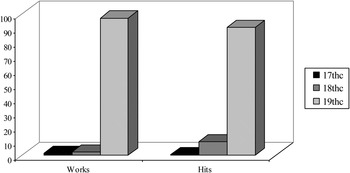
As Figure 4 indicates, there is clear variation between the number of words illustrated by means of 17th-century material and those illustrated by 19th-century data, which shows bias towards the 19th century and the uneven chronological representation of Lancashire words in the EDD. As such, the 17th and 18th centuries are considerably underrepresented, with only 4 works cited for the 1700s, for example (see Figure 5). This is not striking, however, if we consider the number of sources that Wright selected for each time period, or the availability of texts, which is in turn dependent on the literary practices of each period. This also holds true for non-literary works, as glossaries issued during the 1700s, for example, are less abundant than those produced in the 19th century.
Proportion of Lancashire data (hits) illustrated by literary sources: distribution per time period

Chronological representation of Lancashire speech in the EDD: proportion of literary sources and hits per time period

Apart from variation in the number of sources quoted for each period, and the lexical information thereby provided, the treatment of Lancashire literature in the EDD likewise shows variation between the genres considered. Excluding the 17th-century material for obvious reasons, the analysis of the data retrieved from the EDD Online shows a distribution as in Figure 6.
Distribution of genres per time span

Clearly, prose works are the most quoted in the dictionary (140 in total), followed by verse specimens (37 in total), miscellaneous works (6 in total) and drama (2 in total). As expected, most of them were written in the 19th century, especially during the latter half. For example, 112 prose works were produced in the 1800s, out of which 108 were published from 1850 onwards. Similarly, the literary works with no date in the Bibliography were all written by authors whose literary production developed during the 1800s, especially in the second half. From this, it could be assumed that Wright had some obvious kind of preference for prose material. However, it seems more reasonable to think that the outstanding predominance of 19th-century prose works in the coverage of Lancashire English is basically due to the fact that they were available in far larger numbers.
Alongside the chronological and genre bias, it is worth indicating that preference is observed with regard to certain works and authors. A great deal of the Lancashire data contained in the EDD is traced to specific sources. As Figure 7 illustrates, the top Lancashire literary sources in the EDD include Ben Brierley, with 812 quotations and 25 works, followed by Edwin Waugh, with 555 quotations and 32 works (note that 122 quotations are extracted from only one work, Chimney Corner (1874)), and John Collier, with 323 quotations taken from his canonical A View of the Lancashire Dialect (1746).
Top Lancashire literary sources in the EDD (> 100 quotations)

Side by side with these sources, it is worth noting that Wright listed 12 different works written by Margaret Lahee, out of which only 55 quotations are included. Similarly, only 74 citations are taken from Ormerod's important O Ful Tru un Pertikler Okeawnt… (1851), and 55 excerpted from Robert Walker's Plebeian Politics (1798). The lexicographic preference for certain works and authors is somewhat expected given the place that writers such as Ben Brierley, John Collier, Edwin Waugh or Samuel Bamford occupied and still have in the literary tradition of the county. Axon (Reference Axon1870: Preface), for example, stated that ‘The popularity of Mr Waugh's writings […] has given a new impetus to this local literature.’ At the same time, Edwin Waugh praised John Collier and Samuel Bamford as ‘the foremost of all genuine expositors of the characteristics of the Lancashire people’ in his Sketches of Lancashire Life and Localities (1885: ix). Joseph Wright may have also seen the importance of these writers both in literary and linguistic terms, as the numerous examples testifying to the dialect of the county used as citation in the EDD suggest.
As a consequence of this imbalance, the EDD coverage of Lancashire English shows the underutilisation of the language of other authors whose works prove equally valuable for the lexicographic representation of the dialect. Robert Walker's Plebeian Politics (1798), for example, provides interesting antedatings that add to the diachronic profile of some terms and spelling variants. By way of illustration, Walker's use of krope, past form of to creep, antedates the Lancashire usage of this form to 1798, since the EDD first records it in Brierley's Day Out (1859). In like manner, the first Lancashire record of wammo ‘wamble’ is traced to Taylor's Folk-Speech of Lancashire (1901), whilst Plebeian Politics (1798) testifies to this form 103 years earlier:Footnote 2
(1) “I krope o'th' back ov a bush, ot tey kud'n no see meh” [my italics]
(2) “I'll tell theh whot, Nan, I'm very wammo this mornink,…” [my italics]
Suffice it to say that works such as Walker's, or those of other Lancashire figures, are thus worth considering if lexical variation in the county is investigated. They not only add to Wright's diachronic coverage of Lancashire vocabulary, but also provide useful data concerning other linguistic issues, as (2) above shows. It is a fact, however, that the use of literary sources for dictionary quotations and other linguistic purposes is problematic. In this sense, Brewer's (Reference Brewer2010: 112) research into the literary sources of the OED brings into focus ‘the difficulty of quoting literary works out of context, which becomes particularly acute when the meaning of the word that the quotation itself is supposed to illustrate does not readily appear from the quotation itself’. To this must be added that idiosyncratic usage and individualistic diction are unlikely to be taken as fully representative of language use. In a way, the EDD overcame this problem by quoting more profusely from non-literary material, especially glossaries, as I have noted. Both glossary and literary data should be therefore combined and carefully analysed in view of the lack of other LModE tapped dialect material that might provide more refined insights into the great lexical diversity of this period.
5. Concluding remarks
This paper has been concerned with assessing the contribution of Lancashire literature to the EDD by examining the extent to which Wright relied on literary material in his coverage of LModE Lancashire lexis. Thanks to the digitised version of the dictionary, it has been possible to evaluate the treatment that Wright gave to these documents, giving some insight into the lexicographic representation of Lancashire vocabulary and the use that Wright made of the literary data. It has been pointed out that literary sources are preponderant in terms of quantity over other kinds of document. Author-based queries in the EDD Online have revealed, firstly, that not all the sources listed were quoted, and that there are sources that were quoted but were not listed in the Bibliography. As indicated, it is rather difficult to know the reasons behind this, although preference for specific works may be assumed. Notwithstanding this, the literary material seems to have helped Wright in his exemplification of a considerable number of lemmata: 2,472, with 4,345 hits in total. In addition, however, I have noted important variation with regard to the number of words illustrated by means of 18th- and 19th-century material, to the extent that an important bias towards the nineteenth century has been detected. This does not seem to respond to carelessness on the part of Wright, nor to a specific editorial policy, but rather to the greater availability of 19th-century texts. In like manner, variation between the genres has been observed. A careful quantitative inspection of the sources quoted has suggested that prose works from the 19th century, especially from the latter half, were used in greater numbers. The analysis has also shown that Wright had some kind of preference for specific writers, Ben Brierley, Edwin Waugh and John Collier being the most quoted. Obviously, the place of these authors in the literary tradition of the county may have sufficed for Wright to conclude about the usefulness of their works as sources for lexical evidence.
To conclude, the important literary tradition of Lancashire is clearly reflected in the coverage that the EDD made of its material. Although the analysis provided has shown that an important part of the Lancashire data extracted from this kind of artefact comes from specific works that belong to specific text types and specific time periods, the light they shed upon the lexical history of the county should not be disregarded as it may contribute to making sense of the lexical maps of earlier days. It remains a question for future undertaking to measure the whys and wherefores behind Wright's use of literary sources from other counties in order to get more refined insights into variation and diversity in regional Englishes of the LModE period.
 JAVIER RUANO-GARCÍA is Lecturer in English at the University of Salamanca. He received his PhD (with Extraordinary Award) from the University of Salamanca in 2008. His main research interests include English diachronic dialectology, lexical variation, dialect lexicography, corpus linguistics, literary dialects and dialect literature. He has published articles and book chapters on these fields and the monograph Early Modern Northern English Lexis: A Literary Corpus-Based Study (Peter Lang, 2010). He is also a member of The Salamanca Corpus project, headed by Dr María F. García-Bermejo Giner. E-mail: fjrg@usal.es