This paper presents preliminary findings from the lexicographic strand of a British Library (BL) project to document variation in British English. Voices of the UK (VoUK) is the first attempt to present significant amounts of raw data emerging from a nationwide survey of spoken English in the UK since the 1950s. The data derive from the BBC Voices Recordings: a set of group conversations about language, accent and dialect recorded in locations across the UK by BBC Local Radio in 2004 and 2005. The recordings capture speakers from all walks of life exploring their responses to an identical set of prompt words. The result is a large, rich but targeted corpus of lexical variation.
Here we give an overview of the BBC Voices Recordings and VoUK project, placing them in the context of comparable collections, resources and services at the BL for linguistic research. We describe the methodology we developed for recording and presenting the lexical data contained within the recordings, including the substantial metalinguistic information provided in the form of speakers' discussions about how, to whom and when they use different words and phrases. Finally we reflect on the issues and challenges encountered in presenting vernacular speech to an academic and public audience and discuss a subset of the notion words to illustrate the range of elicited variants.
BBC Voices Recordings
The Voices project provided a snapshot of the linguistic landscape of the UK at the start of the 21st century by encouraging members of the public to contribute their words and reflect on the language they use and encounter in their daily lives. The audio strand complemented an online data gathering exercise carried out by BBC Nations and Regions (see Upton and Davies forthcoming) and consisted of recordings in 303 locations involving 1,293 people. Most conversations were conducted in, and focused on, English but a small number of recordings were also made in Welsh, Scottish Gaelic, Irish, Manx and Guernsey French. 50 ‘audio gatherers’ – one from every BBC Local Radio station in England, and one each from Radio Scotland, Radio Wales, Radio Ulster, Radio Foyle, Radio Cymru, Radio Nan Gaidheal, the Asian Network and the independent Manx Radio – interviewed groups of local people between October 2004 and June 2005.
Clearly no survey, however extensive, could possibly hope to include examples of every dialect and accent, and speakers were not targeted as somehow ‘representative’ of particular speech communities. Decisions about whom to record did, however, take into account a desire to capture well established local varieties alongside English influenced by the presence of other languages and by varieties brought to this country from other parts of the world. Where possible, all members of each interview group knew each other well and came from similar geographic, social and/or ethnic backgrounds or shared the same interests and passions. Interviewers were encouraged to intervene as little as possible and most recordings took place in a location familiar to the group, whether upstairs at a local pub, at home, or at the workplace. BBC Local Radio stations in England made on average five recordings from their area; Radio Scotland made 37 recordings (including one in Berwick-upon-Tweed in England); Radio Wales made 23 recordings; and 21 recordings were made in Northern Ireland (15 by Radio Ulster and 6 by Radio Foyle). Most recordings lasted between one and two hours in total with groups generally consisting of between three and five participants.
To ensure the data would be comparable between radio stations and between speaker groups, each conversation followed the same format. Prior to a recording session each participant was given a ‘spidergram’ – a visual prompt sheet with 39 common words clustered into semantically related themes such as ‘how you feel’, ‘what you do’ and ‘getting personal’. Contributors were asked to think in advance about other words and phrases they might use for a set of control terms in each semantic field – ‘how you feel’, for instance, includes the concepts hot, cold, pleased, annoyed, tired and unwell. The Voices spidergram is a condensed version of the ‘Sense Relation Network’ sheets developed by researchers at the University of Leeds and used by a number of PhD students for extensive fieldwork in single urban locations (Llamas, Reference Llamas1999). Interviewers subsequently used this prompt sheet to initiate discussions about alternative words and expressions used by the group and to explore the contexts associated with particular variants. Participants were also encouraged to contribute words and phrases they felt might be of interest beyond the confines of the spidergram.
The recordings featured prominently in BBC Local and Nations Radio broadcast output during August 2005 and on Word4Word, a weekly slot on Radio 4 that explored the discussions in greater depth with contributions and reflections from eminent linguists. In November 2005 the audio archive, known as the BBC Voices Recordings (BL shelfmark C1190), was deposited at the British Library, ensuring it would be available to the public alongside equally prestigious linguistic audio collections, such as the Berliner Lautarchiv British and Commonwealth Recordings (BL shelfmark C1315), Survey of English Dialects (BL shelfmark C908), Survey of Anglo-Welsh Dialects (BL shelfmark C1314) and British National Corpus (BL shelfmark C898).
British Library dialect resources and services
The BL has had a number of significant successes in recent years in developing access to its unique collections of sound recordings of authentic regional speech. The extraordinary popularity of BL Sounds: Accents and Dialects (http://sounds.bl.uk/Accents-and-dialects), an online dialect archive first published in 2004, and of Sounds Familiar? (http://www.bl.uk/soundsfamiliar), an interactive, educational website celebrating and exploring the diversity of British accents and dialects, confirms the academic value of, and enormous public interest in, this type of content. Both resources achieved impressive press and media coverage at launch and are widely incorporated into school and HE teaching syllabuses in the UK and overseas. Above all user figures remain consistently high – in 2011, for instance, Sounds Familiar? attracted 292,000 individual visitors, maintaining its position by a considerable margin as the BL's most widely used learning resource every year since 2007. The success of the two resources derives from the unprecedented access they give to important, and above all reliable, sources. The Survey of English Dialects (SED), internationally acknowledged as the definitive study of dialects in England, features prominently on both sites. However, before the Library provided online access to the survey's sound recordings, the SED was largely only known to, and appreciated by, academics with an understanding of phonetics and historical linguistics. The public response to the web resources shows that specialist and non-specialist audiences alike can relate much more immediately to the rich variety of voices captured in a sound recording than in a written description. Moreover, academics have access for the first time to audio data to complement the meticulously recorded SED published output.
The BL Sounds website was re-launched in 2012 with additional content and enhanced functionality designed to improve the user experience. Recordings on the site can be browsed by location and by date and fully searchable content summaries ensure there are numerous ways of locating appropriate content. Users can now additionally create and save their own play-list(s), tag recordings and insert notes in individual audio files. This will allow users to build their own linguistic corpora to support their teaching and/or research. However, untranscribed sound files present considerable challenges for researchers wishing to interrogate audio data more closely. Anyone wishing, for example, to compile evidence of the distribution of individual linguistic features has little choice but to audit several hundred hours of recordings in the hope of locating useful material. VoUK was conceived to address this challenge and funding was secured from The Leverhulme Trust for three years from 2009 to 2012. The intention is to expose the linguistic content of the BBC Voices Recordings to meet current and future sociolinguistic research enquiries for a wide variety of audiences, but also to create a template that can be applied retrospectively to existing BL sound collections and to future acquisitions. To achieve this we will create a searchable dialect dataset deriving initially from detailed linguistic descriptions of a selection of BBC Voices Recordings. The data extracted will not only contribute to our understanding of contemporary varieties of spoken English in the UK, but will enable the creation of an online discovery and access resource allowing linguists to identify relevant content.
Voices of the UK
VoUK follows on from previous BL studies by Robinson (Reference Robinson2004; Reference Robinson2007) by extracting detailed linguistic information from individual BBC Voices Recordings to create an inventory of lexical, phonological and grammatical phenomena that occur in each recording. The style of presentation intentionally allows both academic linguists and non-specialist audiences to interpret the content. In spring 2012 worldwide access to a catalogue of the BBC Voices Recordings, including fully searchable summaries, was made available at http://cadensa.bl.uk/cgi-bin/webcat and the full set of 283 recordings in English (and Scots/Ulster Scots) was published at http://sounds.bl.uk/. Onsite users at the BL can access sound files directly from the catalogue and remote users can stream audio files from the BL Sounds site. Time stamps included in the summaries allow listeners to locate the appropriate point in a recording quickly and accurately. Individual VoUK linguistic descriptions – one for each group conversation – will be attached as PDF documents to the corresponding audio file at BL Sounds. These will be released in batches once edited to ensure consistency, with a complete set available from summer 2013. A discovery and access functionality to enable users to browse recordings by linguistic criteria will be implemented once the editorial process is complete. This will allow researchers to find recordings according to a pre-determined set of linguistic variables, e.g. grammatical features such as were-generalisation (e.g. she were tired) or phonological phenomena such as TH-fronting (e.g. I fink so). The methodology for phonological and grammatical description is described fully in Upton and Davies (forthcoming); here we focus on the lexical component of the VoUK descriptions (see appendix 1 for a sample lexical description).
The BBC Voices Recordings differ from the vast majority of recent sociolinguistic surveys in a number of ways. Firstly the involvement of BBC Nations and Regions was essential in facilitating fieldwork over a greater geographic area than any previous study. Secondly the prominence afforded to lexical data collection contrasts markedly with the main focus of most post-SED studies in the UK. Finally, an important aspect of the Voices initiative as a whole is public engagement – both in terms of participation in the survey itself, but also in terms of enthusiasm for sharing and acquiring knowledge about language. The British Library performs a unique role in supporting Knowledge Transfer between HE research and the general public and VoUK was intentionally designed to disseminate this primary research data to the widest possible audience. Lexical variation seems to feature prominently in public discourse about linguistic variation, as demonstrated by the continued demand for popular print publications in the form of slang and dialect glossaries and by the proliferation of online platforms such as Urban Dictionary (http://www.urbandictionary.com/). A quick online search shows, for instance, that Countryside Books currently publish a ‘regional dialect series’ that runs to 15 books, while Abson Books publish 21 items in their ‘language glossaries’ series, with many titles appearing in revised editions and enjoying multiple print runs. It is fundamental for our purposes to appreciate that the vast majority of these popular publications and online forums are presented in the form of word lists or ‘dictionaries’ with entries occasionally blurring the distinction maintained by linguists between lexical, phonological and morpho-syntactic phenomena. In many cases items included in these accounts more accurately reflect local pronunciation patterns or grammatical features with authors modifying spelling conventions to convey these localised or colloquial forms. Typical of such entries are deef [= ‘deaf’] or dusta [= ‘are you’] – the former representing broad Cumbrian dialect pronunciation, the latter capturing the use in some northern dialects of a verb phrase with second person familiar pronoun ‘dost thou’ (Barker, Reference Barker2007: 17–18). It is also instructive to note that press interest in the VoUK project has focused predominantly on lexical matters, as illustrated by an ‘A to Z of regional English’ (G2, 27 March Reference Jeffries2009: 12) compiled by a Guardian journalist from a number of sources, including early VoUK descriptive work. Such evidence of popular consumption of linguistic data was sufficiently compelling to encourage us to present our lexical descriptions using standard orthography where possible. We hope this will ensure that the lexical data can be used by a variety of audiences, including schools and teachers, learners of English as a foreign language and the general public.
The lexical data we record falls into two categories: responses provided by participants to the 39 target words on the spidergram prompt sheet and lexical items that occur spontaneously during the course of subsequent discussions. For the sake of clarity we refer to the former as ‘elicited lexis’ and the latter we categorise as ‘spontaneous lexis’. Our treatment of the two types differs for reasons outlined below, but our overriding concern has been a desire to record the data as neutrally as possible. Rather than contribute to linguistic theory VoUK's primary objective is to present linguistic data with minimal analysis to allow researchers to locate content and interpret, evaluate or manipulate it for their own purposes. Despite our desire to remain theory-neutral any written representation of speech data inevitably requires choices to be made. The following account of our descriptive methodology explains the reasoning behind the judgements we made on issues from spelling conventions to debates about whether to categorise a particular variant as lexical, phonological or morpho-syntactical variation or – our default option – a combination of all three. Other challenges we encountered include whether to merge closely related forms into a single entry (e.g. chucking, chucking down, chucking it down, chucking it = TO RAIN HEAVILY); the equivalence (or not) of multi-word expressions elicited; and how to present responses in their discourse context (e.g. humour or deliberate use of antonyms).
Elicited lexis
We initially considered adopting SED conventions for presenting the elicited lexis, i.e. a close phonetic transcription of every response, but this approach was rejected for several reasons. Firstly, SED fieldworkers had limited access to sound recording technology so hand written transcriptions were the most appropriate solution for recording responses to the survey questionnaire for interpretation and analysis at a later date. Due to the prohibitive cost of equipment and inaccessibility of most SED localities it was only possible in the 1950s to make brief sound recordings on site and most actually took place some time after the original fieldwork. A small number of recordings offer tantalising glimpses of the SED questionnaire in practice, such as the recording made by Stanley Ellis in Eggleston, County Durham (BL shelfmark C908/4 C3), but most contain equally rich complementary data in the form of spontaneous reflections on working life or discussions of local farming practices. Much though we applaud the extraordinary foresight of the SED researchers in making their entire raw data available in the Survey of English Dialects Basic Materials (Orton et al., Reference Orton1962–1971) the recording of entries in IPA transcription is a considerable obstacle for a general audience, albeit much valued by linguists. Modern technology offers us the opportunity to make the data available in a variety of formats to suit different audiences. As the BBC Voices Recordings audio files are available online we felt that linguists would be able to create transcriptions to suit their own purposes should they wish, so we were keen to use standard orthography in our lexical descriptions to suit a wider readership.
It is worth stressing that the SED Basic Materials do, of course, include sets of responses in conventional orthography, listed alphabetically at the head of each item in the SED questionnaire, such as the set for LEFT-HANDED (Orton and Halliday, Reference Orton and Halliday1962: VI.7.13). Unfortunately familiarity with IPA phonetics is required to establish the correspondence between individual items in this orthographic list and the phonetically transcribed responses arranged by locality in the main text so that only a linguist would be able to distinguish, for instance, between informants who supplied cow-pawed or kay-pawed. However, the SED orthographic entries have been extremely helpful in enabling us to transcribe lexical items encountered in the BBC Voices Recordings for which we have found no record in other sources – responses such as cowey elicited in Kerseley, Warwickshire (BL shelfmark C1190/01/04) and keg-handed recorded in Heanor, Derbyshire (BL shelfmark C1190/12/04), for example. We also adapt SED conventions for presenting additional information that record an informant's intuitions about the responses they supplied. The SED entry for YAWNING (Orton and Halliday, Reference Orton and Halliday1962: VI.13.4) shows typical supporting information, which includes contextual detail such as [‘older’] or [rare]; suggestions of additional meanings as in [also = staring]; or related phrases like [gape like a cuckoo]. As was intended, the BBC journalists who guided the Voices conversations often probe participants for further clarification. Where this additional reflective information is linguistically revealing we include it. In maintaining this link with existing data and with previous dialect research, we hope to ensure a high degree of consistency and continuity in terms of methodology and practice, and to enable linguistic comparisons to be made between BBC Voices Recordings and with earlier surveys and other contemporary studies.
For each recording we list all the responses to each of the items on the spidergram. Some variables – notably KIT OF TOOLS and TO PLAY (A GAME) – are occasionally overlooked and we often hear an interviewer justify this by commenting that he or she has struggled to elicit responses from previous contributors. In such cases we flag in our descriptions that this item was ‘not discussed’ to avoid the implication that no alternatives were known within the group. Most interviewers do allow contributors sufficient opportunity to ensure the whole set of variables is discussed, but inevitably some items prompt more animated discussion than others. We record each response in italics in the form given by the speaker and in the order in which it appears within the conversation. A verb might therefore appear as a lemma (e.g. belt = TO HIT HARD) or in its inflected form (e.g. belted), depending on how it is supplied by an individual speaker. Supplementary information, where relevant, follows individual entries in brackets following SED practice. The following examples, extracted from descriptions of four groups' responses to the stimulus UNATTRACTIVE, illustrate this approach:
BBC Radio GMR interview in Salford (BL shelfmark C1190/04/05)
- unattractive
a minger; minging; skanker; grot; hanging; moose; munter ∆ (avoided); a dog, a mess (of female); a skank, skanky (of person who pays no attention to his/her appearance, a “scrubber”)
BBC Coventry & Warwickshire interview in Aston Cantlow (BL shelfmark C1190/01/01)
- unattractive
ugly; ugly bugger (of male); unattractive (“not so harsh as ugly”); fell out of the ugly tree and hit every branch on the way down ♦ (used jokingly, not used in general conversation, “banter”); beaten with the ugly stick ◊ (suggested by interviewer, heard used); back of the queue when the looks were given out ♦; she's a dog; “I wouldn't fancy yours”
BBC Essex interview in Maldon (BL shelfmark C1190/02/02)
- unattractive
rough; back end of a bus ∆; a dog (of female); minger (modern); ugly; he wasn't in the pretty queue when the looks were being given out ♦ (modern)
BBC Radio Cornwall interview in Mawla (BL shelfmark C1190/10/03)
- unattractive
ugly; not a lot going for them ⌂; face like a dag ⌂ (used by mother); back of a bus ∆; face like a back of a bus ∆
A speaker's actual utterance(s) are recorded in italics and the order reflects the sequence in which they were supplied in the conversation. Additional information is included in brackets immediately after the variant(s) to which it applies. The entries above therefore show that while ugly is considered more broadly applicable by all groups, a speaker in Aston Cantlow suggests the collocation ugly bugger is more likely to refer to a male. There is consensus among three groups here that dog, on the other hand, is commonly restricted to female referents. In the case of the group in Aston Cantlow this is explicit in the feminine antecedent in she's a dog and for the speakers in Salford it also applies to mess. In the description for Salford we include both minger and minging – the former presumably a noun and the latter an adjective – thus replicating faithfully the forms in which they were given. Similarly skanker, skank and skanky are all included as although they clearly share the same root they differ structurally. The additional information here also records that these terms are not necessarily directly synonymous with UNATTRACTIVE, rather they convey the additional sense of someone considered by this group to be negligent in regard to their own personal appearance. Other information included in brackets sheds further light on who might use a particular lexical item or in what social context it might occur. The phrase face like a dag, for instance, is used by the mother of a speaker in Mawla, while ‘modern’ here denotes a word or phrase only recently acquired or recognised by a group, such as minger and he wasn't in the pretty queue when the looks were being given out in Maldon. A speaker in Aston Cantlow also supplies the similar expression back of the queue when the looks were given out and comments that this is a light-hearted expression associated with “banter”. We italicise entries in double quotation marks within brackets to indicate a speaker's actual words when offering observations on a given usage – as also in the case of “scrubber” in Salford.
We also record responses that result from association with the prompt word, but that are not intended by the speaker(s) as synonyms. Speakers often suggest antonyms, offer idiomatic usage or partake in amusing word play inspired by the discussion of a particular notion word. As this is potentially of interest we include it within the list of variants, marking it by the use of italics within double quotation marks. The example in Aston Cantlow, “I wouldn't fancy yours”, is typical of this kind of entry. Clearly this phrase could not simply replace the adjective ‘unattractive’ in any meaningful statement, but it nonetheless captures a speech act these speakers associate with discourse surrounding the notion of attractiveness. It is, we suspect, routinely associated by native speakers of a certain generation with superficial or flippant discussions among friends of the relative attractiveness of potential romantic partners. Interestingly the form “don't fancy yours much” is captured in the definitions of several entries (e.g. minger) submitted to Urban Dictionary. We feel there is sufficient interest in this kind of additional pragmatic detail to justify its inclusion in our lexical descriptions. As can be seen from the entry for beaten with the ugly stick in Aston Cantlow, we also indicate whether a response is unsolicited or results from an interviewer probing for a group's active use or passive knowledge of particular variants. The following list of common conventions is used as shorthand and gives a sense of the range of additional contextual information recorded:
(of …) indicates a form used to describe a particular speaker, group of speakers or phenomenon (e.g. of weather)
(to …) indicates a form used when addressing a particular speaker or group of speakers (e.g. to children)
(used by …) indicates a form claimed to be typical of a particular speaker or group of speakers outside the interview group (e.g. used by sister)
(used at …) indicates a form used in a particular context or domain (e.g. used at work)
(used in …) indicates a form not used among the group, but associated with speakers elsewhere (e.g. used in Scotland)
(not known) indicates a form supplied by the interviewer but not known by the group
(not used) indicates a form that is known, but not used by the group
(idiolectal) indicates a form claimed by a speaker to be personal or restricted to a very small in-group, such as his or her immediate family
As can be seen from the examples provided above, we follow established spelling conventions where available and attach a superscript symbol to an entry to indicate the source of any precedent. Table 1 below shows sources consulted thus far for spelling guidance. This list will expand to include additional sources as the editorial process continues and we have already identified a number of works we know will be of assistance, such as The Lore of the Playground (Roud, Reference Roud2010) and Fantabulosa (Baker, Reference Baker2002).
Previous lexical datasets consulted to establish spelling precedent

We consult the Oxford English Dictionary (online edition, OED) in the first instance. If a lexical item has an entry in the OED we adopt this spelling and leave the entry unmarked in our description. If we are unable to find a suitable entry in the OED we turn to other authoritative dictionaries and specialist glossaries as necessary, annotating the entry with the corresponding symbol in table 1. Where no previous written evidence has been found or legitimate alternatives exist, decisions regarding appropriate spelling are made on a case by case basis. The following examples from descriptions of three groups responding to the prompt DRUNK illustrate this methodology:
BBC WM interview in Dudley (BL shelfmark C1190/05/02)
- drunk
rat-arsed; pissed; out your face; kaylied; has a drop; half-cut; three sheets to the wind; well-oiled; blotto as a bob-owler ○⌂; legless; pie-eyed; plastered; smashed; sealed ⌂; tiddly; pickled as a newt; smelt the barmaid's apron ⌂ [apən]; dipso; stooled ⌂; stoned; tight; bladdered ∆; tied one on ∆; had enough; addled; blind; sozzled; had a crooked elbow ◊Footnote 1; have a skinful; rattled ◊
BBC Cornwall interview in Mawla (BL shelfmark C1190/03/05)
- drunk
hissed Footnote 2; hissed as a newt Footnote 2; rolling; inebriated; under the weather; jelly-legged ⌂; legless; tipsy, pie-eyed, one over the eight, merry, very merry (of being slightly drunk, “Robin Hood and his Merry Men”); slaughtered, sozzled, sloshed (of being very drunk)
BBC London interview in Southall (BL shelfmark C1190/03/05)
- drunk
had a lot of booze; boozer; pissed; alky
- also supplied
Punjabi [0:29:18]
The superscript triangular symbol (∆) that follows bladdered and tied one on indicates both expressions feature in Dalzell & Victor (Reference Dalzell and Victor2006); the superscript lozenge symbol (◊) indicates rattled is recorded in Green (Reference Green2010); and the superscript pentagonal symbol (⌂) records entries such as sealed, smelt the barmaid's apron, stooled and jelly-legged for which spelling is arguably predictable but for which we have found no previous evidence of use in this sense. The phrases blotto as a bob-owler and had a crooked elbow elicited in Dudley are particularly worthy of further explanation here. The term blotto is recorded in the OED while bob-owler is recorded in Wright (Reference Wright1898–1905) as a West Midlands term for ‘any large moth’ – hence the latter is indexed with the superscript circular symbol (○). However, as we have found no record of the phrase blotto as a bob-owler for ‘drunk’ we also attach (⌂). This use of multiple symbols is rare, but always explained more fully within individual descriptions to avoid confusion. In the case of the description for Dudley the meaning of bob-owler is included within the spontaneous lexis for that recording. The phrase had a crooked elbow, on the other hand, contains recognisable individual elements for which spelling is not in dispute, but the phrase itself is not recorded in any of the sources we consulted. The inclusion of elbow-crooker meaning ‘drunk’ in Dalzell & Victor (Reference Dalzell and Victor2006) is deemed sufficiently close to merit a citation, but we sense additional information included in a footnote is needed to assist researchers in locating the relevant entry. The response smelt the barmaid's apron [apən] also recorded in Dudley includes a phonetic transcription in IPA as the pronunciation is neither immediately apparent nor easy to record appropriately in the corresponding phonological description. As noted earlier, speakers occasionally make an impromptu remark in response to a prompt word, as in the case of Robin Hood and his Merry Men in Mawla. This comment appears to be an example of playful word association triggered by the previous response – merry – the use of which has become fossilised in popular references to the folk legendary figure of Robin Hood and his band of outlaws. As such responses are potentially of interest we include them, but indicate by the use of double quotation marks that they are not intended as direct variants of the stimulus word itself. The description of an interview in Southall here also records the use of a Punjabi word. It has not been possible to transcribe or provide transliterations of many items in languages other than English, but we hope by including this with a time stamp we will be able to crowd-source suggestions for appropriate entries once descriptions are published online. Finally, we try to avoid unnecessary footnotes, but one entry here illustrates the occasional need for further clarification. In the case of hissed in Mawla, we suspect native speakers would recognise a possible euphemism for ‘pissed’. This inference is made even more plausible by a speaker subsequently suggesting hissed as a newt with its obvious similarity to pissed as a newt which is sufficiently well-established to merit inclusion in the OED.
Spontaneous lexis
Additional lexical items that occur spontaneously during the conversations are recorded alphabetically and cited within context with a time stamp to enable users to locate the point in the audio file where the token occurs. As is normal in group conversation many of the lexical items occur in passages that feature multiple speakers, interruptions, hesitations, asides, changes of direction and incomplete sentences. We reproduce as faithfully as possible every element of the cited speech act in which the word or phrase under scrutiny occurs. We use brackets within the citation to indicate a change of speaker but otherwise keep punctuation to a minimum. The extracts from four descriptions below illustrate the kind of incidental lexical material included, and our style of presentation:
BBC Radio Humberside interview in Driffield (BL shelfmark C1190/16/02)
court = to date, go out with (0:08:01 I'd been courting for quite a while actually because uh Audrey who's me wife we used to go to school together)
doctor's orders = humorous catchphrase commonly used in game of bingo to refer to number nine (0:07:14 me mum had seventeen kids and uh I was uh she brought up an eighteenth that's why we say, “born into a family of twenty” uh one of the things which uh I uh (what number were you?) I must sorry (what number) doctor's orders number nine (number nine, oh) aye, doctor's orders number nine)
else = or else, otherwise (0:28:15 so I've got to be stationary else it might crack this old mic [= ‘microphone’] up you see what I mean)
forkin-robin○ = earwig (0:55:34 well just one comes to mind an ‘earwig’ um us at top end of the East Riding where I live Wold Newton is um ‘twitchbell’ where Dot lives it's a ‘forkin-robin’ (aye, we say ‘forkin-robin’)
Southern Counties Radio interview in Lewes (BL shelfmark C1190/36/03)
bodyline = method of bowling in cricket also known as ‘fast leg theory’ (1:14:18 and then Larwood Footnote 3was on bowling and he was he was a sort of I think it was called ‘bodyline bowler’, wasn't he?)
deadFootnote 4 = very (0:34:26 if it was a girl we'd've called her a ‘swankpot’ (that's an that's an interesting name, isn't it?) if it was a man we'd've called him ‘flash Harry’ (yes, ‘flash Harry’) um she said but if she was really um cheap and common we'd uh cheap trendy clothes she'd have said she was ‘dead common’)
swap(-hook) = reaping hook for cutting crops close to ground (1:28:40 grandad used a swap a lot (fag-hooks) (swap-hook) (swap-hook, yeah, that's right my father used that)
tipteers○ = groups of villagers who performed mummers' plays in large country houses in West Sussex (0:46:05 well they were in the old tipteers you know the, like, the mummers and that at (oh yes) at Tillington and Upperton)
Three Counties Radio interview in Milton Keynes (BL shelfmark C1190/37/05)
baddest∆ = best (0:27:39 whereas if I said to my mum, like, “oh I done the baddest trick today” she'd just think, “well why did you bother if it wasn't that good why did you try?”)
grebo = fan of heavy rock music, typically characterised by long hair and clothes associated with biker culture (0:24:00 (is there is there, like, a stereotype go that goes with being a skateboarder?) yeah (yeah everyone thinks you're a crackhead) really it is it used to be a grebo though, didn't it?)
stack = to fall off skateboard in spectacular fashion (0:23:23 (like the way you fall over as well there's different, like, words for that) yeah, like ‘stacked’ (yeah) (‘spank’) (‘slam’))
well = very, really (0:36:01 well I swear in front of my parents and that and just 'cause they're well laid back they don't really care)
BBC Radio Cleveland interview in Coxhoe (BL shelfmark C1190/09/03)
by = exclamation expressing surprise or disbelief (0:07:34 by, you're all proper from Cassop, man, aren't you eh?)
dae† = to do (0:00:09 your mind goes blank you don't know what to dae, dae you?)
gan○ = to go (0:36:08 no, they want to be at that sink there at that cooker getting the dinner ready for us ganning off)
hersel○ = herself (0:13:39 she bought it for hersel for Christmas)
As can be seen from the selection above, we include words or expressions we sense are not part of mainstream usage. This covers potentially unfamiliar terms relating to speaker interest or expertise, such as sporting references (bodyline in Lewes and stack in Milton Keynes); words relating to particular industries, such as agriculture (swap or swap-hook in Lewes); cultural and leisure pursuits (tipteers in Lewes, doctor's orders in Driffield and grebo in Milton Keynes); and items which might be considered geographically restricted (forkin-robin in Driffield and dae, gan and hersel in Coxhoe), age-specific (court in Driffield and baddest in Milton Keynes) or possibly both (else in Driffield, dead in Lewes, well in Milton Keynes and by in Coxhoe). As with the elicited lexis, we cite previous evidence of the data we extract. Thus forkin-robin, gan, hersel and tipteers have entries in Wright (Reference Wright1898–1905), while baddest is recorded in Dalzell & Victor (Reference Dalzell and Victor2006) and dae has an entry in the Dictionary of the Scots Language (online edition). We are also mindful of a worldwide audience and thus define entries (e.g. doctor's orders, bodyline and grebo) that might cause problems for non-native speakers and/or users unfamiliar with English-speaking, particularly British, cultural references.
As noted earlier we try to restrict the use of footnotes, but two entries here illustrate instances where we feel they are justified. Most entries above capture lexical items that occur absolutely naturally, such as the Driffield speaker's use of ‘to court’ in I'd been courting for quite a while actually because uh Audrey who's me wife we used to go to school together. There are, however, examples here that are not strictly ‘spontaneous’, rather they are supplied as illustrative of a particular speaker or speech community or are associated with language use in particular domains. In many cases this can be deduced from the citation, as in (like the way you fall over as well there's different, like, words for that) yeah, like ‘stacked’ (yeah) (‘spank’) (‘slam’) in Milton Keynes. The expression ‘stacked’ here is offered in response to a question from the interviewer about language use among skateboarders that is not widely understood beyond that community of practice. The speaker's words include sufficient contextual information here to ascertain that ‘stacked’ is provided by way of illustration of skateboarding terminology. Where this is not sufficiently clear we use footnotes to indicate that an entry is ‘performed’ or provided in imitation of other speakers, as in the example here of dead supplied by a speaker in Lewes who is quoting her mother. We also use footnotes to provide clarification if a quoted passage contains references to people or events that might impede understanding for some audiences. Only dedicated sports fans (and probably only those of a certain generation and/or from cricketing nations) are likely to recognise Harold Larwood, for instance, in the extract from Lewes above. Hence footnotes contain brief details of historical and contemporary figures, fictional characters, commercial organisations, public institutions, television programmes, films, music and so on. Some references (e.g. ‘The Beatles’ or ‘Adidas’) might seem superfluous to the vast majority of audiences in 2012, but by including it we hope both to future-proof the data, but also to ensure users worldwide can appreciate the fine distinctions made by speakers in their linguistic choices.
VoUK descriptions occasionally include multiple entries of the same linguistic phenomenon. For instance, in the extract from Driffield above we transcribe the speaker's pronunciation of the first person singular possessive pronoun with a comparatively weak vowel as ‘me’:
I'd been courting for quite a while actually because uh Audrey who's me wife we used to go to school together
BBC Radio Humberside interview in Driffield (BL shelfmark C1190/16/02)
This spelling captures a feature that occurs in many varieties of English in the UK and implies a merger of the first person singular object and possessive pronoun. We are aware, however, that it is equally valid to interpret this phenomenon as a phonetic process so we include ‘my’ as a special case within our phonological description of the PRICE lexical set (Wells, Reference Wells1982) for this recording:
PRICE
my (0:08:01 I'd been courting for quite a while actually because uh Audrey who's my [mɪ] wife we used to go to school together)
BBC Radio Humberside interview in Driffield (BL shelfmark C1190/16/02)
and include ‘possessive me’ within our grammatical description:
possessiveme (0:08:01 I'd been courting for quite a while actually because uh Audrey who's me wife we used to go to school together)
BBC Radio Humberside interview in Driffield (BL shelfmark C1190/16/02)
Likewise the entry for dae recorded in Coxhoe we also repeat within our description of the GOOSE lexical set (Wells Reference Wells1982) for this recording:
GOOSE
do (0:00:09 your mind goes blank you don't know what to do, [diː] do [dɪ] you?)
BBC Radio Cleveland interview in Coxhoe (BL shelfmark C1190/09/03)
while dead (from Lewes), well, baddest (both from Milton Keynes) hersel and by (both from Coxhoe) we include in the grammatical descriptions for the respective recording:
intensifierdead (0:34:26 if it was a girl we'd've called her a ‘swankpot’ (that's an that's an interesting name, isn't it?) if it was a man we'd've called him ‘flash Harry’ (yes, ‘flash Harry’) um she said but if she was really um cheap and common we'd uh cheap trendy clothes she'd have said she was ‘dead common’)
Southern Counties Radio interview in Lewes (BL shelfmark C1190/36/03)
non-standard comparative (0:27:39 whereas if I said to my mum, like, “oh I done the baddest trick today” she'd just think, “well why did you bother if it wasn't that good why did you try?”)
intensifierwell (0:36:01 well I swear in front of my parents and that and just 'cause they're well laid back they don't really care)
Three Counties Radio interview in Milton Keynes (BL shelfmark C1190/37/05)
reflexive with <-sel> (0:13:39 she bought it for hersel for Christmas)
utterance initialby (0:07:34 by, you're all proper from Cassop, man, aren't you eh?)
BBC Radio Cleveland interview in Coxhoe (BL shelfmark C1190/09/03)
Many of the lexical items collected are attested in the reference works cited above, but a surprisingly high proportion of the words remain elusive. For these entries we use our own judgment based on the ‘default’ spelling patterns of British English. There are examples of lexical items that are transparent in terms of spelling but represent private code used within a family or group of friends such as ‘fully-handed’ here:
I once asked Jonathan to to pick up his coat as he was getting out of the car and he'd got a book a cuddly and he was about four he said, “I can't mummy I'm fully-handed” so now if you've got too much to carry in our house you're now ‘fully-handed’ (lovely) and you don't realise that other people don't know what you're talking about and think you're a bit odd
BBC Radio Jersey interview in Grouville (BL shelfmark C1190/39/02)
This expression captures the concept perfectly and is in fact grammatically acceptable, but does not reflect idiomatic usage. We choose to hyphenate the two components by analogy with words like ‘left-handed’ and ‘right-handed’ (cf. jelly-legged in Mawla above). In other cases we have had to create our own spelling for entries such as namna, munger and gargy. These forms represent childhood attempts at pronouncing variants for GRANDMOTHER that have subsequently been adopted and used by a family in Ingatestone, Essex (BL shelfmark C1190/02/02). There are also examples of words formed from productive morphological processes such as mama-ji and mummy-ji [= MOTHER] created by adding the Hindi-Urdu honorific suffix <-ji> to English morphemes and used by English-Punjabi bilinguals in Southall (BL shelfmark C1190/03/05). Potential performance errors or slips of the tongue such as battlecock and shuttledore [= ‘shuttlecock and battledore’] in Heanor, Derbyshire (BL shelfmark C1190/12/04) are recorded as closely as possible, as are nonce-formations such as the spoonerism supplied by a landlord in Mansfield (BL shelfmark C1190/26/04) to demonstrate his customary way of encouraging customers to leave his pub: “he's pissed he's not getting no more tell him to fup up and suck off!”. Finally, we occasionally adopt established transliteration conventions of other languages as in the case of kappre [= CLOTHES in Punjabi], which is used by a Punjabi-English bilingual speaker in Southall (BL shelfmark C1190/03/05) during a discussion of code-switching: and they used to say “we are going for shopping to buy some ‘kappre’ for wedding”.
Conclusion
As noted earlier we can report substantial public interest in this content and anticipate a wide variety of users and uses. From November 2010 to April 2011 the British Library staged a major public exhibition, Evolving English: One Language, Many Voices, exploring the evolution of the English language over 1,500 years as documented in the Library's collections. A section focusing on dialect surveys included a graphic displaying VoUK data from Lewes (see appendix 2) and sixteen extracts from the BBC Voices Recordings were played on a continuous loop in the main ‘theatre’ section of the exhibition. This area was designed to encourage visitor interaction, conversation and engagement; and an independent evaluation report rated this audio installation as one of the most popular exhibits. Two of the audio-clips used in the exhibition reveal why the content was so popular and, more importantly, illustrate the potential of the resource for research. Firstly a discussion of the prompt word LONG SOFT SEAT IN MAIN ROOM among three middle-class female speakers in Clapham (BL shelfmark C1190/03/01) shows the potential for qualitative analysis – note, above all, the universal condemnation of the term ‘lounge’ as socially unacceptable in the phrase lounge is out:
we had a ‘television room’ specifically for the children to watch television in (yes) and (we didn't have a ‘sitting room’) I think the ‘sitting room’ (yeah, we had a ‘drawing room’ which was for posh) (yah) no, but do you know Charlotte we I think we call it a ‘sitting room’ because we realise we can't call a room a ‘drawing room’ in our little houses (yeah, exactly and I think that's right) so we've had to we've had to (yes, adapt) create another room (yah) and we're not going to call it a ‘lounge’ (no) (oh no, ‘lounge’) (‘lounge’ is out) and uh we're not going to call it a ‘front room’ so we've developed this ‘sitting room’ which is sort of OK (a half-way house) (no, but our my mother called her our ‘telly room’ the ‘sitting room’) oh did she? (yah)
BBC London interview in Clapham (BL shelfmark C1190/03/01)
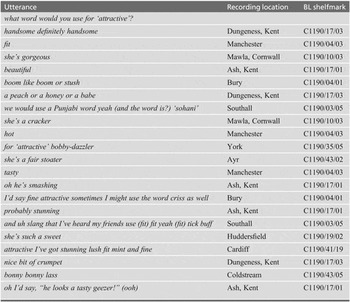
Secondly an audio-clip created from a small selection of the many variants supplied for ATTRACTIVE shows the potential for a more quantitative approach. The sample here is geographically restricted as it was only possible to select from recordings that had been audited during the first year of the VoUK project. Nonetheless table 2 gives a sense of the range of variants: some items like bonny, bobby-dazzler and fair stoater suggest localised forms; terms like crumpet, fit, lush and buff perhaps give clues to a speaker's age; and others reflect new influences on British English, like sohani [= ‘pleasing, beautiful’ in Punjabi] and criss [= ‘crisp’ in Jamaican English, capturing the tendency for some speakers of Caribbean varieties to reduce word final consonant clusters).
Audio-clip used in BL Evolving English exhibition to illustrate variants for ATTRACTIVE selected from the BBC Voices Recordings

VoUK funding ceased in February 2012 and editing of the descriptions is scheduled to be completed by summer 2013. The initial focus on description rather than analysis means we have had little opportunity at this stage to draw firm conclusions about the social or geographical distribution of particular variants or to assess qualitatively the attitudinal data provided by the speakers to the variants supplied. However, it is clear from our preparatory work and the examples provided here that the BBC Voices Recordings and VoUK documentation constitute a wealth of information about the incidence and usage of different lexical items. This applies both to the 39 notion words and also to the more ad hoc spontaneous lexis extracted as the recordings were audited and catalogued. The biographical data collected immediately before or after the recording session and included in the VoUK descriptions will allow researchers to index the words by location, and potentially according to age, gender and socioeconomic status of the speakers in each recorded group. We are intrigued to see how users will engage with the material as it becomes available and anticipate a broad range of audiences manipulating the data and undertaking varied research and analysis.
(Based on research carried out by Jonnie Robinson, Holly Gilbert and Jon Herring.)
Appendix 1: Sample VoUK lexical description

Title:
Kirkby-in-Ashfield, Nottinghamshire
Shelfmark:
C1190/26/03
Recording date:
02.02.2005
Speakers:
Collishaw, Mark, b. 1972 Crawley, West Sussex; male; fireman (father manager; mother fundraising manager)
Duke, Kev, b. 1975 Mexborough, South Yorkshire; male; fireman
Johnson, Richard, b. 1967; male; fireman
Langton, Ivan, b. 1963 Pinxton, Derbyshire; male; fireman
Mason, Danny, b. 1966; male; fireman
The interviewees are all ex-servicemen currently working as fire-fighters in Nottinghamshire; Richard, Ivan and Danny grew up locally; Kev is from Mexborough, South Yorkshire; and Mark grew up in Crawley, West Sussex.
Elicited lexis
○ see English Dialect Dictionary (1898–1905)
* see Survey of English Dialects Basic Material (1962–1971)
▼ see Ey Up Mi Duck! Dialect of Derbyshire and the East Midlands (2000)
∆ see New Partridge Dictionary of Slang and Unconventional English (2006)
◊ see Green's Dictionary of Slang (2010)
♦ see Urban Dictionary (online)
⌂ no previous source (with this sense) identified
- pleased
over t' moon; chuffed; happy
- tired
buggered; knackered; shattered; knick knacked ♦; chin-strapped ∆, chinned ♦ (used in Army); “I'm as tired as ten WEMs”⌂ (used in Navy, ‘WEM’ is acronym for ‘Weapons Engineering Mechanic’ perceived by speaker to be lazy)
- unwell
don't feel right; poorly (“I'm poorly” used during illness); badly (very common locally, “I've been badly” used when returning to work after illness); badly as a fowl ⌂
- hot
redders Footnote 5 (“oh that's redders!” of e.g. cup of tea, short for “red hot”); bothered ⌂; flustered ○; mithered ○ (suggested by interviewer as used by grandmother, also used locally for ‘to moan’); warm [waːm]; bit warm
- cold
icers Footnote 1 (“I'm really icers it's icers outside!”, short for “ice cold”, possibly learnt in Forces); freezing; ice cold; bit chilly; brass monkeys (suggested by interviewer, used by grandparents)
- annoyed
threaders ∆ (possibly learnt in Forces); peed off
- throw
lob (“lob it”); cob (“cob it”); sling; chuck; toss (“toss it here mate!”, used in south, not used locally)
- play truant
cap it ▼ (“let's cap it this afto!”); cap school ▼; capping off ▼ (suggested by interviewer, not used); played truant; hookey; wagging it (used in Yorkshire)
- sleep
kip; zonked, buggered, dead to t' world, out on it, sound off, sound off asleep (of being in deep sleep); fast-on ▼, hard on ⌂ (suggested by interviewer, heard used)
- play a game
lake (used in Barnsley in past); playing
- hit hard
whack it; gie ○it some welly (suggested by interviewer); gie ○it a good whack; thump it; welly it; belted it; crack it
- clothes
kit; clothes; clobber (suggested by interviewer)
- trousers
trollies ∆; pants (“who wears t' pants in your house?”Footnote 6); chinos; jeans
- child's shoe
trainers; pumps; plimps ⌂; plimmies ∆
- mother
mam; mum; mother
- gmother
mama [mɒmɑː]; grandma; gran; nana [nanɑː]; nanan ♦ (used by speaker's children to maternal grandmother from Doncaster, “one gran and one nanan” used to distinguish between maternal and paternal grandmother)
- m partner
“by my first name” (used by speakers' partners); him indoors, sweetheart (suggested by interviewer, not used); babes (suggested by interviewer, not used, used by friend in Sussex, “really irritating”)
- friend
marrow (suggested by interviewer, not used locally, heard used in Cumbria); mucker, oppo ∆ (learnt in Forces); buddy; mate; pal
- gfather
grandad; dada ♦ [dadɑː] (suggested by interviewer, not used)
- forgot name
thingy; whatsit; mate (to person, “see you, mate!”); thingymajig ♦, thingymabob ♦, thingummy; oojah-ma-flip ∆ (of object)
- kit of tools
tool-kit; tool-box; tool bag
- trendy
bling (modern); chav (modern, not used); ?snaff ⌂ (used by father); wally; trendy guy; Kevs ◊, Barry ∆ (suggested by interviewer, not used); Kevs ◊and Traceys ◊, boy racer (heard used of “Essex boys”)
- f partner
missus; our lass; other half; better half; “by her name”
- baby
babby ○; young 'un ∆; little 'un ∆; baby; bairn (suggested by interviewer, not used locally, used by relatives in North East)
- rain heavily
slinging; bucketing down; pouring down; pissing it down; pissing down; teeming down; teeming it down; raining cats and dogs
- toilet
bog; lav; lavvy; shitter; the heads (used in Navy as toilet traditionally located at head of ship); throne (“he's on t' throne again”, used in past by father); going for a swamp ⌂, going for a tiddle (used in Navy of going to toilet to urinate), going for a dump (of going to toilet to defecate); lavatory (“posh”, used in past of outside toilet); latrines; toilet (of inside toilet); outside lav; outside lavvy
- walkway
gennel, ginnel [gɪnəɫ, ʤɪnəɫ] (of walkway between terraced houses); jitty ○ (of walkway behind back garden or at end of buildings)
- long seat
sofa (“posh”); settee (“posher”); sofa [səʊfi]
- run water
brook; stream
- main room
front room; lounge; house (learnt from wife from Kirkby-in-Ashfield)
- rain lightly
drizzle; drizzling; it's a bit damp
- rich
loaded; rich; well off; an arsehole ⌂ (suggested jokingly); stinking rich; silver spoon ∆ (“he's born with a silver spoon in his mouth”, of someone from wealthy family); well-to-do
- left-handed
keggy ○; keggy-handed*; cack-handed; caggy ○; caggy ○ [kɒgɪ] (suggested by interviewer, not known)
- unattractive
a minger (of female); a dog; rough; rough-looking; dog-ugly ⌂
- lack money
skint; brassic (“you got no brass in your pocket you're brassic”, “Cockney rhyming slang”, > brassic lint: skint); broke
- drunk
bladdered ∆; bollocksed; minging (used in Forces); trousered ◊; ?mortalised ⌂ (suggested by interviewer, not used); mortal (used in North East); crappers ∆ (used in Navy); off your trolley ∆
- pregnant
up t' duff, up the duff (impolite, not used in presence of pregnant woman); up the spout; a bun; pregnant (polite, used in presence of pregnant woman); “I see you've babbed your missus again!”⌂, pupped, in foal (used to male friend with pregnant partner); in the club (suggested by interviewer, not heard recently, old-fashioned)
- attractive
gorgeous; fit; babe; a beaut
- insane
bonkers; crackers; mad; mad as a balloon ⌂; mad as a bike ⌂ (suggested by interviewer, not used); mad as a fish ⌂ (heard used); mad as a snake ∆; screw loose; barmy; “you're from t' nuthouse!”; nutcase; “if you carry on like that I'll end up at Pastures!”⌂ (suggested by interviewer as used by mother from Derbyshire); “you'll end up at Millbrook!”⌂, “he's a Millbrook case he is … he's definitely on his way to Millbrook!”⌂ (i.e. reference to local mental health unit in Sutton in Ashfield)
- moody
mardy; grumpy
© Robinson, Herring, Gilbert
Voices of the UK, 2009–2012
A British Library project funded by The Leverhulme Trust
Appendix 2: Graphic display used in BL Evolving English exhibition

 JONNIE ROBINSON is Lead Curator of Sociolinguistics and Education at the British Library, responsible for the Library's collection of sound recordings of vernacular speech. His research focuses primarily on English accents and dialects and he developed the online dialect archive, BL Sounds: Accents and Dialects and Sounds Familiar, an educational website that explores and celebrates regional speech in the UK. He recently curated the Library's exhibition Evolving English: One Language, Many Voices and is currently Principal Investigator on Voices of the UK, a project to create a searchable online dataset of British regional speech. Email: Jonathan.Robinson@bl.uk