


Introduction
Structural simplicity/complexity is an important variable with which New Englishes and native varieties are identified and conceptualised, but predicting such variation in complexity has received little attention in the literature. New Englishes, especially the outer circle varieties such as Nigerian or Indian English, differ in form and function from the inner circle varieties, such as British or American English, but the extent of such variation varies greatly and merits further investigation. According to Gorlach (Reference Gorlach1998), we should expect New Englishes to demonstrate simplification at the levels of morphology, lexis, and syntax. This has indeed been shown to be the case in some varieties, but it has also been shown that this variation differs according to different linguistic and non-linguistic factors. Most recently, Schilk and Schaub (Reference Schilk and Schaub2016) have shown how noun phrase (NP) structure can reveal the underlying structural simpification predicted in the New Englishes varieties. Brunner (Reference Brunner2014) examined NP complexity across three New Englishes (British, Singaporean, and Kenyan English), explicating how grammars of the indigeneous languages in Singapore and Kenya influence NP simplicity/complexity.
Given the unique socio-historical conditions and contact settings characterising Nigerian English, it becomes imperative to show where this variety stands in the structural simplification hypothesis by examining the NP in Nigerian English. In this paper we present a quantitative analysis of the structural simplicity and complexity of the NP in different sub-varieties and text types of Nigerian English, examining certain determinants that have already been tested in other, similar non-native varieties of English. In order to achieve this objective, we applied the theoretical framework of Huddleston and Pullum (Reference Huddleston and Pullum2002) to identify elements of the NP in written texts drawn from the Nigerian component of the International Corpus of English. Combining Huddleston and Pullum (Reference Huddleston and Pullum2002) with the findings of Crystal (Reference Crystal2004) and Hillier (Reference Hillier2004), simple and complex NP structural realisations emerge, which are then described in terms of the selected determinants of grammatical function, text type, and length. Overall, we found that simplicity accounts for 56% of NPs, while complexity accounts for 44% of the total NPs. Grammatical function is found to be the most potent factor influencing NP complexity. NPs are most likely to be simple when functioning as a subject or as an adverbial, and are most likely to be complex when functioning as an indirect object of a clausal verb. Text type is not as potent a factor as grammatical function is, yet it is found that NPs are inherently simple in literary genres (e.g. novels), student writings (e.g. exams), and interactional writings (e.g. skills and hobbies writings). Also, we found a result corroborating Berlage (Reference Berlage2014), that length correlates with structural node in measuring complexity, suggesting that this combination can provide much better insights into NP complexity variations in Nigerian English and possibly also other New Englishes.
Predictors of NP complexity in Nigerian English
In the following sub-sections we discuss the variables that have been identified and analysed as constraining NP complexity in earlier works, and more specifically in New Englishes, where the variety at hand, Nigerian English, is best contextualised. We discuss the findings from these previous studies and base our hypotheses about each factor on them.
Grammatical function
The grammatical function that the NP performs in a syntactic unit (e.g. a clause or a superordinate phrase) is considered an important determinant of its complexity. Gisborne (Reference Gisborne2003) studied the structure of the NP within the relative clause, while Hudson-Ettle and Nilsson (Reference Hudson-Ettle and Nilsson2002) investigated NP complexity within the premodification syntactic function. More recently, Brunner (Reference Brunner2014) examined NP complexity across three New Englishes in British, Singaporean, and Kenyan English, showing how structural patterns in the indigenous languages of Singapore and Kenya compete with the syntactic function of an NP in influencing its complexity in English. Schilk and Schaub (Reference Schilk and Schaub2016) also showed that NPs in subject position are structurally different (simpler) from those in other syntactic functions.
Schilk and Schaub (Reference Schilk and Schaub2016) employed a binary distinction, that is, NPs in subject function versus NPs in non-subject function (other functions). For the present study, eight grammatical functions are identified, following a revision of Aarts (Reference Aarts1971) and Schilk and Schaub (Reference Schilk and Schaub2016). These functions are: subject, subject complement, apposition, direct object, indirect object, object complement, preposition complement, and adverbial. Examples (1–8), which are taken from the Nigerian component of the International Corpus of English (hereafter, ICE-Nigeria) (Gut, Reference Gut2014), illustrate NPs in their respective functions (italics is for emphasis).
-
1. Subject ‘Besides, our target languages in this regard should’
-
2. Subject complement ‘There is need for vocabulary expansion’
-
3. Apposition ‘To all these, the author himself, a renowned writer … proffers all the answers’
-
4. Direct object ‘Even though this innovation has some difficulties and challenges’
-
5. Indirect object ‘ … to show them the way forward’
-
6. Object complement ‘The president called them a nuisance’
-
7. Preposition complement ‘What is the place of a hero?’
-
8. Adverbial ‘Today, Senegalese women are selling that material all over the world’
On the basis of previous findings in Schilk and Schaub (Reference Schilk and Schaub2016) we expect complex NPs to function significantly more frequently in subject positions than in non-subject positions in Nigerian English.
Length
Many different types of word order variation have been shown to be constrained by the length of the syntactic constituents (in terms of number and length of the words they contain; Behaghel, Reference Behaghel1909; Hawkins, Reference Hawkins1994; Bresnan et al., Reference Bresnan, Cueni, Nikitina, Baayen, Bouma, Kramer and Zwarts2007). Wasow (Reference Wasow2002) showed that the principle of long constituents following short constituents influences dative alternation. Szmrecsanyi and Hinrichs (Reference Szmrecsanyi, Hinrichs, Nevalainen, Taavitsainen, Pahta and Korhonen2008) showed that the length of a constituent had an influence on choice between inflectional versus prepositional genitives in English. More relatedly, Berlage (Reference Berlage2014) also showed that length as well as structural node of the NP provided significant insights into NP complexity. In the study of the NP postmodifier in British and American English, Berlage also argued that length can be teased apart from structural node, such that we are able to account for its influence as an independent variable. Biber et al. (Reference Biber, Johansson, Leech, Conrad and Finegan1999) also showed that premodifiers that precede the head noun increase the length viz-a-viz the complexity of the entire NP. On the basis of previous findings such as Berlage (Reference Berlage2014), we expect that in Nigerian English the postmodification unit will contain more words and will hence be longer than the premodification unit. However, on the basis of Babalola's (Reference Babalola2010) findings, we still expect the overall length of the postmodification unit to be significantly lower than what was found by Berlage in British and American English.
Text type, register and genre
Labov (1970) showed that language is inherently variable along factors such as social context, topic changes or genre. Cayer and Sachs (Reference Cayer and Sacks1979: 121) showed that student writers ‘fail to meet the demands of the written mode’ and ‘tend to write more like they talk than do comparatively more skilful writers’. De Haan (Reference De Haan, Souter and Atwell1993) found that text type was a significant determinant of NP complexity, showing that NPs in literary text/language are structurally simper to those NPs in non-literary language such as academic and media writings. Biber (Reference Biber, Conrad and Reppen1998) also showed, by performing factor analysis, how the structure of a NP can provide insights into style marking texts. Biber found a significant difference in NP structure across four registers comprising conversation, fiction, news, and academic prose. Jucker (Reference Jucker1992) also found a similar significant difference in NP complexity across different types of British newspapers. Jucker (Reference Jucker1992) showed that elite British newspapers differed from local newspaper significantly in terms of the frequency of NP complexity and different types of modification that aided such structure. Schilk and Schaub (Reference Schilk and Schaub2016) also found marked differences in NP complexity across four text types in academic humanities texts, unscripted speeches, social letters, and conversation in five varieties of English (Canadian, Singaporean, Indian, Hong Kong, and Jamaican). The present study is different from Schilk and Schaub in four crucial aspects, i.e. (1) it provides a more in-depth analysis of syntactic functions, (2) it includes an increased number of textual categories, (3) it provides an in-depth description of the NP internal structure, and (4) Nigerian English is much more exposed to sundry interferences from the hundreds of indigenous languages. Since the texts in the ICE-Nigeria represent different social contexts or topics in Nigerian English, we are able to provide insights into syntactic features marking the various registers and genres that make up the variety, which may also yield generalised statements about the question of classifying sub-varieties of Nigerian English (Kperogi, Reference Kperogi2015).Footnote 1 Table 1 shows the eleven text types used in the present study.
Text type/genres used in the study

On the basis of previous findings, we expect genre (here used as a cover term to include text type and register) to significantly influence NP complexity in Nigerian English. More specifically, as De Haan (Reference De Haan, Souter and Atwell1993) found, we expect literary language to significantly produce simpler NPs compared to academic language. As with Schilk and Schaub's (Reference Schilk and Schaub2016) findings, we also expect academic and popular humanities texts to produce more complex NPs than other text types. Similarly, we expect findings similar to Biber's (Reference Biber, Conrad and Reppen1998), namely that media and academic texts demonstrate more NPs with more elaborate modification than those in conversation.
Classifying NPs
There are many parameters for identifying simple and complex NPs and it is a subject of substantial controversy in the literature. According to Crystal (Reference Crystal2004), a NP can be described as simple or complex given how many structural elements are configured to produce the construction. Hillier (Reference Hillier2004) also used the aspect of structural combination, i.e. DH (determiner + head, for example, some students) or MHM (premodifier + head+ postmodifier, for example, young children with smartphones) or DMH (determiner + premodifier + head, for example, some beautiful artworks), in determining structural complexity. Schilk and Schaub (Reference Schilk and Schaub2016) itemised four structural NP categories: (1) head alone, (2) premodification with head, (3) head with postmodification, and (4) premodification with head and postmodification. They treated the determiner as optional and as not contributing to the complexity of the NP.
The current study adapted the NP framework of Huddleston and Pullum (Reference Huddleston and Pullum2002) to identify the structural elements of the NP in our corpus. This framework contrasts with many traditional accounts of the structure of the NP in that it argues that the core of the NP may be H (headnoun) or HC (headnoun + complement). According to Huddleston and Pullum (Reference Huddleston and Pullum2002), certain (head) nouns are tied to a complement, thereby making HC an obligatory core NP component as well as nouns that are not necessarily tied (headnoun alone). For the purpose of this study, we classify such structures as HC, together with other structural combinations, as complex NPs. We then adapt Crystal (Reference Crystal2004)’s simple NP as H (headnoun without complement, or a pronoun), with or without a determiner (DH [determiner + head]). Additionally, Huddleston and Pullum (Reference Huddleston and Pullum2002) allow for a H+H structure (e.g. sales man), where compound nouns are configured. Such a structural conception is not followed in this study. Such a construction is analysed as MH (premodifier + head, for example, parent company), H (which takes the compound nouns as one unit formed from two words, for example, motor car). Other structures such as HM (head + premodifier, for example, colour red), HPD (head + peripheral, for example, Nigeria, a nation in Africa), and DH (determiner + head, for example, some students) are classified as a simple or complex NP accordingly.
Method
NPs were extracted from each of the eleven textual categories in the written section of the Nigerian component of the International Corpus of English (Gut, Reference Gut2014). Both POS-tagged and raw texts were used for the extraction of the NPs. There was manual intervention in the extraction process, such as correction of erroneous POS tags, parsing and assignment of grammatical functions, etc. The types of NPs used in this study are actual NPs, which can be replaced by another noun or by a pronoun, and may be found at the clausal or sentence level or may also be embedded in other phrases (for example the NPs embedded in prepositional phrases). The NPs were then categorised as simple or complex. The simple/complex NP distinction is treated as a categorical variable, even though it can be understood as a continous variable for semantic/pragmatic reasons. This implies that for the present study a simple NP cannot be a complex, and vice versa. More information on the theoretical framework relating to structural distribution is provided above.
Coordinated NPs (Biber et al., Reference Biber, Johansson, Leech, Conrad and Finegan1999), that is, NPs conjoined with a coordinating conjunction such as or and and are split, such that nouns within them were identified as heading their own independent NPs. For example, men and women in the concerned men and women were taken as two constructions, i.e (1) ‘the concerned men’, and (2) ‘the concerned women’. Nominalised adjectives (Biber et al., Reference Biber, Johansson, Leech, Conrad and Finegan1999), such as the Nigerian, are also included. Pronouns of all types (Biber et al., Reference Biber, Johansson, Leech, Conrad and Finegan1999) and nominal clauses, including those embedded in a NP, were selected as well. For example, in the sentence, ‘That the new fuel price is suspended is good news’, both the new fuel price and good news were extracted. This resulted in a sample of 8007 NPs from which, after cleaning, 6262 NPs were used for the study. The length of every NP was measured in terms of number of words. Prepositions and conjuctions introducing NPs were included in the word counts.
The components of hyphenated nouns (e.g. mothers-in-law) were counted as separate words, following Pastor (Reference Pastor2008). In conjoined NPs with more than one head noun, the shared determiners, premodifiers, postmodifiers, and peripherals are counted separately for each head noun, since each head noun is taken as an independent structure. Proper names of all word lengths were considered as one word. The counting method was repeated for each level of NP, that is, the superordinate NPs and the embedded NPs. A total of 4979 and 1283 non-embedded and embedded NPs, respectively, were thus extracted, resulting in 3425 simple and 1554 complex NPs, respectively. The 1283 embedded NPs further produced a total of 1747 NPs from different sub-layers ranging from two layers of embedding to seven. For example, the politicians in the Western Nigeria in the early 1960s has two sub-layers of derivable NPs from the PPs: (i) in the Western Nigeria and (ii) in the early 1960s. (Note that while it is possible to compare the structure of NPs at different layers, such factor of recursiveness extends beyond the scope of the present study). The NPs were semi-automatically annotated for the variables under study.
Results
In the present section we discuss the results emerging from the independent analysis of the variables grammatical function, genre (including text type and register) and length (or weight). In order to properly evaluate the strength of influence of each factor, we also provide sufficient information regarding the coding criteria.
Grammatical function
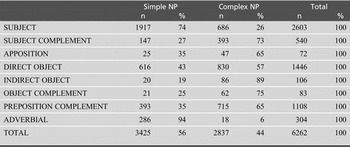
The NP can perform quite a number of grammatical functions. Eight such functions are annotated for in this study. These include subject, object complement, indirect object, apposition, adverbial, preposition complement, and subject complement. Schilk and Schaub (Reference Schilk and Schaub2016) identified only two functions: subject and non-subject functions. Non-subject positions therefore correspond to all other seven functions we identified apart from the subject. The frequency distribution of the functions of the NP in relation to their structural complexity is given in Figure 1 above.
Relative frequency distribution of NP complexity by grammatical function

Table 2 shows that there is a clear preference for certain NP structural types in the subject, subject complement, indirect object, and adverbial positions. At the same time it is clear that most NPs occur in the subject position, and that these NPs are predominantly simple. On the other hand, subject complement NPs are significantly complex. Although not many NPs in the data emerged in the indirect object position, the likelihood is that NPs functioning as indirect objects are mostly realised as complex NPs. The greatest syntactic function influence on the complexity of the NP is found in adverbial NPs, which are most likely to be constructed as simple NPs. In sum, Figure 1 shows that adverbial and subject NPs are mostly likely to be simple, whereas indirect object, object complement, subject complement, preposition complement, and appositive NPs are more likely to be complex.
Simple and complex NPs by syntactic function

Genre
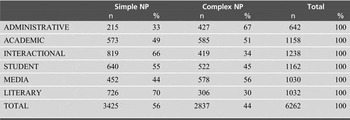
For every type of NP complexity (simple versus complex) it was specified whether it was found in the administrative, academic, interactional, student, media, and literary genres. The frequency distribution of NP complexity across the five genres is presented in Table 3 above.
NP complexity by genre

Table 3 shows that there is a small yet clear relation between genres and NP complexity. Within the literary genre there is a significant preference for simple structure over complex structure (70% versus 30%), while complex NP structures are more likely to occur in the academic genre (49% versus 51%). On the other hand, within the administrative and media genres there is a preference for complex structures, but there is also a similar trend in the administrative (67%) and in the media (56%) genres. Figure 2 clearly shows the variation in the text types.
Length
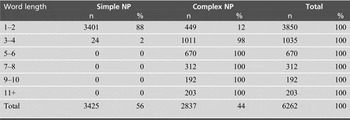
The present study follows Berlage (Reference Berlage2014) in teasing apart length as an independent variable so that insights can be provided into measuring complexity in the variety under investigation. Biber et al.’s (1999) method was adapted for the measurement of length: NPs with 1–4 words were classified as simple, while those with 5 words and more were classified as complex but the 1–4 words range was further broken down into two further types, 1–2 words and 3–4 words. The frequency distribution is given in Table 4 as well as in Figure 3.
NP complexity by length of words

Table 4 shows that, as could be expected, NPs of 1–2 words are more likely to be realised as simple NPs (NPs consisting only of a head or head+complement) than as complex NPs. In contrast, NPs of 3–4 words are more likely to be realised as complex NPs than as simple NPs. Apparently, there are no simple NPs formed from 5–11+ words. If we adapt Biber et al.’s (1999) method of 1–4 words being short, and 5 words and above as long, the following trend emerges, illustrated in Figure 3.
Relative frequency distribution of NP complexity by text type

Relative distribution of NP complexity by length

Figure 3 shows that there is a relationship between NP complexity and length in words; simple NPs are likely to be short, while complex NPs are likely to be long. As Table 4 shows, simple NPs are more likely to be 1–2 words long than 3–4 words long, whereas complex NPs are likely to be 4 words and above in length.
Conclusion
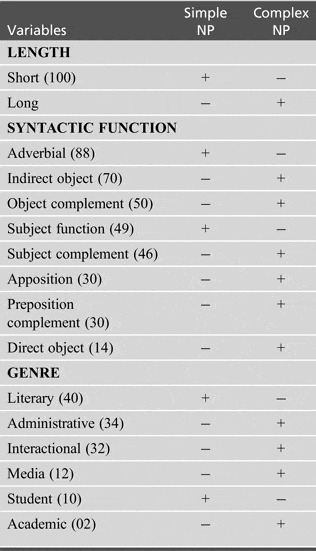
Table 5 shows an overview of the determinants discussed in the preceding section, and how each relates to NP complexity. As can be seen in Table 5, the investigated factors of length, genre and syntactic function all have an impact in determining whether the NP is structurally simple or complex, although some factors exert a stronger influence (e.g. length) than others (e.g. genre). The independent effects of each variable in a univariate analysis are summarised in Table 5.
Independent effects of the variables tested

The variables are ordered according to their relative strength, using percentage differences which are provided in brackets. The +/− signs indicate the direction of the preference. The (+) sign implies preference or association while (−) implies non-preference. Thus, NPs of a short length have a preference for or are associated with simple NP structures and not with complex NP structures. Also, among the eight syntactic functions, adverbial is the most obvious function showing the strongest preference for simple NPs, while the least preferred function is for structurally simple NPs direct object. Among the genres, the literary genre shows the strongest influence associated with simple NPs, whereas the academic genre shows the least preference for simple NPs.
Having examined each variable individually and in isolation, further study is required to examine the interaction effects of these determinants. Therefore, further research is important in order to provide a model of the choice between simple and complex NPs by combining all the effects of the variables as possible predictors. Because several determinants combine to influence production in natural language, it is important to examine how these examined variables interact in these structural choices, using multiple logistic regression statistical analyses. In such a study, all the determinants will be integrated and their interaction effects on choices can be examined further.
 MAYOWA AKINLOTAN holds an MA English from the University of Sunderland, UK, and is currently a PhD student at the Vrije Universiteit Brussel (VUB) where he conducts research on the structure and meaning of the noun phrase in New Englishes and in Nigerian English in particular. He has presented his research findings at international conferences, including the International Conference on Corpus Linguistics (CILC) in Spain and the Annual Conference of the English Scholars’ Association of Nigeria (IFESAN).
 ALEX HOUSEN (MA UCLA, PhD University of Brussels) is Professor of English Linguistics and Applied Linguistics at the Vrije Universiteit Brussel (VUB). He has published extensively on linguistic complexity, second language acquisition and bilingualism in various international journals and edited volumes (e.g. Applied Linguistics, Studies in Second Language Acquisition, Second Language Research, Studia Linguistica, International Review of Applied Linguistics).