Introduction
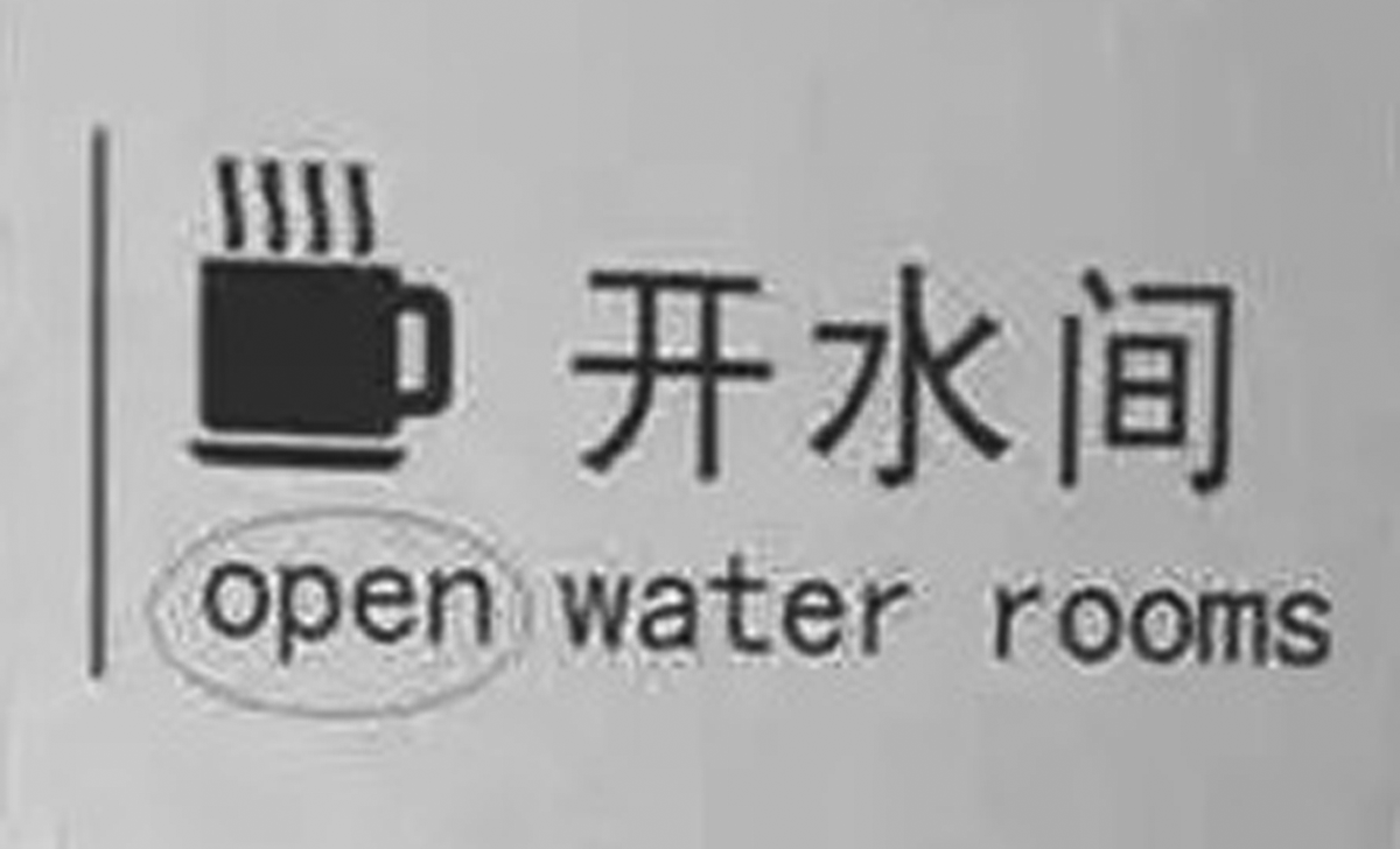
The rupture between China and the former Soviet Union in the 1960s saw English replace Russian to become the most important foreign language in mainland China, and with the implementation of opening-up in the late 1970s, English was used more and more widely, especially in foreign-related public service areas. The use of English in China was accelerated by the 2008 Beijing Olympics and 2010 Shanghai Expo. However, there were various problems with the use of English, notably in bilingual public signs (BISU-CSRC, 2007; Wang & Zhang, Reference Wang and Zhang2016) (see Figure 1). As a result, the derogatory word ‘Chinglish’ was invented by Pinkham (Reference Pinkham2000) as an umbrella term for all kinds of problematic English used by Chinese people. Since 2006, in response to this situation, the provincial and central governments in the country have made great efforts to offer guidelines for the use of English in public signs. For example, on June 20, 2017, the Ministry of Education (MOE), the State Language Commission (SLC) and the Standardization Administration of China (SAC) jointly issued the Guidelines for the Use of English in Public Service Areas (GUEPSA) which came into effect on December 1, 2017.
The bilingual sign for ‘开水间’ (China Daily, June 23, 2017)

A number of scholars have studied the use of English as the world's lingua franca in public signs or linguistic landscapes in European countries such as Portugal, Macedonia and Finland (Stewart & Fawcett, Reference Stewart and Fawcett2004; Dimova, Reference Dimova2007; Taavitsainen & Pahta, Reference Taavitsainen and Pahta2008) as well as in Asian and African countries such as Japan, Korea, Nigeria and China (MacGregor, Reference MacGregor2003; Lawrence, Reference Lawrence2012; Adetunji, Reference Adetunji2015; Hu, Reference Hu2016). These studies have been conducted from various perspectives, including sociology, ideology, linguistics, globalization and translatology, but few of them have paid attention to the efforts made by the government and their effect in standardizing the use of English in public service areas. This article is aimed at emphasizing the necessity of governmental intervention in the use of English in mainland China's bilingual landscapes by summarizing the main types of mistranslations in English signs based on Error Analysis and Norms for Chinese-English Translation of Signs (Lyu et al., Reference Lyu2011), and especially A Chinese-English Dictionary on Signs (Lyu & Shan, Reference Lyu and Shan2015), which contains more than 30,000 domestic and foreign signs. The paper then offers a discussion of GUEPSA as a countermeasure for handling the existing problems with the English signs, focusing on its drafting purpose, component parts, and functions for dealing with existing mistranslations.Footnote 1
Use of English in China's public service areas and problems
The public service areas in which English is used are closely related to foreigners or foreign affairs, including various urban spaces such as streets, shops, parks, buses, hotels, hospitals, airports and banks, as well as highways, tourist attractions and other rural public places. In most cases, English is seen not only in public signs but in brochures, advertisements, newspapers, magazines, menus, bus and train tickets, programmes, and product instructions (BISU-CSRC, 2007: 64). English signs generally function as an information provider, a guide or a warning (Wang & Zhang, Reference Wang and Zhang2016). They often appear in written form on various media of paper, wood, metal, concrete, plastics and electronics, and occasionally in oral form such as train broadcasting.
A public sign is an independent text that has a variety of text types and forms. Seen in terms of text typology, public signs can fall into informative, expressive and vocative texts (Niu, Reference Niu2008). As for the language on the signs, monolingual and bilingual signs are often seen: Chinese signs, English signs and Chinese-English signs, while multilingual signs are not common and they may contain Chinese, English and a second foreign language such as Japanese, or one of China's minority languages such as Tibetan. As far as the linguistic forms of signs are concerned, a word, a phrase or a sentence is often seen as constituting a sign, and occasionally an abbreviation, a paragraph or several paragraphs may also be seen in a sign.
With one-word signs, nouns constitute the largest word group, according to the manual calculation of data in Error Analysis and Norms for Chinese-English Translation of Signs (Lyu et al., Reference Lyu2011) – e.g., ‘Café’, ‘Cashier’, ‘Exit’, ‘Metro’, ‘Reception’ and ‘Spa’; a few nouns are used in the possessive case, such as ‘Barber's’ and ‘Hairdresser's’. A small number of one-word signs use verbs and adjectives, such as ‘Detour’, ‘Flush’, ‘Push’, ‘Fragile’, ‘Free’ and ‘Hot’, and a few verbs are used in the ‘v-ed’ or ‘v-ing’ form, such as ‘Closed’, ‘Reserved’, ‘Parking’ and ‘Advertising’. Occasionally, a hyphen or hyphens may be used in one-word signs such as ‘Check-in’, ‘Non-Recyclables’, ‘U-Turn’ and ‘Toll-by-Weight’, and abbreviations are sometimes seen, such as ‘1F’, ‘B1’, ‘W. C.’, ‘Wi Fi’ and ‘ECG Room’.
In most cases, public signs are phrases. Noun phrases constitute the largest part of phrase-type signs, such as ‘Pay Toilet’, ‘Maximum Capacity’, ‘Security Check’, ‘Priority Seating’, ‘Road Work Ahead’, ‘Hot Water Room’ and ‘Admission by Ticket Only’. Large numbers of ‘warning’ signs result in many ‘NO’-phrases which generally consist of two structures, namely ‘NO + v-ing’ and ‘NO + a noun’, such as ‘No Littering’, ‘No Smoking’, ‘No Parking’, ‘No Bicycle Parking’, ‘No Pedestrian Crossing’, ‘No Dogs’, ‘No Posters’, ‘No Pets Allowed’ and ‘No Food or Drinks Inside’. Prepositional and past-participle phrases are sometimes seen, such as ‘For Passengers Only’, ‘To Metro’, ‘Out of Order’, ‘Lost & Found’, ‘Sold Out’ and ‘Temporarily Closed’. Adjectival phrases are seldom seen, and they often appear in negative form, such as ‘Not Free’, ‘Not Edible’ and ‘Not Open to Visitors’. Infinitive and adverbial phrases are occasionally seen, such as ‘To Be Sterilized’ and ‘Medium Well’.
Sentence-type signs are basically directive or prescriptive ones which give an order, a warning or a requirement, and there are three sentence patterns for this group of signs: declarative sentence, imperative sentence and elliptical sentence. Imperative sentences are most frequently seen in affirmative and negative forms, such as ‘Handle With Care’, ‘Mind the Gap’, ‘Please Conserve Water’, ‘Do Not Use Elevator in Case of Fire’ and ‘Please Do Not Lean on Door’. In some cases, an auxiliary or linking verb in a sign is omitted and thus an elliptical sentence is produced, such as ‘This Way Up the Hill’, ‘Wheelchairs Available’, ‘Credit Card Not Accepted’ and ‘Flammable, Explosive, Poisonous and Other Illegal Articles Strictly Prohibited’ in which ‘Is’, ‘Are’, ‘Is’ and ‘Are’ are omitted respectively. Declarative sentences are sometimes used to give an order, a suggestion or a guide, such as ‘Pedestrians Detour’, ‘Seniors and Children Must Be Accompanied’, ‘This Area Is Under Police Surveillance’ and ‘You Are Here’.
There is a special kind of text in CAUTION/WARNING-related signs that is neither a sentence nor a paragraph, as in the following three examples:
(1) CAUTION Wet Floor
(2) WARNING Be Careful Near the Edge
(3) DANGER Machinery May Cause Injuries
In examples (1), (2) and (3), the capitalized words ‘CAUTION’, ‘WARNING’ and ‘DANGER’ are followed by a phrase or a sentence. It is assumed that this type of text can be regarded as a signage-specific one above the sentence level. As for some signs, the textual forms above the sentence level are complex and they may consist of phrases and sentences. For example:
(4) 3 Simple Steps to Security
Please be ready for security:
1. Show ID and boarding pass
2. Take out liquids and laptops
3. Take off shoes and jackets
According to Error Analysis and Norms for Chinese-English Translation of Signs (Lyu et al., Reference Lyu2011), which contains 1,212 Chinese-English signs, it seems that phrase-type signs constitute the largest group of public signs, followed by sentence-type signs and one-word signs (see Table 1). The ‘others’ category includes signs in the form of an abbreviation, a paragraph or a hybrid text.
Types of English public signs in China (Lyu et al., Reference Lyu2011)

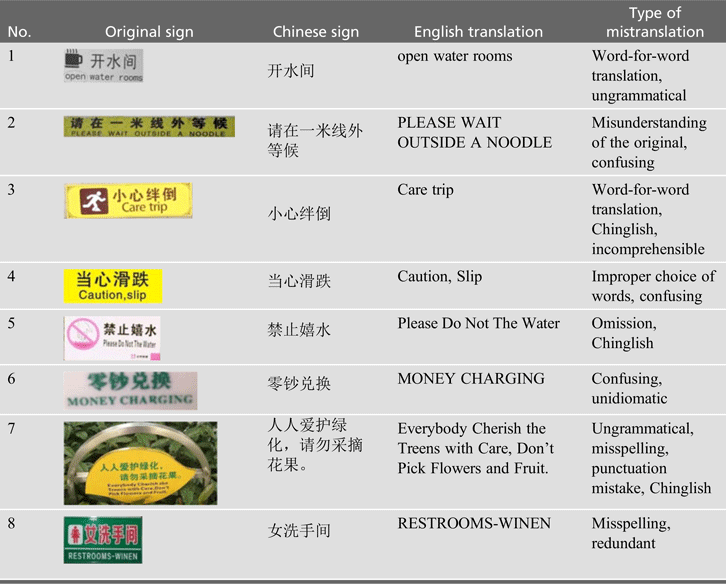
The use of English in public signs in China is closely related to translation and it produces numerous problems which have attracted the attention of many Chinese researchers, according to the China National Knowledge Infrastructure (CNKI) database.Footnote 2 Wang Yinquan (Reference Wang2013), one of the most important Chinese scholars in the field of research on the translation of public signs, summarizes 12 types of mistranslations including misspelling, ungrammatical, incomprehensible, inconsistency, confusing, unidiomatic, wordy, redundant, Chinglish, omission, word-for-word translation and improper choice of words. The examples in an article entitled ‘“Carefully Slide”? Poor Quality Translations Will Be Checked and the Government Has Offered the Standard English Translations for Public Signs’ show the typical mistranslations, i.e. the ones which are the most frequently seen in bilingual landscapesFootnote 3 (see Table 2).
Typical mistranslations in China's English signs (Julie, Reference Julie2017)

The English sign in China's public service areas usually results from the translation of a certain Chinese sign, and word-for-word translation is frequently employed by unqualified sign translators to produce incomprehensible, confusing, ungrammatical or unidiomatic Chinglish due to linguistic and cultural differences between Chinese and English. For example, the three characters in ‘开水间’ correspond to ‘open’, ‘water’ and ‘room’ in English respectively, thus resulting in the word-for-word rendering of ‘open water rooms’ (see Figure 1). However, ‘开’ (kai, ‘open’ or ‘boil’) and ‘水’ (shui, ‘water’) in the sign cannot be understood separately because they are a phrase here, meaning ‘boiling water’ or ‘hot water’. Moreover, the initial letters of the words in the original sign should be capitalized and ‘rooms’ should be used in the singular. As for the English version of ‘请在一米线外等候’ whose literal meaning is ‘Please wait outside the one-meter line’, the treatment of ‘米线’ is just opposite to that of ‘开水’: ‘米线’ is understood by the translator as a phrase to mean ‘rice noodle’. This is why ‘noodle’ is used in the English sign. In fact, ‘米线’ in the original sign should be understood separately, and ‘米’ (mi, ‘meter’) and ‘一’ (yi, ‘one’) together mean ‘one meter’. Although it is grammatically correct, the literal translation of the sign is Chinglish because the idiomatic rendering of ‘一米线’ is ‘the yellow line’. Therefore, the acceptable translation of the sign should be ‘Please Wait Behind the Yellow Line’. ‘Care trip’, the translation of ‘小心绊倒 ’, is typical Chinglish resulting from word-for-word translation which is incomprehensible and unidiomatic. The acceptable English version of the Chinese sign is ‘Watch Your Step’ or ‘Mind Your Step’ which can also be used to render ‘当心滑跌’. ‘Please Do Not The Water’, the English version of ‘禁止嬉水’, is not complete in sentence structure from the viewpoint of literal translation. The verb ‘嬉’ (xi, ‘play with’) is omitted in the English version, but the literal rendering ‘Please Do Not Play With The Water’ is unidiomatic and confusing. The acceptable translation of the sign is ‘No Wading’. ‘MONEY CHARGING’ distorts the meaning of the original sign ‘零钞兑换’ which is generally rendered as ‘Currency Exchange’. As the English version of ‘人人爱护绿化,请勿采摘花果’, ‘Everybody Cherish the Treens with Care, Don't Pick Flowers and Fruit’ has several mistakes. First, the predicate verb ‘Cherish’ should be used in the third-person singular, or ‘Should’ can be added before ‘Cherish’; ‘Treens’ is a misspelling of ‘Trees’; the comma ’,’ should be corrected to be a period ’.’; ‘Fruit’ should be used in the plural so as to achieve the grammatical concord with ‘Flowers’. But this literal rendering, although it is comprehensible, is unidiomatic; the acceptable translation is ‘Keep off the Grass’ (Hu, Reference Hu2016). Obviously, ‘RESTROOMS-WINEN’ for ‘女洗手间’ has spelling mistakes. The word ‘WINEN’ should be corrected to be ‘WOMEN’, and ‘RESTROOMS’ seems redundant because the context is clear.
Although problems with signs are also seen in other countries, such as the United States, England, France, Russia, Japan, Italy and Greece (Wang & Wood, Reference Wang and Wood2014), they might be most serious in China. As the International Federation of Translators points out, ‘China has long been one of the trickiest places in the world for Westerners to find their way around, because of the poor quality of English in the few signs that have been translated’ (cited in Lyu et al., Reference Lyu2011: 105).
GUEPSA
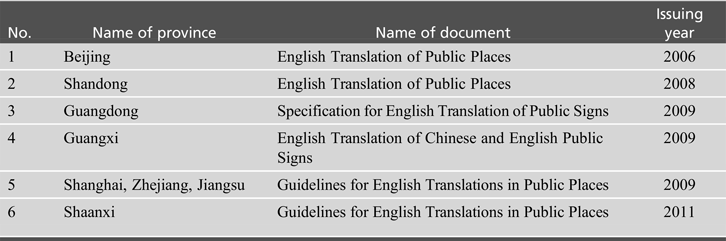
In this section we discuss GUEPSA as a countermeasure for handling the existing problems with the English signs. The enactment and implementation of GUEPSA can be viewed as a state-level official response to the extensive problems in the use of English in China's public service areas. In fact, the drafting and issuing of provincial guidelines for the English translation of Chinese signs have laid a solid foundation for the drafting of GUEPSA (see Table 3), and the production of these provincial guidelines is closely related to some big events. For example, the Beijing Municipal People's Government announced the English Translation of Public Signs on November 3, 2006 in order to provide a good foreign language environment for the 2008 Olympics; similarly, the Shanghai Municipal People's Government, in collaboration with the provincial People's Governments of Jiangsu and Zhejiang, announced the Guidelines for English Translations in Public Places on August 24, 2009 in order to welcome the 2010 World Expo (Wang, Reference Wang2013).
The guidelines issued by local governments (Wang, Reference Wang2013)

In the ceremony for the establishment of the expert committee on GUEPSA in August 2011, Li Weihong, Vice Minister of the MOE and Director of the SLC, emphasized three purposes for drafting GUEPSA: (1) the practical need for strengthening China's language service capability and promoting its opening up; (2) improvement of China's international image; (3) dissemination of Chinese concepts and culture (Wang, Reference Wang2013). GUEPSA is composed of 10 parts, including general rules, transportation, tourism, culture and entertainment, sports, education, health and medicine, post and telecommunications, accommodation and catering, commerce and finance. The key word ‘use’ in the title of GUEPSA corresponds to the characters ‘译写’ (yi xie, ‘translation’ and ‘writing’) in its Chinese version, but the expert committee uses ‘use’ to render ‘译写’ instead of the literal rendering ‘translation and writing’ because ‘writing’ cannot cover transcript, spelling and handwriting (Wang & Zhang, Reference Wang and Zhang2016). The GUEPSA provides the principles, methods and requirements for the use of English in public service areas. The principles include legitimacy, normativity, serviceability and civility, and their content is detailed as follows:
Legitimacy: The use of English should be in agreement with the Law of the People's Republic of China on the Standard Spoken and Written Chinese Language, and it should be based on standard Chinese.
Normativity: Free translation of Chinese signs is generally used instead of literal rendering and the language in the translation should be in agreement with the English language norms and the stylistic features of English public signs.
Serviceability: The use of English should be in accordance with practical needs, English should not be abused in public places, and the language should be easy to understand.
Civility: Civilized language should be used, words cannot be used that impair China's or other countries’ image, or hurt national sentiments, and translations should not be used that are discriminatory or detrimental to social public interests.
The principle of legitimacy determines the nature of translation for the use of English in China's public service areas, and thus an English sign cannot stand alone. As for the translating methods for the names of areas and institutions, proper names should be spelt with Chinese pinyin and common names should be rendered in English; all public service information should be translated into English; different translating methods should be used to render different types of information. Meanwhile, GUEPSA provides the requirements for English translation with respect to choice of words, spelling method, grammar and format. It also provides the rules for English writing, including upper- and lower-case letters, punctuation marks, font size, space and newline. The appendices of GUEPSA contain 3,534 Chinese signs and their English translations for reference (see note 1). According to the appendices, English translations for almost all Chinese signs frequently seen in public areas can be found. For example, the eight mistranslations provided in Table 2 which go against the normativity and serviceability provided by GUEPSA can be corrected as follows: ‘Hot Water Room’, ‘Please Wait Behind the Yellow Line’, ‘Watch Your Step’, ‘CAUTION // Wet Floor’, ‘No Wading’, ‘Currency Exchange’, ‘Keep Off the Plants’, ‘Women’. However, the GUEPSA is not a cure-for-all. Therefore, signs that cannot be found in the appendixes of the GUEPSA should be carefully handled in translations according to the principles and methods offered by the GUEPSA.
Concluding remarks
English signs in China's public service areas are generally in the form of a word, a phrase, a sentence or a text. They are produced via translation of the corresponding Chinese signs. There are various mistranslations in the English signs and they may be misleading. In response to this situation, the Chinese government drafted and enacted GUEPSA, which provides reference translations for Chinese signs so as to correct or replace the existing mistranslations in public areas. It can be argued that China's bilingual environment will improve with the implementation of GUEPSA.
 XU MINGWU is professor in the School of Foreign Languages, Huazhong University of Science and Technology (HUST), China. He has been teaching translation and interpreting for 25 years. He has published extensively in the forms of books, book chapters and articles in such journals as Chinese Translators Journal, Critical Arts, Across Languages and Cultures, Translation Review, Babel and Australian Journal of Linguistics. His special interests are Translation Studies, interpreting teaching and foreign language education. Email: xumingwu@hust.edu.cn
 TIAN CHUANMAO (corresponding author) is professor in the School of Foreign Studies, Yangtze University, China, with a PhD degree in translation and intercultural studies. More than 70 of his papers have been published in a variety of Chinese and international scholarly journals focusing on translation, culture and media, comparative literature and intercultural studies. His special interest is translation and intercultural studies. Email: tcm_316@163.com