


1. Introduction
For several decades, innovations in English language teaching (ELT) have been informed by critical discussions surrounding language and globalization, which theorize the heterogeneity of English and English users, recognize diverse communicative modes and spaces, and resist the traditional ‘target language/culture’ model predicated on native‑speakerism. This is evidenced by the development of the Global Englishes paradigm, an umbrella construct that synthesizes insights from ideologically related paradigms such as World Englishes, English as a lingua franca, and English as an international language (Rose and Galloway Reference Rose and Galloway2019). Responding to calls to attend to real‑world sociolinguistic situations and to embrace linguistic diversity, Global Englishes language teaching (GELT) invites a new way of thinking about language, culture, and human communication in the classroom.
To realize this transformative ELT pedagogy, there are two important issues to consider: criticality and context‑sensitivity. First, GELT should not be grounded in superficial egalitarianism that produces thought‑terminating clichés such as ‘everyone is different’ and ‘every English is equal’. Instead, it should aim to pose difficult questions surrounding invisibilized structural inequalities and to enrich deeper dialogues in the classroom. These dialogues shape and are shaped by explicit awareness‑raising and problem‑posing opportunities to think through how language functions materially and ideologically in society, the importance of which has been emphasized in ELT (Crookes Reference Crookes2021; Glasgow Reference Glasgow2023; Kubota et al. Reference Kubota, Aoyama, Kajigaya and Deschambault2022; Morizumi Reference Morizumi2020). Thus, besides raising awareness of linguistic diversity, a GELT approach should focus on how various intersections of social identities – shaped by, for example, race, ethnicity, gender, ability and class – operate in tandem with language within the current social structure (Kubota et al. Reference Kubota, Aoyama, Kajigaya and Deschambault2022). Making sense of linguistic diversity requires a deep understanding of the contextual interplay among language, identity, power and social (in)justice.
Second, it is imperative that pedagogical applications be situated in the material and institutional conditions of the local teaching context. Regardless of how innovative they may seem, applications will fail to achieve sustainability if they impose significant changes in existing teaching configurations, which are situated within local institutional factors such as school policies, class size, teaching arrangements, teacher workload, curricula, teaching materials and assessment. Indeed, GELT does not imply an overhaul or replacement of existing ELT approaches. As Rose and Galloway (Reference Rose and Galloway2019, 27) argue, ‘methods of teaching need not change, but, rather, it is the ideology that underpins curricula that is to change.’ This argument resonates especially in public elementary and secondary education contexts. In these school contexts, the aforementioned institutional factors may discourage teachers from implementing GELT innovations (Aoyama Reference Aoyama2023; Aoyama et al. Reference Aoyama, Kajigaya, Takeda, Kubota, Deschambault, Tierney, Rizvi and Ercikan2023), the theory and practice of which have been predominantly developed in post‑secondary contexts that allow for greater practitioner autonomy.
In response to these issues, this article reports on teacher participatory action research (PAR) that sought to carve out a space to reflect on language, identity, power and social (in)justice in high school English as a foreign language (EFL) classrooms in Japan. The issue of criticality was addressed by drawing on the critical language awareness (CLA) framework, which informed the project’s pedagogical objectives, key themes and reading/discussion topics in the classroom. Meanwhile, the issue of context‑sensitivity was addressed by employing the obi activity, a common instructional approach to curriculum design and implementation in Japanese elementary and secondary education. This article aims to demonstrate how CLA‑focused curriculum design impacted students’ understanding of the intersections of language, identity, power and social (in)justice. Based on the findings, the study presents implications for future GELT practices and research across diverse contexts.
2. GELT and CLA: theories and applications
Situated within the field of teaching English as an additional language, GELT has been developed to reorient ELT away from a normative view of English and its users. Rose and Galloway’s (Reference Rose and Galloway2019) GELT framework represents inclusive ELT principles, which foreground all English users with diverse linguistic backgrounds and move away from prescriptive monolingual standards toward an emphasis on fluid competence grounded in multi/translingual practices. This pedagogical agenda has long been explored within the research paradigms of World Englishes, English as a lingua franca, English as an international language and, more recently, translanguaging. As an umbrella approach that synthesizes findings from these paradigms, GELT brings together inter/intra‑disciplinary endeavors to enact ELT that is sensitive to identities, culture, diversity and equity. Recent literature on GELT often focuses on raising students’ awareness of the diversity of English and the legitimacy of its varieties (Boonsuk and Fang Reference Boonsuk and Fang2025; Chen Reference Chen2022; Da Costa and Rose Reference Da Costa and Rose2024; Konakahara Reference Konakahara2026; Tardy et al. Reference Tardy, Reed, Slinkard and LaMance2021), while also addressing more specific foci related to GELT, including language ideology (Aoyama and Denton Reference Aoyama and Denton2022; Henderson Lee and Pandey Reference Henderson Lee, Pandey, Hassel and Cole2021; Suzuki Reference Suzuki and Tavares2026), antiracism and decoloniality (Kubota Reference Kubota, Selvi and Galloway2024; Matsuda Reference Matsuda and Friedrich2023; Matsumoto and Kubota Reference Matsumoto, Kubota and Murata2023) and social justice (De Costa et al. Reference De Costa, Green–Eneix, Bupphachuen, Gregory, Melgar, Fäcke, (Andy) Gao and Garrett–Rucks2025; Lee et al. Reference Lee, Her, Kim and De Costa2026).
While GELT focuses on ELT, CLA is situated within the broader language education field, and it is applied in various educational contexts, including language arts and second, foreign (world) and heritage language learning. CLA is a pedagogical approach and framework for language education with a several‑decade history, rooted in critical pedagogy and critical literacy. A recent comprehensive definition is offered by Shapiro (Reference Shapiro2022, 14), who explains that CLA ‘focuses on the intersections of language, identity, power and privilege, with the goal of promoting self‑reflection, social justice, and rhetorical agency.’ Since its early development in the UK, exemplified by the critical discourse analysis‑informed work of Clark et al. (Reference Clark, Fairclough, Ivanič and Martin‐Jones1990) and Fairclough (Reference Fairclough1992), CLA has been adopted and reconceptualized to fit various educational contexts internationally, responding to ongoing calls to enact critical multiculturalism and social justice. Alim (Reference Alim2005), whose work is situated in critical sociolinguistics and focuses on Black language and hip‑hop pedagogy in the US, views CLA as a countermeasure to hegemonic discourses in language education that silence diverse ways of being, seeing and speaking. The central questions that form the basis of CLA are: ‘How can language be used to maintain, reinforce, and perpetuate existing power relations?’ And, conversely, ‘How can language be used to resist, redefine and possibly reverse these relations?’ (Alim Reference Alim2005, 28). Through these inquiries, students and teachers engage in awareness‑raising that enables them to become ‘aware of [their] own position in the world and what to do about it’ and ‘more conscious of their communicative behavior and the ways by which they can transform the conditions under which they live’ (Alim Reference Alim2005, 28). As Alim’s theorization suggests, CLA pedagogy invites students to critically analyze the social structures that shape the realities and inequalities in everyday life. In Spanish heritage language education, Holguín Mendoza (Reference Holguín Mendoza, Loza and Beaudrie2021) proposes addressing this complex task by foregrounding social markers of difference that intersectionally and contextually shape such realities and inequalities in and through language: race, ethnicity, class, gender, sexuality, indigeneity and (dis)ability. She argues that raising this metalinguistic awareness is necessary at all stages of language education programs, advocating for developing students’ critical sociocultural linguistic literacy.
As indicated above, CLA can be designed and enacted through diverse justice‑informed approaches across a wide range of language education contexts (Abe and Shapiro Reference Abe and Shapiro2021; Britton and Lorimer Leonard Reference Britton and Leonard2020; Darvin and Zhang Reference Darvin and Zhang2023; Park et al. Reference Park, Tanghe and Webb2026; Quan Reference Quan2020; Shepard–Carey and Gopalakrishnan Reference Shepard–Carey and Gopalakrishnan2023; Zhang‑Wu and Tian Reference Zhang‑Wu and Tian2023). Sketching out the broad scope of CLA, Shapiro (Reference Shapiro2022) identifies four thematic strands as ‘the Four Pathways’ for CLA pedagogy: sociolinguistics, critical academic literacies, media/discourse analysis and communicating across difference. These ‘pathways’ show that CLA is now more than a pedagogical application of text‑focused critical discourse analysis, pointing to an overlap between CLA and GELT, both of which address the politics of difference from a sociolinguistic perspective. The impact of pedagogical approaches focusing on this overlap may relate not only to students’ affective reactions and renewed understandings within the classroom, but also to their capacity to critically and relationally engage with diverse others in the real world through language (Kubota et al. Reference Kubota, Aoyama, Kajigaya and Deschambault2022). Informed by the shared pedagogical agenda between CLA and GELT, this study aims to raise students’ awareness of the intersections of language, identity and social (in)justice in the ELT classroom.
3. The study: CLA‑focused GELT through participatory action research
This study adopts a PAR design (e.g., Kemmis et al. Reference Kemmis, McTaggart and Nixon2014), which emphasizes doing research with participants rather than on or for participants. PAR reshapes how community members engage in knowledge creation; knowledge emerges as they attempt to improve their social practices by changing them. The participants of this study, namely, the PAR team members, include Kosuke and Kayo (the second and third authors), who are public high school teachers in Japan, and Ryosuke (the first author), a former public high school teacher and currently a doctoral candidate at a Canadian university. This study was built on past and ongoing collegial relationships; we used to work at the same public high school in Japan. With the shared goal of raising students’ awareness of the intersections of language, identity and social (in)justice, we collaboratively learned, designed and implemented CLA‑focused GELT pedagogy responsive to local needs and teaching configurations. The PAR study spanned the 2024–2025 academic year, during which we engaged in the research process through regular Zoom meetings (a total of 37 meetings, each usually lasting about 60–90 minutes) and asynchronous communication via Microsoft Teams.
3.1 PAR settings and curriculum design
Two prefecture‑run public high schools in Japan, the teaching sites of Kosuke and Kayo, served as the settings for the study. Both high schools are considered academically advanced and have a strong record of supporting entry into competitive universities. While Kosuke’s school is characterized as a general academic high school, Kayo’s school specializes in foreign language education, particularly in English. Students at both schools often showed moderate to high levels of motivation to learn English. The English proficiency of students at Kosuke’s school ranged from intermediate to advanced, whereas those at Kayo’s school were at an advanced level within the context of high school ELT in Japan. The students in this study also showed these characteristics, demonstrating active participation in classroom activities in English. It should be noted that not only these student characteristics but also student–teacher relationships influenced this study’s process and results, as Kosuke and Kayo were the students’ teachers.
Kosuke and Kayo are experienced English teachers who, at the time of study, had 12 and 38 years of teaching experience in the Japanese public high school system, respectively. Ryosuke had about 11 years of teaching experience in the same educational system. Our collegial relationship facilitated the PAR process, including identifying and refining research questions, designing and implementing lessons, collecting and analyzing data and reflecting on our practices.
3.1.1 Reading marathon as an obi activity in general English courses
This study was conducted in two general English courses taken by five classes of students (three classes of about 40 students each at Kosuke’s school and two classes of 20 each at Kayo’s) for a total of 154 third‑year students aged 17–18. Through a series of bottom‑up conversations and discussions on Zoom and Microsoft Teams, we explored curriculum and instructional strategies to implement CLA‑focused pedagogy, one of which was the focus of this study: the obi activity (帯活動). The obi (literally, ‘long cloth belt’) activity, a term widely used in ELT in Japan, refers to a planned, often non‑textbook‑based, short activity that is routinely implemented as part of lessons to achieve curriculum goals. It can be visualized as a sustained activity that runs like a ‘belt’ stretching through the curriculum. This recurring instructional time is often used strategically to focus on a specific area of the curriculum (e.g., a recurring warm‑up speaking activity for oral fluency development), especially in elementary and secondary education. While designing lessons based on government‑authorized textbooks tends to be the norm in ELT in Japan, the obi activity offers teachers greater flexibility in instructional design because it does not necessarily require the use of textbooks. Before this study began, Kosuke had conducted an obi activity called the reading marathon, in which students routinely engaged with an assigned article at the beginning of class to facilitate reading development and class discussion. Through our discussions, we considered that the use of the obi‑reading marathon structure would allow us to flexibly infuse CLA elements into the existing curriculum by carefully selecting articles for the activity. That is, we aimed to implement a GELT innovation by introducing reading materials focused on CLA themes into the obi activity, without changing the syllabus structure, regular instructional routine or the format of the existing reading marathon handout.
3.1.2 Reading marathon handout
The format of the reading marathon handout is a double‑sided A4 sheet with a passage from an authentic online article (approximately 700 words on average), followed by reading comprehension questions. For this study, we selected 10 articles as reading passages that speak to the intersections of language, identity and social (in)justice, drawing on the sociolinguistic pathway to CLA pedagogy (Shapiro Reference Shapiro2022). The selection of these articles reflects our pedagogical objective of raising awareness of such intersections. To better facilitate this awareness, we selected articles based on three interconnected sub‑themes, which were designed to 1) develop a descriptive understanding of linguistic diversity 2) raise awareness of issues related to prejudices and stereotypes, racism and language, and 3) critically assess issues related to technologies and linguistic diversity, such as artificial intelligence (AI) and World Englishes. The articles, as presented in Table 1, were introduced in the order of these sub‑themes to scaffold students’ gradual learning.
List of selected articles

1 Long description
Three columns list sub theme, No., and Article for a set of numbered article entries. Under linguistic diversity, No. 1 is Purdue University, World Englishes: An Introduction, Nos. 2 and 3 are Blanco 2022 on dialect versus accent.. Under prejudices and stereotypes, racism, and language, No. 4 is Aggarwal 2024, South Asians are More than an Accent, No. 5 is Matsuzaki 2022 on Japanese actors in Hollywood, No. 6 is Matsuo 2017 on negativity towards Kikokushijo, and No. 7 is Ro 2021 on linguistic racism. Under technologies and linguistic diversity, No. 8 is Dodgson and Han 2022 on accent changing technology for call center agents, No. 9 is Rangarajan 2021 on digital assistants and accents, and No. 10 is Hassan 2024 on an Apple research model combining regional variants of English.
3.1.3 Instructional procedures
Kosuke dedicated approximately the first 15 minutes of 10 consecutive classes (each lasting 50 minutes) to the CLA‑themed reading marathon, covering one article in each class. Following the usual procedure for the reading marathon, he assigned a reading marathon handout as homework, in which students were asked to read the passage and work on reading comprehension questions before class. At the beginning of each lesson, the assigned student wrote on the blackboard the post‑reading discussion question they had formulated, and each student spent about five minutes writing their response in English in their notebooks. After that, students worked in pairs to share their opinions, keeping their notebooks closed to avoid simply reading their written responses aloud. A few students then shared what they had discussed in pairs with the whole class. Finally, the class checked the answers to the comprehension questions on the handout, and Kosuke wrapped up the activity.
As previously explained, the design of the CLA‑themed reading marathon in the obi activity was primarily built on Kosuke’s regular teaching practice at his school. Nevertheless, this obi activity was easily applicable to Kayo’s context. Kayo used the reading marathon handouts of her choice in a total of 14 classes, dedicating the entire class time (50 minutes) to the activity. This was possible because she had a relatively flexible syllabus in terms of time, teaching materials and assessment. She devoted two classes to each reading marathon handout. The first class typically included the following activities: individual reading and answering comprehension questions (15 minutes), checking answers in groups (15 minutes), checking answers in the whole class (10 minutes) and a grammar and vocabulary review and/or a Q&A period to address any questions (10 minutes). The second class focused on group discussions on the handout’s content, using stimulus questions we created. Seven reading marathon handouts were used in her classes, with three (Nos. 4, 5 and 6) excluded due to time constraints.
3.2 Framing the research question, data and data analysis in PAR
The research question that guided this study was simple: How do our students respond to the CLA‑themed reading marathon? The verb ‘respond’ was intentionally used to allow us to engage in open, bottom‑up and reflective analysis of students’ engagement in the activity, aiming to generate meaningful findings and implications for future implementations of GELT.
To answer the research question, we drew on student data, namely, the reflection sheets that the students completed on the last day of the CLA‑themed reading marathon. This sheet included three questions asking students to (Q1) reflect on their engagement in the CLA‑themed reading marathon, (Q2) choose one reading topic they found the most engaging and would like to explore further, and (Q3) reflect on whether and how the CLA‑themed reading marathon helped increase their awareness of the relationship between language, identity and social (in)justice. Consent to the use of these reflection sheets was obtained from each school and student via a letter explaining that students’ decisions about whether to give consent would have no impact on their grades and assuring them that their teachers would learn who had consented only after the term‑end grades had been submitted. In total, 126 students (86 from Kosuke’s classes and 40 from Kayo’s) provided their consent and submitted their reflection sheets.
We framed our approach to the data and its analysis within the PAR methodology, which emphasizes the role of data analysis in promoting collaborative self‑reflection for a better understanding of our practice and conditions, rather than seeking an objective ‘truth’ verified by the methodological standards of validity and reliability (Kemmis et al. Reference Kemmis, McTaggart and Nixon2014). With this in mind, Ryosuke coded students’ open‑ended responses in MAXQDA to identify common themes, while Kosuke and Kayo engaged in reflective writing to explore themes of interest based on their own interpretations of the students’ responses and the preliminary coding results prepared by Ryosuke. Through a series of Zoom meetings, we reached a consensus on our data analysis, that is, how we as a group understood our practices and the students’ responses.
The percentages presented in Section 4.2 represent the proportion of responses out of a total of 252 responses submitted by 126 students. As the reflection sheet had two open‑ended questions (Q1 and Q3), each response was counted and coded separately. Also, responses were often assigned multiple codes. Most student responses were originally in Japanese and were translated into English, unless otherwise noted. Responses originally written in English are presented verbatim to respect students’ voices. All students’ names are pseudonyms.
4. Results and discussion
In this section, we address the research question by presenting and discussing our analysis of students’ responses to the final reflection sheet. As noted above, the questions on the reflection sheet were designed to gauge the students’ engagement and learning outcomes (Q1 and Q3) and their preferences for CLA reading topics (Q2). We first present and discuss the responses to Q2, which were closed‑ended. We then move on to the open‑ended responses to Q1 and Q3, highlighting the four themes related to students’ learning outcomes and their perceptions of the activity.
4.1 Students’ preferences for reading topics
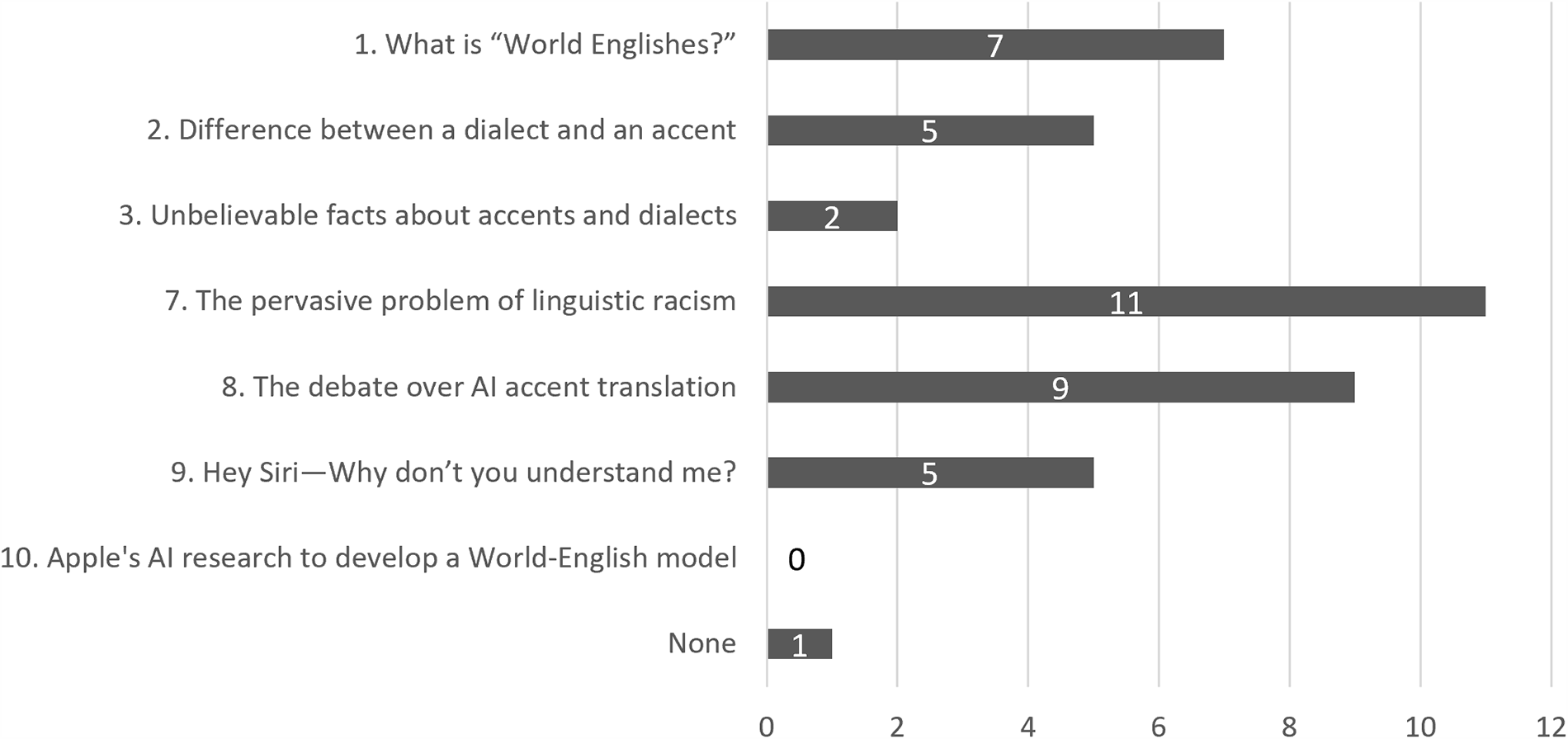
The students were asked to choose the reading they found the most engaging from the 10 articles in Kosuke’s classes (Figure 1) and the seven articles in Kayo’s classes (Figure 2). The majority of Kosuke’s students chose articles in the category of prejudices and stereotypes, racism and language, and the essays on racial stereotypes of Japanese people in Hollywood (No. 5) and common stereotypes of kikokushijo, or returnee students in Japan (No. 6), were selected most frequently. Similarly, among Kayo’s students, the article on linguistic racism (No. 7) in the same category was selected most frequently. Although the question (Q2) did not ask for the reasons for their selections, many students commented on how certain topics engaged them in their responses to the other questions (Q1 & Q3). During the PAR meetings, we analyzed potential reasons for students’ selections by reflecting on their in‑class engagement, and we agreed that topic relevance (e.g., if students can relate the content to their own lives) and reading levels (e.g., vocabulary) may have been key factors. Kosuke and Kayo both shared the view that the article on AI research to develop a World Englishes model (No. 10) was the least popular due to the unfamiliar and technical content, as well as the vocabulary level and grammar complexity.
Students’ selections of the most engaging article (Kosuke’s classes, n=86).

Students’ selections of the most engaging article (Kayo’s classes, n=40).

4.2 Open‑ended responses: Student voices on CLA‑themed readings
By coding the students’ open‑ended reflections on their learning in the activity, we identified four themes: 1) developing awareness of linguistic injustice, 2) moving away from common‑sense assumptions about language, 3) rare opportunities to engage with CLA topics, and 4) reflecting on reading experiences, instruction and materials. In what follows, we detail and discuss these themes while highlighting students’ voices.
1) Developing awareness of linguistic injustice
In the student reflections, a total of 80 (31.7%) responses referred to a heightened awareness of linguistic injustice, such as linguistic racism and discrimination. The responses often indicated that discrimination based on language and accents, as opposed to race, was not something students were very familiar with, which in turn captured their attention and engaged them deeply. Hibiki (Kosuke’s class) reflected, ‘I had kind of recognized differences among dialects and varieties such as American English and British English, but I never knew that there was discrimination and inequality based on such differences.’ As observed in this response, references to American and British English frequently appeared in other reflections, for example: ‘I was not really aware of the connection between language and racism, but through reading the passages, I learned that people, including myself, unconsciously treat American English and British English as the correct forms of English, which leads to discrimination’ (Mio, Kayo’s class). Similarly, Hiroto (Kayo’s class) commented, ‘I have spoken English assuming that white American English is easy to listen to and more correct. But I learned that this could be a microaggression, and I felt sorry that my way of thinking could have led to discrimination.’
The fact that students consider issues of linguistic injustice somewhat novel suggests that they have remained unaffected by such injustice, both as speakers of a dominant variety of Japanese and as learners of English in a Japanese‑dominant society. The following responses address this point rather explicitly: ‘Since I had never experienced language‑related discrimination, I rarely thought about things from such a perspective’ (Wakana, Kosuke’s class); ‘I was very engaged in it [the reading marathon] because I was able to learn about linguistic discrimination, which is difficult to notice while living in Japan.’ (Ayano, Kosuke’s class). Similarly, Rei (Kayo’s class) commented, ‘Born and raised in an island country, we unconsciously consider ourselves as “central”, but when we go abroad, we may find ourselves in the minority in some situations due to our accent and race.’ The reading marathon enabled them to realize this fact, ‘which [they] had been avoiding facing’ (Rei). Manami (Kosuke’s class) commented on this issue through the lens of complicity: ‘I thought I had never engaged in discrimination based on language, but the readings made me realize that I have certain stereotypes that could lead to linguistic discrimination (especially kikokushijo).’ These responses underscore the need to create opportunities where students can critically reflect on how social privilege is invisibilized – shaped by and shaping societal norms – while also recognizing how unawareness of privilege may invisibilize the inequalities faced by minoritized groups (e.g., Sakamoto, Reference Sakamoto2021). As mentioned earlier, the positioning of students as ‘English learners in Japan’, that is, being within the ‘EFL situation’ where they learn English mostly as a school subject with limited opportunities to use it outside the classroom, may structurally contribute to the invisibility of linguistic injustice.
However, it should be noted that a few students approached and reflected on the readings differently, suggesting that the topic of linguistic injustice was already familiar to them as something personal that evoked memories of discrimination. Sui (Kayo’s class) commented, ‘This topic was so close to me (in original, not translated)’ because they had experienced discrimination abroad. Another student, Rin (Kayo’s class), reported that they worked on the activity while reflecting on a study abroad experience in junior high school, where they were laughed at for their pronunciation by classmates. The student observed that only Japanese students were subject to laughter and correction, while students from European countries were exempt despite having strong accents. This led Rin to realize that ‘Asians are discriminated against.’ Rin concluded, ‘I wonder why non‑native speakers keep striving for ‘correct pronunciation’, although even native speakers have various accents and pronunciations.’ These voices suggest how vulnerable students are to linguistic inequalities once they step outside the ‘EFL situation’. This highlights the importance of developing meta‑awareness of language and power in the classroom, which would provide students with a useful epistemic lens for understanding hegemonic discourses and, in turn, for thinking about how they could exercise rhetorical agency to challenge power relations (Shapiro Reference Shapiro2022).
2) Moving away from common‑sense assumptions about language
Fifty‑five responses (21.8%) acknowledged that students’ perspectives on language had shifted in nuanced ways. These shifts entailed students’ disrupting common‑sense assumptions about language and, in turn, embracing ways of thinking about language that foreground the connection to identity. For example, one assumption that students held about language before the activity was that ‘language is only a tool for communication.’ The responses from 10 students explicitly referred to this assumption, demonstrating their heightened awareness of language as a result of the activity. Daiki (Kosuke’s class) shared that they had held this assumption and continued, ‘I think Japanese people learn English for reasons such as its usefulness for communication abroad and career opportunities. However, these readings made me realize that language plays important roles beyond being just a tool.’ Similarly, Ayane (Kayo’s class) came to realize that ‘the most important thing to do in a globalizing society is to consider language not as a mere tool for communication, but as something through which we maintain who we are, that is, our identities’, and highlighted the necessity of respecting different regional accents and grammatical varieties. Ayumu (Kosuke’s class), who had already been interested in aspects of language such as etymology, demonstrated a more nuanced understanding of language:
I learned that language is deeply connected to human identity and that its arbitrariness, shaped by people, gives rise to various social issues. I also learned that languages cannot be typologized or hierarchized; in this sense, each language is unique in its own way. I want to be careful not to reduce language to something artificial but instead to view it as something alive (Ayumu, member of Kosuke’s class).
In light of these responses, we reflected on how an instrumental view of English has been pervasive not only in market‑driven ELT but also in public education in Japan. This view is deeply embedded in the neoliberal discourse of linguistic instrumentalism (Kubota Reference Kubota2011). As these data suggest, however, students can recognize and question this discourse by engaging with CLA topics.
Other than this instrumentalist assumption, students shared various taken‑for‑granted assumptions they used to hold. The responses from Chihiro and Hayato (Kosuke’s class) centered on the construct of language boundaries, which scholars in applied linguistics have theorized as a philosophical ground for translanguaging (Cummins Reference Cummins2021; García and Kleyn Reference García and Kleyn2016). Chihiro pointed out the diversity within a named language, noting that they had previously viewed languages as fixed categories such as ‘Japanese’ or ‘English’, and suggesting that this perspective had prevented them from being attentive to inequalities among language varieties. Hayato, on the other hand, commented on cross‑linguistic connections:
It [the activity] made me reflect deeply on language. I had used language every day as a matter of course, and I had also studied English as a matter of course. I tended to have an ‘English is English, and Japanese is Japanese’ mentality, viewing them as separate and distinct from each other. However, I learned that there are connections across languages, and also differences such as regional variations (Hayato, member of Kosuke’s class).
Another common‑sense assumption students referred to concerns how ‘standard’ is considered unmarked, natural and superior. Examining this assumption seemed to have contributed to a positive change in students’ mindsets toward using English. For example, Haru (Kayo’s class) reflected on technological advancements aimed at enhancing human communication through standardization and pointed out the risk of such technologies becoming discriminatory because ‘it regards different dialects and accents as deviant from “the standard language”.’ The use of quotation marks suggests an understanding of ‘standard’ being naturalized rather than natural, and they continued, ‘I used to want to make my pronunciation closer to that of native speakers, but I’ve come to think that I can take more pride in my own pronunciation because pronunciation is inherently diverse.’ Similarly, Sota (Kayo’s class) commented, ‘I am not good at speaking English. But at the core of this perception has been that my pronunciation is far from white American English or British English.’ They then wrote that the readings enabled them to challenge their assumption about the standard accent and contributed to their confidence in using and learning English. A positive comment by Aoi (Kosuke’s class) was rather short, but it caught our attention: ‘I used to get frustrated by differences in accents (mainly during listening tests). These readings made me think that I should work on listening tests while embracing differences in accents as part of culture.’ Raising language awareness through questioning of standard language ideology has been a frequent focus in GELT, and positive changes brought by this awareness, as seen in these student responses, have been a consistent finding in the recent EFL literature (Aoyama and Denton Reference Aoyama and Denton2022; Jung and Crookes Reference Jung and Crookes2025; Rajprasit Reference Rajprasit2023).
Finally, some responses referred to reflections on assumptions about Japanese rather than English. For example, Yuri (Kayo’s class) reflected on being raised by parents who spoke different dialects (Osaka and Kumamoto dialects) and explained how the dialects deviated from standard Japanese, sharing their experience of not being understood by friends because of regional vocabulary. Yuri continued:
That being said, the language I speak every day is not the Osaka or Kumamoto dialect. The Japanese I speak now is standard Japanese. The articles I read often focused on ‘the standard language.’ As I read, I was able to think about for whom and why languages were standardized (Yuri, member of Kayo’s class).
This finding is consistent with the expectation that fostering language awareness in ELT is facilitated by activating students’ L1 knowledge and perspectives related to their primary and secondary discourses (Gee Reference Gee2015). Tapping into students’ meta‑knowledge about their L1 has often been part of instructional approaches in previous intervention research focusing on linguistic diversity in ELT (Aoyama and Denton Reference Aoyama and Denton2022; Coffey et al. Reference Coffey, Davila and Kolano2013), and the current finding provides support for such approaches.
3) Rare opportunities to engage with CLA topics: Positive and negative responses
Another theme was developed based on the references to rare opportunities to learn about CLA topics in and outside ELT classrooms. Fifty‑one responses (20.2%) highlighted this scarcity, often accompanied by comments that the readings were thus engaging. Typical responses in this theme include reflections such as ‘The topic area [of the CLA‑themed reading marathon] hadn’t been covered in the textbooks before, so it was thought‑provoking and interesting’ (Hina, Kayo’s class) and ‘I have had few opportunities to become interested in language, and I have mostly learned it as an academic subject.’ (Hayato, Kosuke’s class). Ayumu (Kosuke’s class) explained why they found the CLA‑themed reading marathon engaging:
This is because, although the theme does not usually appear in the English passages I read, it is closely related to English as a school subject. I was glad because I had once thought that, in English classes, we should learn not only how to use English but also what it really is (Ayumu, member of Kosuke’s class).
For Akira (Kayo’s class), the CLA‑themed readings were ‘different’ from those typically assigned in the classroom:
Usually, I was like, I don’t care about those reading tasks. However, this time it was different. Through reading about the linguistic topics, I found interesting reading these passages, and actively some of those remained to my memory. I usually delete what I read from my memory so I think I was able to actively engage with it (Akira, member of Kayo’s class; original in English, not translated).
Some students specifically mentioned the changes these novel opportunities brought about, for example, ‘serving as a catalyst for questioning things taken for granted’ (Takumi, Kosuke’s class) and ‘motivating me to learn about Esperanto’ (Masami, Kayo’s class).
As the above quotes show, references to rare and novel experiences with CLA topics often appeared along with positive comments about how such topics were engaging and eye‑opening for students. This finding is also consistent with the findings of previous GELT studies in EFL contexts (Aoyama and Denton Reference Aoyama and Denton2022; Jung and Crookes 2024), suggesting that even though CLA topics are rarely featured in current EFL textbooks, such topics can serve as engaging learning material for students.
However, there were also students who indicated that such topics were novel but seemed distant and were not very relatable. The Japanese word taningoto (他人事), meaning ‘someone else’s problem,’ appeared in four responses, encapsulating the sense of distance the students felt toward the CLA topics and social issues discussed in the readings. The following are Nao’s responses (Kosuke’s class).
Response to Q1:
I was able to engage with the readings, but I also found myself treating them as someone else’s problem, feeling like they were just stories in the articles. This is perhaps because I don’t really encounter such things as I speak Japanese every day [ . . . ] (Nao, member of Kosuke’s class)
Response to Q3:
I had never had a chance to reflect on language from this aspect [the relationship between language, identity and social (in)justice], and I think my perspective has expanded. I think [the CLA‑themed reading] was helpful, and the relationship between language and society will come to mind in various situations in the future, whether consciously or unconsciously. At the same time, as I wrote in Q1, I still have a sense that the issues are someone else’s problem, and I think mitigating this sense will require more tangible and relatable experiences (Nao, member of Kosuke’s class).
Riko (Kosuke’s class) explained this sense of distance more explicitly:
I wasn’t interested [in the readings], as I had never thought about language identity before. This time, I was able to learn about various cases, but I couldn’t really relate to them because I have never experienced linguistic disadvantages. It is important to learn about what is happening in the world, but I felt as if these issues were someone else’s problem, assuming that Japanese people would not face linguistic and cultural disadvantages as long as they were in Japan (Nao, member of Kosuke’s class).
Although this sense of distance toward the reading topics was shared by only a few students, these students’ responses prompted us to discuss how we should interpret them and what implications they have for our future teaching practices. One implication is that CLA should also serve mainstream students, especially those with limited exposure to social issues related to privilege and oppression. As Wallace (Reference Wallace1999, 102) pointed out, ‘they may not otherwise feel much disposed to pursue [critical language study], simply because their immediate interests are not at stake; there is a greater responsibility to challenge social injustices, if, because of relatively privileged social circumstances, we are not personally implicated’. Due to space constraints and the scope of this article, we conclude this section by noting that discussing this issue necessitates deeper reflection and analysis, drawing on a methodology that foregrounds and weaves together our voices as educators embedded within Japanese society, school culture and ELT classrooms.
4) Reflecting on reading experiences, instruction and materials
The final theme concerns students’ reflections on their reading experiences, the instructional design and the reading materials used in the reading marathon. This theme was derived from 44 responses (17.4%) that referenced reading experiences and instruction in general. Of these, 16 responses mentioned that the readings were difficult, but the responses were often coupled with mentions that the instructional design (both delivery and topics), classroom resources and peer interactions scaffolded their reading and learning about the CLA topics.
Regarding the instructional design, reading extensively about the same theme helped enhance students’ reading engagement (Rio and Takumi, Kosuke’s class); Rio noted that the knowledge they gained from the first half of the reading marathon contributed to their comprehension of the second half. Nanami (Kayo’s class) commented that, although the readings were a bit more difficult than those they would normally read, they realized that the linguistic topics, such as dialects, were relatable, and this realization helped them read the passages fluently. Anna (Kayo’s class) wrote that the activity enabled them to realize the need to work on vocabulary and reading skills, motivating them to work harder.
Classroom resources and peer interactions also contributed to students’ reading comprehension and engagement. Hikaru (Kayo’s class) commented, ‘Although I felt it was challenging to get through the readings, I relied on group members and the notes on the blackboard, which helped me frame the reading content as social issues and formulate my own opinions.’ Similarly, Mio (Kayo’s class) highlighted peer interaction as a contributing factor for reading comprehension:
Through discussing the passages with friends after reading them on my own, I came to realize that I tended to rely on my subjective views when working on reading questions, and I ended up getting the answers wrong (Mio, member of Kayo’s class).
Mio went on to emphasize the importance of not letting subjective views or stereotypes influence reading comprehension, framing this as a reading strategy.
As the responses above show, students indicated appreciation of how the instructional design and learning environment contributed to their reading comprehension. Kosuke and Kayo observed that the students generally negotiated and leveraged classroom affordances to engage with challenging reading materials and topics. We stress that creating a participatory classroom discourse that enables such affordances – by purposefully designing a space for student voice and inquiry in instruction – is essential to CLA‑focused GELT pedagogy (e.g., Li and Lin Reference Li and Lin2019).
However, not all students benefited adequately from such a classroom discourse. For example, some students felt that the readings were too challenging to understand, implying that they may not have been able to leverage available resources during the activity. Shiori (Kosuke’s class) found the content in the second half of the 10 readings to be complex, commenting, ‘There are parts I still don’t fully understand.’ Sota and Hanae (Kayo’s class) mentioned that they were so focused on answering the comprehension questions that they ‘did not really think about the content’ (Sota) or ‘could not afford to think deeply about the issues [discussed in the articles]’ (Hanae). In addition, not everyone was satisfied with how the readings were introduced. Unlike Rio and Takumi (introduced earlier in this section), who appreciated the benefits of sustained and structured focus on CLA themes for gradual learning, Sho and Yuma (Kosuke’s class) found such thematic continuity to be repetitive, describing the 10 consecutive readings as tedious toward the end of the activity. By sharing these voices, we aim to highlight that student responses and perceptions of the instruction are nuanced and diverse, serving as a reminder that no single approach works well for everyone in the classroom.
5. Conclusion and implications
Focusing on the theoretical overlap between GELT and CLA, we co‑constructed context‑sensitive pedagogy to develop students’ awareness of the intersections of language and power in Japanese high school EFL classrooms. The four themes we generated from our data analysis suggest that the obi activity generally fostered strong student engagement with CLA topics, providing collaborative opportunities where students reflected on language and its functions in relation to identity, diversity and social inequalities. We argue that such reflection is critical for students to relate to diverse others, regardless of their own positions of power in shifting discourses. We acknowledge that the data used for this study did not allow us to examine how our approach would impact students’ long‑term awareness development, how the observed awareness would be applied or catalyzed outside the English classroom, and, most importantly, how such awareness would inform their actions. However, as the findings suggest, this study provides insights into how GELT might be enacted in ways that could raise students’ awareness of the intersections of language, identity, power and privilege (Shapiro Reference Shapiro2022) and how such pedagogy could overcome the oft‑raised issue of the theory–practice divide through a PAR design. We hope that we have presented the results and insights to similarly positioned language teachers ‘in ways that resonate with their discourse’ (Matsuda and Matsuda Reference Matsuda, Matsuda, Low and Pakir2018, 72). In the hope of amplifying such resonance, we conclude by offering implications for future research and practice.
First, the results highlight the importance of overt instruction on CLA topics in GELT. This study suggests that students are often structurally distanced from engaging with CLA‑related issues due to not only the lack of coverage in mainstream ELT curricula and textbooks but also the ‘EFL situation,’ which tends to limit students’ exposure to English use in social settings outside the classroom. This situation may in turn have shielded students from direct exposure to the social issues discussed in the activity. Their limited awareness of linguistic injustice before our intervention highlights the need for overt instructional opportunities for all students, who are likely to move through shifting power positions that may reify such injustice as ‘someone else’s problem’ or something ‘so close’ to them, as students’ responses showed. While some may argue that awareness‑raising about sociolinguistic issues should be addressed in other school subjects using students’ L1 in EFL settings (e.g., Bruthiaux Reference Bruthiaux2010), our findings suggest that the majority of students may have very few opportunities for such awareness‑raising either in or outside school, which in turn highlights the role of ELT in introducing sociolinguistic issues as a meaningful stimulus for language learning. To address this, we will continue to seek opportunities to infuse CLA into our curriculum, while aiming to foster a community of practice that shares and promotes this pedagogical vision in ELT. Our community‑building efforts include publishing in practitioner‑oriented journals, magazines and online platforms; collaborating with teachers and scholars within and beyond our institutions; and developing an open‑access resource hub for CLA and GELT. We hope to be part of a community where teachers, teacher educators, material developers, policy makers and scholars coordinate their efforts to co‑construct pedagogical praxis.
Second, CLA‑focused GELT calls for teachers to reflect on the politics of overt instruction. In contexts similar to those of this study, incorporating CLA into existing curricula often entails moving away from skills‑based instruction via anodyne or ‘neutral’ content to critical content‑focused instruction that purposefully problematizes the taken‑for‑granted and asks difficult questions. Some may take issue with this overtly political aspect of CLA, but all teaching is political (Gee Reference Gee2015), and the current marginalization of CLA in ELT is also the result of politics (Morizumi Reference Morizumi2020). Nevertheless, it is important that teachers be cognizant that teaching is value‑laden. It is thus necessary for teachers to aim to construct a classroom space grounded in the values of social justice and care, and doing so requires creating a democratic space that centers students’ voices (Aoyama Reference Aoyama2026; Kubota Reference Kubota2014; Reference Kubota2021). We stress that being transparent about activity goals and reading selection, designing a space that promotes students’ inquiry and open discussion, and being responsive to their voices constitute teacher professionalism that ‘go[es] beyond mere instrumentality’ (Crookes Reference Crookes2021, 250). Teacher education also needs to move beyond this instrumentalist ideology – a source of the de‑professionalization of teachers – and focus on core educational values that nurture students’ awareness of the self and the world, empowering them to create a better future.
Finally, we emphasize the importance of CLA‑focused GELT serving students across all learning contexts; it is not only for students in academically advanced schools who are deemed capable of engaging with ‘difficult’ reading materials. The use of the obi activity, that is, the delivery aspect of our approach, may be applied relatively easily to other teaching contexts with similar curriculum constraints. However, we need to carefully consider and adjust the level of materials in terms of language items for wider applications. We designed the handouts using authentic texts based on our assumptions about the students’ needs and academic development, and we recognize that, in many cases, those texts would require rewriting to scaffold students’ reading comprehension in other contexts. This highlights the need to collaboratively engage with material development, one of the long‑standing foci of GELT research (Bayyurt and Selvi Reference Bayyurt, Selvi, Selvi and Yazan2021; Rose and Galloway Reference Rose and Galloway2019; Widodo et al. Reference Widodo, Fang and Elyas2022). We believe it is language items that should be adjusted and simplified to meet various learners’ needs, not the content. We maintain that CLA serves and benefits all students, regardless of their academic performance.
We hope that our study is seen not as a ‘special case’ but as an invitation for other teachers to try something similar. Although there are still challenges in integrating CLA into existing curricula in many places, we believe that teachers, in solidarity, can co‑construct their versions of CLA in locally situated ways. Such pedagogical attempts can help to (re)shape the future of GELT, language education in general and, most importantly, our world.

RYOSUKE AOYAMA is a PhD candidate in TESL in the Department of Language and Literacy Education at the University of British Columbia. His research interests, shaped and informed by his experiences as an English teacher in Japanese public high schools, center around pedagogy aimed at fostering critical language awareness (e.g., World Englishes, English as an international language, Global Englishes, antiracist ELT), language ideology and teacher identity. His work has most recently appeared in Language Teaching Research and ELT Journal. Email: ryosuke.aoyama.11@gmail.com

KOSUKE TANAKA is an English teacher at Chiba Prefectural Chiba Senior High School in Japan, where he also serves as Head of Career Guidance. Kosuke has taught at three secondary schools and has developed pedagogical practices to foster critical thinking and critical language awareness. His academic interests lie in sociolinguistics, with a focus on bilingual education, minority language education and issues of language and power. Email: k.tnk147@chiba-c.ed.jp

KAYO MASUJIMA is an English teacher at Kanagawa Prefectural Yokohama Hitorizawa High School in Japan, with 40 years of experience in English language education. She was awarded the Kanagawa Prefectural Award for Outstanding Teaching Practices in 2010 and the Ministry of Education, Culture, Sports, Science and Technology (MEXT) Award for Excellent Teachers in 2011. In 2024, she received the Kanagawa Prefectural Board of Education Achievement Award for her practical contributions to English speech and debate education. Email: kayomassy@gmail.com



 Open access

