





1. Introduction
World Englishes scholarship has promoted ‘non‑postcolonial Englishes’ (‘non‑PCEs’) as a specific category of Englishes, defined as developing outside of colonial structures. Should their existence be established, non‑PCEs would suggest that the Kachruvian distinction between Outer Circle Englishes and Expanding Circle Englishes (conventionally referred to as ‘ESL’ and ‘EFL’, used in a sociolinguistic rather than acquisitional sense) is not categorical. Detecting in a given English variety the onset of a Phase 4 (‘endonormative stabilization’, signalled by the wide acceptance of emergent local features and ‘homogeneity’) of Schneider’s (Reference Schneider2007) Dynamic Model is a crucial step in establishing ‘variety status’ (i.e. variety X is rather an ESL than an EFL or vice versa). Despite its connections to British and South African colonialism, Namibian English (‘NamE’) has been used as a case in point of how non‑PCEs develop, highlighting the difficulty in determining which of the Dynamic Model’s phases is most applicable but also in distinguishing between ‘homogeneity’ and ‘heterogeneity’. This difficulty is apparent in Schneider and Schröder (Reference Schneider, Schröder and Schröder2021), who summarize efforts made at situating NamE past the onset of Phase 3 (‘nativization’). This article takes a fresh look at where in the Dynamic Model NamE fits while proposing alternative methodologies for evaluating degrees of consensus around norms and ‘endonormative stabilization’ in English varieties, drawing on perceptual and linguistic datasets on NamE.
The article is organized as follows. Section 2 sums up scholarly accounts of NamE as an early Phase 3 non‑PCE, whose plausibility Section 3 assesses based on the socio‑historical record. Following a presentation of this article’s methodology for data collection and analysis (Section 4), Section 5 reports on Namibian sociolinguistic perceptions (5.1), followed by an analysis of Namibian patterns of interactional language use (5.2), and an analysis of NamE sociophonetic data (5.3). Finally, Section 6 puts the findings into the perspective of the Dynamic Model and argues for more theoretically driven approaches to describing norms in World Englishes.
2. The narrative of ‘Namibian English as a non-postcolonial variety’
At the heart of the World Englishes paradigm lies a modelling endeavour, whose origins can be traced back to the threefold distinction proposed by Quirk et al. (Reference Quirk, Greenbaum, Leech and Svartvik1985, 3–4) between English as a Native Language (ENL), English as a Second Language (ESL), and English as a Foreign Language (EFL). Distinguishing between ESL and EFL was grounded in the observation that the former is used for formal education, government business, as an intranational lingua franca, for commerce, science, and technology, and for creative purposes. This is the array of functions that English typically performs in the ‘Outer Circle’, which Kachru (Reference Kachru, Quirk and Widdowson1985) describes as constituted by ex‑British and US colonies. Outer Circle Englishes are non‑native yet form ‘norm‑developing’ varieties, as opposed to Englishes in the ‘Inner Circle’, where English is largely native, and the ‘Expanding Circle’, where English acts as a foreign language. A landmark development in the paradigm is Schneider’s (Reference Schneider2007) Dynamic Model, which captures the development of both Inner and Outer Circle Englishes (i.e., ENLs and ESLs, respectively) along a five‑phase continuum involving Phase 1 (‘foundation’), Phase 2 (‘exonormative stabilization’), Phase 3 (‘nativization’), Phase 4 (‘endonormative stabilization’), and Phase 5 (‘differentiation’). One additional development came with Sridhar and Sridhar’s (Reference Sridhar and Sridhar1986) call to contest the categorical character of the boundary between Outer and Expanding Circle Englishes (i.e, ESLs and EFLs, respectively). Heeding this call, Schneider (Reference Schneider2014) expanded his Dynamic Model to EFLs, proposing that ‘transnational attraction’ (i.e. ‘the appropriation of [components] of English[es] [ . . . ] unbounded by distinctions of norms, nations or varieties’) could precede a development of ESL‑like characteristics in EFLs, such as entering Phase 3 and progressing towards Phase 4. Buschfeld (Reference Buschfeld, Kautzsch, Huber, Buschfeld and Hoffmann2014) took that line of thinking further by proposing the concept of ‘non‑postcolonial English variety’ (‘non‑PCEs’), using NamE as a primary illustration.
Casting NamE as a non‑PCE implies that English began to spread in Namibia only after the country’s independence from South Africa in 1990, in what essentially was a normative vacuum. In implying so, Buschfeld (Reference Buschfeld, Kautzsch, Huber, Buschfeld and Hoffmann2014) endorses Namibia’s reputation as an extraordinary case of language planning, spread by scholarly literature written early in the post‑independence period. The trigger for scholarly interest in Namibian language planning was the decision by the incoming SWAPOFootnote 1 government to make English the country’s only official language, a move that broke with the late South African era’s (1915–1990) legal provisions for not only English, but also Afrikaans, German, and six indigenous languages (Stell Reference Stell2025b). At the forefront of that literature was a volume edited by Pütz (Reference Pütz1995), in which Beck (Reference Beck and Pütz1995) questioned the viability of SWAPO’s language policy, claiming that only approximately 4% of NamibiansFootnote 2 knew English as an L2 in 1991. Gretschel (Reference Gretschel and Pütz1995) and Fourie (Reference Fourie and Pütz1995) echoed Beck’s concerns, arguing for salvaging individual languages from SWAPO’s language policy, specifically German and Afrikaans. Moreover, wasn’t Afrikaans more widespread as a lingua franca, as the large‑scale survey by Prinsloo and Stoker (Reference Prinsloo and Stoker1982) had suggested, and thus a more practical option than English? These scholarly views laid the groundwork for a narrative portraying English as an intruder in Namibia’s language ecology. They provide a fitting backdrop against which NamE can be presented as the outcome of atypical socio‑political dynamics.
Buschfeld and Kautzsch (Reference Buschfeld and Kautzsch2014) provide a list of impressionistic observations on NamE, following through on a theoretical agenda whose premises are largely reprised in Schneider and Schröder (Reference Schneider, Schröder and Schröder2021). The authors propose to look at whether NamE can be seen as evolving from an EFL into an ESL, or in Kachruvian terms, into a ‘norm‑developing’ variety of its own. To be able to call NamE an ESL, one should demonstrate, in the authors’ view, that it has at least entered Phase 3, if not Phase 4, or in other words, that it has been moving past the initial normative vacuum that must have surrounded English in Namibia during the pre‑independence period.
Namibia’s South African occupiers had English as an official language and possibly let it trickle into the country in its South African varieties (see next section). But studies adhering to the ‘NamE as a non‑PCE’ narrative follow one common assumption: NamE does not have a South African ‘settler strand’, nor any settler strand for that matter (native English‑speaking settler strands are considered the trigger for Phase 1), and should therefore not be considered to be derived from South African English (SAE), a full‑fledged Phase 3 variety by Namibia’s independence and today a Phase 4 variety in Schneider’s (Reference Schneider2007) view. Any notion of similarity between early NamE and late‑apartheid SAE would undermine the assumption of a normative vacuum in the early independence‑era use of English in Namibia. Instead, it would entail acknowledging NamE as a normatively focused variety already by 1990, possibly with emergent local features already paving the way for Phase 4. Schneider and Schröder (Reference Schneider, Schröder and Schröder2021: 279–280) accordingly minimize the possibility of a historical similarity: SAE can hardly have sown the seeds of NamE since, they claim, there were ‘extremely limited numbers of [English] speakers’ before independence, a consequence of the South African regime supporting Afrikaans, not English.
To cast NamE as not linked to SAE, the authors focus on characterizing NamE uniquely in terms of its features that cannot be called SAE while largely bypassing what the two may have in common. The main such feature they name is what they call the NURSE‑WORK split, i.e., an alleged NamE tendency for the vowel contained in Wells’ (Reference Wells1982) NURSE lexical set to have two contrasting realizations: One that occurs in the WORK lexical subset of the NURSE lexical set, and another that occurs in the rest of the NURSE lexical set. The reason why this split must be unique to NamE, the authors contend, is that it ‘has not been described for any variety of SAfrE’ (Schröder et al. Reference Schneider, Schröder and Schröder2021, 114). However, this claim appears problematic: no prior account of SAE – or, indeed, of any other World Englishes – refers to a WORK subset, calling into question the evidential basis for the authors’ claim of NamE being distinct from SAE.
The narrative of ‘NamE as a non‑PCE’ frames NamE as largely unfocused while displaying emergent distinctive features. By default, this approach overlooks the possibility that, at least in its high‑status varieties, NamE may have been focused around a SAE historical normative core. The next section assesses the plausibility of SAE and NamE historically deriving from the same source.
3. Socio-historical facts on English in Namibia: Not so foreign
The historical record casts doubt on the premises underpinning the narrative of ‘NamE as a non‑PCE’. When Germany moved to claim Namibia – eventually leading to the proclamation of Deutsch‑Südwestafrika in 1885 – the British proceeded to incorporate into Cape Colony the Penguin Islands and Walvis Bay, the latter attracting guano miners from Cape Town and now forming part of Namibia’s territory. All of Namibia subsequently entered the British orbit in 1915, when the neighbouring Union of South Africa – a British dominion since 1910 – seized Südwestafrika. Like Australia and New Zealand, which shared its dominion status, South Africa was awarded the territories it had seized from Germany as a Class C Mandate in 1919. This mandate provided an explicit legal basis for Pretoria to treat ‘Southwest Africa’ (or ‘SWA’) as an extension of itself and to open it immediately to European settlement through organised schemes. Other former German colonies similarly drawn into the British orbit included the Territory of New Guinea and Western Samoa, which were awarded to Australia and New Zealand, respectively. In other words, there is little justification for presenting Namibia as lacking a British colonial past – unless one is prepared to regard early 20th‑century South Africa, Australia, and New Zealand as ‘un‑British.’ A more meaningful way of addressing how British Namibia was, however, is to consider contemporary Namibian perspectives: did Namibians think of themselves as British subjects?
Pro‑British orientations were evident among the imperial elite that established itself in SWA following the South African takeover (Kotzé Reference Kotzé1990), and they also resonated in some African Namibian voices, in which enthusiasm for English was evident. In 1932, a Herero delegation petitioned the colonial authorities to abandon the policy of mother‑tongue instruction imposed on the territory’s African population. They argued that English should be used instead and should become the territory’s sole official language, replacing Afrikaans and German (ASWA 1958; Scholtz Reference Scholtz1973). Prompted by administrators to justify this demand, Chief Otto Maharero pointed to the Union Jack in South Africa’s flag flying over Windhoek’s Tintenpalast and exclaimed:
‘That flag is the one which loosened the chain from my neck. Why, therefore, should I seek another language? I wish to learn their language [English] and then our children can work.’ (Harlech –Jones Reference Harlech–Jones1990, 85).
Maharero’s quote must be read in light of the early 20th‑century German‑led genocide against the Herero, from which only a fraction escaped by finding refuge in neighbouring British Bechuanaland. British control over Namibia later enabled these survivors to return, fostering both devotion to the British Empire and belief in its promise of redressing injustice. Identifying with English amounted to more than mere gratitude, however. It also provided access to Fort Hare, South Africa’s only university open to Africans, where instruction was in English and which trained much of the elite of Southern Africa’s liberation movements (Emmett Reference Emmett1999).
Namibia’s Coloured population,Footnote 3 who had followed in the wake of the South African army, also identified with the British Empire, as suggested by their leaders’ membership in the African People’s Organization (‘APO’) – a party founded by Cape Town’s pro‑British Coloured intelligentsia (Emmett Reference Emmett1999). Their simultaneous identification with English was manifest in their preference for English‑medium schooling for their children (Scholtz Reference Scholtz1973). Meanwhile, the South African authorities allowed Anglican missions to establish themselves in the populous northern Oshiwambo‑speaking regions (‘Ovamboland’), where they founded successful English‑medium schools, including St Mary’s Odibo, which trained a generation of cadres involved in the Ovambo‑led SWAPO (Hopson Reference Hopson and McCarty2011). Further south, Windhoek had developed into an imperial outpost, socially dominated during the interwar period by European native English speakers (Kotzé Reference Kotzé1990). These formed a prominent part of Namibia’s ‘settler strand’, whose existence Buschfeld and Kautzsch (Reference Buschfeld and Kautzsch2014) denied.Footnote 4 Afrikaans was also present but initially stigmatized. Moreover, a large portion of Afrikaner migrants to SWA after the First World War (who came to constitute the majority of SWA’s European population) were bilingual in Afrikaans and English (Kleinz Reference Kleinz1984; Kotzé Reference Kotzé1990). This likely qualifies them as members of Namibia’s English‑speaking settler strand, just as they were likely part of South Africa’s, as Schneider (Reference Schneider2007, 176) himself argued.
The pro‑Afrikaner National Party’s rise to power in 1948 marked a shift in language policy in South Africa, promoting Afrikaans at the expense of English in the public services. This shift was extended to SWA, treated as a ‘fifth province’: English, until then prevalent in public life, retreated, albeit without losing its co‑official status or its strong associations with private education, the upper classes, and corporate business (Kleinz Reference Kleinz1984; Kotzé Reference Kotzé1990). Later, the 1958 Van Zyl Commission recommended that education for Black Namibians in SWA be modelled on South Africa’s Bantu Education system: English was to be removed from school curricula in favour of ‘Black languages’ and Afrikaans, except at secondary school level, which remained accessible only to a minority (Cohen Reference Cohen1994). This may be what Schneider and Schröder (Reference Schneider, Schröder and Schröder2021) refer to when claiming that South Africa promoted Afrikaans rather than English in Namibia – one of their reasons for denying a South African foundation for NamE (Section 2). Overlooked by Schneider and Schröder (Reference Schneider, Schröder and Schröder2021), however, is the fact that Pretoria’s policy did not suppress English in Namibia more than in South Africa, and that its implementation took time to reach the Oshiwambo‑speaking north. Anglican missionaries in the region continued to provide English‑medium education into the 1970s. Moreover, the 1970s saw a sharp increase in the number of exiled Black Namibian youth in SWAPO’s refugee camps abroad, which offered the prospect of English‑medium schooling free from the constraints of Bantu Education (Williams Reference Williams2004).
Ovamboland’s Anglican educational tradition, combined with the Anglocentric inclinations developed by Southern Africa’s early Black elites at Fort Hare, are the historical factors that predisposed SWAPO to embrace English. It thus seems reductive to claim that SWAPO’s pre‑independence language policy formulations stem from ‘transnational attraction’, rather than from a long‑standing mass consensus – something Schneider and Schröder (Reference Schneider, Schröder and Schröder2021, 280) do not acknowledge. SWAPO’s identification with English ultimately traces back to Namibia’s British imperial connections and to indigenous elites’ identification with a British liberal ethos. Africans’ eagerness to acquire English helps explain why it already occupied a solid second position as an L2 behind Afrikaans by the time of Prinsloo and Stoker (Reference Prinsloo and Stoker1982). Based on their data, English seemed even more widespread than in South Africa: It was known to varying degrees to 55.4% of Namibians,Footnote 5 a figure far removed from Beck’s (Reference Beck and Pütz1995, Section 1),Footnote 6 while it was known to 44.36% of South Africans (DS 1985).Footnote 7 Additionally, its use was widespread across urban populations, both inside and outside the home (especially among Whites, Coloureds, and Basters), as well as in the workplace, clearly a symptom that English in Namibia occupied a place similar as in South Africa (where English was far into Phase 3; see Section 2).Footnote 8 By independence, English had become the language of literacy for a third of Namibians, overtaking Afrikaans (CSO 1994). Overall, these figures hardly lend credence to the narrative that English was ‘foreign’ in Namibia at independence.
Historically, English may not be more foreign in Namibia than in South Africa and plausibly has South African roots. This implies that its Namibian L2 varieties spoken in the pre‑independence period must have had the same ESL‑like attributes as contemporary L2 SAE varieties. This also suggests that today’s NamE likely displays normatively entrenched, typical SAE features, even if the new political border may have created scope for divergence from SAE. The next sections test these two scenarios and assess the extent to which NamE can be attributed Phase 4 status.
4. Methodology
The (socio)linguistic criteria for a Phase 3 variety, as outlined by Schneider (Reference Schneider2014, 27), are as follows:
- Identity is affected (by increasing emancipation from colonial power)
- Regular use in interethnic contacts
- Widespread use
- Borrowings and transfers
The (socio)linguistic criteria for a Phase 4 variety are as follows:
- Transition into endonormativity
- Positive acceptance
- Homogeneity/stability
- Visibility in written form
This study seeks to determine whether NamE meets the criteria outlined above, except for ‘visibility in written form.’ To this end, it draws on a combination of datasets that together provide a contextualised, multidimensional picture of NamE through perceptions and linguistic usage. These datasets are described as follows:
Dataset 1: A perceptual dataset based on a Likert‑scale questionnaire focusing on self‑reported language behaviours and normative perceptions around English in Namibia. This dataset was produced by a sample of 304 young urban respondents aged 17‑25 (Stell Reference Stell2026).
Dataset 2: A naturalistic multilingual corpus consisting of recordings of informal conversations involving 25 young urban participants aged 17‑25, including both intra‑ and interethnic interactions. This corpus builds on Stell (Reference Stell2019a).
Dataset 3: An experimental phonetic corpus obtained through English reading tasks, administered to 125 young urban informants aged 17‑19. This corpus builds on Stell (Reference Stell2022).
Windhoek, the centrally located capital, was selected as the sampling site, as it can be expected to reveal country‑wide language trends. As the economic and political hub and the main destination for rural–urban migration, it is where Namibia’s diverse ethnolinguistic groups are most likely to be found side by side. If English functions as a lingua franca in Windhoek, local norms are likely to have emerged – or to be emerging – and to be diffused to the rest of the country through ‘pendular migration’ (NSA 2015). Informants for Datasets 1 and 2 were recruited from the UNAM campus in Windhoek, and those for Dataset 3 from Grade 12 cohorts in Windhoek schools. The sampled ethnolinguistic groups include White Afrikaans speakers (‘Afrikaners’), Basters, Coloureds, Damaras, Hereros, Namas, and Ovambos, who together constitute the majority of Windhoek’s population. Ovambos – who came to form a demographic plurality in the city – are distinguished as ‘northern’ or ‘southern’, given that a large proportion of Windhoek’s Ovambo residents consists of recent rural migrants from the northern districts (‘northern’) while others grew up in the city (‘southern’) (NSA 2015; Stell Reference Stell2019b). Finally, gender differentials (as well as social class differentials in Dataset 3) in linguistic feature production are closely examined, following Labov’s (Reference Labov2001) principle that women (and the middle classes) converge more strongly towards high‑status varieties and features, which are therefore expected to occur more frequently in their linguistic usage.
To position NamE on the Dynamic Model’s timeline, one must establish whether it is identical to South African English (SAE), at least in its high‑status varieties. If it is, one can argue that NamE remains exonormatively oriented. Alternatively, NamE may have diverged from SAE, in which case it can be analyzed as going (or having gone) through Phase 3 and having possibly reached Phase 4. To test these scenarios, degrees of identification with SAE are assessed, and a range of linguistic features are analysed in terms of their present or absent SAE connections.
5. Namibian English: An empirical view
This section discusses the three datasets introduced above, namely, Dataset 1 (Section 5.1), Dataset 2 (Section 5.2), and Dataset 3 (Section 5.3).
5.1 English and multilingual Namibia: Perceptions
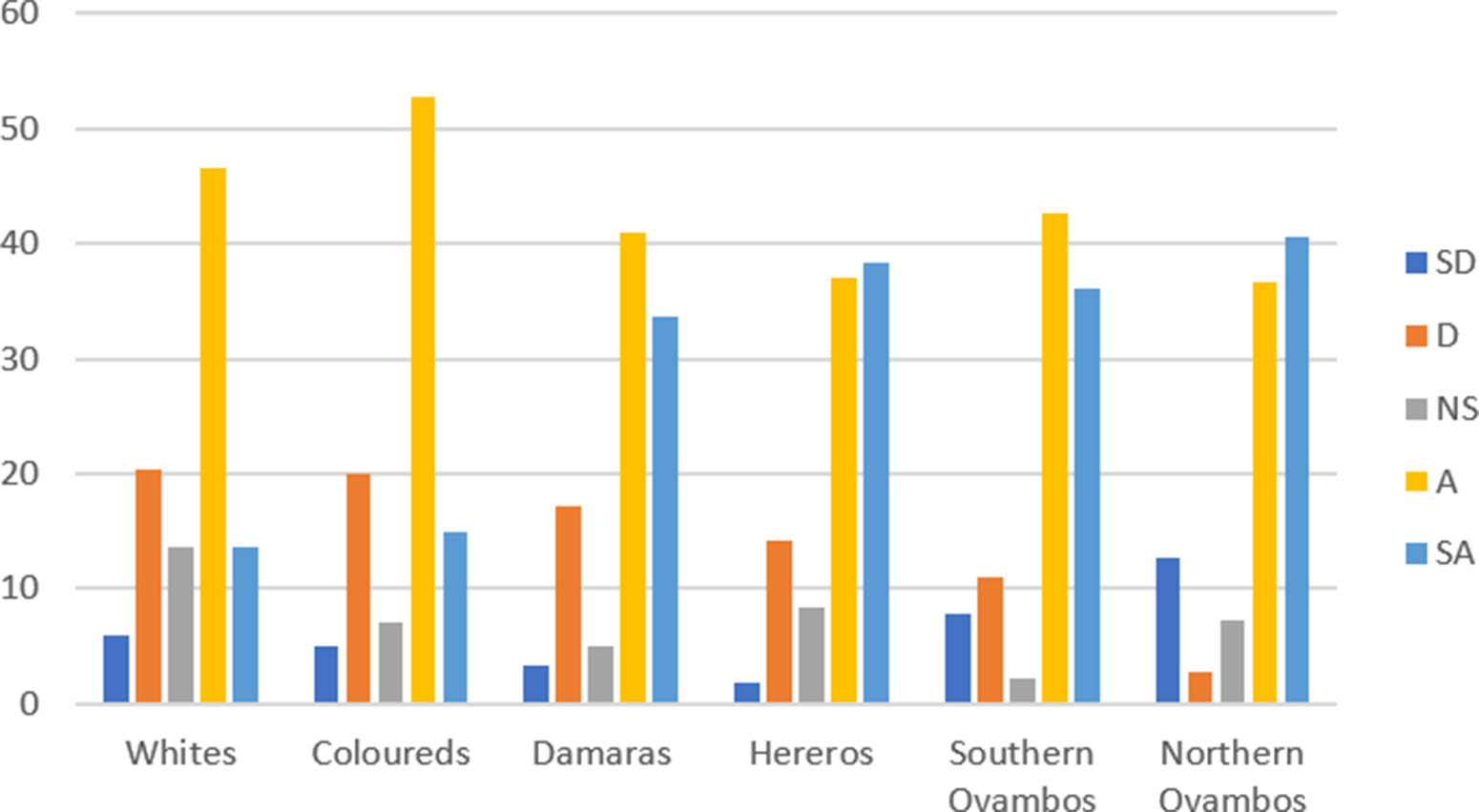
One aim of the questionnaire was to measure perceptions of how frequently English and other languages are used in informal contexts, including inter‑ethnic interactions.Footnote 9 The respondents strongly disagreed with the statement ‘I often use indigenous languages while interacting outside of my ethnic group’ (>98%), which shows that none functions as a lingua franca. Figure 1 summarises levels of agreement with the statement ‘I mostly use English outside of my ethnic in‑group’. Most agreed with the statement, which suggests that English in Namibia is widely used in inter‑ethnic contexts, in line with Phase 3’s ‘inter‑ethnic contacts’ criterion. The Southern and Northern Ovambos most strongly agree (78.7% and 77.2%, respectively), while the Whites and Coloureds agree the least (60.1% and 67.7%, respectively). Women show a significant preference for English (H[1]=9.860, p=.002), which – from a Labovian perspective – suggests that English holds the highest status in Namibian repertoires. This is compatible with the ‘widespread use’ and ‘positive acceptance’ criteria of Phases 3 and 4, respectively. From Trudgill’s (Reference Trudgill2004) perspective on linguistic regularization through accommodation, the responses further suggest that, as a prominent lingua franca, English in urban Namibia is likely to develop – or has already developed – linguistically focused forms across ethnolinguistic groups – in line with the Phase 4 ‘endonormativity’ criterion, unless SAE‑based norms still prevail.
‘I mostly speak English for socializing outside of my ethnic group’, combined gender means, SD=Strongly Disagree; D=Disagree; NS=Not Sure; A=Agree; SA=Strongly Agree (n=304).

1 Long description
A grouped column chart showing degrees of agreement with the statement “I mostly speak English for socializing outside of my ethnic group.” Degrees of agreement are shown for six respondent groups: Whites, Coloureds, Damaras, Hereros, Southern Ovambos, and Northern Ovambos. Hereros and Ovambos tend to show higher levels of strong agreement than the others.
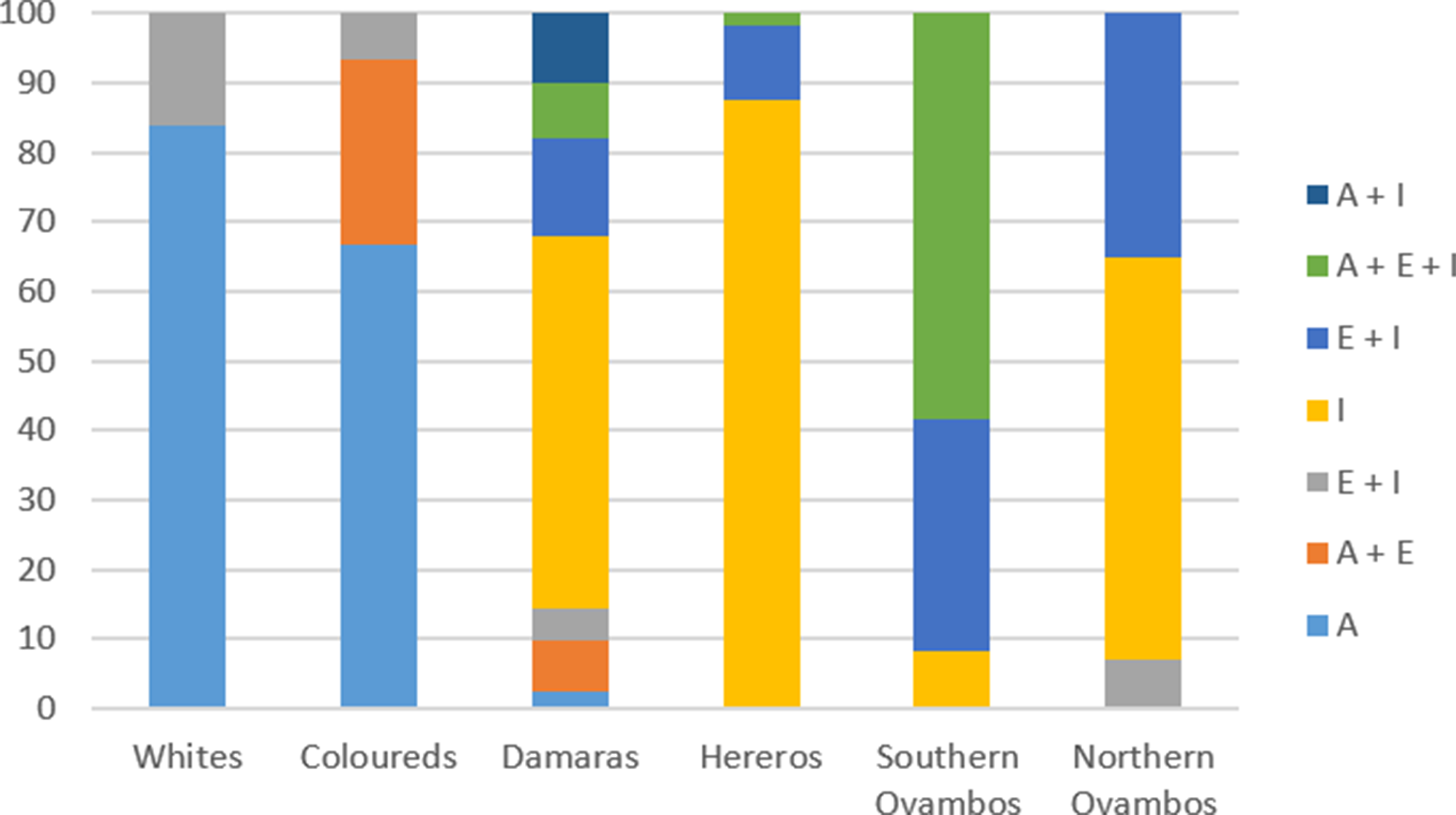
This potential for normative focusing through accommodation is also evident in responses to the question ‘What languages do you use with your siblings?’ (Figure 2). Intra‑ethnic communication might be expected to favour native languages, and this is largely the case (except among Southern Ovambos), albeit always in combination with English. All sample groups report using English alongside either Afrikaans or an indigenous language, or both. Three groups occasionally report using English monolingually with their siblings: Whites (16.1%), Coloureds (6.6%), and Northern Ovambos (7.1%). These observations again fit Phase 3’s ‘widespread use’ criterion, while even hinting at the possibility that Namibia’s native languages may be in the process of being displaced by English in urban informal interactional contexts, a possible reflection of the dynamic of language shift to English that Schneider (Reference Schneider2007, 56) observes in Phase 3.
‘Languages you use with your siblings’, combined gender means, A=Afrikaans; E=English; I=Indigenous (n=304).

Figure 2 Long description
A stacked column chart showing the proportions of Afrikaans, English, indigenous languages, and their combinations reported by respondents in interactions with their siblings. Whites and Coloureds report more monolingual language use, whereas the other groups report more multilingual language use.
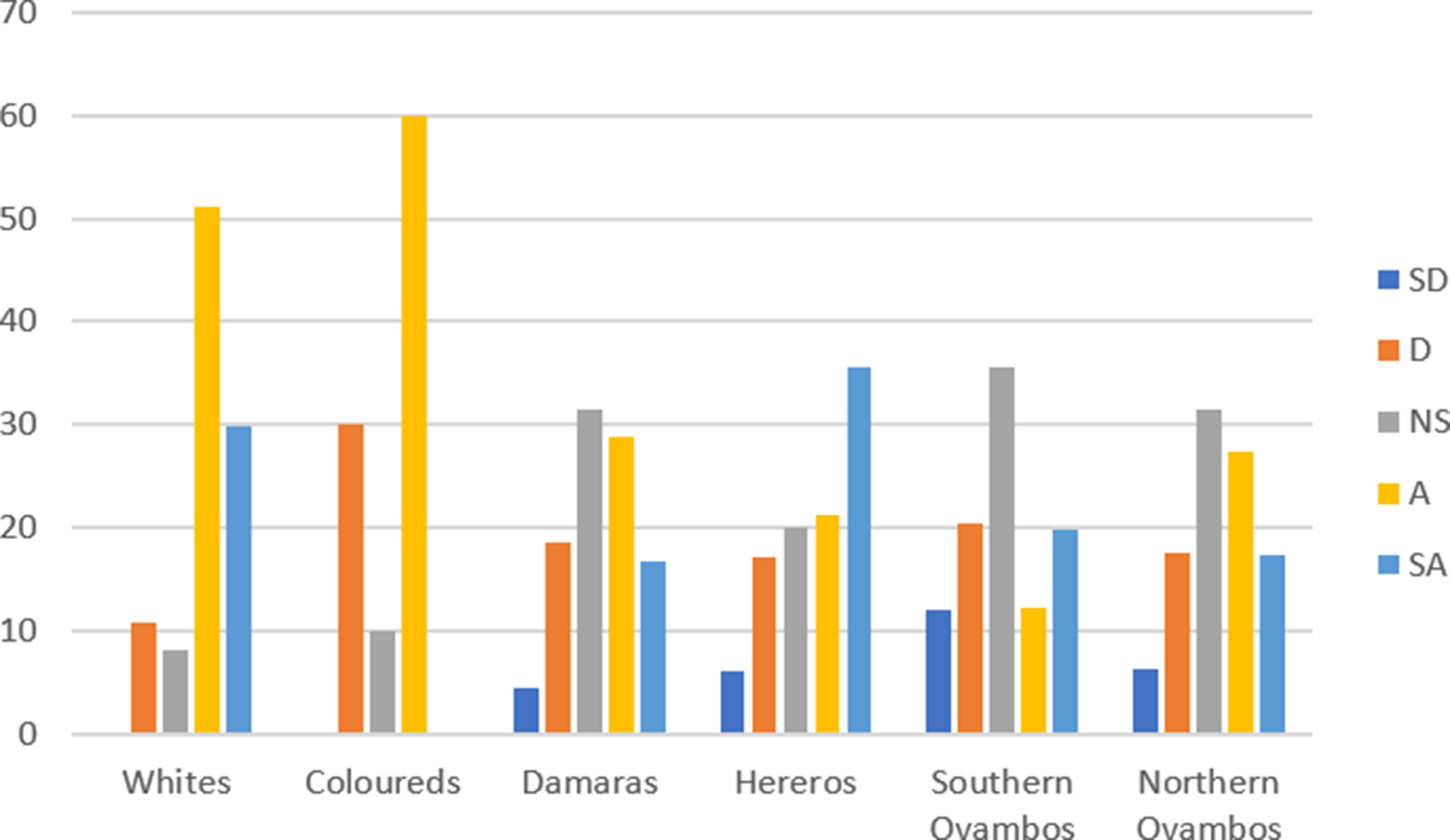
Other questionnaire items aimed to determine which English norms are considered most appropriate in the Namibian context. 53.25% agree that it is ‘British English’ (Figure 3). Whites and Coloureds agree the most (81%), while Damaras agree the least (45.6%). By comparison, only 20.9% agree that it is ‘US English’, and only 17.4% that it is ‘South African English’. Low levels of agreement with ‘South African English’ being the most appropriate norm could be interpreted as reflecting the emergence of a Namibian identity unlinked to South Africa (in line with the Phase 3 ‘identity’ criterion), as well as the development of a local English variety. Paradoxically, however, support for British English may also indicate continued implicit alignment with South African standards in a way that could preclude a Phase 3 or 4: historically, the highest‑ranking SAE variety – ‘Cultivated South African English’ – is largely aligned with European British norms (Bekker Reference Bekker2009).
‘Good English in Namibia is British English’, combined gender means, SD=Strongly Disagree; D=Disagree; NS=Not Sure; A=Agree; SA=Strongly Agree (n=304).

Figure 3 Long description
A grouped column chart showing degrees of agreement with the statement “Good English in Namibia is British English”. Degrees of agreement are shown for six respondent groups: Whites, Coloureds, Damaras, Hereros, Southern Ovambos, and Northern Ovambos. Whites and Coloureds tend to show higher levels of strong agreement than the others.
One further questionnaire item deserves discussion: is ‘good’ English in Namibia a variety that does not reveal one’s ethnolinguistic background? Overall, 49.2% agreed, while only 24.46% disagreed and 26.3% were unsure. Northern Ovambos agree the most (66.4% vs. 17.34% disagreement), whereas Coloureds agree the least (38.95% vs. 28.75%). The fact that agreement outweighs disagreement across subsamples suggests a stigma associated with sounding ‘ethnic’. This stigma may shape variation dynamics in Namibian English, potentially paving the way for Phase 4 via a local compromise variety, widespread and enjoying ‘positive acceptance’ while detached from SAE – a possibility explored in Sections 5.2 and 5.3.
Questionnaire data suggest that English in Namibia is deeply embedded in intra‑ethnic repertoires while also functioning as an urban lingua franca. Its lingua franca functions make it plausible that NamE orbits around focused varieties shaped through mutual accommodation, or through convergence with an English variety locally perceived as more normative than others. High‑status NamE and SAE varieties may be perceived as compatible, while there is also potential for normative divergence from SAE, and thus for Phases 3 and 4. The next section evaluates the extent to which these scenarios are borne out in language practices.
5.2. English in informal Namibian repertoires
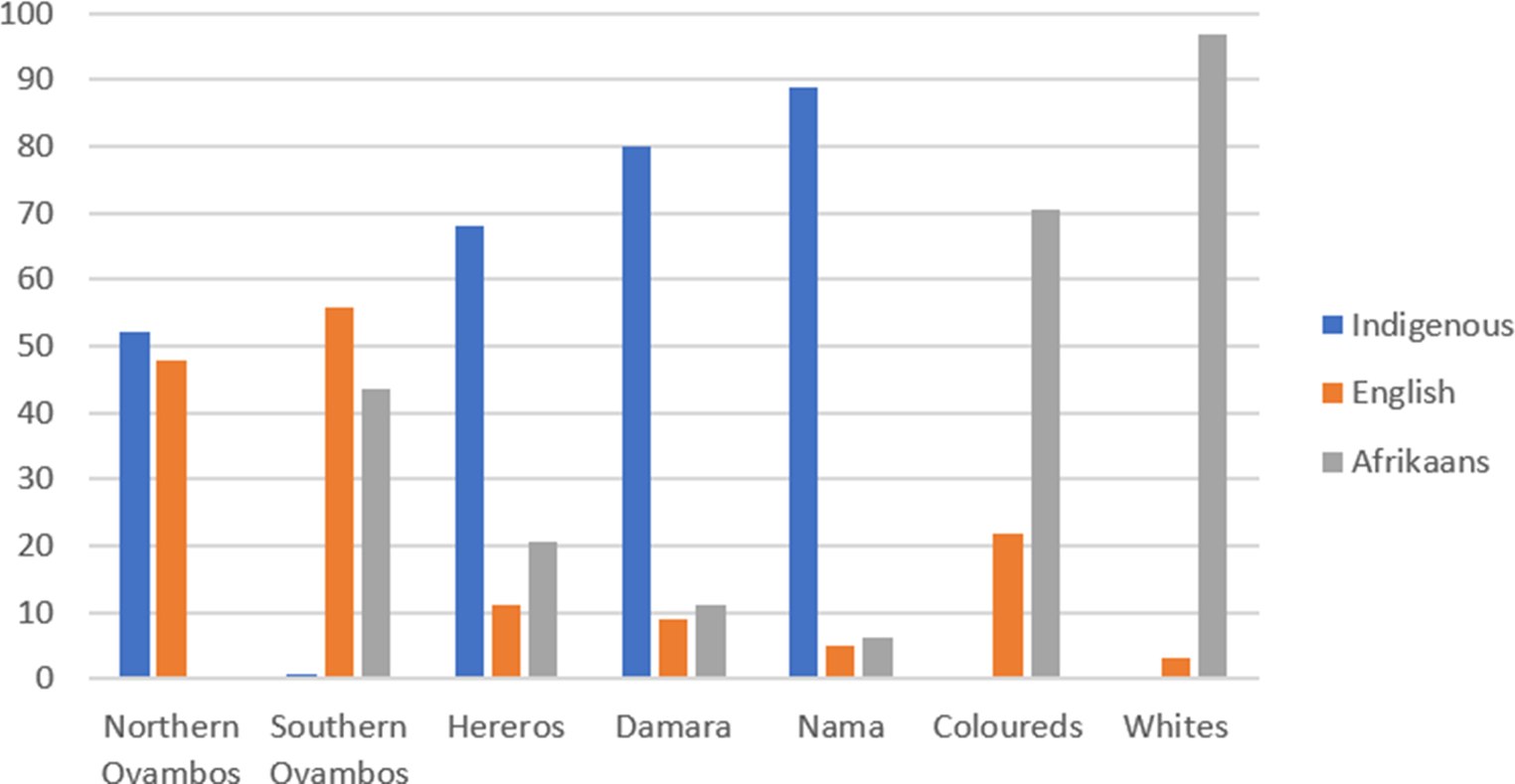
Dataset 2 consists of intra‑ and inter‑ethnic informal interactions involving members of different ethnolinguistic groups recruited from the UNAM campus in Windhoek. The sample includes 2 White Afrikaans speakers (‘Afrikaners’), 5 Coloureds, 4 Hereros, 7 Khoekhoegowab speakers (Damaras and Namas), and 6 Ovambos (‘Northern’ and ‘Southern’) (see Stell Reference Stell2019a). The interactions were recorded remotely, with both topic and language choice left entirely to the participants, yielding a corpus of approximately 200,000 words. Word counts confirm that English consistently forms part of intra‑ethnic repertoires, alongside Afrikaans and, among Black participants, indigenous languages (Figure 4). In inter‑ethnic interactions, only English and Afrikaans are used, except in exchanges between the Nama and Damara participants. English is the dominant medium of interaction between the Northern Ovambo participants and all others (>99% of lexemes), which can be explained by the fact that these Northern Ovambo participants did not report knowledge of Afrikaans, in line with the historically weak presence of Afrikaans in the northern districts (sections 3 and 6). Outside of interactions involving Northern Ovambo participants, English was also found to situationally function as a medium between Black female participants from different ethnolinguistic groups, between specific Black female participants and all other ethnolinguistic groups, and between Black participants and Whites (see Stell Reference Stell2019a).
Languages across intra-ethnic interactions (% lexeme total), n=48,000.

Figure 4 Long description
A grouped column chart showing percentage values for English, Afrikaans, and indigenous language lexemes used in intra-ethnic interactions by Whites, Coloureds, Damaras, Hereros, Southern Ovambos, and Northern Ovambos. Whites and Coloureds show the highest frequencies of Afrikaans and English and do not report using indigenous languages. Among the others, the Southern Ovambos show the highest frequencies of Afrikaans and English and the lowest frequencies of indigenous languages.
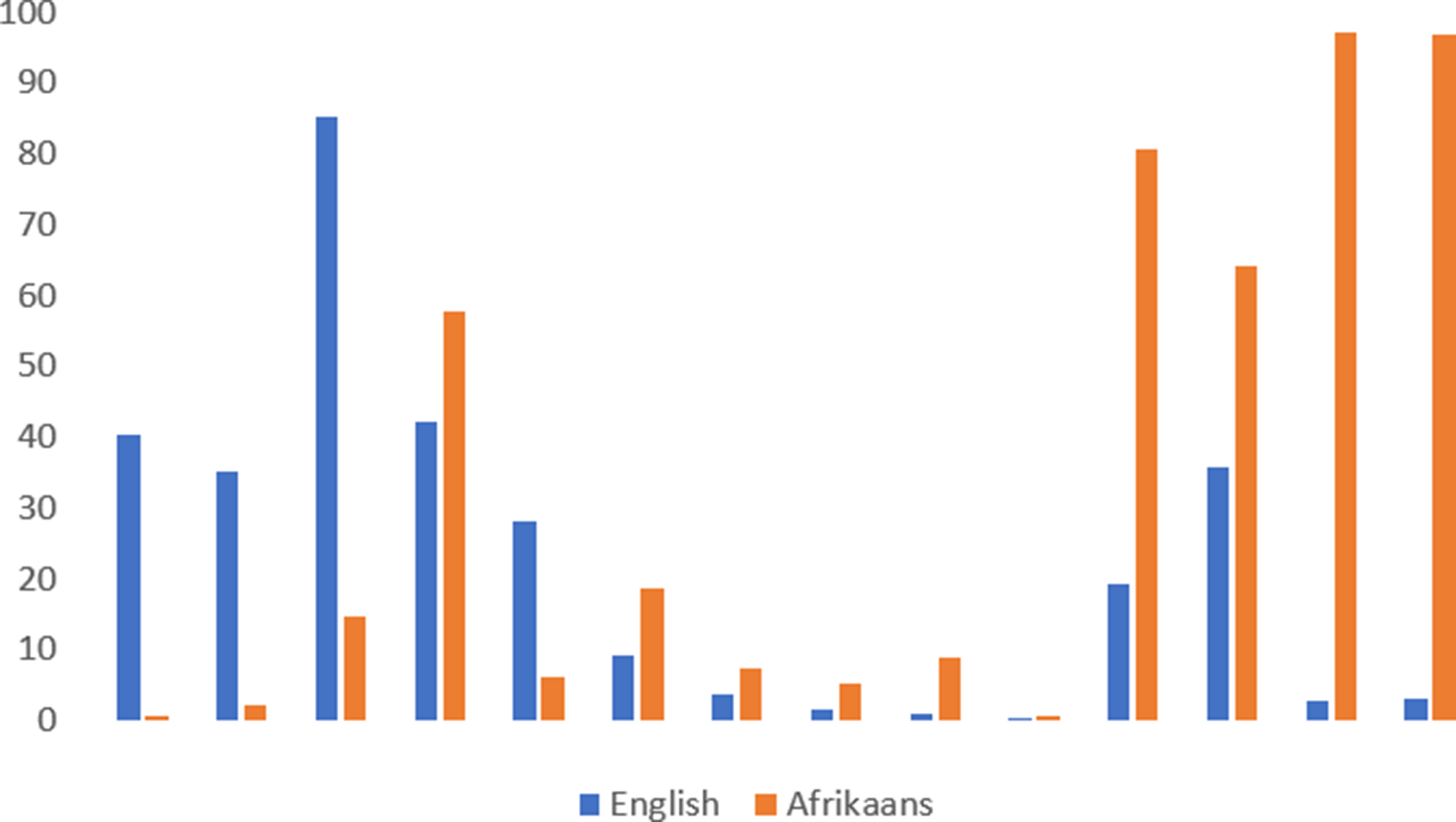
Figure 5 summarizes the distribution of languages across genders in intra‑ethnic interactions. English is more frequently used by women in the Northern Ovambo interaction (40.35% vs. 35.15%, respectively), the Southern Ovambo interaction (85.4% vs. 42.3%), the Herero interaction (28.2% vs. 9.1%), the Damara interaction (3.65% vs. 1.6%), and the Nama interaction (0.9% vs. 0.2%), while it is conversely more frequently used by men in the Coloured interaction (35.7% vs. 19.2%) and in the White interaction (3% vs. 2.8%). This finding again highlights the association between English and women detected earlier (Section 5.1) although, from the perspective of code‑switching practices, that association is found primarily with Black women. Given the Labovian view that women orient more towards high‑status varieties, this indicates that English functions as a high‑status variety in urban Black Namibian repertoires, sometimes in combination with Afrikaans, as is the case among Damaras and Namas. Overall, the linguistic data presented so far corroborate the questionnaire‑based characterisation of NamE as meeting the Phase 3 criteria of ‘widespread use’ and ‘inter‑ethnic contact’, primarily among Black Namibians – particularly women and Ovambos – suggesting that, through the linguistically homogenizing effects of repeated English‑medium interactions and accommodation, these data provide a privileged vantage point on emergent NamE norms.
English and Afrikaans across intra-ethnic interactions and genders (% lexeme total), W: women, M: men, n=48,000.

Figure 5 Long description
A grouped column chart showing percentage values for English and Afrikaans lexemes used in intra-ethnic interactions by women and men in the White, Coloured, Damara, Herero, Southern Ovambo, and Northern Ovambo subsamples. English is more frequently used by women than men among Ovambos, Hereros, Damaras, and Namas.
English combines with indigenous languages and Afrikaans in the form of English insertions into indigenous language or Afrikaans utterances (1), English utterances succeeding or preceding indigenous language or Afrikaans utterances (2), or English utterances featuring indigenous language or Afrikaans pragmatic markers (3, 4). Regularly used in the data by Black and Coloured participants and on no occasion by White participants, these pragmatic markers fit Phase 3’s ‘borrowings and transfers’ criterion. They mostly derive from Afrikaans varieties historically associated with Coloureds and Basters. These prominently include quotative/pretensive kamma (‘like’), not attested in SAE, derived from Cape Khoekhoe //kamüh or =kamüh (6). Other Afrikaans pragmatic markers combined with English by all Black and Coloured participants but not by White participants also find their origins in non‑European Cape Dutch. These prominently include marker of shared knowledge mos and sentence‑final tag nè (‘right’), attested in SAE (Stell Reference Stell2024). These pragmatic markers mark English styles as ‘inter‑ethnic’ when they do not occur alongside pragmatic markers from indigenous languages, as illustrated by (3), which exemplifies the use of an Oshiwambo pragmatic marker absent in inter‑ethnic contexts.

The interactional experiment also comprised verbal‑guise tests, involving six teams of two ‘judges’ – all UNAM students – tasked with socially profiling their ethnolinguistic peers from the interactions based on their recorded language use patterns. Their feedback shows that the English varieties of Oshiwambo speakers who just moved from the north (i.e. ‘Northern Ovambos’) are stigmatized. One linguistic feature that perceptually downranks their varieties is low frequencies – or absence of Afrikaans pragmatic markers. This is an indirect confirmation that the (historically) Baster/Coloured Afrikaans pragmatic markers named above are central to Black Namibians’ conceptions of what high‑status NamE varieties are (see also Stell Reference Stell2019a, Reference Stell2019b).
The fact that non‑White NamE varieties are lexically signalled by recurrent Afrikaans pragmatic markers in inter‑ethnic contexts suggests the existence of a focused, consensual English variety in Namibia. Given these pragmatic markers’ historical Baster and Coloured association, one could presume that these groups exert normative influence on other Namibian groups’ English varieties – a force for normative stabilization that may signal a Phase 4 status for NamE, if leading to divergence from SAE. The next section further explores this possibility at the sociophonetic level.
5.3 Sociophonetic variation in Namibian English
The NamE phonetic corpus is based on reading tasks administered to young urban informants sampled at government schools and private schools, taken to be representative of lower and middle classes, respectively.Footnote 10 The analysed vowel tokens total 20,498. They comprise FLEECE, KIT, DRESS, TRAP, BATH, PALM, LOT, CLOTH, THOUGHT, FOOT, GOOSE, FACE, GOAT, PRICE, MOUTH (see Stell Reference Stell2022). Among these, KIT was analysed in its allophonic realisations in anticipation that it may display a split mirroring White SAE (WSAE) patterns (Mesthrie Reference Mesthrie, Buschfeld, Hoffmann, Huber and Kautzsch2014) – should NamE be identical to (W)SAE. The KIT‑split, which involves a polarisation between high‑front [i] and a centralised schwa‑like value, is considered a typical albeit receding WSAE feature, associated more with the ‘Broad’ than with the ‘General’ WSAE variety.Footnote 11 Its origins are attributed to lower‑class 19th‑century Southeast England speech rather than to contact with Afrikaans (Stell Reference Stell2023). The KIT‑split is also found in Coloured SAE, especially in its working‑class varieties (Toefy Reference Toefy2017), while acrolectal Black SAE (BSAE) displays an ‘emerging contrast’ within KIT (Van Rooy Reference Van Rooy, Schneider, Burridge and Kortmann2004, 948).
Figures 6 and 7 plot KIT allophones categorised along Bekker (Reference Bekker2009). KIT1 refers to KIT in disyllabic words (e.g., city), KIT2 in word‑initial position, following [h], and in contexts involving velars (e.g., it, hid, kit), KIT3 before palate‑alveolars (e.g., dish), KIT4 in ‘unconditioned’ environments (e.g., sit), KIT5 after [l], [ɹ] and labials (e.g., lit, rid, bit), and KIT6 after [w] or before [ɫ] (e.g., with). The numbers of elicited tokens for each variant are as follows: four KIT1, nine KIT2, one KIT3, two KIT4, one KIT5, and four KIT6.
KIT realizations. Afrikaans speakers. Numbers refer to the type of KIT allophone. Combined Lobanov-normalized speaker means for F1 and F2 (n=1,107).

Figure 6 Long description
A vowel plot with x-axis showing f2 values and an y-axis showing f1 values for KIT variants as used by Afrikaners, Basters, and Coloureds. KIT2-3 are higher and more fronted. They are disjunct from KIT1-4-5-6, which are lower and more backed. KIT-6 is the backest.
KIT realizations. Damaras, Hereros, Ovambos. Numbers refer to the type of KIT allophone. Combined Lobanov-normalized speaker means for F1 and F2 (n=1,120).

Figure 7 Long description
A vowel plot with x-axis showing f2 values and an y-axis showing f1 values for KIT variants as used by Damaras, Hereros, and Ovambos. KIT variants form a more seamless continuum than in the previous figure. Polarization is still noticeable between KIT2-3 and KIT1-4-5-6.
Figure 6 mirrors Bekker’s (Reference Bekker2009) findings on WSAE in that KIT2‑3 and KIT4‑5‑6 appear polarized while the same variants tend more to form a continuum in Figure 7. Table 1 displays p‑values associated with differences in f1 and f2 between KIT2, KIT3, and KIT4 by gender within each ethnolinguistic group. The values show that KIT2‑KIT4 are disjunct in both f1 and f2 among Basters, Whites, and Ovambo men, while they are only disjunct in f2 among Coloureds, as well as among Damara and Ovambo women. KIT3‑KIT4 behave differently: they are disjunct in both f1 and f2 only among Whites, Ovambos, Baster women, Damara men, only in f1 among Baster men, and only in f2 among Herero women. Private school Black women display no disjunct KIT2‑KIT4 while they display disjunct KIT3‑KIT4 in both f1 and f2 (p=.01 and .001, respectively).
Significance of differences between KIT-realizations. Significant p-values in bold

Table 1 Long description
Table showing the significance of differences in KIT vowel realizations across White, Baster, Coloured, Damara, Herero, and Ovambo speakers. Significant p-values are highlighted in bold. Comparisons are reported for F1 and F2 values between KIT2 and KIT4, and between KIT3 and KIT4. Most significant differences are found with Whites and Basters, followed by Ovambo men and Coloureds.
To sum up, Whites, Baster women, and Ovambo men systematically conform to Broad WSAfE or Coloured SAE KIT‑split patterns in f1/f2, while the remaining Black informants – who realise the KIT‑split only partially – seem to align more closely with either General WSAfE or acrolectal BSAE patterns. The social prestige of this latter realisation in NamE can be inferred from its association with private‑school Black women. In any case, the NamE KIT‑split points to the continued influence of WSAfE, whether in its Broad or General varieties.
Figure 8 presents the output of a Principal Component Analysis (PCA), highlighting patterns of similarity and distance between individual vowel realisations across the full set of vowels outlined above. Each symbol represents one informant’s average vowel realisation pattern. The PCA yields two dimensions: PC1 accounts for 26.06% of variance and PC2 for 7.92%. Three clusters emerge. Cluster 1 (Cl.1) groups all but one White individual, while Cluster 3 (Cl.3) comprises most non‑White individuals. Cluster 2 (Cl.2) occupies an intermediate position, including most Coloureds, Basters, and Black private‑school individuals. Cl.1 and Cl.3 lie at opposite ends of the continuum. The features associated with Cl.1 are consistent with Broad‑to‑General WSAE (see Stell Reference Stell2023). Cl.1 and Cl.3 can be distinguished based on the following features:
1 Cl.1 has the most disjunct FLEECE‑KIT4 pair, with frontest FLEECE and most centralized KIT4, and Cl.3 the least disjunct FLEECE‑KIT4 pair, with backest FLEECE and frontest KIT4.
2 Cl.1 has the most disjunct DRESS‑TRAP pair, with highest DRESS and lowest TRAP, while Cl.3 has the least disjunct DRESS‑TRAP pair, with lowest DRESS and highest TRAP.
3 STRUT and BATH are backest in Cl.1, frontest in Cl.3.
4 Cl.1 has the frontest FOOT and GOOSE, Cl.3 the backest.
5 Cl.1 has the longest FACE and GOAT, Cl.3 the shortest.
6 Cl.1 has the shortest MOUTH and PRICE, Cl.3 the longest.
Figure 8.PC1 and PC2 for inter-individual variation in vowel realization patterns. The blue circle encompasses all Coloureds, the red circle the Basters, and the brown circle Black private school individuals (n=20,498).

Figure 8 Long description
A PCA plot with x-axis showing Factor 1 (PC1) and y-axis PCA plot of vowel realization patterns with PC1 and PC2 as axes. Data points form three partially overlapping clusters representing Coloureds, Basters, and Black private-school individuals. Cluster 1 comprises most Whites, Cluster 3 most Blacks, and Cluster 3 most Basters, Coloureds, and Black private-school individuals.

Cluster 2 tends towards Cluster 1, with a similar FLEECE‑KIT4 pair, or towards Cluster 3, with a fronted STRUT and BATH. Its diphthongs are located halfway between Clusters 1 and 3.
The lack of overlap between the White variety and the others suggests that the former – and, by extension, WSAE – is not a direct target for Coloured/Baster and urban Black Namibians. Instead, urban Black Namibians, especially women, appear to orient towards Coloured/Baster varieties, which themselves remain distinct from the White variety. The distinctive positioning of women relative to men across clusters mirrors the polarization commonly observed in Labovian studies, where women target high‑status features and men low‑status ones. In the Namibian context, ‘low status’ likely corresponds to ‘ethnic‑sounding’, as suggested by the questionnaire data on English norms (Section 5.1), and supported by verbal‑guise tests (Stell Reference Stell2022). Generally, the polarization patterns provide strong indications that urban Black and Coloured/Baster Namibian women converge on a normative focal point related to though distinct from the historically hegemonic WSAE variety. This contrasts with South African dynamics: young urban middle‑class Black South African women’s English varieties tend to overlap with WSAE (Mesthrie Reference Mesthrie, Buschfeld, Hoffmann, Huber and Kautzsch2014). By implication, there is, in practice, a broad consensus among urban Black and Baster/Coloured Namibians that WSAE no longer constitutes the hegemonic norm. At the same time, there appears to be agreement on what constitutes the local high‑status alternative, consistent with Phase 4 criteria of ‘endonormativity’, whereas the WSAE‑like White variety remains ‘exonormative’.
6. Namibian English in the Dynamic Model
Based on the alleged NURSE–WORK split, Schneider and Schröder (Reference Schneider, Schröder and Schröder2021) argue that NamE shows signs of Phase 3. They also identify ‘premature signs’ of Phase 4, based solely on Namibia’s fledgling English‑language literary production (291). Their reluctance to assign Phase 4 unequivocally stems from their observation of ‘ethnic differences’, which indicate that ‘it [NamE] clearly does not meet the criterion of homogeneity accompanied by awareness and acceptance of the variety’ (291). Accordingly, they conclude that ‘English in Namibia cannot be defined as an EFL variety anymore, but seemingly has not yet fully achieved ESL status either’ (287). This generalisation is limited by the authors’ selective reading of Namibia’s sociolinguistic history. As argued in Section 3, Namibia features a settler strand, meaning that NamE cannot be lightly characterised as having recently emerged from an EFL‑like state. Moreover, the studies on which Schneider and Schröder (Reference Schneider, Schröder and Schröder2021) base their claims share a non‑variationist orientation. As such, they do not consider gender or social class variables, crucial for identifying patterns of normative convergence around features despite ‘ethnic differences’. How should Namibia be positioned within the Dynamic Model in light of the data presented in Section 5?
Based on perceptions of what constitutes the high‑status variety, as well as on select linguistic features – namely Afrikaans pragmatic markers attested in SAE and the KIT‑split – one might be tempted to view NamE as tightly connected to, or even identical to, SAE. This would not qualify NamE for Phase 3 or 4, while not excluding the possibility that it is normatively focused (unlike the imagery of relative normative indeterminacy associated with emergent non‑PCEs). There are indications, however, that NamE may have been developing independently from SAE, potentially qualifying it for at least Phase 3 or even Phase 4. A scenario of divergence from SAE is supported by the use of distinctly Namibian pragmatic markers unattested in SAE and qualify NamE for at least Phase 3. Additional support for at least Phase 3 status for NamE lies in the fact that English is widely acknowledged as the highest‑ranking lingua franca and is widely used by the informants across intra‑ and inter‑ethnic contexts.
The recurrent use of a specific set of pragmatic markers in inter‑ethnic contexts suggests that, except in its White varieties, NamE orients towards a consensual high‑status norm. These markers, historically derived from Coloured/Baster Afrikaans, point to Namibian Coloureds and Basters as a prominent normative point of reference (see also Stell Reference Stell2025a). This is corroborated at the phonetic level, where non‑White middle classes and women converge on features associated with Coloured and Baster English rather than on the historically hegemonic WSAE‑like varieties of White Namibians. Taken together, these patterns support a Phase 4 status for urban Black and Coloured NamE, whereby norms distinct from SAE’s historically normative WSAE core are widely accepted (while that same WSAE core remains normative among urban middle‑class Black South Africans; see Mesthrie Reference Mesthrie, Buschfeld, Hoffmann, Huber and Kautzsch2014).
The onset of NamE’s Phase 1 could be located in either 1878 or 1915. If 1915 is chosen, the settler strand would have included British administrators, soldiers, and clergymen who arrived following the South African takeover, as well as largely bilingual Afrikaner and Coloured migrants (If 1878 is preferred, the settler strand would instead comprise British administrators, sailors, merchants, and Coloured guano miners along the coast and in the south). The English varieties present in the territory at this stage ranged from British English to Broad WSAE and Coloured English. Phase 2 starts with the confirmation of the Mandate in 1919 and extends to the Transitional Government of 1978, when the repatriation of South African public servants began. During this period, there was little scope for NamE to diverge from SAE models. This did not apply to SWAPO’s refugee camps from the 1960s to 1990, where Phase 3 dynamics could emerge in the form of an Oshiwambo‑influenced variety temporarily removed from settler‑strand influence. Outside the White Namibian population, which remained aligned with SAE models, Phase 3 and Phase 4 could have quickly followed one another as post‑apartheid Ovambo migration to urban centres accelerated. Ovambo English varieties could then converge with the English varieties used by urban Whites and Basters/Coloureds to accommodate Ovambo newcomers, who could not use Afrikaans as a lingua franca due to historically limited exposure to it in the north or abroad (see Stell Reference Stell2019b). This scenario fits with the data, which suggest that urban Black Namibians are focusing around Coloured/Baster NamE varieties (in a way reminiscent of mergers between settler strands and indigenous strands typical of transitions into Phase 4, whereby Coloureds possibly act as one settler strand; see Section 3 and Schneider Reference Schneider2007, 45), a process led by women and middle classes. These phases coexist with residual linguistic alignment with South African norms – most notably in the form of White Namibians’ WSAE‑like varieties – and with ethnically marked varieties, more frequently used in intra‑ethnic contexts and by men.
If NamE cannot serve as a flagship example of a non‑PCE, what can it contribute to World Englishes model‑making? One contribution is to question the reliance on a uniform, decontextualised notion of the settler strand, which can lead – as in the case of Namibia – to overlooking social groups that functioned as a settler strand without fitting the profile of native English‑speaking Britons, such as Afrikaners and Coloureds. More broadly, one may ask whether greater weight should be given to degrees of direct British rule or to the historical presence of local English‑speaking colonial elites as a basis for distinguishing between ESL and EFL.
The Namibian case brings into focus the question of how to identify norms in Outer Circle Englishes, of which NamE is clearly a representative. Where English functions as an informal lingua franca, as in Namibia, one may expect processes of linguistic focusing, resulting in regularised features – a predictable outcome of repeated face‑to‑face accommodation in Trudgill’s (Reference Trudgill2004) view. The interactional data presented in Section 5.2 show that such accommodation‑driven focusing around shared features – some more local than others – does occur in urban Black and Coloured NamE. Section 5.3 further demonstrates that phonetic focusing is largely driven by (urban Black and Coloured/Baster) women and middle classes, in line with variationist predictions, around features that do not quite overlap with old WSAE models still influential among White Namibians.
These findings suggest that a variationist perspective is essential for empirically determining whether, as a whole, a variety is undergoing Phase 3 (whereby several norms, including local ones, coexist) or Phase 4 (whereby consensus around a local norm exists). But it can also serve to determine how evenly phases are distributed across the population: Coloured/Baster and urban Black NamE seems to be going through Phase 4 as one single focusing continuum, while Whites conform to now‑turned‑exogenous WSAE models. Judging by the sociophonetic data, Phase 4 seems more specifically spearheaded by Coloured/Baster and urban Black Namibian women from private schools. Importantly, Phases 4 and 3 can also coexist in individual repertoires, as the interactional data showed, with ‘supra‑ethnic’ English varieties used in inter‑ethnic contexts along with ethnically marked English varieties used in intra‑ethnic contexts. Contextual ethnic heterogeneity in NamE raises questions on Phase 5 (‘internal differentiation’): style‑shifting involving ethnically marked ways of speaking English is unlikely to subside as long as ethnic languages and ideologies of ethnic solidarity persist. One could therefore wonder if Phase 5 is not best imagined as a phenomenon necessarily parallel to Phases 3 and 4 not only in NamE but also in most Outer Circle Englishes.
GERALD STELL is Associate Professor of Sociolinguistics at the University of Lausanne, Switzerland, after holding positions at the Hong Kong Polytechnic University and the University of the West Indies. His research focuses on language contact, variation, and attitudes in postcolonial settings, particularly in Southern Africa. He has conducted extensive research on Namibian English, Namibian Afrikaans, and their interaction with Namibian indigenous languages. His recent work includes Namibian English in its Multilingual Context, published by De Gruyter Mouton in 2025. Current projects focus on multilingual repertoires and mobility in a broader African context. Email: geraldstell@gmail.com


 Open access

