Grammars, dictionaries, usage manuals and other linguistic references are traditionally categorized along a spectrum running from prescriptivist to descriptivist, yet for years problems with this system of categorization have been noted. Forty years ago Geoffrey Pullum cautioned against confusing methodology and motives when applying the ‘descriptive’ or ‘prescriptive’ labels (Reference Pullum1974: 77–78). A few years later Emma Vorlat suggested a middle ground, that grammars codify the language along a continuum of prescriptive–normative–descriptive, that is codification based on arbitrary rules – usage by social elites – description without value judgment (Reference Vorlat1979: 129). Ingrid Tieken-Boon van Ostade noted that Vorlat's categories are not discrete, with eighteenth-century grammars increasingly basing prescriptions on descriptions of actual usage as the century progressed (Reference Tieken-Boon van Ostade and Auroux2000: 877). María Rodríguez-Gil further noted that prescriptive grammars often base their advice on description of the language of social elites (Reference Rodríguez-Gil2003: 190). Joan Beal characterized Robert Lowth's eighteenth-century grammars as both ‘normative’ and ‘descriptive’ (Reference Beal2004: 106). And Robin Straaijer has noted that ‘it seems useful to view prescriptivism and descriptivism as being independent from one another rather than diametrical opposites’ (Reference Straaijer, Tieken-Boon van Ostade and van der Wurff2009: 67–68). Yet, perhaps because of the baggage carried by the two terms, to date no one has made the leap to conclude that the two terms address entirely different domains altogether – Straaijer approached the brink but did not leap. Prescriptivism and descriptivism do not exist along the same continuum.
Prescriptivism addresses value in language, how to speak and write aesthetically or in conformity with a particular group or social class. One source defines it as ‘an approach, especially to grammar, that sets out rules for what is regarded as correct in language’ (McArthur, Reference McArthur1996: 263). Whether or not a reference is prescriptive is a question of motive, the purpose for which the reference has been written or to which it is being put. Descriptivism, on the other hand, is a methodology for arriving at conclusions about language, ‘an approach that proposes the objective and systematic description of language, in which investigators confine themselves to facts as they can be observed’ (McArthur, Reference McArthur1996: 263). The prescriptivist-descriptivist dyad compares the apples of motivation and intended use (prescriptive/non-prescriptive) with the oranges of methodology (descriptive/non-descriptive). In this article I propose a different system of categorizing grammars and compare specific pronouncements in two eighteenth-century grammars, along with a few illustrative examples from other grammars and usage manuals, as case studies for this new system.
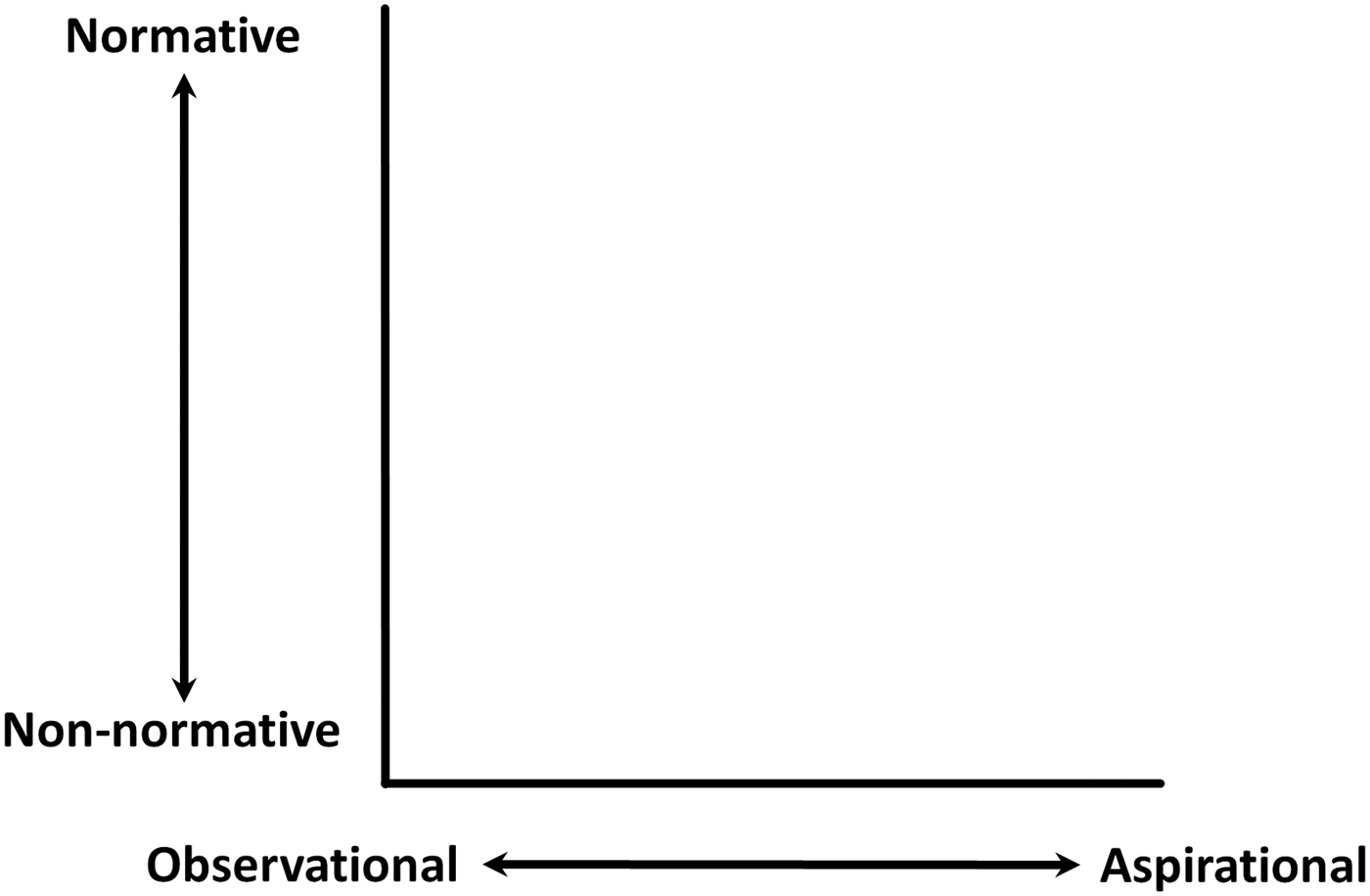
A two-axis system of categorization that separates methodology from intent can clarify and better characterize the relative positions of different grammars (see Figure 1). The x-axis defines the methodology of a grammar running along a continuum from the observational to the aspirational. That is, a methodology based on actual usage of English speakers, be they common folk or the so-called best writers of the age, to one which bases its conclusions on arbitrary choice, logic and analogy with grammatical rules that define an ideal and perfected state. I have chosen the word aspirational as the label because it denotes working toward a desired but unrealized, or even unrealizable, state. The motivation behind the production of a grammar is categorized along a y-axis that measures normativity; a normative grammar being ‘a system of grammatical rules set up as a standard to which language in use must conform’ (OED, 2003). Normativity, as I am using the term here, does not simply refer to codification of typical usage, but the assignment of value to such a codification, be it aesthetic or social value. The normative/non-normative axis can also be used to categorize how grammars and dictionaries are actually used, as opposed to how the authors and editors intend them to be used, but here I restrict my analysis to the author's stated intent and how it is realized. Robin Straaijer has proposed a similar two-dimensional grid for mapping prescriptivist and descriptivist tendencies, although his analysis does not separate the two domains, motivation and methodology (Reference Straaijer, Tieken-Boon van Ostade and van der Wurff2009).
Two-axis characterization of grammars

I avoid using the traditional labels of descriptive or prescriptive as such use invites confusion when discussing the two systems of categorization, not to mention that both descriptive and prescriptive carry with them ideological baggage, use of which immediately makes one a combatant in one of the many language wars that are constantly being waged. It may seem to some that normative and aspirational are much the same, as are non-normative and observational, but the distinction between these pairs lies in the domains in which the terms are applied. Normative/non-normative applies to motivation and use, while aspirational/observational refers to the methodology. It is possible to have a normative-observational grammar that dispenses advice on how to write well, but bases that advice on the actual usage of other writers. Indeed, with the exception of publications written for audiences of academic linguists, most modern grammars and dictionaries are normative – if not in editorial intent, then in how they are used by readers – although they can be distinguished relative to one another in their degree of normativity.
A test case: Priestley and Lowth
I examine here the motives and methodologies of two eighteenth-century grammarians: Joseph Priestley and his 1761 Rudiments of Grammar, which he revised in 1768, and Robert Lowth and his enormously popular Grammar of 1762, revised in Reference Lowth1763. And in particular, I examine the treatment of three linguistic features in these grammars to determine whether such a separation of motivation and methodology can yield a more useful categorization than the traditional prescriptive-descriptive dyad. The three linguistic features I review are double negation, the claim that wert is a subjunctive-only form of to be, and preposition stranding. I have selected these three features because they run a gamut of topics, including grammar, syntax and style, and because both Priestley and Lowth either directly state or leave clues as to the motivations and methodology that lie behind their pronouncements in these three arenas. The analysis given here is not a comprehensive overview of these grammars or the linguistic features contained therein, but simply an examination of whether this two-axis system of categorization can yield useful results.
To provide a basis for comparison and to plot the treatment of the linguistic features in the figures, I have opted for a qualitative approach. Based on the language Priestley and Lowth use to describe their grammars, their purpose and the various observations they make about the language, as well as the evidence from actual usage they provide or allude to, I give each grammar general rankings (slightly, moderately, strongly, absolutely) for motivation and methodology, and then modify the rankings as necessary according to the grammar's treatment of each specific feature. I use this qualitative approach rather than rely on a quantitative approach that would measure only some aspects of motive and methodology. While it is possible to quantify specific markers of normativity, as Straaijer has shown in his examination of modals in Priestley and Lowth (Reference Straaijer, Tieken-Boon van Ostade and van der Wurff2009), a comprehensive evaluation of normativity in any given grammar would need to incorporate multiple quantitative metrics, which is well beyond the scope of this paper. Furthermore, measurement of methodology is much less amenable to quantitative analysis, particularly since the data are simply not available for these grammars. One cannot quantify statements like Priestley's, ‘use hath established the modification that is here laid down’, without knowledge of what corpora or exemplars he based this judgement upon (Reference Priestley1761: 20–21). A qualitative interpretation of the data is sufficient to validate whether or not the model outlined here is useful, and of course nothing precludes others from applying quantitative metrics to the model. Note also that the rankings are relative ones. If a wider range of grammars were to be included, particularly modern ones based on exhaustive examination of large digital corpora, the mapping of methodology on the graphs might shift, moving these eighteenth-century grammars toward the aspirational.
The traditional view of eighteenth-century grammarians is that they were primarily prescriptive in their approach, with Robert Lowth's Reference Lowth1762 grammar serving as the icon of the prescriptivism of the era. In this traditional view the exception is Joseph Priestley, who applied a scientific and descriptive approach to his study of language in the production of his 1761 grammar (Straaijer, Reference Straaijer, Tieken-Boon van Ostade and van der Wurff2009: 59). In 1974 Geoffrey Pullum refuted this traditional view of Lowth, arguing that the grammarian was more descriptive than tradition would have it, an argument that was little heeded until Ingrid Tieken-Boon van Ostade's work on Lowth followed up on and affirmed Pullum's argument (Reference Tieken-Boon van Ostade2010: 83). As for Priestley, both Jane Hodson and Robin Straaijer have argued that he is more prescriptive than his reputation would have it (Hodson, Reference Hodson2006; Straaijer, Reference Straaijer, Tieken-Boon van Ostade and van der Wurff2009: 83–84). Since Pullum's Reference Pullum1974 article, the views on eighteenth-century grammarians have become more accurate, but their categorization has remained muddled because the descriptive-prescriptive dyad is simply inadequate to the task of categorization.
Priestley and Lowth's general motivation
Priestley intended his Rudiments of English Grammar for a specific audience, as is evident from its subtitle, Adapted to the Use of Schools, and he later stated that his initial motivation for composing it was for use in his classroom – although its publication may have come too late for him to have done so himself (Priestley, Reference Priestley1806: 44; Straaijer, Reference Straaijer2011: 37–38). Its positioning as a pedagogical grammar marks the work as normative – by their nature pedagogical grammars are normative in that they seek to instruct in how to use the language – but Priestley also telegraphs his normative intentions when he defines grammar as ‘the art of using words properly’, a definition that Ian Michael has pointed out is highly formulaic and that, with variations, appears in the majority of grammars of the era (Priestley, Reference Priestley1761: 1; Michael, Reference Michael1970: 189).
Priestley originally thought a single grammar could serve both schoolchildren and advanced scholars, and he therefore subtitled the 1761 edition Adapted to the Use of Schools, with Observations on Style. But by 1768 Priestley had concluded that English grammar was more complex, and a simple school grammar could not also serve the community of nascent linguists that was beginning to emerge (Chapman, Reference Chapman and Tieken-Boon van Ostade2008). His 1768 revision is almost two books: one a straightforward grammar for schoolchildren and the other a more complex treatise on language. The new subtitle reflects this change: With Notes and Observations, For the Use of Those Who Have Made Some Proficiency in the Language (Hodson, Reference Hodson and Tieken-Boon van Ostade2008: 182). Priestley also amends his definition of grammar in his 1768 revision, deviating from the standard formula and giving it a dual normative/observational nature consistent with a shift in his intended audience: ‘the grammar of any language is a collection of observations on the structure of it, and a system of rules for the proper use of it’ (Reference Priestley1768: 1). Yet Priestley's Reference Priestley1768 observations are not entirely free of normative judgements, as is evident in this passage on the use of the plural where he uses ‘seems better’:
Names of mental qualities seldom have any plurals, yet when particular acts and general habits are meant, the plural number sometimes occurs; as insolences. Hume's Hist. vol. 7. p. 411. but it seems better to have recourse to a periphrasis in this case. (Reference Priestley1768: 62)
He also expresses the normative desire to ‘guard against’ undesirable changes in the language (Reference Priestley1768: xi). So it would seem that Priestley's non-normative intentions are occasionally undermined by his insertion of normative judgements. Both editions are pedagogical, but with a secondary non-normative purpose. As a result, the two editions of Priestley's grammar can be generally classified as moderately normative, with the later edition being somewhat less so.
Like Priestley, Lowth's initial motivation for writing his grammar is also pedagogical, and he also addresses both students and more sophisticated scholars. But unlike Priestley, Lowth's unstated motivation was to provide his readers with the linguistic tools needed for upward social mobility (Beal, Reference Beal2004: 94; Tieken-Boon van Ostade, Reference Tieken-Boon van Ostade2011: 49). He originally conceived the book as an educational tool for his son, and Lowth reworked and published the grammar at the request of a patron, who wanted the grammar for his own son – such books were in demand among the upper middle classes to prepare their children before sending them to school to learn Latin (Tieken-Boon van Ostade, Reference Tieken-Boon van Ostade2012: 64). But in its reworking the grammar took on a more scholarly focus (Tieken-Boon van Ostade, Reference Tieken-Boon van Ostade and Hickey2010: 74–75). Like Priestley's, the main text of Lowth's grammar is rather simple, with the notes being more sophisticated and aimed at the scholar. Yet Lowth describes his grammar as ‘not a Philosophical, but a Popular’ one, and he includes the ‘Children of the lowest Class’ among its intended readership (Tieken-Boon van Ostade, Reference Tieken-Boon van Ostade2012: 68). In the preface to his grammar, Lowth agrees with the charge made earlier by Swift ‘that the English Language as it is spoken by the politest part of the nation, and as it stands in the writings of our most approved authors, oftentimes offends against every part of Grammar’ (Reference Lowth1762: ii–iii). And he uses the standard, normative formula for his definition of grammar, ‘the Art of rightly expressing our thoughts by Words’ (Reference Lowth1762: 1). As a result of these focuses on pedagogy and social mobility, as well as the statements above, both the 1762 and 1763 grammars, like Priestley's, can be classified as moderately normative in their intent.
Since both Priestley and Lowth are only moderately normative, it is instructive to compare them to a strongly normative motivation, that of Samuel Johnson in his dictionary and accompanying grammar. Although he does not specifically address or even mention the grammar in his 1747 Plan of a Dictionary, Johnson gives a clear, normative purpose for the project as a whole when he says, ‘the chief intent of it is to preserve the purity and ascertain the meaning of the English idiom’ (Reference Johnson, Kolb and DeMaria2005: 29). In his grammar he uses the formulaic definition of grammar as ‘the art of using words properly’ (Reference Johnson, Kolb and DeMaria2005: 275). In the dictionary itself, the entry for grammar defines it as ‘the science of speaking correctly; the art which teaches the relations of words to each other’, and ‘propriety and justness of speech; speech according to grammar’, and ‘the book that treats the various relations of words to one another’ (Johnson, Reference Johnson1755). And in the Plan he goes on to say his intent is to create a reference that ‘instructs the learner’, ‘amuses the philosopher’, and is of ‘advantage to the common workman’ (Reference Johnson, Kolb and DeMaria2005: 29). So for Johnson, his dictionary and its accompanying grammar are preservational and pedagogical, with a secondary non-normative purpose of ‘ascertain[ing] the meaning of the English idiom’ and ‘amus[ing] the philosopher’. Perhaps Johnson's most telling statement of intent is when he likens himself to a colonial power, bringing enlightenment and the benefits of classical language to the benighted natives of Britain:
When I survey the Plan which I have laid before you, I cannot, my Lord but confess, that I am frighted at its extent, and, like the soldiers of Caesar, look on Britain as a new world, which it is almost madness to invade. But I hope, that though I should not complete the conquest, I shall at least discover the coast, civilize part of the inhabitants, and make it easy for some other adventurer to proceed farther, to reduce them wholly to subjection, and settle them under laws. (Reference Johnson, Kolb and DeMaria2005: 58)
To Johnson, grammar is an external civilizing force that must be imposed upon a population. It is not only linguistically normative, but socially and morally as well.
On the other end of the spectrum, it is difficult, perhaps impossible, to find an example of a non-normative eighteenth-century grammar, but a modern illustrative example is Huddleston and Pullum's The Cambridge Grammar of the English Language, which states its non-normative aim, albeit using the traditional labels of description and prescription:
Our aim is to describe and not prescribe: we outline and illustrate the principles that govern the construction of words and sentences in the present-day language without recommending or condemning particular usage choices. Although this book may be (and we certainly hope it will be) of use in helping the user decide how to phrase things, it is not designed as a style guide or a usage manual. … Rather, this book offers a description of the context common to all such decisions: the linguistic system itself. (Reference Huddleston and Pullum2002: 2)
Huddleston and Pullum recognize that their grammar may be put to normative uses, but their grammar itself does not make normative judgements. The Cambridge Grammar can be compared with another modern source, a usage guide, Merriam-Webster's Dictionary of English Usage that ‘examines and evaluates common problems of confused or disputed English usage’ (Merriam-Webster, 1994: 4a). A usage manual, like a pedagogical grammar, is inherently normative, and the preface to the MWDEU, with its use of evaluates, problems, confused and disputed confirms that normativity in this case. Yet while one is non-normative and the other normative, both The Cambridge Grammar and the MWDEU are methodologically observational as they both base their pronouncements on extensive corpora of usage.
Similarly, while a non-normative/aspirational English grammar is conceptually possible, I know of no examples from any century, nor is it clear why anyone would wish to compile such a work. Certain grammars of invented languages, such as Esperanto or Klingon, might fall into this category, however.
Priestley and Lowth's general methodology
Priestley presents his methodology in observational terms. Not only does he, in the 1768 revision, define grammar in observational terms, in the earlier edition he compares his grammar to ‘a treatise of Natural Philosophy’, as is fitting for one of the preeminent natural philosophers of the age (Reference Priestley1761: vi). But where observations of usage provide mixed results, Priestley allows recourse to logic and analogy to determine the matter. And where recourse to the established rules is no help, ‘the thing must remain undecided, till all-governing custom shall declare in favour of one or the other’ (1761: vii).
Yet in the main body of his 1761 grammar Priestley uses only a handful of illustrative quotations, and these are negative examples, showing writers not adhering to the grammar he outlines. The final section of the first edition is ‘Examples of English Composition’, which provides positive examples from writers such as Pope, Addison, Shakespeare and Swift, but he does not link these examples to any specific grammatical observations. So while Priestley presents his methodology as observational, in the first edition he provides little evidence of this in practice.
Priestley takes a different approach in his 1768 revision. He replaces the few usage citations and the non-specific examples found the earlier edition with a plethora of quotations illustrative of specific grammatical points in his ‘Notes and Observations’ section. He also shows a preference for contemporary writers over those of past generations. Priestley's examples of good writing include non-literary writers, and at one point an example from the speech of tradesmen (Reference Priestley1768: 61), indicating that he does not wish to plumb the depths of the literary English of the past, but rather to describe how English is currently used in a number of contexts and genres. As a result, Priestley's approach in the 1761 edition is neutral – ostensibly observational, but with little evidence to demonstrate it. In contrast, his 1768 edition is rather strongly observational, with a more expansive description of his observational methodology and copious usage citations from a wide variety of writers.
For his part, Lowth makes no overarching statements describing his methodology. While he makes extensive use of citations from twenty-seven authors and the 1611 Authorized Bible to buttress his grammatical pronouncements, in most cases these quotations are examples of errors and not positive examples of how English is used (Tieken-Boon van Ostade, Reference Tieken-Boon van Ostade2011: 129; Percy, Reference Percy2012: 13–14). At points he is more deferential to logic and analogy than is Priestley (Lowth, Reference Lowth1762: 19, 105, 120; Percy, Reference Percy1997: 132). And he also consistently distinguishes between different registers, describing different grammatical rules for various formal, informal and poetic contexts (Reference Lowth1762: 48, 127–28, 131, 137). Lowth's phraseology when making grammatical pronouncements is consistently observational rather than aspirational, e.g. ‘Who is appropriated to Persons […] we apply which to Things only’ (Reference Lowth1763: 147), but there are exceptions, e.g., his use of ‘properly’ in ‘That is used indifferently both of persons and things: but perhaps would be more properly confined to the latter’ (Reference Lowth1763: 147). And unlike Priestley's two editions, no significant differences can be seen in the overall methodology used in Lowth's two editions. Lowth, therefore, is slightly observational in his approach, weakly describing his work as observational and providing some, albeit mostly negative, usage examples.
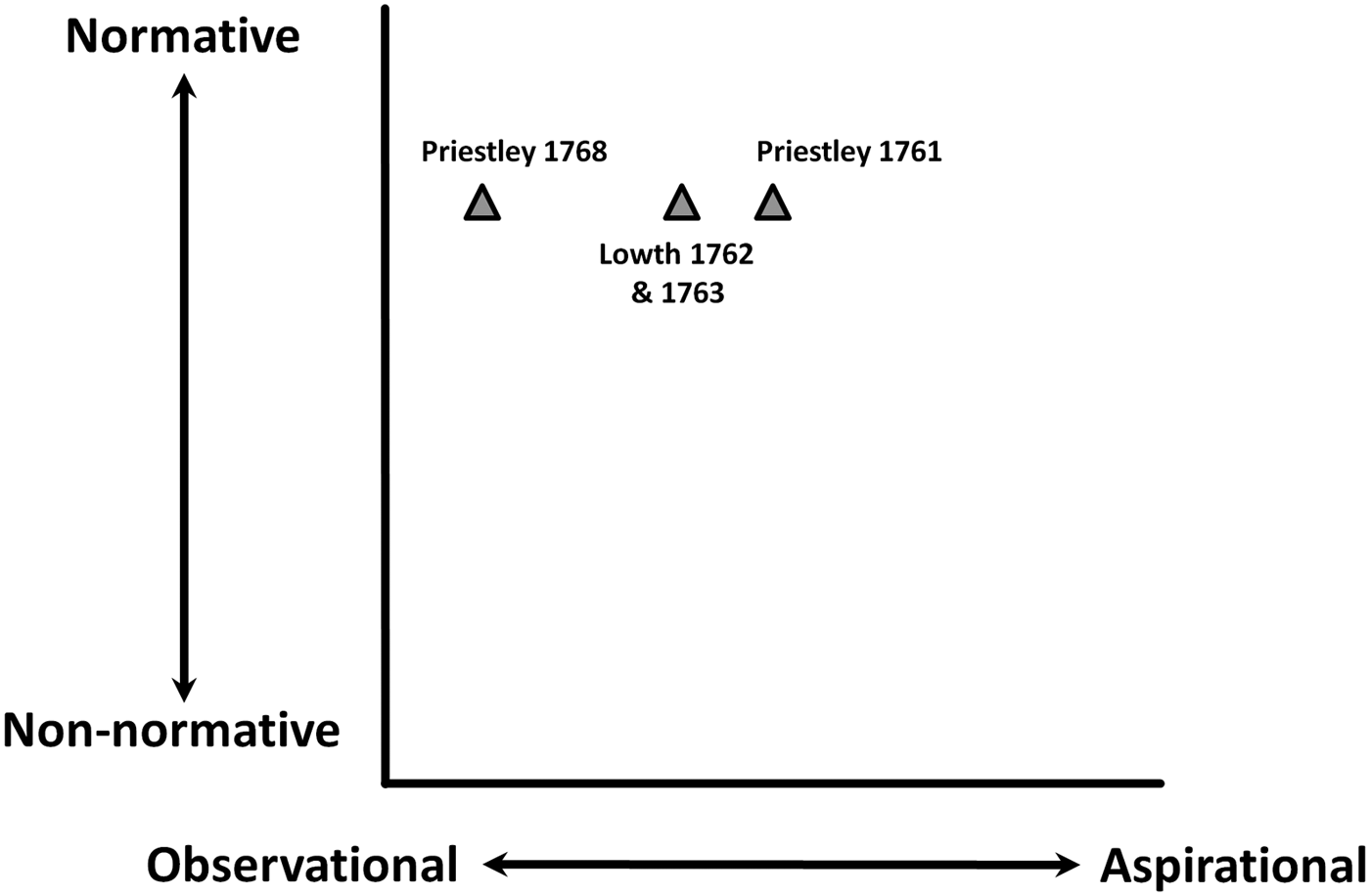
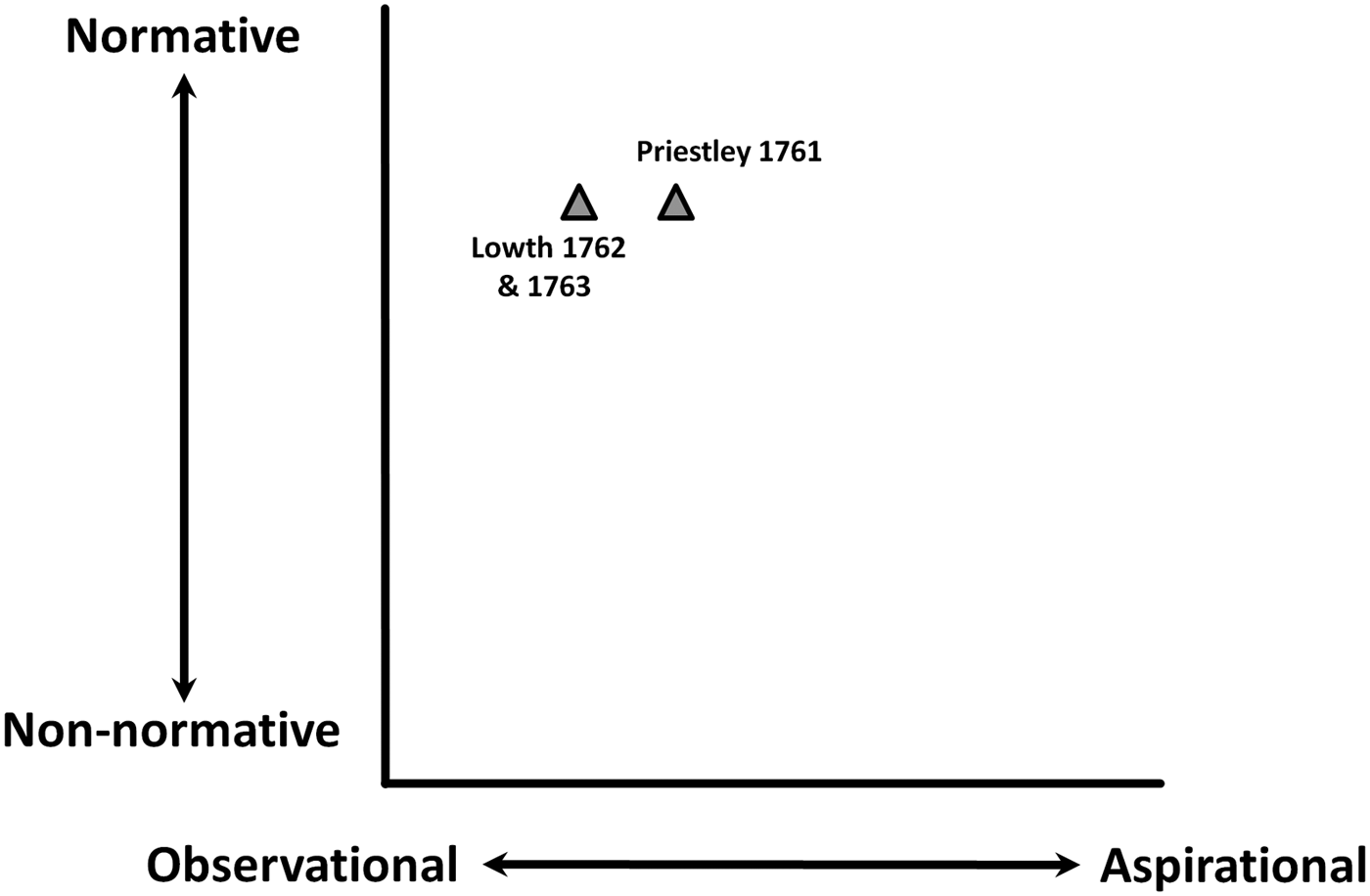
Figure 2 plots these general rankings on the two-dimensional grid. All four editions are similarly normative, but differ significantly in their methodology. Surprisingly, Priestley's Reference Priestley1761 grammar is the least observational, but the 1768 grammar conforms to the traditional view that his approach was ‘scientific’. The revised view of Lowth appears to be justified as well. Yet one can see that the traditional prescriptive and descriptive labels do not capture the differences. All four grammars can be considered prescriptive in that they advocate for how the language should be used, yet at the same time they display varying degrees of description of contemporary usage.
General motivation and methodology
We now turn to some specific grammatical rules promulgated by Priestley and Lowth to see how they apply their stated motives and methodologies to specific cases: double negation, the subjunctive of the verb to be, and preposition stranding.
Double negation
Neither Priestley nor Lowth address the question of double negation in their first editions, but both include the issue in their revisions and do so in observational, rather than aspirational, terms. Priestley gives a brief, straightforward, observational analysis of double negation when he writes, ‘two negative particles were formerly used, as in Greek, where we now use only one,’ giving a citation from the fourteenth-century The Book of John Mandeville as an example of the older usage (Reference Priestley1768: 136). However, later on Priestley writes, ‘Negative particles often occasion embarrassment to a writer, who, in this case, is not so apt to attend to the exact correspondence of the different parts of a sentence’. He goes on to cite two negative examples from David Hume (Reference Priestley1768: 198–99). As one might expect in a pedagogical grammar, this sentiment is normative in that it seeks to instruct writers so as to avoid ‘embarrassment’. Priestley's underlying methodology remains observational as it is based on actual usage. As a result, Priestley's treatment of double negation is moderately normative, and in his discussion he says nothing to contravene the grammar's general ranking of strongly observational.
For his part, Lowth writes, ‘two Negatives in English destroy one another, or are equivalent to an Affirmative’, followed by an example from Paradise Lost. But in a footnote he includes quotations of Shakespeare and Chaucer using double negatives to emphasize the negative rather than create an affirmative. He states the construction is particularly common in Shakespeare and observes, ‘It is a relique of the antient style abounding with the Negative, which is now grown wholly obsolete’ (Reference Lowth1763: 139–40). While the conclusion that the construction is ‘wholly obsolete’ is not accurate – double negation was still in use informally and dialectally when Lowth wrote his grammar, as it still is today (Merriam-Webster, 1994: 365–66); just because a grammar's methodology is observational does not mean that it is free from error – like Priestley, Lowth renders his analysis without any normative judgement on the propriety of the construction, basing his conclusions on its supposed frequency in current writing as compared with the past (Tieken-Boon van Ostade, Reference Tieken-Boon van Ostade1982: 283–84; Reference Tieken-Boon van Ostade, Beal, Nocera and Sturiale2008a: 198). Nothing in Lowth's treatment of double negation occasions changing the general motivational ranking of moderately normative, but his use of quotations to support his conclusions increases his methodological ranking in this case from slightly to moderately observational.
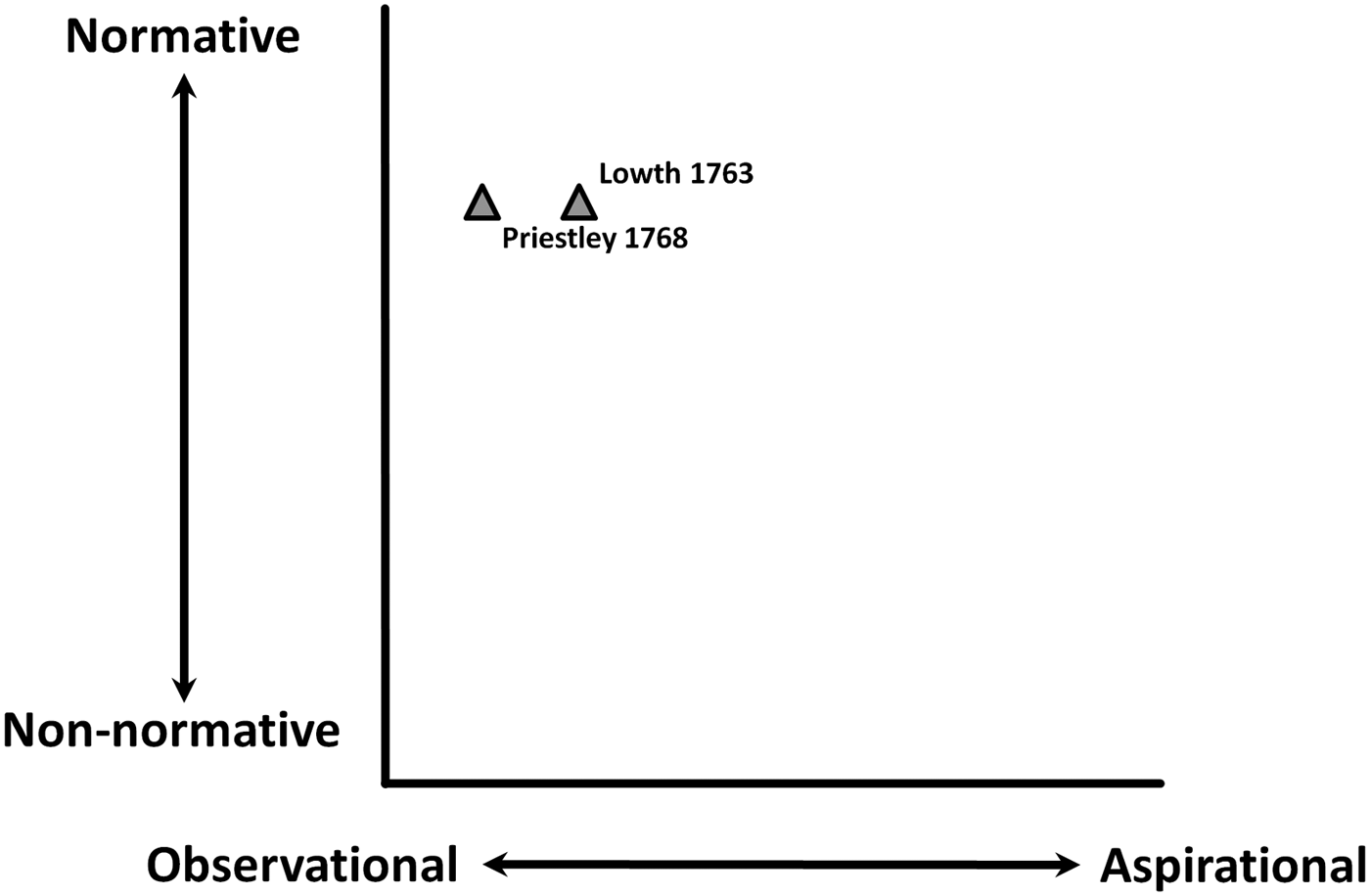
Figure 3 shows the relative positions of the two grammars in their treatment of double negation. As is expected of pedagogical grammars, all three are moderately normative in intent, but they differ in methodology, with Priestley being more strongly observational.
Double negation
Subjunctive-only wert
Subjunctive-only Wert
In their tables of the conjugation of the verb to be, both grammarians list the second-person, singular, preterit form, wert, as a subjunctive-only form, even though there is ample evidence that from the late Middle English period into the nineteenth century wert was used for both the indicative and the subjunctive (OED, 2010). So both Priestley and Lowth are incorrect in their assessment that wert is used solely in the subjunctive, but the reasons for the error vary.
Priestley's methodology here is largely opaque, but he makes a gesture toward the observational. In his 1761 grammar he labels the construction as ‘thou wert’ as subjunctive in his table of conjugations of to be, and says about the conjugation of the verb as a whole, ‘Use hath established the modification that is here laid down’ (Reference Priestley1761: 20–21). The ‘use’ that Priestley refers to may be a reference to Johnson's Reference Johnson1755 grammar, as he references that source elsewhere in the table, but he otherwise provides no evidence for his pronouncement. The table with ‘thou wert’ as subjunctive is also present in his 1768 revision, but Priestley omits the observational justification (Reference Priestley1768: 20–21). Since there is nothing in his treatment of the subjunctive to change the overall motivational ranking, Priestley's motivational ranking for this particular feature remains at moderately normative in both his 1761 and 1768 editions, but his methodology shifts toward the aspirational, giving him a neutral and a slightly aspirational ranking for his treatment of the subjunctive-only wert in the two editions.
It is Lowth who firmly establishes an aspirational basis for the subjunctive-only wert, and he does so in spite of his also citing examples of the indicative wert from Milton, Dryden, Addison, Prior and Pope. Despite these examples, Lowth concludes:
Shall we in deference to these great authorities allow wert to be the same with wast, and common to the Indicative and Subjunctive Mode? Or rather abide by the practice of our best antient writers; the propriety of the language, which requires, as far as may be, distinct forms for different Modes. (Reference Priestley1762: 52)
Here Lowth rejects both common use and the example of ‘great authorities’ of recent vintage in favour of an aspirational harkening back to older writers and to analogy. Anita Auer contends that eighteenth-century grammarians, like Lowth, regarded the subjunctive as a social shibboleth, and this view may explain his insistence on distinguishing the subjunctive here (Reference Auer2009: 61). Whatever his reason for doing so, here, at least, Lowth fulfils the view traditionally held of him. Lowth's general motivational ranking of moderately normative is unchanged, but his methodology is absolutely aspirational as he explicitly rejects all observations of actual usage in favour of the ideal of ‘propriety’.
Preposition stranding
Dryden in 1672 is generally held culpable for the idea that prepositions should not be placed at the end of a clause, but it was not until the 1760s that the precept received widespread treatment in grammars (Yáñez-Bouza, Reference Yáñez-Bouza and Tieken-Boon van Ostade2008: 251, 274–75). Both Priestley and Lowth hold forth on the topic with similar views and language. In the main body of his 1761 grammar Priestley writes of ending sentences with prepositions:
Prepositions generally precede their substantives; as He went to London: but sometimes a verb more elegantly parts them; as This is the thing with which I am pleased; or, This is the thing which I am pleased with. (Reference Priestley1761: 34)
And in the appendix on Observations on Style he writes:
It is often really diverting to see with what extreme caution words of such frequent occurrence as of and to are prevented from fixing themselves in the close of a sentence; though that be a situation they naturally incline to, where they favour the easy fall of the voice, in a familiar cadence; and from which nothing but the solemnity of an address from the pulpit ought to dislodge them; as in any other place they often give too great a stiffness and formality to a sentence. (Reference Priestley1761: 50–51)
Priestley couches his argument in observational terms, noting that writers and speakers ‘incline to’ placing the preposition at the end of a sentence, yet he provides no examples of actual practice. He is also taking a poke at those who would torture a sentence to avoid stranding a preposition. Adding to the humour is his stranding of the preposition in ‘incline to’. But Priestley, with this use of ‘easy fall of the voice’, ‘familiar cadence’, ‘stiffness’ and ‘elegantly’, is also making an aesthetic judgement that uncovers his original normative purpose; he is trying to teach how to write well as much as he is trying to describe grammar. He also notes that there is a particular formal register of speech, such as that used in sermons, where preposition stranding should be avoided. Priestley's moderately normative approach remains unchanged here, as does his slightly observational methodology. Priestley omits the subject in his 1768 revision when he drops the Observations on Style section.
Lowth's view is similar in both sentiment and wording:
This is an Idiom which our language is strongly inclined to; it prevails in common conversation, and suits very well with the familiar style in writing; but the placing of the Preposition before the Relative is more graceful, as well as more perspicuous; and agrees much better with the solemn and elevated Style. (Reference Lowth1762: 127–28)
Lowth cites Pope as a positive example of the practice, ‘The world is too well bred to shock authors with a truth, which generally their booksellers are the first that inform them of’ (Reference Lowth1762: 127). Lowth's selection of this quotation is especially apt and playful since Pope is writing about bad poets who are unaware of their own faults and errors. Like Priestley, Lowth appears to be having a bit of fun at the expense of those who base their prescriptions on aspirational justifications. As in Priestley's grammar, there is nothing in Lowth's treatment of preposition stranding to change the general assessment of moderately normative in his motivation, but his discussion of various registers and his citation of Pope makes Lowth's treatment of this particular feature moderately observational, rather than the general ranking of only slightly so.
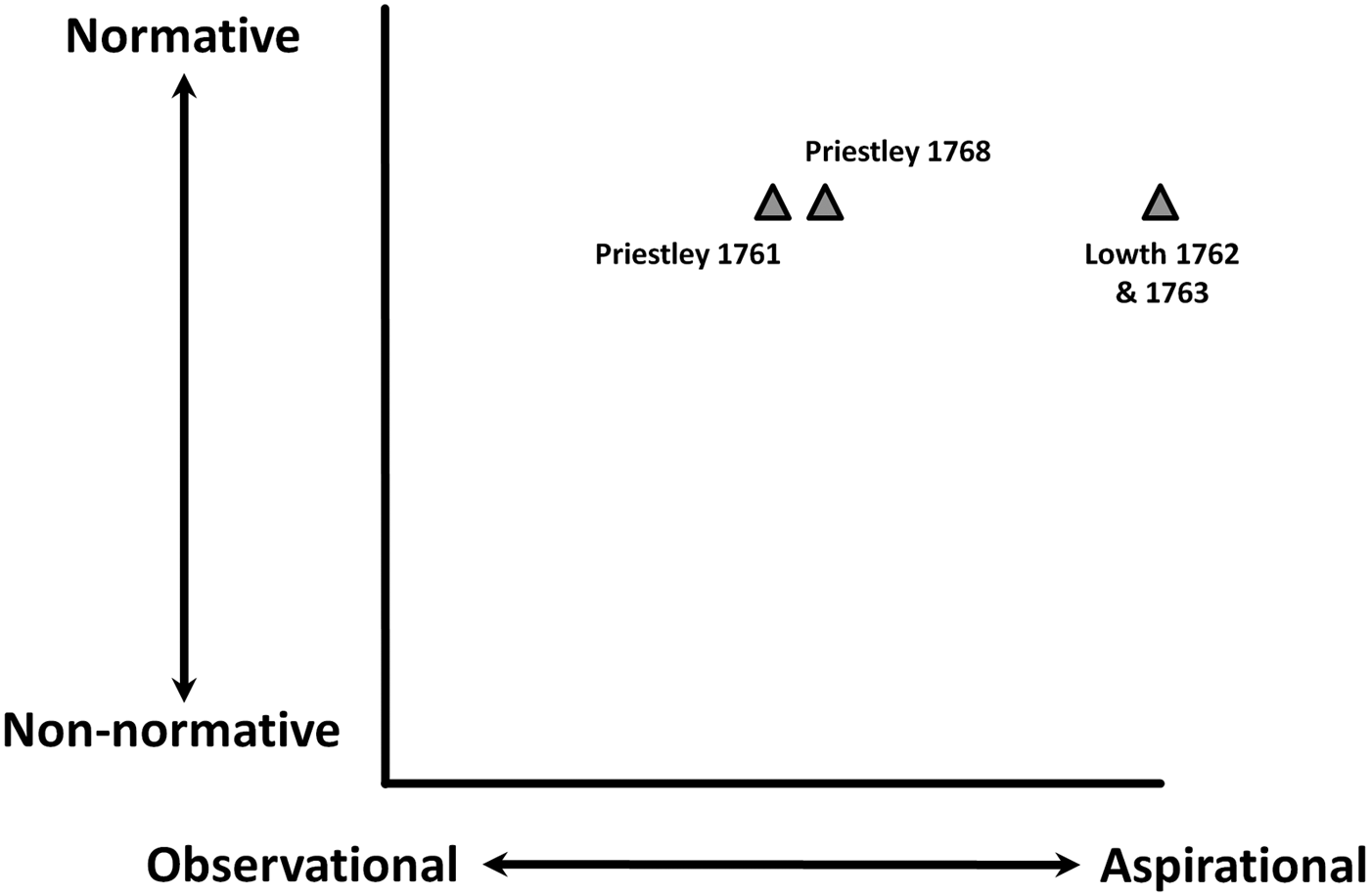
Of particular note is the jocular use by Priestley and Lowth of the stranded preposition in the phrase ‘incline(d) to’, which reinforces the acceptability of the practice (Yáñez-Bouza, Reference Yáñez-Bouza and Tieken-Boon van Ostade2008: 256–57). One is tempted to conclude that Lowth cribbed from Priestley here, especially since he also uses the words ‘familiar’ and ‘solemn’ to match Priestley's ‘familiar’ and ‘solemnity’, and that the up-and-coming churchman was reluctant to acknowledge the dissenter's influence for political and careerist reasons, but the close publication dates makes it unlikely that Lowth could have read Priestley's grammar before his went to press (Tieken-Boon van Ostade, Reference Tieken-Boon van Ostade2008b: 103–04). In any case, both Priestley and Lowth use an observational methodology to form their conclusions regarding preposition stranding, although they both couch their arguments in normative, aesthetic terms. The plotting of the relative positions of Priestley and Lowth on Figure 5 shows their positions have flipped; Lowth is more observational than Priestley here, but this treatment is in Priestley's Reference Priestley1761 edition, which is generally less observational than his later work.
Preposition stranding
Looking at the three linguistic features examined here, it becomes obvious that both Priestley and Lowth are consistently normative in their motivation and any assessment that concludes that one or the other is significantly more or less normative is off the mark. The difference in the grammars is in their methodologies, which vary from feature to feature. It is no surprise that in two of the three features the natural philosopher Priestley takes a more observational approach to language, especially in his 1768 revision, confirming the traditional view that his method is observational, even if his motivation is normative. Yet his treatment of preposition stranding shows a shift toward the aspirational. With the notable exception of his treatment of the subjunctive-only wert, the analysis also upholds the recent view that Lowth is also observational in his approach. Neither grammarian, however, is consistent in his application of methodology, and any comprehensive review of the grammars that incorporates all the linguistic features dealt with therein is likely to map each grammar to a ‘fuzzy’ area on the figure rather than to a discrete point. The reasons for the variation probably represent a variety of factors, including idiosyncratic preferences of the author, reader's comments, the publisher's desire to conform to public expectations, and haste and sloppiness.
Conclusion
By conflating motivation and methodology, the traditional labels of prescriptivist and descriptivist have made the task of classification of linguistic references problematic. How does one classify a usage manual that makes recommendations, but bases those recommendations on a corpus of actual writing samples? Can a dictionary include usage notes without compromising its primary purpose of describing the language? When Webster's Third New International Dictionary was published in 1961, were the objections really over its observational methodology, or were they due to the absence of normative usage notes and labels? The traditional categories do not recognize that one can be both descriptive and prescriptive. Margery Fee and Janice McAlpine state it well in their preface to their Canadian usage guide:
as Jaclyn Rea points out, ‘because the recycling of handbooks and style guides presupposes an ideal and a general failure to attain this ideal (their raison d'être), these texts endlessly reproduce [a] promise of perfectability.’ Knowing perfection is impossible, we aim more modestly to base our advice on real examples drawn from Canadian English written texts – describing what Canadian writers do, explaining what others have said they should do, and only then offering advice of our own. (Reference Fee and McAlpine2011: vii)
Splitting motivation from methodology can also help combat what Arnold Zwicky has labelled ‘zombie rules’ (Reference Zwicky2005) – those grammatical rubrics, like those against preposition stranding or split infinitives, that continue to live on long after they should be declared dead – by calling for an explanation of why they are promulgated without having the argument degenerate into accusations about how ‘descriptivists’ do not appreciate ‘good’ writing. There are sound scholarly reasons for producing non-normative grammars and linguistic references, but it does not follow that the ‘descriptivists’ who produce them have no interest in promoting ‘good’ English. Acknowledging this fact shifts the focus of debate away from the question of how permissive one should be and onto the more productive methodological ground of how we should determine what the standards of ‘good’ English are.
DAVID WILTON is a doctoral candidate in the Department of English at the University of Toronto, working on a dissertation on metaphors and how they can explicate Anglo-Saxon ideas of agency and free will. His academic interests are Old English language and literature, cognitive approaches to medieval literature, and the history of the English language. Since 1997 he has been the editor of the website Wordorigins.org. Email: dave.wilton@mail.utoronto.ca.