Introduction
Kachru's (Reference Kachru and Kachru1992) Eccentric Circles framework has been very influential in understanding and explaining trends in the unprecedented spread of English around the world. However, so far the research within the World Englishes paradigm has focused mostly on Inner and Outer Circle countries and their English varieties (Seidlhofer, Reference Seidlhofer2009), rather than Expanding Circle countries. While Expanding Circle countries in Asia (e.g. Chang, Reference Chang2006) or parts of the European Union (e.g. Coleman, Reference Coleman2006) have been gaining increasing attention in recent years, Expanding Circle countries like Turkey have not been examined to the same degree. Notable exceptions include Doğançay-Aktuna (Reference Doğançay-Aktuna1998), Büyükkantarcı (Reference Büyükkantarcı2004), and Selvi (Reference Selvi2011), which we summarize below. As in many Expanding Circle countries, the spread of English has not been equally distributed in all domains of life in Turkey. For example, little is known in the field regarding English in the higher education context compared with other domains, such as language policy, business, or media, both in Turkey and in other Expanding Circle countries. We address this issue through this study.
Previous research has shown that English has spread to many countries in almost all domains of life including the media, the marketplace, and education, e.g. in former British colonies such as Malaysia (Stephen, Reference Stephen2013), Expanding Circle countries such as Greece (Oikonomidis, Reference Oikonomidis2003), Macedonia (Dimova, Reference Dimova2003) and Azerbaijan (Shafiyeva & Kennedy, Reference Shafiyeva and Kennedy2010), and many countries in (East) Asia (Kirkpatrick, Reference Kirkpatrick2012). As in other domains, the role of English in higher education has been gaining more and more prominence, as policymakers want to enhance their national competitiveness, attract more international students, and prepare young generations to meet the demands of the global economy. The result is generally referred to as the internationalization of higher education (Altbach & Knight, Reference Altbach and Knight2007), which goes hand in hand with the use of English as the medium of instruction in tertiary education. Consequently, in many countries, English is used not only as a foreign language, but also as the medium of instruction in some higher education institutions, for example, in the Netherlands, South Africa, Hong Kong, Spain, Finland, Israel (Dois et al., Reference Dois, Lasagabaster and Sierra2013), Vietnam (Manh, Reference Manh2012), China (Hu, Reference Hu2009; Hu et al., Reference Hu, Li and Lei2013), and Korea (Kang, Reference Kang2012).
As an Expanding Circle country, Turkey is not exempt from these trends regarding the spread of English and the internationalization of higher education. Previous research on Turkey has mainly concentrated on historical accounts of the spread of English, language policies, and attitudes toward English. In one study on English in Turkey which focused on historical and sociopolitical issues, Doğançay-Aktuna (Reference Doğançay-Aktuna1998) provided a detailed sociolinguistic profile of Turkey and claimed that the unplanned dispersion of English since the mid-1980s might have negative effects, which might require some changes in language policies. In another article, Büyükkantarcı (Reference Büyükkantarcı2004) provided a detailed account of the historical, sociopolitical, and economic factors influencing the development and current status of English in Turkey from the Ottoman Era to the present. Selvi (Reference Selvi2011) also provided a similar historical socioeconomic overview of English in education, the media and business in the Turkish context. Similar to Doğançay-Aktuna & Kızıltepe (Reference Doğançay-Aktuna and Kızıltepe2005), Selvi drew attention to the unique situation of English in Turkey: Although Turkey is an Expanding Circle country, in terms of language policies, it carries some characteristics of former colonies of English-speaking countries. He also summarized the medium of instruction debate surrounding English in Turkey (see also Sert, Reference Sert2008). Moreover, Kırkgöz (Reference Kırkgöz2007, Reference Kırkgöz2009) provided a window to the language policy changes at several levels of education in Turkey.
The studies above (e.g. Doğançay-Aktuna & Kızıltepe, Reference Doğançay-Aktuna and Kızıltepe2005; Kırkgöz, Reference Kırkgöz2007) provided only background information on higher education in Turkey. One exception to this is Yağmur's (Reference Yağmur, Zeyrek and Ruhi1997) empirical study on attitudes towards English, which showed that students at English-medium universities (EMI) tended to have more positive attitudes toward English compared with those at non-English medium universities (see also Kırkgöz, Reference Kırkgöz2005, for attitudes towards EMI in the university context). Given the increasing importance of higher education in the global arena and the lack of studies focusing primarily on tertiary education in Turkey, we designed the current study to fill this gap.
Methods
In order to determine the role English plays in the university context, we conducted our research using two main primary sources: reports published on Turkish higher education by Turkish state institutions and Turkish universities’ websites. The reports we focused on were published in 2013 by The Turkish Student Selection and Placement Center (ÖSYM), which is the only organization that administers the National Placement Tests in Turkey. We limited our inquiry to bachelor degree programs offered by the Turkish universities. Our aim was to address the following questions, which helped us to understand the practices surrounding English in the Turkish higher education context:
(1) What is the language of instruction in bachelor degree programs at Turkish universities?
(2) Which degree programs are taught in English the most frequently?
(3) How do universities offering bachelor degree programs in English evaluate their students’ proficiency in English?
(4) Are there any degree programs offered in cooperation with a university abroad?
(5) Do universities have websites in languages other than Turkish?
Results
We present our findings across five sections: languages of instruction, program offerings in English, proficiency exams, international cooperation, and university websites.
Languages of instruction
According to the booklet published by ÖSYM (2013), there are currently 164 universities in Turkey. An important point to note here is that in 2007, this number was only 77 (53 public and 24 private universities), but a year later the number had more than doubled to 164 universities (102 public and 62 private universities) (Selvi, Reference Selvi2011). It is reasonable to assume that the role of English has shown an increasing trend in Turkish higher education because most private universities, which are being founded at an increasing rate and are supported by the state, are English-medium. According to Kırkgöz (Reference Kırkgöz2009), the number of students in private universities with English as the medium of instruction showed a 27% increase from 1995 to 2007. The universities in Turkey offer a total of 4,574 bachelor degree programs that require four or more years of education. These degree programs include not only traditional degrees in arts, sciences, and engineering, but also those in law and medicine. Contrary to those in the US, in Turkey, law and medical schools are offered at undergraduate level. Twenty-four of the 164 universities have more than 75% of their programs instructed in English. These universities include Abdullah Gul, Adana Science and Technology, Atilim, Bahcesehir, Bogazici, Cag, Cankaya, Dogus, Bilkent, Bilgi, Kemerburgaz, Sehir, Izmir Institute of Technology, Koc, METU, Ozyegin, Piri Reis, Suleyman Sah, TED, Toros, International Antalya, Yasar, and Yeditepe universities. There has also been a rapid increase in EMI universities: 24 currently compared with only four in the 1990s: Bilkent, Koc, Bogazici, and METU (Büyükkantarcı, Reference Büyükkantarcı2004). Among these, the first two are private universities, while the second two are public universities.
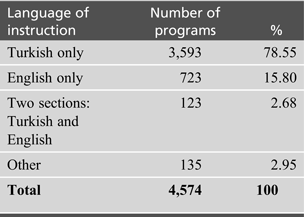
Not surprisingly, the language of instruction of 3,593 programs (78.55%) is Turkish. 723 programs (15.8%) are only offered in English whereas 123 programs (2.68%) are offered in both. Therefore, the language of instruction of about 18.5% of all bachelor degree programs is English. Table 1 presents these results.
The language of instruction in bachelor degree programs in Turkish universities

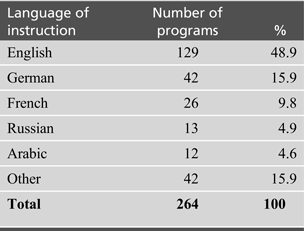
Of the 723 programs instructed in English, the total number of English language, literature, and culture programs is 129. There are also language, literature, and culture related programs (n = 135) offered in a language other than Turkish or English. In descending order, these languages are German (42), French (26), Russian (13), and Arabic (12), as well as several widely used languages such as Chinese, Japanese, Spanish, Italian, Korean; regional languages such as Greek, Persian, Kurdish, Bulgarian, Hindu, Hungarian, Polish, Urdu, Georgian, and Hebrew; and ancient languages such as Latin, Sumerian, and the Hittite language. Table 2 shows these results.
Language, literature, and culture related programs in languages other than Turkish in Turkish universities
Program offerings in English
We also examined programs with English as the medium of instruction. The results showed that there are a total of 168 programs in a variety of colleges: from computer science to psychology, from public relations to economics, from law to medicine, and from electrical engineering to entrepreneurship. Surprisingly, there is also one program in Turkish language and literature offered in English. The programs that most frequently use English as the medium of instruction are engineering (35% of all programs are in English), English-related programs (15%) such as English teaching, followed by business/economics (13%), international relations (9%), social sciences (7%), natural sciences (7%), and architecture (5%). This shows that education in English has already spread to many areas of study at undergraduate level. Our findings on English-taught programs and courses resonate with Maiworm & Wachter's (Reference Maiworm and Wachter2002) findings in the context of Europe, where engineering and business courses are more likely to be taught in English as well (as cited in Coleman, Reference Coleman2006).
Proficiency exams
We closely examined the universities which offer bachelor degree programs in English. When students choose to attend EMI universities, they either have to document their proficiency by passing an institutional or international test, or attend an intensive English program for a year, at the end of which they have to pass a test to proceed to their regular classes (Büyükkantarcı, Reference Büyükkantarcı2004; Selvi, Reference Selvi2011). We found that these universities ask students to document their proficiency level in English according to international criteria, often citing TOEFL (Test of English as a Foreign Language) and IELTS (International English Language Testing System), two major English proficiency tests originating in the US and Britain/Australia, respectively. If students do not fulfill the criteria, only two universities offer an internationally acknowledged English test: Koc University administers an institution-based TOEFL and Sehir University administers an institution-based IELTS. All of the other universities administer their own institutional proficiency exams. If students fail the test, they are required to register at an English preparatory school for the period of one academic year. At the end of the year, the students again take the test to demonstrate their proficiency. Unlike Asian countries, where TOEIC (Test of English for International Communication) is the preferred English proficiency test (Lowenberg, Reference Lowenberg2002), in Turkey TOEFL and IELTS seem to be more popular. The legitimacy of using standardized tests, which take Inner Circle varieties of English as the norm for local situations, has been highly criticized in recent years. For example, the tests have been criticized for their use in the context of local/national university entrance level placement tests (e.g. Kim, Reference Kim2006). However, our findings illustrate that local and international tests seem to coexist in the context of Turkish higher education.
International cooperation
Although Turkey is not a European Union country, it joined the Bologna Process in 2001 (Erçetin, Reference Erçetin2006; Furuzan, Reference Furuzan2012). In addition, some Turkish universities have an agreement with universities abroad. Students can enroll in a Turkish university but study abroad to fulfill all of their course requirements. A closer examination of the ÖSYM 2013 report showed that out of 4,574 programs, a total of 45 programs in 17 universities are run in cooperation with a university abroad: 32 of them in the US, 12 in the UK, and 1 in Cyprus. Of 45 programs, 16 of them are in business and economics and 15 of them are in engineering. Almost all universities participated in the Erasmus program, a European student and scholar exchange program, which allows a number of selected students to spend one or two semesters in a European university (including Turkey).
Our results suggest that despite recent calls to be open to English varieties other than those of the Inner Circle, in the Turkish higher education context internationalization of higher education is skewed towards the US and Britain, as in other Expanding Circle countries (Kachru, Reference Kachru and Kachru1992; Varghese, Reference Varghese2008).
University websites
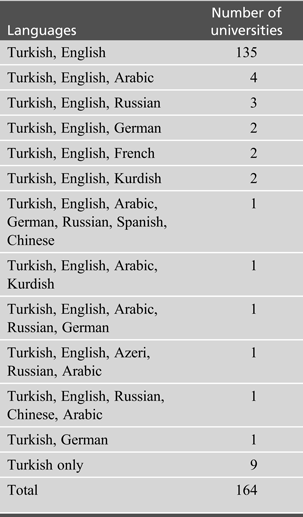
We also investigated the official websites of the universities. We found that, naturally, all of the universities have a website in Turkish. We also found that 154 universities (94% of all universities) have a website in English. Nine of the remaining 10 universities have a website only in Turkish. One university, the Turkish-German University, has a website in Turkish and German. Only 30 universities have a website in a foreign language other than English. These include widely used languages such as German, French, Russian, Chinese, Arabic, and a regional language, Azeri. Only three universities offer a website in a minority language, Kurdish. The overwhelming number of websites in English compared with other foreign or minority languages on Turkish university websites show the significance attributed to English in higher education. Our findings are in line with Callahan and Herring's (Reference Callahan and Herring2012) study that investigated the languages used in university websites in 57 countries. According to this research, for Expanding Circle countries like Turkey, national languages were the default choice for the websites, English was the single most popular second language used on university websites, and there was a trend towards more multilingual websites. Table 3 presents the details of our findings.
Languages of Turkish university websites
Conclusion
Our findings illustrate not only the degree of influence English has in Turkish universities, but also the distribution of this influence according to the program of study. The results show that for around 20% of the programs in Turkish universities the language of instruction is, at least partially, English. When we looked at the distribution of the English-medium programs according to majors, we found that around 50% of the programs that chose English as their medium of instruction were either engineering or English-related programs, such as English language teaching. Our findings also show that Turkish bachelor degree programs mostly use institutional tests to determine whether their students are qualified to continue to their regular courses or whether they should first be placed in English preparatory classes, unless they provide evidence of proficiency according to their TOEFL or IELTS test results.
One of the common practices in the internationalization of higher education is collaboration between universities in different countries. This is especially true for countries (including Turkey) that joined the Bologna process, which aims to ensure some basic standards among the European Union countries. Turkish universities also participate in Erasmus student exchange programs among these countries. When we looked at the Turkish university websites, we also observed that almost all of the Turkish universities have websites in English. Despite international integration efforts, our findings suggest that only about 10% of the programs in Turkish universities have affiliations with universities abroad, and almost all these universities are in Inner Circle countries, the US and Britain to be more specific.
Our findings will be of interest to scholars interested in the spread of English in Expanding Circle countries as well as in higher education contexts, in addition to English language teaching professionals in Turkey and elsewhere. In the future, we will investigate the change in the language of instruction in higher education institutions over the years. This research is needed to explore whether there has been a steady or exponential increase in the adoption of English as the medium of instruction in Turkish universities. In the present study, we focused on the language of instruction in bachelor degree programs, excluding associate degree programs, which usually last two years, and Master's and doctoral degree programs. In the future we will also investigate this topic in the latter programs. We hypothesize that the ratio of English to Turkish programs in graduate school is higher than that in bachelor degree programs, which, in return, is higher than that in AA programs. We are currently conducting research on the attitudes of students and faculty members towards English as the language of instruction in higher education in Turkey.
BERIL T. ARIK is a PhD candidate in the Second Language Studies/English as a Second Language program at Purdue University. She has an MA from the same program. Currently she is working on her dissertation, which explores the interactions between identity and literacy practices in the graduate school context. She is interested in ecological approaches to second language acquisition and second language writing. She is the author of The Cognitive-Social Tension in Second Language Acquisition Studies: A Historical Account. Email: btezelle@purdue.edu
ENGIN ARIK has a PhD in Linguistics from Purdue University. He is currently a Visiting Scholar at Purdue University and Assistant Professor of Psychology at Dogus University. He is interested in language typology, including sign and spoken languages, expressions of space-time, bibliometrics of social sciences, and current issues in higher education. He is the author of A Crosslinguistic Study of Space: Sign and Spoken Languages and the editor of Current Directions in Turkish Sign Language Research. Email: enginarik@enginarik.com